
Reading Time: 26 Minutes
When European explorers travelled through Australia during the nineteenth century, they sometimes encountered landscapes that resembled carefully maintained European parks. Grasslands stretched between scattered trees, woodlands appeared unusually open, and certain valleys seemed almost designed for grazing animals. To the newcomers, these landscapes looked like remarkable examples of nature arranging itself.
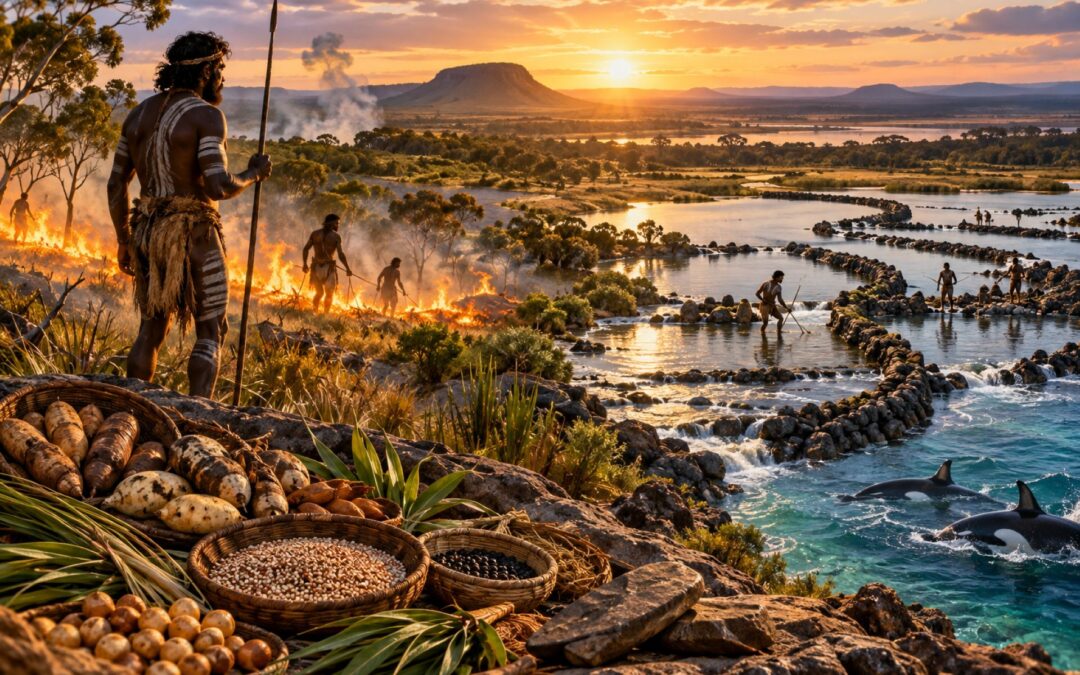
What many failed to recognise was that the land had a long history of human management. Aboriginal Australians had spent thousands of years developing detailed knowledge of local plants, animals, waterways, seasons, and ecological relationships. Through selective harvesting, deliberate burning, water engineering, and other practices, different communities influenced the availability of food and the condition of their environments.
These systems did not resemble European agriculture in every respect. Many Aboriginal peoples continued to hunt, fish, and gather wild resources while deliberately tending productive areas. Others developed extensive grain-processing traditions, sophisticated aquaculture systems, and forms of settlement that challenge conventional distinctions between farming and foraging.
Understanding these practices requires looking beyond the question of whether Indigenous Australians were farmers or hunter-gatherers. The more revealing question is how they managed the resources on which their communities depended, often across extraordinarily long periods, and what happened when European colonisation disrupted those relationships.
The Australian Landscapes Europeans Mistook for Wilderness
In the 1830s, the explorer Thomas Mitchell travelled through parts of southeastern Australia and described countryside that reminded him of an extensive park. Open grasslands, widely spaced trees, and apparently productive pastures created an impression of landscapes naturally suited to grazing. Similar observations appeared in other European accounts of early colonial Australia.
These descriptions became important evidence for historians investigating how Aboriginal peoples managed the continent before widespread European settlement. The landscapes that Mitchell admired were not necessarily untouched wilderness. Many had been influenced by generations of burning, harvesting, movement, and selective management of useful plants and animals.
Historian Bill Gammage developed this interpretation in The Biggest Estate on Earth, arguing that Aboriginal Australians deliberately shaped substantial areas of the continent through sophisticated environmental practices. Rather than imposing a rigid separation between people and nature, many communities worked within ecological processes to encourage particular combinations of vegetation and wildlife.
The resulting landscapes could be productive without looking like conventional European farms. Grasslands might provide grazing for kangaroos and other animals, while nearby woodlands supplied edible plants, timber, fibres, medicines, and habitats for different species. Wetlands and waterways supported fish, shellfish, waterbirds, and aquatic plants.
Fire was particularly important in some regions. Carefully timed burning could influence where grasses flourished, where shrubs accumulated, and how vegetation recovered after disturbance. Repeated harvesting and soil disturbance could also affect the abundance of certain edible plants.
However, describing Australia as a single enormous human-made park would be misleading. The continent contained deserts, tropical savannahs, rainforests, alpine environments, coastal wetlands, and temperate woodlands. Aboriginal communities developed different practices according to local ecology, seasonal conditions, cultural knowledge, and responsibilities to Country.
Country, in many Aboriginal traditions, is more than a physical territory or collection of natural resources. It encompasses relationships among people, ancestors, plants, animals, waterways, significant places, and obligations passed between generations. Caring for Country therefore involves social and cultural responsibilities as well as practical environmental knowledge.
This distinction matters because Indigenous land management was not simply an early version of modern agricultural production. Food availability was important, but the systems through which communities maintained it were embedded in broader relationships with the environments they inhabited.
European observers frequently lacked the knowledge needed to recognise those relationships. A landscape without fences, ploughed fields, or permanent European-style buildings could appear unused even when its resources were carefully managed and its use governed by established laws and traditions.
The practices that sustained those landscapes become clearer when examined individually, beginning with the plants that supplied food across different parts of Australia.
Murnong, Yams and the Management of Native Plants
One of the most revealing examples of Indigenous plant management comes from murnong, commonly known as yam daisy. This native plant once grew abundantly across parts of southeastern Australia, particularly in grasslands and open woodlands. Its underground tubers provided an important food source for Aboriginal communities.
Murnong was especially associated with the food-gathering work of women, who used digging sticks to loosen the earth and collect edible tubers. Harvesting required knowledge of where plants grew, when their underground portions were suitable for consumption, and how to obtain them without unnecessarily damaging productive areas.
The activity could also influence the plants’ growing environment. Digging disturbed and loosened the soil, while selective harvesting affected which plants remained to reproduce. Repeated work in productive patches could help maintain suitable conditions for further growth.
This relationship between harvesting and plant productivity complicates the familiar distinction between collecting food and cultivating it. A person digging a wild tuber may appear to be gathering whatever nature provides, but the same activity can become a form of management when it is repeated selectively and guided by knowledge of the plant’s life cycle.
Accounts of Aboriginal uses of native roots and bulbs documented by the Australian National Botanic Gardens demonstrate how important underground plant foods were in parts of southeastern Australia. Such foods required considerable botanical knowledge, particularly because different species had different growing patterns, edible components, and preparation requirements.
Murnong was not the only useful underground food. Across Australia, Aboriginal communities collected and managed various native yams, bulbs, corms, and other plant structures. In northern regions, different yam species could be harvested using techniques suited to their growth habits and seasonal availability.
Some traditional harvesting methods involved leaving parts of plants in the ground, preserving growing material, or returning portions to the soil. These practices could encourage regrowth, although the precise methods and their ecological effects varied between species and communities.
Such knowledge was especially valuable in environments where the availability of particular foods changed dramatically across the year. Knowing when a plant would produce an edible tuber, where it was likely to grow after rain, and how its abundance related to local conditions made harvesting more predictable.
These activities should not automatically be described as domestication. A plant can be managed, encouraged, protected, or harvested selectively without developing the inherited characteristics associated with a fully domesticated crop. The distinction is important because the evidence for traditional plant management is stronger and more widespread than the evidence for formal domestication of particular Australian food plants.
Nevertheless, the practical sophistication of these systems becomes apparent when compared with the consequences of their disruption.
European settlement introduced large numbers of sheep and cattle into landscapes containing native food plants. Livestock grazed vegetation, disturbed growing areas, and altered soils through trampling and compaction. Agricultural expansion and changing land use further transformed many grasslands that had supported Aboriginal food gathering.
Murnong declined severely in numerous areas where it had previously been abundant. The loss was not simply a botanical change. It affected a food resource, the activities associated with its harvesting, and the cultural knowledge through which communities had maintained relationships with productive places.
The historical record does not establish that every murnong patch was deliberately planted or that every harvested plant was managed in the same way. It does establish that Aboriginal plant-food systems involved far more than randomly collecting whatever happened to be edible.
The same point becomes even clearer when examining the harvesting of native grains and the technologies used to transform seeds into food.
Native Grains, Flour and Food Storage
Grain processing is commonly associated with the rise of agriculture in the Middle East and other regions where domesticated cereals became essential food crops. Yet Aboriginal Australians developed extensive knowledge of native grasses and seeds, including methods for harvesting, cleaning, grinding, cooking, and storing them.
In parts of inland and northern Australia, seeds from native grasses provided important food resources. Species such as native millet were suited to environments where rainfall could be unpredictable and conditions for growing introduced cereals would be difficult.
European explorers recorded examples of Aboriginal people gathering substantial quantities of grass seeds. Thomas Mitchell described harvested grass arranged in large piles, while other nineteenth-century accounts refer to extensive areas of grain collection and the use of stone implements to cut or process plants.
These observations are significant because they reveal organised work involving substantial quantities of food. Harvesting grain required identifying productive areas, understanding when seeds were ready, and coordinating collection before they were lost to wind, animals, or changing weather.
The research literature on Australian native grains also highlights the diversity of species used as food and the opportunities and difficulties associated with understanding their historical management. Evidence of widespread grain use does not mean that every region maintained cultivated fields, but it demonstrates how important native seed resources were to several Aboriginal economies.
Seeds could be collected using different methods depending on the plant and environment. Some were gathered directly from grass heads, while others were collected from the ground or from areas where mature seeds had accumulated. Harvested material then needed further processing to separate edible seeds from unwanted plant matter.
This processing could involve threshing, winnowing, grinding, and combining flour with water. The resulting foods varied, but grain could be transformed into dough-like mixtures and cooked using heated surfaces, embers, or other traditional methods.
The tools required for this work provide some of Australia’s most compelling archaeological evidence of ancient food preparation.
Grinding stones were used to crush and process plant material, including seeds and other edible substances. Their surfaces often developed characteristic wear through repeated grinding, while residues and associated archaeological materials can help researchers investigate how they were used.
The Australian Museum’s documentation of Aboriginal grinding stones illustrates the role of these implements in preparing food and other materials. Grinding technology required suitable stone, considerable physical effort, and accumulated knowledge of processing techniques.
At Cuddie Springs in New South Wales, archaeologists have reported grinding stones associated with deposits dating to approximately 30,000 years ago. These discoveries are important evidence for the antiquity of plant-food processing in Australia.
However, grinding grain or other plant material is not the same as proving that bread was baked. Archaeologists distinguish evidence of grinding, flour preparation, dough production, and baking because each requires different supporting evidence.
It would therefore be inaccurate to claim that the Cuddie Springs stones conclusively identify Aboriginal Australians as the world’s first bakers. Their importance lies in demonstrating that sophisticated processing technologies existed long before the development of many later agricultural societies.
Another important element of grain use was storage.
Food availability could fluctuate substantially across Australia’s different environments. Gathering and processing more food than was immediately consumed allowed communities to prepare for periods when particular resources were scarce or inaccessible.
Historical accounts describe seeds and other foods being stored in containers made from locally available materials. The specific methods depended on the food being preserved, the climate, and the length of time for which storage was necessary.
Some foods could be dried, ground, cooked, or otherwise processed to improve their usefulness. These activities required an understanding of spoilage, moisture, seasonal supply, and the labour involved in preparing edible material.
Food preparation was particularly important for nardoo, a group of aquatic ferns whose reproductive structures were used as food in parts of inland Australia. Nardoo could grow in wetlands and temporary water bodies, making it useful in environments where the availability of other plant foods varied with rainfall.
Aboriginal communities developed specialised methods for collecting and preparing nardoo. Proper processing was important because some nardoo contains compounds that can interfere with the body’s use of vitamin B1 when inadequately prepared.
The experiences of the nineteenth-century explorers Burke and Wills are often discussed in connection with nardoo. Their expedition encountered severe food shortages, and nardoo formed part of their desperate attempts to survive. The episode illustrates the difference between recognising a plant as edible and possessing the knowledge required to prepare it safely and obtain sufficient nutrition.
Traditional food systems depended on much more than identifying species. They involved knowing how plants behaved, where productive populations occurred, how to collect them efficiently, how to process them, and when to preserve food for later use.
Knowledge and useful plant materials could also move between communities through exchange, travel, and social relationships. Such movement helped connect local food traditions with wider networks of interaction, although it does not establish that all transported plants became domesticated crops.
The importance of these systems lies in their flexibility. Different environments provided different foods, and Aboriginal communities developed methods suited to particular ecological opportunities rather than relying everywhere on a small number of intensively cultivated crops.
This was not necessarily an inferior alternative to agriculture. It was a different relationship with food production, one that could combine harvesting, management, mobility, storage, and selective cultivation according to local circumstances.
Cultural Burning and the Creation of Productive Country
Fire is one of the most important forces shaping Australian ecosystems. Long before European colonisation, Aboriginal peoples used it for many purposes, including managing vegetation, improving access, influencing animal habitats, supporting food resources, and fulfilling cultural responsibilities.
The practice is often described as cultural burning, although that expression encompasses a wide range of traditions rather than one uniform technique.
A carefully planned burn could affect an environment differently from an uncontrolled fire. Its behaviour depended on vegetation, available fuel, weather, soil and plant moisture, wind, season, and the conditions under which it was lit.
In some landscapes, burning under suitable conditions could remove accumulated dry vegetation while avoiding the intensity associated with more destructive fires. Some plants could then regenerate, producing new growth that influenced the availability of food and habitat for animals.
This created opportunities for managing the relationship between vegetation and wildlife.
Fresh plant growth following fire could attract herbivorous animals, including kangaroos and wallabies, into particular areas. A landscape containing vegetation at different stages of recovery might provide grazing, shelter, and other resources within a relatively small area.
For communities familiar with these patterns, animal movements could become more predictable. Knowledge of where animals fed, rested, and travelled could improve hunting opportunities without requiring the construction of permanent physical barriers.
The interaction between burning and wildlife has sometimes been described as creating natural or psychological fences. The expression captures the idea that animals respond to differences in food and habitat, but it should not be taken to mean that Aboriginal communities everywhere maintained precisely designed systems that completely controlled animal movement.
Fire could also influence access to useful plants. Burning particular vegetation might create more open conditions, reduce competition from some species, or encourage the regeneration of plants adapted to disturbance.
The effects depended heavily on the ecosystem involved. A fire regime beneficial to one species could be harmful to another, and excessive or poorly timed burning could damage vegetation, soils, or animal populations.
That variability makes local knowledge central to understanding cultural burning.
Aboriginal communities living in tropical savannahs, temperate woodlands, coastal grasslands, and other environments encountered different vegetation, rainfall patterns, and fire behaviour. Techniques appropriate to one environment could not automatically be transferred to another.
Scientific research has increasingly examined the historical relationship between human activity and Australian fire regimes. A 2024 study published in Nature Geoscience investigates evidence for the emergence of anthropogenic fire regimes in Australian tropical savannah environments, contributing to the understanding of long-term human influence on vegetation and landscape processes.
Such evidence supports the importance of fire in Indigenous environmental history. It does not establish that every Australian landscape was deliberately burned at the same frequency or according to an identical management plan.
This distinction matters because some influential accounts have presented Aboriginal burning as a nearly universal system of carefully arranged vegetation mosaics.
Researchers examining particular regions, including the Lake Eyre Basin, have questioned whether the evidence supports such sweeping interpretations. Fire frequency, ignition practices, vegetation responses, and the role of natural fires differed considerably across Australia.
The strongest historical account therefore recognises both the widespread importance of Indigenous fire knowledge and the limits of generalising from particular landscapes.
European colonisation altered many of these relationships.
Settlers often regarded fire as a direct threat to buildings, fences, livestock, stored crops, and commercial property. Burning practices that had served Indigenous communities could conflict with the priorities of pastoral and agricultural settlement.
As Aboriginal people were displaced from Country or prevented from carrying out traditional practices, some established fire-management systems were interrupted. Introduced animals, changing vegetation, land clearing, and altered land use also affected how fires behaved and how ecosystems responded.
However, the consequences were not identical everywhere. Some landscapes experienced changes in fuel accumulation and vegetation structure, while others were transformed by repeated burning, grazing, clearing, or combinations of these disturbances.
Modern research into Indigenous-led fire management demonstrates the continuing relevance of this knowledge. Projects involving Traditional Owners have examined how carefully timed burning can influence fire seasonality, vegetation patterns, biodiversity, and the likelihood of extensive late-season fires.
The results are especially significant in environments where particular burning practices have been maintained or renewed through strong connections between cultural knowledge and ecological observation.
Yet cultural burning should not be reduced to a convenient technological solution for preventing bushfires. Its meaning includes responsibilities to Country, relationships between generations, and the authority of communities whose knowledge developed through long experience of particular places.
The historical achievement was not that Aboriginal Australians somehow eliminated fire from their environments. It was that many communities understood fire as a process that could be worked with, rather than simply a destructive force to be suppressed.
Fish Traps, Eel Farms and the Engineering of Water
Aboriginal food management was not confined to plants or fire. Across different parts of Australia, Indigenous communities developed sophisticated ways to harvest fish and other aquatic resources, including structures designed to take advantage of changing water levels and animal movements.
Two particularly important examples are the stone fish traps at Brewarrina in New South Wales and the Gunditjmara aquaculture system associated with Budj Bim in southwestern Victoria. Both demonstrate deliberate environmental engineering, but they operated in different ecological settings and should be understood through their distinct histories.
Baiame’s Ngunnhu: The Brewarrina Fish Traps
On the Barwon River near Brewarrina lies an extensive system of stone structures known as Baiame’s Ngunnhu. The fish traps consist of arrangements of rocks that form channels, barriers, and holding areas within the river.
These structures were designed to work with the movement of water and fish. Rather than relying entirely on individuals catching fish as they encountered them, the system could guide fish into areas where they were more easily collected.
The arrangement of stones was important because river conditions changed. Water levels could rise or fall, and fish moved through the river in response to seasonal and environmental conditions. Structures positioned at different levels provided opportunities to harvest fish under varying circumstances.
The system also required maintenance and knowledge of how water behaved around the stone barriers. Rocks could be moved or adjusted, while effective use depended on understanding the timing and movement of fish through the river.
The Heritage NSW record of the Brewarrina Aboriginal Fish Traps identifies their exceptional archaeological, historical, and cultural significance. The site is associated with Aboriginal communities whose relationships with the fishery extend through traditions of custodianship and shared responsibilities.
The traps were more than a collection of fishing equipment. Their use was connected with social organisation, obligations, and the regulation of access to resources. Different groups could participate in fishing under established cultural arrangements.
This is an important point because sophisticated food systems require more than physical technology. A productive fishery used by multiple communities also depends on knowledge, cooperation, and rules governing how resources are accessed.
Brewarrina is sometimes described as one of the oldest human-made structures in the world, with claims placing its origins tens of thousands of years in the past. Such statements require substantial caution.
The original construction date of Baiame’s Ngunnhu has not been established with sufficient certainty to support a precise age such as 40,000 years. Aboriginal oral traditions communicate the site’s deep cultural history, but those traditions should not be presented as if they were identical to archaeological construction dates.
Its significance does not depend on winning a competition for the world’s oldest structure. The surviving arrangement demonstrates a carefully designed fishing system adapted to a changing river environment and embedded in longstanding Aboriginal cultural relationships.
Budj Bim: The Gunditjmara Aquaculture System
In southwestern Victoria, the Gunditjmara people developed an extraordinary aquaculture system within the volcanic landscape associated with Budj Bim and the wetlands around Lake Condah.
Unlike a conventional fishing site where people simply waited for fish to pass, this system involved modifying waterways to influence the movement and availability of aquatic animals.
The landscape contains extensive basalt formed through ancient volcanic activity. Gunditjmara communities used this environment to construct and maintain channels, weirs, dams, and holding areas that directed water and supported the capture of kooyang, or short-finned eels.
The system required detailed knowledge of local hydrology. Water moved through wetlands differently according to rainfall, seasonal conditions, and connections between pools and channels. By modifying these pathways, Gunditjmara people could influence where eels travelled and where they could be captured or held.
Such engineering represented a substantial investment in productive infrastructure. Channels and barriers had to be placed where they could interact effectively with the water, and their continued usefulness depended on maintenance and familiarity with local environmental changes.
The available archaeological evidence indicates that aquaculture activity in this landscape extends back at least 6,600 years. This makes Budj Bim an exceptionally important example of longstanding Indigenous environmental engineering.
The UNESCO World Heritage documentation for the Budj Bim Cultural Landscape recognises both the antiquity of the system and its cultural significance. The World Heritage listing acknowledges the relationship between Gunditjmara people, their aquaculture practices, and the cultural landscape in which those practices developed.
The system also illuminates the relationship between food production and settlement.
Archaeological remains in the wider landscape include stone structures associated with places where people lived and worked. Together with evidence of eel management and food processing, these remains challenge the assumption that all pre-colonial Aboriginal communities were necessarily highly mobile and lacked substantial built environments.
However, the evidence should not be stretched into unsupported claims about exact settlement populations or the permanent occupation of every structure. Settlement patterns could change with environmental conditions, cultural obligations, and the availability of resources.
Food preservation formed another important part of Gunditjmara resource use. Eels could be prepared and smoked, improving their usefulness beyond the moment of capture. Processing and preserving food made it possible to manage periods of abundance more effectively.
The relationship between aquaculture, settlement, and food preparation demonstrates an integrated system. Water engineering influenced the availability of eels, while knowledge of processing and preservation helped communities make effective use of the harvest.
Budj Bim also challenges the assumption that sophisticated food production necessarily depends on domesticated crops. Gunditjmara aquaculture involved deliberate management of a naturally occurring aquatic resource through constructed infrastructure and accumulated ecological knowledge.
It was not simply passive fishing, but neither should it automatically be described as identical to modern commercial fish farming.
Equally important is the continuity of Gunditjmara cultural knowledge.
The landscape’s historical significance cannot be separated from the people who maintained relationships with it. Traditional Owners have played a central role in documenting, protecting, interpreting, and caring for the cultural landscape.
The Gunditjmara account of their culture and relationship with Budj Bim places these aquaculture systems within a continuing cultural tradition rather than treating them merely as abandoned archaeological curiosities.
For much of Australian colonial history, sophisticated Indigenous structures were overlooked, misunderstood, or interpreted through assumptions that Aboriginal societies could not have created substantial engineering works. Budj Bim provides powerful evidence against those assumptions.
Together, Brewarrina and Budj Bim demonstrate that Aboriginal Australians developed different forms of aquatic resource management suited to their environments. One used extensive river fish traps adapted to changing water levels; the other incorporated constructed wetland channels, holding areas, and long-term eel management.
Both required technical knowledge, planning, maintenance, and systems of social responsibility that deserve recognition on their own terms.
Bogong Moth Feasts and the Killer Whales of Twofold Bay
Some Indigenous Australian food systems depended on understanding the seasonal movement of animals rather than cultivating plants or constructing permanent structures.
The annual migration of bogong moths provides a striking example. These insects travelled in enormous numbers and gathered in sheltered alpine locations, where they could become a concentrated seasonal food resource.
Aboriginal communities from different areas of southeastern Australia travelled to mountainous regions associated with these gatherings. The arrival of large quantities of moths created opportunities for harvesting, while the gatherings also supported social relationships, ceremonies, exchange, and interaction between communities.
Collecting moths required knowledge of when they would arrive and where they sheltered. They could be gathered from rock crevices and other protected locations using techniques suited to their behaviour.
The moths were valued as a food rich in fat and energy. They could be cooked and processed into preparations that made substantial harvests easier to consume or preserve.
Archaeological evidence supports the antiquity of these practices. A 2020 study published in Scientific Reports identified evidence of bogong moth food processing at Cloggs Cave in southeastern Australia, dating to approximately 1,600–2,100 years ago.
This finding is especially important because insects and the foods made from them often leave limited archaeological traces. The evidence helps establish a historical basis for practices also known through Indigenous knowledge and later written accounts.
The bogong moth gatherings illustrate how seasonal abundance could sustain activities extending beyond immediate food collection. Predictable resources could support meetings between communities, the transmission of knowledge, and wider cultural relationships.
An even more unusual example of Indigenous knowledge of animal behaviour comes from Twofold Bay, near Eden on the southeastern coast of New South Wales.
The Thaua people have traditions describing relationships with killer whales, or orcas, that cooperated with humans during the hunting of larger whales. Historical accounts from the nineteenth and early twentieth centuries also describe interactions between local whalers and orcas.
According to these accounts, killer whales helped drive or hold baleen whales in positions where human hunters could reach them. In return, the orcas were allowed access to parts of the carcass, especially the tongue and lips.
The relationship is sometimes associated with a killer whale known as Old Tom, whose remains became central to the history preserved at Eden.
A 2023 study examining Old Tom’s ancestry and the historical relationship between humans and killer whales incorporated Thaua Traditional Custodian knowledge alongside scientific research. It offers an important account of the cultural and historical significance of these interactions.
The documented relationship should not be confused with proof that every traditional story can be independently dated or that all the mechanisms involved are fully understood. The historical record supports remarkable human-orca interactions, while the precise origins and development of the relationship remain less certain.
Both the moth gatherings and the Twofold Bay traditions demonstrate a broader principle. Indigenous environmental knowledge was not limited to identifying useful species. It involved understanding behaviour, migration, seasonal timing, and relationships that could make food resources more predictable.
Such knowledge developed through sustained observation and cultural transmission. It allowed communities to take advantage of ecological opportunities without necessarily converting the animals involved into domesticated populations.
How Colonisation Disrupted Indigenous Food Systems
European settlement transformed the environments in which Aboriginal Australians obtained and managed food. The consequences extended beyond the loss of particular plants or animals because many Indigenous food systems depended on relationships between people, access to Country, seasonal movement, and ecological processes.
When the First Fleet arrived in 1788, British officials hoped to establish a settlement capable of supporting itself through agriculture and livestock. They encountered land already occupied by Aboriginal peoples with established laws, food systems, and responsibilities to place.
The newcomers did not generally understand those systems in their own terms. Their expectations were shaped by European ideas of land ownership, cultivation, permanent settlement, and productive improvement.
This conflict is evident in the establishment of Britain’s first penal colony in Australia, when British attempts to obtain land, timber, water, and food immediately intersected with the existing rights and activities of Aboriginal communities.
European expansion increasingly restricted Indigenous access to productive environments. Settlements, roads, fences, farms, and pastoral leases transformed places that had been important for gathering plants, fishing, hunting, and seasonal travel.
Dispossession could therefore interrupt food production even where a particular plant or animal species survived. A resource was of limited practical use to a community that could no longer access the place where it occurred.
Introduced livestock created additional ecological changes.
Sheep and cattle grazed vegetation that had developed under very different patterns of animal movement and human use. Repeated trampling could compact soils and damage plants, while heavy grazing altered competition among species.
These effects were especially significant for some native grasslands and food plants. Murnong, once abundant in parts of southeastern Australia, declined in many districts as pastoral settlement expanded.
The arrival of livestock did not produce identical results everywhere, and native food plants could also be affected by drought, clearing, altered fire regimes, and other environmental pressures. Nevertheless, the transformation of grazing patterns was an important element of colonial ecological change.
Water systems were also affected. The clearing of vegetation, changes to catchments, the construction of dams and other infrastructure, and the expansion of agricultural land could alter waterways and wetlands.
These changes had consequences for aquatic food resources. Fish habitats, eel movement, wetland vegetation, and access to traditional fishing places could all be affected by modifications to the landscape.
The interruption of cultural burning added another dimension.
In some areas, Aboriginal communities had used fire according to knowledge of local vegetation and seasons. Colonial restrictions, displacement, and changing land use disrupted the transmission or practice of this knowledge.
Fire patterns could then change, although the results depended on vegetation, climate, grazing, settlement, and numerous other factors. It would be too simple to attribute every later bushfire problem to the suppression of Indigenous burning, but the removal of established management practices was an important historical change in some environments.
The ecological consequences of colonisation also interacted with introduced predators, invasive species, hunting, land clearing, disease, and later industrial development.
Australia subsequently experienced exceptionally severe biodiversity losses. The Australian Government’s State of the Environment assessment of biodiversity documents the decline and extinction of native species and the continuing pressures affecting Australian ecosystems.
More than a century of ecological research has demonstrated that extinction and habitat degradation rarely have just one cause. Introduced species, habitat destruction, environmental change, and changing fire regimes can interact in ways that intensify their effects.
It would therefore be inaccurate to suggest that Indigenous management always maintained a perfect ecological balance or that European settlement was the sole explanation for every later environmental problem. Ancient environments also changed through climate variation, species interactions, and natural disturbances.
The historically significant contrast lies in the speed, scale, and character of many colonial transformations. Systems shaped by long relationships between communities and particular environments were increasingly replaced by forms of land use oriented toward European settlement, commercial agriculture, and pastoral production.
The effects on Indigenous communities were inseparable from the wider violence and dispossession of colonisation. Epidemic disease, massacres, displacement, and coercive government policies caused immense human losses while undermining access to resources and opportunities to transmit knowledge.
Knowledge of plants, animals, and environmental practices was not simply written down in manuals that remained available regardless of social upheaval. Much of it was maintained through participation, observation, instruction, language, ceremony, and relationships with particular places.
When communities were separated from Country or prevented from practising customary activities, these systems of transmission were placed under extraordinary pressure.
Yet the history does not end with disappearance.
Aboriginal and Torres Strait Islander communities have continued to maintain, recover, and renew cultural knowledge despite the disruptions of colonisation. Traditional Owners remain central to contemporary efforts involving cultural burning, native food systems, wetland restoration, biodiversity protection, and the management of culturally significant landscapes.
These efforts are not merely attempts to recreate an idealised past. They involve living communities applying knowledge, rights, and responsibilities to present-day environmental conditions.
The continuing importance of Indigenous land management is particularly visible where cultural knowledge and scientific research work together. Such collaborations can improve understanding of ecological processes while recognising the authority of Traditional Owners over their own knowledge and Country.
This continuity raises a final question about how the historical systems should be classified and why those classifications have become so contested.
Were Aboriginal Australians Farmers or Hunter-Gatherers?
The distinction between farming and hunter-gathering is often presented as a major dividing line in human history. Farming societies are associated with domesticated crops, settled communities, food surpluses, and increasingly complex institutions, while hunter-gatherers are frequently imagined as small mobile groups that simply collected resources from nature.
The history of Indigenous Australian food systems demonstrates why this contrast can be misleading.
Aboriginal communities developed practices that crossed several categories commonly treated as separate. They gathered naturally occurring foods, deliberately managed productive plants, processed grain, stored resources, modified waterways, constructed fishing systems, and used fire to influence ecological conditions.
Some communities maintained more enduring settlements, while others moved according to seasonal opportunities and cultural obligations. These patterns varied considerably across the continent.
The difficulty lies partly in the meanings assigned to familiar terms.
Foraging generally describes obtaining resources from naturally occurring plant and animal populations. It does not necessarily imply that people lack knowledge of ecology or have no influence over their environments.
Resource tending involves deliberate practices intended to maintain or improve useful populations. Selective harvesting, protecting productive patches, and influencing vegetation through fire can fall within this broad category.
Cultivation more directly involves preparing, tending, or managing plants for food production. It can occur without the domestication of a species and without necessarily becoming the principal basis of a community’s economy.
Domestication refers to longer-term changes in organisms resulting from their relationship with human selection and management. A cultivated plant is not automatically domesticated, and a domesticated organism may have undergone many generations of biological change.
Agriculture usually describes systems in which deliberate plant cultivation or animal production forms a substantial part of food provisioning. However, the boundaries of this definition are debated, especially when applied to societies whose resource management differs from familiar cereal farming or livestock husbandry.
These distinctions help explain the controversy surrounding Aboriginal Australian agriculture.
Bill Gammage’s The Biggest Estate on Earth drew attention to the possibility that many Australian landscapes had been deliberately shaped through Indigenous management. His work challenged the assumption that colonial observers encountered predominantly untouched environments.
Bruce Pascoe’s Dark Emu brought another argument into public discussion. Drawing on historical accounts, Pascoe emphasised evidence of grain harvesting, plant tending, food storage, aquaculture, and settlement to challenge conventional descriptions of Aboriginal societies.
Both works encouraged readers to reconsider the relationship between Indigenous Australians and their environments. They also generated debate about the interpretation of historical records and the criteria used to classify particular practices as agriculture.
Researchers including Ian Keen, Peter Sutton, and Keryn Walshe have questioned aspects of the farming interpretation. Their criticisms concern the evidence for particular claims, the diversity of Aboriginal economies, and the risks of imposing inappropriate categories on Indigenous societies.
In Ian Keen’s examination of the controversy over Dark Emu and Aboriginal agriculture, the debate is situated within broader anthropological questions about how Indigenous economies should be understood.
One significant criticism is that describing Aboriginal Australians as farmers can inadvertently reinforce the assumption that agriculture represents a higher stage of human development. If sophisticated societies must be recognised as agricultural before their achievements are respected, the traditional hierarchy remains largely intact.
The evidence instead suggests that complexity can take many forms.
A society does not need domesticated wheat, cattle, or permanent ploughed fields to develop substantial ecological knowledge. Nor does mobility necessarily imply an absence of planning, investment, resource management, or cultural institutions.
The Gunditjmara aquaculture system demonstrates extensive engineering and management of aquatic resources. Brewarrina illustrates the coordination of fishing technology and social responsibilities. Native grain processing reveals specialised food technologies, while cultural burning demonstrates sophisticated knowledge of ecological relationships in particular environments.
Each example should be evaluated according to what the evidence establishes, rather than forced into a single category.
This also changes how we understand the development of agriculture in human civilisation. The transition from hunting and gathering to farming was not a universal sequence in which every successful society eventually adopted the same practices.
Different communities responded to ecological opportunities through different combinations of cultivation, management, mobility, storage, settlement, and exchange. Intensive agriculture became dominant in many regions, but it was not the only way human societies developed complex relationships with food and land.
The Australian evidence is especially valuable because it demonstrates how long-term environmental knowledge could support food systems adapted to highly variable conditions.
It also provides a useful perspective on contemporary land management.
Interest in cultural burning, native grains, wetland management, and Indigenous ecological knowledge has grown as researchers and land managers seek better ways to respond to environmental challenges. These practices may offer valuable insights into biodiversity, habitat management, resource resilience, and the relationship between people and ecosystems.
Their usefulness, however, depends on understanding their specific contexts. A traditional practice developed in one environment cannot automatically be applied elsewhere, and ecological outcomes must be evaluated using appropriate evidence.
Equally important, Indigenous knowledge should not be separated from the communities that maintain it. Contemporary applications require meaningful participation, authority, and recognition of Traditional Owners rather than treating cultural practices as techniques that can simply be extracted and reproduced.
The strongest conclusion is therefore not that every Aboriginal Australian was a farmer, or that the term hunter-gatherer should be abandoned entirely. It is that conventional categories often fail to convey the full range of practices through which Indigenous Australians obtained food and managed their environments.
The historical record reveals societies whose achievements deserve careful explanation without exaggeration and without measuring their sophistication by how closely they resembled European agricultural systems.
When European explorers admired the open woodlands, productive grasslands, and seemingly natural parklands of Australia, they were observing environments with histories that were often invisible to them. Those landscapes had been influenced by ecological processes and, in many places, by generations of human knowledge and deliberate management.
The wider evidence reveals an extraordinary diversity of Indigenous food systems. Aboriginal Australians harvested and tended useful plants, processed native grains, managed vegetation with fire, constructed fish traps, engineered wetlands, preserved seasonal foods, and developed detailed knowledge of animal behaviour.
These practices were not uniform, and their environmental outcomes cannot be reduced to a single claim of perfect sustainability. Their significance lies in demonstrating how communities developed locally adapted ways of obtaining resources and maintaining relationships with Country over very long periods.
Colonisation disrupted many of those systems, but it did not erase the knowledge, responsibilities, or people associated with them. Indigenous Australians continue to care for Country and contribute to contemporary understanding of environmental management.
Recognising this history changes the way Australia’s landscapes are understood. What appeared to European newcomers as untouched wilderness was often a place of accumulated human knowledge, sustained cultural responsibility, and complex relationships between people and the natural world.
Last Updated on October 30, 2026 by Aseem Gupta