
There is no meaningful way to calculate what percentage of India’s history humanity knows. Historical knowledge does not come from counting artefacts alone. It also comes from buildings, inscriptions, coins, manuscripts, landscapes, human remains, environmental evidence, oral traditions and the relationships between objects found at the same site.
That makes the claim that only 0.5 per cent of Indian history is known impossible to prove. Yet the provocation behind it points towards a genuine problem: vast quantities of historical evidence remain undiscovered, undocumented, inaccessible or stripped of the information that once gave them meaning.
As of March 2026, the National Mission on Monuments and Antiquities had documented 17,20,139 antiquities, along with around 1.84 lakh built-heritage sites and monuments. Even that impressive number cannot tell us how many objects remain in temples, private homes, archaeological stores, dealer warehouses or collections abroad. Nor can it measure how much information has already disappeared through theft, undocumented excavation and opaque sales.
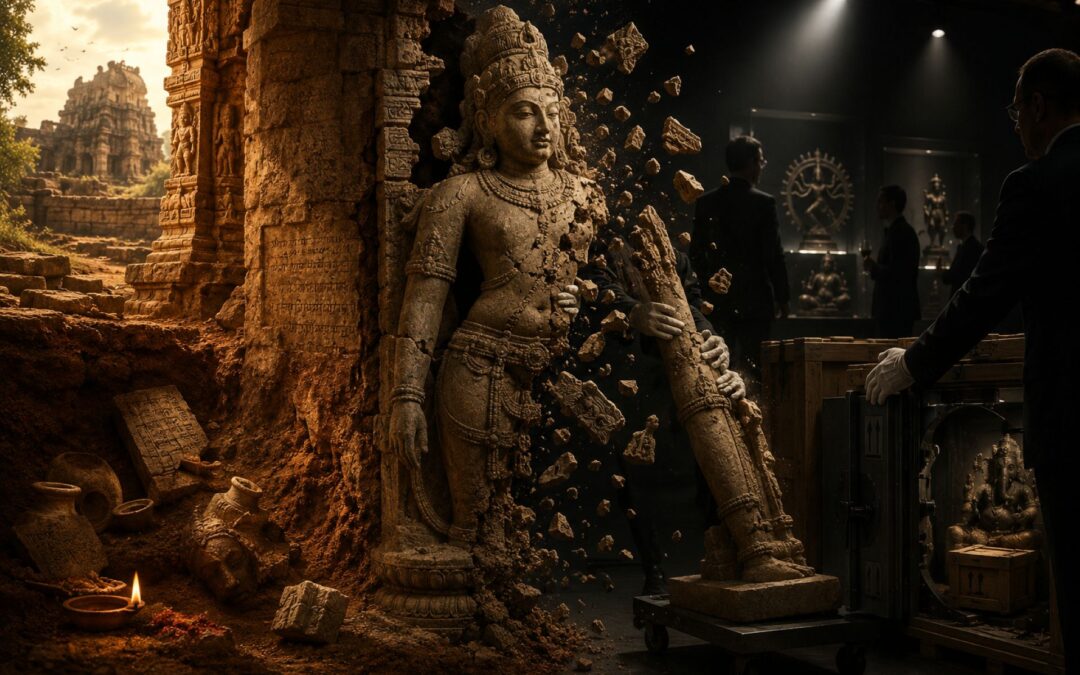
The deeper problem is not simply that valuable Indian objects have left India. It is that the trade in antiquities can dismantle the evidence from which history is made.
When an object is torn from a temple wall, dug from an archaeological layer or separated from the materials found beside it, it may retain its beauty and commercial value. But its place in history becomes harder to reconstruct. Once its origin is hidden, its ownership history falsified and its physical location concealed, scholars may no longer be able to authenticate it, date it securely or understand what it once meant.
The antiquities trade does not merely move objects. At its worst, it turns historical evidence into a private commodity while leaving the public record permanently poorer.
The Real Loss Is the Archaeological Record
A statue is not a self-contained piece of history.
To an auction bidder, it may appear to be an individual masterpiece: a bronze deity, a sandstone guardian, an ivory panel or a painted manuscript page. To an archaeologist, however, the object is only one part of a much larger body of evidence.
Where was it found? Was it buried deliberately or discarded? Which layer of soil contained it? What materials lay beside it? Was it installed in a temple, a palace, a monastery or a domestic shrine? Did it retain pigments, ritual residue or an inscription? Had it been repaired or moved in antiquity? Was it one figure in a larger sculptural programme?
These relationships form the archaeological context. They allow researchers to connect an object to a place, period, community and practice. They can reveal trade routes, religious change, manufacturing techniques, political authority, patterns of destruction and the everyday lives of people who left no written records.
Looting destroys many of these relationships in minutes.
An illicit excavator is not recording soil layers, photographing surrounding material or preserving fragments that appear commercially unimportant. The objective is to remove something saleable as quickly as possible. Pottery shards, botanical remains, damaged inscriptions, architectural debris and ordinary tools may be scattered or discarded even when they are essential to dating and interpreting the site.
Archaeologist Neil Brodie has described the wider destruction caused by the illicit trade in cultural objects: archaeological landscapes are damaged, knowledge is lost and local communities are deprived of material connections to their past. The commercial market rewards the extraction of attractive objects, not the preservation of the full body of evidence surrounding them.
International cultural-property law recognises this distinction. The 1995 UNIDROIT Convention identifies the pillage of archaeological sites as a cause of irreparable loss to archaeology, history and science. It also allows unlawfully excavated cultural objects to be treated as stolen where the relevant national law provides for it.
This is why physical preservation alone is not enough.
A looted sculpture may survive in excellent condition. It may be cleaned, restored, photographed and stored in a climate-controlled room. Yet the destruction of its findspot cannot be reversed. The object may have been preserved while much of its historical meaning was lost.
Provenance is equally important. In the art market, the term usually refers to an object’s documented chain of ownership. A reliable provenance can show when the object left its original location, who possessed it, when it crossed borders and whether its movement complied with applicable laws.
Provenance also helps test authenticity. An object that appears suddenly, accompanied only by a vague reference to an unnamed “European private collection”, is more difficult to assess than one supported by dated photographs, inventories, export permits, estate records and earlier publications.
Neither stylistic expertise nor scientific testing can always compensate for missing context. A scholar may identify the broad artistic tradition or estimate the age of the material, but that does not reveal where the object was found or whether it was legally exported. A thermoluminescence test may indicate that clay is ancient, but it cannot show when the finished object entered the market.
The result is a paradox. The most visually spectacular objects may command enormous prices precisely after the information needed to understand them has been destroyed or concealed.
The market saves the masterpiece and loses the evidence.
How an Antiquity Enters the Market
The journey from an Indian temple or archaeological site to an international collection rarely begins at a prestigious auction house. It begins with local knowledge.
A thief may know that a rural shrine is unguarded, that a sculpture has not been properly photographed or that a temple committee lacks a reliable inventory. An illicit excavator may know where ancient material appears after rains or construction. A local intermediary may provide transport, temporary storage or connections to a dealer in a major city.
The first transactions are often small compared with the final sale price. The person who physically removes the object may receive only a fraction of what it later commands once it has crossed borders, acquired an attractive description and entered a wealthier market.
This creates a supply chain in which different participants perform different tasks. One person identifies the target. Another removes it. Another transports it. A dealer groups objects, arranges concealment or mixes antiquities with legitimate handicrafts. Export documents may describe an ancient sculpture as a modern decorative item. Once the object reaches an intermediary jurisdiction, its Indian origin can be obscured behind a new company, owner or collection history.
The investigation of Jaipur antiquities dealer Vaman Ghiya offered one of the clearest views of this alleged pipeline. In Patrick Radden Keefe’s account of the case, investigators described a network that allegedly sourced sculptures and other antiquities from sites across India, stored large quantities of material and connected them to international buyers.
The case became a symbol of the scale and sophistication that antiquities trafficking could reach. Police seized thousands of objects and alleged that legitimate commercial activities had provided cover for illicit dealing. International auction-market connections were also scrutinised.
But the legal outcome matters.
Ghiya was convicted by a trial court in 2008. In January 2014, the Rajasthan High Court quashed the conviction and acquitted him. The UN Office on Drugs and Crime’s summary of the appellate case records that the prosecution failed to establish essential elements of the charges to the court’s satisfaction.
That history must be stated completely. The allegations and seizures revealed serious questions about the trade, but an investigation is not the same as a final conviction. A responsible account cannot turn a disputed prosecution into settled proof merely because the original accusations were dramatic.
The case nevertheless illustrates a wider enforcement problem. Antiquities crimes are difficult to prosecute when objects were never inventoried, witnesses cannot establish where they were found, export records are incomplete and the chain of custody stretches across several countries.
A temple may know that a sculpture is missing without being able to produce a dated photograph. Police may recover an object but struggle to prove that it came from a particular shrine. A foreign buyer may insist that the piece belonged to an old collection, while the supposed earlier owner is dead or unnamed. The crime may be visible in outline but difficult to prove object by object.
The removal process can also alter the artefact itself. Sculptures may be cut from architectural settings, broken into transportable pieces or stripped of materials that reveal recent ritual use. Inscriptions may be separated from the objects they identify. A group of figures intended to be read together can be divided among different dealers and collections.
By the time the object enters an international marketplace, the physical evidence of its origin may already have been reduced to an unverifiable story.
The next stage is not merely transportation.
It is transformation.
The stolen or undocumented object must be converted into a respectable commodity.
How Provenance Is Manufactured
An antiquity cannot usually be offered by a major auction house with the description “removed recently from an unknown Indian temple”. It needs a biography that makes ownership appear legitimate, or at least creates enough uncertainty for a sale to proceed.
This is where provenance laundering begins.
A vague phrase can do considerable work. “From an old European collection” suggests age and respectability while revealing almost nothing. “Acquired before 1970” may imply compliance with modern cultural-property standards, yet the claim can be difficult to verify when no named owner, invoice, photograph or export record is supplied.
More elaborate methods may involve offshore companies, trusts, inherited collections, altered documents or transactions between closely connected parties. A dealer can sell an object to an intermediary, who later consigns it through another jurisdiction. Each step adds paperwork while increasing the distance between the artefact and its actual source.
Publication can then provide a different kind of legitimacy.
Once an object appears in a scholarly book, exhibition catalogue or specialist magazine, later sellers can cite that publication as part of its history. The text may establish an attribution, link the object to an artistic tradition or describe it as belonging to a private collection. Even when the publication does not prove lawful ownership, its existence can make the object appear studied, recognised and institutionally accepted.
The problem is not scholarship itself. Careful publication can preserve knowledge, identify stolen objects and expose false claims. The danger arises when scholarly authority is used without adequate disclosure of provenance or when experts become dependent on dealers and collectors for access.
A peer-reviewed study of academic facilitation in the illicit cultural-object trade examined the conduct of Himalayan-art scholar Mary Slusser. Drawing on archival material, the authors argued that academic work can facilitate the market passively, by publishing and authenticating poorly provenanced objects, or actively, through closer collaboration with collectors and dealers.
Slusser’s position was unusually powerful. Her knowledge allowed her to identify important works, while her relationships gave her access to material unavailable to most scholars. According to the study, she had photographed objects in religious settings that later entered private collections, and her subsequent publications did not always disclose evidence connecting them to those earlier locations.
The case exposes a structural conflict. Scholars may need access to privately controlled objects to conduct research. Collectors and dealers, meanwhile, benefit when respected scholars publish, authenticate or praise those objects. If the scholar asks too many questions, access may disappear. If the scholar publishes without asking enough, the work may strengthen the market value of something with a suspicious history.
Similar concerns emerged around British dealer Douglas Latchford, who was indicted in the United States over allegations involving looted Cambodian antiquities but died before trial. Investigations described offshore structures, questionable provenance claims and objects that entered prominent collections.
Reporting on artefacts linked to Latchford showed how books and scholarly descriptions were alleged to have reinforced the provenance of disputed objects. High-quality publications co-authored with consultant Emma Bunker presented Khmer sculptures as important works of art and created a bibliographic history that later accompanied them through the market.
A publication history is not the same as an ownership history.
An object can be photographed, catalogued and praised without anyone proving where it was before the photograph was taken. Yet repetition creates familiarity. A description in one book is cited by a later catalogue. That catalogue is cited by a dealer. A museum exhibition adds another line to the object’s record. Over time, the artefact can acquire an aura of legitimacy through the accumulation of references.
Institutional proximity has a similar effect. A museum loan, academic conference or expert endorsement can increase confidence even when the provenance remains incomplete. Buyers may assume that somebody else has already performed the necessary checks.
That assumption is precisely what professional standards are meant to prevent. The International Council of Museums’ guidance on provenance and acquisition due diligence places responsibility on institutions to investigate ownership history and lawful export rather than rely on reputation or appearance.
The critical question is not whether an object has been published.
It is whether the publication discloses what is known, what is missing and what remains contested.
Scholarship should illuminate provenance, not substitute for it.
Where the Legal and Illegal Markets Meet
There is a legitimate trade in art and antiquities. Objects can be lawfully inherited, sold, donated and transferred across borders. Responsible collectors can fund conservation, support scholarship and eventually place important material in public institutions.
The illicit trade is not identical to that legitimate market.
The problem is that the two can meet.
A looted object does not remain permanently inside a visibly criminal underworld. Its value rises when it crosses into respectable commerce. It needs a dealer who can reach wealthy buyers, an expert who can describe it, an institution willing to display it or an auction house capable of creating competition around it.
At that boundary, uncertainty becomes commercially useful. A seller may not prove that an object was lawfully exported, but a buyer may proceed because nobody can conclusively prove the opposite. Missing records become a shield rather than a warning.
The case of the tenth-century Khmer sculpture known as the Duryodhana shows how this interface can work.
The statue originally stood at Prasat Chen in the Koh Ker temple complex in Cambodia. Its feet and pedestal remained at the site after the upper body disappeared. The sculpture later moved through brokers and a European collection before being consigned to Sotheby’s in New York.
Cambodian authorities objected to the sale. The United States filed a civil forfeiture action, alleging that the statue had been looted and transported through the international market. The case ended in a settlement, and the Duryodhana was returned to Cambodia.
What made the case especially powerful was the surviving archaeological evidence. The statue could be connected to the feet and pedestal still present at the temple. The empty place helped establish where the object belonged.
Many stolen Indian antiquities are harder to trace. A rural temple may lack old photographs. A sculpture may have been replaced before anyone recorded the theft. A manuscript can be divided into individual pages. Objects removed from undocumented archaeological sites may have no surviving pedestal, inventory number or community witness capable of identifying them.
That makes market due diligence more important, not less.
The 1970 UNESCO Convention created an international framework for preventing the illicit import, export and transfer of cultural property. Its influence explains why auction catalogues and museum policies often focus on whether an object can be traced to a collection before 1970.
But the date is not a universal certificate of legality.
The convention operates through national laws and obligations accepted by participating states. Jurisdiction, implementation dates, export rules and available evidence all matter. An unsupported sentence claiming that an object was “acquired before 1970” does not prove that it was.
Nor does the reputation of an auction house or museum settle the question. Institutions can employ skilled provenance researchers and still make mistakes. They may rely on incomplete records supplied by consignors. Commercial deadlines can conflict with lengthy investigation. Private sales may involve even less public scrutiny than open auctions.
Responsible market participants argue that legal collecting can preserve endangered objects, broaden appreciation and support research. That argument has merit where provenance is transparent, export was lawful, conservation is professional and access is meaningful.
Private ownership is not automatically destructive. Foreign custody is not automatically illicit. Museum display is not automatically ethical.
The central dividing line is not nationality or ownership category. It is evidence and conduct.
Can the object’s history be documented? Were credible warning signs investigated? Was the export lawful? Are gaps disclosed? Can scholars inspect the object? Will new evidence trigger renewed scrutiny?
The legal market becomes vulnerable when reputation is allowed to replace verification. Once that happens, illicit objects do not need to defeat the system.
They merely need to resemble the objects already accepted by it.
Why Private Custody Can Still Hide the Past
Collectors often describe themselves as custodians. In some cases, the description is justified.
A responsible private owner may conserve a fragile object more carefully than an underfunded institution. The owner may fund photography, lend the work to museums, invite scholars to study it and eventually donate it to a public collection.
Yet custody involves more than keeping an object physically safe.
Historical stewardship requires documentation, provenance, access and the possibility of independent verification. An artefact preserved in perfect climatic conditions but hidden from scrutiny can remain absent from the usable historical record.
Researchers must first know that the object exists. They need reliable photographs, dimensions, material descriptions and ownership information. In some cases, they need to inspect tool marks, pigments, residues or inscriptions directly. Scientific analysis may require sampling. A disputed attribution may demand repeated examination by several specialists.
A private owner controls all of these possibilities.
Access may be granted to one favoured expert and denied to others. Images may be withheld or released only under restrictive terms. Findings that increase the object’s prestige may be encouraged, while conclusions questioning authenticity or provenance can threaten the owner’s financial interest.
This does not mean every collector manipulates research. It means that private control can create a conflict between historical inquiry and asset value.
The problem becomes sharper when the artefact lacks a secure provenance. Scholars may be invited to determine what an object is without being given enough information to determine where it came from. An impressive identification can then circulate publicly even though the object’s ownership history, findspot and authenticity remain uncertain.
A privately held object cannot reliably resolve a historical dispute merely because somebody posts photographs or publishes an attribution. Other researchers must be able to test the claim.
Responsible private stewardship therefore requires more than occasional exhibition. It requires a clear chain of ownership, disclosure of provenance gaps, professional conservation, high-quality documentation and reasonable scholarly access. It also requires long-term planning. A collection that depends entirely on one owner’s goodwill can disappear again when it is inherited, divided or sold.
Public museums are not automatically free from these problems. Many institutions hold large quantities of material in storage, and access can be slow or restricted. Some lack complete digital catalogues. Others possess objects whose histories were never fully investigated.
The difference is that public institutions are expected to operate according to public-interest responsibilities. Their catalogues, acquisition policies and decisions can be scrutinised. Researchers can press for access. Governments, donors and communities can demand reform.
A private collection may have none of those accountability mechanisms.
This is why the debate cannot be reduced to whether an object is “safe”. Safety is one part of stewardship. The object must also remain connected to information and open to examination.
Otherwise, history survives materially but disappears intellectually.
Why Antiquities Attract Financial Secrecy
Antiquities occupy an unusual position in the financial world.
They can be extremely valuable, physically portable and difficult to price objectively. Comparable objects may be rare or nonexistent. Attribution can change. A newly recognised inscription, museum exhibition or scholarly publication may transform perceived importance. Two experts can provide sharply different valuations without either estimate being obviously absurd.
These characteristics make antiquities attractive to collectors. They can also make the market vulnerable to financial crime.
Ownership may be structured through companies, trusts, agents and advisers. A transaction can involve a buyer in one country, a seller in another, an intermediary in a third and storage in a fourth. The public may never learn who ultimately controls the object.
Freeports add another layer. These secure storage facilities allow high-value goods to remain in specialised warehouses, sometimes under favourable customs arrangements. An artefact can change ownership without appearing in a public gallery or moving to the buyer’s home. The object may remain physically stationary while companies, invoices and beneficial owners change around it.
Not every freeport transaction is suspicious. Collectors, museums and dealers have legitimate reasons to use secure, climate-controlled storage. The risk comes from opacity combined with high value and weak oversight.
The Financial Action Task Force’s assessment of money-laundering and terrorist-financing risks in the art and antiquities market identifies privacy, intermediaries, cross-border transactions, limited specialist expertise and uneven regulation as important vulnerabilities.
An object may be bought through an agent, revalued after exhibition or publication and later resold. It may be used as collateral or donated to an institution. In jurisdictions that permit deductions for cultural donations, valuation can influence tax treatment, although the rules vary and should not be generalised.
The same opacity that can conceal the source of money can conceal the source of the artefact.
Anonymity makes it harder to determine who bought from a suspicious dealer. Offshore ownership complicates restitution claims. Private sales remove public catalogues that investigators might otherwise examine. Subjective valuation makes it difficult to distinguish a legitimate appreciation in value from manipulation.
The antiquities trade can also intersect with conflict financing. Looted cultural material has been sold in and from regions controlled by armed groups. FATF recognises the terrorist-financing risk, but precise estimates of revenue are often unreliable. Claims that antiquities formed a particular organisation’s second-largest source of income or generated hundreds of millions of dollars should not be repeated without compelling evidence.
The defensible conclusion is serious enough: cultural objects can become part of financial networks that exploit secrecy, fragmented regulation and international movement.
This helps explain why illicit antiquities do not remain with the people who steal them. Their real value emerges after they enter systems capable of converting uncertain origin into prestige, liquidity and financial legitimacy.
The historical record is damaged at the excavation site.
The profits grow elsewhere.
Why India’s Safeguards Still Leave Gaps
India does not lack antiquities law.
The Antiquities and Art Treasures Act, 1972 was designed to regulate the export trade, prevent smuggling and fraudulent dealings, provide for the registration of antiquities and control licensed dealing. It gave the state a legal framework for treating cultural objects as more than ordinary commodities.
The difficulty lies in documentation, implementation and coordination.
An object cannot easily be reported stolen if no accurate record proves that it was present. Temple inventories may be incomplete. Old photographs may not show enough detail for identification. State archaeology departments, museums, police forces and religious institutions may maintain records in different formats—or no usable records at all.
The National Mission on Monuments and Antiquities was established to create national registers of built heritage and antiquities. Its documentation of more than 17.2 lakh antiquities is significant. Yet only part of the digitised information is publicly accessible, and a national count does not by itself guarantee that every vulnerable object has a detailed photograph, current location and unique identifying information.
A usable record should contain more than a name. It should include dimensions, material, inscriptions, condition, distinctive damage, photographs from several angles and information about where the object is normally kept.
Such records serve several purposes. They discourage substitution, allow communities to identify missing objects, help police issue alerts and provide foreign authorities with evidence when India seeks restitution.
Monitoring the international market is equally important. Auction catalogues, dealer websites and museum acquisitions frequently provide the first visible sign that a missing object has resurfaced.
The Comptroller and Auditor General’s 2013 performance audit examined the preservation and management of monuments and antiquities. Reporting on the audit highlighted the finding that the Archaeological Survey of India had not systematically collected information on Indian antiquities offered by major international auction houses, in part because the law did not explicitly direct it to perform that function.
That gap reflected a larger institutional problem. Antiquities trafficking cuts across agencies that do not always share information effectively.
The Archaeological Survey of India may oversee protected monuments and certain antiquities. State departments manage other sites and museums. Temple authorities or trusts control religious objects. Customs officials inspect exports. Police investigate theft. Financial investigators may be needed to trace companies and payments. Prosecutors must establish ownership and illegal movement. Foreign governments and museums control evidence located outside India.
A failure at any point can break the case.
India has made substantial progress in recovering objects from abroad, particularly through diplomatic cooperation and investigations conducted in countries where antiquities entered collections. Repatriation demonstrates that documentation, market monitoring and international pressure can work.
Yet the number of returned objects cannot measure the full loss. It excludes antiquities whose theft was never recorded, objects destroyed during removal, pieces still hidden in storage and artefacts whose provenance has been obscured so successfully that nobody recognises them as Indian.
Return also cannot reconstruct a destroyed archaeological layer. It can restore possession and cultural connection, but not the information erased at the moment of looting.
The legal dates commonly used by the market require similar care. The UNESCO Convention of 1970 and the UNIDROIT Convention of 1995 are important frameworks, but neither creates a simple worldwide rule that everything before the named date is lawful and everything after it is not.
Applicable national law, state participation, implementation, export restrictions and evidence still matter.
The real weakness is not that India has no rules. It is that law works only when objects are documented, markets are watched, agencies coordinate and foreign institutions demand credible provenance before accepting a sale.
What Protecting the Historical Record Would Require
Protecting Indian antiquities requires more than catching individual smugglers or celebrating occasional returns. The system must preserve the information attached to objects before that information disappears.
Several reforms follow directly from the weaknesses in the existing pipeline.
- Complete and update inventories
Temples, museums, archaeological stores, universities and government collections need detailed, regularly verified records. Each entry should include high-quality photographs, dimensions, material, inscriptions, condition, identifying damage and current location.
An inventory that records only “one stone statue” is not enough to establish which statue later appears at auction. - Make appropriate records searchable
Sensitive archaeological locations should not be exposed in ways that encourage looting. But authorities, researchers and source communities need a system through which they can identify objects, report concerns and request access.
A database that exists but cannot be searched by the people trying to trace stolen material has limited preventive value. - Monitor international sales systematically
India needs permanent specialist capacity to review auction catalogues, dealer listings, museum acquisitions, exhibitions and online sales involving Indian antiquities. Monitoring should not depend entirely on volunteers noticing an object after it has been advertised.
Suspicious listings should trigger rapid coordination between cultural authorities, police, customs officials, diplomats and foreign law-enforcement agencies. - Demand meaningful provenance
Descriptions such as “old private collection” should be treated as unanswered questions, not evidence.
Sellers should be expected to establish named ownership histories, lawful export, acquisition dates and the basis for any pre-1970 claim. Gaps should be disclosed plainly rather than hidden behind polished catalogue language. - Strengthen due diligence across the market
Responsibility cannot end with the person who physically stole the object.
Dealers, auction houses, museums, collectors, insurers, appraisers, academics and publishers all influence whether undocumented material acquires legitimacy. Each should investigate warning signs instead of assuming that another participant has already done so. - Create specialist enforcement teams
Antiquities cases require expertise that ordinary property-crime investigations may not possess. Investigators must understand art history, archaeological records, customs law, financial structures and international cooperation.
Dedicated teams should combine archaeologists, police officers, prosecutors, customs officials and financial investigators rather than relying on fragmented case-by-case coordination. - Protect sites before objects enter the market
Market regulation addresses demand, but vulnerable sites also need local protection. Communities should have clear reporting channels, updated inventories and support for safeguarding temples and monuments.
Rapid documentation after damage or theft can preserve evidence that would otherwise vanish. - Require responsible scholarly practice
Scholars studying undocumented objects should disclose provenance gaps and distinguish firmly between attribution and ownership history. Publications should not present “private collection” as a sufficient substitute for evidence.
Research can help identify stolen material, but it should not unintentionally provide market legitimacy while concealing how the object became available. - Connect restitution with research access
Recovered objects should be documented, conserved, studied and made reasonably accessible after their return. Repatriation should not simply move an antiquity from one inaccessible store to another.
Public catalogues and high-quality digital records can make returned material part of historical knowledge again. - Treat information as part of the heritage
The ultimate goal is not only to preserve old things. It is to preserve the relationships that make them intelligible.
A sculpture’s location, associated objects, ritual history, ownership record and excavation context are part of the cultural heritage too. Policy should protect those connections with the same seriousness applied to the object itself.
No database, law or restitution agreement can recover every piece of information already lost. But stronger documentation and transparency can prevent future objects from becoming historically mute.
An antiquity is not merely a beautiful survivor from another age. It is evidence of a relationship between people, material, place, belief and time.
When that relationship remains documented, the object can continue to answer questions. When it is severed, hidden or replaced with an invented ownership history, the object may still attract admiration and command millions at auction. Yet something irreplaceable has disappeared.
Returning a stolen sculpture can correct possession. Conserving it can protect its material form. Displaying it can restore a measure of public access.
None of those acts can recreate the archaeological layer destroyed when it was removed.
History survives only when evidence remains connected, testable and accessible. The greatest danger posed by the antiquities trade is therefore not that India’s past will vanish completely.
It is that fragments of that past will survive everywhere, while the knowledge linking them together is gone.
Last Updated on July 27, 2026 by Aseem Gupta