
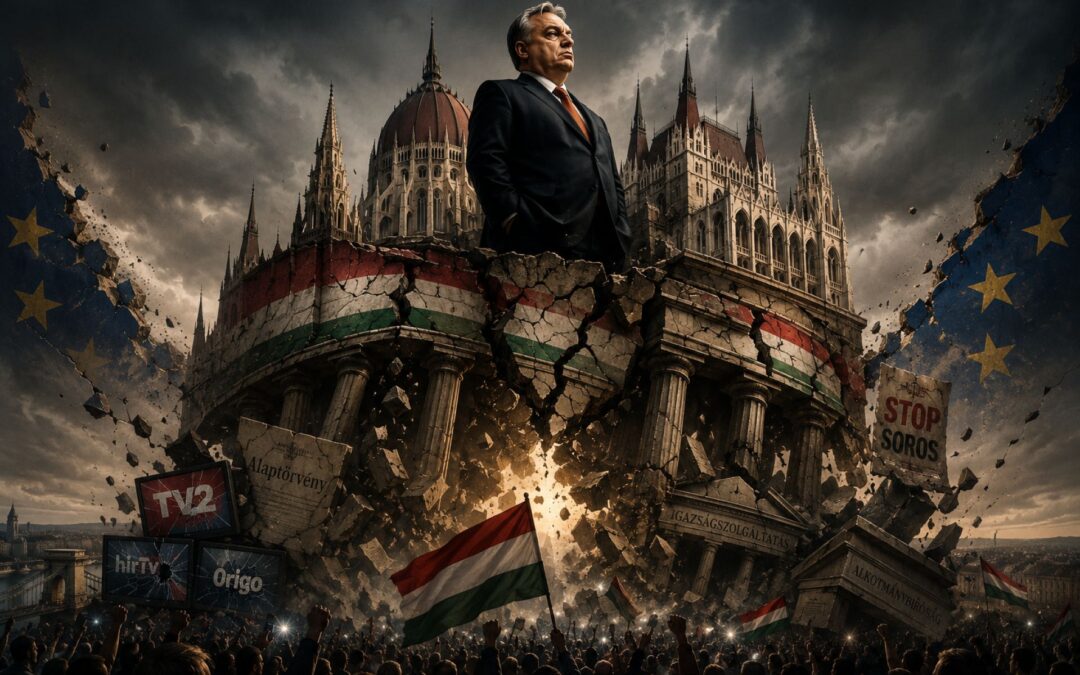
In June 1989, a 26-year-old Hungarian dissident stood before a vast crowd in Budapest and demanded the withdrawal of Soviet troops from his country. His name was Viktor Orbán, and his speech at the reburial of a murdered revolutionary leader made him one of the most recognisable figures in Hungary’s democratic awakening. He represented a generation determined to end communist rule and build a future in which Hungarians could govern themselves.
Thirty-seven years later, Orbán’s political career had taken an extraordinary turn. On April 12, 2026, Hungarian voters decisively rejected the government he had led for sixteen consecutive years, handing a parliamentary supermajority to Péter Magyar’s opposition Tisza party. The man who had once challenged an authoritarian system had spent much of his premiership constructing a political order that international observers criticised for weakening democratic checks, distorting electoral competition and concentrating power around his ruling party.
Orbán’s defeat raises a question that goes beyond Hungary’s borders: how did a former liberal dissident become one of Europe’s most influential advocates of illiberal government, and why did a political system designed to protect his power ultimately fail to keep him in office?
The answer lies in more than the election itself. It requires understanding Orbán’s ideological transformation, the institutions he reshaped, the political loyalties he cultivated, the economic contradictions of his government and the unusual opposition movement that finally defeated him. His departure from office ended an extraordinary period in Hungarian politics, but it did not erase the system he left behind.
From Anti-Soviet Dissident to Hungary’s Prime Minister
To understand Viktor Orbán’s political career, it helps to begin with Hungary’s struggle against Soviet domination. In October 1956, Hungarians launched an uprising against their communist government and demanded political independence, democratic reforms and the withdrawal of Soviet forces. Moscow responded with overwhelming military force, crushing the revolution and leaving thousands dead.
One of the revolution’s central figures was Imre Nagy, the reformist prime minister who had supported Hungary’s withdrawal from the Warsaw Pact. He was subsequently arrested and executed in 1958. For decades, the communist authorities treated him as a traitor, but as the Soviet bloc began to disintegrate, Nagy became a symbol of the independence that Hungarians had been denied.
Viktor Orbán was born in 1963, seven years after the uprising. He grew up under communist rule in a family that experienced modest circumstances before his father’s career in an agricultural cooperative improved its position. An ambitious and argumentative young man, he developed interests in politics and football, eventually studying law at Eötvös Loránd University in Budapest.
By the late 1980s, Orbán had become involved in the student opposition to communism. He travelled to Poland, where the Solidarity movement had demonstrated that organised resistance could challenge an entrenched communist government. In March 1988, he helped establish Fidesz, the Alliance of Young Democrats, alongside fellow student activists.
The original Fidesz bore little resemblance to the conservative nationalist organisation it would eventually become. It was a liberal, anti-communist youth movement that advocated political pluralism, civil liberties and democratic reform. Its members belonged to a generation that had grown increasingly impatient with the ideological rigidity and political restrictions of the Soviet-backed system.
Orbán’s breakthrough came on June 16, 1989, when Hungary held a public reburial ceremony for Nagy and other victims of communist repression. Hundreds of thousands gathered in Budapest to commemorate the failed revolution and demand a different future. Orbán delivered a brief but forceful speech calling for Soviet troops to leave Hungary and for free elections to determine the country’s government.
The speech made Orbán a national political figure at precisely the moment communist authority was collapsing. Hungary declared itself a republic in October 1989 and held its first free parliamentary elections the following year. Fidesz entered parliament with 22 seats, establishing itself as a significant part of the new democratic opposition.
Yet the transition from communism to liberal democracy did not produce an uncomplicated period of prosperity. Market reforms opened Hungary to foreign investment and European integration, but they also brought unemployment, industrial restructuring, inequality and insecurity. Many citizens experienced the disappearance of the old system’s guarantees more immediately than the benefits of the new economic order.
These frustrations helped reshape Hungarian politics. Some voters came to associate liberal economic reforms with privatisation, foreign influence and domestic elites who seemed more comfortable with Western institutions than with the difficulties of ordinary Hungarians. Orbán increasingly recognised the appeal of nationalism, cultural conservatism and promises of stronger national economic control.
During the 1990s, Fidesz moved steadily to the right, repositioning itself as a conservative alternative to Hungary’s socialist and liberal parties. Orbán began emphasising national identity, traditional values and the interests of Hungarian communities beyond the country’s borders. His political identity evolved from that of a liberal dissident into that of a leader claiming to represent the authentic Hungarian nation against political and economic establishments.
The transformation helped bring him to power. Following the 1998 parliamentary election, Fidesz formed a governing coalition with smaller conservative parties, and Orbán became prime minister at 35. His first government pursued conservative policies and sought to strengthen its influence over public institutions, but it operated within a more competitive political environment than the one he would later construct.
Fidesz lost the 2002 election, returning Orbán to opposition. His party suffered another defeat in 2006, but the political environment subsequently changed in its favour as Hungary struggled with economic difficulties, public disillusionment and scandals affecting the socialist-led government.
By the time the 2010 parliamentary election arrived, Orbán had spent years consolidating the conservative electorate and presenting Fidesz as the only credible force capable of restoring stability. The party’s landslide victory gave its alliance with the Christian Democratic People’s Party a two-thirds parliamentary majority. This would prove far more consequential than his first election victory.
Orbán returned to office not simply with a programme for governing Hungary, but with the parliamentary power to transform its constitutional and institutional foundations.
The 2010 Supermajority and the Birth of the Illiberal State
The significance of Orbán’s 2010 victory lay in the size of his parliamentary majority. Hungary’s constitutional system permitted numerous fundamental laws and institutional arrangements to be changed with the support of two-thirds of parliament. Fidesz and its Christian Democratic allies possessed that threshold without needing agreement from the opposition.
Orbán used this advantage to reshape the state. His government introduced a new constitution, known as the Fundamental Law, which entered into force in January 2012. It also changed the rules governing the judiciary, electoral competition, media regulation and several independent institutions.
Supporters argued that these reforms were justified by the scale of Fidesz’s democratic mandate. They maintained that Hungary needed stronger leadership after years of political instability, economic crisis and disappointing governance. From this perspective, the reforms represented a legitimate effort to replace a failed post-communist political settlement with a more effective national model.
Critics saw a different process unfolding. They argued that Fidesz was using an electoral victory to weaken the institutions designed to restrain future governments, reducing the possibility that the ruling party could be held accountable or removed on equal terms.
Orbán articulated his broader political philosophy in a 2014 speech at Băile Tușnad, Romania. He argued that the liberal state had failed to protect Hungarian national interests, public assets, families and economic sovereignty. He presented countries including Singapore, China, India, Russia and Turkey as examples of states whose success challenged assumptions about the superiority of liberal political organisation.
His proposed alternative was an illiberal state that prioritised national community, economic competitiveness and collective interests rather than making liberal ideology the organising principle of government. Orbán insisted that this approach need not reject individual freedom or fundamental rights, but critics questioned whether those commitments could survive the weakening of independent institutional safeguards.
The distinction between democracy and liberal constitutionalism became central to his argument. Orbán emphasised the legitimacy derived from electoral majorities and the right of elected governments to pursue national priorities. Liberal democracy, however, also depends on institutions that protect individual rights, limit executive authority and ensure that governments cannot permanently entrench themselves through control of the rules.
These competing understandings of democracy shaped Hungary’s political development. Orbán did not eliminate parliament, abolish opposition parties or cancel elections. Instead, his government increasingly altered the conditions under which those institutions operated, allowing formal democratic processes to coexist with growing inequalities of political power.
The resulting system proved remarkably durable. Fidesz continued to win elections, benefited from substantial genuine voter support and maintained an organised national political network. At the same time, the advantages available to the ruling party became embedded in the constitution, the media environment, public institutions and the electoral system itself.
This was the fundamental mechanism of Orbán’s illiberal experiment: transforming temporary electoral power into institutional advantages capable of surviving individual election cycles.
How Fidesz Built an Unequal Political System
Orbán’s political dominance cannot be explained by a single authoritarian measure or the popularity of one leader. It emerged from the interaction of constitutional changes, institutional appointments, media ownership, public resources and electoral rules. Each reinforced the others, creating an environment in which Fidesz could compete for votes while enjoying structural advantages unavailable to its opponents.
Hungary’s elections remained meaningful, as the eventual opposition victory demonstrated. But their continued existence did not make the surrounding political system equally competitive. International observers repeatedly distinguished between the technical administration of elections and the broader fairness of the circumstances in which parties contested them.
The Constitution, Courts and Independent Institutions
One of Fidesz’s earliest priorities was changing the institutions responsible for reviewing government decisions. Constitutional courts and independent oversight bodies are intended to prevent temporary political majorities from exercising unlimited authority. Their effectiveness depends partly on appointment procedures, institutional autonomy and protections against political retaliation.
Following its 2010 victory, Fidesz changed the process for selecting Constitutional Court judges and expanded the court’s membership from eleven to fifteen. These changes enabled the parliamentary majority to exercise greater influence over appointments. Over time, the balance within an institution designed to review legislation shifted towards judges selected under the new political arrangement.
The government also restructured the ordinary judiciary. Changes introduced in 2011 reduced the compulsory retirement age for many judges, prosecutors and notaries from 70 to 62, forcing numerous experienced legal officials to leave their posts. The Court of Justice of the European Union subsequently ruled that the abrupt change constituted unjustified age discrimination.
Another reform concentrated important administrative powers over the courts in the leadership of the National Judicial Office. Decisions involving judicial administration, appointments and the allocation of resources became matters of concern for European institutions. Critics argued that such arrangements increased the risk of political influence over a branch of government that needed to remain independent.
The consequences extended beyond individual judges. Long appointments to influential offices could preserve the political impact of Fidesz’s decisions after a future government lost its parliamentary majority. A newly elected administration might gain control of ordinary government departments while continuing to confront institutional leaders appointed during the preceding political era.
Concerns also developed around prosecutorial independence, corruption oversight and the effectiveness of other accountability mechanisms. Universities, independent organisations, civil society groups and journalists encountered different forms of legislative, administrative and political pressure. These institutions were not all controlled in identical ways, but their operating environment became increasingly difficult.
Hungary’s Sovereignty Protection Office, created under legislation adopted in 2023, eventually became a particularly controversial example. Its stated purpose was to protect Hungary from foreign political influence. Critics argued that its broad investigative authority could be used against journalists, civil society organisations and other actors critical of the government.
The broader pattern attracted international scrutiny. In 2022, the European Parliament described Hungary as a hybrid regime of electoral autocracy, reflecting its assessment that the country’s democratic institutions had deteriorated significantly. Organisations monitoring political rights and civil liberties also documented restrictions on independent institutions and civic activity.
The institutional question was therefore not whether Hungary still possessed courts, prosecutors and oversight bodies. It was whether those bodies retained sufficient independence to constrain the governing party when doing so became politically inconvenient.
Media Ownership, State Advertising and Political Messaging
Media influence was another foundation of Fidesz’s dominance. Over the years, businessmen aligned with the governing party acquired newspapers, television channels, radio stations and online publications. Public advertising expenditure and government communication contracts also provided important financial support to politically friendly outlets.
The most striking consolidation occurred in November 2018, when more than 470 government-friendly media outlets were brought together under the Central European Press and Media Foundation, commonly known as KESMA. As documented in the European Commission’s assessment of Hungary’s media environment, the government declared the transaction strategically important, exempting it from ordinary competition and media-authority scrutiny.
The significance of KESMA extended beyond the number of outlets involved. Its network included regional newspapers that played a major role in shaping information outside Budapest, where independent national journalism often had less reach. Combined with public broadcasting and commercially important pro-government media, this gave Fidesz a powerful advantage in reaching voters.
Independent journalists and media organisations continued to operate, especially online, and some remained influential. Nevertheless, the financial and institutional imbalance affected their ability to compete. A government-friendly outlet could benefit from advertising contracts and political access, while critical publications faced commercial disadvantages, difficulties obtaining information and a hostile political environment.
Orbán’s political communication used this infrastructure to construct a recurring narrative of national danger. Migrants, Brussels officials, George Soros, foreign-funded NGOs, liberal intellectuals and LGBTQ rights activists were frequently presented as threats to Hungarian sovereignty, cultural identity or family life. Disputes over different policies could be connected through the suggestion that Hungary was under pressure from an external ideological establishment.
The strategy had a practical political function. By framing controversies around national survival, the government could make ordinary disagreements appear to be battles between patriots and their enemies. Supporters who trusted Fidesz might consequently regard criticism from journalists, courts or European institutions as evidence that the government was fighting powerful interests on their behalf.
This messaging was not based solely on manufactured concerns. Questions about immigration, national identity, traditional values and the influence of distant political institutions mattered genuinely to many Hungarian voters. Orbán’s advantage came from connecting those concerns to a political narrative in which he appeared indispensable to the nation’s protection.
The media system also influenced how government failures were interpreted. Inflation could be blamed on external forces, corruption allegations could be dismissed as politically motivated and disputes with Brussels could be presented as proof of the government’s independence. Controlling the dominant narrative did not require persuading every citizen; it required reaching enough voters consistently enough to shape political expectations.
The result was a powerful but potentially fragile arrangement. A government capable of dominating public communication could sustain loyalty for years, yet it could also become increasingly responsible for the very political atmosphere it had created.
Electoral Boundaries, Cross-Border Votes and Structural Advantage
Orbán’s government also changed Hungary’s electoral system. The National Assembly was reduced to 199 members, with 106 elected from individual constituencies and 93 through national party-list arrangements. The interaction between these components meant that constituency boundaries and the distribution of votes could substantially influence the final parliamentary result.
Fidesz redrew constituency boundaries in ways that critics argued favoured its electoral geography. Opposition support was often concentrated in larger urban areas, while Fidesz enjoyed broad support across smaller towns and rural constituencies. When constituency design and single-member elections amplify such patterns, a party can win a disproportionately large share of seats without receiving a comparable share of the national vote.
The 2014 election illustrated the result. Fidesz and its Christian Democratic allies obtained approximately 45% of the national party-list vote but secured 133 of parliament’s 199 seats, exactly the two-thirds threshold. They won 96 of the 106 individual constituencies, demonstrating how constituency victories translated into parliamentary dominance.
Cross-border voting provided another advantage. Hungary’s citizenship and electoral reforms enabled eligible ethnic Hungarians living in neighbouring countries, including Romania and Serbia, to participate through postal ballots under rules that differed from those applying to some Hungarian citizens residing abroad. These voters became a strongly pro-Fidesz constituency.
In the 2022 election, approximately 94% of valid postal votes from eligible voters without a Hungarian address went to Fidesz–KDNP. Such support was politically significant, although it was only one part of a larger electoral system that also benefited the governing alliance through constituency strength, political organisation and incumbency.
The distinctions matter because electoral advantage is not the same thing as fabricated votes. Fidesz repeatedly attracted substantial public support, and its opponents faced both genuine political weaknesses and institutional disadvantages. The issue was that the rules and resources surrounding competition systematically favoured the incumbent.
The OSCE’s final assessment of Hungary’s 2022 election described a well-administered vote conducted without a level playing field. Observers identified overlap between state and party messaging, biased media coverage, problems with campaign financing and concerns about electoral boundaries. Their findings did not deny voters’ ability to choose among candidates; they documented the unequal conditions affecting that choice.
These advantages helped explain why earlier opposition coalitions struggled even when dissatisfaction with Orbán was substantial. Winning required more than persuading voters who already opposed Fidesz. A challenger needed to overcome the ruling party’s organisational reach, media influence and electoral geography while attracting people who might never have supported the traditional opposition.
For years, no opposition force managed to assemble that combination. By 2026, however, the political environment had changed sufficiently for those advantages to be overcome.
The Sovereignty Paradox: Brussels, Moscow and Ukraine
Hungarian sovereignty remained the most consistent theme in Orbán’s political identity. As a young dissident, he had demanded that Soviet troops withdraw from Hungary. Decades later, as prime minister, he repeatedly accused European institutions of trying to impose decisions on the Hungarian people.
For his supporters, there was continuity between these positions. Orbán had always argued that Hungarians should determine their own future, whether the outside pressure came from Moscow during the Cold War or Brussels during disputes over migration, constitutional policy and national identity. His government presented its conflicts with the European Union as resistance to excessive interference in domestic affairs.
The European Union, however, was fundamentally different from the Soviet system Hungary had escaped. Hungary joined the EU voluntarily in 2004, gaining access to the single market, freedom of movement, development funding and participation in common European institutions. Membership also involved legal obligations and shared rules governing areas such as competition, public spending and the rule of law.
Orbán’s political strategy exploited this tension. Hungary benefited economically from European integration while its government regularly portrayed Brussels as a threat to national independence. Criticism from EU institutions could be transformed into domestic political evidence that Fidesz was defending Hungary against an intrusive external establishment.
Migration became one of the most visible conflicts. During Europe’s 2015 refugee crisis, Orbán adopted an uncompromising position against compulsory asylum relocation and constructed barriers along Hungary’s southern border. He argued that Hungary had the sovereign right to determine whom it admitted and that European migration policy threatened national security and cultural continuity.
The position generated substantial support among voters who shared those concerns. It also helped establish Orbán as an influential figure among European nationalist and populist movements, including leaders and parties critical of immigration and liberal European integration. His political model attracted attention from conservatives in the United States, where figures associated with Donald Trump praised his emphasis on borders, national identity and cultural conservatism.
Relations with Russia created a more complicated contradiction. Although Orbán had launched his career opposing Soviet domination, his government developed relatively close ties with Vladimir Putin’s Russia. Hungary remained dependent on Russian energy, and Orbán frequently opposed or delayed aspects of the European response to Moscow’s invasion of Ukraine.
His government argued that sanctions and energy diversification could impose unacceptable costs on Hungarian households and businesses. Hungary’s geography, existing pipelines and energy infrastructure presented genuine practical difficulties. Yet critics maintained that successive governments had also made political choices that deepened rather than reduced dependence on Russian supplies.
A March 2026 report examined by Deutsche Welle found that Russian crude oil accounted for approximately 93% of Hungary’s oil imports in 2025, compared with 61% in 2021. The increase occurred despite wider European efforts to move away from Russian energy following the full-scale invasion of Ukraine in February 2022.
Much of Hungary’s Russian oil arrived through the Druzhba pipeline, which crossed Ukrainian territory. This created a direct connection between Hungary’s domestic energy policy and its increasingly confrontational relationship with Kyiv.
In early 2026, a disruption to pipeline operations intensified the dispute. Orbán’s government blamed Ukraine for obstructing supplies, while Ukraine maintained that Russian attacks had damaged infrastructure. Hungary subsequently blocked a proposed €90 billion EU loan package for Ukraine while demanding the restoration of oil deliveries.
The dispute demonstrated how Hungary’s energy dependence could influence broader European foreign policy. Because important EU decisions required unanimity, Orbán could use Hungarian opposition to delay initiatives backed by many other member states. His government portrayed this leverage as protection of Hungarian interests, while critics regarded it as obstruction that benefited Moscow.
The sovereignty argument nevertheless remained politically effective among parts of the Hungarian electorate. Orbán presented himself as a leader willing to resist both the European political establishment and pressures to deepen involvement in the war. His opponents had to recognise the appeal of that position rather than assume every Hungarian voter wanted a complete reversal of national policy.
Magyar’s eventual government would adopt a more cooperative approach towards European institutions and Ukraine, but it also maintained limits on military assistance and remained attentive to the interests of ethnic Hungarians in neighbouring countries. The election therefore changed Hungary’s diplomatic direction without eliminating every concern that Orbán had successfully incorporated into the national debate.
Why Orbán’s Economic and Political Bargain Broke Down
For much of his time in office, Orbán’s political appeal rested on more than cultural identity or institutional control. His government promised economic stability, higher employment, support for families and protection from the insecurity associated with earlier Hungarian governments. During much of the 2010s, Hungary experienced substantial economic growth, supported by European integration, industrial investment, EU funding and a favourable regional economic environment.
This performance helped sustain Fidesz’s popularity. Voters could disagree with aspects of Orbán’s rhetoric or institutional changes while believing that his government delivered greater stability than the alternatives. Strong growth also made it easier to finance family-support policies, household energy subsidies and other measures designed to reinforce the government’s reputation for economic competence.
By the early 2020s, however, that bargain was weakening. Hungary suffered exceptionally high inflation, particularly after energy prices increased and European economies absorbed the consequences of Russia’s invasion of Ukraine. Prices rose sharply, household purchasing power came under pressure and businesses faced uncertainty.
Hungary’s economy contracted by approximately 0.9% in 2023, while annual inflation averaged around 17%. The downturn did not arise from a single government decision: international energy markets, wider European weakness and global economic disruptions all contributed. Nevertheless, domestic fiscal choices, energy policy and weakening investor confidence intensified the country’s difficulties.
The subsequent recovery was disappointing. According to Eurostat’s March 2026 GDP release, Hungary’s economy grew by just 0.4% in 2025, compared with 1.5% across the European Union. Hungary was among the EU’s weakest performers that year, undermining the claim that its increasingly confrontational political model was producing exceptional economic results.
Relations with Brussels added another problem. The European Union had long provided Hungary with substantial funding for infrastructure, development and economic modernisation. But European institutions froze or suspended access to parts of this funding because of concerns involving corruption risks, judicial independence, procurement practices and the rule of law.
The precise amounts varied because different EU programmes were subject to different restrictions and conditions. Some allocations were blocked, others became accessible following reforms, and portions of funding faced deadlines after which unspent money could be lost. What mattered politically was that Hungary’s confrontations with the EU were increasingly associated with tangible economic costs.
For Orbán, this created a difficult contradiction. Criticism of Brussels had been useful for building support, but Hungary still depended heavily on European trade, investment and funding. The government could accuse EU institutions of unfairly withholding money, while opponents argued that the funds were at risk because Fidesz had refused to address longstanding governance problems.
Russian energy dependence created a similar vulnerability. Hungary’s government justified continued imports as necessary to protect consumers from high prices, and subsidised household energy costs became an important component of its political appeal. But international price shocks and disrupted supplies also exposed the public finances and the wider economy to risks that domestic political messaging could not eliminate.
Economic frustration was accompanied by growing anger over corruption and politically connected wealth. Over Orbán’s sixteen-year premiership, businessmen with close relationships to the governing party acquired substantial interests in sectors including construction, banking, infrastructure and media. Critics alleged that public procurement and state resources had helped enrich a relatively small network of politically connected individuals.
Not every successful company or public contract demonstrated unlawful conduct, and accusations against particular individuals required investigation rather than assumption. Nevertheless, the broader pattern of patronage became an important issue in Hungarian political life, particularly as citizens compared their own economic difficulties with the fortunes of government-linked business figures.
Hungary’s deteriorating standing in international governance assessments reinforced those concerns. In Transparency International’s 2025 Corruption Perceptions Index, Hungary scored 40 out of 100, placing it alongside Bulgaria at the bottom of the European Union. The index measures perceptions of public-sector corruption rather than establishing the number of crimes committed, but its findings reflected persistent concerns about the country’s institutional environment.
The political consequences extended beyond financial statistics. Public services, wages, living standards and the perception of unequal opportunities affected how voters evaluated a government that had been in office for sixteen years. Corruption allegations became especially damaging when they could be connected to everyday experiences of economic insecurity.
Orbán’s extraordinary longevity also created a different kind of political exhaustion. For younger voters, his government had shaped nearly their entire conscious experience of national politics. Its messages, institutional conflicts, public controversies and recurring political enemies had become permanent features of Hungarian life.
Dominance can generate loyalty, but it can also create frustration among people who feel that meaningful change has become impossible. The same political machine that once represented decisiveness may eventually appear inflexible, self-serving and incapable of admitting failure.
The concentration of authority around Orbán intensified that problem. When a government claims responsibility for national stability and economic success, it eventually becomes difficult to escape responsibility for stagnation, corruption scandals and deteriorating public confidence. External explanations can remain persuasive to committed supporters, but their appeal weakens when disappointment becomes prolonged.
Fidesz’s system had been constructed around the assumption that Orbán was uniquely capable of representing the nation. By 2026, an increasing number of Hungarians were prepared to question that assumption.
Péter Magyar and the Revolt from Inside Fidesz
The opposition figure who finally defeated Orbán was unusually well positioned to challenge his political narrative. Péter Magyar did not emerge from Hungary’s traditional liberal opposition, which had struggled for years to defeat Fidesz. He came from within the political and professional circles associated with the governing party.
A lawyer and former public-sector executive, Magyar had been connected to Fidesz’s wider establishment. He was also married to Judit Varga, who served as Hungary’s justice minister from 2019 to 2023. Their relationship placed him close to a political world whose internal workings he would later publicly criticise.
His break with that establishment followed a scandal that erupted in February 2024. It emerged that President Katalin Novák had granted a pardon to a man convicted of helping conceal sexual abuse at a children’s home. The revelation provoked widespread outrage and led to Novák’s resignation.
Varga, who had countersigned the pardon during her period as justice minister, also withdrew from political life. Magyar publicly criticised the governing establishment and began presenting himself as someone who understood its operation from the inside.
A separate controversy followed in March 2024, when Magyar released a recording of a conversation with Varga. The recording concerned allegations that figures connected to the government had interfered with material in a corruption investigation involving former officials. As Reuters reported on the leaked recording and the resulting prosecutorial investigation, the claims became the subject of significant political controversy.
The pardon scandal and the recording were distinct events, although both helped transform Magyar’s political position. They reinforced his argument that corruption and accountability problems were embedded within the governing establishment.
Magyar’s advantage was that he could challenge Orbán without rejecting every aspect of Hungarian conservatism or nationalism. He presented himself as patriotic, concerned with national sovereignty and critical of corruption, while promising to restore functioning public institutions and improve Hungary’s relations with Europe.
This made him difficult to dismiss using the political categories Fidesz had employed for years. Orbán frequently portrayed his opponents as representatives of a discredited liberal establishment or foreign interests. Magyar could argue that he understood the governing system precisely because he had belonged to it.
He also offered an alternative to an opposition landscape weakened by repeated electoral defeats and internal divisions. Earlier attempts to unite parties against Fidesz had brought together politicians with sharply different ideologies and political histories. Such alliances often struggled to persuade voters beyond the existing anti-Orbán electorate.
Magyar’s movement attracted a broader coalition. Some supporters wanted liberal democratic reform, while others were conservative voters dissatisfied with corruption and poor governance. Still others were primarily concerned with economic conditions, healthcare, education, public services or the simple exhaustion of living under the same government for so long.
The Tisza party provided those constituencies with a common political vehicle. Magyar became its president in 2024, and the party quickly developed into the principal challenger to Fidesz. Its expanding popularity suggested that opposition to Orbán no longer belonged exclusively to the country’s established anti-government parties.
The change also weakened the ruling party’s claim to exclusive ownership of Hungarian national identity. Magyar could criticise Fidesz’s political system while insisting that patriotism did not require loyalty to Orbán. That distinction mattered in a country where the government had spent years presenting itself as the defender of the nation against hostile outsiders.
As the 2026 election approached, Magyar increasingly connected the institutional criticisms of Orbán’s government with everyday economic dissatisfaction. Corruption was not merely an abstract concern about political ethics; it could be framed as a reason public money was not improving schools, hospitals and living standards. Relations with the EU were not only a matter of constitutional principle; they affected investment, development funding and economic confidence.
This approach gave voters a reason to connect the problems they experienced with the structure of the political system itself. Magyar did not need every supporter to agree on Hungary’s relationship with Russia, immigration or social policy. He needed enough voters to conclude that the existing government had become an obstacle to improving the country.
By the time the election arrived, Tisza had become the first opposition movement in years capable of challenging Fidesz across a sufficiently broad political and geographical landscape.
The April 2026 Election: How Orbán Finally Lost
Hungary’s parliamentary election on April 12, 2026, became a referendum on more than sixteen years of Orbán’s uninterrupted premiership. Fidesz entered the campaign with an extensive political organisation, a favourable media environment and longstanding institutional advantages. Yet it also faced a much stronger opposition movement and a public increasingly concerned about economic stagnation and corruption.
Orbán attempted to frame the contest around security, national sovereignty and the consequences of the war in Ukraine. His campaign portrayed the government as a safeguard against external pressures and suggested that a change of leadership could expose Hungary to dangerous international commitments. Those messages resembled the political appeals that had helped sustain Fidesz during earlier elections.
Magyar concentrated on corruption, public services, economic opportunity and the need to end the governing party’s entrenched dominance. Tisza’s campaign sought support beyond Budapest and established opposition strongholds, including among communities where Fidesz had previously been particularly strong.
The result was decisive. According to the Hungarian National Election Office’s final party-list figures, Tisza received approximately 53.18% of the national party-list vote, compared with 38.61% for Fidesz–KDNP.
After the final parliamentary count, Tisza held 141 of the National Assembly’s 199 seats. Fidesz–KDNP was reduced to 52 seats, while the far-right Mi Hazánk movement won the remaining six. Tisza’s parliamentary majority exceeded the 133 seats required for constitutional amendments, giving Magyar a remarkable mandate to pursue institutional reforms.
The constituency results were especially significant. Fidesz, which had won 87 individual constituencies in 2022, secured only ten in 2026. Tisza’s ability to win across the country demonstrated that Orbán’s party could no longer rely on its longstanding geographical electoral advantages to maintain parliamentary control.
Voter participation also reflected the importance of the contest. Turnout reached approximately 79%, an exceptionally high figure for a Hungarian parliamentary election. Millions of citizens participated in a contest whose outcome had been made to appear increasingly difficult to change during the preceding political era.
Orbán conceded defeat, ending the sixteen-year premiership that had begun in 2010. Magyar subsequently became prime minister in May 2026, opening a new political chapter.
The election did not invalidate earlier criticism of Hungary’s electoral system. The OSCE’s preliminary assessment of the 2026 vote recognised genuine electoral choice, active campaigning and strong public participation, while again identifying an unequal competitive environment.
International observers documented advantages arising from government communication resources, biased media coverage, the misuse of public office and weaknesses in campaign-finance regulation. They also noted that the technical administration of voting was generally efficient and that most stages of the election process were assessed positively.
The distinction helps explain why an opposition landslide was possible within an unequal system. Fidesz had accumulated structural advantages that made political competition more difficult for challengers, but those advantages had not eliminated the capacity of voters to choose a different government. Once Tisza assembled a broad enough coalition, the ruling party’s machinery was insufficient to prevent defeat.
Orbán’s loss was therefore both a political and an institutional turning point. It demonstrated that a governing party could shape electoral conditions for years without making itself invulnerable. The same system that had repeatedly converted Fidesz’s support into large parliamentary majorities now produced a sweeping victory for its opponents.
The defeat also exposed the limits of Orbán’s political communication. For years, his government had sought to define the country’s central conflicts and portray its own leadership as indispensable. Magyar’s success suggested that many voters had become more concerned with the failures of the governing establishment than with the enemies it identified.
Yet the result should not be understood as the inevitable collapse of an unsustainable system. Orbán had retained substantial support through multiple elections, and Fidesz remained a significant political force after losing power. The outcome depended on a particular combination of economic frustration, political organisation, opposition leadership and voter mobilisation.
What changed in 2026 was not that Hungary suddenly acquired the capacity to vote against Orbán. It was that enough voters were willing to do so, and a credible political organisation existed to translate that willingness into a decisive electoral result.
After Orbán: Can Hungary Dismantle the System He Built?
Winning the election resolved the question of who would govern Hungary, but it did not resolve the condition of the country’s institutions. Orbán’s political legacy extended through the constitution, judiciary, public administration, media ownership, business networks and long-term appointments made during sixteen years in power.
Magyar’s Tisza government inherited a difficult combination of opportunity and responsibility. Its parliamentary supermajority gave it the ability to reverse important elements of the previous constitutional order. At the same time, it created the possibility that institutional changes could once again be imposed with limited need for agreement across party lines.
Some changes began rapidly. Hungary’s parliament voted in June 2026 to abolish the Sovereignty Protection Office, an institution that had become a symbol of Fidesz-era pressure on independent journalists and civil society. The legislation took effect in July, ending the office’s operations and demonstrating that an important part of Orbán’s institutional framework could be dismantled.
The media environment also began changing after the election. Senior figures at prominent pro-Orbán outlets lost their positions, some influential programmes were discontinued and public broadcasting became more open to political voices previously marginalised. Magyar’s government promised changes to media regulation and reductions in the state advertising that had helped support pro-government media networks.
Reforming media institutions, however, involves more than transferring political influence from one party to another. A genuinely independent media system requires predictable funding, transparent regulation, competitive markets and safeguards against interference from whichever government happens to be in office.
The problem is particularly complicated when private media ownership has developed through years of political patronage. Businesses that benefited from government contracts or favourable treatment may retain extensive financial resources and commercial connections. A new administration can investigate improper conduct and alter procurement rules, but it must distinguish lawful business activity from corruption rather than treating every association with the previous government as evidence of wrongdoing.
Magyar placed anti-corruption reform at the centre of his agenda. His administration pursued new oversight arrangements and investigations into alleged misuse of public resources, while also proposing measures aimed at the wealth accumulated by politically connected elites. An October 2026 proposal for a tax on individuals with assets exceeding one billion forints illustrated how the new government connected fiscal policy with demands for greater economic accountability.
The broader effort to recover public confidence also confronted constitutional questions. In July 2026, Hungary’s parliament passed an amendment ending President Tamás Sulyok’s term before its scheduled conclusion. Sulyok, who had been selected during Fidesz’s period in power, signed the amendment but warned that it damaged constitutional principles.
Magyar defended the change as part of the process of restoring democratic accountability after years of institutional domination by Fidesz. Critics argued that removing a constitutional officeholder through the governing majority’s power raised concerns about the independence and stability of the presidency.
The controversy illustrated the dilemma facing governments that inherit institutions reshaped by their predecessors. Retaining existing officeholders can allow an old ruling party to exercise influence after losing an election. Removing them through sweeping majoritarian reforms can establish precedents that weaken the security of independent offices.
The challenge is to create institutions capable of restraining all governments, including the government responsible for reforming them. If judicial appointments, media regulation and constitutional offices simply become instruments of a new parliamentary majority, the political beneficiaries change without necessarily resolving the underlying institutional problem.
Orbán’s personal political influence also survived his departure from the premiership. He remained an important figure within Fidesz and was re-elected party leader in June 2026. His continued leadership ensured that the ideological movement and political organisation he had built would remain part of Hungarian public life.
The new government also confronted difficult economic expectations. Improving relations with Brussels could help restore access to European funds and rebuild investor confidence, but this could not immediately reverse years of sluggish growth, fiscal pressures or weaknesses in public services. The expectations generated by a landslide victory could themselves become a political vulnerability if improvement proved slower than voters hoped.
Foreign policy offered an early indication of change. Magyar pursued a less confrontational relationship with European partners and adopted a more cooperative diplomatic approach towards Ukraine, while maintaining Hungarian concerns about minority rights and the economic consequences of the war.
On October 16, 2026, Reuters reported that Hungary and Ukraine had agreed to reset their bilateral relationship following talks between Magyar and Ukrainian President Volodymyr Zelenskyy. The improvement was linked partly to Ukrainian measures concerning minority-language education, an issue of particular importance to ethnic Hungarians living in western Ukraine.
Hungary also lifted objections to further stages of Ukraine’s EU accession negotiations. The development marked an important departure from Orbán’s frequent confrontations with Kyiv, although Magyar did not abandon every position associated with his predecessor. His government remained cautious about military assistance and continued to emphasise Hungary’s national interests.
This mixture of change and continuity demonstrates the difference between replacing a leader and transforming a country’s political priorities. Orbán had helped shape debates over sovereignty, migration, Europe and national identity so thoroughly that even his principal opponent could not simply discard them. The new government needed to respond to many of the same concerns while establishing different standards of governance and international cooperation.
Hungary’s experience also carried implications beyond its borders. Orbán had become a prominent model for nationalist and populist political movements, particularly among those seeking to combine electoral legitimacy with stronger executive authority, cultural conservatism and reduced constraints from liberal institutions.
His defeat challenged the assumption that such a political system could make itself permanently secure. Yet it did not establish that illiberal movements had lost their appeal or that democratic institutions automatically recover once a long-serving leader leaves office.
The durability of Hungary’s political transformation will depend partly on whether Magyar’s government can establish rules that remain fair when its own popularity declines. Independent courts, transparent public spending, accountable government and competitive elections matter precisely because no party can be assumed to govern wisely or indefinitely.
Orbán’s career began with a demand that Hungarians should govern themselves rather than remain subject to Soviet domination. Over the following decades, he redefined national sovereignty around the strength of an elected government, while his critics argued that he had weakened the institutions necessary to ensure that governments remained accountable to the people.
His defeat in April 2026 revealed the limits of the system he had built. Orbán had made political competition unequal, but he had not made electoral defeat impossible. Economic frustration, corruption concerns, public exhaustion and an effective opposition movement eventually combined to overcome the advantages that had sustained him for sixteen years.
The larger lesson is not that democracy inevitably corrects itself. Hungary’s institutions were weakened over many years, and repairing them involves political choices that can create new risks. A government that promises to restore constitutional democracy must demonstrate that its own power will remain subject to meaningful restraints.
Orbán’s premiership ended when Hungarian voters exercised the political choice that his system had made increasingly difficult. Whether that victory becomes a lasting democratic renewal depends on what Hungary builds after him, and whether the institutions of the new political order can protect the country’s freedom regardless of who wins the next election.
Last Updated on October 18, 2026 by Aseem Gupta