
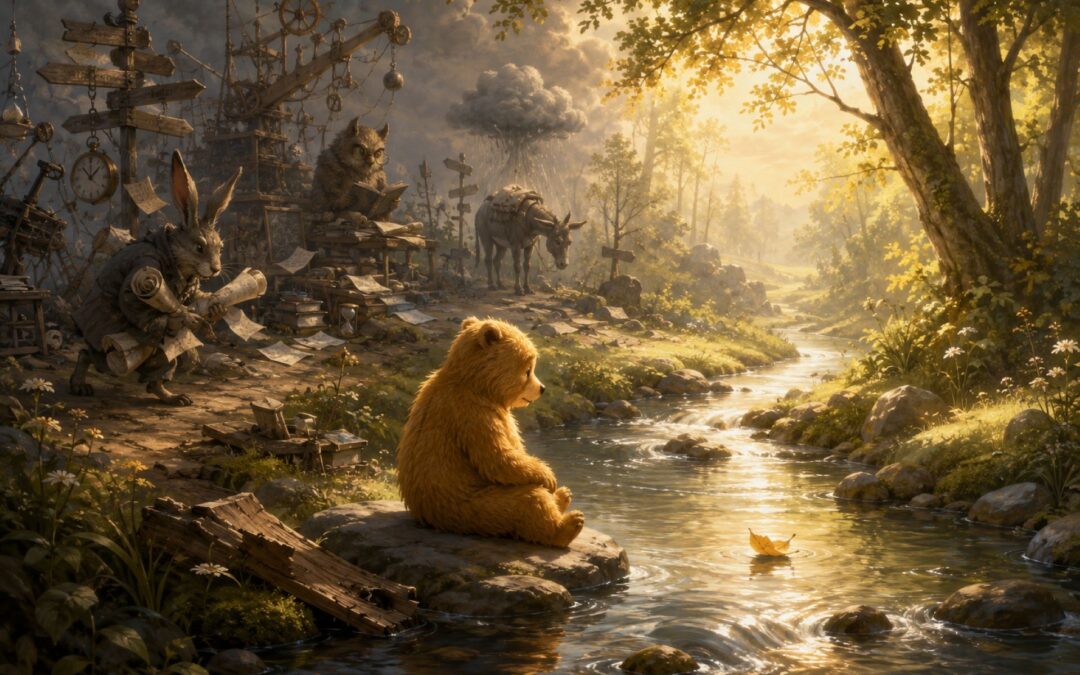
Benjamin Hoff’s The Tao of Pooh begins with an unlikely proposition: perhaps the “Bear of Very Little Brain” understands something that cleverer people routinely miss. Instead of introducing Taoism through formal metaphysics, historical surveys, or line-by-line commentary on Chinese classics, Hoff turns to Winnie-the-Pooh and the inhabitants of the Hundred Acre Wood. Pooh’s simplicity, Rabbit’s busyness, Owl’s learning, Eeyore’s pessimism, Piglet’s timidity, and Tigger’s exuberance become ways of thinking about how people relate to themselves and the world.
First published by E. P. Dutton in 1982 and later reissued in editions including the 2003 Egmont illustrated reprint, The Tao of Pooh is neither a conventional philosophy textbook nor a systematic introduction to Chinese religion. The original 1982 edition established the book as a work of popular philosophy whose appeal depends on making difficult ideas feel immediately recognizable. Hoff’s central claim is that simplicity, naturalness, non-forcing action, contentment, caring, and openness are not signs of intellectual deficiency. Properly understood, they can constitute a form of wisdom.
That simplicity is also the book’s central problem. Hoff is often illuminating when he uses Pooh to dramatize ideas associated with Daoism, but he is far less reliable when his interpretation expands into sweeping claims about Buddhism, Confucianism, scholarship, science, Western civilization, or the historical scope of Taoism itself. The best way to read The Tao of Pooh is therefore neither as an authoritative guide to Daoism nor as a charming book whose philosophical claims need no scrutiny. It is a remarkably effective work of philosophical translation whose strengths and distortions arise from the same method.

What The Tao of Pooh Is Trying to Do
Hoff frames the book from the beginning as a conversation rather than a lecture. Pooh does not merely supply examples from A. A. Milne’s stories; he appears as a participant in the writing process, interrupting, questioning, misunderstanding, and occasionally summarizing Hoff’s ideas more effectively than Hoff himself. That device lets the book dramatize its governing paradox: the character least qualified to sound like a philosopher may be the one who most consistently behaves like Hoff’s ideal philosopher.
On his official website, Hoff describes The Tao of Pooh and its later companion The Te of Piglet as books that explain Taoism through Milne’s characters. That description accurately captures the method but understates how thoroughly the Pooh cast structures the philosophy. Hoff does not simply attach a Taoist concept to an isolated scene. He converts whole personalities into recurring philosophical tendencies, so that Rabbit comes to represent compulsive cleverness and activity, Owl represents knowledge detached from direct experience, Eeyore represents gloomy intelligence, and Pooh represents natural responsiveness.
The Foreword establishes this approach by asking how a person might remain calm and content across changing circumstances. Pooh cannot supply a scholarly answer, and his inability to do so becomes part of Hoff’s point. A person may know the language of philosophy while failing to live wisely, just as another person may lack sophisticated terminology yet move through life with an instinctive sense of proportion.
This distinction between intellectual possession and lived understanding shapes everything that follows. Hoff repeatedly distrusts knowledge when it becomes self-important, action when it becomes compulsive, ambition when it loses contact with present experience, and self-improvement when it becomes an attempt to replace one’s nature rather than understand it. Pooh becomes persuasive because he does not appear to be practicing a philosophy. He simply lives in a manner Hoff interprets philosophically.
The Vinegar Tasters and Hoff’s Starting Point
Hoff begins his main exposition with the traditional image of the Vinegar Tasters. Three figures stand around a vat of vinegar representing life: Confucius finds it sour, the Buddha finds it bitter, and Lao-tse smiles. Hoff uses the scene to establish a three-way contrast among Confucianism, Buddhism, and Taoism, though the contrast is deliberately simplified for rhetorical effect.
In Hoff’s presentation, the Confucian response is sour because the world is measured against a proper social order and found deficient. Society requires rules, forms, duties, and correction because reality does not automatically correspond to the standards human beings believe it ought to follow. The Buddhist response is bitter because ordinary existence is marked by attachment, dissatisfaction, suffering, and the need to escape or overcome the conditions that perpetuate them. Lao-tse alone smiles because Taoism, in Hoff’s telling, begins by accepting the nature of the world rather than condemning it for failing to be something else.
This smiling Lao-tse becomes the foundation for the rest of the book. The Tao, or Way, cannot be fully captured in tidy definitions because it refers to the processes by which reality functions. Wisdom therefore requires more than learning propositions about the world. It requires observing those processes, seeing how things actually behave, and reducing the unnecessary interference produced by desire, ego, cleverness, fear, or convention.
Hoff’s Taoism is consequently practical and this-worldly. The world is not treated primarily as a trap from which one must escape or as raw material to be disciplined into an ideal social pattern. It is something with which one can learn to cooperate. When human beings become dissatisfied, Hoff frequently asks whether reality itself is the problem or whether the problem lies in the attempt to force reality into a preferred arrangement.
That distinction creates the characteristic mood of The Tao of Pooh. Hoff does not promise a life without difficulty. He argues instead that many difficulties are intensified by needless resistance. People try to control what should be observed, improve what should be understood, hurry what should be allowed to develop, and explain what might be better experienced directly.
The chapter also establishes one of the book’s largest limitations. Hoff acknowledges that Taoism has appeared in different philosophical, monastic, religious, and popular forms, but he immediately narrows his subject to what he calls “basic Taoism.” That enables him to produce a clear personal philosophy, but it also encourages readers to mistake his selection of Taoist ideas for the tradition as a whole. The simplification becomes more consequential later, once Pooh’s way of behaving begins to stand not merely for Hoff’s interpretation but for Taoism itself.
The Uncarved Block: Why Pooh’s Simplicity Matters
Having established the Tao as a Way discovered through alignment rather than control, Hoff needs a character who can embody that orientation. Pooh becomes that character through the Taoist image of P’u, or the Uncarved Block. The central idea is that before something has been cut, shaped, labeled, polished, or forced into an artificial form, it retains a simple integrity and a wider range of natural possibility.
P’u and the “Uncarved Block”
Hoff treats P’u as more than innocence. The Uncarved Block represents an original simplicity that has not yet been distorted by the urge to appear sophisticated. Pooh fits this role because he has few intellectual pretensions, little concern about status, and almost no desire to impress anyone with abstract knowledge. He likes honey, enjoys his friends, becomes confused easily, and often proceeds without elaborate calculation.
This simplicity can appear foolish because Pooh cannot compete with Owl in vocabulary or Rabbit in planning. Yet Hoff repeatedly arranges the examples so that conventional intelligence performs badly while Pooh’s responsiveness works. The philosophical reversal is important: intelligence is not being measured by how much information a character possesses but by whether the character’s mode of awareness actually fits the situation.
One of the clearest examples occurs when the characters become lost in the mist. Rabbit attempts to solve the problem through planning and reasoning, but his efforts do not reliably bring them home. Pooh eventually approaches the situation differently, paying attention rather than asserting control, and the group finds its way. Hoff interprets the episode as an example of the Uncarved Block functioning in practice: Pooh’s mind is not cluttered by the need to demonstrate that it already knows the solution.
P’u therefore contains an epistemological claim as well as a moral one. A simple mind can notice things that a complicated mind overlooks because attention is not always improved by adding more thought. Sometimes the added layer becomes interference. Hoff will spend much of the book expanding this premise from perception into self-knowledge, action, time, relationships, and even civilization.
Rabbit, Owl, and Eeyore as Counterexamples
Pooh’s simplicity becomes clearer through contrast with the other characters. Rabbit is clever in an active, managerial sense. He plans, organizes, calculates, and frequently assumes that the right response to a problem is to intervene more decisively. His intelligence is real, but Hoff portrays it as chronically vulnerable to overmanagement.
Owl represents another kind of intelligence. He possesses knowledge, language, and social authority; the other characters often turn to him because he appears educated. Yet his learning can become detached from immediate reality. Hoff’s criticism is not that facts are useless but that the possession of facts can become a substitute for seeing what is directly present.
Eeyore represents a darker variation. He is perceptive enough to notice problems and clever enough to articulate them, but his intelligence repeatedly reinforces pessimism. Instead of liberating him, thought becomes a mechanism through which disappointment confirms itself. Hoff thereby separates intelligence from wisdom: people can use considerable intellectual ability to complicate, control, complain, or rationalize without becoming more capable of living well.
The contrast among the characters gives The Tao of Pooh much of its enduring memorability. Hoff is effectively creating a small psychology of mental habits. Rabbit asks how to manage everything, Owl asks how to explain everything, Eeyore anticipates how everything will go wrong, and Pooh often responds to what is simply there.
“Spelling Tuesday” and the Limits of Cleverness
“Spelling Tuesday” develops Hoff’s suspicion of verbal intelligence most directly. Owl’s command of language makes him impressive within the Hundred Acre Wood, but Hoff repeatedly turns verbal sophistication into comedy. The joke about spelling “Tuesday” eventually collapses elaborate linguistic confidence into something more immediate: whatever else one calls it, it is Today.
The scene illustrates a distinction that runs throughout the chapter. A word points toward something, but it is not the thing itself. A concept can organize experience, but conceptual mastery should not be confused with experience. Hoff’s complaint is that intellectual systems often begin as tools for understanding and then become barriers when people pay more attention to the system than to what the system was meant to describe.
Eeyore’s association with the letter “A” extends the satire into status. Knowing the right letter, term, or formal category can become a social performance whose importance exceeds its practical value. Hoff is especially suspicious of academic culture when specialization fragments a living whole into pieces and then mistakes the pieces for complete understanding.
This criticism contains a legitimate insight but also a danger that becomes more obvious later. Knowledge can become performative, and expertise can become arrogant, but those possibilities do not make learning itself an obstacle. Hoff occasionally acknowledges that scholars provide useful information, yet his rhetorical energy usually favors the joke at their expense. The result is a book that distinguishes wisdom from knowledge effectively while sometimes treating the distinction as a rivalry more absolute than it needs to be.
Cottleston Pie: Inner Nature, Limits, and Self-Reliance
The chapter “Cottleston Pie” turns simplicity into a theory of individuality. If the Uncarved Block describes the value of remaining close to one’s natural character, Inner Nature asks what that character actually consists of. Hoff uses Pooh’s nonsensical song as a compact philosophical framework for thinking about difference, limitation, usefulness, and self-knowledge.
Things Are As They Are
The first principle is that things possess their own qualities. Hoff introduces this through Rabbit’s distrust of Kanga and Roo, whose arrival disrupts the familiar social pattern of the Hundred Acre Wood. Rabbit initially treats difference itself as a problem, while Hoff uses the situation to suggest that reality becomes easier to understand when difference is observed before it is judged.
The point is not that every existing trait is automatically good. Hoff’s argument is that things cannot be dealt with intelligently if their actual characteristics are ignored. A bird and a fly can both move through the air, but they do not do so in the same way, and trying to make one fulfill the nature of the other would be absurd.
A story from Chuang-tse about supposed uselessness broadens the principle. Something declared useless under one standard may become valuable under another because usefulness depends on context. A crooked or unsuitable tree may avoid being cut precisely because it fails the criteria by which other trees are exploited.
Hoff connects this idea to human life by criticizing the pressure to fit standardized definitions of success. A person may spend years attempting to become suitable for a career, role, relationship, or social identity that conflicts with their actual temperament and capacities. From Hoff’s perspective, this is not admirable perseverance if the underlying fit is wrong; it is a failure to understand Inner Nature.
Knowing What You Cannot Do
The second Cottleston principle concerns limitations. Hoff argues that people often treat limitations only as defects to overcome, even though limits provide crucial information about where effort is likely to be fruitful. Self-knowledge therefore includes acknowledging what one cannot do comfortably, naturally, or well.
Tigger supplies the comic example because his confidence dramatically exceeds his tested abilities. He announces capacities with enormous enthusiasm and later discovers that believing oneself capable of something is not the same as actually possessing the relevant ability. His trouble at the Six Pine Trees demonstrates what happens when exuberance is not balanced by accurate self-knowledge.
Piglet illustrates the reverse case. His smallness appears to be a disadvantage because the Hundred Acre Wood contains larger and more physically confident characters. Yet precisely because he is small, he can sometimes do things the others cannot. Hoff uses this reversal to argue that limitation and usefulness are not opposites; a limitation can shape a distinctive capacity.
This is one of the book’s most practical ideas because it avoids the shallow claim that people can become anything they desire if they try hard enough. Hoff’s alternative is not defeatism but discrimination. A person who understands both strengths and limits can direct effort where it has a natural chance to matter rather than wasting energy proving that every boundary can be conquered.
Turning Weaknesses into Useful Strengths
The third movement of “Cottleston Pie” asks readers to reconsider traits that initially appear inconvenient or undesirable. Hoff does not claim that every weakness is secretly a strength, but he repeatedly shows that qualities judged negatively in one context may become useful when understood and redirected.
The attempt by Pooh and Piglet to trap a Heffalump makes the principle comic. They try to reason about what a Heffalump would want and eventually use honey as bait, but Pooh’s own relationship with honey complicates the plan. The story exposes a recurring difficulty in strategic thinking: people may analyze the nature of the external problem while failing to understand their own tendencies.
Hoff also tells a Taoist anecdote in which a man possessing a disreputable or apparently useless skill becomes valuable during a dangerous situation. The moral resembles the crooked-tree story: abilities cannot be evaluated outside the conditions in which they operate. A culture’s standard of prestige is not identical to actual usefulness.
Rabbit’s campaign to “unbounce” Tigger is the chapter’s fullest demonstration. Rabbit treats bouncing as an irritating defect and constructs a plan intended to reform Tigger into a more acceptable personality. The scheme fails, and when Rabbit himself becomes lost, Tigger’s distinctive nature helps resolve the situation. The characteristic Rabbit wanted to eliminate turns out to be inseparable from the qualities that make Tigger useful.
The Ugly Duckling analogy gives Hoff’s theory of Inner Nature an emotional dimension. People often suffer because they interpret themselves through standards suited to someone else. Discovering what one actually is may not remove every difficulty, but it can transform the meaning of characteristics previously experienced only as inadequacies.
The Pooh Way: Wu Wei and Action Without Forcing
The earlier chapters describe what Hoff thinks human beings should understand: reality has a nature, individuals have an Inner Nature, and excessive cleverness can obscure both. “The Pooh Way” asks how a person acts once those insights are taken seriously. Hoff’s answer is wu wei, the concept around which the practical philosophy of the book most clearly turns.
What Wu Wei Means in Hoff’s Framework
Wu wei is often translated too literally as “not doing,” which can make it sound like complete passivity. Hoff rejects that interpretation. His version refers to action that does not strain against the nature of circumstances and does not add unnecessary interference to what can unfold more naturally.
Water becomes a central image because it moves without insisting on one rigid path. When confronted with rocks or contours, water responds to them rather than wasting energy pretending they are not there. Its flexibility is not weakness; it is what allows it to continue moving.
Hoff reinforces the point with a story from Chuang-tse about a swimmer who survives dangerous waters not by overpowering them but by moving according to their patterns. Someone unfamiliar with the water sees danger and imagines a contest of strength. The experienced swimmer survives because he cooperates with conditions.
Hoff links this orientation to Tzu Jan, which he renders as “Self So.” The idea points toward things being spontaneously what they are rather than becoming natural through deliberate performance. Pooh exemplifies this because he does not consciously try to behave like a Taoist sage. His effectiveness arises precisely because he is not constructing a philosophical identity for himself.
How Pooh Acts Without Straining
Hoff accumulates Pooh episodes to show what non-forcing action looks like in ordinary situations. The point is not that Pooh never makes mistakes. He frequently does. What distinguishes him is that he is relatively willing to use the situation that exists rather than become trapped by the situation he intended to create.
When Eeyore ends up in the river during the Poohsticks episode, different characters respond with different degrees of fuss and planning. Pooh’s contribution succeeds because he works with the direction and movement already present. Instead of trying to overpower circumstances, he notices how one part of the situation can affect another.
The peg-and-hole image makes the principle explicit. Hoff contrasts forcing an inappropriate fit with recognizing how things naturally correspond. Desire often insists that the preferred peg must fit the preferred hole; cleverness invents increasingly elaborate ways to force the fit; the Pooh Way begins by examining what actually belongs together.
A similar pattern appears when Pooh succeeds after relaxing while Tigger’s effortful insistence creates disorder. The contrast is not a universal law that relaxation always produces better results. Hoff uses it to expose a familiar human mistake: when something resists effort, people often assume the solution must be even more effort rather than reconsidering their approach.
The search for Small further satirizes organized striving. A formal search produces movement, discussion, and effort, while Pooh encounters the needed outcome through a less elaborate route. Hoff repeatedly treats the difference between activity and effectiveness as morally significant because modern people tend to equate visible effort with responsible action.
Eeyore’s birthday provides one of the chapter’s best examples because both Pooh and Piglet fail according to their original intentions. Pooh means to bring honey but eats it, leaving only the pot. Piglet intends to bring a balloon but accidentally destroys it. Yet the empty pot and damaged balloon happen to work together in a way Eeyore enjoys, so the failed plans become successful gifts once the characters respond to what remains.
The lesson is subtler than “everything happens for a reason.” Hoff does not need the accident to have been predetermined. What matters is that reality after the accident differs from the plan, and usefulness comes from engaging with that new reality rather than continuing to mourn the lost version.
Yielding, Intuition, and Conflict
Hoff extends wu wei beyond practical problem-solving into intuitive decision-making. Pooh often decides whom to visit or which direction to take without generating an argument elaborate enough to satisfy Rabbit or Owl. Hoff treats such choices as examples of a mind sufficiently quiet to respond before analysis multiplies unnecessary alternatives.
This is also why wu wei cannot simply mean inactivity. A person following the Pooh Way may act quickly and decisively, but the action does not arise from the compulsion to dominate every condition. Responsiveness replaces self-conscious force.
The chapter connects this quality to T’ai Chi Ch’uan and to the broader image of yielding rather than meeting force head-on. A rigid object resists until it breaks, while something flexible can absorb movement and redirect it. Hoff’s philosophy therefore challenges the assumption that strength always appears as opposition.
That principle applies psychologically as well as physically. People often intensify conflict by answering pressure with greater pressure, criticism with defensiveness, fear with control, and uncertainty with frantic planning. The Pooh Way asks whether a better response might begin by understanding the direction of the force already present.
The Bisy Backson: Busyness, Progress, and the Failure to Live Now
If Pooh represents action without unnecessary strain, the Bisy Backson represents life organized around the conviction that one must always be going somewhere else. Hoff takes a misspelled notice from Christopher Robin and turns it into a social diagnosis. The joke works because “busy” and “back soon” combine into a character who is perpetually absent from the present.
The Backson Mentality
Rabbit is the most obvious Backson in the Hundred Acre Wood. He plans, organizes, visits, calculates, corrects, and arranges, often with the assumption that visible activity proves usefulness. Hoff does not deny Rabbit’s intelligence or energy, but he asks what happens when activity becomes an identity rather than a response to genuine need.
A Chuang-tse story about a man trying to escape his own shadow captures the paradox. The faster he runs, the more completely the problem accompanies him. He imagines that greater effort will eventually produce escape, even though the structure of the problem makes his strategy self-defeating.
Hoff sees the same pattern in modern life. A person becomes dissatisfied, works harder to reach the condition that will supposedly end the dissatisfaction, adjusts rapidly when the condition arrives, and then identifies another future achievement as the new requirement for happiness. Desire perpetually moves the finish line.
Pooh’s dream of inaccessible honey converts the pattern into absurdity. The desired reward is always just beyond reach, so the pursuit never settles into enjoyment. The dream matters because it reveals how a future-focused life can remain permanently incomplete even while producing enormous amounts of motion.
Time, Goals, and the Process of Living
Hoff’s central criticism of goal-oriented living is not that goals are inherently harmful. The problem begins when the reward becomes the only part of the process considered worth experiencing. If happiness is reserved for completion, achievement, arrival, or possession, then the majority of life becomes mere waiting.
This is why Hoff insists that time cannot truly be saved. Efficiency may reduce the amount of time needed for one task, but the saved minutes do not accumulate in a vault. They are immediately spent on something else. A society can therefore become dramatically more efficient without its inhabitants feeling that they possess more time.
The insight leads back to wu wei. Attention to process changes the meaning of action because the action is no longer merely an obstacle between the present and the reward. Walking, working, eating, talking, resting, or traveling can possess value before any final outcome is reached.
Pooh’s preference for an apparently unimportant day illustrates that attitude. He can listen to birds or enjoy the weather without needing the experience to justify itself through productivity. Hoff treats this ability as a kind of freedom because Pooh does not require every hour to become evidence of improvement.
There is a serious philosophical challenge embedded in the joke. Much of modern ambition depends on postponement: endure the present so that life can become meaningful later. Hoff asks what happens if the later condition never arrives, or if reaching it only produces another requirement. A life organized entirely around future rewards may become remarkably successful at missing itself.
Hoff’s Critique of Modern Life
The Backson chapter expands aggressively from personal busyness into cultural criticism. Hoff attacks the work ethic, compulsory exercise, industrial progress, conquest, technological convenience, consumer abundance, environmental damage, and the idea that greater speed automatically represents improvement. His target is a civilization that can produce astonishing capability without asking carefully enough what the capability is for.
Some of these arguments remain strikingly contemporary. Hoff sees how quickly convenience becomes expectation and how easily efficiency becomes a demand for more output rather than an opportunity for more leisure. Technologies that promise to save labor often raise the standard for what a person is expected to accomplish instead of liberating that person from work.
The chapter also contains some of Hoff’s broadest historical generalizations. Puritanism, frontier expansion, technological culture, and environmental destruction are drawn into one narrative of restless striving. The narrative has rhetorical coherence, but it should not be mistaken for a complete historical explanation of Western development.
Hoff’s discussion of longevity is more problematic. He invokes traditional Taoist longevity practices and treats the extreme age attributed to Li Ching-Yuen as historically credible. That claim cannot be accepted as established fact; later verification has found no reliable evidence for the alleged 256-year lifespan, a problem that matters because Hoff presents the story as evidence rather than legend.
Even so, the chapter’s central point does not depend on extraordinary longevity. Its real question is qualitative rather than numerical: what does it mean to possess more years if those years are spent rushing toward later years? Hoff’s answer is that length and speed are poor substitutes for presence.
That Sort of Bear: Self-Worth, Caring, and Courage
“That Sort of Bear” shifts the argument from natural action toward the ethical and emotional consequences of accepting Inner Nature. Hoff now asks what happens when people measure their value against standards that do not fit them. The chapter answers by connecting self-acceptance to usefulness, courage, caring, and the capacity to affect others constructively.
Being Special Without Competing
Pooh’s value does not depend on becoming more like Owl or Rabbit. Piglet’s value does not depend on becoming larger. Hoff uses these characters to challenge the assumption that worth must be established competitively, as though a person becomes valuable only by outperforming or resembling someone else.
The parable of the stonecutter makes the point through endless comparison. A dissatisfied stonecutter imagines that another form of existence would grant greater power. Each transformation produces a new comparison until the apparent hierarchy circles back toward the condition he originally rejected.
The problem is not aspiration itself but alienation from actual nature. When identity becomes a permanent attempt to acquire the qualities of someone else, satisfaction remains structurally impossible because comparison can always generate another superior model. The person becomes like the Backson, except the future destination is now a future self.
Hoff gives the idea a modern consumerist edge in the shoe-sale episode. Pooh receives advertising that addresses him with flattering personal importance and is briefly drawn toward a purchase he does not truly need. The episode exposes a familiar mechanism of consumption: create or intensify insecurity, attach status to a product, and then sell the product as a solution to the insecurity.
Against this manufactured insufficiency, Hoff emphasizes capacities already present. The episodes involving Roo, the North Pole, and later the flood show Pooh becoming useful not because he acquires superior expertise but because he notices what can be done with what is available. His apparent ordinariness becomes part of the philosophical argument.
Tz’u: Caring as a Source of Courage
Hoff introduces Tz’u, or caring and compassion, as one of the central treasures associated with Lao-tse. This concept prevents the philosophy of Inner Nature from collapsing into self-absorption. Understanding oneself matters, but the mature expression of naturalness includes responsiveness to other people.
Caring also changes Hoff’s account of courage. Courage is not presented as the absence of fear or the possession of a naturally fearless personality. Piglet remains frightened easily, yet he can act courageously when another person’s need becomes more important than his impulse to retreat.
The collapse of Owl’s house provides the chapter’s clearest example. Piglet finds himself in a dangerous situation and must do something that terrifies him. His smallness, previously treated as a weakness, becomes useful, while concern for his friends gives him a reason to act despite fear.
This makes Piglet one of the book’s most important characters. Pooh represents natural simplicity, but Piglet demonstrates development. His temperament does not vanish; fear is integrated into courage rather than replaced by it. Hoff’s moral psychology is strongest here because it does not require a person to become someone else before acting well.
Caring also becomes a source of practical intelligence. A person who genuinely attends to another being notices things that detached cleverness may miss because concern directs attention. Hoff therefore connects compassion with wisdom rather than treating morality as a separate layer added after perception.
The Tiddely-Pom Principle
The Tiddely-Pom Principle describes the way small tendencies can gather momentum. Hoff compares attitudes and actions to something that grows through repeated movement, so that a minor pattern can eventually become much larger than its starting point suggests. The principle can work constructively or destructively.
Negative habits can reinforce the expectations that generated them. A person convinced of inevitable failure may behave in ways that produce poorer outcomes, which then appear to prove the original belief. Hoff’s alternative is not magical positive thinking but attention to how repeated responses help create the atmosphere in which future responses occur.
Piglet’s growth illustrates the constructive version. After he acts courageously, Pooh recognizes what he has done rather than allowing Piglet to dismiss it as an anomaly. Being seen differently helps Piglet see himself differently, and the new interpretation affects later choices.
The culmination comes when Eeyore mistakenly identifies Piglet’s home as an ideal replacement for Owl’s destroyed house. Piglet chooses generosity despite the personal cost and allows Owl to take it. Pooh then offers Piglet a home with him, turning the apparent loss into a deepened relationship.
The episode connects several earlier ideas at once. Piglet’s smallness has become usefulness, fear has become courage through caring, and loss becomes an occasion for generosity rather than merely deprivation. Hoff’s philosophy is no longer only about reducing resistance to the world; it has become an account of how people can participate in one another’s lives.
Nowhere and Nothing: Emptiness, Attention, and Childlike Wisdom
After chapters about action, usefulness, and courage, “Nowhere and Nothing” deliberately moves toward what appears to be absence. Christopher Robin and Pooh walk toward Nowhere while doing Nothing, and Hoff uses the joke to argue that emptiness is not the opposite of life. Properly understood, empty space can be the condition that allows perception, creativity, rest, and responsiveness to occur.
The Great Nothing
Hoff introduces T’ai Hsu, which he renders as the Great Nothing, to describe a form of emptiness that is not merely deprivation. The idea initially sounds paradoxical because modern language usually treats “something” as valuable and “nothing” as useless. Hoff reverses the hierarchy by asking what all the somethings depend upon.
A room is usable partly because it contains empty space. A landscape becomes intelligible through distance and openness as well as objects. Music requires intervals and silence, and conversation requires pauses in which one person stops producing sound long enough for another to enter.
A Chuang-tse dialogue reinforces the idea of proceeding without a rigid destination. The absence of imposed direction can permit forms of awareness that a predetermined plan excludes. Hoff is not arguing that destinations never matter; he is challenging the assumption that experience without a measurable objective is automatically wasted.
This chapter therefore develops the earlier critique of the Bisy Backson. Compulsive busyness fears emptiness because empty time appears unproductive. Hoff instead treats emptiness as a resource that becomes unavailable precisely when every moment must be filled.
The Empty Mind
The philosophical idea of emptiness becomes psychological through the Empty Mind. Hoff tells a Taoist story in which a lost pearl cannot be recovered through the usual deliberate faculties but is found through a more empty mode of awareness. The parable suggests that focused effort can sometimes narrow perception so aggressively that the desired object becomes harder to see.
Eeyore’s missing tail functions as the Pooh-world equivalent. Rabbit is busy, Owl is learned, and Eeyore is immersed in the fact of loss, yet the tail is effectively present in plain sight because Owl has repurposed it without recognizing what it is. Pooh sees what the others overlook.
Hoff’s point is not that thought literally prevents vision. It is that mental categories can determine what people expect to see, and expectations can hide an obvious reality. An object classified as a bell rope may no longer be perceived as Eeyore’s tail even when everyone already knows a tail is missing.
The chapter widens this concept through artistic and sensory imagery. Empty areas in paintings, silence around sound, expanses of snow, open air, and water all illustrate how absence can shape experience. Hoff objects to the impulse to fill every visual, mental, domestic, and temporal space simply because emptiness makes people uncomfortable.
He also criticizes the way children’s lives become increasingly scheduled and categorized. Education, organized activities, entertainment, and expectations can crowd out forms of attention that emerge only when nothing has been assigned. The argument connects cultural busyness with psychological clutter.
A story about Emperor Hirohito appreciating an unexpectedly empty hall gives Hoff another example of relief through absence. What matters is not the historical figure as such but the reversal of expectation: a grand space need not be filled with spectacle in order to be valuable.
Hoff then invokes a Taoist contrast between learning and wisdom. Learning commonly involves addition—more information, more distinctions, more concepts—whereas Taoist cultivation can involve subtraction. The aim is not ignorance but the removal of habits that obstruct direct responsiveness.
The Child Who Knows
The chapter ends with Hoff’s ideal of recovered childlike awareness. Children begin life encountering the world before they possess elaborate systems for classifying, ranking, and interpreting it. Socialization necessarily teaches many useful distinctions, but Hoff believes it can also bury a more immediate form of perception beneath layers of expectation.
His goal is not literal regression. A mature adult cannot and should not return to infant ignorance. The ideal is to recover receptivity without discarding experience—to become capable of seeing freshly after having learned how easy it is for knowledge to become automatic.
Christopher Robin’s Enchanted Place gives the argument its most lyrical expression. The place matters because it is both somewhere and, in Hoff’s interpretation, not a distant spiritual destination at all. The capacity represented by the Enchanted Place can emerge where one already is when the urge to get somewhere else temporarily stops.
This resolves several earlier chapters. The Backson always lives ahead of himself, Rabbit organizes the future, Owl interprets through accumulated knowledge, and Eeyore inhabits a narrative of disappointment. Pooh’s emptier awareness allows the present to exist before it is turned into a problem, project, or explanation.
The Now of Pooh: How the Book Brings Its Ideas Together
“The Now of Pooh” gathers the book’s philosophy into its final psychological form. Hoff returns to the apparently insignificant Bear in the Forest and asks whether the intellectual powers modern civilization prizes so highly have actually produced corresponding wisdom. Intelligence can create astonishing tools and systems, but Hoff argues that cleverness alone cannot determine whether those tools improve the world.
This is where his environmental and social concerns reappear. The problem is not that thinking exists; it is that capability can expand faster than restraint, compassion, or understanding. A civilization may become better at transforming nature while becoming worse at recognizing when transformation is unnecessary or destructive.
Hoff’s final conceptual move is especially effective because he brings the cast inside the reader. Owl, Rabbit, Eeyore, and Pooh cease to be merely literary characters representing external personality types. They become tendencies that can coexist within one person.
The inner Owl wants to interpret, define, and establish intellectual authority. The inner Rabbit wants to organize, manipulate, and keep moving. The inner Eeyore anticipates disappointment and turns intelligence toward confirming it. The inner Pooh accepts more of what is present, acts without excessive strain, enjoys simple things, and does not require constant proof of importance.
Hoff does not ultimately demand the elimination of the first three. His argument is that modern people allow them to dominate while neglecting the Pooh-like capacity for simplicity. The book’s conclusion is therefore a change of balance rather than the construction of a wholly different personality.
The Backword returns to the conversational style of the opening. Pooh offers a simple summary of the Way, while Hoff accepts that elaborate explanation can only go so far. The circular structure is deliberate: a book devoted to explaining why explanation is sometimes overrated finally hands the philosophy back to the supposedly unphilosophical bear.
The Taoist Concepts Behind Hoff’s Metaphors
Hoff’s concepts form a coherent personal philosophy, but understanding their relationship to Daoism requires separating his pedagogical language from the wider textual and historical tradition. Several of his central ideas have genuine roots in classical Daoist thought, especially simplicity, naturalness, non-forcing action, and the symbolic value of the uncarved block. The problem arises when these selected themes are allowed to represent everything Daoism has meant.
P’u, Inner Nature, and Ziran
Hoff’s P’u is not an invention. The uncarved block is a genuine Daoist image associated with simplicity, lack of artificial embellishment, and a condition not yet fragmented by excessive differentiation. The Stanford Encyclopedia of Philosophy’s discussion of Laozi likewise identifies the uncarved block as an important symbol of simplicity and integrity.
Hoff’s interpretation works especially well when P’u describes freedom from pretension. Pooh does not need to construct a socially impressive self before he can act. His lack of sophistication becomes a resource because fewer layers of status anxiety stand between perception and response.
Inner Nature is somewhat more Hoff-specific as a packaged doctrine. Classical Daoist ideas certainly value naturalness, but Hoff turns that orientation into a recognizable modern philosophy of personality: know your capacities, accept limitations, stop forcing yourself into unsuitable roles, and work from what you actually are. The synthesis is persuasive, but readers should not assume that “Inner Nature” functions as one standardized classical doctrine in exactly Hoff’s form.
Tzu Jan, now more commonly romanized as ziran, brings Hoff closer to established Daoist vocabulary. Ziran refers to naturalness or the condition of being “so of itself,” and it helps explain why Hoff distrusts forced self-improvement. Naturalness is not something a person can convincingly perform through greater artificial effort; the attempt to appear natural can itself become another layer of self-consciousness.
Wu Wei: Non-Forcing, Not Mere Inactivity
Wu wei is probably the concept Hoff communicates most successfully. His Pooh examples make it difficult to confuse the idea with laziness because Pooh repeatedly does act. What distinguishes him is the absence of unnecessary strain, coercion, or insistence that the situation obey a preconceived plan.
Modern scholarship similarly warns against translating wu wei as absolute inactivity. It can suggest non-assertive, non-coercive, spontaneous, or effortless forms of action, depending on context. The apparent paradox disappears once “doing nothing” is understood not as refusing all behavior but as reducing activity generated mainly by ego, compulsion, domination, or artificial interference.
Hoff’s water imagery is therefore well chosen. Water moves constantly, yet its movement does not depend on insisting that obstacles disappear. It responds to contours and often becomes powerful precisely because it does not adopt rigidity as its only form of strength.
Where Hoff narrows the concept is in making it predominantly personal. Classical texts can connect wu wei with ethics, rulership, social order, desire, and political authority as well as private behavior. Hoff’s emphasis on effortless personal action is memorable, but it removes much of the context in which questions about non-action originally mattered.
His interpretation also risks being mistaken for passive acceptance. The examples themselves resist that reading: Piglet acts courageously, Pooh helps others, characters improvise, and yielding can involve strategically redirecting force. A responsible reading of the book should therefore treat wu wei as non-forcing action, not as permission to avoid responsibility.
Compassion, Emptiness, and Return
The later chapters broaden Hoff’s philosophy beyond individual ease. Tz’u introduces caring, showing that naturalness without relationship would be incomplete. Piglet’s courage matters because compassion turns attention outward and gives fear something more important than itself.
Emptiness performs a different function. The Empty Mind is not simply blankness but a reduction of compulsive mental occupation. Hoff treats it as the condition under which obvious things can once again become visible because perception is not completely filtered through plans, labels, habits, and anxieties.
The child motif brings simplicity, naturalness, and emptiness together. Hoff imagines maturity not as endlessly adding complexity but as learning enough to recognize which complications can eventually be released. The adult who recovers childlike receptivity is not supposed to become naïve again; the ideal is experience without total domination by the conceptual machinery experience has accumulated.
Taken together, these ideas explain why The Tao of Pooh feels more coherent than many collections of philosophical “lessons.” Simplicity identifies an original condition, Inner Nature identifies appropriate fit, wu wei governs action, caring gives that action an ethical direction, and emptiness protects the awareness needed to perceive what circumstances require. The system is Hoff’s synthesis, but its pieces are sufficiently related to Daoist concerns to make the synthesis more than decorative appropriation.
Pooh and His Friends as a Philosophical Cast
One of Hoff’s greatest achievements is converting familiar literary personalities into a compact psychology. The characters remain recognizable from Milne, but Hoff selects particular traits and makes them philosophically legible. Readers can therefore remember an abstract distinction by remembering the kind of thing Rabbit, Owl, Eeyore, Piglet, Tigger, or Pooh tends to do.
Pooh
Pooh represents simplicity, but Hoff wisely does not make him flawless. He is forgetful, easily distracted, highly motivated by honey, frequently confused, and capable of mistakes. If Pooh were merely a disguised sage who always behaved perfectly, the philosophical device would become sentimental and unconvincing.
His usefulness comes from a different source. Pooh does not maintain much distance between himself and his experience. Hunger is hunger, friendship is friendship, a pleasant day is pleasant, and a practical problem is usually approached without transforming it into a referendum on his intelligence or importance.
That lack of self-consciousness gives Pooh unusual resilience. Failure does not always become identity, uncertainty does not automatically become crisis, and ignorance does not have to be hidden behind prestige. He can be wrong without needing elaborate defenses against being wrong.
Hoff occasionally romanticizes this simplicity, but the character works because he embodies an attractive possibility: intelligence might include knowing when intelligence is becoming interference. Pooh does not abolish thinking. He dramatizes the possibility of living without making thought the unquestioned ruler of every moment.
Rabbit, Owl, and Eeyore
Rabbit is the philosophy’s clearest antagonist because his strengths so easily become excesses. Organization, planning, initiative, and cleverness are useful qualities, yet Rabbit repeatedly pushes them beyond their proper scope. He does not merely solve problems; he tends to assume that problems require him to take charge.
That makes Rabbit more interesting than a simple symbol of stupidity. He is intelligent, and Hoff needs him to be intelligent because the book’s argument depends on capable people undermining themselves through overcontrol. Rabbit’s flaw is not thought but the inability to recognize when thought has stopped serving the situation.
Owl similarly represents a real human strength distorted by identification. Knowledge becomes prestige, and prestige makes it difficult to admit when direct perception would be more useful than explanation. The joke about Owl is strongest when his education causes him to miss something obvious, because the failure exposes the difference between possessing information and perceiving relevance.
Eeyore is less active but equally important. His pessimism is not mere ignorance. He notices genuine disappointments and often sees absurdities the others miss, but his intelligence has become organized around expectation of loss. The result is a mind that can turn every new event into confirmation of an old emotional conclusion.
Hoff exaggerates all three characters because they function as philosophical types rather than balanced psychological portraits. Real scholars are not all Owls, organized people are not all Rabbits, and pessimists are not simply choosing Eeyore’s worldview. The caricature works pedagogically even when it becomes unfair descriptively.
Piglet and Tigger
Piglet complicates the book’s preference for naturalness because his natural temperament includes fear. If Hoff simply told readers to “be themselves,” Piglet would remain frightened and limited. Instead, the book allows character to develop without requiring self-erasure.
Piglet learns that courage can grow from caring. His fear remains part of him, but circumstances reveal that another part of his nature can become stronger when someone else needs help. Hoff therefore distinguishes accepting a trait from obeying it permanently.
Tigger creates the opposite complication. His exuberance is charming and genuinely useful, yet he can overestimate himself. Inner Nature is therefore not equivalent to trusting every impulse. Tigger needs accurate knowledge of his limits just as much as Piglet needs confidence in neglected strengths.
Together, Piglet and Tigger prevent Hoff’s system from becoming pure passivity. Naturalness includes development, and self-acceptance includes correction. The goal is not to freeze personality in its present condition but to change in ways that remain responsive to what a person actually is.
The Book’s Major Themes
The Tao of Pooh repeatedly returns to a small set of tensions, but their meaning changes as the argument develops. Simplicity begins as an alternative to intellectual pretension and eventually becomes a theory of action, identity, time, relationship, and attention. The themes therefore work best when traced across the book rather than extracted as independent slogans.
Simplicity Versus Cleverness
The opposition between simplicity and cleverness begins in the Foreword, becomes explicit through P’u, intensifies in “Spelling Tuesday,” and returns in the final contrast among the inner Owl, Rabbit, Eeyore, and Pooh. Hoff’s recurring claim is that cleverness is a tool rather than a complete form of wisdom.
The theme is compelling because many failures genuinely arise from overcomplication. People can create complex explanations to avoid obvious truths, devise strategies for problems caused by excessive strategy, or accumulate expertise without gaining perspective. Hoff’s Pooh examples make these possibilities easy to recognize.
The weakness appears when simplicity is idealized too completely. Some situations are genuinely complicated, and expertise can reveal truths that naïve perception cannot. The strongest version of Hoff’s theme is therefore not “simplicity is always wiser than intelligence” but “intelligence needs simplicity as a corrective when it becomes detached from reality.”
Presence Versus Striving
The Bisy Backson chapter makes this contrast explicit, but the theme begins earlier with wu wei and reaches its culmination in “Nowhere and Nothing.” Striving turns the present into an instrument for obtaining a future condition. Presence allows current experience to possess value before that condition arrives.
Hoff is particularly sharp about the endless deferral built into achievement culture. The promise is usually that one more accomplishment will create sufficient security, status, money, efficiency, or freedom. Once the accomplishment arrives, however, the new condition often becomes normal and the next requirement immediately appears.
Pooh escapes some of this machinery because he is easily satisfied by ordinary pleasures. Honey matters enormously to him, but the book does not portray him as building an identity around accumulating ever greater quantities of honey. Desire occurs without becoming a total philosophy of life.
“Nowhere and Nothing” radicalizes the theme by suggesting that unoccupied time is itself valuable. A person who cannot tolerate an empty hour will inevitably fill it, and once every empty hour is filled, life may feel permanently crowded without becoming more meaningful.
Self-Acceptance, Limits, and Usefulness
Cottleston Pie introduces the principle that things have distinctive natures, while “That Sort of Bear” adds emotional and moral depth. Hoff rejects the assumption that self-acceptance means declaring every quality equally excellent. Understanding limits is part of understanding nature.
Tigger must learn that enthusiasm cannot substitute for ability. Piglet must learn that smallness does not eliminate usefulness. Pooh must remain Pooh rather than becoming intellectually impressive. The characters reveal different errors produced by comparing oneself with unsuitable standards.
The theme also reframes weakness. A quality can be disadvantageous in one context and useful in another, which means identity cannot be summarized by a single ranking. Hoff encourages readers to ask not merely whether a trait is good or bad but what kind of situation allows it to function constructively.
This is one reason the book remains more humane than a conventional doctrine of relentless self-optimization. Hoff does not ask readers to maximize every trait. He asks them to understand which possibilities actually belong to them.
Caring, Nature, and a Less Combative Life
Caring prevents the book’s simplicity from becoming purely aesthetic. A person who is relaxed and natural but indifferent to others would not represent Hoff’s mature ideal. Tz’u makes responsiveness relational.
Piglet’s courage is the clearest expression of this theme because compassion changes what action becomes possible. The chapter suggests that concern for another person can reorganize attention more effectively than abstract commands to “be brave.” Courage emerges from relationship rather than ego.
The same principle extends toward Hoff’s treatment of nature and conflict. Wu wei reduces unnecessary opposition, while the environmental critique warns against treating the world as inert material whose only purpose is to submit to human projects. Both ideas ask what changes when control is replaced by greater attention to relationship.
Hoff sometimes romanticizes harmony, but the moral insight remains useful. People do not always have to prove strength by increasing force. Flexibility, concern, restraint, and responsiveness can be active virtues rather than signs of surrender.
How The Tao of Pooh Is Written
The philosophical content of The Tao of Pooh cannot be separated from its form because the method demonstrates the thesis. Hoff explains a philosophy of simplicity through a book that tries to remain playful, conversational, repetitive in a mnemonic rather than systematic way, and suspicious of heavy conceptual machinery. Even when the book becomes polemical, it rarely sounds like a conventional treatise.
Dialogue, Humor, and Philosophical Allegory
The recurring conversations between Hoff and Pooh create a self-aware structure. Hoff is ostensibly the knowledgeable author explaining Taoism, but Pooh repeatedly disrupts the hierarchy by failing to understand unnecessary complications or by expressing the conclusion in simpler language. The device allows the book to mock its own explanatory ambition.
Humor is therefore not decoration. When Owl gets tangled in words or Rabbit’s planning produces confusion, the comedy performs the philosophical criticism. Readers do not merely receive an argument that overthinking can be counterproductive; they experience the argument through an episode in which excessive thought becomes funny.
Hoff also uses Chinese anecdotes and parables as miniature thought experiments. A swimmer moves with dangerous water, a useless tree becomes useful because it avoids exploitation, a stonecutter discovers the instability of comparison, and a search fails because the searcher cannot step outside the assumptions guiding it. These stories compress abstract relations into images readers can retain.
The book frequently personifies abstractions such as Cleverness and Knowledge, sometimes almost turning them into characters. This contributes to accessibility because the argument becomes dramatic: different mental habits enter a situation and produce different results. The cost is that complexity can disappear when abstract positions are made to behave like comic stereotypes.
Why the Winnie-the-Pooh Episodes Work
The Pooh material works because the characters already possess strong behavioral identities. Hoff does not need lengthy case studies before explaining Rabbit’s relation to busyness or Eeyore’s relation to pessimism. A single recognizable episode can carry an argument because the personality has already been established by Milne.
This gives Hoff an unusual advantage over ordinary popular philosophy. A reader may forget a definition of wu wei but remember Pooh using circumstances rather than forcing them. A reader may forget a discussion of Inner Nature but remember Tigger’s overconfidence or Piglet discovering that being small can be useful.
The technique also invites rereading of apparently simple children’s stories. Episodes involving lost tails, birthday gifts, floods, bouncing, or getting lost acquire philosophical depth when placed beside Taoist ideas. Hoff demonstrates how literary character can become a tool for reflection without requiring the original story to have been written as philosophical allegory.
That distinction matters. Hoff’s interpretation shows that Milne’s stories can illuminate Taoist concepts; it does not establish that Milne intended Pooh as a Taoist sage. The philosophical meaning belongs to Hoff’s act of reading and arrangement.
The Risks of the Anti-Intellectual Voice
The same technique that gives Hoff clarity can make him unfair. Scholars, scientists, specialists, planners, and other representatives of “cleverness” often appear primarily to be mocked. Their failures are memorable because the book does not devote equivalent attention to situations in which expertise prevents error.
This creates an internal tension. The Tao of Pooh depends on translation, historical interpretation, textual knowledge, and literary analysis while repeatedly suggesting that scholarly habits interfere with wisdom. Hoff can perform the critique only because he has acquired the very kinds of knowledge his rhetoric sometimes dismisses.
The fairest reading is to treat the anti-intellectualism as corrective rather than literal doctrine. Expertise without perspective can become absurd, but ignorance does not become wisdom merely because it is simple. Pooh is valuable because of responsiveness, not because knowing less is automatically better than knowing more.
The prose nevertheless succeeds because its surface simplicity fits its subject. Hoff writes in a manner that allows philosophical ideas to become conversational rather than ceremonial. Even where the analysis is incomplete, the book rarely loses sight of the reader.
Where Hoff’s Version of Taoism Simplifies the Tradition
The central critical question is not whether The Tao of Pooh contains authentic Daoist ideas; many of its most important concepts clearly do. The problem is proportion. Hoff selects a group of themes particularly compatible with his critique of modern Western life, presents them vividly, and then often lets that selection stand for Taoism more broadly.
The Vinegar Tasters and the “Three Teachings”
The Vinegar Tasters is rhetorically brilliant because a complex philosophical comparison becomes instantly understandable. Confucius is sour, the Buddha is bitter, and Lao-tse smiles. A reader can grasp Hoff’s preferred orientation before encountering any difficult terminology.
As intellectual history, however, the picture is too neat. Confucian traditions cannot be reduced to joyless rule-following, and Buddhism cannot be reduced to declaring life bitter. Both contain far more varied understandings of cultivation, suffering, ethics, community, joy, discipline, metaphysics, and liberation than Hoff’s symbolic contrast allows.
The problem is not that a popular writer uses simplification. Any introduction must simplify. The problem is that simplification becomes polemic when rival traditions are reduced mainly to defects that Hoff’s Taoism conveniently solves.
This pattern recurs throughout the book. Hoff creates memorable binary oppositions—simple versus clever, natural versus artificial, present versus future, experience versus explanation—but reality often contains relationships more complex than the binaries permit. The book is most useful when readers treat them as diagnostic contrasts rather than exhaustive descriptions.
A Selective Version of Daoism
Historical Daoism is much broader than Hoff’s personal philosophy of natural simplicity. The Internet Encyclopedia of Philosophy’s overview of Daoist philosophy shows how difficult it is to separate the tradition cleanly into a purely philosophical Taoism and a later or secondary “religious” Taoism. Daoist history includes philosophical, ritual, contemplative, political, bodily, communal, cosmological, and longevity traditions that developed in complex relation with one another.
Hoff touches some of this material only briefly. His Taoism is largely a modern personal ethic: know your nature, simplify, stop forcing, avoid obsessive cleverness, remain present, care for others, and make room for emptiness. Those ideas are genuinely connected to Daoist texts, but they are not a comprehensive map of Daoism.
The distinction matters especially for readers encountering the tradition for the first time. Because Hoff writes with confidence and clarity, his selection can easily become the reader’s definition of Taoism itself. The book works better as a doorway into certain Daoist sensibilities than as a substitute for Laozi, Zhuangzi, or serious historical study.
Hoff’s older transliterations can also make the tradition appear more distant than necessary. Tao is now commonly written Dao, Lao-tse as Laozi, Chuang-tse as Zhuangzi, and Tzu Jan as ziran. The older forms are not automatically wrong, but modern readers benefit from recognizing that the terminology belongs to an earlier romanization convention.
Science, Scholarship, and Modernity as Straw Targets
Hoff’s criticism of intellectual arrogance is one of the book’s strengths when narrowly applied. People do sometimes confuse technical vocabulary with understanding, and institutions can reward expertise that has lost contact with practical wisdom. Complex explanations can also obscure obvious realities.
The argument weakens when scientific explanation itself becomes suspect. Naming mechanisms does not exhaust the meaning of an experience, but understanding mechanisms remains valuable. Knowing how a phenomenon works can coexist with wonder, direct perception, and ethical seriousness.
The same problem affects Hoff’s attacks on modernity. His critique of compulsive productivity, environmental destruction, consumerism, and the worship of speed remains powerful, but he sometimes writes as though modern technological civilization were one continuous expression of the Bisy Backson personality. That interpretation compresses historical conflicts, material improvements, political institutions, scientific achievements, and technological diversity into a single moral type.
A stronger version of Hoff’s argument would ask when cleverness becomes self-defeating rather than treating cleverness as inherently suspect. It would ask when technological progress ceases to improve human life rather than implying that complexity itself is evidence of error. Readers can preserve the book’s most useful critique without accepting every contrast Hoff uses to dramatize it.
Historical and Factual Problems
The clearest factual problem is Hoff’s treatment of Li Ching-Yuen, who is presented as an extraordinarily long-lived Taoist whose age supposedly exceeded two centuries. Modern verification does not support the claim. The extreme lifespan attributed to Li remains legendary rather than authenticated, despite the story’s repeated circulation.
For comparison, the greatest fully authenticated human lifespan recognized by Guinness World Records belongs to Jeanne Calment, who lived 122 years and 164 days. That does not disprove every traditional longevity practice, but it does show that Hoff’s dramatic historical example cannot be used as straightforward evidence for a documented two-century human lifespan.
The mistake is peripheral rather than fatal. Hoff’s central arguments about busyness, simplicity, naturalness, and attention do not depend on Li Ching-Yuen having lived for more than 200 years. The episode does, however, illustrate why the book should not be treated as a rigorously sourced work of historical scholarship.
A similar caution applies more generally to its anecdotes and sweeping cultural claims. They function primarily as philosophical illustrations. Their rhetorical effectiveness should not automatically be converted into historical proof.
Critical Review: What The Tao of Pooh Achieves and Where It Falls Short
Judged as popular philosophy rather than academic history, The Tao of Pooh achieves something genuinely difficult. It takes concepts that can sound remote when encountered through unfamiliar terminology and makes them intuitive without reducing the entire book to inspirational slogans. Readers are likely to remember not merely that wu wei involves non-forcing but why Eeyore’s birthday, Rabbit’s plans, Piglet’s courage, and Pooh’s contentment help Hoff explain it.
Its Greatest Strength
The book’s greatest strength is mnemonic and imaginative power. Hoff understands that abstract philosophy becomes durable when readers can attach it to recognizable behavior. Rabbit, Owl, Eeyore, Piglet, Tigger, and Pooh become a mental vocabulary that can be carried into ordinary life.
The method also gives the philosophy emotional warmth. A formal distinction between naturalness and artificiality can remain abstract, but Piglet discovering the usefulness of being small gives the idea human texture. A discussion of non-forcing action can sound obscure, but Pooh responding to circumstances rather than insisting on a failed plan makes the principle visible.
Hoff is especially good at identifying common forms of unnecessary struggle. The book notices how people use thought to avoid perception, goals to avoid the present, improvement to avoid self-acceptance, activity to avoid stillness, and explanation to avoid experience. Those observations remain psychologically recognizable even when the Taoist framework is set aside.
The book is also more coherent than its playful form initially suggests. P’u, Inner Nature, wu wei, the Backson critique, Tz’u, emptiness, and the final inner-cast model form a real progression. Hoff is not merely collecting random bits of wisdom associated with Pooh.
Its Greatest Limitation
The greatest limitation is that the book’s explanatory method encourages overidentification between Hoff’s synthesis and Taoism itself. A reader may finish The Tao of Pooh with a reasonably strong grasp of Hoff’s personal philosophy while believing that the same grasp amounts to a comprehensive understanding of Daoism. It does not.
Hoff’s binaries also become too convenient. Owl demonstrates a real danger of intellectual vanity, but scholarship does not generally reduce to Owl. Rabbit reveals the problem of overcontrol, but planning is not inherently anti-Taoist. Eeyore reveals how pessimism can become self-confirming, but critical judgment is not simply negativity.
The simplification becomes most problematic when rival positions are not granted their strongest form. Confucianism, Buddhism, science, academia, technological progress, and Western civilization often appear as foils whose weaknesses allow Pooh’s simplicity to shine. The book would be philosophically stronger if these alternatives were allowed to challenge Hoff rather than merely provide contrast.
Yet the limitation does not destroy the project. The book never needed to become a scholarly survey in order to succeed. It needed only to make clear what kind of introduction it was offering, and its confidence sometimes obscures that boundary.
What Has Aged Well—and What Has Not
The critique of busyness has aged exceptionally well. Contemporary life offers even more opportunities than Hoff’s world did for every idle interval to be filled, every activity measured, every hobby optimized, and every moment converted into a task. The Bisy Backson remains instantly recognizable.
Hoff’s insistence that efficiency does not guarantee freedom also retains force. Faster communication, greater convenience, and more powerful tools can reduce the time required for individual tasks while simultaneously increasing expectations. The result can be more capability accompanied by a persistent sense of insufficient time.
His concern about consumer identity also remains relevant. The shoe-sale joke captures the way commercial systems can create symbolic deficiencies and then offer products as evidence of importance, belonging, competence, beauty, or success. Pooh’s susceptibility to flattery makes the criticism less preachy because even the book’s philosophical hero is not immune.
The environmental argument also remains meaningful at the level of values. Hoff asks whether the capacity to alter the world has been confused with the wisdom to know when alteration is justified. Whatever one thinks of his broader anti-modern rhetoric, the distinction between technical power and ethical judgment is still important.
Other parts have aged more poorly. Sweeping East-versus-West contrasts now feel especially reductive, as do caricatures of academic expertise and some of the confident historical anecdotes. The Li Ching-Yuen episode is the most obvious factual example, but the larger issue is a style of argument that sometimes prefers a good parable to careful qualification.
The book’s suspicion of science likewise requires caution. Scientific description is not the whole of human understanding, but dismissing explanation because it does not capture every qualitative dimension of experience creates a false choice. Wonder and mechanism are not mutually exclusive.
Who Will Get the Most from the Book
The Tao of Pooh remains particularly effective for readers who find conventional philosophical writing intimidating. Its narrative method lowers the threshold of entry without eliminating substantive ideas. A reader can begin with Pooh and later discover that the book has raised serious questions about action, selfhood, time, desire, knowledge, and attention.
It will also appeal to readers exhausted by cultures of constant optimization. Hoff’s argument does not offer a formal productivity system, and that absence is part of the appeal. Instead of teaching how to accomplish more, the book asks whether accomplishing more has become an unquestioned good.
Readers already interested in Taoism may enjoy it as an interpretation rather than an introduction. Familiarity with Laozi, Zhuangzi, or the history of Daoism makes it easier to see where Hoff is perceptive, where he modernizes, and where his cultural contrasts become overly neat.
The book is less suitable for anyone seeking a comprehensive historical account of Chinese philosophy or religion. It should not serve as the sole source for understanding Daoism, nor should its anecdotes be treated as scholarly evidence merely because they support attractive ideas.
It is also not an empirically grounded self-help program. Hoff gives no systematic practice regimen, no tested therapeutic method, and no evidence-based behavioral protocol. Its value lies in reframing perception and provoking reflection rather than promising measurable transformation through a standardized method.
Is The Tao of Pooh Still Worth Reading?
Yes, provided it is read for what it does best. The Tao of Pooh remains an unusually effective invitation to think about simplicity, naturalness, non-forcing action, self-acceptance, contentment, caring, emptiness, and presence. Its achievement is not that it proves Pooh secretly contains the complete philosophy of Taoism, but that Pooh makes certain philosophical possibilities difficult to forget.
The book’s limitations are real. Hoff simplifies competing traditions, romanticizes simplicity, sometimes caricatures intellectual life, and compresses the history of Daoism into a form shaped by his own cultural criticism. A few factual claims, particularly the treatment of extreme longevity, should not be accepted without correction.
Those flaws matter most when the book is treated as an authority on Taoism. They matter less when it is read as a philosophical interpretation that opens a door. Readers who find the ideas compelling should eventually move beyond Hoff to Laozi, Zhuangzi, and broader scholarship on Daoist traditions, where familiar concepts such as wu wei and naturalness appear in richer philosophical, political, religious, and historical contexts.
What survives most powerfully is Hoff’s use of the Hundred Acre Wood as a map of mental habits. Most people can recognize something of Owl’s need to know, Rabbit’s need to manage, Eeyore’s readiness for disappointment, Piglet’s fear, Tigger’s excess confidence, and Pooh’s unembarrassed simplicity. The lasting value of The Tao of Pooh lies in asking whether all those tendencies deserve equal authority within us—and whether, in a culture that rewards the Rabbit and admires the Owl, there may still be wisdom in making a little more room for Pooh.
Last Updated on August 18, 2026 by Aseem Gupta