
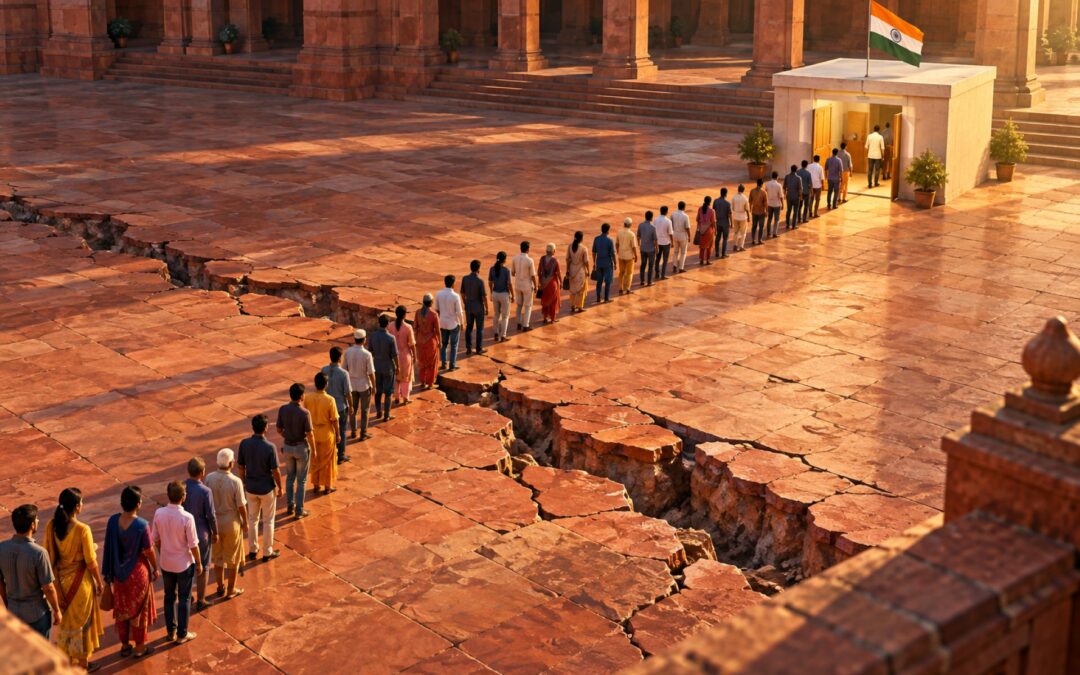
In 1950, Sukumar Sen, a mathematician and senior civil servant, became India’s first Chief Election Commissioner. His assignment was extraordinary: organise a national election for a country with approximately 173 million eligible voters, most of whom could not read or write. India was still recovering from Partition, millions lived in poverty, and the institutions of the new republic were only beginning to take shape. Yet its leaders had decided that ordinary citizens would choose their government, regardless of their wealth, education, caste, or social standing.
More than seven decades later, India conducted the largest democratic election in history. Nearly 980 million people were registered to vote in the 2024 Lok Sabha election, and approximately 646 million votes were cast. The parliamentary results deprived Prime Minister Narendra Modi’s Bharatiya Janata Party (BJP) of the majority it had previously enjoyed, demonstrating that even a powerful incumbent could suffer a significant electoral setback.
But India’s ability to conduct enormous elections has increasingly been accompanied by questions about the health of its democratic institutions. International organisations have downgraded their assessments of Indian democracy, citing concerns about press freedom, minority rights, electoral institutions, and restrictions on dissent. The government disputes many of these criticisms, while competitive elections and public protests continue to demonstrate the political influence of ordinary citizens.
This creates a historical puzzle. How did a country widely considered unprepared for democracy sustain it through wars, poverty, social divisions, and an authoritarian Emergency, only to face serious questions about democratic decline decades later? Understanding that contradiction requires examining not just how Indians gained the right to vote, but what happened to the institutions and social relationships that were supposed to give that right meaning.
The Republic That Chose Democracy Against the Odds
When India gained independence on 15 August 1947, its political future was uncertain. British colonial rule had left behind a limited system of representative institutions, an overwhelmingly agricultural economy, widespread poverty, and deep social inequalities. The British departure also coincided with Partition, which divided British India into the independent dominions of India and Pakistan.
The division triggered one of the largest migrations of the twentieth century. Millions of Hindus, Muslims, and Sikhs crossed the new borders, often fleeing communal violence. Estimates of the deaths vary considerably, but the violence, displacement, destruction of property, and separation of communities left both countries facing an enormous humanitarian crisis. The hurried demarcation of borders in Punjab and Bengal disrupted families, villages, transport networks, and agricultural systems that had previously functioned across the same territory.
India’s leaders also inherited the challenge of political integration. British India consisted of directly administered provinces alongside hundreds of princely states, whose relationships with the British Crown had differed from those of the provinces. The integration of these territories into the new Indian Union required negotiation, political pressure, and, in some cases, military intervention.
The resulting republic contained immense linguistic, religious, regional, and cultural diversity. No single language could provide a straightforward foundation for a uniform national identity, and communities differed considerably in their customs, economic circumstances, and political expectations. These differences created difficult questions about representation, national unity, and the distribution of political authority.
Caste presented another fundamental challenge. Traditional hierarchies had shaped access to land, education, occupations, religious institutions, and social status for generations. People from communities subjected to untouchability and other forms of caste discrimination frequently faced exclusion and coercion in everyday life. Granting an individual the right to vote did not automatically eliminate the social power exercised by landlords, dominant castes, and established local elites.
Many established democracies had introduced broad voting rights gradually, often after extensive economic and institutional development. Britain’s franchise expanded through successive reforms, while women and racial minorities in the United States faced long struggles against exclusion and discriminatory restrictions. India chose a markedly different route by adopting universal adult franchise at the founding of its republic.
Under the new Constitution, every qualifying adult citizen would receive the vote without property, educational, or caste qualifications. The original voting age was 21, later reduced to 18 in 1989. Instead of waiting for mass literacy, industrialisation, or the growth of a large middle class, India’s constitutional founders made democratic participation a starting point for national development.
Few understood the difficulties of this decision better than B. R. Ambedkar, chairman of the Constitution’s Drafting Committee. Born into a community subjected to untouchability, Ambedkar had spent much of his political career confronting the contradiction between formal legal rights and entrenched social inequality.
During the Constituent Assembly debate on 4 November 1948, Ambedkar warned that constitutional morality could not be assumed to arise naturally within society. Democratic institutions depended upon habits of restraint, respect for constitutional procedures, and acceptance of political rules that had to be cultivated.
His concerns became even more explicit in his final major address to the Constituent Assembly on 25 November 1949. He warned that India would enter political life with formal equality while continuing to experience profound inequality in social and economic life. He also cautioned that devotion to political leaders could become dangerous when personal loyalty displaced constitutional principles.
These were not arguments against democracy itself. They were warnings that constitutional democracy could become unstable if the society operating it failed to develop the values necessary to sustain it. India would have to build democratic institutions while simultaneously confronting the inequalities and political habits that threatened them.
Sukumar Sen and the Election That Made Democracy Real
The Constitution established the principle of universal adult franchise, but turning that principle into a functioning election required an extraordinary administrative undertaking.
Sukumar Sen was appointed India’s first Chief Election Commissioner in March 1950. A mathematician by training, he had to coordinate the electoral machinery of a country with difficult terrain, limited transport infrastructure, widespread illiteracy, and an electorate larger than that of any previous democratic election.
The practical challenges were immense. Election officials had to prepare electoral rolls, identify polling locations, recruit and train personnel, print voting materials, and transport ballot boxes across mountains, plains, forests, villages, and cities. Many communities lacked the infrastructure that would ordinarily make such an operation manageable.
Approximately 173 million people were registered for the first general election. More than 196,000 polling stations were established, and millions of steel ballot boxes were manufactured or assembled for use across the country. Voting took place over several months between October 1951 and February 1952, reflecting the enormous logistical challenge of reaching the electorate.
Illiteracy demanded particular ingenuity. Voters who could not read candidates’ names still needed a practical way to identify their preferences. Election authorities assigned candidates recognisable symbols, and polling stations used separate ballot boxes identified by candidates’ names and symbols. Familiar images enabled people to participate without having to read a printed list of candidates.
The election also required officials to explain electoral procedures to citizens who had never participated in a comparable national democratic exercise. In many places, the act of voting introduced people to the practical meaning of equal political citizenship, even when their everyday social relationships remained profoundly unequal.
According to the Election Commission of India’s historical account of the first general election, voters elected representatives to 489 Lok Sabha seats under the first-past-the-post system. The Indian National Congress won 364 seats with approximately 45% of the popular vote, allowing Jawaharlal Nehru to continue as prime minister with a substantial parliamentary majority.
The difference between Congress’s vote share and seat share was significant. India’s electoral system rewarded candidates who won constituencies rather than allocating parliamentary representation directly according to each party’s national vote percentage. This feature would remain important throughout the republic’s history, sometimes producing decisive parliamentary majorities without an equivalent majority of votes.
The greatest achievement of the election, however, was not the result. It was the establishment of a credible process through which millions of people could choose their political representatives.
The first election did not remove poverty, caste discrimination, or unequal influence. Nor did Congress’s overwhelming victory mean that political competition had already developed into a balanced multiparty system. Nevertheless, India had demonstrated that mass electoral participation was administratively possible under conditions that many observers considered deeply unfavorable.
Sen helped establish an electoral institution capable of repeating that achievement. Subsequent elections would expand participation, improve administrative procedures, and gradually turn voting into a familiar part of Indian political life.
How India Held Together Through Political Accommodation
Conducting a successful election was only the beginning. India also needed to manage the demands of communities whose linguistic, regional, and cultural identities did not fit neatly within the administrative boundaries inherited from colonial rule.
One of the earliest major challenges concerned the demand for a separate state for Telugu-speaking people. The existing Madras State included substantial Telugu-speaking regions, and campaigners argued that linguistic identity deserved recognition within India’s federal structure.
In 1952, activist Potti Sriramulu undertook a hunger strike in support of a separate Andhra state. His death in December, after a prolonged fast, sparked widespread protests and unrest. Nehru’s government initially resisted the pressure for linguistic reorganisation because of concerns that such demands might encourage fragmentation.
The intensity of the movement demonstrated that the existing arrangement had become politically unsustainable. The government announced its willingness to create Andhra State, which was established in October 1953. The decision helped establish a precedent for accommodating linguistic identities through territorial and constitutional change.
The wider issue could not be settled through a single new state. A commission examined India’s internal boundaries, and the States Reorganisation Act of 1956 reorganised large parts of the Union. India emerged from the process with fourteen states and six union territories, many of the new boundaries reflecting major linguistic communities.
This was a significant political choice. Rather than insisting that national unity required every region to subordinate its linguistic identity to a single dominant culture, the republic made room for several identities within a shared constitutional framework.
The process was not entirely peaceful, and linguistic politics did not eliminate regional conflicts. Disputes over language, territory, resources, and political representation continued to shape movements in different parts of India. Nevertheless, the government demonstrated that some seemingly divisive demands could be accommodated without dismantling the Union.
Elections contributed to this process by providing regional interests with a route into political institutions. Political parties could organise around local concerns, negotiate with national governments, and seek representation within state and central legislatures.
The Election Commission also accumulated experience as elections became recurring national events. Its ability to administer contests across increasingly diverse political environments helped establish continuity even when governments and political alliances changed.
India’s survival therefore depended on more than one successful electoral exercise. It involved the gradual development of mechanisms through which political conflict could be expressed, negotiated, and sometimes resolved without abandoning the constitutional system.
That resilience would face a far more dangerous test in 1975.
The Emergency: When Indian Democracy Nearly Broke
By the mid-1970s, Indira Gandhi had become one of India’s most powerful political figures. The daughter of Jawaharlal Nehru, she had consolidated considerable authority within the Congress party and the central government. Her leadership combined popular electoral appeal with an increasingly centralised style of political decision-making.
On 12 June 1975, the Allahabad High Court found Gandhi guilty of electoral malpractice in her 1971 parliamentary election and invalidated her election to the Lok Sabha. The judgment created a political crisis at a time when her government was already confronting opposition movements, economic difficulties, and growing public discontent.
On 25 June 1975, a national Emergency was proclaimed on the grounds of internal disturbance. The Emergency gave the central government extraordinary powers and marked the beginning of one of the most serious assaults on civil liberties in independent India’s history.
Opposition politicians were detained, press censorship was imposed, and restrictions on fundamental freedoms weakened citizens’ ability to challenge the government. Newspapers faced official controls over publication, while political organisations and activists operated under the threat of arrest.
The repression extended beyond prominent opposition leaders. Detention laws enabled authorities to imprison people without ordinary criminal trials, and the political atmosphere discouraged open criticism of government decisions. The concentration of executive authority undermined the constitutional expectation that public power should remain subject to scrutiny and restraint.
Among the most disturbing developments was the coercive implementation of population-control policies. Under the influence of Sanjay Gandhi and with the involvement of administrative authorities, sterilisation campaigns expanded dramatically. More than eight million sterilisation procedures were performed during 1976–77, and numerous cases involved coercion, intimidation, or pressure linked to access to essential services.
The Emergency demonstrated that democratic institutions could be hollowed out through powers exercised within an existing constitutional framework. Elections had previously established the government’s legitimacy, but the leadership now used state authority to restrict opposition and undermine the conditions necessary for meaningful political competition.
The judiciary, executive, legislature, and bureaucracy all became involved in disputes over the limits of constitutional authority. The crisis was therefore not simply a personal struggle between Indira Gandhi and her opponents. It exposed institutional weaknesses that allowed extraordinary government powers to operate with insufficient protection for individual rights.
Yet the Emergency ended in a way that distinguished India’s experience from many authoritarian reversals elsewhere.
In January 1977, Gandhi announced that general elections would be held. Her government expected to retain sufficient public support, but the electorate delivered a decisive rejection.
The March 1977 election produced a major victory for the opposition Janata Party. Congress lost its parliamentary dominance, and Gandhi herself was defeated in Rae Bareli. As documented in the President of India’s historical account of the 1977 election, Congress won only 154 seats, while the Janata Party secured 295. Gandhi lost her own constituency by more than 55,000 votes.
For the first time since independence, Congress moved into opposition at the national level. The transfer of power demonstrated that Indian voters could remove a government that had used extraordinary authority to suppress political competition.
The result was a profound statement about democratic resilience. Citizens whom earlier observers had considered too poor, divided, or politically inexperienced to sustain democracy had participated in reversing an authoritarian period through the electoral process.
However, the restoration of electoral competition did not mean that the deeper problems exposed by the Emergency had disappeared. The centralisation of power, vulnerability of civil liberties, and potential weakness of institutional safeguards remained questions for future governments.
The Emergency also gave lasting significance to Ambedkar’s warning about political devotion. A constitutional system cannot depend solely on the assumption that its leaders will voluntarily exercise restraint. It requires institutions and citizens capable of imposing limits when those leaders do not.
The Social Inequality Democracy Could Not Simply Abolish
India’s constitutional settlement established equality at the ballot box, but it could not immediately transform the distribution of social and economic power. The contradictions Ambedkar identified in 1949 continued to shape political life throughout the following decades.
Caste remained an important factor in access to education, employment, land, political office, and public resources. Constitutional protections, affirmative-action policies, and social reform movements challenged inherited discrimination, but the influence of caste varied considerably across regions and communities.
These social divisions inevitably entered electoral politics. Parties sought support from different caste groups, religious communities, and regional constituencies, while voters often evaluated candidates according to their ability to represent collective interests.
Such mobilisation cannot be understood simply as a corruption of democracy. For historically excluded communities, organising politically around caste identity sometimes became a means of challenging entrenched dominance. Representation in legislatures, access to public employment, and participation in government could provide groups with influence they had long been denied.
At the same time, community-based politics could create incentives for patronage and transactional bargaining. Political intermediaries might promise access to jobs, contracts, public benefits, or protection in exchange for electoral support. Where local social hierarchies remained powerful, voters could face pressure from influential community leaders.
The term vote bank emerged to describe communities perceived as providing reliable support to particular parties or candidates. Yet the concept can be misleading when it treats voters as passive members of a homogeneous bloc. Individuals frequently disagree with community leaders, change their voting preferences, and respond to wider political and economic considerations.
The implementation of the Mandal Commission’s recommendations in 1990 transformed the national debate over representation. The decision to reserve 27% of central government employment opportunities for Other Backward Classes, alongside existing reservations for Scheduled Castes and Scheduled Tribes, intensified political mobilisation around social justice and caste identity.
For supporters, the policy addressed historic exclusion and unequal access to state institutions. For opponents, it raised concerns about the distribution of opportunities and the role of caste in public policy. The controversy reshaped party competition and helped strengthen political formations representing previously marginalised communities.
It would be inaccurate, however, to suggest that reservation policies created identity-based voting or political patronage. Both predated Mandal, and their development involved local power structures, social movements, party organisations, economic inequalities, and changing electoral coalitions.
Another persistent concern is the presence of elected representatives facing criminal proceedings.
The Association for Democratic Reforms’ examination of the 2024 Lok Sabha winners found that 46% of newly elected MPs had declared criminal cases in their election affidavits. Approximately 31% had declared serious criminal cases, a category that includes allegations involving grave offences. The overall proportion had risen substantially compared with earlier parliamentary elections.
These figures require careful interpretation. A pending criminal case is not a conviction, and some politicians face proceedings arising from protests or politically motivated complaints. Indian law requires disclosure of such cases partly so that voters can make informed decisions rather than automatically treating every accused candidate as guilty.
Nevertheless, the prevalence of serious pending cases raises questions about political recruitment, party incentives, and the relationship between local power and electoral success.
In constituencies where public services are unreliable, legal disputes take years to resolve, or government benefits depend heavily on intermediaries, voters may place considerable value on candidates perceived as capable of getting things done. Sometimes that reputation is associated with wealth, social influence, or the ability to mobilise supporters through coercive networks.
Political parties may also prefer candidates who can finance expensive campaigns or command established local organisations. These incentives can allow individuals with controversial backgrounds to remain electorally competitive.
The broader problem is not that Indian voters are incapable of choosing responsibly. It is that electoral choices occur within unequal social and institutional conditions. Formal voting rights coexist with differences in wealth, security, information, and access to public authority, affecting both who can enter politics and how citizens experience government.
How Democratic Competition Comes Under Pressure
India’s regular elections demonstrate that political competition remains an important feature of public life. But elections cannot be evaluated only by examining whether votes are cast and counted. Their democratic significance also depends on whether political parties can compete under fair conditions, whether public institutions operate independently, and whether citizens can scrutinise those who govern them.
Several developments over the past decade have intensified debate about these conditions. Changes to the appointment of election commissioners, controversies surrounding political finance, concerns about media independence, and restrictions affecting activists and critics are distinct issues. Together, however, they raise a common question about the institutional environment in which Indian political competition takes place.
Who Chooses the Election Referees?
The Election Commission of India occupies a central position in the country’s constitutional framework. Established under Article 324, it supervises elections to Parliament, state legislatures, and the offices of president and vice-president.
Its responsibilities include overseeing electoral rolls, administering polling and counting processes, enforcing election-related rules, and helping ensure that competing parties are treated according to established procedures.
Because the Commission regulates contests involving the government itself, its independence is particularly important. A ruling party should not be able to determine electoral conditions solely according to its own interests.
For many years, the appointment of election commissioners rested largely with the executive. Critics argued that this arrangement provided insufficient protection against political influence, even though commissioners enjoyed significant constitutional and statutory safeguards once appointed.
In March 2023, the Supreme Court addressed the appointment process and directed that, until Parliament enacted a law, appointments should be recommended by a committee consisting of the prime minister, the leader of the opposition in the Lok Sabha, and the Chief Justice of India.
The arrangement was intended to reduce the executive’s exclusive influence over appointments. However, Parliament subsequently enacted legislation establishing a different committee.
Under the 2023 law, the selection committee consists of the prime minister, a Union cabinet minister nominated by the prime minister, and the leader of the opposition or the leader of the largest opposition party in the Lok Sabha.
The Chief Justice was therefore replaced by another member of the executive. As PRS Legislative Research explains in its analysis of the election commissioners’ appointment law, this arrangement gives government representatives a majority on the selection committee.
Supporters of the legislative approach can argue that Parliament has constitutional authority to establish the appointment procedure and that elected representatives should play a central role in selecting public officials. The presence of an opposition representative also introduces a formal element of political scrutiny.
Critics counter that a government-majority committee can select commissioners without opposition agreement, weakening the perception that the election authority is insulated from the ruling party. This concern is especially significant because the Commission must make decisions that may directly affect the government responsible for appointing its members.
The appointment structure alone does not prove that election results are manipulated or that individual commissioners act improperly. Questions about institutional design, the conduct of particular officials, and the validity of specific electoral decisions require separate evidence.
Nevertheless, independence must be considered both in terms of actual conduct and the safeguards designed to protect public confidence. When the institution responsible for supervising political competition is perceived as vulnerable to executive influence, disputes about electoral fairness become more difficult to resolve.
Who Funds Political Power?
Money has always influenced electoral politics, but the rules governing political donations determine how much citizens can discover about the financial relationships between political parties and their supporters.
In 2018, India’s electoral-bonds scheme became operational as a mechanism for donating money to eligible political parties through designated banking channels. Donors could purchase bonds from the State Bank of India, which political parties could then redeem.
The scheme was defended as a way to bring political contributions into the formal financial system while protecting donor confidentiality. Supporters argued that encouraging transactions through banks would be preferable to relying on unaccounted cash donations.
However, the arrangement created serious transparency concerns. Although banks maintained certain transaction records, ordinary citizens did not have access to comprehensive information identifying political donors and the parties receiving their money.
Changes to corporate donation rules also allowed companies to contribute without the earlier overall limits tied to profitability. Critics warned that these arrangements could facilitate financial dependence between political parties and large corporate interests while preventing voters from evaluating potential conflicts of interest.
The controversy eventually reached the Supreme Court.
In February 2024, the Court struck down the electoral-bonds scheme, holding that the non-disclosure of political funding information violated citizens’ constitutional right to information. It also found the removal of restrictions on corporate political contributions constitutionally defective.
The Supreme Court’s subsequent proceedings concerning disclosure of electoral-bond records required the State Bank of India to provide information about bond purchases and redemptions, making previously concealed political-funding details available for public examination.
The disclosures revealed substantial differences in the amounts received by political parties, with the BJP emerging as the largest beneficiary of the scheme. Opposition parties also received electoral-bond donations, demonstrating that the controversy concerned the wider financing system rather than a practice used exclusively by one party.
Large donations do not automatically prove corruption or establish that a particular government decision was purchased. Demonstrating such wrongdoing requires evidence connecting financial contributions to improper official conduct.
The constitutional problem was broader. Citizens were being asked to evaluate political parties without access to important information about the financial interests supporting them.
A democracy can hold competitive elections while allowing significant inequalities in campaign resources. Political funding becomes a particularly serious concern when differences in financial capacity are combined with limited transparency, weak oversight, or privileged access to decision-makers.
The electoral-bonds judgment demonstrated that constitutional institutions could still impose meaningful restrictions on government policy. At the same time, the controversy exposed how rules enacted through ordinary legislation could substantially change the information available to voters.
Who Shapes the Public Debate?
Elections depend on citizens having access to information about public affairs. Voters need opportunities to evaluate government performance, hear competing political arguments, investigate allegations, and question those seeking power.
The media plays a central role in this process. Journalists can investigate wrongdoing, challenge official explanations, and make information accessible beyond the institutions where political decisions are made.
India possesses an enormous and diverse media environment, including newspapers, television networks, digital publications, regional-language outlets, and independent journalists. The expansion of digital media has also created new opportunities for political criticism and citizen-led reporting.
Yet the existence of many outlets does not automatically guarantee that journalism can operate without significant pressure.
Media organisations may depend on government advertising, face legal or regulatory challenges, or operate within ownership structures linked to powerful business groups. Journalists can encounter political intimidation, harassment, litigation, and threats from both state and nonstate actors.
These problems are not exclusive to any single administration. Governments led by different political parties have used legal and economic pressure against critical journalists. However, concerns about the scale and character of these pressures have become particularly prominent during Narendra Modi’s tenure.
A significant development occurred in 2022 when the Adani Group acquired control of NDTV, a major television news organisation historically associated with critical coverage of governments. The acquisition raised questions about media concentration and the relationship between business power and political influence.
Gautam Adani has frequently been described as having close ties to Modi, although such descriptions do not establish that every editorial decision within a company he controls is directed by the government. Ownership changes should be evaluated through evidence about management, editorial independence, and the resulting media environment rather than treated as automatic proof of censorship.
The wider concerns are reflected in Reporters Without Borders’ assessment of press freedom in India. Its 2026 World Press Freedom Index ranked India 157th among 180 countries, citing problems involving violence against journalists, concentrated ownership, political alignment, and pressure on independent reporting.
The index measures several dimensions of press freedom, including political, economic, legal, social, and security conditions. It does not establish that all Indian journalism is controlled by the government or that independent reporting has disappeared.
Indeed, critical journalism continues to exist across print, digital, and regional media. Investigative reporting and public debate remain important sources of scrutiny.
The central question is whether journalists can perform this function consistently without disproportionate legal, financial, or physical risks. A political system may retain many news organisations while still experiencing a reduction in the freedom and independence with which they operate.
What Happens When Citizens Dissent?
The ability to criticise a government is one of the clearest distinctions between electoral participation and broader democratic freedom. Voting provides citizens with periodic influence over who governs, while freedoms of expression, association, and peaceful assembly allow them to challenge government decisions between elections.
India’s Constitution protects these freedoms, subject to legally permitted restrictions. Governments also possess legitimate responsibilities to address terrorism, serious violence, and threats to public order.
The difficulty lies in ensuring that powers created for those purposes are not applied in ways that unnecessarily suppress lawful political activity.
One important area of debate concerns the Unlawful Activities (Prevention) Act, commonly known as UAPA. Originally enacted in 1967 and subsequently amended, the law provides authorities with powers to investigate and prosecute unlawful activities and terrorism-related offences.
The legislation’s stringent bail provisions have attracted particular criticism. In relevant terrorism-related cases, obtaining bail can be exceptionally difficult, creating the possibility of prolonged detention while criminal proceedings remain unresolved.
Official figures illustrate the scale of the law’s application, although they must be interpreted carefully.
According to information provided by the Ministry of Home Affairs to the Lok Sabha, 10,440 people were arrested under UAPA between 2019 and 2023, while 335 convictions were recorded during those calendar years.
These totals cannot legitimately be divided to calculate a conviction rate for the people arrested in that period. Convictions recorded in a particular year may relate to arrests made earlier, while many cases involving recent arrests may still be proceeding through the courts.
The figures nevertheless raise important questions about prosecution timelines, pretrial detention, and the treatment of accused people who have not been convicted. The legal and human consequences of lengthy proceedings can be substantial regardless of the eventual outcome.
The case of Stan Swamy illustrates these concerns. Swamy, an elderly Jesuit priest and activist who had worked with marginalised communities, was arrested under UAPA in connection with the Bhima Koregaon case. He denied the allegations against him and died in custody in July 2021 at the age of 84, without having been convicted.
His detention and death generated criticism from civil-liberties organisations and human-rights advocates, who questioned the treatment of elderly and medically vulnerable accused persons. The case became part of a wider debate about the relationship between national-security legislation, judicial safeguards, and individual rights.
Digital restrictions have created another area of concern. India has repeatedly recorded large numbers of internet shutdowns, often justified by authorities as necessary for public order or security. Such restrictions can affect emergency communication, education, economic activity, journalism, and the organisation of peaceful political movements.
Governments may sometimes face genuine security threats requiring carefully designed restrictions. However, the democratic legitimacy of such measures depends on their necessity, proportionality, legal basis, and availability of meaningful review.
The wider issue is whether citizens can oppose the government without facing unreasonable risks to their liberty or livelihood. Electoral competition becomes less meaningful if political participation outside the polling station is subject to excessive restriction.
Is India Still a Democracy? What the Rankings Actually Measure
The concerns surrounding India’s institutions have influenced international assessments of its political system. However, the organisations producing these assessments do not all measure democracy in the same way, and their conclusions require careful interpretation.
The V-Dem Institute, based at the University of Gothenburg, evaluates countries using an extensive collection of indicators concerning elections, political participation, civil liberties, institutional constraints, and other features of governance.
Its Democracy Report 2026 continued to classify India as an electoral autocracy, a category it has applied to the country since 2017. India ranked 105th on the Liberal Democracy Index using the report’s 2025 data.
The classification does not mean elections have ceased to occur. Rather, V-Dem’s assessment is that deficiencies in democratic freedoms, institutional checks, or the conditions of political competition are sufficiently serious that the country no longer meets its threshold for electoral democracy.
Freedom House uses a different assessment framework. Its evaluations cover political rights and civil liberties, examining electoral processes alongside freedom of expression, association, personal autonomy, and the functioning of government.
In its 2026 assessment of India, Freedom House classified the country as Partly Free, assigning it 62 out of 100 points. It identified concerns involving discrimination, harassment of critics, and restrictions on civil liberties.
Yet Freedom House also regarded India’s national electoral process as generally free and fair, noting that Modi secured another term after the NDA won a parliamentary majority in 2024.
This distinction matters. It would be inaccurate to present Freedom House’s assessment as proof that Indian election results are fabricated or that the electorate has no meaningful influence over government formation.
Reporters Without Borders evaluates a narrower question: the conditions under which journalists and media organisations operate. Its low ranking for India provides evidence of significant press-freedom concerns, but it is not intended as a complete classification of the country’s political system.
The Indian government has challenged international democracy rankings, arguing that their methods can be subjective, politically influenced, or insufficiently attentive to India’s distinctive circumstances. Those criticisms deserve evaluation through the actual methodologies and evidence used by rating institutions.
Expert-based assessments inevitably involve decisions about which political characteristics matter, how they should be weighted, and how uncertain information should be interpreted. Rankings can illuminate patterns without providing an infallible measurement of a country’s political reality.
Nevertheless, methodological uncertainty does not make institutional concerns disappear. Laws governing election oversight, restrictions on civil liberties, the treatment of journalists, and political-finance disclosures can be examined directly, independently of any international index.
The important distinction is between electoral democracy as a mechanism for choosing governments and liberal-democratic safeguards that limit how those governments exercise power.
India retains large-scale competitive elections, powerful regional parties, constitutional institutions, and an electorate capable of delivering unexpected results. It also faces serious concerns about whether the broader conditions of political competition and individual freedom meet the standards expected of a robust constitutional democracy.
Understanding both realities is more useful than reducing the country to an unqualified declaration that democracy is either functioning perfectly or has already ceased to exist.
The 2024 Election and the Limits of Political Dominance
The 2024 Lok Sabha election offered one of the clearest demonstrations that India’s electoral system could still produce significant political consequences for a powerful incumbent government.
The BJP entered the contest after a decade in power under Narendra Modi. Its campaign projected confidence in the prime minister’s popularity and sought an exceptionally large parliamentary mandate for the National Democratic Alliance.
The slogan Abki Baar, 400 Paar expressed the coalition’s ambition to cross 400 seats in the Lok Sabha. Such a result would have represented overwhelming parliamentary dominance.
The electorate delivered a different outcome.
According to the Election Commission’s Atlas of the 2024 general election, approximately 979.8 million people were registered to vote, and around 646.4 million votes were cast, including postal ballots. The overall voter turnout was approximately 66.1%, excluding the uncontested Surat constituency from the turnout calculation.
The figures reflected an administrative operation of unprecedented scale. Polling arrangements extended across India’s immense geographical and social diversity, involving more than a million polling stations and thousands of candidates.
The parliamentary results were considerably less favorable to the BJP than its campaign ambitions suggested.
According to the Inter-Parliamentary Union’s account of the 2024 election, the BJP won 240 Lok Sabha seats, falling below the 272 required for a standalone majority in the 543 elected seats. This represented a decline from the 303 seats it had secured in 2019.
The Congress increased its parliamentary representation, while regional parties and opposition alliances made important gains. The BJP remained the largest single party and continued to govern through the NDA, relying on coalition partners including the Telugu Desam Party and Janata Dal (United).
Modi therefore began a third term as prime minister, but under different parliamentary circumstances. Coalition management became more important, and the ruling party could no longer assume that its own MPs alone would provide a majority.
The election demonstrated an important limit to political dominance. Voters could reduce the parliamentary power of a popular and well-resourced incumbent without producing a complete change of government.
It also complicated claims that India’s electoral process had become meaningless. A system entirely incapable of registering public dissatisfaction would not readily produce such a significant setback for the governing party.
However, the result did not settle every concern about democratic quality. Electoral competition can remain meaningful while political parties dispute campaign conditions, institutional neutrality, media access, and the treatment of opposition figures.
The appropriate conclusion is therefore neither that the 2024 result disproved every warning about democratic decline nor that those warnings rendered the result insignificant.
The election showed that citizens retained substantial power at the ballot box. What remained contested was the broader institutional environment in which that power was exercised.
The Cockroach Janta Party and India’s New Protest Politics
In May 2026, a controversy surrounding remarks about unemployed young people helped produce an unexpected political movement.
Supreme Court judge Surya Kant had made remarks interpreted as comparing unemployed youth to cockroaches, although he subsequently maintained that his comments had been misconstrued. The episode attracted criticism at a time when concerns about unemployment and access to educational opportunities were already prominent among young Indians.
Abhijeet Dipke, a political communications strategist from Maharashtra, responded with a satirical social-media post asking what would happen if cockroaches came together. The idea soon developed into the Cockroach Janta Party, or CJP, an initially satirical political platform that used the insulting comparison as a symbol of collective identity.
What began as mockery of an establishment remark became a vehicle for expressing wider frustration. The movement attracted attention from young people concerned about employment, public examinations, government accountability, and the responsiveness of political institutions.
As Reuters documented in its July 2026 profile of Abhijeet Dipke, the movement’s appeal extended beyond online humour. It developed into a major protest platform capable of bringing demonstrators into the streets and attracting support from established political groups.
The controversy surrounding the National Eligibility cum Entrance Test, or NEET, became a central grievance. Allegations of examination paper leaks and irregularities raised concerns about fairness in a highly competitive system affecting millions of students seeking entry into medical education.
For students who devote years to preparing for such examinations, the integrity of the process has immediate consequences. Suspected leaks and administrative failures undermine confidence that academic effort will translate into opportunity according to established rules.
The Cockroach Janta Party helped mobilise protests demanding accountability from the Union government. Demonstrations at Jantar Mantar in Delhi developed into a prolonged campaign, while other activists and political organisations joined demands for action.
The participation of Sonam Wangchuk, an activist known for his work on environmental and educational concerns, attracted further attention. Hunger strikes, student mobilisation, and confrontations with the authorities increased the political pressure surrounding the examination controversy.
In July 2026, Education Minister Dharmendra Pradhan resigned amid the protests. According to The Indian Express’s report on his resignation, he announced his decision while facing sustained demands for accountability over the NEET controversy.
The resignation was an important political development because the protesters had made his departure a central demand. It demonstrated that organised public pressure could coincide with a significant change at the highest levels of government.
At the same time, it would be overly simplistic to attribute the resignation exclusively to one protest organisation. The examination controversy involved student grievances, opposition-party pressure, administrative criticism, and wider political calculations.
The movement’s significance extended beyond the departure of a minister.
Its development illustrated how political mobilisation could begin outside conventional party structures. Social media provided a means of transforming a shared grievance into a collective identity, while physical demonstrations gave that identity a presence that governments could not address simply by ignoring an online discussion.
By October 2026, the Cockroach Janta Party had become involved in a different controversy concerning India’s electoral rolls.
Opposition leaders, student organisations, and CJP activists challenged a large-scale revision of voter lists, alleging that substantial numbers of names had been removed in ways that could disadvantage vulnerable communities or benefit the ruling BJP.
The Election Commission rejected allegations of political bias and defended the revision as an effort to improve the accuracy of electoral records by identifying duplicate, deceased, relocated, or otherwise ineligible entries. It maintained that eligible voters removed incorrectly could pursue procedures for restoring their names.
These competing positions involve a serious question about electoral rights. Accurate voter lists are necessary to prevent fraud and administrative errors, but revisions can also produce exclusion if eligible citizens face unreasonable documentation requirements or barriers to correcting mistakes.
The relevant issue is not simply how many entries are deleted. It is whether the revision process treats citizens fairly, provides effective opportunities to challenge errors, and avoids unjustified exclusion from the franchise.
The controversy generated renewed demonstrations demanding the resignation of Chief Election Commissioner Gyanesh Kumar. On 16 October, protests in Delhi’s Connaught Place and other locations led to police intervention and detentions.
Reuters’ coverage of the October demonstrations described the mobilisation, the authorities’ public-order response, and the competing claims surrounding the electoral-roll controversy. The government and BJP characterised elements of the agitation as politically motivated attempts to undermine confidence in legitimate electoral administration, while demonstrators argued that their voting rights and ability to protest were under threat.
The allegations concerning voter-list manipulation require independent evidence and should not be treated as established proof of deliberate electoral fraud. Equally, the existence of official explanations does not eliminate the need for transparent scrutiny of administrative decisions affecting citizens’ right to vote.
The movement demonstrates something important about political participation in India. Elections are not the only occasion on which citizens seek to influence those who govern them. Protests, public campaigns, litigation, journalism, and organised pressure also shape the relationship between society and the state.
The ability of a satirical movement to attract nationwide attention, contribute to a major ministerial controversy, and challenge electoral authorities reveals continuing capacities for political mobilisation. The restrictions, arrests, and confrontations surrounding its activities simultaneously raise questions about how freely those capacities can be exercised.
Neither the growth of the movement nor the government’s response provides a complete verdict on Indian democracy. Together, they reveal a political system in which citizens continue to organise against concentrated power, while the boundaries of legitimate dissent and institutional accountability remain contested.
India’s democratic experiment began with the conviction that political equality could be established before the country had achieved social or economic equality. That decision gave millions of people a formal share in government, and the survival of electoral competition through extraordinary crises demonstrated the durability of the institutions created at independence.
But Ambedkar’s warnings remain relevant because elections were never intended to be the entirety of democracy. Political equality becomes incomplete when unequal social power restricts people’s practical choices, while devotion to leaders becomes dangerous when institutions lose the independence necessary to hold those leaders accountable.
The history of Indian democracy therefore resists both easy celebration and inevitable predictions of collapse. Its voters have removed governments, overturned authoritarian rule, weakened dominant parties, and repeatedly challenged established political authority. At the same time, the continuing disputes over institutions, political finance, civil liberties, and dissent show that the existence of elections cannot resolve every question about democratic freedom.
The enduring lesson is that democracy must be judged by more than the regularity of voting. Its strength also depends on whether citizens can criticise those in power, whether minorities and dissenters enjoy meaningful protection, whether institutions apply rules impartially, and whether political authority remains accountable between elections. India’s remarkable democratic survival is an achievement of its citizens and institutions, but the quality of that democracy depends on how those principles are upheld in practice.
Last Updated on October 18, 2026 by Aseem Gupta