
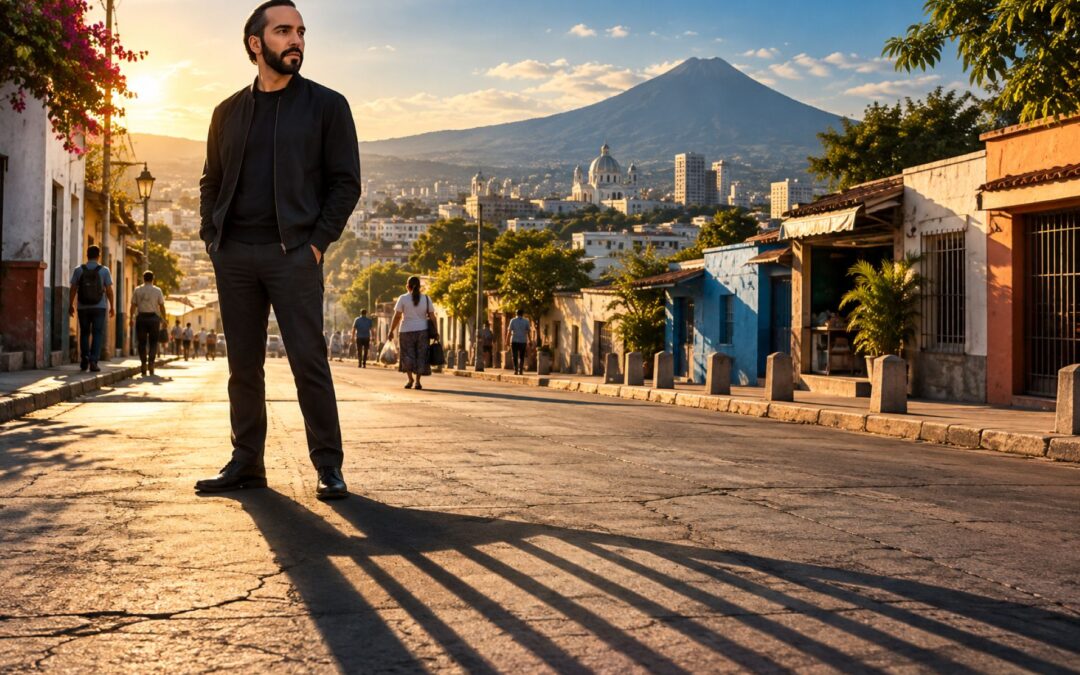
For years, everyday life in El Salvador was governed by invisible boundaries. Residents of one neighborhood could risk their lives by entering another. Small businesses paid extortion money to criminal gangs, families feared that their children would be forcibly recruited, and entire communities lived under the authority of armed groups that operated beyond the government’s control. For many Salvadorans, freedom meant something as basic as being able to walk down the street without permission from a gang.
Today, that reality has changed dramatically. Under President Nayib Bukele, the government has dismantled much of the territorial control exercised by the country’s notorious gangs, MS-13 and Barrio 18. El Salvador, once among the world’s most violent countries, now reports one of the lowest homicide rates in the Americas. Bukele has become extraordinarily popular, with millions of Salvadorans crediting him for restoring security that previous governments had failed to provide.
Yet this transformation has come with extraordinary consequences. More than 90,000 people have been arrested under emergency measures introduced in 2022, constitutional protections have been weakened, and the government has accumulated powers that extend well beyond fighting organized crime. Human rights organizations have documented arbitrary detention, deaths in custody, and the erosion of judicial independence.
El Salvador presents a difficult political question because two realities coexist: the country has become substantially safer from criminal gangs, while its democratic safeguards have deteriorated. Understanding how both developments became possible requires examining the history that brought Bukele to power and the system he constructed to defeat the gangs.
How El Salvador’s Gangs Took Root
El Salvador’s modern crisis of gang violence has roots in a much older history of inequality, political repression, and civil conflict. During the late nineteenth and early twentieth centuries, the country’s economy was dominated by powerful landowning families whose wealth depended heavily on coffee production. Popularly described as the Fourteen Families, this oligarchy was not literally restricted to fourteen households, but the expression captured the concentration of economic and political power.
Large sections of the population, particularly rural laborers and Indigenous communities, faced poverty and limited political representation. Land disputes and demands for reform repeatedly brought them into conflict with an establishment supported by the military. In 1931, General Maximiliano Hernández Martínez seized power, beginning a period in which military governments dominated Salvadoran politics. The following year, the state brutally suppressed an uprising involving peasants, Indigenous people, and left-wing activists. The massacre, known as La Matanza, killed thousands, with estimates commonly reaching into the tens of thousands.
Political repression continued through subsequent decades. By the late 1970s, escalating inequality, fraudulent elections, political assassinations, and violence by security forces and death squads had pushed the country toward civil war. A reformist military coup in October 1979 promised political change, but the new authorities failed to contain the violence.
Among the most prominent critics was Archbishop Óscar Romero, who condemned government repression and appealed for an end to American military support. On March 24, 1980, Romero was assassinated while celebrating Mass. His murder became one of the defining symbols of El Salvador’s descent into civil war.
The conflict pitted the Salvadoran government and armed forces against the Farabundo Martí National Liberation Front (FMLN), a coalition of left-wing guerrilla organizations. The United States provided substantial support to the government, viewing the conflict through the Cold War struggle against communism. The war lasted twelve years, killed approximately 75,000 people, and displaced large portions of the population before ending with the 1992 Chapultepec Peace Accords. The United Nations’ account of the peace process documents the effort to end the fighting and rebuild the country’s political and security institutions.
The war also produced a migration movement with consequences that would eventually return to El Salvador. Hundreds of thousands of Salvadorans fled abroad, particularly to the United States, where substantial communities settled in Los Angeles. Young Salvadoran immigrants encountered established street gangs, discrimination, and violence in disadvantaged neighborhoods.
MS-13 emerged in Los Angeles during the 1980s among Salvadoran immigrants, while the older 18th Street Gang, also known as Barrio 18, recruited members from several immigrant communities, including Salvadorans. Both organizations developed increasingly violent rivalries and criminal networks. Their growth would become particularly consequential when American immigration policy began returning larger numbers of people with criminal records to Central America.
The 1996 Illegal Immigration Reform and Immigrant Responsibility Act expanded grounds for deportation and strengthened immigration enforcement. Deportations were already occurring, but the changes accelerated the return of individuals who had developed criminal connections in the United States. Many arrived in a country still struggling to rebuild its institutions after a devastating civil war.
Research by economist Maria Micaela Sviatschi, published in the American Economic Review as Spreading Gangs: Exporting US Criminal Capital to El Salvador, found that these deportations contributed to higher homicide rates, gang activity, recruitment, and subsequent migration. The returning individuals brought not just personal experience but organizational knowledge and criminal connections.
Deportation alone did not create El Salvador’s gang crisis. Poverty, weak institutions, limited economic opportunities, and the disruption caused by years of conflict also mattered. Nevertheless, the interaction between these conditions and returning gang networks helped transform local criminal groups into organizations capable of challenging the Salvadoran state.
Why the Old Security Strategies Failed
By the early twenty-first century, MS-13 and Barrio 18 had established extensive control over Salvadoran communities. They demanded payments from shopkeepers, transport operators, and street vendors, punished those who resisted, and recruited young people through intimidation. Gang membership could offer income, identity, and protection in neighborhoods where legitimate opportunities were scarce, while leaving could invite violent retaliation.
Their authority extended beyond conventional criminal activity. Residents sometimes needed permission to cross neighborhood boundaries, visit relatives, or maintain relationships with people from rival territories. The gangs effectively exercised coercive control over everyday life, undermining the government’s ability to guarantee freedom of movement, personal security, and commercial activity.
Successive governments attempted to regain control through aggressive security policies collectively associated with mano dura, or iron-fist policing. Beginning in the early 2000s, these strategies emphasized mass arrests, increased penalties, and military participation in public security. Although intended to incapacitate gang members, overcrowded prisons sometimes became environments in which criminal organizations consolidated their internal hierarchies and maintained communication with members outside.
The problem was not simply that law enforcement was too weak. The gangs were increasingly capable of operating as organized institutions, with leadership structures, recruitment systems, financial resources, and influence over particular neighborhoods. Arresting individual members did not necessarily destroy the wider network, especially when recruitment continued and imprisoned leaders retained influence.
In 2012, another approach emerged when the government facilitated a controversial truce between MS-13 and Barrio 18. Homicides initially declined, suggesting that gang leaders exercised considerable influence over the violence committed by their organizations. But the arrangement lacked transparency, faced intense public opposition, and did not permanently dismantle the gangs’ extortion networks or territorial control.
When the truce broke down, violence escalated again. In 2015, El Salvador recorded a homicide rate exceeding 100 per 100,000 people, placing it among the most violent countries in the world.
The repeated failure of confrontation and negotiation damaged confidence in the two parties that had dominated Salvadoran politics after the civil war: the right-wing Nationalist Republican Alliance (ARENA) and the former guerrilla movement FMLN. Both had governed, and neither had established lasting control over the country’s security crisis. Their inability to deliver safety created an opening for a politician who promised to abandon the old political order.
The Rise of Nayib Bukele
Nayib Bukele did not enter politics as a conventional representative of El Salvador’s poor or marginalized communities. Born in 1981 into an affluent family of Palestinian descent, he grew up with advantages unavailable to much of the population. His father, Armando Bukele, was a successful businessman whose commercial interests included advertising and other industries.
Bukele became involved in the family advertising business, gaining experience in public relations and political communication. The firm’s relationship with the FMLN brought him into contact with the political establishment, and in 2012 he became mayor of Nuevo Cuscatlán under the party’s banner. Three years later, he was elected mayor of San Salvador, the national capital.
His appeal rested partly on his ability to present himself as a modern administrator who understood communication, public image, and the frustrations of younger voters. While traditional Salvadoran politics remained strongly shaped by its Cold War divisions, Bukele increasingly emphasized practical results, modernization, and opposition to corruption.
However, his relationship with the FMLN deteriorated. Party leaders accused him of misconduct and insubordination, and in 2017 he was expelled following disciplinary proceedings that included allegations of insulting and mistreating a female party official. Bukele rejected the legitimacy of his expulsion and portrayed himself as a victim of an outdated political establishment.
He subsequently created Nuevas Ideas, a political movement built around his personality and the promise of a break with traditional party politics. When it could not complete the necessary registration arrangements in time for the 2019 presidential election, he ran under the banner of the established GANA party.
Bukele’s campaign relied heavily on social media, allowing him to communicate directly with voters and reduce his dependence on traditional news organizations. He cultivated the image of a young, technologically fluent outsider willing to challenge entrenched institutions. In February 2019, he won the presidency in the first round with approximately 53% of the vote, ending three decades of presidential competition dominated by ARENA and the FMLN.
His political success was particularly striking because he had previously worked within the very establishment he was attacking. Rather than presenting a comprehensive new ideology, he offered a combination of anti-corruption rhetoric, administrative modernization, and promises of decisive leadership.
Security quickly became central to his presidency, although the mass crackdown most closely associated with him did not begin immediately. In June 2019, Bukele introduced the Territorial Control Plan, which increased the presence of police and soldiers in gang-affected areas, strengthened prison restrictions, and expanded security operations. Confrontational measures were already evident in 2020, when the government imposed severe restrictions on imprisoned gang members following a surge in killings.
Homicides declined during these early years, although the causes remain contested. Bukele’s government credited its security strategy, while investigations later raised questions about whether secret negotiations with gangs had also contributed to the reduction.
By 2021, Nuevas Ideas had secured a commanding legislative majority. Bukele now possessed not only the presidency but also the political capacity to reshape the country’s institutions. The following year, a sudden outbreak of violence provided the immediate justification for a much more sweeping transformation.
March 2022: The Weekend That Changed Everything
Between March 25 and 27, 2022, El Salvador experienced an extraordinary wave of gang-related killings. Approximately 87 people were murdered over the three-day period, including 62 on March 26 alone. The sudden violence shocked a population that had already experienced years of insecurity and exposed how much destructive power criminal organizations continued to possess.
The killings occurred against a background of serious allegations concerning negotiations between government officials and gang leaders. Investigative reporting had described covert contacts, and in December 2021 the United States Treasury Department announced sanctions against Salvadoran officials involved in what it described as negotiations with MS-13 and Barrio 18.
According to Treasury’s findings, officials had offered financial incentives and prison privileges in exchange for reduced violence and political support. The findings challenged the government’s public presentation of its security strategy as an exclusively confrontational campaign. Bukele’s administration disputed allegations of improper agreements, and the exact circumstances surrounding the March 2022 killings remain contested.
Nevertheless, the sudden wave of murders made clear that the gangs retained the capacity to inflict widespread violence. Bukele responded by demanding extraordinary legal powers and launching an intensified campaign against gang structures.
On March 27, the Legislative Assembly approved a nationwide régimen de excepción, or state of exception. As the Assembly’s official announcement explained, the measure temporarily suspended specified constitutional guarantees, including protections involving communications, assembly, and the rights of detained individuals. It also permitted authorities to hold suspects for longer periods before bringing them before judicial authorities.
This was not a wholesale suspension of the Salvadoran Constitution. The state of exception was a constitutionally recognized emergency mechanism, initially approved for thirty days and subject to legislative renewal. Its significance lay in the powers it granted security forces and the progressive normalization of extraordinary restrictions.
The government argued that conventional criminal procedures were inadequate against organizations capable of intimidating witnesses, threatening police officers, and exercising control over entire communities. Bukele presented the confrontation as a struggle to recover territory and protect citizens from groups that had effectively replaced legitimate state authority.
With overwhelming legislative support, the government began arresting suspected gang members on an unprecedented scale. The operation quickly became one of the most aggressive domestic security campaigns in modern Latin American history.
Inside El Salvador’s State of Exception
Bukele’s crackdown combined military deployment, expanded police powers, mass detention, stricter prison administration, and changes to criminal proceedings. Its underlying objective was to remove gang members from the communities they controlled while preventing imprisoned leaders from continuing to direct criminal activities.
Unlike earlier security campaigns that often focused on individual arrests or temporary territorial operations, the new approach attempted to incapacitate entire criminal networks. Its speed and scale made it possible to disrupt gang organizations across numerous communities simultaneously. The same approach also created serious problems for identifying suspects accurately and protecting individuals against wrongful detention.
The Raids and Mass Arrests
Police and military forces established checkpoints, conducted neighborhood searches, and surrounded areas identified as gang strongholds. In some operations, security forces restricted movement into and out of particular communities while searching for suspected members of MS-13 and Barrio 18.
Authorities used intelligence records, criminal histories, suspected gang affiliations, tattoos, information supplied by residents, and other indicators to identify individuals for arrest. In communities where gang membership was difficult to distinguish from family connections or ordinary social contact, these methods created substantial risks of misidentification.
The government’s operational advantage came from the emergency powers that reduced procedural obstacles to detention. Security forces could arrest large numbers of suspects rapidly, without immediately satisfying the evidentiary requirements that would ordinarily govern prolonged detention. The strategy also relied on the visible presence of armed personnel to demonstrate that the state, rather than the gangs, controlled public space.
The results were dramatic. Tens of thousands of people were detained within the first months, and the total eventually exceeded 90,000 arrests under the emergency regime. For established gang organizations, the simultaneous detention of members and the restriction of communication with imprisoned leaders severely disrupted their ability to operate.
Yet the definition of gang collaboration was often broad. Individuals could be accused of assisting criminal organizations because of personal associations, neighborhood relationships, or activities undertaken under coercion. The distinction between a willing participant, someone forced to comply with gang demands, and an uninvolved resident became critically important.
For the government, rapid arrests were necessary to prevent the gangs from regrouping and retaliating. For critics, the scale of detention and weakened procedural protections meant that the system could deprive innocent people of their liberty without meaningful opportunities to contest the accusations.
The campaign’s extraordinary effectiveness at removing suspected gang members from neighborhoods therefore existed alongside an equally significant question about the reliability of the process used to identify them.
CECOT and the Detention System
A central symbol of Bukele’s security strategy is the Terrorism Confinement Center, commonly known by its Spanish acronym, CECOT. Opened in 2023 near Tecoluca, the massive prison was designed to hold approximately 40,000 inmates, making it one of the largest prison complexes in the world by stated capacity.
That figure describes the facility’s intended capacity, not a verified count of the people actually imprisoned there. Reliable information about occupancy, inmate movements, and the identities of detainees has remained limited.
CECOT was designed around strict confinement and control. Its highly restrictive conditions, extensive security infrastructure, limited outside contact, and carefully managed public access were intended to prevent prisoners from directing criminal organizations beyond the prison walls.
The government has repeatedly publicized images of prisoners in uniform clothing, often seated in tightly controlled formations under the supervision of heavily armed guards. Such imagery forms part of Bukele’s political communication strategy, presenting incarceration as visible evidence of the state’s dominance over organizations that once terrorized Salvadoran neighborhoods.
The wider detention system has also been transformed. Large numbers of people arrested under the emergency have been held in existing prisons, and legal reforms have facilitated collective criminal proceedings involving substantial groups of defendants. The use of anonymous judges in certain cases, prolonged pretrial detention, and restrictions on legal representation have raised serious concerns about whether individual guilt can be assessed adequately.
The 2026 investigation by Amnesty International documents how mass arrests and weakened procedural safeguards have produced patterns of arbitrary detention and other abuses. Its findings concern the broader system, not merely CECOT, making it important to distinguish the conditions of different detention facilities rather than assuming that every prisoner experiences identical treatment.
The government maintains that severe restrictions are necessary because incarcerated gang leaders had previously continued issuing orders from prison. Critics respond that preventing criminal communication does not justify denying suspects meaningful opportunities to challenge their detention or exposing prisoners to mistreatment.
Both arguments concern genuine problems within El Salvador’s security system. Earlier prisons had failed to sever gang command structures, but a detention system capable of incapacitating criminal organizations also requires reliable procedures for separating dangerous offenders from people who have not committed crimes.
The fundamental innovation of Bukele’s approach was not simply the construction of a large prison. It was the creation of a system capable of arresting, isolating, and processing enormous numbers of suspected gang members while operating under legal powers far broader than those ordinarily available to police and prosecutors.
How Much Safer Has El Salvador Become?
The most powerful argument for Bukele’s security policies is the extraordinary decline in homicide rates. El Salvador’s official figures show that the country moved from one of the world’s most violent societies to one reporting unusually low levels of lethal violence.
In 2015, the country’s homicide rate reached approximately 106.3 deaths per 100,000 inhabitants. By 2025, the government reported just 82 homicides nationwide, equivalent to a rate of 1.3 per 100,000. Even allowing for serious questions about how the figures are compiled, the magnitude of the change is substantial.
However, attributing the entire decline to the March 2022 state of exception would distort the chronology. Homicides had already begun falling after their 2015 peak, and the rate continued to decline during Bukele’s first years in office. The country recorded roughly 18 homicides per 100,000 inhabitants in 2021, before the emergency crackdown began.
The rate subsequently fell much further, reaching approximately 7.8 in 2022, 2.4 in 2023, 1.9 in 2024, and 1.3 in 2025 according to official statistics. The security transformation therefore involved several stages rather than a single abrupt change.
Establishing causation requires distinguishing the effects of police deployment, mass incarceration, earlier security measures, possible gang negotiations, and other influences on criminal violence. A simple comparison between the worst year and the latest year cannot determine how much of the reduction resulted from any one policy.
Researchers Miguel Paradela-López and José-Ignacio Antón addressed that problem in their study, Has the Iron Fist Against Criminal Gangs Really Worked in El Salvador?, published in Defence and Peace Economics. Using a statistical design intended to estimate the effects of Bukele’s major security interventions, they concluded that the policies accounted for a substantial portion of the homicide decline between 2019 and 2024.
Their estimates attributed approximately 45 fewer homicides per 100,000 inhabitants to the two major security interventions examined, representing nearly three-quarters of the reduction during their study period. The authors argued that the policies significantly weakened the gangs’ capacity to commit violence through deterrence and incapacitation.
This is stronger evidence of policy effectiveness than simply observing that homicide rates fell during Bukele’s presidency. Nevertheless, statistical estimates remain dependent on their assumptions and available data. Demonstrating substantial short- and medium-term effectiveness does not establish that every component of the strategy was necessary or that the same results could not have been achieved with stronger legal safeguards.
There are also important problems with the government’s homicide figures. As InSight Crime’s 2025 regional homicide analysis explains, El Salvador excludes certain categories of violent deaths from its official homicide calculations, including suspected gang members killed by security forces, deaths inside prisons, and bodies discovered in clandestine graves.
These exclusions differ from the approaches used in many other countries. Consequently, comparisons claiming that El Salvador is categorically safer than the United States, Canada, or European countries based solely on its reported homicide rate can be misleading. Declining government transparency has also made independent verification more difficult.
Yet the limitations of the statistics do not erase the evidence of a major reduction in gang activity. InSight Crime itself recognizes that the crackdown has substantially dismantled MS-13 and Barrio 18, with neither organization showing signs of regaining its former territorial dominance.
For many Salvadorans, the transformation is visible without consulting statistics. Communities that once experienced routine extortion and armed intimidation have recovered public spaces. Residents can cross boundaries that previously separated gang territories, and businesses that operated under constant threats face a different security environment.
These everyday changes explain why the government can claim an achievement far more meaningful than an improved international ranking. It has altered the practical relationship between citizens and public space, reducing the power of criminal organizations that once controlled fundamental aspects of daily life.
The evidence therefore supports two conclusions simultaneously: Bukele’s security policies have played a major role in reducing gang violence, and the official homicide figures should not be treated as complete or perfectly comparable measures of national safety.
Why Bukele Remains Popular
Bukele’s extraordinary popularity becomes easier to understand when viewed against El Salvador’s recent history. For citizens who spent years living under gang intimidation, the restoration of ordinary security represents a direct improvement in everyday life. It is not merely a political slogan or a statistic presented by the government.
A small business owner who no longer pays regular extortion demands may evaluate the administration differently from an international observer primarily concerned with constitutional procedure. Parents who believe their children can travel safely through previously dangerous neighborhoods may regard the government’s security achievement as more important than disputes between political institutions.
These experiences help explain the strength of Bukele’s public support, but they do not mean that Salvadorans hold identical opinions about every part of his security strategy.
An independent survey conducted in May 2026 by the Universidad Centroamericana’s Public Opinion Institute, IUDOP, found that 87.8% of respondents rated Bukele’s government positively. However, the same IUDOP assessment of the government and state institutions found that 68.9% supported extending the state of exception, while 28.6% believed the country should seek other measures.
That difference matters. Favorable opinions of a president are not equivalent to unconditional approval of every policy. Some respondents who recognized improvements in security also favored better investigations, stronger protections against wrongful arrests, and a return to ordinary legal procedures.
The survey also revealed that economic problems continued to trouble the population. Security had improved substantially, but Salvadorans still faced concerns about income, employment, and living standards.
Bukele’s appeal nevertheless benefits from a political comparison with his predecessors. The traditional parties governed through decades in which gangs gained extraordinary influence, while his administration has produced visible security improvements. His social-media strategy reinforces that contrast by presenting decisive government action directly to the public, often without the scrutiny or mediation of traditional journalism.
Popular support thus reflects more than personal charisma. It is rooted in the government’s ability to solve a problem that citizens had long considered intolerable. Understanding that legitimacy is necessary to explain Bukele’s political dominance, even though public approval cannot independently establish that every exercise of government power is lawful or justified.
The Human Cost Behind the Security Numbers
The restoration of public safety has been accompanied by a detention system whose consequences extend beyond confirmed gang members. The central concern raised by human rights organizations is that the government has relied on arrest procedures and legal powers that make it difficult to distinguish criminal involvement from suspicion, association, or coercion.
In densely populated communities where gangs had exercised extensive influence, ordinary residents often had unavoidable contact with criminal organizations. A shopkeeper might pay extortion money to keep a business open, a family might have a relative involved in a gang, or a resident might live in an area identified as a criminal stronghold. None of these circumstances automatically establishes that an individual willingly participated in organized crime.
Under the state of exception, however, broad indicators of suspected gang affiliation and weakened safeguards have exposed people to the possibility of arrest without sufficiently individualized evidence. Human rights investigators have documented cases involving people with no demonstrated criminal involvement, including individuals detained after anonymous accusations or because of their appearance and neighborhood connections.
Poorer communities have been especially vulnerable. Residents often lack the resources to secure effective legal representation or challenge prolonged detention, and families can struggle to obtain reliable information about where detained relatives are being held.
The absence of prompt judicial review compounds these problems. When detention extends for months or years without a meaningful opportunity to contest the accusations, a person who has not been convicted may experience severe punishment before guilt has been established.
Human rights organizations have also documented mistreatment, inadequate medical care, severe detention conditions, and deaths in custody. The available investigations describe patterns that go beyond isolated administrative mistakes, raising questions about systemic failures of accountability within the prison system.
The distinction between lawful punishment and arbitrary detention is fundamental. A person convicted of murder, extortion, or participation in a violent criminal organization may legitimately face lengthy imprisonment after fair proceedings. A person detained without reliable evidence and denied an effective opportunity to defend themselves occupies a fundamentally different legal position.
El Salvador’s emergency system has made that distinction harder to maintain. Mass proceedings involving large numbers of defendants create difficulties for lawyers and judges attempting to evaluate individual conduct. Restrictions on access to legal counsel and information can also prevent families from presenting evidence that might establish innocence.
The government’s position rests on the extraordinary threat previously posed by the gangs. Criminal organizations had intimidated witnesses, corrupted institutions, and controlled neighborhoods through systematic violence. Supporters argue that conventional procedures had repeatedly failed and that the state needed exceptional powers to dismantle organizations capable of manipulating the justice system.
That argument deserves examination because the pre-crackdown security crisis was real. Effective law enforcement, however, does not require treating every safeguard against wrongful conviction as an obstacle. A legal system must possess the capacity to incapacitate dangerous criminals while also correcting mistakes and establishing individual responsibility.
The 2026 Human Rights Watch assessment of El Salvador describes both the reduction in gang violence and the erosion of legal protections. The coexistence of these findings makes the situation more complicated than a choice between supporting public safety and defending human rights.
The families of people murdered, extorted, or terrorized by gangs have legitimate claims to justice. So do individuals wrongfully detained by the government, particularly when their imprisonment imposes suffering on families who were never involved in criminal activity.
These harms are not interchangeable, and acknowledging one should not require minimizing the other. A serious assessment of Bukele’s policies must recognize the security recovered by millions of citizens while examining whether the methods used to recover it inflicted avoidable suffering on people who did not deserve punishment.
How Emergency Rule Reshaped Democracy
Bukele’s security campaign did not unfold in isolation from the country’s political institutions. His presidency has also been marked by significant changes to the judiciary, legislature, electoral system, and conditions under which journalists and civil society organizations operate.
The process of consolidating institutional power began before the March 2022 state of exception. Following Nuevas Ideas’ overwhelming victory in the 2021 legislative elections, the newly installed Assembly removed judges from the Supreme Court’s Constitutional Chamber and dismissed the attorney general. Their replacements were chosen by a legislature controlled by the president’s allies.
Later that year, the reconstituted Constitutional Chamber issued a ruling permitting an incumbent president to seek consecutive reelection under an interpretation that departed from longstanding understandings of the constitutional restrictions. Bukele subsequently ran for another presidential term in 2024 and won by a large margin.
These developments are important because the independence of courts determines whether executive decisions can be challenged effectively. When the political branches responsible for exercising oversight become closely aligned with the president, formal constitutional procedures may continue to exist while offering weaker practical restraints on government power.
The legislative majority has also repeatedly renewed the state of exception since March 2022. What was initially presented as a temporary response to an extraordinary wave of violence became an enduring feature of Salvadoran governance. By October 2026, emergency powers remained in operation despite the government’s claims that organized gangs had been largely dismantled.
This raises a central question about the relationship between emergency measures and constitutional government. Extraordinary powers may be defensible during exceptional threats, but their continuation becomes harder to justify without clear criteria for determining when the emergency has ended.
Independent journalism has faced increasing pressure during the same period. The investigative outlet El Faro published extensive reporting on alleged negotiations between Bukele administration officials and gang leaders, challenging the government’s account of its security successes.
In 2025, the outlet’s reporting and subsequent legal pressures contributed to a climate in which journalists feared arrest and imprisonment. In an interview published by the Committee to Protect Journalists, El Faro journalist Óscar Martínez described the risks confronting reporters investigating the administration. Several journalists left El Salvador amid fears of prosecution.
The government has defended its actions against perceived threats to national security and rejected allegations of political persecution. Nevertheless, investigations by press-freedom and human-rights organizations describe a deteriorating environment for independent reporting, legal advocacy, and criticism of the authorities.
The situation extends beyond journalism. Civil society organizations have faced increasing pressure, and prominent human rights defenders have reported intimidation or been driven into exile. Such developments limit the capacity of independent institutions to investigate wrongdoing, challenge unlawful decisions, and represent people affected by the security campaign.
The constitutional changes have become more far-reaching. Reforms introduced in 2025 and expanded in April 2026 altered several major electoral rules, including restrictions on presidential reelection, the duration of presidential terms, and the structure of elections.
According to the Library of Congress’s analysis of the constitutional reforms, the changes permit continuous presidential reelection, extend presidential terms from five to six years, remove the requirement for a second-round presidential election, and revise the electoral calendar. The next presidential election was brought forward to 2027.
Supporters argue that voters should be able to reelect a successful president and that electoral changes can improve administrative efficiency and political representation. Critics argue that removing term limits while weakening judicial and legislative independence makes it increasingly difficult for political competition to constrain an incumbent who already controls the principal institutions of government.
The resulting system still contains elections and enjoys substantial public support, but the mechanisms that ordinarily prevent excessive concentrations of power have become significantly weaker.
A notable development emerged in October 2026, when Bukele announced a proposal that could lead to the early release of a substantial number of people detained under the state of exception. As reported by the Associated Press on October 16, 2026, the proposal could potentially affect up to half of those arrested, particularly individuals categorized as collaborators rather than core gang members.
The distinction is consequential because some people classified as collaborators may have assisted gangs under coercion or lived in communities where refusal to comply could invite retaliation. However, an announced plan is not evidence that the proposed releases have occurred, and important questions remain about eligibility, legal review, and remedies for wrongful detention.
The proposal also reveals a broader tension in the government’s security strategy. If the gangs have been substantially defeated, maintaining sweeping emergency powers indefinitely requires an increasingly convincing justification.
Bukele’s administration has achieved an extraordinary concentration of political authority while delivering a security transformation that many citizens genuinely value. The challenge is that a government powerful enough to operate without meaningful opposition may also become difficult to hold accountable when it makes mistakes or abuses its authority.
Can Bukele’s Model Work Elsewhere?
El Salvador’s transformation has attracted attention far beyond its borders. Across Latin America, governments confronting organized crime have studied Bukele’s methods, while politicians have increasingly adopted his rhetoric, visual presentation, and promises of decisive security measures.
This influence is often described as Bukelismo, a political style combining uncompromising action against criminal organizations with strong executive leadership, intensive social-media communication, and public demonstrations of state power. Its appeal rests on a straightforward political argument: when conventional institutions fail to protect citizens, extraordinary measures may appear more legitimate than continued insecurity.
The model is attractive because insecurity remains a major concern throughout much of Latin America. In several countries, criminal organizations have expanded their influence over territory, prisons, commercial activity, and public institutions. Politicians who promise to restore control therefore have a powerful message, especially where citizens have lost confidence in traditional security policies.
In Ecuador, President Daniel Noboa responded to escalating organized crime violence by declaring an internal armed conflict in 2024 and expanding military involvement in public security. His administration also pursued the construction of maximum-security detention facilities intended to isolate dangerous criminal leaders. The similarities with Bukele’s approach are evident, although Ecuador faces a distinct security crisis driven partly by drug-trafficking networks and competition over international trafficking routes.
Colombia provides another example of Bukele’s political influence. President Abelardo de la Espriella, elected in 2026, adopted a strongly confrontational approach to crime and a highly personalized style of political communication. His emphasis on hardline security policies reflects elements of the broader Bukelismo phenomenon, although Colombia’s armed groups, drug-trafficking networks, and political history differ substantially from El Salvador’s street-gang structures.
The influence is particularly visible in prison construction. In October 2026, Costa Rican President Laura Fernández inaugurated the High-Containment Center Against Organized Crime, known as CACCO, a maximum-security prison modeled on El Salvador’s CECOT. As Reuters reported on October 14, 2026, the facility was developed with Salvadoran cooperation and designed to hold approximately 5,100 inmates.
Costa Rica’s decision reflects the appeal of a prison system intended to prevent criminal organizations from exercising influence behind bars. Yet constructing a similar facility does not establish that another country can reproduce El Salvador’s results. Prison administration is one component of a much wider security strategy, and the effects of incarceration depend on the nature of criminal organizations, the competence of law enforcement, and the strength of judicial institutions.
Bukele’s supporters sometimes compare his approach with that of Singapore’s founding prime minister, Lee Kuan Yew. Singapore developed a reputation for disciplined administration, strict law enforcement, public order, and rapid economic development under a political system that placed significant limits on opposition and dissent.
Lee’s government employed extensive state powers, including preventive detention under the Internal Security Act, harsh criminal penalties, and legal pressure against political critics. Admirers emphasize Singapore’s extraordinary rise from economic vulnerability to prosperity and security, while critics point to restrictions on civil liberties and political competition.
However, the comparison has important limitations. Singapore’s transformation involved far more than strict policing or imprisonment. Its development depended on economic policy, effective public administration, education, infrastructure, international trade, investment, and the creation of durable institutions. The country’s historical conditions and governing structures were also profoundly different from those of El Salvador.
Using Singapore as evidence that authoritarian methods automatically produce prosperity or lasting stability confuses correlation with causation. It overlooks the wider policies and institutions that contributed to Singapore’s success and assumes that concentrating political power will generate similar outcomes under very different circumstances.
El Salvador’s achievement in reducing gang violence is substantial, but reproducing that success elsewhere requires more than expanding prisons or granting exceptional authority to the executive. Different criminal systems demand different responses, and the long-term performance of any security strategy depends on its ability to survive changes of government without undermining the institutions responsible for enforcing the law.
For other countries considering Bukelismo, the lesson is therefore more complicated than the appeal of decisive leadership. El Salvador demonstrates that concentrated state action can severely weaken entrenched criminal organizations, but it also illustrates the danger of turning temporary emergency powers into a permanent model of government.
Bukele’s legacy cannot be measured solely by the number of people imprisoned or the homicide rate reported in a particular year. The transformation of El Salvador has restored important freedoms that criminal gangs once denied to ordinary citizens, and those gains deserve recognition. At the same time, the country has weakened the constitutional and legal protections intended to prevent the state itself from exercising power arbitrarily.
The decisive question is whether those achievements can become durable features of a system governed by predictable laws, independent courts, and accountable institutions. The ability to move safely through a neighborhood is a fundamental freedom, but so is the ability to challenge an unlawful arrest, receive a fair trial, and criticize the government without fear of retaliation. A stable society needs both forms of protection.
The proposed release of detainees, the eventual restoration of ordinary legal procedures, and the future independence of Salvadoran institutions will help determine whether Bukele’s security gains can endure without requiring permanent emergency rule. The greatest test of his achievement may not be whether the state was powerful enough to defeat the gangs, but whether it can now protect its citizens without retaining powers that place their rights at the government’s discretion.
Last Updated on October 18, 2026 by Aseem Gupta