
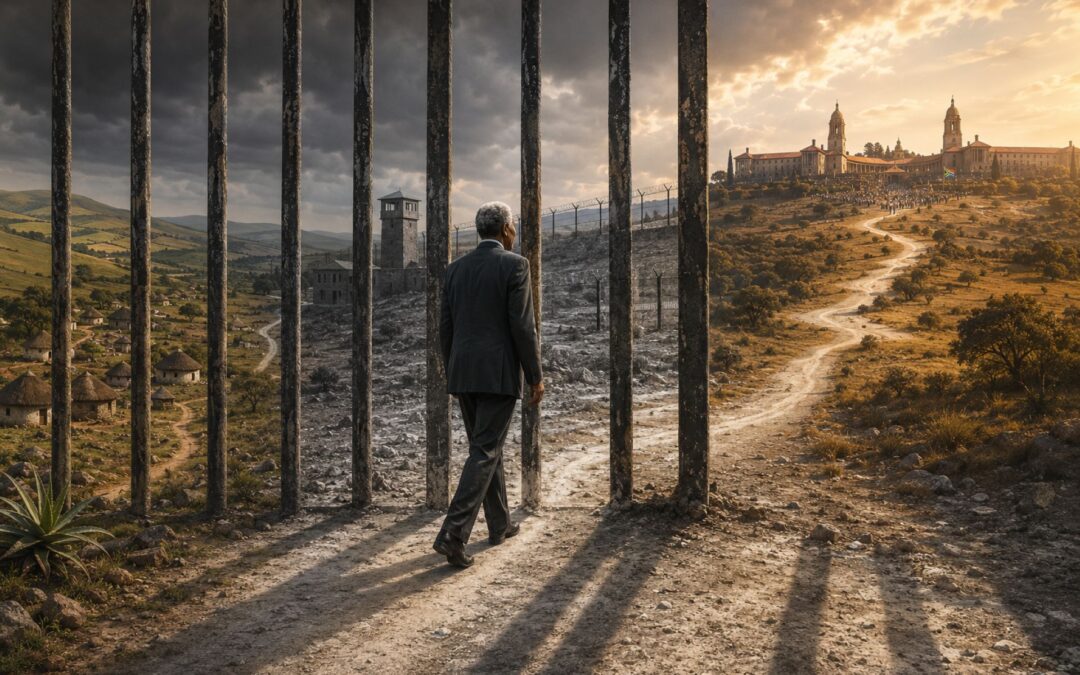
Nelson Mandela’s Long Walk to Freedom has acquired the aura of an inspirational classic, but the book itself is considerably more complicated than the public image surrounding it. It is not simply the story of a heroic prisoner who forgave his enemies, nor is it a collection of lessons about perseverance and leadership. It is a vast political autobiography in which Mandela reconstructs the experiences that carried him from a Thembu childhood through African nationalism, mass civil disobedience, underground organization, armed resistance, twenty-seven years of imprisonment, secret negotiations with the apartheid government, and finally South Africa’s first democratic election.
That scale matters because the Mandela who emerges from the complete memoir is not a man who possesses a finished philosophy from childhood onward. He changes. He can be proud, stubborn and status-conscious; he initially distrusts communists and sometimes resists interracial political alliances; he later helps create an armed organization after concluding that nonviolent resistance has reached its limits; and still later initiates negotiations with the government without first receiving formal authorization from all his comrades. What remains comparatively stable is his opposition to racial domination and his belief that legitimate political freedom ultimately requires equal citizenship rather than the replacement of white supremacy with black supremacy.
Long Walk to Freedom is therefore most useful when read as the testimony of a political actor learning through experience rather than as the life of an unchanging saint. Its extraordinary firsthand range makes it one of the essential political memoirs of the twentieth century, but it is still an autobiography: retrospective, selective, collaboratively produced and written by a man who knew that his own life had become inseparable from the history of the movement he represented.
This article contains the complete story told in the memoir, including Mandela’s marriages, trials, underground activities, role in establishing Umkhonto we Sizwe, imprisonment, negotiations, political conflicts after his release, the 1994 election and the ending of the book.

Detailed Summary of Long Walk to Freedom
Mandela organizes his life into eleven named parts rather than giving individual titles to the memoir’s 115 numbered chapters. Those parts function almost like stages in a political education. Each begins with Mandela inhabiting one kind of world and ends with that world becoming too small, too dangerous or politically impossible for him to remain the person he was at its beginning.
Part One: A Country Childhood
Mandela begins far from Johannesburg, the ANC and the institutions that will eventually define his public life. He is born Rolihlahla Mandela into the Madiba clan of the Thembu people, with a connection to the Thembu royal house through his father, Gadla Henry Mphakanyiswa. His father serves as a counselor and local chief, but after defying a white magistrate he loses his official position and much of the income and status attached to it. Mandela’s mother, Nosekeni, consequently moves with her children to Qunu, the rural village Mandela remembers as the landscape of his happiest childhood years.
Qunu provides the memoir with its first image of freedom. Mandela herds cattle, swims in streams, fights with sticks, steals maize, listens to stories and participates in a communal world whose rules seem natural because he has not yet encountered the full reach of the racial state. The freedom is real in the immediate sense that the young Mandela experiences space, family and play without constant conscious political anxiety. Only retrospectively does he understand that this childhood liberty existed within a society whose political boundaries had already been drawn by colonial conquest and white rule.
School introduces another world. Mandela begins formal education at a mission school, where his teacher gives him the English name Nelson. The episode is presented without melodrama, but it quietly establishes a recurring feature of colonial life: Africans are expected to translate themselves into institutions whose assumptions were created elsewhere. Christianity, Western schooling and British cultural ideals enter Mandela’s life alongside Thembu tradition rather than simply replacing it.
In the memoir’s childhood chronology, Mandela’s father dies while he is still a boy, an event that changes the direction of his life. Chief Jongintaba Dalindyebo, the acting regent of the Thembu, takes Mandela into his household at Mqhekezweni. Mandela is treated alongside the regent’s son Justice and gains access to a political environment that would have been unavailable to an ordinary village child.
Mqhekezweni becomes one of the deepest influences on Mandela’s later conception of leadership. At meetings of the Thembu council, the regent does not begin by dictating a conclusion. Men speak in turn, often criticizing the ruler directly, while Jongintaba listens and waits before summarizing the sense of the gathering. Mandela later sees in this practice an ideal of leadership in which authority depends partly on hearing others before deciding.
His initiation into manhood complicates that inherited world. At sixteen, Mandela undergoes the Xhosa circumcision ceremony alongside other boys. The event is supposed to mark their entrance into adult society, but Chief Meligqili delivers a speech that unsettles the celebration. The young men may have been declared men according to custom, he argues, yet they remain members of a conquered people whose land and political power have been taken from them. Mandela does not immediately become an activist, but the speech plants a connection between personal dignity and collective subordination.
Education then carries him increasingly beyond the Great Place. At Clarkebury and Healdtown, Mandela encounters mission discipline, African students from different communities and the expectation that educated Africans will succeed within a system still structured by racial inequality. He begins shedding some of his provincial assumptions. At Healdtown, the poet Samuel Mqhayi makes a particularly strong impression by asserting African cultural pride in an institution dominated by British traditions.
Fort Hare widens Mandela’s world further. The university college is one of the few institutions of higher education open to black Africans, and it gathers students who will later become important across southern and eastern Africa. Mandela meets Oliver Tambo, participates in student life and begins discovering that institutional authority can be challenged even when the immediate issue is not yet national liberation.
His confrontation with Fort Hare’s administration grows from a student representative dispute. Mandela is elected to the Student Representative Council after students have expressed dissatisfaction with food and institutional conditions, but he does not believe the council has a legitimate mandate if the electorate rejects it. When the principal insists that he either serve or leave the university, Mandela refuses to submit. The choice is partly principled and partly stubborn; the memoir does not disguise how sensitive he is to questions of personal dignity and authority.
Returning to Mqhekezweni creates a second confrontation. Jongintaba expects Mandela to return to Fort Hare and also arranges marriages for Mandela and Justice. Instead of accepting the regent’s decision, the two young men flee. Their journey is improvised, periodically blocked by officials and relatives, but they eventually make their way toward Johannesburg.
The first part therefore ends with an act of personal rebellion rather than explicit revolutionary commitment. Mandela has not yet dedicated himself to politics. He has, however, learned several patterns that will recur throughout the memoir: he respects tradition without treating every authority as legitimate, is acutely resistant to humiliation, and repeatedly chooses uncertain independence over obedience when the two become incompatible.
Part Two: Johannesburg
Johannesburg destroys any possibility that Mandela can understand racial inequality only as an abstract political condition. He first encounters the city through the mining industry on which its wealth depends. The enormous gold economy reveals a modern industrial system built partly on tightly controlled African labor, with black workers separated from the prosperity their work makes possible.
Mandela and Justice initially try to find employment at Crown Mines by presenting themselves as men sent there with the regent’s approval. Their story is exposed, and the two eventually separate as they try to establish independent lives. Through Walter Sisulu and other contacts, Mandela obtains clerical work at the law firm Witkin, Sidelsky and Eidelman, where Lazar Sidelsky encourages his education and where political activists begin entering his everyday world.
He also moves into Alexandra, a black township whose energy and poverty coexist. Mandela describes overcrowding, inadequate infrastructure, police raids and material insecurity, but he is equally struck by the resourcefulness of residents who create a social world under conditions designed to restrict them. Alexandra gives him a far more concrete education in urban African life than his earlier schooling could provide.
Mandela continues studying and eventually attends the University of the Witwatersrand to pursue law. At Wits he is one of very few African students and becomes part of an unusually diverse intellectual circle. People such as Joe Slovo, Ruth First, Bram Fischer and George Bizos expose him to white and Jewish South Africans committed to opposing racial domination, while Indian activists demonstrate political traditions different from the African nationalism Mandela is beginning to embrace.
Communism initially makes him suspicious. He associates it with ideas that seem to subordinate African nationalism to a foreign doctrine, and some of its white adherents strike him as culturally alien. Yet Johannesburg makes simple racial categories harder to maintain. He encounters whites willing to accept personal risk for African liberation and black activists whose political understanding has been shaped by socialist analysis.
Mandela’s political awakening is therefore gradual. Johannesburg does not give him one dramatic conversion scene. It supplies a succession of contradictions that make neutrality increasingly impossible: the mines, segregated law, pass restrictions, poverty, interracial friendship and the realization that educated personal advancement cannot protect an African from a political system constructed around race.
Part Three: Birth of a Freedom Fighter
Mandela explicitly rejects the idea that he can identify the moment when he became political. To be black in South Africa, he argues, means encountering political restrictions from birth whether or not one initially names them as politics. What changes during the 1940s is not the existence of oppression but Mandela’s willingness to organize his life around resisting it.
Walter Sisulu becomes central to that transformation. Through Sisulu’s circle, Mandela meets Anton Lembede, A.P. Mda and other younger African nationalists dissatisfied with the comparatively cautious leadership of the African National Congress. The ANC has existed since 1912, but the Youth League wants a more assertive mass organization rooted in African nationalism rather than petitions to white authority.
Lembede profoundly influences the young Mandela. His Africanism emphasizes black self-confidence and rejects the assumption that liberation should depend on white benevolence. Mandela finds the doctrine psychologically powerful because apartheid relies not only on laws but also on convincing Africans of their own political helplessness. At this stage, he is wary of communists and of alliances that might weaken specifically African political leadership.
His private life is developing at the same time. Mandela meets Evelyn Mase, related to Sisulu’s household, and the two marry. The marriage begins before Mandela becomes the relentlessly absent political figure he will later be, but the demands of activism soon enter the relationship. This tension between political obligation and domestic responsibility becomes one of the memoir’s most painful recurring subjects.
The African mineworkers’ strike of 1946 advances Mandela’s political education. Tens of thousands of African miners stop work, and the state’s harsh response demonstrates both the potential power of organized labor and the violence with which the racial order will defend itself. Mandela also observes the passive-resistance campaigns organized by Indian South Africans against discriminatory legislation, seeing disciplined mass action practiced by another oppressed community.
These experiences gradually weaken some of his earlier sectarianism. He does not suddenly become a communist, but the difference between ideological disagreement and practical cooperation becomes clearer. People from different traditions can oppose the same system without abandoning their own political identities.
The 1948 election provides the decisive external acceleration. The National Party comes to power on an explicit apartheid program and begins turning existing racial hierarchy into an even more systematic legal order. For Mandela and the Youth League, the result proves that gradual requests for reform will not match the government’s determination.
The Youth League pushes the ANC toward its Programme of Action, emphasizing boycotts, strikes, civil disobedience and other forms of mass resistance. Older leaders are challenged, and a younger generation gains influence. Mandela learns another enduring political lesson during these internal battles: allegiance to an organization and a collective strategy may require opposing people one personally respects.
The apartheid government quickly supplies the conditions for confrontation. The Population Registration Act formalizes racial classification, while the Group Areas Act gives the state enormous power over where people of different racial categories may live. Other laws tighten segregation, mobility controls and political repression. Apartheid is not presented as a single policy but as an interlocking attempt to regulate ordinary existence.
The Defiance Campaign of 1952 becomes Mandela’s first major experience organizing a national mass campaign. Volunteers deliberately violate discriminatory laws by entering restricted spaces, breaking curfews and using facilities reserved for whites. The initial strategy is disciplined: selected volunteers knowingly invite arrest, with an expectation that controlled defiance can expand into wider resistance.
Mandela serves as volunteer-in-chief and travels extensively to organize participants. The experience turns political theory into operational work. He must think about communications, discipline, local leadership, police response and the difference between rhetoric and what ordinary people can realistically be asked to risk.
The campaign does not destroy apartheid, but Mandela believes it alters something important in the psychology of resistance. The state can arrest individuals, yet disciplined citizens can choose to break laws publicly rather than treating every government command as morally legitimate. For Mandela, political courage increasingly becomes a collective capacity that can be trained rather than a heroic trait possessed by exceptional individuals.
Part Four: The Struggle Is My Life
The Defiance Campaign raises Mandela’s standing inside the ANC just as the government begins making ordinary political work more difficult. Chief Albert Luthuli becomes ANC president, representing a more vigorous era of opposition. Mandela’s responsibilities increase, but so do banning orders that restrict his movements, meetings and public speech.
These bans teach him how a formally legal system can create a kind of prison without walls. The restrictions are administrative rather than theatrical, yet they make normal political coordination dangerous. Mandela responds by helping develop the M-Plan, a proposed underground structure intended to preserve ANC organization if the state bans the movement entirely.
The M-Plan imagines small local units linked through carefully structured lines of communication. It is not yet a military organization. Its purpose is political survival: if public branches disappear, people can still receive instructions, political education and organizational contact through neighborhood cells.
At the same time, Mandela must earn a living. He completes his legal preparation and, with Oliver Tambo, establishes Mandela & Tambo, one of the country’s best-known African law practices. The office becomes another education in apartheid because clients arrive with problems created directly by racial regulation: pass offenses, evictions, employment restrictions, classification disputes and the innumerable crimes apartheid creates simply by defining ordinary black life as unlawful.
Law gives Mandela an unusually intimate view of the state’s reach. It can determine whether a person is classified African or Coloured, where a family may live, whether someone may be in a city and whether a worker possesses the correct administrative permission to exist in a particular place. The law practice also reveals a central contradiction that will follow Mandela into his trials: courts can sometimes restrain individual abuses even though the larger legal order they administer is profoundly unjust.
Sophiatown becomes the next great political battlefield. The mixed and culturally vibrant township stands in the way of the government’s racial redesign of Johannesburg, and the state plans to remove its black residents. The ANC organizes resistance under militant slogans, but the government possesses overwhelming coercive power.
The Sophiatown campaign forces Mandela to confront the difference between language and capability. Leaders can promise that people will resist removal, yet the organization cannot responsibly command an insurrection it lacks the means to sustain. The eventual removals expose the limitations of protest against a state willing to mobilize police power and reshape entire communities by force.
Walter Sisulu’s travels abroad meanwhile connect the movement to wider anticolonial struggles. Newly independent states and liberation movements suggest that white minority rule in Africa is not permanent, but they also raise the possibility that South Africa’s conflict may eventually become armed. Mandela is not yet committed to that outcome, though the question is entering serious strategic discussion.
The Congress of the People and the Freedom Charter represent a different kind of political advance. Organizers gather demands from communities around the country and bring delegates together at Kliptown in 1955. The resulting charter declares that South Africa belongs to all who live in it and imagines a democratic state based on equal political rights rather than racial government.
For Mandela, the Freedom Charter helps define the ANC’s nonracialism. It does not mean pretending that Africans are not the principal victims of apartheid or that black political leadership is unnecessary. It means rejecting the idea that liberation should culminate in racial exclusion of whites, Indians or Coloured South Africans.
Mandela’s political responsibilities increasingly separate him from ordinary domestic life. Bans, meetings, travel and legal work make sustained family presence difficult. His return to the Transkei temporarily reconnects him with rural communities and with the political problems created by the government’s attempt to govern Africans through ethnic “homelands” and compliant traditional authorities.
He also writes and speaks about the need for a long struggle. The phrase associated with his speech “No Easy Walk to Freedom” captures a change in expectation: liberation will not arrive through one campaign, one leader or one spectacular confrontation. Organization has to survive defeats, repression and periods when progress is almost invisible.
Part Five: Treason
In December 1956, police arrive at Mandela’s home before dawn and arrest him as part of a sweeping treason prosecution. More than 150 activists from different racial and political backgrounds are initially accused of participating in a conspiracy to overthrow the state. The government intends the trial to cripple the liberation movement; instead, detention also brings leaders from different organizations into sustained contact.
The Treason Trial lasts for years and becomes almost a parallel political institution. Prosecutors try to prove that the Freedom Charter and the Congress Alliance amount to a revolutionary conspiracy, while the defense argues that demands for democracy and equal citizenship are not equivalent to violent overthrow. The case repeatedly consumes the time of people whose political work the state has already tried to restrict through bans.
Mandela’s marriage to Evelyn is collapsing during the same period. The conflict cannot be reduced to one cause. Evelyn develops a strong commitment to the Jehovah’s Witnesses, whose religious focus conflicts with Mandela’s revolutionary politics, while Mandela’s constant absence has made normal married life increasingly impossible.
The separation is one of the clearest places where the memoir’s public story produces private casualties. Mandela can explain why the struggle demands his time, but explanation does not erase Evelyn’s experience of a husband repeatedly choosing politics over home. The memoir acknowledges that he often failed as a conventional husband and father even while remaining convinced that the political work itself was necessary.
During a recess in the preliminary proceedings, Mandela meets Nomzamo Winifred Madikizela, known as Winnie. She is young, professionally ambitious and already accustomed to confronting racial discrimination in her work as a social worker. Their courtship develops quickly, and they marry in 1958.
Marriage to Mandela means immediate entry into political surveillance. Winnie does not merely become the wife waiting at home for a famous activist; she develops a political identity of her own and is increasingly exposed to detention, harassment and later banning. The memoir nonetheless tells much of this story from Mandela’s position, a limitation that becomes more important as Winnie’s independent public life grows.
The political environment is becoming more fractured. Resistance to extending passes to African women brings women into direct confrontation with the state in large numbers. Mandela observes movements and arrests that challenge any assumption that liberation politics is primarily a male arena.
At the same time, ideological disputes within African nationalism produce a major split. Robert Sobukwe and other Africanists reject the ANC’s multiracial alliances and establish the Pan Africanist Congress in 1959. The PAC argues for a more explicitly Africanist political program and competes with the ANC for leadership of mass resistance.
The government is constructing what it calls separate development. The Promotion of Bantu Self-Government Act strengthens the homeland system, dividing Africans into supposedly distinct ethnic political units rather than recognizing a common South African citizenship. The policy has particular resonance for Mandela because the Transkei and Thembu leadership are personally familiar to him.
The Treason Trial finally moves from preliminary examination to formal proceedings while national politics accelerates outside the courtroom. Both the ANC and PAC prepare anti-pass campaigns. The PAC acts first in March 1960, calling on Africans to leave their passes at home and present themselves for arrest.
At Sharpeville, police fire on a crowd outside the police station, killing scores of people and shocking the country and the world. The massacre changes the political atmosphere. Demonstrations spread, passes are burned, the government declares a State of Emergency, thousands are detained, and both the ANC and PAC are banned.
Mandela is again arrested during the emergency. He and other Treason Trial defendants find themselves attempting to maintain a legal defense while detention gives the state enormous control over their movements. The experience deepens Mandela’s belief that the government is narrowing every lawful avenue of opposition.
When the emergency is eventually lifted, the banned ANC must decide how an illegal mass organization can continue to function. Underground planning becomes less a hypothetical contingency than a practical necessity. Mandela’s earlier M-Plan thinking now belongs to a broader problem of political survival.
The Treason Trial reaches its conclusion on 29 March 1961. The defendants are acquitted, a major legal defeat for the government after years of prosecution. Yet Mandela does not interpret the verdict as evidence that the political system is becoming safer. The state has already banned the ANC, expanded detention powers and demonstrated at Sharpeville what it will do when mass protest directly challenges authority.
Mandela is simultaneously helping organize the All-in African Conference and calling for a national constitutional convention. A stay-at-home is planned for the end of May 1961 to pressure the government. The state responds with an immense security mobilization.
The acquittal therefore does not restore Mandela to ordinary life. Instead of going home to celebrate, he disappears underground. One stage of his political career has ended: the government may have failed to convict him of treason, but the space in which he previously practiced open legal opposition is disappearing.
Part Six: The Black Pimpernel
Mandela’s underground period produces one of the memoir’s sharpest changes in tone. He moves between safe houses, disguises himself, depends on secret networks and travels through the country while the police try to find him. Newspapers eventually turn him into the “Black Pimpernel,” a fugitive who appears at political meetings and vanishes before authorities can arrest him.
The romantic nickname disguises the practical strain. Mandela cannot live with his family, and people who shelter him risk arrest. Small mistakes may compromise whole networks. Underground existence requires not only personal nerve but an entire infrastructure of drivers, hosts, messages and disciplined secrecy.
The planned May 1961 stay-at-home becomes the immediate strategic test. The government floods the country with security forces and threatens workers, making the action difficult to sustain at the level organizers hoped. Mandela sees the partial failure as evidence that the state has learned how to meet familiar forms of protest with overwhelming force.
He now confronts a question that had been approaching for years: whether nonviolent tactics can remain the sole method of resistance when peaceful organizations are banned, unarmed demonstrators are shot and legal opposition is systematically closed. His answer is controversial but clear. Nonviolence, as he has practiced it politically, is a tactic rather than an absolute moral doctrine that must be preserved regardless of circumstance.
This reasoning leads to the creation of Umkhonto we Sizwe, commonly known as MK or “Spear of the Nation.” Mandela becomes one of its principal organizers despite having no military experience. Because the ANC has long publicly embraced nonviolent methods, MK is initially structured as a distinct organization even though many of its leaders come from the ANC.
Mandela and his comrades consider different forms of violence. Terrorism, guerrilla warfare, open revolution and sabotage are discussed as strategically different options rather than treated as synonyms. They choose sabotage as the initial method because attacks on government installations, communications and infrastructure can demonstrate resistance while being planned to minimize the loss of life.
That distinction matters to Mandela’s later defense of the armed struggle. He does not claim violence is inherently desirable. He argues that the government has left the movement with a narrowing range of choices and that sabotage is the form least likely to produce human casualties while still showing that the state cannot rule indefinitely without resistance.
Mandela begins teaching himself military history and revolutionary strategy. He reads about guerrilla campaigns and anticolonial wars, trying to understand conflicts for which his legal and political training has not prepared him. The amateur quality of this education is part of the story: MK does not emerge because Mandela has always dreamed of being a soldier but because a political leader believes circumstances have forced him into unfamiliar territory.
Liliesleaf Farm in Rivonia becomes an important underground base. Mandela can work in comparative seclusion there and, at moments, see Winnie and the children. These visits create a painful illusion of domestic normality inside a life that has made normal family presence impossible.
MK launches its first sabotage campaign in December 1961. The targets are selected to symbolize state power and avoid casualties as far as possible. The attacks publicly announce that a new stage of resistance has begun.
Mandela then leaves South Africa secretly in 1962. His mission combines diplomacy, fundraising and military preparation. At the Pan-African Freedom Movement conference in Addis Ababa and during travels through newly independent African states, he seeks support for the ANC and MK while encountering political leaders who govern countries no longer ruled by European colonial powers.
For a South African whose entire life has unfolded under white minority government, visiting African states governed by black majorities has enormous psychological force. Independence elsewhere makes South Africa appear historically abnormal rather than permanent. Mandela also receives military exposure and seeks training that he expects will become useful if the struggle escalates.
His travels carry him beyond Africa to London, where he reconnects with supporters and experiences a society that, despite its own inequalities and imperial history, allows forms of political and personal freedom unavailable to him at home. Mandela admits an enduring affection for certain British institutions even while fighting a political system with deep colonial roots.
The journey could have tempted him into exile. Instead, he returns. The decision leads almost immediately to the next transformation in the memoir: the Black Pimpernel who has evaded the police is about to become a prisoner.
Part Seven: Rivonia
Mandela re-enters South Africa and continues moving clandestinely, but on 5 August 1962 police stop the car in which he is traveling with Cecil Williams. His period as a fugitive ends. He is charged with leaving the country without a passport and inciting workers to strike.
Mandela decides to use the trial politically. He participates heavily in preparing his own defense and argues that an African defendant cannot simply treat a court created by white minority rule as a politically neutral institution. His legal training allows him to challenge the structure surrounding the proceedings even though he knows a conviction is highly likely.
He appears in court wearing traditional clothing rather than the conventional suit expected of an attorney, deliberately asserting an African political identity inside a colonial legal setting. The memoir describes the kaross he wore as leopard skin; later archival examination has identified the garment as jackal skin, one of several specific factual details in the autobiography subsequently corrected.
Mandela does not deny the central political conduct underlying the charges. He uses the courtroom to explain why resistance exists and why African political demands cannot be reduced to criminality. He is convicted and sentenced to five years’ imprisonment.
Prison immediately begins its assault on individuality. Uniforms, numbers, rules and commands strip away ordinary markers of identity. Mandela responds by treating dignity itself as contested terrain, an approach that will become central during the much longer incarceration still ahead.
Outside prison, repression intensifies. Meanwhile, the underground leadership continues operating from Liliesleaf. In July 1963 police raid the farm and arrest senior activists, discovering documents that connect the organization to sabotage planning and broader discussions of armed struggle.
Mandela, already in prison, is subsequently brought into what becomes the Rivonia Trial. The stakes are vastly higher than in his previous case. The defendants face charges associated with sabotage and plans that the prosecution argues amount to preparation for violent revolution, carrying the possibility of death sentences.
One especially contentious document is the draft known as Operation Mayibuye, which discusses a possible guerrilla campaign. Mandela and the defense distinguish between strategies that MK had actually adopted and plans that remained under discussion. Mandela does not present every revolutionary document found at Rivonia as settled policy.
The trial becomes the most famous legal episode of Mandela’s life because he refuses to build a defense around denying the political struggle itself. His statement from the dock explains why sabotage was adopted after other forms of resistance had been blocked. At the same time, he insists that the ultimate political goal is a democratic society in which people of all races enjoy equal rights.
This position separates majority rule from racial revenge. Mandela opposes white domination because it denies political equality, but he also rejects black domination as a replacement. The ideal he defends is not a reversal of apartheid’s racial hierarchy but the destruction of racial hierarchy as the organizing principle of the state.
The defendants do not know whether this political defense will make execution more likely. International attention grows, demonstrations and appeals occur abroad, and the possibility of death hangs over the final proceedings. Mandela prepares himself for a sentence that may be irreversible.
On 12 June 1964, the court imposes life imprisonment rather than death on Mandela and most of the principal defendants. The sentence saves their lives while apparently removing them from political history indefinitely. The apartheid state believes it has confined a revolutionary leadership; Long Walk to Freedom now spends more than a quarter of its narrative demonstrating why imprisonment fails to make those men politically irrelevant.
Part Eight: Robben Island — The Dark Years
Mandela reaches Robben Island under conditions designed to communicate absolute power. The prison operates not merely as a place of confinement but as a concentrated version of the racial order outside. Clothing, food and treatment are differentiated by race, and black prisoners occupy the lowest position even among those the state has already deprived of liberty.
Mandela and his comrades quickly decide that accepting every humiliation will make survival harder rather than easier. They distinguish between the reality of imprisonment, which they cannot immediately change, and the countless unnecessary degradations through which officials attempt to break morale. Challenging those details becomes part of political resistance.
Work is physically exhausting. Prisoners perform hard labor and later spend years at the limestone quarry, where glare, dust and monotony punish the body. Mandela’s leadership in prison often involves deciding which abuses justify collective confrontation and which provocations are traps designed to provoke punishable disobedience.
The authorities classify prisoners into categories from A to D, with privileges tied to status. Mandela begins as a D-category prisoner, severely limiting letters and visits. The system is intended to make good behavior, as defined by the prison, the route to minor improvements, but political prisoners refuse to treat political submission as rehabilitation.
Communication with family becomes one of the most painful restrictions. Letters are infrequent and heavily censored. Visits occur across barriers and under supervision, forcing husbands, wives, parents and children to compress years of life into brief conversations from which political or emotionally sensitive subjects may be removed.
Mandela repeatedly contests racial differences in prison clothing and food. These may appear minor compared with life imprisonment, but that is precisely why the authorities can underestimate their importance. If prisoners accept that an African deserves shorter trousers, less food or a degrading form of address simply because he is African, then apartheid has reproduced itself successfully within the prison.
The prisoners learn to exploit whatever avenues remain available. Inspections by the International Committee of the Red Cross provide opportunities to complain about conditions to outsiders. Visits by parliamentarian Helen Suzman similarly create rare channels through which treatment on the island can become politically visible.
They also assess individual warders rather than reducing every white employee to the same type. Some are gratuitously cruel, some rigid, some susceptible to pressure and others capable of ordinary human interaction. Mandela’s later reputation for dealing with opponents as individuals develops partly through these years of watching how institutions shape people without completely determining every person’s behavior.
Hunger strikes and collective refusals periodically test prisoner solidarity. Different political organizations do not always agree about tactics, and the ANC’s relationship with PAC prisoners can be tense. Robben Island contains the same ideological divisions that exist outside, compressed into a small community where rivals must nevertheless coexist.
Mandela regards those disagreements seriously. The PAC’s Africanism, the ANC’s Congress Alliance tradition, communist interpretations and different theories of revolutionary strategy do not disappear simply because everyone has been imprisoned by the same government. Prison becomes a political academy partly because these disputes continue.
Information about resistance outside reaches the island irregularly but powerfully. News that armed units connected to the ANC are active reminds the Rivonia generation that the movement did not end when its senior leadership was imprisoned. Even small indications that younger activists are continuing the struggle counter the psychological purpose of isolation.
Yet the harshest blows are personal rather than organizational. Mandela’s mother dies while he is incarcerated. He requests permission to attend the funeral and is refused, leaving him unable to fulfill obligations he would have considered fundamental in ordinary family life.
An even more devastating loss follows when his eldest son, Thembi, dies in a car accident. Again Mandela cannot attend the funeral. Political commitment has already cost him daily fatherhood; prison now denies him the rituals through which a father would ordinarily mourn his child.
Visits from his surviving children underline the scale of absence. A child grows into an adult while Mandela remains on the same island, often knowing family developments only through delayed and censored information. The memoir’s public story of resilience therefore contains a second, quieter story about years that cannot be restored.
The first Robben Island section deserves its title “The Dark Years” because progress is difficult to perceive. Conditions sometimes improve, but every concession has to be fought for and can be withdrawn. The prisoners do not yet know that the government will one day negotiate with them; their immediate task is to remain politically and psychologically intact without any guarantee that they will live to see freedom.
Part Nine: Robben Island — Beginning to Hope
The second Robben Island section does not mark a sudden transformation from misery to optimism. Mandela is careful to describe prison progress as uneven. Improvements arrive alongside setbacks, and a new official can erase years of gradual accommodation.
Cultural and educational activities become increasingly important. In a prison production of Antigone, Mandela plays Creon, the ruler whose insistence on state authority collides with a higher conception of justice. The classical tragedy resonates with prisoners who have been sentenced under laws they consider illegitimate without requiring Mandela to turn the episode into a simplistic allegory.
The arrival of harsh commanding officers periodically intensifies conflict. Colonel Badenhorst becomes associated with a renewed regime of intimidation and abuse. Prisoners document mistreatment and use every available inspection or complaint mechanism, eventually contributing to his departure.
His replacement, Colonel Willemse, represents the possibility of a more pragmatic administration. Mandela does not confuse better treatment with freedom, but differences among prison officials matter because they change daily life. The memoir repeatedly shows that negotiation begins long before formal political talks: prisoners negotiate food, work, study, communication and forms of respect.
Robben Island becomes known among political prisoners as “the University.” Men with different backgrounds teach one another history, economics, politics, languages and organizational theory. Formal qualifications matter less than the collective exchange of knowledge among people who include lawyers, trade unionists, nationalists and communists.
Mandela participates enthusiastically in this education while also trying to understand the political traditions of younger prisoners. Education serves several functions. It occupies the mind, prepares activists for a future they may never personally experience, and prevents imprisonment from shrinking their political world to the dimensions of a cell.
Outside, Winnie remains subject to intense state harassment. Police raids, banning restrictions and forced separation make her life another front in the government’s attempt to isolate Mandela. His concern for her is mixed with helplessness because he has almost no capacity to influence what happens beyond the island.
The mid-1970s also produce the first version of the autobiography itself. Mandela secretly writes a long account of his life with the help of fellow prisoners. Walter Sisulu and Ahmed Kathrada help test and restore memories, while Laloo Chiba and Mac Maharaj are involved in transcribing and preserving the manuscript.
The project is dangerous. A copy kept in prison is eventually discovered by the authorities, but another version has been concealed and carried out. The existence of this prison manuscript later becomes central to understanding how Long Walk to Freedom was produced after Mandela’s release.
The government periodically tries to turn personal release into political surrender. Justice Minister Jimmy Kruger visits Mandela and raises the possibility of freedom if Mandela accepts residence in the Transkei, one of apartheid’s supposed homelands. Mandela refuses because such a bargain would recognize the political legitimacy of the homeland system he opposes.
The Soweto uprising of 1976 then transforms the prison population. Young Black Consciousness activists arrive with a different political vocabulary, immense anger and little automatic reverence for the older Rivonia generation. Some regard the imprisoned ANC leaders as representatives of an earlier era.
Mandela initially finds aspects of the younger prisoners’ behavior undisciplined, but he also recognizes their courage and the significance of the movement that has produced them. The generations teach one another. Older prisoners offer organizational experience, while the younger men demonstrate that resistance has renewed itself despite the state’s attempt to eliminate previous leadership.
This episode is important to Mandela’s conception of leadership. Authority cannot depend solely on historic prestige. A political leader has to understand the experiences creating a new generation rather than expecting younger people to inherit old loyalties automatically.
Family suffering continues. Winnie is eventually banished to Brandfort, a remote town where the state hopes to isolate her from the networks surrounding her in Soweto. Mandela’s inability to protect his family remains one of the starkest contradictions between his public stature and private powerlessness.
Prison conditions slowly become less restrictive. After years of campaigning, prisoners obtain greater access to newspapers and information. News changes the psychological geography of Robben Island because events in South Africa and abroad can now be followed with more continuity rather than reconstructed from fragments.
The national situation is also changing. The apartheid state remains powerful, but resistance is growing and international isolation is deepening. The government itself is searching for ways to adapt without surrendering white control, creating political openings that would have seemed impossible in the 1960s.
Mandela continues exercising, studying and maintaining routines that protect a sense of personal discipline. Gardening becomes especially important. Cultivating plants inside a prison offers no liberation in itself, yet it gives Mandela a sphere in which patience and deliberate care produce visible results, qualities he associates with political leadership as well.
Older questions about Thembu politics also return. Mandela had once been prepared for a role as counselor to a traditional ruler, and his relationship with homeland leaders remains complicated by personal history. He rejects apartheid’s attempt to turn ethnic authority into a substitute for national citizenship while refusing to dismiss the cultural institutions from which he himself emerged.
In 1982, Mandela, Sisulu, Mhlaba and other senior ANC prisoners are unexpectedly transferred from Robben Island to Pollsmoor Prison on the mainland. They are not told that this is the beginning of a negotiating process. Nevertheless, the move brings Mandela physically closer to the government whose leaders will soon begin treating him not merely as a prisoner but as a political interlocutor.
Part Ten: Talking with the Enemy
Pollsmoor is still a maximum-security prison, but it differs sharply from Robben Island. Mandela and his senior comrades occupy better physical conditions, gain greater access to news and exist much closer to the political center of the country. The change makes it easier to understand how dramatically South Africa is deteriorating outside prison.
The 1980s bring mass revolt, labor resistance, the United Democratic Front, township conflict and escalating state repression. The government’s tricameral constitutional reforms attempt to incorporate Coloured and Indian representation while continuing to exclude the African majority from national political power. Rather than stabilizing apartheid, the reforms help expose how little meaningful change the state is prepared to offer.
P.W. Botha eventually announces that Mandela can be released if he renounces violence. Mandela rejects the offer because it treats him as though he possesses the power to end a conflict unilaterally while the government maintains the political conditions that created it. Through a public response communicated by his daughter Zindzi, Mandela insists that only free people can negotiate and asks why the government demands that prisoners renounce violence while the state retains its own coercive apparatus.
This position does not mean Mandela opposes negotiation. In fact, he is moving toward the opposite conclusion. The scale of violence and the apparent military stalemate convince him that neither side is likely to achieve a clean victory without catastrophic cost.
After surgery for an enlarged prostate in 1985, Mandela is temporarily separated from his comrades. The isolation gives him space to pursue an idea he knows may be controversial inside the ANC: initiating contact with the government. He reasons that someone must begin “talks about talks” before formal negotiations can ever occur.
Mandela contacts Justice Minister Kobie Coetsee. He does not initially have a formal mandate from the ANC leadership, either inside or outside prison, and this is one of the most revealing decisions in the memoir. Mandela, who repeatedly emphasizes collective discipline, deliberately acts ahead of collective authorization because he believes the political moment requires someone to test whether negotiations are possible.
He also understands the risk. If the initiative is exposed prematurely, it might be interpreted as a personal deal for release or an attempt by the government to divide Mandela from the ANC. He therefore insists that he is exploring possibilities rather than bargaining away organizational positions.
The government gradually begins preparing Mandela for a different relationship with the outside world. Officials take him on discreet drives beyond prison, allowing him to see ordinary South Africa after decades of confinement. Cars, development, consumer goods and social patterns have changed, and the trips confront him with the disorienting fact that the country he hopes to help govern is not the country he last experienced as a free man in 1962.
Formal secret meetings eventually begin with a small government committee. The talks expose the fundamental fears on both sides. Officials demand clarity about the ANC’s armed struggle and its alliance with the South African Communist Party; Mandela presses the government on majority rule, political prisoners, banned organizations and the refusal to recognize black South Africans as full citizens.
Mandela spends substantial effort addressing white fears. He argues that majority government does not require the expulsion or political humiliation of whites, and that the ANC’s goal is not to replace one form of racial domination with another. This is both a moral position and negotiating strategy: whites will resist democratic transition more violently if they believe democracy necessarily means their destruction.
At the same time, Mandela refuses to let reconciliation become surrender. He does not offer to dissolve the ANC, disown its allies or renounce fundamental political demands in exchange for his own release. The legitimacy of negotiations depends on representing the movement rather than becoming an individual prisoner bargaining for privileges.
In 1988, illness interrupts the process. Mandela develops tuberculosis and spends time in hospital. His age and health make the possibility that he could die before a settlement more tangible, adding urgency to contacts already under way.
After his recovery, he is transferred to a private cottage at Victor Verster Prison. The conditions are radically different from a Robben Island cell: he has space, greater privacy and more control over daily routines. Yet the comfort also creates political danger because privilege could separate him psychologically from comrades still imprisoned elsewhere.
The secret meetings continue. Mandela repeatedly emphasizes that he can prepare the ground but cannot sign a national settlement on behalf of the ANC without the organization itself. This distinction is crucial to his self-understanding. His symbolic status gives him leverage, but legitimacy still comes from collective political structures.
In July 1989, Mandela finally meets P.W. Botha. The encounter has more symbolic than substantive value. Botha has been the dominant figure of the security state, and his willingness to receive Mandela confirms that the government can no longer treat him solely as an imprisoned criminal.
Botha soon leaves office and F.W. de Klerk emerges as his successor. Mandela initially remains cautious, but signs of change accumulate. Senior political prisoners are released, and de Klerk appears more willing than Botha to address the structural political crisis rather than merely manage unrest.
On 2 February 1990, de Klerk makes the announcement that changes the political landscape: the ANC, PAC and South African Communist Party are unbanned, restrictions on political activity are eased, and negotiations toward a new order become publicly conceivable. Mandela is no longer negotiating merely about whether talks can occur; the question becomes how he will leave prison and enter a national political process.
Even the terms of his release involve negotiation. Government officials want control over timing and presentation, while Mandela rejects attempts to turn his freedom into a state-managed spectacle. After more than twenty-seven years in custody, he prepares to leave prison not as a private citizen returning to an interrupted life but as the most internationally recognizable leader of a movement entering an uncertain constitutional struggle.
Part Eleven: Freedom
Mandela is released from Victor Verster Prison on 11 February 1990. The image of him walking out beside Winnie becomes one of the defining visual moments of the century, but the memoir emphasizes how little personal privacy accompanies the event. Crowds, journalists, political organizers and security concerns immediately consume the reunion he has imagined for decades.
He addresses an enormous crowd in Cape Town from the balcony overlooking the Grand Parade. His message disappoints anyone expecting release to produce an instant abandonment of the ANC’s previous positions. Mandela praises the struggle, acknowledges the armed movement and insists that political conditions must genuinely change before the conflict can be considered over.
The next task is reintegration into an organization that has lived without his daily leadership for almost three decades. Mandela travels to Lusaka to meet the ANC’s external leadership and reconnects with Oliver Tambo, who carried immense responsibility during the years Mandela was imprisoned. When Tambo suggests that Mandela should assume the ANC presidency, Mandela insists that organizational procedure rather than personal celebrity must determine leadership.
International travel follows. Mandela visits governments and movements that supported the anti-apartheid struggle, thanking them and asking that sanctions not be lifted prematurely. Political reforms have begun, but the ANC fears that removing international pressure before irreversible change will strengthen the government’s bargaining position.
Returning home also means confronting internal violence. Relations between ANC supporters and Mangosuthu Buthelezi’s Inkatha movement become increasingly deadly, particularly in Natal and on the Witwatersrand. Mandela’s personal history with Buthelezi is more complicated than the hostility between their organizations, and he struggles to separate political disagreement from personal demonization.
Formal talks with the government begin slowly. After violence at Sebokeng delays planned discussions, the ANC and government eventually produce the Groote Schuur Minute, establishing mechanisms for addressing political prisoners and obstacles to political normalization. For Mandela, the purpose of such agreements is to create conditions under which genuine constitutional negotiations can occur.
He also returns to Qunu and his mother’s grave. The visit is one of the memoir’s most emotionally concentrated homecomings. The political prisoner has become a global symbol, but he cannot recover the years in which his mother died without him or restore the childhood world from which the entire journey began.
Mandela continues traveling abroad and arguing over sanctions with leaders who believe de Klerk’s reforms deserve immediate reward. Margaret Thatcher remains opposed to the ANC’s preferred sanctions strategy, and Mandela cannot persuade her. The disagreement illustrates how the movement’s international supporters and interlocutors do not necessarily accept its judgment on every tactical question.
Back in South Africa, negotiations remain vulnerable to violence. Arrests connected to Operation Vula, an ANC underground project, threaten trust just as the organizations are attempting to normalize political activity. Meanwhile, killings between political factions escalate dramatically.
In August 1990, the Pretoria Minute records the ANC’s suspension of armed actions. The decision represents an enormous transition for an organization whose military campaign emerged precisely because legal politics had been closed. Mandela treats suspension as part of negotiated movement toward open political competition, not as retrospective admission that creating MK had been wrong.
Continuing violence makes that transition precarious. Mandela increasingly accuses forces connected with the security establishment of encouraging conflict between black political organizations, contributing to what becomes known as the “Third Force” allegation. The memoir presents his suspicion forcefully, but his account remains the perspective of an involved political leader and should not be treated as independent proof of every incident or chain of command.
Oliver Tambo finally returns from exile in December 1990 after three decades outside South Africa. His return allows Mandela to acknowledge something a personality-centered account of liberation can easily obscure: while Mandela became the imprisoned symbol of the movement, Tambo performed the difficult work of preserving and expanding the ANC internationally.
At the ANC’s national conference, Mandela becomes president through organizational processes, while Tambo receives recognition for his leadership. Mandela is now formally occupying the position that his public reputation has already seemed to imply.
His political rise contrasts painfully with developments in his marriage. Winnie has become a powerful and controversial political figure whose experiences during Mandela’s imprisonment cannot be reduced to the role of loyal spouse. Criminal proceedings involving the kidnapping of Stompie Moeketsi and related assault allegations create a major crisis. Winnie is convicted of kidnapping and being an accessory to assault, though Mandela remains publicly convinced of her innocence and emphasizes that she did not personally participate in the assault.
Formal constitutional negotiations finally begin with CODESA, the Convention for a Democratic South Africa, in December 1991. Multiple political organizations gather to determine how minority rule can be replaced by a democratic system. The ceremonial importance is immense, but underlying disagreements over power, constitutional thresholds and transitional arrangements remain severe.
A public confrontation between Mandela and de Klerk reveals how fragile their cooperation is. Mandela accuses the government of bad faith and responsibility for violence, while de Klerk attacks the ANC’s conduct. Their relationship is not the smooth partnership later commemorative images can suggest; it combines mutual dependence, strategic competition and periodic anger.
De Klerk then calls a referendum among white voters on whether negotiations should continue. Mandela recognizes that an overwhelming “yes” vote will strengthen de Klerk. It does: roughly two-thirds of participating white voters support the negotiating process, giving the government leader a stronger mandate but also encouraging a tougher bargaining position.
Mandela’s personal life reaches another breaking point in April 1992 when he publicly announces his separation from Winnie. He later reflects on the bitter paradox that his children once imagined the imprisoned father would eventually return to them, only to discover that release makes him even more public. The man celebrated as “father of the nation” has had comparatively little opportunity to live as the father of his own family.
CODESA II fails to resolve crucial constitutional disputes. The ANC wants genuine majority rule and an elected constituent assembly, while the government seeks protections that the ANC fears could preserve minority veto power. The negotiations stall.
Then the Boipatong massacre intensifies the crisis. After residents are killed in an attack associated with Inkatha supporters, Mandela suspends negotiations with the government and accuses the state of failing to protect citizens and of complicity in political violence. Mass action replaces formal talks.
The ANC organizes strikes and demonstrations to show that constitutional negotiation cannot proceed as though violence is an unrelated background problem. Yet mass action also carries grave risks. At Bisho, demonstrators are shot by Ciskei forces, producing another massacre and demonstrating the danger of treating popular mobilization as cost-free pressure.
The failures force both sides back toward compromise. The Record of Understanding between the ANC and government restores momentum. One of the most important concessions comes from within the ANC alliance itself when Joe Slovo proposes a transitional compromise that will allow power-sharing through a temporary Government of National Unity rather than requiring the old regime to surrender all institutional power immediately.
The compromise is controversial because liberation movements do not spend decades fighting for majority rule in order to preserve their former opponents in government. Its logic is transitional rather than permanent. The ANC will accept temporary guarantees because they may reduce white fears, prevent institutional sabotage and make a democratic transfer of power possible.
In 1993, the assassination of Chris Hani nearly destroys that possibility. Hani is one of the country’s most prominent revolutionary figures and has enormous support among younger and more militant activists. His murder by a white right-wing extremist creates an immediate danger of retaliatory violence.
Mandela addresses the country on television and appeals for calm. The moment demonstrates that political authority has already begun moving beyond formal state office: an unelected former prisoner becomes the figure many South Africans look to when the country appears close to catastrophe. Hani’s death also creates urgency around the negotiations, making endless delay increasingly dangerous.
Oliver Tambo dies not long afterward. For Mandela, the loss is both personal and historical. Tambo survives long enough to return from exile and see political organizations unbanned, but not long enough to cast a ballot in the democratic election toward which he devoted much of his life.
On 3 June 1993, negotiators agree that South Africa will hold its first national nonracial election on 27 April 1994. The decision converts an abstract democratic future into a fixed political deadline. The ANC now has to transform itself from a liberation organization into a party capable of campaigning, educating first-time voters and preparing for government.
Later that year, Mandela and de Klerk jointly receive the 1993 Nobel Peace Prize for their roles in ending apartheid and laying the foundations for democratic South Africa. Mandela is conscious of the apparent contradiction: the man who helped establish MK is receiving the world’s most famous peace prize. He accepts it not as a repudiation of the struggle but as recognition of a negotiated transition made possible by decades of resistance.
The election itself remains uncertain almost until the last moment. Inkatha initially refuses to participate, demanding stronger guarantees for KwaZulu and the Zulu monarchy. White right-wing organizations likewise resist the transition and promote demands for an Afrikaner homeland.
The crisis in Bophuthatswana weakens part of the right-wing resistance when the homeland government loses control amid popular protest and the intervention of armed Afrikaner extremists ends in humiliation and violence. Inkatha eventually enters the election only days before voting, avoiding the possibility that a major political constituency will remain outside the new system.
Mandela and de Klerk hold a televised debate shortly before the vote. Mandela attacks the National Party vigorously, but the encounter ends with a deliberate public gesture of cooperation. The moment encapsulates his negotiating method: political opponents can be confronted sharply without being treated as people with whom future coexistence is impossible.
Mandela votes on 27 April at Ohlange in Natal, near the grave of John Dube, the ANC’s first president. The location allows the memoir to connect the election with the organization’s founding in 1912. What Dube’s generation began as a struggle for African political recognition has reached universal adult suffrage more than eight decades later.
The ANC wins 62.6 percent of the national vote and 252 of 400 National Assembly seats. It falls short of the two-thirds threshold that might have allowed it greater unilateral constitutional power, while the National Party and Inkatha retain significant regional and national constituencies. The result makes the new government dominant but not politically omnipotent.
Mandela’s first response is therefore not triumphal racial reversal. He repeatedly reassures white South Africans and other minorities that liberation was a struggle against a system rather than against a color. The Government of National Unity brings former opponents into the same executive structure.
On 10 May 1994, Mandela is inaugurated at the Union Buildings in Pretoria, a site long associated with white political power. Thabo Mbeki and F.W. de Klerk are sworn in as deputy presidents before Mandela takes the oath as president of a democratic, nonracial South Africa.
The book could have ended there as a conventional victory narrative. Instead, Mandela returns to the idea of freedom and complicates it. He remembers first believing that freedom meant the ordinary liberties of childhood, then wanting personal adult independence, and eventually recognizing that his own freedom could not be separated from the freedom of his people.
The final realization goes further. Liberation from legal oppression is not the same as completing a free society. Political victory creates responsibilities, and the end of white minority government does not automatically heal generations of damage or guarantee that the liberated will always use power justly.
The memoir therefore closes with the image of reaching the top of one hill and discovering more hills beyond it. The long walk has produced a democratic government, but democracy is presented as a beginning rather than a destination at which political responsibility ends.
Nelson Mandela’s Development as a Political Leader
Mandela’s political development is compelling partly because the memoir does not present him as naturally destined for moral greatness. The young man who leaves the Transkei is ambitious, proud and highly conscious of status. He likes elegant clothes, wants professional respectability and initially imagines advancement in more personal terms than the political symbolism later attached to his name might suggest.
That pride never disappears completely. Mandela is deeply sensitive to disrespect, whether it comes from a university principal, magistrate, prison warder or political opponent. What changes is the scale on which he interprets dignity. A personal refusal to submit gradually becomes an understanding that millions of Africans are subjected to institutional humiliation as a permanent condition of life.
Mqhekezweni gives him one model of leadership before he has political ideology. Jongintaba’s council meetings teach him that authority need not mean speaking first or loudest. Mandela repeatedly returns to the idea that leaders should hear a group before attempting to express its collective position, although his own later behavior sometimes reveals the tension between this ideal and his willingness to act decisively on personal judgment.
The Johannesburg years add intellectual instability to that inherited model. Mandela initially favors an assertive African nationalism and distrusts communists, particularly white communists who appear to be inserting themselves into African politics. Continued contact with people such as Joe Slovo, Ruth First and other activists forces him to distinguish racial identity from political commitment.
The change is not a conversion to ideological communism. Mandela remains willing to disagree with communist allies, but he becomes increasingly pragmatic about coalition. If South Africans from different racial and ideological backgrounds are prepared to fight apartheid on a basis consistent with African liberation, he sees little reason to reject their participation merely to preserve doctrinal purity.
His development on violence is even more consequential. The later image of Mandela as an apostle of reconciliation can obscure the fact that he explicitly helps establish an armed organization. Long Walk to Freedom makes the transition central rather than embarrassing.
Mandela’s justification depends on political circumstance. Nonviolent methods are useful when they can mobilize people, expose injustice and create pressure. After banning, Sharpeville, emergency rule and the suppression of peaceful organization, he concludes that refusing to reconsider tactics would amount to allowing the government to decide permanently which forms of resistance its opponents may use.
Yet the choice of sabotage shows limits within that tactical flexibility. Mandela does not celebrate indiscriminate violence. He wants a form of armed resistance that demonstrates the state’s vulnerability without intentionally killing civilians, partly because loss of life would harden racial conflict and make future coexistence more difficult.
Prison changes his leadership again. In the underground, speed, secrecy and initiative are essential. On Robben Island, leadership requires patience, emotional restraint and the ability to recognize victories too small to satisfy revolutionary rhetoric but large enough to improve people’s lives.
A pair of long trousers, the right to study or a slightly less degrading prison rule can become meaningful because prisoners inhabit an institution where officials control nearly everything. Mandela learns to negotiate without confusing negotiation with capitulation. The skill later scales upward from prison regulations to constitutional politics.
His decision to contact the apartheid government in the 1980s reveals perhaps the most important contradiction in his leadership style. Mandela repeatedly stresses organizational loyalty, yet he begins exploratory negotiations without first securing a full organizational mandate. He believes the situation requires initiative and that his status gives him a unique opportunity to test the government’s intentions.
He does not disguise the danger of the move. A leader who begins secret discussions with the enemy can easily be accused of personal ambition, betrayal or willingness to trade collective demands for individual freedom. Mandela tries to contain that risk by separating exploratory contact from binding negotiation and insisting that only the ANC can conclude a settlement.
The episode demonstrates that his commitment to collective leadership is not procedural absolutism. He is willing to act alone when he believes circumstances require it, but he also recognizes that personal authority cannot permanently replace institutional legitimacy. The same principle appears when he refuses simply to inherit the ANC presidency from Tambo and insists on formal organizational processes.
Mandela’s greatest strength as presented in the memoir is therefore not ideological consistency in the narrow sense. It is his ability to distinguish an underlying political objective from the tactics used to pursue it. Mass defiance, sabotage, prison resistance and constitutional negotiation can appear contradictory if tactics are mistaken for principles. For Mandela, they become different responses to changing conditions while the objective—equal political citizenship—remains comparatively stable.
His weaknesses are visible in the same traits. Confidence can become stubbornness. Political discipline can require emotional compartmentalization that damages intimate relationships. His ability to subordinate personal life to a cause produces historic commitment but also permits him to rationalize absences whose consequences are borne heavily by his wives and children.
The memoir’s most revealing self-criticism concerns fatherhood. Mandela can explain that he had responsibilities to millions of oppressed people, but he cannot claim that those responsibilities erased the needs of his own children. By the time he is released, he discovers that being embraced as the father of a nation does not restore the domestic life he surrendered.
This tension prevents the strongest reading of Mandela from becoming hagiographic. His political greatness and private failures are not separate stories. They emerge from the same capacity to devote himself so completely to collective struggle that ordinary claims on his time repeatedly lose.
The People and Relationships Behind the Public Figure
Mandela’s autobiography inevitably places Mandela at the center, but almost every stage of his development depends on people who expand, challenge or sustain him. The book works best when these relationships are treated not as supporting characters in a heroic life but as evidence that Mandela’s achievements were produced inside families, organizations and political traditions he did not create alone.
Jongintaba is the first major formative figure after Mandela’s parents. By taking the boy into the Great Place, the regent changes his educational prospects and gives him firsthand exposure to leadership. Mandela later rebels against Jongintaba’s authority over his university future and marriage, yet the regent’s deliberative model remains embedded in his political imagination.
Walter Sisulu is arguably the most important political relationship in the book. Sisulu helps Mandela find a place in Johannesburg, introduces him to people who will shape his political life and remains a comrade through activism, trial and prison. His importance lies less in one famous intervention than in continuity: he is present near the beginning of Mandela’s political formation and beside him through decades of struggle.
Oliver Tambo represents a different form of partnership. Mandela and Tambo share education, law practice and ANC leadership, but history eventually separates their roles. Mandela becomes the imprisoned internal symbol while Tambo spends decades in exile sustaining the organization internationally.
The memoir’s final political victory therefore depends on a division of labor that public memory can obscure. Mandela’s imprisonment gives the movement a globally recognizable human symbol, but Tambo’s work ensures there remains an organization capable of using that symbolic power. Mandela’s affection and respect for him are intensified by awareness that Tambo carried burdens Mandela could not share from prison.
Anton Lembede belongs to an earlier ideological stage but remains essential because he provides the intellectual confidence of Youth League African nationalism. Mandela does not preserve all Lembede’s political assumptions. What he retains is the insistence that liberation cannot be founded on African dependence or inferiority.
Chief Albert Luthuli embodies another path. His leadership during the era of mass nonviolent resistance gives the ANC moral authority, and Mandela treats him with great respect. The later creation of MK nevertheless illustrates how political circumstances can move an organization beyond the methods associated with an admired leader without requiring the organization to disown him.
Ahmed Kathrada becomes particularly important in prison. The relationship is intellectual, political and deeply personal. Kathrada belongs to the Indian Congress tradition, and his closeness to Mandela also embodies the multiracial political alliance that Africanists had once criticized.
Joe Slovo demonstrates the evolution of Mandela’s relationship with communists. Earlier suspicion gives way to durable cooperation, while neither man has to pretend ideological differences do not exist. Slovo’s proposal for transitional power-sharing becomes one of the decisive compromises of the early 1990s, showing that the feared communist ally can become a principal architect of a negotiated constitutional bridge.
Bram Fischer illustrates another challenge to racial simplification. An Afrikaner lawyer from a prominent family, Fischer commits himself to the anti-apartheid struggle and leads the Rivonia defense while secretly involved in underground politics himself. For Mandela, people like Fischer are proof that a liberation movement aimed at ending white domination need not become a movement against white people as such.
Robert Sobukwe is an ideological rival rather than a villain. The PAC’s criticism of the ANC raises genuine questions about African leadership, multiracial alliances and the political meaning of nonracialism. Mandela disagrees strongly with the breakaway movement, but the existence of the dispute helps prevent the memoir from presenting the anti-apartheid struggle as politically homogeneous.
Mangosuthu Buthelezi presents a still more difficult relationship because personal history and mass political conflict collide. Mandela has longstanding reasons to treat him with respect, while ANC supporters increasingly view Inkatha as a violent political enemy. Their relationship illustrates the danger of assuming personal negotiation can automatically overcome organizations with competing interests and constituencies.
P.W. Botha and F.W. de Klerk occupy different roles among Mandela’s opponents. Botha represents the security-state mentality that tries to reform apartheid without accepting genuine majority rule, yet even his government eventually recognizes the need for contact with Mandela. De Klerk goes much further by unbanning political organizations and entering negotiations, but Mandela never turns him into the benevolent giver of freedom.
The transition works precisely because Mandela can recognize the importance of de Klerk’s decisions while continuing to treat him as a political competitor responsible for defending a system the ANC seeks to dismantle. Their relationship alternates between cooperation, accusation and tactical maneuvering. Reconciliation does not eliminate conflict.
The most difficult relationships in the memoir are with Mandela’s wives. Evelyn Mase enters his life before he becomes a national political figure, and their marriage deteriorates as activism consumes him. Her growing Jehovah’s Witness faith and his political commitments move them in incompatible directions, but Mandela’s absence cannot be dismissed as merely ideological incompatibility.
Evelyn’s perspective remains comparatively underdeveloped because Mandela is narrating. He can acknowledge neglect without fully reconstructing what years of marriage to an increasingly unavailable activist looked like from her side. That asymmetry is one of the memoir’s limitations.
Winnie Madikizela-Mandela is treated with more dramatic intensity because her relationship with Mandela spans the great years of repression, prison and release. She experiences detention, banning, harassment and banishment while raising children and becoming an important political figure independently of her husband.
Mandela admires her courage and repeatedly expresses guilt that his political life exposes her to suffering. Yet the narrative becomes increasingly strained as her public identity and controversies no longer fit the role of prisoner-spouse. The reader receives Mandela’s loyalty, worry and eventual disappointment, but not an independent account of Winnie’s political evolution.
Their post-release separation is therefore more than a private collapse. It exposes the impossibility of simply resuming a marriage after twenty-seven years of forced separation, especially when both partners have become public political symbols under radically different conditions.
Mandela’s children carry the cost with the least political power. Their father is repeatedly absent because of activism, then physically removed by imprisonment, then returned to public life as a global figure whose time belongs to everyone. The memoir’s acknowledgment of this loss is among its most morally serious features because Mandela does not pretend historic necessity transformed neglect into painless virtue.
The relationships ultimately undermine the mythology of solitary greatness. Mandela becomes extraordinary within a network of mentors, comrades, rivals, lawyers, spouses, children and opponents. The “long walk” is his autobiography, but the book repeatedly demonstrates that he never walks it alone.
South Africa as the Book’s Political and Social World
The settings in Long Walk to Freedom are not merely backgrounds through which Mandela travels. Each represents a different structure of power, and his political development depends partly on learning how those structures operate. The memoir moves from traditional authority to colonial education, urban capitalism, apartheid bureaucracy, underground resistance, prison administration and finally constitutional government.
Qunu initially appears almost outside politics because Mandela experiences it as a child. Its hills, streams, cattle and communal rhythms form the emotional geography to which he repeatedly returns. Yet the story of his father’s loss of office already demonstrates that white magistrates possess power over traditional African authority.
Mqhekezweni reveals that indigenous political institutions have their own complexity. The Great Place is neither romanticized as pure democracy nor dismissed as primitive hierarchy. Mandela learns from its deliberative customs even while later rejecting the apartheid government’s attempt to manipulate traditional authorities through the homeland system.
Mission schools embody another contradiction. They provide Mandela with education that expands his life while also transmitting British cultural assumptions and Christian institutional norms. His intellectual growth takes place through structures implicated in colonial society rather than outside them.
Johannesburg provides the most dramatic social transformation. The mining economy concentrates wealth, modern industry and African labor in the same city while separating them through race. For Mandela, the city demonstrates that apartheid is not only prejudice between individuals; it is a system governing labor, residence, movement, policing and access to opportunity.
Alexandra shows how black urban communities develop under deliberate state neglect. Sophiatown goes further by demonstrating what happens when such a community violates the racial geography envisioned by planners. Its destruction is not incidental urban policy but an attempt to make physical space conform to racial ideology.
The law is equally spatial. Passes determine whether Africans may be present in cities. Group Areas rules determine where racial categories may live. Bantustans attempt to redefine Africans as citizens of ethnic territories so that the white-controlled central state can deny responsibility for the political rights of the black majority.
The homeland system is especially important because it exposes apartheid’s claim that racial exclusion is actually a form of cultural self-government. Mandela’s own Thembu background makes him sensitive to the distinction. Respect for African traditional institutions does not require accepting political fragmentation engineered to deny national citizenship.
Courtrooms are among the memoir’s most ambiguous institutions. Mandela is a lawyer who believes legal argument can matter, and the Treason Trial acquittal shows that courts sometimes resist the most extreme demands of the state. Yet the same legal system enforces pass laws, racial classifications, political bans and criminal statutes designed to suppress resistance.
The courtroom therefore becomes a place where legality and legitimacy separate. Mandela can use law while arguing that the political order producing the law is unjust. His Rivonia strategy depends on that distinction: he does not deny the state has enacted laws against sabotage, but he denies that obedience to those laws exhausts the moral question.
Robben Island is apartheid reduced almost to laboratory scale. Race determines clothing and food even among prisoners. Bureaucratic classifications regulate letters and visits. Warders possess immense discretionary power, and resistance must often begin with apparently mundane arguments over trousers, study rights and forms of address.
The prison’s importance lies precisely in this smallness. Apartheid’s broader abstractions become tangible in who receives what food, who may wear what clothes and how one man is required to address another. Political philosophy is converted into everyday bodily hierarchy.
Pollsmoor and Victor Verster then mark transitional spaces between total isolation and political engagement. Mandela remains formally imprisoned, yet his treatment gradually shifts because the state increasingly needs him as a negotiating partner. The changing prison environment becomes an index of changing political power.
The South Africa Mandela re-enters in 1990 is neither the country he left nor a society already liberated. Apartheid law is beginning to retreat, but political violence is immense, movements are competing for power and state institutions remain shaped by decades of minority rule. The transition is therefore not a simple movement from prison into freedom; it is movement from one kind of political struggle into another.
This geography gives the memoir much of its explanatory strength. Mandela’s ideas change because the places in which he acts keep changing what action means. A strategy suitable for a public ANC campaign in the 1950s cannot simply be repeated under banning; prison leadership requires different skills from underground command; negotiations become meaningful only after both resistance and state crisis have altered the balance of possibility.
The Changing Strategy of Resistance
The political core of Long Walk to Freedom is Mandela’s attempt to explain why a movement committed to democratic equality passes through tactics that appear radically different from one another. The sequence matters. Mandela does not begin with armed struggle and later discover peace; neither does he begin as an absolute pacifist who betrays his principles when he accepts sabotage.
His earliest organized politics are shaped by African nationalism. The Youth League wants the ANC to become a movement of mass African action rather than elite petition. Psychological independence matters because a population trained to regard white political superiority as inevitable cannot easily mobilize against it.
The Programme of Action moves from psychological assertion to organized pressure. Boycotts, strikes and civil disobedience are designed to involve ordinary people directly. Political rights will not be won merely by persuading the government that apartheid is morally wrong; the oppressed must create costs for maintaining it.
The Defiance Campaign is the clearest expression of this strategy. Volunteers break specific discriminatory laws in a disciplined and largely nonviolent manner, accepting arrest to expose the injustice of the legal order. Its power lies in converting obedience from an automatic habit into a conscious political choice.
The campaign also teaches limits. The state can arrest participants, ban leaders and enact harsher laws. Mass resistance creates political confidence, but it does not by itself remove the coercive resources available to the government.
The Freedom Charter broadens the political objective while resistance tactics are still evolving. Its nonracial democratic vision moves the Congress Alliance beyond a narrowly ethnic conception of liberation. The future South Africa is imagined as belonging politically to all its people rather than as a state in which racial supremacy simply changes hands.
This position generates opposition from Africanists who eventually form the PAC. Their challenge forces the ANC to clarify what multiracialism means. Mandela’s answer is not that race has ceased to matter; apartheid has made African dispossession the central political reality. The claim is instead that justice cannot be constructed through a new permanent racial hierarchy.
As government repression increases, the M-Plan introduces clandestine organization without yet embracing violence. Its logic is defensive: political organization must survive even when the public structures through which it previously operated are banned. The government can outlaw a legal entity more easily than it can erase relationships embedded in neighborhoods.
Sharpeville and the banning of the ANC alter Mandela’s calculation fundamentally. Peaceful protestors have been killed, emergency powers expand and open political organization becomes illegal. In Mandela’s account, continuing to insist on exactly the same methods regardless of these changes would turn nonviolence from a strategy into a ritual.
The creation of MK is therefore explained as adaptation to political closure. Mandela’s distinction among sabotage, terrorism, guerrilla warfare and open revolution is crucial. These forms of violence have different strategic and moral consequences, and the organization chooses sabotage because it can attack the machinery of government while attempting to avoid killing people.
Critics can still object that sabotage creates escalation and may lead toward broader violence. Mandela himself understands this possibility. MK’s leaders discuss guerrilla warfare precisely because sabotage may not compel reform, but they do not treat every imaginable escalation as already authorized.
The later Rivonia evidence makes the distinction politically important. Operation Mayibuye contemplates a guerrilla struggle, yet Mandela rejects the government’s claim that every proposal found at Liliesleaf represents an approved operational decision. Revolutionary movements contain drafts, arguments and contingency plans just as governments do.
Prison does not end the strategic evolution. The ANC’s senior leaders lose direct operational control over events outside, but Mandela continues thinking about the relationship between resistance and political outcome. He has time to observe both the endurance of the state and the inability of imprisonment to destroy opposition.
The arrival of the Soweto generation proves that rebellion can renew itself without the direct leadership of the Rivonia prisoners. Black Consciousness introduces language and energy that do not simply reproduce the ANC’s traditions. Mandela gradually understands that the broader struggle cannot be managed as a closed inheritance belonging to his generation.
By the 1980s, a new strategic problem emerges. Resistance has made apartheid increasingly costly and difficult to govern, but the state retains military power and the capacity to inflict enormous violence. The ANC can make the country ungovernable in important respects without necessarily being able to conquer the state militarily.
Mandela begins to regard negotiation as a necessary extension of struggle. This is not a sudden discovery that his opponents are good people. It is recognition that political conflict ultimately seeks a political settlement and that refusing to speak until total victory may condemn the country to indefinite bloodshed.
His secret contacts with the government embody the same pragmatism that earlier justified sabotage. A tactic is judged by whether it advances the political objective under actual conditions. Once negotiation can potentially deliver majority rule, legal political organization and a democratic constitution, talking to the enemy becomes rational rather than shameful.
Yet Mandela tries to preserve leverage. He rejects release conditioned on renouncing violence because such a declaration would concede that the government may retain coercive power while demanding unilateral restraint from its opponents. Negotiation has to occur between political forces, not between a sovereign state and a grateful prisoner accepting terms.
The Pretoria Minute’s suspension of armed action becomes possible only after organizations are unbanned and negotiations begin creating alternative political space. Sequence again matters. Mandela does not claim armed struggle was morally wrong because it is later suspended; he argues that changed conditions make different tactics appropriate.
CODESA then reveals the difficulty of converting liberation goals into constitutional design. Majority rule sounds simple until negotiators confront the fears of minorities, existing state institutions, regional political movements and opponents who believe an electoral majority may use power without restraint.
The transitional Government of National Unity is the clearest example of strategic compromise. A liberation movement that has demanded majority government accepts temporary power-sharing with the party that administered apartheid. The agreement makes sense only if one distinguishes an ultimate principle from a transitional mechanism.
For Mandela, the principle is democratic equality. Temporary power-sharing can be accepted because it may make the transition to that principle safer; permanent minority veto power cannot, because it would preserve the essence of unequal rule. This distinction allows negotiation without making every compromise equivalent to surrender.
The book’s strategic argument is therefore more sophisticated than a simple progression from violence to peace. Mandela repeatedly changes methods because political circumstances change. The constant is his belief that the purpose of strategy is to create a democratic political order, not to preserve the moral purity of any one tactic.
Freedom, Sacrifice, Discipline and Reconciliation
Freedom is the memoir’s central idea because Mandela’s understanding of it keeps expanding. The boy in Qunu experiences freedom as movement, play and life within familiar customs. The young student thinks of it more individually: the ability to make choices about education, marriage and personal ambition.
Johannesburg exposes the inadequacy of purely individual freedom. Mandela may obtain education and professional status, but apartheid determines where an African can live, work, travel and vote. Personal advancement inside an unfree political structure cannot protect him from the restrictions imposed on everyone classified as African.
His concept of freedom consequently becomes collective. He cannot regard himself as fully free while the majority of black South Africans are denied political citizenship. This shift explains why activities that damage his personal prospects can appear rational within his larger moral framework.
The same development creates the theme of sacrifice. Mandela loses income, family time, ordinary privacy and eventually decades of liberty. The memoir often presents these sacrifices as necessary, but its strongest moments recognize that the cost is distributed unequally.
Evelyn did not choose every consequence created by Mandela’s political life. His children did not choose to grow up largely without him. Winnie chooses political activism but also suffers state actions intended partly to punish her because of her marriage and political associations.
The language of noble sacrifice can therefore become morally dangerous if it makes other people’s losses disappear inside one man’s greatness. Mandela partly resists this by acknowledging his failures as husband and father. He does not resolve the contradiction; he admits that political necessity did not give him the domestic happiness he later regrets missing.
Discipline is one mechanism through which he survives that contradiction. Mandela repeatedly emphasizes physical exercise, controlled routine, study and deliberate conduct. Boxing attracts him partly because it reduces social distinction to physical technique inside the ring, while prison exercise gives him a way to maintain agency over a body the state otherwise regulates.
His garden on Robben Island belongs to the same pattern. Cultivation requires patience, repetition and attention to gradual change. The metaphor is tempting, but its power comes from its practical reality: in an environment where dramatic liberation is impossible, keeping something alive becomes an exercise in controlled persistence.
Courage is similarly stripped of romantic simplicity. Mandela does not define courage as absence of fear. Political bravery consists in acting despite fear and, especially for leaders, preventing one’s fear from spreading uncontrollably to others.
That emotional discipline helps explain his later dealings with prison officials and politicians. He is willing to express anger, but he becomes increasingly careful about whether anger advances the objective. Hatred may feel justified while still being strategically self-defeating.
Reconciliation grows from this combination of principle and practicality. Mandela’s willingness to negotiate with Afrikaner officials is sometimes retold as though decades of imprisonment mysteriously purified him of anger. The memoir presents something more political.
South Africa’s white population is not going to disappear when apartheid ends. Its members possess skills, institutions, military resources, property and deeply rooted fears about majority rule. Building democracy therefore requires a settlement in which whites lose racial privilege without being told that they have no future in the country.
Mandela’s rejection of racial domination in both directions gives reconciliation a principled foundation. Yet reconciliation also functions strategically by reducing incentives for desperate resistance. He wants opponents to understand that conceding democracy does not require consenting to their own destruction.
The approach has limits. Reassurance can become politically uncomfortable when victims have received neither justice nor material repair, and the memoir ends before the democratic government has to confront many of those post-apartheid tensions. The book therefore establishes reconciliation as a condition for transition more clearly than it demonstrates what reconciliation can accomplish afterward.
Journey imagery helps connect these themes. Roads, hills, walking and return recur because Mandela repeatedly reaches destinations that turn out to be intermediate stages. Johannesburg seems like an escape from arranged marriage; legal qualification looks like individual advancement; acquittal seems like legal victory; prison release appears like freedom. Each turns out to open another problem.
Open landscapes acquire particular force after imprisonment. Qunu represents an embodied memory of movement, while Robben Island reduces life to walls, routines and controlled spaces. Mandela’s longing for landscape is therefore both personal and political without needing to function as an elaborate symbolic code.
Names and forms of address operate similarly. Receiving the name Nelson reflects colonial schooling; prisoners’ struggles to be addressed respectfully become contests over dignity. Apartheid works partly by assigning classifications and identities from above, while Mandela’s politics repeatedly insists that people possess an equality no bureaucratic label can legitimately erase.
The memoir’s final definition of freedom gathers these strands together. Freedom is not merely getting out of prison or replacing a government. It includes responsibility for creating conditions in which other people can also live without domination, including people who once benefited from the system being dismantled.
How Long Walk to Freedom Is Written and Structured
The apparent simplicity of Long Walk to Freedom’s structure is one reason the book remains accessible despite its size. Mandela proceeds largely chronologically and divides the autobiography into eleven phases, each corresponding to a recognizable change in environment or political status. The result gives readers an intuitive map through a life that spans rural childhood, professional work, revolutionary politics, prison and statecraft.
Within that chronological frame, the prose alternates among scene, explanation and retrospective reflection. Mandela may narrate a police raid or family encounter, pause to explain a law or political organization, then conclude with a broader observation about leadership or freedom. The method allows personal memory and political history to coexist without making the memoir read like either a private diary or a textbook.
The early chapters contain some of the book’s most sensuous description. Qunu has hills, streams, cattle, games and household routines. Later sections become more institutionally dense because Mandela’s world is increasingly composed of committees, courtrooms, laws, organizations and negotiations.
That shift is appropriate to the life being narrated, though it changes the emotional texture. The reader often knows Mandela’s political reasoning more intimately than his private emotional life. He can reconstruct strategic disagreements in considerable detail while moments of grief or marital failure may be described with comparative restraint.
The restraint is partly stylistic. Mandela rarely indulges in self-pity, even when describing circumstances that would justify bitterness. Humiliation is often rendered through concrete detail rather than emotional declaration: clothing rules, censored letters, a forbidden funeral, an obstructive warder or the inability to touch a spouse during a visit.
Humor provides another form of resistance. Mandela enjoys stories in which officials are confused, comrades tease one another or his own vanity is exposed. The humor makes the iconic public figure more human and prevents political seriousness from turning every scene solemn.
The prison chapters pose the book’s largest narrative problem because decades of incarceration can easily become repetitive. Mandela solves it by treating prison as an evolving political community. Warders change, regulations change, younger prisoners arrive, educational systems develop, family circumstances alter and the outside political world gradually intrudes.
The narrative voice also moves repeatedly between “I” and “we.” Mandela is the autobiographical subject, but important achievements are often attributed to the organization, comrades or broader movement. This does not eliminate the self-centering inherent in autobiography, yet it shows an active effort to place individual experience inside collective history.
The book’s polished voice should not, however, be imagined as the untouched prose of a single sitting author. Its construction has a long history beginning with the clandestine prison manuscript and continuing through extensive post-release collaboration. The Nelson Mandela Foundation’s account of the manuscript process describes the involvement of Walter Sisulu and Ahmed Kathrada in reviewing Mandela’s memories, Laloo Chiba and Mac Maharaj in preserving and transmitting the text, and Richard Stengel in the later process that helped produce the published autobiography.
Mandela himself acknowledges that collaboration openly. Stengel interviewed him extensively, edited and revised early material and assisted with later portions of the book. William Phillips at Little, Brown also edited the manuscript, and Gail Gerhart undertook factual review.
The resulting voice remains recognizably Mandela’s in political perspective and autobiographical stance, but it is a constructed literary voice rather than a raw documentary transcript. That matters because the exceptional clarity of the finished book is partly an achievement of editorial shaping.
The eleven-part structure also gives history an apparent inevitability it could not have possessed while events were occurring. A reader knows that “Talking with the Enemy” will be followed by “Freedom.” Mandela living through the 1980s did not know that negotiations would produce a democratic election rather than collapse into more violence.
This is not necessarily manipulation; retrospective structure is unavoidable in autobiography. It does mean the reader should distinguish the coherence of the finished narrative from the uncertainty of the lived experience being narrated.
Memory, Accuracy, Collaboration and the Limits of the Memoir
Long Walk to Freedom is an extraordinary primary account, but a primary account is not the same thing as a final historical authority. Mandela is remembering events across many decades, relying partly on comrades and documents, and narrating political conflicts in which he was not a neutral observer. The memoir’s value depends on proximity to events, while its limitations arise from the same proximity.
The prison manuscript makes this especially visible. Mandela begins writing clandestinely on Robben Island with extensive assistance from fellow prisoners who help reconstruct memories and assess the draft. The project is collective long before professional editors become involved.
After his release, the earlier material becomes the foundation for the published book. Richard Stengel conducts extensive interviews and helps revise and extend the narrative. Mandela’s acknowledgments are unusually direct about this process, which is useful because it prevents readers from having to pretend that autobiography emerges through isolated recollection.
Collaborative construction does not make the memoir inauthentic. Nearly all major published autobiographies involve editorial shaping to some degree. It does, however, complicate assumptions that every sentence should be treated as unmediated evidence of Mandela’s spontaneous private voice.
Later archival work has also identified factual problems. The Nelson Mandela Foundation’s examination of inaccuracies in Long Walk to Freedom warns that the text’s complicated evolution produced errors and imprecisions that became increasingly visible as additional archival material was assembled.
One example concerns Mandela’s father’s death. The memoir’s sequence creates the impression that Gadla died when Mandela was around nine, after which Mandela moved into the regent’s household. Later documentary evidence places Gadla’s death in 1930, making Mandela older than the published narrative suggests.
Another concerns Mandela’s courtroom clothing in 1962. The memoir famously describes his traditional kaross as leopard skin. Later archival investigation identifies it as jackal skin. The correction is minor in relation to the political history, but it is valuable precisely because it demonstrates why even vivid autobiographical details should not automatically be treated as infallible.
The chronology of the prison manuscript also illustrates the problem. The published acknowledgments date the beginning of clandestine writing to 1974, while later accounts of the prison manuscript process can produce somewhat different dating around the mid-1970s. Unless the precise manuscript chronology is itself the subject, “mid-1970s” is safer than pretending the evidence is perfectly uniform.
More consequential historical questions exist outside the book. Later testimony and investigation have strengthened claims that American intelligence may have provided information connected to Mandela’s 1962 arrest, but the evidence has not produced an official confirmation clear enough to transform the allegation into an uncontested fact. The memoir itself should therefore not be retroactively rewritten as though Mandela knew with certainty who assisted the police operation.
Political interpretation creates a broader limitation than factual error. Mandela’s account of the ANC, PAC, Inkatha, communists, homeland leaders and National Party officials is necessarily shaped by his own position. He can describe what he believed opponents were doing and why he distrusted them, but readers should distinguish his judgment from independent proof of every motive.
The “Third Force” issue during the early 1990s is a good example. Mandela becomes convinced that elements associated with the security establishment are helping fuel violence between black political organizations. The broader historical question is serious, but a memoir written by the leader of one side cannot alone establish responsibility for every specific act.
Family relationships create a different type of omission. Evelyn’s marriage appears primarily through Mandela’s retrospective explanation. Winnie’s political development is filtered through the husband who spent most of their marriage physically separated from her. His children’s experiences appear when they intersect with his awareness of what absence has cost.
These are not necessarily dishonest exclusions. Autobiography has a point of view by definition. The problem comes only when a reader mistakes Mandela’s point of view for comprehensive access to everyone else’s inner life.
The memoir also centralizes Mandela in a struggle involving millions of people. It does more than many political autobiographies to credit Sisulu, Tambo, Luthuli, Kathrada, Slovo, ordinary volunteers and later generations, yet its structure still organizes history around one man’s movement through it. Events enter most fully when Mandela experiences them directly or when they alter his political trajectory.
This makes Long Walk to Freedom a better guide to Mandela’s experience of the liberation struggle than a complete social history of apartheid. The economic structures of racial inequality, the experiences of women beyond Mandela’s immediate political circle, the internal histories of competing movements and the lives of ordinary people often receive less attention than the institutions with which Mandela personally interacts.
Retrospective self-presentation also matters. By the time the book appears, Mandela is already an international moral authority and South Africa’s transition has made reconciliation central to his public identity. Earlier acts and choices can therefore appear to lead naturally toward the statesman of 1994.
The lived history was less inevitable. Mandela in 1961 did not know that sabotage would eventually be followed by negotiations rather than prolonged guerrilla war. Prisoners in the 1970s did not know whether they would ever be released. Negotiators in 1992 did not know whether violence would overwhelm the constitutional process.
Recognizing these limitations does not weaken the memoir’s importance. It makes the book more interesting because the reader can see two Mandelas at once: the man living events under uncertainty and the older political leader arranging those events into a coherent account of how he came to understand freedom.
The fairest way to read Long Walk to Freedom is therefore as major primary testimony rather than final history. It tells us not only what Mandela remembers happening but also how, at the moment of democratic transition, he wants the relationship among nationalism, armed struggle, imprisonment, negotiation and reconciliation to be understood.
The Ending Explained: Why the Long Walk Is Not Over
The literal ending of Long Walk to Freedom is unmistakably triumphant. Mandela votes in a national democratic election, the ANC wins, and he is inaugurated at the Union Buildings where governments devoted to white supremacy once exercised power. The prisoner sentenced to life becomes president of the state that imprisoned him.
Yet the political arrangements surrounding that victory prevent it from becoming a simple story of conquest. The ANC does not eliminate its opponents from public life. De Klerk remains inside the Government of National Unity, constitutional negotiations continue, and Mandela repeatedly reassures minorities that democratic rule is not a program of racial revenge.
The ending therefore completes the book’s argument about majority rule. Mandela has never abandoned the demand that political power must rest on equal citizenship and democratic choice. What changes is the method by which that principle becomes institutional reality.
Temporary power-sharing does not negate majority rule because it is designed as a bridge toward a permanent democratic system rather than a permanent minority veto. Reconciliation likewise does not mean pretending apartheid was a misunderstanding. It means building a political order in which ending racial privilege does not require declaring the former privileged population collectively outside the nation.
The final meditation on freedom then broadens the meaning of victory. As a child, Mandela thinks he is free because he can run through the countryside. As a young adult, he desires ordinary personal independence. Political experience teaches him that neither form is adequate if the society around him systematically denies other people the same rights.
The election creates the institutional basis for a different society, but Mandela refuses to call that society complete. Apartheid has created social, economic and psychological wounds too deep to disappear on inauguration day. A democratic constitution can abolish racial political domination more quickly than it can repair everything that domination produced.
That is why the journey metaphor matters. Reaching the summit of one hill changes what can be seen, but the new view reveals additional hills. The achievement is real without being final.
There is also a structural irony in where Mandela stops. The memoir spends hundreds of pages preparing him to exercise state power and then ends almost as soon as he acquires it. The actual problems of governing democratic South Africa lie beyond the book.
That choice keeps Long Walk to Freedom a liberation autobiography rather than a presidential memoir. Its central question is how Mandela reaches democratic political freedom, not what every consequence of that freedom will become.
Critical Review: What Long Walk to Freedom Achieves and Where It Falls Short
Long Walk to Freedom succeeds first because its historical range is extraordinary. Mandela participates directly in many of the central phases of South Africa’s twentieth-century liberation struggle: the Youth League’s rise, Defiance Campaign, Congress Alliance, Treason Trial, turn to armed resistance, Rivonia Trial, Robben Island leadership, secret government contacts and constitutional transition. Few memoirs combine such proximity to events with a protagonist whose personal trajectory became so inseparable from national political change.
The book’s greatest narrative achievement is making that range understandable without reducing the story to a chronology of famous dates. Political institutions are usually introduced when Mandela encounters them. Apartheid laws matter because clients arrive at his law office after violating them; the prison classification system matters because it determines whether he can receive letters; constitutional compromises matter because negotiations repeatedly approach collapse.
This concreteness keeps the memoir readable across an enormous span. Mandela is explaining political strategy, but he gives readers rooms, roads, clothes, courtrooms, prison yards, meetings, arguments and family visits through which the strategy can be understood. The strongest scenes make historical structure tangible.
The prison narrative is particularly effective. Twenty-seven years of incarceration could easily produce repetitive writing, yet the book demonstrates that prison is a changing political world. Rules are contested, warders change, generations of prisoners arrive, information from outside grows, education flourishes and the state gradually alters its treatment of men it once expected to bury in obscurity.
Mandela’s emotional restraint is another strength. He rarely asks the reader to admire him directly. Even painful events such as the deaths of his mother and son are narrated with control rather than elaborate appeals for sympathy.
That restraint paradoxically intensifies the emotional effect. A man unable to attend his child’s funeral does not require decorative language to make the loss serious. The political system’s cruelty is most persuasive when the memoir lets specific deprivation carry its own weight.
Mandela is also more self-critical than the public myth can suggest. He acknowledges vanity, youthful prejudice, stubbornness and serious failures in family life. He describes political disagreements in which his own position evolves rather than pretending he always possessed the wisdom of his older self.
The memoir is especially valuable for understanding his conception of political strategy. Readers who know Mandela chiefly through later images of reconciliation may be surprised by the seriousness with which he explains sabotage and armed struggle. Readers who know him chiefly as a revolutionary may be equally struck by how early he thinks about the long-term necessity of coexistence.
That combination gives the book its intellectual force. Mandela does not treat courage as maximal confrontation in every circumstance. The leader who knows when to resist must also know when continued resistance in the same form has become strategically sterile.
His portrayal of negotiation is consequently one of the book’s strongest contributions. Talking with one’s enemy is not presented as emotional surrender. It is a method of discovering whether power has shifted enough to make political settlement possible.
The memoir is also unusually good at showing that dignity can be political without becoming abstract. Prisoners contest trousers, food portions, names and study rights because systems of domination operate through precisely such details. The book understands that oppression survives partly by teaching people to accept humiliation as normal.
Yet Long Walk to Freedom has significant limitations, beginning with the unavoidable problem of narrative centrality. Mandela repeatedly credits colleagues, but history is still organized around his presence. Events that happen near him receive texture; events occurring elsewhere may enter mainly because they affect his journey.
The result can encourage readers to overestimate one man’s causal role in ending apartheid. The book itself provides the evidence needed to resist that interpretation—Tambo’s exile leadership, Sisulu’s organizational role, mass uprisings, trade union activism, international pressure, youth movements, armed resistance and countless ordinary activists—but Mandela remains the narrative lens through which they are seen.
The private life is also less complete than the political life. Mandela acknowledges the cost imposed on Evelyn, Winnie and his children, but he cannot give their experience equal depth. His explanation of why he was absent may be compelling without being the same thing as their account of what that absence meant.
Winnie’s treatment is particularly difficult because she becomes a major political figure in her own right while Mandela remains imprisoned. By the time he returns, they have experienced the struggle through radically different circumstances. His memoir can describe his love, loyalty, concern and eventual separation, but it cannot substitute for an independent history of her political choices.
The collaborative authorship creates another complication. The polished narrative has a remarkable coherence across decades, but that coherence partly reflects the work through which memories were selected, revised and shaped. The prison manuscript, comrades’ assistance, Stengel’s interviews and professional editing make the book a carefully constructed autobiography rather than a transparent deposit of memory.
Documented factual errors reinforce the point. Mistakes about Mandela’s father’s death and his courtroom kaross do not destroy the larger narrative, but they demonstrate why the book should not be used as the sole authority even for apparently precise autobiographical detail. Historical importance does not confer immunity from ordinary problems of memory.
The memoir’s political perspective is similarly partial. Mandela’s interpretation of the PAC, Inkatha, government officials or the security forces may be informed and often persuasive, but he is still a participant advancing positions within ongoing conflicts. A definitive history must compare those claims with other evidence.
The book also gives readers a political and institutional history of apartheid more effectively than a comprehensive socioeconomic one. Land, labor, urbanization and racial capitalism appear because they shape Mandela’s experiences, but the memoir does not systematically analyze every structural dimension of the society apartheid created.
Its endpoint creates another limitation. Ending with the inauguration gives the long narrative immense emotional satisfaction and allows the book’s themes to converge. It also means reconciliation is judged largely as a strategy that makes democratic transition possible rather than as a governing philosophy tested against the inequalities and conflicts of post-apartheid South Africa.
The arc can consequently seem more inevitable than the history really was. Because readers know the destination, sabotage, prison survival and negotiation appear as successive stages on a road toward 1994. In real time, any of those stages could have ended differently.
None of these weaknesses undermines the book’s central achievement. They establish the kind of book it is. Long Walk to Freedom is not and should not be treated as the complete history of apartheid, the ANC or Nelson Mandela.
It is something more specific and, in its own way, irreplaceable: the large-scale political self-portrait of a man who spent decades inside one of the twentieth century’s defining liberation struggles and then participated directly in negotiating its most important political victory. It lets readers see how Mandela interpreted his own evolution from ambitious young African nationalist to underground revolutionary, political prisoner and constitutional statesman.
Its strongest contribution is the refusal, despite later mythology, to make those identities mutually exclusive. The reconciler does not erase the founder of MK. The prisoner does not erase the lawyer. The democratic president does not pretend that negotiation became possible independently of pressure and resistance.
Its most important limitation is equally clear. The coherence of Mandela’s retrospective account can make a collective and uncertain history appear more unified around Mandela than it actually was. Readers should therefore use the memoir as an entrance into the history rather than a substitute for the history.
For anyone interested in Mandela himself, the anti-apartheid struggle, political imprisonment, liberation movements or the difficult relationship between principle and strategy, the book remains essential reading. Its length is justified because the years that made Mandela famous cannot be separated from the less famous experiences that formed his judgment.
The popular image of Mandela often isolates the most comforting final stage of his life: the former prisoner who shakes hands with his enemies and asks a wounded nation to live together. Long Walk to Freedom restores everything that had to happen before that image became possible. Reconciliation comes after organization, ideological conflict, repression, sabotage, trials, prison, mass revolt and bargaining conducted under the threat of further violence.
That full sequence is what keeps the memoir from becoming merely inspirational. Mandela’s story does contain endurance, courage and extraordinary self-command, but its deeper subject is political responsibility under changing conditions. The question is never only how one survives oppression. It is how one decides what to do next when every available choice carries a cost.
By ending with democratic victory while denying that the journey is complete, Mandela also resists the simplest myth his own life could have created. Freedom is not a reward bestowed on a hero at the end of suffering. It is a political condition that has to be built, extended and defended by people who remain capable of misusing it.
That is why Long Walk to Freedom remains worth reading even for readers who already know its famous ending. The value lies not in discovering that Nelson Mandela eventually walked out of prison and became president, but in understanding the succession of choices, compromises, relationships, failures and transformations that made that outcome possible.
Mandela reaches the Union Buildings having crossed a distance that would have been almost unimaginable to the child herding cattle in Qunu. Yet the meaning he gives that distance is deliberately unfinished. The journey from personal freedom to collective liberation has taught him that every political victory creates obligations beyond itself, and that reaching one summit merely reveals the terrain that remains.
For that reason, the fairest final judgment of Long Walk to Freedom is neither that it is an unquestionable historical scripture nor that its self-fashioning diminishes its importance. It is a monumental autobiography whose limitations are inseparable from the form that gives it power. Read critically and alongside broader histories, it remains one of the clearest firsthand accounts of how a political human being can change his methods repeatedly without abandoning the fundamental question that first made resistance necessary: what would it take for people who have been denied equal citizenship to become genuinely free?
Last Updated on August 27, 2026 by Aseem Gupta