
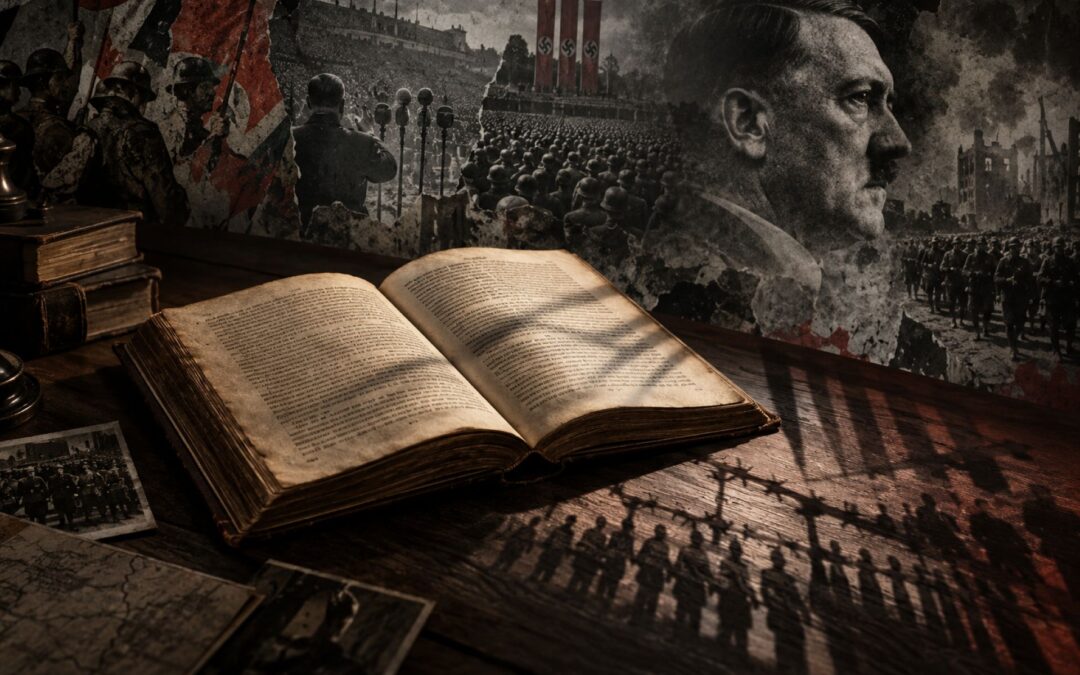
Few political books are as historically consequential, as frequently invoked, and as poorly understood as Adolf Hitler’s Mein Kampf. Written after the failed Beer Hall Putsch and begun during Hitler’s imprisonment at Landsberg in 1924, it combines political autobiography, ideological manifesto, movement history, propaganda theory, racial doctrine, reflections on organization, and arguments about Germany’s future foreign policy. The result is neither a conventional memoir nor a systematic work of political philosophy. It is a book in which Hitler reconstructs his own life as the origin story of a worldview and then presents that worldview as the foundation for a political movement and, eventually, a transformed German state.
Understanding the book therefore requires more than extracting its most notorious ideas. Its argument develops across two volumes and 27 chapters: childhood and Vienna lead into war and defeat; defeat becomes a theory of national betrayal; that theory feeds racial antisemitism and anti-Marxism; ideology becomes party organization; party organization becomes a theory of leadership, propaganda, political violence, citizenship, and state power; and these domestic ideas ultimately connect to foreign alliances and territorial expansion in Eastern Europe. The United States Holocaust Memorial Museum describes Mein Kampf as part autobiography and part political treatise, emphasizing its antisemitism, racist worldview, and aggressive pursuit of Lebensraum.
The distinction between Hitler’s claims and established history is essential throughout. His autobiographical account is often retrospective, selective, or demonstrably inaccurate, while his racial theories have no valid biological foundation and his explanations of German history repeatedly rely on conspiracy thinking and scapegoating. This article discusses those racist, antisemitic, and violent ideas because they are central to the book, but it treats them as historical and ideological claims to be explained and evaluated, not as factual descriptions of Jews, racial groups, or political events.

Before the Summary: What Mein Kampf Is and How to Read It
Hitler began Mein Kampf after the November 1923 Beer Hall Putsch, an unsuccessful attempt to overthrow the German republican government. Convicted of high treason, he was imprisoned at Landsberg in 1924 and used the period to begin a work intended both to explain the development of the National Socialist movement and to set out its aims. Volume I appeared in 1925 and Volume II in 1926 through the Nazi Party’s publishing house, Franz Eher Verlag.
The complete structure can be checked directly in the James Murphy unexpurgated English translation, first published in 1939. The edition contains a dedication and preface, twelve chapters in Volume I, fifteen chapters in Volume II, and an epilogue; material such as Murphy’s translator’s introduction and the later George Orwell review included with the online text is not part of Hitler’s original work.
For historical interpretation, the English translation should not be treated as the final authority on every nuance of wording. The Institut für Zeitgeschichte’s 2016 critical edition places the text against extensive historical annotation, while the Historisches Lexikon Bayerns overview of Mein Kampf summarizes its publication history, ideological content, autobiographical unreliability, and relationship to later Nazi policy. The distinction matters because Mein Kampf is simultaneously evidence about what Hitler wanted readers to believe and an unreliable source for many of the events he describes.
Hitler’s own preface explains the basic conception of the work. Rather than offering only a doctrinal treatise, he proposes to describe both the aims of his movement and its development, implying that the history of the movement will itself demonstrate the validity of its principles. The book therefore turns biography and party history into political evidence: the author’s life supposedly proves his worldview, while the party’s growth supposedly proves that the worldview can be converted into power.
That design is also why Volume I and Volume II feel different without being separable. The first volume presents a retrospective account of Hitler’s formation and the origins of the movement. The second is more programmatic, shifting toward the state, citizenship, leadership, party organization, paramilitary force, propaganda, labor organization, alliances, and expansion. The argument is cumulative: the racial and nationalist assumptions embedded in the autobiographical story become the premises for the political system proposed later.
Volume I: A Retrospect — Complete Summary
Volume I is organized as a political life story, but biography gradually gives way to ideological interpretation. Hitler begins with childhood, moves through Vienna and Munich, narrates the First World War and Germany’s defeat, describes his emergence as a political speaker, and then turns increasingly toward a diagnosis of Germany’s supposed national decline and the racial worldview through which he claims that decline can be understood.
By the final chapter, the personal narrative has largely completed its function. Hitler has transformed the story of an obscure Austrian-born aspiring artist and soldier into the claimed origin of a political worldview, and he is ready to move from the formation of one man to the formation of an organized movement.
Childhood, Vienna, and the Making of a Political Self
Chapter I, “In the Home of My Parents,” begins not with intimate family psychology but with geography and nationalism. Hitler emphasizes that he was born in Braunau am Inn, on the Austro-German frontier, and immediately gives that accident of birthplace political significance. The union of German-speaking Austria with Germany is presented as an overriding national objective, so even the opening of the autobiography frames personal origin through the future political program.
The childhood narrative then turns to Hitler’s relationship with his father, Alois, who wanted him to pursue a stable career in the civil service. Hitler portrays himself as resisting this path because he wanted to become an artist, making youthful conflict into an early demonstration of independence and will. He also presents his schooling as a setting in which German nationalist feeling developed, particularly within the multinational Habsburg environment, where questions of language, nationality, and loyalty could be interpreted through the Pan-German politics that later interested him.
The death of his father removed one obstacle to his artistic ambitions, while the death of his mother Klara in 1907 was a profound personal loss. Hitler then moved to Vienna, where his attempt to enter the Academy of Fine Arts failed. Chapter II, “Years of Study and Suffering in Vienna,” turns this failure and the poverty that followed into another stage in the construction of his political identity.
His account emphasizes material hardship, precarious lodging, reading, observation, and encounters with the social conditions of the imperial capital. Poverty is represented not simply as deprivation but as political education. Hitler claims to have studied social questions through experience and reading and to have encountered Social Democratic organization among workers, developing an admiration for its ability to mobilize people while rejecting its ideas.
The chapter also contains one of the most important retrospective claims in the entire book: Hitler presents Vienna as the setting in which he became an ideological antisemite. He describes a supposed progression from uncertainty or indifference to a belief that Jews constituted a distinct racial and political force behind phenomena he disliked. This personal “discovery” becomes structurally crucial because later chapters will explain journalism, Marxism, culture, finance, political revolution, and national decline through the same antisemitic conspiracy theory.
Historical evidence complicates this self-portrait. The USHMM account of Hitler’s early years notes that Hitler had Jewish acquaintances and business associates in Vienna and that the surviving evidence does not support the claim that his fully developed antisemitic ideology was already formed there in the way he later described. The Vienna years probably mattered to his political development, but Mein Kampf projects the later Hitler backward into the young man with much greater consistency than the contemporary evidence allows.
Chapter III, “Political Reflections Arising Out of My Sojourn in Vienna,” expands the autobiographical material into a catalogue of political lessons. Hitler discusses the Habsburg monarchy as a multinational state he believes is incapable of sustaining German national interests, and he contrasts political movements according to their ability to understand mass psychology, mobilize supporters, and connect ideology with organization. Vienna becomes less a city in which events happened to him than an ideological laboratory whose every institution allegedly taught him something.
Two Austrian politicians occupy a particularly important place in this reconstruction. Georg von Schönerer represents an aggressively Pan-German nationalist politics Hitler admires in some respects but criticizes for political misjudgment, while Vienna mayor Karl Lueger is treated as a more effective reader of popular opinion and political organization. Hitler is especially interested in the relationship between doctrine and constituency: a movement may possess ideas he approves of, but if it cannot understand the public, formulate effective propaganda, or build durable institutions, it will fail.
Parliamentary politics is another major target. Hitler depicts parliamentary government as irresponsible because collective voting obscures personal accountability, an argument that will later develop into his leadership principle. In his telling, the democratic assembly encourages mediocrity and compromise, whereas decisive political action requires identifiable leaders with authority and responsibility.
Vienna therefore supplies much of the vocabulary that will dominate the rest of the book: nationality, race, Marxism, mass psychology, propaganda, leadership, parliament, political organization, and the alleged threat posed by Jews. The chapter’s importance lies less in whether these ideas truly originated exactly when Hitler says they did than in the way he retrospectively arranges them into a coherent conversion story.
Munich, War, Defeat, and Revolution
Chapter IV, “Munich,” begins with Hitler leaving Vienna for Bavaria. In the book, Munich appears as a culturally and nationally congenial German city, sharply contrasted with the multinational Habsburg world from which he says he wanted to escape. The move also creates space for a broader geopolitical argument about how Germany should respond to population, land, and national power.
The chronology of this autobiographical episode requires correction. Hitler remained in Vienna until May 1913 and then moved to Munich; the documented chronology of his early life is more reliable than the self-dramatizing sequence presented in Mein Kampf.
More important for the book’s later argument is the territorial logic introduced here. Hitler rejects the idea that economic growth, overseas trade, or conventional colonial policy alone can solve Germany’s long-term problems. He increasingly connects national strength with possession of sufficient territory, preparing an argument that will become far more explicit in Volume II: a growing German nation should seek land in Europe rather than merely participate in overseas imperial competition.
Chapter V, “The World War,” marks the next major turning point in Hitler’s self-narrative. He describes the outbreak of the First World War as an emotionally transformative moment and military service as a source of belonging, purpose, and national unity. The army is idealized in contrast to the civilian political society he distrusts, allowing the war to become both a personal high point and a model of collective discipline.
Hitler served in the Bavarian army, eventually working as a dispatch runner. He was wounded during the war and later hospitalized after a gas attack; the armistice and revolution reached him while he was recovering in November 1918. The basic outline of service is real, although Mein Kampf integrates it into a later political myth in which the front symbolizes authentic national community while civilian politics becomes associated with weakness and betrayal.
Chapter VI, “War Propaganda,” interrupts the autobiographical sequence to draw lessons from wartime persuasion. Hitler argues that propaganda should address broad masses rather than intellectual elites and that its effectiveness depends on simplicity, emotional force, restriction to a small number of themes, and persistent repetition. Nuance is treated as a liability when the purpose is mass mobilization.
He also compares German and enemy propaganda, concluding that Germany underestimated the importance of psychological warfare. Whatever the accuracy of his specific judgments, the conceptual lesson is clear: propaganda is not a vehicle for balanced education. It is an instrument designed to create conviction and direct emotion toward a political objective.
Chapter VII, “The Revolution,” returns to Germany’s collapse in 1918. Hitler describes declining morale, unrest, revolution, defeat, and the end of the monarchy not as a complex outcome of military exhaustion, economic pressure, strategic failure, and social crisis but through a moralized theory of internal betrayal. Marxists and Jews are increasingly cast as coordinated enemies who allegedly undermined the nation from within.
This interpretation turns defeat into ideological proof. If Germany was not defeated because its war effort had become unsustainable but because internal enemies destroyed national unity, then the lesson is not to reconsider German military or political strategy; it is to identify, exclude, and defeat those alleged enemies. The explanatory structure is circular because groups Hitler already opposes become the cause of events he wishes to explain.
The chapter culminates in Hitler’s description of deciding to enter politics. Personal despair at defeat becomes political vocation, completing one of the book’s most important transitions: the soldier who experiences national collapse supposedly recognizes that restoring Germany requires not merely military service but ideological struggle.
From Army Agitator to German Workers’ Party Member
Chapter VIII, “The Beginning of My Political Activities,” describes Hitler’s postwar period in the Bavarian military. Rather than immediately emerging as an independent political leader, he remained in military service and entered an environment in which soldiers were exposed to political education and intelligence work. Hitler presents this period as the discovery of his ability to speak persuasively before groups.
The historical record adds useful context. In summer 1919 he joined the Information Office of the Bavarian Military Administration, participated in anti-Communist political education, and began giving political talks. By September 1919 he had also produced an explicitly antisemitic written response for the army in which Jews were characterized in racial terms, indicating that his mature racial antisemitism was firmly visible by this postwar stage even if the Vienna conversion story is overstated.
Chapter IX, “The German Labour Party,” describes the encounter from which Hitler’s formal party career developed. Acting in connection with his military duties, he attended a meeting of the small German Workers’ Party, or DAP, in September 1919. In the book, he emphasizes the organization’s tiny scale, its lack of polished machinery, and the combination of skepticism and attraction he initially felt toward it.
The pivotal episode is a political argument during the meeting. Hitler portrays himself responding forcefully to another speaker and thereby attracting the attention of the party’s organizers, including Anton Drexler. He subsequently receives an invitation to join and debates whether such a small, amateur organization could become useful.
His decision is presented as significant precisely because the party is insignificant. A larger organization would have forced him into an existing structure; the DAP, by contrast, offers room to shape doctrine and organization. The narrative therefore makes obscurity an advantage: because almost nothing exists, everything can be built.
The later documentary record confirms that Hitler attended a DAP meeting on September 12, 1919, joined shortly afterward, and rapidly became important because of his speaking ability. It also corrects one piece of Hitler’s self-mythology: he later claimed an extremely early membership number, while party records used higher numbers designed partly to make the organization look larger than it was.
From Germany’s Collapse to Racial Ideology
Chapter X, “Why the Second Reich Collapsed,” is one of the longest and most wide-ranging sections in Volume I. Hitler no longer tells a primarily personal story. Instead, he diagnoses the alleged weaknesses of Imperial Germany across government, society, economics, culture, education, public morality, class relations, journalism, foreign policy, and national identity.
Some of the discussion begins from recognizably political questions: whether parliamentary government weakened leadership, whether rapid economic development altered social cohesion, whether the state neglected workers, whether education encouraged character as well as knowledge, and whether national institutions produced adequate political leadership. Yet these observations are not developed through disciplined comparison or evidence. They accumulate into a theory in which many different problems are eventually made to point toward the same ideological enemies.
Hitler repeatedly rejects explanations based on ordinary institutional complexity. Political disagreement becomes moral failure, competing social interests become evidence of national decay, and pluralism becomes weakness. The possibility that modern states contain legitimate conflicts among classes, regions, religions, parties, and economic interests is replaced by an organic idea of the nation in which healthy politics should produce unity around a supposedly authentic national community.
The chapter is especially important because it shows the transition from broad criticism to racialized causation. Economic change, journalism, socialist organization, modern culture, and political conflict are not allowed to remain separate historical processes. They increasingly become manifestations of a single hidden struggle, allowing antisemitism to operate as an all-purpose explanation.
Chapter XI, “Race and People,” makes that worldview explicit. Hitler presents human history as a racial struggle and assigns different groups fixed capacities, virtues, and defects. He elevates an imagined “Aryan” racial type as the principal bearer of culture while describing racial mixture as degeneration, thereby interpreting states, civilizations, and historical change through notions of biological purity and hierarchy.
Jews occupy a uniquely central position in this system. Rather than being treated as diverse individuals or communities, they are constructed as a single racial actor capable of pursuing coordinated goals through finance, Marxism, journalism, culture, parliamentarianism, and other institutions that Hitler opposes. Contradictory accusations can coexist because the conspiracy theory does not require consistent evidence: Jews can be blamed simultaneously for capitalism and revolutionary socialism because both are interpreted as instruments of the same imagined racial strategy.
This is the ideological core through which much of the rest of the book should be read. Once history is imagined as an existential racial struggle, compromise becomes dangerous, pluralism appears as contamination, political opponents become biological threats, and the state can be reconceived as an instrument for racial preservation rather than a legal framework applying equally to citizens.
Modern biological evidence does not support this conception of humanity. The American Association of Biological Anthropologists’ statement on race and racism explains that socially recognized racial categories do not accurately map human biological variation, that human populations have never existed as fixed and biologically “pure” racial units, and that genetic diversity does not divide humanity into the discrete racial hierarchies assumed by theories such as Hitler’s.
Building the Early National Socialist Movement
Chapter XII, “The First Stage in the Development of the German National Socialist Labour Party,” returns from racial theory to organization. Hitler explicitly signals that the next volume will provide fuller treatment of the movement’s principles and state theory, while the closing chapter of Volume I describes how the small party began developing into a recognizable political organization.
The chapter emphasizes the importance of public meetings. A political movement must not merely publish ideas; it must bring people together, create an atmosphere of common commitment, confront opposition, and convert passive agreement into collective identity. Hitler increasingly understands politics as an event experienced by crowds rather than only as an argument processed individually.
The party’s program is treated as something that should remain fixed enough to function as a creed. Hitler is suspicious of frequent programmatic revision because he believes ordinary supporters require recognizable principles around which loyalty can form. The argument anticipates Volume II’s distinction between a worldview, a program, propaganda, and organization: doctrine needs a simplified public expression, and that expression must be embodied in a disciplined movement.
The February 1920 mass meeting at Munich’s Hofbräuhaus becomes the narrative climax. Hitler describes presenting the party’s program to a large crowd and interprets the audience’s response as proof that a new political movement has been born. Historically, the DAP soon renamed itself the National Socialist German Workers’ Party, or NSDAP, and Hitler’s speaking ability accelerated his rise within it.
Volume I thus closes by converting political autobiography into movement history. Childhood, Vienna, war, defeat, and ideological formation have all been arranged to lead toward organization. The private self has become the political speaker, and the speaker has found the institution through which his worldview can seek power.
Volume II: The National Socialist Movement — Complete Summary
Volume II begins where the first volume ends: with a movement that now needs doctrine, structure, cadres, propaganda, discipline, and long-term political objectives. Personal recollection remains present, but it is increasingly subordinate to the question of how National Socialism should organize society and acquire power.
The sequence moves from worldview to state, citizenship, and leadership; from there to public meetings, political conflict, paramilitary force, centralization, and organization; and finally toward labor relations, international alliances, eastern expansion, and the justification of force. The scale of the argument has expanded from one man’s development to a proposed national order.
Worldview, State, Citizenship, and Leadership
Chapter I, “Weltanschauung and Party,” distinguishes an ordinary political platform from a comprehensive worldview. Hitler argues that a movement capable of transforming society must offer more than temporary policies or electoral slogans. It needs an integrated conception of history, community, enemies, and political purpose that can command deep loyalty.
The German word Weltanschauung is therefore central. In Hitler’s use, it refers not merely to a set of opinions but to an encompassing worldview through which political events become intelligible. National Socialism is supposed to supply such a worldview, while the party program translates it into propositions that ordinary supporters can recognize and defend.
The argument also explains Hitler’s resistance to constant doctrinal revision. Political movements may be tempted to modify programs whenever circumstances change, but he fears that doing so weakens faith and creates internal disputes. A simplified, stable program is useful not because it captures every intellectual nuance but because it gives a mass organization a fixed object of allegiance.
Chapter II, “The State,” develops one of the most consequential arguments in the book. Hitler rejects the idea that the state possesses inherent moral value simply because it exists. Instead, he treats it as an instrument whose legitimacy depends on whether it preserves and advances the racial community he imagines.
This reverses ordinary constitutional reasoning. Rather than beginning with citizens who create institutions to govern common affairs, Hitler begins with a supposed biological people whose preservation becomes the state’s highest objective. Political rights, education, culture, reproduction, physical development, and social policy are consequently judged according to whether they strengthen that racial collective.
Education receives extensive attention. Hitler criticizes schooling that emphasizes information without physical development, character, courage, obedience, or national consciousness. The ideal citizen is imagined less as an autonomous participant in civic life than as a physically disciplined member of a collective prepared to subordinate individual interests to national struggle.
The chapter also connects reproduction to politics. Because Hitler treats heredity as decisive, the state acquires an interest in regulating who should reproduce and in preventing what he regards as hereditary decline. These ideas belong to the wider racial and eugenic thinking circulating in the era, but Mein Kampf embeds them within a particularly radical political program in which state power is justified by racial preservation.
Chapter III, “Citizens and Subjects of the State,” converts these principles into political status. Hitler proposes a distinction between residents or subjects and full citizens, with political rights reserved for those who satisfy his racial and national criteria and demonstrate service to the community. Citizenship therefore ceases to be a broadly legal relationship between the individual and the state and becomes a privilege tied to racial membership.
The chapter is relatively short, but its implications are large. If only members of the favored racial-national community can possess full political rights, exclusion is not an accidental abuse of the system; it is built into the definition of the system itself. Later Nazi law did not simply reproduce this chapter word for word, but the underlying distinction between racial belonging and full citizenship became a central feature of the regime.
Chapter IV, “Personality and the Ideal of the People’s State,” addresses political leadership. Hitler argues against decision-making by anonymous majorities and in favor of a principle according to which authority belongs to identifiable leaders who carry personal responsibility for their decisions. Advisory bodies may contribute expertise, but authority should not ultimately arise from parliamentary voting.
The model is hierarchical. Each level of organization should contain leaders with real power and responsibility, creating a chain of command rather than a representative system in which leadership depends continuously on negotiation among competing interests. Hitler presents this as an antidote to bureaucratic mediocrity and parliamentary evasion of responsibility.
Chapter V, “Weltanschauung and Organization,” connects the theory of the future state back to the party. A movement cannot advocate hierarchical authority while organizing itself according to principles it rejects. Its internal structure must therefore prefigure the political order it hopes to establish.
This creates a close relationship between doctrine, leadership, and discipline. The movement is not envisioned primarily as a coalition in which different groups bargain with one another. It is an instrument for transforming ideological conviction into coordinated action, with authority concentrated rather than dispersed.
Mass Meetings, Conflict, and the SA
Chapter VI, “The First Period of Our Struggle,” returns to early National Socialist campaigning. Hitler focuses on speeches, public meetings, political atmosphere, and controversial issues capable of drawing audiences. His recurring concern is how to move people from curiosity to emotional commitment.
The meeting hall matters because Hitler believes collective experience strengthens conviction. A person reading alone may question or hesitate, while someone inside an enthusiastic crowd can experience political agreement as social confirmation. The speaker, symbols, reactions of the audience, and confrontation with opponents all become part of persuasion.
This section therefore shows propaganda functioning in practice. The principles stated earlier—simplicity, emotional concentration, repetition, and adaptation to an audience—are not left as abstract theory. They are incorporated into a political culture of rallies, speeches, ritual, and escalating collective identification.
Chapter VII, “The Conflict with the Red Forces,” turns from persuasion toward organized confrontation. Hitler describes clashes at meetings with Communists and other left-wing opponents and celebrates the party’s ability to prevent disruption. Political opposition is increasingly conceptualized not as something to answer within shared democratic rules but as an enemy force to be physically defeated.
The narrative places great value on visible strength. A movement that cannot protect its meetings or impose order in its own spaces appears weak, while successful resistance to opponents is treated as evidence of vitality. Violence therefore acquires symbolic as well as practical importance: it demonstrates resolve to followers and seeks to intimidate adversaries.
Chapter VIII, “The Strong Is Strongest When Alone,” addresses cooperation among nationalist organizations. Hitler argues that alliances among ideologically similar groups may look attractive because they seem to combine strength, but he fears that coalitions dilute purpose, obscure leadership, and preserve weak organizations that should disappear.
His preferred model is competitive consolidation. Instead of assembling a federation of nationalist groups, one movement should prove itself superior and absorb or displace rivals. The underlying assumption resembles his broader theory of struggle: unity is achieved not primarily through negotiated pluralism but through the victory of the strongest organization.
Chapter IX, “Fundamental Ideas Regarding the Nature and Organization of the Storm Troops,” develops this logic through the SA. Hitler rejects the idea that the movement’s paramilitary formation should simply imitate a conventional army or operate as a secret conspiratorial organization. He wants a public, politically committed force connected directly to the movement.
The SA’s purpose is partly protective, especially at meetings, but the chapter reaches beyond ordinary security. It provides a disciplined body of activists, projects strength in public, creates a culture of action, and helps translate political antagonism into physical confrontation. The movement thereby acquires an organized capacity for coercion without yet possessing state power.
The chapter is crucial because it shows violence becoming institutional rather than incidental. Conflict is not presented merely as an unfortunate consequence of heated politics. The movement is expected to cultivate the ability and willingness to meet opponents with force.
Centralization, Propaganda, and Organization
Chapter X, “The Mask of Federalism,” shifts to tensions among German regional identities and political structures. Hitler is especially concerned that Bavarian particularism, Prussian antagonism, or other regional loyalties could weaken national unity. Federal arguments are therefore judged according to whether they strengthen or fragment the imagined German national community.
The target is not every form of administrative decentralization in the abstract. The deeper concern is political sovereignty: Hitler rejects rival sources of identity and authority that might compete with the centralized national movement. The chapter fits naturally with his hostility toward coalitions and divided leadership.
Chapter XI, “Propaganda and Organization,” is one of the book’s clearest accounts of movement-building. Hitler distinguishes the broad task of propaganda from the narrower task of organization. Propaganda seeks the largest possible circle of sympathy; organization turns a smaller number of committed supporters into a durable political structure.
The distinction solves a problem created by mass recruitment. A movement needs many sympathizers to become politically powerful, but not everyone who is persuaded should immediately occupy organizational responsibility. Hitler therefore imagines propaganda as expansive and organization as selective.
The model also creates different criteria for success. Propaganda should reach outward, reduce complexity, and intensify identification. Organization should evaluate commitment, allocate roles, maintain discipline, and generate leaders capable of action.
Hitler regards failure to distinguish these functions as dangerous. If organization tries to include everyone indiscriminately, it becomes unwieldy; if propaganda addresses only a narrow cadre, the movement cannot build mass support. The desired political machine therefore depends on a large outer audience and a more controlled internal structure.
Trade Unions, Alliances, and the Turn East
Chapter XII, “The Problem of the Trade Unions,” considers how National Socialism should respond to workers already organized through labor institutions associated with rival political movements. Hitler recognizes that economic interests and workplace security give unions practical importance, making it unrealistic simply to ignore them.
Yet he resists independent class politics because it conflicts with the concept of a unified national community. Workers and employers are not supposed to organize ultimately as antagonistic social classes with competing political interests. Economic conflicts should instead be incorporated into a national order that subordinates class identity to racial-national solidarity.
The chapter therefore reveals an unresolved tension between practical politics and ideological aspiration. Hitler acknowledges institutions that arise from genuine economic interests but seeks to strip them of independent political power. The movement must reach workers without accepting the Marxist interpretation of class struggle that he treats as an enemy ideology.
Chapter XIII, “The German Post-War Policy of Alliances,” moves decisively from domestic organization to international politics. Hitler considers Germany’s weakness after the First World War and asks what alliances might create room for national recovery. Britain and Italy occupy important places in his calculations, while France is presented as a principal continental enemy.
Alliances are not ends in themselves. Hitler judges them according to whether they create strategic conditions favorable to Germany’s larger objectives. Diplomatic cooperation is therefore instrumental, not an expression of a stable international order based on mutual restraint.
The argument also rejects the idea that Germany can solve its problems merely by restoring its prewar status. The foreign-policy discussion begins to move beyond revision of Versailles toward a more radical question: where should Germany seek the territory and power Hitler thinks necessary for its future?
Chapter XIV, “Germany’s Policy in Eastern Europe,” supplies the answer. Hitler argues that Germany should turn toward Eastern Europe rather than base its ambitions primarily on overseas colonies or simple restoration of earlier borders. Russia and the territories to Germany’s east become the imagined space for expansion.
This is the major Lebensraum chapter. Territorial conquest is justified through a combination of demographic reasoning, racial hierarchy, geopolitical competition, and the belief that national survival requires sufficient land. The argument is not simply that Germans living outside Germany should be incorporated into the Reich; it envisions acquisition of territory inhabited by other peoples.
The racial worldview and foreign-policy worldview therefore become inseparable. If history is a struggle among racial communities for land and survival, then conquest can be presented as natural necessity rather than political choice. Eastern Europe is not approached as a region whose peoples possess their own political rights but as space to be evaluated according to German expansion.
The Historisches Lexikon Bayerns analysis of Mein Kampf identifies these foreign-policy passages as some of the clearest indications of Hitler’s long-term priorities. They establish a direction—eastward territorial expansion, hostility to France, and strategic use of alliances—even though they do not provide a precise operational timetable for the later war.
“Self-Defence” and the Expected Victory of the Movement
Chapter XV, “The Right to Self-Defence,” returns to Germany’s postwar condition and to the idea that national recovery requires struggle rather than passive acceptance. Hitler discusses the Ruhr crisis, resistance, political authority, and the failure he perceives in Germany’s existing leadership. The title’s language of “self-defence” allows aggressive political measures to be framed as responses to an existential threat.
The chapter also intensifies the book’s treatment of internal enemies. Jews, Marxists, democratic politicians, and other opponents are not handled as competing groups within a common political community; they are folded into a narrative of national subversion. Because the alleged threat is existential, ordinary restraints can be dismissed as weakness.
Some of the most violent antisemitic rhetoric in the book appears within this political logic. Its significance does not depend on reproducing the language at length. What matters is that racial conspiracy theory, national humiliation, political struggle, and legitimate force have by this point become mutually reinforcing concepts.
The epilogue looks back at the revival of the National Socialist movement after its temporary suppression following the Beer Hall Putsch. Hitler presents renewed organization as evidence that the movement’s underlying worldview survived political defeat. Short-term failure is reinterpreted as a stage in a longer struggle.
The ending therefore completes the movement that began on the first page. A birthplace becomes a symbol of national unification; childhood becomes political formation; Vienna becomes ideological awakening; war becomes national community; defeat becomes betrayal; betrayal becomes worldview; worldview becomes party; party becomes organization; and organization becomes the anticipated foundation of a future state.
Mein Kampf as Political Autobiography: Myth, Memory, and Self-Construction
The autobiographical portions of Mein Kampf are most useful when read as political self-construction rather than as transparent memoir. Hitler selects episodes from childhood, Vienna, Munich, war, and postwar politics and arranges them so that the adult political leader appears to have emerged through an almost continuous process of recognition. Experiences that were ambiguous when they occurred are given definite ideological meanings in retrospect.
The Vienna antisemitism narrative illustrates the method particularly well. In the book, Hitler depicts himself gradually discovering what he presents as the hidden racial reality of modern society. Yet the USHMM reconstruction of his Vienna years notes that surviving evidence does not support the claim that his comprehensive racial antisemitism had already developed there exactly as he later maintained. His ideological radicalization is much more securely visible in postwar Munich.
The discrepancy matters because Vienna is not a decorative memoir episode. It functions as proof. By claiming that antisemitism emerged reluctantly from observation and experience, Hitler attempts to present an ideological prejudice as an empirical discovery rather than as a political doctrine shaped by the antisemitic currents around him.
The same retrospective design shapes the account of parliamentary politics. Hitler describes witnessing institutions and movements whose strengths and weaknesses supposedly taught him durable lessons about leadership, propaganda, mass psychology, and national identity. The adult political theorist is projected backward into the young observer, making later doctrine appear like accumulated practical wisdom.
War is treated similarly. The First World War becomes the period in which Hitler supposedly experiences authentic national community, sacrifice, and discipline, while the revolution and defeat of 1918 become the traumatic moment that converts personal loyalty into political mission. This gives the later Nazi leader a symbolic biography: he is not simply a politician pursuing power but a soldier emerging from national catastrophe.
Even the small German Workers’ Party is incorporated into the myth. Hitler presents himself as recognizing that its insignificance creates opportunity and as possessing unusual clarity about what the embryonic movement could become. Genuine elements of his rapid rise are therefore embedded within a narrative that continually minimizes contingency and magnifies inevitability.
Literary scholar Albrecht Koschorke’s analysis of the narrative strategies of Mein Kampf emphasizes precisely this interaction between political argument and invented or reshaped autobiographical detail. Koschorke highlights the way autobiographical episodes are constructed to make ideological points and how political enemies become linked through a widening conspiracy narrative.
The result is a political protagonist rather than a psychologically rich autobiographical self. Hitler says relatively little about dimensions of private life that do not serve the ideological story. Relationships, uncertainties, ordinary pleasures, and personal contradictions largely disappear unless they contribute to the emergence of the political identity.
That narrowness is deliberate in effect even where it may not be consciously literary in method. The narrator exists to demonstrate conviction. Life is valuable mainly because it can be reorganized into a sequence of lessons about nation, race, enemies, propaganda, leadership, and struggle.
This is also why factual correction alone does not exhaust the value of the autobiography. Discovering that a date is wrong or a political conversion occurred later than claimed is important, but the deeper question is why the story was told in that form. The answer is that Mein Kampf seeks to make ideology look biographically inevitable.
Race, Antisemitism, and the Logic of the “People’s State”
Race is not one theme among many in Mein Kampf. It is the organizing concept through which Hitler attempts to connect culture, history, state power, citizenship, reproduction, war, and political enemies. Once the racial premise is accepted, the rest of the political structure follows with greater apparent coherence.
The book treats humanity as if it were divided into biologically distinct groups possessing durable collective characteristics. Cultural achievements are attributed to supposed racial capacities, while decline is explained through racial mixture. This transforms complicated historical questions into biological ones: civilizations rise because allegedly superior racial qualities are preserved and decline when those qualities are supposedly diluted.
The central “Aryan” category is correspondingly mythic rather than scientifically defined. Hitler uses it as a civilizational and biological ideal, assigning creative cultural capacity to it and constructing other groups in relation to its supposed superiority. This is not a conclusion produced by biological research; it is an ideological hierarchy presented in biological language.
Modern anthropology directly contradicts the premises. The AABA statement on race and racism explains that human variation does not divide into discrete continental racial types, that no human population has been biologically “pure,” and that socially defined racial categories do not map cleanly onto genetic patterns. The biological essentialism required by Hitler’s political system is therefore not supported by contemporary population genetics or biological anthropology.
Antisemitism occupies an even more specific function. Jews are not merely placed low within an invented racial hierarchy; Hitler constructs them as an active, coordinated antagonist. This makes antisemitism explanatory in a way that ordinary prejudice alone would not be: Jews supposedly account for contradictory developments ranging from finance capitalism to Marxist revolution, from journalism to modern culture, and from parliamentary liberalism to revolutionary unrest.
The contradictions reveal the conspiratorial structure. Capitalism and communism ordinarily represent competing systems, but conspiracy reasoning allows both to be interpreted as masks worn by the same imagined enemy. Evidence that should falsify the theory instead expands it, because any institution can be reclassified as another instrument of hidden control.
This device greatly simplifies political reality. Germany’s military defeat, social conflict, economic instability, cultural change, class politics, and institutional weakness no longer need separate explanations. They can be fused into one narrative of racial subversion.
The “people’s state” proposed in Volume II is the governmental expression of this worldview. The state does not exist to protect equal legal citizenship irrespective of ancestry. It exists to preserve and develop the favored racial community, meaning that government becomes authorized to distinguish among people according to inherited identity.
Chapter III’s separation of citizens from mere subjects makes the logic concrete. Political rights are not universal within the state; they depend on belonging to the racial-national community as Hitler defines it. Exclusion is therefore a constitutional principle rather than an accidental prejudice.
The later Nazi regime translated racial concepts into law. The Nuremberg Laws of September 1935 distinguished full citizenship according to “German or related blood,” excluded Jews from full citizenship, and prohibited marriage and sexual relations between Jews and people classified as German. The laws did not mechanically copy Mein Kampf, but they institutionalized the same fundamental premise that ancestry should determine political membership and legal status.
The broader USHMM history of Nazi racism shows how such racial thinking shaped persecution under the Nazi regime. The later history is essential because it demonstrates what happens when categories presented in ideological writing become administrative categories backed by police, law, bureaucracy, and state violence.
Still, the historical relationship should be described carefully. Mein Kampf contains radical antisemitism, racial exclusion, eugenic thinking, and violent hostility, but it is not a detailed administrative description of every later stage of persecution and mass murder. The text establishes central ideological assumptions and objectives; later policy developed through additional decisions, institutions, wartime radicalization, and interactions among Nazi leaders and agencies.
The most revealing feature of the racial system is therefore not that it predicts every later measure. It is that it eliminates conceptual barriers that would otherwise protect individuals. When rights depend on race, when racial communities are imagined as locked in existential struggle, and when an entire minority is described as a conspiratorial enemy, exclusion and coercion become compatible with the book’s definition of legitimate government.
Propaganda, Organization, and the Psychology of Mass Politics
Hitler’s treatment of propaganda is among the most systematic elements in Mein Kampf. It appears first in the discussion of wartime propaganda and then returns repeatedly in the account of party growth, mass meetings, organization, and public conflict. Propaganda is not merely publicity for policies; it is the mechanism by which a worldview is simplified, emotionally charged, and converted into mass loyalty.
The theory begins from a deeply hierarchical conception of audiences. Hitler assumes that most people have limited political attention, imperfect memory, and a greater responsiveness to emotionally clear messages than to complexity. From that assumption, he concludes that effective propaganda should concentrate on a small number of claims, repeat them constantly, and avoid qualifications that could weaken certainty.
This approach is opposed to education in the ordinary sense. Education might introduce complexity, competing evidence, and uncertainty, while propaganda seeks a predetermined response. Truth is therefore subordinated to effectiveness because the question becomes not “What is the most accurate description?” but “What message will most reliably produce the desired belief and action?”
Repetition is especially important. A claim does not gain strength because new evidence is added; it gains political force because it becomes familiar, associated with emotion, and embedded in group identity. The method works most efficiently when repeated messages reduce complicated events to a few recognizable causes, symbols, and enemies.
The meeting hall intensifies this process. Mein Kampf repeatedly contrasts the solitary reader with the participant in a crowd. A mass meeting surrounds the individual with visible agreement, applause, symbols, emotional cues, and a speaker capable of adjusting rhetoric to audience reaction.
Political ritual therefore supplements argument. Banners, uniforms, repeated slogans, confrontations with opponents, and disciplined groups create the impression that a worldview already exists as a living community. Persuasion becomes experiential rather than merely intellectual.
Chapter XI of Volume II adds the crucial distinction between propaganda and organization. Propaganda aims for breadth; organization aims for commitment and control. A movement needs far more sympathizers than administrators, activists, or leaders, so it should attract widely while selecting more carefully for internal responsibility.
This distinction reveals a sophisticated organizational logic even within a book that is otherwise often repetitive and intellectually undisciplined. Hitler understands that mass support and institutional capacity are different political resources. Popular enthusiasm can produce visibility, but a durable movement also requires routines, leadership, discipline, and members prepared to sustain activity between moments of public excitement.
Koschorke’s study of Mein Kampf as a work of political rhetoric is useful here because it emphasizes that the book itself performs many of the techniques it discusses. Enemies are simplified, outrage is repeatedly triggered, autobiographical stories authenticate political claims, and disparate grievances are integrated into one emotionally coherent worldview.
There is nevertheless a tension between Hitler’s theory of speech and the existence of Mein Kampf itself. He frequently treats spoken propaganda as better suited to moving masses because a speaker can respond to an audience and exploit collective emotion. Yet he also attempts to stabilize the movement through a large written work, suggesting that the book serves a different function: it codifies identity and doctrine for committed followers more than it operates as an efficient instrument of mass persuasion.
That distinction helps explain why Mein Kampf can be stylistically cumbersome while remaining politically significant. Its historical importance does not depend on being an elegant or universally persuasive book. It helped articulate a worldview for a movement whose real mass mobilization also depended on speeches, rallies, newspapers, symbols, organization, and later state-controlled media.
Leadership, Anti-Parliamentarism, and Political Violence
Hitler’s hostility toward parliamentary government begins in the Vienna chapters and becomes a constitutional principle in Volume II. He objects not merely to particular parliamentary outcomes but to collective decision-making itself, arguing that majority voting separates power from personal responsibility. The alternative is a hierarchy in which leaders possess real authority and are individually accountable for results.
This “personality principle” is often presented as an argument for competence. Hitler claims that important achievements come from exceptional individuals rather than committees and that institutions should identify and empower capable leaders. Yet the system contains no equivalent mechanism for democratic accountability if a leader becomes incompetent, dishonest, or destructive.
The contradiction is significant. Hitler attacks parliament because elected representatives can evade responsibility, but concentrating authority can make correction even harder when dissenting institutions, independent media, opposition parties, and electoral competition are weakened or removed. Personal responsibility is rhetorically emphasized while institutional checks on personal power are rejected.
The same logic operates inside the movement. Local structures are not supposed to behave like independent political communities negotiating with one another. They are components of a hierarchy whose legitimacy flows downward from leadership and upward only in the sense that successful leaders prove themselves through struggle.
Political violence fits naturally within this conception. If politics is a competition among legitimate interests, violence threatens the shared rules that make politics possible. If politics is instead an existential struggle between the nation and enemies seeking its destruction, force can be reframed as protection.
The SA chapters show that this was not only rhetorical. The movement expected organized activists to secure meetings, confront opponents, and project strength. Violence and the visible capacity for violence helped construct the party’s political identity.
Hitler also makes a distinction between secret conspiratorial activity and open force. He does not want the SA to function simply as an underground military organization. Its public presence matters because political strength has to be seen as well as exercised.
This helps explain the relationship among propaganda, leadership, and violence. Propaganda identifies the enemy and creates emotional certainty; leadership gives the movement a hierarchy capable of directing action; organized force demonstrates that the movement can dominate physical space. The three functions reinforce one another.
The anti-parliamentary model also produces a profound tension between mass participation and political sovereignty. Hitler wants enormous popular mobilization, but he does not want the mobilized public continuously making policy through representative institutions. The masses are expected to support, sacrifice, follow, and embody national unity while decisive authority is concentrated in leaders.
Mein Kampf therefore advocates mass politics without democratic pluralism. It seeks enthusiastic participation but rejects the legitimacy of enduring disagreement. Mobilization is valuable when it produces unity behind the movement; opposition is increasingly interpreted as obstruction, weakness, or hostility to the nation.
Lebensraum: Foreign Policy, War, and Eastern Expansion
Foreign policy in Mein Kampf is not an isolated set of diplomatic preferences. It grows directly from Hitler’s racial and social-Darwinist worldview. If nations are imagined as biological communities competing for survival and territory, then international politics becomes a struggle over land rather than a system that can be stabilized indefinitely through legal rules and negotiated interests.
The argument begins before Volume II. In the Munich chapter of Volume I, Hitler questions whether commercial development, overseas markets, or conventional colonial expansion can secure Germany’s future. Population and territory are increasingly connected, laying the groundwork for the later claim that Germany must acquire additional European land.
Volume II turns that implication into strategy. Chapter XIII considers potential alliances and principal enemies, particularly France. Britain and Italy appear as possible partners not because Hitler believes in permanent international friendship but because he judges alliances instrumentally according to whether they improve Germany’s position.
Chapter XIV makes the eastern orientation explicit. Hitler rejects mere restoration of Germany’s pre-1914 borders as an adequate objective and directs attention toward Russia and Eastern Europe. The desired territory is imagined as the agricultural and strategic space required for future German power.
This is Lebensraum, or “living space,” in its most politically consequential form. The concept combines demographic assumptions, racial hierarchy, agrarian romanticism, military power, and empire. It treats the presence and political rights of existing populations as subordinate to the supposed needs of an expanding German nation.
The book’s antisemitism also becomes entangled with its anti-Bolshevism and eastern policy. Soviet Russia is interpreted through racial conspiracy theory as well as geopolitical rivalry. A potential eastern war can therefore be imagined simultaneously as territorial conquest, racial struggle, and ideological conflict.
After 1933, these ideas became increasingly relevant to actual German foreign policy. The USHMM account of German foreign policy from 1933 to 1945 identifies overturning Versailles, incorporating ethnic German populations, and acquiring a vast empire in Eastern Europe as major goals of Nazi foreign policy.
The relationship is clear enough to reject the view that Lebensraum was a meaningless rhetorical flourish. Hitler had already argued in the 1920s that eastern territorial acquisition should become a major German objective. Later expansion into Eastern Europe and war against the Soviet Union developed in the same broad ideological direction.
At the same time, the book should not be misread as a precise military operations plan. It does not forecast every diplomatic reversal, tactical compromise, date, invasion route, or administrative decision that later occurred. Hitler could act opportunistically, and international conditions changed dramatically between the mid-1920s and the Second World War.
That distinction matters when interpreting Mein Kampf historically. The book is strong evidence for durable ideological priorities: racial empire, territorial expansion, hostility to the postwar order, and the conviction that Germany’s future required power beyond its existing borders. It is much weaker as a detailed schedule of the sequence through which those ambitions would later be pursued.
Structure and Style: Why the Book Reads Like a Speech More Than a Treatise
Mein Kampf is structurally unstable because it attempts to perform several literary and political functions at once. It is autobiography, political polemic, movement history, racial doctrine, propaganda theory, organizational reflection, and foreign-policy argument. These forms repeatedly interrupt one another rather than being arranged into a clean intellectual system.
The prose often behaves more like extended oratory than like a carefully edited analytical treatise. Arguments proceed through repetition, escalation, rhetorical questions, sweeping generalizations, attacks on enemies, and declarations of certainty. Ideas recur long after they have first been introduced because reiteration is itself part of Hitler’s theory of persuasion.
This repetition can make the book difficult to summarize without either reproducing its redundancy or flattening its progression. The same enemies and concepts appear across many chapters, but their political function changes. Antisemitism begins within autobiographical self-construction, expands into historical explanation, enters racial theory, shapes the state, affects citizenship, and later merges with anti-Marxism and foreign-policy conflict.
The movement between anecdote and universal claim is another characteristic feature. Hitler frequently begins with something supposedly witnessed in Vienna, Munich, the army, a political meeting, or the press and then generalizes from that episode to conclusions about entire classes, nations, political systems, or racial groups. The personal observer becomes an authority whose experiences are treated as sufficient evidence for sweeping theories.
This rhetorical form helps the autobiography and ideology fuse. A conventional treatise would have to defend premises independently. Mein Kampf can instead say, in effect, that the author saw how politics really works, suffered the consequences of national weakness, discovered the nature of the enemy, and therefore earned the authority to explain the system.
Koschorke’s literary analysis of Mein Kampf emphasizes the constructed nature of this performance. His reading identifies borrowed ideas, politically useful autobiographical invention, the expansion of attacks on Social Democracy into antisemitic conspiracy theory, contempt for scientific restraint, and deliberate provocation.
The language also depends heavily on binary opposition. Strong and weak, healthy and diseased, national and alien, creator and destroyer, leader and parliament, loyalty and betrayal are repeatedly presented as mutually exclusive alternatives. Once politics is expressed through such binaries, compromise appears not prudent but corrupt.
Organic and biological metaphors intensify the effect. States and peoples are discussed as if they were living bodies capable of health, contamination, growth, degeneration, and survival. Political disagreement can therefore be redescribed as pathology, allowing exclusion to seem like treatment rather than repression.
The style is not consistently controlled. Long digressions, repetition, overstatement, contradictory claims, and sudden changes of scale frequently weaken argumentative clarity. Yet the book’s lack of elegance should not be confused with lack of political function.
Its form suits a movement in which doctrine is less important as a logically demonstrated philosophy than as a framework for interpreting experience. A reader already sympathetic to major premises can find explanations for defeat, resentment, cultural anxiety, political conflict, and national ambition within the same worldview. The system feels comprehensive not because each component is proven but because almost everything can be assigned a place inside it.
Historical Reliability and Evidence: What the Book Claims Versus What We Know
As historical evidence, Mein Kampf has two very different kinds of value. It is weak as an objective account of Hitler’s early life, German society, race, Jews, Marxism, or the causes of military defeat. It is far stronger as evidence of the political identity Hitler wanted to construct and the ideological framework he was publicly articulating in the 1920s.
The autobiographical problem is visible from Vienna onward. Hitler later claimed that his decisive antisemitic awakening occurred there, but the USHMM examination of his early years finds that the surviving evidence points toward a later consolidation of his comprehensive racial antisemitism, particularly in postwar Munich.
Even relatively straightforward chronology is shaped by self-presentation. Hitler left Vienna for Munich in May 1913, and the reasons and circumstances can be reconstructed independently from his retrospective political storytelling. What matters is not simply catching inaccuracies but recognizing a broader pattern in which episodes are selected and rearranged to support later ideology.
The account of German defeat in 1918 presents a more consequential distortion. Mein Kampf interprets defeat through internal political betrayal, giving Marxists and Jews a central role in national collapse. This ideological explanation minimizes the military, economic, strategic, and geopolitical conditions that made continued German victory impossible.
The structure resembles what later became known as the “stab-in-the-back” myth. Germany’s battlefield forces are imagined as essentially undefeated until civilian enemies undermine them from within. Such a theory serves a political purpose because it transfers responsibility from military and imperial leadership to groups that the radical right already opposes.
The racial chapters display an even clearer failure of evidence. Hitler presents sweeping claims about inherited cultural capacity and racial purity without a scientifically defensible account of human biological variation. Modern biological anthropology shows that humans do not divide into the discrete, homogeneous racial populations assumed by his system.
His antisemitic argument is also unfalsifiable in practice. When Jews can supposedly control finance and revolutionary Marxism, liberal newspapers and radical politics, cultural experimentation and economic exploitation, contradictory evidence does not challenge the theory. It simply creates additional roles within the conspiracy.
This is one reason conspiratorial systems can acquire such explanatory reach. They reduce the number of independent causes needed to explain events. A world of institutional complexity, conflicting interests, unintended consequences, and historical contingency becomes a world controlled by hidden intention.
The method of evidence is therefore deeply selective. Experiences that support the worldview are generalized; counterexamples receive little attention; broad claims about whole populations are made from stereotypes or ideological assumptions; and opposing institutions are interpreted according to hostile motive rather than studied on their own terms.
The same problem affects Hitler’s claims about “the masses.” Some observations about repetition, group emotion, simplified messaging, and political identification resemble phenomena studied more systematically in later political communication. But Mein Kampf rarely distinguishes between empirical observation and contemptuous generalization.
Its claims about propaganda consequently have to be separated into different levels. It is historically important that Hitler believed propaganda should be simple, emotional, repetitive, and focused. That does not make every assertion he makes about mass psychology scientifically established.
The Institut für Zeitgeschichte’s critical edition is valuable precisely because it allows the text to be read against factual history, intellectual sources, and later developments rather than as a self-authenticating document. The gap between ideological assertion and historical evidence is not secondary to understanding Mein Kampf; it is one of the book’s defining features.
From Mein Kampf to Nazi Rule: Continuity, Radicalization, and the Limits of the “Blueprint” Idea
The relationship between Mein Kampf and Nazi policy after 1933 is frequently reduced to a single question: was the book a blueprint? The most useful answer is to separate ideological continuity from detailed operational prediction. The book clearly identifies several major objectives and assumptions that later became central to Nazi rule, but it does not contain a complete administrative script for everything the regime eventually did.
The strongest continuity appears in racial politics. Mein Kampf argues that the state should serve a racial community, distinguishes political belonging according to ancestry, and treats Jews as an existential racial enemy. After the Nazi seizure of power, racial classification increasingly shaped citizenship, marriage, employment, education, policing, and persecution.
The 1935 Nuremberg Laws provide a particularly clear example. They restricted full citizenship according to “German or related blood,” legally classified Jews through ancestry, and prohibited marriages and sexual relationships between Jews and those classified as German. These measures institutionalized principles closely compatible with the racial state imagined in Mein Kampf, even though the detailed legal machinery was developed later.
There is similar continuity in political structure. Hitler’s rejection of parliamentary pluralism, preference for hierarchical leadership, hostility toward independent opposition, and insistence that movement organization embody authoritarian command all predate the dictatorship. Once in power, the Nazi regime dismantled political pluralism and concentrated authority around Hitler, though the actual state remained institutionally more complex and competitive than the book’s simplified hierarchy suggests.
Propaganda offers another connection. The regime’s later propaganda apparatus used technologies, institutions, media systems, and bureaucracies not laid out in Mein Kampf, but the underlying emphasis on repetition, emotional clarity, simplified enemies, collective spectacle, and coordination between propaganda and organization is unmistakably continuous with the book.
Foreign policy provides perhaps the strongest case for treating Mein Kampf as evidence of long-term direction. Hitler openly argues for territorial expansion in Eastern Europe and treats the existing postwar settlement as unacceptable. The USHMM history of Nazi foreign policy shows how the regime later sought to overturn Versailles, absorb territories with ethnic German populations, and create an empire in Eastern Europe.
The invasion of the Soviet Union in 1941 therefore did not emerge from an ideological vacuum. It corresponded to a long-standing conception of eastern territory, racial empire, and anti-Bolshevik struggle that was already visible in Mein Kampf. Readers who want the wider geopolitical sequence can follow that development within the broader origins and course of World War II.
Yet “blueprint” becomes misleading if it implies that Hitler wrote a complete chronological program in the 1920s and merely executed each step later. International politics required tactical shifts, temporary agreements, changing priorities, and opportunistic responses. The Nazi-Soviet Pact of 1939, for example, demonstrates that immediate strategy could diverge sharply from ideological hostility when Hitler judged a temporary arrangement useful.
The Holocaust requires especially careful treatment. Mein Kampf contains extreme antisemitism, dehumanizing conspiracy theories, demands for racial exclusion, and violent rhetoric. These are central components of the worldview from which later persecution grew, but the book does not provide a detailed advance administrative plan for the Holocaust as it developed during the Second World War.
That distinction does not minimize ideological continuity. It prevents retrospective history from becoming artificially simple. Radical political systems develop through interaction among ideology, institutions, war, opportunities, subordinate actors, bureaucratic competition, and decisions made under changing circumstances.
The Historisches Lexikon Bayerns treatment of Mein Kampf is helpful because it preserves both sides of the issue. Major ideological goals—especially racial politics and expansion toward the east—are unmistakably present, while the book should not be treated as a detailed schedule for every later policy.
The most defensible interpretation is therefore neither that Mein Kampf predicted everything nor that it meant nothing. It publicly articulated a worldview whose major components later shaped the Nazi regime, while leaving substantial space for tactical adaptation, institutional development, and wartime radicalization.
Critical Review: Historical Significance, Intellectual Failures, and Value as a Primary Source
Judged as a source for understanding Hitler’s ideological self-presentation, Mein Kampf is extraordinarily important. It reveals how he wanted followers to understand his life, how he linked antisemitism to nationalism and anti-Marxism, how he conceptualized propaganda and organization, how he rejected parliamentary government, how he imagined racial citizenship, and how openly he connected Germany’s future to territorial expansion.
Its strength as a primary source, however, should not be confused with reliability. The autobiography is selectively constructed, important historical events are interpreted through ideological myth, and racial claims rest on assumptions contradicted by modern scientific understanding. The book tells historians a great deal about Hitler’s worldview while frequently telling them much less reliably about the external world that worldview claims to explain.
As argument-driven nonfiction, the work has severe evidentiary weaknesses. Claims about entire populations routinely exceed the available evidence, stereotypes substitute for comparative inquiry, and conspiracy theory absorbs contradictory phenomena into a single hostile explanation. Instead of testing whether different causes might account for different events, Hitler repeatedly forces economic, cultural, military, and political developments into one ideological framework.
This produces a paradoxical kind of coherence. The book is often disorganized at the level of prose and chapter construction, yet ideologically repetitive enough to create a strong sense of thematic unity. Nearly every subject can eventually be connected to race, national struggle, leadership, propaganda, enemies, and survival.
That unity helps explain the worldview’s attraction to committed adherents without validating its reasoning. A comprehensive ideology can feel powerful because it promises to explain many unrelated frustrations at once. The cost is that ambiguity and complexity must be removed, while evidence that challenges the system is reinterpreted as further evidence of hostility.
The treatment of propaganda is more concrete than many other sections. Hitler understands that political movements need different mechanisms for attracting sympathizers and organizing activists, and he recognizes that emotional identification, repeated messages, public spectacle, and organizational discipline interact. These observations make the book useful to historians studying Nazi mobilization.
They should not, however, be detached from the political purposes they serve. In Mein Kampf, propaganda does not aim at helping citizens evaluate competing claims more accurately. It seeks to manufacture unity around a worldview that delegitimizes opponents and reduces complex events to simplified enemies.
The organizational discussions display a similar mixture of practical observation and authoritarian assumption. Hitler is attentive to recruitment, leadership, the difference between supporters and cadres, the weakness of diffuse coalitions, and the importance of consistent identity. Yet these ideas operate within a system that increasingly treats dissent not as information or legitimate disagreement but as evidence of weakness or hostility.
The foreign-policy chapters have unusual historical significance because they make the book difficult to dismiss as retrospective propaganda produced only after Nazi rule began. Eastern territorial expansion, hostility to the postwar order, and racial conceptions of international struggle were being articulated years before Hitler became German chancellor.
At the same time, interpretation benefits from avoiding hindsight. Knowing what happened between 1933 and 1945 makes certain passages appear prophetic, but not every statement developed into policy exactly as written. The historian’s task is to identify continuities without pretending that later events were mechanically predetermined.
Stylistically, Mein Kampf is often cumbersome. It is repetitive, digressive, polemical, structurally uneven, and prone to turning assertions into conclusions through sheer accumulation. Its prose lacks the concise architecture expected of a rigorous political treatise.
Yet those weaknesses also illuminate its intended function. The book does not primarily invite skeptical readers into a shared process of inquiry. It continually reinforces identity, grievance, certainty, and antagonism, making its rhetorical form inseparable from the political worldview it communicates.
Its originality is likewise limited if originality means creation of ideas from nothing. Racial nationalism, antisemitism, social-Darwinist rhetoric, Pan-Germanism, anti-Marxism, authoritarianism, eugenic ideas, and imperial thinking all had histories before Hitler. His historical significance lies less in inventing each component than in combining radical versions of them into a political worldview attached to a movement that later acquired state power.
For readers studying Nazi Germany, this makes contextualization indispensable. A bare edition shows what Hitler wrote, but a critical edition can identify distortions, predecessors, factual errors, changes in terminology, and relationships to later policy. The Institut für Zeitgeschichte’s critical edition was designed precisely to place the document within that scholarly framework.
The book remains valuable primarily because it exposes the structure of an ideology before the Nazi dictatorship reached full power. It shows how autobiography can be turned into political myth, how conspiracy theories can unify unrelated grievances, how racial categories can be converted into a theory of citizenship, how propaganda can be separated from evidence, how mass mobilization can coexist with authoritarian leadership, and how territorial conquest can be reframed as national necessity.
Those features also explain its limitations as anything other than a critically contextualized historical source. It is not a dependable autobiography, not a scientifically credible theory of human difference, not a balanced explanation of Germany’s defeat, and not a disinterested account of the political movements and social groups it attacks. Its historical importance comes from the power later acquired by the movement whose worldview it articulates, not from the factual reliability of that worldview.
The complete arc of Mein Kampf is therefore more revealing than any isolated notorious quotation. Hitler begins by reconstructing a life so that nationalism appears rooted in childhood, antisemitism appears discovered through experience, war appears to reveal true national unity, and defeat appears to expose internal betrayal. He then converts those claims into a political system in which race defines the nation, the state protects the racial community, citizenship becomes conditional, leadership overrides parliamentary pluralism, propaganda mobilizes the masses, organization disciplines them, force defeats opponents, and territorial expansion promises national survival.
Reading the book historically means holding two facts together. It is an unreliable and ideologically distorted account of much of the world it claims to explain, yet it is an important primary document for understanding how Hitler publicly framed National Socialism before taking national power. Its enduring significance lies in that distinction: Mein Kampf is most informative not when accepted as an explanation of history, but when examined as evidence of how a radical political worldview transformed grievance, racial myth, conspiracy, leadership, propaganda, and expansion into a single story of struggle.
Last Updated on September 21, 2026 by Aseem Gupta