
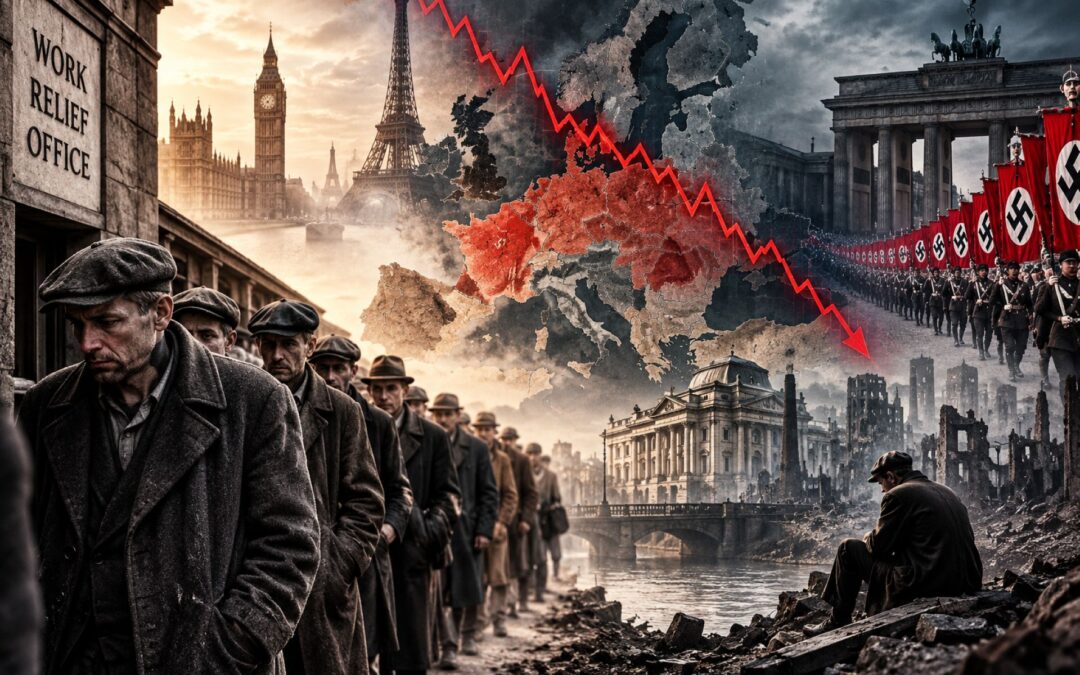
On 11 May 1931, Austria’s largest bank, Creditanstalt, revealed losses so enormous that its survival was in doubt. Depositors and foreign creditors began to panic, fearing that their money might disappear. The Austrian government intervened, but the crisis soon spread beyond the country’s borders, threatening banks in Germany and undermining confidence in Europe’s financial system.
Europe was already suffering from the Great Depression when Creditanstalt’s troubles became public. The American stock market had crashed in October 1929, international lending was contracting, businesses were failing, and unemployment was rising. Yet the banking panic of 1931 exposed something even more dangerous: European economies were so financially interconnected that trouble in one country could rapidly destabilize several others.
The Great Depression in Europe became much more than an economic disaster. It helped destroy Germany’s democracy, transformed government intervention in Italy, forced Britain to abandon a monetary system it had struggled to restore, and pushed France into years of political conflict. By the end of the decade, much of the continent was preparing for another devastating war.
Understanding how this happened requires looking beyond Wall Street. Europe’s economic collapse was rooted in the unfinished consequences of World War I, an unstable international financial system, and the difficult choices governments made when their economies began to unravel.
The Postwar Recovery Was Built on Borrowed Money
Europe emerged from World War I economically exhausted. Four years of fighting had destroyed factories, farms, railways, homes, and other essential infrastructure across large parts of the continent. Millions of workers had been killed or injured, governments had accumulated enormous debts, and inflation weakened the purchasing power of ordinary households.
The war also fundamentally changed the international economic balance. Before 1914, European financial centers, particularly London, had played a dominant role in global lending and investment. After the war, the United States had become the world’s leading creditor, while several European powers depended on borrowing to finance reconstruction and meet their obligations.
The Treaty of Versailles imposed substantial reparations obligations on Germany. Meanwhile, Britain, France, and other Allied governments owed large wartime debts, particularly to the United States. These obligations were politically contentious because governments were expected to make payments while rebuilding economies already strained by the war.
Germany’s financial instability became especially visible during the hyperinflation of 1923. The government had relied heavily on money creation to finance expenditures, and the mark eventually lost almost all its purchasing power. Savings denominated in the currency were devastated, wages struggled to keep pace with prices, and public confidence in monetary institutions collapsed.
Stabilization eventually brought the immediate inflationary emergency under control. However, Germany still faced the challenge of rebuilding its productive economy while satisfying its international obligations.
The Dawes Plan of 1924 helped address this problem by reorganizing German reparations payments and facilitating access to international credit. American investors and banks subsequently lent substantial sums to German governments, businesses, and financial institutions. The money supported reconstruction, industrial investment, public spending, and the country’s ability to meet payments abroad.
This created an international financial arrangement that worked reasonably well as long as American credit remained available. Germany received loans from American lenders and used part of its resources to pay reparations to countries such as France and Britain. Those governments, in turn, could use their revenues to service debts owed to the United States.
In effect, a significant portion of Europe’s financial recovery depended on money circulating through an interconnected system of borrowing and repayment.
The International Monetary Fund’s historical discussion of interwar international lending describes how American banks expanded overseas lending after the Dawes Plan, helping finance Europe’s recovery while increasing its exposure to changes in international capital flows.
The arrangement did deliver meaningful progress. German industry recovered during the middle of the 1920s, France experienced renewed economic growth following monetary stabilization, and several European cities enjoyed rising consumption and cultural prosperity. The period was not simply one of uninterrupted misery between the two world wars.
However, this prosperity was uneven. British industries such as coal, steel, and shipbuilding struggled with weak demand and international competition. European farmers faced falling agricultural prices, while several countries operated banking systems vulnerable to financial shocks.
More importantly, an economy dependent on foreign credit can become unstable when its lenders suddenly demand repayment or refuse to extend new loans. Europe had rebuilt much of its economic activity without eliminating the underlying weaknesses of its financial arrangements.
The Gold Standard Made Europe’s Economies Fragile
One of the most important decisions European governments made during the 1920s was to restore the gold standard.
Under a gold-standard system, a currency’s value was tied to a specified quantity of gold. Governments and central banks maintained monetary arrangements designed to preserve that relationship, which also helped stabilize exchange rates between participating countries.
Before World War I, the international gold standard had supported relatively predictable currency relationships and international financial transactions. Wartime inflation, government borrowing, and the suspension of gold convertibility disrupted that system.
During the 1920s, policymakers attempted to reconstruct it. Britain returned to gold in 1925, while France stabilized its currency later in the decade. Other European countries also adopted gold-based monetary arrangements, although they did not all return under identical conditions.
The appeal was understandable. After years of inflation, currency instability, and financial uncertainty, governments wanted to demonstrate that their money could be trusted. Gold appeared to provide discipline by preventing authorities from expanding the money supply without regard for their international commitments.
However, the reconstructed system contained serious weaknesses.
Britain, for example, restored sterling at its prewar gold parity, even though its economic circumstances had changed considerably since 1914. This contributed to an overvalued pound, making British exports relatively expensive and placing additional pressure on industries already struggling with unemployment.
Other countries entered the system with different currency valuations, economic conditions, and gold reserves. These imbalances made the international monetary arrangement less stable than its supporters anticipated.
The deeper problem emerged when economies began contracting.
Suppose investors lost confidence in a country’s currency and attempted to exchange their holdings for gold or foreign money. Its central bank could respond by raising interest rates to attract funds and discourage withdrawals. The government might also reduce expenditures, while businesses faced pressure to lower wages and prices to restore competitiveness.
Such policies could help defend the currency’s gold parity, but they also made an economic downturn worse.
Higher interest rates discouraged borrowing and investment. Reduced government spending weakened demand, while falling wages lowered households’ purchasing power. Businesses facing declining sales reduced production and dismissed workers, creating further unemployment.
Deflation introduced another problem. When prices and wages fall but debts remain fixed in nominal terms, borrowers find their obligations increasingly difficult to repay. A business earning less revenue still owes the same amount to its bank, while a government collecting less tax revenue must continue servicing its existing debt.
This could turn a recession into a prolonged cycle of falling prices, financial distress, and declining economic activity.
The international nature of the gold standard made matters worse because one country’s efforts to defend its currency could transmit pressure to another. Countries gaining gold did not necessarily expand their economies enough to offset contraction elsewhere. France’s accumulation of gold during the late 1920s and early 1930s became an important part of this imbalance.
As Ben Bernanke explains in his analysis of monetary policy and the global economy, the reconstructed gold standard restricted countries’ ability to pursue the expansionary monetary policies needed during the Depression.
The system had been restored to create stability, but its rigidity made stabilization increasingly difficult when the international economy began to collapse.
How America’s Crash Reached Europe
The Wall Street crash of October 1929 is generally remembered as the defining opening event of the Great Depression. However, the transmission of the crisis to Europe began through financial pressures that were already developing before the stock market collapsed.
During the late 1920s, rising American interest rates and the attraction of speculative opportunities in the United States reduced the availability of capital for overseas borrowers. American investors became less willing to provide new funds to European governments, companies, and banks.
After the stock market crash, deteriorating financial conditions intensified this retreat. Investors attempted to preserve liquidity, financial institutions became more cautious, and European borrowers found it increasingly difficult to refinance existing obligations.
Germany was especially vulnerable because much of its recovery had relied on foreign lending. When loans matured, borrowers often needed fresh credit to repay them. If lenders refused to renew their commitments, otherwise functioning businesses and financial institutions could suddenly confront severe cash shortages.
The resulting contraction affected the wider European economy. Businesses postponed investment, banks restricted lending, consumers reduced spending, and international demand declined.
Agriculture also suffered. Falling commodity prices reduced farmers’ incomes and weakened the economies of countries dependent on agricultural exports. Industrial producers faced shrinking markets at home and abroad, leading to additional reductions in employment and wages.
Governments responded partly by raising barriers against foreign competition. In June 1930, the United States enacted the Smoot-Hawley Tariff Act, increasing duties on a wide range of imported goods. Other countries introduced or strengthened tariffs, quotas, and restrictions in an attempt to protect domestic producers.
Britain eventually moved away from its traditional commitment to free trade, introducing broad import duties and imperial preference arrangements in 1932. Other European governments also adopted measures intended to shield domestic industries from collapsing international competition.
However, protectionism could not solve the fundamental problem of insufficient demand. Restricting imports might provide temporary relief to some producers, but retaliation could reduce export opportunities for others.
The scale of the international trade collapse was extraordinary. A World Trade Organization historical study reports that the value of world merchandise exports fell from approximately $32.7 billion in 1929 to $12.6 billion in 1932, a decline of roughly 60%.
That figure must be distinguished from the physical quantity of goods traded. World trade volume declined by approximately 30% over the same three-year period. Falling prices therefore accounted for a substantial portion of the much larger collapse in trade value.
Trade barriers aggravated the contraction, but declining incomes, falling prices, financial instability, and weak international demand were also major causes.
By 1931, the financial system connecting European borrowers with foreign lenders was under immense strain. What began as a worldwide economic slowdown was about to become a continental banking emergency.
1931: Banking Panic Crossed Borders
Austria was one of the European countries most vulnerable to the withdrawal of international confidence.
Its banking institutions had inherited complicated relationships with businesses and financial networks across the territories of the former Austro-Hungarian Empire. After the empire’s dissolution, Austrian banks continued operating within a much smaller domestic economy while retaining substantial industrial investments and international obligations.
Creditanstalt, Austria’s largest bank, occupied a central position in this system. It had accumulated serious financial weaknesses, including losses connected with industrial holdings and earlier banking mergers.
On 11 May 1931, the bank disclosed enormous losses. The announcement triggered a crisis of confidence that extended far beyond its balance sheet.
A bank does not normally keep all its deposits as cash. Much of the money deposited by customers is lent to businesses, invested, or held in assets that cannot immediately be converted into cash without losses. Under ordinary circumstances, this arrangement works because depositors do not all demand repayment simultaneously.
A bank run occurs when large numbers of customers attempt to withdraw their deposits because they fear that the institution may fail. Even a bank holding valuable assets can run short of immediately available funds if withdrawals become sufficiently large.
Creditanstalt’s situation was particularly dangerous because it involved both serious underlying losses and an international scramble for liquidity. The Austrian authorities intervened to support the institution, but the rescue did not immediately restore confidence.
Foreign creditors worried that other Central European banks might face similar problems. The fear spread toward Germany, where financial institutions were already struggling with declining business activity and the withdrawal of foreign capital.
The crisis intensified during the summer of 1931. On 13 July, Germany’s Danat Bank was forced to close, contributing to a broader banking panic. Authorities imposed emergency banking restrictions and sought to prevent additional withdrawals from destabilizing the financial system.
The Banque de France’s history of the 1929 crisis traces the contagion from the withdrawal of American financing through Austria and Germany to the pressure that subsequently reached Britain.
The immediate problem was closely connected to the structure of international lending. German banks and businesses owed money to foreign creditors, but repayment became increasingly difficult as exports, production, and access to new credit declined.
Even efforts at international financial assistance struggled to contain the panic. In June 1931, American President Herbert Hoover proposed a temporary moratorium on intergovernmental war debts and reparations, hoping to ease the pressure on European borrowers. The initiative offered some relief but could not quickly repair damaged banking confidence.
Hungary and other Central European economies experienced related pressures on their foreign exchange reserves and international payment commitments. Governments imposed exchange controls and payment restrictions to prevent scarce foreign currency from leaving their economies.
These measures sometimes helped conserve reserves, but they also made normal international borrowing and commercial transactions more difficult.
The crisis then placed growing pressure on London, still one of the world’s most important financial centers. Foreign investors began withdrawing funds, raising doubts about whether Britain could continue maintaining sterling’s gold parity.
By September 1931, the European banking panic had become a test of the international monetary system itself.
Britain Left Gold, but Its Recovery Was Uneven
Britain entered the Depression with substantial structural economic problems.
Its traditional export industries had struggled throughout the 1920s. Coal mining faced competition from alternative energy sources and foreign producers, while shipbuilding and heavy manufacturing suffered from weak international demand. Several industrial regions experienced persistent unemployment even before the worldwide downturn.
The restoration of sterling’s prewar gold parity in 1925 had increased the pressure on exporters. When international trade contracted, these underlying difficulties became more severe.
The banking crisis of 1931 then threatened Britain’s monetary position. International investors withdrew large sums from London, forcing the Bank of England and the government to use reserves and obtain emergency foreign credits.
Eventually, defending the pound at its existing gold value became unsustainable.
On 20 September 1931, the British government announced its decision to suspend gold convertibility. Its official Treasury statement preserved by the National Archives explained that more than £200 million had been withdrawn from the London market since the middle of July.
Britain’s departure from gold marked a major turning point. Sterling depreciated against gold-linked currencies, making British goods relatively cheaper for foreign buyers and imported goods more expensive for domestic consumers.
More importantly, the government and the Bank of England gained greater freedom to adjust monetary policy without constantly defending a fixed gold parity.
Interest rates subsequently fell, and Britain entered a period often described as the era of cheap money. Lower borrowing costs supported housing construction, investment, and household spending, particularly in sectors serving the domestic market.
The resulting recovery was gradual rather than immediate. Nevertheless, Britain began improving earlier than several European countries that remained committed to gold.
Bank of England research on monetary and fiscal policy in interwar Britain emphasizes how consequential the period’s policy decisions were for unemployment and prices. Different monetary and fiscal choices could produce significantly different economic outcomes.
Britain also changed its trade policies. The government introduced broad import duties in 1932 and negotiated arrangements that favored trade within the British Empire. These measures protected certain producers, although they also complicated international commerce and cannot alone explain the recovery.
The benefits of renewed economic growth were distributed unevenly.
Newer industries and regions associated with housing construction, consumer goods, and manufacturing expansion often improved more rapidly. Older industrial areas dependent on coal, steel, and shipbuilding continued experiencing severe hardship.
The contrast became especially visible during the Jarrow March of October 1936. Around 200 unemployed men marched from Jarrow in northeastern England to London, seeking government attention for the devastating unemployment in their community.
Their journey, covering roughly 300 miles, became a lasting symbol of the suffering that could persist even during a period of national economic recovery.
Britain’s experience demonstrated that abandoning gold could create important opportunities for economic stabilization. It also showed that successful national policy did not automatically restore prosperity to every industry, community, or household.
Germany’s Depression Helped Destroy the Weimar Republic
Germany experienced one of Europe’s most devastating economic and political crises.
Its dependence on foreign capital made it vulnerable to the withdrawal of American lending, while the 1931 banking panic further damaged confidence in the financial system. Industrial production contracted sharply, businesses closed, and mass unemployment placed growing pressure on public institutions.
By 1932, registered unemployment had reached approximately six million people. Millions more experienced reduced working hours, insecure employment, or severe financial hardship.
For families already affected by the upheavals of the 1920s, the downturn threatened whatever economic security they had managed to rebuild. Workers struggled to pay rent and purchase necessities, while unemployed people relied on increasingly strained public assistance arrangements.
The government faced a difficult problem. It needed to protect the financial system, maintain confidence in the currency, and manage its obligations to foreign creditors while supporting an economy whose productive capacity was rapidly declining.
Chancellor Heinrich Brüning, appointed in March 1930, pursued policies intended to restore financial confidence and improve Germany’s competitive position through lower costs.
His government reduced public expenditure, cut wages and benefits, raised certain taxes, and pursued deflationary measures. These decisions reflected fears about currency instability, the constraints of Germany’s international financial position, and political calculations concerning reparations.
However, austerity during a severe downturn also reduced spending power and weakened demand.
When households, businesses, and the government all attempt to reduce expenditure simultaneously, the resulting contraction can intensify unemployment and make debt repayment even more difficult. Brüning’s policies contributed to this downward pressure, although Germany’s collapse cannot be explained by austerity alone.
The banking crisis, international financial conditions, monetary restrictions, political instability, and the worldwide collapse in demand all played important roles.
Economic distress also transformed the country’s political landscape.
The Weimar Republic had struggled with political polarization since its establishment after World War I. Conservative nationalists resented the postwar settlement, radical movements rejected parliamentary democracy, and violent confrontations between political organizations had weakened public confidence in democratic institutions.
The Depression made those weaknesses more dangerous. Moderate political parties appeared increasingly unable to provide employment, financial stability, or effective government.
The Nazi Party exploited this discontent by promising national revival, jobs, political order, and the reversal of Germany’s postwar humiliation. It combined those promises with extreme nationalism, antisemitism, anticommunism, and hostility toward democracy.
The Communist Party also gained support by presenting the capitalist economic system as fundamentally incapable of meeting workers’ needs.
The Nazis’ electoral growth was dramatic. They won approximately 18% of the national vote in September 1930 and became the largest party in the Reichstag after receiving roughly 37% in July 1932.
However, their popularity was neither universal nor continuously increasing. Their vote share fell to around 33% in November 1932, demonstrating that Hitler’s eventual appointment was not simply the inevitable outcome of steadily rising electoral support.
The political system had become increasingly difficult to govern through normal parliamentary coalitions. Presidential emergency powers played a growing role, while conservative elites searched for arrangements that would preserve their influence.
On 30 January 1933, President Paul von Hindenburg appointed Adolf Hitler chancellor after negotiations involving influential right-wing politicians who believed they could control him.
As the United States Holocaust Memorial Museum explains in its history of the Nazi rise to power, Hitler’s appointment resulted from economic crisis, political manipulation, popular support, and decisions made by powerful individuals. It was not an unavoidable consequence of the Depression.
Once in office, the Nazis rapidly dismantled democratic institutions. Political opponents were arrested, civil liberties were suppressed, competing parties were eliminated, and Germany became a dictatorship.
The economic situation also changed after 1933.
The Nazi government expanded public spending and investment in construction, infrastructure, and employment programs. It introduced policies that strengthened state control over labor and industry, while military spending became increasingly important.
The Autobahn highway network became a prominent symbol of the regime’s public works, but it was not the principal explanation for Germany’s eventual employment recovery.
Rearmament absorbed growing amounts of industrial capacity, particularly in steel, engineering, chemicals, and military manufacturing. Conscription and compulsory labor arrangements also influenced employment figures, while restrictions and exclusions affected who was counted as unemployed or permitted to work.
By the later 1930s, officially recorded unemployment had fallen dramatically. Yet those figures do not describe an ordinary recovery in which freely employed workers enjoyed unrestricted economic opportunities.
Independent trade unions had been destroyed, collective bargaining was suppressed, and workers faced extensive government direction. The regime’s racial persecution excluded Jews and other targeted groups from areas of economic life, while military objectives increasingly dictated the allocation of resources.
Historical research on Nazi work creation and rearmament shows that the reduction in unemployment involved multiple policies and structural changes, including the expansion of military production.
The German economy was being reorganized around the ambitions of a dictatorship preparing for territorial expansion and war.
The Depression did not create Nazism or make its triumph inevitable. It did, however, create conditions in which economic desperation, political breakdown, and existing extremist ideologies could reinforce one another with catastrophic consequences.
Italy’s Fascist Government Turned to State Intervention
Italy’s experience differed from Germany’s in one essential respect: Benito Mussolini was already a dictator when the Great Depression began.
Mussolini had come to power in 1922 and consolidated authoritarian rule during the following years. Italy therefore did not undergo a democratic collapse in response to the Depression in the same way Germany did.
Instead, the crisis forced an existing fascist government to confront serious weaknesses in the economy it controlled.
During the 1920s, Mussolini placed considerable political importance on the value of the Italian lira. His government pursued a policy of currency stabilization, including an ambitious effort to raise the lira’s international value.
The resulting overvaluation placed pressure on Italian exporters, whose products became relatively expensive abroad. It also created difficulties for industries already facing international competition.
When worldwide demand collapsed after 1929, these vulnerabilities intensified.
Industrial production declined, firms struggled to service debts, and unemployment increased. Agricultural producers faced falling prices, while Italy’s banks encountered growing losses connected with their industrial investments.
The relationship between banks and industry was especially important. Several major Italian banks held significant interests in businesses they financed. When those businesses encountered financial trouble, the banks themselves became vulnerable.
Mussolini’s government responded through extensive state intervention.
In 1933, it established the Istituto per la Ricostruzione Industriale, commonly known as the IRI. The institution was designed to address the banking and industrial crisis by reorganizing distressed financial interests and taking control of substantial corporate holdings.
According to the Italian Ministry of Culture’s historical archive record of the IRI, the organization was established on 23 January 1933 to confront severe banking and industrial difficulties. Its responsibilities included financial rehabilitation and restructuring companies previously controlled through major banking groups.
The IRI eventually made the Italian state a major owner of industrial assets. It became an important feature of the country’s economic organization and continued operating long after Mussolini’s dictatorship ended.
The creation of the institution should not be confused with the regime’s wider political ideology. Although it operated under fascist rule, its immediate economic purpose involved preventing banking failures and stabilizing industrial ownership.
The dictatorship also pursued policies intended to increase economic self-sufficiency. These ambitions became more pronounced as Italy’s relations with other powers deteriorated.
In 1935, Mussolini launched the invasion of Ethiopia. The war increased demands for military equipment and mobilized resources, but it also involved enormous human suffering, colonial aggression, and international condemnation.
Military expenditure could generate orders for certain industries, yet it did not resolve the fundamental weaknesses of Italy’s economy. Sanctions, foreign exchange shortages, and the growing emphasis on autarky created additional difficulties.
Italy’s Depression-era response thus combined financial rescue, state ownership, authoritarian direction, and increasingly aggressive foreign policy.
Unlike Britain, which gradually recovered within a parliamentary system, or Germany, where economic collapse contributed to dictatorship, Italy’s crisis strengthened the economic intervention of a regime that had already eliminated political freedom.
France’s Delayed Crisis Ended in the Popular Front Experiment
France initially appeared more insulated from the Great Depression than several other European countries.
Its economy had a substantial agricultural sector, and its banks were generally less exposed to American lending than Germany’s financial institutions. France had also experienced economic growth following the stabilization of the franc during the late 1920s.
These conditions helped delay some of the Depression’s most severe effects.
However, remaining attached to gold became increasingly costly as other countries abandoned the system and allowed their currencies to depreciate.
Britain’s departure from gold in 1931 made sterling cheaper relative to the franc, placing French exporters at a competitive disadvantage. Other countries subsequently adjusted their currencies, while France continued defending its monetary arrangements.
Falling prices reduced business revenues, profits, and investment. Industrial production weakened, unemployment increased, and agricultural producers faced difficult conditions.
France also accumulated substantial gold reserves, contributing to the international monetary imbalances that helped intensify deflation. Its predicament was therefore not simply one of passively suffering from policies adopted elsewhere.
Economic distress eventually produced serious political consequences.
The French Third Republic had long experienced frequent government changes, but the Depression intensified conflicts over public spending, social conditions, and political legitimacy. Governments struggled to develop policies capable of satisfying both financial interests and increasingly frustrated workers.
Tensions escalated during the political unrest of February 1934, when demonstrations involving far-right leagues and other protesters culminated in violence in Paris. The events generated widespread fear among the left that parliamentary democracy might be threatened by fascist movements.
In response, left-wing parties and trade unions developed closer cooperation. Socialists, Communists, and Radicals eventually formed the Popular Front electoral alliance.
The Popular Front won the 1936 parliamentary elections, and Socialist leader Léon Blum became prime minister.
His government introduced a major program of labor and social reforms during a period of widespread strikes and factory occupations.
The Matignon Agreements of June 1936 helped establish wage increases, collective bargaining arrangements, and stronger recognition of trade-union rights. Subsequent legislation reduced the standard working week from 48 to 40 hours and introduced two weeks of paid annual leave for employees.
These reforms represented significant changes in French working life.
For many workers, paid holidays created an opportunity to travel and enjoy leisure time without sacrificing their wages. The sight of working-class families taking vacations became one of the lasting images associated with the Popular Front.
The French National Assembly’s historical account of the Popular Front documents the social legislation, the Matignon settlement, and the monetary difficulties facing Blum’s government.
The reforms were socially consequential, but the economic situation remained difficult.
Wage increases improved nominal earnings for many workers, while the forty-hour week and changes in labor costs created tensions in some industries. Businesses also faced uncertainty about prices, investment conditions, and the direction of government policy.
Blum’s administration was particularly constrained by France’s monetary position.
In September 1936, France finally devalued the franc, moving away from its previous gold-standard commitments. The decision was intended to improve export competitiveness and reduce the pressure caused by defending an increasingly difficult exchange rate.
However, devaluation did not immediately solve the country’s problems. Rising prices eroded some wage gains, while capital flight, weak investment, and political disagreements undermined confidence.
Employers and conservative political groups opposed important elements of the Popular Front’s program. Meanwhile, disagreements among its supporters made it increasingly difficult to combine social reform with financial stabilization.
Blum resigned in June 1937 after failing to secure the financial powers he sought. The broader Popular Front coalition subsequently weakened, and by 1938, important aspects of its economic program were being reversed or substantially modified.
The government did not simply collapse because employers disliked paid holidays or higher wages. Its difficulties reflected a combination of monetary pressures, inflation, investment problems, institutional constraints, and political conflict.
France’s experience illustrates how remaining on gold could prolong the Depression and how difficult recovery could become when monetary change occurred amid intense social and political divisions.
The Popular Front nevertheless left an enduring legacy through reforms that significantly expanded workers’ rights and expectations.
Economic Desperation, Dictatorship and the Road to War
By the middle of the 1930s, European countries were emerging from the Depression at different speeds and through different political arrangements.
Britain experienced a gradual recovery after leaving gold, although regional unemployment remained serious. France endured a longer and more politically contentious adjustment. Italy expanded state intervention under an established dictatorship, while Germany recovered much of its industrial activity within an increasingly militarized totalitarian system.
These differences demonstrate that the Depression did not produce one inevitable political outcome.
Nevertheless, its broader consequences were deeply destabilizing.
Mass unemployment undermined confidence in governments and economic institutions. Falling wages, business failures, and financial insecurity encouraged people to question whether existing political systems could protect their livelihoods.
Extremist movements exploited these fears by promising decisive leadership, national renewal, and simple solutions to complicated problems.
In Germany, the Nazis combined economic promises with racism, antisemitism, territorial revisionism, and the destruction of democratic government. In Italy, Mussolini’s dictatorship used the crisis to justify further state direction and later intensified its pursuit of imperial expansion.
Elsewhere, economic hardship contributed to political polarization without necessarily producing fascist rule. Britain’s parliamentary institutions survived, while France maintained republican government despite repeated crises.
The international political environment also deteriorated.
Governments increasingly prioritized domestic protection over economic cooperation. Tariffs restricted trade, exchange controls complicated international payments, and currency depreciation created tensions between countries attempting to improve their competitive positions.
However, currency depreciation should not automatically be treated as equivalent to protectionism. Leaving gold allowed governments to adopt easier monetary policies that supported domestic recovery, producing potential benefits beyond temporarily improving export competitiveness.
The larger failure was the inability of governments to develop a sufficiently coordinated response to the international financial emergency.
As economic nationalism expanded, confidence in multilateral institutions declined. The League of Nations struggled to address major political and security problems, while European governments became increasingly divided over how to respond to aggressive authoritarian states.
The Depression also influenced military and diplomatic calculations. Governments still managing unemployment, debt, and financial weakness were reluctant to undertake the costs and risks of another major European conflict.
Economic difficulties contributed to the environment in which British and French leaders pursued appeasement, although memories of World War I, military preparedness, public opinion, and strategic judgments were also significant.
Meanwhile, Nazi Germany’s rearmament increasingly directed industrial production toward tanks, aircraft, weapons, and other military requirements.
The relationship between economic recovery and war preparation became particularly dangerous because the regime’s political ambitions demanded continued military expansion.
Yet World War II was not an automatic consequence of the economic collapse. Nazi ideology, Hitler’s expansionist decisions, the weakness of collective security, and the actions of other governments were essential to the outbreak of war.
The Depression had damaged Europe’s economic foundations and intensified existing political conflicts. Those conditions made the continent more vulnerable, but political leaders still made decisions that determined how the crisis would develop.
What Europe Built After the Depression and War
The destruction caused by the Great Depression and World War II encouraged a major reconsideration of international economic cooperation.
Policymakers had witnessed the dangers of financial contagion, prolonged deflation, collapsing trade, and governments responding to international crises without effective coordination. They wanted an economic system that could provide currency stability without reproducing the rigid constraints of the interwar gold standard.
In July 1944, representatives of 44 countries met at Bretton Woods in the United States to design a new international monetary framework.
The resulting agreements established the foundations of the International Monetary Fund and the International Bank for Reconstruction and Development, which became the central institution of the World Bank.
As the Federal Reserve’s history of the Bretton Woods system explains, the IMF was designed to support international monetary cooperation and help countries facing external payment difficulties, while the World Bank initially focused on reconstruction and later expanded into economic development.
The new system did not eliminate gold from international monetary arrangements. Instead, currencies were generally linked to the American dollar, while the dollar maintained an official relationship with gold. Exchange rates could be adjusted under specified circumstances, providing more flexibility than the interwar arrangements had allowed.
Governments also became more willing to use monetary and fiscal policies to support employment and economic stability. Keynesian economic ideas, emphasizing the role of aggregate demand and government intervention during downturns, gained considerable influence, although national policies continued to differ.
European leaders pursued closer economic integration as well.
The European Coal and Steel Community was established through a treaty signed in 1951, bringing key industries of six countries into a common institutional framework. The Treaties of Rome, signed in 1957, subsequently created the European Economic Community, which began operating in 1958.
The European Union’s official history of postwar integration explains how cooperation in strategically important industries became a foundation for wider European economic integration.
These institutions were shaped by the combined experience of two world wars and the economic catastrophe between them. Their creation reflected an effort to replace destructive international rivalry with more stable arrangements for reconstruction, trade, and cooperation.
Europe’s Great Depression began as a financial and economic emergency, but its consequences reached far beyond banks, factories, and unemployment statistics. The crisis exposed weaknesses in an international system built around debts, foreign lending, and fixed exchange rates, while revealing how dramatically national policy choices could alter economic outcomes.
Britain’s monetary flexibility, France’s prolonged adjustment, Italy’s authoritarian intervention, and Germany’s democratic collapse demonstrate that economic devastation did not dictate a single response. Institutions, ideologies, and political decisions mattered enormously.
The Depression did not make World War II inevitable, but it weakened the continent’s economies, deepened political divisions, and helped create conditions in which aggressive dictatorships could become increasingly dangerous. Its enduring significance lies in showing how financial instability can reshape societies and political institutions long after the immediate economic shock has passed.
Last Updated on October 21, 2026 by Aseem Gupta