
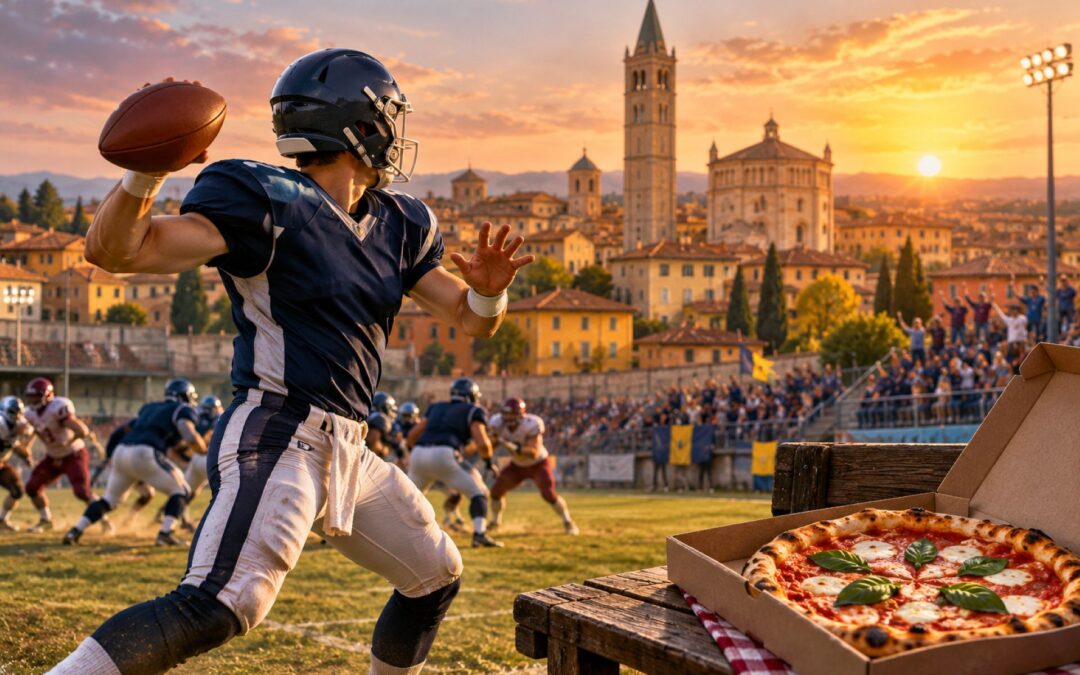
John Grisham’s Playing for Pizza tells the story of Rick Dockery, an American football quarterback whose professional career collapses after one of the most humiliating performances imaginable. Rejected by the NFL, pursued by an unforgiving sports journalist, and desperate to escape public attention, Rick accepts an improbable opportunity to play for the Parma Panthers in Italy. What initially seems like an embarrassing last resort becomes an unexpected chance to reconsider his ambitions, relationships, and understanding of success.
Originally published by Doubleday in 2007, the novel is a departure from the legal thrillers for which Grisham is best known. Its story combines American football, Italian food, opera, travel, romance, and the peculiar experience of being a professional athlete in a country where few people recognize your sport. Beneath the comedy, however, lies a more complicated question: what happens when someone who has spent his adult life pursuing professional recognition discovers that his most rewarding achievement may come in a place where almost nobody is watching?
Rick’s journey is neither a straightforward redemption story nor a complete rejection of his former life. He begins to appreciate the loyalty of his teammates and the pleasures of living in Italy, but his pride, impulsiveness, and dangerous attachment to football remain. Grisham allows Rick to win something meaningful without establishing that he has solved every problem that brought him to Parma.
Spoiler Warning: This article covers the complete novel, including its major football games, character developments, championship result, and ending.

Rick Dockery’s Collapse in Cleveland and Escape to Parma
Rick Dockery wakes in a Cleveland hospital suffering from a concussion, confused about where he is and unable to remember the circumstances of his injury. His agent, Arnie, eventually explains what happened during the AFC Championship game between the Cleveland Browns and the Denver Broncos. Rick had entered the game as an emergency quarterback after injuries removed the players ahead of him, with Cleveland leading 17–0 and apparently heading toward the Super Bowl.
The situation should have offered Rick an extraordinary opportunity. A journeyman quarterback who had spent years moving between teams suddenly had the chance to protect a commanding lead in one of the biggest games of his career. Instead, he threw three disastrous interceptions in the final eleven minutes, enabling Denver to complete an astonishing comeback. His last appearance in an NFL uniform became a public catastrophe.
The defeat is especially damaging because Rick has never established himself as a reliable starting quarterback. He has spent much of his professional life surviving as a backup, moving from team to team, hoping that an injury or change in management might finally provide an opportunity. His career has been defined by short contracts, uncertain prospects, and the persistent belief that he deserves another chance.
Charley Cray, a Cleveland sports columnist, turns the failure into a national humiliation. In a particularly savage article, he compares Rick’s performance with notorious mistakes from sporting history and declares him the greatest goat in professional sports. The distinction is cruelly specific: other athletes may have made one disastrous play, but Rick managed three in the closing minutes of a championship game.
The article devastates Rick. Already physically miserable, he retreats into painkillers, sleep, and self-pity, finding little comfort in the knowledge that other players also contributed to Cleveland’s collapse. His reputation now seems permanently attached to a single game, with his earlier seasons and professional persistence rendered irrelevant.
Meanwhile, Arnie attempts to salvage his client’s career. He telephones NFL organizations, contacts people associated with Rick’s former teams, and explores any opportunity that might keep him employed. The response is overwhelmingly negative. Teams that might once have considered a veteran backup now see an athlete whose presence could embarrass an entire franchise.
Arnie eventually contacts Sam Russo, the American coach of the Parma Panthers, who play American football in Italy. Sam’s starting quarterback has departed, and he needs someone capable of directing the offense. An experienced NFL player is far beyond the normal level of talent available to an Italian club, making Rick an attractive possibility despite the catastrophe in Cleveland.
The offer is hardly glamorous. Parma cannot promise the money, attention, facilities, or professional prestige that Rick associates with American football. The players mostly hold ordinary jobs and practice in the evenings, while the league attracts relatively small crowds. Rick initially struggles to imagine that playing there could be a serious career decision.
He has another reason to leave the United States, however. Tiffany, a woman with whom he previously had a relationship, is pursuing a paternity claim involving her pregnancy. Rick is frightened by the possibility of further legal expenses, unwanted publicity, and a confrontation he would rather avoid. Arnie points out that moving overseas could make the immediate legal pursuit more difficult.
Rick’s flight from Cleveland consequently becomes an attempt to escape several forms of accountability at once. He leaves his apartment, avoids journalists, and moves through temporary accommodation while trying to disappear. The pressure of his football disgrace and the threatened lawsuit makes Italy increasingly appealing.
Eventually, he accepts the opportunity in Parma. His decision is neither particularly courageous nor romantic: he has exhausted his preferable alternatives, and Italy offers a temporary refuge where he can continue playing without enduring constant American scrutiny.
Sam welcomes Rick at the Parma train station and introduces him to the city. Rick discovers narrow streets, historic buildings, unfamiliar traffic patterns, a modest apartment, and a small car with a manual transmission. Even ordinary errands require more effort than they would at home, while his limited Italian leaves him dependent on other people.
Sam, who has already established a life in the country, views these inconveniences differently. He regards Parma as a wonderful place to live and encourages Rick to enjoy the experience rather than obsess over what he has lost. This becomes one of the first important differences between them: Sam has chosen Italy, while Rick initially sees it as the place where his career has stranded him.
Learning to Play—and Live—with the Parma Panthers
Rick’s first encounter with the Panthers’ football facilities confirms his fears about the new assignment. Stadio Lanfranchi is primarily a rugby ground, and its crowds bear little resemblance to the tens of thousands who attend NFL games. The team does not possess the elaborate equipment, personnel, or infrastructure familiar to an American professional.
The players, however, take football seriously. Many have careers outside the sport and must organize their training around ordinary working lives. They arrive at practices full of noise, arguments, jokes, and enthusiasm, revealing a camaraderie that Rick has seldom encountered in the highly competitive professional environment.
Sam explains the organization of Italian football, including the league’s divisions, the limited number of imported American players, and the challenges of building a competitive squad. The sport has an enthusiastic but relatively small following, and the Panthers compete against more established organizations, particularly the powerful Bergamo Lions.
The team’s ambitions are nevertheless substantial. Parma has never won the Italian Super Bowl, and its players dream of defeating the clubs that have dominated the competition. Some have spent much of their adult lives pursuing a championship for which they will receive little more than personal satisfaction.
Rick finds the Panthers’ playbook unexpectedly simple. Having encountered the extensive offensive systems used in American college football and the NFL, he is accustomed to complex terminology, detailed formations, and numerous variations. The Italian players prefer a smaller selection of plays that can be executed reliably despite differences in experience and language.
The squad contains several distinctive personalities. Nino is an energetic leader whose enthusiasm helps drive the team. Franco, a veteran fullback and judge, combines physical aggression on the field with considerable influence in the city. Fabrizio Bonozzi is an exceptionally gifted Italian receiver whose speed and natural ability make him a vital offensive weapon.
Among the Americans are Sly Turner, an experienced running back, and Trey Colby, a player capable of contributing in several roles. Their presence gives Rick familiar company, but their careers also expose the uncertainty facing athletes who cannot establish themselves at the highest professional level. Each has found his way to Italy for different reasons, and none possesses a secure future in American football.
Rick’s first practices are not entirely comfortable. Although he can throw accurately and understands the game, he is not in ideal physical condition, particularly after his injury and period of inactivity. His teammates are less impressed by his NFL background than he expects, and some of their conditioning and enthusiasm expose his own lack of preparation.
The Panthers are excited to have an American quarterback, but they do not want a celebrity who treats the season as a holiday. They expect him to learn their offense, lead the team, and contribute to its championship ambitions. The expectations are different from those in the NFL, but they are not necessarily lower.
Life away from football introduces another unfamiliar set of demands. Driving the small Fiat becomes a recurring source of frustration, particularly because Rick struggles with its manual transmission and Parma’s narrow streets. Parking restrictions and encounters with local police add to his difficulties.
One apparently alarming encounter with Detective Romo leads Rick to believe that he might be facing another legal problem. Instead, he is taken to meet Franco, who is delighted to welcome the Panthers’ American quarterback. Franco’s admiration for American football, particularly the legendary Pittsburgh Steelers fullback Franco Harris, reveals the enthusiasm with which many Italian players have adopted the sport.
Franco and Signor Bruncardo, the Panthers’ owner, also help Rick understand the role of personal connections in local life. Their influence can sometimes resolve practical difficulties that seem insurmountable to a foreigner, creating humorous situations in which Rick receives unexpected assistance from people who admire his football credentials.
Food becomes an equally important part of his introduction to Parma. Sam takes Rick to restaurants where meals unfold over several courses, accompanied by wine, conversation, and lengthy discussions. Nino and other players introduce him to the region’s culinary specialties, and meals become a regular extension of the team’s social life.
Rick initially approaches these occasions as unfamiliar experiences to be endured or enjoyed casually. Gradually, however, he begins appreciating the pleasure the Italians take in preparing food, sharing it, and spending time together. The leisurely atmosphere contrasts with the hurried routines of professional football in America.
During an elaborate dinner at Franco’s home, Rick encounters another side of Parma’s culture. Fine food, carefully arranged surroundings, and opera playing in the background create an experience far removed from locker rooms and training facilities. His hosts do not see a contradiction between loving the violent physicality of American football and appreciating music, family, and traditional hospitality.
These early experiences do not immediately change Rick’s personality. He continues to follow American football news, communicate with Arnie about possible opportunities, and measure himself against the professional career he wanted. Yet he is beginning to enjoy an environment that offers pleasures unrelated to his reputation as an athlete.
Early Victories, Opera, and the Defeat in Milan
The Panthers open their season at home against the Naples Bandits. Their opponents endure a demanding journey north, illustrating the limited resources available to many Italian teams, and arrive determined to compete despite the difficulties of traveling across the country.
Rick experiences an uncomfortable reminder of Cleveland when he throws an interception early in the game. His teammates and coaches have followed his American career closely enough to understand the significance of the mistake. For a moment, the prospect of another collapse threatens to overwhelm him.
He recovers quickly. Parma begins moving the ball effectively through its running game and passing attack, with Sly and Fabrizio providing important options. Rick’s arm strength and professional experience become increasingly apparent as he exploits weaknesses in the Naples defense.
The Panthers win 48–28. Rick finishes with four touchdown passes and another touchdown on the ground, providing the sort of performance he once expected from himself. His teammates celebrate enthusiastically, and the entire club gathers afterward at Polipo’s for pizza, beer, songs, and jokes.
The celebration gives the book its distinctive title. These players are not competing for enormous contracts or national fame; they play because they love football, their teammates, and the shared experience. Pizza is part of the reward, but the greater attraction is belonging to the group.
Rick enjoys the victory, although his communications with Arnie reveal that he has not abandoned thoughts of returning to a more prestigious league. He takes satisfaction in dominating the Italian competition while still considering it a possible stepping stone toward another American opportunity.
His cultural education continues when Signor Bruncardo introduces him to opera at Parma’s Teatro Regio. Rick attends a performance of Giuseppe Verdi’s Otello, initially regarding the occasion as another unfamiliar social obligation.
Anna, one of his hosts, helps him follow the story and understand the performance. Rick becomes fascinated by Gabriella Ballini, the soprano portraying Desdemona, whose appearance and stage presence capture his attention. But Gabriella’s singing attracts hostility from members of the audience, and Rick witnesses her being publicly criticized during a difficult period in her career.
The experience unexpectedly connects opera with football. Rick recognizes the pain of performing before people who feel entitled to judge, ridicule, and dismiss an individual after a disappointing performance. Gabriella’s situation resembles his own, although their artistic and athletic professions are otherwise very different.
Rick begins pursuing Gabriella, finding opportunities to meet and talk with her. He learns that she has been struggling professionally and that her personal life includes a longstanding relationship with Carletto. His attraction is therefore complicated from the beginning, but he remains confident that charm and persistence might produce a romance.
Meanwhile, Parma prepares to face the Milan Rhinos, an opponent the Panthers consider relatively weak. The Rhinos have recently played in a lower division, and Parma’s players assume the game should be straightforward after their successful season opener.
The team’s practices become careless. Sam struggles to maintain discipline as players joke, drink beer during film sessions, and dismiss his warnings. Rick participates in this complacency, treating the upcoming game as an occasion that will require little serious preparation.
During the trip to Milan, Rick encounters Beverly, an American woman who attracts his attention during a night out. He spends much of the night with her instead of resting properly before the game. His behavior leaves him exhausted and physically unprepared when the Panthers need their quarterback to perform.
The match becomes a disaster. Rick throws interceptions, the offense fails to establish a productive rhythm, and his teammates become increasingly frustrated. Nino is ejected, Fabrizio abandons his involvement in the game, and the team’s collective discipline collapses.
Sam eventually removes Rick from the offense, and backup quarterback Alberto takes over. The Panthers manage a late touchdown, but it offers little consolation for a humiliating defeat against opponents they expected to beat comfortably.
The result exposes weaknesses that their victory over Naples had concealed. Rick’s talent cannot compensate for poor preparation, while Parma’s commitment to football remains meaningless unless the players behave responsibly. Rick realizes that he has disappointed teammates who care deeply about their club, even though many possess far fewer professional opportunities than he has enjoyed.
His personal life also deteriorates. Gabriella’s performances remain disappointing, and her frustrations leave little space for the relationship Rick wants. She eventually returns to Florence, and his pursuit ends without producing the romance he had imagined.
Sly then announces that he is leaving Italy. His wife is pregnant, and the news forces him to reconsider his career and responsibilities. Having pursued professional football for years without finding lasting success, he recognizes that returning home has become more important than continuing to chase opportunities abroad.
Sly’s departure creates an immediate problem for the Panthers because he has been one of their most dependable offensive players. It also provides Rick with an example of an athlete accepting that his football career cannot continue indefinitely.
After the Milan defeat, the team’s early optimism has largely disappeared. Rick has lost the confidence of his teammates, Gabriella is gone, and the offense has become weaker just as the championship race is beginning.
Injuries, Team Rebuilding, and the Choice to Stay
With Sly gone and Fabrizio absent, Rick and Sam must redesign an offense that had depended heavily on their contributions. The simplified plays that seemed adequate during the opening victory no longer provide enough options. Rick begins working more seriously with his coach, studying the available players and considering how they can compensate for their losses.
Trey Colby emerges as an important part of the solution. His athletic versatility allows Rick to use him as a receiving threat, giving the Panthers a chance to rebuild the passing game. Although the arrangement is improvised, it initially works remarkably well against the Bologna Warriors.
Parma establishes a commanding lead, demonstrating that Rick can adapt his professional knowledge to an unfamiliar collection of teammates. Unfortunately, the game’s direction changes when Trey suffers a compound fracture of his lower leg while attempting to catch a pass. The injury is serious enough to require surgery and effectively ends his season.
Without Trey, the Panthers struggle to maintain their offensive momentum. Bologna’s running game becomes increasingly effective, with Ray Montrose helping the Warriors recover from their early deficit. Parma eventually loses 35–34 after leading 27–7 at halftime.
The defeat is painful for reasons beyond the score. Rick has helped create a successful attack only to watch it disintegrate following another player’s injury. Charley Cray exploits the result in a fresh newspaper column, suggesting that Rick has again found a way to lose despite holding a substantial lead.
The criticism oversimplifies what happened, ignoring the injury and the team’s broader problems. Nevertheless, it renews Rick’s anxiety about his reputation. He has traveled to another continent, yet the journalist who helped destroy his American career continues following and ridiculing him.
Rick and Sam visit Trey during his recovery. The injured player’s situation provides another sobering illustration of football’s costs, particularly for athletes without the financial security enjoyed by major professional stars. Trey is young enough to imagine that his playing career should have continued for years, but the fracture abruptly changes his future.
The Panthers urgently need Fabrizio back. His absence has left the passing attack without its most dangerous receiver, and the team cannot realistically compete against stronger opponents without him. The problem is that Fabrizio and his representative want compensation.
Paying an Italian player creates difficulties because the club’s culture rests largely on voluntary participation and shared sacrifice. The Americans receive special financial arrangements, but most of the Italian players compete for their love of the game. A paid contract for Fabrizio threatens to disturb that understanding.
Rick offers to contribute some of his own money toward an arrangement that would bring Fabrizio back. Franco becomes involved in the negotiations, helping find a solution acceptable enough for the club to continue. Rick’s willingness to sacrifice money is significant because his first response to Parma had been to measure the job by its inadequate financial rewards.
The reunion transforms the offense. With Fabrizio providing the speed and receiving ability the Panthers desperately need, Rick can once again exploit opposing defenses. Against the Marines of Lazio in Rome, Parma wins 62–12, restoring some of its confidence and demonstrating how dangerous the combination can be.
The victory does not silence Cray, whose hostile reporting continues. Rick remains a convenient target, and even substantial statistical success in Italy is portrayed as insignificant compared with his failure in the NFL.
At this point, a new American opportunity presents itself. Arnie informs Rick that Rat Mullins, a coach Rick knows from an earlier professional assignment, has been hired by the Saskatchewan Roughriders in the Canadian Football League. Rat wants Rick to join him and offers a contract worth approximately $80,000.
For a player who once regarded Parma as professional exile, the offer should be irresistible. Canadian football would provide greater money, larger crowds, more substantial media attention, and a recognizable place in the North American professional game.
Rick is tempted. He has spent most of his adult life trying to remain employable as a quarterback, and rejecting a legitimate contract would once have seemed almost unthinkable. Yet he now recognizes that leaving would damage the Panthers’ season and disappoint teammates who have come to depend on him.
During Parma’s week off, he travels to Florence. Part of the attraction is the possibility of reconnecting with Gabriella, but his efforts lead nowhere. Instead, while sitting near a group of American students, he meets Livvy Galloway.
Livvy is an American student from Savannah, Georgia, who has developed a deep enthusiasm for Italian art, architecture, history, and travel. Their initial conversations are playful, and Rick enjoys meeting someone who knows little about his humiliation in Cleveland. Rather than approaching him as a failed professional athlete, Livvy treats him as another American living abroad.
They begin spending time together, and the relationship develops through walks, conversations, and shared experiences in Florence. Unlike Gabriella, whose professional disappointments created an unexpected connection with Rick, Livvy introduces him to a way of experiencing Italy that is more active, curious, and exploratory.
The Canadian opportunity remains unresolved, however. Rat pressures Rick to join the Roughriders, and Arnie emphasizes the financial and professional advantages of leaving Parma. Rick insists that he has made a commitment to his Italian team, but he still travels to Canada, partly to determine whether he can truly abandon the possibility.
His journey exposes how much his priorities have changed. The familiar professional environment no longer appeals to him as strongly as it once did, and reports of other quarterbacks being considered reinforce the insecurity he knows from years of competing for temporary positions.
Instead of completing the journey to his prospective team, Rick diverts to Cleveland. He has become increasingly obsessed with Cray’s continuing attacks, and the possibility of another article ridiculing him provokes an impulsive decision.
Rick enters the newspaper office under a false identity and confronts Cray in his workplace. He seizes the columnist and punches him hard enough to cause serious injury, then leaves. The confrontation provides Rick with immediate satisfaction, but it also reveals that his anger and inability to manage humiliation remain significant weaknesses.
The episode has an important contradiction. Rick is becoming more loyal and responsible toward the Panthers, yet he still responds to personal criticism through aggression and an exaggerated concern for his reputation. Grisham presents the attack with considerable comic satisfaction, but the act itself is violent and disproportionate.
Rick returns to Italy without accepting the Canadian offer. For the first time in his adult career, he has voluntarily placed a commitment to a modest football club ahead of an opportunity to earn more money in a prestigious professional environment.
Livvy, the Winning Streak, and the Road to the Playoffs
Livvy visits Rick in Parma, and their relationship soon becomes part of his daily routine. She is enthusiastic about the city, interested in its architecture and history, and eager to discover places Rick might otherwise ignore. Her presence gives him a companion who appreciates Italy for reasons entirely separate from football.
The Panthers welcome her into their social gatherings, where she attracts considerable attention from Rick’s teammates. She enjoys their enthusiasm and becomes familiar with the rituals surrounding training sessions and games.
Parma’s next opponent is the Rome Gladiators. Heavy rain makes the home game uncomfortable and places additional demands on the players, but Rick approaches the contest with renewed seriousness. His improved preparation and the return of an effective passing attack help the Panthers secure another victory.
The relationship with Livvy continues developing alongside these sporting successes. Rick enjoys their physical attraction and easy companionship, while she encourages him to travel and explore. They begin imagining how their time together might extend beyond a brief romantic encounter.
Parma then travels to Bolzano, a city in northern Italy whose history and linguistic identity differ from those of Parma. Grisham describes a region influenced by its former ties to Austria and its German-speaking population, giving Rick another glimpse of Italy’s geographical and cultural variety.
The Panthers face a demanding opponent led by Quincy Shoal, an American running back with exceptional speed. Quincy repeatedly breaks through Parma’s defense, exposing its vulnerability against a powerful rushing attack.
The game becomes an offensive contest in which Rick and Fabrizio must compensate for the points surrendered by their defense. Rick’s passing ability, combined with the improved running game, enables the Panthers to keep pace despite Quincy’s spectacular performances.
Parma eventually wins 56–41. By the end of the game, Rick realizes that his emotional investment in the team has changed. He is no longer primarily thinking of himself as a professional quarterback temporarily employed in Italy; he feels like a member of the Parma Panthers.
The distinction is important because his professional identity has been one of constant movement. For years, Rick has traveled wherever a contract might be available, regarding organizations primarily as employers. In Parma, he begins identifying himself with teammates whose commitment to the club extends beyond money.
The Panthers’ next major test is Bergamo, the dominant force in Italian football. The Lions have won eight consecutive national championships and accumulated a remarkable 67-game winning streak. Their reputation rests on a powerful defense, disciplined preparation, and a group of players determined to preserve their supremacy.
Rick and Sam approach the game more seriously than they approached Milan. They study film, examine defensive tendencies, and develop ways to counter the Lions’ most dangerous players, particularly Maschi, a formidable middle linebacker, and the American defenders who can disrupt the passing game.
The Panthers’ growing discipline becomes apparent during training. Their earlier complacency has disappeared, replaced by an awareness that defeating Bergamo will require a coordinated effort from every player. Rick contributes actively to the preparations rather than treating the game as an opportunity for individual statistical success.
The encounter is exceptionally physical. Bergamo’s defenders challenge Parma’s offense through aggressive tackling and intimidation, while Franco and the Panthers’ offensive line respond with their own determination. The contest becomes increasingly hostile as both teams refuse to retreat.
Parma’s ability to neutralize key defensive threats creates opportunities for Rick and Fabrizio. Franco’s willingness to confront Maschi helps disrupt Bergamo’s confidence, while Fabrizio’s speed places pressure on defenders who cannot contain every offensive option.
The Panthers score 35 points and defeat the Lions, ending their extraordinary winning streak. The result establishes Parma as a serious championship contender and gives the team one of the greatest victories in its history.
The celebration is complicated by Rick’s physical condition. He has absorbed repeated blows and experiences dizziness and headaches afterward. Although he has escaped the immediate humiliation that brought him to Italy, the damage accumulated during his football career remains an unresolved danger.
With the regular season approaching its conclusion, Rick and Livvy travel along the Adriatic coast. They spend time at beaches and visit historic towns, wineries, churches, and architectural sites. Livvy’s knowledge allows Rick to appreciate details he would previously have overlooked.
Their conversations also reveal more about her relationship with her family. Livvy feels constrained by her parents’ expectations and is reluctant to return to an American life that others have largely planned for her. Her desire to remain in Italy begins resembling Rick’s own reluctance to resume his former career.
Parma completes the regular season with a victory against the Ancona Dolphins. The Panthers finish with a 6–2 record, earning a place in the playoffs and establishing themselves among the league’s leading contenders.
The change from their early-season difficulties is substantial. Rick has helped rebuild an offense weakened by departures and injuries, while the players have become more disciplined and confident. Their next challenge is Bologna, the team responsible for one of their most painful defeats.
The Semifinal, the Venice Detour, and Livvy’s Family Crisis
Before the semifinal, Grisham introduces one of the Panthers’ most affecting figures in greater detail. Tommy, or Tommaso, is a forty-two-year-old defensive end who has spent twenty seasons playing for Parma without winning a championship.
Tommy’s physical abilities have declined, and he can contribute only for limited stretches of a game. He nevertheless insists that he will not retire until the Panthers win the Italian Super Bowl, making the current season especially important to him.
His devotion highlights the difference between the Americans’ uncertain professional careers and the Italian players’ long-term attachment to their club. Rick once thought primarily about the next contract, but Tommy has spent decades pursuing a championship for the same organization, despite having little prospect of financial reward.
The semifinal against Bologna offers Parma an opportunity to avenge its earlier defeat. In their first meeting, the Panthers had surrendered a substantial lead after Trey’s injury, allowing Ray Montrose and the Warriors to complete a dramatic comeback.
This time, Rick and his teammates are better prepared. The offense operates with greater confidence, balancing the running game with a passing attack that makes effective use of Fabrizio. Franco and Giancarlo contribute important rushing plays, while the offensive line provides Rick with the protection necessary to direct the game.
Bologna’s Ray Montrose remains dangerous and repeatedly challenges Parma’s defense. The Warriors produce offensive success, but they cannot match the Panthers’ sustained scoring.
Parma builds a commanding lead and eventually wins 51–27. The victory sends the Panthers to the Italian Super Bowl, where they will face Bergamo once again.
For Tommy and the other veterans, reaching the final represents the culmination of years of effort. Rick begins to appreciate that the championship carries different meanings for different players, many of whom have invested far more of their lives in Parma than he has.
With the semifinal complete, Livvy persuades Rick to visit Venice. Their trip allows the romance to develop away from football, although Rick’s limited enthusiasm for historic churches and elaborate sightseeing continues providing comic contrast with her curiosity.
They spend time exploring Venice, navigating canals, visiting landmarks, and enjoying their relationship. Rick’s willingness to accompany Livvy represents a modest but noticeable change from the man who arrived in Parma with little interest in anything beyond football and attractive women.
The relationship is not entirely carefree. Livvy’s family wants her to return to the United States, and her determination to remain abroad creates increasing conflict. Her parents have significant resources and influence, and they are not prepared to accept her independence without resistance.
The conflict becomes unmistakable when private investigators arrive at Rick’s apartment in the early morning, seeking information about Livvy. They have been hired to locate her, revealing the lengths to which her family is prepared to go.
Rick refuses to cooperate. Although he privately recognizes that Livvy’s family situation may be more complicated than he understands, he resents the attempt to control her movements and sees the investigators as an intrusion into their relationship.
Livvy later explains that her father has arranged an airline ticket intended to bring her home. She refuses to use it, insisting that she will return to America only on her own terms. Her defiance demonstrates genuine independence, but it also leaves practical problems unresolved.
Her visa has expired, and she begins exploring the possibility of obtaining a permesso di soggiorno, a residence permit that might allow her to remain in Italy temporarily. She hopes that Rick’s connections with Franco, Bruncardo, or other members of the Panthers’ organization might help.
The novel treats these arrangements somewhat casually, consistent with its comic portrayal of local influence. Nevertheless, Livvy’s immigration status and family conflict introduce a genuine uncertainty into the couple’s future.
As Rick prepares for the championship, he has two distinct reasons to remain in Italy. One is the football team whose success he has helped create; the other is a relationship with someone who wants to build an independent life abroad. Neither offers a fully settled future, but both give him reasons to reconsider returning to America.
The Italian Super Bowl and Rick’s Unsettled Future
The Italian Super Bowl takes place in Milan, with Parma facing Bergamo in a rematch of their dramatic regular-season encounter. The game attracts a comparatively large crowd for Italian American football, and the occasion includes many familiar elements of the American sporting spectacle: supporters arriving early, team banners, organized celebrations, and television coverage.
Bergamo has recovered from the defeat that ended its winning streak. Its players enter the final determined to regain control of the competition and prevent Parma from completing an extraordinary season.
The Panthers expect a difficult contest, but the opening stages are even more demanding than anticipated. Bergamo’s defense concentrates on containing Fabrizio, using its American players to limit the receiver’s effectiveness. The pressure removes Rick’s most dependable passing option and exposes the limitations of an offense built around his exceptional partnership with Fabrizio.
Maschi is particularly effective. His speed and aggression disrupt running plays, pressure Rick, and prevent the Panthers from establishing a consistent rhythm. Several attempted passes fail, while physical confrontations create tension between players and officials.
Parma’s defense performs impressively, preventing Bergamo from taking full advantage of its offensive problems. The opening quarter ends without either team scoring, and the contest becomes a struggle for field position rather than the high-scoring encounter that their first meeting might have suggested.
Near halftime, Bergamo converts a field goal to take a 3–0 lead. The Panthers enter the dressing room frustrated by their inability to move the ball, but they remain within one possession of the champions.
During the break, Sam praises the defense and encourages the players to maintain their intensity. Several veterans address the team, emphasizing the importance of the opportunity and the years they have spent pursuing a championship.
Tommy reminds his teammates that the final may be his last game. Others speak about their shared commitment, their history with the club, and the significance of defeating Bergamo.
Rick then addresses the team, with Franco translating. He expresses gratitude for being accepted as a Panther and explains how much his experience in Parma has meant to him. His words are striking because they contrast with the indifference and self-absorption he displayed when he first arrived.
The halftime scene demonstrates how far Rick has moved from his earlier attitude. He no longer treats the Italian championship as an inferior substitute for professional recognition in America. Winning with these teammates has become important in its own right.
During the second half, Rick and Sam begin changing the offensive approach. Bergamo’s defense has become accustomed to Parma’s conventional plays, concentrating on stopping Fabrizio and pressuring the quarterback.
Rick starts using his mobility more aggressively. By keeping the ball on designed runs and exploiting misdirection, he forces the Lions’ defenders to consider possibilities they had previously ignored.
The adjustments produce modest gains rather than immediate success. Bergamo continues to defend effectively and eventually adds another field goal early in the fourth quarter, extending its lead to 6–0.
With approximately ten minutes remaining, Parma still has not scored. Rick realizes that he must challenge the defense in ways that increase his own physical exposure.
He begins running more frequently, using fakes, bootlegs, and option plays to escape the pressure. His willingness to carry the ball changes the defense’s responsibilities, preventing Bergamo from concentrating exclusively on Fabrizio and the traditional rushing attack.
The Panthers gradually advance, but their drive stalls near the goal line. Rather than risk leaving the game without any points, they settle for a short field goal. Bergamo now leads 6–3.
Parma’s defense forces another punt, but the Panthers regain possession deep in their own territory with only a few minutes remaining. Rick faces an extraordinarily difficult situation: the team must travel almost the entire length of the field against one of the best defenses in the league.
He remains calm enough to direct the opening plays. Giancarlo gains yards on the ground, while Rick uses his ability to escape the pocket and advance when passing options are unavailable.
The crucial moment comes when Rick rolls away from pressure and sees Fabrizio moving into open space downfield. Bergamo’s defenders have been forced to pay greater attention to Rick’s running, allowing the receiver an opportunity that was unavailable earlier.
Rick must choose between protecting himself and delivering a risky long pass. Maschi is charging toward him, and releasing the ball will leave him exposed to a violent collision.
He plants his feet and throws an extraordinary deep pass. Maschi strikes him immediately afterward, leaving Rick badly dazed and barely aware of what happens next.
Far downfield, Fabrizio accelerates toward the descending football. He leaps near the goal line, stretches to reach the pass, and completes a spectacular touchdown catch.
The pass travels approximately 76 yards through the air. Its success depends on Rick’s accuracy, Fabrizio’s exceptional speed, and the offensive adjustments that finally created an opening in Bergamo’s defense.
The touchdown ties the game, and Filippo converts the extra point to give Parma a 7–6 lead. The Panthers must still survive Bergamo’s final possession, but the decisive change has occurred.
Charley Cray, who is present at the game despite his earlier confrontation with Rick, recognizes the extraordinary quality of the play. Even his hostile reporting cannot entirely deny the spectacle, although he emphasizes Fabrizio’s contribution.
Bergamo’s last opportunity ends when its offense fails to advance. Tommy makes an important late defensive play, bringing his long pursuit of a championship to a fitting conclusion. With the Lions unable to convert their final attempt, Parma regains possession and runs out the remaining time.
The Parma Panthers are Italian Super Bowl champions.
The victory brings the players the emotional reward they have pursued for years. Rick is celebrated as a central figure in the achievement, but he is still suffering from the collision that followed his touchdown pass.
The team gathers afterward at a pizzeria in Milan, where Bruncardo has arranged an extravagant celebration. The players watch recordings of the game, drink, sing, exchange congratulations, and enjoy a victory that transforms their club’s history.
The celebration completes the social ritual introduced after the opening win against Naples. What began as an unfamiliar gathering for Rick has become one of the most meaningful occasions of his career.
Yet the physical consequences remain troubling. Rick has difficulty recalling the immediate aftermath of the winning play, and the injury revives concerns that have accompanied him since Cleveland.
A few days later, Sam meets Rick for lunch and raises the possibility of another season. Bruncardo wants to retain his championship quarterback and offers an improved contract: €2,500 per month for twelve months, along with continued use of an apartment and car.
The offer is generous by the Panthers’ standards and far better than the temporary arrangement that originally brought Rick to Parma. It provides an opportunity to remain with the team he now loves and perhaps pursue another championship.
Rick does not accept immediately. He explains that the concussion he suffered in Cleveland was his third and that the blow during the Italian Super Bowl appears to have caused a fourth. He had previously been advised to consider abandoning football, and he now recognizes that continued exposure to serious head injuries may have consequences he cannot afford to ignore.
The conversation gives the championship a complicated aftermath. Rick has finally achieved a level of belonging and sporting satisfaction that his American career never provided, but the very act that secured the victory may have brought him closer to the end of his playing life.
The novel closes with Rick and Livvy beginning an extended journey through Italy. They plan to travel through different regions, enjoy the countryside, and spend time together without committing to a settled future.
Livvy remains uncertain about her family and education, while Rick has not decided whether he will return to football. Neither possesses a comprehensive plan for life after the summer.
As their train leaves Parma, Rick looks toward Stadio Lanfranchi and smiles with deep satisfaction. He has no guarantee of another season, another championship, or a lasting relationship, but he has found an experience that gives him genuine happiness.
The ending deliberately leaves his future unresolved. What Rick takes from Parma is not a permanent solution to every problem, but an understanding that the life he once considered beneath him has become one he does not regret choosing.
Parma and the World of American Football in Italy
Parma is far more than a decorative setting for Rick’s journey. The city’s social structure, traditions, sporting culture, and everyday rhythms create the conditions under which his attitudes can change. Without the contrast between American professional football and the Panthers’ small organization, the novel’s central development would lose much of its force.
In the NFL, Rick measures his career through contracts, roster positions, statistics, reputation, and access to opportunities. He knows that teams can discard players quickly, that injuries create openings for replacements, and that a single failure may outweigh years of persistent effort.
The Panthers operate within a different economy. Their Italian players generally earn their living through ordinary occupations, arranging practices and games around their professional and family responsibilities. The sport demands considerable physical commitment without providing the financial rewards that would justify treating it as a full-time career.
Grisham makes the contrast visible through routine details. The team uses a rugby stadium, maintains limited equipment, adapts its schedule to other sports, and operates with relatively small crowds. Players accept uncomfortable travel arrangements and compete against opponents who share many of the same constraints.
The setting draws on an existing football community rather than inventing an entirely fictional sport. During research, Grisham visited the real Parma Panthers and consulted people associated with the team, including coach Andrew Papoccia, as described in Illinois State University’s account of the novel’s origins. His author’s note also acknowledges the relationship between the book and the Italian football environment that inspired it.
The distinction between inspiration and fiction is essential. Rick Dockery, Sam Russo, the novel’s player relationships, and its championship narrative belong to Grisham’s fictional construction. The detailed portrayal of football culture lends credibility to the setting without making the invented season a historical record.
Language also shapes the Panthers’ organization. Sam must communicate tactical ideas across differences in English and Italian, while Rick learns that the sophisticated terminology familiar to American professionals is not always useful. The offense must be designed around what the team can understand and execute reliably.
These limitations are not presented entirely as weaknesses. The Panthers’ simpler approach sometimes makes their priorities clearer, forcing Rick to concentrate on timing, coordination, and the abilities of individual teammates rather than the prestige attached to a complicated professional system.
Parma’s wider social world offers a related contrast. Rick discovers a city where long meals, local relationships, architecture, opera, and public gatherings occupy a substantial place in everyday life. The characters are interested in football, but their identities are not restricted to their involvement in the sport.
Franco embodies this mixture of worlds. He is both a judge and an aggressive football player, a respected figure in local society who enjoys the physical violence of a competitive game. His influence helps Rick navigate unfamiliar institutions while his dedication to the Panthers demonstrates that sporting identity can coexist with an entirely separate career.
Bruncardo provides another example. His financial support is essential to the club, but his interest extends beyond commercial considerations. He treats the Panthers as a community project worthy of expenditure, celebration, and personal attention.
The book often presents Italy through Rick’s comic misunderstandings. Bureaucratic flexibility, driving habits, elaborate dining customs, and passionate conversations become occasions for amusement, sometimes at the expense of cultural complexity. These episodes should be understood as elements of Grisham’s fictional portrayal rather than authoritative descriptions of Italian society.
Nevertheless, the novel succeeds in making its setting affect the plot. Parma changes how Rick spends his time, whom he meets, what he values, and eventually how he understands his professional future.
Rick Dockery’s Growth and the Cost of His Football Dream
Rick’s principal weakness at the beginning of the novel is his inability to separate personal worth from professional status. He has spent years trying to prove that he deserves to play quarterback at the highest level, and every failed contract or disappointing performance threatens his sense of identity.
His response to Cleveland illustrates the problem. Rick is understandably devastated by the interceptions and subsequent criticism, but he also becomes consumed by the idea that his reputation has been unfairly reduced to a single disastrous performance. He wants another opportunity partly to restore his pride rather than because he has a clear understanding of what continuing his career will cost.
His decision to travel to Italy initially reflects avoidance. He is escaping journalists, professional rejection, legal trouble, and the ordinary consequences of his decisions. Nothing suggests that he has arrived in Parma seeking personal growth.
The early chapters reveal his limited understanding of responsibility. Rick regards the Panthers as an inferior organization and sometimes assumes that his professional background entitles him to special treatment. His failure to prepare properly for the Milan game is the clearest demonstration of this attitude.
The defeat forces him to recognize that his teammates’ dedication deserves respect. They have jobs, families, and limited opportunities, but they approach football with a seriousness that he has neglected. His superior experience cannot compensate for his lack of discipline.
Rick’s development becomes visible through actions rather than declarations. He studies the offense more carefully, helps rebuild the team after injuries, works with Sam on tactical adjustments, and offers his own money to help bring Fabrizio back.
These decisions matter because they require him to invest something beyond his throwing ability. He gradually becomes responsible for the consequences of his participation, rather than treating every organization as a temporary employer.
The Canadian contract creates a more decisive test. Rick is offered an opportunity to return to a better-paid and more familiar professional environment, exactly the kind of development he has pursued throughout his career. Rejecting it means accepting that his commitment to the Panthers may be more important than immediate financial advancement.
His choice does not represent a complete loss of ambition. Rick still wants to win, still enjoys performing well, and continues to take pride in his physical abilities. What changes is the relationship between ambition and loyalty.
He begins valuing achievement shared with people who know him personally. The Panthers’ championship matters because it fulfills a collective dream, including Tommy’s decades-long determination to win before retiring.
Rick’s flaws remain visible, however. His romantic behavior is frequently impulsive, his concern with women’s appearance is persistent, and his confrontation with Charley Cray demonstrates a willingness to use violence when humiliated.
The attack on Cray is particularly revealing because Rick plans it rather than acting in a moment of uncontrollable surprise. He travels to Cleveland, deceives the newspaper’s security staff, and deliberately injures the columnist. His improvement as a teammate has not produced equivalent maturity in his handling of criticism.
His relationship with physical danger is equally complicated. Early in the novel, Rick is conscious of the pain and uncertainty associated with his concussion history. He often prefers avoiding unnecessary contact, an understandable concern for a quarterback whose career has been shaped by injuries.
During the championship, however, he increasingly exposes himself to tackles while running the ball. The final pass succeeds because he accepts the possibility of being struck by Maschi before the play is completed.
The action demonstrates courage and commitment, but its consequences complicate the usual sports-fiction interpretation of heroic sacrifice. Rick suffers another concussion, and the final chapter makes clear that his health may require him to retire.
Grisham therefore leaves Rick at a meaningful crossroads. He has become a more generous and committed teammate, but his continuing participation in football may threaten the future he has begun to imagine outside the sport.
Sam Russo, the Panthers, and the Meaning of Team Loyalty
Sam Russo is central to Rick’s development because he understands both the American football environment Rick has left and the Italian world he has entered. He can explain professional tactics, recognize Rick’s abilities, and appreciate the frustrations of a player accustomed to superior facilities and higher standards of competition.
At the same time, Sam has learned to enjoy living in Parma. He appreciates its culture and recognizes that the Panthers’ enthusiasm offers a different kind of satisfaction from the relentless competition surrounding American professional careers.
Sam is not a passive mentor. He becomes angry when Rick behaves irresponsibly, especially after the defeat against Milan, and he challenges his quarterback to take the team’s ambitions seriously. Their relationship develops through shared tactical work, disagreements, setbacks, and eventual trust.
The relationship works because both men need something from the other. Rick benefits from Sam’s understanding of Italy and the Panthers, while Sam depends on Rick’s experience and ability to turn a promising team into a genuine championship contender.
Franco provides a contrasting form of leadership. As a respected local judge and veteran football player, he commands attention through personality, physical courage, and long association with the club. His efforts to help Rick navigate Italian life demonstrate hospitality, while his aggressive playing style exemplifies the team’s competitive spirit.
Nino contributes energy and emotional commitment, particularly during moments when the Panthers need encouragement. His leadership is less concerned with strategic detail than with the collective identity of the team and its determination to compete.
Fabrizio is essential to the novel’s football narrative because his abilities create the conditions for Rick’s greatest successes. His speed allows the offense to operate at a level that would otherwise be impossible, and his final touchdown catch provides the decisive moment of the championship.
His demand for compensation also raises a genuine tension within the club. The Panthers celebrate amateur commitment, yet exceptional players possess skills that have economic value. Rick’s willingness to help finance Fabrizio’s return acknowledges that an ideal of unpaid loyalty cannot always resolve practical problems.
Sly and Trey offer different perspectives on the uncertain careers of American athletes. Sly eventually chooses family responsibility over another season abroad, recognizing that his pursuit of professional football must end. Trey’s serious injury forces him to confront the same possibility more abruptly.
Both characters demonstrate that the transition out of sport is difficult, particularly for men who have spent much of their lives identifying themselves primarily as athletes. Rick encounters their experiences before facing his own possible retirement.
Tommy gives the championship its deepest connection to the Panthers’ history. His twenty years without winning reflect a commitment that cannot be measured through salary or public recognition. The final defensive play that helps secure the title provides an especially satisfying conclusion to his long pursuit.
The offensive contributions of Giancarlo, the discipline demanded of the linemen, and the determination of defenders such as Pietro and Silvio further establish that Parma’s success depends on more than Rick and Fabrizio. Their performances give substance to the team’s collective achievement.
Grisham sometimes characterizes these players through memorable traits rather than sustained psychological exploration. Nevertheless, their distinct histories and reactions help explain why Rick gradually stops seeing himself as an exceptional American temporarily surrounded by amateurs.
He learns to participate in a group whose members have different backgrounds and ambitions but are united by a shared purpose.
Gabriella Ballini, Livvy Galloway, and Rick’s Relationships
Rick’s relationships with Gabriella and Livvy occupy different phases of his experience in Italy, and each reveals something about the kind of attention he seeks.
Gabriella first attracts him during an operatic performance in which she is struggling professionally. Her appearance interests him immediately, but he also recognizes the humiliation of being criticized publicly while attempting to perform at a demanding level.
This creates a genuine connection between their circumstances. Rick has been condemned for his failed performance against Denver, while Gabriella faces the judgment of an audience unwilling to overlook deficiencies in her singing.
Both careers depend on specialized ability, public evaluation, and the fragile confidence needed to perform under pressure. The comparison gives Rick a reason to empathize with Gabriella beyond physical attraction.
His pursuit is nevertheless shaped by wishful thinking. Gabriella has a longstanding relationship with Carletto and is deeply concerned about her professional future. Rick hopes that shared disappointment might produce intimacy, but he fails to recognize how little space she has for a new romance.
Gabriella eventually returns to Florence, leaving Rick disappointed. Her departure demonstrates that his ability to connect emotionally with another person’s struggles does not guarantee a relationship, particularly when that person has commitments and problems of her own.
Livvy enters the story under different circumstances. She meets Rick while traveling and studying in Italy, with no particular interest in his sporting reputation. Her curiosity is directed toward art, architecture, history, and the experience of discovering a country that she does not want to leave.
Rick initially responds to her appearance and playful personality, but their relationship gradually develops through repeated encounters and shared experiences. Unlike the failed pursuit of Gabriella, his connection with Livvy is sustained by time spent together.
Livvy encourages Rick to explore places he might otherwise ignore. Their visits to Florence, Venice, coastal towns, and historic sites introduce him to aspects of Italy that are only loosely connected to his football assignment.
She also has personal problems that complicate the apparent freedom of their relationship. Her family expects her to return to America, and her determination to remain abroad produces increasingly aggressive efforts to locate and persuade her.
Livvy’s conflict is therefore about autonomy as well as romance. She wants to make decisions about her future without having her parents dictate where she must live or how she should complete her education.
Rick’s response is mixed. He supports her determination to remain independent and refuses to cooperate with investigators seeking her whereabouts. At the same time, he sometimes regards her family troubles as complications he does not fully understand or wish to confront.
The relationship remains convincing partly because neither character is ready to commit to a comprehensive future. Their attraction is strong, and they enjoy traveling together, but Rick’s football career and Livvy’s education and immigration status remain unsettled.
There are limitations to Grisham’s characterization of both women. Gabriella is largely presented through Rick’s fascination with her beauty and professional disappointment, while Livvy frequently appears through descriptions emphasizing her physical attractiveness.
Livvy receives more room to demonstrate independence, intelligence, and personal ambition, particularly through her knowledge of Italy and resistance to family pressure. Even so, much of her narrative remains filtered through Rick’s perception, which sometimes reduces her complexity.
The contrast between the relationships is significant. Gabriella becomes associated with Rick’s desire to connect with someone who shares the experience of failure, while Livvy becomes associated with the possibility of building a life that is no longer organized around recovering his professional reputation.
Their final journey does not establish that the relationship will last indefinitely. It shows that Rick is willing to enter an uncertain future with someone whose interests have helped him discover pleasures beyond football.
Food, Opera, Travel, and the Motifs of Belonging
Food is the novel’s most conspicuous recurring cultural motif. Rick repeatedly encounters meals that take much longer than he expects, involve unfamiliar regional specialties, and function as social occasions rather than simple opportunities to eat.
At first, the elaborate descriptions emphasize his sense of being a foreigner. He approaches Italian dining as something unfamiliar, sometimes amusing, and occasionally excessive.
As he becomes more comfortable, however, the meals acquire a different significance. They are opportunities to spend time with teammates, build friendships, and participate in a community whose members value shared pleasure.
Pizza is the clearest expression of this pattern. The Panthers celebrate their early victories through communal gatherings, and the championship celebration returns to the same tradition on a much larger emotional scale.
The ritual emphasizes how little the players need in the way of material reward to experience satisfaction. After winning the Italian Super Bowl, they celebrate with pizza, beer, family, and friends rather than the enormous commercial spectacle surrounding an NFL championship.
Opera performs a different function. Rick’s attendance at Otello initially provides an occasion for cultural misunderstanding and romantic interest, but Gabriella’s difficult performance creates an important parallel between music and professional sport.
Both Rick and Gabriella understand what it means to work toward a demanding public performance and then face an audience unwilling to forgive mistakes. The booing Gabriella experiences recalls the criticism Rick suffers after Cleveland, creating a connection between artistic and athletic vulnerability.
The comparison also exposes differences between them. Rick attempts to escape his humiliation by moving to another country and continuing to play football, while Gabriella struggles within an artistic profession that remains central to her identity.
Travel becomes increasingly important as the novel progresses. Rick’s initial journey to Parma is motivated by shame and avoidance, while his later trips are undertaken for pleasure, romance, and curiosity.
The distinction is visible in his experiences with Livvy. She encourages him to notice architecture, regional history, landscapes, and the cultural differences between Italian cities. His attention gradually shifts from the possibility of returning to American football toward the immediate pleasure of discovering unfamiliar places.
The novel repeatedly contrasts temporary accommodation with emotional belonging. Rick has lived in numerous places throughout his professional career, generally following contracts rather than putting down roots. His Parma apartment initially resembles another stop in that sequence.
By the end of the novel, he has become attached to the city, his teammates, and the routines that once seemed inconvenient. The apartment and stadium may not represent permanent security, but they have acquired personal meaning.
This change is reflected in the final train departure. Rick looks toward the stadium and experiences satisfaction rather than embarrassment about the season he has spent there.
These motifs are effective because they develop through recurring experiences. They do not depend on elaborate symbolism: meals become meaningful because Rick shares them with people he values, and travel matters because he learns to undertake it for reasons other than escaping his problems.
Failure, Masculinity, Fame, and the Meaning of Success
The novel repeatedly questions the standards by which professional athletes judge themselves and are judged by others. Rick’s disastrous appearance for Cleveland is significant, but the public response transforms a single performance into a comprehensive judgment of his personal worth.
Charley Cray embodies the destructive potential of that process. His columns reduce Rick’s long career to a few mistakes, treating humiliation as entertainment and implying that an athlete’s failure entitles the public to ridicule him indefinitely.
Rick contributes to his own suffering because he accepts much of this framework. He wants fame, money, recognition, and a permanent place in a prestigious league. When those rewards disappear, he struggles to imagine that football might still offer anything worthwhile.
The Panthers introduce a competing definition of success. Their players pursue victory with determination, but most cannot expect substantial financial rewards. Their commitment grows from enjoyment, friendship, personal pride, and a sense of obligation to the club.
The contrast does not make the Italians indifferent to winning. On the contrary, their willingness to train, compete, and endure injuries without major financial incentives often exceeds Rick’s early dedication. Their behavior challenges his assumption that professional status necessarily produces the most serious athletes.
The novel also examines masculine identity through its depiction of competition and aggression. Many of the Panthers express affection through insults, physical confrontation, drinking, and exaggerated declarations of loyalty. Their emotional lives are closely connected to the rituals of sport.
This culture can be inclusive and generous. The Panthers welcome Rick, celebrate one another’s achievements, and demonstrate genuine concern when players are injured.
It can also encourage damaging behavior. The team’s admiration for physical toughness makes serious injury seem almost inseparable from sporting excellence, while Rick’s confrontation with Cray reflects a belief that public insult can be answered through bodily punishment.
Grisham does not consistently challenge these assumptions. The attack on Cray is presented with comic satisfaction, and the championship’s decisive play depends on Rick exposing himself to another dangerous collision.
Yet the novel’s ending introduces a counterweight to the celebration of physical sacrifice. Rick’s fourth concussion makes it impossible to treat his courage as an uncomplicated success, because the damage may permanently change his future.
The stories of Sly and Trey reinforce that concern. One leaves football to accept family responsibility, while the other’s injury abruptly ends his season and threatens his career. Both must confront the possibility of developing identities beyond athletic competition.
Rick’s decision to remain in Parma also complicates the idea that success is measured primarily through income. The Canadian offer is financially superior, but accepting it would require him to abandon teammates who have come to depend on him.
The choice gains importance because Rick makes it voluntarily. He has spent years following contracts, so refusing one for the sake of a team represents an unfamiliar form of commitment.
Nevertheless, Grisham does not suggest that money and professional recognition are inherently meaningless. Rick continues to enjoy performing well, appreciates the improved contract offered after the championship, and remains aware that elite football provides opportunities the Panthers cannot match.
The novel’s stronger argument is that these rewards are insufficient on their own. Professional success cannot provide lasting satisfaction when an athlete has no stable relationships, meaningful community, or interests beyond the next contract.
Parma offers Rick a glimpse of a wider life. Whether he can preserve that understanding after leaving the city remains an open question, particularly because his competitive instincts and personal flaws have not disappeared.
Grisham’s Comic Realism, Football Scenes, and Narrative Structure
Playing for Pizza is organized around a familiar sports-fiction framework: a disgraced athlete joins an underestimated team, struggles through setbacks, develops stronger relationships, and helps achieve an unlikely championship.
Grisham uses the framework efficiently. The novel begins with a spectacular failure, then introduces a new sporting environment whose modest expectations provide an opportunity for recovery. The season supplies a natural sequence of challenges through which Rick’s behavior can be tested.
The narration is in the third person and concentrates primarily on Rick’s experiences, although Grisham occasionally follows other characters or provides information Rick does not directly witness. The perspective allows readers to understand his anxieties and desires while maintaining enough distance for comedy.
Much of the humor depends on the contrast between Rick’s expectations and the realities of Italian life. His difficulties driving a manual-transmission Fiat, confusion about local customs, unfamiliarity with opera, and encounters with authority become recurring comic situations.
Grisham often uses dialogue to establish character quickly. Sam’s practical advice, the Panthers’ noisy exchanges, Franco’s exaggerated enthusiasm, and Rick’s conversations with Arnie reveal differences in personality and priorities without requiring lengthy explanations.
The novel’s most detailed passages frequently concern food, travel, and football. Grisham describes elaborate meals with an enthusiasm that occasionally exceeds their importance to the plot, while his attention to Italian streets, buildings, and regional customs creates an attractive sense of place.
The football scenes are generally more purposeful. Games are developed through identifiable strategies, player matchups, injuries, and changes in momentum, allowing the reader to understand why the Panthers succeed or fail.
The defeat against Bologna is particularly effective because it connects an apparently successful tactical adjustment with an unexpected injury. Trey’s fracture changes the team’s offensive capabilities, creating the conditions for a comeback that would otherwise seem difficult to justify.
Similarly, the Italian Super Bowl is constructed around Bergamo’s successful neutralization of Fabrizio. Rick’s subsequent use of running plays forces the defense to change, eventually creating the opportunity for the long touchdown pass.
These sequences make the final result feel connected to decisions made during the game rather than dependent entirely on an arbitrary moment of inspiration. Grisham’s experience writing suspenseful commercial fiction is apparent in his handling of the championship’s final minutes.
The structure also has limitations. The sequence of an early victory, discouraging defeats, improved teamwork, and eventual championship follows a highly recognizable underdog narrative. Readers familiar with sports fiction may anticipate the destination well before the final game.
The romantic material is similarly conventional. Rick encounters an unavailable woman whose disappointment reflects his own, then develops a more sustained relationship with a younger American whose adventurous personality helps him enjoy his surroundings.
The novel is most distinctive in its setting rather than the originality of its plot. Parma gives familiar sporting and romantic developments an unusual environment, allowing Grisham to combine professional football with culinary and cultural tourism.
The tone remains predominantly light, even when addressing injuries, failed careers, family conflict, or professional humiliation. This makes the novel accessible and entertaining, but it sometimes limits the emotional and ethical complexity of situations that could sustain deeper examination.
Grisham’s prose favors clarity, movement, humor, and recognizable situations over intricate language or experimental technique. The result is a novel whose entertainment depends heavily on pacing, setting, and the reader’s willingness to enjoy its characters without demanding extensive psychological depth.
What the Championship Resolves—and What It Leaves Open
The championship resolves the Panthers’ central sporting ambition. After years of failing to win the Italian Super Bowl, the team finally defeats the dominant Bergamo Lions and secures a trophy that carries enormous personal meaning for its players.
For Tommy, the victory fulfills a dream that has sustained him through twenty seasons. For Sam, it validates his coaching and commitment to an organization that lacks the prestige of American professional football. For Franco, Nino, Fabrizio, and the other Panthers, it rewards the effort they have invested around their ordinary working lives.
Rick’s achievement is different because his relationship with Parma begins as an escape from humiliation. He initially regards Italian football as evidence of how far his career has fallen, making his eventual pride in the championship an indication of how much his perspective has changed.
The winning touchdown also connects his greatest success with his deepest professional vulnerability. His extraordinary pass requires both skill and the willingness to absorb another violent blow, producing a result that restores his confidence while threatening his health.
The contrast prevents the championship from resolving everything. Rick has proven himself capable of making a decisive play under pressure, but he has also sustained a fourth concussion and must consider whether continuing to play would be responsible.
Bruncardo’s improved contract makes that decision more difficult. Parma now offers Rick a stable arrangement and the opportunity to continue with teammates he respects. Accepting would mean returning to the activity that has finally provided him with personal satisfaction, but it could also expose him to further physical damage.
The novel does not tell readers whether Rick signs the contract or retires. His conversation with Sam establishes the seriousness of the dilemma without producing a definitive answer.
His relationship with Livvy is similarly unresolved. They enjoy one another’s company and embark on an extended journey, but Livvy’s family difficulties, educational plans, and immigration status remain unsettled.
Their departure therefore represents a decision to enjoy the immediate future rather than a guaranteed permanent escape from responsibility. Rick and Livvy have reasons to remain together, but the novel provides no evidence that the relationship will overcome every practical problem awaiting them.
The final image of Rick looking toward Stadio Lanfranchi is satisfying because it confirms an emotional change that does not depend on what he chooses next. He arrived in Parma ashamed of where his career had taken him, and he leaves with genuine affection for the club and the life he discovered there.
The championship has given him something worth remembering, but the unresolved future preserves a distinction between a successful season and a completely successful life.
Where the Novel Succeeds and Where It Takes Shortcuts
Playing for Pizza succeeds most clearly as an accessible sports comedy with an unusually appealing setting. Grisham takes a familiar underdog story and gives it freshness through the contrast between American professional football and the small, enthusiastic world of the Parma Panthers.
The premise is effective because Rick’s predicament provides an immediate reason for his displacement. His disastrous performance in Cleveland makes returning to the NFL improbable, while his continuing attachment to football explains why he would accept an opportunity that offers relatively little money or prestige.
The novel’s strongest achievement is its portrayal of team culture. The Panthers feel like a recognizable group whose shared rituals, arguments, injuries, and celebrations matter as much as their results. Their commitment helps explain why Rick gradually comes to value the club.
Grisham also makes effective use of football strategy. The Panthers’ problems follow from identifiable weaknesses, including missing players, inadequate preparation, and dependence on particular offensive options. Their later improvements arise through tactical adjustments and greater cooperation.
The final championship game is especially successful on these terms. Bergamo’s ability to contain Fabrizio creates a genuine obstacle, and Rick’s decision to run more frequently gives the winning touchdown a plausible strategic foundation. The spectacular finish is improbable in the manner of sports fiction, but it has been prepared through the preceding action.
The descriptions of Parma are another major strength. Food, restaurants, architecture, travel, and social customs provide the novel with a relaxed atmosphere distinct from the more intense world of the football games.
The combination was generally appreciated by some contemporary reviewers. Publishers Weekly praised the novel’s entertainment value while acknowledging that its enthusiasm for describing Italian life could sometimes become excessive.
That qualification identifies one of the book’s most noticeable structural weaknesses. Grisham occasionally pauses the narrative for detailed accounts of meals, tourist attractions, or regional customs that contribute more atmosphere than character or plot development.
These passages may be enjoyable for readers attracted to Italian travel writing, but they sometimes interrupt the momentum of the football season. The novel is at its best when the cultural experiences affect Rick’s decisions or relationships rather than functioning as independent sightseeing descriptions.
The characterization is also uneven. Rick is consistently recognizable in his vanity, insecurity, attraction to women, and desire for professional respect, but his transformation often follows the expected trajectory of a disgraced athlete discovering teamwork.
His choice to remain in Parma is convincing because the novel has developed his relationships with the Panthers. Nevertheless, some of his other problems receive comparatively little examination, particularly his conduct toward women and his response to Charley Cray.
The confrontation with Cray illustrates the tonal difficulty. The columnist’s relentless cruelty makes Rick’s anger understandable, and the novel treats the punch as a satisfying act of revenge. Yet the violence is premeditated and severe, raising questions about whether Rick has developed the self-control associated with genuine maturity.
Grisham does not require the character to confront those questions at length. The incident largely functions as comic retaliation against an unpleasant antagonist, preserving the novel’s light tone at the expense of moral complexity.
The treatment of Gabriella and Livvy presents another limitation. Both women have recognizable interests and problems, but they are frequently described through Rick’s physical attraction and the roles they play in his changing experience of Italy.
Gabriella’s professional struggles provide an interesting parallel with Rick’s failure, but her departure limits the development of that connection. Livvy is more substantial, particularly because her cultural knowledge and family conflict give her goals independent of Rick’s football career.
Even so, their romance follows familiar conventions, and Rick’s repeated attention to her appearance sometimes overwhelms the more interesting aspects of her personality.
The novel’s cultural representations also invite criticism. Italian characters are often portrayed as passionate, noisy, physically expressive, devoted to food, and willing to navigate institutions through personal influence. These descriptions contribute to the humor and atmosphere, but they occasionally resemble familiar stereotypes rather than carefully differentiated observations.
In his Los Angeles Times review, David Davis questioned the novel’s predictability and reliance on recognizable cultural conventions. That criticism has merit, particularly because the story rarely departs radically from the expectations established by its opening premise.
The book also attracted more severe contemporary criticism. Bruce Schoenfeld’s Washington Post review was skeptical of the novel’s plotting and characterization, reflecting the view that its pleasant setting cannot entirely compensate for its conventional narrative.
Such reservations are reasonable, but they need to be measured against what Grisham is attempting. Playing for Pizza does not aspire to the psychological complexity of a major literary novel or the intricate plotting of his legal thrillers. Its pleasures are more immediate: an engaging premise, entertaining social encounters, well-described sporting action, and an attractive sense of place.
The novel’s lighter treatment of difficult issues sometimes works in its favor. Rick’s humiliating public failure could support a much darker story, but Grisham avoids allowing professional disgrace to overwhelm the comedy. His approach makes the eventual championship feel enjoyable rather than excessively burdened by psychological suffering.
The cost is that certain problems remain underdeveloped. Rick’s paternity dispute largely serves as an early reason to leave America, his violence toward Cray receives limited ethical scrutiny, and Livvy’s family conflict ends without substantive resolution.
Some of these unresolved matters are appropriate to the ending’s emphasis on uncertainty. Others feel more like secondary complications introduced for narrative convenience.
The concussion storyline is more successfully integrated. Rick’s injuries appear at the beginning, influence his attitude toward physical danger, and return at the championship’s decisive moment. His conversation with Sam afterward prevents the conclusion from being an entirely uncomplicated celebration of athletic courage.
There is still a tension between the novel’s excitement about violent football and the seriousness of repeated head injuries. Grisham recognizes the danger without fully examining its possible consequences, leaving the reader to consider whether Rick’s greatest achievement has also brought him closer to the end of his career.
The book’s originality therefore lies less in its plot than in the environment through which that plot unfolds. An American quarterback winning an underdog championship is familiar material; an American quarterback rebuilding his sense of purpose among Italian players who combine ordinary jobs with passionate devotion to football is more distinctive.
The overall result is an entertaining, approachable novel whose humor and sporting action are stronger than its psychological depth. Its limitations are real, but they do not destroy the central pleasure of watching Rick become attached to a place and a community he originally considered beneath him.
Who Should Read Playing for Pizza Today?
Playing for Pizza is especially well suited to readers who enjoy sports fiction, light comedy, travel narratives, and stories about individuals recovering from professional disappointment. Its account of the Parma Panthers offers enough tactical detail to satisfy readers interested in American football while providing a sufficiently clear narrative for those unfamiliar with the sport.
Readers attracted to Italy may find the novel particularly enjoyable. Grisham’s descriptions of Parma, its restaurants, architecture, and surrounding destinations create an atmosphere in which everyday cultural discoveries matter almost as much as the football results. The book’s unhurried meals and travel episodes will appeal to readers who appreciate that kind of immersion.
It is a less natural choice for anyone approaching John Grisham primarily for courtroom drama, legal intrigue, or the suspenseful plotting of his most famous thrillers. Although the championship produces genuine tension, the novel remains predominantly comic and episodic, with relatively little mystery about the broad direction of its story.
Readers seeking complex romantic characterization or a searching examination of professional failure may also find the book limited. Rick’s relationships and personal development are recognizable, but the novel does not investigate every contradiction in his behavior with equal seriousness.
What gives Playing for Pizza its lasting appeal is the credibility of its emotional destination. Rick begins by thinking that Parma represents the end of a respectable football career, yet he eventually discovers that the experience offers something his years in American professional sport never consistently provided: teammates who accept him, an achievable shared ambition, and a life containing pleasures that cannot be measured by contracts or public recognition.
The championship is a satisfying conclusion to the Panthers’ season, particularly because it fulfills the ambitions of players such as Tommy and Franco, whose attachment to the club extends far beyond Rick’s temporary assignment. Their victory gives the sporting narrative emotional weight even when the individual characterization remains relatively simple.
Rick’s unresolved future strengthens the ending. He may return to football, retire, remain in Italy, or eventually confront the American life he has been avoiding. Grisham does not choose among those possibilities, because the season’s importance no longer depends on guaranteeing him another successful contract.
That is also the novel’s fairest achievement. Playing for Pizza is an enjoyable, sometimes predictable story with memorable football scenes, an appealing setting, and a limited but convincing account of personal change. It is worth reading for the warmth of its sporting community and its recognition that an experience can be deeply worthwhile even when it does not solve every problem or establish what comes next.
Rick’s final glance toward Stadio Lanfranchi captures that recognition. The stadium remains small, the professional rewards remain modest, and his future is still uncertain. Yet the place he once regarded as an embarrassment has become the setting of one of the happiest and most meaningful seasons of his life.
Last Updated on October 10, 2026 by Aseem Gupta