
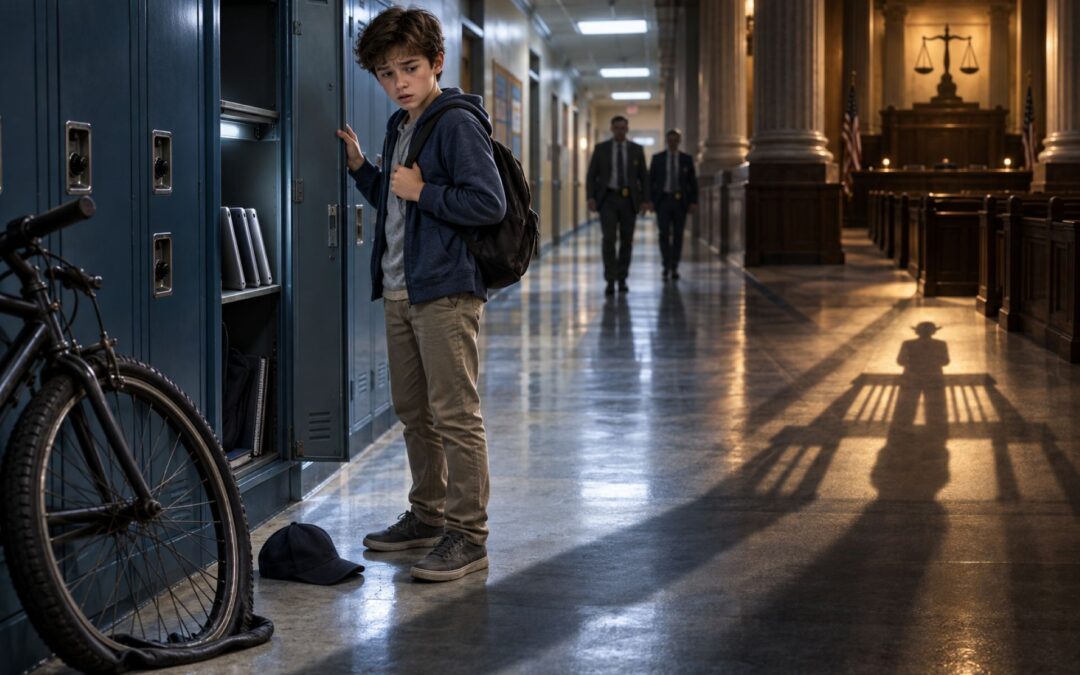
John Grisham’s Theodore Boone: The Accused takes the central idea of the Theodore Boone series and turns it against its hero. Theo is normally the thirteen-year-old who knows the courthouse, understands legal procedure better than most adults expect, and enjoys explaining concepts such as presumption of innocence and reasonable doubt. In this novel, that confidence is tested when apparently convincing evidence begins to suggest that Theo himself has committed a serious burglary.
Published as the third book in the Theodore Boone series, The Accused shifts the emphasis away from Theo watching other people face the justice system and toward his own experience of suspicion, investigation, damaged reputation, and fear. The Hodder & Stoughton 2012 edition develops that premise across a tightly chronological mystery in which each new piece of evidence makes Theo look more guilty, even though the reader knows that someone is deliberately constructing a case against him.
The most interesting part of the novel is not simply discovering who framed Theo. Grisham uses the mystery to separate several ideas that Theo has previously been able to treat as naturally aligned: truth, evidence, law, reputation, morality, and justice. Theo is innocent of the crime, yet the evidence against him is real. The police have legitimate reasons to investigate him, yet their investigation makes an innocent child feel powerless. His friends know his character better than the physical evidence does, yet loyalty is not proof. Most importantly, Theo eventually helps clear himself through an action that he knows violates the confidentiality standards he normally respects.
This article contains complete spoilers for the entire novel, including the identity and motives of the people who frame Theo, the police investigation, the recovery of the stolen property, and the ending.

Complete Plot Summary of Theodore Boone: The Accused
The novel begins as though Pete Duffy’s murder case will again dominate Theo’s attention. Instead, Duffy disappears before his retrial can proceed, leaving the courthouse drama unresolved and creating space for a more personal legal crisis. From that point onward, the plot works by steadily increasing the pressure on Theo: first through apparently random harassment, then through planted evidence, public rumor, police scrutiny, and finally a search of his own home.
The mystery is effective because the evidence against Theo is not obviously absurd. His missing property appears at the crime scene, stolen merchandise is found in his locker, witnesses can place him in the relevant area, and anonymous information pushes police toward him. Solving the case therefore requires more than insisting that Theo is a good person. It requires finding a completely different explanation for how all of those facts came to exist.
Chapters 1–5: Pete Duffy Vanishes and Theo Becomes a Target
Theo begins the book looking forward to the renewed murder trial of Pete Duffy. Duffy had previously been accused of murdering his wife, and Theo had become unusually involved in the case after learning about Bobby Escobar, an eyewitness whose testimony could destroy Duffy’s defense. Theo is fascinated by the coming trial because the courtroom is his favorite environment, but he is also concerned about what testifying might mean for Bobby, whose immigration situation and personal security make involvement dangerous.
At school, Theo talks about the case with Mr. Mount and his classmates. His explanation of the presumption of innocence and the prosecution’s burden of proving guilt beyond a reasonable doubt establishes one of the novel’s central ironies. At this point Theo speaks about these principles with the confidence of someone observing the justice system from outside. He understands their definitions, but he has never experienced what it feels like when other people believe there is good evidence that he himself has done something wrong.
Theo reaches the courthouse and once again demonstrates how naturally he moves through Strattenburg’s legal world. He knows court personnel, understands routines that confuse ordinary visitors, and sees the building almost as an extension of home. Even his conflict with Buck Boland, a security guard who dislikes Theo, has the familiarity of an established rivalry rather than genuine danger.
The expected trial never begins. Pete Duffy has disappeared, and even his defense lawyer, Clifford Nance, cannot explain where he has gone. Judge Henry Gantry is forced to halt proceedings while authorities search for the missing defendant. The disappearance ultimately prevents the retrial from continuing, and the legal drama that Theo had expected to watch becomes a fugitive hunt instead.
Theo has mixed feelings about Duffy’s disappearance. On one level, he is relieved that Bobby Escobar may not have to testify and expose himself to risk. On another, he knows that Duffy’s associates Omar Cheepe and Paco have been watching him before, and their continued presence keeps the case threatening even when Duffy himself is gone. After leaving court, Theo notices Cheepe and Paco following him in a Jeep, reinforcing the possibility that his connection to the Duffy case still makes him a target.
The sense that someone is watching Theo soon moves into his ordinary school life. He discovers that somebody has entered his locker. Two inhalers and his Minnesota Twins baseball cap are missing, even though nothing about the theft seems valuable enough to explain why someone would take them. The school’s surveillance cameras happen to be unavailable because they are being upgraded, so there is no useful footage showing who entered the locker.
Later, Theo finds that the front tire of his bicycle has been deliberately slashed. His bicycle is central to his independence because it allows him to move freely among school, court, Boone & Boone, friends’ homes, and other parts of Strattenburg. Sabotaging it is therefore more than minor vandalism. Someone is interfering with the basic mobility on which Theo’s unusually independent life depends.
Gil’s Wheels replaces the tire on credit, but the problem does not end. During a Boy Scout meeting, another tire is slashed. What might have looked like a single piece of school mischief begins to seem deliberate, especially because Theo cannot identify anyone with a motive to keep targeting him.
The threat escalates dramatically when a large rock comes crashing through the glass of Theo’s office door at Boone & Boone. The rock narrowly misses him. The earlier incidents could be dismissed as irritating or juvenile, but this attack could have injured Theo badly and demonstrates that someone is willing to frighten him inside his family’s law office.
Theo remains unsure whether the harassment is connected to Pete Duffy, Buck Boland, somebody at school, or another person entirely. That uncertainty matters because the novel initially encourages both Theo and the reader to interpret the attacks through the enemies already known from earlier books. The true motive lies elsewhere.
The early chapters also reinforce Theo’s relationship with Uncle Ike. Ike is a former lawyer who has been disbarred and who lives at a greater distance from the professional respectability represented by Theo’s parents. Theo trusts him deeply, and Ike’s experience has given him an instinct for the uglier and more morally ambiguous side of legal conflicts. That difference between Ike and Theo’s parents becomes essential once the case against Theo begins to form.
Chapters 6–10: Stolen Tablets Turn Theo into the Prime Suspect
Before Theo becomes the direct subject of a police investigation, the novel quietly introduces another source of danger connected to Boone & Boone. Marcella Boone handles divorce and family-law matters, and one of her cases involves Karen and Roger Treen. Roger arrives at the office angry and armed, forcing the Boones to deal with an emotionally volatile situation created by the collapse of a marriage.
The Treen confrontation does not directly cause Theo’s later problems, but it demonstrates something important that Theo has not fully considered: his parents’ legal work can create enemies. A lawyer may represent one person in a family dispute while another person comes to see that lawyer as responsible for everything that has gone wrong. That possibility will later become the key to Ike’s theory about why somebody might attack Theo.
Theo continues his ordinary commitments, including helping children at a homeless shelter. While riding his bicycle downtown, he encounters Officer Stu Peckinpaw and acknowledges that he is breaking one of the local bicycle rules. At the time, the meeting seems trivial. Later, however, it gives police a reliable reason to place Theo downtown near the scene of a serious burglary.
The major reversal occurs when detectives Hamilton and Vorman begin questioning Theo about a break-in at Big Mac’s Systems, a local electronics store. A large quantity of merchandise has been stolen, including Linx 0-4 tablets, laptops, mobile phones, and other equipment. Police have received information directing their attention toward Theo.
Theo agrees to let his school locker be searched because he knows he has nothing to hide. Instead of clearing him, the search produces three stolen Linx 0-4 tablets. The devices were taken from Big Mac’s.
Theo immediately understands how serious the discovery is. He denies owning the tablets and insists that somebody must have placed them in his locker, but he also recognizes that his explanation has weaknesses. He had discovered days earlier that somebody had entered the locker, yet he never formally reported the incident. What Theo knows to be an important piece of context can therefore sound to investigators like a convenient story invented only after stolen property has been found.
He reacts using the legal instincts that normally make him seem precociously confident. Rather than continue talking freely, Theo asks for his parents or a lawyer and contacts Ike. His knowledge gives him some protection, but the emotional difference between understanding rights and needing those rights becomes increasingly clear.
Big Mac himself is brought into the investigation and identifies the tablets as merchandise from his store. He reacts angrily toward Theo and believes that the boy looks familiar. Theo again denies ever having visited the store, but another piece of apparently incriminating information has now entered the case.
Ike arrives and immediately approaches the situation differently from the detectives. He focuses on the earlier locker intrusion and argues that someone could have stolen Theo’s belongings and later planted the tablets. When Theo finally tells him about the repeated bicycle tire slashings and the rock thrown through Boone & Boone, Ike sees a pattern that the police have not yet accepted. Someone may be doing more than stealing electronics; someone may be deliberately constructing a story in which Theo appears guilty.
Theo later gives a formal recorded statement with his parents and Ike present. He explains the locker break-in, the missing cap, the bicycle vandalism, his presence downtown, and the rock attack. His account is coherent, but coherence is not the same as proof. Police still have stolen merchandise in his locker and a legitimate reason to place him in the relevant area.
The anonymous tip that led investigators toward Theo further complicates matters. The tip was made from a payphone near a hospital, providing no obvious identity for the caller. Whoever is framing Theo has not merely planted property but has taken deliberate steps to ensure that law enforcement discovers it.
Fingerprints do not provide an easy answer. The tablets fail to produce evidence that automatically identifies another person, leaving the investigators with a case that remains circumstantial but troubling. Woods Boone argues that the sequence of attacks against Theo makes the framing theory plausible, yet the detectives cannot simply accept the family’s belief in Theo’s innocence.
The distinction between legal investigation and social judgment becomes harsher when an anonymous GashMail message spreads around school. An image of the Boone family leaving the police station is circulated with the false claim that Theo has been arrested for the burglary and will appear in Juvenile Court. The rumor converts suspicion into apparent certainty.
Students who know almost nothing about the evidence begin reacting to Theo as though guilt has already been established. For Theo, this is a new kind of injury. He knows that a court has not convicted him and that police have not even formally proved the case, but legal distinctions offer little comfort when classmates are treating him as a thief.
At home, his parents begin thinking more systematically about who could have planted the tablets. Whoever did it probably had access to the school. Because the burglary involved a large amount of equipment, they also suspect that more than one person may be involved. Theo is asked to identify enemies, yet he cannot think of anyone who hates him enough to organize such a complicated campaign.
Chapters 11–15: Reputation, Violence and a Search Warrant
Theo returns to school knowing that the accusation has become part of his public identity. Students chant “Jailbird” and “guilty,” and the humiliation is especially difficult because Theo has always taken pride in being trusted by adults and classmates. Legal innocence cannot protect him from social punishment.
Baxter begins taunting Theo, and Woody responds by punching him. Griff becomes involved on Baxter’s side, and Theo enters the fight because he wants to defend Woody. Theo knows that fighting violates school rules, and he normally prides himself on understanding and respecting rules, but loyalty overcomes his reluctance.
The fight gives the novel an early example of the ethical problem that will later become much more serious. Theo does something formally wrong for a reason that he considers morally defensible. The consequences are relatively small compared with the later confidentiality breach, but the episode begins loosening the assumption that obeying a rule and doing the right thing are always the same action.
Principal Mrs. Gladwell investigates the fight and questions the students separately. Even while being disciplined, Theo notices weaknesses in the way she conducts the questioning, which shows that his legal mind has not disappeared under pressure. None of the boys involved betrays the others, and they receive suspensions and probation.
Woods picks Theo up and listens to his explanation. He does not pretend that Theo followed school rules, but he understands why his son intervened when Woody was being attacked. The response illustrates Woods’s characteristic balance between respect for procedure and attention to circumstances.
Theo’s legal position worsens when detectives produce another piece of evidence: his missing Minnesota Twins cap has been recovered from Big Mac’s Systems. The cap is marked with Theo’s initials, making it much harder to dismiss as coincidence.
The discovery produces two competing stories. Theo’s version is that someone stole the cap from his locker specifically so it could later be planted at the burglary scene. The alternative is much simpler from an investigator’s perspective: Theo participated in the burglary, lost the cap inside the store, then invented the earlier locker intrusion to explain why it was missing.
The detectives move closer to treating Theo as a genuine criminal suspect and ask permission to search the Boone home. His parents refuse to give voluntary consent. They do not interfere unlawfully, but they require police to obtain a warrant rather than allowing the family’s privacy to be invaded simply because investigators have asked.
During his suspension, Theo becomes involved in one of the novel’s strangest but most characteristic side stories. Miss Petunia Plankmore needs help after her llama, Lucy, becomes involved in an Animal Court dispute following encounters with Buck Boland and another guard, with additional chaos connected to May Finnemore’s spider monkey, Frog.
Theo researches the relevant local ordinance and approaches the conflict almost exactly as he would approach a conventional legal problem. Rather than turning the dispute into a dramatic courtroom victory, he helps arrange a practical compromise involving an apology and measures intended to prevent more trouble. Judge Yeck accepts the solution.
The Animal Court episode temporarily moves away from the burglary mystery, but it also creates a revealing contrast. In the criminal investigation, Theo is frightened, defensive, and dependent on adults. In Animal Court, he is once again the composed young advocate who understands procedure and helps another person solve a problem.
That contrast becomes even sharper when Hamilton and Vorman arrive with a warrant and search the Boone home. Theo has reached the point where he worries not merely about what police might find but about the frightening possibility that more evidence could somehow appear in his own house. The experience shows how completely the framing has destabilized his trust in his surroundings.
The search is thorough. Police inspect the house, attic, shed, and other spaces but find none of the missing merchandise. Marcella is angry at the intrusion, while Theo’s parents continue reassuring him that they believe him.
The family later goes out for pizza, and Theo retells the Animal Court episode. The comic story provides relief, but the deeper contrast remains. Theo can successfully navigate absurd legal problems involving animals, yet he cannot simply reason his way out of a serious accusation when physical evidence points toward him.
Chapters 16–21: Ike’s Risky Theory and the Finn Brothers
The investigation changes direction when Theo spends time with Ike. Ike begins by asking a question that the police and Theo have largely overlooked: what if the person attacking Theo does not actually hate Theo?
Because Theo is closely identified with his parents and Boone & Boone, Ike considers whether the real resentment might be directed toward Woods or Marcella. Marcella’s divorce practice immediately becomes important. Divorce cases can create intense anger, and losing spouses may view opposing lawyers as personally responsible for decisions, settlements, custody arrangements, or the collapse of their family.
Ike starts reviewing public information about Marcella’s cases, but much of the useful material is protected by professional confidentiality. He therefore proposes looking at Boone & Boone’s internal case-summary system, InfoBrief. Theo understands at once that this would cross a serious line.
The conflict is important because Theo is not confused about the rule. He knows that confidential client information is protected for a reason and that he has no right to search through his mother’s files simply because he is desperate. Ike nevertheless argues that the circumstances justify exceptional action because Theo is being framed for a serious crime and could face consequences if they fail to identify the attackers.
Theo reluctantly obtains the InfoBrief credentials from Vince’s computer at Boone & Boone. The act immediately troubles him. Unlike entering the school fight, where the moral justification felt obvious to Theo, accessing the files creates an unease that remains even after the strategy proves successful.
At the same time, the school rumor network produces a potentially useful clue. Griff, who had been involved in the fight against Theo and Woody, apologizes and passes along information that his sister Amy has heard. An older teenager may be selling brand-new Linx 0-4 tablets at prices far below normal retail value.
The rumor matters because the merchandise matches the stolen property from Big Mac’s. Theo asks Griff to learn the seller’s name. The possibility that stolen tablets are circulating among students provides the first promising route toward a suspect independent of the evidence planted against Theo.
Theo also receives support from Major Ludwig at Scouts. Ludwig privately tells him that he believes him. The reassurance cannot erase the police investigation, but it matters because Theo’s crisis is increasingly about trust as much as law. Adults and friends who know him are preserving a version of his identity that public rumor has begun to destroy.
Another bicycle tire is slashed, proving that the campaign against Theo has not stopped. Police acknowledge that the damage is deliberate, yet it still does not establish who committed the burglary or prove that the electronics were planted. Theo becomes frustrated by the difference between evidence that convinces him something is happening and evidence that can actually redirect an official investigation.
Under increasing pressure, Theo finally gives Ike the InfoBrief credentials. Ike searches the divorce cases and narrows his attention to several bitter disputes. One family stands out: the Finns.
The Finn divorce involves two boys, Jonah and Jessie, who strongly prefer their father and have absorbed his hostility toward Marcella. Their father has serious personal problems, including drinking and gambling, and he blames Marcella for his marital difficulties. The possibility emerges that the boys may view Theo as a way to retaliate against the lawyer they believe has harmed their father.
A separate clue now connects with Ike’s theory. The teenager suspected of selling cheap Linx tablets is named Jessie. Suddenly, the family resentment discovered through the confidential files and the stolen-electronics rumor point in the same direction.
The Pete Duffy story briefly returns when Duffy is reportedly spotted at Chicago’s O’Hare Airport but escapes again. The sighting does not resolve his story, yet it keeps the novel’s original accused man in the background while Theo’s own case grows more serious. Duffy can avoid legal scrutiny by disappearing; Theo has no such option and must live inside the accusation until it is disproved.
Theo begins quietly mobilizing his friends. He tells April Finnemore what has happened, and because April knows people connected to Jonah, she agrees to gather information. Woody, Chase, and Griff also help. The network is informal, but it becomes increasingly effective because students can learn things that police cannot easily discover through formal questioning.
Griff confirms that the suspicious seller is Jessie. The boys consider using Woody’s older brother Tony to buy one of the tablets so they can obtain proof that Jessie has stolen merchandise. Tony begins making contact while Theo continues trying to avoid acting recklessly.
April eventually provides even more important information. Jonah has become angry and moody, repeats his father’s accusations against Marcella, suddenly seems to have money, and possesses both a new Excell phone and a Linx 0-4 tablet. None of those facts alone proves that the brothers committed the burglary, but together they create a much stronger basis for suspicion.
A church sermon about stealing makes Theo’s own moral discomfort harder to ignore. He is innocent of the burglary, yet he has secretly helped Ike obtain access to private legal information. The comparison is not morally equivalent, but Theo cannot simply divide the world into guilty criminals and innocent rule-followers anymore.
He returns to Ike with the new information. The investigation is now close to producing evidence that can be given to authorities without exposing the confidential-file search that first pointed them toward the Finn family.
Chapters 22–25: The Trap Closes and Theo Is Cleared
Theo eventually returns to school and apologizes to Mrs. Gladwell for his part in the fight. He also changes his locker code from “Judge” to “Lawyer.” The small change reflects his persistent identification with the legal world after an experience that has made that world far less comfortable than it once seemed.
Ike advises Theo not to accuse Jonah directly of burglary without evidence. Instead, Theo reports something the school can legitimately investigate: Jonah is carrying a phone in violation of school rules. A teacher confiscates it.
The phone’s serial number is checked, and it turns out to be one of the devices stolen from Big Mac’s Systems. For the first time, authorities have physical evidence connecting someone other than Theo to the burglary.
At roughly the same time, Tony Lambert approaches Jessie and negotiates over the possible purchase of another suspiciously cheap tablet. The effort helps strengthen the picture already forming around the brothers. Police now have reason to look beyond Theo without relying on his family’s insistence that he has been framed.
Investigators discover more stolen electronics connected with Jonah. Once the case begins shifting toward the Finn brothers, the same machinery of investigation that felt threatening when focused on Theo starts working in his favor. Police proceed carefully because suspicion alone is not enough; they need evidence that can support searches and questioning.
Detectives Hamilton and Vorman separate Jonah and Jessie during interrogation. Each brother is confronted with the evidence, and investigators use pressure designed to make him believe the other has already started talking. Because the brothers cannot coordinate their stories, their shared defense begins to collapse.
More stolen property is discovered in their school lockers. Jonah becomes especially vulnerable when detectives suggest that Jessie has blamed him for planting the electronics and attacking Theo. The alliance that allowed the brothers to commit the crimes becomes a weakness once each fears that the other will protect himself first.
The investigation eventually reaches the Finn home. Their mother, Linda Finn, faces police scrutiny as officers search for the remaining merchandise. Under pressure, Jonah reveals that stolen electronics are hidden in a crawl space above the garage.
Police recover a substantial quantity of Big Mac’s property, including laptops, tablets, phones, and other devices. The discovery makes continued denial increasingly impossible. The brothers are now tied directly to the burglary by physical evidence that cannot plausibly be explained through Theo.
The eventual confessions reveal that the burglary and the campaign against Theo had related but distinct motives. Jonah and Jessie initially stole electronics because they wanted money. Their decision to frame and terrorize Theo grew from their resentment of Marcella Boone, whom their father blamed for the family’s divorce problems.
They had entered Theo’s locker, taken his belongings, planted stolen tablets there, placed his Minnesota Twins cap at Big Mac’s, repeatedly slashed his bicycle tires, and thrown the rock through Boone & Boone. The campaign was designed to make Theo suffer because he was Marcella’s son.
Theo is finally cleared. Detectives inform the Boone family that the Finn brothers have been arrested and that most of the stolen property has been recovered. The physical evidence that once made Theo look guilty can now be explained as part of the framing operation.
The resolution creates a professional problem for Marcella. Because her own son has been victimized by children involved in the Finn family conflict, she can no longer continue representing Linda Finn as though Boone & Boone were detached from the dispute. She withdraws from the case.
Theo returns Ike’s unused money, but he remains troubled by the way they discovered the Finn connection. He wants to admit that he helped Ike access confidential InfoBrief material. Ike discourages him from confessing and says that he will accept responsibility if the breach ever becomes an issue.
The novel therefore gives Theo complete legal exoneration without giving him complete moral relief. He did not steal from Big Mac’s, plant evidence, or commit the crimes for which he was suspected. Yet he has learned that being right about the central issue does not automatically make every action taken in self-defense ethically clean.
Pete Duffy also remains at large. The adult defendant whose case began the novel escapes legal resolution, while the falsely accused child remains in Strattenburg, survives investigation, and eventually sees the evidence corrected. The final statement that Theo is “no longer the accused” resolves the title literally, but the experience has changed what the phrase means to him.
Strattenburg and the Legal World Around Theo
Strattenburg is not merely the place where the story happens. The town is organized around the institutions through which Theo understands the world: courts, law offices, police, schools, local ordinances, civic groups, and informal networks of adults who know one another. Because the setting is compact, Theo can move among these institutions by bicycle and participate in adult legal life while still remaining unmistakably a child.
The courthouse is the most important part of this environment because Theo treats it almost as a second home. He knows judges, clerks, lawyers, security routines, and courtroom expectations. Other children might find the building intimidating, but Theo sees it as an ordered place where problems are translated into procedures and disputes are governed by rules. That familiarity explains why being treated as a suspect is so destabilizing: the institutions that normally make him feel competent suddenly make him feel exposed.
Boone & Boone performs a similar double function. It is a family workplace where Theo has his own office, access to legal conversations, and constant exposure to professional life. At the same time, the attack through his office window and the later misuse of confidential case information reveal that the law office is not completely safe. Professional conflicts can follow lawyers into their private lives, while professional confidentiality can become a temptation when personal interests are threatened.
The school operates as another miniature system of authority. It has rules, investigations, punishments, locker security, surveillance cameras, and administrators who must judge competing stories. Theo’s fight and the discovery of the tablets show that institutional procedures can be necessary without being infallible. Mrs. Gladwell cannot simply exempt Theo because she knows him, just as detectives cannot ignore stolen property because his parents believe he is innocent.
Police authority becomes especially important because Theo normally thinks about criminal justice in abstract legal terms. When detectives search his locker, take statements, question him, and execute a warrant at his home, procedure becomes physical. Doors open, possessions are inspected, private spaces become accessible to strangers, and a thirteen-year-old must rely on adults to protect his interests.
Animal Court broadens Strattenburg’s legal landscape in a deliberately comic direction. The absurdity of a llama dispute still requires rules, interpretation, compromise, and a judge willing to approve a workable solution. Theo’s competence there reinforces the idea that law is not only about dramatic criminal trials but about ordinary conflicts that communities need mechanisms to resolve.
Scouts, the homeless shelter, church, school friendships, and community businesses complete the setting. Theo exists inside a dense network of relationships in which adults know his family and young people exchange information quickly. That closeness helps him because friends eventually gather crucial clues, but it also makes false accusation especially painful because rumors move faster than official facts.
The bicycle connects these worlds. Theo can travel independently through Strattenburg because he is trusted, capable, and accustomed to moving among adult spaces. Repeatedly slashing his tires therefore attacks more than property. It narrows his freedom and converts familiar routes into reminders that someone can reach him almost anywhere.
The novel does not present Strattenburg’s procedures as a comprehensive account of American law, and readers should be cautious about treating particular fictional practices as universal legal rules. The setting works primarily as a simplified civic world for middle-grade readers, one in which legal institutions are understandable enough to follow but complex enough to demonstrate that rules and truth do not always line up immediately.
Character Analysis
The mystery changes the way several established characters function because Theo is no longer helping somebody else with a legal problem. His parents, Ike, friends, teachers, and police must decide what they believe about him, while Theo must discover which relationships survive when his reputation becomes uncertain. The Finn brothers, meanwhile, are important less because of deep psychological development than because they reveal how adult hostility can be absorbed and redirected by children.
Characterization in The Accused is generally functional and accessible rather than psychologically elaborate. The greatest depth belongs to Theo, whose emotional experience gives the book more weight than a simple puzzle about stolen electronics.
Theodore Boone
Theo begins the novel almost perfectly comfortable with his identity. He is a student, Boy Scout, aspiring lawyer, courthouse regular, and trusted child of two attorneys. He understands rules well enough to explain them to classmates and enjoys situations in which knowledge gives him an advantage over adults who underestimate him.
That confidence is not the same as arrogance, but it does depend on a particular assumption: that understanding the system means being able to navigate it. The burglary investigation breaks that assumption. Theo understands why detectives care about the tablets, cap, and downtown sighting, yet understanding the logic does not give him the power to make the evidence disappear.
His fear grows because he realizes how persuasive the case could look to somebody who does not know him. A tablet in a locker, a cap at a crime scene, a witness placing him nearby, and an anonymous tip form a story with internal coherence. Theo knows that story is false, but he cannot simply substitute his own certainty for proof.
The social consequences are almost as painful as the legal ones. Theo has built much of his identity around being dependable and unusually mature. When classmates call him “Jailbird” and circulate claims that he has been arrested, they attack the quality he values most: the belief that he is someone adults and friends can trust.
His decision to enter the school fight reveals that his commitment to rules is already becoming more complicated. Theo knows that fighting is prohibited, yet he cannot stand aside when Woody is defending him. The act does not transform him into a rebel, but it shows that loyalty can create situations in which formal obedience feels morally insufficient.
The InfoBrief episode develops that conflict much further. Theo understands that secretly obtaining confidential credentials is wrong. His desperation does not erase that knowledge, which is why the action continues troubling him after it helps solve the case. He becomes more morally interesting because the novel allows him to be innocent of the central crime without making him ethically spotless.
His investigative strengths remain significant. Theo listens carefully, notices connections, uses his friends intelligently, and follows Ike’s advice not to make an unsupported accusation against Jonah. Reporting Jonah’s prohibited phone instead of directly accusing him of burglary is particularly revealing. Theo learns to distinguish suspicion from evidence even while trying to escape suspicion himself.
By the ending, Theo’s legal ambitions have not disappeared. Changing his locker code from “Judge” to “Lawyer” suggests that the experience has not destroyed his attraction to law. What has changed is the innocence of that attraction. He now understands more personally that legal systems operate through imperfect evidence, institutional power, conflicting duties, and human judgment.
Ike Boone
Ike is essential because he understands forms of conflict that Theo’s more conventional legal upbringing does not prepare him to recognize. His disbarment and outsider status make him less respectful of professional boundaries, but they also allow him to imagine explanations that respectable lawyers and police do not initially consider.
He is fiercely loyal to Theo. When stolen tablets are discovered, Ike arrives quickly and immediately begins constructing the framing theory rather than accepting the obvious interpretation of the evidence. He notices that the locker intrusion, slashed tires, thrown rock, planted cap, and stolen merchandise might all belong to one coordinated campaign.
His greatest contribution is changing the motive question. Instead of asking which of Theo’s personal enemies might want revenge, Ike asks who might hate Theo’s parents. That shift leads directly to Marcella’s divorce clients and eventually to the Finn family.
Ike is also the novel’s most ethically dangerous mentor. His willingness to access confidential information is not presented as simple villainy, because without the search Theo might remain trapped much longer. Yet his reasoning is unmistakably consequentialist: the end is important enough that he is prepared to violate a rule designed to protect clients.
Theo’s discomfort prevents the novel from turning Ike’s success into full moral endorsement. Ike can solve a problem that more cautious adults have failed to solve, but he does so by asking a child to participate in conduct the child believes is improper. His willingness to take responsibility later does not undo the fact that Theo has already crossed the line.
The relationship therefore becomes more mature by the ending. Theo still loves and trusts Ike, but he can no longer treat Ike’s unconventionality merely as charming rebellion against stuffy rules. Ike’s instincts are valuable precisely because they operate near boundaries that sometimes exist for good reasons.
Marcella and Woods Boone
Marcella and Woods provide two different models of legal adulthood. Both believe Theo immediately, but they respond to his crisis with different temperaments and professional instincts.
Marcella is emotionally protective and professionally disciplined. Her work in divorce law gives her direct experience with bitter family conflicts, yet she does not initially imagine that resentment from one of those cases could reach Theo. The Finn revelation forces her to see that representing one spouse can make the lawyer a symbolic enemy in the eyes of another family member.
Her anger during the search of the Boone home is understandable because the investigation has moved from her son’s locker into the family’s private space. At the same time, she respects the distinction between police asking for consent and police arriving with a lawful warrant. Her professionalism makes the later InfoBrief breach especially uncomfortable because Theo and Ike violate the type of confidentiality she is responsible for maintaining.
Marcella’s withdrawal from the Finn matter at the end demonstrates that legal ethics do not disappear merely because her family has been wronged. Once Theo becomes a victim and possible witness in matters involving the Finn children, her continued participation creates a conflict that cannot simply be ignored.
Woods is generally calmer. He trusts Theo without treating that trust as evidence police are obligated to accept. His refusal to consent casually to a search reflects procedural caution rather than hostility to law enforcement, and his reaction to Theo’s school fight similarly combines disapproval of the rule violation with understanding of the circumstances.
Together, the Boones represent the more institutional side of the legal world. Their approach contrasts with Ike’s improvisation. They believe in rights, procedures, and professional boundaries even when those constraints make solving Theo’s problem slower and more frustrating.
Jonah and Jessie Finn
Jonah and Jessie are the perpetrators of both the electronics burglary and the campaign against Theo. Their actions have two motives that need to be distinguished. They steal from Big Mac’s largely because they want money, while their attacks on Theo are driven by resentment connected to their parents’ divorce.
Their father has blamed Marcella for his marital problems, and the boys have absorbed his hostility. Theo becomes a proxy target. Rather than attack Marcella directly, they punish her son by constructing a situation that could damage his reputation and potentially expose him to juvenile prosecution.
The brothers’ methods show planning. They steal Theo’s cap, plant tablets in his locker, leave the cap at the burglary scene, repeatedly damage his bicycle, throw the rock through Boone & Boone, and use an anonymous tip to ensure that police discover the planted evidence. They understand that the strongest frame-up will combine real stolen property with details that independently place Theo near the relevant location.
Their relationship is also essential to their eventual defeat. Acting together allows them to commit and conceal the crimes, but interrogation separates them. Once each brother believes the other may be cooperating with detectives, their shared story becomes unstable.
The novel gives them enough motive to explain the plot, but not enough early presence to make them fully satisfying mystery antagonists. Their importance becomes clear relatively late. As a result, the reader spends much of the novel wondering who could be attacking Theo without having a strongly developed suspect whose earlier behavior can later be reinterpreted.
Their family situation provides context rather than excuse. Adult bitterness has shaped their view of Marcella, but the brothers still make deliberate choices to steal, intimidate, lie, plant evidence, and endanger another child. The novel is strongest when that distinction remains clear.
Theo’s Allies and Institutional Opponents
Theo’s friends demonstrate why personal knowledge matters even when it cannot substitute for legal proof. April believes him and uses her social connections to learn about Jonah. Woody physically defends him when classmates mock him, while Chase and Griff become part of the information network that eventually points toward Jessie.
Griff’s role is especially useful because he moves from being involved in the school fight against Theo to providing an important rumor about cheap tablets. That shift prevents the school community from dividing too neatly into loyal friends and cruel enemies. People can make bad decisions in one moment and still contribute positively later.
Major Ludwig offers a different kind of support. His private statement that he believes Theo does not solve anything, but it reinforces Theo’s sense that his reputation has not been completely destroyed. For a child under investigation, adult trust has emotional value even when it has no formal evidentiary weight.
Mrs. Gladwell occupies a more ambiguous institutional role. She cannot simply treat Theo as innocent because she likes him, particularly after a fight or when police discover stolen property at school. Her actions remind Theo that institutions often require decisions before complete truth is available.
Detectives Hamilton and Vorman are not villains. From Theo’s perspective they are frightening because they question him, search his belongings, and bring the investigation into his home, but the physical evidence gives them legitimate reasons to investigate. Their later pursuit of Jonah and Jessie demonstrates the same principle: police procedure can burden an innocent person when evidence points wrongly, yet it can also uncover the truth once stronger evidence appears.
Pete Duffy remains largely outside Theo’s immediate social circle, but his presence shadows the novel. His fugitive status creates a contrast between a man who avoids legal process and a child who must endure it. That contrast becomes more important in the book’s larger thematic structure than in direct character interaction.
Major Themes
The Accused uses a relatively straightforward middle-grade mystery to explore several ideas that become more interesting because Theo already thinks he understands them. The novel repeatedly takes a legal or moral principle that sounds simple in the abstract and places Theo in circumstances where applying it becomes uncomfortable.
Its themes work best when they emerge from concrete events rather than from Theo’s explanations of legal doctrine. The planted tablets, viral rumor, home search, school fight, and confidential-file breach all test whether rules, evidence, truth, and fairness actually coincide.
Presumption of Innocence, Evidence and Reputation
The novel begins with Theo explaining the presumption of innocence in relation to Pete Duffy. A defendant is not supposed to be treated as legally guilty merely because he has been accused, and prosecutors must prove their case. Theo understands this intellectually.
His own experience demonstrates why the principle matters. Police do not investigate him because they arbitrarily decide that they dislike him. They find stolen tablets in his locker, discover his cap at the burglary scene, know that he was downtown, and receive an anonymous tip pointing toward him.
Each fact is genuine even though the conclusion they seem to support is false. That distinction is central to the novel. Evidence does not lie in the simple sense that the tablets really are stolen and the cap really is Theo’s, but evidence can be arranged by people who want investigators to draw the wrong conclusion.
Theo’s predicament therefore demonstrates why a persuasive story cannot replace proof. The easiest narrative is that Theo committed the burglary and invented the locker break-in afterward. The more complicated truth is that someone deliberately stole his belongings, committed an unrelated theft, planted merchandise, and manipulated the police investigation.
Social reputation operates by a much weaker standard. GashMail turns an image of Theo leaving the police station into a false claim that he has been arrested. Classmates begin using labels such as “Jailbird” without waiting for charges, evidence, or any form of adjudication.
That contrast makes legal presumption of innocence look less like an abstract technicality and more like protection against a common human instinct. People prefer coherent stories, especially when those stories appear to be confirmed by authority. Once Theo is publicly associated with police, many classmates stop asking whether the accusation is true.
The novel does not claim that investigators should ignore evidence because a suspect has a good reputation. The more serious point is that evidence needs interpretation, and institutional caution matters most when the available facts seem persuasive but are incomplete.
Rules, Justice and the Ethics of Breaking Rules
Theo begins as a rule-conscious child who admires systems. He likes courts partly because they transform conflict into procedures. Yet the novel repeatedly places him in situations where following the rule and doing what feels right are not obviously identical.
The school fight provides the simplest example. Theo knows that fighting is prohibited, but Woody is defending him against cruel taunting and becomes physically involved. Theo chooses loyalty over nonviolence and accepts suspension.
That decision is morally understandable even though the rule violation is real. Woods’s reaction reinforces the distinction: Theo did something prohibited, but the circumstances matter when judging the meaning of what he did.
The InfoBrief episode raises the stakes because confidentiality exists to protect clients who have trusted lawyers with sensitive information. Theo understands that he and Ike do not have permission to search those files for their own purposes. Their motive may be self-defense, but the privacy interests of Marcella’s clients do not disappear because Theo has been framed.
Ike effectively argues that justice requires breaking the rule because normal methods are failing. Theo accepts that argument enough to participate, yet his continuing guilt shows that the novel never resolves the issue completely in Ike’s favor.
The police investigation creates another variation. Detectives follow procedures that distress Theo because the evidence points toward him. From his perspective, justice would mean believing him immediately. From an investigative perspective, however, ignoring stolen property because a suspect appears trustworthy would itself be irresponsible.
The novel therefore moves away from a simple moral world in which good people obey rules and bad people break them. Rules can protect innocent people, as search warrants and professional confidentiality are intended to do, but circumstances can expose tensions among competing rules, loyalties, and responsibilities.
Theo’s maturity comes partly from learning to live with that tension instead of expecting every ethical problem to have a perfectly clean procedural answer.
Privacy, Surveillance and Control
Privacy is one of the novel’s most persistent concerns. Theo’s crisis begins when somebody enters his locker, a small personal space that he assumes is secure. From there, the story repeatedly asks who has the power to access information or property that another person considers private.
The disabled school cameras matter because surveillance might have protected Theo by showing who entered his locker. Their absence makes the crime possible to conceal. Yet the book later shows the opposite side of institutional observation when police search Theo’s locker and eventually his home.
The search warrant is especially important because legal authorization does not make the experience feel less invasive. Theo’s family may respect the legitimacy of the warrant while still resenting strangers examining their belongings. The scene gives younger readers a concrete sense of what investigative power can feel like from inside the home.
GashMail demonstrates a different form of exposure. Information does not have to be accurate to become socially powerful once it circulates quickly. A photograph combined with a false explanation can redefine Theo’s identity around school before official institutions have reached any conclusion.
The InfoBrief breach brings the theme back onto Theo himself. After suffering invasions of his locker, reputation, and home, he participates in an invasion of confidential information belonging to other people. That symmetry is uncomfortable and deliberate.
Passwords, locker codes, private files, warrants, cameras, anonymous calls, and rumors all become mechanisms controlling access to information. The question is not merely whether secrecy is good or bad, but who gets to know what, under what authority, and for what purpose.
Family Conflict and Collateral Damage
The Finn brothers’ motive turns the burglary mystery into a story about how adult conflict can spread beyond the people formally involved. Marcella is doing professional work in a divorce case, but Jonah and Jessie interpret her as an enemy because their father blames her for what has happened to the family.
The earlier Treen confrontation prepares the reader for this possibility. Divorce law involves people at moments of anger, fear, financial pressure, and resentment. A lawyer who represents one party can become a target for another person’s frustration even when the lawyer did not create the underlying marital problems.
Jonah and Jessie redirect that resentment toward Theo. He has no control over his mother’s cases and is not responsible for their parents’ marriage, yet harming him becomes a way of harming Marcella indirectly.
The novel is careful enough to show that family conflict is context rather than destiny. Many children experience divorce without becoming criminals. The Finn brothers choose to steal, vandalize property, frighten Theo, plant evidence, and lie to investigators.
What matters thematically is the transmission of blame. Their father’s view of Marcella becomes their own, and Theo becomes the easiest symbolic target because he is accessible at school. The justice system eventually deals with the brothers’ actions, but the emotional origin of those actions lies in unresolved family hostility.
The Boone household provides the opposite model. Theo’s parents disagree in temperament and react differently to events, but they present a stable front of belief and support. Their confidence does not solve the case, yet it prevents Theo from facing the accusation alone.
Friendship, Loyalty and Community
False accusation isolates Theo publicly, but the novel also shows how relationships can preserve identity when reputation collapses. The most valuable support often comes from people who cannot prove anything but know Theo well enough to refuse the easiest interpretation of events.
Woody’s defense of Theo is impulsive and leads to a fight, yet it demonstrates loyalty when classmates are turning suspicion into cruelty. April’s support is quieter and ultimately more useful because she gathers information about Jonah that Theo could not obtain directly.
Griff shows that loyalty can develop after conflict. Although he participates in the school fight on the other side, he later apologizes and provides the rumor about Jessie selling tablets. The case is solved partly because information crosses friendship boundaries rather than remaining inside Theo’s closest circle.
Major Ludwig and other trusted adults provide emotional reinforcement. Their belief cannot control police, but it matters to a child whose sense of self is being reshaped by rumor.
Community has a double edge throughout the novel. The same closeness that spreads gossip also spreads useful information. Students know who has suddenly acquired new electronics, siblings hear rumors about cheap tablets, and friends can ask questions in places where official investigators would attract attention.
Theo’s eventual exoneration therefore depends on both formal and informal systems. Police recover the evidence and secure the confessions, but friends and family help produce the clues that redirect attention toward the Finn brothers.
Symbols, Motifs and Structural Parallels
The Accused is not written as symbol-heavy literary fiction, so its recurring images work best when treated as practical motifs rather than mysterious coded meanings. Several objects and repeated situations gain thematic force because they appear at important stages of Theo’s loss and recovery of control.
The strongest patterns involve accusation, mobility, privacy, and access. They reinforce the story without requiring the reader to assume that every repeated object carries an elaborate hidden meaning.
Pete Duffy and Theo: Two Meanings of “The Accused”
Pete Duffy appears at first to be the obvious accused person in the novel. He faces a murder retrial, understands that new testimony could threaten him, and disappears before the judicial process can continue.
Theo appears to occupy the opposite position. He is the courtroom enthusiast watching the case from outside, confident enough to explain the principles governing what should happen to Duffy.
The structure then reverses those positions. Duffy escapes the immediate reach of the court, while Theo becomes trapped inside an accusation he cannot avoid. The adult defendant physically disappears; the innocent child remains in Strattenburg and experiences the consequences of being suspected.
Their situations are not morally equivalent. The novel does not suggest that every accused person resembles Theo or that Duffy’s case is identical to a frame-up. The parallel instead emphasizes how different the word “accused” looks depending on perspective.
For Theo, the experience strips away the comforting distance between studying law and living under its scrutiny. He discovers that presumption of innocence matters most when the evidence looks bad, not when everyone already believes the accused person.
Duffy’s unresolved status also prevents the ending from becoming excessively neat. Theo’s case reaches the truth, but the larger legal world still contains uncertainty. One investigation can be corrected without proving that every case reaches a satisfying conclusion.
Bikes, Slashed Tires and Theo’s Loss of Freedom
Theo’s bicycle represents everyday independence more strongly than any other possession in the series world. It allows a thirteen-year-old to move among school, courthouse, law office, Scouts, friends, and community obligations without constant adult supervision.
Repeatedly slashing the tires therefore attacks the practical structure of Theo’s life. The damage is petty compared with burglary or false accusation, but it is personal in a way the larger crimes initially are not.
The bicycle attacks also escalate Theo’s awareness that someone can reach him anywhere. A locker can be entered at school, a rock can break an office window, and a bicycle can be damaged while he attends Scouts. Familiar places stop feeling entirely secure.
Because the bicycle normally symbolizes movement, its repeated disabling mirrors Theo’s broader loss of freedom. He cannot simply continue his routine while somebody is constructing evidence against him.
The motif becomes especially effective because it remains ordinary. Grisham does not need a dramatic symbol of imprisonment. A flat tire is enough to show how intimidation can make a child’s world smaller.
Lockers, Passwords and Confidential Files
Access control appears throughout the novel in different forms. Theo’s school locker is supposed to be private but can be entered. Its security failure allows the frame-up to begin because the Finn brothers steal his cap and later plant stolen tablets.
The locker code itself becomes meaningful when Theo changes it from “Judge” to “Lawyer.” The change is small and somewhat playful, but it suggests that his experience has altered the way he imagines his future inside the legal world.
Passwords matter again when Theo secretly obtains access to InfoBrief. This time he is not the victim of unauthorized entry. He becomes the person crossing a boundary that somebody else expects to remain secure.
That reversal gives the privacy theme moral complexity. Theo understands exactly how violating private space feels, yet desperation persuades him to help Ike do something analogous with information.
The police search adds a third version of access. Unlike the locker intrusion or confidential-file breach, the search of the Boone home occurs under formal legal authority. The family dislikes the invasion, but the warrant provides a procedural basis for it.
These variations prevent the novel from treating privacy as absolute. Some access is criminal, some professionally unethical, and some legally authorized. Theo’s experience forces him to consider those differences instead of treating every intrusion as the same kind of wrong.
Animal Court as a Comic Mirror of the Main Case
The Lucy the llama episode can feel like a detour because it arrives during the most serious part of Theo’s personal crisis. The tone shifts away from burglary, interrogation, and reputational damage toward an absurd local dispute involving animals, complaints, and practical compromise.
Structurally, however, the episode serves a clear purpose. Theo is almost powerless when defending himself against suspicion, yet he remains highly competent when helping Miss Petunia navigate Animal Court.
The contrast preserves an important part of Theo’s identity. The accusation has frightened him, but it has not suddenly erased the knowledge and confidence that define him.
Animal Court also shows a version of law working almost ideally. The dispute is manageable, the facts are understandable, Theo can research the relevant rules, and a sensible compromise resolves the conflict. His own case offers the opposite experience, where the facts have been manipulated and no clever argument can instantly reveal the truth.
The subplot therefore provides both tonal relief and thematic contrast. It can slow the central mystery, particularly for readers eager to know who is framing Theo, but removing it would also make the book more mechanically focused and less connected to the wider Theodore Boone world.
Law, Ethics and the Moral Ambiguity of Theo’s Investigation
The legal content in The Accused is most effective when it demonstrates how principles feel from inside a crisis. Theo has always enjoyed explaining concepts such as presumption of innocence, warrants, evidence, and procedure. This novel makes those ideas personal without pretending that a middle-grade mystery is a comprehensive guide to real-world American law.
The investigation against Theo illustrates why procedural safeguards exist even when police are acting for legitimate reasons. Detectives have genuine evidence: stolen property in his locker, a cap at the scene, an anonymous tip, and confirmation that he was downtown. Investigating him is not irrational, yet the experience remains frightening because investigators possess powers Theo does not.
His decision to ask for a parent or lawyer when the tablets are discovered shows the value of understanding rights. Theo’s knowledge does not prove innocence, but it helps him avoid becoming completely passive when adults are asking questions that could have serious consequences.
The search of the Boone home makes the balance between investigation and privacy concrete. Woods and Marcella refuse voluntary permission, so police obtain a warrant. Once the warrant exists, the Boones must tolerate an intrusion they resent because the investigation has crossed the relevant procedural threshold within the fictional setting.
The novel does not need readers to conclude that the detectives are wrong simply because Theo is innocent. The harder lesson is that an honest investigation can still burden an innocent person. Legal process reduces certain risks, but it cannot guarantee that suspicion will always begin with the correct target.
The Finn investigation later demonstrates the same principle from the opposite perspective. Theo may be convinced that Jonah and Jessie are involved, but he cannot simply accuse them and expect authorities to act because he believes he has discovered the truth. Independent evidence must emerge.
The confiscated phone becomes crucial because it can be checked against the list of stolen property. Once the serial number matches Big Mac’s inventory, the case begins moving beyond rumor and motive. Additional electronics, interrogation inconsistencies, and the crawl-space stash build a chain much stronger than Theo’s initial suspicion.
The most difficult ethical issue involves the confidential Boone & Boone files. Professional confidentiality is not an arbitrary obstacle created to frustrate Theo. Clients involved in divorce cases may disclose sensitive information because they trust lawyers to protect it.
Ike nevertheless decides that Theo’s situation justifies searching those materials. His reasoning has practical force. Somebody is attacking Theo, the police investigation is moving toward him, and the obvious suspect pools have produced nothing. Looking at Marcella’s bitter cases could reveal a motive invisible from public information.
The strategy works. Without the Finn connection, Theo might not have known how to interpret the rumor about a seller named Jessie. The private information helps Ike identify a family in which hostility toward Marcella and access to two school-age sons overlap.
Success does not settle the ethics. Theo is disturbed precisely because the act produces a good result. If the files had revealed nothing, condemning the breach would be easy. Because the breach helps expose the people who framed him, he must confront the more difficult possibility that an unethical action can still have useful consequences.
Ike’s final advice intensifies rather than resolves the discomfort. Theo wants to admit what happened, while Ike urges silence and offers to take responsibility if necessary. From Ike’s perspective, disclosure would create damage without changing the truth of Theo’s innocence. From Theo’s perspective, remaining silent means continuing to benefit from conduct he believes crossed a boundary.
The novel does not force a final answer. That ambiguity is one of its better choices. Theo has learned that being the innocent party in the main conflict does not guarantee that every decision he makes while defending himself will also be innocent.
The ethical complexity also prevents the book from becoming a simple celebration of rule-breaking. Ike’s methods are effective, but Marcella’s professional obligations show why confidentiality matters. Theo’s unease keeps both truths visible at once.
Narrative Structure, Point of View and Style
The Accused uses a straightforward chronological structure that suits both its middle-grade audience and the logic of a framing mystery. Events generally unfold in the order Theo experiences them, so readers discover the changing evidentiary picture alongside him rather than receiving information through elaborate flashbacks or multiple perspectives.
The third-person narration remains closely aligned with Theo. Readers know what he sees, fears, suspects, and understands, but they do not receive private access to the Finn brothers that would reveal the answer early. This limitation preserves suspense while keeping the emotional center on the experience of being accused.
Grisham builds the central mystery through accumulation. A locker intrusion might be a prank. A slashed tire suggests harassment. A second tire and a thrown rock establish persistence. Stolen tablets transform harassment into criminal suspicion. The cap at the burglary scene then makes Theo’s framing explanation look much harder to prove.
That progression is more effective than simply announcing that Theo has been falsely accused. Each new development removes an easy escape. He cannot merely say that someone planted the tablets once another piece of his property turns up inside the burglarized store.
Short chapters keep the pace brisk. The legal explanations rarely become extremely technical because the book is aimed at younger readers, and Theo’s unusual enthusiasm for law allows Grisham to explain procedure without making every explanation feel completely external to the character.
The same device occasionally becomes didactic. Theo sometimes exists partly to explain how legal institutions work, and readers who already understand the concepts may notice the instructional machinery. The simplicity is appropriate to the intended audience, but it can make parts of the prose feel more functional than literary.
Humor provides necessary contrast. Buck Boland, Animal Court, Lucy the llama, and ordinary school complications prevent the book from becoming relentlessly anxious. The lighter material also keeps Theo recognizable as the same character from earlier installments rather than transforming the series abruptly into a darker juvenile crime thriller.
The tradeoff is pacing. The Animal Court sequence arrives when the main mystery is gaining urgency and temporarily postpones the question of who is framing Theo. Readers primarily invested in the burglary plot may experience it as interruption even though it serves character and thematic purposes.
The Pete Duffy material creates a similar tension. Duffy’s disappearance gives the novel a strong opening and creates an effective structural parallel with Theo, but the fugitive plot is not resolved within the book. Readers expecting every major opening thread to receive closure may find that frustrating.
The largest weakness in the mystery construction is the late importance of Jonah and Jessie Finn. A strong fair-play mystery often introduces the eventual culprits early enough that readers can reinterpret earlier scenes after learning the answer. The Accused instead spends much of its first half establishing that Theo is being framed before the actual perpetrators become meaningful suspects.
That approach makes the novel an effective suspense story about false accusation but a less satisfying whodunit. The central question for much of the book is not “Which of these developed suspects did it?” but “How can Theo survive until somebody finds who did it?”
The eventual solution still feels causally coherent. The boys have access to Theo through school, a motive connected to Marcella, stolen merchandise they can plant, and enough coordination to create the appearance of guilt. The problem is not that the solution makes no sense; it is that the reader has relatively little opportunity to solve it independently before Ike’s divorce-case theory points toward the correct family.
The interrogation scenes accelerate the final act efficiently. Once the stolen phone creates independent evidence, the narrative moves quickly from suspicion to searches, pressure on the brothers, recovery of property, and confession. That speed fits the book’s audience, although it leaves less space for deep exploration of Jonah and Jessie after their guilt is established.
Stylistically, Grisham prioritizes clarity. The prose is direct, the legal concepts are explained in accessible language, and the story rarely depends on ambiguity at the sentence level. Readers looking for elaborate psychological prose or stylistic experimentation will not find it here, but the writing serves the novel’s primary purpose: making a legal mystery understandable and exciting for younger readers.
The Ending Explained
The ending resolves the factual mystery decisively. Jonah and Jessie Finn are responsible for the burglary of Big Mac’s Systems and for the campaign designed to make Theo appear guilty.
Their burglary motive begins with money. They steal electronics that can be sold cheaply to other young people, which explains why rumors eventually circulate about Jessie offering new Linx tablets at suspicious prices.
The attack on Theo has a different emotional motive. The Finn boys resent Marcella Boone because their father blames her for his problems during the divorce. They convert that resentment into revenge against her son.
Their plan is effective because it combines intimidation with manufactured evidence. They enter Theo’s locker and steal his cap, plant stolen tablets in the same locker, place the cap inside Big Mac’s, repeatedly slash Theo’s bicycle tires, throw the rock through Boone & Boone, and use an anonymous tip to direct police toward him.
Once Jonah’s prohibited phone is confiscated and its serial number is matched with Big Mac’s stolen inventory, the balance changes. Police now have physical evidence against someone other than Theo, and further investigation uncovers more stolen property.
Separating the brothers during interrogation breaks their ability to maintain a coordinated story. Each begins to fear that the other is cooperating. The search of the Finn home then produces the decisive physical evidence when stolen electronics are recovered from the crawl space above the garage.
The confessions clear Theo because they explain the facts that once seemed to incriminate him. The tablets did not reach his locker because he stole them. His cap did not reach Big Mac’s because he dropped it during the burglary. Both items were deliberately placed where police would find them.
Theo’s legal problem therefore ends completely. He is not charged as the burglar, his parents’ faith in him is vindicated, and the community now has a different explanation for the evidence.
Marcella’s professional problem begins precisely because Theo’s personal problem ends. Her son has become a victim of the Finn children, which means she can no longer continue representing Linda Finn from the detached professional position required of the family’s lawyer. She withdraws.
Pete Duffy remains unresolved. The fugitive defendant whose retrial opened the book has not been returned to court, and the report of a sighting at O’Hare produces no final capture. That incompleteness reinforces the sense that Theo’s story is one episode inside a larger continuing legal world.
The most important unresolved issue belongs to Theo himself. He wants to acknowledge the unauthorized InfoBrief access because he knows that solving the mystery does not automatically make the method proper.
Ike discourages disclosure and offers to accept responsibility. The novel ends without forcing Theo to confess or pretending that he has stopped feeling guilty.
That is why the phrase “no longer the accused” has more than one meaning by the end. Theo has escaped the identity imposed on him by police suspicion and school rumor, but he has also learned that innocence is narrower than moral perfection. He can be innocent of burglary while still questioning one of the choices he made to prove it.
The ending therefore changes Theo’s understanding of law. At the beginning, legal principles are concepts he can explain. By the end, he understands them as protections and constraints operating in situations where people may be frightened, mistaken, desperate, or morally compromised.
Critical Review: What The Accused Does Well—and Where It Falters
The Accused works best when judged as a middle-grade legal suspense novel rather than as a miniature version of John Grisham’s adult thrillers. Its strongest achievement is taking a protagonist defined by confidence in legal procedure and forcing him to experience the justice system from its most uncomfortable side.
The reversal gives Theo more vulnerability than a conventional series adventure would. His knowledge does not stop detectives from questioning him, classmates from mocking him, or police from searching his home. For once, understanding how the law works offers only partial control.
That vulnerability improves Theo as a character. A child who is always the smartest person in the room can become difficult to invest in emotionally, but The Accused places him in circumstances where intelligence cannot solve everything immediately. He needs his parents, Ike, friends, teachers, and ultimately the same police investigators whose attention frightened him.
The framing sequence is also carefully escalated. Grisham does not jump directly from harmless school life to an implausibly overwhelming case. The missing cap and locker intrusion occur before the tablets appear, which later allows Theo to offer a framing explanation without making that explanation automatically persuasive.
The cap at Big Mac’s is particularly effective. Until that point, the tablets might conceivably be dismissed as a simple planting. Finding Theo’s personal property at the crime scene produces an independent-looking link that makes the false case substantially stronger.
The viral rumor gives the book a second kind of suspense. Theo is not only worried about police action; he is watching his social identity collapse. For the intended younger audience, classmates chanting “Jailbird” may feel as immediately threatening as the legal investigation itself.
The book’s treatment of law is generally accessible without reducing every issue to a moral slogan. A contemporary assessment of its legal and ethical material similarly highlights the way the novel combines a child-friendly mystery with questions about evidence, loyalty, privacy, and ethical choices. Its instructional purpose is obvious, but the best lessons arise through Theo’s personal predicament rather than through exposition alone.
The InfoBrief storyline is probably the book’s most valuable complication. A simpler novel would have Theo follow every rule, uncover the culprits through pure cleverness, and emerge completely vindicated. Instead, he compromises one of the principles associated with his parents’ profession.
The decision does not make Theo hypocritical so much as more human. He is frightened, his reputation is being destroyed, and formal investigation seems unable to protect him. The temptation to use information he should not access becomes understandable without becoming automatically right.
Ike’s role is similarly strong. He remains charismatic and resourceful, but the book allows readers to see why his willingness to ignore professional boundaries is both useful and dangerous. Theo needs Ike’s unconventional imagination, yet he also needs the ethical standards Ike is willing to bypass.
The Boone parents provide an effective counterweight. Their confidence in Theo creates emotional security, while their procedural behavior shows that belief in a child does not require pretending legal institutions have no legitimate role. Woods and Marcella resist unnecessary intrusion without declaring war on the justice system.
Friendship is handled with similar restraint. Woody’s defense of Theo is impulsive and imperfect, April’s help is practical, Griff’s later cooperation complicates his earlier role in the fight, and Major Ludwig’s belief gives Theo emotional support rather than magically solving anything.
The novel is also effective at showing the distinction between reputation and proof. The school rumor does not require the evidentiary standards of a courtroom. Once students believe Theo has been arrested, the label itself becomes socially powerful.
That idea remains relevant because the basic mechanism is not tied to a particular technology. A photograph, a rumor, and a claim of official involvement can create social certainty long before institutions determine what actually happened.
The main weakness lies in the mystery architecture. Jonah and Jessie Finn make sense as culprits once Ike identifies the family, but they are not established early enough as major figures for readers to conduct a satisfying independent investigation.
A more critical contemporary reading objected to aspects of the prose, the Pete Duffy thread, and the late emergence of the culprits. The criticism about mystery construction is particularly fair. The solution is coherent, but coherence after revelation is not quite the same achievement as planting enough material for readers to suspect the right people beforehand.
The Finn brothers’ motive also arrives with relatively little psychological development. Their father’s resentment toward Marcella explains why they choose Theo as a target, but the final chapters move quickly from suspicion to evidence, interrogation, recovery, and confession.
More time with Jonah and Jessie earlier in the book could have strengthened several elements at once. Their family anger would feel less like a late explanatory device, their behavior could create genuine alternative clues, and the final revelation would carry greater character weight.
The Pete Duffy subplot presents another tradeoff. As series continuity, it makes sense. Duffy’s unresolved legal status connects the book to earlier Theodore Boone stories and gives the opening immediate stakes.
As a standalone novel, however, the thread promises more resolution than it delivers. Duffy disappears, is reportedly seen later, and remains at large. Readers who enter the book primarily because the opening chapters foreground his retrial may reasonably expect a more complete payoff.
The subplot still has thematic value because Duffy and Theo become contrasting accused figures. That structural function makes the unresolved material more meaningful than a purely abandoned plot line, but meaning does not completely eliminate the feeling of incompleteness.
Animal Court creates a similar divide. The sequence is amusing, reinforces Theo’s legal competence, and gives younger readers relief during a tense story. It also interrupts the central mystery at a moment when many readers will be eager for the next clue.
Whether that interruption feels welcome will depend on what readers value in the series. Those who enjoy Strattenburg as a continuing world may appreciate seeing Theo solve a smaller absurd case while struggling with his own. Readers seeking the tightest possible thriller may see the sequence as unnecessary delay.
The prose is functional rather than distinguished. Grisham writes clearly, explains legal concepts directly, and rarely allows stylistic complexity to interfere with plot. That approach suits the publisher’s middle-grade positioning, particularly for readers who may be encountering legal vocabulary for the first time.
The cost is occasional didacticism. Characters sometimes explain procedures because the audience needs the explanation, and experienced readers can feel the educational purpose behind the dialogue or narration. The novel generally recovers quickly because something concrete follows the explanation.
Its procedural realism should also be understood in context. Strattenburg is a fictional setting designed to make courts and investigations legible to younger readers. The book is useful for introducing legal ideas but should not be treated as a precise manual for how every American jurisdiction handles juvenile suspects, warrants, school searches, or police interrogation.
Emotionally, the novel is strongest when Theo realizes that being innocent does not protect him from fear. The home search is especially effective because nothing dramatic needs to happen. Police simply exercise authorized investigative power while Theo watches strangers move through the spaces where he normally feels safest.
The ending succeeds because it refuses one easy form of closure. The burglary mystery is solved completely, but Theo’s moral discomfort remains. Grisham could have dismissed the confidential-file breach as harmless because it produced the correct suspect, yet Theo’s desire to admit what happened preserves the seriousness of the choice.
Ike’s insistence on silence can be read in more than one way. It protects Theo from consequences and reflects Ike’s willingness to own his own methods, but it also continues the same pattern of deciding that a good end justifies concealment. The book leaves younger readers with a genuine ethical question rather than supplying a simple lesson.
Within the Theodore Boone series, the premise is especially effective because readers already know how much Theo admires legal systems. A newcomer can still understand the story, but the reversal gains force if the reader knows the usual version of Theo: confident, curious, and thrilled to enter a courthouse.
The book remains accessible without requiring extensive prior knowledge. The necessary Duffy background is explained, the Boone family roles are understandable, and the central framing mystery is self-contained even though Duffy’s broader story continues beyond the volume.
Its strongest contribution is therefore not the revelation that Jonah and Jessie did it. The mystery answer matters, but the real value lies in making Theo inhabit the uncertainty he previously understood only intellectually.
The most important limitation is that the culprits do not receive enough early narrative weight to turn the story into a first-rate fair-play mystery. Readers are likely to feel suspense about Theo’s worsening situation rather than the pleasure of assembling clues toward the solution themselves.
Those two qualities can coexist. The Accused is a better novel about being falsely suspected than it is a novel about guessing who committed the crime.
For middle-grade readers interested in law, mysteries, school conflicts, or characters who solve problems through observation rather than physical power, it remains an appealing entry in the series. Readers expecting the complexity and darkness of Grisham’s adult legal thrillers should adjust expectations; this is deliberately simpler, more explanatory, and more reassuring.
That simplicity does not make the central idea trivial. The book asks a question that remains difficult at any age: what does belief in fairness mean when the evidence appears to point toward the wrong person?
Theo begins the story thinking of law largely as an orderly system he wants to join. By the end, he still wants that future, but his understanding of it has become less romantic. He has seen how quickly suspicion can harden into reputation, how real evidence can support a false story, how legitimate procedures can terrify innocent people, and how desperation can tempt even a rule-conscious person to cross an ethical boundary.
That development is what makes Theodore Boone: The Accused worth reading beyond the mechanics of its mystery. The Finn brothers are caught, the stolen electronics are recovered, and Theo’s name is cleared, but the experience leaves him with something more valuable than a simple victory: a more complicated understanding of justice.
He is no longer the accused, yet he is also no longer quite the same boy who confidently explained presumption of innocence before Pete Duffy’s retrial. For younger readers, that shift gives the novel its lasting value. The law remains something Theo admires, but now he understands that justice depends not only on rules and evidence, but on the difficult human work of interpreting both carefully.
Last Updated on September 12, 2026 by Aseem Gupta