
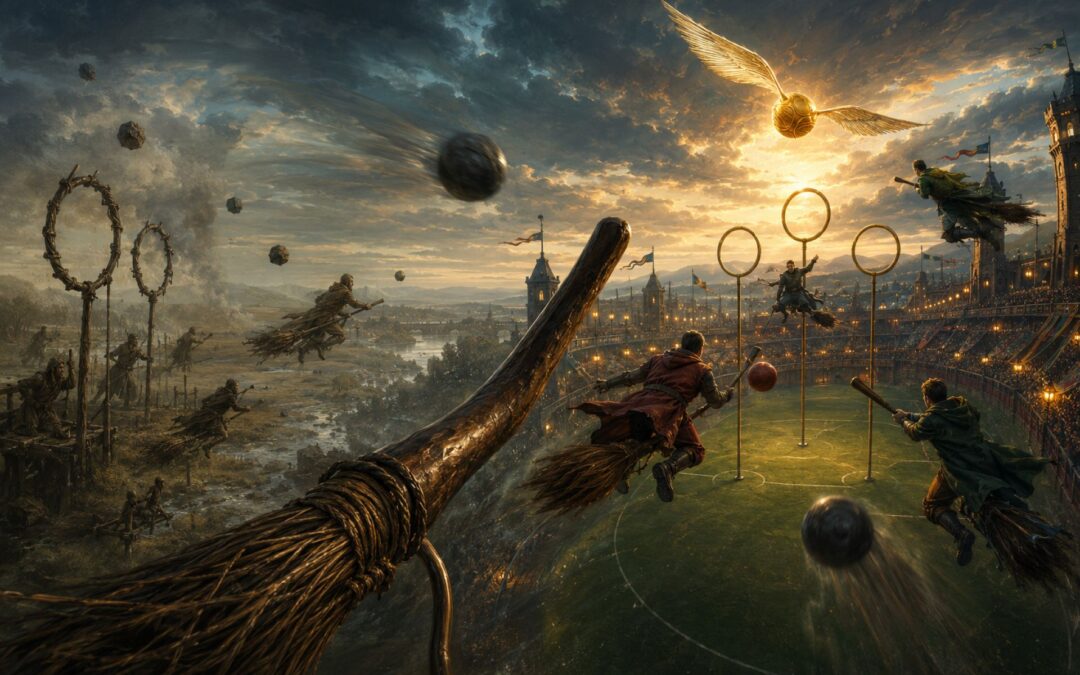
Quidditch Through the Ages occupies an unusual place in J.K. Rowling’s Wizarding World. It is not a Harry Potter novel, nor does it tell a conventional story with a protagonist moving through a sequence of conflicts. Instead, Rowling takes one of the fictional textbooks mentioned in the Harry Potter series and publishes it as though a battered copy has escaped from the Hogwarts library. The title page attributes the work to the fictional Quidditch historian Kennilworthy Whisp, while the physical and textual apparatus treats readers as Muggles who have somehow been permitted to consult a genuine wizarding book.
The conceit is tied to a real publishing history. Rowling’s official page for Quidditch Through the Ages explains that it was published in 2001 alongside Fantastic Beasts and Where to Find Them in aid of Comic Relief. The edition considered here is the original American form of the book, rather than one of the later redesigns. A later Bloomsbury edition preserves Rowling’s original text while presenting it with new visual treatment, while the 2018 audiobook edition adds separate World Cup bonus material that does not belong to the original ten-chapter book.
What makes Quidditch Through the Ages more interesting than a catalogue of fictional sporting trivia is the way Rowling constructs a history around the game. Quidditch does not arrive fully formed. Broom technology improves, primitive games emerge, rules accumulate, animals are exploited and then protected, ministries regulate play, professional clubs build traditions, manufacturers compete to make faster racing brooms, and players develop increasingly sophisticated tactics. The result is a fictional sport that feels embedded within a functioning society rather than invented only for the convenience of a school story.
This article covers the complete contents of the book, including the origin of the Golden Snitch, the development of modern Quidditch, its rules, fouls, teams, international spread, racing brooms and tactics. It then examines how Rowling makes this imaginary history convincing, what the sport reveals about wizarding society, whether Quidditch actually works as a competitive game, and how successfully the book stands on its own as a piece of world-building.

From Flying Broomsticks to Queerditch Marsh
Before Quidditch can exist, witches and wizards need to become competent enough on broomsticks to use them for something more than transportation. The opening chapters therefore move further back than the sport itself, tracing the technological and recreational conditions from which organized broom games could eventually emerge.
The Evolution of the Flying Broomstick
Whisp begins with a basic constraint of wizarding life: witches and wizards cannot simply fly through the air unaided. Magical transportation therefore requires some kind of object, and the broomstick becomes an especially practical solution. A broom is cheap, portable and easy to hide in plain sight because Muggles already regard it as an ordinary household tool. That makes it useful not only as transportation but also as a technology compatible with the wizarding community’s need for secrecy.
Early broomsticks are far from the smooth racing machines familiar from later Quidditch. Whisp cites evidence of broom flight from medieval Europe and portrays the earliest devices as uncomfortable, slow and difficult to control. Guthrie Lochrin’s complaint after a long broom journey in 1107 emphasizes the physical misery of riding such primitive equipment. These early brooms solve the problem of magical flight, but they do not yet make flying enjoyable.
Manufacturing is initially local and inconsistent. Wizarding families make their own brooms, which means that two apparently similar models can behave very differently. Speed, balance, manoeuvrability and comfort depend on the ability of whoever constructed the broom. Over time, specialists begin producing superior designs and exchanging their craftsmanship for other goods and services, creating the beginnings of a dedicated broom-making trade.
That improvement changes the social meaning of flight. Once a broom is no longer merely an unpleasant but useful means of getting from one place to another, flying can become recreation. Witches and wizards begin experimenting with races, contests and dangerous aerial games. Quidditch grows from that shift: before there can be a professional sport, there must first be a technology pleasurable and controllable enough to play with.
Ancient Broom Games
Quidditch is not portrayed as the first organized broom sport. Whisp surveys a collection of older games from different parts of Europe, each of which demonstrates how broadly witches and wizards experimented with competitive flight before anything resembling modern Quidditch emerged.
One of the oldest traditions is the Swedish annual broom race, a brutal long-distance event covering more than three hundred miles between Kopparberg and Arjeplog. The course passes through difficult terrain and even a dragon reservation, emphasizing endurance rather than tactical ball play. Unlike several other ancient games, the race survives into the modern wizarding world, suggesting that some sporting traditions remain viable without evolving into Quidditch.
Other games are more obviously dangerous. Stitchstock, associated with Germany, uses an inflated dragon bladder mounted on a pole. One player protects the bladder while opponents attempt to puncture it with sharpened broom ends. The sport eventually dies out, but the idea of attacking and defending a fixed target resembles one small element of later goal-based games.
The Irish game Aingingein is more elaborate. A player carries a ball known as the Dom, actually a goat’s gallbladder, through a sequence of flaming barrels suspended in the air. Success depends on speed, precision and the ability to avoid being burned. It has little direct resemblance to Quidditch’s scoring system, but it demonstrates how early broom sports turned aerial control itself into a competitive skill.
The Scottish Creaothceann is even more dangerous. Players strap cauldrons to their heads and attempt to catch enchanted rocks and boulders falling from above. The game becomes infamous for injuries and deaths and is eventually outlawed in 1762. Its combination of flying stones and airborne players later becomes relevant when Whisp considers the possible origins of Bludger-like objects.
Shuntbumps, associated with Devon, resembles aerial jousting. The object is simply to collide with opponents until they fall from their brooms, leaving one survivor in the air. Swivenhodge, from Herefordshire, is considerably less lethal: players knock an inflated pig’s bladder backward and forward across a hedge using the twigs of their brooms. It survives mostly as a children’s game.
These sports matter because Rowling resists giving Quidditch a single moment of invention. The wizarding world already possesses races, target games, violent collisions, airborne hazards and ball contests. Modern Quidditch eventually combines several of these impulses, but Whisp does not claim that every earlier sport is a direct ancestor. The wider point is evolutionary: once broom technology improves, people repeatedly discover different ways of turning flight into competition.
The Game From Queerditch Marsh
The first recognizable form of Quidditch appears not in an official rulebook but in the irritated diary of Gertie Keddle, an eleventh-century witch who lives beside a marsh. Keddle is not interested in preserving sporting history. She finds the players noisy, disruptive and ridiculous, which makes her accidental testimony more convincing within the book’s fictional scholarly framework.
Keddle records a group of broom riders playing with a large leather ball. They throw it to one another and attempt to send it into trees positioned at opposite ends of the marsh. The basic structure already resembles the future Quaffle game: teams carry or pass a ball toward targets placed at opposing ends of a defined playing area.
Her account also describes large rocks enchanted to fly around the field and knock players from their brooms. These are unmistakable precursors to Bludgers. Keddle mentions a large Scottish wizard among the participants, leading Whisp to wonder whether someone familiar with the rock-catching game Creaothceann may have influenced this development. He presents that connection as speculation rather than established fact, an important example of the mock historian occasionally acknowledging the limits of his evidence.
A later letter from Goodwin Kneen, written roughly a century after Keddle’s diary, shows that the game has developed considerably. Kneen describes a version of “Kwidditch” with more specialized players and recognizable roles. Players now pursue the scoring ball, defend goals and strike hostile projectiles away from teammates. Barrels are being used as targets, while the game has spread geographically from its obscure marshland origins into Yorkshire.
Several core components of Quidditch are therefore present by this stage. There is a main scoring ball, opposing goals, dangerous projectiles, team specialization and organized competition. What remains absent is the feature that will later dominate the sport’s identity: the Golden Snitch.
How the Golden Snitch and Secrecy Remade Quidditch
The early marsh game becomes recognizably modern Quidditch through two very different historical pressures. One adds the sport’s most famous object, while the other forces wizarding authorities to regulate when and where Quidditch can be played. Together, the Golden Snitch and the problem of Muggle secrecy transform an improvised broom game into a highly organized institution.
The Arrival of the Golden Snitch
Before there is a Golden Snitch, wizarding society has the Golden Snidget, a small magical bird prized for extraordinary speed and manoeuvrability. Catching one is difficult enough to become a fashionable aristocratic sport. Hunters pursue the bird in the air, and successful captures bring prestige, but the Snidget is usually killed in the process.
The history of the Snidget becomes entangled with Quidditch in 1269. Barberus Bragge, then Chief of the Wizards’ Council, attends a match and releases a Snidget onto the pitch. He offers 150 Galleons to whichever player catches it. The effect is immediate: ordinary Quidditch largely stops as everyone abandons the existing game to chase the bird.
The episode establishes the future relationship between the Snitch and the rest of Quidditch. The value attached to catching the Snidget overwhelms normal scoring, and the hunt becomes a separate contest taking place inside the larger match. What begins as Bragge’s spectacle is eventually formalized, with one player assigned specifically to pursue the bird. This specialist is first known as the Hunter and later becomes the Seeker.
The game also preserves Bragge’s original reward symbolically. Catching the Snidget becomes worth 150 points, and the capture ends the match. Those two rules survive when the living animal is eventually replaced, which explains why the modern Snitch is simultaneously a scoring object and the mechanism that concludes play.
Not everyone accepts the cruelty involved. During Bragge’s famous match, a spectator named Modesty Rabnott intervenes to save the Snidget. She succeeds in rescuing the bird and is fined for interrupting the game. Rabnott’s protest does not immediately end the practice, but her role becomes important in the book’s broader account of how wizarding institutions slowly respond to abuse.
The problem grows as Snidget hunting becomes increasingly popular. Quidditch creates massive demand for the tiny birds, and their numbers decline. Eventually Elfrida Clagg, a later leader of the Wizards’ Council, protects the species. The Golden Snidget becomes legally protected, and a reserve associated with Rabnott’s name is established to preserve it.
Quidditch now faces a structural problem. By this point, the Snidget hunt has become integral to the sport. Removing it entirely would fundamentally change Quidditch, but continuing to use live birds is no longer acceptable.
Bowman Wright, a metal-charmer from Godric’s Hollow, provides the technological solution. He designs a small enchanted golden ball that reproduces the Snidget’s essential sporting characteristics: tiny size, extreme speed and unpredictable changes of direction. The artificial object is also enchanted to remain within the boundaries of the pitch.
The Golden Snitch therefore enters Quidditch as an act of substitution rather than pure invention. Rowling gives one of the strangest elements of the game a layered history involving aristocratic cruelty, conservation law, technological innovation and institutional compromise. By the time the Snitch replaces the Snidget, all of the essential elements of modern Quidditch are finally present.
Anti-Muggle Precautions
The next major change is driven not by sporting preference but by political necessity. Quidditch is spectacular, noisy and conspicuous. Players fly at speed through the air, balls move independently, and large groups of spectators may gather to watch. For a society trying to keep magic hidden from Muggles, the sport is an obvious security problem.
Whisp cites Zacharias Mumps’s 1398 description of safe Quidditch practice. Mumps recommends remote moorland, substantial distance from Muggle settlements and Muggle-Repelling Charms. Night matches are preferable because darkness reduces the chance of discovery. The advice makes clear that secrecy problems predate the modern Ministry system.
Wizarding authorities repeatedly tighten restrictions on where matches can be played. The persistence of these regulations suggests that players often ignore them. Whisp turns this into a joke by suggesting that the enduring Muggle image of witches flying on broomsticks may owe something to centuries of careless wizarding sportsmen exposing themselves in the sky.
The International Statute of Wizarding Secrecy of 1692 raises the stakes. Once concealment becomes a central responsibility of organized wizarding government, national authorities can no longer treat reckless sport as merely a local nuisance. In Britain, regulation eventually falls within the responsibilities of the Department of Magical Games and Sports.
Professional Quidditch accordingly shifts toward formally maintained pitches hidden from Muggle observation. Instead of every village or group playing wherever it chooses, the sport becomes geographically constrained by secrecy. That pressure contributes to the limited professional league structure later described by Whisp.
The Banchory Bangers provide an example of what happens when a team treats those restrictions with contempt. After a match in 1814, their celebrations become so reckless that officials intervene. Among other offences, the team behaves irresponsibly with a Bludger and attempts to acquire a Hebridean Black dragon as a mascot. Their conduct leads to permanent disbandment.
This chapter is one of the clearest demonstrations that Quidditch cannot be separated from the rest of wizarding society. A sporting regulation is simultaneously a secrecy regulation, and the Ministry’s involvement in athletics grows from the same political structure that governs magical concealment more broadly.
How Modern Quidditch Works
Having traced the game from crude broom contests through the Snidget era and the rise of official regulation, Whisp pauses the historical narrative to explain the standardized modern sport. Chapter Six is the practical center of the book because it defines the pitch, equipment, player roles, rules, fouls and officials that turn centuries of improvisation into a recognizable competitive system.
The Pitch and the Four Balls
The modern Quidditch pitch develops from earlier playing grounds rather than being designed according to a single plan. Zacharias Mumps describes an oval field approximately five hundred feet long and one hundred and eighty feet wide, with a small central circle. Fourteen players gather around the center before the balls are released and the match begins.
Early scoring targets are baskets mounted high above the ground. Their dimensions vary enough to create competitive disputes, especially because different basket sizes can give teams inconsistent scoring opportunities. By the nineteenth century, arguments over standardization become unavoidable.
In 1883, traditional baskets are replaced by the familiar circular hoops. Rowling treats the change like a real sporting controversy, even imagining supporters who resent the loss of old customs. The joke works because every established sport has experienced similar arguments over equipment, dimensions and rules. Something that appears inevitable to modern players was once an unpopular reform.
The main scoring ball is the Quaffle. Its early ancestor is simply a leather ball, but modern versions are standardized at roughly twelve inches across and colored scarlet so that players can see them clearly against the ground and sky. A Gripping Charm helps Chasers handle the ball with one hand while controlling their brooms, while later enchantments cause the Quaffle to fall more slowly when dropped.
Two Bludgers introduce a radically different kind of problem. They do not function as scoring objects. Instead, they are bewitched to pursue players and knock them from their brooms, forcing teams to defend themselves while also attacking. Early Quidditch uses enchanted rocks, but these prove unpredictable and dangerous in ways that become difficult to standardize. Lead is later tried, yet it dents under repeated blows from Beaters’ bats and can begin flying irregularly.
Modern Bludgers are therefore made of iron. They remain dangerous by design, but their material allows more consistent movement after being struck. Their existence ensures that Quidditch is never simply an aerial version of a conventional goal-scoring game. Every offensive or defensive action happens under the threat of a separate projectile deliberately trying to disrupt the players.
The fourth ball is the Golden Snitch. Its small size and unpredictable flight imitate the Snidget it replaced. Unlike a real bird, however, it can be magically confined to the playing area. The Snitch is simultaneously the smallest object on the pitch and the object with the greatest power over the outcome, because catching it earns 150 points and ends the game.
The Seven Players and Their Roles
Each Quidditch team fields seven players. The positions have developed over time, but modern teams consist of one Keeper, two Beaters, three Chasers and one Seeker. The structure divides responsibility among goal defence, offensive scoring, control of Bludgers and pursuit of the Snitch.
The Keeper protects the three goal hoops. Earlier versions of the role are more restricted, with the player expected to remain near the scoring area. As the sport evolves, Keepers gain greater freedom to leave the hoops and participate more actively in the flow of the match, although their defensive responsibility remains primary.
Two Beaters defend their teammates from Bludgers. They carry bats and attempt to redirect the iron balls away from friendly players and toward opponents. Their job requires strength, awareness and coordination because both Bludgers are moving independently while the rest of the game continues around them.
Three Chasers handle the Quaffle and provide the ordinary scoring mechanism of Quidditch. They pass among themselves, advance toward the opposing end of the field and attempt to send the Quaffle through one of the three hoops. Their role is the clearest surviving link to the earliest Queerditch game described by Gertie Keddle, where players already passed a leather ball and attempted to score at opposite ends of the marsh.
Rules eventually develop to prevent Chasers from overwhelming a Keeper through crowding. These restrictions show how player specialization creates further regulation: once an offensive tactic becomes too dominant or unfair, the sport responds by defining where players may position themselves.
The Seeker has the narrowest job and the greatest potential influence on the final score. The Seeker searches for the Golden Snitch while trying to prevent the opposing Seeker from catching it first. Seekers are often smaller and lighter than other players because acceleration and manoeuvrability matter more than strength.
Their importance also makes them obvious targets. Opposing Beaters have strong incentives to disrupt a Seeker, because eliminating or delaying that player can determine whether the Snitch is caught. The glamour attached to the position therefore comes with unusual danger, a combination that becomes important when considering whether Quidditch is balanced as a sport or designed primarily for narrative excitement.
Rules, Fouls and Referees
Modern Quidditch is governed by seven major rules. Players may fly at any height, but they must remain within the boundaries of the pitch; crossing the boundary causes possession of the Quaffle to pass to the opposing team. A captain may request a time-out, and players are allowed to touch the ground during these pauses.
The referee can award penalties when rules are broken. Players may take the Quaffle from an opponent, but they are not permitted simply to seize another player’s body. Injury does not allow a substitute to enter, which means teams must continue with fewer players if someone becomes unable to participate.
Players may carry their wands during a match, but they cannot use them against opponents, brooms, officials, spectators or any of the balls. This restriction is essential because otherwise Quidditch would quickly stop being a broom sport and become an unrestricted magical duel.
The final rule gives Quidditch its extraordinary duration. A match ends when the Golden Snitch is caught or when both captains agree to stop. Because the Snitch may evade capture for an extended period, games can last far longer than ordinary sports with fixed clocks.
Whisp claims that the Department of Magical Games and Sports recognizes roughly seven hundred possible fouls and that every one of them occurred during the notoriously violent first Quidditch World Cup of 1473. Rather than reproduce the entire imaginary catalogue, he identifies ten common violations.
Blagging means grabbing the tail of another player’s broom to slow or stop them. Blatching is a deliberate midair collision, while blurting involves locking broom handles in order to force an opponent off course. Cobbing is excessive use of the elbows against another player.
Several fouls involve misuse of the equipment itself. Bumphing occurs when a Beater deliberately sends a Bludger toward spectators rather than another player. Quaffle-pocking is illegal magical tampering with the Quaffle. Snitchnip occurs when anyone other than a Seeker touches or catches the Golden Snitch.
Other fouls regulate scoring and defensive positioning. Haversacking means pushing or carrying the Quaffle through a hoop instead of throwing it. Flacking occurs when a Keeper physically puts part of the body through a hoop to knock away a shot. Stooging occurs when multiple Chasers crowd the scoring area in a manner prohibited by the rules.
These fouls reveal an important feature of Rowling’s design. Quidditch is violent, but it is not supposed to be lawless. The rules accept a remarkable amount of physical risk while drawing lines between ordinary competitive aggression and behavior that would make the sport impossible to control.
Refereeing such a game is consequently difficult. One official must track fourteen players, four independently moving balls, goals, boundaries, fouls and possible magical interference. The referee must also do so while flying.
The danger is not theoretical. Whisp recounts the death of referee Cyprian Youdle during a supposedly friendly match in 1357. Youdle is killed by a curse, and the person responsible is never conclusively identified. Other officials have suffered broom tampering and related attempts at interference.
Modern referees therefore require extensive training and operate under tighter security. The absurdity of the profession is part of the humor, but it also strengthens the central world-building effect: if Quidditch were genuinely played for centuries, refereeing practices, regulations and occupational hazards would inevitably develop alongside it.
The Teams, Global Spread and Racing Brooms
Once the rules are established, Whisp widens the frame again. Quidditch becomes a professional culture with clubs, supporters, international rivalries and specialized equipment manufacturers. These chapters are less about the mechanics of a single match and more about what happens when a game becomes an institution shared by millions of people.
The British and Irish League Teams
Professional Quidditch in Britain and Ireland is constrained by secrecy requirements, which prevents an unlimited number of clubs from maintaining visible home grounds. Whisp identifies thirteen principal League teams, each with its own traditions, achievements and legends.
The Appleby Arrows, founded in 1612, are remembered partly for an old victory celebration in which supporters fired arrows into the air. The tradition ends when one of those arrows strikes a referee. The anecdote neatly summarizes the tone of Whisp’s sporting history: club folklore, official regulation and potentially fatal stupidity are treated with equal seriousness.
The Ballycastle Bats are a successful Northern Irish side associated with a bat mascot called Barny the Fruitbat. Their sporting identity spills into commercial culture through Butterbeer advertising, showing that professional Quidditch produces the same mixture of mascots, sponsorship and brand recognition found around real sports.
The Caerphilly Catapults are one of the prominent Welsh teams, with a strong domestic and European record. Their history contributes to the sense that club competition exists on several levels rather than inside a single isolated league.
The Chudley Cannons are among the book’s most comic clubs. Once successful, they have fallen into prolonged mediocrity by Whisp’s time. Their supporters remain stubbornly loyal, allowing Rowling to parody the psychology of fans who treat devotion as a moral obligation even when results give them little reason for optimism.
The Falmouth Falcons cultivate a far more aggressive identity. Their reputation emphasizes physical intimidation and an almost celebratory attitude toward rough play. They demonstrate how teams can acquire recognizable cultural personalities independent of their actual win-loss records.
The Holyhead Harpies are particularly notable as an all-witch team with a long history. Their famous match against the Heidelberg Harriers becomes one of the more extravagant sporting legends in Whisp’s account, emphasizing both the Harpies’ endurance and the tendency of Quidditch history to turn extreme events into cherished mythology.
The Kenmare Kestrels represent Irish Quidditch tradition. Their history includes players associated with tactical innovation, including Darren O’Hare. Such references help Chapter Seven connect club lore with the later tactical vocabulary of modern Quidditch rather than presenting the teams merely as decorative names.
The Montrose Magpies are the most successful club in the British and Irish League according to Whisp’s account. Their numerous championships and famous players position them as a genuine sporting dynasty, providing the league with the kind of historically dominant institution against which other clubs can measure themselves.
The Pride of Portree comes from the Isle of Skye and contributes a strong Scottish identity to the league. Its history is intertwined with prominent players from the McCormack family, reinforcing the idea that professional Quidditch develops multi-generational traditions.
Puddlemere United, founded in 1163, is presented as the oldest League club. Its long record of domestic and European success makes it one of the central institutions in British Quidditch history. The club’s antiquity also helps Rowling bridge the medieval development of the sport with its supposedly modern professional structure.
The Tutshill Tornados are associated with a period of extraordinary dominance and with Seeker Roderick Plumpton. Plumpton’s exceptionally rapid capture of the Snitch becomes legendary and later gives his name to one of the tactical moves described in Chapter Ten.
The Wigtown Wanderers originate with Walter Parkin and his seven children. The family connection becomes part of the club’s identity, another example of how Whisp treats sporting organizations as inherited social traditions rather than interchangeable teams.
Finally, the Wimbourne Wasps are a successful club whose name is linked to an old incident involving a wasps’ nest. Like the Arrows and Bats, their identity combines actual competitive history with odd stories repeated by generations of supporters.
Taken together, these thirteen clubs do more than fill a league table. They give Quidditch the accumulated texture of sport: old dynasties, hopeless fan bases, violent reputations, family traditions, mascots, legends, records and historical grudges. Rowling understands that a believable sport needs memories as much as it needs rules.
The Spread of Quidditch Worldwide
Whisp next traces Quidditch beyond Britain and Ireland, beginning with continental Europe. The game spreads across the region during the medieval period, and the 1473 World Cup is nominally international even though its competitors are all European. Over time, both national and club competitions become more genuinely global.
European teams mentioned by Whisp include the Vratsa Vultures of Bulgaria, the Quiberon Quafflepunchers of France, the Heidelberg Harriers of Germany, the Bigonville Bombers of Luxembourg, the Braga Broomfleet of Portugal and the Grodzisk Goblins of Poland. Their inclusion gives different wizarding countries their own sporting reputations, famous players and traditions.
Australia and New Zealand encounter Quidditch later, largely through European magical migration. The geography of the region proves useful because large sparsely populated areas provide space for concealed pitches. Prominent teams include the Moutohora Macaws of New Zealand and the Australian Thundelarra Thunderers and Woollongong Warriors, whose rivalry becomes particularly intense.
Africa receives Quidditch through contact with European broom-flying traditions, although Whisp makes clear that African magical communities already possess sophisticated magical knowledge of their own, especially in fields such as astronomy and alchemy. Uganda becomes one of the major African centers of the sport.
Teams such as the Patonga Proudsticks of Uganda, Tchamba Charmers of Togo, Gimbi Giant-Slayers of Ethiopia and Sumbawanga Sunrays of Tanzania develop strong international reputations. African Quidditch is particularly associated with complex aerial formations and technical skill.
North America provides the most important example of Quidditch competing with an alternative sport. European magical settlers bring Quidditch across the Atlantic, but its early growth is slowed by strong concerns about persecution and exposure. Canadian clubs eventually become prominent, including the Moose Jaw Meteorites, Haileybury Hammers and Stonewall Stormers.
In the United States, however, Quidditch has to share attention with Quodpot. According to Whisp, Quodpot begins when Abraham Peasegood transports a Quaffle that has been magically altered in such a way that it explodes. The accident inspires an entirely new sport built around an explosive ball, and Quodpot becomes deeply established in American wizarding culture.
Quidditch still develops important American clubs, including the Sweetwater All-Stars and Fitchburg Finches, but it never enjoys the same uncontested cultural position it holds in Britain. This is a particularly effective piece of world-building because it allows sporting culture to diverge regionally rather than assuming that one British game must dominate everywhere.
South America supports both Quidditch and Quodpot. Argentina and Brazil have achieved notable World Cup performances, while Peru is presented as an emerging power. The Tarapoto Tree-Skimmers become an internationally recognized Peruvian club, and Whisp connects some of the region’s magical sporting history with broader contact between European wizarding authorities and South American magical environments.
Across much of Asia, Quidditch remains less dominant because broomsticks do not hold the same place in everyday magical transport. Flying carpets continue to be culturally important in several areas, reducing the social centrality of broom flight from which Quidditch historically developed.
Japan forms the major exception. The Toyohashi Tengu become a respected international Quidditch team, although Whisp criticizes their tradition of destroying their brooms after defeat. Their inclusion allows the chapter to end with another mixture of admiration, sporting eccentricity and cultural caricature.
The international chapter greatly enlarges the apparent scale of the Wizarding World, but it also exposes one of the book’s limitations. Whisp can give Britain thirteen clubs with specific histories while whole continents receive only a handful of names and characteristics. That imbalance becomes more significant when examining the book’s cultural perspective later.
The Development of the Racing Broom
The professionalization of Quidditch is inseparable from improvements in broom manufacturing. Early players use ordinary everyday brooms, but competitive sport gradually creates demand for equipment specifically designed for speed, braking and manoeuvrability.
The Cushioning Charm, invented by Elliot Smethwyck in 1820, dramatically improves rider comfort. Even then, nineteenth-century broomsticks are mostly handcrafted, meaning performance varies from one maker to another.
The Oakshaft 79, produced in 1879 by Elias Grimstone, represents one important step toward specialized design. Built from oak, it is durable and performs well in strong winds, making it suitable for long-distance travel. Its weight and handling, however, make it less effective for the rapid turns demanded by elite Quidditch.
Gladys Boothby’s Moontrimmer, introduced in 1901, emphasizes speed and control at high altitude. Demand quickly exceeds what Boothby can produce by hand. The same limitation affects the Silver Arrow, another celebrated early racing broom whose quality cannot overcome the manufacturing constraints of artisanal production.
The decisive shift occurs in 1926 when Bob, Bill and Barnaby Ollerton establish the Cleansweep Broom Company. Their Cleansweep One is built specifically for sport and manufactured on a scale capable of supplying large numbers of competitive players. Racing-broom design now becomes an industry.
Competition follows almost immediately. Randolph Keitch and Basil Horton establish the Comet Trading Company and release the Comet 140 in 1929. Their patented braking technology provides a clear performance advantage and forces rival manufacturers to continue innovating.
Subsequent decades produce new models such as the Cleansweep Two and Comet 180, followed by the Tinderblast, Swiftstick and Shooting Star. Not every broom is successful. Some climb poorly, some deteriorate with use, and some manufacturers fail to match the quality promised by their marketing.
The Nimbus 1000, introduced in 1967, changes the market again. It combines exceptional speed with manoeuvrability and reliability, establishing Nimbus as the dominant high-performance brand among professional players. Later Nimbus models build on that reputation.
The Twigger 90, released in 1990, attempts to challenge Nimbus by loading the broom with fashionable features and gimmicks. Whisp treats it dismissively, implying that technological competition can produce overengineered products as easily as genuine improvement.
Chapter Nine therefore does more than explain why modern Quidditch brooms are fast. It imagines an entire sporting-industrial economy. Craft production gives way to mass manufacturing, patents matter, rival firms compete, brand reputations rise and fall, and professional athletes increasingly depend on specialized commercial technology.
Quidditch Today: Tactics and the Book’s Final Word
By the final chapter, the sport has moved far beyond the noisy game Gertie Keddle watched on Queerditch Marsh. Modern players do not merely understand fixed positions and standardized rules; centuries of competition have produced named tactical manoeuvres, specialized techniques and strategic deception. Whisp concludes his history by showing how mature sports generate a technical language of their own.
The Bludger Backbeat is a Beater’s technique in which the Bludger is struck backward rather than in the player’s apparent direction of travel. The unusual angle can surprise opponents because they expect the ball to be sent forward. Dopplebeater Defence uses both Beaters at once, striking a single Bludger simultaneously to give it far greater force.
The Double Eight Loop belongs to the Keeper. During a penalty attempt, the Keeper moves rapidly around the three goal hoops in a looping pattern designed to cover as much scoring space as possible.
The Hawkshead Attacking Formation is a Chaser manoeuvre in which all three Chasers fly together in an arrowhead shape. The formation allows the team to advance aggressively while presenting opponents with a concentrated attacking front.
Parkin’s Pincer also uses three Chasers, but as a trap rather than a straightforward formation. Two Chasers close from the sides while the third approaches an opposing player head-on, reducing escape routes. The move is associated with the Parkin family and the Wigtown Wanderers.
The Plumpton Pass is one of the more disputed techniques. It involves a Seeker appearing to direct the Snitch into the sleeve during a rapid manoeuvre. Roderick Plumpton claimed that his famous 1921 capture occurred intentionally in this way, although Whisp leaves room for doubt about whether it was genuine technique or fortunate accident.
The Porskoff Ploy is an offensive deception. A Chaser carrying the Quaffle climbs sharply, encouraging opponents to follow upward, then drops the Quaffle to a teammate positioned below. The move uses altitude itself as part of passing strategy.
A Reverse Pass is simpler but risky: the Chaser throws the Quaffle backward over one shoulder to a teammate without turning fully around. The Sloth Grip Roll is defensive, allowing a player to hang upside down beneath the broom in order to avoid an approaching Bludger.
The Starfish and Stick is a Keeper technique in which the player hangs almost horizontally from the broom with arms and legs extended. The objective is to make the body cover the largest possible area in front of the three hoops.
The Transylvanian Tackle is psychological. A player swings a fist toward an opponent’s nose but avoids actual contact. Because no blow lands, the manoeuvre can remain legal while still provoking hesitation or panic.
The Woollongong Shimmy is a rapid zigzag movement designed to shake off pursuing Chasers. The Wronski Feint, one of the best-known Seeker tactics, uses the opposing Seeker’s attention against them. One Seeker dives steeply toward the ground as though pursuing the Snitch, encourages the rival to follow, then pulls out at the last possible moment while the deceived opponent risks crashing.
These manoeuvres complete the transformation of Quidditch from rough improvisation into professional technique. The game has acquired not only rules but an accumulated tactical memory in which successful players, clubs and regions lend their names to specific innovations.
Whisp ends by returning to Gertie Keddle. The chaotic game she once regarded as an irritating disturbance has become almost unrecognizable: standardized hoops have replaced improvised targets, metal Bludgers have replaced rocks, the Golden Snitch has replaced a living bird, professional clubs operate under ministry regulation, and athletes ride specialized racing brooms.
Yet Whisp does not treat modern Quidditch as a finished form. The book’s final implication is that constant change is precisely what has kept the sport alive. The rules readers encounter are merely the current stage of a process that began long before Keddle’s diary and will presumably continue long after Whisp’s history ends.
How Rowling Makes a Fictional Sport Feel Historically Real
The most impressive achievement of Quidditch Through the Ages is not the invention of four balls or seven playing positions. Rowling’s deeper accomplishment is creating the impression that Quidditch possesses a history independent of the Harry Potter novels. The sport feels older than Harry because the book continually presents present-day customs as the results of forgotten accidents, controversies and reforms.
Archives, Artefacts and Mock Scholarship
Kennilworthy Whisp rarely presents information as though an omniscient creator is explaining the world directly. Instead, he behaves like a historian working with incomplete evidence. He cites diaries, letters, paintings, council decrees, sporting records, old rule descriptions and surviving artefacts. That technique changes the reader’s relationship with the fictional material.
Gertie Keddle’s diary is a particularly effective example. Rowling could simply have stated that Quidditch began on Queerditch Marsh, but Keddle’s irritation allows the history to appear indirectly. She records details because the players annoy her, not because she understands their significance. The modern historian must interpret evidence whose original author had entirely different concerns.
Goodwin Kneen’s letter performs another function. It demonstrates change over time by providing a later snapshot rather than a retrospective explanation. Readers can compare his organized “Kwidditch” with Keddle’s crude game and infer how much specialization has occurred.
Whisp occasionally distinguishes evidence from conjecture. His suggestion that Creaothceann may have influenced the early use of flying rocks is not presented as certain. This small gesture toward scholarly restraint makes the rest of the pseudo-history feel more persuasive because the narrator is not pretending every causal link is provable.
The fictional bibliography around Whisp strengthens the illusion further. He is not simply “the man who wrote this book”; he supposedly belongs to an existing world of sports writing, team histories, biographies and specialist tactical studies. Readers see only fragments of that imagined literature, but the implication is that far more knowledge exists beyond the volume in their hands.
The same applies to statistics and records. Club championships, famous Snitch captures, World Cups and manufacturing dates are often mentioned without exhaustive explanation. Their incompleteness makes them feel less like information invented for the reader and more like references to history that wizarding readers would already recognize.
Rowling also uses mock documents and media fragments to vary the presentation. Debates over baskets and hoops, official bans, fan reactions and club mythology imitate the documentary clutter surrounding real sports. A believable institution rarely has a perfectly orderly history, and Quidditch gains credibility precisely because its past contains pettiness, accidents, bureaucracy and unresolved arguments.
Codification, Institutions and Technological Change
A second source of realism is the fact that rules rarely appear for purely abstract reasons. They arise because earlier practices create problems. Live Snidgets become ecologically unsustainable, so a magical substitute is invented. Inconsistent baskets cause disputes, so standardized hoops replace them. Dangerous or unpredictable ball materials are abandoned for better ones. Muggle exposure leads to restrictions on playing grounds.
This is how institutions actually develop: one rule solves a previous problem and creates the conditions for later behavior. Rowling repeatedly builds Quidditch through this sequence of improvisation, consequence and regulation.
The rise of the Ministry’s Department of Magical Games and Sports is especially important. Once Quidditch becomes large enough to threaten secrecy and involve professional teams, informal custom is no longer sufficient. The sport needs schedules, protected pitches, referees, disciplinary mechanisms and recognized rules.
Technology changes alongside law. Early broomsticks are poor enough that elaborate aerial sport would be difficult. Better manufacturing makes increasingly sophisticated games possible. Once Quidditch becomes professional, the sport itself begins driving technological innovation as companies compete to produce specialized racing brooms.
The relationship is circular. Improved brooms create better athletes and more demanding tactics, while increasingly demanding sport creates a market for better brooms. The Cleansweep, Comet and Nimbus rivalries therefore perform the same world-building function as the Ministry regulations: they show how Quidditch has become important enough to reshape the surrounding economy.
By the time Chapter Ten introduces named manoeuvres, the sport has accumulated centuries of institutional memory. A tactic can be named after a player because professional Quidditch already possesses records, heroes and traditions. That layered causality is why Rowling’s fictional game feels historically developed rather than mechanically assembled.
What Quidditch Reveals About Wizarding Society
A sport can reveal a society because it brings rules, technology, identity, commerce, violence and government into one place. Quidditch Through the Ages consequently expands much more than Quidditch lore. It offers a sideways view of how the wider magical world organizes itself.
Secrecy, Bureaucracy and Muggle Relations
Quidditch repeatedly clashes with the need to remain hidden. The game is inherently public and spectacular, while wizarding political survival depends on concealment. Much of its institutional history can therefore be understood as a compromise between communal entertainment and secrecy.
Early warnings about remote moorland and night games show that secrecy begins as informal prudence. Later restrictions transform it into law. The International Statute of Wizarding Secrecy makes exposure a governmental problem, while the Department of Magical Games and Sports converts that political obligation into concrete sporting regulation.
The result is an unusually bureaucratic picture of wizarding life. Ministries do not merely chase Dark wizards or regulate dramatic magical threats. They also decide where sports can be played, punish reckless teams, supervise referees and manage the mundane consequences of a hidden society.
Muggles remain mostly absent as people, but constantly present as a regulatory concern. Their possible observation shapes stadium location, travel and acceptable behavior. Even in a book devoted to sport, separation from the non-magical world remains one of the foundational conditions of wizarding society.
Gender, Violence, Fandom and National Identity
Quidditch is relatively unusual within the Wizarding World because men and women compete within the same sporting system. The Holyhead Harpies are explicitly an all-witch professional team rather than a novelty exhibition, and women appear throughout the sport’s history as players, innovators and officials.
The book does not offer a sustained theory of gender, but its casual inclusion of women in violent elite competition contributes to the normalization of mixed-gender magical sport. Physical strength matters for Beaters, while speed, balance and skill matter elsewhere, allowing Rowling to imagine athletic specialization without building separate male and female leagues into the system.
Violence is much more central. Bludgers exist specifically to hit players. Fouls include dangerous midair collisions, and injuries do not permit substitutions. Referees can themselves be cursed or sabotaged. The sport’s normal level of danger would be extraordinary by real-world standards.
Yet Whisp treats that violence with comic detachment because wizarding medicine and magical resilience alter the implied threshold of acceptable risk. Quidditch therefore reflects a broader feature of Rowling’s world, where broken bones, magical accidents and bodily transformations can be frightening but also routinely reversible.
Club fandom reveals another social dimension. Chudley supporters remain loyal through failure, clubs preserve old celebrations and legends, families attach themselves to teams, and rivalries become part of regional identity. Quidditch allows witches and wizards to belong to communities that are neither familial nor governmental.
National identity emerges even more strongly in international competition. Countries possess characteristic clubs, famous players and styles of play. The World Cup converts magical nationalism into regulated spectacle rather than political conflict, giving the Wizarding World an arena in which collective identity can be expressed competitively.
Globalisation and the Limits of Whisp’s Cultural Map
The worldwide spread of Quidditch gives Rowling’s magical society a geographical scale that the original British school setting cannot provide on its own. Europe has established clubs, Australia develops intense rivalries, African teams gain reputations for technical excellence, North America divides its sporting loyalties, South America becomes increasingly competitive, and Japan emerges as an Asian Quidditch power.
The chapter also makes an intelligent point about technological culture. Quidditch spreads most easily where broomsticks already matter. In societies where flying carpets remain important, the social conditions that made broom sport central in Britain are less powerful. The popularity of a sport therefore depends on existing habits rather than universal magical taste.
Quodpot provides the strongest alternative model. American wizarding culture does not simply imitate Britain. An accidental explosive-ball game develops into a rival sport with its own popularity, meaning that Quidditch must compete for attention rather than automatically dominating.
At the same time, Whisp’s international survey is much thinner than his British material. Britain and Ireland receive thirteen richly individualized clubs, whereas enormous regions are sometimes represented by a handful of teams and broad characteristics. This imbalance reflects the book’s fictional British author, but it also means the global Wizarding World can feel like a set of compressed national sketches rather than fully imagined cultures.
Some of those sketches depend on exaggerated habits or stereotypes. The result is not catastrophic because the book is deliberately comic and brief, but the international chapter has aged less gracefully than the carefully textured British sporting history. Its world-building ambition is admirable; its cultural granularity is uneven.
Voice, Humor and the Hogwarts Library Illusion
The book would be far less memorable if its facts were presented in neutral encyclopedia prose. Rowling’s humor depends on an elaborate mismatch between absurd material and institutional seriousness. Quidditch becomes funny because Kennilworthy Whisp treats exploding balls, lethal ancient sports and homicidal fouls as though they belong to a respectable scholarly discipline.
Kennilworthy Whisp as Narrator and Authority
Whisp is less a psychologically developed character than an authorial mask. His personality emerges through what he chooses to record, how seriously he treats sporting trivia and how willing he is to speculate about obscure points in Quidditch history.
He writes with the confidence of a specialist who assumes his subject deserves serious historical attention. Ancient letters, team records, equipment standards and tactical innovations are treated as worthy of preservation. That seriousness is essential because Rowling rarely needs to announce the joke directly.
Whisp’s occasional uncertainty makes him more convincing. When evidence does not establish a connection, he sometimes says so. His scholarly caution gives the impression that a more complete historical record exists somewhere beyond his reach.
At the same time, his priorities reveal obsession. He knows obscure clubs, sporting disputes, broom manufacturers and tactical terminology. His fictional biography further suggests that Quidditch dominates his intellectual and recreational life, turning him into a recognizable version of the devoted sports historian.
The humor is therefore affectionate rather than purely satirical. Rowling is teasing fans, historians and statisticians who can devote enormous energy to apparently trivial questions, but the book itself depends on exactly that kind of devotion. Whisp’s excessive seriousness is what allows Quidditch to acquire depth.
Dumbledore, Madam Pince and the Charity Frame
The illusion begins before Whisp’s history. The book is presented as though it belongs to Hogwarts, complete with signs of library use and fictional endorsements. Familiar characters appear not as protagonists but as traces left on an object that supposedly exists inside their world.
Dumbledore’s foreword is the most important bridge between fiction and reality. He explains that Hogwarts has permitted Muggle readers access to the book and jokes about the difficulty of persuading Madam Pince to allow one of her precious library volumes to leave its normal environment.
At the same time, the foreword incorporates the real charitable purpose of the publication. Rowling’s official description of the book’s Comic Relief origins confirms that the fictional explanation surrounds an actual fundraising project. The boundary between the Harry Potter universe and the reader’s world therefore becomes intentionally porous.
This works particularly well because the charity message is not placed outside the fiction as a dry publisher’s note. Dumbledore speaks to Muggles while remaining Dumbledore. The real purpose of the book enters the imaginary publishing apparatus without breaking it.
Madam Pince is equally useful to the joke. Her legendary protectiveness toward Hogwarts books allows Rowling to pretend that the object in the reader’s hands has institutional value within the fictional world. Even the possibility of damaging it becomes part of the performance.
The result resembles an artefact more than an ordinary tie-in publication. Readers are not simply told about a Hogwarts textbook; they are invited to pretend that they possess one. That imaginative transaction is one of the book’s strongest pleasures.
Does Quidditch Actually Work as a Sport?
A fictional sport can be narratively exciting without being competitively elegant. Quidditch contains enough tactical and institutional detail to invite serious examination, and once it is treated as a real game rather than a storytelling device, several unusual design choices become difficult to ignore.
The Snitch and the Scoring Problem
The most obvious issue is the Golden Snitch. Catching it awards 150 points and ends the match. Because ordinary Quaffle goals are worth far less, the Seeker can exercise enormous influence over the final result.
The familiar criticism is that this arrangement makes the Chasers almost irrelevant. That judgment goes too far. A sufficiently large Quaffle lead can still determine the match, and the losing team’s Seeker may face a strategic reason not to catch the Snitch until the score changes.
The rule therefore creates unusual tactical possibilities. A Seeker is not merely racing to make the first possible catch; the player must understand the score and recognize when ending the match would help or hurt the team. Chasers can create the margin that changes whether a Snitch capture produces victory.
Even so, the imbalance remains substantial. One player has access to a scoring event worth the equivalent of many ordinary goals and controls the normal mechanism for ending the game. In most matches, that makes the Seeker disproportionately important compared with every other position.
The explanation is partly literary. Harry Potter plays Seeker, and Rowling wants his actions to have visible consequences during school matches. The Snitch allows a single protagonist’s individual contest to coincide with the resolution of the larger game.
That narrative usefulness does not make Quidditch nonsensical, but it does reveal the priorities behind its design. The sport is built first to generate dramatic scenes and only second to function like a perfectly balanced competitive system.
Tactics, Safety and Spectator Logic
Outside the Snitch problem, Quidditch contains surprisingly rich tactical possibilities. Three Chasers can coordinate formations and passing plays, Beaters can influence space by redirecting Bludgers, Keepers must defend multiple targets, and Seekers conduct a parallel search duel.
The four-ball structure creates constant simultaneous action. A Chaser may be attacking while a Bludger approaches, forcing Beaters to respond while the opposing Seeker follows a movement elsewhere on the pitch. That complexity would make the sport difficult to watch in real life, but magical spectators are presumably accustomed to tracking aerial movement.
The named formations in Chapter Ten demonstrate that Rowling understands the need for developed sports to produce tactical specialization. The Porskoff Ploy uses vertical space, the Parkin’s Pincer uses coordinated pressure, and the Wronski Feint exploits psychology. These moves suggest a game with genuine strategic depth rather than random flying.
Safety is harder to defend. Bludgers deliberately attack players, midair collisions are normal hazards, and injured players cannot be replaced. A team can therefore be permanently disadvantaged during a match simply because someone is hurt.
The no-substitution rule is particularly severe when matches can last indefinitely. If a player is injured early in an unusually long game, the team may spend hours or even days competing shorthanded. From a real sports-design perspective, this creates questionable incentives and potentially rewards deliberate attempts to incapacitate opponents.
Magical medicine partly explains why the culture tolerates such danger. Injuries that would end real athletic careers may be quickly treatable in Rowling’s world. Even so, the rules repeatedly choose spectacle over safety.
The same is true of match duration. Ending only with the Snitch or mutual agreement produces legendary marathon games, but it would complicate broadcasting, scheduling and tournament management. Within the whimsical tone of the Wizarding World, however, those practical inconveniences become sources of mythology rather than reasons to redesign the sport.
Quidditch therefore works best when judged as a fantastical spectator game with enough internal rules to sustain strategy. It is not an optimized real-world sport. Its inconsistencies are visible, but many of them are inseparable from the qualities that make it imaginative and memorable.
Themes: Tradition, Innovation, Identity and Play
Although Quidditch Through the Ages is a reference book rather than a philosophical work, several themes emerge consistently across its invented history. The strongest is the relationship between tradition and innovation. Almost every feature of modern Quidditch exists because an older practice was modified.
Broomsticks begin as uncomfortable transportation and become sports technology. Rocks become standardized Bludgers. Baskets become hoops. A living Snidget becomes an enchanted mechanical substitute. Handmade brooms become industrial products. Improvised flying patterns become named tactical formations.
Tradition is therefore not presented as the preservation of an unchanged original game. Quidditch tradition consists of remembering accumulated changes. Modern players inherit institutions that would be incomprehensible to the people who first played at Queerditch Marsh.
The Snidget episode makes this especially clear. A beloved tradition becomes ethically and ecologically indefensible, but reform does not destroy the sport. Technology allows Quidditch to preserve the function of the hunt while abandoning the killing of the bird.
Institutional regulation follows the same pattern. Players resent restrictions, yet regulation allows Quidditch to survive in a society governed by secrecy. Rules that appear limiting are often what make large-scale professional competition possible.
Identity is another recurring theme. Clubs become containers for regional loyalty, family tradition and historical memory. Supporters remain loyal through losing seasons, famous athletes become legends, and international competition gives countries opportunities to express magical national identity.
The book also treats play as a natural consequence of technological possibility. Witches and wizards invent broomsticks to travel, but once they can fly well, they immediately begin racing, colliding, throwing balls and inventing games. Useful technology becomes recreational technology because people rarely restrict tools to their original purposes.
Competition then pushes innovation further. Better players demand better brooms, professional teams create tactical experimentation, and new equipment allows even more sophisticated play. Sport is therefore not a decorative addition to wizarding culture. It becomes one mechanism through which the culture develops.
Violence sits uneasily inside this process. Many ancient broom games are lethally dangerous, and modern Quidditch remains physically extreme. Rules do not remove violence; they domesticate it by deciding which kinds are legitimate and which count as fouls.
That distinction may be the book’s most revealing idea about organized sport. What separates a game from chaos is not the absence of aggression but collective agreement about how aggression can be used. Quidditch becomes an institution when wizarding society stops merely playing on brooms and begins preserving, regulating and arguing about what legitimate play should mean.
Critical Review: What the Book Achieves and Where It Falls Short
Quidditch Through the Ages should not be judged as though it were a compressed Harry Potter novel. Its ambition is narrower but also more unusual: Rowling wants to make one fictional pastime feel as though generations of people have argued about it, profited from it, legislated it, improved it and built identities around it. On those terms, the book is remarkably effective.
Where the Book Excels
Its greatest strength is imaginative density. Almost every few pages introduce an institution, historical personality, obsolete rule, manufacturer, sporting controversy or team tradition. Because those details are connected causally rather than scattered randomly, they reinforce one another.
The Golden Snitch is the clearest example. Rowling does not merely invent a magical ball and state its rules. She invents the animal that preceded it, the aristocratic entertainment that popularized the hunt, the reckless official who introduced it to Quidditch, the spectator who protested, the conservation crisis that followed and the inventor who created a replacement. One rule consequently acquires social, technological and ethical history.
The broom chapter works similarly. The Nimbus is not simply “a fast broom.” Its prestige sits at the end of a manufacturing history involving artisan limitations, mass production, patents, corporate rivalry, technological failures and changing professional expectations.
This method enriches the main Harry Potter novels retrospectively. A reader who encounters a Nimbus broom, a professional Quidditch club or a Ministry sports official after reading Whisp’s history can imagine structures extending far beyond the immediate scene.
The humor is equally effective because Rowling rarely pauses to announce that something is absurd. Creaothceann is described as a historical sport despite involving enchanted boulders and cauldrons strapped to players’ heads. Seven hundred fouls supposedly occur during a single World Cup. A team is disbanded after attempting to obtain a dragon mascot. The mock seriousness is what makes these jokes work.
The paratextual design adds another layer. The library presentation, fictional endorsements, Whisp biography and Dumbledore foreword transform a small companion book into an artefact. Later editions can change its visual presentation—as the Bloomsbury edition history demonstrates—but the underlying conceit remains strong because it is embedded in the writing itself.
Rowling also succeeds in giving Quidditch internal development. The sport has ancestors, obsolete rules, technological constraints and institutions. It possesses things that no author strictly needed to invent for the Harry Potter plot, and that apparent excess is exactly what makes the wider world feel large.
Where It Is Limited
The same density that gives the book richness can make some sections feel catalogue-like. Chapter Seven moves through thirteen teams, Chapter Eight through continents and clubs, Chapter Nine through broom models, and Chapter Ten through named techniques. Readers fascinated by fictional sports history may enjoy the accumulation; others may feel they are reading a sequence of encyclopedia entries rather than a continuously developing work.
The absence of emotional depth is not inherently a flaw because the book never promises a novel. Even so, the mock-reference format creates a natural ceiling on engagement. Gertie Keddle, Modesty Rabnott and Bowman Wright are memorable because of what they contribute to Quidditch history, not because they become complex characters.
The international material is also uneven. Britain and Ireland receive richly individualized club histories, while entire continents can be reduced to a few national teams, habits or jokes. The book gestures toward a global magical culture without having enough space to imagine most of those cultures with equal specificity.
Some of the broad cultural characterizations consequently feel more dated than the British sporting satire. The problem is less that Rowling creates regional differences than that those differences can become shorthand. The book is at its strongest when it invents specific institutions and weakest when a whole country or region is represented by one exaggerated trait.
Quidditch itself remains structurally imperfect. The Snitch gives the Seeker extraordinary influence, and the no-substitution rule makes injury disproportionately powerful. Match duration can become absurd, while several legal forms of physical aggression would make actual professional administration difficult.
Those flaws do not destroy the book’s project because Quidditch was never conceived as a real governing body’s ideal rule set. It was designed to produce exhilarating scenes inside a magical school story. The companion book makes the sport more coherent, but it cannot entirely erase the narrative priorities built into the original invention.
The book is also heavily dependent on prior investment in the Wizarding World. Someone with no interest in Harry Potter is unlikely to care deeply about the historical difference between a Moontrimmer and a Cleansweep or why the Chudley Cannons have such loyal supporters. The pleasure comes from seeing an already familiar world expand.
Who Will Get the Most From It
Harry Potter readers who enjoy world-building are the clearest audience. The book rewards anyone curious about questions that the main novels do not need to answer: where Quidditch came from, why it uses four balls, how professional leagues work, what other countries play and why certain broom models matter.
It also has particular value for readers interested in the craft of fantasy construction. Writers can observe how relatively small pieces of pseudo-history create the illusion of depth. Rowling repeatedly demonstrates that a convincing imaginary institution needs old mistakes, failed technologies, reform movements and boring bureaucratic details as much as it needs spectacular magic.
Readers primarily seeking plot, character development or emotional intensity will find less to hold them. This is deliberately a fictional textbook, and its pleasures are informational, comic and imaginative rather than dramatic.
Later formats may add visual or audio appeal, and the 2018 audiobook includes additional Quidditch World Cup material. That bonus content should be understood as supplementary, however, rather than as missing chapters from the original 2001 text.
Is Quidditch Through the Ages Worth Reading?
Quidditch Through the Ages succeeds because J.K. Rowling recognizes that believable worlds are built not only from heroic events but from ordinary institutions. People in imaginary societies need sports, regulations, arguments, products, favorite teams, terrible referees, failed technologies and inherited traditions. Quidditch becomes convincing when it acquires all of them.
The book’s strongest contribution is therefore not any individual fact about the Golden Snitch or the Wronski Feint. It is the cumulative sense that Quidditch existed before Harry Potter arrived at Hogwarts and would continue without him. Gertie Keddle watches a crude game on a marsh; centuries later, professional athletes fly specialized brooms inside regulated international competition. The space between those moments is filled with enough accidents, reforms, legends and institutions to resemble history.
Its limitations are real. Several later chapters become catalogues, its international world-building is uneven, and Quidditch remains a sport whose most famous rule gives one position unusually large influence. Readers who are indifferent to the Wizarding World will probably find the density of invented statistics and club lore excessive rather than charming.
For Harry Potter readers, however, those flaws do not undermine the central achievement. The book takes something that could have remained a colorful school-game gimmick and gives it technological, political, economic and cultural roots. That makes Quidditch Through the Ages one of Rowling’s most effective demonstrations of how secondary world-building can enlarge a fictional universe.
It is especially worth reading for fans who care about how the Wizarding World functions when Harry is not at the center of it. The book’s final return to Gertie Keddle captures its essential idea: Quidditch matters not because someone invented a perfect magical game, but because generations of witches and wizards kept changing an imperfect one until it became tradition.
Last Updated on August 18, 2026 by Aseem Gupta