
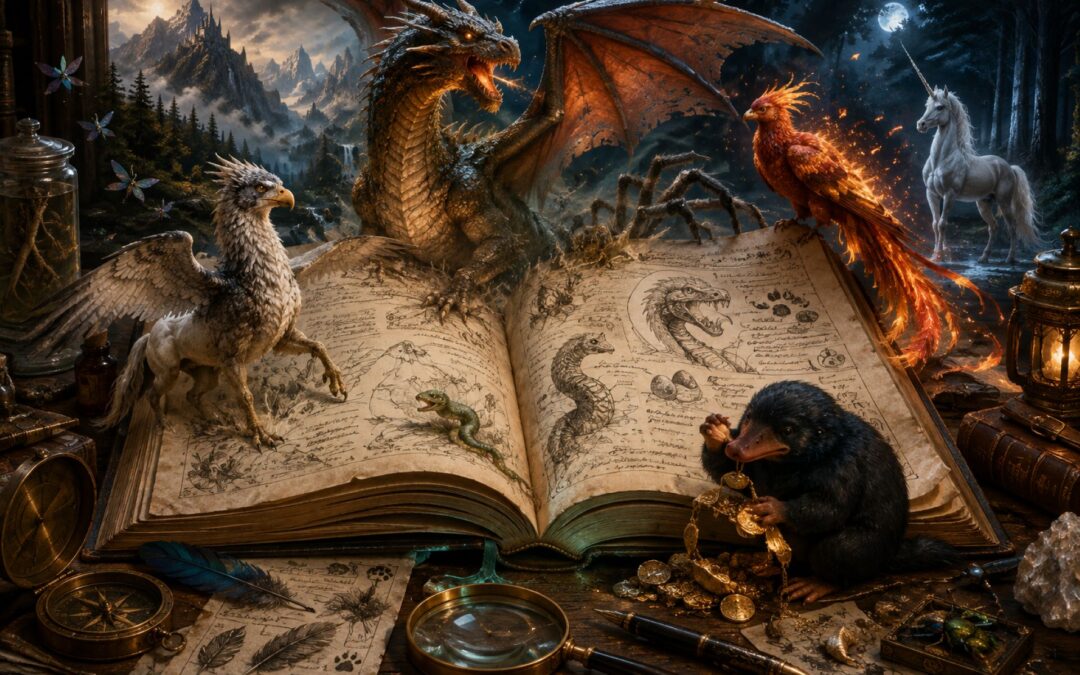
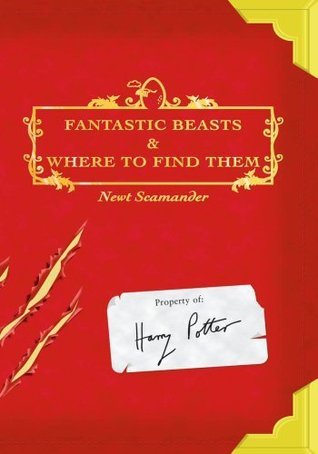
Fantastic Beasts and Where to Find Them is easy to misunderstand if approached through the later film series that borrowed its name. J.K. Rowling’s original book is not an adventure about Newt Scamander, Grindelwald, or events in 1920s New York. It is a fictional reference book: the supposedly real Hogwarts textbook that Harry Potter and his classmates would consult when learning about magical creatures. The pleasure comes not from following a plot but from opening what appears to be an object that escaped from the Wizarding World.
The book was first released in March 2001, alongside Quidditch Through the Ages, with proceeds benefiting Comic Relief. This article focuses on that original 2001 version, which contains Newt Scamander’s introductory essays, the Ministry of Magic classification system, 75 principal creature entries, ten separately described dragon breeds, illustrations, and handwritten comments attributed to Harry, Ron, and Hermione. A revised edition published in 2017 added six creatures and replaced the original framing with a new foreword by Newt Scamander, so later copies should not be treated as identical to the text examined here.
What makes the original book interesting is therefore larger than the question of which magical animal is the most dangerous or entertaining. Rowling constructs an entire knowledge system around these creatures. They have habitats, migration patterns, uses in magical medicine, restrictions on trade, legal classifications, relationships with Muggles, conservation problems, government departments, breeding regulations, and histories of contact with human society. Some are domesticated, some hunted, some protected, some exploited, and some intelligent enough to make the label “beast” politically contentious.
The result is a deceptively small exercise in world-building. A dragon is not simply a dragon because it breathes fire; it belongs to a regional breed, lives under particular conservation arrangements, threatens the International Statute of Secrecy, and possesses body parts valuable enough to encourage exploitation. A centaur is not simply a mythical horse-person; its placement inside the Ministry’s bureaucracy becomes a question of political identity. A werewolf is simultaneously a human and, at certain times, an uncontrollable magical creature, which makes the Ministry’s classifications visibly inadequate. Through such details, Fantastic Beasts and Where to Find Them suggests that a convincing fantasy world requires not only wonders but also the institutions that argue about, regulate, misunderstand, and preserve them.
The Textbook and Its Fictional Author
Before Newt Scamander begins describing animals, Rowling establishes the fiction that readers are holding a book with a history inside the Wizarding World. The opening material does not present J.K. Rowling as the zoologist responsible for the entries. Instead, Newton “Newt” Artemis Fido Scamander is introduced as a distinguished magizoologist whose fascination with magical creatures began in childhood under the influence of his mother, a breeder of Hippogriffs.
The fictional biography places Newt inside the Ministry of Magic’s bureaucracy. After leaving Hogwarts, he works in the Department for the Regulation and Control of Magical Creatures, initially spending an unhappy period in the Office for House-Elf Relocation before moving into the Beast Division. His career supposedly contributes to the creation of the Werewolf Register and the Ban on Experimental Breeding, while his work with the Dragon Research and Restraint Bureau takes him around the world. Those travels provide the fictional basis for the encyclopedic knowledge contained in the book.
This is a clever piece of framing because Newt is made credible in the same way a real reference-book author might be credible. He has professional appointments, areas of expertise, institutional achievements, field experience, awards, a publication history, and a later domestic life. His authority does not depend on Rowling simply telling readers that he knows a lot about magical creatures; it is embedded in a manufactured scholarly career.
Albus Dumbledore’s foreword reinforces the illusion. He discusses Fantastic Beasts and Where to Find Them as an established Hogwarts textbook whose usefulness extends beyond the classroom. In his description, wizarding households consult it for practical problems involving creatures such as Horklumps, Augureys, and Puffskeins. The book therefore belongs not only to scholars but to the everyday material culture of magical life.
The Comic Relief framing adds another layer. In the real world, Rowling published the book as a charitable project. Inside the fiction, Dumbledore explains its release as the first time the venerable magical publisher Obscurus Books has allowed the title to become available to Muggles. The joke depends on maintaining two realities at once: readers know they are buying a Rowling spin-off, but the text insists that the Wizarding World has temporarily permitted them access to one of its books.
Even the fictional publication history supports the illusion. Newt says he was commissioned to write the work in 1918 and that the first edition appeared in 1927. The copy presented to readers is supposedly a much later edition of an enduring scholarly work. The real 2001 publication date and the invented 1927 publication date therefore coexist, each belonging to a different level of the book’s construction.
This elaborate framing matters because the bestiary would be far less distinctive if it were simply titled “J.K. Rowling’s Guide to Magical Creatures.” By attributing it to a character, placing it within Hogwarts education, supplying a publication history, and allowing fictional readers to scribble in its margins, Rowling transforms supplementary lore into an artifact. The central imaginative achievement begins before the first creature appears.
How Newt Defines the Magical Animal World
Newt’s introduction does more than prepare readers for a catalogue. It establishes the conceptual problems that make magizoology necessary in the first place. Before magical creatures can be regulated, concealed, protected, or studied, the Wizarding World has to decide what counts as a creature at all—and Rowling makes that apparently simple question surprisingly political.
The introduction also gives the A–Z entries a logic that would otherwise be easy to miss. The creatures that follow are not merely arranged for entertainment. They become examples of a system involving intelligence, danger, government responsibility, secrecy, conservation, and the unstable border between human and nonhuman life.
What Is a Beast?
Newt begins with a problem familiar to any system of classification: obvious examples are easy, boundary cases are not. A Hippogriff clearly fits ordinary expectations of a magical beast. A werewolf does not, because most of the time a werewolf is an ordinary human being. A centaur is physically unlike a human but possesses language, intelligence, social organization, and independent political judgment. A troll can communicate to a limited degree but lacks the intellectual sophistication associated with centaurs or merpeople.
The Wizarding World’s history of defining “beast” therefore becomes a comic record of failed bureaucracy. One early attempt under Burdock Muldoon treats any magical creature walking on two legs as a “being” and everything else as a beast. The resulting gathering is disastrous because physical anatomy has almost nothing to do with intelligence or civic capacity. Creatures that satisfy the two-legged rule but cannot meaningfully participate in political discussion overwhelm the meeting.
Elfrida Clagg attempts to improve the definition by using human speech as the decisive test. This also fails. Some creatures can imitate speech without possessing the sort of intelligence the classification is intended to identify, while intelligent groups may speak languages that wizards either do not recognize or do not understand. The problem becomes even more complicated when ghosts demand consideration despite no longer being living creatures at all.
The eventual solution associated with Grogan Stump shifts the issue from anatomy and language toward civic intelligence. A “being” is essentially a creature capable of understanding the laws of the magical community and bearing responsibility for participating in the creation or administration of those laws. This is a more sophisticated definition because it recognizes cognition and political agency rather than appearance.
Even Stump’s solution does not resolve everything. Centaurs object to sharing official “being” status with groups they do not regard as their peers and request classification among beasts instead. Merpeople later make the same choice. Their placement in the bureaucracy therefore does not reflect an objective zoological judgment; it reflects political identity and self-determination.
Werewolves create a different problem. A werewolf is a human being for most of the month but transforms into a dangerous creature during the full moon. The Ministry consequently cannot place werewolves neatly on one side of the beast-being divide. Their existence exposes the assumption that stable categories can be applied to identities that physically change.
Other creatures create still different difficulties. Acromantulas and Manticores can display intelligence and, in the case of Acromantulas, articulate speech, but both are sufficiently dangerous to humans that their rational capacities do not make ordinary coexistence straightforward. Sphinxes possess intelligence yet communicate in riddles and may respond violently when their challenges are failed. Trolls can use language but lack the sophistication that Stump’s definition expects.
The introduction therefore reveals one of the book’s strongest ideas before the catalogue begins: “beast” is not a purely biological category. It can incorporate intelligence, behaviour, danger, politics, law, prejudice, institutional convenience, and the wishes of the creatures being classified. Rowling presents this with humour, but the logic of the joke is serious. Once a government must regulate a world containing multiple intelligent species, zoology immediately becomes political philosophy.
Muggles, Secrecy and Magical Creatures
Having asked what a beast is, Newt turns to the other obvious question: if magical creatures exist across the world, why do Muggles not know about them? Rowling’s answer is not that Muggles have always been incapable of seeing magical fauna. On the contrary, Newt argues that Muggles once knew considerably more.
Medieval art, stories, and legends contain dragons, unicorns, griffins, centaurs, phoenixes, and other creatures that modern Muggles classify as imaginary. Newt interprets this not as evidence that people invented monsters but as distorted cultural memory of actual encounters. According to the fictional history, Muggles sometimes recorded these creatures inaccurately, but the underlying sightings were real.
The problem for the wizarding community is that magical creatures cannot always protect themselves from human attention. Some are conspicuous, dangerous, valuable, or tempting to hunt. Wizards also face growing pressure to conceal the entire magical world. The book therefore links creature secrecy with the broader withdrawal of magical society from Muggle awareness.
The turning point comes with international efforts surrounding magical secrecy in the late seventeenth century. Once wizards commit to hiding themselves from Muggles, magical creatures become part of the same political problem. Governments cannot maintain secrecy if dragons fly over populated settlements, kelpies become tourist attractions, or large populations of unusual animals appear where Muggles can repeatedly observe them.
Newt describes negotiations over which species should be concealed and how responsibility should be distributed. Early attempts focus on a limited list of creatures, but the obvious practical problem is that no narrow list can account for the full range of magical animals capable of exposing wizarding society. The eventual principle becomes broader: wizarding governments must take responsibility for magical creatures within their territories and prevent them from attracting Muggle attention.
Clause 73 of the International Statute or Code of Wizarding Secrecy becomes crucial to this system. National magical authorities are responsible not merely for hiding witches and wizards but for managing the creatures whose existence might reveal magic. A dragon outbreak therefore becomes an international-security issue as much as an animal-control problem.
This historical explanation gives the bestiary a dimension that ordinary monster catalogues rarely possess. The existence of magical animals creates institutional consequences. Governments need laws, enforcement systems, reservations, breeding controls, memory modification, emergency responses, and international coordination. The creatures are part of a political order whether they understand that order or not.
How the Wizarding World Hides and Protects Beasts
Once secrecy becomes a government obligation, Rowling has to solve one of the practical weaknesses common to hidden-world fantasy: enormous magical creatures should be extremely difficult to conceal. Newt’s answer is deliberately elaborate. Some animals hide themselves, some live in inaccessible places, some are kept inside protected habitats, and some require active intervention by wizards.
The result is one of the book’s richest pieces of background world-building. Rather than relying on a vague suggestion that Muggles simply fail to notice magic, Rowling invents overlapping ecological and administrative systems that explain why different species remain unknown.
Safe Habitats and Concealment
Some magical creatures solve much of the problem themselves. Demiguises can become invisible. Diricawls can vanish from one place and reappear elsewhere. Other species inhabit remote mountains, deep oceans, forests, marshes, islands, or regions where encounters with Muggles are naturally uncommon. Such adaptations reduce the amount of direct intervention required.
Other creatures are too conspicuous for that solution. Dragons are enormous, dangerous, and capable of flight, so the wizarding world maintains protected areas and restrictions designed to keep them away from ordinary human populations. Merpeople live beneath the water, but bodies of water visited by Muggles still create exposure risks. Kelpies can be mistaken for ordinary aquatic mysteries only as long as repeated encounters remain sufficiently ambiguous.
Newt uses the Loch Ness Monster as an example of magical secrecy surviving through Muggle misinterpretation. In his account, the famous monster is a particularly large kelpie whose appearances are absorbed into folklore. The joke works because the Wizarding World does not need every Muggle sighting to disappear; it needs Muggles to interpret those sightings as legend, hoax, uncertainty, or unexplained natural phenomena.
The Yeti creates a similar difficulty. Because repeated Muggle reports have made the creature widely known as a legendary monster, the wizarding community must intervene to prevent those rumours from becoming proof. Rowling thus treats cryptozoological folklore as residue left behind when magical concealment is imperfect.
Not every failure can be dismissed as legend. Newt refers to the Ilfracombe incident, involving a dragon witnessed by Muggles, as evidence that spectacular creatures can overwhelm ordinary concealment. Such events require wizards to repair both the immediate danger and the witnesses’ memories.
Protected habitats are therefore not merely wildlife preserves. They are secrecy infrastructure. Islands may be made unplottable, areas can be protected by charms that discourage or confuse Muggle visitors, and dangerous species may be restricted to regions that magical authorities can monitor.
The idea adds another layer to Rowling’s world. Conservation and secrecy often point in the same direction: preserving a species means giving it habitat, while hiding magic means preventing Muggles from entering that habitat. Yet the motivations are not identical. A reservation may protect an animal because it is rare, because it is dangerous, because humans want valuable materials from it, or simply because its discovery would compromise magical society.
Breeding, Memory Charms and Misinformation
Habitat control cannot prevent wizards themselves from creating problems. Magical creatures can be bred, traded, kept as pets, harvested for useful materials, or experimentally altered. Newt’s fictional career therefore includes pride in the Ban on Experimental Breeding, a law intended to prevent the creation of new creatures that might prove impossible to manage.
Ownership and breeding regulations recur throughout the book. Crups require licensing and physical alteration so that Muggles will mistake them for normal dogs. Winged horses must be concealed. Some magical pets are permitted only under specific conditions. Dangerous creature eggs may be controlled as trade goods because an animal’s reproductive cycle can itself create a secrecy threat.
When concealment fails, magical authorities can intervene directly. Disillusionment Charms may make creatures difficult to see, while Memory Charms can remove inconvenient experiences from Muggle witnesses. Obliviators therefore become part of creature management even though their obvious job concerns human memory rather than zoology.
The Office of Misinformation represents an even more sophisticated response. Certain events are too large for individual memory modification to solve easily, especially when many witnesses or physical consequences are involved. In those circumstances, the wizarding state can cooperate with Muggle institutions to create a plausible alternative explanation.
Rowling’s system is deliberately comic because it treats legendary monsters and inexplicable disasters as administrative problems. Yet it also shows how much infrastructure a hidden magical world would require. Secrecy is not sustained by one spell; it is maintained through law, geography, breeding regulation, surveillance, habitat management, memory alteration, and the strategic production of disbelief.
Why Magizoology Matters and How Creatures Are Classified
After describing the difficulty of deciding what a beast is and the elaborate work required to keep magical creatures hidden, Newt finally explains why anyone should bother. His answer gives the book an ethical centre. Magical creatures are not merely obstacles that wizarding governments need to contain; they are forms of life worth knowing and preserving.
Newt’s attitude combines admiration with realism. He never pretends every creature is gentle. Some will kill humans without hesitation, some carry venom, some prey specifically upon children, and some are so dangerous that only highly trained wizards should approach them. Respect for creatures therefore does not mean sentimentalizing them.
Instead, magizoology requires accurate knowledge. Knowing that a Hippogriff expects a particular form of respectful approach may prevent an attack. Knowing the life cycle of an Ashwinder allows a wizard to find and freeze its dangerous eggs. Understanding a Lethifold identifies the only defence known to work against it. Knowing a kelpie’s preferred form or a Pogrebin’s behaviour allows danger to be recognized before it becomes fatal.
This practical knowledge leads into the Ministry of Magic classification system. Creatures receive ratings from X to XXXXX. An X designates a creature considered boring; XX generally indicates harmlessness or easy handling; XXX describes animals that a competent wizard should be able to manage; XXXX signals danger requiring specialist knowledge; and XXXXX marks creatures considered wizard killers or otherwise impossible to domesticate safely.
The scale initially looks like a simple danger rating, but the book soon complicates that interpretation. Centaurs, unicorns, phoenixes, and the Golden Snidget receive classifications that reflect respect, difficulty, rarity, or legal protection rather than aggressive behaviour. A unicorn is not dangerous in the same way as a dragon. The shared rating therefore tells readers as much about the limitations of bureaucracy as it does about the creature.
Newt explicitly presents the catalogue as an introduction rather than an exhaustive survey of everything magical. The 2001 edition contains 75 principal species, and even within those entries some categories subdivide further. The Dragon entry alone describes ten distinct breeds, while the Winged Horse entry names several varieties. The apparent simplicity of an alphabetical handbook therefore hides considerable differentiation.
The Complete A–Z Bestiary
The A–Z catalogue is the core of Fantastic Beasts and Where to Find Them. Each entry generally combines physical description, habitat, behaviour, danger, magical properties, human uses, and some practical advice, but Rowling varies the emphasis enough to make the creatures feel as though they occupy different ecological and cultural niches.
The summaries below follow the original 2001 sequence and account for all 75 principal entries. Some species deserve more space because they reveal the book’s larger ideas about intelligence, conservation, secrecy, or magical institutions, while others work primarily as comic or imaginative details inside the broader ecosystem.
Acromantula to Dragon
The Acromantula is a gigantic spider originating in Borneo. Unlike ordinary spiders, it possesses remarkable intelligence and can communicate in human language, yet this intelligence does not make it safe: Acromantulas retain a strong appetite for human prey. They live collectively in huge ground-level webs, produce valuable venom, and are believed to have been bred by wizards, probably to guard dwellings or treasure. Their classification as XXXXX reflects their extreme danger, while their ability to speak reinforces the introductory problem of why intelligence alone cannot settle the distinction between beast and being.
The Ashwinder is less intellectually significant but demonstrates Rowling’s pleasure in imagining magical ecology arising from ordinary wizarding mistakes. If a magical fire burns uncontrolled for too long, a pale serpent forms in its embers and slithers into a dark part of the building. It survives for only about an hour, but during that period it lays extremely hot red eggs capable of setting the house on fire. If found and frozen, however, those same eggs become valuable ingredients and remedies, turning a domestic hazard into a magical resource.
The Augurey, sometimes called the Irish Phoenix, is a thin, mournful bird native mainly to Britain and Ireland. Its eerie cry was once believed to predict death, causing generations of witches and wizards to fear hearing it. Careful observation eventually reveals that it predicts rain instead. The entry encapsulates Newt’s faith in empirical study: superstition makes the creature terrifying, while research replaces fear with understanding.
The Basilisk belongs at the opposite end of the danger scale. It is an enormous serpent artificially produced by hatching a chicken egg beneath a toad, a breeding method attributed to an ancient dark wizard and subsequently outlawed. Its gaze can kill, its fangs carry deadly venom, and it can survive for centuries under favourable conditions. A Parselmouth may exert unusual control over it, making the creature not only naturally lethal but potentially useful as a weapon.
The Billywig is a tiny Australian insect whose sting produces giddiness and levitation. Although the effects can be dangerous, young witches and wizards sometimes seek them deliberately for recreation, which gives the entry the feel of a magical public-health warning. Repeated exposure can leave a victim floating for an extended period and, in extreme cases, permanently.
The Bowtruckle is a small, twig-like guardian of wand-quality trees. Its appearance provides excellent camouflage, and it is normally peaceful, but it attacks the eyes of anyone threatening its tree. Wizards collecting suitable wood can distract a Bowtruckle with wood lice, making the animal a good example of how practical knowledge allows coexistence rather than brute-force control.
The Bundimun is essentially a magical household infestation. It resembles a patch of fungus but feeds on dirt and produces substances capable of rotting the structure beneath it. Small infestations can be removed with magic, while severe ones require professional extermination. The creature helps make the Wizarding World feel domestic: not every magical animal exists for epic adventure; some are simply pests.
Centaurs transform the catalogue back into political territory. They possess intelligence, language, communities, and sophisticated knowledge, including astronomical expertise. Their XXXX rating does not mean they are naturally aggressive; the classification reflects the respect with which wizards are expected to treat them. More importantly, centaurs asked to be classified as beasts rather than beings because they rejected the company implied by the Ministry’s “being” category and preferred political independence.
The Chimaera is Rowling’s version of the classical hybrid monster, combining features of a lion, goat, and dragon. It is extremely rare, ferocious, and notoriously difficult to defeat. Its XXXXX rating is straightforward: unlike the centaur’s classification, this one expresses direct lethal danger.
The Chizpurfle is a minute parasite attracted to magic. It can infest the fur or feathers of magical creatures, chew magical objects, and even feed upon residue left in cauldrons. By showing parasites adapting specifically to magical environments, Rowling extends magical ecology below the level of spectacular monsters.
The Clabbert is a tree-dwelling creature from the American South with a monkey-like body and a forehead pustule that flashes when danger approaches. Wizards once used domesticated Clabberts as household warning systems, only for the visible flashing to attract Muggle attention. International secrecy regulations consequently restrict the practice, making the creature another example of everyday behaviour becoming a legal issue because of the Statute of Secrecy.
The Crup resembles a Jack Russell terrier except for its forked tail. It is intensely loyal to wizards and aggressively hostile toward Muggles, which makes ownership a secrecy problem. Wizarding owners require licences and must modify the animal’s tail so that it can pass as an ordinary dog.
The Demiguise is a peaceful, ape-like creature found in the Far East and distinguished by its ability to become invisible. Its silvery hair can be woven into Invisibility Cloaks, making the animal economically valuable despite its harmless nature. That usefulness later becomes important to the book’s conservation theme: magical animals are repeatedly desirable not only as living creatures but as sources of rare materials.
The Diricawl is a plump bird from Mauritius capable of disappearing and reappearing elsewhere when threatened. Muggles know the species by another name—the dodo—and believe they drove it to extinction. The wizarding world knows that the bird survived through magical evasion but deliberately allows Muggles to retain their mistaken conclusion, regarding the supposed extinction as a useful lesson about the consequences of environmental destruction.
The Doxy resembles a tiny, hairy, four-armed fairy but is much more dangerous than its delicate size suggests. It possesses wings, venomous teeth, and a tendency to infest houses, while its eggs can appear in large numbers. The comparison with fairies shows Rowling’s tendency to subvert familiar fantasy silhouettes by giving similar-looking creatures radically different behaviours.
The Dragon receives by far the most elaborate treatment of the early catalogue. Dragons are among the most dangerous magical creatures, but their importance extends beyond danger. Their hide, blood, hearts, livers, and horns have magical uses; their eggs are valuable and tightly regulated; their size makes concealment extraordinarily difficult; and the need for protected reserves has produced an international system of research, restraint, and conservation.
Rather than treating “dragon” as a single creature, Newt identifies ten pure breeds. The Antipodean Opaleye, native to New Zealand, has pearly scales and striking multicoloured eyes. It is considered less aggressive than several other breeds and generally prefers sheep to human prey, although it remains formidable.
The Chinese Fireball, also called the Liondragon, has scarlet scales, golden facial spikes, and a distinctive fiery attack. It is unusually tolerant of other dragons of its own species, which gives it a social trait beyond simple aggression. Like many dragons, however, it is fully capable of attacking humans.
The Common Welsh Green is associated with the mountain regions of Wales. It is comparatively inclined to avoid humans and prefers sheep, but its ability to remain concealed is not perfect. Its involvement in the Ilfracombe incident shows why even a relatively unobtrusive dragon poses a major secrecy challenge.
The Hebridean Black inhabits the Hebrides and requires a vast territory. Dark-scaled and highly aggressive, it feeds on large animals and is traditionally managed by the MacFusty clan. That detail suggests that dragon management is not solely a centralized Ministry function; local magical communities can develop inherited responsibilities around particular species.
The Hungarian Horntail is described as one of the most dangerous dragons in existence. It has black scales, bronze horns and tail spikes, and an unusually long range of fire. Its anatomy seems built for both attack and defence, justifying its fearsome reputation even among people accustomed to dragons.
The Norwegian Ridgeback is rare and exceptionally aggressive, including toward members of its own species. It resembles the Horntail in some respects but develops distinctive ridges and has an unusual willingness to prey upon aquatic creatures. This type of behavioural detail helps differentiate breeds that might otherwise amount to little more than colour variations.
The Peruvian Vipertooth is the smallest known dragon but also one of the fastest. Its copper-coloured body, venomous fangs, and particular appetite for human beings make it disproportionately dangerous for its size. Population growth eventually becomes serious enough to prompt intervention by international dragon experts, illustrating magical wildlife management at a global scale.
The Romanian Longhorn has dark-green scales and long golden horns prized for potion ingredients. Demand for those horns contributes to declining numbers, so the species is protected by breeding programmes and restrictions on trade. This is one of the clearest cases in which Rowling turns magical zoology into conservation economics.
The Swedish Short-Snout has a silvery-blue body and produces brilliant blue flame capable of reducing material to ash. It has killed fewer humans than several other breeds largely because it inhabits remote, uninhabited mountains. The distinction is important: recorded danger is influenced by geography and contact rates, not merely temperament.
The Ukrainian Ironbelly is the largest dragon described, reaching immense weight. It is slower in flight than smaller breeds but powerful enough to crush dwellings and other structures when it lands. Its combination of size and destructive potential makes government supervision essential even when it is not the most aggressive species.
Taken together, the dragon breeds show Rowling’s best world-building method in miniature. The distinctions involve geography, anatomy, temperament, diet, population pressure, resource value, conservation, historical management, and likelihood of human contact. The category becomes convincing because the differences have consequences.
Dugbog to Manticore
The Dugbog inhabits marshland in Europe and the Americas and resembles a piece of dead wood when motionless. It attacks the ankles of unsuspecting walkers but prefers Mandrakes, making it a particular nuisance for magical gardeners. Its camouflage and feeding behaviour give it the texture of an irritating wetland predator rather than a grand monster.
The Erkling comes from Germany’s Black Forest and poses a far more disturbing threat. It uses a high-pitched cackle to attract children away from their guardians before attempting to eat them. Newt notes that regulation and increased awareness have greatly reduced attacks, reinforcing the idea that magical creature management can produce measurable improvements rather than simply responding to disasters.
The Erumpent is a massive African animal resembling a rhinoceros, with thick hide resistant to spells and a horn capable of producing catastrophic explosions when it penetrates a target. It generally attacks only when provoked, making its XXXX status an example of the difference between inherent destructive capability and habitual aggression. Its reproductive rate is low, which also gives the species an implied ecological vulnerability.
The Fairy gives Rowling an opportunity to mock sentimental Muggle folklore. Her fairies are small, beautiful, vain, decorative creatures with wings and little intelligence. They cannot hold ordinary conversation and willingly pose for display, which Newt uses to explain why Muggle stories have exaggerated their elegance while overlooking their limitations.
The Fire Crab, native to Fiji, looks more like a large tortoise than a crab and possesses a jewel-covered shell. Its ability to project flame from its rear makes it dangerous, but human greed is equally important: both Muggles and wizards may want the valuable shell. A protected reservation exists partly to shield the animal from exploitation.
The Flobberworm receives the lowest possible classification. It is a nearly motionless brown worm with few distinguishing behaviours, although its mucus has potion-making uses. The joke is that a bureaucratic scale designed for dragons and lethal predators also needs a category equivalent to “boring.”
The Fwooper is an African bird with vividly coloured plumage and an initially pleasing song. Prolonged exposure to that song eventually drives the listener insane, so domesticated Fwoopers must be kept under a Silencing Charm. The creature turns aesthetic beauty into an environmental hazard: what is delightful for a short time becomes dangerous through repetition.
The Ghoul is ugly but largely harmless. It often lives in attics or barns, making noises and occasionally interacting with household objects, and wizarding families may regard its presence as an eccentric domestic feature rather than an emergency. When a magical property passes into Muggle hands, however, government specialists may need to remove the resident ghoul.
The Glumbumble is a grey flying insect whose secretions produce melancholy. Its treacle has specialised magical applications, including correcting excessive emotional effects created elsewhere. Like many minor creatures, it matters less as an independent character of the world than as one link in a network of potion ingredients, magical side effects, and ecological interactions.
The Gnome is the familiar pest of wizarding gardens. Rowling gives its removal a comic physicality: the usual method involves grabbing the gnome, spinning it until disoriented, and throwing it beyond the garden boundary. Jarveys can also hunt gnomes, although using one turns pest control into something much more brutal.
The Graphorn is a large mountain beast with greyish-purple colouring, horned anatomy, and extremely tough hide resistant to many spells. Mountain trolls sometimes attempt to ride Graphorns, though the relationship is difficult and violent. Its horn has potion value, which again creates a potential conflict between rarity and human use.
The Griffin, derived from classical mythology, combines the foreparts of an eagle with the body and hindquarters of a lion. It is fierce and has traditionally been associated with guarding treasure, but skilled wizards can sometimes form working relationships with one. Rowling retains the creature’s mythic dignity while fitting it into the Ministry’s practical classification scheme.
The Grindylow is a small water demon found in Britain and Ireland. It has long fingers that can grip victims but are relatively easy to break, making the creature dangerous without being overwhelming. Merpeople have been known to domesticate Grindylows, demonstrating that a species considered threatening to humans may occupy a different position in another intelligent community.
The Hippocampus is a Mediterranean hybrid with the front of a horse and the rear of a fish. Merpeople have successfully domesticated examples, again hinting that magical zoology changes depending on which culture is doing the domesticating. The entry is brief but broadens the book’s sense of underwater life.
The Hippogriff combines the front half of a giant eagle with the rear of a horse and is one of the clearest examples of magical creature etiquette. A person approaching one should maintain eye contact and bow, waiting to see whether the creature returns the gesture before moving closer. Respect is therefore not an abstract moral principle but a practical survival technique: treating the Hippogriff as a creature with dignity reduces the chance of provoking it.
The Horklump resembles a fleshy mushroom and can spread rapidly through gardens. It feeds on earthworms and is in turn eaten by gnomes. This simple food-chain relationship is a small example of the ecological connections that prevent the catalogue from feeling like 75 entirely isolated inventions.
The Imp is a small, mischievous creature found mainly in Britain and Ireland. Unlike a fairy it cannot fly, and it delights in petty cruelty such as tripping or pushing people into water. Its behaviour is malicious enough to be annoying but rarely severe enough to make it a serious threat.
The Jarvey resembles an oversized ferret and possesses the ability to speak, but its vocabulary is limited and often insulting. It hunts gnomes and other small animals. The creature is another useful challenge to language-based definitions of intelligence: merely producing human words does not make an animal capable of political reason.
The Jobberknoll is a small bird that makes no sound during its life. At the moment of death, however, it releases every sound it has ever heard in reverse sequence. Its feathers are used in magical substances associated with memory and truth, connecting the creature’s strange biology with its practical magical value.
The Kappa comes from Japanese folklore and is described as an aquatic creature that attacks humans in shallow water. A depression in its head must remain filled with water for it to retain its strength, allowing a knowledgeable opponent to exploit ritual etiquette by making it bow. Cucumbers can also distract it. The mixture of genuine folkloric motifs with Rowling’s reference-book format typifies how the bestiary repackages older supernatural traditions.
The Kelpie is a British and Irish shape-shifting water demon that often takes the form of a horse. It allows a rider to mount before dragging the victim underwater and consuming them. A properly applied magical restraint can control it, and Newt identifies the famous Loch Ness Monster as an unusually large kelpie, turning a piece of Muggle cryptozoology into evidence of imperfect magical secrecy.
The Knarl looks exactly like an ordinary hedgehog, but its psychology differs. If offered food, it interprets the gesture as an attempt to trap it and retaliates by destroying the surrounding garden. The joke depends on behavioural classification: two animals can appear identical while reacting completely differently to humans.
The Kneazle is a highly intelligent cat-like creature with an excellent capacity for detecting suspicious or untrustworthy people. It can guide an owner home if lost and may interbreed with ordinary cats, although ownership is regulated. Newt’s fictional retirement with several Kneazles gives the species a personal connection to the supposed author.
The Leprechaun, or Clauricorn, is a small intelligent creature associated with Ireland. It speaks, produces temporary gold, and enjoys mischief, but it does not demand the political status that might be expected from its intelligence. The disappearing gold is particularly significant because it can fool anyone who forgets that magical wealth may not behave like ordinary money.
The Lethifold, or Living Shroud, is among the book’s most frightening creations. Found in tropical climates, it resembles a dark piece of fabric that moves silently across the ground, covering and suffocating sleeping victims before consuming them completely. Because it leaves little evidence, attacks are difficult to document, and Newt reproduces an account of a survivor whose successful Patronus repelled the creature.
That embedded testimony is important stylistically as well as zoologically. Instead of merely stating that a Patronus works, Rowling gives the entry a miniature case history, imitating the way a scholarly naturalist might quote a documented observation. The surrounding humour about people falsely claiming Lethifold deaths for personal reasons prevents the episode from becoming entirely grim.
The Lobalug is a simple North Sea creature with a venomous sac. When threatened, it can expel poison, and merpeople use it as a weapon. Wizards also extract the venom for potions, though the practice is controlled, providing another instance where an animal’s natural defence becomes a resource coveted by intelligent species.
The Mackled Malaclaw resembles a lobster and inhabits European coastlines. Its bite does not merely injure the victim physically; it produces a period of extraordinary bad luck. Newt therefore advises victims to avoid gambling and other speculative behaviour until the effect has passed, giving the entry the tone of a magical safety manual.
The Manticore is a Greek creature with a human-like head, lion’s body, and scorpion tail. It is capable of speech, but its intelligence offers little comfort because it remains a violent predator whose skin can resist many spells. Like the Acromantula, it demonstrates why speech and reason do not automatically produce peaceful coexistence or easy bureaucratic classification.
Merpeople to Yeti
Merpeople are not a single local curiosity but intelligent aquatic peoples found in different parts of the world. They have their own language and social organisation, and some maintain relationships with other aquatic species such as Grindylows. Their decision to reject official “being” status and join the centaurs among the Ministry’s beasts turns their entry into one of the clearest examples of classification as political self-definition.
The Moke is a small British and Irish lizard with the ability to shrink dramatically when threatened. Its skin retains this property after being made into magical objects, which makes it useful for purses and bags that resist discovery by thieves. Again, an animal adaptation becomes an economic resource.
The Mooncalf emerges from its burrow only during a full moon and performs elaborate dances in isolated places. The patterns it leaves in crops can be mistaken by Muggles for mysterious phenomena, while its dung has powerful effects on magical plants. The entry combines whimsy, folklore-style explanation, and practical magical horticulture.
The Murtlap is a rat-like coastal creature whose back carries fleshy growths with medicinal properties when preserved and consumed. Limited use can increase resistance to certain magical injuries, but excessive consumption causes unpleasant side effects. Rowling repeatedly prevents magical resources from becoming effortless solutions by attaching risks to them.
The Niffler is one of the most immediately appealing animals in the book. Black, fluffy, and burrowing, it has an irresistible attraction to glittering objects and precious materials. Goblins use Nifflers to search for treasure, but keeping one inside a house is disastrous because its enthusiasm for valuables leads it to destroy rooms while searching.
The Nogtail looks like a stunted piglet and behaves like a parasitic farm demon. It infiltrates a pigsty, feeds alongside ordinary piglets, and causes progressive decline in the livestock and land unless driven away. The creature translates folklore about mysterious agricultural misfortune into a magical veterinary problem.
The Nundu is a gigantic East African leopard-like predator whose breath carries disease capable of devastating entire communities. Newt presents it as one of the most dangerous creatures known, noting that subduing one requires an exceptional number of skilled wizards. Its XXXXX classification is therefore among the least ambiguous in the book.
The Occamy is a winged, serpentine creature found in parts of the Far East and India. It is aggressive toward threats, especially when defending its eggs, whose shells are made of valuable silver. The combination of protective behaviour and valuable offspring creates an obvious reason for conflict with collectors.
The Phoenix is one of the catalogue’s most remarkable examples of a high classification that does not reflect viciousness. The scarlet-and-gold bird can disappear and reappear, carry extraordinarily heavy loads, and heal wounds with its tears. When its body reaches the end of its cycle, it burns and is reborn from the ashes, making apparent death part of its normal biology.
Phoenixes are gentle and resistant to ordinary attempts at domestication, which is why their XXXX rating must be read as a measure of difficulty and respect rather than aggression. This inconsistency in the classification system is deliberate enough to expose the limits of a single numerical scale.
The Pixie, particularly associated with Cornwall, is a small electric-blue creature capable of flight despite lacking wings. Pixies enjoy mischief and can physically carry humans into inconvenient or dangerous positions. Their size encourages underestimation, but large groups can cause serious chaos.
The Plimpy is a round fish with legs, commonly found in lakes. It is more irritating than dangerous and is particularly disliked by merpeople, who deal with it by tying its legs together until it drifts away. The method is absurd enough to underline the book’s deadpan humour.
The Pogrebin is a small Russian demon that follows humans for long periods while remaining out of sight. Its true attack is psychological: prolonged pursuit causes despair and hopelessness, after which the creature attempts to consume the exhausted victim. Once identified, however, it can be driven away relatively easily, making recognition the key defensive skill.
The Porlock is a shy horse guardian native to Britain and Ireland. It lives near herds and protects them while avoiding humans. Its existence suggests that magical ecology contains relationships of stewardship among creatures rather than only predation.
The Puffskein is a soft, spherical and extremely docile pet. It tolerates handling and makes few demands, although its long tongue and willingness to consume almost anything can create disgusting habits. The humour works because a cute magical pet is given the sort of unpleasant behaviour familiar to owners of real animals.
The Quintaped, also called the Hairy MacBoon, lives on the Isle of Drear and possesses five powerful legs. It has an appetite for humans and is so dangerous that its island has been made inaccessible to outsiders. Wizarding legend claims that the species originated in a feud between two families, one of which transformed the other into monstrous creatures and was then destroyed in retaliation.
Newt does not fully endorse that origin story. His scepticism is significant because it gives the fictional textbook something resembling scholarly caution: a colourful legend may circulate widely without qualifying as reliable zoological fact. The distinction between recorded knowledge and folklore exists even inside the invented world.
The Ramora is a magical fish found in the Indian Ocean that can anchor ships and is regarded as a protector of sailors. It is internationally protected against poaching. Its low danger rating combined with strong legal protection further demonstrates why Ministry classifications cannot be interpreted purely as threat levels.
The Red Cap is a dwarf-like creature associated with places where human blood has been spilled, particularly battlefields and other violent sites. It attacks vulnerable travellers, especially Muggles. The creature turns the landscape of human violence into habitat, linking magical danger with historical brutality.
The Re’em is an extremely rare golden ox whose blood grants immense strength. That property makes it enormously valuable, but scarcity means the substance is nearly impossible to obtain. The entry introduces a familiar pattern: the more useful the magical biological resource, the greater the potential pressure on the species producing it.
The Runespoor is a three-headed African snake whose heads possess different psychological tendencies. One focuses on planning, another on dreams, and the third criticises the other two, sometimes so relentlessly that the snake’s remaining heads bite it off. Beyond the comedy, the design turns internal mental conflict into anatomy.
Runespoor eggs also have magical uses connected with mental ability, encouraging human interest in the species. The creature is one of Rowling’s more conceptually inventive originals because its biology, behaviour, and symbolic possibilities all emerge from the same central idea.
The Salamander is a small fire-dwelling lizard that is born from and sustained by flames. It can survive briefly outside its originating fire under certain conditions, and its blood possesses restorative value. Different flame sources may affect its colour, making magical environment part of physical appearance.
The Sea Serpent is huge and visually terrifying, but Newt notes that appearances have produced exaggerated Muggle stories. Despite its size and frightening shape, confirmed human fatalities are notably absent. The creature therefore offers a reminder that perceived danger and actual behaviour are not always the same.
The Shrake is an Atlantic fish covered with sharp spines capable of tearing fishing nets. Wizarding folklore attributes its origin to a magical act of revenge against Muggle fishermen. Whether or not the story is reliable, it is another example of the book preserving legends about how particular species supposedly came into existence.
The Golden Snidget is a tiny, extraordinarily fast bird that once became the object of a brutal wizarding sport. Participants tried to capture the bird during games, and the value placed on successful catches brought the species close to extinction. Conservationists eventually intervened, protected surviving populations, and replaced the live bird in the sport that would become Quidditch with the Golden Snitch.
The Snidget is one of the book’s clearest conservation stories because human entertainment, rather than natural danger, becomes the threat. Its XXXX classification reflects its protected status rather than any meaningful threat to wizards, making the Ministry scale visibly multidimensional.
The Sphinx combines a lion’s body with a human head and possesses great intelligence. Sphinxes are traditionally used as guardians because they enjoy puzzles and riddles, but they become dangerous when someone fails a challenge or threatens what they protect. Their capacity for sophisticated thought again complicates the label of beast.
The Streeler is a giant snail whose shell changes colour and whose trail is toxic enough to destroy vegetation. Despite the danger, wizards sometimes keep Streelers as pets because of their striking appearance. The entry captures the recurring tension between aesthetic fascination and practical risk.
The Tebo is an African warthog capable of becoming invisible, which makes it difficult to evade when it attacks. Its hide has protective magical uses. Unlike the peaceful Demiguise, invisibility here makes an already aggressive animal more dangerous, showing how the same magical ability can serve radically different ecological functions.
The Troll is enormous, immensely strong, and generally unintelligent. Newt distinguishes mountain, forest, and river varieties, but all share limited reasoning compared with creatures such as centaurs or merpeople. Trolls possess enough language to have complicated early definitions of “being,” yet their behaviour makes the limitations of speech-based classification obvious.
The Unicorn begins life with golden colouring, becomes silver when young, and eventually develops the pure white appearance associated with the adult animal. Its horn, tail hair, and blood possess powerful magical properties. Unicorns are difficult to capture and tend to avoid humans, though younger animals are less wary.
The creature’s XXXX rating represents respect rather than aggression. That qualification matters because few entries demonstrate the inadequacy of the Ministry’s scale as clearly: placing a unicorn and an aggressively dangerous creature in the same category does not mean they present the same risk.
The Werewolf is not an independent animal species in the ordinary sense but a human being infected through the bite of another werewolf. During most of the month the individual remains human, but the full moon forces a transformation into a predatory state that endangers other people. The condition therefore sits uncomfortably between disease, identity, and zoology.
Newt notes that advances in potion-making can lessen the danger by allowing an affected person to retain greater control or awareness during transformation. Yet the bureaucratic problem remains: the Ministry has reason to regulate the transformed creature without reducing the human being to that temporary state. The Werewolf Register mentioned in Newt’s biography further reveals how zoological classification can become social administration.
The Winged Horse is an umbrella category rather than a single breed. Newt identifies varieties including the immense Abraxan, the chestnut Aethonan, the grey Granian, and the black Thestral. Their Ministry ratings vary because size, behaviour, and difficulty differ among breeds.
Owners must use magic to keep winged horses hidden from Muggles, since an airborne horse is almost impossible to explain through ordinary natural history. The category therefore combines domestication with secrecy: even relatively manageable creatures can become regulatory problems when their visible biology contradicts the Muggle world.
Finally, the Yeti, also known as the Abominable Snowman or Bigfoot in related traditions, is described as a large white creature associated with Tibet and possibly related to the troll. It is highly dangerous but afraid of fire. Because Muggle sightings have repeatedly entered popular folklore, magical authorities have had to devote special attention to preserving uncertainty around its existence.
The Yeti provides alphabetical closure rather than a climax. By the time readers reach it, the catalogue has moved from parasites and pets to intelligent peoples, giant predators, endangered species, artificial monsters, domestic pests, mythical hybrids, and creatures whose bodies supply valuable magical commodities. The cumulative effect is the point: magical animals do not occupy one narrative role because they constitute an entire parallel natural world.
Newt Scamander’s View of Animals
Although Newt rarely narrates personal adventures, the book creates a surprisingly distinct persona through the way he describes creatures. He is fascinated by unusual forms of life without being naïve about their dangers. He can admire a species while warning readers never to approach it, and he routinely distinguishes between creatures that attack from instinct, creatures that defend territory, creatures that retaliate when provoked, and creatures that actively prey upon humans.
This distinction is central to his ethics. Newt does not assume that “dangerous to wizards” means “evil.” An Erumpent is catastrophically destructive when it charges, but it generally does so only after provocation. A Hippogriff may attack a disrespectful person, but correct behaviour allows interaction. A kelpie deliberately preys on riders, while a unicorn is powerful yet elusive and non-aggressive. The classifications may place these animals into broad danger categories, but Newt’s descriptions are usually more nuanced than the labels.
His method is strongly practical. Readers learn how to approach a Hippogriff, what to do about loose Ashwinders, why they should not trust the harmless appearance of particular creatures, and which magical defences can work against extreme predators. Magizoology in this conception is not detached academic knowledge; it is field knowledge with immediate consequences.
At the same time, Newt’s curiosity extends beyond usefulness. His conclusion argues for preservation because magical creatures possess beauty, strangeness, and powers worth carrying into the future. That makes the book’s conservationism more than a resource-management policy. Creatures deserve survival even when their most obvious relationship with human society is inconvenience or danger.
Newt’s persona is also more sceptical than the textbook parody might suggest. He distinguishes legends from better-supported accounts, notes uncertainties in classification, and implicitly admits that official systems sometimes fail. The Quintaped origin story is treated as tradition rather than unquestioned history, while the whole “What Is a Beast?” essay is effectively an account of governments making repeated conceptual mistakes.
What he rarely does is question the right of wizards to place themselves at the centre of the classification system. Even sympathetic magizoology remains largely organized around what animals mean to magical humans: whether they threaten them, can be hidden from Muggles, supply ingredients, submit to domestication, understand wizarding law, or require Ministry intervention. This limitation becomes especially visible when intelligent groups such as centaurs and merpeople resist the categories offered to them.
Newt is therefore an appealing but not neutral observer. He represents the Wizarding World’s best version of enlightened administration: curious, protective, knowledgeable, and willing to correct error. The fact that even his system retains anthropocentric assumptions gives the book more interpretive interest than a straightforward fantasy field guide would possess.
Beasts, Beings and the Politics of Classification
The most intellectually interesting part of Fantastic Beasts and Where to Find Them is the repeated failure of tidy categories. The Ministry wants a system because regulation requires labels. Yet the creatures Rowling imagines differ across too many dimensions for one distinction to work cleanly.
Physical form is obviously inadequate. Centaurs and merpeople are not biologically human, but both possess cultures, intelligence, communication, and political preferences. Werewolves are biologically human except during periodic transformation. Trolls are humanoid and capable of limited communication but lack the reasoning that the Ministry eventually treats as decisive.
Language does not solve the problem either. Jarveys can produce human speech but do not participate meaningfully in human society. Acromantulas possess sophisticated speech and collective life but remain predators whose relationship with humans is profoundly hostile. Manticores can speak while presenting such severe danger that theoretical rationality offers little practical basis for coexistence.
The Ministry’s eventual emphasis on understanding and participating in magical law is therefore more coherent than anatomy or speech, but it is still culturally specific. It effectively asks whether a creature can function inside a political order designed by witches and wizards. Centaurs and merpeople expose the weakness by refusing the invitation. They are intelligent enough to qualify but reject the status on political grounds.
Their choice reveals that classification can be an assertion of power even when presented as recognition. To call a centaur a “being” may sound respectful from the Ministry’s point of view, yet the centaurs do not necessarily want wizarding bureaucracy to define their legitimacy. By requesting placement among beasts, they transform a supposedly inferior label into a declaration of autonomy.
The werewolf case is more troubling because the ambiguity occurs inside a single individual. The person is normally capable of legal responsibility and ordinary social life, but the transformed state creates genuine danger. Any bureaucracy trying to classify the werewolf as purely beast or purely being will erase part of the condition.
This matters because administrative labels have social consequences. Newt’s fictional biography mentions a Werewolf Register, demonstrating that classification is not merely an index at the back of a textbook. A person who becomes the object of a special government register may experience surveillance, restriction, or stigma even when not transformed.
The Ministry ratings create a second classification problem. At first glance, XXXXX through X appears to rank creatures according to danger. That works reasonably well for Basilisks, dragons, Lethifolds, and Nundus. It becomes much less coherent when unicorns, centaurs, phoenixes, or Golden Snidgets receive high ratings for reasons that include difficulty, respect, or legal protection.
This inconsistency can be read simply as comic bureaucracy, and the book certainly encourages that response. A government handbook compressed enough for schoolchildren inevitably sacrifices precision. Yet the inconsistency also supports the larger theme: no single number can encode physical danger, intelligence, rarity, ethical status, political sensitivity, and conservation law simultaneously.
Rowling does not develop this into a systematic philosophy of nonhuman personhood, and it would be a mistake to pretend she does. The questions arise through jokes, footnotes, and creature descriptions rather than extended argument. Their importance lies in the fact that the invented world produces them naturally. Once fantasy includes multiple intelligent species, the apparently harmless phrase “magical creature” becomes a political category with contested boundaries.
Conservation, Exploitation and the Magical Economy
A second major pattern becomes visible when the catalogue is read as a whole: magical animals are economically useful. Their horns, blood, hair, feathers, venom, eggs, hides, shells, secretions, and other body parts can become ingredients, medicines, tools, clothing materials, protective objects, or commodities. The Wizarding World therefore has as much reason to exploit extraordinary species as it has to marvel at them.
Dragons are the clearest example because almost every part of their bodies has recognised magical value. Dragon heartstring becomes a wand core elsewhere in the Wizarding World, while this book emphasizes other useful materials and the regulated trade surrounding eggs and organs. A dragon reservation consequently performs two functions at once: it protects dangerous animals from populated areas and helps prevent unrestricted extraction.
The Romanian Longhorn shows how economic demand can contribute to decline. Its golden horns are valuable, so conservation and breeding programmes become necessary. The Golden Snidget provides an even more explicit history of exploitation: a sport based on capturing the tiny bird pushes the species toward extinction until protection replaces the live animal with an artificial object.
Other creatures reveal the same tension at smaller scales. Demiguise hair can be used to produce invisibility effects. Re’em blood grants strength. Graphorn horns are valuable. Unicorn horns, hair, and blood possess powerful properties. Occamy eggs are coveted for their silver shells. Fire Crab shells attract poachers because of their jewels.
The important point is that Rowling rarely presents these materials as detached fantasy ingredients. Their usefulness creates incentives. If an animal produces something rare and powerful, someone will want to capture, kill, breed, trade, or poach it. Conservation law therefore becomes an inevitable extension of magical economics.
Not all human-creature relationships are extractive. Nifflers can work with goblins to locate treasure, merpeople domesticate Grindylows and Hippocampi, wizards keep Kneazles and Puffskeins, and particular communities manage dragon populations. These examples suggest a spectrum ranging from companionship and cooperation to intensive exploitation.
The Ministry’s response is characteristically regulatory. Licensing limits ownership. Trade restrictions constrain dangerous eggs and substances. Reservations separate vulnerable or conspicuous species from uncontrolled contact. Breeding restrictions attempt to stop wizards from creating new biological problems through magical experimentation.
Newt’s conservation argument therefore exists within a world where the economic motives for harming creatures are obvious. His appeal to preserve their beauty and powers is not sentimental decoration at the end of the introduction; it is a response to patterns visible throughout the catalogue. Wizarding society benefits from magical animals while simultaneously threatening them.
This is one of the book’s strongest world-building achievements because it gives magical ecology material consequences. A fantasy animal is not merely a design waiting to appear in an action scene. It has a habitat, reproduction rate, commercial value, legal status, and relationship with intelligent populations. Those details make the creature feel embedded in a world rather than added to it.
Mythology and the Bestiary Tradition
Rowling’s bestiary combines original creatures with figures drawn from much older folklore and mythology. Basilisks, centaurs, Chimaeras, griffins, Kappas, kelpies, leprechauns, manticores, phoenixes, sphinxes, unicorns, sea serpents, and Yetis arrive with cultural histories that predate the Harry Potter universe, while creatures such as Bowtruckles, Nifflers, Runespoors, and Ashwinders feel more specifically shaped for Rowling’s magical ecology.
This mixture gives the Wizarding World a useful balance between recognition and invention. A reader who already knows the basic image of a unicorn or phoenix receives a new pseudo-zoological treatment rather than a complete reinvention. More original species can then coexist with familiar mythical animals because Newt’s scholarly voice places them inside the same taxonomy.
The form also resembles the much older tradition of the bestiary. The British Library’s account of medieval bestiaries explains that such works assembled descriptions of animals—real and imagined—inside broader systems of meaning, often combining natural history with religious interpretation and moral symbolism. The Getty’s discussion of the medieval bestiary similarly demonstrates how illustrated books of beasts brought together many different animals rather than following a conventional narrative.
Fantastic Beasts and Where to Find Them is not a medieval bestiary in the theological sense. Rowling does not describe a lion in order to teach Christian doctrine, nor does every creature embody a moral lesson. The comparison is useful at the level of form: an animal catalogue becomes a way to explain how an entire culture understands the natural and supernatural world.
Newt’s categories reveal the values of wizarding society just as older bestiaries revealed the interpretive frameworks of their compilers. Whether a magical animal is considered dangerous, useful, intelligent, protected, domesticated, or politically awkward says something about witches and wizards as much as about the animal itself.
Rowling also modernizes the form through bureaucracy. Medieval moral interpretation is replaced by Ministry departments, legal classifications, trade rules, licensing regimes, and secrecy obligations. A monster may carry centuries of mythological resonance, but Newt is equally interested in who issues its ownership licence and whether its eggs can cross borders.
The result is a kind of comic administrative folklore. Ancient monsters survive, but they have become subjects of paperwork. That contrast is central to the book’s tone: extraordinary beings are made more believable precisely because somebody somewhere has had to create a department for dealing with them.
Harry, Ron and Hermione in the Margins
One of the most important features of the 2001 edition exists outside Newt’s formal prose. Handwritten comments scattered through the pages make the copy appear to belong to Harry Potter himself, with Ron and Hermione occasionally joining the conversation. These annotations transform the book from an invented encyclopedia into a used schoolbook.
The effect depends on the collision between authority and experience. Newt may describe an animal in controlled, scholarly language, only for the students’ notes to respond from the perspective of people who have actually encountered dangerous magical creatures. Comments about spiders, Basilisks, werewolves, and other familiar threats create an informal counter-text running alongside the official one.
Hagrid becomes a recurring point of humour because his idea of an appealing creature differs radically from ordinary standards of safety. When Newt describes something terrifying, marginal comments can reinterpret the information through the students’ experience of Hagrid’s enthusiasm for monsters. This allows several Harry Potter novels to echo through the bestiary without the reference book turning into a plot summary of those stories.
The handwriting also differentiates the social world around the book. Hermione’s studious seriousness, Ron’s irreverence, and Harry’s lived familiarity with danger are suggested through tone rather than narrated scenes. The students feel present because they treat the textbook exactly as students often treat real schoolbooks: correcting, mocking, commenting, and leaving traces of conversations.
That physical illusion is especially important because the printed text itself belongs to an earlier generation of the fictional world. Newt writes as an accomplished expert with decades of professional authority, whereas the annotations belong to schoolchildren living with the practical consequences of the creatures he describes. The old textbook becomes contemporary through use.
The marginalia can even undermine Newt. A formal claim that something is uncertain may be met by a note from characters who know more because of events in the novels. The supposedly authoritative reference text therefore acquires gaps, just as real textbooks can lag behind lived experience.
This layered authorship is difficult to reproduce in later digital descriptions of the creatures because it depends on the page as an object. Readers are not merely told that Harry used the book; they see signs of use. That distinction helps explain why the original companion volume possesses a charm independent of the much larger film franchise later built around Newt’s name.
Style, Structure and the Illusion of a Real Textbook
Rowling’s dominant stylistic tool is deadpan seriousness. Newt rarely announces that an idea is funny. He describes absurd creatures, disastrous bureaucratic meetings, dangerous household infestations, and magical accidents in the same measured tone a real naturalist might use for nesting habits or feeding patterns.
This restraint allows the humour to emerge from contrast. A creature may possess a ridiculous appearance but receive a precise classification. A wizarding ministry may respond to a legendary monster with licensing requirements. A footnote may calmly explain some administrative complication that becomes funnier precisely because nobody inside the fictional text sees the situation as unusual.
The invented citations strengthen that effect. Newt refers to historical officials, regulations, specialised offices, past incidents, and other magical writings as though his readers could consult them. Many of these references exist only to support a paragraph or joke, but together they imply a much larger archive of Wizarding World knowledge.
Footnotes are particularly effective because they imitate scholarly qualification while expanding the comedy. A straightforward claim may generate an aside about an exception, political disagreement, embarrassing incident, or bureaucratic euphemism. The form lets Rowling build laterally, adding fragments of history without interrupting the alphabetical structure.
Creature names perform a different function. Some echo old myth, while invented names frequently suggest sound, appearance, behaviour, or comic temperament. “Flobberworm” feels appropriately dull; “Glumbumble” sounds melancholy and insect-like; “Pogrebin” suggests something small and grim; “Niffler” feels quick and nosy. The names often communicate a creature’s tone before the description begins.
The alphabetical structure provides clarity but limits development. Readers can open the book anywhere, learn about a creature, and leave without missing a narrative sequence. That makes it successful as a simulated textbook but inevitably produces repetition as entries return to habitat, danger, Ministry rating, useful materials, and concealment.
The introduction partly solves this by creating concepts that the entries can demonstrate. Once readers understand the beast-being controversy, the Centaur, Merpeople, Troll, Acromantula, Manticore, Sphinx, and Werewolf entries acquire additional meaning. Once secrecy has been explained, dragons, kelpies, Yetis, Clabberts, Diricawls, and winged horses become examples of different concealment problems.
The illustrations and hand lettering further resist the polished neutrality of a conventional encyclopedia. They imply notes produced inside the world rather than a coffee-table guide designed for outside fans. The book is supposed to have passed through hands, classrooms, printings, regulations, and revisions.
This is why the shortness of individual entries does not necessarily produce a small fictional world. Rowling creates scale through implication. A reference to a Dragon Research and Restraint Bureau suggests employees, regulations, budgets, training, and international operations without describing any of them in detail. A Centaur Liaison Office suggests a long history of political awkwardness even when no centaur actually uses it.
The technique is economical world-building: instead of narrating every institution, the book reveals its paperwork. That approach is particularly appropriate to Harry Potter, where the magical world is often funniest and most convincing when the extraordinary is treated as ordinary administration.
What the Ending Means in a Book Without a Plot
There is no climax in Fantastic Beasts and Where to Find Them, and expecting one misunderstands the form. The final creature, the Yeti, is simply the last entry required by alphabetical order. Nothing is resolved there because no narrative conflict has been developing toward resolution.
The book’s real conclusion appears earlier in “Why Magizoology Matters.” After explaining classification, secrecy, and the difficulties of living alongside magical animals, Newt argues that these creatures should be studied and protected so future generations can continue to encounter their extraordinary qualities. That passage supplies the ethical purpose behind the catalogue.
The Ministry classification system then acts as a bridge. It translates Newt’s principles into a practical guide that readers can apply while moving through the A–Z entries. The catalogue that follows is effectively evidence: 75 species demonstrating just how diverse, dangerous, useful, intelligent, vulnerable, irritating, beautiful, and strange the magical animal world can be.
The absence of a conventional ending therefore suits the book. A real field guide does not resolve nature; it stops cataloguing. By ending alphabetically, Rowling reinforces the illusion that the world continues beyond the page and that Newt’s book represents only one organised sample of something much larger.
Critical Review: How Well Does Fantastic Beasts and Where to Find Them Work?
Judged as a novel, Fantastic Beasts and Where to Find Them would obviously fail. It has no sustained plot, almost no dramatized character development, little emotional arc, and no climax. But those are not shortcomings when measured against the form Rowling actually chose. The relevant question is whether the book works as an imagined textbook, compact bestiary, and extension of the Harry Potter world.
On those terms, its greatest strength is efficiency. Rowling can create an entire area of magical culture in a few paragraphs because each creature carries several layers of information at once. A description of a dragon may establish zoology, geography, commerce, conservation, international law, and wizarding history. A centaur entry can expand biology and political philosophy simultaneously.
The book is particularly strong when the creature itself creates an institutional problem. Werewolves complicate legal identity. Dragons require multinational management. Clabberts force secrecy regulations. Golden Snidgets produce conservation law. Centaurs and merpeople expose the inadequacy of wizard-defined political categories. These entries demonstrate how world-building becomes richer when magical phenomena have consequences beyond spectacle.
The humour also remains effective because Rowling rarely overexplains it. Government offices have absurdly specific responsibilities, but people inside the world treat them as ordinary. Creatures possess ridiculous habits, but Newt records them with academic seriousness. The tension between magical wonder and mundane administration is one of the defining comic strengths of the Harry Potter setting, and this book distils it exceptionally well.
The marginalia may be the most inspired feature of the original edition. Without it, Newt’s voice would dominate completely and the book could feel like a detached lore manual. Harry, Ron, and Hermione’s comments restore the unruly energy of the novels by reminding readers that actual students do not receive textbooks with reverence.
Those comments also give the volume emotional proximity to the Harry Potter series without forcing a conventional narrative into it. The reader can recognise dangers the students have encountered and understand jokes that Newt cannot. The effect resembles finding a schoolbook once owned by familiar characters rather than reading an encyclopedia written about them.
The catalogue also displays impressive imaginative range. Rowling moves from enormous predators to microscopic parasites, from pets to pests, from mythical creatures to invented ones, and from animals valued for magical substances to intelligent peoples resisting wizarding classification. The best entries rarely stop at appearance; they supply some combination of behaviour, habitat, history, regulation, and ecological role.
Dragons are the strongest demonstration of this method. Ten breeds could easily have been ten colour schemes, but their differences involve temperament, geography, diet, rarity, conservation, size, fire, venom, and patterns of human contact. The category feels like a population of related animals rather than a repeated fantasy archetype.
The weakest entries are those that provide little beyond a joke or single trait. Creatures such as the Horklump, Glumbumble, Porlock, or Plimpy contribute texture but do not possess the conceptual richness of the Centaur, Werewolf, Dragon, Snidget, Lethifold, or Runespoor. A full alphabetical reading can therefore become repetitive even when individual entries are amusing.
That unevenness is partly inevitable. A credible natural world cannot consist exclusively of spectacular apex predators and philosophically interesting intelligent beings. Ecosystems need parasites, pests, harmless animals, dull species, and creatures that mainly matter to specialists. The Flobberworm is funny precisely because wizarding zoology has room for something genuinely boring.
The international scope is less consistently successful. Rowling places creatures across Africa, Asia, Europe, the Americas, Australia, and the oceans, which gives the Wizarding World geographical breadth. Yet many locations function chiefly as labels attached to a creature rather than as developed cultures with distinctive magical relationships to local fauna.
This becomes more noticeable when compared with the detail devoted to British institutions. The Ministry, its offices, laws, school practices, and bureaucratic humour feel socially embedded. A creature identified simply as African, Japanese, Peruvian, or Indian may receive vivid biology but comparatively little cultural context around the magical communities that live alongside it.
The book therefore creates a global zoology more convincingly than a global magical anthropology. That does not destroy the premise, but it limits the depth of the world outside Rowling’s most familiar institutional setting.
The taxonomy is another area where weakness and charm overlap. As a rigorous zoological system, the Ministry classifications are inconsistent. Danger, respect, rarity, intelligence, legal protection, and difficulty of domestication cannot meaningfully be compressed into one scale without confusion.
Yet perfect consistency would make the book less convincing as satire. Real bureaucracies frequently combine categories created at different times for different purposes. Newt’s footnotes acknowledging anomalies make the classification feel like inherited government practice rather than a flawless system designed by an omniscient author.
The “beast” versus “being” framework is similarly suggestive rather than complete. Rowling raises questions about personhood, citizenship, self-classification, prejudice, and legal responsibility but does not follow them through philosophically. Readers can infer substantial tensions from the positions of centaurs, merpeople, werewolves, trolls, and intelligent predators, but the book remains a comic bestiary rather than a treatise on multispecies politics.
That limitation should not be mistaken for failure. The achievement lies in making such questions appear naturally inside a children’s fantasy reference book. The world feels deeper because readers can see unresolved problems beyond the immediate purpose of the page.
Newt’s conservation ethic has also aged well as part of the book’s internal logic. Species face pressure from hunting, sport, ingredient extraction, illegal breeding, habitat requirements, and the need for concealment. The Wizarding World is not depicted as automatically enlightened merely because it has magic; it can endanger animals for the same broad reasons nonmagical societies do.
At the same time, the ethics remain strongly human-centred. Creatures are often described through their danger to wizards, usefulness as ingredients, suitability as pets, or capacity to understand wizarding law. Intelligent nonhuman groups occasionally resist this perspective, but the book does not fully escape it.
The 2017 revision creates another complication for readers deciding which Fantastic Beasts and Where to Find Them is definitive. Expanding the catalogue makes sense for a fictional textbook supposedly receiving new editions, and the revision cleverly allows the object to evolve alongside the larger franchise. Yet it also means the lean 2001 artifact and the later version are not interchangeable.
The original has a particular historical charm because it belongs to the early Harry Potter publishing era, before “Fantastic Beasts” became the name of a film franchise. Newt exists primarily as an authorial persona rather than a cinematic protagonist, and the book’s identity depends more strongly on the conceit that readers have obtained Harry’s textbook.
For readers who know the Harry Potter novels, that conceit remains the strongest reason to read it. Online encyclopedias can provide far more information about individual creatures, and later Wizarding World publications vastly expand Newt’s universe. What those sources cannot perfectly reproduce is the experience of a compact schoolbook in which formal descriptions share space with jokes apparently scribbled by Harry and his friends.
Readers coming entirely from the films should adjust their expectations. There is no narrative of Newt arriving in New York, no central conflict with Grindelwald, and none of the ensemble relationships that drive the screen stories. The original book supplies the conceptual seed—a magizoologist named Newt Scamander who knows extraordinary creatures—but not the film plot.
Readers interested in fantasy world-building may get even more from the book than readers interested only in creature trivia. Its most reusable lesson is structural: a fictional world becomes persuasive when wonders interact with institutions. Rowling does not merely invent dragons; she invents dragon reserves, research bureaux, trade controls, regional breeds, secrecy crises, and conservation problems.
Likewise, she does not merely invent intelligent nonhuman peoples. She asks where the Ministry files them, whether they accept that classification, which office theoretically communicates with them, and what happens when bureaucracy cannot represent their identity. Such details create the sensation that the world existed before the reader opened the book.
The strongest contribution of Fantastic Beasts and Where to Find Them is therefore not any one creature. It is the demonstration that reference material can itself become storytelling. Laws imply past disasters. Classifications imply arguments. Conservation programmes imply exploitation. Footnotes imply forgotten histories. Marginalia implies lives continuing beyond the printed text.
Its most important limitation follows from the same form. Because so much is implied rather than dramatized, many compelling ideas remain sketches. Readers who become fascinated by centaur autonomy, merpeople society, werewolf regulation, dragon conservation, or magical ecosystems will find questions opening faster than the book answers them.
That is nevertheless a productive limitation. A companion book should enlarge the fictional horizon rather than close it. Fantastic Beasts and Where to Find Them leaves the reader with a stronger sense that Hogwarts occupies only one corner of a world crowded with species, professions, laws, habitats, cultures, and unresolved political problems.
More than two decades after the original publication, the 2001 edition remains worth reading primarily for that feeling. Its creatures are entertaining, its jokes are often excellent, and some entries have become famous through later stories, but its lasting appeal lies in the form. Rowling makes an imaginary textbook feel as though generations of students, bureaucrats, researchers, breeders, conservationists, and careless pet owners have already depended on it.
For established Harry Potter readers, it is one of the clearest examples of how effectively a fictional document can deepen a world without telling another conventional story. For readers interested in fantasy craft, it is a compact lesson in the value of secondary systems: economics, bureaucracy, ecology, education, and law can make impossible creatures feel oddly plausible. Readers looking for the Fantastic Beasts film narrative will need a different book, but readers willing to accept Newt Scamander as a scholarly voice rather than an adventure hero will find that the original’s modest scale is part of its charm.
The title promises fantastic beasts and their locations, but the book ultimately gives readers something more interesting: an account of what happens when a society has to live with the fantastic as an ordinary part of reality. Dragons become conservation problems, unicorns become protected resources, werewolves become bureaucratic dilemmas, Nifflers become working animals, and centaurs become political actors who refuse the government’s preferred terminology. By treating magic as something that requires knowledge, rules, arguments, and care, Fantastic Beasts and Where to Find Them turns a creature catalogue into one of the Harry Potter universe’s most efficient pieces of world-building.
Last Updated on August 18, 2026 by Aseem Gupta