
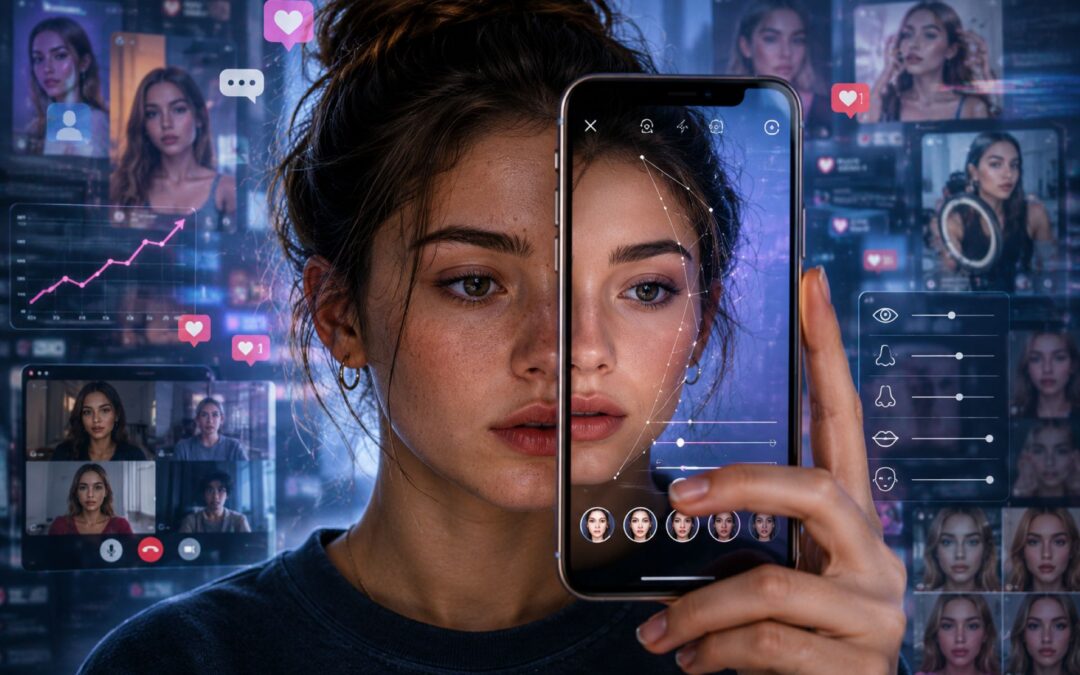
For most of human history, people did not look at their own faces very often.
They saw themselves in water, polished metal, mirrors, family photographs, bathroom reflections, shop windows, and the occasional bad passport picture. Their face belonged mostly to other people. It was something they lived through, not something they constantly inspected.
Then the smartphone arrived.
Suddenly, the face became portable.
You could see it anywhere: on the front-facing camera, in selfies, in video calls, in Instagram stories, in TikTok drafts, in dating profiles, in Zoom meetings, in tagged photos, in old memories resurfaced by an app, and in hundreds of tiny reflections across the day.
Then filters arrived.
And the mirror stopped showing your face.
It started showing a better one.
Smoother skin. Larger eyes. Narrower nose. Fuller lips. Sharper jaw. Brighter complexion. Lifted cheeks. Better lighting. Better angles. A face that still looked enough like you to feel personal, but corrected enough to make your real face feel unfinished.
That was the real shift.
Social media did not merely expose people to unrealistic beauty standards. Magazines, films, advertisements, and celebrities had already been doing that for decades.
Social media did something more intimate.
It gave people edited versions of themselves.
And once you have seen your own face improved by software, the original can start to feel like the mistake.
The Mirror That Follows You Everywhere
The old mirror had limits.
You stood in front of it, looked for a while, adjusted your hair, checked your clothes, maybe judged your skin, then walked away. The mirror stayed behind.
The smartphone mirror follows you.
It is in your hand, your pocket, your workplace, your bedroom, your car, your group chat, your social life. It does not only show you your face. It records it, stores it, edits it, distributes it, and ranks it through likes, comments, views, matches, shares, and silence.
That changes self-perception.
A mirror shows you a private image. Social media shows you a social image. It is not just “How do I look?” but “How will this perform?”
That question is brutal because the face becomes measurable. A selfie can succeed or fail. A story can get replies or none. A profile picture can attract attention or disappear. A TikTok can flatter your face in one angle and punish it in another.
The face becomes content.
And content is always being optimized.
This is why smartphone beauty pressure feels different from older forms of appearance anxiety. It is not occasional. It is ambient. You may not be consciously thinking about your face all day, but the infrastructure around you keeps making it visible, comparable, and correctable.
The result is a strange new habit: people watch themselves living.
They watch themselves talk on video calls. They watch themselves pose for selfies. They watch themselves in front-facing cameras before joining meetings. They watch themselves through filters before deciding whether the unfiltered version is acceptable.
The face is no longer only part of the body.
It is a screen object.
Beauty Standards Used to Belong to Other People
Before social media, beauty standards were still powerful, but they usually came from far away.
A movie star.
A supermodel.
A magazine cover.
A music video.
A billboard.
A fashion campaign.
The ideal was external. It belonged to someone else.
That distance mattered. You could compare yourself to a celebrity, but the comparison had some built-in absurdity. Of course they looked different. They had stylists, lighting, makeup artists, photographers, genetics, money, and professional image-making teams.
The beauty standard was unrealistic, but it was also recognizably produced.
Social media blurred that distance.
Influencers looked more accessible than celebrities. Friends started posting polished photos. Ordinary people learned professional angles. Apps gave everyone editing tools. Beauty culture moved from magazines into bedrooms, bathrooms, cars, classrooms, gyms, and workplaces.
The ideal stopped being rare.
It became everyday.
Then came the most powerful change of all: instead of only comparing yourself to other people, you could compare yourself to yourself.
A filtered selfie did not say, “Here is a famous person you will never look like.”
It said, “Here is what you could look like with a few small corrections.”
That is psychologically different. It makes the ideal feel close. Almost reachable. Almost real.
The gap between your actual face and your edited face can feel smaller than the gap between you and a celebrity. But that smaller gap may be more painful because it looks solvable.
A narrower nose.
A smoother forehead.
A lifted brow.
A sharper chin.
A brighter under-eye.
Once software can make those changes instantly, the mind begins to ask a dangerous question:
Why can’t real life?
Filters Made the Ideal Face Personal
The phrase “Snapchat dysmorphia” became popular because doctors began noticing a strange new pattern.
Patients were no longer bringing in only photos of celebrities. Some were bringing in filtered photos of themselves.
A medical article in JAMA Facial Plastic Surgery asked whether “Snapchat dysmorphia” was a real issue, noting that filtered selfies were affecting how people thought about cosmetic procedures. The concern was not simply that filters made people look better. It was that filters created a digitally altered self that people wanted to reproduce physically.
That is the hinge of the whole story.
The filtered face feels personal because it is built from your face. It keeps your identity but edits the parts that bother you. It does not replace you with someone else. It creates a version of you that feels more acceptable.
This makes it seductive.
A celebrity photo may inspire envy.
A filtered selfie creates a target.
That target can be hard to forget.
The filtered face becomes a kind of private advertisement: your face, but optimized. Your face, but more symmetrical. Your face, but without pores. Your face, but with better bone structure. Your face, but closer to the algorithm’s idea of beauty.
Time reported on this shift when doctors began discussing patients who wanted to look like Snapchat-filtered versions of themselves. The key change was not that people suddenly cared about beauty. They always had.
The change was that beauty became interactive.
You no longer had to imagine a better face. You could generate it, save it, send it, post it, and then feel disappointed when the mirror did not match.
This is not vanity in the old sense.
It is calibration.
The app teaches the eye what to expect. Then the real face fails the test.
When Edited Faces Started Looking Normal
At first, filters looked obvious.
Dog ears. Flower crowns. Cartoon eyes. Sparkles. Exaggerated smoothing. Plastic-looking skin.
They were playful because everyone knew they were fake.
Then filters became subtle.
They stopped looking like costumes and started looking like good lighting. They slimmed the face just enough. Smoothed the skin just enough. Lifted the eyes just enough. Warmed the complexion just enough. They created images that did not scream “edited.” They whispered “better.”
That is where the problem deepens.
When altered faces look obviously fake, people can mentally discount them. But when altered faces look natural, the brain starts updating its sense of normal.
A 2023 study on the virtualization of the face examined how photo editing and augmented-reality filters affect facial perception. One of the unsettling implications of this kind of research is that people may become increasingly adjusted to digitally modified faces.
In plain English: edited faces can start to look normal.
That matters because beauty standards are not only about extremes. They are about baselines. If everyone online appears to have smooth skin, symmetrical features, bright eyes, and sculpted proportions, then ordinary human variation starts to look like failure.
Pores become defects.
Texture becomes neglect.
Asymmetry becomes a problem.
Aging becomes a crisis.
A normal face becomes a before photo.
The strange thing is that no one has to say this directly. The feed teaches it through repetition.
Every scroll trains the eye.
Every filter trains the expectation.
Every edited face raises the floor.
Eventually, the problem is not that people believe every image is real. Many people know the images are edited. The problem is that knowing does not fully protect perception.
You can know a filter is fake and still prefer how you look with it.
You can know a photo is edited and still feel worse after seeing it.
You can know social media is curated and still compare yourself to it.
The rational mind knows the trick.
The eye adapts anyway.
The Cosmetic Surgeon’s New Reference Photo
Cosmetic surgeons used to hear a familiar kind of request: “I want her nose,” “I want his jawline,” “I want lips like this actor,” “I want to look like this model.”
Now some patients arrive with their own edited selfies.
That creates a new ethical problem.
A celebrity reference photo may be unrealistic, but it is at least external. A filtered selfie is more intimate. It suggests that the patient is not trying to look like someone else. They are trying to make their physical face match their digital identity.
A 2019 study in JAMA Facial Plastic Surgery found associations between certain forms of social media use and greater acceptance of cosmetic surgery, including links involving Snapchat filters. The point is not that social media causes every cosmetic procedure. People seek cosmetic treatments for many reasons. But the research supports what many doctors were already seeing: image-heavy platforms can increase openness to changing the face.
A later review on social media filters and plastic surgery argued that filters have reshaped patient demands and created new ethical challenges for surgeons, including the need for careful consultation, patient education, and psychological screening.
That matters because cosmetic procedures are not just technical services. They involve judgment.
A surgeon is not only asking, “Can I do this?”
They also have to ask, “Should I do this?”
If a patient wants to resemble a filtered image, what exactly is the doctor being asked to create? A healthier version of the patient’s desired appearance? Or a physical approximation of a face that never existed?
This becomes especially difficult because filters are not bound by anatomy. They can change light, skin, bone structure, proportion, and texture without respecting tissue, aging, healing, risk, or biology.
Software has no scar tissue.
The body does.
That is why the filtered face can become an impossible medical brief. It asks the human body to obey digital logic.
Zoom Turned the Face Into a Work Screen
Social media made people photograph and edit their faces. Video conferencing made them stare at their faces while trying to work.
During the pandemic, millions of people spent hours each day in Zoom meetings, Google Meet calls, online classes, webinars, interviews, and remote social events. For many, the strangest part was not seeing other people.
It was seeing themselves.
That little self-view box turned the face into a work screen.
People watched themselves listen. Watched themselves talk. Watched their eyes drift. Watched their chin angle. Watched their skin under bad lighting. Watched their nose distorted by laptop cameras. Watched their face move in ways mirrors had never shown them for so long.
This produced what became known as “Zoom dysmorphia” or videoconferencing dysmorphia. A 2022 article on Zoom dysmorphia linked the phenomenon to increased appearance concerns during the rise of video conferencing.
The issue was not only vanity. Video calls created a bad mirror and made it professional.
You could not always turn it off. You had to attend the meeting. You had to look presentable. You had to see your face next to everyone else’s. You had to perform competence while silently judging your own appearance.
A 2025 study in the Journal of Clinical and Aesthetic Dermatology found that videoconferencing and filter use influenced cosmetic-procedure interest, with frequent self-viewing strongly associated with interest in cosmetic procedures.
That is important because it shows how ordinary work technology became part of beauty culture.
You did not need to be an influencer.
You did not need to post selfies.
You did not need to chase likes.
You just needed a webcam.
The face became part of workplace performance. And because webcam images are often distorted by angle, lighting, lens quality, and proximity, people were not even judging their real faces. They were judging a technically warped version of themselves.
But the anxiety was real.
Algorithms Reward the Most Optimized Face
Social media platforms do not need to issue beauty rules.
They let performance metrics do the teaching.
If a certain kind of face gets more likes, views, comments, matches, saves, shares, and followers, users notice. Maybe not consciously at first. But over time, platform feedback trains behavior.
Better lighting performs.
Clear skin performs.
Symmetry performs.
Youth performs.
Expressive eyes perform.
Sharp features perform.
Certain poses perform.
Certain edits perform.
The algorithm does not need to believe in beauty standards. It only needs to reward what people already respond to.
This creates a loop.
Users post optimized images. Audiences engage with them. Platforms distribute them more widely. Other users learn what works. The standard spreads. Then the next round of images becomes even more optimized.
Nobody planned it as a global beauty curriculum.
But that is what it became.
The pressure is especially intense because social media collapses different kinds of visibility into one space. A person may use the same platforms for friends, dating, work, networking, entertainment, self-expression, and business. The face is always potentially public.
This changes how people present themselves.
A selfie is not just a memory. It may be social proof. A profile photo is not just identification. It may affect attraction, credibility, and status. A video is not just communication. It may become personal branding.
The face becomes a competitive asset.
Once that happens, editing feels less like deception and more like maintenance. Filters, angles, makeup, skincare, lighting, injectables, and procedures become part of the same continuum: ways to make the face perform better in visual culture.
That is the machine.
It does not force everyone to change their face.
It simply makes the optimized face more rewarding to have.
Teenagers Are Growing Up Inside the Edited Mirror
Adults can remember a time before filters.
Teenagers increasingly cannot.
That difference matters.
For someone who discovered filters later in life, the edited face may feel like a tool or enhancement. For someone who grows up with filters, the edited face can become part of identity formation. It is there during adolescence, when the body is already changing, comparison is already intense, and social belonging feels urgent.
This is why young people are especially vulnerable to image-heavy platforms.
A 2024 study on visual social media use found associations between appearance dissatisfaction and cosmetic procedure tendencies among young adults. A 2025 Cureus article examined the role of social media in rising body dissatisfaction and dysmorphia among adolescents. Mass General Brigham also summarized research linking frequent Instagram and Snapchat use among teenagers with body dysmorphic symptoms.
This does not mean every teenager who uses Instagram or Snapchat will develop a disorder. That would be too simplistic.
But it does mean the environment matters.
Teenagers are not only comparing themselves to classmates. They are comparing themselves to influencers, celebrities, edited peers, algorithmically selected faces, and filtered versions of themselves.
They are doing this while their own faces are still changing.
That can make ordinary development feel like a defect. Acne, baby fat, asymmetry, awkward angles, uneven skin, and facial growth are normal parts of being young. But on a filtered platform, normal adolescence can look like something to fix.
The danger is not only that young people want to be attractive. That is not new.
The danger is that they may never get a stable sense of what their own face looks like without correction.
Before they can accept the real face, they meet the edited one.
AI Will Make the Fake Face Feel Even More Real
Filters used to be limited.
Now artificial intelligence is making them more powerful, subtle, and convincing.
A simple filter smooths skin or changes proportions. AI can do more. It can relight a face, generate idealized portraits, enhance facial structure, remove imperfections, change age, alter expression, create synthetic headshots, and produce images that look natural enough to be believable.
This is the next stage of the problem.
The fake face will no longer look fake.
A Guardian report on virtual beauty and AI-led cosmetic culture explored how digital beauty is increasingly shaping real-world aesthetic expectations. The future of beauty pressure may not come from a magazine cover or even a filtered selfie. It may come from machine-generated versions of ourselves that look plausible, polished, and emotionally convincing.
That is more dangerous than obvious fantasy.
If an AI-generated version of your face looks like you on your best possible day, it may not feel like fiction. It may feel like a standard. It may feel like the face you should have had.
This will make cosmetic desire more complicated. People may no longer ask to look like celebrities, influencers, or even ordinary filtered selfies. They may ask to look like AI-enhanced identities: versions of themselves produced by tools that understand beauty patterns better than any human editor.
And because these images will be personalized, they may be harder to resist.
A generic beauty standard can be rejected.
A personalized one feels intimate.
That is the future social media is moving toward: not one beauty ideal for everyone, but a custom-generated beauty ideal for each person.
Your face, upgraded.
Your flaws, corrected.
Your future insecurity, pre-rendered.
The Problem Is Not Vanity. It Is Calibration.
It is easy to mock people for caring too much about their faces.
That misses the point.
The problem is not that people want to look good. Wanting to look good is human. People have decorated, styled, painted, groomed, shaped, and presented themselves for thousands of years.
The problem is that social media has changed the baseline.
It has trained people to see the face as editable. It has made comparison constant. It has made self-viewing unavoidable. It has made beauty measurable. It has made filters feel normal. It has turned the face into content, the content into performance, and performance into identity.
That is not just vanity.
It is calibration.
The eye is being recalibrated by images no human face can naturally sustain. The mind is being taught that normal skin is rough, normal aging is failure, normal asymmetry is wrong, and the real face is merely the unedited draft.
That is why the phrase “new face” matters.
Social media did not only make people want to look better. It made people feel that somewhere inside the phone, there is a more acceptable version of themselves waiting to be brought into real life.
The tragedy is that the real face was never the problem.
It was simply human.
The camera made it visible.
The filter made it insufficient.
The algorithm made it competitive.
The market offered to fix it.
And now millions of people carry a mirror that does not merely reflect them.
It negotiates with them.
Every day, it asks the same quiet question:
Wouldn’t you rather look like this?
Last Updated on June 9, 2026 by Aseem Gupta