
Reading Time: 32 Minutes
In 1997, Apple Computer was a company with an extraordinary past and a deeply uncertain future. It had helped bring personal computing into homes, introduced the Macintosh and made itself synonymous with creative independence. Yet its losses were mounting, its product catalogue was bewildering, and computers running Microsoft Windows had captured most of the market. The former challenger had become an expensive alternative that fewer customers were willing to buy.
Within a generation, the same company would make the iPod, transform the mobile phone, build one of the world’s richest software ecosystems and pass a stock-market valuation of $3 trillion. It would persuade millions to pay premium prices for devices sometimes less flexible than rivals, yet often easier to use. In the process, a struggling computer manufacturer became a business that influenced music, photography, publishing, retail, entertainment and everyday communication.
The contrast invites a deceptively simple explanation: Steve Jobs left, Apple failed, Jobs returned, and Apple succeeded. But that version overlooks the engineers, investors, designers and managers who made the products possible. It also overlooks Apple’s serious mistakes during Jobs’s first period, the infrastructure behind its later success, and the ways the company continued changing after his death. The history of Apple is a story of invention and timing, but also of financing, disagreement, organisational discipline and the difficult decision to replace a product while it is still successful.
Two Steves and the Birth of Apple
In the early 1970s, the region south of San Francisco was changing from a landscape of orchards and suburban neighbourhoods into a centre of semiconductor manufacturing and electronics. Silicon Valley already had major employers, but its particular energy came from the circulation of ideas between established firms, university laboratories, small workshops and people who liked building things for their own amusement. Personal computers were not yet ordinary consumer goods. Computing power was usually encountered through large institutional machines, shared terminals or specialised equipment, and using it often required considerable technical knowledge.
Steve Wozniak was the kind of engineer who found the technical problem itself irresistible. He worked at Hewlett-Packard, enjoyed working out how circuits functioned and tried to make electronic systems do more with fewer components. Steve Jobs, several years younger, shared his interest in technology but brought a different temperament. Where Wozniak took pleasure in an elegant circuit, Jobs was fascinated by how a device might become a product that strangers would want to own. Their differences could generate friction, yet their early partnership joined engineering ingenuity to an unusually forceful sales instinct.
The two had met through a mutual friend, Bill Fernandez, in 1971. They later moved through the informal electronics culture that helped create personal computing, including the Homebrew Computer Club. The club’s meetings were part demonstration, part technical exchange and part argument about what computers could become if they escaped the exclusive world of institutions. A capable computer on a desk at home sounded increasingly achievable as microprocessors and memory components became cheaper. Wozniak began developing a computer board that could put that possibility within reach of enthusiasts.
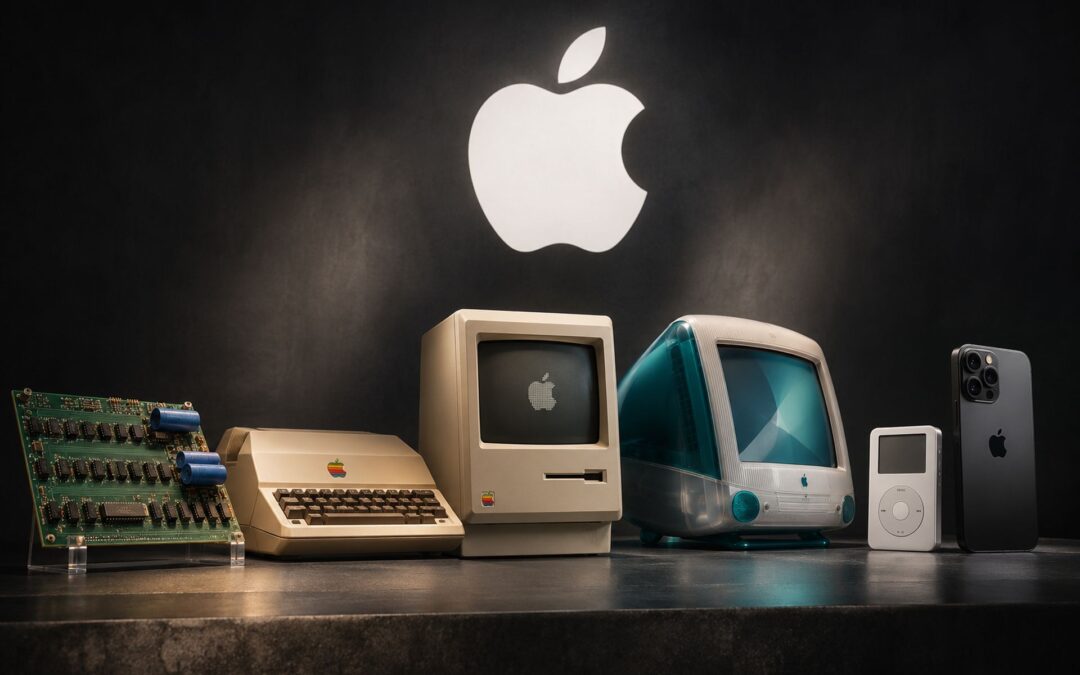
Wozniak’s early design eventually became the Apple I. It was a significant achievement because it brought together essential computing functions in an economical board, rather than leaving the buyer to assemble an entire system from unrelated circuits. Yet the difference between a clever hobbyist project and a business was not immediately obvious. Wozniak initially valued the pleasure of showing his design to other enthusiasts. Jobs saw a product and an opportunity to sell it, particularly if the necessary components could be purchased and assembled in sufficient quantities.
Money was the first obstacle. Early accounts describe Jobs selling a Volkswagen vehicle and Wozniak selling a programmable scientific calculator to help finance the venture. Their initial funds were modest, and the familiar figure of roughly $1,300 captures the scale of the enterprise more effectively than any grand story about venture capital. They needed enough money to buy parts, not enough to construct a modern corporation. Their ambitions were growing much faster than their balance sheet.
They also brought in Ronald Wayne, an older colleague of Jobs from Atari who could contribute experience with business paperwork and administration. On 1 April 1976, Jobs, Wozniak and Wayne established Apple Computer Company as a partnership. Wayne initially held a 10% interest and designed its elaborate first logo, which depicted Isaac Newton beneath an apple tree, before the simpler symbol that would become famous appeared. The company name was approachable rather than intimidating, a deliberate contrast with the technical language of much of the industry. Jobs’s time around an apple orchard and the useful prospect of appearing ahead of Atari in a directory are both part of the commonly told account of his choice.
Wayne’s position was uncomfortable from the beginning. He had more conventional assets to lose than his younger partners, and partnership obligations could expose him personally if the venture incurred debts it could not pay. Within roughly eleven or twelve days, he withdrew, accepting $800 for his interest; he later received an additional $1,500 in a settlement. The value that 10% might have acquired decades later makes the decision an enduring story of missed wealth. At the time, however, Wayne was not choosing between $800 and a guaranteed future fortune. He was refusing a risky liability in an enterprise whose survival was far from assured.
A decisive commercial test came from Paul Terrell, owner of the Byte Shop in Mountain View. Terrell wanted to sell an actual computer product to customers, not merely a bag of components, and placed an order for fifty assembled Apple I boards at about $500 apiece. The distinction matters: these were not complete modern computers with screens, keyboards and enclosed cases. Buyers still needed other equipment, but the preassembled board represented a meaningful step beyond the most demanding home-built kits. Terrell’s order gave Apple something rare for a new venture: a customer prepared to pay for a substantial initial batch.
Producing that batch required materials Apple did not yet have the cash to buy. Jobs approached suppliers and arranged credit against the expected sale, turning the retailer’s order into a practical argument for allowing the company to purchase components before receiving payment. Wozniak’s design made the product possible, while the order and credit arrangements made production possible. This was an early example of the collaboration that would define Apple’s commercial approach: sophisticated engineering joined to the ability to persuade other businesses to support a product that did not yet exist at scale.
The family garage in Los Altos became part of this story, but the usual image of two founders inventing the computer entirely at a garage workbench is misleading. Wozniak later explained that the engineering and prototyping occurred elsewhere, including his apartment and workplace. Boards were manufactured outside the garage; the Jobs family home was used for activities such as testing, correcting faults, packing and preparing deliveries. The garage was real, but its larger significance lies in the modest resources of the enterprise rather than in a precise claim about where every circuit was designed or assembled.
Apple sold the Apple I to other customers at a retail price of $666.66, a repeated-number price associated with Wozniak’s preference for such figures, not the sinister symbolism that later observers sometimes supplied. Only a few hundred units were made. That was a tiny production run compared with what Apple would later sell, yet it demonstrated that people were prepared to spend serious money on a compact computer. Jobs’s more consequential insight was that the audience could expand far beyond technically accomplished hobbyists if the entire experience became easier.
How the Apple II Turned a Hobby into an Industry
The Apple I asked its buyers to be interested enough in computing to supply much of what a working system required. The Apple II aimed at a different customer: someone who wanted a finished machine that could be placed on a desk, connected to a display and used without first becoming an electronics hobbyist. It still rewarded experimentation, but its form suggested a household appliance rather than unfinished laboratory equipment. The shift from a board to a recognisable consumer product changed both Apple’s manufacturing requirements and its potential market.
Wozniak supplied the core technical design, including the elegant circuitry that enabled colour graphics. Jobs pressed for a coherent exterior and a product that looked respectable in a home or office. The Apple II came with a keyboard and a moulded plastic enclosure, while an external display and storage devices completed the setup. These choices were not merely cosmetic. A computer that could be demonstrated clearly, operated conveniently and maintained as a dependable product was much easier to sell through ordinary retail channels.
Making that transition required an investment Apple could not finance through individual equipment sales alone. Mike Markkula, a former Intel executive who had already made money in the semiconductor industry, saw the promise of a much larger market. He provided financial support and helped secure a bank credit line of roughly $250,000, while bringing business planning and managerial credibility to the young enterprise. Markkula became a major shareholder and Apple’s first chairman. His contribution complicates the popular idea that the company grew solely because Jobs and Wozniak possessed unusual talent; someone also had to turn their machine into a viable manufacturing and sales operation.
The Apple II appeared in 1977 and gave Apple a product it could improve and sell over a period of years. It was not the only personal computer competing for attention, but its combination of usable hardware, display capabilities and increasingly capable software helped it establish a durable presence. The design also allowed expansion, so users could adapt the machine with additional hardware. For the first time, Apple had a product family that could develop alongside a growing market rather than depend on a brief burst of enthusiasm among specialists.
Its importance changed dramatically when VisiCalc arrived in 1979. The electronic spreadsheet let people alter numbers and see the effects on calculations without rewriting columns of arithmetic by hand. Someone preparing a budget, comparing business forecasts or modelling costs could change assumptions repeatedly and evaluate the consequences. The Apple II suddenly had a practical use that justified its purchase to people who might have had little interest in computers for their own sake. Software, rather than the specifications of the machine alone, became a compelling reason to own the hardware.
VisiCalc did not make all other computer applications irrelevant, nor was Apple the sole inventor of electronic spreadsheets. It showed how one powerful program could transform the economics of a platform. A computer might be attractive because it was well engineered, but customers often bought it because of what it allowed them to accomplish. That lesson would resurface much later when software and services drew people to the iPhone and kept them using it.
As the Apple II’s market expanded, Apple’s sales rose from a relatively small base to more than $100 million annually around the turn of the decade. On 12 December 1980, Apple went public at an offering price of $22 per share. The flotation generated enormous attention and substantial paper fortunes for early shareholders and employees. Jobs, only twenty-five, had become extraordinarily wealthy, while Wozniak and Markkula had helped build one of the defining young companies in an industry that was beginning to reshape work and home life.
The success carried an uncomfortable implication. Apple’s existing computers had created a market, but competitors were gaining confidence, and an expanding customer base would demand interfaces easier than the traditional command-driven experience. Jobs was already looking beyond the machine that had made him rich. The Apple II established that ordinary people would buy computers; the next challenge was to make them accessible to people who did not want to think like computer programmers.
The Macintosh Revolution and Steve Jobs’s Downfall
In 1979, Jobs visited Xerox’s Palo Alto Research Center, commonly called PARC, and saw work on graphical computing that contrasted sharply with the command-driven systems familiar to many computer users. Researchers there had developed interfaces involving windows, icons and a pointing device called a mouse. Instead of memorising typed instructions, users could manipulate objects on a screen and discover actions through visual interaction. The demonstration reinforced Jobs’s conviction that a computer’s interface could be as important as the computing hardware underneath it.
Xerox had not simply handed Apple an invention that Apple then sold unchanged. Graphical interfaces had a longer research history, PARC had pioneered important elements, and Apple’s engineers did substantial additional work to turn such ideas into commercial systems. The distinction matters because the strongest version of Apple’s achievement is not a claim that it invented the mouse or the graphical interface from nothing. It was able, eventually, to combine technologies, software and industrial design in a way that more ordinary customers could encounter and use.
One attempt was the Lisa, released in 1983. It brought a sophisticated graphical environment to a commercial personal computer, but its nearly $10,000 price put it beyond the reach of most prospective buyers. Performance, compatibility and the limited market for expensive office computers also constrained its prospects. The machine demonstrated technical ambition while exposing the gap between building something impressive and finding enough customers willing to purchase it. Innovation could increase costs faster than it created demand.
Jobs became deeply involved in the smaller Macintosh project, which promised a more accessible graphical computer. The group working on it developed a distinct internal identity, partly by resisting conventional company processes. Jobs encouraged the idea of a small team creating something exceptional rather than merely following the requirements of a large organisation. The pirate flag associated with the Macintosh building became a visible symbol of that rebellious spirit. It was effective at building commitment, but it also reflected a management style that could turn disagreement into personal conflict.
Apple’s public introduction of the Macintosh was almost as carefully crafted as the computer. The advertising agency Chiat/Day devised a television commercial inspired by George Orwell’s Nineteen Eighty-Four, with an anonymous crowd watching a dominating figure on a giant screen. Directed by Ridley Scott, the advertisement culminated in a woman racing forward and smashing the screen with a hammer. The message positioned Apple as a liberator from technological conformity, implicitly challenging the growing power of IBM in personal computing.
The famous Super Bowl broadcast occurred on 22 January 1984, two days before the Macintosh was officially introduced. It became a landmark in television advertising because its imagery was memorable and because broadcasters replayed it as news. The oft-repeated assertion that the commercial aired only once needs qualification: it had also appeared in a limited local showing in December 1983. What mattered commercially was that Apple used a single major national exposure to make a new computer feel like a cultural event.
On 24 January, Jobs unveiled the Macintosh at Apple’s shareholders’ meeting. The compact beige computer displayed a graphical interface, offered a mouse and presented users with windows, menus and icons. Its presentation suggested that interacting with a computer could be direct and even entertaining. Jobs’s staging was designed to make the machine seem like a new kind of personal companion rather than another box of electronics, and the product quickly acquired an unusually devoted following.
Reality was more complicated than the launch suggested. The original Macintosh had only 128 kilobytes of memory, limited storage and a relatively small selection of software. Its graphical interface demanded resources, making some operations feel slow, while its closed design offered less flexibility than users accustomed to expandable systems might want. Early enthusiasm did not translate into indefinitely rising sales. The Mac eventually built particular strengths in fields such as design and desktop publishing, but it was not an immediate general-purpose replacement for every established PC.
Meanwhile, Apple’s internal politics had become unstable. In 1983, Jobs had recruited John Sculley, an executive at Pepsi, to become chief executive. A widely repeated account credits Jobs with challenging Sculley to choose between continuing to sell sugary drinks and helping change the world. Whether recalled word for word or not, the story conveys Jobs’s appeal: he could make a corporate job sound like participation in a historic mission. Yet the relationship between the two men deteriorated as they disagreed about management, sales performance and the company’s direction.
Sculley had been hired in part to provide discipline to a fast-growing business. Jobs, however, remained an influential founder with strong views and an increasingly difficult relationship with colleagues. The Macintosh’s commercial difficulties sharpened those tensions. In 1985, Apple directors supported a reorganisation that deprived Jobs of operational control of the Macintosh business. It is common to describe this as Jobs being fired from Apple, but he was not immediately dismissed from every position. He lost the authority that mattered to him and eventually decided that remaining offered little future.
Jobs resigned in September 1985 and sold most of his Apple shares, reportedly retaining a single share. He was thirty. The company had not only lost a charismatic founder but revealed an unresolved conflict between ambitious product invention and the institutional management needed for a growing corporation. Jobs would spend the next decade pursuing new ventures; Apple would discover that removing him did not automatically solve its deeper strategic problems.
Apple Loses Its Way Without Steve Jobs
Apple did not fall apart the moment Jobs walked out. It retained technically capable people, profitable businesses and customers who valued the Macintosh experience. The company improved its computers, expanded their capabilities and benefited from an increasingly important market among designers, publishers and other creative professionals. As page-layout software, graphics tools and laser printing matured, the Mac became a distinctive working environment for businesses that cared about type, images and visual presentation. A loyal customer could have good reasons to prefer it even when competitors offered cheaper machines.
The difficulty was that the wider personal-computer market was moving in another direction. IBM-compatible computers could be assembled and sold by many manufacturers, allowing customers to choose among different prices, components and suppliers. Microsoft Windows gradually made graphical interfaces available across that broad hardware ecosystem. The Windows experience was not identical to the Mac’s, especially in its early versions, but it improved while the economies of scale became increasingly difficult for Apple to match. A software developer choosing where to invest could reach far more potential customers by serving the larger Windows market.
Apple’s tightly integrated approach gave it meaningful advantages in consistency and control, but also placed limits on price competition and market reach. Because Apple designed the operating environment around its own hardware, customers generally needed to purchase an Apple computer to use the Mac system. Competing PC manufacturers could fight for customers in countless retail and business segments, while Apple bore more of the burden of maintaining a distinctive platform. The question was not simply whether one operating system looked nicer. It was whether the benefits of integration outweighed higher prices and a smaller library of compatible applications for enough buyers.
As the 1990s progressed, Apple’s offerings became harder to understand. Several Macintosh families contained models whose numbers and specifications differed in ways that were not apparent to consumers. Instead of one clear choice for a home buyer and another for a professional, the catalogue presented overlapping machines, frequent revisions and competing explanations of which computer suited which task. Complexity spread beyond marketing. Developing, manufacturing, stocking and supporting so many variations consumed resources that a smaller organisation could not easily spare.
Apple continued experimenting. The Newton MessagePad, introduced in 1993, envisioned a portable personal digital assistant that could organise information and accept handwriting. Its ambition was remarkable, but the early handwriting-recognition experience became a target of jokes, and the category struggled to justify its cost and limitations to mainstream buyers. It would be unfair to treat the Newton as proof that Apple had stopped inventing. The problem was almost the opposite: the company had several interesting ideas without a reliable means of deciding which deserved sustained investment and how to turn them into large, profitable markets.
Leadership changes did not solve the underlying tension. John Sculley left the chief-executive role in 1993, Michael Spindler succeeded him, and Gil Amelio took over in 1996. Each confronted some combination of product complexity, operational difficulties, competitive pressure and the costly challenge of modernising Apple’s software. None could restore sustained confidence quickly enough. Apple’s financial troubles became particularly severe in the middle of the decade, with losses exceeding a billion dollars over the troubled 1996–1997 period.
The Mac’s operating system was also showing its age. It had been designed in an earlier era of personal computing and lacked some capabilities that were becoming essential to modern systems, including a robust foundation for multitasking and memory protection. Apple pursued internal modernisation efforts, but they struggled to deliver the replacement its future products needed. By 1997, the company faced not merely declining sales but a problem of direction: it needed a credible operating-system future and a convincing reason for customers to choose its computers again. The solution would arrive through an unlikely purchase from the founder it had lost.
NeXT, Pixar and the Road Back to Apple
Jobs did not leave Apple to spend a quiet decade watching its mistakes. He established NeXT in 1985, hoping to build sophisticated computers for universities and other demanding users. The ambition reflected an idea he had never abandoned: powerful computing could become more useful when hardware, software and design were developed together. NeXT’s machines attracted attention for their striking appearance and advanced operating environment, but they were expensive and sold in relatively limited numbers. Jobs had again produced an impressive product without discovering a sufficiently broad commercial market for it.
The computers nevertheless contained valuable technology. NeXTSTEP incorporated features and software-development tools that made sophisticated applications easier to build and manage. Its modern foundations offered an alternative to Apple’s increasingly fragile classic Mac operating system. NeXT eventually concentrated more heavily on software, even as its hardware business failed to become the next Apple. Commercial disappointment in one form did not mean that its engineering work had become useless; that distinction would later matter enormously.
Jobs pursued another venture that appeared even farther removed from personal computers. George Lucas’s film operation included a computer-graphics group developing techniques and equipment for digital imagery. In 1986, Jobs purchased the division and established it as an independent company called Pixar. Descriptions of the transaction commonly cite $10 million, combining the purchase and his initial investment commitments rather than representing a single simple payment for a successful studio. Pixar initially had formidable technical talent but no guarantee that computer animation would support a sustainable feature-film business.
The new company worked on graphics technology, animation tools and short films while searching for a commercially workable model. Its eventual success required more than Jobs’s money: Ed Catmull and Alvy Ray Smith had helped build the technical organisation, and John Lasseter and fellow artists developed an approach to characters and storytelling that audiences could care about. Pixar’s relationship with Disney became crucial in reaching cinemas. The studio’s own history of its development traces the path from Lucasfilm’s computer division to the independent company and its film-making breakthrough.
In 1995, Toy Story became the first feature-length film produced entirely with computer animation. Its achievement was technological, but its cultural impact depended on an engaging story and characters rather than the novelty of computer-generated pictures alone. Pixar went public shortly after the film’s release, and Jobs’s substantial ownership stake dramatically increased his wealth. He was becoming a billionaire through a venture that had initially looked like an expensive side bet. The episode demonstrated his continued willingness to back a technology whose practical audience was not obvious at the beginning.
At Apple, the search for a new operating system eventually brought executives to NeXT. The company considered different technical routes, including licensing technology from outside suppliers, because its existing software could not comfortably support the future it needed. In December 1996, Apple announced that it would acquire NeXT, with the transaction valued at approximately $429 million. The deal was intended to provide a modern software foundation, not to arrange an emotional reunion with Jobs. Yet it also returned him to the organisation whose trajectory he had once helped define.
Jobs initially came back as an adviser rather than immediately reclaiming executive control. Gil Amelio remained chief executive during the early part of 1997, and the board’s confidence in his leadership deteriorated amid continuing losses. After Amelio’s departure, Jobs assumed a growing role and became interim chief executive in September. He was now in a different position from the thirty-year-old founder who had left in anger. He had learned something about failure, organisational power and the difficulty of finding customers for technically brilliant products. Just as importantly, NeXT supplied Apple with technology that could support a new generation of Mac software.
The return was not guaranteed to succeed. Jobs had led NeXT into commercial difficulty, and Pixar’s triumph could not by itself fix Apple’s manufacturing, distribution or competitive problems. What changed was that Apple once again had a leader prepared to make hard choices about what the company would not build. Those choices would matter at least as much as any dramatic product demonstration.
The Turnaround: Focus, Microsoft and the iMac
Jobs returned to an organisation with too many products, too many unresolved projects and too little money to pursue all of them. His most famous response was to reduce Apple’s future computer portfolio to a simple framework: consumer and professional customers on one axis, desktop and portable computers on the other. Instead of dozens of overlapping configurations, the company would concentrate on four principal product roles. The diagram worked because it was more than a marketing slogan. It gave engineers, designers, sales teams and managers a shared answer to the question of which projects deserved resources.
For employees who had devoted years to ambitious products, the decisions could be brutal. Jobs stopped initiatives that did not fit the narrower strategy, including the Newton program, and curtailed other work that might have looked promising in isolation. Apple also moved to end licensing arrangements that allowed outside manufacturers to sell Macintosh-compatible clones. Those machines had enlarged the number of computers able to run Mac software, but Apple feared they were taking sales from its own higher-margin hardware rather than expanding the overall market sufficiently. Reasserting control reduced one source of competition inside Apple’s relatively small ecosystem.
This was not a lesson that every company should copy. Eliminating projects can remove valuable ideas, while proprietary control can limit customer choice and alienate partners. In Apple’s particular circumstances, however, the alternative was continued fragmentation at a time when it could not afford to fund numerous competing bets. A strategy becomes meaningful when it changes resource allocation. Jobs’s four-part matrix told the company to choose coherence over the appearance of variety.
A second rescue measure was both commercial and symbolic. In August 1997, Jobs appeared at the Macworld event in Boston and announced an agreement with Microsoft, whose Windows platform had long been Apple’s most formidable rival. Microsoft would invest $150 million in non-voting Apple preferred stock, while the companies addressed outstanding patent disputes and established arrangements involving software, including continued Microsoft Office support for the Mac. When Bill Gates appeared by satellite video, the reaction included audible boos from an audience accustomed to treating Microsoft as the enemy.
The money mattered, but it should not be described as though a single $150 million cheque saved Apple on its own. The 1997 corporate filing documents the investment and associated arrangements. Commercially, continued access to Office helped reassure buyers that a Macintosh could participate in the working world dominated by Microsoft applications. Legally, the settlement reduced uncertainty and distraction. Symbolically, the agreement suggested that Apple could survive by offering a differentiated product rather than treating every competitor as an existential enemy.
Operational discipline also mattered. Apple needed more reliable manufacturing, tighter inventory management and clearer decisions about which systems to support. Tim Cook, who joined in 1998, would become important to that work, but the broader direction was already clear: Apple could not sell premium products successfully if unsold stock and a sprawling supply chain destroyed the profitability of those products. Design, finance and operations had to reinforce one another rather than pulling in separate directions.
The iMac made the strategy visible in 1998. Designed under the leadership of Jony Ive and Apple’s design team, it abandoned the anonymous beige-box appearance of many personal computers. The machine had a curved, translucent Bondi-blue enclosure with a built-in display, colourful details and a handle. Its appearance mattered partly because it was memorable, but also because it communicated that computing did not have to be visually intimidating. Apple was making a device people might want to display on a desk rather than conceal underneath it.
The iMac also simplified the promise of getting online. Its packaging and marketing stressed approachable setup at a time when connecting a home computer to the internet could be frustrating. Meanwhile, Apple omitted the floppy-disk drive, a decision critics saw as premature. The company expected customers to move towards network connections and newer forms of storage. This was a calculated risk: abandoning an established feature could make the product feel cleaner and more modern, but it could also inconvenience people still relying on that feature every day.
Customers responded strongly. Apple sold large numbers of iMacs within months of launch, giving the brand renewed public energy and retailers a product that could be demonstrated immediately. The company’s results improved and profitability returned during the turnaround period. Yet the iMac’s importance went beyond its sales figures. It proved that a simplified product range, distinctive industrial design and a focused customer proposition could work together to create demand in a market otherwise dominated by relatively interchangeable computers.
The turnaround was therefore not simply the tale of Jobs arriving with superior taste. NeXT gave Apple a credible software foundation, Microsoft supplied commercial reassurance, narrower products reduced organisational confusion, and disciplined operations made successful sales more profitable. The colourful iMac was the public face of a reconstruction whose less visible parts were equally necessary. Apple had survived, but its leaders were no longer content to remain one premium computer maker among many.
The iPod and Apple’s Reinvention of the Music Business
At the beginning of the twenty-first century, digital music presented a peculiar opportunity. People were learning to store songs as computer files, but the experience was often fragmented. Music might come from CDs that had to be copied onto a computer, downloaded files with uncertain quality or legality, and portable players whose storage limits and awkward interfaces made them frustrating to use. Music piracy exposed enormous consumer demand for convenient digital access, even as record companies worried that their established sales model was being dismantled.
Apple approached the problem through a series of connected products. In January 2001, it introduced iTunes as software for organising and playing digital music on a Mac. Later that year, it launched the iPod, a compact portable music player with a distinctive white design and a mechanical scroll wheel that made navigating a large song collection comparatively easy. Its most memorable proposition was simple: a thousand songs in your pocket. Apple was not the first company to make an MP3 player, but it made the entire experience of carrying and finding music feel more coherent.
The relationship between the iPod and the computer was crucial. Users could manage music on a familiar screen and synchronise it with their portable player rather than perform every task through tiny buttons and menus. Apple’s expertise in combining hardware and software gave it a practical advantage over manufacturers that treated the device as an isolated gadget. The iPod was also a fashion statement; its white earbuds became instantly recognisable, and its advertising made the act of listening to music appear energetic and personal rather than technical.
In 2001, Apple opened its first retail stores, another move that drew scepticism. A company whose market share was modest was investing in expensive physical spaces rather than relying entirely on other retailers. Yet the stores gave Apple direct control over how its products were demonstrated, explained, purchased and serviced. Customers could try the devices, ask questions and experience the relationship between the Mac and the iPod without depending on a retailer whose sales staff might know competing PCs better. Retail became another part of the integrated experience.
The digital-music strategy became more powerful in 2003 with the iTunes Music Store. By negotiating with record labels, Apple offered individual tracks at a familiar price of 99 US cents, giving consumers a convenient authorised alternative to illegal file-sharing. The arrangement did not end piracy or solve every disagreement about digital rights, and purchased music initially came with restrictions. Nevertheless, it proved that customers would pay for music when the price and the process seemed reasonable. Labels gained a new distribution channel, while Apple made its music player more attractive.
This was a second reinvention for Apple. Rather than simply selling a device and waiting for the next hardware upgrade, it could improve the value of that device through software, licensed content, retail support and a growing relationship with customers. As the iPod expanded into different sizes and price ranges, Apple became central to a business far beyond personal computing. But the more successful the iPod became, the more exposed Apple was to a future in which a different kind of device could play music just as well.
How the iPhone Changed Apple and the Entire Smartphone Industry
By the middle of the 2000s, mobile phones were becoming capable of taking pictures, playing music and accessing the internet. The functions were often inconvenient, constrained by small displays, awkward software and carrier-controlled services, but the direction was clear. A phone accompanied its owner almost everywhere. If it could become a good music player, why would that owner carry an iPod as well? Apple faced the possibility that its celebrated new business might be undermined by a device another company made.
Jobs chose to confront that threat instead of protecting the iPod indefinitely. Developing a phone was difficult: Apple would need expertise in wireless networks, batteries, compact components, software and the requirements imposed by mobile operators. There were also competing ideas inside the company about how to build the product. Rather than assume that adding a telephone function to an existing device would be enough, the team worked towards a touch-driven computer that could also make calls. The decision demanded investment in a market already occupied by powerful manufacturers.
On 9 January 2007, Jobs presented Apple’s answer at Macworld in San Francisco. He introduced what sounded like three separate products: a widescreen iPod with touch controls, a revolutionary phone and a breakthrough internet communications device. Repeating the descriptions, he let the audience discover that all three belonged to one machine. The original iPhone announcement described a large multi-touch screen, web browsing, email, maps and a software keyboard. The presentation made the device’s ambition immediately understandable: this was meant to be more than a telephone with a few additional features.
The first iPhone went on sale in June 2007. It lacked the physical keyboard that many BlackBerry users valued and that numerous industry observers considered essential for serious communication. Apple instead let the screen change according to the task, becoming a keyboard when text was needed and providing a larger area for photographs, web pages or music controls at other times. The interface used familiar actions such as tapping, dragging and pinching. These elements were not all invented by Apple, but their integration in a successful consumer handset altered expectations about how a smartphone should behave.
The original product had real limitations. Its mobile-data capabilities were modest by later standards, it did not initially offer the third-party application marketplace that would define subsequent iPhones, and some familiar phone functions were missing or constrained. Nor did it instantly conquer the industry. Existing handset makers had enormous distribution networks, established customer relationships and extensive experience with mobile hardware. BlackBerry remained particularly attractive to organisations that depended on secure messaging and centralised device management, while Nokia sold phones across an astonishing range of markets and prices.
What Apple was changing, however, was the central question people asked of a phone. Traditional handset design had often started with calls, messages and physical controls. The iPhone encouraged customers to see the handset as a flexible pocket computer, capable of acquiring new functions through software. That shift did not immediately erase the strengths of BlackBerry’s enterprise messaging system or Nokia’s vast mobile-phone business. It gradually changed the basis on which those strengths were judged.
The larger turning point arrived in July 2008 with the App Store, launched alongside Apple’s expanding iPhone software platform. Apple opened a controlled distribution channel through which outside developers could offer applications to customers. As Apple’s retrospective on the App Store’s first decade records, the store began with 500 applications. The number soon grew, as did the range of tasks people could perform without using a conventional computer. A phone could become a navigation device, a game console, a banking tool or a platform for services that had not existed when its hardware was manufactured.
This was a different economic proposition from selling standalone gadgets. More users attracted developers, useful applications made the phones more attractive, and a larger customer base encouraged further investment in software. Apple governed access to the store and earned revenue from parts of the transaction flow, while developers gained a distribution system they did not have to construct individually. The arrangement created opportunities but also disputes about fees, review rules and Apple’s power to decide which applications could reach its customers. Integration brought convenience and a substantial gatekeeper role at the same time.
The iPhone also threatened the iPod more effectively than any external rival might have done. As smartphones became central to daily life, many consumers no longer needed a separate music player, compact camera or portable internet gadget. Apple had willingly made its former flagship category less necessary. It was a commercial gamble that succeeded because the company captured a much larger market than portable music players alone could provide. The story illustrates a difficult principle: protecting a successful product is not always the same as protecting the future of the business.
Apple extended the same family of software and interface ideas to the iPad, introduced in 2010. Tablets existed before the iPad, just as smartphones existed before the iPhone, but Apple’s model helped establish a mass market for a larger touch-screen device suited to reading, media, games and certain kinds of work. By then Apple’s value no longer depended on convincing the world that a Mac was better than a Windows PC. Its business rested increasingly on portable devices linked to software, services, content and one another.
Tim Cook and the Making of a Technology Empire
Behind Apple’s most celebrated product launches, Steve Jobs was confronting a serious illness. He had been diagnosed with a rare form of pancreatic cancer in 2003 and subsequently underwent treatment, including surgery. His health became a matter of intense public speculation, partly because investors and customers associated Apple’s success so closely with his personal judgement. In August 2011, Jobs resigned as chief executive and recommended Tim Cook as his successor. On 5 October, only weeks later, Jobs died at fifty-six.
Cook was not simply a less theatrical replacement for a charismatic founder. He had joined Apple in 1998 after working in operations and supply chains, and his contributions had helped make the company’s ambitious product launches commercially reliable. A device can have excellent design and still fail if factories produce too few units, components arrive late or warehouses accumulate unsold models. Cook specialised in aligning suppliers, inventory, production and demand, turning operational efficiency into a strategic advantage. It allowed Apple to sell enormous quantities of premium products while continuing to revise them frequently.
The transition raised an obvious question: could Apple remain inventive after losing the person most closely identified with its product vision? Cook did not attempt to reproduce Jobs’s stage presence or management style. Instead, the company continued developing its existing platforms while introducing complementary products and expanding its service businesses. Its enduring competitive advantage increasingly appeared to be an institution capable of creating and delivering integrated experiences, not merely a sequence of inspired decisions by one individual.
In 2015, Apple brought the Apple Watch to market. It extended the iPhone’s ecosystem to the wrist, offering notifications, fitness tracking and health-related functions in a device that worked closely with the phone. AirPods followed in 2016, combining compact wireless earbuds with relatively simple pairing and integration across Apple devices. Neither category was invented by Apple. Their commercial importance came from making accessories feel like natural extensions of the products customers already used, encouraging deeper attachment to the wider ecosystem.
Services also became central to Apple’s financial identity. The App Store, iCloud, Apple Music and other subscriptions and digital offerings generated revenue long after a customer purchased a device. They helped reduce Apple’s dependence on the timing of individual hardware upgrades, although the services remained closely connected to the installed base of iPhones, Macs and other products. A customer with photographs in iCloud, purchased applications, a watch and wireless headphones might find the system convenient; that same collection of purchases and habits could make moving to another platform more troublesome.
Apple’s commercial scale became remarkable. In August 2018, it became the first publicly traded American company to reach a $1 trillion market capitalisation. In 2020, it crossed $2 trillion, and in January 2022 its market value briefly reached $3 trillion during trading. Market capitalisation is the value investors assign to a company’s outstanding shares, not an amount of cash sitting in its bank account. Still, the milestones showed how dramatically expectations had changed since the period when Apple’s continued survival was openly questioned.
Apple’s control over its underlying technology deepened in 2020 when it began moving Macs away from Intel processors towards its own Apple Silicon chips, starting with the M1 family. The company had already designed processors for its mobile devices and could now apply that expertise across its computer range. Custom silicon made it possible to optimise the relationship between processing power, energy consumption, operating-system functions and hardware design. The transition was gradual rather than an overnight abandonment of every Intel Mac, but it strengthened Apple’s ability to coordinate choices across the product as a whole.
That integration came with trade-offs. Customers could gain efficiency, consistent performance and devices that worked smoothly together, while repair choices, software distribution and compatibility with competing ecosystems could be more restricted. Apple’s control of the App Store also made it a participant in arguments over platform access and developer economics. The same architecture that offered customers convenience gave Apple influence over other businesses that depended on its devices. Its size made those questions difficult to dismiss as minor disagreements about product preferences.
In 2024, Apple released the Vision Pro, a headset designed to blend digital windows and immersive experiences with the physical surroundings. It was a conspicuous attempt to imagine computing beyond a conventional screen, but its high price and demanding form made widespread adoption uncertain. Apple had often succeeded by entering an existing technological category and turning it into an approachable product for a much larger audience. Whether spatial computing would follow the same pattern remained an open question, not a victory that could be declared at launch.
Cook’s era therefore combined continuity with change. Apple still valued distinctive hardware, carefully designed software and premium positioning, but it became an enormous operation supported by recurring services, specialised chips and a global network of suppliers and developers. Its achievement was not to recreate the original Macintosh or iPhone moment every year. It was to build a business resilient enough to prosper through many years when no single new device transformed the market in quite the same way.
Apple at Fifty: A New Leader and an Unfinished Story
On 1 April 2026, Apple reached fifty years since its founding. The anniversary invited an unusually broad perspective: the company that marked five decades of innovation had survived changing owners, executives, technologies, competitors and customer expectations. It had begun by selling a computer board to enthusiasts and reached a point where its phones, computers and services influenced how millions of people work, communicate and entertain themselves. Its progress had never been a smooth climb, and its anniversary was as much a reminder of past vulnerability as a celebration of scale.
There was another major development shortly after the anniversary. On 20 April 2026, Apple announced a planned leadership transition: Tim Cook would become executive chairman and John Ternus, previously senior vice president of Hardware Engineering, would succeed him as chief executive on 1 September. That announcement came after the anniversary and after the period to which an early-April retrospective naturally belongs. It nevertheless marks an important subsequent chapter in Apple’s history, with a leader whose career was rooted in the hardware organisation that created many of its recent products.
The year’s financial figures placed the scale of that responsibility in context. In its fiscal 2026 results, reported after the September year-end, Apple recorded approximately $478.8 billion in annual revenue, including $123.3 billion from services. The company’s 2026 annual filing also showed that the iPhone remained its largest product business. These were later developments, not figures known at the start of April. They demonstrate how the organisation that once struggled to finance a small order for computer boards had become capable of generating annual sales on a scale that would have been unimaginable to its founders.
Success did not remove the underlying strategic questions. Apple’s ecosystem gave customers continuity across devices, but its dependence on the iPhone left it sensitive to changes in smartphone demand and competitive expectations. Its global supply chain brought extraordinary efficiency alongside exposure to international tensions and manufacturing disruptions. Advances in artificial intelligence challenged technology companies to rethink how people interact with software, while Vision Pro showed that Apple’s attempts to create a major new computing experience could still face obstacles of cost, comfort and practical usefulness.
The tension between control and openness remained unresolved as well. Apple’s close management of hardware, operating systems, applications and services could make products coherent and reliable. It could also constrain developers, limit user flexibility and invite scrutiny over the company’s power to set rules for a market in which other businesses hoped to compete. The approach was neither an automatic guarantee of superior products nor simply a defect. It was a consequential strategic choice whose benefits and costs changed as Apple became larger.
The history of Apple makes more sense when its failures remain part of the account. The Lisa was innovative but expensive; the first Macintosh was compelling but constrained; the Newton was ambitious without a mass audience; and the 1990s showed that an impressive reputation could not compensate for fragmented products and weak execution. The comeback worked because the company matched technical possibilities to commercial realities, concentrating resources where it could make a distinctive product and a sustainable business around it.
That pattern also explains why replacing the iPod with the iPhone was more important than simply building another successful gadget. Apple recognised that its customers’ needs would not remain fixed around the products that had served them yesterday. At fifty, it faced the same difficult task on a far larger scale: deciding which familiar strengths were worth protecting and which assumptions might need to be discarded. Long after the first Apple I boards were tested and packed for the Byte Shop, the central challenge was still to make advanced technology useful enough that people would want to bring it into their lives.
Last Updated on November 14, 2026 by Aseem Gupta