
Reading Time: 32 Minutes
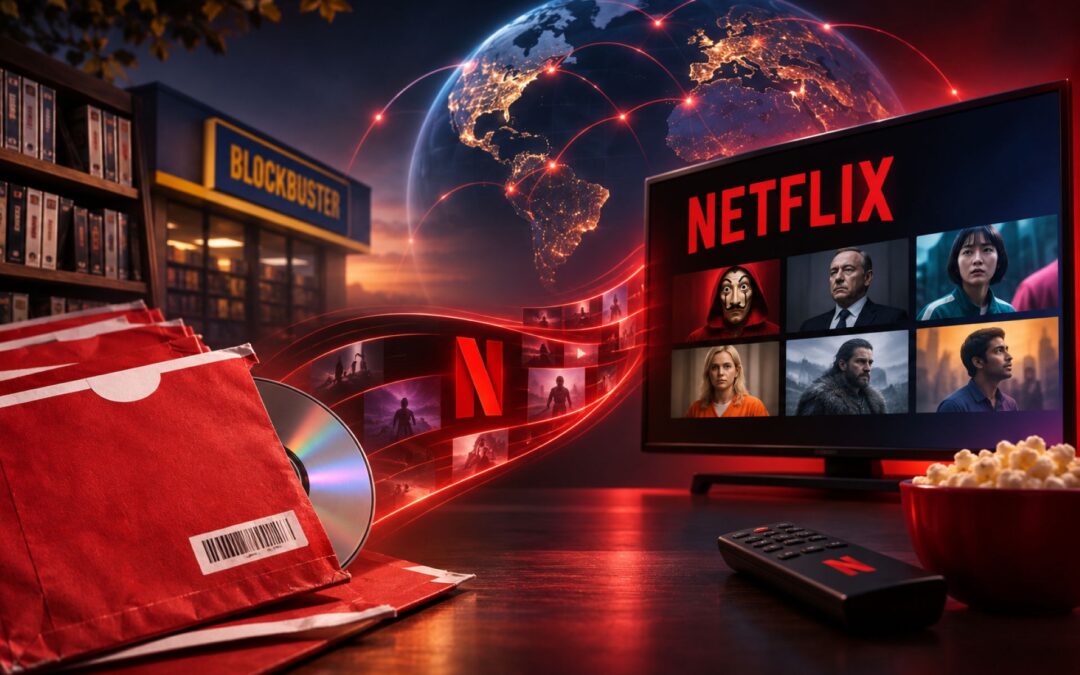
In September 2000, two entrepreneurs from California visited the headquarters of Blockbuster in Dallas. Their young company rented DVDs through the mail, had yet to prove that its business could make money, and was running short of cash. Reed Hastings and Marc Randolph hoped the world’s dominant video-rental chain might pay $50 million for Netflix and give it responsibility for building an online rental operation. Blockbuster did not buy it.
That decision became a legend of business history. In one version, senior executives could barely suppress their laughter at the proposal. The people involved do not agree about what happened in the room, but the ending is beyond dispute: ten years later, Blockbuster entered bankruptcy protection, while Netflix was on its way to transforming how people watched films and television.
It is an irresistible contrast, and also an incomplete explanation. Netflix did not merely spot an opportunity that Blockbuster missed. Its founders began with the wrong pricing model, struggled to deliver discs economically, endured the collapse of the dot-com boom, angered customers with a disastrous corporate restructuring, and repeatedly took risks on businesses in which they had little experience. At several points, their survival was far from certain.
More remarkably, the company that succeeded was barely recognizable as the one that started. A website selling individual DVD rentals became a subscription service. A mail-order operation became an internet television platform. A distributor of Hollywood films began commissioning its own productions, then financing stories in languages and countries far beyond its American origins. The history of Netflix is not a single victory over a video store; it is the history of a company learning to abandon the methods that had once made it successful.
The Two Men Behind Netflix
Wilmot Reed Hastings Jr. was born in Boston in 1960. He studied mathematics at Bowdoin College in Maine, graduating in 1983, but took an unconventional route into the technology industry. He joined the Peace Corps and spent two years teaching mathematics in Swaziland, the southern African country now called Eswatini. The experience demanded patience, improvisation and a willingness to work outside familiar institutions, although it would be misleading to treat his later management philosophy as an inevitable result of those years.
Back in the United States, Hastings earned a master’s degree in computer science from Stanford University. In 1991, he founded Pure Software, which made tools that helped programmers discover errors and improve software performance. It addressed an unglamorous but important problem: as computer programs became more complicated, developers needed better ways to detect why they failed. The company grew, acquired other businesses and eventually merged with Atria Software.
Running Pure Software taught Hastings more than how to build technology. As the workforce expanded, the company developed the procedures and layers of management that rapidly growing organizations often adopt to maintain control. Hastings later described frustrations with bureaucracy and with his own decisions as an inexperienced manager. Those experiences helped shape his interest in building a future company that could remain effective without allowing procedures to overwhelm judgment.
The merged company was acquired by Rational Software in 1997 in a transaction valued at roughly $700 million. Hastings, then in his late thirties, had gained the financial independence to attempt something new. Yet money alone did not produce the idea for Netflix, and he did not develop it in isolation.
Marc Randolph had worked in direct marketing and technology businesses. Where Hastings brought engineering experience, capital and an appetite for large structural change, Randolph understood customer acquisition, testing offers and the practical difficulties of selling a product people had never purchased in that way before. Both had worked at Pure Software, and they began discussing new ventures during long commutes between Santa Cruz and Silicon Valley.
The car became a laboratory for ideas that were often more curious than promising. They discussed personalized shampoo, customized baseball bats and sending dog food to people’s homes. Each raised questions about how much consumers would pay, whether the products could be distributed affordably and whether the internet made the offering substantially better. Dog food, for example, might arrive conveniently at a customer’s door, but the weight of the product made shipping an expensive proposition.
The wider commercial environment made the exercise worth pursuing. Amazon had shown that people were prepared to order books through a website rather than browse only in neighborhood stores. An internet retailer could present a vast catalog, collect information about customers and operate without placing every available item on a local shelf. The founders began searching for a category in which these advantages would matter, rather than merely transferring a familiar storefront onto a computer screen.
Movies offered a tempting possibility. They had widespread appeal, customers often wanted titles unavailable at nearby shops, and the existing rental business carried familiar irritations. But an online movie business would still have to move a physical product across the country. In the mid-1990s, that product was usually a VHS cassette: bulky, relatively heavy and costly to send through the post. The solution appeared when the medium itself began to change.
How a DVD in the Mail Became Netflix
The DVD entered the American market in March 1997. Compared with a videotape, a disc was small, thin and light. It also offered the promise of better picture quality and a more durable viewing format, although initially very few households owned a compatible player. For a company contemplating movie rentals by mail, its most interesting characteristic was not the improved image but the possibility of inexpensive delivery.
Randolph has recounted an informal experiment that captured the founders’ way of thinking. He bought a compact disc, put it in an ordinary envelope and mailed it to Hastings. The disc reportedly arrived safely the following day, with postage costing about 32 cents. This did not establish that a nationwide rental service would work: actual DVDs still had to survive repeated handling, travel in both directions and be tracked accurately. It did show that sending a disc was a different proposition from shipping a cassette.
Their proposed company was initially called Kibble, a name Randolph associated with an earlier dog-food idea and the principle that a product had to appeal to its customers. The corporate incorporation record confirms that the business was formally established as Kibble, Inc., on 29 August 1997. The more recognizable name combined the language of the internet with that of movies: Netflix, using a stylized form of “flicks.”
The Netflix website began operating on 14 April 1998. It employed roughly 30 people and offered about 925 DVD titles, a substantial share of the films then available in the format. A visitor could search online, choose a movie and have a disc delivered, without visiting a rental counter. The selection was an important promise from the start, because no single local shop could realistically keep every release available to every customer.
The service was not yet the subscription company people later remembered. Customers initially paid around $4 per rental, along with shipping charges, and overdue discs could incur late fees. This made Netflix look less like a revolutionary alternative to Blockbuster than a version of conventional renting that replaced the car trip with a postal delivery. For spontaneous movie nights, the store could still be faster. Netflix also had to persuade customers that it would reliably send the right disc, in working condition, and handle returns without confusion.
A more dramatic founding story circulated widely in later interviews. Hastings supposedly rented Apollo 13 from Blockbuster, misplaced the tape beneath a pile of laundry, rediscovered it weeks later and faced a $40 late fee. Embarrassed by the charge, he resolved to create a rental business without such penalties. The tale is easy to remember because it gives an enormous corporate transformation a single, recognizable starting point: the annoyance of paying for a movie long after watching it.
Randolph has challenged that account as a simplified origin story rather than the event that actually launched the company. Netflix’s original use of late fees is another reason not to treat the tale as a literal description of its initial business model. The underlying irritation was real, and eventually important, but the founders’ opportunity was broader. They wanted to exploit a new medium and an internet catalog that could offer more choices than the shelves of any one store.
Even that promising combination presented serious problems. Discs needed protective packaging and a dependable return procedure. Orders had to be matched with stock, mailed to customers, inspected after return and dispatched again. Each lost or damaged DVD represented a cost, and every day a customer waited made the service less attractive than an immediate rental. Netflix had to invent not just a website, but a physical distribution business precise enough to make the website useful.
The Subscription Model That Changed Movie Rentals
In 1998, a particularly awkward obstacle confronted Netflix: the market for DVD rentals was still tiny. A household with a VHS player could browse the aisles of Blockbuster, but it could not use Netflix’s growing DVD catalog without buying different hardware. The company’s potential customers were therefore not simply all the people who watched movies. They were the much smaller group who had recently purchased DVD players and were searching for films to play on them.
Netflix pursued those customers at the point of purchase. It arranged promotions with DVD-player manufacturers and retailers, offering rental incentives or trials to people who bought the new devices. The strategy did two things simultaneously. It reduced the cost of reaching people who were likely to need the service, and it associated Netflix with the excitement of a new technology rather than with the inconvenience of waiting for the mail.
The founders still faced the daily arithmetic of distribution. An order was only useful if the title was available, the correct disc was selected, the envelope was addressed properly and the package reached its destination quickly. When the customer finished watching, another chain of events had to happen in reverse. Netflix gradually built distribution facilities closer to customers and improved its systems for tracking inventory, recognizing that an extra day of waiting could make the difference between a service people tolerated and one they recommended.
The original transaction-based model was difficult to sustain. A customer who rented only occasionally generated little revenue, while each shipment involved postage, processing and the possibility of replacement costs. Worse, the customer faced a new decision and another charge every time they wanted a film. What looked like a convenient online shop still made entertainment feel like a series of separate purchases.
In September 1999, Netflix began offering monthly subscriptions. For a flat fee, customers could keep an agreed number of DVDs at home at once and work through a larger list of titles over time. There were no ordinary due dates and no conventional late fees. When a subscriber returned one disc, Netflix could send the next available movie from the queue. The promise of renting as many movies as desired was therefore constrained by simultaneous-disc limits and the speed of postal circulation, rather than being an unlimited supply delivered instantaneously.
The queue changed the experience of choosing a film. Instead of driving to a store and deciding what to rent that evening, customers could build a list whenever they thought of something interesting. Netflix then handled the sequence, sending the next available title when a slot opened. The subscriber had less control over the precise day a particular film arrived but more control over the library of movies they wanted to explore.
The disappearance of late fees also altered the emotional transaction. A customer could keep a disc for several nights without worrying that a forgotten return would generate a penalty. Netflix did not eliminate the economic cost of a disc sitting in someone’s home: that copy could not be rented to another subscriber. It transferred the problem from a customer-facing fine to an internal challenge of predicting demand, setting subscription prices and circulating inventory efficiently.
This was a fundamental business-model shift. With individual rentals, revenue depended on every completed transaction; under a subscription, money arrived regularly even if a member watched few movies during a particular month. Heavy users could still be expensive, especially when they mailed back discs rapidly, but a broad base of customers gave the company recurring income and better information about demand. It also made a continuing relationship more valuable than a single successful sale.
Netflix did not immediately arrive at a perfect formula. It experimented with membership terms and pricing, and for a time the old rental arrangements existed alongside the subscription offer before being abandoned. The company had given up the possibility of earning extra money from missed return dates in exchange for a relationship customers could understand and manage more easily. That gamble mattered because it addressed not only what consumers bought, but what made them reluctant to use a rental service in the first place.
The postal operation remained labor-intensive, and the economics were still precarious. Yet the model now had a distinctive advantage over visiting a store: people could treat a large, centrally managed catalog as an ongoing service rather than an errand. It was this combination of selection, subscription and the removal of traditional penalties—not simply putting DVDs on a website—that eventually gave Netflix a reason to exist beside Blockbuster.
The $50 Million Offer Blockbuster Rejected
For decades, Blockbuster had defined what convenient home entertainment looked like. David Cook opened its first store in Dallas in October 1985, combining a large movie inventory with computerized tracking and a brighter, more standardized retail experience than many independent rental shops offered. Under Wayne Huizenga, the chain expanded rapidly through acquisitions and franchising. Viacom acquired Blockbuster in 1994 in a deal valued at roughly $8 billion, and the familiar blue-and-yellow signs eventually appeared at thousands of locations.
A store gave viewers something Netflix could not provide: the chance to carry a movie home immediately. The weekly visit had become a social ritual, complete with shelves of new releases, staff recommendations, games and snacks. At the same time, Blockbuster depended on leases, employees, inventory and the continual movement of physical customers through its shops. It also collected substantial amounts in overdue charges. Contemporary reporting put late-fee revenue in 2000 at approximately $796 million, around 16 percent of total company revenue, making the penalties both a source of income and a source of resentment.
The arrangement exposed a structural difficulty. Eliminating unpopular fees might make customers happier but undermine a profitable practice; building an online service might attract new subscribers while drawing business away from expensive stores. Those dilemmas would later feature prominently in Blockbuster’s rise and collapse. In 2000, however, the chain still looked formidable, and Netflix was the company in immediate danger.
The dot-com boom had encouraged investors to fund internet companies long before their business models were proven. When markets turned and confidence faded, startups that had assumed more money would always be available suddenly had to justify their losses. Netflix was spending heavily on customer acquisition, stock and distribution while serving a still-developing market for DVDs. Its founders needed a route to survival and saw Blockbuster’s immense customer base as a possible partner.
Hastings and Randolph traveled to Dallas with a proposal valued at $50 million. The basic logic was that Blockbuster could continue operating its stores while Netflix took responsibility for developing the online side. In Randolph’s firsthand recollection, the executives listened and reacted with incredulity to the asking price. He has described a moment in which the Blockbuster team appeared to struggle not to laugh. The dramatic scene became an enduring illustration of an incumbent underestimating a challenger.
But it is not a scene on which every participant agrees. In John Antioco’s subsequent account, the Blockbuster chief executive said that he was not part of the meeting itself, although he greeted the visitors, and disputed the suggestion that serious acquisition negotiations had taken place. He acknowledged that the Netflix team apparently offered to sell for $50 million. The documentary record and competing memories support the conclusion that a business proposal was made and no acquisition followed, not a definitive reconstruction of who laughed or exactly what was said.
It is also worth remembering how uncertain the decision looked at the time. Netflix had not proven that a DVD-by-mail subscription could reliably earn money. Blockbuster possessed a recognized brand, physical distribution, industry relationships and a way to satisfy viewers who wanted a film immediately. Rejecting a risky acquisition was not automatically irrational simply because the target later became extraordinarily successful. The future success of the buyer would have depended on how the combined organization behaved, not merely on signing a check.
Blockbuster eventually responded more directly to the challenge. It launched a DVD-by-mail operation in 2004 and announced the end of traditional late fees in its stores in early 2005. The latter initiative provoked controversy because certain replacement charges could still apply when movies were kept beyond specified periods. The attempt to present the service as fee-free demonstrated how difficult it was to remove a painful customer practice without also changing the system of obligations and revenue behind it.
The stronger counterattack came in November 2006 with Total Access. Subscribers to Blockbuster’s online service could exchange eligible mailed DVDs for rentals at participating stores. This combination offered something Netflix lacked: the broad selection of mail delivery alongside the possibility of an immediate in-store choice. Customers responded, and Netflix took the rival seriously. But the model was costly: postage, generous exchanges, store staffing and film inventory could make enthusiastic subscribers unprofitable.
Antioco believed investment was needed to build a viable future beyond traditional stores. Activist investor Carl Icahn and other directors were concerned about spending, losses and the debt already burdening the company. Their conflict, alongside disputes over executive compensation, contributed to Antioco’s departure in 2007. His successor, Jim Keyes, placed more emphasis on profitability and adjusted the online offering, reducing some customer benefits. Those changes lost subscribers while improving certain costs; neither side of the argument proves that Total Access would have succeeded indefinitely under the old terms.
The collapse came through several pressures rather than one rejected deal. Cheap DVD sales, Redbox kiosks and eventually streaming weakened traditional rentals. Stores became expensive to support as traffic declined, while debt limited the room to experiment. The 2008 financial crisis compounded the strain. Blockbuster filed for Chapter 11 bankruptcy protection in September 2010, and DISH Network later bought substantially all its assets. The surviving independently operated Blockbuster in Bend, Oregon, preserves a small piece of the once-dominant chain’s identity, but not its business model at national scale.
By then, Netflix was moving into a new industry altogether. The famous Dallas rejection had become a symbol of the contest, but the important distinction was deeper: Netflix had been willing, repeatedly, to change what it sold and how it delivered it. Blockbuster had attempted change too, yet struggled to finance that change while maintaining the infrastructure of its original success.
How Red Envelopes Became a Profitable Business
Netflix’s survival after the Dallas meeting was not assured. The company cut expenses and concentrated on the subscription operation while the dot-com crash narrowed its options for raising money. The rising popularity of DVD players helped at precisely the moment it needed a larger market. As hardware prices fell and the format spread into ordinary households, a service once suited mainly to early adopters began reaching families accustomed to renting movies regularly.
Netflix’s distribution network had to expand alongside demand. The red envelopes became a recognizable part of American mailboxes, but their simplicity concealed a complicated routing system. Returned discs had to be identified, inspected and made available for another customer, often from a strategically located distribution center. Shortening the interval between sending one movie back and receiving the next mattered because it made the subscription feel more generous without requiring Netflix to eliminate the physical limits of postal delivery.
On 23 May 2002, Netflix went public with its shares priced at $15. The initial 5.5 million shares offered represented $82.5 million in gross proceeds, before expenses; an additional allotment subsequently raised the total. In its public offering prospectus, Netflix described a business built around customer subscriptions, online movie selection and a network intended to deliver DVDs quickly. Investors were being asked to support not merely a dot-com retailer but a technology-assisted physical distribution system.
The next years finally supplied evidence of commercial viability. Netflix passed one million subscribers in 2003 and recorded its first annual profit that year. By the end of 2004, it had more than four million subscribers. These milestones were important partly because the company had spent so long trying to prove that the costs of buying films, attracting customers and mailing discs would not overwhelm membership revenue.
The distinctive red envelope also helped turn a technical process into something recognizable. Customers did not need to remember a website address each time they watched a film; the next movie could simply appear in the post. It was a physical brand identity built for a business that had originally hoped to transcend the local video store.
Choice remained Netflix’s greatest advantage and its next challenge. A neighborhood rental shop had limited shelf space and usually promoted whatever was new or in heavy demand. Netflix could draw on a central catalog that included older titles, independent films and niche genres, with far more possibilities than a small store could display. Yet a larger library was only useful if subscribers could find something worth watching among those possibilities.
To address that problem, Netflix developed a personalized recommendation system called CineMatch. Subscribers rated movies they had seen, and the software used those responses to estimate which other titles they might enjoy. The approach was not a magical understanding of individual tastes; it relied on patterns across large numbers of ratings, along with the limitations and biases of the data people supplied. But recommendations made the catalog less intimidating and helped obscure films find audiences without the promotional budgets of a major release.
In October 2006, Netflix offered $1 million to researchers who could improve its recommendation accuracy by 10 percent. The contest drew researchers from around the world, combining statistics, computer science and machine learning in an unusually public competition. After nearly three years, the company awarded the Netflix Prize in September 2009 to BellKor’s Pragmatic Chaos, a collaboration of competing teams that had achieved the required improvement.
The prize mattered even beyond the winning algorithm. It showed that Netflix understood its advantage as more than warehousing and shipping movies. The company was also gathering signals about what people wanted to watch and using those signals to make an enormous selection manageable. This expertise would grow increasingly important when movies stopped arriving in envelopes and began arriving as digital streams.
The Risky Decision to Move From DVDs to Streaming
As Netflix’s postal business became profitable, Hastings was already contemplating the possibility that its most recognizable product would become unnecessary. DVDs were a highly effective way to deliver movies in the early 2000s, but they imposed a delay and cost every time a customer wanted to watch something. Sending information across the internet promised a more radical kind of convenience: no journey to a store, no return envelope and no waiting for a physical copy to become available.
The idea was easier to imagine than to execute. Broadband connections were not equally available or reliable, and video files required far more bandwidth than ordinary webpages. Consumers often watched entertainment on television sets that were not connected to the internet. Studios controlled the rights to their films and were wary of distributing them in a format that might weaken existing sales and licensing arrangements. Netflix could see the direction of technological change without knowing how quickly those obstacles would disappear.
In January 2007, the company introduced a feature that allowed subscribers to watch selected films and television episodes on their personal computers. Its 16 January announcement described a gradual rollout over six months and an initial streaming library of about 1,000 titles, compared with more than 70,000 available through its DVD catalog. Streaming came as an additional benefit for eligible members rather than an immediate replacement for their discs.
The difference between the two catalogs was striking. Netflix’s mail customers could choose from a vast physical selection, while the new streaming feature offered a relatively small collection and viewing on a computer screen. Picture quality depended on the connection, and buffering could interrupt the experience. The DVD service remained better for many films and many households.
Hastings nonetheless believed digital delivery could eventually make the service more convenient and scalable. For mail rentals, every additional viewing involved a physical object that had to travel and be processed. Streaming required expensive technology and licensing agreements but could send a title to many different homes without individually mailing a disc for each viewing. Once the digital system existed, the economics and speed of distribution began to look fundamentally different.
The television problem was especially important. A company trying to replace video stores could not succeed forever by asking families to watch their favorite films on laptop and desktop screens. Netflix engineers worked on a small device that could receive video through the internet and display it on a television. The project raised a strategic question: should Netflix manufacture the box itself, gaining direct control over the experience, or should it persuade other companies to build equipment that could run Netflix?
The solution involved Anthony Wood and Roku, a company he had already founded. Netflix developed an internal player project and, in 2008, shifted that effort into Roku’s orbit rather than pursuing a proprietary Netflix-branded device. The distinction matters because Roku was not simply a company conjured into existence in 2008. As described in a contemporary account of the streaming hardware strategy, Netflix chose a model in which its service could reach customers through hardware makers with their own expertise and commercial incentives.
If Netflix tried to compete with every company making living-room devices, those companies would have less reason to integrate its application. By giving up exclusive control of the hardware, Netflix increased the number of screens through which subscribers might reach it.
Netflix moved onto the Xbox 360, other game consoles, set-top boxes, Blu-ray players, smart televisions and eventually phones and tablets. Each new device removed a little friction. Customers no longer needed to know which machine or disc format carried a particular film; they increasingly expected their subscription to be waiting whenever they switched on a screen.
Meanwhile, the nature of the competitive threat changed. Netflix had once competed mainly with rental stores and DVD-by-mail services. Digital delivery placed it alongside cable television, satellite providers, studios and technology platforms. The company would have to obtain streaming rights, keep applications working across different devices, and deliver video dependably at enormous scale. Its original logistical expertise did not solve those problems, but its experience in software, customer accounts and personalization gave it a starting point.
For a time, DVDs and streaming reinforced one another. The physical service offered depth of selection, while streaming offered immediacy for the titles available. Yet the faster streaming improved, the less obvious it became that the two businesses belonged together. Netflix was approaching a difficult transition in which the delivery system responsible for its rise would increasingly compete with the one expected to secure its future.
Freedom, Responsibility, and the Qwikster Disaster
Netflix’s willingness to change was not only a matter of products. Hastings wanted a company where employees could exercise judgment without waiting for permission at every stage. He had experienced what growing bureaucracy could do at Pure Software, and Netflix became an experiment in managing a fast-moving organization around unusually explicit expectations rather than elaborate procedural controls.
The philosophy became widely known as freedom and responsibility. Employees were expected to act in the company’s interests, communicate candidly and own the consequences of their choices. Netflix became famous for its flexible vacation approach, under which salaried employees were not generally assigned a conventional fixed annual allowance. The absence of a strict limit did not mean that everyone could leave whenever they wished: workload, team commitments and managerial expectations still shaped what was practically possible.
The other side of freedom was demanding. Netflix emphasized high performance, was prepared to pay competitively for people it considered exceptional and did not promise lifelong employment. Its so-called keeper-test philosophy asked managers to consider how strongly they would fight to retain a particular employee. Critics argued that this could create insecurity and pressure to perform, even while admirers praised the clarity and autonomy it offered. The culture suited some people better than others, and its success cannot be reduced to one personnel policy.
In August 2009, Hastings published an extensive presentation setting out the company’s approach. The Netflix culture presentation circulated widely through the technology industry, introducing executives and workers elsewhere to a style of management that treated context and individual judgment as alternatives to elaborate permission systems. Netflix later revised the document as its scale and circumstances changed, but its emphasis on performance and responsibility remained recognizable.
A culture that encouraged bold decisions could also produce spectacular mistakes. In 2011, Netflix faced the task of turning a company still associated with DVD deliveries into a serious streaming business. Customers who took both services had benefited from a bundle, while the economics of each were diverging. A disc sent by mail imposed postage and processing costs; an online viewing session depended on digital rights, technology and bandwidth. Netflix needed to invest in streaming without pretending the two products cost the same to provide.
In July 2011, it announced separate prices for DVDs and streaming. For certain customers who wanted to keep both, the combined price rose by as much as 60 percent. People who had come to associate Netflix with predictable value saw the change as a sharp break in the bargain. A price increase might have been commercially defensible, but the way it was introduced made many customers feel that a familiar service was being taken away.
Then came an even more confusing announcement. In September, Hastings said the DVD business would be renamed Qwikster, while Netflix would concentrate on streaming. Customers who wanted both services would deal with separate brands and accounts, creating the prospect of different websites and bills for what had previously felt like one relationship. The company seemed to be making the experience more complicated just as its customers had come to rely on Netflix for removing complications.
Hastings acknowledged the poor communication and apologized, but his explanation did not immediately calm the backlash. The company had correctly recognized that streaming and postal rentals were becoming distinct operations; it had underestimated how much customers valued the Netflix brand and the simplicity of accessing both offerings together. In an examination of the episode, strategy analysts later distinguished the logic of separating business economics from the damaging choice to split the customer-facing brands.
The financial and reputational consequences were severe. Netflix lost roughly 800,000 subscribers in the third quarter of 2011, and its stock fell dramatically from the highs it had reached earlier that year. The fall cannot be interpreted as the effect of Qwikster alone, since pricing and wider concerns about the business were also involved. Nevertheless, the controversy showed how quickly customers could punish a company whose appeal depended on convenience and trust.
In October 2011, Netflix abandoned the Qwikster branding plan. The announced separation never proceeded in the form customers had been shown, although the distinction between DVD and streaming pricing remained. Hastings had not been wrong to see the long-term importance of streaming; the mistake lay in confusing internal strategic clarity with a better experience for people using the service.
The episode was a useful counterweight to stories that portray Netflix as uniformly prescient. A business can recognize where an industry is heading and still move too abruptly, explain itself poorly or overlook what customers actually value. Netflix survived the controversy partly because it reversed a specific decision without abandoning the technological transition that had prompted it. The company was forced to learn that changing its business model did not give it permission to discard the relationship built around the old one.
From Renting Hollywood’s Movies to Making Its Own
Streaming introduced a problem that mailing discs had never posed in quite the same way. A DVD in Netflix’s inventory was a physical item it could circulate to customers under ordinary rental arrangements. Streaming a title required digital distribution rights, often governed by separate contracts, territories and time limits. The company might build an excellent video service only to find that the entertainment people wanted was owned by studios with little incentive to remain dependent on it.
As streaming gained popularity, Hollywood companies began reconsidering what they had licensed. A film or television series that made Netflix attractive could also be used to strengthen a studio’s own services or negotiate higher fees. The better Netflix became at delivering other companies’ entertainment, the more those companies could see it as a competitor. The company needed not only a convenient platform but a dependable supply of programming that rivals could not easily withdraw.
It began developing and acquiring series presented as Netflix originals. The distinction between commissioning a show from scratch and securing exclusive distribution rights is important: not every early Netflix original was produced in exactly the same way or owned outright by Netflix. The company’s first original series was Lilyhammer, which debuted on Netflix on 6 February 2012. The Norwegian-American crime comedy, starring Steven Van Zandt as a former gangster adjusting to life in Norway, demonstrated an appetite for distinctive programming beyond a familiar Hollywood formula.
Netflix later commemorated the tenth anniversary of its original-series history by explicitly recognizing Lilyhammer as the beginning, a useful correction to the common claim that House of Cards was its very first original. House of Cards was nevertheless a much larger statement of ambition. With David Fincher involved as an executive producer and Kevin Spacey starring, the political drama signaled that Netflix intended to compete for prestige television audiences, not merely provide a convenient home for older movies.
Netflix made an unusually substantial commitment to the series, reportedly agreeing to two seasons in a deal widely described as costing around $100 million. It proceeded without the conventional American television process of first producing a pilot and waiting for a network to determine whether a full season should follow. The decision did not mean that Netflix possessed certainty about the program’s success. It meant the company believed the combination of creative talent, audience information and its subscription model justified taking a risk that traditional broadcasters often divided into smaller stages.
When House of Cards arrived in February 2013, Netflix released the complete first season at once. Conventional networks had trained viewers to return weekly for new episodes, with schedules structured around broadcast slots and advertising inventory. Netflix’s model allowed subscribers to decide whether to watch one episode at a time or spend a weekend moving through an entire season. Binge-watching existed long before Netflix, particularly through recorded television and DVD box sets, but the platform helped make the full-season release a mainstream expectation.
Orange Is the New Black, which also debuted in 2013, showed that Netflix was not limited to one genre or audience. The prison comedy-drama combined a large ensemble cast with stories about race, class, punishment and relationships, attracting critical acclaim and a substantial audience. Together, such shows suggested that Netflix could build subscriber loyalty through programming people associated with the service itself rather than with a conventional television channel.
There was a commercial logic behind the creative expansion. An exclusive series could persuade someone to join Netflix, give an existing subscriber a reason to stay and strengthen the brand in markets where other platforms offered similar licensed films. Releasing an entire season also changed the rhythm of attention: a show could become the subject of intense conversation over days or weeks instead of depending on a weekly broadcast schedule.
But the costs were formidable. Commissioning series required advance commitments to actors, writers, production crews, locations and marketing. Some expensive programs failed to attract enough viewers, while successful ones could create pressure for even greater spending. Netflix had exchanged dependence on studio licensing for exposure to the risks of being a studio itself. Its recommendation systems might help people discover original shows, but they could not guarantee that a creative production would become a hit.
That shift altered the company’s identity. Netflix no longer existed simply to deliver movies more conveniently than a video store; it was becoming an organization capable of determining which stories were financed, which creators received opportunities and how audiences around the world encountered them. The next transformation would extend that role far beyond the United States.
How Netflix Became a Global Entertainment Company
The internet made it technologically plausible for Netflix to reach viewers across borders, but international expansion demanded much more than switching on a website. Copyright licenses could be limited to particular countries, payment preferences differed, connection speeds varied, and audiences expected programming in languages they understood.
Netflix expanded gradually at first, moving into Canada in 2010 and then into parts of Latin America and Europe. Each market helped it learn about local internet infrastructure, licensing negotiations, consumer purchasing power and competition. A service that was convenient in Los Gatos needed to feel equally natural in São Paulo, Madrid, Seoul and Mumbai.
On 6 January 2016, Netflix announced a dramatic acceleration. During a presentation at the Consumer Electronics Show in Las Vegas, Hastings revealed that the service was becoming available in more than 130 additional countries. The simultaneous international launch greatly expanded its reach, although licensing restrictions and other barriers meant that it did not instantly serve every country or offer the same catalog everywhere.
The new scale created an important cultural question. Would viewers in dozens of countries mainly watch American shows, or could Netflix invest in local stories and circulate them internationally? It increasingly chose both. Subtitles and dubbing made programs accessible beyond their original languages, while regional commissioning helped audiences see familiar places, conflicts and styles of storytelling on a platform that had begun as a US movie-rental business.
Productions from Spain, South Korea, India and other markets became important parts of the strategy. The Spanish crime drama Money Heist developed a vast international following through Netflix, showing how a series originally created for one national market could find a second and much larger life abroad. Indian originals and films gave the platform ways to appeal to audiences with different language preferences and viewing habits. Localized interfaces and promotional campaigns mattered because distribution alone could not make unfamiliar entertainment attractive.
The breakthrough most closely associated with Netflix’s global identity was the Korean survival thriller Squid Game, released in 2021. Its story of financially desperate contestants playing deadly versions of children’s games became an international phenomenon, reaching audiences far beyond South Korea. Its achievements need to be interpreted using Netflix’s stated measurement periods and viewing metrics rather than treated as an eternal, unqualified ranking of every show ever made. The broader significance was clear: a Korean-language drama could become one of the world’s most discussed television events through a platform available across continents.
The strategy changed what international success meant for producers. A show no longer needed to be remade in English to reach a substantial American audience, and a regional production could become valuable to Netflix subscribers in many other countries. This offered opportunities for creators and introduced commercial pressure to produce stories that might travel. It also raised questions about how fairly the economic rewards of a global hit were shared among platforms, creators and production partners.
International growth came with substantial complexity. Netflix had to balance global brands with local expectations, comply with different regulations and manage the cost of licensing or commissioning content for diverse markets. Competitors included domestic streaming services, established broadcasters, US technology companies and studios building their own platforms. The company that once needed to understand a single country’s DVD postage now had to understand the economics and cultural preferences of audiences around the world.
The End of the Red Envelope and Netflix’s Next Challenge
Becoming a global streaming leader did not free Netflix from the forces that had weakened its earlier competitors. As Disney, Amazon and other companies developed or expanded their own services, viewers gained more options but also more subscription bills. Studios reclaimed desirable titles for their platforms, and Netflix had to spend increasingly large sums to make its own library distinctive. Success had made it an industry power, but it had also made maintaining that position expensive.
After years in which rising subscriber totals had seemed almost inevitable, Netflix reported quarterly net subscriber losses in 2022 for the first time in more than a decade. Some losses reflected circumstances such as its withdrawal from Russia, while slowing growth in other markets exposed the limits of relying on new subscriptions to support ever-rising content budgets. Investors responded sharply, and the company had to explain how it would attract and retain customers in a more mature streaming market.
One response was to introduce a less expensive, advertising-supported subscription tier. For years, Netflix had been strongly associated with viewing without conventional commercial interruptions, so the new plan represented another alteration of its identity. Yet it also gave price-sensitive viewers another way to subscribe and created an additional revenue stream. Advertisers, in turn, were attracted by the possibility of reaching audiences who spent substantial time watching television outside traditional broadcast schedules.
Netflix also began restricting widespread password sharing, encouraging households that had been using someone else’s account to pay for their own memberships or use approved additional-member arrangements. The policy generated criticism from viewers who felt that informal account sharing had long been part of the Netflix experience. From the company’s perspective, however, viewing by people who contributed no subscription revenue limited the money available to fund entertainment. The controversy resembled earlier pricing debates in one respect: a practice customers appreciated could become a problem for the economics of the service.
The platform’s creative decisions brought their own tensions. Netflix could offer an immense variety of films and series, yet viewers sometimes complained that finding a compelling title among so many thumbnails was exhausting. Popular programs might be canceled after relatively short runs, frustrating fans who had invested in their characters and stories. A company that once distinguished itself through abundant choice now had to decide how much choice customers could value and how many costly programs it could sustain.
Leadership also evolved. In January 2023, Hastings stepped away from the co-chief-executive role, becoming executive chairman, while Ted Sarandos and Greg Peters became co-CEOs. Sarandos had played a central role in the original-content strategy, while Peters brought extensive product and operational experience. The transition indicated that Netflix was no longer a founder-led experiment organized primarily around one entrepreneur’s decisions; it was a large entertainment and technology business facing the demands of continued growth.
That same year, Netflix closed the operation that had started everything. On 29 September 2023, the company shipped its final DVDs, ending 25 years of disc delivery. The announcement was brief, but the meaning was substantial. The product that had first allowed Netflix to compete with video stores had become a separate legacy business serving a much smaller group of loyal customers. Its disappearance marked the completion of the company’s shift from moving movies through the postal system to delivering them across digital networks.
There was an emotional cost to that transition. For some subscribers, receiving a red envelope and selecting films from a deep catalog had offered a sense of discovery different from browsing a streaming interface. Not every title available on DVD survived in the digital catalog, because streaming rights, restoration, demand and commercial arrangements placed limits on what could be offered. Greater convenience did not mean that every form of choice expanded in equal measure.
Netflix’s scale nevertheless continued to grow. Its 2026 shareholder disclosures reported that it had ended 2025 with more than 325 million paid memberships and approximately $45.2 billion in annual revenue. That figure represents paid memberships rather than a precise count of individual viewers, since a subscription can serve more than one person. The scale illustrated how far the service had traveled from its first few hundred DVD titles, but it also showed how much of the global entertainment business was now riding on subscribers continuing to see value in the product.
Later figures underline the size of that responsibility without changing the story’s earlier milestones. In its October 2026 quarterly results, Netflix reported approximately $12.9 billion in revenue for the third quarter, alongside continued spending on series, films and live events. It was no longer reasonable to describe the company only as a subscription-video library. The business increasingly combined recurring payments, advertising, licensed titles, exclusive productions and entertainment formats that could attract audiences at particular moments.
Live sports and special events introduced another kind of viewing behavior. Traditional Netflix promised that subscribers could watch on their own schedule; live entertainment gave audiences a reason to gather around a specific broadcast time. The company also explored games as a way to broaden engagement beyond passive viewing, although gaming was not comparable in scale to its film and television operations. These initiatives were extensions of the same underlying contest for people’s attention, not evidence that every new experiment would necessarily become a major business.
Content spending and financial obligations remained central constraints. Netflix could fund programs that competitors struggled to match, but it also had to make careful decisions about licensing costs, production budgets and the debt associated with its investments. Advertising created new possibilities while increasing the complexity of the business. Raising subscription prices could support the economics of high-quality productions but risk pushing some viewers toward cheaper alternatives or no paid streaming service at all.
The competitive landscape was therefore different from the one Netflix encountered in the late 1990s, but it carried a familiar warning. Blockbuster had once possessed a vast network, an admired brand and a business model that worked exceptionally well until consumers discovered alternatives. Netflix now possessed a global distribution system, celebrated shows and enormous customer data, yet none of those strengths guaranteed that viewers would continue to choose it as technology, budgets and entertainment habits changed.
The most revealing continuity in Netflix’s history is its determination to make viewing feel easier and more personal. Mailing a DVD removed the trip to a store. A subscription removed the ordinary late-fee deadline. Recommendations helped customers navigate a vast selection. Streaming removed the envelope altogether, while original productions and international expansion broadened what that service could offer. Each improvement solved an old inconvenience and created new obligations, dependencies or trade-offs.
When Hastings and Randolph experimented with a disc in an envelope, they were testing whether the post could carry a movie cheaply enough to create a business. They could not have known how many times the answer to their underlying question would change. Netflix eventually stopped mailing movies, but it never escaped the question that started the venture: how can people get entertainment they genuinely want, with the greatest possible choice and the least possible friction? Its next chapter depends on whether it can keep answering that question better than the alternatives, even when doing so challenges the company it has become.
Last Updated on November 14, 2026 by Aseem Gupta