
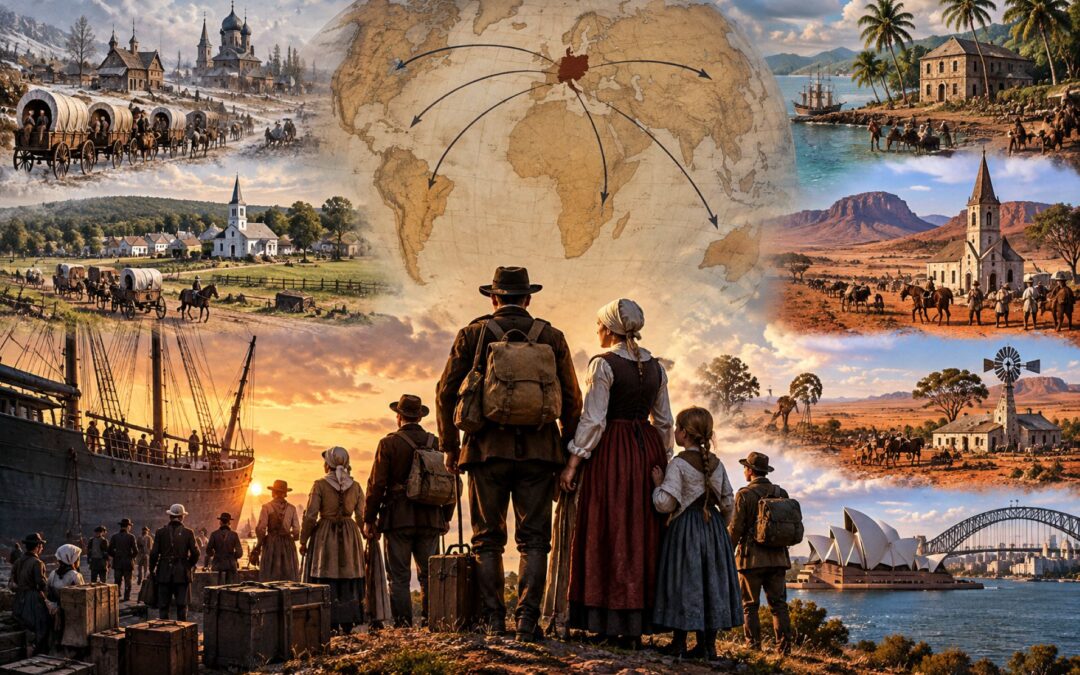
In the mountains of Jamaica, there is a village called Seaford Town where some residents can trace their ancestry to German immigrants who arrived nearly two centuries ago. Thousands of kilometres away, communities in southern Brazil preserve German-derived dialects and traditions. In Russia and Kazakhstan, descendants of German settlers carry family histories shaped by imperial invitations, religious persecution and Soviet deportations. Across the United States, millions of people identify German ancestry even though their families may not have spoken German for generations.
These communities are connected by ancestry, but their histories are remarkably different. Some Germans left Europe seeking farmland and economic opportunity. Others migrated to escape religious restrictions or political upheaval. Some were encouraged by foreign rulers to populate contested territories, while others became settlers in Germany’s own overseas colonies. Millions more were uprooted by the wars, expulsions and political transformations of the twentieth century.
Together, these movements created the German diaspora: a worldwide population whose connections to German-speaking Europe stretch across centuries and continents. Understanding how Germans ended up in so many places means following not one great migration, but a succession of journeys in which people repeatedly crossed borders, adapted to new societies and sometimes moved again when the political conditions around them changed.
What Counts as the German Diaspora?
Before examining where Germans migrated, an important distinction needs to be made. The German diaspora is not a single, easily counted population, and being of German descent does not necessarily mean being German in the modern national sense.
Germany became a unified nation-state only in 1871. For centuries before that, German-speaking populations lived across numerous kingdoms, principalities, free cities and imperial territories. Some of these lands belong to present-day Germany, while others lie within Austria, Switzerland, Poland, the Czech Republic and several other countries. Consequently, historical German migration frequently began in territories that do not fall within Germany’s modern borders.
There is also a difference between German citizens living abroad, people born in Germany who subsequently emigrated, ethnic Germans whose families lived outside Germany for generations, and people who report German ancestry through one or more distant relatives. These groups overlap, but they are not interchangeable. Someone born in Brazil whose ancestors migrated from Germany in 1850 might consider themselves entirely Brazilian, while a German citizen working in Canada might have no intention of permanently settling there.
This distinction makes worldwide population estimates difficult. The German Federal Statistical Office’s international data on Germans abroad illustrates how migration statistics depend on the definitions and reporting systems used by individual countries. Some governments count ancestry, others record ethnicity or birthplace, and some do not collect comparable information at all.
The United States provides the most striking example of the diaspora’s scale. American census data has consistently identified German ancestry as one of the country’s largest reported ancestry groups, with more than 40 million people reporting German roots in recent estimates. Canada also has a substantial German-descended population: its 2021 census recorded approximately 2.96 million people reporting German ethnic or cultural origins.
But these numbers cannot simply be added to figures from Brazil, Argentina, Australia and other countries to produce a precise worldwide total. Different censuses permit different responses, ancestry estimates may include distant or multiple origins, and many descendants no longer identify with their ancestors’ nationality.
The German diaspora is therefore best understood as a historical and cultural phenomenon rather than a neatly defined population. Its origins lie much earlier than the establishment of modern Germany, beginning with the movement of German-speaking communities across Central and Eastern Europe.
How Germans Settled Across Central and Eastern Europe
Long before Germans crossed the Atlantic in large numbers, German-speaking populations were moving eastward across Europe. Between the Middle Ages and the eighteenth century, these movements established communities in territories that are now part of Poland, the Czech Republic, Slovakia, Hungary, Romania, Ukraine and Russia.
The migrations occurred under different political circumstances. Some settlers were invited by local rulers seeking farmers, merchants and craftsmen. Others arrived through organised colonisation schemes, religious migration or imperial expansion. Their presence contributed to agricultural development, towns and trade networks, but it also changed existing relationships over land, political authority and local communities.
The Medieval Eastward Settlement
One of the earliest major movements was the Ostsiedlung, a German term meaning eastward settlement. Beginning on a substantial scale during the High Middle Ages, particularly from the twelfth century onward, German-speaking settlers established communities in regions east of the established German-speaking heartlands.
Population growth, agricultural expansion and opportunities for landholding helped drive this migration. European agriculture was changing, towns were expanding, and rulers sought ways to increase settlement, production and revenue. German farmers, artisans and merchants were among those who responded to opportunities in territories governed by Polish dukes, Bohemian rulers and other regional authorities.
These movements were not always the result of German political conquest. Local rulers sometimes actively recruited settlers because they wanted to establish towns, expand cultivation or strengthen economic activity. Settlers might receive land, temporary tax advantages or legal privileges intended to make migration attractive.
German-speaking settlers participated in clearing forests, developing agricultural land and founding or enlarging towns. German municipal legal traditions also influenced urban development in parts of Central and Eastern Europe. Over time, numerous settlements developed German-speaking populations alongside Slavic, Baltic and other communities.
However, this history should not be mistaken for the peaceful development of an empty frontier. The territories involved were already inhabited, and the consequences of migration varied considerably. Existing populations sometimes benefited from economic development and new commercial relationships, while elsewhere settlement was associated with political subordination, altered land rights, coercion and displacement.
The University of Kiel’s research on medieval Slavic societies offers important context for understanding this region as a landscape of established societies rather than unoccupied territory awaiting development. German migration took place within existing political, economic and cultural worlds.
By the later Middle Ages, German-speaking communities had become established across a broad region. Some towns were predominantly German-speaking, while others were multilingual environments in which settlers and local populations interacted through trade, marriage, religion and political institutions.
The pace and character of settlement changed as European conditions evolved. The demographic crisis associated with the Black Death, regional warfare and changing economic circumstances disrupted expansion, but the communities established through earlier movements remained part of Central and Eastern Europe’s population for centuries.
The Danube Swabians and Habsburg Resettlement
Another important migration developed several centuries later in the territories of the Habsburg monarchy.
During the seventeenth and early eighteenth centuries, wars between the Habsburgs and the Ottoman Empire transformed large parts of Central and Southeastern Europe. Military campaigns, population movements, destruction and economic disruption left some regions with diminished populations and damaged agricultural production.
As Habsburg authority expanded into territories previously controlled by the Ottomans, imperial officials encouraged settlement to restore economic activity, consolidate political control and strengthen strategically important regions.
German-speaking farmers and craftsmen were among the migrants recruited for these purposes. Many came from southwestern German territories, including Swabia, although settlers originated from several regions. The communities that developed through these movements became collectively known as the Danube Swabians.
Settlements emerged across areas that now belong to Hungary, Serbia, Croatia and Romania, particularly the Banat and neighbouring Danubian regions. Migrants established farms, villages, churches and local institutions, often maintaining German-language traditions while living within a much more diverse imperial society.
The Habsburg authorities considered settlement economically and politically useful. Agricultural production generated revenue, rural communities supported local markets, and populations considered loyal to the monarchy could help consolidate its authority.
For the settlers, the attractions included land, opportunities to establish farms and sometimes temporary privileges. Yet these incentives existed within an imperial strategy that also affected the rights and interests of populations already living in the region.
Over generations, the Danube Swabians developed distinct local identities. Their dialects and customs reflected both their German-speaking origins and their long residence in the Habsburg lands. By the nineteenth and early twentieth centuries, many no longer had meaningful personal connections to the particular German territories from which their ancestors had migrated.
They were German-speaking communities, but their everyday lives had developed in Hungary, the Balkans and neighbouring regions. Their history would become especially complicated when nationalism and the world wars transformed the political boundaries around them.
The Volga, Black Sea, and Mennonite Communities
One of the most consequential chapters of German migration began under the Russian Empire.
In 1763, Empress Catherine II issued a manifesto inviting foreigners to settle in Russia. Catherine had been born into a German princely family, but the programme reflected the Russian state’s broader economic and territorial ambitions rather than simply her personal ancestry.
Russia wanted to develop agricultural production, populate selected territories and encourage settlement in regions considered important to imperial expansion. The government offered prospective migrants incentives that could include land, religious freedom, certain tax privileges and exemptions from military service.
For people living in economically difficult or politically fragmented German territories, these promises were attractive. Thousands responded, and German-speaking settlements developed along the Volga River.
These communities became known as the Volga Germans. They established villages, cultivated land and maintained religious and linguistic traditions. Catholic and Protestant communities existed alongside one another, and the settlements developed distinctive identities shaped by their origins and generations of life in Russia.
German migration also occurred in territories north of the Black Sea. These settlements developed through later imperial policies, particularly during the late eighteenth and early nineteenth centuries, as Russia expanded its control over lands formerly associated with Ottoman authority and other regional powers.
The Black Sea Germans therefore shared some historical circumstances with the Volga Germans but did not originate from an identical migration programme. Their communities developed in areas including present-day southern Ukraine and surrounding territories.
An especially important group within these wider movements was the Mennonites.
Mennonites belong to the Anabaptist tradition of Christianity, and many historically maintained commitments to pacifism and religious separation. Some Mennonite communities had established themselves in Prussian territories before migrating into the Russian Empire, where imperial privileges offered opportunities to preserve their religious practices and avoid military service.
Mennonite agricultural settlements became particularly significant in parts of southern Imperial Russia. Over generations, communities developed their own social institutions, farming traditions and forms of Low German speech, including Plautdietsch.
The University of Passau’s research into Russian-German history helps situate these movements within the broader history of German-speaking populations living under Russian imperial and later Soviet authority.
By the nineteenth century, German communities were established across large portions of Eastern Europe and the Russian Empire. They had become part of the social and economic fabric of their adopted regions, even as many retained identifiable religious, linguistic and cultural traditions.
Yet the privileges that had encouraged some of these migrations were not permanent. As states began demanding greater political and cultural conformity, the position of German-speaking minorities changed dramatically.
How War and Expulsion Remade German Communities in Eastern Europe
For centuries, German-speaking communities had lived outside the political borders of Germany or its predecessor states. Their presence was often treated as an ordinary feature of Europe’s multilingual societies, particularly within large empires containing numerous ethnic and religious groups.
During the nineteenth and twentieth centuries, however, nationalism increasingly challenged this arrangement. Governments and nationalist movements began placing greater importance on common language, identity and political allegiance. Communities that had previously maintained local privileges or separate institutions could now be viewed as obstacles to national integration or as potential allies of foreign powers.
In the Russian Empire, this shift became especially significant during the reign of Alexander II.
The Russian government pursued policies intended to integrate different populations more closely into imperial institutions. Some privileges previously granted to foreign settlers were reduced or withdrawn, including exemptions from military service that had been particularly important to pacifist Mennonite communities.
These changes were not the only pressures facing Russian Germans. Economic conditions, land availability, population growth and changing opportunities also influenced decisions to migrate. Nevertheless, the erosion of earlier settlement arrangements contributed to growing interest in emigration.
Beginning in the nineteenth century, substantial numbers of German-speaking settlers left the Russian Empire for destinations including the United States, Canada and parts of South America. In many cases, these migrants were not leaving their ancestral homeland in Germany. Their families had already lived in Russia for several generations.
This created an important pattern within the German diaspora: migration from Germany or German-speaking Europe to Russia, followed by a second migration from Russia to the Americas.
The First World War introduced further dangers.
When Germany and Russia became enemies in 1914, ethnic Germans within the Russian Empire faced increasing suspicion. Some authorities regarded German-speaking populations near strategically important regions as potential security threats, regardless of their actual political loyalties.
Russian wartime measures included restrictions, property seizures and forced relocations, with particularly severe consequences for German communities in areas such as Volhynia. Families whose ancestors had been invited to settle in imperial territories could now find themselves treated as unreliable inhabitants.
The situation became considerably more destructive during the Second World War.
Adolf Hitler’s regime regarded ethnic Germans outside Germany as potential instruments of territorial expansion and racial policy. Nazi authorities promoted the idea of bringing German-speaking populations into territories under German control, particularly in Eastern Europe.
Following the 1939 German-Soviet agreements, organised population transfers relocated various ethnic German communities from territories entering the Soviet sphere of influence. These movements formed part of a wider rearrangement of populations and territories under two authoritarian regimes.
The Nazi programme was not simply an effort to reunite separated families or provide homes to migrants. It was connected to conquest, forced displacement and racial domination. German settlement policies in occupied Eastern Europe frequently operated alongside the dispossession, exploitation and persecution of local populations.
After Germany invaded the Soviet Union in June 1941, ethnic Germans living under Soviet rule faced another wave of collective punishment.
Stalin’s government increasingly treated German ancestry as evidence of potential disloyalty. In August 1941, Soviet authorities ordered the deportation of the Volga Germans, and other German communities were subjected to deportation, compulsory relocation and forced labour.
Hundreds of thousands were transported to regions including Siberia and Kazakhstan. Many experienced separation from their homes, harsh conditions, restrictions on movement and compulsory labour. Their treatment was part of a wider Soviet practice of punishing entire ethnic populations through collective deportation.
These histories complicate any simple picture of ethnic Germans during the war. Nazi Germany perpetrated aggressive war, genocide and policies of racial colonisation, while German-descended civilians living under Soviet authority could simultaneously experience persecution because of their ancestry. Neither circumstance removes the need to distinguish individual responsibility from collective identity.
The most dramatic transformation followed Germany’s defeat in 1945.
As Soviet armies advanced and the war ended, millions of Germans fled, were evacuated or were subsequently expelled from territories across Central and Eastern Europe. These movements affected populations in lands transferred from Germany to Poland and the Soviet Union, as well as long-established German communities in other countries.
The Potsdam Conference established a framework under which the Allied powers accepted the transfer of German populations from Poland, Czechoslovakia and Hungary, calling for such transfers to be conducted in an orderly and humane manner. The reality was frequently far more violent and chaotic, with suffering occurring both before and after those arrangements.
Across the broader period from 1944 into the postwar years, approximately 12–14 million Germans experienced flight, expulsion or related displacement, depending on the geographical boundaries and categories used. Many died during these upheavals, although estimates of deaths differ considerably and should not be treated as settled without qualification.
The German Federal Agency for Civic Education’s account of the consequences of World War II places these population movements within the broader devastation and reconstruction of postwar Europe.
These events cannot be understood independently of World War II and the destruction of the European order. Nazi Germany’s occupation policies, mass violence and attempted territorial transformation were central to the circumstances in which Germany was defeated, borders were redrawn and populations were uprooted.
The consequences for the German diaspora were enormous. Communities established over centuries disappeared from many regions, while refugees and expellees were absorbed into postwar Germany and Austria. Other ethnic Germans remained in Eastern Europe or the Soviet Union, often under political systems that restricted cultural expression or migration.
Later movements continued during the Cold War and after its end. People of German ancestry from the Soviet Union and its successor states migrated to Germany under policies recognising certain ethnic German resettlers and their families.
By the end of the twentieth century, the distribution of German-speaking communities across Eastern Europe had changed profoundly. Some survived as minorities in countries such as Poland, Romania, Hungary, Russia and Kazakhstan, while many others existed primarily through the memories, records and cultural traditions of their descendants.
The United States and Canada: Mass Migration and Assimilation
Although German migration into Eastern Europe began much earlier, the United States eventually became the country with the largest population reporting German ancestry outside Germany.
German-speaking people arrived in North America during the colonial period, but a particularly important early settlement was established in 1683 at Germantown, in present-day Philadelphia. The settlement became associated with the wider development of German-speaking communities in Pennsylvania.
Religious circumstances played an important role in early migration. Protestant groups, including Mennonites and other communities seeking greater freedom to practise their beliefs, were attracted by opportunities in British North America.
Economic conditions mattered just as much. Land was an especially powerful incentive for families who faced limited opportunities or insecure livelihoods in Europe. Migration offered the possibility of creating farms, establishing trades and building communities with greater control over everyday life.
Between the late seventeenth and eighteenth centuries, German-speaking settlements expanded through Pennsylvania and into regions including New York and the Shenandoah Valley.
One of the best-known cultural communities to emerge from this history was the Pennsylvania Dutch. Despite the name, these communities were predominantly associated with German-speaking ancestry rather than migration from the Netherlands.
The term Dutch has a complicated linguistic history connected with older English terminology for continental Germanic peoples and the word Deutsch. Pennsylvania Dutch communities developed distinctive forms of speech, religion and culture, with Amish and Mennonite groups becoming particularly recognisable examples of their continuing traditions.
However, the largest transformation of German-American demographics occurred during the nineteenth century.
The decades after 1820 brought substantial immigration from German-speaking Europe, driven by agricultural pressures, economic opportunity, political unrest and population changes. The failed revolutions of 1848 also encouraged some political activists and reform-minded Germans to seek new lives abroad.
These migrants were more diverse than the early religious communities. They included Catholics, Protestants, Jewish immigrants, political refugees, farmers, labourers, merchants and skilled workers.
Many settled in the American Midwest, particularly states such as Ohio, Wisconsin, Illinois and Missouri. German-speaking communities contributed to agricultural development, manufacturing, urban commerce, educational institutions and local political life.
The Library of Congress’s history of German immigration documents how this movement expanded German-American communities beyond their early colonial centres and helped make German ancestry a major component of the American population.
German immigrants also established newspapers, schools, religious congregations, cultural associations and businesses. In some towns and cities, German was widely heard in everyday life, and immigrant organisations preserved regional identities brought from Europe.
The relationship between German ancestry and American identity nevertheless changed significantly over time.
During the First World War, anti-German sentiment placed many communities under pressure. German-language institutions declined, some families Anglicised their surnames, and public expressions of German identity became politically sensitive.
These pressures accelerated processes of assimilation already underway through schooling, intermarriage, urbanisation and successive generations growing up in English-speaking environments.
German influence remained visible in numerous aspects of American life, including food traditions, brewing, religious communities, music and local festivals. Yet familiar claims that particular American foods were simply invented in Germany often conceal more complicated histories of adaptation, commercialisation and cultural exchange.
The hamburger, for example, has associations with Hamburg and German-influenced culinary traditions, but the development of the modern American hamburger involved changes that took place in the United States. Similar qualifications apply to sausages, hot dogs and other foods with European antecedents.
German-American ancestry ultimately became widespread without necessarily remaining a distinct cultural identity. Millions of Americans can report German roots while having little direct connection to contemporary German language or culture.
Canada experienced a related but somewhat different history.
German-speaking settlers established communities in areas that became Ontario, particularly in and around Waterloo County. Mennonite settlement contributed to this development, as did migration from Pennsylvania and other North American communities.
Some settlers arrived because British North America offered new land and opportunities to preserve religious practices. Others came through later movements from Europe and the Russian Empire.
By the nineteenth century, parts of southwestern Ontario had developed substantial German-speaking populations, while migration to the Canadian Prairies opened additional opportunities.
The arrival of Mennonites from Imperial Russia became particularly important. Some communities were attracted by agricultural land and possibilities for maintaining religious and educational institutions, although their relationships with Canadian state policies would later become contentious.
Canada also received German immigrants after the Second World War, including people whose homes and political circumstances had been transformed by Europe’s changing borders.
According to Statistics Canada’s account of German origins, approximately 2.96 million people reported German ethnic or cultural ancestry in the 2021 census, representing about 8.1 percent of the population.
As in the United States, this figure includes people whose families have lived in Canada for generations. Some preserve identifiable religious or linguistic traditions, while others understand their German ancestry primarily as one part of a broader Canadian identity.
The North American story therefore illustrates two contrasting outcomes of migration. German-descended populations became extremely large, but the maintenance of German language and culture varied enormously between communities.
Latin America: Land, Labour, Religion, and New Identities
German migration to Latin America developed through several overlapping but distinct movements. Unlike the United States and Canada, where large-scale immigration is often discussed within a familiar North American settlement narrative, German communities in Latin America emerged under widely varying political and economic circumstances.
Newly independent states sought immigrants to cultivate land, develop agricultural production and strengthen control over territories. German-speaking families were attracted by farming opportunities, commercial prospects and, in some cases, religious freedom. Other migrants arrived after political upheavals in Europe or moved from communities that had already settled elsewhere.
Latin America’s German-descended populations were consequently shaped by both direct migration from Europe and secondary migration from places such as Russia and Canada. Their experiences also intersected with the expansion of national governments into territories inhabited by Indigenous peoples.
Mexico and the Mennonite Migration Routes
Mexico is not usually the first country associated with large German immigration, but it contains communities with particularly distinctive German-speaking histories.
German-speaking migrants arrived in different periods, including merchants, craftsmen, farmers and people involved in commercial agriculture. Some participated in the economic development of regions where coffee cultivation and other export industries were expanding.
Their settlement cannot, however, be explained primarily through the idea that German Texans relocated into Mexico after Texas became part of the United States in 1848. German settlement in Texas had its own complicated chronology, much of it developing after Texas separated from Mexico in 1836.
A particularly significant later movement involved Mennonites migrating from Canada during the 1920s.
These communities were descended in substantial part from German-speaking Mennonites who had earlier settled in the Russian Empire before moving to North America. Their migration to Mexico therefore represented another stage in an already lengthy transcontinental journey.
Changes to educational requirements in Canada created tensions for some conservative Mennonite communities, particularly over schooling, language and the independence of religious institutions. Mexico offered opportunities to establish agricultural settlements while preserving community practices.
Approximately 6,000 Mennonites were involved in the early migration movement from Canada to Mexico in the 1920s. Communities developed particularly in Chihuahua and other northern regions, where descendants maintained distinctive religious institutions, agricultural practices and varieties of Low German.
This does not mean all German-descended Mexicans belong to Mennonite communities. German and other Central European influences also entered Mexican society through commercial activity, urban settlement and cultural exchange.
Music offers a familiar example. Accordions and related European musical instruments became important in several Mexican regional traditions, including styles associated with northern Mexico.
German-speaking and other Central European influences contributed to these developments, but it would be inaccurate to attribute Mexican accordion music exclusively to German immigrants. The musical traditions emerged through broader interaction among local, Indigenous, Mexican and immigrant communities.
Mexico’s German-descended populations demonstrate how an ethnic or linguistic identity can survive through repeated movement without remaining closely connected to the contemporary German state.
Brazil’s German-Speaking South
Brazil became one of the most important destinations for German-speaking migrants outside Europe.
After gaining independence from Portugal in 1822, Brazil’s government pursued immigration and settlement policies intended to develop agricultural production, strengthen its control over territory and populate selected regions.
Organised German immigration began in 1824, when settlers established communities in southern Brazil, including São Leopoldo in what is now Rio Grande do Sul.
The newcomers were attracted by opportunities to acquire or cultivate land and establish livelihoods. The Brazilian authorities, meanwhile, saw immigration as a means of developing regions they considered strategically and economically important.
Over the following decades, additional German-speaking communities developed in Rio Grande do Sul, Santa Catarina and Paraná. Settlements associated with German immigration included places such as Blumenau and Joinville, which later became well-known examples of German-Brazilian cultural influence.
The Instituto Martius-Staden’s account of German immigration to Brazil places the beginning of organised settlement in the context of Brazil’s nineteenth-century development and the emergence of German-speaking communities in the south.
Agriculture was a central occupation for many migrants, although German-speaking immigrants also participated in commerce, manufacturing and urban development. Families established farms, churches, schools and local associations, while communities developed social and cultural institutions through successive generations.
These settlements were not simply replicas of German villages transplanted into South America. Their development reflected Brazil’s environment, political institutions, economy and relationships among different populations.
Colonisation also had consequences for Indigenous communities whose territories were affected by expanding settlement. Policies that described regions as available for agricultural development often obscured existing patterns of Indigenous occupation and territorial rights.
German-Brazilian identities developed through a combination of cultural retention and adaptation. In some communities, German-derived dialects continued to be spoken long after migration, while other families increasingly adopted Portuguese as their principal language.
Immigration was not the only force shaping the German-Brazilian population. Families expanded over generations, descendants moved into other regions, and intermarriage contributed to increasingly varied identities.
The resulting ancestry estimates differ considerably. Some calculations suggest several million Brazilians have German roots, while higher estimates depend on broader assumptions about ancestry across generations. Without a consistent national measure, these figures should be treated as estimates rather than precise population counts.
German-Brazilian cultural traditions remain visible in architecture, festivals, food, religious institutions and local languages, particularly in parts of southern Brazil. Yet their presence represents a Brazilian historical experience shaped by German migration, not an unchanged survival of nineteenth-century Germany.
The distinction is important because descendants may identify strongly with German-Brazilian heritage while being culturally, linguistically and nationally Brazilian.
Argentina and Chile
Argentina attracted German-speaking migrants during a period of rapid agricultural and economic development in the nineteenth and early twentieth centuries.
The expansion of commercial farming, railway networks and export industries created opportunities for European immigrants. German-speaking settlers arrived from different territories, including Germany and the Russian Empire.
Among the most distinctive communities were Volga Germans whose ancestors had migrated into Russia under imperial settlement policies.
As conditions changed in the Russian Empire, some of these families moved again, establishing communities in Argentina. Settlements developed in provinces including Entre Ríos, Buenos Aires and other agricultural regions.
These migrants brought religious practices, agricultural knowledge, dialects and community institutions shaped by generations of life in Russia. Their ancestry might have originated in German-speaking Europe, but the Russia-to-Argentina journey was a central part of their historical identity.
German migration also included merchants, industrial workers, professionals and people seeking refuge from European political developments.
Chile followed a somewhat different pattern, particularly in its southern territories.
During the nineteenth century, the Chilean government encouraged European settlement as part of efforts to strengthen state control and develop regions south of the country’s established political and economic centres.
German-speaking immigrants were recruited or encouraged to settle in areas including Valdivia, Osorno and the Llanquihue region. Their presence contributed to agriculture, trade, manufacturing and the development of local towns.
The National Library of Chile’s historical material on German colonisation documents the role of this migration in the country’s nineteenth-century settlement policies.
However, state-supported colonisation also intersected with Indigenous landholding and sovereignty. Southern Chile was not an empty territory, and the expansion of settlement formed part of wider processes through which Indigenous peoples, including Mapuche and Huilliche communities, faced increasing pressure on their lands and political autonomy.
The German cultural influence that remains visible in some southern Chilean towns must therefore be understood alongside this more complicated history.
The twentieth century brought additional migration to South America under very different circumstances.
As the Nazis consolidated power in Germany, Jewish families, political opponents and other people threatened by persecution sought refuge abroad. Countries including Argentina, Brazil and Chile became destinations for some of these refugees.
The United States Holocaust Memorial Museum’s history of German-Jewish refugees explains the pressures that forced people to seek escape from Nazi Germany and the difficulties they faced in finding countries willing to admit them.
After the war, another and entirely different movement attracted considerable historical attention: the escape of Nazi officials and collaborators to South America.
Argentina became particularly associated with networks that helped certain fugitives evade prosecution. Adolf Eichmann, who played a central role in organising the deportation of Jews during the Holocaust, lived in Argentina under an assumed identity until Israeli agents captured him in 1960.
These events are an important part of the history of Nazi accountability, but they should not define German migration to South America as a whole.
German-descended communities had existed in Argentina, Brazil and Chile for generations before Hitler came to power. Jewish refugees fleeing Nazi persecution and Nazis escaping responsibility for their crimes were not equivalent populations, and their migration histories require clear separation.
Across Latin America, German-descended communities developed through agriculture, commerce, religious settlement, political exile and successive migration. Their identities were influenced by local languages, national institutions and cultural relationships as much as by their ancestral European origins.
Australia and New Zealand: Small Communities, Lasting Influence
German migration also reached Australia and New Zealand, although on a smaller scale than in North or South America.
German-speaking individuals arrived in Australia during the earliest period of British colonisation, including some among the convicts transported to New South Wales. However, organised migration associated with enduring German-speaking communities became particularly significant during the nineteenth century.
In 1838, groups of German Lutherans from Prussian territories began settling in South Australia. Religious circumstances were important to their migration, particularly disagreements over church practices and the desire to maintain their own forms of worship.
The settlers established communities in areas such as Klemzig and later Hahndorf and the Barossa Valley. They developed farms, churches and educational institutions, while maintaining language traditions brought from Europe.
Further German immigration occurred during the nineteenth century, including people influenced by the political upheavals surrounding the revolutions of 1848.
German-speaking migrants contributed to agriculture, commerce and local industries. In South Australia, their involvement in farming and viticulture became particularly significant, contributing to the development of wine-producing districts that remain important today.
The connection between German immigrants and Australian winemaking should not be overstated, since the industry developed through contributions from numerous populations. Nevertheless, German-speaking settlers played a recognisable role in particular regions.
Across the Tasman Sea, German migrants also established communities in New Zealand. They arrived as individuals, families and organised groups, settling in rural and urban areas and participating in farming, trade and local economic development.
German communities in both countries faced considerable difficulties during the world wars.
When Australia and New Zealand fought against Germany, people of German ancestry could become targets of suspicion regardless of their citizenship or personal loyalties. Some experienced internment, discrimination, pressure to abandon German-language institutions or encouragement to Anglicise their names.
These experiences accelerated cultural assimilation. Over generations, English increasingly replaced German in everyday life, although some traditions and family histories survived.
Contemporary ancestry and ethnicity figures illustrate both the continued presence of German heritage and the difficulty of measuring it consistently.
Australia’s 2021 census recorded more than one million people reporting German ancestry. In contrast, New Zealand’s 2023 census ethnicity data recorded 17,565 people identifying with German ethnicity.
These are not directly equivalent measures. An ancestry question can capture distant family origins that respondents do not regard as their present ethnicity, while ethnicity reporting reflects a different form of identification.
Consequently, the New Zealand figure should not be mistaken for the total number of people who might discover a German ancestor somewhere in their family history. Equally, a much larger speculative ancestry estimate should not be presented as though it were the country’s official German-ethnicity count.
The Australian and New Zealand experiences show how relatively small immigrant populations can leave lasting local cultural influences even when their descendants become thoroughly integrated into the wider society.
Jamaica and Namibia: Two Different Colonial Migrations
German settlement in Jamaica and Namibia demonstrates how widely the circumstances of migration could differ.
In Jamaica, Germans arrived within a British colonial system seeking new labour arrangements following emancipation. In Namibia, German settlers became associated with Germany’s own colonial expansion and the violent establishment of imperial rule.
Both histories produced communities whose German heritage remains visible, but the political relationships underlying their settlement were profoundly different.
Jamaica provides one of the most unexpected examples of the German diaspora.
After Britain abolished slavery in its colonies in 1834, followed by an apprenticeship system that ended in Jamaica in 1838, plantation owners and colonial authorities faced changes in the organisation and availability of labour.
Formerly enslaved people sought greater control over their lives and working conditions, while plantation interests continued to seek dependable and inexpensive labour supplies. Colonial immigration programmes were developed partly in response to these economic and political pressures.
European migrants were among those recruited, including German settlers who arrived during the 1830s.
According to the Jamaica National Heritage Trust’s historical account of immigrant communities, approximately 1,210 Germans arrived between 1834 and 1838.
Some became associated with settlements such as Seaford Town, in the parish of Westmoreland. The village developed a distinctive history connected with German-speaking settlers and their descendants.
The immigration programme must be understood within the inequalities of the colonial plantation economy. European recruitment reflected assumptions about labour, race and settlement that were part of British colonial policy, rather than a neutral attempt to diversify the island’s population.
Life for the newcomers was not necessarily what they had been promised. Settlers encountered unfamiliar environmental conditions, difficult economic circumstances and challenges establishing stable livelihoods.
Over generations, their descendants became part of Jamaican society. English and Jamaican Creole displaced the German languages of earlier generations, and local cultural identities developed through everyday life, family relationships and wider social integration.
The result is a community in which some families retain knowledge of German ancestry without necessarily speaking German or identifying culturally with modern Germany.
Seaford Town illustrates a form of diaspora in which ancestry survived more clearly than the language or national identity of the original settlers.
Namibia presents a much darker colonial history.
German involvement in the territory began with missionaries, merchants and other European actors before Germany formally established colonial authority in 1884.
The territory, then designated German South West Africa, became one of Germany’s most important overseas colonies. German administrators, settlers and commercial interests sought political control, agricultural land and opportunities for economic exploitation.
Settler expansion occurred in territories already occupied by African communities with established political, economic and social systems. Colonial authority increasingly involved coercion, land dispossession, restrictions on Indigenous autonomy and the use of force.
Conflict escalated catastrophically in the early twentieth century.
In 1904, Herero resistance to German colonial rule developed into a major war. German colonial forces responded with extreme violence, including a campaign that drove Herero populations into conditions in which large numbers died from thirst, hunger and exhaustion.
The subsequent German campaign against the Nama also involved mass violence, imprisonment, forced labour and devastating population losses.
The events of 1904–1908 are recognised as the genocide of the Herero and Nama peoples. They represent one of the most serious atrocities committed under German colonial rule.
The German federal government’s remembrance of the Herero and Nama genocide acknowledges the historical significance of these crimes and the continuing importance of confronting their consequences.
Germany lost control of its overseas colonies during the First World War. South African forces occupied German South West Africa in 1915, and the territory subsequently came under South African administration through the postwar international mandate system.
Some German settlers departed, while others remained. German-speaking communities continued to exist under South African rule and later within independent Namibia, which achieved independence in 1990.
Today, German-language traditions and colonial-era architecture remain visible in places such as Swakopmund and Lüderitz. German-derived names, businesses and cultural institutions also testify to the country’s distinctive history.
Yet these features cannot be interpreted simply as picturesque reminders of European settlement. They are connected to a colonial system whose violence transformed Indigenous societies and whose consequences remain important in debates about land, historical responsibility and reparations.
The contrast between Jamaica and Namibia is revealing. Both contain German-descended communities, but their formation involved different colonial authorities, different social positions for migrants and different consequences for existing populations.
German ancestry alone tells us little about the political circumstances through which a diaspora community emerged. Those circumstances must be reconstructed from the history of each destination.
What Remains of the Global German Diaspora?
After centuries of movement, the German diaspora survives in many different forms.
In some places, German-derived languages remain important markers of community identity. Pennsylvania Dutch continues among particular religious communities in North America, while varieties of Low German are maintained by some Mennonite populations in the Americas. Parts of Brazil also preserve German-derived dialects shaped by generations of local development.
Elsewhere, the language has largely disappeared while traditions, surnames, religious institutions, architectural styles or family memories remain. Someone may participate in a regional festival associated with German heritage without speaking German or having any close relationship with Germany itself.
These differences reflect the circumstances through which communities developed.
Relatively isolated religious settlements sometimes maintained distinctive traditions because their institutions encouraged continuity across generations. In larger cities or societies where immigrants intermarried widely and adopted the dominant language, assimilation could proceed much more rapidly.
Political pressure also mattered. War, anti-German hostility, state restrictions on minority languages and forced relocation sometimes accelerated the disappearance of cultural practices that had survived for centuries.
The relationship between German ancestry and national identity therefore varies considerably. A German-descended Brazilian, Canadian, Jamaican or Australian may share elements of historical ancestry with someone living in Germany while possessing an entirely different cultural and national identity.
The most fascinating aspect of this history is perhaps the way certain communities migrated repeatedly.
Consider a family whose ancestors left German-speaking Central Europe in the eighteenth century and settled in the Russian Empire. Several generations later, changes in Russian policy might have encouraged their descendants to move to Canada.
If members of that community subsequently migrated to Mexico during the 1920s, the family’s history would connect Central Europe, Russia, Canada and Mexico across a relatively short number of generations.
Other families followed different routes, moving from Russia to the United States, Brazil or Argentina. Some descendants later returned to Germany, particularly through postwar and post-Cold-War resettlement movements.
These journeys reveal why it is misleading to imagine the diaspora as a simple movement outward from Germany to the rest of the world. Migration could occur in stages, with communities developing identities in one country before circumstances encouraged them to move again.
The twentieth century also produced movement in the opposite direction. German-descended populations that had lived outside Germany for generations migrated into German territory, particularly after the upheavals of World War II and the political transformations associated with the Cold War and the division of Europe.
In these cases, people could be recognised as ethnically German while simultaneously carrying cultural experiences shaped by Russia, Romania, Kazakhstan or other societies. Their settlement in Germany did not erase those histories.
The worldwide German diaspora is consequently not one uniform community. It includes descendants of religious migrants, farmers, political refugees, colonial settlers, people persecuted because of their ancestry and families whose German origins have become only a distant part of their identities.
This diversity is precisely what makes its history significant.
German-speaking populations spread across the world because different historical forces repeatedly created reasons to move. Medieval agricultural expansion, imperial settlement policies, religious freedom, economic opportunity, colonial ambition, political persecution and forced displacement all contributed to the creation and transformation of communities beyond German-speaking Europe.
What remains today is not an unchanged German culture reproduced across continents, but a collection of histories shaped by the places where migrants settled and the societies with which they interacted. Some communities preserved their ancestral language and traditions, while others became almost entirely integrated into their adopted countries.
The story of how Germans ended up everywhere is ultimately a history of migration itself: how political borders change, how families respond to opportunity and danger, and how identities evolve when people build lives far from the places their ancestors once called home.
Last Updated on October 30, 2026 by Aseem Gupta