
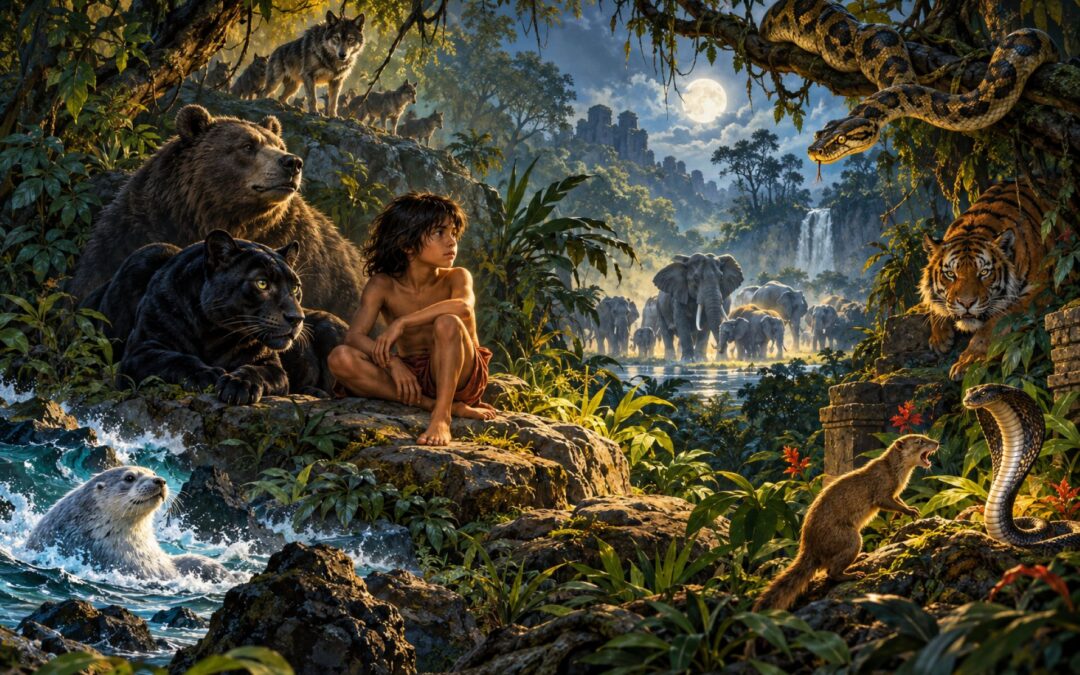
Rudyard Kipling’s The Jungle Book is much stranger, broader and more ambitious than the familiar image of Mowgli wandering through the jungle with Baloo and Bagheera. The original book is not a continuous Mowgli novel at all. It is a collection of seven stories—only three of them centred on Mowgli—paired with seven poems that expand, complicate or comment on the prose narratives.
This article contains full spoilers for every story in the book, including the endings. It treats Kipling’s 1894 collection as a complete work rather than using later adaptations as a guide. The central question running through the book is not simply whether humans or animals are more civilised, but how any creature learns to belong to a community governed by rules, loyalties, hierarchies and obligations—and what happens when an exceptional individual cannot fit entirely inside those systems.
That is why the book repeatedly returns to outsiders. Mowgli belongs to the wolves but is not a wolf. Kotick is mocked by his fellow seals before he becomes their leader. Rikki-tikki enters a human household and makes himself indispensable to it. Little Toomai crosses a boundary between human knowledge and the hidden world of elephants. Even the military animals in the final story understand themselves through specialised roles inside a larger system they cannot fully comprehend.
The result is a collection that combines adventure, fable, satire, animal fantasy, colonial politics and moral inquiry. Its storytelling remains extraordinarily effective, but its admiration for discipline, hierarchy and ordered service also has to be read alongside the imperial society from which it emerged.

What The Jungle Book Actually Contains
Kipling’s The Jungle Book was first published by Macmillan in 1894. The 1894 first edition recorded by the Library of Congress contains the same essential sequence preserved in modern editions: seven prose stories, each followed by or associated with a poem. The 2009 Puffin Classics edition adds modern editorial material, including an introduction by Christopher Paolini, but the core literary work remains Kipling’s original collection.
The first three stories form the Mowgli sequence contained in this particular volume: “Mowgli’s Brothers,” “Kaa’s Hunting” and “Tiger! Tiger!” They tell how Mowgli is adopted by wolves, educated in the laws and languages of the jungle, threatened by Shere Khan, expelled from the wolf pack, accepted briefly by a human village, and finally rejected by that community as well. “Kaa’s Hunting” appears second but takes place before the ending of “Mowgli’s Brothers,” so the printed order is not a perfectly linear chronology.
After “Tiger! Tiger!” the book leaves Mowgli entirely. “The White Seal” follows Kotick, a white seal who searches for a refuge where his people will be safe from human hunters. “Rikki-Tikki-Tavi” centres on a mongoose defending an English family in India from cobras. “Toomai of the Elephants” follows a young Indian boy who witnesses a legendary gathering of wild elephants. “Her Majesty’s Servants,” the final prose story, moves into a British Indian military camp, where animals discuss fear, work and obedience before a grand imperial review.
The seven poems are not detachable decorations. “Hunting-Song of the Seeonee Pack,” “Road-Song of the Bandar-Log,” “Mowgli’s Song,” “Lukannon,” “Darzee’s Chaunt,” “Shiv and the Grasshopper” and “Parade-Song of the Camp Animals” give voices to communities that the prose usually describes from outside. They turn hunting into ritual, expose monkey vanity, articulate Mowgli’s divided identity, mourn slaughtered seals, celebrate Rikki, place animal life inside a cosmic order, and finally present military service from the viewpoint of the animals who bear its physical burden.
The complete original text available through Project Gutenberg makes the collection’s architecture especially clear. The Jungle Book is therefore best approached not as one adventure but as a series of variations on the same underlying problems: how communities create order, how outsiders negotiate belonging, and how intelligence or independence can both protect an individual and separate that individual from everyone else.
Mowgli’s Story in The Jungle Book
Mowgli’s three stories provide the most continuous narrative in the collection, but even here Kipling avoids the structure of a conventional coming-of-age novel. “Mowgli’s Brothers” establishes Mowgli’s adoption and eventual expulsion, “Kaa’s Hunting” moves backward into his childhood education, and “Tiger! Tiger!” resumes the narrative after his departure from the wolves. Taken together, they show a boy becoming powerful precisely because he can move between worlds without ever fully belonging to either.
“Mowgli’s Brothers”
The story begins in the Seeonee hills with Father Wolf preparing to hunt. Tabaqui, a jackal associated with Shere Khan, arrives with news that the tiger has changed his hunting ground. Shere Khan has chosen to hunt near the wolves’ territory, violating the customs that regulate relations among the jungle animals and increasing the danger to everyone nearby.
Soon afterward a naked human baby appears at the mouth of the wolves’ cave. The child shows neither terror nor submission, even when Mother Wolf examines him closely. Shere Khan arrives and demands that the wolves surrender the child, claiming him as prey, but Mother Wolf refuses. She takes the baby into the litter beside her own cubs and names him Mowgli, the Frog.
Adoption inside a family is not enough to make him a recognised member of the wolf pack. Under the Law, young wolves must be presented at Council Rock, and disputes over a cub may require other members of the community to speak for it. Shere Khan argues that Mowgli belongs to him, while many wolves see no reason to risk themselves for a human child.
Baloo, the brown bear who teaches wolf cubs the Law of the Jungle, speaks on Mowgli’s behalf. Bagheera, the black panther, then offers a freshly killed bull in exchange for the pack accepting him. Mowgli’s membership is therefore neither accidental nor sentimental. From the beginning, it is created through the procedures, bargains and obligations of an organised society.
Mowgli grows among the wolves for years. He learns to run and hunt with them, studies the jungle under Baloo, and develops an intimate bond with Bagheera. His human intelligence gives him an unusual advantage: he can stare directly into the eyes of animals who cannot comfortably return his gaze, and he gradually becomes capable of removing thorns from the wolves’ paws and performing other small acts that strengthen their affection for him.
Yet Shere Khan never abandons his claim. He cultivates dissatisfaction among younger wolves and waits for Akela, the pack’s ageing leader, to fail at a hunt. Under the pack’s rules, a leader who misses his kill can be challenged, and Shere Khan intends to use that moment to destroy both Akela’s authority and Mowgli’s protection.
Bagheera recognises the danger earlier than Mowgli does. During one of their conversations, he reveals a crucial fact about his own past: he was born in captivity among humans and still bears the mark of a collar. Bagheera understands human beings from experience, and he knows that Mowgli’s apparently ordinary childhood among wolves cannot continue forever.
He tells Mowgli that the animals fear one human power above all—the Red Flower, their name for fire. If Mowgli is to survive the coming political struggle, he must obtain it. Mowgli goes to the nearby human settlement, steals a vessel containing burning coals and keeps the fire alive until the Council Rock confrontation.
The crisis unfolds exactly as Bagheera expected. Akela has missed his kill. Shere Khan and the discontented wolves demand Mowgli’s death, while Akela offers his own life if the pack will allow Mowgli to leave unharmed. Mowgli, however, no longer faces the animals as a dependent child. Holding fire in his hands, he terrifies the wolves, forces them back and turns his anger on Shere Khan.
He burns the tiger’s hide and humiliates him before the pack. He also protects Akela, refusing to allow the old wolf to be killed merely because his strength has declined. Yet Mowgli’s victory destroys the possibility of returning to his previous position. The Red Flower proves what Bagheera has understood all along: Mowgli may love the jungle, but he possesses a kind of power that separates him from every animal around him.
The emotional consequences surprise him. He begins to cry, something the wolves cannot understand in the same way. Bagheera tells him that these are only tears, but they mark a transformation more important than the political victory. Mowgli now knows that he is human.
He leaves the wolf pack and sets out toward the human village. Before going, however, he promises that he will one day return with Shere Khan’s hide laid across Council Rock.
“Kaa’s Hunting”
“Kaa’s Hunting” takes place earlier in Mowgli’s life, before the break with the wolf pack. It shows what Mowgli’s education actually involves and explains why knowledge, rather than physical strength, is his most important survival tool.
Baloo is responsible for teaching the young wolves the laws and languages required for life in the jungle. Mowgli’s education is more extensive because, unlike an ordinary wolf, he moves among many species. He learns calls, customs and what Baloo calls the Master Words—forms of communication that allow him to identify himself properly and request protection or cooperation.
Baloo’s teaching can be severe. He strikes Mowgli when the boy fails to remember important lessons, which causes occasional arguments with Bagheera, who thinks the bear can be unnecessarily harsh. Baloo nevertheless understands that ignorance in the jungle can be fatal. The rules Mowgli finds tedious are not abstract school exercises; they are technologies of survival.
Mowgli temporarily rejects this discipline when he becomes fascinated by the Bandar-log, the monkey people. They flatter him, tell him that he is clever and promise that he might become their leader. They appeal to exactly the part of Mowgli that is impatient with restraint.
Baloo and Bagheera react with disgust. The Bandar-log, they explain, have no real Law, no reliable leaders and no lasting memory. They imitate what they see, make grand plans, abandon them almost immediately and imagine that noise is equivalent to achievement. They are socially excluded by the other jungle peoples not because they are uniquely violent, but because nobody can depend on them.
The danger becomes clear when the monkeys suddenly kidnap Mowgli. They carry him through the treetops toward the Cold Lairs, the ruins of an abandoned human city. Mowgli cannot overpower them, but his education gives him options that the monkeys do not anticipate. Seeing a kite overhead, he uses the appropriate Master Word to ask that news of his capture be carried to Baloo and Bagheera.
The rescue requires help from Kaa, a massive rock python. The monkeys are terrified of him because he can climb almost anywhere they can and because his hypnotic power makes him especially dangerous. Bagheera distrusts him, while Baloo recognises that they have little choice.
At the Cold Lairs, Kipling turns the ruined city into a physical reflection of the Bandar-log themselves. The monkeys occupy remnants of human architecture but understand neither their purpose nor their history. They sit in council chambers, pretend to govern, repeat fragments of behaviours they have observed and abandon each activity for another. They possess the outward signs of civilisation without the memory or discipline that would make civilisation function.
Bagheera attacks the monkeys but is almost overwhelmed. Baloo arrives and fights with enormous strength, yet numbers are against them. Kaa finally enters the ruins and changes the balance completely. His presence terrifies the Bandar-log, allowing Mowgli to be freed.
The story then becomes more disturbing. Kaa begins his Hunger Dance, moving rhythmically while the monkeys fall under his control. Baloo and Bagheera also begin to succumb. Mowgli alone remains sufficiently independent of the spell to pull his friends away before Kaa feeds.
The episode vindicates Baloo’s teaching. Mowgli survives not because he is the strongest creature at the Cold Lairs but because he has learned languages, protocols and alliances that connect him to beings far more powerful than himself. It also complicates the simple idea that the jungle is divided into good and evil creatures. Kaa is both rescuer and predator; the same power that saves Mowgli makes him terrifying.
“Tiger! Tiger!”
“Tiger! Tiger!” resumes the story immediately after Mowgli leaves the wolves. For the first time, he attempts to live permanently among human beings.
He enters a village where his appearance attracts immediate attention. The villagers regard him as a wild child, and Messua, a woman whose son Nathoo was taken by a tiger years earlier, believes that Mowgli may somehow be her lost child returned. She brings him into her household and treats him with genuine kindness.
Mowgli begins learning human customs as though he were entering yet another animal society. He learns words, clothes, food practices and domestic expectations, but he also finds many human behaviours puzzling or ridiculous. He has grown up within one complicated code and now encounters another.
The village hierarchy gives him work as a buffalo-herder. Mowgli spends his days outside with the animals, which puts him back in an environment he understands. His connection with the jungle has not ended: Gray Brother meets him secretly and eventually warns him that Shere Khan has returned.
Mowgli does not attempt to defeat the tiger through direct combat. Instead, he combines jungle knowledge, human intelligence and control over domesticated animals. He discovers that Shere Khan has recently eaten heavily and is less agile than usual. He then develops a plan based on the geography of a ravine and the force of the village buffalo herd.
Akela joins him despite the earlier political collapse of the wolf pack. Together with Gray Brother, he helps divide the buffalo into groups. Mowgli drives the bulls from one end of the ravine while another part of the herd closes from the opposite direction. Shere Khan is trapped between steep sides and two masses of charging animals.
The tiger is trampled to death. Mowgli has fulfilled the threat he made at Council Rock, but the victory is not simply revenge. Shere Khan has represented the argument that Mowgli can never escape being human prey; killing him establishes that Mowgli now controls the conditions of his own survival.
Mowgli begins skinning the tiger so that he can carry the hide back to Council Rock. Buldeo, a village hunter who has told elaborate stories about Shere Khan, arrives and attempts to claim both the hide and the glory. When Mowgli refuses, Akela pins the hunter down.
Buldeo returns to the village with a transformed version of what happened. Mowgli’s command over wolves and buffalo becomes evidence of witchcraft. The same human community that once treated him as a curiosity now decides that he is dangerous.
When Mowgli returns, villagers throw stones at him. Messua remains sympathetic, but he recognises that he cannot remain. His experiment in human belonging ends almost exactly as his childhood in the wolf pack did: a community accepts him provisionally and then becomes frightened by the qualities that make him different.
Mowgli goes back to Council Rock and spreads Shere Khan’s hide over the stone. The wolves who once expelled him now want leadership restored, but Mowgli does not simply reclaim his old position. He chooses to hunt with his four wolf brothers instead.
His revenge is complete, yet his identity is not. He is no longer merely the human child protected by wolves, but neither has he become a village boy. The Mowgli story in The Jungle Book ends with extraordinary personal freedom purchased at the cost of secure membership in either world.
“The White Seal”
“The White Seal” moves abruptly away from India to the Pribilof Islands in the Bering Sea. Its protagonist is Kotick, a seal whose unusual white coat marks him as exceptional before he has done anything exceptional at all.
Kotick is born among the enormous seal colonies that return seasonally to the breeding grounds. His early life introduces a society governed less by formal law than the Mowgli jungle but still shaped by territory, breeding, conflict and inherited habits. The older seals fight over places on the beach, younger animals learn the sea, and the colony treats human presence as part of the environment.
Kotick’s moral awakening occurs when he encounters something the other seals have normalised. He follows young seals who are being driven away by human hunters and witnesses them being killed and skinned. The slaughter shocks him because he has not yet learned to regard it as inevitable.
The other seals largely respond with resignation. Human beings have always come; seals have always died; nothing can be done. Kotick alone refuses to accept the inherited conclusion.
He decides to find a breeding place humans cannot reach. The search becomes the central structure of his life. He travels through different seas, questions other animals and repeatedly fails to discover a location that combines safety, food and suitable beaches.
Years pass. Kotick grows stronger and more experienced, but his people continue to mock him. His whiteness, once merely unusual, becomes associated with a project that everyone else regards as foolish.
His breakthrough comes through the Sea Cow creatures, which he follows through an underwater passage into a remote region. Beyond the passage lies exactly what he has been seeking: a vast, protected breeding ground inaccessible to human hunters.
The discovery does not automatically solve the problem. A refuge is useless if no seals will follow him there. Kotick must return to a community whose deepest obstacle is no longer geography but fatalism.
He eventually uses physical dominance to force his fellow seals to pay attention. After demonstrating his strength, he persuades large numbers to accompany him. Thousands migrate to the new breeding ground, turning Kotick from mocked eccentric into founder and leader.
The story derives some of its force from the historical reality of commercial seal killing. Kipling drew on published material about the Pribilof seal industry, but the story transforms that background into a fable about refusing inherited helplessness.
Kotick’s heroism differs from Mowgli’s. Mowgli repeatedly moves away from communities that cannot contain him. Kotick becomes exceptional so that he can create a safer community for others. Yet both are defined by the willingness to reject what everyone around them treats as normal.
“Rikki-Tikki-Tavi”
“Rikki-Tikki-Tavi” is the most tightly constructed adventure story in the collection. Its world is much smaller than Mowgli’s jungle or Kotick’s ocean, but Kipling turns an English family’s bungalow and garden into a complete territory whose inhabitants compete for control.
A flood washes the young mongoose Rikki-tikki away from his parents. He is found unconscious by an English family and brought into the house, where he recovers quickly. His curiosity immediately takes over. Rikki explores rooms, investigates objects, watches the family and becomes especially attached to their son, Teddy.
The household offers security, but Rikki does not become a passive pet. A mongoose is a snake-hunter, and the garden contains enemies capable of killing every human in the bungalow.
Rikki meets Darzee, a tailorbird grieving because one of his chicks has been eaten. The culprit is Nag, a large cobra. Nag appears with his mate, Nagaina, and attempts to distract Rikki while Nagaina attacks from behind. Rikki escapes, but the encounter establishes the scale of the conflict.
Soon afterward a smaller snake, Karait, threatens Teddy. Rikki attacks and kills it. The victory proves to the human family that the mongoose is more than an amusing animal, but it also teaches Rikki that defending this household has become his responsibility.
The larger threat develops at night. Chuchundra, a nervous muskrat, indirectly helps Rikki discover that Nag has entered the bungalow. Rikki overhears Nag and Nagaina discussing their plan: if the humans are killed, Rikki will have less reason to remain, and the snakes can control the garden without interference.
Nag enters the bathroom and waits for Teddy’s father. Rikki attacks him while he is vulnerable. The fight is extremely dangerous because Rikki must hold on while the cobra thrashes violently. The noise eventually wakes the household, and Teddy’s father kills Nag with a gun.
Nagaina is now more dangerous because she is both surviving enemy and mother. Rikki learns that her eggs are hidden in the garden. He understands that defeating the adult cobras will be meaningless if a new generation hatches.
With help from Darzee’s wife, he locates the eggs and destroys almost all of them. He keeps one as leverage. When Nagaina confronts the family on the veranda and threatens Teddy, Rikki appears with the final egg and forces her attention away from the child.
Nagaina seizes the egg and retreats toward her hole. Rikki follows her underground, where a mongoose loses many of the advantages available in open space. The other animals wait without knowing whether he will return.
Eventually Rikki emerges alive. Nagaina is dead, the final egg is destroyed and the garden is safe.
Darzee begins turning Rikki’s victory into heroic legend, but Rikki remains restless and practical. He does not retire from danger; he continues patrolling the territory. His belonging to the human household has therefore been earned through action, but the action also expresses his natural identity. Unlike Mowgli, he does not have to choose between what he is and the community he serves.
“Toomai of the Elephants”
“Toomai of the Elephants” begins not with Little Toomai but with Kala Nag, an old elephant whose life has already passed through many forms of human service. He has worked in military contexts, carried loads and participated in the capture of other elephants. His body and experience record the long relationship between human institutions and animal labour.
Kala Nag’s mahout is Big Toomai, whose family has handled elephants for generations. Big Toomai prefers predictable government service and dislikes the dangerous business of elephant-catching. His young son has inherited the family’s familiarity with elephants but not his father’s caution.
Little Toomai is fascinated by the keddah, the operation in which wild elephants are driven into an enclosure and controlled. During one capture, he descends into a dangerous area among frightened elephants to retrieve a rope. The act impresses Petersen Sahib, the senior elephant-catcher.
Little Toomai wants permission to participate more fully in such work. Petersen Sahib jokingly tells him that he may become a real elephant-catcher when he has seen the elephants dance. The condition is meant to be impossible. The “dance” belongs to stories and rumours, not ordinary human experience.
Later Kala Nag slips away at night. Little Toomai follows rather than raising an alarm and is carried deep into the forest. The journey takes him beyond the ordered world of camps, chains, handlers and captured animals.
At a hidden clearing, elephants gather from different directions. They move and stamp through the night in a mysterious collective ritual. Kipling does not explain the dance in ordinary human terms, which is essential to its effect. For once, the human observer receives access to animal knowledge without mastering it.
Little Toomai eventually returns exhausted. The adults initially struggle to believe him, but signs at the clearing confirm what he has witnessed. The impossible condition imposed by Petersen Sahib has been fulfilled.
The boy is honoured and given the title “Toomai of the Elephants.” His achievement is not based on dominating animals more effectively than everyone else. It comes from entering their world without fully possessing it.
That distinction gives the story much of its continuing power. The human system surrounding elephants is built on capture, labour, inherited expertise and control, yet the story imagines a realm of elephant life that exists beyond all of those institutions. Little Toomai’s reward comes from briefly crossing that boundary.
“Her Majesty’s Servants”
The final prose story changes scale again. Instead of a boy, mongoose or seal confronting a local problem, Kipling presents an enormous military system preparing for imperial display.
The narrator is at Rawalpindi during a meeting involving the Viceroy of India and the Amir of Afghanistan. The camp contains thousands of soldiers, attendants and animals. Heavy rain has turned the ground into mud, and the apparent precision of the military machine temporarily dissolves when frightened camels break loose.
One camel crashes into the narrator’s tent, forcing him out into the camp. Because the narrator claims to understand animal speech, he overhears a conversation among military animals that gradually becomes an anatomy of organised service.
A mule, a cavalry horse, camels, bullocks and an elephant discuss what they do and what frightens them. Their different fears are not presented as simple measures of courage. They reflect different bodies, experiences and kinds of imagination.
The mule takes pride in technical competence. He knows how to carry equipment over difficult ground and understands that survival depends on doing a specialised job correctly. The cavalry horse thinks in terms of his rider and the trust required to move into danger under command.
The bullocks focus on the brutal physical problem of pulling heavy guns. The camels are associated with panic and confusion. The elephant, despite his size and strength, is capable of imagining dangers that other animals do not anticipate, which gives his fear a different psychological structure.
The next day transforms the night conversation into spectacle. The military forces assemble for a great review. Soldiers, horses, elephants, guns and other units move in disciplined formations.
An Afghan observer is astonished that such a massive collection of men and animals can act as one. The answer he receives is essentially a theory of hierarchy. Animals obey drivers, soldiers obey officers, officers obey higher commanders, and the chain ultimately reaches the imperial authority above them all.
Order therefore depends on every participant occupying a defined place and trusting or submitting to the commands flowing through the system. The story turns an apparently comic conversation among animals into the book’s most explicit political statement about discipline.
Yet the effect is not entirely simple. The animals have spent the night describing fear, injury, labour and dependence. The grand parade is magnificent because those individual burdens have been coordinated into a system. The story admires that coordination, but it also allows the reader to hear what military splendour sounds like from the level of the creatures carrying it.
The Seven Poems and What They Add
The poems change the book’s perspective. In the prose stories, a narrator usually describes animal societies from outside, even when he claims unusually intimate knowledge of them. In the poems, wolves, monkeys, seals, camp animals and other figures speak collectively, turning rules and experiences into songs, rituals, boasts or laments.
They also prevent the prose adventures from closing too neatly. A story may end in victory, but the poem that follows can shift the emotional register, expose a character’s divided feelings or reveal the cost paid by a whole community.
Hunting, Boasting and Divided Identity
“Hunting-Song of the Seeonee Pack” gives the wolves a collective voice. Hunting is presented not as random bloodshed but as shared practice governed by rhythm, movement and group identity. The song reinforces the idea that the pack’s strength comes from coordination.
That matters because the wolf society in “Mowgli’s Brothers” is political as well as biological. The pack has leaders, councils, procedures and obligations. The hunting song gives cultural form to that organisation.
“Road-Song of the Bandar-Log” does almost the opposite. The monkeys celebrate themselves as clever, inventive and socially important, but the song constantly reveals their inability to sustain purpose. They imitate, announce great plans and forget them.
The humour comes from the gap between their self-image and their behaviour. They believe fluent speech demonstrates intelligence, whereas the larger collection repeatedly treats memory, responsibility and knowledge as more important than noise.
“Mowgli’s Song” is emotionally more serious. After killing Shere Khan and being driven from the human village, Mowgli tries to describe what has happened to him. The triumphant boy who has fulfilled his promise is also a boy who has been rejected twice.
His sense of being “two Mowglis” captures the central contradiction of his identity. He can function in both jungle and human society, but that very capacity prevents him from fitting completely into either one.
The poem therefore does something the action narrative cannot accomplish by itself. “Tiger! Tiger!” ends with victory and independence; “Mowgli’s Song” reveals the loneliness hidden inside those achievements.
Lament, Praise and Cosmic Order
“Lukannon” turns the world of “The White Seal” into collective memory. The seal community remembers breeding grounds associated with abundance and security, then contrasts that memory with the arrival of human violence.
Kotick’s story is structured as successful rescue, but “Lukannon” preserves the grief that made rescue necessary. It refuses to let the discovery of a safe island erase the slaughter at the old beaches.
“Darzee’s Chaunt” is lighter. The tailorbird celebrates Rikki as though composing an epic monument to the mongoose’s victory over the cobras. The scale of the praise is comic because the battlefield is a bungalow garden, yet from Darzee’s perspective the danger was total.
Rikki interrupts the celebration, which protects him from becoming merely a self-satisfied hero. His attention returns to practical security rather than reputation.
“Shiv and the Grasshopper,” associated with “Toomai of the Elephants,” moves beyond a local animal society. It imagines Shiva providing for living creatures while Parvati tests whether anything has been overlooked.
The discovery of the hidden grasshopper suggests a universe in which even the smallest creature remains part of a larger order. The poem therefore places the elephant story inside a much broader vision of interdependence, need and provision.
The Parade-Song and the Book’s Final Voice
“Parade-Song of the Camp Animals” gives the final word of the collection to the creatures whose bodies make military organisation possible. Different animals sing according to their roles: elephants, bullocks, horses, mules and camels each understand service through the labour their bodies perform.
The structure resembles the final prose story’s division of military functions. Each creature occupies a specialised position, and the combined system depends on these differences being disciplined rather than erased.
Yet the song’s collective ending changes the emotional effect. The animals identify themselves as creatures of the camp, bound to equipment, loads and commands, while acknowledging suffering shared with the humans beside them.
That ambiguity matters. If the book ended only with the grand review, the final impression might be simple admiration for organisation. The poem leaves a harder question behind: a system can be extraordinarily efficient without each participant understanding the ultimate purpose for which effort, fear and pain are being demanded.
Setting and World-Building: More Than One Jungle
The phrase “the jungle” can make Kipling’s world sound like a single natural wilderness, but the book actually contains multiple environments, each with its own social logic. The Seeonee landscape of Mowgli’s stories includes animal territories, Council Rock, hunting grounds, water sources, human settlements and the ruins of earlier human civilisation. It is less an untouched wilderness than a network of overlapping jurisdictions.
Kipling did not simply record a specific forest he knew directly. The Kipling Society’s critical guide to the Jungle Books helps clarify how the setting was constructed from Indian experience, literary sources and imaginative synthesis. That matters because the “jungle” functions simultaneously as habitat, fable-world and social model.
The Law of the Jungle gives the Seeonee world institutional depth. Different animals do not merely occupy the same ecosystem; they possess languages, expectations, territorial customs, taboos and mechanisms for resolving conflict. Council Rock turns wolf society into something recognisably political.
The human village creates a contrasting social order. Mowgli encounters family relations, property, superstition, occupational hierarchy and communal judgment. It is not presented as inherently more rational than the jungle: villagers can be generous, as Messua is, but they can also become frightened by stories of witchcraft and collectively expel someone they do not understand.
Cold Lairs is perhaps the most concentrated piece of symbolic world-building in the Mowgli stories. The Bandar-log occupy the ruins of a human city without knowing how to use what they have inherited. They imitate councils and human actions without institutional memory.
The location therefore works on two levels. Physically it is evidence that human societies can vanish, leaving structures behind. Socially it mirrors the monkeys, who possess fragments of behaviour without the continuity required to turn behaviour into culture.
“The White Seal” builds a very different ecology around migration, breeding grounds and the dangers of commercial hunting. The vast ocean makes Kotick’s search feel almost limitless, while the crowded rookeries show how strongly animal life can depend on a small number of suitable places.
“Rikki-Tikki-Tavi” compresses its world into a bungalow and garden. Walls, paths, bathrooms, bird nests, snake holes and cultivated spaces become strategic geography. Because the territory is small, almost every location matters to the plot.
“Toomai of the Elephants” presents one landscape divided between institutional control and animal secrecy. Human beings create camps, chains, capture operations and inherited professional knowledge, while the elephants retain access to a hidden gathering place beyond ordinary human observation.
“Her Majesty’s Servants” ends the collection with perhaps the most artificial environment of all: a temporary imperial city made of tents, roads, guns, equipment, animals, servants and soldiers. It appears chaotic during the storm and perfectly ordered during the review. The contrast demonstrates that order in this book is usually produced rather than natural.
Across these different settings, Kipling repeatedly asks the same question in different forms: who knows the rules of a place? Survival depends less on abstract cleverness than on understanding territory, language, habit and social expectation. Mowgli’s education, Rikki’s garden patrols, Kotick’s migrations and Little Toomai’s inherited elephant knowledge all turn environmental understanding into power.
Character Analysis
Kipling rarely develops characters through sustained introspection. He reveals them through action, speech, competence, social roles and the rules they accept or resist. Even strongly symbolic characters usually retain enough individuality to function as participants in an adventure rather than as mere embodiments of ideas.
Mowgli receives the deepest development because his three stories allow his position to change. The other protagonists are more concentrated figures, but their different relationships to communities help expand the collection’s central concerns.
Mowgli and His Jungle Family
Mowgli begins almost without history. The reader knows little about his human parents or infancy, which allows his jungle family to become his formative community rather than a temporary substitute for a “real” one.
His defining trait is not physical superiority. Many animals can kill him easily. His advantage comes from intelligence, curiosity, confidence and an unusual capacity to learn across species boundaries.
That learning produces both strength and arrogance. Mowgli becomes accustomed to looking animals in the eye, knowing their languages and moving with unusual freedom. He loves his companions deeply, yet he can also assume that knowledge gives him authority.
His relationship with Mother Wolf establishes belonging at the most basic level. She does not treat him as a political project; she treats him as a son. Her willingness to defy Shere Khan gives Mowgli a home before the wider pack recognises him.
The wolf brothers, especially Gray Brother, preserve that kinship even after the pack rejects him. Their loyalty demonstrates that institutional membership and family affection are not identical. A council can expel Mowgli without erasing the relationships created during childhood.
Akela represents legitimate but fragile authority. He leads because he has competence and standing, but wolf government allows challenge when a leader fails. The system protects the pack from permanent weakness while also making an ageing leader vulnerable to factional manipulation.
Mowgli’s loyalty to Akela matters because he refuses to treat the Law as an excuse for opportunism. When younger wolves attempt to exploit Akela’s missed kill, Mowgli uses fire to prevent a technically permissible challenge from becoming an unjust execution.
Baloo provides a different form of authority. He is teacher rather than ruler. His methods can be harsh, but the danger of the jungle gives his insistence on memory and discipline a practical foundation.
Bagheera is more psychologically complicated. He combines enormous physical power with social intelligence and personal experience of captivity. Because he has lived among humans, he recognises Mowgli’s difference before Mowgli fully understands it himself.
Bagheera also knows how institutions actually work. At Council Rock he does not rely on moral persuasion alone; he uses the pack’s rules and offers the bull that secures Mowgli’s acceptance. His protection is affectionate, but it is never naive.
Together Baloo and Bagheera give Mowgli two forms of education. Baloo teaches codes; Bagheera teaches power. Mowgli survives because he learns both.
Kaa, Shere Khan and the Bandar-Log
Kaa is one of the clearest examples of why the book cannot be reduced to a simple moral division between friendly and dangerous animals. He is terrifying, capable of killing creatures who fall under his influence, yet he becomes essential to Mowgli’s rescue.
His relationship with Mowgli is therefore based on negotiated alliance rather than sentimental companionship. Mowgli respects his power without pretending Kaa is harmless.
Shere Khan is much closer to a conventional villain. He is dangerous, arrogant and willing to manipulate the dissatisfaction of other wolves for his own benefit. Yet his threat is political as well as physical.
He repeatedly insists that Mowgli belongs to him because the boy is human prey. The argument reduces Mowgli to a category defined by Shere Khan’s appetite. Mowgli’s development is partly the process of becoming someone who can reject that definition.
The Bandar-log function less as individual characters than as a social satire. Their defining traits are imitation, vanity, forgetfulness and excitement without follow-through.
They are not powerless because they lack intelligence in every sense. They can speak, coordinate temporarily, kidnap Mowgli and occupy a human city. Their weakness comes from the inability to turn momentary intention into durable structure.
That makes them the inverse of nearly every successful community in the book. Wolves have Law, seals have inherited migration patterns, military animals have discipline, and human institutions have chains of command. The Bandar-log have endless declarations and almost no memory.
Kotick, Rikki-Tikki and Little Toomai
Kotick is the collection’s clearest reformer. His society accepts slaughter as inevitable, while his defining ability is to imagine that a different arrangement might exist.
His heroism depends on persistence more than combat. Although he eventually uses physical strength to win attention, years of searching create his real achievement.
Rikki-tikki is different. He does not challenge an established social order; he enters a household and finds a role perfectly aligned with his instincts and abilities.
His curiosity initially looks almost comic, but it becomes the foundation of his competence. He investigates everything, and that attentiveness allows him to discover threats before they become catastrophic.
Rikki also experiences fear. His bravery is not presented as effortless confidence but as the capacity to act while understanding the danger.
Little Toomai combines inherited expertise with openness to mystery. He comes from a family whose identity is built around elephants, yet adult professional knowledge has become routine for the people around him.
His importance lies in seeing beyond routine. He takes risks, follows Kala Nag and enters a dimension of elephant life unavailable to the experts who supposedly know everything about the animals they manage.
All three figures therefore possess exceptional qualities, but Kipling gives exceptionality different forms. Kotick sees an alternative future, Rikki reacts perfectly to immediate danger, and Little Toomai crosses into knowledge that cannot be obtained through ordinary instruction.
Kala Nag and the Camp Animals
Kala Nag is both individual character and working animal. His long history of service gives him dignity, experience and memory, but it also makes him evidence of how extensively animal life can be incorporated into human institutions.
His relationship with Little Toomai is important because it does not resemble simple ownership. The boy trusts the elephant enough to follow him into the forest, and Kala Nag permits that trust to continue into a space human beings normally cannot enter.
The military animals are characterised more directly through function. Mules, horses, camels, bullocks and elephants speak in ways shaped by the work they perform.
This can make them appear schematic, but the story deliberately uses those differences to explore varieties of courage and fear. A cavalry horse understands danger through trust in a rider. A mule values technical certainty. An elephant may fear more because he can imagine more.
Their individuality never cancels their institutional roles. That is precisely the point. “Her Majesty’s Servants” asks what happens when very different bodies and temperaments are incorporated into one disciplined system.
Belonging, Kinship and Life Between Worlds
Mowgli’s deepest problem is not survival. Once educated, he becomes unusually capable of surviving. His deeper problem is membership.
The wolf pack is his first society, but its acceptance is conditional. His original membership has to be argued and purchased, and later political fear overwhelms childhood familiarity. Mowgli loves individual wolves even when the pack as an institution rejects him.
The human village repeats that pattern in altered form. Messua offers real affection and attempts to place Mowgli inside a family history, yet the larger community remains suspicious. Once Mowgli demonstrates powers the villagers cannot explain, curiosity becomes fear.
His two expulsions reveal the paradox of being culturally fluent in more than one world. Mowgli can understand wolves better than humans can, and humans better than wolves can, but that fluency does not make either group consider him completely ordinary.
His closest relationships therefore become personal rather than institutional. Mother Wolf remains his mother regardless of pack politics. Gray Brother remains loyal after expulsion. Bagheera and Baloo continue to care for him without requiring him to occupy a fixed social category.
This distinction between chosen or intimate kinship and official membership appears elsewhere in the collection. Rikki does not share species with the human family he protects, yet mutual dependence makes the household his home. His belonging is created through action rather than biological similarity.
Kotick begins within his own species but becomes socially isolated because he refuses its fatalism. He has to separate himself intellectually from the seals before he can lead them physically to safety.
Little Toomai’s position is more unusual. He belongs to a hereditary profession in human society but gains honour by entering a hidden animal ritual that other humans cannot access. His identity expands rather than simply changing sides.
The recurring pattern is therefore not “outsider eventually finds the correct group.” Kipling is more interested in the productive discomfort of the in-between position. Characters who stand partly outside a system can perceive possibilities that insiders miss.
That freedom has a cost. Mowgli’s double perspective makes him powerful but lonely. Kotick spends years being mocked. Little Toomai’s achievement depends on leaving the safety of the camp.
The collection repeatedly suggests that belonging gives security, language and purpose, while partial distance from belonging can produce insight. Neither condition is sufficient by itself.
The Law of the Jungle, Discipline and Freedom
The modern phrase “law of the jungle” often means ruthless competition or survival of the strongest. Kipling’s book presents almost the opposite idea. The jungle is survivable because behaviour is regulated.
Baloo teaches rules concerning hunting, water, territory, communication and relations among different species. Council Rock provides procedures for membership and leadership. Even predators are expected to operate within limits.
The Law is therefore practical before it is moral. It reduces unnecessary conflict between creatures who must share space and resources. A rule can be valuable because it prevents chaos even if it does not express a universal ethical principle.
Mowgli’s education demonstrates this repeatedly. His knowledge of Master Words saves him because different species recognise forms of communication and obligation beyond immediate friendship. Knowing the right way to address another creature allows cooperation where ignorance would produce hostility.
The Bandar-log provide the central contrast. They experience the absence of binding law as freedom. Nobody tells them what to do, they can move anywhere, and they constantly invent new ambitions.
Yet their freedom produces almost no sustained achievement. Because they cannot remember, commit or accept durable responsibility, they cannot create reliable institutions. Their society is energetic but politically empty.
This is why “Kaa’s Hunting” is so important to the book’s larger argument. Mowgli initially experiences Baloo’s teaching as unnecessary restriction, while the monkeys appear liberated. The kidnapping reveals that rules can expand practical freedom because knowledge creates dependable options.
The same principle appears differently in wolf politics. Akela’s leadership is constrained by law rather than absolute. That can protect the pack, but it can also be manipulated.
When Shere Khan uses Akela’s failure to encourage revolt, Kipling distinguishes legality from justice. The younger wolves can invoke procedure while acting from fear, resentment and opportunism.
Mowgli’s defence of Akela therefore complicates any claim that obedience to Law is always morally correct. He uses an external power—fire—to disrupt what the pack’s procedures are allowing. The book values order, but it also repeatedly values individuals capable of seeing when a system has become inadequate.
That tension appears in scholarly readings of law in the book, which examine the relationship between natural order, legal authority and colonial structures. Such interpretations are useful because Kipling’s animal societies plainly function through rules, but the Law should not be converted into a single allegorical code.
Its meaning changes according to context. In Baloo’s lessons, Law is accumulated survival knowledge. At Council Rock, it is political procedure. In contrast with the Bandar-log, it is social memory. In the final military story, organised obedience begins to resemble imperial administration.
Freedom is similarly double-edged. Characters suffer under captivity, chains and coercion, yet complete independence is rarely idealised. Kotick wants freedom from human slaughter but ultimately leads seals into a new collective settlement. Mowgli rejects communities that cannot accept him yet retains profound obligations to individuals.
Kipling’s preferred condition is therefore not simply freedom or obedience. The stories repeatedly admire disciplined communities while reserving special status for those intelligent enough to know when inherited arrangements no longer work.
Empire, Hierarchy and Colonial India
The imperial context is impossible to remove from The Jungle Book, especially because the collection ends by making imperial organisation explicit. “Her Majesty’s Servants” takes place inside the machinery of British rule in India, with the Viceroy, military formations, colonial troops, animals and Afghan observers all participating in a demonstration of organised power.
The final review presents hierarchy as the mechanism through which scale becomes possible. Thousands of bodies can move coherently because each part obeys commands received through a chain of authority.
That model echoes structures found elsewhere in the book. Wolves have leaders and councils, Baloo teaches inherited law, and successful action repeatedly depends on specialised knowledge and disciplined cooperation.
It is therefore understandable that critics have read Kipling’s animal societies alongside British imperial ideology. Postcolonial readings of the collection have examined how nationality, race, hierarchy and English power shape the supposedly natural worlds of the stories.
Such readings identify real features of the text, but they become reductive when every animal or event is assigned a fixed political equivalent. Shere Khan does not simply “represent” one colonised population, nor does Mowgli mechanically stand for British rule in every scene.
The collection’s politics operate more effectively through recurring assumptions. Stable order is admired. Competent hierarchy is frequently presented as superior to disorder. Knowledge gives authority, and disciplined cooperation can transform vulnerable individuals into powerful communities.
“Her Majesty’s Servants” makes those assumptions most visible because the military system is literally imperial. The Afghan observer is impressed by the ability of British-led forces to coordinate enormous numbers of men and animals, and the explanation he receives contrasts hierarchical obedience with a society imagined as more individually autonomous and therefore less organised.
Modern readers should recognise the ideological work being done by that contrast. Colonial rule can appear not merely politically dominant but structurally rational, while alternative systems are represented as disorderly.
The Mowgli stories contain related tensions. Mowgli’s unusual knowledge allows him to understand, command and move across different societies. He often knows the rules of a community better than its ordinary members do.
That can support a reading of mastery grounded in privileged knowledge. Yet the stories also repeatedly undermine any simple hierarchy in which humans naturally deserve control.
The human villagers are capable of superstition and mob behaviour. Human hunters slaughter seals on an enormous scale. Elephants possess rituals inaccessible to their handlers. Bagheera understands freedom partly because he escaped human captivity.
Animals are therefore not merely childlike subjects waiting for superior human organisation. They possess languages, institutions, memories, loyalties and forms of knowledge that human characters often fail to understand.
This contradiction is one reason the book remains worth analysing rather than merely classifying. Kipling’s imagination is deeply shaped by empire, yet his commitment to giving animals socially complex lives repeatedly produces perspectives that complicate straightforward human superiority.
Animals, Humans, Captivity and Power
Kipling anthropomorphises animals extensively, but he also returns obsessively to the material fact that human beings capture, use, breed, kill and organise them. The resulting stories can celebrate intimate human-animal relationships while remaining full of collars, ropes, guns, chains and labour.
Bagheera’s past makes this explicit in the Mowgli sequence. His authority in the jungle comes partly from knowledge acquired through captivity. The collar mark becomes evidence that freedom is something he understands because he once lacked it.
His experience also allows him to identify Mowgli’s human nature before the boy understands it himself. Captivity has therefore wounded Bagheera but also expanded his knowledge across species boundaries.
“The White Seal” gives human power a much harsher form. The hunters do not need to hate seals. Commercial killing turns animals into resources, and the scale of violence comes precisely from its routine character.
Kotick’s response makes the story unusual within the collection. Instead of learning to cooperate with human institutions, he searches for geographical escape from them.
“Toomai of the Elephants” is more morally ambiguous. The story treats elephant-handling as a field of skill, tradition and expertise, and human characters form genuine relationships with the animals. Yet Kala Nag’s life is also a history of service under human command.
The hidden elephant dance creates a temporary counter-world. Beyond the camp, the animals gather without handlers, equipment or assigned work. Little Toomai’s access to that world is an honour precisely because human control does not extend there.
“Her Majesty’s Servants” pushes domestication toward complete institutional incorporation. Animals are trained not merely to live with humans but to become components of warfare.
Kipling clearly admires their competence. At the same time, the final poem’s emphasis on burdens and suffering prevents complete identification of usefulness with freedom.
“Rikki-Tikki-Tavi” offers the most harmonious version of cross-species alliance. Rikki chooses to remain in the bungalow because the household gives him food, affection and territory, while his natural abilities protect the family.
Even here, however, the apparent moral clarity deserves qualification. Nag and Nagaina are dangerous to the humans, but they are also defending a reproductive future and territorial position. The fable requires the reader to identify with the household, so the cobras become enemies within that moral frame.
Across the collection, power is therefore never only physical. Humans possess technology and institutions. Animals possess specialised sensory abilities, knowledge of environments and social systems of their own. Mowgli becomes extraordinarily powerful because he combines forms of knowledge normally separated by species.
The book does not fully escape human-centred hierarchy, but it continually imagines worlds in which humans understand less than they think they do. That tension gives the animal stories far more depth than a simple celebration of human mastery would allow.
Symbols and Motifs
Kipling’s symbols generally emerge from objects and practices already necessary to the stories. Fire matters because it can actually burn Shere Khan. Language matters because communication can actually save Mowgli. Chains matter because animals are actually restrained by human beings.
Their thematic force therefore grows out of narrative function rather than being imposed from outside. Several motifs recur across otherwise unrelated stories and help bind the collection together.
Fire, Eyes and Speech
The Red Flower is the clearest symbol in the Mowgli sequence. To the animals, fire is mysterious and frightening; to Mowgli, it is an ordinary human tool once he learns how to obtain and preserve it.
Carrying fire into Council Rock changes his social position instantly. He no longer confronts the wolves merely as an adopted child. He brings a power that belongs to another world.
The fire symbolises human technology, but more importantly it makes Mowgli’s difference impossible to ignore. His deepest attachment may be to the wolves, yet he possesses capacities that alter the balance of power between them.
Eyes work similarly. Mowgli’s ability to stare directly at animals gives him authority, while their difficulty returning his gaze marks him as unsettlingly different.
The motif connects perception with dominance. To see clearly and refuse to look away becomes a form of power.
Speech is even more important. Baloo’s lessons transform languages into access. The Master Words allow Mowgli to cross boundaries that would otherwise remain dangerous.
The Bandar-log expose the opposite possibility: abundant speech without memory or commitment. Kipling therefore does not treat language alone as civilisation. Speech becomes valuable when connected to shared rules and responsibility.
Chains, Borders and Escape
Collars, ropes, harnesses, pickets and other forms of restraint appear throughout the collection. Bagheera remembers captivity through the mark left by a collar. Kala Nag spends much of his life under human direction. Military animals are defined partly by the equipment linking their bodies to work.
These physical restraints correspond to social boundaries. Mowgli crosses the line between jungle and village. Rikki patrols the boundary between bungalow and garden. Kotick searches for an ocean route beyond human access.
Some borders protect. The safe seal island is valuable precisely because humans cannot easily enter it. Other boundaries exclude, as village and pack each attempt to decide whether Mowgli belongs.
Escape therefore has different meanings. Bagheera escapes captivity. Kotick engineers collective escape from slaughter. Mowgli repeatedly escapes social definitions that have become intolerable.
Yet the book rarely imagines freedom as total isolation. The refuge Kotick discovers becomes a community. Bagheera chooses jungle society. Mowgli continues hunting with his wolf brothers.
Songs, Dances and Collective Identity
Songs repeatedly express what groups think they are. Wolves sing coordinated hunting; monkeys sing vanity; seals sing loss; military animals sing labour.
The poems therefore act as cultural artefacts inside the fictional world. A society does not merely have rules; it creates rhythms and stories through which those rules become identity.
Dance appears more ambiguously. Kaa’s Hunger Dance is organised, beautiful and lethal. It imposes control so complete that its spectators lose their independent wills.
The elephant dance represents almost the opposite. It is a collective ritual hidden from human control. Little Toomai witnesses it but cannot convert it into a system that humans can reproduce.
The Bandar-log also behave collectively, but their movement lacks continuity. Kipling’s repeated use of songs and dances therefore distinguishes different kinds of coordination: ritual can create identity, express grief, impose domination or preserve mystery.
Style, Narrative Voice and Structure
One of The Jungle Book’s greatest strengths is the confidence with which Kipling makes impossible material feel internally documented. Animals speak, maintain laws and possess traditions, yet the narrator often describes these things as though reporting specialised facts rather than introducing fantasy.
The preface establishes that tone immediately through mock scholarly authority. It treats animal informants and jungle knowledge with exaggerated seriousness, blurring the boundary between ethnography, natural history and storytelling.
That style allows Kipling to move between very different registers. A story can contain technical observations about animal behaviour, comic dialogue, brutal violence, proverbial wisdom and moments of near-mythic wonder without appearing to change genres completely.
His animal speech is especially effective because it usually preserves distinctions between species and social roles. The monkeys speak differently from wolves; military animals understand their work differently from one another; Kaa’s presence creates a different rhythm from Baloo’s instruction.
The stories also rely on oral techniques. Repetition, songs, rules, formulaic sayings and sharply defined character voices make many passages feel designed to be told aloud.
That accessibility can disguise structural sophistication. The collection constantly pairs prose with verse, moves between continents and habitats, and shifts from intimate family stories to large political systems.
The Mowgli sequence itself is deliberately non-linear because “Kaa’s Hunting” interrupts the forward movement established by “Mowgli’s Brothers.” The effect is to deepen Mowgli’s education after the reader already knows that his childhood among the wolves cannot last.
The prose/verse structure prevents each adventure from becoming self-contained. “Mowgli’s Song” makes emotional division explicit after the action plot has apparently resolved. “Lukannon” changes triumph into mourning. “Parade-Song” alters the political tone of the military review.
Kipling’s prose can also be remarkably efficient. Characters are often established through a few behaviours rather than psychological explanation. Rikki’s curiosity, Kotick’s persistence and Baloo’s seriousness become visible through what they repeatedly do.
That efficiency has limitations. Some figures, especially in the independent stories, remain closer to fable types than psychologically complex characters. Moral oppositions can also become simplified when adventure requires a clear enemy.
Nag and Nagaina, for example, possess motives connected to territory and offspring, but the story’s narrative allegiance makes those motives secondary to the necessity of destroying them. The same compression that gives the tale speed reduces its ethical ambiguity.
Violence is another distinctive part of the style. Kipling rarely sanitises danger completely for younger readers. Tigers are burned and trampled, snakes are killed, seals are clubbed, animals fight and the possibility of death remains immediate.
The violence gives the Law real stakes. Rules matter because mistakes can be fatal. At the same time, the book’s briskness can make extreme events feel less disturbing than they would in a more psychologically realistic narrative.
The collection’s unevenness partly reflects its range. “Mowgli’s Brothers,” “Kaa’s Hunting,” “Rikki-Tikki-Tavi” and “Toomai of the Elephants” offer especially strong combinations of narrative movement and imaginative world-building. Other pieces are more dependent on the reader’s interest in a particular setting or institutional idea.
Yet that unevenness is also what makes the book larger than any one protagonist. The Jungle Book is not simply Mowgli’s jungle. It is a collection of differently organised worlds, each testing the relationship between individuals and the systems around them.
How The Jungle Book Ends
Mowgli’s story in this volume ends before the book does, and understanding that distinction prevents one of the most common misconceptions about The Jungle Book. “Tiger! Tiger!” resolves his conflict with Shere Khan but deliberately does not resolve his identity.
Mowgli kills the tiger, keeps his promise and returns to Council Rock with the hide. In the terms of an ordinary revenge story, that should be closure.
Instead, he discovers that victory has left him socially homeless. The village has rejected him as a sorcerer, while his relationship with the wolf pack can no longer return to childhood normality.
He therefore refuses a simple restoration. He will hunt with his wolf brothers, preserving family loyalty without pretending that the old political arrangement still exists.
“Mowgli’s Song” makes the unresolved condition explicit. He experiences triumph, grief, anger and attachment simultaneously because neither “human” nor “wolf” is sufficient to describe his life.
Readers familiar with later Mowgli stories should remember that his larger life continues beyond this collection. The Jungle Book itself stops before a final adult resolution.
The complete book then moves through three independent stories and finally arrives at “Her Majesty’s Servants.” That placement matters because the last prose narrative expands the question of belonging from an individual problem into a system of mass organisation.
Mowgli struggles because no existing hierarchy can contain him. The camp animals function because each has been given a precise place within hierarchy.
The grand review shows the extraordinary power created by coordinated obedience. From the perspective of imperial authority, the spectacle is proof that disciplined organisation can turn difference into collective force.
“Parade-Song of the Camp Animals,” however, changes the final emphasis. The animals speak from inside the mechanism rather than looking at it from above.
They know harnesses, loads, commands and fear more immediately than they know imperial strategy. Humans march beside them, but the final perspective does not suggest that every participant fully understands why the system demands what it demands.
That ending creates an unresolved tension appropriate to the collection as a whole. Order can protect life, teach cooperation and create remarkable achievements. It can also bind individuals to purposes determined elsewhere.
The Jungle Book never completely solves that tension. Its most memorable characters usually need communities, but its heroes are often those capable of seeing beyond the limits of the communities that made them.
Critical Review: How Well Does The Jungle Book Hold Up?
As storytelling, The Jungle Book remains exceptionally strong. Kipling can establish a world, conflict and memorable character with remarkable speed, and his best stories still possess the clarity and momentum expected from excellent adventure fiction.
“Mowgli’s Brothers” succeeds because the adoption story, political struggle and identity crisis develop together. Shere Khan is simultaneously predator and political agitator; Akela’s decline is both natural ageing and institutional crisis; the Red Flower is both practical weapon and revelation of Mowgli’s humanity.
“Kaa’s Hunting” may be even richer structurally. Baloo’s apparently tedious lessons become the mechanism that saves Mowgli, the Bandar-log provide comedy and menace at once, the Cold Lairs turns setting into social criticism, and Kaa remains frightening even while functioning as rescuer.
“Rikki-Tikki-Tavi” is perhaps the cleanest piece of pure suspense. The geography is comprehensible, dangers escalate naturally, each secondary character contributes to the action and the destruction of Nagaina’s eggs raises the stakes beyond a single fight.
“Toomai of the Elephants” offers a different pleasure. Its climax depends less on combat than wonder. The hidden elephant dance works because Kipling refuses to explain away the mystery.
“The White Seal” is more openly didactic. Kotick’s determination, the slaughter scenes and the long search establish a strong moral pattern, but the other seals sometimes function primarily as representatives of complacency rather than fully individual characters.
“Her Majesty’s Servants” is likely to divide modern readers most sharply. As an imaginative explanation of specialised military labour it is clever and memorable, especially in its treatment of different kinds of fear. Its admiration for hierarchy, however, is inseparable from an imperial structure whose political assumptions no longer deserve the effortless legitimacy the story often grants them.
The book’s world-building remains one of its greatest achievements. Kipling does not merely make animals talk. He imagines societies with procedures, memories, vocabularies, occupations and inherited knowledge.
That is why the Law of the Jungle remains more interesting than the phrase it later became. The original concept is not a celebration of brute force but a recognition that dangerous environments require rules.
The characterisation is uneven but often extraordinarily efficient. Mowgli, Bagheera, Baloo, Shere Khan, Kaa and Rikki are memorable partly because their personalities emerge from distinct relationships to knowledge and power.
Bagheera may be the collection’s most sophisticated secondary character. He is affectionate without sentimentality, powerful without needing constant display and politically intelligent because his life has crossed the human-animal boundary.
Baloo works because his pedagogy initially appears excessive and later proves necessary. Kaa works because usefulness never cancels danger.
Mowgli remains compelling because Kipling refuses to let competence solve identity. His intelligence grows faster than his sense of belonging, which gives the adventures emotional stakes beyond physical survival.
The book’s poetry is more important than readers who know only the famous stories may expect. Not every poem has equal force, but collectively they transform the collection’s structure.
“Mowgli’s Song” and “Lukannon” are particularly important because they restore emotional costs that successful adventure plots could otherwise erase. “Parade-Song of the Camp Animals” similarly prevents the final display of discipline from being entirely triumphant.
Kipling’s treatment of animals is both a strength and a limitation. His imagination allows animal characters to become socially vivid without always collapsing them into miniature humans.
Yet the stories still organise animals around human concepts such as law, political hierarchy, inherited occupation and military service. They are not neutral windows into animal life.
The same duality applies to his depiction of India. Kipling knew colonial India intimately, and the stories often contain vivid material detail. But intimacy with a society does not eliminate ideological assumptions.
The collection repeatedly treats disciplined hierarchy as a sign of functioning order. In the final story, this becomes explicitly imperial. A modern critical reading has to acknowledge that admiration without pretending it is politically innocent.
Some of the book’s racial and colonial assumptions have aged poorly. The asymmetry between who observes and who is observed, the confidence with which imperial hierarchy can be naturalised, and the contrast between British organisation and supposedly less disciplined societies all belong to a historical worldview that should not simply be carried forward as common sense.
At the same time, it would be inaccurate to reduce the entire book to imperial propaganda. Kipling’s imagination repeatedly gives moral and cultural weight to creatures and communities outside direct human control.
Human villagers can be irrational. Hunters can be brutal. Animals possess knowledge humans cannot access. Bagheera’s captivity is not presented as an improvement over freedom, and Kotick’s achievement consists precisely in escaping human exploitation.
The collection is therefore more ideologically unstable than either uncomplicated celebration or uncomplicated condemnation suggests. Kipling believes strongly in order, but his most memorable heroes are often creatures who see what established orders fail to see.
The portrayal of violence has also aged in complicated ways. Modern children’s publishing often avoids the directness with which The Jungle Book describes predation, death and danger.
Kipling’s willingness to include such violence gives the stories real stakes and helps explain why the Law matters. Yet some readers may find the combination of brutality and jaunty narrative tone uncomfortable, especially when death functions primarily as adventure resolution.
The book’s uneven structure may also disappoint readers expecting a single novel. Mowgli disappears less than halfway through the collection, and later stories repeatedly require new settings, protagonists and rules.
Viewed as a collection, however, this becomes a strength. The shift from wolves to seals, mongoose, elephants and military animals reveals that Kipling is testing related ideas across very different societies rather than merely prolonging one successful character’s adventures.
Its greatest literary achievement is probably the combination of accessibility and structural depth. A child can read “Rikki-Tikki-Tavi” as a thrilling mongoose story. An adult can simultaneously notice the territorial politics, moral simplification and relationship between instinct and adopted responsibility.
“Mowgli’s Brothers” works as adventure, family story, political fable and identity narrative at once. “Toomai of the Elephants” works as a tale of professional initiation while also preserving the possibility that another species possesses a world humans cannot fully master.
That layered readability explains much of the book’s durability. It can be enjoyed without analysis, but analysis usually reveals additional structure rather than replacing the adventure with a completely different book.
Its most important limitation is that its faith in hierarchy is much more confident than its examination of who deserves to rule. Kipling is excellent at showing how order works and why disorder can be destructive. He is less consistently interested in questioning the political legitimacy of the larger systems that claim the benefits of that order.
Modern readers should therefore neither discard The Jungle Book because of its imperial assumptions nor ignore those assumptions because the stories are beloved. The fairest reading holds both facts together.
The book remains worth reading because the original is richer, harsher and more intellectually complicated than its popular afterlife suggests. Readers looking only for the familiar Mowgli adventure may be surprised by how little of the collection actually concerns him, but that surprise is one of the best reasons to return to Kipling’s text.
Its seven stories create different answers to a shared problem. Communities give creatures language, protection, memory and purpose, yet communities can also become complacent, frightened, coercive or incapable of recognising someone who does not fit.
Kipling’s strongest characters survive because they learn systems thoroughly without becoming completely trapped inside them. Mowgli knows the Law but can challenge the pack. Kotick rejects inherited resignation. Rikki makes a foreign household his territory. Little Toomai inherits human knowledge and still discovers something beyond it.
That tension between belonging and independence is ultimately more enduring than any single adventure. The Jungle Book remains valuable not because its politics have escaped history, but because its best stories continue to make order, freedom, loyalty and difference feel like lived problems rather than abstract themes.
For readers willing to encounter the book on its own terms—with the poems, non-Mowgli stories, violence, imperial setting and contradictions intact—the original The Jungle Book is still a remarkable work of imaginative storytelling. It is also a more demanding book than nostalgia suggests: one whose memorable societies teach their members how to live together while repeatedly producing outsiders who reveal the limits of every rule.
Last Updated on October 5, 2026 by Aseem Gupta