
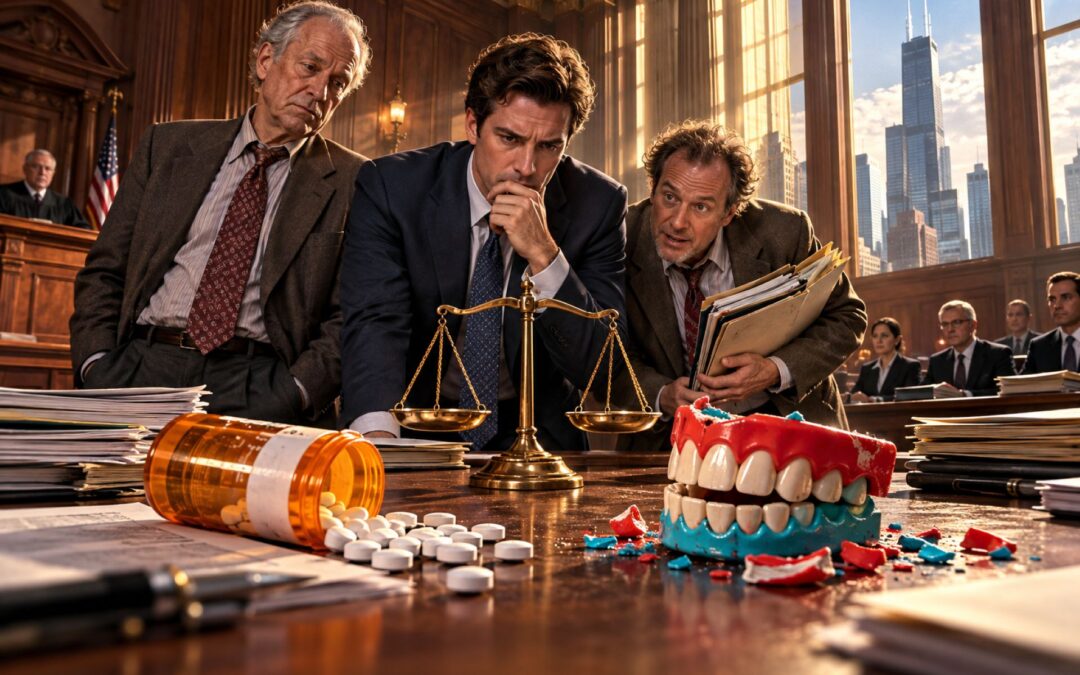
John Grisham’s The Litigators, published in 2011, follows three lawyers who have little reason to expect their careers to intersect. David Zinc is a highly paid Harvard Law School graduate whose prestigious job has become unbearable. Oscar Finley and Wally Figg operate a struggling Chicago law firm that survives on divorces, minor injuries, and whatever clients its lawyers can persuade to walk through the door. When David abruptly abandons his corporate career and joins their practice, he enters a world where professional freedom comes with financial insecurity, questionable ethics, and an alarming absence of preparation.
Their unlikely partnership becomes involved in a massive pharmaceutical lawsuit against Varrick Laboratories, the manufacturer of a cholesterol drug called Krayoxx. Wally anticipates a multimillion-dollar settlement, but the case develops very differently from his expectations. Meanwhile, David discovers other clients whose injuries and legal claims are more compelling than those driving the firm’s pursuit of pharmaceutical riches. Grisham combines workplace comedy with courtroom suspense, using these contrasting cases to examine professional ambition, corporate power, scientific evidence, and the uneasy relationship between making money and obtaining justice.
Spoiler Warning: This article covers the complete novel, including the Krayoxx trial verdict, the Nasty Teeth settlement, the fate of the Khaing family, and the epilogue.

The Escape From Rogan Rothberg and a New Life at Finley & Figg
Finley & Figg occupies a shabby converted house at 418 Preston Avenue on Chicago’s southwest side. The partners describe their practice as a boutique firm, although its surroundings and clientele hardly support the fashionable image that term suggests. Oscar Finley, the senior partner, has spent decades handling ordinary legal disputes without achieving significant financial success. His younger colleague, Wally Figg, continually searches for personal-injury claims that might produce a substantial contingency fee. Their secretary and office manager, Rochelle Gibson, maintains order while enduring their arguments, dubious business schemes, and chronic money problems.
The office also houses AC, a dog whose presence contributes to the firm’s informal atmosphere. Unlike the carefully organized world of corporate law, Finley & Figg has few professional boundaries. Clients arrive with domestic disputes, small legal problems, and complaints that may offer little financial reward. Wally advertises aggressively and pursues potential claimants wherever he can find them, while Oscar complains about the resulting workload and the firm’s persistent inability to earn enough money.
David Zinc approaches this world from the opposite end of the profession. He works at Rogan Rothberg, an elite Chicago law firm whose offices occupy the upper floors of the imposing Trust Tower. His salary is approximately $300,000, and his credentials place him among the profession’s privileged young lawyers. Yet his daily life consists of exhausting hours, demanding assignments, and almost complete subordination to the expectations of senior partners.
His supervising partner, Roy Barton, embodies the culture David has come to despise. Roy measures success through money, billable hours, and professional advancement, expecting younger lawyers to display similar devotion. David has spent five years in this environment, accumulating financial security while sacrificing leisure, independence, and much of his relationship with his wife, Helen.
One morning, David experiences a crisis while approaching his office. His feet seem impossibly heavy, his breathing becomes difficult, and the prospect of another day at Rogan Rothberg overwhelms him. Instead of continuing to work, he turns around and leaves. His physical symptoms subside as he recognizes that he has escaped, at least temporarily, from an existence he can no longer tolerate.
Without a plan for what comes next, David wanders into a bar called Abner’s. There he begins drinking, explaining his professional misery to the bartender and eventually becoming thoroughly intoxicated. His sudden departure alarms Helen, who receives incoherent messages from him and discovers that nobody at his office can adequately explain his disappearance.
While David drinks, Wally Figg is becoming excited about an entirely different development. A former client named Chester Marino has died, and Wally learns that Marino had taken Krayoxx, a cholesterol medication manufactured by Varrick Laboratories. Reports are circulating that the drug may cause heart attacks and strokes. Wally sees the possibility of recruiting the deceased man’s family into a potentially lucrative pharmaceutical lawsuit.
The idea appeals to Wally because pharmaceutical mass torts can produce enormous settlements. Lawyers representing large groups of injured clients may earn considerable contingency fees without personally taking every claim to trial. Wally believes that identifying several Krayoxx users who suffered heart-related injuries could transform the firm’s finances.
David’s drunken journey eventually brings him to Finley & Figg. He arrives without an appointment, impresses nobody with his condition, and announces that he wants to work there. Oscar and Wally initially struggle to understand why a successful young corporate lawyer would seek employment at their impoverished practice. Nevertheless, the situation intrigues them, particularly when they discover his education and former salary.
The absurdity increases when the lawyers become involved in the aftermath of a nearby traffic accident. Their instinctive interest in potential clients exposes David to the aggressive personal-injury culture that will dominate his new workplace. Despite his intoxication, he begins to find the unfamiliar environment appealing.
Helen eventually arrives to retrieve him. She is frightened by his disappearance and bewildered by his choice of destination. The episode forces the couple to confront something their comfortable household has concealed: David’s professional life has become intolerable, and returning to it may damage him further.
When David returns sober, he confirms that he genuinely wants to join the firm. He offers to accept a fraction of his previous compensation because he and Helen have accumulated savings. His objective is to learn practical law in an environment where he can interact with clients and potentially spend less time working.
Oscar and Wally are skeptical, but they agree. David receives a neglected office, begins cleaning and organizing it, and prepares to undertake work for which his expensive education and corporate experience have left him surprisingly unprepared.
His first courthouse encounters reveal the distance between legal prestige and practical courtroom competence. Accompanying Wally through ordinary proceedings, including the troubled divorce of DeeAnna Nuxhall, David observes lawyers improvising, negotiating, and maneuvering around judges and opposing counsel. These activities bear little resemblance to his previous work, but they represent the kind of professional experience he believes he has been missing.
David also discovers that his new colleagues are considerably less respectable than he initially imagined. Wally’s schemes regularly approach ethical boundaries, while Oscar’s long familiarity with street-level practice has encouraged habits that would be unacceptable in a more closely supervised environment. The freedom David has obtained comes with immediate exposure to professional disorder.
He nevertheless begins to enjoy ordinary experiences that his former career had crowded out. He can see daylight through his office windows, interact directly with people, and imagine a future without constant pressure from Roy Barton. His satisfaction remains tentative, because he has not yet faced the financial and legal consequences of his new colleagues’ ambitions.
How the Krayoxx Lawsuit Becomes a Fortune in the Making
Wally’s excitement about Krayoxx increases as reports of possible cardiovascular dangers spread. The drug has been prescribed to patients with high cholesterol, and lawsuits are beginning to allege that it causes the very kinds of medical disasters its users hope to avoid. For an attorney accustomed to modest fees, the prospect of representing several people who suffered heart attacks or strokes appears irresistible.
The first problem is finding clients. Wally attempts to recruit people through direct approaches and a mass mailing that urges former Krayoxx users and their families to contact the firm. The campaign is intrusive, expensive, and largely unsuccessful. Many letters return undelivered, while some recipients complain about the firm’s tactics.
Undeterred, Wally visits potential plaintiffs personally. David accompanies him on some of these calls and witnesses the uncomfortable process of converting illness and bereavement into legal claims. Some families are grieving, others are suspicious, and several potential clients have medical histories that make the alleged connection between Krayoxx and their injuries difficult to establish.
Wally is much more interested in obtaining signed representation agreements than in investigating those complications. He talks confidently about large settlements, encouraging clients to believe that participation in the litigation could bring financial security. David increasingly recognizes that Wally’s predictions are based on the economics of previous mass-tort cases rather than strong evidence concerning this particular drug.
Within a relatively short period, Finley & Figg assembles eight death claims. The firm files a lawsuit seeking $100 million from Varrick Laboratories, an extraordinary amount for lawyers with almost no experience in federal pharmaceutical litigation.
The case is assigned to Judge Harry Seawright, an elderly federal judge known for strict scheduling and little patience with lawyers who waste the court’s time. Seawright immediately recognizes the imbalance between the plaintiffs’ ambition and their professional qualifications. A tiny neighborhood practice has taken on one of the country’s largest pharmaceutical manufacturers without demonstrating that it possesses the resources to conduct the litigation properly.
Wally assumes this problem can be solved by joining forces with Jerry Alisandros, a wealthy Florida lawyer whose firm specializes in pharmaceutical mass torts. Alisandros operates in a different financial universe from Finley & Figg. He commands teams of lawyers and medical specialists, travels in a private jet, and handles litigation involving numerous plaintiffs and enormous potential settlements.
Wally travels to meet him and becomes intoxicated by the displays of wealth surrounding the mass-tort business. The expensive offices, aircraft, and confident predictions appear to confirm his belief that Krayoxx will make him rich.
Alisandros offers an arrangement under which his organization will provide expertise and financial support in exchange for a share of the eventual proceeds. Wally welcomes the alliance because it appears to solve the firm’s lack of experience and capital. Oscar is less enthusiastic, recognizing that powerful partners and expensive experts will absorb substantial portions of any settlement.
David sees another danger. The firm’s expectations depend on a result that has not been established: that Krayoxx actually caused the medical conditions alleged by its plaintiffs. Alisandros possesses a formidable commercial operation, but its size does not necessarily guarantee the accuracy of its underlying claims.
Varrick Laboratories is pursuing its own strategy. Its chief executive, Reuben Massey, understands the financial and reputational risks of pharmaceutical litigation. The company has previously faced serious problems involving another drug, Klervex, and Massey has no intention of allowing Krayoxx to become another expensive defeat.
Varrick’s lawyers believe the Krayoxx allegations are substantially weaker than the claims that damaged the company in the past. Rather than rushing to settle, they plan to challenge the scientific foundation of the lawsuits while creating the impression that a negotiated resolution remains possible.
The company retains Rogan Rothberg, David’s former employer, to defend it in Chicago. Nadine Karros, an experienced litigation partner, becomes the central courtroom representative. Her polished appearance and professional courtesy conceal a formidable command of trial strategy, expert evidence, and procedural advantage.
For David, this development brings his two professional lives into direct conflict. He understands the resources, culture, and reputation of Rogan Rothberg from the inside. Now he must face that institution as a lawyer working for a firm that cannot match its staff, money, or specialized knowledge.
Karros and the Varrick team intend to isolate a vulnerable plaintiff whose case can be tried before the larger litigation produces a settlement. They identify the claim involving Percy Klopeck, a deceased Krayoxx user whose widow, Iris, is represented by Finley & Figg.
The Klopeck case offers the defense an attractive target. Percy’s medical history includes serious health problems that complicate the allegation that Krayoxx caused his death. A decisive defense verdict could undermine confidence in the wider mass-tort campaign and frighten other plaintiffs’ firms away from similar claims.
Judge Seawright’s discovery conference brings the opposing lawyers together. While Wally is impressed by Karros’s attention and apparent friendliness, David recognizes that she is carefully studying the firm’s weaknesses. The judge establishes demanding deadlines, making it increasingly difficult for the plaintiffs to delay proceedings while awaiting an industry-wide settlement.
David’s personal circumstances also continue to change. His father, Anderson Zinc, the chief justice of the Minnesota Supreme Court, finds his career decision troubling. A successful judge with conventional expectations about professional achievement, Anderson cannot easily understand why his Harvard-educated son would abandon a prestigious firm for such a chaotic workplace.
David remains determined to proceed. He believes he has exchanged exhausting but meaningless work for an opportunity to become a real lawyer. Yet the Krayoxx litigation is already developing into a test that neither he nor his partners fully understand.
The Khaing Family and the Expanding Krayoxx Litigation
While Wally concentrates on pharmaceutical claims, Helen brings David’s attention to a family suffering a different kind of medical catastrophe. Through a household employee named Zaw and Helen’s university connections, the couple learns about Thuya Khaing, a young boy from a Burmese immigrant family who has suffered devastating lead poisoning.
Thuya’s parents, Soe and Lwin Khaing, have limited financial resources and few opportunities to challenge anyone responsible for their son’s condition. Their child has been hospitalized with severe neurological injuries. Doctors suspect that prolonged exposure to lead caused the damage, but identifying the exact source remains difficult.
David visits the family and begins investigating their living conditions. Lead poisoning can arise from several environmental sources, including contaminated paint, water, and consumer products. He examines Thuya’s surroundings and becomes interested in a collection of inexpensive plastic novelty teeth that the boy frequently handled and chewed.
The toys are called Nasty Teeth. Their brightly colored appearance makes them seem harmless, but David suspects that the paint coating them may contain dangerous concentrations of lead. He arranges laboratory testing through Dr. Biff Sandroni, a specialist familiar with product-related poisoning cases.
The results establish a promising connection between the toys and Thuya’s injuries. However, David faces a major obstacle: the family no longer possesses the original packaging, and the toys themselves do not adequately identify the company responsible for their manufacture or distribution.
Without identifying a suitable defendant, David cannot pursue an effective product-liability claim. He begins searching shops and other possible retail sources for matching toys, hoping to find an unopened package that will reveal their commercial origin.
Unlike the speculative Krayoxx litigation, the Khaing investigation develops from a specific injury toward physical evidence and an identifiable causal explanation. David has not yet solved the case, but he is undertaking the factual work necessary to determine whether it can be brought responsibly.
The emotional consequences are equally important. David and Helen visit Thuya in the hospital, where the child depends on intensive medical support. His suffering is not an abstract claim in a lawyer’s file. The couple sees the disruption of his family’s life and the terrifying uncertainty surrounding his recovery.
Meanwhile, Nadine Karros begins deposing the Krayoxx plaintiffs. These depositions expose weaknesses that Wally had paid insufficient attention to while recruiting clients. Iris Klopeck and other claimants face detailed questions about their medical histories, medication use, family circumstances, and previous statements.
David observes the difference between Wally’s informal conversations and the disciplined examination conducted by a sophisticated defense lawyer. Facts that seemed unimportant during client recruitment become central when the plaintiffs must defend their claims under oath.
The mass-tort operation continues expanding. Alisandros arrives with an entourage of lawyers and experts, demonstrating the resources supposedly available to the plaintiffs. Yet Judge Seawright remains determined to keep the Klopeck case moving toward trial.
Alisandros expects Varrick to settle before that happens. His strategy depends on making the litigation expensive and dangerous enough that the company will prefer a negotiated agreement to continued uncertainty.
Then the death of Senator Kirk Maxwell dramatically changes the public atmosphere. Maxwell collapses while speaking in the United States Senate, and his family subsequently reveals that he had been taking Krayoxx. The possibility that a prominent senator died from a widely prescribed medication attracts intense media attention.
The senator’s history complicates the controversy. Maxwell had been closely associated with pharmaceutical interests, making his family’s potential lawsuit politically embarrassing for the industry. Wally and other plaintiffs’ lawyers interpret the publicity as powerful support for their claims.
Regulatory pressure follows. The Food and Drug Administration orders Krayoxx withdrawn from the market, apparently confirming the impression that the medication presents serious dangers. Calls flood Finley & Figg as frightened former users seek advice, reassurance, or an opportunity to participate in the litigation.
Rochelle struggles with the workload, while Wally grows increasingly excited about the firm’s apparent importance. He begins acting as though the litigation has already succeeded, even though the underlying scientific questions remain unresolved.
Varrick is alarmed by the publicity but continues planning strategically. Massey and political adviser Layton Koane consider a confidential settlement with Maxwell’s family, hoping to remove a damaging public controversy while containing broader litigation risks.
The proposed settlement is driven by concerns beyond the medical merits of the case. Public reputation, regulatory relationships, political influence, and the possibility of further lawsuits all enter the calculation.
This creates a misleading situation for Finley & Figg. The company is willing to resolve a politically sensitive claim, but that willingness does not establish that the other Krayoxx lawsuits are scientifically sound. Wally interprets the signals as evidence of a general settlement when Varrick’s strategy remains much more selective.
David continues balancing these developments with the Khaing investigation. The family has a severely injured child and laboratory findings pointing toward a particular product, but the responsible corporation remains unidentified. The contrast between the cases grows stronger as the pharmaceutical litigation becomes louder and the quieter investigation struggles to move forward.
Oscar’s Divorce, the Cicero Pipe Case, and David’s First Victory
As the Krayoxx litigation becomes increasingly valuable in Wally’s imagination, its anticipated proceeds begin influencing his colleagues’ personal decisions. Oscar has endured a deeply unhappy marriage to Paula Finley for many years. Wally encourages him to pursue a divorce before any substantial litigation fees arrive, believing that doing so may protect future income from marital claims.
His advice is both practical and ethically questionable. Wally discusses ways of separating anticipated earnings from divorce proceedings and fantasizes about shielding wealth from scrutiny. The men increasingly make decisions on the assumption that a settlement is certain.
Oscar eventually leaves Paula and begins enjoying the independence that has eluded him for decades. His new circumstances improve his mood, but the divorce becomes contentious as Paula’s lawyer investigates the firm’s finances and possible future income.
Wally’s romantic entanglement with DeeAnna Nuxhall produces related difficulties. As she becomes more interested in his expected wealth, Wally worries about maintaining the relationship and begins thinking about protecting himself financially.
David and Helen, meanwhile, develop a closer relationship with the Khaings. Thuya survives his hospitalization but returns home with devastating disabilities. He requires constant assistance with feeding, movement, and personal care, and his parents must confront the possibility that he will never regain his former abilities.
David and Helen sometimes take Thuya outside, including visits to the lakefront, giving his parents brief relief from their responsibilities. These encounters deepen David’s determination to identify the company responsible for the contaminated toys.
His involvement also exposes him to the precarious lives of immigrant workers. Soe Khaing and others belong to communities whose members may endure dangerous or exploitative employment conditions because they lack money, legal knowledge, or secure immigration status.
David learns about workers employed by Cicero Pipe, a contractor involved in a major water-treatment project. The company is paying undocumented laborers grossly inadequate wages despite requiring extremely long working hours.
Five workers from Burma and Mexico agree to bring a lawsuit. Many other exploited employees are reluctant to participate because they fear losing their jobs, being identified by immigration authorities, or suffering retaliation.
David studies the wage violations and calculates the compensation owed under the law. Unlike the Krayoxx claims, the dispute involves identifiable employment arrangements, payment practices, and legal obligations. The facts provide him with a concrete basis for demanding compensation.
He files a federal lawsuit against Cicero Pipe. The company’s response quickly becomes threatening. David receives menacing communications warning him to withdraw the case, and the danger soon extends beyond anonymous messages.
One night, Justin Bardall, an employee connected to Cicero Pipe, approaches the Finley & Figg office carrying gasoline and materials intended to start a fire. Oscar, who has been sleeping at the office after separating from Paula, hears the intrusion.
Armed with a gun, Oscar confronts Bardall and shoots him. The attacker survives but suffers serious injuries to both legs. The shooting attracts police attention and considerable publicity, especially after investigators connect Bardall to the contractor involved in David’s wage case.
Oscar suddenly enjoys a form of public recognition that decades of ordinary legal work never provided. Reporters portray him as a fearless neighborhood lawyer who defended his premises against criminal intimidation. The incident is treated comically in parts, but it also demonstrates the dangers faced by workers and lawyers challenging an abusive employer.
The resulting investigation creates enormous pressure on Cicero Pipe. The company’s owners and employees face criminal proceedings, while government authorities examine the underlying labor abuses. The publicity makes it increasingly difficult for the contractor to resist resolving the civil claims.
During this period, Helen gives birth to Emma, the couple’s first child. David now has responsibilities that extend beyond his own professional satisfaction. Fatherhood also reinforces his desire to avoid the work culture that previously consumed nearly every waking hour.
The Cicero Pipe lawsuit produces David’s first significant victory. Six weeks after filing, he secures settlements of $40,000 each for his five original clients. Another group of approximately three dozen exploited workers receives $30,000 per person.
Judge Sally Archer, known as Sudden Sal, reviews the agreement. She sharply condemns the contractor’s exploitation of its workforce and recognizes that David has obtained meaningful compensation for people who otherwise possessed little practical bargaining power.
The court also approves $30,000 in attorneys’ fees for David’s work. The award is modest compared with the sums being discussed in the Krayoxx litigation, but it represents a concrete achievement grounded in successful legal representation.
For the first time since joining Finley & Figg, David has independently handled a significant lawsuit from investigation through resolution. His success does not depend on riding the financial momentum of a mass-tort settlement. It results from researching the law, identifying violations, obtaining evidence, and using litigation to force an abusive employer to compensate its workers.
The experience increases David’s confidence and demonstrates that his education and analytical abilities can translate into practical courtroom-related work. Unfortunately, the victory does little to restrain Wally’s growing expectations about Krayoxx.
Why the Krayoxx Case Collapses Before Trial
The pharmaceutical litigation appears increasingly profitable as the scheduled Klopeck trial approaches. Settlement discussions continue, Varrick remains under public pressure, and Wally reassures his clients that compensation is imminent.
He even distributes communications suggesting that favorable negotiations are underway. These promises create expectations among clients who have already begun imagining how much money they will receive.
Behind the scenes, however, the scientific foundation of the litigation is deteriorating. Alisandros’s organization has retained medical experts to examine the alleged connection between Krayoxx and cardiovascular injuries. Their findings are much less helpful than expected.
The experts cannot establish persuasive evidence that Krayoxx causes the heart attacks and strokes attributed to it. Some conclusions suggest that the drug may be substantially safer than the plaintiffs’ lawyers assumed when they began recruiting clients.
This problem is far more serious than a disagreement about damages or trial tactics. Product-liability litigation requires evidence connecting the product to the alleged injury. A large number of unhappy or frightened claimants cannot compensate for the absence of reliable proof.
Alisandros initially attempts to preserve the appearance of confidence. He continues discussions with Varrick while privately considering whether the entire Krayoxx campaign should be abandoned.
The strategy depends on obtaining a settlement before the weakness of the scientific evidence becomes widely known. As the experts’ conclusions become increasingly unfavorable, that possibility fades.
Varrick understands the change in circumstances. Its lawyers are now less concerned about the threat posed by the plaintiffs and more interested in exploiting their vulnerability. Settlement discussions are canceled, and Alisandros withdraws his support from the Klopeck lawsuit.
Finley & Figg suddenly discovers that the wealthy specialist on whom it depended will not provide the promised protection. Oscar, Wally, and David are left with a rapidly approaching trial, enormous potential expenses, and a case their own side’s experts no longer believe in.
Wally attempts to dismiss the lawsuit. From his perspective, the sensible course is to abandon a case that can no longer produce a favorable result.
Karros refuses to allow such an easy exit. Varrick wants a public verdict demonstrating that the Krayoxx allegations are unfounded. A decisive victory against an especially weak claim could discourage numerous other plaintiffs and strengthen the company’s campaign to restore the drug’s reputation.
The defense also threatens sanctions for filing frivolous litigation. Such penalties could impose serious financial consequences on Finley & Figg, whose partners have already spent money and borrowed against their anticipated windfall.
The firm faces additional danger from dissatisfied clients. Malpractice attorney Bart Shaw begins investigating potential claims against the lawyers who encouraged people to expect substantial settlements. Wally’s earlier promotional confidence now threatens to become evidence of professional misconduct.
The three partners confront an unpleasant collection of possibilities. Continuing the litigation may produce a humiliating defeat. Abandoning it may trigger sanctions, claims by clients, or further financial losses. Their reliance on Alisandros has left them without the expertise necessary to conduct the case themselves.
With few alternatives, they borrow money and prepare for trial. They seek medical witnesses willing to support the plaintiffs’ position, even though their strongest prospective experts have retreated.
Dr. Igor Borzov, a cardiologist with a difficult communication style and limited courtroom appeal, becomes their principal medical witness. The firm also plans to present economic testimony concerning the financial consequences of Percy Klopeck’s death.
David attempts to introduce some discipline into the preparations. He insists that his colleagues dress professionally, studies procedural rules, and observes other trials to learn how federal courtroom practice works.
Oscar is designated lead trial counsel because he has more courtroom experience than Wally or David. Yet his experience does not equip him for a complex federal pharmaceutical trial against an exceptionally prepared defense team.
The lawyers fail to challenge the qualifications and methodologies of Varrick’s experts through the available pretrial procedures. They recognize that those witnesses possess formidable credentials, while their own expert support is dangerously thin.
Judge Seawright refuses to postpone proceedings merely because the plaintiffs have discovered the weakness of their case. His determination makes clear that filing a major lawsuit creates obligations that cannot be escaped whenever a predicted settlement fails to materialize.
The difference between the two sides is now unmistakable. Varrick has chosen the forum, developed its evidence, financed its defense, and identified its objective. Finley & Figg entered the litigation expecting someone else to negotiate a settlement and now must conduct a trial for which it was never properly prepared.
The Klopeck Trial: Medical Crisis, Addiction, and Legal Disaster
The Klopeck trial begins badly even before the lawyers make their opening statements. Iris Klopeck, the plaintiff, does not appear in court. Her absence requires explanations to Judge Seawright and complicates the firm’s presentation to the jury.
Iris’s medical condition and personal circumstances create further difficulties. The lawyers struggle to determine whether she can attend and whether her testimony would help or damage the case.
Her earlier deposition has already exposed weaknesses in the presentation of her husband’s medical history. Because the plaintiff’s credibility is important, the partners worry that her appearance might create more problems than it solves.
The lawyers therefore approach the trial with uncertainty about the person whose lawsuit they are supposed to be pursuing. Karros, meanwhile, has organized a comprehensive defense supported by medical experts and a carefully constructed account of Krayoxx’s safety.
Oscar is supposed to deliver the plaintiffs’ opening statement. Before he can establish a coherent argument, he suffers a heart attack in the courtroom.
The medical emergency forces an immediate interruption. Oscar survives and undergoes serious treatment, but his collapse deprives the plaintiffs of their designated lead lawyer at the moment they most need him.
Wally must suddenly assume responsibility. In an effort to establish rapport with the jurors, he makes an improper joke involving Krayoxx. Karros objects, and Judge Seawright declares a mistrial.
For Wally and David, the mistrial appears to offer the possibility of desperately needed additional preparation time. Seawright refuses to reward their incompetence with an extended delay, however, and orders proceedings to continue before a new jury.
The second trial begins with Wally presenting the plaintiffs’ case. His opening statement lacks the clarity and authority of Karros’s presentation, which emphasizes the absence of credible proof that Krayoxx caused Percy Klopeck’s death.
The jury watches Iris’s recorded deposition. Instead of presenting a sympathetic and persuasive witness, the recording exposes an awkward, unprepared woman whose appearance and answers do little to strengthen the claim.
Dr. Borzov then takes the stand. His qualifications initially appear useful because he has medical training and experience in cardiology, but his testimony quickly becomes a disaster.
Borzov struggles to communicate clearly. His accent, technical explanations, and awkward responses make it difficult for jurors and even the court reporter to follow his answers. Wally attempts to guide him through diagrams and medical records, but the presentation remains confusing.
The doctor discusses Percy’s heart condition and proposes a mechanism by which Krayoxx might have contributed to his death. Yet the testimony fails to supply the convincing causal explanation necessary to overcome the defense’s objections.
Percy’s existing health problems also remain prominent. The jury must consider whether the drug caused his death or whether his cardiovascular risks provide a more plausible explanation.
Wally grows increasingly distressed as the trial progresses. He has long struggled with alcohol, and the collapse of his most ambitious professional venture intensifies his vulnerability.
After drinking again, he fails to appear in court. David discovers evidence of the relapse at the office and realizes that he may have lost his final experienced courtroom colleague.
Judge Seawright becomes furious when David explains that Wally is missing. Karros has little interest in granting relief to the plaintiffs, and the judge refuses to allow the trial to disintegrate because their lawyers cannot manage their professional responsibilities.
David admits that he has never tried a case. Nevertheless, he is pressured into continuing the proceedings, with assurances addressing some of the threatened sanctions and malpractice concerns.
The situation places him in the position he has been trying to reach since leaving Rogan Rothberg: he must practice law directly, before a judge and jury, with responsibility for the outcome. The circumstances are considerably less attractive than the idealized apprenticeship he originally imagined.
David struggles through the remaining plaintiffs’ evidence. He must examine witnesses, respond to objections, and make decisions for which he has almost no practical preparation.
The economic expert, Kanya Meade, provides testimony concerning Percy’s projected earnings and the financial consequences of his death. Yet sophisticated calculations of damages accomplish little if the jury does not believe Varrick caused the injury.
David begins understanding that litigation depends on more than the presentation of professional opinions. Experts must be credible, their conclusions must relate to the actual dispute, and their evidence must survive questioning from capable opposing counsel.
He also searches for Wally. When David finds his colleague, he recognizes that the relapse requires treatment rather than another argument about courtroom responsibilities. He arranges for Wally to enter rehabilitation and assumes responsibility for the expense.
The decision reveals David’s growing loyalty to the people at Finley & Figg. Although Wally’s behavior has created enormous professional danger, David does not abandon him when he becomes helpless.
At the same time, David’s search unexpectedly advances the Khaing case. During his travels, he discovers packaged Nasty Teeth in a retail location. The packaging identifies Gunderson Toys, a company subsequently acquired by Sonesta Games.
The discovery supplies the missing link in the product-liability investigation. David now has a possible corporate defendant, original packaging, and toxic products that can be examined by experts.
Back in court, Varrick’s witnesses present a much stronger account of Krayoxx than anything the plaintiffs have produced. Their professional credentials, medical evidence, and orderly testimony expose the inadequacy of Finley & Figg’s presentation.
Varrick’s leadership watches the developing trial with satisfaction. Its chief executive is offered the possibility of securing a legal victory without waiting for the jury, but he prefers a public verdict that can be used against the wider Krayoxx litigation.
Massey’s objective is no longer limited to defending one lawsuit. He wants to demonstrate the weakness of the allegations and make other plaintiffs’ lawyers reconsider their positions.
David visits Oscar during his recovery and Wally at the rehabilitation facility, attempting to maintain the relationships that have survived the firm’s collapse. Meanwhile, he prepares to complete the trial despite knowing that the original case is probably lost.
His predicament is especially painful because he has begun acquiring genuine competence precisely when the lawsuit’s factual weaknesses make success nearly impossible.
Varrick’s Victory and the Nasty Teeth Settlement
The defense continues presenting expert evidence intended to establish that Krayoxx is safe and that Percy Klopeck’s death cannot reliably be attributed to the medication. David is increasingly impressed by the preparation of Varrick’s lawyers even as he resents the company’s determination to destroy the plaintiffs’ case publicly.
An unexpected opportunity appears when Dr. Mark Ulander, a senior Varrick executive involved in pharmaceutical research, takes the stand. David begins questioning him about the company’s clinical trials and its broader record of drug development.
He discovers that Varrick conducts much of its testing outside the United States, including in developing countries where poor participants may have limited protections or bargaining power. David challenges the company’s explanation that restrictive American regulation makes overseas trials necessary.
The exchange gives him an opening to examine Varrick’s treatment of vulnerable research participants. He pursues questions about testing practices, medical risks, and the company’s willingness to profit from drugs developed through ethically troubling procedures.
Karros objects that these subjects are irrelevant to the Krayoxx lawsuit. Judge Seawright allows David some latitude, and the inexperienced lawyer presses his advantage.
David turns to other drugs previously developed by Varrick. He questions Ulander about Amoxitrol, an abortion medication tested on women in African countries, and exposes disturbing allegations concerning injuries and deaths during the trials.
He continues examining the company’s record with additional medications, drawing attention to research practices and warnings that cast doubt on Varrick’s broader commitment to patient safety.
For the first time, Karros appears genuinely uncomfortable. Ulander struggles to answer several questions, and the jurors become interested in revelations that differ sharply from the corporation’s carefully managed public image.
David experiences the excitement of effective cross-examination. He has identified information his opponent would prefer to conceal and used it to challenge a powerful witness.
But the distinction between corporate misconduct and legal liability remains decisive. Evidence suggesting that Varrick behaved irresponsibly in other drug trials does not establish that Krayoxx caused Percy Klopeck’s death.
David’s questioning damages the company’s moral credibility more effectively than its scientific position. The defense can still argue that the case before the jury concerns a particular medicine and a particular death.
After several hours of questioning, David decides that he has accomplished as much as possible. He recognizes that further attacks on Varrick’s history may irritate the jury or distract from the legal issue they must decide.
During the trial, he also learns the identity of Aaron Deentz, a hostile blogger who has been mocking Finley & Figg under the name the Hung Juror. Deentz’s commentary has added public humiliation to the firm’s already miserable circumstances.
When the defense rests, David delivers a brief closing argument. He acknowledges his inexperience and does not pretend that his side has presented a convincing medical case.
Karros responds with a more disciplined argument. She redirects attention away from Varrick’s unrelated controversies and toward Krayoxx, Percy’s medical history, and the weakness of the plaintiffs’ proof.
The jury returns a verdict for Varrick Laboratories after just seventeen minutes of deliberation.
The speed of the decision confirms the inadequacy of the Klopeck case. David’s successful cross-examination has not overcome the absence of reliable evidence linking Krayoxx to the alleged injury.
Outside the courtroom, David encounters Deentz and assaults him. The incident exposes the anger and loss of control beneath his increasingly competent professional exterior. His frustration is understandable, but the attack is indefensible and complicates any interpretation of him as consistently principled.
Varrick immediately uses the verdict to strengthen its public position. The company’s stock benefits from the result, and its representatives portray the judgment as confirmation that Krayoxx has been unfairly targeted.
For Finley & Figg, the outcome is financially and professionally devastating. The firm has spent money it cannot easily replace, alienated clients, and exposed itself to continuing legal threats.
David now turns his attention to the case that has quietly survived the disaster. Having identified Gunderson Toys and Sonesta Games, he submits packaged Nasty Teeth for additional laboratory testing.
Dr. Sandroni confirms that the toys contain dangerously high levels of lead. The findings provide a concrete connection between a particular product and Thuya’s injuries.
David assembles a detailed evidentiary package containing laboratory results, photographs, information about the toys, and supporting documentation. He sends the material to Sonesta Games rather than immediately filing another major lawsuit.
The company’s response differs dramatically from Varrick’s. Sonesta’s representatives contact David and arrange a meeting with senior executives, including chief executive Carl LaPorte, chief counsel Dylan Kott, and chief financial officer Wyatt Vitelli.
David accompanies Soe and Lwin Khaing to the company’s facilities. The parents are intimidated by the setting and the powerful people involved, but the executives do not begin by denying responsibility.
LaPorte apologizes for the family’s suffering and acknowledges the company’s responsibility for the harmful toys. He expresses concern about the damage to children and the possibility that additional contaminated products remain in circulation.
David is surprised by the directness of the response. His recent experience with Varrick has prepared him for aggressive denials, elaborate litigation tactics, and prolonged negotiation.
Sonesta’s willingness to settle also reflects its commercial interests. A company that manufactures toys depends on public trust, and a widely publicized case involving lead poisoning could seriously damage its reputation.
David nevertheless has substantial evidence supporting a large settlement. He presents examples of verdicts involving children with severe brain injuries and develops a calculation of the Khaing family’s losses.
His demand includes future medical and caregiving expenses, lost income, transportation needs, and compensation for suffering and diminished quality of life. He calculates approximately $3.2 million in specific financial needs and another $1.8 million for less easily measured harms.
The total proposed payment to the family is $5 million. David separately demands $1.5 million in attorneys’ fees, making the overall settlement $6.5 million.
This distinction matters because the fee is not deducted from the family’s compensation. The arrangement is subject to court approval, and David has already made provision for guardianship and oversight of the funds.
The executives initially appear prepared to offer less than David demands. He refuses to reduce his figure, explaining that he is willing to take the case to trial if necessary.
When LaPorte asks about his recent courtroom defeat, David acknowledges losing but emphasizes the difference between the two cases. The Krayoxx lawsuit suffered from weak evidence; the Nasty Teeth case involves a documented product hazard, an identifiable defendant, and a catastrophic injury.
David’s confidence is no longer based primarily on speculation about what a large corporation might pay to avoid publicity. He has assembled evidence that gives his threat of litigation real force.
Sonesta agrees to the full $6.5 million settlement. The agreement is signed, the Khaings receive an explanation of its terms, and the company’s executives again express regret for what happened to Thuya.
Before David leaves, Dylan Kott privately provides him with information about other consumer products associated with lead poisoning. The material suggests possible future cases and offers David a direction for developing his professional practice.
The settlement provides financial relief for the family and an extraordinary fee for Finley & Figg. It also demonstrates how completely David’s position has changed since his first drunken arrival at the office.
The New Partnership, Thuya’s Death, and David’s Independence
David returns to Finley & Figg with news that neither Oscar nor Wally expects. Their anticipated Krayoxx fortune has disappeared, and the partners have been concentrating on survival rather than expansion.
He explains the Khaing investigation, the discovery of the manufacturer, and the successful settlement. When he reveals that the attorneys’ fees amount to $1.5 million, Oscar and Wally are almost unable to believe what they are hearing.
David then presents a proposal for a new firm called Finley, Figg & Zinc. Rather than simply collecting the fee and leaving, he offers his colleagues an equal partnership built around stricter professional standards.
The agreement prohibits questionable referral payments, aggressive ambulance chasing, and the cheap advertising practices that have long defined Wally’s business development. David also proposes tighter controls over client recruitment, accounting, and approval of new cases.
He intends to use part of the fee to repay debts and address expenses remaining from the Krayoxx disaster. Rochelle is to receive a substantial bonus for her work, and the remaining proceeds will be distributed among the three lawyers.
Oscar and Wally recognize that David could reasonably keep a much larger portion for himself. He explains that he would never have discovered the Khaing case without the unusual sequence of events that brought him to their firm.
The proposal provides a financial rescue and a possible opportunity for professional reform. The partners accept, although the restrictions are particularly difficult for Wally, whose career has been built around soliciting cases.
The final scene of the main narrative captures the uncertainty of this arrangement. An ambulance siren approaches, and Wally instinctively looks toward the window, momentarily forgetting that his new agreement forbids the behavior associated with such opportunities.
Oscar and David recognize the familiar impulse, and the three men laugh. The moment is affectionate, but it also raises doubts about whether long-established habits can disappear because of a signed partnership agreement.
The epilogue resolves those doubts while providing a more complicated account of the characters’ futures.
The immediate legal aftermath is relatively favorable to Finley & Figg. Bart Shaw abandons his threatened malpractice actions, and the firm’s various professional complaints fail to produce serious consequences. Karros honors her decision not to pursue further sanctions against the small firm, although Varrick continues acting aggressively against other Krayoxx plaintiffs’ lawyers.
Alisandros faces serious financial consequences elsewhere for litigation he has no intention of pursuing. The broader Krayoxx campaign has become a warning about the risks of speculative pharmaceutical lawsuits.
The most painful development concerns Thuya. Despite the settlement and the family’s efforts to care for him, he suffers violent seizures and dies three days after Christmas.
David, Helen, Oscar, Wally, and Rochelle attend his funeral. Representatives of Sonesta Games also attend and express condolences to his parents.
The settlement remains binding, and the promised money will still be paid. Yet the funds can no longer support Thuya’s future treatment or restore the life his parents hoped he would have.
His death prevents the Khaing case from becoming an uncomplicated celebration of financial compensation. David achieved a successful legal result, but the family has suffered a loss that no settlement can reverse.
Other matters reach their conclusions. Oscar’s divorce becomes final, and he settles into a happier personal life with a new companion. Wally remains sober and begins helping other lawyers struggling with addiction.
Justin Bardall receives a prison sentence for attempting to burn the law office. The owner of Cicero Pipe and a construction superintendent also receive prison sentences for their involvement in the criminal conduct. David succeeds in obtaining dismissal of Bardall’s lawsuit against Oscar.
The new partnership, however, gradually loses its momentum. Oscar’s heart surgery and changing personal circumstances reduce his interest in practicing law. Wally, chastened by the Krayoxx catastrophe, no longer possesses his former enthusiasm for aggressively recruiting cases.
David recognizes that his partners do not share his ambitions for building a serious product-liability practice. The agreement has improved their finances and encouraged better conduct, but it cannot give Oscar and Wally the skills or energy required for the cases he now wants to handle.
Helen gives birth to twin boys eleven months after Emma’s arrival, further changing David’s personal priorities. He begins planning a law firm that will allow him to practice independently while remaining close to his growing family.
He leases an office near their home in Lincoln Park. From its windows he can see Chicago’s skyline, including the Trust Tower where he once worked. The building that previously represented confinement now appears as a reminder of the professional life he has escaped.
When the one-year partnership agreement approaches its expiration, David announces his intention to leave. Oscar decides to retire, while Wally accepts that the firm has reached its natural end.
The partners agree to sell the building and close the practice. Their separation is sad but not bitter; each has obtained something he lacked when David first arrived.
David takes AC with him and hires Rochelle as office manager. She receives better compensation and a more substantial professional role in the new practice.
David E. Zinc, Attorney-at-Law, specializes in product-liability litigation. After settling additional lead-poisoning cases, he establishes a growing and financially successful firm.
He still works in federal court and occasionally visits downtown, but he approaches the city differently. Sometimes he stops at Abner’s, recalling the day he abandoned Rogan Rothberg and began the unexpected journey that transformed his career.
His final position is neither a return to corporate prestige nor a permanent commitment to the disorder of Finley & Figg. He has developed his own practice, learned through failure, and obtained a greater degree of control over the relationship between his work and personal life.
Chicago’s Two Legal Worlds and the Economics of Litigation
Chicago serves as more than the geographical setting of The Litigators. Grisham uses the city to contrast sharply different legal institutions, professional cultures, and economic opportunities. The distance between Rogan Rothberg’s elevated offices and Finley & Figg’s deteriorating building represents a divide within the legal profession that David initially understands only in superficial terms.
The Trust Tower reflects the prestige and financial rewards of large-firm practice. Its lawyers serve wealthy institutional clients, maintain specialized departments, and command extraordinary resources. Their professional standing depends on credentials, billing, reputation, and access to influential individuals and corporations.
David enjoys many of these advantages before leaving. His salary allows him and Helen to live comfortably, and his association with Rogan Rothberg provides immediate credibility. Yet the firm’s demanding work culture has reduced his autonomy. Its emphasis on billable hours and institutional expectations makes personal fulfillment appear secondary to professional success.
Finley & Figg operates with much less money and far greater freedom. Its clients include people involved in divorces, small injuries, personal disputes, and wage conflicts. Such work brings the lawyers into direct contact with ordinary lives, but it also exposes them to unpaid bills, unreliable clients, and cases whose likely fees barely justify the effort involved.
In a contemporary interview about his writing and legal experience, Grisham explained that the idea for The Litigators began as a sitcom script and drew partly on his familiarity with street-level lawyers. That background helps explain the comic attention he gives to the firm’s modest premises, demanding clients, and financially precarious routines.
The novel is particularly interested in how different lawyers earn money. At Rogan Rothberg, David’s labor is billed to clients at high hourly rates, and the firm’s income depends on maintaining a large volume of expensive professional work. Finley & Figg often represents clients who cannot afford hourly fees, making its prosperity dependent on successful cases and eventual recoveries.
Contingency-fee litigation creates opportunities for people who lack the money to hire lawyers in advance. If the case succeeds, the lawyer receives a portion of the compensation. This arrangement can make legal representation accessible to injured individuals who would otherwise struggle to obtain it.
It also creates powerful financial incentives. Lawyers may be tempted to exaggerate the value of uncertain claims, accumulate large numbers of clients, or spend more time pursuing potentially lucrative lawsuits than handling smaller but legitimate disputes.
Wally’s enthusiasm for Krayoxx follows precisely this logic. He believes that identifying enough claimants will allow him to join a larger legal campaign and collect fees when the defendant settles. His calculations depend less on proving individual injuries than on the assumption that the overall litigation will produce an enormous payment.
Alisandros operates the same model on a much larger scale. His wealth comes from organizing numerous claims, coordinating experts, and creating financial pressure on corporate defendants. The private jets and expensive legal teams surrounding him are evidence of how profitable such litigation can become.
However, those displays of success conceal the risks involved. Expert testimony, discovery, litigation financing, and trial preparation cost money. If a defendant refuses to settle and the evidence proves insufficient, a firm may lose its investment and face further liability.
Varrick understands those economics. Its strategy is designed to exploit the difference between lawyers prepared to try their cases and those who expect the company to settle before trial. The Klopeck lawsuit becomes an opportunity to demonstrate that mass-tort plaintiffs cannot rely indefinitely on the threat of litigation.
The federal courtroom functions as the novel’s most important institutional equalizer, although not an entirely fair one. Seawright expects both sides to comply with procedural obligations, regardless of their resources. Finley & Figg cannot excuse its lack of preparation by pointing to its small size.
At the same time, the defense’s professional advantages are immense. Rogan Rothberg can assign specialized lawyers, prepare expert witnesses, and invest in the strategic management of the case. David and his colleagues must attempt similar work with minimal resources and no comparable experience.
The Cicero Pipe and Khaing cases offer different economic models. David begins with identifiable injuries or violations, develops evidence, and then seeks compensation. Those claims are profitable because they have legal substance, rather than becoming legally substantial because they might be profitable.
The novel does not suggest that small firms are inherently virtuous or large firms inherently corrupt. Instead, it demonstrates how professional structures reward certain behaviors and how lawyers must decide whether to follow those incentives or exercise independent judgment.
David Zinc and Helen Zinc: Marriage, Ambition, and Reinvention
David Zinc begins the novel with professional credentials that would ordinarily suggest a successful career. He attended Harvard Law School, obtained a position at a prestigious firm, and earns far more than many lawyers ever will. Yet his apparent success conceals a growing inability to tolerate his daily life.
His breakdown is the consequence of prolonged dissatisfaction rather than a carefully considered career change. He has no detailed plan when he walks away from Rogan Rothberg. The drinking episode at Abner’s reveals both the intensity of his distress and his temporary loss of judgment.
David initially treats Finley & Figg as a place where he can escape the oppressive demands of corporate practice. He imagines working fewer hours, interacting with clients, and gradually acquiring skills that his previous employment never required him to develop.
His assumptions are partly naive. He expects the smaller practice to offer independence without fully understanding the ethical problems, financial risks, and professional incompetence he will encounter. His early optimism reflects a desire to escape one extreme rather than an accurate understanding of the alternative.
Nevertheless, David possesses qualities that distinguish him from Oscar and Wally. His education has given him strong analytical abilities, he can research difficult legal questions, and he recognizes the importance of preparing thoroughly. He gradually applies these abilities to problems that require practical rather than theoretical solutions.
The Cicero Pipe lawsuit demonstrates his emerging competence. He identifies wage violations, calculates damages, files a federal claim, and negotiates compensation for vulnerable workers. His result comes from legal preparation rather than the hope that publicity will force a wealthy defendant to pay.
The Khaing investigation develops similar skills under more difficult circumstances. David must investigate a medical injury, identify a possible product defect, obtain laboratory evidence, and locate the responsible manufacturer. Each stage requires persistence and judgment.
He also becomes emotionally invested in his clients. His visits to Thuya and his relationship with Soe and Lwin show a lawyer who increasingly understands the human consequences of his work. He is not simply trying to maximize the value of a claim; he has seen the suffering that makes compensation necessary.
Yet David’s development is not a straightforward transformation into an ideal professional. He experiences excitement when he realizes that the Nasty Teeth case might produce a substantial fee. His financial imagination is not entirely different from Wally’s, even though his investigation is more disciplined.
He also makes serious mistakes. His inexperience contributes to his difficulties during the Klopeck trial, and his assault on Aaron Deentz shows how quickly professional humiliation can overwhelm his judgment. David does not become morally flawless merely because he escapes a career he hated.
His later success depends partly on good fortune. Discovering the packaged Nasty Teeth is a major breakthrough, and Sonesta’s willingness to settle removes the need for another expensive trial. David has earned a stronger negotiating position, but circumstances also favor him.
His generosity toward Oscar, Wally, and Rochelle demonstrates another aspect of his character. After obtaining the Khaing fee, he could reasonably keep most of the proceeds. Instead, he uses the money to repair the firm’s finances and reward the people who supported his unusual professional transition.
The decision is generous, though it also reflects his belief that he can reform Finley & Figg by imposing higher standards. His later departure demonstrates that financial generosity and contractual rules cannot eliminate fundamental differences in professional ambition.
Helen’s role is essential to understanding David’s transformation. At the beginning, she shares the material comfort produced by his corporate salary while experiencing the consequences of his absence. Their marriage has become secondary to a career that demands nearly all his energy.
Her reaction to his disappearance combines fear, anger, and concern. She cannot immediately know whether his actions represent temporary irresponsibility or the beginning of a larger psychological crisis.
As David establishes himself at Finley & Figg, Helen gradually accepts the change. Their financial savings make the transition possible, but her willingness to reorganize their expectations is equally important.
Helen also becomes involved in his work. She brings the Khaing family’s situation to his attention, helps develop their relationship with the family, and provides emotional support as he struggles with demanding cases.
Her pregnancy and the birth of Emma add further responsibilities. The arrival of twin boys in the epilogue eventually encourages David to reconsider his long-term professional arrangements.
The marriage provides a measure against which his career decisions can be judged. At Rogan Rothberg, David earned impressive sums while allowing his working life to consume the relationship. At Finley & Figg, he begins creating a more sustainable balance, although his major cases sometimes recreate the long hours and pressures he hoped to escape.
Helen is not developed as fully as David. Much of her narrative role involves supporting his choices, responding to his difficulties, and connecting him with the Khaing family. Her own studies and ambitions receive comparatively less sustained attention.
Still, the marriage gives David’s professional development an important personal dimension. His eventual success matters because he gains greater control over his life, not simply because his new practice becomes lucrative.
Oscar Finley, Wally Figg, and Rochelle Gibson
Oscar Finley and Wally Figg initially appear to be comic exaggerations of unsuccessful neighborhood attorneys. Their office is disorganized, their professional ambitions exceed their resources, and their behavior repeatedly challenges conventional expectations of legal respectability. As the narrative develops, however, both men acquire personal histories and vulnerabilities that complicate the humor.
Oscar is the senior partner, a lawyer who has spent decades handling ordinary disputes without building a prosperous practice. His cynical manner reflects long experience with difficult clients, disappointing fees, and the limitations of his professional prospects.
He is frequently irritated by Wally’s schemes, yet he remains willing to participate when a lucrative opportunity appears. This combination of skepticism and temptation defines much of his involvement in Krayoxx.
Oscar understands that Wally’s promises are unreliable. Nevertheless, the possibility of extraordinary wealth appeals to a man whose career has produced few substantial financial rewards.
His marriage to Paula has become another source of unhappiness. Their relationship is marked by resentment, financial conflict, and a longstanding absence of affection. Wally’s encouragement helps Oscar pursue a divorce, although the plan to protect anticipated litigation fees complicates the moral implications of that decision.
Oscar’s move out of the marital home eventually places him at the office when Justin Bardall attempts to burn it. His armed response saves the premises from a potentially devastating attack, and his subsequent publicity briefly transforms him into a local hero.
The episode also exposes his capacity for excessive force. The narrative indicates that his shooting of Bardall extends beyond the minimum necessary to stop the threat. Grisham treats the incident with comic energy, but Oscar’s conduct remains morally complicated.
His heart attack during the Klopeck trial is another major turning point. The sudden medical crisis removes him from professional responsibility and confronts him with his vulnerability.
During recovery, Oscar becomes more thoughtful about his life and less obsessed with the firm’s immediate financial disasters. He begins enjoying his personal independence and eventually recognizes that retirement may offer greater satisfaction than continuing an exhausting practice.
Wally Figg is more energetic and considerably more reckless. He thrives on finding potential cases, persuading clients to sign agreements, and imagining the settlements that might transform his circumstances.
His enthusiasm gives Finley & Figg much of its distinctive character. Without Wally, the firm might simply stagnate under Oscar’s weary supervision. His energy produces opportunities, but it also exposes everyone to extraordinary risks.
Wally’s Krayoxx campaign demonstrates his greatest professional flaw. He begins with the prospect of profit and works backward toward constructing claims that might produce it. When medical evidence becomes inconvenient, he relies on the expectation that a large defendant will settle rather than fight.
His professional failures are closely connected to his personal vulnerabilities. Wally has struggled with alcoholism and repeatedly attempted recovery. As the litigation collapses, the pressure threatens the stability he has achieved.
His relapse during the trial is devastating because it occurs when his colleagues depend on him. By disappearing, he abandons David in an almost impossible courtroom situation.
Yet Wally is not portrayed as entirely selfish. He shows loyalty to the firm, affection for his colleagues, and moments of generosity. His comic enthusiasm sometimes conceals genuine insecurity about his limited achievements.
David’s decision to arrange rehabilitation demonstrates the value of their relationship despite Wally’s failures. By the epilogue, Wally remains sober and helps other lawyers confronting addiction.
His recovery does not restore his former professional ambition. Instead, he gradually loses interest in chasing speculative claims, suggesting that his earlier energy was partly sustained by expectations that ultimately damaged him.
Rochelle Gibson provides the firm’s most consistent source of practical competence. She manages clients, correspondence, accounts, and daily administrative problems while the partners pursue schemes that frequently create more work than income.
Her exchanges with Oscar and Wally are often confrontational, but she understands both men well. She recognizes their weaknesses, challenges their behavior, and occasionally protects them from the consequences of their own decisions.
Rochelle’s loyalty is not passive submission. She has her own opinions about clients, money, professional conduct, and the firm’s prospects. Her willingness to confront Wally about his drinking is especially important because she knows his history and recognizes the warning signs of relapse.
Her relationship with AC adds warmth to the office environment. The dog also helps establish the firm’s character as a peculiar mixture of workplace, refuge, and deteriorating family arrangement.
Rochelle’s final decision to join David is significant. She leaves the unstable practice for a better-paid position with greater responsibility, becoming office manager at his independent firm.
The move reflects David’s recognition of her abilities and gives her a more secure professional future. Unlike Oscar and Wally, she possesses skills that remain valuable regardless of the firm’s particular litigation ambitions.
Together, the three characters give the novel its strongest comic relationships. Their arguments are entertaining because they arise from established personalities and years of shared frustration. Their eventual separation is therefore more affecting than the dissolution of an ordinary business partnership would be.
The Plaintiffs, Corporate Lawyers, and Judge Seawright
The novel’s legal conflicts depend heavily on the differences among the people who bring claims, defend corporations, and manage the courtroom. Grisham avoids presenting every plaintiff as innocent or every defense lawyer as personally corrupt. The quality of each claim and the behavior of those involved matter more than their formal positions.
Iris Klopeck is the central plaintiff in the Krayoxx trial. Her husband Percy suffered from significant health problems before his death, making it difficult to isolate any possible role played by the medication.
Iris has reason to grieve, but her personal circumstances and expectations complicate the litigation. She believes the lawsuit may provide financial compensation, while the lawyers have encouraged hopes that the available evidence cannot justify.
Her deposition and absence from court expose weaknesses in the plaintiffs’ preparation. Wally has treated the case as a potential source of income without adequately investigating whether Iris can credibly support the allegations.
The narrative’s humor occasionally depends on Iris’s appearance, habits, and social position. Such treatment may make the courtroom scenes entertaining, but it also risks encouraging readers to dismiss her because she is an unsympathetic witness rather than because the evidence is weak.
The Khaings occupy a different position. Soe and Lwin are vulnerable immigrants whose child has suffered a severe, identifiable injury. Their lack of financial resources makes legal representation difficult to obtain, but it does not weaken the factual basis of their claim.
David’s relationship with the family develops through visits, investigation, and personal involvement. The parents remain frightened and overwhelmed even after he identifies the responsible company, emphasizing how unfamiliar and intimidating the legal process can be for people in their circumstances.
The Cicero Pipe workers face similar disadvantages. Their employer exploits their immigration status and their fear of retaliation. Their eventual settlement demonstrates that legal rights can have practical value when someone is willing to investigate and enforce them.
Nadine Karros represents the opposite end of the professional hierarchy. She is experienced, well prepared, and intensely competitive. Her courtroom conduct reveals a lawyer who understands both the legal merits of a case and the psychological advantages that can be gained from controlling proceedings.
Karros is ruthless in her pursuit of Varrick’s interests, but her defense of Krayoxx is not necessarily dishonest. The plaintiffs’ medical evidence is weak, and she is entitled to challenge allegations that cannot be proved.
Her professional effectiveness creates an important contrast with the disorganized plaintiffs’ lawyers. She understands the applicable procedures, prepares witnesses carefully, and repeatedly redirects attention to the actual legal dispute.
Jerry Alisandros occupies a less admirable position. He presents himself as a formidable mass-tort specialist whose expertise and financial resources will secure a settlement. His prestige impresses Wally and temporarily reassures David.
When the scientific evidence collapses, however, Alisandros withdraws from the case, leaving the smaller firm exposed. His behavior demonstrates how a financially powerful litigation operation may transfer risks to weaker partners when expected profits disappear.
Reuben Massey is a calculating corporate executive whose primary concern is protecting Varrick’s financial position. He sees litigation as part of a wider struggle involving investors, regulators, competitors, and public reputation.
Massey’s decision to pursue a jury verdict rather than accept an easier procedural victory reveals his aggressive strategic outlook. He wants to influence other lawsuits, discourage plaintiffs’ lawyers, and restore confidence in Krayoxx.
Nicholas Walker, Varrick’s chief in-house counsel, must operate within those corporate priorities. His legal judgment is shaped by the company’s commercial objectives and the expectations of senior management.
Judge Harry Seawright possesses a different form of power. He controls the proceedings, establishes deadlines, and refuses to indulge lawyers who cannot meet their obligations.
His determination exposes Finley & Figg’s incompetence, but his inflexibility also places David in an extraordinarily difficult position after Oscar’s heart attack and Wally’s disappearance. The judge’s commitment to orderly litigation sometimes appears stronger than his sympathy for individual circumstances.
Bart Shaw represents another troubling professional incentive. By threatening malpractice proceedings against Finley & Figg, he adds pressure to a firm already facing collapse. His intervention becomes part of Varrick’s wider effort to force the Klopeck lawsuit to trial.
Sonesta Games offers the clearest counterpoint to Varrick’s confrontational approach. Carl LaPorte and his colleagues recognize the evidence of harm, apologize, and negotiate compensation without forcing the family through prolonged litigation.
Their response reflects both ethical responsibility and commercial self-interest. Protecting the reputation of a toy manufacturer is important, especially when its products have injured a child.
The contrast demonstrates that corporate size alone does not determine legal or moral conduct. Different organizations make different choices, just as the novel’s plaintiffs and lawyers display varying degrees of honesty, competence, and self-interest.
Money, Evidence, Corporate Responsibility, and Vulnerable Clients
Money influences nearly every significant decision in The Litigators. David abandons a lucrative position because its financial rewards no longer compensate for his unhappiness. Wally pursues Krayoxx because he believes a major settlement will provide wealth and professional recognition. Oscar reorganizes his personal life around money he has not yet received, while Varrick spends enormous sums defending its commercial interests.
The novel’s most sustained criticism concerns the tendency to confuse the financial value of a lawsuit with the strength of its evidence. Wally begins recruiting Krayoxx claimants before establishing that the drug causes the injuries alleged. His attention remains focused on the number of clients and the settlement they might collectively generate.
This approach becomes dangerous because the claims concern genuine medical suffering. People who have lost relatives or experienced serious illnesses may be particularly receptive to suggestions that a pharmaceutical company caused their injuries.
A lawyer who raises expectations without adequate evidence risks exploiting those vulnerabilities. Wally does not necessarily believe every claim is false, but he repeatedly treats uncertainty as an obstacle to future compensation rather than a reason for caution.
Alisandros operates through a more sophisticated version of the same incentives. He has the money to retain experts and organize extensive litigation, but his financial expectations encourage him to pursue claims before their scientific foundation has been established.
The collapse of medical support exposes the weakness of that model. Numerous plaintiffs, substantial publicity, and expensive legal teams cannot replace reliable evidence.
Scientific uncertainty is especially important in the Krayoxx litigation because the alleged injuries are medically complicated. Heart attacks and strokes can arise from multiple causes. Patients prescribed cholesterol medication may already possess cardiovascular risk factors, making it difficult to determine whether the treatment contributed to a particular injury.
A successful claim requires more than establishing that someone took Krayoxx and subsequently suffered a medical problem. The plaintiffs need persuasive evidence connecting the medicine to the harm alleged.
The defense exploits that distinction. Karros’s witnesses focus on medical records, research, and alternative explanations, while the plaintiffs’ evidence remains confused and unreliable.
David’s cross-examination of Ulander introduces a different ethical issue. His questions concerning clinical trials and other drugs suggest that Varrick has previously exposed vulnerable people to serious risks.
These revelations may be morally significant, but they do not establish Krayoxx liability. The novel therefore separates evidence of general corporate misconduct from proof of responsibility in a particular case.
This distinction complicates the familiar legal-thriller arrangement in which a heroic plaintiff exposes an evil corporation and wins a massive verdict. Varrick may have behaved badly in other circumstances, yet the specific lawsuit against it can still fail because the alleged injury has not been proved.
Corporate responsibility is also connected to public image. Varrick seeks a decisive verdict partly because it believes victory will help restore regulatory and investor confidence. Its courtroom strategy is designed to influence events beyond the Klopeck case.
Sonesta’s approach is different. After receiving David’s evidence, its executives recognize that the company has a serious product-safety problem. They also understand that denying an apparently strong claim could cause greater financial and reputational damage.
Their settlement is therefore both a responsible response to a child’s injury and a commercially rational decision. Grisham does not require readers to choose between those explanations.
The Khaing case also shows why legal compensation matters even when it cannot restore what has been lost. Thuya’s injuries impose immense financial and emotional burdens on his family. Medical care, specialized assistance, and the loss of ordinary childhood experiences all have consequences that the law attempts to measure.
David’s settlement calculations translate those needs into money. Some expenses, such as nursing and transportation, can be estimated. Others, including pain, loss of enjoyment, and emotional suffering, are much harder to quantify.
The $5 million settlement is meaningful because it recognizes the scale of the family’s loss and creates financial security. Yet Thuya’s later death exposes the limits of treating compensation as resolution.
The Cicero Pipe case makes a related argument about access to justice. Undocumented workers possess legal rights but may lack the practical ability to enforce them. Their vulnerability allows the employer to impose abusive wages and conditions.
David’s lawsuit gives those workers a means of challenging the exploitation. The resulting compensation demonstrates how legal practice can benefit people with limited power, even when the sums are far smaller than those discussed in mass-tort litigation.
David’s own development remains complicated by the financial incentives surrounding his work. He is excited by the prospect of a substantial Nasty Teeth fee and eventually builds a profitable product-liability practice. The novel does not suggest that ethical lawyers must reject wealth.
Instead, the distinction lies in whether financial ambition follows the evidence or determines how that evidence is treated. David’s strongest cases begin with identifiable wrongs and develop toward compensation. Wally’s weakest case begins with anticipated compensation and searches for enough claims to produce it.
The tension never disappears entirely. David must continue deciding which cases deserve attention, how much risk to assume, and how to balance client interests with professional profit. His success gives him greater freedom to make those decisions, but it does not eliminate the incentives that shaped his former colleagues.
Offices, Ambulances, Alcohol, and Nasty Teeth as Recurring Motifs
Grisham relies on recurring objects, places, and situations to give the novel its comic identity and reinforce its larger conflicts. These details generally function as elements of satire rather than elaborate literary symbols, but their repeated appearances connect character behavior with the changing direction of the story.
The contrast between the Trust Tower and Finley & Figg’s office is the most obvious example. Rogan Rothberg’s elevated workplace represents wealth, prestige, specialization, and institutional control. David can look across Chicago from its windows, yet his professional routine leaves him little time to appreciate the view.
Finley & Figg’s converted house is physically unimpressive but initially offers him greater freedom. Its disorder, modest furniture, difficult clients, and resident dog establish a workplace that feels almost domestic compared with the corporate tower.
The meaning of the contrast changes during the novel. David eventually discovers that the small firm’s independence can become a liability when its lawyers lack discipline and resources. His final office combines elements of both worlds: professional seriousness and financial success without the oppressive culture he abandoned.
Ambulances provide a recurring comic motif associated with Wally’s aggressive approach to personal-injury litigation. The partners instinctively recognize accidents as possible business opportunities, sometimes responding with more enthusiasm for potential fees than concern for those involved.
The ambulance siren near the end of Chapter 50 draws attention to the persistence of those habits. Wally has agreed to abandon questionable solicitation practices, but his immediate reaction suggests that years of professional conditioning cannot be erased overnight.
Alcohol plays a less harmless role. David’s drinking at Abner’s accompanies the breakdown that causes him to abandon Rogan Rothberg. His episode is temporary, but it reveals how thoroughly his previous working life has exhausted him.
Wally’s drinking has more serious consequences. His alcoholism is a longstanding vulnerability, and his relapse threatens both his health and his clients’ interests. The contrast between David’s single extraordinary episode and Wally’s recurring struggle prevents alcohol from functioning as a simple comic accessory.
Private jets and luxury offices recur as signs of the wealth associated with pharmaceutical litigation. Wally’s admiration for Alisandros’s aircraft exposes how quickly he becomes fascinated by the lifestyle surrounding successful mass-tort lawyers.
The objects matter because Wally interprets them as evidence of the litigation’s likely outcome. They demonstrate that other lawyers have become wealthy, but they do not establish that the Krayoxx claims will succeed.
The Nasty Teeth toys provide the novel’s most distinctive material image. Their silly name and cheap appearance are consistent with Grisham’s humor, yet their consequences are devastating.
David first encounters them as ordinary objects in the Khaing household. Once laboratory testing reveals their lead content, the toys become evidence connecting a child’s injuries to a defective consumer product.
Their missing packaging initially prevents legal action, while the eventual discovery of an identifiable package transforms the investigation. The same objects therefore connect the family’s suffering, David’s developing professional skill, and the firm’s eventual financial rescue.
The contrast between their comic appearance and tragic effects is particularly effective. It allows Grisham to preserve the novel’s playful tone while showing that apparently insignificant consumer products can produce catastrophic consequences.
Comic Satire, Shifting Viewpoints, and Courtroom Pacing
The Litigators differs from many conventional legal thrillers because its central lawyers are initially ill-equipped to conduct the litigation that drives the plot. Much of the humor arises from their incompetence, exaggerated ambitions, and inability to recognize the consequences of their own decisions.
Grisham’s original conception of the story as a sitcom helps explain its ensemble structure. Oscar, Wally, and Rochelle have established personalities that generate recurring conflicts within a limited workplace. The office functions as a setting in which small disagreements about clients, money, advertising, and personal relationships can become elaborate comic scenes.
David’s arrival disrupts this familiar arrangement. His impressive credentials make him appear professionally superior, yet his lack of courtroom experience leaves him vulnerable to mistakes that Oscar and Wally might avoid in ordinary neighborhood practice.
The contrast produces humor without requiring either side to be consistently competent. David possesses analytical skills and professional polish but lacks practical knowledge. His older colleagues understand local legal routines but are poorly prepared for complex litigation.
Grisham uses a shifting third-person narrative perspective to develop the different sides of the Krayoxx dispute. Readers observe Finley & Figg’s hopes, Varrick’s strategic planning, the operations of Alisandros’s mass-tort organization, and the private calculations of corporate executives.
This structure creates dramatic irony. Readers often understand the danger facing the plaintiffs before Wally and Oscar fully recognize it. Their confidence becomes increasingly comic because it depends on assumptions that the opposing lawyers are deliberately exploiting.
The movement between offices, courtrooms, corporate meetings, and family life also allows the novel to present legal disputes as institutional conflicts. The lawyers’ decisions are shaped by clients, experts, executives, judges, regulators, and financial markets rather than by courtroom speeches alone.
Dialogue carries much of the characterization. Wally’s enthusiasm and improvisation contrast with Oscar’s irritation, Rochelle’s practical responses, David’s increasingly confident questioning, and Karros’s professional precision.
Grisham’s prose generally favors clear action, brisk exchanges, and easily followed explanations of legal procedure. He rarely interrupts the story for extended psychological reflection, allowing decisions and conversations to reveal character.
The chronology reinforces the sense of mounting pressure. Early chapters spend time establishing the firm’s chaotic routines and David’s adjustment. Once the Krayoxx litigation accelerates, deadlines, expert reports, financial commitments, and courtroom obligations begin narrowing the characters’ choices.
Judge Seawright’s insistence on a trial date is particularly important to the pacing. The lawyers repeatedly expect settlement negotiations to rescue them, but the approaching courtroom confrontation makes those expectations increasingly dangerous.
The actual trial combines procedural detail with escalating farce. Iris’s absence, Oscar’s heart attack, Wally’s inappropriate remark, the mistrial, Borzov’s disastrous testimony, and Wally’s relapse produce a sequence of setbacks that would be implausible as a conventional display of professional heroism.
The events work more convincingly as an accumulation of consequences arising from poor preparation and unsuitable representation. Each crisis leaves David with responsibilities that he did not expect and can barely manage.
The novel’s tone becomes more serious as the Khaing case develops. The family’s suffering has little in common with the broad humor surrounding Finley & Figg’s office. Grisham uses the contrast to demonstrate that the same legal profession can produce absurdity, exploitation, genuine service, and irreversible tragedy.
The conclusion returns to an optimistic professional trajectory, but the epilogue introduces qualifications that prevent the ending from remaining purely comic. Thuya dies, the partnership dissolves, and the original firm disappears.
The result is an uneven but purposeful combination of farce and legal drama. Its most distinctive feature is the way an apparently enormous courtroom battle ends in defeat while a quieter investigation supplies the protagonist’s meaningful professional success.
What the Two Case Outcomes and Epilogue Actually Mean
The ending of The Litigators depends on the contrast between two cases that initially appear to have very different prospects. The Krayoxx lawsuit begins with the promise of enormous financial rewards and the support of sophisticated mass-tort specialists. The Khaing investigation begins with a severely injured child, a handful of suspicious toys, and no identifiable defendant.
By the conclusion, those expectations have reversed. The pharmaceutical case ends in a humiliating defense verdict, while the product-liability investigation produces a substantial settlement supported by strong evidence.
This reversal challenges the assumption that a morally troubling corporation must lose whenever an injured person brings a lawsuit. Varrick’s previous conduct may justify serious criticism, but the Klopeck case remains weak.
The jury’s rapid decision emphasizes the difference between disliking a defendant and proving legal responsibility. David’s cross-examination of Ulander creates a dramatic courtroom moment, yet it does not establish the central allegation.
The outcome also exposes the weaknesses of the plaintiffs’ lawyers. Wally recruited clients through inflated expectations, Alisandros relied on settlement pressure, and the firm entered trial without adequate expert support or preparation.
Their defeat is therefore neither an inexplicable injustice nor simply the result of a wealthy company buying victory. The corporation’s resources matter, but the plaintiffs’ failure to establish their case matters more.
The Nasty Teeth settlement presents a different relationship between evidence and power. Sonesta is a large corporation, and the Khaings possess few resources. Yet David’s investigation produces evidence strong enough to make litigation a credible threat.
Sonesta’s response demonstrates that accepting responsibility can be compatible with corporate self-interest. The executives apologize and agree to compensation partly because they recognize the consequences of denying a well-supported claim.
David’s financial success follows from the combination of preparation, evidence, negotiation, and favorable circumstances. His result does not establish that he is uniquely brilliant; he has learned to pursue a case whose factual basis is substantially stronger than the one that defeated him.
The settlement also allows him to rescue Finley & Figg. His decision to share the fee gives Oscar and Wally a measure of security and offers them an opportunity to change their professional behavior.
Yet the partnership’s failure suggests that money cannot automatically produce transformation. Oscar has reached a stage of life where retirement is more attractive than professional reinvention. Wally’s recovery changes his priorities and reduces his appetite for speculative litigation.
David’s ambition is different. He has discovered an area of law in which his research skills and developing litigation ability can be applied effectively. The partners’ separation reflects incompatible futures rather than a simple betrayal.
Thuya’s death is the ending’s most important qualification. David obtained substantial compensation, but the child whose suffering justified the claim does not survive.
The money remains valuable to the family, yet it cannot restore Thuya’s health or return their previous life. His death prevents the settlement from serving as an uncomplicated moral victory.
The novel therefore offers two different kinds of resolution. David’s professional story ends with greater freedom, competence, and financial success. The Khaings’ personal tragedy continues to carry consequences that legal success cannot eliminate.
David’s final view of the Trust Tower completes his development. From his independent office, he can see the institution he once served without being subject to its daily demands.
He has not rejected ambition or wealth. Instead, he has developed a professional identity in which those rewards are connected to work he chooses, clients he represents directly, and responsibilities he understands more fully.
The epilogue’s return to Abner’s reinforces this change. David can revisit the place where his old life collapsed without repeating the desperation that brought him there. The novel closes with a lawyer who has learned to use his professional opportunities rather than allowing an institution to define his entire existence.
The Litigators’ Strengths as a Courtroom Comedy
The greatest strength of The Litigators is its unusual approach to the legal-thriller formula. Grisham frequently writes about individuals confronting powerful institutions, but here the central lawyers are initially as much a source of danger to their clients as the corporations they sue.
Oscar and Wally’s incompetence gives the novel a distinctive comic energy. Their office is full of petty arguments, questionable advertising, financial confusion, and ambitious plans that exceed their abilities. Because Grisham establishes these habits early, the later disasters emerge from recognizable personalities rather than arbitrary misfortune.
Wally is particularly effective as a comic character. His relentless optimism makes him entertaining even when readers can see that his schemes are likely to fail. He interprets every development as confirmation of the settlement he expects, repeatedly confusing possibility with certainty.
Oscar provides a useful contrast. His skepticism and irritability make him more aware of practical difficulties, but he is not immune to the prospect of easy money. His willingness to participate in Wally’s fantasies prevents him from becoming a consistently sensible counterweight.
Rochelle’s presence makes the ensemble more convincing. She possesses the administrative competence that the lawyers often lack, and her familiarity with their weaknesses gives her dialogue an authority that formal professional status does not provide.
David’s arrival creates an effective collision between elite credentials and ordinary practice. The novel repeatedly demonstrates that legal education and experience in corporate transactions do not automatically produce courtroom competence.
His apprenticeship becomes more interesting because it involves failure rather than a steady progression toward triumph. He must observe, investigate, negotiate, and endure embarrassment before he can confidently manage significant litigation.
The Klopeck trial is one of the novel’s strongest sequences. The accumulation of medical crises, poor testimony, courtroom mistakes, and personal collapse creates both suspense and comedy.
Grisham also makes the legal process understandable to readers without specialized knowledge. Discovery conferences, expert witnesses, settlement negotiations, sanctions, and trial strategy become meaningful because each affects the characters’ choices.
The novel’s most successful reversal is the defeat of the plaintiffs despite Varrick’s questionable corporate history. This development resists the easy moral satisfaction that a conventional courtroom victory might provide.
Karros’s competence also strengthens the conflict. She is not simply an obstructive villain who deserves defeat. Her arguments concerning the weakness of the Krayoxx evidence are persuasive, even when her tactics are aggressive.
The secondary cases prevent David’s development from depending entirely on the central trial. Cicero Pipe provides an early opportunity for him to help exploited workers, while the Khaing investigation requires patience and factual investigation.
These storylines give the narrative a broader view of legal practice. Some cases concern speculative claims, others involve straightforward violations, and still others require difficult scientific investigation.
The contrast among them makes the novel more intellectually interesting than a story in which all injured plaintiffs are sympathetic and all corporations are guilty.
The relationship between David and his older colleagues also becomes unexpectedly affecting. Although Oscar and Wally repeatedly disappoint him, he grows attached to them and eventually helps protect them from the consequences of their failures.
His generosity after the Sonesta settlement is emotionally satisfying because it recognizes those imperfect relationships. The partnership’s later dissolution does not erase the importance of what they accomplished together.
Grisham also deserves credit for allowing the novel’s humor to coexist with genuine suffering. Wally’s addiction, Oscar’s heart attack, immigrant exploitation, and Thuya’s injuries give the story consequences beyond professional embarrassment.
The inclusion of Thuya’s death prevents the conclusion from equating financial compensation with a complete restoration of justice. That choice adds emotional seriousness to an otherwise optimistic account of David’s professional reinvention.
The book is especially effective when its comedy emerges from the workings of the legal profession itself. Wally’s fascination with mass-tort wealth, Oscar’s courtroom discomfort, David’s discovery of his own limitations, and Karros’s strategic precision are all rooted in the characters’ professional positions.
Where the Novel Strains Credibility and Who Should Read It
The novel’s comic energy sometimes depends on developments that stretch plausibility. Finley & Figg experiences an extraordinary concentration of disasters during the Klopeck litigation, including a plaintiff’s absence, a senior lawyer’s heart attack, an immediate mistrial, disastrous expert testimony, and another lawyer’s disappearance into alcoholism.
Individually, these events are possible. Their rapid accumulation creates a farcical escalation that serves the novel’s entertainment value more clearly than its realism.
Readers who accept the story as courtroom comedy may enjoy the sequence. Those expecting a tightly realistic account of federal litigation may find the constant emergencies excessively convenient.
David’s developing trial competence creates a related problem. His lack of experience makes the early courtroom scenes convincing, and his struggles appropriately demonstrate how difficult litigation can be for a novice.
Nevertheless, his effective cross-examination of Ulander arrives with remarkable dramatic force. The scene is satisfying because he finally unsettles the defense, but it also gives an inexperienced lawyer a conspicuously successful moment after prolonged incompetence.
The distinction between embarrassing Varrick and proving Krayoxx liability helps preserve the legal logic of the sequence. Even so, the scene is structured to provide the kind of courtroom excitement readers expect from Grisham.
The Nasty Teeth resolution involves further conveniences. David happens upon identifiable packaging at a crucial moment, secures strong laboratory evidence, and encounters a defendant willing to negotiate an enormous settlement without prolonged litigation.
Sonesta’s executives respond unusually quickly and cooperatively compared with the combative corporations that dominate legal thrillers. Their behavior is not impossible, especially given the company’s reputational interests, but the speed and financial scale of the agreement make David’s professional transformation unusually fortunate.
The settlement also resolves Finley & Figg’s financial problems with remarkable efficiency. David can repay debts, reward Rochelle, compensate his partners, and finance a new professional arrangement through one successful case.
The novel partly acknowledges this convenient structure by allowing the partnership to dissolve in the epilogue. Yet David’s later success continues to depend on an unusually favorable sequence of discoveries and outcomes.
Character development is uneven. Oscar and Wally often feel more distinctive than David because their weaknesses and habits generate much of the novel’s humor. David provides the central perspective and experiences the greatest professional change, but his personality can appear comparatively straightforward.
Helen’s development is also limited. She plays an important role in David’s recovery and the discovery of the Khaing case, yet her own studies, aspirations, and personal decisions receive less attention than those of her husband.
The book’s treatment of women occasionally relies on broad comic characterization. Paula and DeeAnna, for example, frequently appear through the male lawyers’ complaints about money, relationships, and inconvenient personal demands.
Those portrayals fit the satirical atmosphere, but they can become reductive when women’s appearances or financial interests dominate their characterization.
The presentation of Iris Klopeck raises similar concerns. Her habits, body, and personal circumstances contribute to the defense’s portrayal of an unconvincing plaintiff. These details can make the scenes memorable, but they sometimes encourage ridicule where a more careful distinction between personal dignity and weak medical evidence would have been preferable.
The immigrant storylines are more sympathetic, although the Khaings and exploited workers remain primarily connected to David’s professional development. Their suffering gives his work moral importance, but the narrative devotes comparatively little independent attention to their lives outside the legal problems he undertakes to solve.
The tonal movement between comedy and tragedy can also feel abrupt. The absurdity surrounding Finley & Figg belongs to a different emotional register from Thuya’s catastrophic injuries and death.
Grisham generally manages the contrast through the separation of storylines, but their convergence in the ending places heavy emotional demands on a novel that has often encouraged laughter at professional failure.
The book’s treatment of corporate behavior is more convincing when it examines incentives than when it offers convenient resolutions. Varrick’s determination to secure a public verdict follows logically from its commercial interests, while Sonesta’s rapid acceptance of responsibility can appear designed to deliver the narrative’s final reward.
Still, the distinction between the companies is valuable. Grisham resists presenting corporate defendants as a single moral category, and the contrasting outcomes give the novel a more sophisticated legal argument than its broad humor might initially suggest.
The book also remains interesting as a portrayal of professional burnout. David’s crisis reflects the pressures of a culture that rewards intense work and prestigious employment while allowing personal dissatisfaction to accumulate.
His reinvention is deliberately fortunate, and readers should not interpret it as a realistic formula for changing careers. Its value lies in the narrative exploration of competence, independence, and professional purpose.
Readers seeking a fast-paced legal thriller with substantial humor are likely to enjoy The Litigators. The dysfunctional partnership, courtroom disasters, and satirical depiction of mass-tort litigation distinguish it from more conventional stories of heroic lawyers defeating corrupt corporations.
Those especially interested in courtroom procedure may appreciate the attention given to discovery, expert witnesses, trial strategy, and settlement economics, although the novel’s farcical elements should not be mistaken for a comprehensive representation of legal practice.
Readers who prefer psychologically complex characterization or consistently realistic plotting may be less satisfied. The narrative emphasizes pace, dialogue, and professional reversals more than deep interior development.
The book is also worth reading for its refusal to grant victory to plaintiffs simply because their opponent is powerful or morally questionable. Its central lawsuit fails for reasons that matter, and that failure strengthens the contrast with David’s later success.
The Litigators is not Grisham’s most restrained or psychologically intricate novel, but its humor, memorable supporting characters, and unusual legal structure make it a distinctive entry in his work. Its principal weakness is the convenience of several major developments, especially those that produce David’s final financial success. Its strongest achievement is showing how a lawyer can emerge from a failed case with a clearer understanding of what responsible legal practice requires.
David Zinc’s journey begins with an escape from a successful career that has become unbearable and ends with the creation of a practice he can direct himself. Between those points, he discovers that independence is neither effortless nor automatically virtuous. He must learn to investigate claims, confront stronger opponents, accept failure, and distinguish the possibility of profit from the strength of the evidence.
The final contrast between the Krayoxx defeat and the Khaing settlement gives the novel its lasting meaning. A powerful corporation can win when a claim is unsupported, while a vulnerable family can obtain compensation when a lawyer develops a credible case. Yet Thuya’s death reminds readers that even successful litigation has limits. Grisham’s comedy works best when it acknowledges those limits, allowing David’s professional success to remain satisfying without pretending that every injury has been repaired or every problem solved.
Last Updated on October 14, 2026 by Aseem Gupta