
Reading Time: 21 Minutes
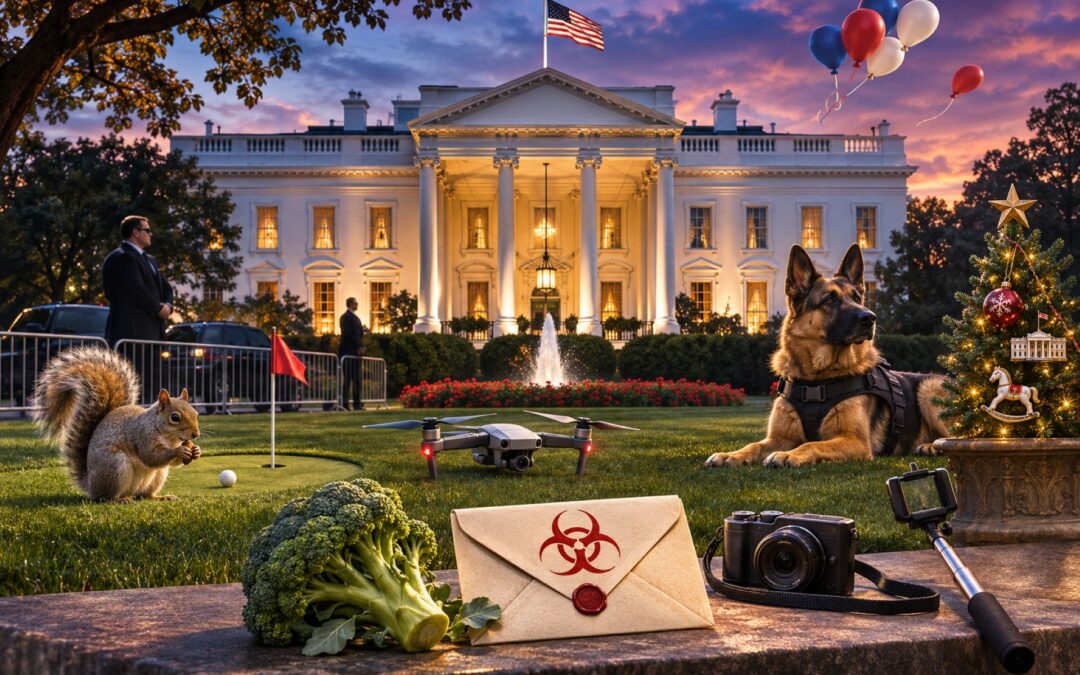
The White House is one of the most heavily protected buildings in the world. Behind its familiar columns, presidents have confronted wars, economic emergencies and threats to national security. Yet the people who live and work at 1600 Pennsylvania Avenue have also found themselves dealing with considerably smaller problems: squirrels ruining a putting green, a president who refused to eat broccoli, an unwanted drone, and dogs that kept biting the people assigned to protect their owner.
Some of the resulting restrictions make perfect sense. Dangerous substances cannot be allowed into presidential mail, unauthorized visitors cannot enter state dinners, and security personnel have good reasons to be wary of unfamiliar objects near the grounds. Others reflect the tastes and habits of whoever happened to occupy the presidency. A rule about jeans is not quite the same as a no-fly zone, and a president disliking a vegetable does not make it illegal.
There is a third category, too: supposedly famous White House bans that become more dramatic with each retelling. To understand what was actually forbidden, it helps to follow the stories behind the rules—and distinguish official security policies from household preferences, workplace customs and outright legends.
When Presidential Preferences Became White House Rules
Dwight D. Eisenhower spent much of his career directing military operations on an enormous scale. As supreme commander of Allied forces in Europe, he dealt with generals, logistical crises and decisions that affected millions of lives. By the time he became president in 1953, he had earned the right to hope that a little recreation might be comparatively uncomplicated.
Golf offered that escape. Eisenhower played frequently, and he had a putting green installed on the White House grounds so he could practice without leaving the residence. The problem was that he shared the South Lawn with squirrels. They regarded the carefully tended turf as an excellent place to dig for food and bury nuts, leaving marks that infuriated the president.
The dispute was peculiarly difficult because the lawn was not simply an ornamental garden. It was a working part of the president’s routine, maintained by staff who were supposed to keep it ready for his few unhurried moments. Gardeners could repair damaged turf, but there was little they could do to convince squirrels to stop burying food. Every new patch of disturbed soil seemed to bring the same argument back again.
The dispute became an unlikely episode in presidential history. According to accounts preserved in reporting on Eisenhower’s war with the squirrels, he was so exasperated that he reportedly spoke of shooting the offending animals. His valet, John Moaney, and White House grounds personnel were drawn into the problem. But a threat made in irritation was not an order to turn the lawn into a shooting range.
Instead, the solution was removal. In 1955, the effort became known as Operation Squirrel: traps were used to capture the animals and take them away from the putting green. The campaign attracted publicity and objections from people who thought the administration was being unusually hard on the resident wildlife. Accounts of the episode describe three squirrels being relocated, not an extermination campaign. There is no good reason to transform the president’s reported outburst into an official nationwide—or even building-wide—ban on squirrels.
What makes the episode memorable is its scale. The most powerful officeholder in the country could command armies and negotiate with world leaders but could not persuade the local wildlife to respect the boundaries of his golf practice. The gardeners, squirrels and reporters turned a private irritation into a small piece of presidential folklore. For a wider view of the man behind the anecdote, Eisenhower’s wartime command and political career form part of his larger presidential biography.
George H. W. Bush’s disagreement with broccoli was more public and even less concerned with national security. Bush disliked the vegetable, and by March 1990 he was weary of being served it. In a memorable declaration, he explained that he had not liked broccoli as a child and, now that he was president, was not going to eat it anymore. His irritation reportedly extended to the menus served aboard Air Force One.
This was not a presidential executive order declaring broccoli contraband. It was an unusually visible example of a person in charge exercising control over his own meals. Bush’s preference became a national joke partly because it contrasted with his public responsibilities: diplomatic negotiations were serious business, but vegetables were apparently negotiable too.
Broccoli growers did not appreciate the publicity. California farmers arranged to send approximately ten tons of the vegetable to Washington, turning a food preference into a cheerful agricultural protest. Contemporary reporting on the farmers’ response captured the mixture of commercial frustration and humour. The shipment was put to charitable use, while Barbara Bush made clear that she did not share her husband’s dislike.
Neither the squirrels nor the broccoli threatened the republic. Both stories illustrate something revealing about the executive residence: the president’s personal habits can become informal rules for the people preparing meals, tending grounds or arranging daily routines. Once those habits become public, however, the difference between a personal preference and a presidential prohibition is easily lost.
What People Could Wear and Carry Inside the White House
The White House has always been both a home and a workplace, and those two identities have shaped expectations about appearance. For much of American history, women attending official functions or working in professional offices were expected to wear dresses or skirts. Clothing conventions were enforced largely through social pressure and institutional culture, rather than through a statute prohibiting trousers at the executive residence.
Popular retellings sometimes claim that women were barred from wearing pants in the White House until the energy crisis of 1973. According to this story, reduced heating left female staff cold enough to abandon skirts, forcing officials to relax the rule. The tale captures a real period of changing attitudes toward women’s workplace clothing, but the precise White House-wide ban and its supposed 1973 repeal are not sufficiently documented to present as historical fact.
The energy-crisis setting itself is worth understanding. In 1973, the United States faced shortages and calls for conservation, and public offices were among the places expected to reduce energy use. Cooler rooms could make traditional office clothing less comfortable, especially when dress expectations left women fewer practical choices than men. It is reasonable to discuss those pressures as part of the atmosphere of the period, but not to assert that a single presidential order or thermostat adjustment finally legalized trousers inside the White House.
What can be said is more interesting than a simple before-and-after story. During the twentieth century, women’s participation in government expanded, professional fashions changed, and trousers gradually became acceptable in settings where they had previously been considered improper. These changes did not happen everywhere at the same time. The meaning of suitable dress depended on a person’s position, the occasion and the administration’s culture.
A clearer example of an actual presidential dress expectation came with George W. Bush. Soon after taking office in January 2001, Bush emphasized a more formal atmosphere in the Oval Office. He wanted the room associated with dignity and respect for the presidency, and staff were expected to dress accordingly. Contemporary accounts of the new dress code describe a preference for business attire and a disapproval of jeans in that particular working environment.
A no-jeans expectation in the Oval Office was not a rule that every person crossing the White House threshold had to wear a suit. It concerned the culture of specific presidential spaces. That distinction made occasional exceptions notable. When the musician Bono appeared at the White House wearing black jeans in 2005, the contrast between rock-star informality and presidential formality became part of the story. His celebrity may have made the outfit easier to overlook, but the episode says more about flexible etiquette than about someone defeating a security checkpoint.
Clothing is a matter of presentation. Personal phones raise a different issue because they can photograph documents, record conversations, connect to outside networks and carry sensitive information into or out of secure workspaces. During Donald Trump’s first administration, Chief of Staff John Kelly moved to restrict personal electronic devices in the West Wing.
A January 2018 White House memo reported by ABC News laid out the new limits. Staff members faced restrictions on bringing personal phones into their working areas and were expected to rely on authorized government devices. The White House described the change as a security measure, although the administration was also struggling with leaks and intense attention to internal conversations.
The restriction annoyed people who had come to depend on their own phones for family messages and everyday tasks. It also demonstrated why a modern secure workplace cannot treat an ordinary smartphone as merely an extension of the owner’s pocket. Still, the policy applied to specified work areas and personnel; it was not an eternal ban on cell phones throughout every White House room. The story moves us from etiquette to the realities of protecting information in a building where casual conversation can have international consequences.
How Alcohol and Smoking Became Presidential Questions
A state dinner communicates hospitality, status and national priorities. The drinks on the table can therefore become surprisingly political. In the late nineteenth century, the question of whether the White House should serve alcohol reflected a much larger American argument about morality, family life and public drunkenness.
Rutherford B. Hayes entered the presidency in 1877 with a reputation for personal restraint. His wife, Lucy Webb Hayes, was associated with temperance and Methodist values, and the couple’s White House became known for abstaining from alcoholic service at official entertainments. The decision suited their convictions and the growing influence of reformers who believed strong drink contributed to social and domestic problems.
The absence of wine was noticed because the White House ordinarily entertained politicians, diplomats and visitors accustomed to alcoholic refreshments. Instead, guests could expect alternatives such as lemonade, punch and other nonalcoholic drinks. Critics complained that the policy made formal receptions less festive. Lucy acquired the familiar nickname “Lemonade Lucy,” although that label can also obscure the fact that presidential hospitality was a joint household and political decision rather than a unilateral command by the first lady.
The Rutherford B. Hayes Presidential Library’s historical material places the family within the religious and reform culture of their time. The White House policy did not forbid Americans from drinking, nor did it anticipate a national law by presidential decree. It controlled what would be offered at official executive-residence functions. Decades later, the broader temperance movement helped produce constitutional Prohibition in America, a far more sweeping and consequential experiment.
The same distinction helps explain why guests’ reactions to the Hayes policy varied. For supporters of temperance, an alcohol-free reception projected moral consistency from the highest office. For others, especially people who regarded shared wine as a basic part of formal hospitality, it seemed an awkward intrusion of domestic virtue into public ceremony. The debate was not really about whether lemonade tasted good; it was about whether a presidential household should model reformist behavior for the nation.
The end of national Prohibition in 1933 did not settle what appropriate presidential entertaining should look like. Eleanor Roosevelt had her own views about alcohol and the tone of White House functions, and some formal occasions placed limits on stronger drinks. But it would be misleading to describe Franklin D. Roosevelt’s White House as simply dry. Franklin enjoyed mixing cocktails and entertaining friends in more private settings. The FDR Presidential Library’s account of his cocktail habits is a reminder that official hospitality and private social life could operate under different expectations.
Smoking produced a related reversal, though it was driven increasingly by public-health evidence rather than temperance ideals. For much of the twentieth century, tobacco was a familiar presence in political life. Photographs of presidents, advisers and guests with cigars or cigarettes reflected an era when smoking indoors was widely tolerated. Franklin Roosevelt was famously photographed with a cigarette holder; John F. Kennedy and Lyndon Johnson also belonged to a political culture in which tobacco was commonplace.
By the early 1990s, however, awareness of the risks of smoking and secondhand smoke had changed American workplaces. In February 1993, shortly after Bill Clinton took office, Hillary Clinton instituted a smoke-free policy inside the White House. Contemporary reporting on the decision described an institutional change that would have seemed startling to some earlier occupants.
The shift was more significant than the often-repeated joke that Bill Clinton could no longer light his cigars indoors. It showed how an executive residence adapts to a society’s changing expectations. Alcohol restrictions had often expressed a president’s moral outlook; the smoking ban reflected an increasingly established understanding that the air shared by staff and guests was also a health concern.
Why Balloons, Selfie Sticks and Cameras Became Security Concerns
A security team responsible for protecting the president must consider what an unfamiliar object might do, not only what its owner intended. A harmless-looking package, an unexpected noise or something drifting into a restricted area can trigger a response before its nature is clear. That helps explain why a place built for ceremonial hospitality has rules about party decorations and tourist accessories.
On 22 May 2016, balloons drifting near the White House triggered a brief security lockdown. Officers had to determine whether the objects posed a danger and protect access to the grounds while they assessed the situation. According to contemporary coverage of the balloon incident, the disruption was short-lived and the objects were not a hostile attack.
The more dramatic version of the story has officials being rushed into underground bunkers while armed agents prepare to shoot down floating helium decorations. Such details are not supported by the established reporting. The underlying event is revealing enough without embellishment: an object as ordinary as a balloon can create uncertainty in an environment where a security mistake may carry enormous costs. Restrictions on balloons around White House visitor areas are best understood in that light, not as proof that every child’s party decoration is inherently dangerous.
The difference between a security alarm and an actual attack matters. Protective officers must act before they know for certain that an unfamiliar object is harmless. Once a balloon is identified, the episode may sound comical; during the assessment, staff cannot responsibly make the same assumption. That explains why an unnecessary false alarm can still be the product of a reasonable precaution rather than panic or incompetence.
Selfie sticks illustrate another mundane problem. The telescoping poles became popular because they let tourists place a camera farther away from their faces and fit a larger group into the frame. But a long stick carried through a crowded historic building can obstruct movement, strike another visitor, interfere with security procedures or put valuable interiors at risk. Its usefulness in an open square does not automatically make it suitable on a tightly controlled tour.
Cameras themselves have had a more complicated history. For roughly four decades, ordinary visitors could tour the White House but could not simply take photographs throughout the public route. Officials cited practical concerns such as crowd movement, the preservation of interiors and the difficulties created by equipment and flash photography. The restriction was not a universal ban on cameras anywhere inside the building. Press photographers and authorized guests at official events operated under different arrangements.
On 1 July 2015, the Obama administration announced that public-tour visitors could once again take pictures. Michelle Obama marked the change in a playful video in which she tore up a sign announcing the old restriction. The official White House announcement also explained the limits: flash photography, selfie sticks and certain types of photographic equipment remained prohibited.
That combination is easy to misunderstand. The White House was not suddenly declaring cameras harmless after decades of treating them as weapons. Rather, administrators had decided that modern visitors could be permitted ordinary photographs while retaining restrictions on equipment likely to disrupt the tour or complicate security. The change acknowledged the everyday expectation that people will want to photograph a memorable visit, without treating that expectation as a reason to remove every precaution.
When Dangerous Mail Threatened the Presidency
The White House receives an extraordinary volume of correspondence, much of it from ordinary people hoping to be heard by their president. Letters are part of the democratic image of the office: citizens can complain, ask for help, express admiration or attempt to influence public policy. Yet an envelope can also conceal a threat, and the period after the attacks of 11 September 2001 demonstrated the danger in a particularly frightening way.
In the following weeks, letters containing anthrax spores reached news organizations and congressional offices. Some were directed to prominent journalists and others to Senators Tom Daschle and Patrick Leahy. Anthrax is caused by the bacterium Bacillus anthracis; exposure to spores can cause a severe infection, particularly when they are inhaled. The use of contaminated mail meant that the danger extended beyond the intended recipients to postal employees and anyone handling affected correspondence.
The postal system made the crisis especially difficult to contain. An envelope passes through sorting machinery and the hands of people who have no idea where it is headed or what it contains. Contaminated material in one part of the network could create risks at another location, and ordinary workers suddenly found themselves on the front line of a national emergency. Investigators had to think not only about identifying a sender but also about protecting buildings, equipment and thousands of people whose jobs involved handling mail.
Five people died and seventeen others were sickened during the 2001 attacks. The deaths and the uncertainty surrounding the source created fear in newsrooms, government buildings and postal facilities. The FBI’s history of the Amerithrax investigation documents both the human toll and the vast inquiry that followed.
A persistent retelling suggests that the deadly letters were addressed to the White House itself and conveniently intercepted before reaching the building. That is not an accurate account of the known 2001 attacks. They targeted media and congressional recipients, although they had profound implications for protecting the presidency and other government institutions. Mail screening, including examination for hazardous materials at facilities away from sensitive offices, became an essential safeguard. The lesson was not that someone had officially banned a particular powder as an eccentric household rule; it was that routine correspondence could be exploited to deliver a biological weapon.
The threat returned in a different form in April 2013, when letters containing ricin were mailed to President Barack Obama and other public officials. Ricin is a highly toxic substance derived from castor beans. Unlike anthrax, it is not an infectious bacterium that can multiply inside a victim; it is a poison capable of damaging the body’s cells. That distinction matters because the two cases involved different substances and different public-health dangers, even though both used the postal system.
The 2013 investigation also showed how quickly a frightening security event can produce a wrongful accusation. Authorities initially arrested a Mississippi man, Paul Kevin Curtis, but the case against him fell apart and the charges were dropped. Investigators subsequently focused on James Everett Dutschke, who admitted involvement in sending the poisoned letters and pleaded guilty. The Justice Department’s account of Dutschke’s guilty plea establishes the central facts of the prosecution.
That sequence deserves more than a passing mention because it reveals a second danger during a security scare: the pressure to identify a culprit can run ahead of the evidence. The poison in the envelopes was the immediate threat, but accurately establishing who sent it was a separate and difficult task. A responsible history of the incident must include both the attempted attack and the reversal of the initial accusation.
In September 2020, another ricin-containing letter was addressed to President Donald Trump. It was detected by mail screening before reaching him. Authorities arrested Pascale Ferrier, a Canadian-French woman, in connection with the letter and related threats. She later pleaded guilty and was sentenced to more than twenty-one years in prison, as documented in the Justice Department’s sentencing announcement.
The anthrax attacks of 2001 and ricin attempts of 2013 and 2020 were not interchangeable incidents. They had different targets, perpetrators, substances and consequences. What linked them was the need to protect people far beyond the intended victim: letter carriers, inspectors, administrative assistants and security personnel could all become part of the chain of exposure. Modern White House mail precautions are therefore among the least whimsical restrictions associated with the building, even if they are less visible than checkpoints and fences.
Drones, Gate-Crashers and the Limits of White House Security
For generations, a person seeking to threaten the White House had to approach its physical defenses: fences, gates, guards and identification checks. Small civilian drones introduced a different challenge. A remotely controlled aircraft could cross a boundary that was difficult to patrol from the ground, potentially carrying a camera or another payload into highly sensitive airspace.
The problem became unmistakable on 26 January 2015, when a small drone landed on the White House grounds. The operator was an off-duty government employee who had been flying the device nearby and reported losing control of it. Investigators determined that the incident had not been an intentional attack. The Justice Department’s explanation of why no charges were pursued provides the official account of the operator and the wayward aircraft.
There was still a serious question to answer: how had an unauthorized flying object reached such a protected location? The event prompted scrutiny of surveillance and defenses against small aircraft, which can be difficult to detect or respond to in a crowded urban setting. A drone that is not malicious can expose a vulnerability just as clearly as one operated with hostile intent.
The response also illustrated a dilemma familiar to anyone regulating new technology. Drones can serve harmless purposes such as recreation, photography and inspection, and many users have no intention of entering restricted space. But the same characteristics that make a lightweight aircraft accessible—low cost, small size and remote operation—can challenge traditional defenses. A rule designed for larger aircraft does not by itself guarantee that a tiny drone will be detected in time.
It is inaccurate, however, to say that the White House created its no-fly zone only after this crash. Restricted airspace in central Washington had existed long before civilian drones became common. The 2015 incident was important because it showed how consumer technology could exploit gaps in an already established security system. Rules against unauthorized drone flights near the White House are part of that wider security framework, not merely a reaction to a single embarrassing landing.
If the drone demonstrated the limits of physical barriers, a 2009 state dinner demonstrated the limits of paperwork and human judgment. On 24 November that year, President Barack Obama hosted Indian Prime Minister Manmohan Singh for his first state dinner. The guest list was supposed to have been carefully controlled. Yet Tareq and Michaele Salahi, a Virginia couple seeking public attention, entered without invitations.
They did not climb a wall or sneak through a basement window. They arrived dressed for the occasion and passed through the sequence of checks that should have established whether they belonged there. Once inside, they mingled with prominent guests and were photographed at the event. They even encountered the president, making the incident especially troubling to those responsible for his safety.
The couple’s appearance in photographs, including images involving Vice President Joe Biden, turned their unauthorized visit into a national spectacle. The story quickly became about more than two people enjoying a party they had not been invited to. Investigators wanted to know how the invitation process, checkpoint procedures and communication between staff had failed to stop them.
A congressional report examining the Salahi breach documents the security failures and the official scrutiny that followed. The event did not prove that the entire White House was unguarded; rather, it exposed weaknesses in a system that depended on people correctly executing every step. The familiar claim that the couple were formally “banned for life” is not well established, and a supposed Secret Service memo with a comic warning should not be mistaken for an authentic document.
Unlike a drone, a convincingly dressed visitor can talk to guards and appear to have a reason to be present. The Salahi episode shows why security is not only about fences and prohibited gadgets. It also depends on names, invitations, identification, communication and the willingness of staff to question someone who looks as though they belong.
When Presidential Dogs Became Security Problems
The White House has a long history of animals becoming part of presidential family life. Dogs in particular help humanize an institution that can otherwise seem remote. They appear in photographs on the lawn, greet visitors and sometimes become celebrities in their own right. But a presidential dog also occupies a workplace crowded with Secret Service agents, residence staff and other people who cannot simply avoid the animal whenever they wish.
President Joe Biden and First Lady Jill Biden brought two German shepherds, Champ and Major, to the White House. Major had been adopted from a shelter, and his arrival attracted attention partly because it gave a rescue dog a place in the executive residence. The novelty soon gave way to a problem: Major was involved in biting incidents involving people who worked around the first family.
The family pursued training and adjusted arrangements, but Major ultimately went to live in a quieter setting with family friends in Delaware. The decision was described as being made in the dog’s interest as well as for the safety of those around him. It was not a White House law against German shepherds or a declaration that rescued dogs were unsuitable as pets. It reflected the difficulty of managing an anxious or reactive animal in a noisy, highly secured residence.
Another young German shepherd, Commander, joined the Bidens later. His story proved more serious. Reports emerged of bites involving Secret Service personnel and others working in close proximity to the president. An initial public figure of eleven incidents became widely repeated, but it did not capture the full record that later became available.
In February 2024, documents showed at least twenty-four incidents involving Secret Service personnel. The incidents occurred in multiple settings, underscoring that this was not a single startling encounter with an unfamiliar visitor. For agents expected to guard the president, avoiding an unpredictable dog could interfere with their ordinary duties and even with how they moved through the building.
The documented incidents did not mean that Commander was perpetually aggressive or that every interaction ended in a bite. Dogs can respond differently to familiar family members, strangers, unfamiliar uniforms and stressful movement around them. But the White House could not be managed as though only the family’s positive experiences mattered. Even a relatively uncommon aggressive response becomes a serious concern when employees have repeated unavoidable contact with the animal.
Some incidents required medical attention. The repeated bites created a workplace-safety issue that was hard to dismiss simply because the animal belonged to the first family. Training and other efforts did not resolve the situation, and Commander was eventually removed from the White House environment. That decision protected personnel while acknowledging that the residence was not necessarily an appropriate setting for the dog.
Presidents have long been photographed affectionately with pets, and those images can make the White House feel like an ordinary family home. Major and Commander reveal the limits of that comparison. A home occupied by the president is also a high-pressure workplace whose employees must interact with the family under unusual conditions. The animals were not forbidden because the Secret Service disliked dogs; they were removed because specific behavior created documented risk.
The White House Christmas Tree Ban That Never Existed
Few White House stories fit the image of an eccentric presidential ban better than the claim that Theodore Roosevelt prohibited Christmas trees. Roosevelt was a committed conservationist who helped establish national forests, wildlife refuges and protected landscapes. It sounds plausible that a president worried about the destruction of trees might object to cutting one down for a few weeks of holiday decoration.
The legend usually goes further. Roosevelt supposedly announced that no Christmas tree would be allowed in the executive residence, only for his young son Archie to smuggle one into the building and hide it upstairs. In some versions, the president becomes furious; in others, the family persuades him to accept the display. The story is so appealing that it often circulates without anyone asking whether the prohibition existed in the first place.
Archie’s small Christmas tree is part of White House history. In 1902, he arranged a surprise tree inside the residence, an episode remembered in accounts of the Roosevelt family’s holidays. But the claim that his father had imposed a formal ban on Christmas trees does not have convincing documentary support. The White House Historical Association’s history of Christmas trees distinguishes the genuine family anecdote from the later story of a presidential prohibition.
The chronology makes the myth especially slippery. Roosevelt was president during the early years when White House holiday traditions were becoming better known through newspapers and family recollections. A tree remembered as a surprise for the household could later be retold as an act of defiance. Over time, details about a child’s secrecy, a father’s conservation principles and the absence of a grand public display were blended into a neat story about an official ban. The ingredients are historical, but the resulting rule is not.
There are several reasons the legend has endured. Roosevelt’s conservationism gives the claim an apparently sensible motivation. The secret tree supplies an engaging scene with a rebellious child and a powerful father. And the phrase “banned Christmas trees from the White House” is more memorable than the comparatively ordinary observation that families celebrated the holiday in different ways and that Christmas decorating customs changed over time.
But conservation does not automatically mean opposition to every use of a tree. Roosevelt’s environmental priorities concerned the management and protection of natural resources on an enormous scale. Treating those priorities as proof that he forbade one household decoration confuses his public policy with an imagined domestic rule.
The Christmas tree story also provides an appropriate ending to the long catalogue of things supposedly banned from the White House. Some restrictions were real and necessary: screening dangerous mail, controlling access to state dinners and safeguarding secure workspaces. Others reflected the tastes of particular presidents, from a fondness for golf to an aversion to broccoli. Still others changed as American society changed its ideas about clothing, smoking, photography and private technology.
And some bans were never bans at all. The White House is both an institution of immense power and an unusually visible household. That makes even its ordinary disagreements irresistible material for legend. The most revealing question is not simply what was forbidden inside its walls, but whether the prohibition was ever real—and what it tells us about the people and the era that produced the story.
Last Updated on November 12, 2026 by Aseem Gupta