
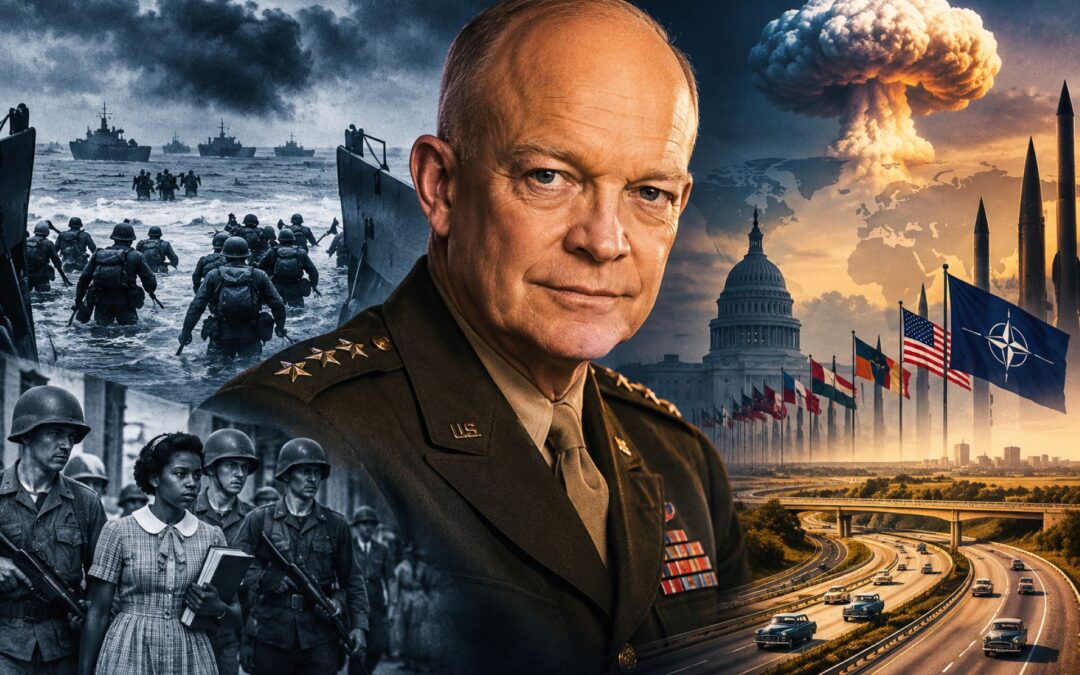
Dwight D. Eisenhower commanded the largest amphibious invasion in military history, helped defeat Nazi Germany, and became the thirty-fourth president of the United States. He led the Allied armies through some of World War II’s most dangerous campaigns before governing America during the early Cold War, when nuclear weapons threatened to turn international rivalry into an unprecedented catastrophe. Few Americans have occupied positions of such enormous military and political responsibility.
Yet Eisenhower was an unusual figure among the powerful personalities of his age. He was neither a flamboyant battlefield commander like George Patton nor a commanding public speaker like Winston Churchill. His greatest strength lay in organizing complicated operations, managing difficult people, balancing competing interests, and making decisions under extraordinary pressure. These qualities helped him hold together an international military coalition and later navigate an increasingly divided world.
His achievements, however, were accompanied by serious contradictions. The president who enforced school desegregation in Arkansas was reluctant to become an outspoken champion of racial equality. The general who understood the horrors of war expanded America’s nuclear arsenal and approved covert operations against foreign governments. The leader who strengthened the permanent national-security establishment eventually warned Americans that the same establishment could threaten their democracy.
Understanding Eisenhower requires looking beyond his victories and examining how his character developed, how he exercised power, and where his judgment proved both effective and limited. His journey from a modest Kansas household to the highest offices of military and civilian leadership reveals a man whose extraordinary capacity for responsibility was inseparable from his complicated historical legacy.
The Boy from Abilene: Faith, Work, and Ambition
Dwight David Eisenhower was born on October 14, 1890, in Denison, Texas, the third son of David Jacob Eisenhower and Ida Elizabeth Stover Eisenhower. His family came from modest circumstances, with paternal ancestors belonging to German-speaking Protestant communities that had settled in Pennsylvania during the eighteenth century. Over subsequent generations, branches of the family moved westward, eventually establishing themselves in Kansas.
David and Ida married in 1885 and initially settled in Hope, Kansas, where David attempted to operate a general store. The business failed, leaving the young family facing financial difficulties. David subsequently found employment with a railroad in Texas, but in 1892 the Eisenhowers returned to Kansas and settled in Abilene, the community Dwight would always regard as his hometown.
Although he had been born in Texas, Eisenhower’s childhood identity was firmly rooted in the Kansas plains. His father worked long hours at the Belle Springs Creamery, while Ida managed a busy household with limited resources. The family eventually included six surviving sons: Arthur, Edgar, Dwight, Roy, Earl, and Milton. Another son, Paul, died of diphtheria in infancy, bringing an early experience of profound loss into the household.
The Eisenhowers occupied a small home and depended on careful spending, hard work, and cooperation. Each boy had responsibilities, including cultivating vegetables and contributing to the family’s needs. They grew up in an environment that combined considerable freedom with firm expectations concerning honesty, discipline, personal responsibility, and respect for others.
Dwight later remembered his childhood as largely happy despite the family’s limited income. Poverty did not prevent the boys from developing ambitious interests or participating in the outdoor activities that defined life in their community. Hunting, fishing, competitive games, and physical work helped shape a childhood that was energetic, demanding, and frequently contentious.
The Eisenhower brothers were intensely competitive, and Dwight possessed a particularly quick temper. He occasionally fought with other boys and struggled to control his anger when challenged. These tendencies were significant because the adult Eisenhower would eventually become famous for a composed and conciliatory manner that contrasted sharply with his youthful impulsiveness.
Religion was another defining feature of the household. David and Ida had connections to the River Brethren, a Christian tradition influenced by Anabaptist beliefs, including a commitment to peaceful conduct. Ida subsequently became involved with the International Bible Students, the religious movement from which Jehovah’s Witnesses later emerged. Bible study and religious discussion became important parts of family life.
Both parents expressed pacifist convictions, creating an interesting tension with Dwight’s growing fascination with military history. His mother encouraged serious religious study and hoped to moderate his attraction to stories of warfare. Yet the young Eisenhower devoured accounts of military campaigns and admired commanders such as Hannibal and George Washington.
His enthusiasm for military history did not initially translate into a clear ambition to become a professional soldier. He was primarily an energetic young man who enjoyed reading, competitive activities, and the outdoors. History appealed to his imagination, while mathematics and practical subjects attracted his problem-solving instincts.
Ida had worked as a teacher and valued education. Dwight was not consistently an exceptional student, but he developed an enduring appetite for books. Military histories and popular Western novels remained particular favorites, even after he became one of the most prominent men in the world.
Football eventually became an equally powerful interest. The sport offered physical competition, teamwork, and an outlet for his considerable energy. A serious childhood leg infection reportedly brought him close to amputation, an outcome he resisted because of his determination to retain the ability to play and live an active life.
Such stories illuminate his stubbornness and independence, although they should not be treated as proof that his later achievements were inevitable. Many ambitious young men shared similar qualities without becoming generals or presidents. What mattered was how Eisenhower’s circumstances, opportunities, education, and experiences gradually transformed his personal traits into professional abilities.
His early religious upbringing also deserves a distinction that is sometimes overlooked. Although he did not formally join a church during most of his military career, Eisenhower eventually became a Presbyterian and was baptized in February 1953, shortly after assuming the presidency. His religious life therefore developed considerably beyond the traditions of his childhood, even as he continued to regard faith as an important personal and civic influence.
The Kansas years established several enduring elements of his character: personal resilience, attachment to family, competitive determination, respect for work, and a belief that cooperation could achieve results unavailable to individuals acting alone. They also left him with a tendency toward emotional self-control that would become increasingly important as the scale of his responsibilities grew.
The boy who enjoyed military history from the safety of a modest Kansas home would eventually command millions of soldiers. Yet his first major step toward that future was motivated as much by the practical need for an education as by any romantic ambition for military glory.
West Point, Mamie, and a War Without Combat
Eisenhower graduated from Abilene High School in 1909 alongside his older brother Edgar. Both wanted to pursue higher education, but the family’s finances could not support two sons attending college simultaneously. They therefore reached an arrangement under which Dwight would work to help finance Edgar’s studies, with the understanding that Edgar would later assist him.
Dwight took employment at the creamery where his father worked. The work was physically demanding and offered little immediate prospect of the intellectual or professional life he hoped to pursue. A suggestion that he apply to a federal military academy eventually provided an alternative to the family’s financial problem.
Admission to the United States Military Academy at West Point offered the possibility of a government-funded education. Eisenhower applied, passed the necessary examinations, and entered the academy in 1911. Although his interest in military history made the environment appealing, a permanent Army career was not initially his only ambition.
At West Point, Eisenhower discovered a demanding institution organized around academic instruction, physical fitness, discipline, and military tradition. His performance was respectable rather than outstanding. He showed particular interest in English, history, and practical subjects, but he did not rank among the academy’s most distinguished scholars.
He was also considerably less successful at conforming to every disciplinary expectation. His enjoyment of card games, smoking, and informal social activities sometimes conflicted with academy regulations. These minor rebellions reflected the energetic young man from Kansas who had not yet completely mastered his competitive temperament.
Football remained central to his life. In 1912, West Point faced the Carlisle Indian Industrial School, whose football team included the remarkable athlete Jim Thorpe. The encounter became part of Eisenhower’s sporting memories, although injuries ultimately ended his hopes of continuing as a player.
A serious knee injury forced him to abandon competitive football, a disappointment that initially threatened his enthusiasm for military education. He subsequently found satisfaction in coaching younger players, discovering that organizing a team and preparing others for competition could be rewarding in its own right.
The experience provided an early opportunity to develop a different kind of leadership. Rather than relying exclusively on personal strength or individual accomplishment, a coach had to understand the capabilities of others, assign responsibilities, develop coordinated plans, and adjust strategies to changing circumstances.
It would be excessive to claim that football coaching alone created the future supreme commander. Nevertheless, the transition from player to coach reflected an important shift in Eisenhower’s development: he was beginning to find purpose in preparing and directing collective effort.
He graduated in 1915, ranking sixty-first among 164 graduates. His class became known as the class the stars fell on because an extraordinary number of its members later attained general-officer rank. Among them was Omar Bradley, who would become one of Eisenhower’s most important associates during World War II.
Eisenhower selected the infantry and received an assignment to Fort Sam Houston in Texas. There he met Mamie Geneva Doud, the daughter of a prosperous Denver family. Their backgrounds differed considerably, particularly in financial circumstances, but they quickly developed a close relationship.
Eisenhower proposed in February 1916, and the couple married on July 1 that year. Mamie was sociable, lively, and accustomed to a more comfortable lifestyle than the young Army officer could immediately provide. Their marriage would endure repeated relocations, lengthy separations, family tragedy, public scrutiny, and the extraordinary pressures of military and political life.
Their first son, Doud Dwight Eisenhower, was born in 1917. Affectionately known as Icky, he brought considerable happiness to the young family. Yet the demands of military service meant that domestic stability was frequently interrupted by new assignments and changing responsibilities.
When the United States entered World War I in April 1917, Eisenhower expected that military service might finally provide the opportunity to participate in a major conflict. Like many officers of his generation, he believed that combat experience could establish a professional reputation and accelerate advancement.
Instead, the Army repeatedly assigned him to training, organization, and administrative responsibilities within the United States. He helped prepare soldiers for overseas service and became involved in the developing field of armored warfare, particularly the training and management of tank units.
His responsibilities at Camp Colt in Gettysburg, Pennsylvania, were especially important. Tanks were still relatively new weapons, and the Army was learning how to integrate them into its operations. Eisenhower became interested in their potential to change warfare through mobility, concentrated firepower, and mechanized coordination.
He also learned that the effectiveness of a military unit depended on much more than battlefield courage. Equipment had to be maintained, personnel trained, supplies delivered, and transportation organized. The experience strengthened his appreciation for the logistical foundations of modern warfare.
In November 1918, Eisenhower was preparing for an overseas assignment when the armistice ended the fighting. The announcement brought relief to millions of families, but he experienced it as a personal professional disappointment. He had spent the war preparing others for combat without ever receiving an opportunity to fight abroad himself.
His frustration reflected the military culture of the period, in which battlefield distinction often carried enormous prestige. Eisenhower worried that his lack of combat experience would restrict his advancement and leave him at a disadvantage compared with officers who had fought in Europe.
Yet the apparent setback contributed to an unusual professional education. While other officers developed experience commanding troops under fire, Eisenhower acquired extensive knowledge of training systems, equipment, administration, and the difficulties of preparing large organizations for military operations.
Another important experience arrived in 1919, when he participated in a transcontinental Army motor convoy from Washington, D.C., to San Francisco. The journey took approximately two months and exposed the severe limitations of America’s road network.
Vehicles broke down, bridges proved inadequate, and roads became nearly impassable under difficult conditions. Eisenhower saw firsthand how poor transportation infrastructure could obstruct military mobility and impose enormous costs on the movement of personnel and equipment.
The experience would remain relevant decades later when he supported the construction of a national interstate highway system. It also reinforced a lesson that became central to his military career: ambitious plans are meaningful only when people, equipment, and supplies can actually reach the places where they are needed.
His professional frustrations were soon overshadowed by a terrible personal tragedy. In January 1921, three-year-old Icky died after contracting scarlet fever. Both parents were devastated, and Eisenhower carried the memory of his son’s death throughout his life.
The loss affected their marriage and emotional lives in ways that neither publicly discussed at great length. Eisenhower continued working, but the death remained one of the most painful experiences he ever endured. For years afterward, he marked the anniversary by sending Mamie flowers.
Their second son, John Sheldon Doud Eisenhower, was born in August 1922. John’s arrival restored an important measure of happiness to the household, although it did not erase the memory of his older brother.
Eisenhower had entered the Army hoping for adventure, achievement, and perhaps battlefield glory. By his early thirties, he had experienced professional disappointment, acquired extensive organizational knowledge, married, become a father, and suffered the loss of a child. These experiences added emotional depth to a man whose public composure would often conceal intense private feelings.
Learning to Lead: Patton, Fox Conner, and MacArthur
For much of the period between the world wars, Eisenhower appeared to be an officer whose career was progressing slowly. He remained in relatively junior ranks while working through a succession of staff appointments, educational assignments, and administrative responsibilities. Compared with officers who had earned prominent reputations in combat, his record seemed unremarkable.
Yet these years proved essential to his eventual success. They brought him into contact with influential military leaders, exposed him to strategic thinking beyond the battlefield, and taught him how large institutions worked. They also forced him to confront the relationship between personal ambition and effective service.
One of the most important friendships he developed was with George S. Patton. The two men shared an interest in armored warfare and spent considerable time discussing equipment, tactics, and the possible future of mechanized combat. Their personalities were quite different, but their professional enthusiasm created a lasting connection.
Patton was aggressive, theatrical, intensely competitive, and convinced of the importance of decisive action. Eisenhower gradually became more deliberate, accommodating, and concerned with organizational coordination. Their contrasting temperaments would later create both a productive professional relationship and serious problems during World War II.
An even more influential figure entered Eisenhower’s life through Patton. General Fox Conner recognized the younger officer’s potential and selected him for service in the Panama Canal Zone in 1922. Conner became one of the most important mentors of Eisenhower’s military career.
Conner had served in World War I and believed that another major international conflict was possible. He therefore encouraged Eisenhower to study military history, political relationships, strategy, and the management of large coalition forces. Their discussions went far beyond individual battles or traditional military tactics.
Eisenhower read extensively about earlier wars, particularly the campaigns of Napoleon and the experience of World War I. He examined the relationship between military objectives and political circumstances, the importance of unified command, and the difficulties of cooperation between nations with different priorities.
Conner emphasized that future conflicts would require officers capable of thinking beyond their immediate assignments. A successful commander needed to understand alliances, resources, industrial production, civilian leadership, and the consequences of military decisions.
The lessons were especially important because Eisenhower had not yet commanded major forces in combat. Conner’s mentorship gave him a broader intellectual foundation that helped compensate for the battlefield experience he lacked. It also encouraged the disciplined self-education that would become one of his strengths.
In 1925, Eisenhower entered the Command and General Staff School at Fort Leavenworth, Kansas. The institution trained officers in operational planning, administration, and the problems of directing military formations. Its demanding curriculum required students to analyze complicated scenarios and devise workable solutions.
Eisenhower graduated first among 245 officers in 1926. The achievement marked a striking change from his relatively ordinary academic performance at West Point and demonstrated his growing mastery of military planning.
Further appointments continued his development. He worked with the American Battle Monuments Commission under General John J. Pershing, studying the American Expeditionary Forces’ experience in Europe. He also attended the Army War College and spent time examining World War I battlefields in France.
These assignments deepened his understanding of the difference between military plans and battlefield realities. Studying earlier campaigns exposed him to the consequences of inadequate preparation, divided command, logistical failure, and poorly coordinated operations.
He subsequently worked on industrial mobilization planning in Washington. The assignment required consideration of how the United States could transform its economic resources into military capabilities during another major war. It provided further evidence that modern military power depended on civilian industry and national infrastructure as well as soldiers.
In 1930, Eisenhower began working closely with General Douglas MacArthur, then the Army’s Chief of Staff. MacArthur recognized his abilities as a staff officer and valued his intelligence, diligence, and organizational competence. Eisenhower became deeply involved in planning and administrative responsibilities under one of the Army’s most prominent commanders.
MacArthur was an exceptionally capable but often difficult personality. His confidence in his own judgment and sensitivity to disagreement created challenges for subordinates. Eisenhower learned to function effectively within this environment, although their relationship eventually became strained.
In 1935, MacArthur traveled to the Philippines to advise the Commonwealth government on military development as the islands prepared for eventual independence from the United States. Eisenhower accompanied him and spent several years helping organize plans for Philippine defense.
The assignment presented severe practical problems. The Philippines needed a credible military organization capable of defending widely separated islands, but available financial, industrial, and military resources were limited. Training large numbers of citizen soldiers required time, equipment, and administrative capacity that could not be created simply by issuing ambitious instructions.
Eisenhower worked to translate strategic objectives into realistic organizational arrangements. The experience reinforced his belief that successful military planning required an honest understanding of what available resources could accomplish.
He also experienced increasing frustration with MacArthur’s leadership style and the political complications surrounding the Philippine assignment. Their relationship deteriorated, but Eisenhower continued performing his duties rather than allowing personal disagreement to become professional insubordination.
His ability to cooperate with people he disliked or disagreed with became an important distinguishing feature. This did not mean he lacked convictions or never became angry. Rather, he increasingly learned to separate personal feelings from the demands of an institution and the responsibilities of command.
By the time he returned to the United States in 1939, Eisenhower had spent nearly a quarter-century in uniform without experiencing battlefield command. He had nevertheless developed an unusual combination of administrative expertise, strategic education, logistical knowledge, and experience dealing with strong personalities.
He understood how senior officers thought, how military bureaucracies functioned, and how difficult it could be to turn political objectives into operational reality. Those skills were precisely what the United States would soon require as Europe descended into another catastrophic war.
Marshall’s Choice and the Lessons of North Africa
Germany’s invasion of Poland in September 1939 began World War II in Europe, although the United States initially remained outside the conflict. American military leaders nevertheless understood that continued neutrality could not be assumed. The Army began expanding its strength and examining how it might participate in a large international war.
Eisenhower returned from the Philippines during this period and took on a succession of important staff and field responsibilities. He participated in military planning and exercises intended to test the readiness of America’s expanding forces.
The Louisiana Maneuvers of 1941 became a particularly important moment in his career. These large-scale exercises exposed the strengths and weaknesses of American formations under simulated wartime conditions. Eisenhower’s performance helped demonstrate his capacity to coordinate complex operations and contributed to his growing reputation among senior officers.
He was promoted to brigadier general in September 1941. Only three months later, the Japanese attack on Pearl Harbor brought the United States directly into World War II, transforming the country’s military requirements almost overnight.
General George C. Marshall, the Army Chief of Staff, faced the enormous challenge of organizing American participation in a global conflict. He needed officers capable of assessing strategic problems, working independently, and managing responsibilities far beyond traditional unit command.
Marshall recognized Eisenhower’s unusual combination of experience and judgment. Shortly after Pearl Harbor, Eisenhower was called to Washington and assigned important war-planning duties. His rapid advancement reflected Marshall’s confidence that he could manage difficult organizations without requiring constant supervision.
In June 1942, Eisenhower arrived in London as American preparations for operations against Germany accelerated. He encountered an alliance whose members shared the objective of defeating Nazi Germany but frequently disagreed about how to achieve it.
British and American military leaders had different priorities, experiences, and political pressures. The Soviet Union was demanding a major Western offensive to relieve German pressure on the Eastern Front. Meanwhile, the Western Allies had to decide how quickly they could assemble sufficient troops, equipment, shipping, and air power for large operations.
Eisenhower’s task was not merely to design military plans. He had to encourage cooperation among political leaders, senior commanders, intelligence organizations, and armed services whose interests did not always align.
His first major operational test came with Operation Torch, the Allied invasion of French North Africa in November 1942. American and British forces landed in Morocco and Algeria, opening a new front against Axis forces and increasing the pressure on Germany and Italy in the Mediterranean.
The operation was extraordinarily complicated. Allied planners had to coordinate amphibious landings across widely separated locations while dealing with uncertain French resistance, difficult supply arrangements, and the political sensitivities surrounding Vichy French authorities.
Although the landings ultimately succeeded, the wider campaign exposed serious shortcomings in American preparation. Troops lacked experience, communications were imperfect, and commanders sometimes struggled to coordinate their activities. The Allied advance toward Tunisia encountered determined German resistance and logistical difficulties.
The fighting around Kasserine Pass in February 1943 was particularly damaging to American confidence. German forces exploited weaknesses in Allied command arrangements, training, and battlefield coordination, inflicting a significant defeat on inexperienced American formations.
Eisenhower had to assess the failures and support changes in command, organization, and operational practice. Rather than treating every setback as proof of personal incompetence, he increasingly concentrated on identifying what needed to change.
This capacity to learn was important to his leadership. Successful military organizations cannot eliminate every mistake, particularly during their first major campaigns. They must instead identify errors quickly enough to prevent them from recurring under even more dangerous circumstances.
The Tunisian campaign eventually ended in May 1943 with the surrender of large Axis forces. The result provided a significant Allied victory and established the conditions for operations against Sicily and Italy.
However, the outcome should not obscure the campaign’s complications. German and Italian resistance had delayed Allied operations, and some Axis personnel and equipment escaped during earlier stages. Eisenhower emerged from North Africa with valuable experience, but not with an unblemished record.
The next major operation, the invasion of Sicily in July 1943, presented another difficult coalition-management problem. General Bernard Montgomery commanded British forces, while Patton led the American Seventh Army. Both were capable commanders with strong professional ambitions and sharply different personalities.
Competition between British and American formations sometimes complicated cooperation. While Allied forces advanced across Sicily, German and Italian troops conducted a substantial evacuation across the Strait of Messina, preserving manpower and equipment for continued fighting on the Italian mainland.
The episode demonstrated that military success could coexist with missed opportunities. Eisenhower had to weigh the benefits of empowering aggressive subordinate commanders against the dangers created by personal rivalry and poorly coordinated objectives.
Patton presented an even more serious challenge when he physically assaulted American soldiers suffering from combat-related psychological distress during the Sicilian campaign. The incidents revealed the destructive side of Patton’s demanding and sometimes abusive approach to discipline.
Eisenhower condemned the conduct and required corrective action, although he also recognized Patton’s considerable military ability. His handling of the affair reflected the difficult responsibility of balancing accountability, military effectiveness, and the reputational consequences of senior officers’ behavior.
The Italian campaign continued after the fall of Mussolini’s Fascist government, but German forces defended the peninsula with determination. Italy’s mountainous geography, constrained transportation routes, and strong defensive positions made Allied progress costly and slow.
By late 1943, Eisenhower had accumulated experience that no classroom exercise could fully provide. He had managed an international command, suffered operational setbacks, supervised major invasions, confronted difficult subordinates, and learned how political considerations shaped military decisions.
He also understood more clearly than ever that planning could not eliminate uncertainty. Even the most carefully designed operation would encounter unexpected resistance, changing circumstances, and human mistakes.
These lessons formed the foundation for the largest and most consequential assignment of his career.
D-Day: The Decision That Tested Allied Command
In December 1943, President Franklin D. Roosevelt selected Eisenhower to command the Allied expeditionary forces preparing to invade German-occupied Western Europe. The appointment placed him at the center of one of the most ambitious military operations ever attempted.
The invasion, known as Operation Overlord, was intended to establish a major Allied foothold in France and open a Western Front against Nazi Germany. Soviet forces were already fighting enormous battles in Eastern Europe, and the Western Allies needed to bring sustained pressure against Germany from the opposite direction.
The strategic objective was straightforward, but the operational problems were immense. Allied forces had to cross the English Channel, land large formations on defended beaches, secure supply routes, establish positions in enemy territory, and expand those positions before German reinforcements could overwhelm them.
The Germans knew that an invasion was coming. Their forces had constructed defensive positions along much of the Atlantic coast, including artillery emplacements, obstacles, mines, bunkers, and fortified strongpoints.
What German commanders did not know was where and when the principal assault would occur. The narrow waters near the Pas-de-Calais made that region an obvious possibility, but the Allies selected Normandy for the main invasion.
The choice reflected a combination of geography, operational requirements, the availability of suitable landing beaches, and the need to establish a sustainable bridgehead. Allied planners also had to consider access to ports, inland transportation, and the possibility of German reinforcements arriving quickly from other regions.
Eisenhower supervised a multinational organization involving land, sea, and air forces from several countries. British, American, Canadian, and other Allied personnel contributed to planning and execution, while senior commanders carried substantial operational responsibilities within their own services.
The command structure was complicated by national sensitivities and professional rivalries. Montgomery, Patton, British naval leaders, American air commanders, and numerous other senior officers brought different assumptions and preferences to the planning process.
Eisenhower’s effectiveness depended on recognizing these differences without allowing them to fracture the overall operation. He had to delegate technical responsibilities while maintaining authority over the central strategic decisions.
The invasion also demanded an extraordinary logistical effort. Millions of personnel were involved in the wider preparations, and enormous quantities of ammunition, vehicles, fuel, medical equipment, food, and construction materials had to be assembled and transported.
Specialized landing craft were needed to bring soldiers and equipment ashore. Engineers developed temporary harbor facilities and systems for supplying forces after the initial landings. Air and naval units prepared to protect the assault and disrupt German communications and reinforcements.
The complex planning is documented in the National WWII Museum’s account of the Normandy campaign, which places the invasion within the broader Allied effort to defeat Germany in Western Europe.
One of the operation’s most sophisticated elements was its deception campaign. Allied intelligence organizations worked to convince the Germans that the principal invasion might take place somewhere other than Normandy.
Operation Fortitude was central to these efforts. The Allies created misleading communications, false military formations, dummy equipment, and carefully controlled intelligence intended to distort German assessments of Allied intentions.
A fictitious American army group associated with Patton helped strengthen German expectations of an attack near the Pas-de-Calais. The deception was supported by double agents who transmitted misleading information and by elaborate efforts to simulate military preparations in areas where the main assault would not occur.
These operations were the work of numerous military, intelligence, and technical specialists rather than the personal invention of Eisenhower. His responsibility was to ensure that deception, operational planning, and the larger invasion strategy served the same objective.
Air operations sought to weaken German transportation networks and complicate the movement of reinforcements. Allied commanders nevertheless faced difficult choices about bombing targets because attacks on bridges, railways, and infrastructure could also cause civilian casualties in occupied France.
Another problem proved impossible to control: the weather. The invasion required conditions suitable for ships, landing craft, airborne operations, and air support. Strong winds, heavy seas, and poor visibility could turn an already dangerous assault into a disaster.
The original landing schedule was disrupted by unfavorable forecasts. Eisenhower had to decide whether to postpone the invasion or exploit a limited improvement in conditions.
The decision carried enormous consequences. Delaying too long risked exposing Allied preparations and losing the necessary combination of tides, moonlight, and favorable weather. Proceeding under unsuitable conditions could result in catastrophic losses before Allied troops established a secure foothold.
After consulting his meteorological advisers and senior commanders, Eisenhower authorized the invasion for June 6, 1944.
The decision was not an act of reckless confidence. It reflected a judgment that the available opportunity, though imperfect, offered a reasonable chance of success. No amount of additional planning could guarantee that the Germans would respond slowly or that every landing would proceed according to schedule.
Eisenhower also understood the personal responsibility attached to the decision. Before the invasion, he prepared a statement accepting blame if the operation failed. Its significance lay less in the dramatic possibility of publication than in his willingness to recognize that the final responsibility rested with him.
In the early hours of June 6, Allied airborne troops landed behind German positions to disrupt communications, secure important routes, and protect the flanks of the approaching invasion.
Later that morning, naval forces delivered troops to five principal landing beaches: Utah, Omaha, Gold, Juno, and Sword. American forces assaulted Utah and Omaha, British forces landed at Gold and Sword, and Canadian troops landed at Juno.
The fighting varied enormously between locations. Some Allied formations encountered comparatively manageable resistance, while others faced devastating German fire, difficult terrain, and confusion that disrupted carefully prepared plans.
Omaha Beach became particularly notorious for its heavy casualties. American troops faced formidable defensive positions, and many units suffered severe losses before establishing secure positions inland.
Yet the operation succeeded in placing substantial Allied forces on the French coast. Approximately 156,000 Allied troops participated in the landings and associated airborne operations on D-Day.
Their success depended on the courage and persistence of individual soldiers, effective supporting fire, specialized engineering, naval coordination, and the accumulated work of the wider Allied organization. Eisenhower’s achievement was to direct that organization toward a common objective while accepting the uncertainty that no supreme commander could eliminate.
The landings did not immediately produce victory in France. German forces continued fighting fiercely, and Allied troops spent weeks advancing through Normandy’s difficult terrain.
Hedgerows, fortified villages, and carefully prepared German defensive positions slowed the advance. The battle for Caen was especially prolonged, while American forces struggled through the bocage country before achieving a major breakthrough during Operation Cobra in late July.
As Allied formations expanded beyond Normandy, German forces faced increasing danger of encirclement. The fighting around the Falaise Pocket further weakened German positions and accelerated the Allied advance across France.
Patton’s Third Army became an important instrument of the offensive once Allied forces broke out of Normandy. His aggressive style produced rapid advances, but also presented logistical and coordination challenges that Eisenhower had to manage within the wider campaign.
The Normandy operation was therefore far more than a single day of successful landings. It required the establishment of a sustainable military position, the movement of enormous resources into France, and the coordination of multiple armies advancing toward Germany.
Understanding the wider Allied campaign in World War II helps place Eisenhower’s command within the struggle against Nazi Germany across Europe, the Mediterranean, the Atlantic, and the Eastern Front.
Eisenhower’s achievement was not that he possessed every answer or devised every successful tactic. His contribution lay in creating and sustaining a command arrangement capable of concentrating the resources of several nations on an extraordinarily difficult objective.
He accepted advice, delegated responsibility, managed rivalries, and remained accountable for the final decisions. Those qualities did not make the invasion bloodless or perfectly executed, but they helped transform a complicated multinational plan into a decisive strategic success.
Normandy established Eisenhower as one of the most consequential Allied commanders of the war. The campaign also demonstrated that his effectiveness depended less on battlefield spectacle than on the disciplined coordination of people, institutions, and resources.
The Battle of the Bulge, Victory, and the Nazi Camps
Following the breakout from Normandy, Allied armies advanced across France and toward Germany’s western borders. The speed of their initial progress encouraged hopes that the war in Europe might end relatively quickly. Yet German resistance remained formidable, and Allied forces increasingly encountered logistical difficulties as their supply lines stretched across liberated territory.
Fuel, ammunition, transportation, and access to functioning ports became central concerns. Eisenhower had to determine how to distribute limited resources among commanders who each believed that their operations deserved priority.
These decisions sometimes intensified disagreements between British and American officers. Montgomery favored concentrating resources for particular advances, while American commanders frequently argued for broader offensive operations. Eisenhower attempted to reconcile these approaches within a strategy designed to maintain pressure across the German front.
In December 1944, Hitler launched a major counteroffensive through the Ardennes region of Belgium and Luxembourg. The attack sought to exploit weaknesses in Allied positions, create confusion, and disrupt the Western Allies’ ability to continue their advance.
The offensive became known as the Battle of the Bulge because German advances produced a large westward projection in the Allied front line.
Hitler hoped that German forces could seize Antwerp, divide the Allied armies, and produce a political or military crisis serious enough to weaken the Western coalition. The broader ambition was to prevent Germany’s imminent defeat by forcing a change in the strategic situation.
The Germans initially achieved surprise and made important territorial gains. Poor winter weather restricted Allied air operations, while difficult terrain and disrupted communications complicated the defensive response.
American formations defending exposed positions suffered heavily. Bastogne became one of the best-known centers of resistance as surrounded American troops refused to surrender despite intense pressure.
Eisenhower responded by coordinating the movements of Allied reserves and working to restore the defensive situation. He recognized the danger of the offensive but also understood that German forces were committing scarce resources to an operation that might leave them vulnerable if their advance could be stopped.
Patton’s Third Army redirected forces northward to help relieve Bastogne. Other Allied formations resisted German advances, protected critical routes, and prepared counterattacks intended to eliminate the German salient.
The campaign required coordinated action rather than a single brilliant battlefield maneuver. Eisenhower’s responsibility was to ensure that different Allied commands responded to the same strategic emergency without allowing national rivalries or competing operational preferences to prevent cooperation.
When weather conditions improved, Allied aircraft could again attack German transportation routes and concentrations of forces. German formations encountered increasingly severe shortages of fuel and supplies, while Allied ground forces gradually regained territory.
By January 1945, the German offensive had been defeated. The losses weakened Germany’s remaining capacity to resist the Allied advance, although significant fighting continued during the final months of the war.
The battle demonstrated the importance of Eisenhower’s coalition leadership, but it should not be described as his only genuine test as a wartime commander. North Africa, Italy, Normandy, and the advance across Western Europe had already required difficult decisions under conditions of uncertainty.
What distinguished the Ardennes campaign was the need to manage a sudden operational emergency when the Allies appeared to be approaching victory. Eisenhower had to restore confidence, direct reinforcements, and prevent a major German attack from disrupting the broader Allied strategy.
As the Western Allies advanced into Germany in the spring of 1945, they encountered evidence of crimes whose scale and brutality went far beyond conventional warfare.
The discovery and liberation of Nazi concentration camps confronted Allied soldiers with starving prisoners, mass death, disease, and the systematic consequences of Nazi persecution. Although information about German atrocities had circulated during the war, encountering these conditions directly had a profound effect on those who witnessed them.
Eisenhower visited the Ohrdruf concentration camp in April 1945. He observed the evidence of mass murder and the appalling condition of the surviving prisoners.
The experience convinced him that the crimes had to be thoroughly documented. He encouraged the collection of photographic and eyewitness evidence and supported efforts to ensure that military personnel, journalists, political representatives, and others understood what had occurred.
His concern extended beyond the immediate need to prosecute perpetrators. He recognized that the enormity of the atrocities might make future audiences unwilling to believe they had happened.
The National Park Service’s account of Eisenhower’s confrontation with the Holocaust records the importance of his visit to Ohrdruf and his commitment to preserving evidence of Nazi crimes.
This response became one of the most morally significant aspects of his wartime leadership. Eisenhower did not personally create the broader Allied system for investigating atrocities, but his authority helped reinforce the determination to document what soldiers had discovered.
Germany surrendered in May 1945, ending the war in Europe. Eisenhower remained involved in the immediate occupation and the immense challenges associated with disarmament, displaced populations, reconstruction, and the administration of defeated territory.
The Allied occupation raised difficult questions about responsibility and punishment. Germany’s population included perpetrators, supporters, opponents, and victims of the Nazi regime, while the destruction of infrastructure and shortages of essential supplies created severe humanitarian problems.
Eisenhower had to operate within Allied occupation policies while managing the practical requirements of feeding civilians, restoring essential services, and maintaining public order.
The war had transformed him from a relatively obscure American officer into an internationally recognized commander. He had overseen the operations of an alliance that crossed national, political, and institutional boundaries and contributed decisively to Germany’s defeat.
Yet his military success emerged from a conflict that had devastated entire societies and exposed the capacity of modern states to organize industrialized mass murder. The responsibilities he had exercised were therefore inseparable from the human cost of the war.
Eisenhower returned to the United States as a celebrated national hero. He possessed a level of public recognition that few American military officers had ever achieved, and his future seemed certain to extend far beyond the Army career he had originally imagined.
From War Hero to Republican Candidate
The end of World War II brought Eisenhower extraordinary public admiration, but it did not immediately settle the question of what he would do next. Political leaders from both major parties recognized his popularity and considered him a potential presidential candidate. His military reputation gave him national appeal at a moment when Americans were trying to understand their country’s new global position.
Eisenhower, however, was cautious about entering politics. He had spent his professional life in an institution that formally separated military service from partisan activity. Moving directly from senior military command into an electoral campaign raised questions about the relationship between military authority and democratic government.
In November 1945, Eisenhower became Chief of Staff of the United States Army, succeeding George Marshall. The appointment required him to supervise the difficult transition from wartime mobilization to postwar military requirements.
Demobilization created immediate challenges. Millions of servicemen wanted to return home, while American leaders were beginning to recognize that the emerging rivalry with the Soviet Union might require a more permanent international military presence than had been maintained before World War II.
Eisenhower therefore faced problems that went beyond the traditional responsibilities of an Army commander. Questions about global security, military expenditure, international alliances, and the political direction of postwar Europe became increasingly important.
In 1948, he became president of Columbia University. The appointment offered an opportunity to move into civilian intellectual life and participate in discussions about the problems confronting the postwar world.
Eisenhower had a lifelong interest in history, public affairs, and education, but university administration proved more difficult than he anticipated. His military background did not automatically translate into a comfortable relationship with the academic establishment.
Some faculty members questioned his scholarly credentials, while Eisenhower sometimes found university procedures slow and frustrating. He was more comfortable directing large organizations toward defined objectives than navigating the dispersed authority and institutional traditions of academic life.
Nevertheless, his years at Columbia were not without value. They allowed him to engage with scholars, policymakers, and international specialists during a period when the United States was redefining its global responsibilities.
The Columbia University account of Eisenhower’s presidency also clarifies an important chronological distinction: Eisenhower did not simply resign in 1950 when he resumed major military responsibilities. He took leave to serve NATO and remained Columbia’s president until January 1953.
In December 1950, Eisenhower was appointed NATO’s first Supreme Allied Commander Europe. The organization had been established in 1949 in response to growing concerns about European security and Soviet power.
His responsibilities resembled those he had exercised during World War II, but the political circumstances had changed. Instead of coordinating an alliance already engaged in a major war, he had to help create a military structure intended to deter aggression and make another European catastrophe less likely.
The appointment suited his experience in coalition management. European governments had different resources, political concerns, and strategic priorities, while the United States possessed military power essential to the alliance’s credibility.
Eisenhower’s work reinforced his conviction that American security could not be separated from the stability of Western Europe. He regarded international alliances as necessary instruments for maintaining peace, a position that would soon influence his political decisions.
By 1951, movements encouraging Eisenhower to run for president were gaining considerable strength. Both Democrats and Republicans recognized that his personal popularity could transform the election.
President Harry Truman had previously explored the possibility of Eisenhower seeking office as a Democrat. The two men shared experience in wartime government and international security, but their relationship deteriorated as Eisenhower’s political intentions became clearer.
Eisenhower eventually identified himself as a Republican. His decision was influenced in part by concerns about the Republican Party’s direction, particularly the possibility that Senator Robert A. Taft’s more restrained approach to international commitments might weaken the alliance system Eisenhower had helped develop.
The contest for the Republican nomination therefore involved more than personal ambition. It reflected competing visions of America’s international responsibilities after World War II.
Eisenhower entered the campaign with advantages unusual for a political newcomer. His military service had given him national recognition, his public manner suggested competence and stability, and his lack of a long partisan record made him attractive to voters dissatisfied with established politicians.
His campaign adopted the memorable slogan I Like Ike, reinforced by television advertising and popular political merchandise. The simplicity of the message contrasted with the complex international reputation on which his candidacy depended.
In the November 1952 election, Eisenhower defeated Democratic candidate Adlai Stevenson decisively. He won a substantial popular majority and carried forty-two states, including several in the traditionally Democratic South.
The victory ended twenty years of Democratic control of the White House. It also demonstrated that Eisenhower’s personal appeal extended beyond the conventional boundaries of Republican support.
Richard Nixon became his vice president, bringing a younger and more explicitly partisan political figure into an administration led by a president whose own style emphasized moderation, administrative competence, and broad national appeal.
Eisenhower’s transition into the presidency was historically unusual. He had never held elected office and had spent most of his life serving within military institutions. Yet his experience managing multinational organizations, negotiating with powerful personalities, and directing complicated operations gave him skills that could be adapted to civilian government.
The challenge was that a president could not command Congress, the courts, state governments, or public opinion as though they were units within a military hierarchy. Eisenhower would have to exercise influence within a constitutional system whose competing institutions possessed their own authority.
He entered the White House in January 1953 as one of the most respected Americans of his generation. His leadership would now be judged not by the defeat of a common military enemy, but by his capacity to govern a prosperous yet deeply unequal society during an increasingly dangerous international confrontation.
Prosperity, Social Security, and the Interstate Highway System
Eisenhower became president at a time when the United States was experiencing major economic and social transformation. The Second World War had expanded industrial production, accelerated technological development, and strengthened America’s position in the global economy. Millions of veterans had returned to civilian life, and new patterns of housing, transportation, work, and consumption were reshaping the country.
The prosperity associated with the 1950s was not created by Eisenhower alone. Wartime industrial investment, accumulated household savings, technological improvements, and earlier government programs all contributed to postwar economic development.
The GI Bill had helped veterans obtain education and housing opportunities, while New Deal institutions provided elements of economic security that had been largely absent before the Great Depression. American industry also benefited from a strong domestic market and a favorable international economic position.
Eisenhower inherited these conditions rather than inventing them, but his administration made important decisions about how the federal government should operate within the expanding economy.
He described his political philosophy in moderate terms, attempting to reconcile conservative concerns about government expenditure with acceptance of established social protections and national economic responsibilities.
Unlike Republicans who wanted to dismantle major New Deal programs, Eisenhower recognized that institutions such as Social Security had become important parts of American life. He did not regard the preservation of every federal program as desirable, but he understood the political and practical consequences of eliminating widely supported protections.
His administration supported the expansion of Social Security coverage. The Social Security Amendments of 1954 extended coverage to millions of additional workers, including groups that had previously been excluded from important parts of the system.
The changes helped broaden the program’s reach within an economy where employment patterns were evolving rapidly. Eisenhower’s approach reflected a willingness to preserve and adapt federal institutions even while maintaining a generally conservative outlook on public finance.
He also sought balanced budgets and warned against excessive federal debt. His administration reduced some government expenditures, resisted certain spending proposals, and placed considerable emphasis on administrative efficiency.
These priorities sometimes brought him into conflict with members of his own party. He was unwilling to pursue sweeping reductions in established social programs simply to satisfy ideological demands, and he accepted the continuation of relatively high marginal income-tax rates inherited from earlier administrations.
His economic record was nevertheless more complicated than an uninterrupted story of prosperity. The United States experienced recessions during his presidency, including downturns in 1953–1954, 1957–1958, and 1960–1961.
Economic growth also failed to benefit every group equally. Racial discrimination, regional poverty, unequal educational opportunities, and barriers to housing and employment prevented many Americans from enjoying the full benefits of postwar expansion.
The extraordinary growth of automobile ownership became one of the period’s most visible changes. Cars gave millions of households greater mobility, helped encourage suburban development, and expanded markets for manufacturing, fuel, retail, and leisure industries.
Eisenhower’s most consequential contribution to this transformation was the federal interstate highway program.
The idea had deep roots in his military experience. During the 1919 transcontinental Army convoy, he had witnessed the difficulty of moving vehicles across inadequate roads. His later experiences in Europe also exposed him to the military and economic possibilities of modern highway systems.
By the 1950s, national leaders were increasingly concerned about traffic congestion, road safety, military mobility, and the limitations of America’s existing transportation infrastructure. The Cold War added another consideration: the ability to transport personnel and equipment during a national emergency.
Eisenhower supported a national system of high-quality highways that would connect major cities, facilitate interstate commerce, and improve transportation across the country.
The Federal-Aid Highway Act of 1956 established the financing framework for what became the Interstate Highway System. The legislation committed the federal government to an enormous infrastructure project that would continue developing long after Eisenhower left office.
The National Archives’ account of the Interstate and Defense Highways Act explains how the program combined transportation, economic, and national-defense objectives.
The new highways transformed the movement of goods and people. Businesses could distribute products across longer distances with greater reliability, while trucking became increasingly important to national commerce.
Small communities gained access to wider markets, and long-distance automobile travel became easier. Tourism, roadside services, suburban retail, and new forms of commercial development expanded alongside the growing road network.
The program also created jobs and encouraged investment in construction, vehicles, petroleum, and related industries. Its consequences extended into urban planning, settlement patterns, and the organization of American economic life.
Yet the interstate system carried substantial costs that were not distributed equally. Highway construction sometimes destroyed established neighborhoods, displaced residents, and divided urban communities.
The damage was particularly severe in some lower-income and predominantly Black neighborhoods, where political influence was limited and residents had little power to resist transportation projects. Highways also reinforced automobile dependence and contributed to patterns of suburban expansion that reshaped American cities.
These consequences were not necessarily the outcomes Eisenhower personally intended, but they formed part of the historical impact of the program his administration championed.
His domestic economic record therefore reflected a distinctive combination of continuity and transformation. Eisenhower preserved major social institutions, supported fiscal restraint, and helped initiate an infrastructure program that changed the country’s physical and economic geography.
He was not a revolutionary domestic reformer. His preference was generally to maintain stability while improving the operation of institutions he believed the country required.
That approach produced significant achievements, but it also revealed limitations when the central problem was not administrative efficiency or economic growth, but the unequal distribution of rights and power.
Civil Rights, McCarthyism, and the Limits of Moderation
Eisenhower’s reputation as a moderate president becomes more difficult to evaluate when examining his response to racial injustice and political persecution. The United States of the 1950s remained deeply divided by segregation, discriminatory laws, unequal political rights, and the legacy of slavery. At the same time, Cold War fears encouraged government investigations and public campaigns that threatened civil liberties.
Eisenhower believed strongly in constitutional government and the rule of law. He also valued social stability and was reluctant to use the presidency as an instrument of sweeping political confrontation.
These convictions sometimes reinforced one another, but they could also produce serious tension. A commitment to orderly government might support the enforcement of civil rights when courts issued clear decisions, yet the same preference for gradual change could discourage public leadership against entrenched injustice.
Racial segregation remained legally protected across much of the American South when Eisenhower entered office. Black Americans faced widespread discrimination in education, housing, employment, voting, and access to public facilities.
Violence and intimidation reinforced these barriers. Segregation was not merely a matter of local custom or individual prejudice; it was sustained by law, political institutions, economic power, and the threat of physical harm.
Eisenhower recognized that certain forms of discrimination were incompatible with American constitutional principles. His administration pursued desegregation in areas of direct federal responsibility and supported important legal and administrative changes.
One institutional achievement concerned the armed forces. President Truman had issued Executive Order 9981 in 1948, declaring a policy of equality of treatment and opportunity in the military.
Implementation continued into Eisenhower’s presidency, and his administration played a role in completing the integration of the armed services. The distinction matters because the original desegregation decision belonged to Truman, while Eisenhower inherited responsibility for further implementation.
The National Archives’ documentation of Truman’s military desegregation order establishes the earlier decision and its historical significance.
Eisenhower also appointed Earl Warren as Chief Justice of the United States in 1953. Warren subsequently presided over the Supreme Court when it issued its landmark decision in Brown v. Board of Education in 1954.
The Court ruled that racial segregation in public education was unconstitutional because separate educational facilities were inherently unequal. The decision undermined the constitutional foundation of school segregation and became a central legal milestone in the civil-rights movement.
The ruling did not automatically eliminate segregation across the country. State and local authorities resisted implementation, and federal enforcement became necessary when officials refused to comply.
Eisenhower was personally cautious about the pace of social change. He worried that aggressive intervention could intensify resistance and believed that durable progress required public acceptance as well as legal authority.
Critics argued that this approach underestimated the determination of segregationists and placed an unfair burden on Black Americans who were already being denied their constitutional rights.
The confrontation at Little Rock, Arkansas, in 1957 exposed the limits of gradualism. Nine Black students attempted to attend Central High School following desegregation efforts, but Governor Orval Faubus used the Arkansas National Guard to obstruct their entry.
The students encountered threats, hostility, and large crowds determined to prevent integration. The confrontation became a national test of whether federal judicial authority could be defied by a state government.
Eisenhower initially sought a political resolution. He attempted to secure cooperation from Faubus and avoid an escalating confrontation between federal and state authorities.
When the governor failed to ensure compliance, Eisenhower acted decisively. He federalized the Arkansas National Guard and sent troops from the 101st Airborne Division to enforce the court order and protect the students.
The intervention demonstrated that the federal government would use its authority when state officials openly resisted constitutional obligations. It also established a powerful example of presidential responsibility for enforcing judicial decisions.
However, Eisenhower’s conduct remained controversial because he generally framed the intervention around law and order rather than offering an expansive public moral argument against segregation.
Civil-rights leaders wanted more than reluctant enforcement. They sought a president who would publicly condemn racial violence, challenge discriminatory institutions, and use the influence of the White House to advance equality.
Eisenhower was unwilling to embrace that role fully. His public caution disappointed many activists, particularly when he failed to speak forcefully about incidents such as the murder of Emmett Till in 1955.
His administration nevertheless supported significant federal legislation. The Civil Rights Act of 1957 was the first major federal civil-rights legislation enacted since Reconstruction, and it established new mechanisms for protecting voting rights.
The Civil Rights Act of 1960 introduced additional provisions intended to strengthen enforcement, particularly regarding voting discrimination. Both laws had limitations, and their practical effects were constrained by political compromise and resistance.
Eisenhower’s record therefore cannot be described fairly as either indifference or consistent civil-rights leadership. He helped enforce crucial constitutional changes and signed important legislation, but often resisted the stronger public advocacy that reformers believed the moment required.
A different contradiction appeared in his response to Senator Joseph McCarthy and the wider Red Scare.
Communist espionage was a genuine concern during the Cold War. However, investigations and accusations frequently extended far beyond credible evidence, damaging careers and reputations while weakening protections for political expression and personal association.
McCarthy became the most recognizable figure associated with this atmosphere. His accusations created political fear, and his aggressive tactics placed pressure on federal institutions.
Eisenhower reportedly regarded McCarthy with considerable personal contempt. Nevertheless, he avoided a direct and prolonged public confrontation for much of the controversy.
Instead, he preferred indirect methods, including limiting access to executive-branch information and allowing political and institutional processes to weaken McCarthy’s influence.
During the confrontation over investigations involving the Army and executive officials, Eisenhower’s administration asserted executive privilege to protect internal communications. The principle itself was older than his presidency, but his administration helped define and employ it in the modern constitutional context.
His approach reflected both political calculation and a belief that the presidency should not become entangled in every partisan dispute. Critics argued that presidential silence allowed McCarthy’s methods to damage individuals and institutions for longer than necessary.
The Red Scare also encouraged discrimination against groups considered vulnerable to blackmail or politically unreliable. Gay and lesbian federal employees were among those targeted, often despite the absence of evidence that their private lives created genuine security threats.
In 1953, Eisenhower signed Executive Order 10450, which broadened federal employment-security standards and helped institutionalize the exclusion of people regarded as security risks because of alleged misconduct or personal characteristics.
The resulting dismissals and investigations became an important part of the Lavender Scare. The campaign destroyed careers, encouraged secrecy, and reinforced discrimination against gay and lesbian Americans.
The National Park Service’s history of Eisenhower and the Lavender Scare documents how these policies affected federal employees and contributed to the longer history of LGBTQ rights struggles.
This record exposes a serious tension between Eisenhower’s commitment to national security and the civil liberties of individuals whose lives did not conform to prevailing social expectations.
Another major criticism concerns the federal government’s treatment of Native American communities. During the 1950s, federal policymakers promoted termination policies intended to end certain special relationships between the United States and federally recognized tribes.
Supporters presented termination as a means of encouraging assimilation and reducing federal supervision. Many Native American leaders understood it instead as an attack on tribal sovereignty, treaty obligations, community institutions, and economic security.
The policy could undermine legal protections and expose communities to the loss of resources and political autonomy. It continued a long history of federal efforts to reshape Native American life according to assumptions imposed by outside authorities.
Eisenhower’s administration did not invent the broader tradition of assimilationist policy, but it participated in advancing termination measures with serious consequences for affected tribes.
Taken together, these issues complicate the image of a universally fair-minded president. Eisenhower’s concern for legality and stability could produce important constitutional enforcement, as at Little Rock, but his restraint could also delay moral leadership or coexist with discriminatory policies.
The distinction between moderation and justice becomes central to understanding his domestic record. Compromise may be valuable when legitimate interests are competing, but it can also preserve an unequal situation when one group already possesses the power to deny another group’s rights.
Eisenhower’s presidency demonstrated both sides of that problem. His achievements in enforcing desegregation were substantial, yet his reluctance to confront injustice more openly remains an important part of his historical assessment.
The Cold War: Containment, Covert Action, and Nuclear Risk
Foreign policy occupied an unusually important place in Eisenhower’s presidency. He entered the White House during a period when the United States and Soviet Union were developing increasingly powerful nuclear weapons, maintaining rival military alliances, and competing for influence across Europe, Asia, the Middle East, and Latin America.
Eisenhower’s experiences in World War II had given him a direct understanding of the devastation produced by modern warfare. He recognized that another great-power conflict, particularly one involving nuclear weapons, could threaten civilization itself. At the same time, he believed that communist expansion presented a serious challenge to American security and the international balance of power.
His central strategic problem was to resist perceived Soviet expansion without allowing military expenditure or international crises to make another world war inevitable. This required a combination of diplomacy, alliances, conventional military capabilities, nuclear deterrence, and covert operations.
The resulting approach became associated with the New Look, a national-security strategy that placed greater emphasis on nuclear weapons and the threat of massive retaliation while attempting to control the cost of large conventional forces.
Eisenhower believed that the United States could not maintain unlimited military commitments without risking economic weakness. He regarded fiscal strength as an important component of national security and was wary of allowing defense expenditure to overwhelm the wider economy.
Yet a strategy that relied heavily on nuclear deterrence created its own dangers. Threatening overwhelming retaliation might discourage aggression, but it could also make international crises more dangerous if leaders misunderstood one another’s intentions or felt compelled to defend their credibility.
The United States expanded its nuclear capabilities during Eisenhower’s presidency, even while the president pursued diplomatic initiatives intended to reduce the danger of nuclear confrontation.
Understanding the larger Cold War confrontation is essential to placing these policies within the international rivalry that shaped American decisions for decades.
Eisenhower’s strategy was neither simple isolationism nor a willingness to wage war wherever communism appeared. He supported international alliances and intervened abroad, but he also recognized limits to American military power and repeatedly avoided committing the country to new large-scale wars.
These tensions became particularly visible in Korea, covert intervention, and the increasingly complex struggles taking place in Asia and the Caribbean.
Korea and the Limits of Military Leverage
When Eisenhower became president in January 1953, the Korean War had been underway for more than two and a half years. North Korea had invaded South Korea in June 1950, prompting an intervention by United Nations forces led by the United States.
China subsequently entered the conflict, and the fighting developed into a prolonged struggle marked by enormous casualties and destruction. By the time Eisenhower took office, the front had stabilized near the dividing line between North and South Korea.
Negotiations had been underway, but important disagreements prevented a final settlement. The status and repatriation of prisoners of war became particularly difficult issues.
Eisenhower had campaigned on his determination to bring the conflict to an end. His visit to Korea before taking office reinforced his understanding of the military and political difficulties involved.
He recognized that the war could not be resolved easily through conventional military escalation without risking a wider confrontation with China or the Soviet Union. At the same time, he wanted communist leaders to understand that continued fighting might produce additional costs.
His administration considered a range of military and diplomatic pressures, including the possibility of expanding the conflict. The relationship between nuclear threats and the eventual settlement remains a subject of historical debate.
Some interpretations emphasize Eisenhower’s willingness to suggest that the United States might escalate the war. Others place greater weight on the death of Joseph Stalin in March 1953, changes in Soviet and Chinese calculations, military exhaustion, and the ongoing negotiations.
No single explanation adequately accounts for the armistice. The agreement signed on July 27, 1953, ended organized large-scale fighting but did not produce a comprehensive peace treaty.
China did not simply withdraw its forces from the Korean Peninsula as a consequence of American nuclear pressure. The armistice established military arrangements that left Korea divided, and Chinese forces remained in North Korea for years afterward.
For Eisenhower, the end of major fighting represented an important political achievement. His administration avoided a new general war while accepting an outcome that fell short of reunifying Korea under a government aligned with the United States.
The episode demonstrated the practical limits of containment. American military power could prevent certain outcomes and influence negotiations, but it could not automatically impose a complete political settlement without unacceptable risks.
Iran and Guatemala: The Covert Dimension
Eisenhower’s determination to limit conventional warfare also encouraged the use of covert operations. The Central Intelligence Agency offered tools for influencing foreign governments without openly deploying large American forces.
Administration officials frequently justified such operations through the language of anticommunism and national security. However, the countries involved possessed their own political conflicts, economic interests, and histories of resistance to foreign influence.
In Iran, Prime Minister Mohammad Mosaddegh had pursued the nationalization of the country’s oil industry, challenging longstanding British commercial interests. The dispute unfolded amid wider concerns about political instability and the possibility of communist influence.
In 1953, the United States and Britain supported a covert operation that contributed to Mosaddegh’s overthrow and strengthened the position of Shah Mohammad Reza Pahlavi.
The operation reflected a combination of strategic fears, British and American economic interests, and Iranian domestic political struggles. Reducing it to a simple effort to stop communism obscures the significance of oil and foreign influence, while treating it solely as an economic conspiracy overlooks the genuine Cold War calculations of American officials.
The overthrow had consequences extending far beyond the immediate change of government. The Shah’s increasingly authoritarian rule, close relationship with Washington, and repression of political opposition contributed to longstanding resentment of American involvement in Iran.
That resentment became an important part of the political environment preceding the Iranian Revolution of 1979.
A similar pattern emerged in Guatemala. President Jacobo Árbenz pursued reforms intended to redistribute land and address longstanding inequalities in a country where agricultural property was highly concentrated.
The reforms threatened powerful domestic landowners and affected the interests of the American United Fruit Company. Eisenhower administration officials also feared that communist influence was becoming significant within Guatemala’s political system.
In 1954, the CIA supported an operation that helped overthrow Árbenz. The intervention weakened Guatemala’s elected government and contributed to an unstable political environment that would later experience prolonged repression and civil conflict.
The operations in Iran and Guatemala demonstrated the appeal of covert action to an administration reluctant to engage in expensive direct wars. They also exposed the danger of treating complex domestic political movements primarily as instruments of a global ideological struggle.
The broader history of American covert regime-change operations illustrates how intelligence agencies became instruments of foreign policy during the Cold War.
Eisenhower’s responsibility for these decisions cannot be dismissed as a minor exception to an otherwise restrained foreign policy. The use of covert intervention was an important part of his administration’s approach to international power.
The contrast is significant. Eisenhower believed that preventing great-power war required caution, but his government was willing to destabilize foreign political systems when officials considered them threatening to American interests.
The distinction between avoiding direct war and respecting another country’s political sovereignty was therefore not always maintained.
Taiwan, Vietnam, and Cuba: Pressures Beyond Europe
The rise of Communist China created another major challenge for Eisenhower. Following the Chinese Communist victory in 1949, the defeated Nationalist government established itself on Taiwan, which continued to receive American support.
The possibility of military confrontation across the Taiwan Strait created serious risks. China regarded Taiwan as part of its territory, while American policymakers feared that communist control of the island would alter the strategic balance in East Asia.
The Taiwan Strait crises of the 1950s tested Eisenhower’s commitment to deterrence. His administration supported Taiwan militarily and considered the possible use of overwhelming force, while also attempting to prevent a regional confrontation from becoming a larger war.
The policy illustrated the difficulty of maintaining credibility without surrendering control over escalation. American commitments could discourage an attack, but they could also increase the danger of confrontation if opponents challenged the limits of those commitments.
The struggle in Vietnam presented a different problem. France had attempted to restore colonial authority in Indochina after World War II, encountering resistance from Vietnamese nationalist and communist forces led by Ho Chi Minh.
The First Indochina War ended with French military defeat at Dien Bien Phu in 1954. The subsequent Geneva arrangements established a temporary military division of Vietnam while leaving unresolved the question of its political future.
Eisenhower viewed the conflict through the wider struggle against communism. His administration feared that a communist victory in Vietnam might increase pressure on neighboring states, an argument associated with the domino theory.
The United States supported the government of Ngo Dinh Diem in South Vietnam and provided financial assistance, military equipment, and advisers. Eisenhower did not commit American combat forces on the scale later undertaken by Lyndon Johnson, but his policies helped establish the foundations of deeper American involvement.
His administration treated the survival of an anticommunist South Vietnam as an important American interest, even though Vietnamese political struggles had roots in colonialism, nationalism, regional divisions, and competing visions of independence.
The subsequent escalation is part of the longer history of the Vietnam War, but the Eisenhower years were significant because they shaped the commitments and assumptions inherited by later presidents.
The Caribbean presented another growing challenge after Fidel Castro’s revolutionary movement overthrew Cuban dictator Fulgencio Batista in January 1959.
The new Cuban government moved toward land reform, nationalization, and increasingly hostile relations with the United States. American officials feared that Castro’s government might become a source of communist influence close to the American mainland.
Eisenhower’s administration imposed economic pressure and authorized early covert planning intended to undermine or remove Castro’s government.
These plans became part of the background to the Bay of Pigs invasion, carried out under President John F. Kennedy in April 1961. Kennedy approved the final operation, which differed from earlier planning and ended in a major American-backed failure.
The Cuban Missile Crisis followed in October 1962, after the Soviet Union deployed nuclear missiles to Cuba. The failed invasion contributed to Castro’s fears of another American attack, but the crisis also reflected Soviet strategic calculations and subsequent decisions made by both superpowers.
It would therefore be misleading to present the Bay of Pigs and the missile crisis as one uninterrupted operation planned by Eisenhower.
His presidency nevertheless played an important role in establishing the policies and conflicts that later intensified under Kennedy.
Across Korea, Iran, Guatemala, Taiwan, Vietnam, and Cuba, Eisenhower displayed a recurring pattern. He sought to contain communist influence while avoiding the costs and dangers of direct great-power warfare.
Sometimes that approach produced agreements that limited military escalation. At other times, it encouraged covert intervention, support for authoritarian governments, and commitments whose consequences became increasingly difficult to control.
His foreign policy was therefore not defined simply by peace or aggression. It was a strategy of managing international rivalry through several instruments of power, each carrying different risks and consequences.
Diplomacy and Distrust: Atoms for Peace, Suez, and the U-2
Although Eisenhower relied heavily on nuclear deterrence, he remained deeply concerned about the possibility of nuclear war. His military experience gave him a clear understanding of how political decisions could unleash destruction that leaders could not easily control once fighting began.
The development of more powerful nuclear weapons made these concerns increasingly urgent. The Soviet Union had tested its first atomic bomb in August 1949, ending the American nuclear monopoly, and both countries subsequently developed hydrogen weapons of vastly greater destructive potential.
By the early 1950s, the arms race had become a central feature of international relations. Each government feared that falling behind technologically could expose it to coercion or attack.
Eisenhower’s response combined military preparedness with attempts to create diplomatic arrangements that might reduce the danger. He believed that the United States had to maintain credible defensive capabilities, but he also recognized that accumulating increasingly destructive weapons could threaten the very security they were intended to protect.
In December 1953, he delivered his Atoms for Peace address to the United Nations. The initiative proposed international cooperation in the peaceful development of atomic energy and sought to redirect some nuclear knowledge and materials toward civilian purposes.
The speech reflected a belief that nuclear technology need not be associated exclusively with military destruction. Atomic energy might also contribute to electricity production, scientific progress, medicine, and economic development.
Atoms for Peace was not simply a proposal for the immediate dismantling of the American and Soviet nuclear arsenals. Its central emphasis was on creating international mechanisms through which atomic materials and technology could serve peaceful purposes.
The program eventually contributed to international nuclear cooperation and the institutional development of safeguards, although the relationship between civilian nuclear technology and the proliferation of weapons remained complicated.
Eisenhower also pursued proposals intended to reduce mistrust between the superpowers. At the Geneva summit of 1955, he presented the Open Skies concept, under which the United States and Soviet Union would permit reciprocal aerial observation of military facilities.
The proposal was intended to reduce the danger of surprise attack by increasing transparency. Eisenhower believed that uncertainty about another country’s military capabilities encouraged fear, miscalculation, and excessive spending.
Soviet leaders rejected the proposal, viewing it as potentially advantageous to the United States. The refusal reflected the deep distrust that existed between the two countries and the difficulty of negotiating meaningful inspection arrangements.
Eisenhower’s diplomatic activity was not confined to relations with Moscow. In 1956, the nationalization of the Suez Canal by Egyptian President Gamal Abdel Nasser triggered an international crisis involving Britain, France, Israel, and Egypt.
Britain and France regarded the canal as strategically important, while Israel had its own security concerns involving Egypt. The three countries coordinated military action against Egypt, expecting to secure strategic advantages and weaken Nasser.
Eisenhower opposed the invasion. He feared that military intervention would inflame regional hostility, damage Western credibility, and provide the Soviet Union with opportunities to expand its influence.
His administration applied diplomatic and financial pressure that contributed to the withdrawal of invading forces. The episode demonstrated that Eisenhower was willing to oppose close American allies when he believed their actions threatened broader strategic interests.
The Suez Crisis also revealed the changing balance of international power. Britain and France could no longer assume that their traditional imperial influence would allow them to act independently of American opposition.
For Eisenhower, the episode reinforced the importance of restraining allied governments as well as adversaries. Successful international leadership sometimes required preventing partners from undertaking actions that might undermine the alliance’s wider objectives.
American policy in the Middle East nevertheless remained complicated. The Eisenhower Doctrine of 1957 offered assistance to countries resisting perceived communist aggression, reflecting Washington’s determination to limit Soviet influence in the region.
The United States subsequently intervened in Lebanon in 1958 amid regional tensions and domestic political instability. The operation demonstrated that Eisenhower’s preference for avoiding major wars did not amount to a refusal to deploy military forces abroad.
Meanwhile, technological developments were transforming superpower competition. The Soviet launch of Sputnik in October 1957 created anxiety about Soviet scientific capabilities and the military implications of advanced rocket technology.
Eisenhower responded by supporting institutional and scientific initiatives, including the creation of NASA in 1958. He recognized the strategic importance of space technology, although he remained skeptical of allowing symbolic competition to produce uncontrolled expenditure.
He regarded scientific achievement as important but questioned whether every prestigious technological objective justified its cost. His concerns reflected a broader fear that national-security competition could become detached from realistic assessments of public priorities.
The contradictions of his diplomatic strategy became especially apparent in the U-2 incident of 1960.
American intelligence agencies had been conducting high-altitude reconnaissance flights over Soviet territory to gather information about military facilities and strategic capabilities. Such operations provided intelligence that American officials considered essential to assessing the Soviet threat.
On May 1, 1960, a U-2 aircraft piloted by Francis Gary Powers was shot down over the Soviet Union. The United States initially attempted to provide a misleading explanation of the mission.
Soviet leader Nikita Khrushchev subsequently revealed that the pilot had survived and that the aircraft had been engaged in espionage. The disclosure embarrassed the Eisenhower administration and damaged American credibility.
Eisenhower accepted responsibility for the intelligence program but refused to issue the apology demanded by the Soviet leadership. The dispute contributed to the collapse of the Paris summit that had been expected to offer an opportunity for improving relations.
The incident exposed the tension between diplomacy and intelligence gathering. Eisenhower believed that reliable information was essential to avoiding dangerous misunderstandings, but the methods used to obtain that information could themselves provoke international crises.
His efforts to reduce nuclear danger therefore operated within a system that continued to depend on secrecy, threats, and strategic competition.
The presidency’s final years did not produce a decisive settlement of the Cold War. Yet Eisenhower had helped establish a pattern of combining military deterrence with diplomatic engagement, arms-control proposals, and cautious crisis management.
The successes were incomplete and the contradictions substantial, but his insistence that military power had to be accompanied by political judgment remained central to his governing philosophy.
The Farewell Warning and the Reassessment of Eisenhower
On January 17, 1961, three days before leaving office, Eisenhower delivered one of the most consequential presidential farewell addresses in American history. He warned that the United States had developed a permanent relationship between its military establishment and the industries responsible for producing weapons and equipment.
He called this arrangement the military-industrial complex. The phrase became an enduring part of American political vocabulary and remains closely associated with his presidency.
The warning carried particular weight because Eisenhower was not an outsider criticizing military institutions he did not understand. He had spent decades in uniform, commanded Allied armies during World War II, supervised NATO’s European military structure, and governed the United States during a period of intense nuclear competition.
He recognized that modern security requirements had changed permanently. Before World War II, the United States had frequently reduced military forces and production capacity after major conflicts. The Cold War made a return to that older pattern increasingly difficult.
A permanent military establishment required specialized manufacturers, scientific research, large procurement programs, and close relationships between government agencies and private industry.
Eisenhower did not argue that these institutions should disappear. He acknowledged that the United States needed substantial defensive capabilities in a dangerous world.
His concern was that the organizations responsible for maintaining military power might acquire political and economic influence that exceeded their proper role in a democratic society.
Companies benefiting from defense contracts had incentives to preserve spending programs. Military institutions could resist reductions in resources, while elected representatives might support expensive projects because they created employment and economic activity within their constituencies.
Scientific research and universities could also become increasingly dependent on national-security funding. Over time, the interests of military, industrial, academic, and political institutions might become difficult to separate.
Eisenhower feared that this concentration of influence could distort public debate and weaken independent judgment. Governments might continue supporting particular weapons, institutions, or commitments not solely because they were necessary for national defense, but because powerful interests had become invested in their continuation.
The National Archives preserves Eisenhower’s farewell address, including his warning about the relationship between military power, industrial influence, and democratic responsibility.
The address was not a rejection of national security. It was an argument that defending a free society required more than maintaining military strength. Citizens and political leaders also had to preserve the ability to question how that strength was organized, financed, and used.
The warning becomes more interesting when considered against Eisenhower’s own record. His administration had relied heavily on nuclear weapons, supported military alliances, expanded intelligence operations, and approved substantial defense procurement.
He therefore understood the institutions he criticized partly because he had helped direct and maintain them. The apparent contradiction was central to his concern: he believed some permanent military capabilities were necessary but feared that their influence could grow beyond democratic control.
The continuing history of the American military-industrial complex demonstrates why the institutional relationships he identified became an enduring subject of political debate.
Eisenhower’s farewell warning reflected themes that had appeared throughout his career. He valued military preparedness but feared unnecessary war. He believed in effective institutions but distrusted excessive concentration of authority. He respected the expertise of professionals while recognizing that expertise could become entangled with personal and organizational interests.
His presidency ended on January 20, 1961, when John F. Kennedy took office after defeating Eisenhower’s vice president, Richard Nixon, in the 1960 election.
The transition marked the end of eight years of Republican control of the White House. It also brought generational change, as the younger Kennedy presented a different public image and political style from the seventy-year-old Eisenhower.
Eisenhower and Mamie retired to their farm near Gettysburg, Pennsylvania. The property offered a degree of personal stability that had often been unavailable during the decades of military assignments and political responsibilities.
Retirement allowed Eisenhower to spend more time with his wife, their son John, and their grandchildren. He continued enjoying familiar interests, including reading, painting, card games, and golf.
He also remained involved in public affairs. Eisenhower supported Republican candidates, offered political observations, and continued writing about his experiences.
His memoirs and later works contributed to the documentation of a career that had placed him at the center of major twentieth-century events. His wartime memoir, Crusade in Europe, had already become a major publishing success in 1948, and additional books followed during retirement.
Although he no longer held public office, he remained an influential figure whose opinions attracted attention. His military reputation and presidential experience gave him a distinctive position in discussions about national security and political leadership.
His health, however, had been a concern for years. Eisenhower suffered a major heart attack in 1955 while serving as president, prompting questions about the demands of the office and the public disclosure of presidential health information.
Further medical problems affected him during the remainder of his life. By the late 1960s, repeated cardiovascular difficulties had severely restricted his activities.
Dwight D. Eisenhower died on March 28, 1969, at Walter Reed Army Medical Center in Washington, D.C. He was seventy-eight years old.
His death prompted national mourning and recognition of his military and presidential service. He was buried at the Eisenhower Presidential Library complex in Abilene, Kansas, the community that had shaped his childhood and remained central to his identity.
His first son, Icky, was also buried there, and Mamie joined them after her death in 1979. The burial place brought together the public history of a celebrated national leader and the private history of a family marked by enduring affection and grief.
Eisenhower’s reputation continued to evolve after his death. Earlier assessments of his presidency had frequently characterized him as a pleasant but relatively passive executive who delegated too much responsibility and avoided difficult political questions.
Critics pointed to his cautious response to racial injustice, unwillingness to confront McCarthy publicly, and mixed Cold War record. His golf outings and relaxed public manner sometimes encouraged the impression that he was less deeply involved in governing than more visibly energetic presidents.
Later historical research challenged this interpretation. Scholars examining presidential records and private communications found evidence that Eisenhower frequently exercised influence through indirect methods, careful planning, and behind-the-scenes negotiations.
Political scientist Fred I. Greenstein helped develop the influential interpretation of Eisenhower’s hidden-hand presidency. This perspective emphasized the distinction between his understated public presentation and his active private management of presidential responsibilities.
Eisenhower sometimes allowed subordinates to take visible positions while he retained control over the larger decision-making process. He could use discretion, informal negotiation, and carefully timed intervention to shape outcomes without presenting himself as the central figure in every controversy.
This interpretation helped explain how a president who appeared publicly detached could remain highly involved in institutional management and political strategy.
It also encouraged historians to reconsider his achievements in maintaining international alliances, avoiding direct war with the Soviet Union, preserving important domestic institutions, and responding to crises without allowing them to escalate unnecessarily.
The Miller Center’s assessment of Eisenhower’s historical impact reflects the importance of this reassessment while recognizing that his record remains open to substantial criticism.
The hidden-hand interpretation does not resolve every controversy. Private political skill is not the same as wise policy, and effective management does not automatically justify the objectives pursued.
Eisenhower’s covert interventions in Iran and Guatemala had serious consequences. His administration supported discriminatory federal employment policies, advanced Native American termination measures, and often responded cautiously to the demands of the civil-rights movement.
His nuclear strategy also involved risks that cannot be dismissed simply because a direct superpower war did not occur during his presidency.
Attributing the absence of World War III entirely to Eisenhower would exaggerate his influence. Soviet leaders, American allies, international institutions, strategic circumstances, and the deterrent effects of nuclear weapons all contributed to the management of Cold War confrontation.
Nevertheless, Eisenhower’s judgment mattered. He repeatedly made decisions concerning war, alliances, military expenditure, diplomacy, and executive authority at moments when the consequences of miscalculation could have been enormous.
His historical significance therefore rests on more than one spectacular military operation or one memorable presidential speech. He participated in the creation of the postwar international order and helped define how the United States would exercise global power during the nuclear age.
He also demonstrated that leadership could be effective without constant public confrontation or dramatic displays of authority. His preferred methods involved preparation, institutional coordination, political restraint, and the careful use of influence.
Those methods brought substantial success, but they also produced failures when caution became avoidance or stability was valued more highly than justice.
Eisenhower’s life illustrates the possibilities and limits of leadership grounded in moderation. The qualities that made him exceptionally capable of coordinating an alliance were not always sufficient to confront inequality or anticipate the longer-term consequences of intervention abroad.
His final warning about the military-industrial complex remains an especially revealing expression of that tension. Having spent his life building and directing powerful institutions, he concluded that maintaining democratic control over those institutions was among the most important responsibilities of a free society.
Dwight D. Eisenhower’s journey from Abilene to the supreme Allied command and the presidency was extraordinary, but his legacy cannot be explained solely as the triumph of personal ambition over modest origins. His achievements depended on a combination of determination, education, historical circumstances, institutional opportunity, and an unusual capacity for bringing people together.
He helped lead the Allies to victory in Europe, presided over major changes in American society, and navigated some of the most dangerous years of the early Cold War. At the same time, his presidency demonstrated that a preference for compromise and restraint could coexist with decisions that imposed serious costs on vulnerable people and foreign societies.
The most revealing feature of Eisenhower’s career may be the continuity between his military and political leadership. He believed that large objectives required disciplined organizations, carefully managed relationships, and an awareness of the consequences of uncontrolled conflict. Those principles helped him achieve remarkable successes, but they did not guarantee that the objectives he pursued were always just or that the compromises he accepted were always defensible.
His place in history is therefore neither that of an uncomplicated hero nor that of a leader whose achievements disappear under criticism. Eisenhower was an exceptionally capable commander and a consequential president whose greatest strengths were accompanied by significant limitations. Understanding both is essential to understanding the man, the institutions he led, and the world he helped shape.
Last Updated on October 30, 2026 by Aseem Gupta