
Reading Time: 65 Minutes
War of Lanka by Amish Tripathi is the fourth book in the Ram Chandra Series, bringing together the stories of Ram, Sita, and Raavan after three novels that followed their lives from different perspectives. Published in 2022, it reimagines the war described in the Ramayana as an elaborate military and political confrontation involving rival philosophies, divided families, technological ingenuity, and competing ideas of righteous leadership.
The novel begins with Sita imprisoned in Lanka and Ram preparing to recover her. Yet the conflict is more complicated than a straightforward attempt to rescue an abducted queen. Raavan has reasons for keeping Sita alive that reach into his past, religious and political factions are competing to determine India’s future, and the coming war will demand sacrifices from people on both sides. Amish gives particular importance to the difference between defeating an enemy and establishing a just society afterward.
As the first three books’ separate narratives converge, War of Lanka becomes increasingly concerned with how wars are planned, fought, and remembered. Its detailed accounts of engineering, espionage, military formations, and battlefield reversals sit alongside a family tragedy in which love and loyalty repeatedly lead people toward destruction. The result is an ambitious conclusion to the series’ central conflict, although the novel also establishes the foundations of a larger story.
Spoiler Warning: This article covers the complete plot of War of Lanka, including all major revelations, character deaths, the final battle, and the ending.

From Sita’s Abduction to Raavan’s Bargain
The novel opens in 3400 BCE with Raavan haunted by a nightmare about Vedavati, the woman he has loved and worshipped for much of his life. Her murder remains the defining catastrophe of his existence. The violence and grief associated with that event have never left him, and his memories make clear that the powerful emperor of Lanka is still governed by an emotional wound inflicted decades earlier.
Raavan has recently abducted Sita, the wife of Ram, and brought her to Lanka. Meanwhile, Ram and Lakshman confront the consequences of the attack. Jatayu and fifteen Malayaputra warriors have died defending Sita, and their funeral pyres confront Ram with the human cost of his failure to protect her. Hanuman arrives and initially fears that Sita herself has been killed. Once Ram explains that she has been kidnapped, Hanuman commits himself to rescuing her and avenging the fallen.
The response to Sita’s abduction quickly spreads beyond Ram’s immediate companions. In Ayodhya, Bharat governs the kingdom during his elder brother’s exile, supported by Shatrughan. News of Sita’s captivity creates a difficult political decision: Ram has instructed Bharat not to mobilize the kingdom’s resources on his behalf, but the abduction of Ayodhya’s queen demands a response. Bharat must reconcile his obligations as regent with his loyalty to Ram.
A different calculation occupies Vishwamitra, the powerful sage who has long intended Sita to become the next Vishnu. In Amish’s fictional universe, the Vishnu is an exceptional human leader capable of establishing a more righteous social order. Vishwamitra has invested enormous effort in preparing Sita for that role, and her kidnapping creates an opportunity to make her eventual victory over Raavan the foundation of her authority.
Vashishtha, Ram’s guru, has a competing vision. He considers Ram the more suitable leader and distrusts Vishwamitra’s intentions. Their rivalry means that Sita’s captivity has become part of a larger struggle over the future of India, even before Ram’s army begins assembling.
In Lanka, Sita is confined within Ashok Vatika, a beautiful garden whose name suggests freedom from grief. Its comfort makes little difference to her. She refuses food, rejects the authority of her captors, and declares that she would rather die than submit to Raavan. Her resistance is sharpened by her knowledge of his reputation and her refusal to believe that he has honorable intentions.
Kumbhakarna, Raavan’s younger brother, approaches her with an unusual revelation. He shows Sita a portrait painted by Raavan. The woman in the painting resembles Sita so closely that she assumes Raavan has been obsessively depicting her. Kumbhakarna explains that the portrait represents Vedavati, Sita’s biological mother.
This discovery transforms Sita’s understanding of her imprisonment. She has always known that Janak and Sunaina raised her, but she now learns something significant about the woman who gave birth to her. At the same time, the resemblance raises a disturbing possibility: if Raavan loved Vedavati, could he be Sita’s biological father?
When Raavan eventually meets Sita, he resolves that fear. Vedavati was her mother, but her father was Prithvi, whom Raavan describes as a fundamentally good man. His relief at Sita’s existence is bound to the survival of someone he had thought lost forever. Sita, for her part, discovers an unexpected connection to an enemy she despises.
Raavan explains that Vedavati was a Kanyakumari, a revered spiritual figure whose goodness commanded extraordinary devotion. He had loved her deeply, but she loved Prithvi. Her subsequent murder destroyed the emotional center of Raavan’s life, and his reaction to her death became a source of terrible violence.
One of the novel’s most intimate moments concerns a pendant Raavan wears around his neck. It contains two preserved finger bones belonging to Vedavati, relics he has cherished because they allow him to imagine that he can still hold her hand. Once he understands that Sita is Vedavati’s daughter, he gives her one of the fingers. For a moment, captor and captive share an experience of grief rather than hostility.
The exchange does not erase Raavan’s wrongdoing. Sita still condemns his actions, and the emotional connection between them makes his contradictions more visible. He is capable of tenderness, artistic beauty, and reverence for goodness while also having committed cruelty on a devastating scale.
As their conversations continue, Raavan begins revealing his philosophy of greatness. He argues that suffering can produce extraordinary individuals because pain forces people beyond ordinary limitations. His own suffering, however, has largely generated destruction. Sita challenges him to consider whether greatness should be measured by power and endurance or by the good a person creates.
Their disagreement brings Ram into the discussion. Sita believes that Ram possesses an unusual ability to remain committed to dharma even when circumstances give him every reason to abandon it. Raavan responds to suffering with rage, whereas Ram attempts to preserve justice despite grief. This difference convinces Sita that Ram, rather than herself, should become the Vishnu.
The distinction is central to the novel’s political philosophy. Sita observes that war can remove an injustice or destroy an immediate evil, but the creation of justice requires sustained work during peace. A warrior may be capable of defeating a tyrant without possessing the discipline needed to establish a fair and durable society. Ram’s greatest qualification, in her view, is his ability to remain committed to lawful conduct after the immediate crisis has passed.
Raavan increasingly accepts this argument, although his agreement is shaped by motives of his own. He has lost the desire to live after Vedavati’s death and believes that his remaining existence has become spiritually empty. Rather than simply surrender, he wants a death that will give his suffering a place in history.
He comes to believe that his own defeat could help establish Ram and Sita as legendary figures. If he becomes the great enemy whom they overcome, his name will survive within their story. This is a disturbing bargain because it turns the destruction of his kingdom into an instrument of his personal search for meaning.
Raavan therefore asks Sita to spare three men whom he considers genuinely good: Kumbhakarna, his uncle Mareech, and his son Indrajit. He hopes they can escape the catastrophe he expects to bring upon Lanka. Kumbhakarna refuses immediately. Whatever he thinks of his brother’s conduct, he will not abandon him in his final struggle.
By the end of these opening chapters, the central conflict has changed. Ram is preparing a rescue and Raavan seems willing to accept destruction, while Sita understands that the coming battle may determine who will lead India into a new political era. The war is becoming unavoidable even though some of its principal participants already recognize its terrible cost.
Hanuman’s Failed Rescue and the Cost of Alliance
Ram initially favors rescuing Sita without launching a major invasion. His reasoning is practical as well as ethical: if Hanuman can recover her, thousands of soldiers need not die in a war whose immediate objective would already have been achieved.
Hanuman possesses the abilities and connections required for such a mission. As a Vayuputra, he belongs to the community associated with Lord Rudra, the previous Mahadev. He also has close ties to the Malayaputras and their leadership. His mission brings together soldiers and agents capable of entering Lanka, moving secretly through hostile territory, and locating Sita within Sigiriya.
Sursa joins the expedition. She is an experienced and capable warrior whose relationship with Hanuman becomes increasingly important. Her confidence and refusal to accept limitations imposed on women distinguish her from characters who depend primarily on political position or inherited authority.
The infiltration begins with attacks on Lankan coastal security and continues through the island toward Ashok Vatika. Hanuman hopes to avoid unnecessary casualties, understanding that secrecy is the mission’s greatest advantage. A violent confrontation that exposes the rescuers would endanger Sita and could provoke the wider conflict Ram is trying to prevent.
While the rescue party advances, Ram travels south and meets Shabari at Shabarimala. Shabari is a respected spiritual figure whose discussions with Ram address the meaning of disciplined strength. Through the sculptures and symbols surrounding Lord Ayyappa, she encourages him to distinguish between possessing power and exercising it righteously.
The distinction matters because Ram is already contemplating war. His ability to command soldiers, defeat enemies, and enforce his will does not automatically make him worthy of religious or moral leadership. A powerful person must learn when strength should be restrained, especially when anger supplies an apparently persuasive justification for violence.
Shabari also directs Ram toward the practical difficulties of invading Lanka. The sea separates his forces from their enemy, and the transport of an army presents a formidable challenge. Ships may carry soldiers and equipment, but the army’s effectiveness will depend on cavalry, supplies, and especially elephants. Ram cannot simply assemble warriors and expect them to reach Sigiriya.
He therefore seeks support from the Vaanars of Kishkindha, whose leader Vali is a powerful and respected warrior. Vali is devoted to Lord Ayyappa and has been completing a period of religious observance. His support could supply thousands of additional soldiers, but his private circumstances will complicate the negotiations.
Other potential allies prove unreliable. Ram expects that rulers who recognize Raavan’s wrongdoing will support him regardless of their personal disputes. Bharat and Lakshman are less optimistic about Kekaya, whose ruler Ashwapati has political grievances involving Ayodhya. They understand that appeals to dharma do not automatically overcome ambition and resentment.
In Lanka, Hanuman eventually reaches Sita. Arishtanemi, acting on behalf of Vishwamitra and the Malayaputras, has also approached her. Both men hope to persuade her to leave, but their missions carry different political expectations.
Hanuman brings a letter from Ram. Its emotional significance is immediate: Sita can touch something her husband has handled after months of separation. Yet her decision is unchanged. She will not escape in secret.
Sita explains that Ram must come to Lanka and defeat Raavan. Her reasoning arises from her belief that he should become the Vishnu. An ordinary rescue would free her, but it would leave the larger conflict unresolved and deny Ram the opportunity to demonstrate the leadership India needs.
This is an enormous decision because Sita knowingly accepts the risks of a war that will kill large numbers of people. Her judgment is not presented as merely personal pride. She believes the confrontation between Ram and Raavan has acquired consequences for the future political order, and she considers Ram’s public victory necessary.
Arishtanemi is particularly disturbed by her insistence. He has spent years accepting Vishwamitra’s belief that Sita is the chosen candidate. Sita now instructs him to support Ram instead, effectively rejecting the political arrangement that helped shape her own upbringing.
Hanuman cannot force her to leave. He must carry her message back to Ram, and the rescue mission becomes an intelligence mission whose outcome makes invasion more likely.
The return journey ends in tragedy. Lankan soldiers pursue the infiltrators, and the escaping party faces the possibility of being trapped between opposing enemy forces. Sursa devises a diversion involving the Lankans’ horses. By releasing the animals and creating confusion, she gives her companions a better chance of reaching safety.
She refuses to remain behind merely because the operation is dangerous. Her actions help save the others, but she is wounded by a specially designed arrow whose serrated edges make removal difficult. The injury proves fatal.
Hanuman’s grief is severe. Sursa’s death is not a distant military loss or an abstract sacrifice demanded by dharma. She is someone he loves and respects, and her final act confronts him with the terrible vulnerability of people who willingly enter danger for others.
The news intensifies the desire for revenge among the Malayaputras and Vayuputras. It also creates one of the novel’s recurring moral problems: how can soldiers honor a fallen companion without allowing grief to become a justification for uncontrolled violence?
Meanwhile, Ram’s negotiations with Vali take an unexpected turn. Vali insists on a duel, a demand that initially seems irrational given the importance of the impending war. Shabari and Vashishtha gradually uncover the painful personal history behind his conduct.
Vali once suffered injuries that left him unable to father children. His son Angad was conceived through niyoga, an accepted arrangement involving another man, Sugreev. Vali’s subsequent discovery of the truth deeply damaged his sense of himself and complicated his relationship with the boy he had raised.
The tragedy lies in the difference between biological fatherhood and the emotional responsibilities of being a parent. Vali loves Angad, but the revelation has shaken his pride and his ability to express that love consistently. His desire to fight Ram becomes connected to a warrior’s wish to die at the hands of a worthy adversary.
Ram accepts the duel and fights according to its rules. Vali’s conduct during the encounter increasingly suggests that he is seeking an honorable death rather than a conventional victory. Ram refuses to exploit opportunities that would violate his principles, but the contest nevertheless ends with Vali mortally wounded.
As he dies, Vali speaks to Angad and makes clear that their bond remains real despite the circumstances of Angad’s conception. He also instructs the young prince to support Ram against Raavan. His final decisions secure the alliance that his earlier demands had endangered.
Sursa and Vali die for different reasons, but their deaths give the approaching war a personal gravity it did not possess during the first discussions of rescue. Hanuman has lost someone he cherished, and Angad must carry forward the obligations of a father whose private suffering he could not fully understand.
Ram now possesses an important military ally, but the price of reaching this point has already been considerable. The invasion has not begun, and several people essential to its preparation are dead.
Shatrughan’s Bridge and the Two-Pronged Invasion
Bharat and Shatrughan eventually arrive from Ayodhya with military resources and a substantial fleet. Ram is unhappy that Bharat has disobeyed his earlier instructions, but his brothers believe the crisis demands their participation. Their reunion brings together four men whose abilities complement one another.
Ram supplies authority, discipline, and overall military judgment. Bharat brings diplomatic skill, tactical flexibility, and an unusually practical understanding of human motives. Lakshman contributes courage and formidable combat ability, while Shatrughan possesses technical knowledge that will prove indispensable.
The army’s greatest immediate obstacle is geographical. Lanka is separated from India by the sea, and the invading force must cross with enough men, horses, elephants, and supplies to survive a campaign deep inside hostile territory. A naval crossing can move soldiers, but transporting elephants in sufficient numbers creates much greater difficulties.
Shatrughan proposes building a bridge between Pamban and Mannar. The project initially appears absurd. Neither the necessary conventional foundations nor ordinary construction techniques seem capable of supporting the required loads across such an expanse.
Shatrughan’s solution depends on understanding the physical properties of materials and the local environment. During a survey near Dhanushkodi, he explains the unusual conditions of the surrounding waters, including the relationship between fresh and salt water. He plans to use dense ebony wood that sinks, together with a form of stone capable of floating, to create the bridge’s supporting structure.
The discussion is one of the novel’s longest technical explanations. Shatrughan describes the interaction between buoyancy, structural stability, the resistance of different materials to deterioration, and the need for a sufficiently broad crossing. The proposal transforms the apparently impossible bridge into an engineering project with identifiable stages and material requirements.
Its feasibility also depends on timing and labor. The northeast monsoon imposes constraints, while the gathering of timber, stone, equipment, and workers requires extensive preparation. The Vaanars provide manpower in addition to their value as soldiers.
Ram’s brothers are impressed because the plan allows their invasion to exploit something the Lankans do not expect. If the bridge succeeds, Ram can land a large army on the western side of Lanka while another force distracts the enemy elsewhere.
Shatrughan therefore proposes two linked operations. He will supervise construction and the transport of the main army, while Bharat and Lakshman lead a naval expedition toward Lanka’s eastern and northeastern approaches. The naval force need not defeat the entire Lankan military. Its purpose is to hold enemy attention long enough for the bridge crossing to produce a decisive surprise.
This division is crucial. Raavan’s forces must perceive the naval expedition as the principal invasion, while the more consequential movement unfolds elsewhere.
The Ayodhyan navy approaches Gokarna, Lanka’s major commercial port. Gokarna is wealthy, cosmopolitan, and politically significant because of its merchant guilds. Raavan’s empire depends upon trade, shipping, commercial administration, and the cooperation of people whose interests are not identical to those of the royal family.
Bharat understands that the city cannot be treated simply as enemy territory. His diplomatic approach draws on the guilds’ economic interests and their capacity to influence the outcome of the war. The merchants provide opportunities for cooperation, but their loyalty remains conditional.
The campaign also includes an operation at Ketheeswaram, where Hanuman and Arishtanemi confront Lankan soldiers associated with the earlier pursuit of Sursa’s party. Arishtanemi’s grief has hardened into a desire for retaliation. Hanuman attempts to impose limits, particularly when the opposing soldiers are no longer capable of defending themselves effectively.
The episode leads to disagreements within Ram’s coalition. For Ram, the moral status of an enemy does not disappear because that enemy has committed wrongs. Killing helpless people or deliberately exploiting illness violates principles that should govern even a justified war.
Arishtanemi’s anger illustrates the difficulty of maintaining those principles after a personal loss. Soldiers who have watched a friend die may interpret restraint as betrayal. Ram’s challenge is to preserve discipline without denying the suffering that makes revenge attractive.
Another decisive development occurs when Vibhishan, Raavan’s relative and a powerful figure within the Lankan establishment, approaches Bharat. He offers assistance in exchange for political advancement after Raavan’s defeat.
Vibhishan possesses detailed knowledge of Lanka’s defenses, particularly the enormous river fortress at Onguiaahra. He has access to secret engineering works and underground passages that could permit an invading force to enter the fortress unexpectedly.
The opportunity is extraordinary. Onguiaahra controls important river approaches leading toward Sigiriya. If the Ayodhyans can take it, their ships may move deeper into Lanka, and Raavan’s forces could be trapped between converging threats.
Bharat nevertheless recognizes the danger of depending on a traitor. Vibhishan is willing to abandon his own family and government for personal advantage. His intelligence may be genuine, but his willingness to betray one authority offers no guarantee of loyalty to another.
The brothers decide to exploit his information while remaining alert to deception. Their choice illustrates the uneasy relationship between political necessity and moral confidence: even a righteous campaign may require help from people whose motives are far from righteous.
The invasion now depends on several moving parts. Shatrughan must complete the bridge, Bharat must sustain the naval diversion and secure local support, Lakshman must exploit the fortress’s concealed approaches, and Ram must be ready to advance when the Lankans’ attention is elsewhere.
The complexity of the plan creates opportunities for a spectacular victory, but it also means that a single unexpected development could endanger the entire campaign.
The Battle for Onguiaahra and the Unravelling Deception
Onguiaahra is more than an ordinary military fortress. Its defenses are integrated with the surrounding river system, reservoirs, channels, and engineered mechanisms that control the movement of water. A commander who possesses the fortress without controlling these systems may discover that the apparent victory offers fewer advantages than expected.
Vibhishan reveals that he arranged for hidden passages to be constructed near the fort’s foundations. One connects to the downstream approaches toward Gokarna, while another leads in the direction of Sigiriya. These passages provide opportunities for covert entry that conventional attackers would never possess.
His technical knowledge is impressive, but the novel also exposes the moral character behind it. Vibhishan has been involved in the use of lead water pipes whose harmful effects contribute to illness in Sigiriya. His willingness to accept civilian suffering as part of his political calculations distinguishes him sharply from the principled reformer he would prefer his new allies to imagine.
Bharat is particularly suspicious of his offer. The Ayodhyans can benefit from Vibhishan’s knowledge while recognizing that his ambitions might later threaten the political settlement. Yet abandoning the opportunity would require fighting an extremely difficult campaign without access to important intelligence.
Lakshman leads a covert force through the tunnels. The operation demands precise movement through cramped and dangerous passages, coordination between groups, and the maintenance of secrecy until the soldiers reach their intended positions.
The underground system becomes a second battlefield before the fighting has even begun. The soldiers must trust unfamiliar routes designed by a man whose loyalty remains questionable. Their success depends on emerging at the correct points before the defenders understand what is happening.
Raavan’s defenders are not entirely unprepared. Indrajit suspects Vibhishan’s betrayal and begins acting on that suspicion. Mareech, an experienced and loyal member of Raavan’s family, supports the defense while trying to understand the extent of the deception.
When Lakshman’s soldiers emerge inside Onguiaahra, they confront the Lankan garrison. The fighting is violent and confused, with little room for orderly maneuvers. Dhumraksha, the fort’s commander, resists fiercely.
Lakshman ultimately defeats Dhumraksha, demonstrating the combat abilities that make him one of Ram’s most formidable supporters. He also treats the defeated enemy with respect. His conduct matters because it shows that the novel’s ideal of warrior honor is not confined to Ram.
The Ayodhyans appear to have achieved a major breakthrough. By entering the fort through passages believed to be secret, they have bypassed defenses that might otherwise have required a costly direct assault. Control of Onguiaahra should now open the river route.
Indrajit, however, understands that the fort’s water-management system offers another way to resist. He and Mareech exploit the reservoirs, sluice gates, and spillways. By destroying or disabling vital controls, they interfere with the water levels and flows necessary for the Ayodhyan fleet to continue upstream.
The distinction between taking a fort and controlling the entire military system becomes decisive. Lakshman’s troops may possess important buildings and defensive positions, but the navy still cannot advance as planned. The Lankans have turned the surrounding environment into an obstacle that survives the loss of the fortress itself.
This countermeasure gives Indrajit time to investigate the larger purpose of the invasion. He suspects that Ram would not commit so much effort to an operation whose apparent strategic rewards are limited. The naval offensive may be concealing a second attack.
Meanwhile, Vishwamitra continues developing his own political strategy. Sita’s decision to identify Ram as Vishnu has undermined his preferred arrangement, but he is unwilling to relinquish influence over the country’s future.
The military and political plots remain connected. Whoever wins in Lanka may emerge with enough prestige to determine India’s institutions, and the sages’ competing interests therefore extend beyond the battlefield.
Indrajit’s investigation takes a darker turn when an Ayodhyan soldier named Kshiraj is captured. Samichi, a ruthless Lankan operative, interrogates him using a particularly horrifying technique involving soldier ants.
The torture is intended to overcome the soldier’s resistance by inflicting intense suffering. Kshiraj eventually reveals information about an army approaching from the west. That disclosure allows Indrajit to connect the naval operation with the existence of Shatrughan’s bridge.
The scene is among the novel’s clearest illustrations of cruelty practiced in the name of defending a nation. Samichi’s actions assist Lanka’s military intelligence, but their usefulness cannot transform them into honorable conduct. Her treatment of Kshiraj demonstrates how readily the language of national survival can be employed to justify brutality.
Indrajit now understands the danger. Ram’s primary army is not limited to the force visible near the river. A second army, with formidable resources, is preparing to approach Sigiriya from another direction.
He warns Raavan, Kumbhakarna, and Mareech. The commanders must abandon assumptions that had guided their defense and prepare for an attack larger than the one they originally anticipated.
During these developments, the narrative pauses for an extended recollection involving Vashishtha and Vishwamitra. Vashishtha remembers their earlier friendship, when they were associated with a scholarly institution and discussed politics with Nandini, another accomplished intellectual.
Vishwamitra’s argument begins with the problem of sustaining large civilizations. Complex societies require cooperation between large populations and groups capable of organizing political, military, economic, and ideological power. According to him, instability emerges when the number of people aspiring to elite status grows beyond the available positions.
He describes the resulting competition as elite overproduction. When powerful groups begin fighting among themselves, frustrated rivals may organize opposition, exploit popular discontent, or invite foreign intervention. Poverty among the wider population increases the danger by creating opportunities for counter-elites to mobilize rebellion.
Vishwamitra proposes a radical solution. Children would be raised in a system that separates them from the privileges of their birth families. Their abilities would be evaluated, and they would subsequently be assigned social roles and adoptive families according to their assessed capacities.
The proposed Maika system is intended to prevent hereditary privilege and continually renew the ruling class. Its enormous human cost becomes apparent when Nandini challenges the assumption that children and parents can be treated as instruments of political efficiency.
The recollection reveals that the rivalry between Vashishtha and Vishwamitra is rooted in disagreements about social order, power, and human attachments. Their conflict is much older than the debate over whether Ram or Sita should become Vishnu.
For the military campaign, the immediate consequence of the battle at Onguiaahra is clear. Ram’s strategy has lost its element of surprise. Indrajit has delayed the naval advance and discovered the larger invasion, while the Ayodhyans must prepare for an enemy that now understands their intentions.
What was supposed to be an unexpected strike toward Sigiriya has become a more conventional and dangerous campaign. Ram will have to win through superior judgment and execution rather than rely on the advantage of surprise.
The March on Sigiriya and the Fire in the Fields
Ram receives intelligence that the Lankans have discovered the bridge and understood the two-pronged invasion. He must revise the plan rather than proceed as though the original assumptions remain valid.
The immediate priority is establishing a secure foothold in Lanka and protecting the army’s supply routes. An invading force cannot survive indefinitely on battlefield victories alone. Food, medicine, transport, communication, and reinforcements must continue moving while the soldiers advance.
The war elephants require particular care. Their size and strength make them potentially decisive against infantry and cavalry, but they also consume enormous resources and must be protected during transport and deployment. Their presence cannot be concealed indefinitely.
Sigiriya presents a formidable defensive problem. Its fortifications and distinctive geography make a direct assault costly. The Lankans possess the advantages of familiar terrain, prepared positions, and the ability to shelter soldiers behind strong defenses.
Ram responds by organizing a siege while looking for a way to compel Raavan to fight outside the walls. A prolonged siege might exhaust his own army before producing a decisive result, especially if the Lankans retain reliable food supplies.
An outbreak of illness within Sigiriya creates an opportunity for ruthless exploitation. Ram refuses to take it. Instead, he authorizes the provision of medicines to the city’s inhabitants, including people who remain politically loyal to his enemy.
Bharat, Hanuman, and Naarad participate in negotiations involving Kumbhakarna and Indrajit under a temporary peace arrangement. Medical aid can pass into the city despite the continuing conflict between the armies.
The decision is consistent with Ram’s belief that righteous warfare requires restrictions on what a commander may do. He considers civilians and helpless people deserving of protection, even when assisting them reduces an immediate military advantage.
The situation also illustrates the difference between Ram and Raavan. Raavan’s rule has allowed cruelty, ambition, and personal grievance to shape state policy. Ram wants his soldiers to understand that victory will not entitle them to imitate the conduct they condemn.
The problem of supplies remains unresolved, however. Sigiriya is surrounded by cultivated land, including fields of ripening grain that could help sustain the population and the defending army during a prolonged siege.
Hanuman identifies the fields as a military vulnerability. If the agricultural resources are destroyed, the defenders will face an increasingly difficult choice between surrendering, abandoning their positions, or attacking Ram’s army in the open.
A covert operation is therefore planned. Hanuman leads a small party of Vayuputras equipped for stealth and rapid movement. The mission requires them to avoid the attention of the fort’s sentries while reaching positions from which they can ignite the crops.
The passage emphasizes detailed preparation: the distribution of guards, the use of darkness, portable equipment, the timing of movement, and the difficulties of setting fire to fields without exposing the raiders. The natural environment becomes a weapon rather than merely a setting.
The operation succeeds. Fire spreads through the cultivated land, and the destruction becomes visible from Sigiriya. The blaze threatens the city’s ability to withstand a long siege, forcing Raavan to reconsider his remaining options.
The sequence complicates the ethical portrait of Ram’s campaign. He is willing to provide medical assistance to enemy civilians, but he also authorizes a strategy that threatens the food resources on which those civilians depend. The novel presents the crop destruction as a means of shortening the war and avoiding a prolonged assault, yet the tension between strategic necessity and humanitarian restraint remains significant.
Raavan now prepares to leave Sigiriya and confront the invading army directly. He retains formidable numbers, experienced commanders, and troops fighting for their homeland. Although Ram has secured a superior tactical position, victory is not assured.
Ram visits the elephants and their handlers, emphasizing the relationship between the animals and the soldiers responsible for controlling them. The elephants are dangerous because of their extraordinary power, but that power can be directed effectively only through training, confidence, and disciplined communication.
Their importance also changes the nature of Ram’s impending battle. Rather than attempting to match the larger Lankan army through conventional infantry and cavalry alone, he intends to exploit the effects of elephants against enemy formations.
As the armies prepare to meet outside Sigiriya, the campaign enters its decisive stage. Raavan’s soldiers must defeat a force whose technological and tactical capabilities they have underestimated, while Ram must prevent superior numbers and unfamiliar terrain from overwhelming his carefully constructed battle plan.
The Battle of Sigiriya and the Fall of Raavan’s Family
The first day of the Battle of Sigiriya begins when Raavan leads his army out of the capital. The Lankan forces possess substantial infantry, cavalry, and chariot formations, as well as commanders accustomed to large-scale warfare.
Ram’s arrangement initially appears vulnerable. His forces do not form the kind of straightforward defensive line an opponent might expect. Instead, he deploys formations intended to provoke movement by the Lankan cavalry and create openings for the elephants.
Before the fighting begins, Ram addresses his soldiers. His speech emphasizes responsibility to their homeland and the moral purpose of the campaign. He does not deny the danger they face, but he presents their struggle as a defense of the principles that make their civilization worth protecting.
The Lankans make the first important moves. Their cavalry attempts to exploit what appear to be exposed Ayodhyan positions, and Ram’s regiments maneuver in ways that encourage the pursuit.
This is the trap. The apparent vulnerability is intended to draw the enemy out of carefully maintained formations and expose it to a weapon against which conventional cavalry is poorly equipped.
Once the Lankan horsemen are committed, Ram releases the concealed elephant corps. The massive animals charge through the resulting openings, crushing troops, horses, and chariots while creating panic among soldiers unable to stop their advance.
The attack succeeds because the elephants are deployed against formations that have already lost some of their cohesion. Their destructive power is magnified by the confusion of the retreating cavalry and the difficulty of maintaining order when animals and vehicles collide.
The battle turns sharply in Ram’s favor. Large sections of the Lankan mounted forces collapse, and the remaining commanders must attempt to preserve enough troops to continue resisting.
Raavan fights to cover the retreat of his soldiers. Indrajit organizes movement toward Sigiriya’s gates, where the need to evacuate large formations creates a dangerous bottleneck.
Kumbhakarna’s position becomes decisive. Unlike commanders whose troops have been drawn into the trap, he maintains discipline and directs resistance against Hanuman’s elephants. His soldiers use wrecked chariots, fallen horses, and battlefield debris to create barriers that can obstruct the animals.
The defenses are improvised but effective. Sharp metal, tangled wreckage, and confined approaches prevent the elephants from simply charging through the Lankan position. Kumbhakarna directs attacks at vulnerable parts of the animals while placing himself in extraordinary danger.
His resistance allows other Lankan troops to escape. Each moment he holds the position preserves soldiers who might otherwise be destroyed before reaching the city’s defenses.
The struggle becomes increasingly desperate. Kumbhakarna must fight enemies with overwhelming physical advantages while also confronting the knowledge that the larger battle is going badly. His determination is founded on loyalty to Raavan and responsibility toward the men who depend on him.
Hanuman recognizes his courage even as he attempts to defeat him. Their conflict is not presented as a contest between a noble soldier and a contemptible enemy. Both understand the duties of warriors, and both possess the discipline to respect courage on the opposing side.
Kumbhakarna is eventually mortally wounded. His death comes after prolonged resistance, during which he has helped prevent a complete collapse of the Lankan retreat.
Hanuman approaches the dying warrior and remains with him. His response is one of grief and reverence rather than triumph. When Kumbhakarna dies, Hanuman kneels in respect, and soldiers on both sides follow his example.
The gesture establishes that the moral value of courage is not determined solely by political allegiance. Kumbhakarna has fought for a ruler whose conduct he knows to be flawed, yet his personal nobility and willingness to sacrifice himself for others remain real.
The first day’s fighting is devastating for Lanka. Much of its cavalry and chariot strength has been destroyed, and both Kumbhakarna and Mareech are dead. Raavan has lost two of the men whose loyalty he most valued.
Ram sees an opportunity to end the war without further slaughter. He honors the dead, supports the care of the wounded, and hopes that the magnitude of the defeat will persuade the remaining Lankan leadership to abandon resistance.
Indrajit refuses to accept that conclusion. He understands the scale of the disaster but still possesses a weapon capable of transforming the next battle: the Pushpak Vimaan.
In Amish’s retelling, the Pushpak Vimaan is a sophisticated flying machine. Its mobility allows soldiers to attack from above and bypass some of the protections available against conventional ground forces.
Ram anticipates that it might be used to attack his infantry. He therefore develops defensive formations in which soldiers can raise their shields together, creating a protective surface against missiles dropped or fired from the aircraft.
Shatrughan also develops additional protective equipment for the animals. Bharat and Lakshman practice spear-throwing techniques designed to strike a target moving above the battlefield.
These preparations demonstrate the brothers’ ability to respond collectively to unfamiliar military technology. Yet the effectiveness of a countermeasure depends upon correctly anticipating the enemy’s intentions.
Before the second day’s battle, Indrajit visits Mandodari. His mother lives austerely despite being queen of Lanka, and her conversations with her son reveal an uncompromising ethical outlook.
Mandodari distinguishes between warriors who fight to protect what is valuable and those who fight to seize or destroy it. She regards Ram as a warrior whose purposes are fundamentally defensive and believes that Indrajit possesses the same essential character.
She also understands that Raavan’s death may be necessary before Lanka can make peace. Her judgment is painful because it concerns her husband, but she refuses to confuse familial obligation with moral approval.
Indrajit does not accept her preferred course. He knows that his father has caused much of Lanka’s suffering, but he is determined to defend his kingdom and preserve his family’s honor.
On the second day, the Lankan army modifies its formations to reduce the effectiveness of the elephant charges. Instead of presenting densely packed lines for the elephants to trample, the soldiers create broad spaces intended to channel or evade the animals.
The Pushpak Vimaan enters the battle, and Indrajit reveals that Ram has misunderstood its intended targets. Rather than focus primarily on the infantry, he attacks the elephant corps.
His strategy is based on using the enemy’s greatest strength against it. The elephants are powerful because their handlers can guide their movements. If those handlers are killed or incapacitated, frightened animals may become uncontrollable and trample their own allies.
From above, Indrajit’s soldiers have unusually favorable angles for targeting the mahouts. They use arrows, spears, and stones against men whose elevated positions normally provide advantages during ground combat.
The attack creates immediate disorder. Some handlers are killed, and others lose control of their animals. The danger spreads because panicked elephants can trigger similar reactions among neighboring animals.
Ram personally intervenes to restore control. He recognizes that attempting to stop the animals through force would intensify the chaos. The elephants must instead be calmed and redirected before panic produces a disastrous stampede.
His intervention prevents a major collapse, but Indrajit still possesses the aircraft and can attack other positions.
The Ayodhyans now execute another plan. Hanuman withdraws part of the elephant corps toward the forest, where the trees can shield the animals from attacks from above. Indrajit pursues, hoping to destroy the remaining elephant strength before it reaches safety.
Akampana, the aircraft’s pilot, has already been approached by Vibhishan and Naarad. He has agreed to assist the Ayodhyans by bringing the Pushpak Vimaan into a position where it can be attacked.
As the aircraft descends and changes direction, Lakshman prepares to throw a spear. He has removed armor that would restrict the strength and range of his throw, exposing himself to considerable danger.
Indrajit notices the prince and releases a poisoned arrow toward him. Lakshman throws his spear, but a sudden movement of the aircraft causes it to miss. Indrajit’s arrow strikes Lakshman in the chest, inflicting a severe wound.
Bharat witnesses the attack. His fear for his brother intensifies his response, and he throws his own spear at the aircraft. Although the target is moving at a formidable distance, the spear strikes Indrajit and fatally wounds him.
Indrajit falls from the aircraft’s opening, restrained by a rope that prevents him from dropping freely to the ground. The violent movement breaks his neck and back, killing him.
Akampana brings the Pushpak Vimaan down. Hanuman orders the surviving Lankan soldiers arrested rather than killed, preserving the distinction between defeating armed opponents and harming captives.
Lakshman’s condition is critical. The arrow has wounded his chest and lung, and the poison threatens to make the injury fatal despite the available surgical expertise.
The doctors identify rare plants required for treatment, including herbs associated with the Sanjeevani tradition. These medicinal resources are difficult to obtain quickly enough by ordinary transport.
The captured Pushpak Vimaan becomes essential to Lakshman’s survival. The necessary plants have been cultivated at Dronagiri near Mahodayapuram in Kerala, allowing the aircraft to reach a comparatively accessible source instead of undertaking an impossible journey to distant Himalayan locations.
The medicine is recovered, and Lakshman undergoes surgery. His survival depends upon the combined efforts of physicians, military commanders, and the technical capabilities recently taken from Lanka.
The use of the captured aircraft to save a life gives the machine a purpose very different from the destruction Indrajit attempted to cause with it.
For Raavan, the deaths of Kumbhakarna and Indrajit are unbearable. His brother has died defending him, and his son has been killed attempting to save a kingdom whose destruction Raavan increasingly regards as inevitable.
When Raavan comes to claim Indrajit’s body, the human consequences of his decisions become impossible to ignore. He has lost the two men he truly loved most among the living.
Mandodari is devastated by their son’s death. She condemns Raavan’s ego and the choices that have brought the family to ruin. Her grief is accompanied by the knowledge that Indrajit was trying to preserve a political order his father had already helped destroy.
The war is effectively lost, but Raavan will not accept an ordinary surrender. He challenges Ram to the Duel of Indra, a formal combat governed by sacred rules.
Ram accepts because the terms of the challenge appeal to his conception of honor. Bharat recognizes the practical danger: the war has already been won, and his brother is now risking his life in a contest that military necessity no longer demands.
Raavan’s challenge transforms the conflict’s final stage. Two armies have fought at enormous cost, but the war will now end in a personal confrontation between rulers whose philosophies and choices have shaped everything that preceded it.
Ram’s Duel, Sita’s Return, and the Road to Meluha
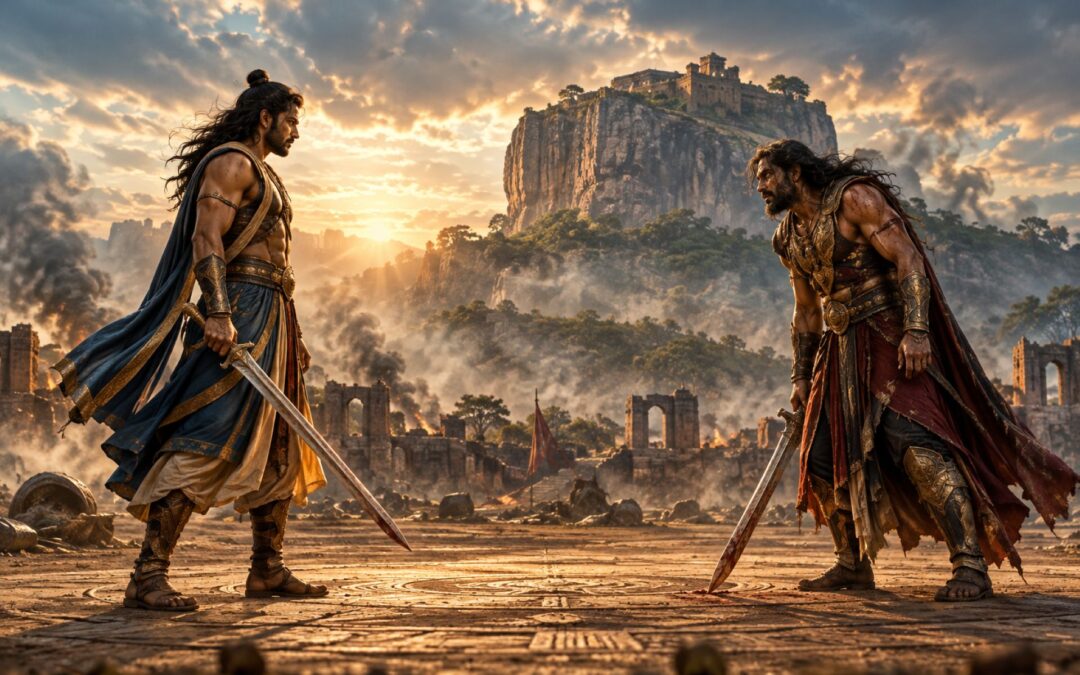
The Duel of Indra takes place within a carefully prepared arena known as the Indrajal, whose circular measurements and symbolic arrangement follow the traditions associated with Lord Indra. The elaborate ritual structure gives the confrontation a significance beyond ordinary combat.
Both participants must observe the established rules. The duel will continue until one of them dies, and its conditions require each combatant to accept the other’s stated demands should he be defeated.
Ram’s demands are comparatively straightforward. He wants Sita released and the people affected by the war protected. His concerns reflect the political obligations he believes victory should establish.
Raavan’s demands are more elaborate. He insists that Vibhishan must not become ruler of all Lanka. He requires honorable burial arrangements for himself, Kumbhakarna, and Indrajit, including ceremonies connected to Sinauli and the preservation of their death masks.
He also demands the continuing support of a hospital in Vaidyanath, the transfer of his remaining Vedavati pendant to Sita, and the distribution of his artistic and intellectual possessions. His musical instruments are to go to Annapoorna Devi, while his books are to be given to Shatrughan.
Another demand reveals Raavan’s concern with how he will be remembered. If the story of Ram and Sita is ever written, he does not want himself erased from it.
His final instruction concerns Mandodari, who must not remain in Sigiriya. Even as Raavan prepares to die, he attempts to arrange the circumstances of those who will survive him.
The formal terms expose the differences between the combatants. Ram primarily seeks protection and the restoration of order, whereas Raavan is attempting to control his legacy, honor his attachments, and give meaning to the people and objects he is leaving behind.
The duel begins with swords. Raavan possesses enormous strength and attacks with exceptional ferocity, using his physical power to force Ram into difficult defensive positions.
Ram responds through discipline, technical skill, and patience. His ability to survive the early assault depends on understanding Raavan’s methods and avoiding errors that would allow the stronger opponent to overwhelm him.
As the contest continues, Ram finds opportunities to counterattack. The fighting tests both men’s endurance, but Raavan’s determination is complicated by his willingness to die. He wants the dignity of a serious contest without necessarily seeking the survival that would ordinarily define victory.
Ram eventually inflicts a devastating wound that leaves Raavan unable to continue fighting. The Lankan emperor falls, recognizing that his death has become inevitable.
In his final moments, Raavan returns to Vedavati. His love for her has remained the emotional center of his existence, and he imagines death as the possibility of reunion.
Ram recognizes the suffering behind his enemy’s final words. He does not excuse Raavan’s crimes, but neither does he deny the humanity of the dying man. When Raavan indicates that he wants the end to come, Ram delivers a swift and merciful final blow.
Raavan dies believing that he will finally reach Vedavati. His death ends the central war but leaves a difficult legacy: a man capable of extraordinary devotion and achievement has also caused immense suffering because he could not govern his grief and power.
Ram orders that Raavan’s body be treated with respect. The necessary rituals and arrangements for his remains proceed even though some members of the victorious army question the honor being extended to their former enemy.
Only after these matters are attended to does Ram enter Ashok Vatika to reunite with Sita.
Their meeting is emotionally charged by the months of separation and the sacrifices made during the rescue campaign. Sita has remained committed to Ram throughout her captivity, while Ram has endured the fear that he might never see her again.
The garden that held Sita against her will becomes the place where their relationship is restored. Its name, associated with freedom from grief, acquires a meaning that Sita’s imprisonment had previously denied.
The victory also requires attention to Mandodari. She has lost Indrajit, her husband, and the political world in which she occupied an extraordinary but often isolated position.
Mandodari decides to undertake a voluntary fast unto death. The practice represents a deliberate withdrawal from life, and she considers her remaining existence emptied of meaningful attachments.
Vashishtha and Sita visit her and refuse to accept that conclusion. They recognize her intellectual and spiritual authority, arguing that her knowledge and moral judgment remain valuable even after the collapse of her family.
Sita speaks from her own experience of grief and loss. Love does not cease to exist when the beloved dies; it may instead become a source of profound suffering. Yet the capacity to love can also find expression in service to others.
Mandodari eventually agrees to continue living. Her decision is one of the ending’s most important emotional reversals because it contrasts with Raavan’s belief that death is the only remaining resolution to his suffering.
Ram and Sita then return to Ayodhya. Their homecoming is celebrated with lights and public rejoicing, an event the novel presents as the origin of the first Diwali.
The reunion also brings the brothers back to their families. Lakshman, recovering from his injury, looks forward to seeing Urmila after their long separation. Ayodhya’s celebrations recognize the end of exile and the restoration of the royal family.
The settlement of Lanka presents another difficulty. Ram had promised Vibhishan that he would receive the throne, but he has also accepted Raavan’s demand that Vibhishan must not rule all of Lanka.
Bharat finds a solution by distinguishing between the entire island and a reduced kingdom. Gokarna and its surrounding commercial region become an independent republic governed through its merchant guilds and citizens. Vibhishan receives the remaining Lankan kingdom centered on Sigiriya and the western part of the island.
This arrangement allows Ram to honor both promises, although it also reflects the political consequences of having allowed Vibhishan to bargain for power during the war.
Raavan’s other wishes are fulfilled. His writings are given to Shatrughan, his instruments are delivered to Annapoorna Devi, and the arrangements for his remains are respected. His demand to remain part of Ram and Sita’s story also becomes a reminder that the defeated may continue shaping how history is told.
The final chapters do not end with an uncomplicated peace. Vishwamitra remains active and believes he can still influence India’s future. He has established political connections and placed agents where they may serve his purposes, including Mrigasya within Ayodhya’s sphere.
Vashishtha understands that defeating Raavan has not resolved the larger ideological conflict. The rivalry over India’s future continues, and Vishwamitra’s ambitions extend beyond the authority of any single kingdom.
In conversation with Mandodari, Vashishtha speaks about the need to create a new social order. Ram, Sita, and Bharat possess complementary abilities that could enable them to transform the country.
Their earlier gurukul names—Sudas, Bhoomi, and Vasu—are associated with this emerging political vision. Vashishtha regards the three as a combination capable of undertaking work that no one of them could accomplish independently.
The proposed new realm is called Meluha, the Land of Pure Life. Its creation will require another struggle, one that Vashishtha expects to involve a far more extensive political transformation than the defeat of Lanka.
The novel ends by announcing the continuation of this story in Rise of Meluha.
The immediate resolution is therefore complete: Sita has returned, Raavan is dead, the Lankan war has ended, and the principal survivors have begun rebuilding their lives. Yet the central philosophical question remains unsettled. Ram has demonstrated the ability to defeat a powerful enemy, but the far more complicated project of creating a just and enduring social order still lies ahead.
How Amish Reimagines India and Lanka
Amish’s fictional world combines the familiar geography and spiritual vocabulary of the Ramayana with a political and technological civilization constructed according to his own imaginative rules. Its cities, kingdoms, religious institutions, commercial networks, and military organizations operate with a degree of administrative complexity that frequently resembles a later historical society.
The Sapt Sindhu represents a broad civilization rather than a single unified kingdom. Ayodhya is an important political power, but its authority does not automatically extend across the subcontinent. Other kingdoms retain competing interests, while commercial guilds and religious institutions possess substantial independent influence.
This fragmentation makes Ram’s military campaign more demanding than a simple contest between two monarchies. He must secure allies, obtain resources, manage relations with independent powers, and anticipate the ambitions of rulers who may prefer Raavan weakened without wanting Ayodhya strengthened.
Kekaya illustrates these complications. Its disagreements with Bharat and Ayodhya prevent Ram from assuming that shared cultural or religious values will produce automatic cooperation. Political behavior depends on status, rivalries, security concerns, and calculations of advantage.
Lanka is equally complex. Raavan governs an empire supported by wealth, trade, military force, and sophisticated infrastructure. Gokarna’s commercial importance shows that the Lankan economy is not reducible to royal taxation or conquest.
The merchant guilds possess political leverage because rulers depend on the economic systems they administer. Their eventual separation from Vibhishan’s kingdom demonstrates how commercial authority can be converted into a distinct constitutional arrangement.
Sigiriya provides the clearest expression of Lankan imperial power. The fortifications around Lion’s Rock, the integrated water-management system, and the defensive geography create a capital that must be approached through engineering and logistics rather than heroic combat alone.
Onguiaahra performs a related function. Its hidden passages, reservoirs, and hydraulic defenses make it possible for the defenders to obstruct an invasion even after an attacker enters the fort. Geography and infrastructure become active participants in the conflict.
The religious institutions are also significant. The Malayaputras preserve the tradition associated with the earlier Vishnu, while the Vayuputras represent the legacy of the previous Mahadev. Both groups participate in the struggle against Raavan, but their institutional histories and political loyalties can place them in tension.
The Vishnu is particularly important because Amish treats the title as a responsibility assumed by an exceptional human leader rather than as an identity established entirely outside human history. The selection and preparation of such a leader become political as well as spiritual activities.
This interpretation allows the dispute between Vishwamitra and Vashishtha to influence the plot directly. Their preferred candidates differ, and the country’s future institutions may depend upon which candidate acquires sufficient legitimacy.
The Vaanars are similarly presented as a distinct community with its own political organization, military resources, religious loyalties, and family conflicts. Vali and Angad matter because of the decisions they make, not simply because they occupy positions recognizable from the traditional epic.
The novel’s technology sometimes challenges expectations associated with its ancient setting. Shatrughan’s bridge requires detailed material science, Lankan fortifications depend on elaborate engineering, and the Pushpak Vimaan operates as a technically sophisticated aircraft.
These inventions have consequences for military strategy, allowing ingenuity to become as important as individual combat ability. Shatrughan’s contributions are decisive even though he is not portrayed as the strongest of Ram’s brothers.
The treatment of technology also introduces a limitation. Some scientific and mechanical explanations are extremely elaborate, and their confident presentation can make speculative devices feel as though they belong to a documented historical civilization. They should be understood as components of Amish’s fictional setting, not evidence about the technologies available in the historical period the novel invokes.
Nevertheless, the world-building establishes a coherent foundation for the conflict. Raavan’s defeat requires more than the courage of individual warriors because his power rests on institutions, resources, geography, and technical systems. Ram’s eventual victory comes from understanding and exploiting those systems.
Ram and Sita: Two Visions of the Vishnu
Ram and Sita are united by their commitment to dharma, but they understand leadership through different experiences and possess distinct strengths. Their relationship is especially important because Sita’s decision to support Ram as Vishnu reverses the expectations of people who have spent years preparing her for that role.
Ram’s defining characteristic is his determination to act according to principles that remain valid even under extreme pressure. Sita’s abduction gives him ample reason to seek revenge, yet his first response is to attempt a rescue that might avoid a large-scale war.
His conduct during the invasion follows a similar pattern. He condemns the mistreatment of incapacitated enemies, provides medicine to people inside Sigiriya, honors fallen Lankan warriors, and tries to prevent looting or indiscriminate violence after victory.
These decisions distinguish his approach from the idea that moral restrictions become irrelevant during a just war. Ram believes that the righteousness of a cause must be reflected in the methods used to pursue it.
His commitment to principle is accompanied by intelligence and tactical flexibility. The elaborate deception surrounding the bridge and naval expedition, his response to Indrajit’s countermeasures, and his use of elephants against the Lankan cavalry demonstrate that his moral convictions do not make him militarily naive.
Yet Ram’s insistence on honorable conduct can create danger. Bharat repeatedly understands political situations more pragmatically than his elder brother. The acceptance of Raavan’s final duel is the most obvious example: Ram risks his life when the war has already been effectively decided.
His character therefore raises a difficult question about whether absolute adherence to a personal code can sometimes conflict with responsibilities to others. The novel generally admires Ram’s integrity, but the consequences of that integrity still require examination.
Sita is characterized through independence and political judgment. She is a trained warrior and an accomplished leader, and her captivity does not eliminate her ability to influence events.
Her refusal to escape is the clearest demonstration of her agency. Hanuman and Arishtanemi arrive with the intention of deciding how she can be brought home, but she rejects their plans and insists upon determining the larger purpose of her liberation.
The choice is controversial because it places many lives at risk. Sita believes Ram’s public victory is necessary to establish his legitimacy as Vishnu, but the narrative does not make the human cost disappear. Her decision reveals a leader willing to subordinate immediate personal safety to a long-term political objective.
She also possesses emotional insight that Ram is not always required to demonstrate. Her conversations with Raavan move from anger and suspicion toward an understanding of his grief, without becoming an endorsement of his behavior.
Learning about Vedavati introduces an additional dimension to her identity. Sita must reconcile the love she feels for Janak and Sunaina with the discovery of her biological parents and the complicated circumstances surrounding her birth.
Her response does not diminish the legitimacy of her adoptive family. Instead, it expands her understanding of herself while allowing her to remain loyal to the relationships that shaped her upbringing.
The difference between Ram and Sita becomes especially clear in their interpretation of the Vishnu’s responsibility. Ram hesitates to accept the title and its implications, whereas Sita sees why his qualities are necessary for the country’s future.
Her argument is that defeating evil and establishing good require different abilities. She considers herself capable of confronting injustice through strength and decisive action, but recognizes that Ram’s patient adherence to law makes him better suited to creating a peaceful order.
The distinction does not make Sita subordinate to Ram. She identifies the strengths of a partner whose abilities complement her own, and their ultimate importance lies in their combined influence.
Their reunion confirms the emotional foundation of that partnership. The war has tested their relationship through separation, grief, and choices made without the other’s immediate participation. Their return to each other restores the intimacy that political responsibility repeatedly threatens to overwhelm.
Raavan: Grief, Power, Art, and Self-Destruction
Raavan is the novel’s most psychologically complicated character because his extraordinary abilities coexist with an inability to govern his emotions. He is an emperor, warrior, artist, intellectual, and experienced political ruler, yet his life remains dominated by Vedavati’s death.
The opening nightmare establishes that his grief has not diminished with time. His recollections suggest a man who has never accepted the separation between loving someone and possessing a claim upon that person’s continued existence.
Vedavati represents an ideal of goodness and spiritual beauty that Raavan recognizes but cannot consistently embody. His devotion to her reveals his capacity to admire virtue, even as his conduct demonstrates how far he has departed from it.
The contrast is visible in the pendant containing her preserved fingers. To Raavan, it is a tangible connection to someone whose death destroyed his emotional stability. When he gives one finger to Sita, the gesture becomes an extraordinary act of generosity because he willingly relinquishes something he has treasured for decades.
His artistic abilities deepen the contradiction. The portrait of Vedavati shows an attentiveness and delicacy that seem at odds with his reputation for violence. His musical achievements and intellectual writings similarly indicate that he possesses capacities that might have enriched the world under different circumstances.
The novel therefore resists portraying Raavan as evil because he lacks admirable qualities. His tragedy is that those qualities have not prevented him from causing enormous harm.
Raavan’s argument about greatness attempts to give his suffering an explanation. He believes pain can elevate people beyond the limitations of ordinary life, producing the strength required for extraordinary achievements.
Sita exposes the weakness of his position by distinguishing between suffering and the use made of suffering. Pain may become part of a person’s development, but its existence does not establish moral greatness. A destructive response to loss remains destructive regardless of its emotional intensity.
Raavan’s own life supports that objection. His love for Vedavati has not made him consistently compassionate or just. Instead, his inability to accept her death has contributed to violence, political ambition, and emotional neglect.
His relationships with Kumbhakarna and Indrajit reveal the human cost. Both love him deeply, and both are willing to fight for him, but he cannot persuade them to abandon a war he increasingly believes he must lose.
He wants their survival while also arranging the circumstances of his own destruction. The contradiction exposes the limits of a self-centered conception of sacrifice. Raavan may imagine his death as meaningful, but the path toward it requires others to pay costs they have not chosen for the same reasons.
His marriage to Mandodari is equally revealing. He respects her moral force and recognizes her intellectual stature, yet he never gives her the love he continues directing toward Vedavati’s memory.
Mandodari consequently lives beside a man whose greatest emotional commitment belongs to someone long dead. Their son’s death makes the injustice of that arrangement impossible to overlook.
Raavan’s final duel allows him to construct an ending that suits his idea of honor. He will die fighting a worthy opponent, preserve his reputation as a formidable warrior, and secure a place in the legend of Ram and Sita.
The desire to be remembered complicates his apparent willingness to sacrifice himself. He wants death, but he also wants control over the meaning of his life after death.
His last requests expose both sides of his character. The preservation of his family’s remains, support for a hospital, and transfer of his writings and instruments suggest care extending beyond himself. His insistence that future storytellers include him in Ram and Sita’s history also reveals a continuing attachment to recognition.
Amish gives Raavan a deeply human ending without erasing his responsibility. His longing for Vedavati explains much of his conduct, but it does not justify the suffering he inflicts on people who love him or the kingdom he rules.
The characterization is most effective when the novel allows those contradictions to remain uncomfortable. Raavan is neither an innocent victim of grief nor a figure whose cruelty makes sympathy impossible. His tragedy arises from possessing enough goodness to recognize a better life while repeatedly making choices that prevent him from living it.
Brothers, Sons, and the Cost of Family Loyalty
The relationships among the four Ayodhyan brothers contrast sharply with those within Raavan’s family. Both households contain genuine affection and a willingness to sacrifice, but their approaches to disagreement produce different outcomes.
Ram, Bharat, Lakshman, and Shatrughan are not interchangeable examples of brotherly devotion. Each possesses abilities the others lack, and their effectiveness depends on respecting those differences.
Bharat is especially valuable because he combines loyalty with political realism. He understands that public duty may require him to challenge Ram’s instructions and that agreements are often shaped by self-interest rather than moral ideals.
His dealings with Gokarna’s merchants and Vibhishan demonstrate this understanding. He does not expect every ally to share Ram’s principles, and he recognizes that political cooperation can be built around overlapping interests.
The settlement of Lanka is his clearest achievement. By establishing a separate republic around Gokarna and limiting Vibhishan’s kingdom, he enables Ram to honor two promises that initially appear irreconcilable.
Bharat also possesses considerable physical courage. His killing of Indrajit is not the result of elaborate calculation but an instinctive response to his brother’s near-fatal injury. The moment reveals the emotional force beneath his usual pragmatism.
Lakshman represents a more direct and passionate form of loyalty. He is an exceptional warrior whose instinct is often to meet danger through action. His frustration with uncertainty contrasts with Bharat’s patience and Shatrughan’s analytical temperament.
His infiltration of Onguiaahra and his willingness to expose himself during the airborne battle establish his bravery. His near-fatal injury demonstrates both the courage and vulnerability that accompany such intensity.
Shatrughan’s contribution is different but no less important. He is not defined primarily by feats of personal combat. His abilities lie in engineering, scientific understanding, planning, and the willingness to solve problems that cannot be overcome through strength.
The construction of Nala Setu changes the strategic possibilities available to the entire army. Without it, Ram’s numerical and tactical advantages might never become relevant.
Raavan’s appreciation of Shatrughan’s intellect appears in his final request that his books be given to him. The defeated emperor recognizes a mind capable of valuing knowledge, even across the divisions created by war.
These contrasting abilities make the Ayodhyan brothers effective as a group. Their loyalty does not require identical personalities or absolute agreement. Their relationships are strongest when one brother compensates for another’s limitations.
Raavan and Kumbhakarna possess an equally deep bond, but it operates under more destructive conditions. Kumbhakarna understands his elder brother’s flaws and recognizes that Raavan has repeatedly made harmful choices.
Nevertheless, he refuses to abandon him. His loyalty is grounded in love and personal duty rather than the belief that Raavan is always correct.
The distinction makes Kumbhakarna one of the book’s noblest tragic figures. He knows that his brother’s decisions have helped create the catastrophe, yet he regards leaving him to face it alone as an unacceptable betrayal.
His defense during the Battle of Sigiriya demonstrates that loyalty can produce extraordinary courage. He sacrifices himself to preserve others, including soldiers who will survive because he refuses to retreat prematurely.
The tragedy is that his virtues help sustain a war driven partly by Raavan’s personal suffering. Kumbhakarna’s goodness cannot transform his brother’s choices into good ones.
Indrajit experiences a related conflict. As prince of Lanka, he has obligations to his country, army, and people. As Raavan’s son, he feels compelled to preserve his father’s honor and protect him from humiliation.
He understands the possibility that Raavan desires death, but this knowledge creates a dilemma rather than a solution. Helping his father achieve a meaningful death may require allowing Lanka to fall, while preserving the kingdom may require resisting his father’s wishes.
Mandodari urges Indrajit to recognize that a peaceful settlement could become possible after Raavan’s death. Her advice places the welfare of the kingdom above the survival of a ruler whose continued authority has become destructive.
Indrajit nevertheless fights. His strategic intelligence makes him a formidable opponent, particularly when he identifies the bridge invasion and later exploits the vulnerability of the elephant corps.
His death is therefore tragic because he is neither foolish nor incapable. He possesses genuine abilities, but his loyalty and the military situation lead him toward a contest he cannot ultimately win.
The two royal families reveal different relationships between love and judgment. Ram’s brothers repeatedly challenge, correct, and support one another, allowing their shared purpose to become stronger than any individual’s limitations.
Raavan’s family also contains people willing to speak difficult truths, but their warnings cannot overcome the decisions of the man whose authority dominates their lives. Affection survives, while the family itself is destroyed.
Hanuman, Sursa, Mandodari, and the People War Leaves Behind
Hanuman’s role in War of Lanka extends beyond physical strength and devotion to Ram. He is a soldier, strategist, intelligence operative, and moral participant whose experiences repeatedly expose the emotional costs of warfare.
His relationship with Sursa is particularly important because it gives him something personal to lose. Sursa is confident, capable, and determined to participate directly in dangerous missions. Their affection develops through mutual respect rather than through an assumption that one must protect the other from every risk.
Her final mission demonstrates those qualities. She refuses to remain passive and devises a diversion that improves the chances of the others escaping. The resulting fatal injury gives her death a clear causal relationship to her decisions and abilities.
Hanuman’s grief challenges his military discipline. He is capable of anger and revenge, but he also understands the danger of allowing those emotions to determine how helpless enemies are treated.
His later conduct toward Kumbhakarna confirms that this restraint is a developed moral position rather than indifference. He fights the Lankan commander with determination, then honors him after his death.
The respect he extends to Kumbhakarna contrasts with the cruelty shown by Samichi during the interrogation of Kshiraj. Both characters act on behalf of their own side, but their methods reveal fundamentally different attitudes toward human dignity.
Mandodari provides another perspective because she sees the war through a combination of intellectual independence and devastating personal loss. Her status as queen does not prevent her from criticizing Raavan, and her austere life separates her from the imperial luxury surrounding his court.
She is portrayed as an accomplished scholar whose understanding of ethics gives her influence independent of her marriage. Her conversation with Indrajit about different kinds of warriors reveals a willingness to make moral distinctions even when they disadvantage her own family.
After Indrajit’s death, her condemnation of Raavan expresses a truth she has understood for years. His unresolved attachment to Vedavati has inflicted suffering on the people who remained beside him.
Mandodari’s decision to continue living after contemplating voluntary death is therefore significant. Unlike Raavan, she eventually accepts that grief need not exhaust the purposes of existence.
The secondary characters broaden these concerns. Vali’s final reconciliation with Angad establishes the importance of chosen and sustained parental responsibility. Angad’s later service demonstrates how a child may honor a parent without reproducing every aspect of that parent’s suffering.
Arishtanemi embodies the difficulty of controlling grief within a military organization. His rage after Sursa’s death is understandable, but it threatens to destroy the restraint that distinguishes the coalition’s stated ideals.
Vibhishan represents a different moral problem. He supplies information that helps defeat an oppressive ruler, yet his ambitions and readiness to manipulate others prevent his conduct from becoming a simple example of virtue.
Mareech’s loyalty to Raavan exposes the pain of serving someone whose decisions are increasingly dangerous. Akampana illustrates how political calculations can alter military loyalties, while Samichi shows the capacity for cruelty that can exist within an otherwise sophisticated defensive system.
Together, these characters prevent the war from becoming a contest in which every admirable quality belongs to one side. The novel repeatedly presents courageous people defending flawed causes and self-interested people contributing to outcomes that may nevertheless be beneficial.
The Ideological Rivalry of Vashishtha and Vishwamitra
The conflict between Vashishtha and Vishwamitra gives the novel a political dimension that extends beyond the war for Sita’s freedom. Both sages seek to influence India’s future, but they disagree about the kind of society that should be established and the leader best suited to accomplish it.
Their dispute is rooted in an earlier friendship. Vashishtha remembers discussions involving Vishwamitra and Nandini when the men were younger scholars and teachers. These conversations reveal that their philosophical disagreements developed long before Ram and Sita became candidates for the position of Vishnu.
Vishwamitra begins from the claim that large civilizations depend upon organized cooperation. Societies contain ruling groups and wider populations whose relationship makes political stability possible.
He defines elites primarily through the possession and exercise of power rather than hereditary social identity alone. Military, economic, political, and ideological influence are distinct forms of power that may reinforce one another.
A commander possesses military power through the ability to organize violence. A merchant or guild leader may wield economic power by controlling substantial resources. Political power belongs to people capable of directing state institutions, while ideological power comes from shaping the beliefs through which populations interpret authority.
Vishwamitra believes that societies become unstable when too many individuals compete for positions of influence. As the number of elite aspirants grows, opportunities become insufficient, and rival groups begin struggling for control.
The danger increases when living conditions among the wider population deteriorate. Frustrated people become more receptive to counter-elites offering alternative leadership, and powerful groups may encourage unrest to weaken their competitors.
Vishwamitra also argues that internal divisions can invite foreign intervention. Factions seeking an advantage over domestic rivals may welcome outside forces without recognizing the long-term consequences for their civilization.
His proposed solution is the Maika system, which attempts to reduce inherited advantage by separating children from their birth families and educating them through a common institutional structure.
The children would be assessed according to their abilities and assigned suitable social roles. Adoption into families associated with those roles would follow, preventing birth status from automatically determining privilege.
Vishwamitra believes the arrangement would continually refresh the ruling class. Talented people from disadvantaged backgrounds could acquire positions of influence, while the descendants of powerful families would receive no automatic guarantee of status.
The logic has a recognizable attraction. A society that allocates responsibility according to demonstrated ability rather than inheritance might reduce some forms of entrenched privilege.
Yet the proposal imposes an enormous moral cost. Parents would lose control over their children’s upbringing, and children would be denied knowledge of their biological families. Individual identity and affection would become subordinate to a system designed for political stability and efficiency.
Nandini challenges this assumption. She recognizes that the relationships among parents and children cannot be dismissed as obstacles to effective administration. Love forms part of what makes human society worth sustaining.
Vashishtha is interested in the theoretical possibilities but remains less committed to the proposal’s radical implications. The conversation exposes how Vishwamitra’s analytical brilliance can encourage him to treat human lives as material for institutional design.
The later rivalry over the Vishnu follows naturally from these disagreements. Vishwamitra has invested in Sita because he believes she possesses the abilities required to establish the order he favors.
Vashishtha’s support for Ram reflects greater confidence in the importance of principled, restrained leadership. Ram’s capacity to accept limits upon his own power becomes essential to the society Vashishtha hopes to create.
The novel does not establish Vishwamitra’s political theory as a proven explanation of historical development. It belongs to the characters’ intellectual debate and must be evaluated as part of their fictional world.
Its strongest function is to make the conflict between the sages consequential. Their disagreement concerns the relationship between social efficiency and human freedom, and the outcome may affect generations beyond the war in Lanka.
The weakness of Vishwamitra’s position is that a system intended to eliminate hereditary injustice might create another form of oppression through centralized control of family life. His faith in rational organization does not adequately explain who would hold the power to administer the system or how that power would remain accountable.
The question returns in the ending. Raavan’s death has removed a violent ruler, but the struggle over India’s institutional future remains unresolved. Vishwamitra continues organizing political support because the battle for Lanka was only one stage of a much larger contest.
Dharma, Power, Grief, and the Price of Victory
The novel’s treatment of dharma begins with the behavior of individual characters but eventually becomes a question about the responsibilities of political power. Ram’s central challenge is to demonstrate that a ruler can remain committed to justice when military success seems to demand morally questionable decisions.
His conduct at Ketheeswaram establishes the importance of restraint. Soldiers enraged by Sursa’s death see an opportunity for revenge, but Ram refuses to accept that wounded or incapacitated enemies may be killed without ethical consideration.
The same principle informs his decision to provide medicine to Sigiriya. The city remains an enemy stronghold, yet the people suffering within it do not lose their claim to humane treatment.
At the same time, Ram authorizes the destruction of agricultural resources to pressure the Lankans into fighting outside their defenses. The operation is militarily effective, but it creates a tension between avoiding direct attacks on civilians and exposing them to the consequences of losing essential food supplies.
The tension is important because it prevents dharma from functioning as a simple set of declarations. A commander may intend to minimize suffering while still choosing strategies that produce harmful consequences beyond his immediate control.
Ram’s response to Kumbhakarna’s death provides another expression of his ethical code. He recognizes courage and sacrifice in an enemy who fought for a ruler he considered morally compromised.
The soldiers’ collective gesture of respect suggests that warrior honor can exist across political divisions. It also distinguishes the act of fighting an opponent from the judgment of that opponent’s complete moral worth.
Raavan complicates these issues through his philosophy of suffering. He believes extraordinary pain can produce greatness and uses the intensity of his devotion to Vedavati as evidence of the depth of his character.
Sita challenges the relationship he draws between suffering and moral achievement. Pain may explain why someone becomes powerful, but power acquired through suffering is not inherently benevolent.
The contrasting responses of Ram and Raavan support her argument. Ram suffers through separation, danger, and loss but attempts to preserve the limits of acceptable conduct. Raavan allows his suffering to become the organizing force of his political and personal life.
The novel also distinguishes different forms of loyalty. Kumbhakarna’s refusal to abandon Raavan is moving because it arises from love, but his sacrifice does not make Raavan’s war morally sound.
Indrajit’s loyalty creates a similar problem. He possesses admirable courage and intelligence, yet those abilities are employed in defense of a political order he increasingly recognizes as dangerous.
Mandodari offers a more difficult form of love by refusing to excuse the people closest to her. Her loyalty to Indrajit includes the willingness to tell him that continued war may be destructive, even though he does not accept her advice.
The difference between winning a war and winning peace becomes the novel’s central political argument. Military force can remove a particular injustice, but the elimination of an enemy does not automatically establish good institutions or trustworthy government.
Bharat’s settlement of Lanka illustrates the transition. His division of political authority between Gokarna and Vibhishan’s kingdom is an attempt to turn military victory into a workable political arrangement while honoring Ram’s promises.
Yet the arrangement also contains compromises. Vibhishan’s past actions reveal serious defects of character, and the new republic’s legitimacy depends upon commercial groups whose interests may not always correspond with those of the wider population.
The victory therefore does not eliminate the need for judgment. It merely changes the situations in which judgment must be exercised.
By the ending, the novel has moved from the ethics of individual combat toward the challenges of constructing a political order. Ram’s greatest achievement may be his ability to defeat Raavan without entirely adopting Raavan’s methods, but his greatest responsibilities remain ahead of him.
Symbols of Death, Memory, and Renewal
The most important recurring symbol in War of Lanka is Vedavati’s finger-bone pendant. Raavan wears it as a physical connection to the woman whose death has defined his existence, preserving a remnant of her body because he cannot accept the finality of their separation.
The pendant’s meaning changes when Raavan discovers Sita’s identity. Giving her one of Vedavati’s preserved fingers allows him to share a private object of devotion with someone who possesses a different but equally legitimate claim to her memory.
For Sita, the relic creates a connection to the biological mother she never knew. Its significance is therefore different from Raavan’s: she receives it as an expression of origin and belonging, while he has preserved it as a defense against unbearable absence.
The remaining finger becomes part of Raavan’s final wishes. Its transfer after his death completes the movement from possessive grief toward the recognition that Vedavati’s memory belongs to others as well.
Fire is another major image. It appears in cremations, battlefield destruction, the burning fields around Sigiriya, and the celebrations that accompany Ram and Sita’s return.
Its meanings are not identical in every appearance. The funeral pyres of Jatayu and the Malayaputras mark sacrifice and the grief of those who survive. The burning crops represent deliberate destruction undertaken for strategic purposes.
At Ayodhya, light associated with Diwali carries a different significance. The return of the royal family and the end of exile produce a communal celebration of renewal rather than devastation.
These contrasting uses of fire connect destruction with the possibility of transformation. Yet the connection should not be made too neatly: the crops burned at Sigiriya are a material loss, not a benign symbol of purification.
The sun appears through the novel’s religious imagery, royal symbolism, descriptions of power, and the natural conditions governing military operations. Its association with radiance and authority contributes to the story’s interest in legitimate greatness.
Raavan’s artistic works provide a more personal form of symbolism. The portrait of Vedavati preserves an image of someone who continues to dominate his emotions, while his representation of an older Ram reveals the intellectual curiosity and imaginative ability that survive beneath his cruelty.
The works also raise questions about the relationship between representation and memory. Raavan repeatedly tries to preserve what cannot be held permanently, whether through painting, music, relics, or the story he hopes later generations will tell.
The elaborate burial arrangements and death masks serve a related purpose. Raavan’s demands concerning himself, Kumbhakarna, and Indrajit reveal a desire to preserve dignity after death.
They also reveal his need to control the interpretation of his life. His wish to remain within Ram and Sita’s story is especially revealing because the defeated ruler understands that historical memory can confer a kind of survival unavailable to the body.
Nala Setu carries a different symbolic function. As an engineering achievement, the bridge allows the invasion to succeed. As a physical connection between separated lands, it also gives form to the work of cooperation among the brothers and their allies.
Its construction contrasts with Raavan’s attempt to secure greatness through personal suffering. Shatrughan creates something useful by applying knowledge to a collective problem, while Raavan’s ambition has often turned his exceptional gifts toward destruction.
The elephants represent the ambivalent nature of power. Their enormous strength gives Ram a decisive advantage, but their effectiveness depends upon trained handlers and careful direction.
Indrajit’s attack exposes that dependence. Once the mahouts are incapacitated, the same animals that protect the Ayodhyans may become dangerous to them. Power without guidance becomes unpredictable and potentially destructive.
The Pushpak Vimaan undergoes a comparable transformation. It first appears as a terrifying instrument of airborne attack, capable of striking enemies from positions they cannot easily defend.
After its capture, the machine carries medicinal resources needed to save Lakshman. Its use changes from destruction to preservation, showing that a technology’s moral significance depends substantially upon the purposes for which it is employed.
Ashok Vatika is the ending’s most intimate setting. Despite its association with freedom from grief, it initially functions as Sita’s prison. Its beauty cannot compensate for the suffering caused by captivity.
When Ram finally meets Sita there, the garden becomes a setting for restoration. The change arises from the actions and relationships of the characters rather than from any transformation of the place itself.
Across these symbols, Amish returns repeatedly to the relationship between loss and continuity. Objects preserve memory, rituals honor the dead, and works of engineering or political organization create possibilities for people who remain alive.
The crucial distinction is between memory that enables life to continue and memory that imprisons the living. Raavan spends much of his existence trapped by the past; Mandodari’s survival suggests a different way of honoring what has been lost.
Military Engineering, Dialogue, and the Novel’s Structure
War of Lanka occupies an unusual position within the Ram Chandra Series because it follows three earlier novels that develop overlapping histories from different character perspectives. The author’s explanation of the series’ converging structure clarifies why the fourth volume begins with established relationships and political conflicts rather than introducing its protagonists from the beginning.
The narrative moves among Ram’s expedition, Sita’s captivity, Raavan’s court, and the competing political activities of the sages. This arrangement allows readers to understand developments that individual characters do not yet know.
The military campaign benefits from that structure. Indrajit’s suspicion about the bridge can be followed alongside Shatrughan’s construction, and the reader understands how competing intelligence operations influence the approaching battle.
Amish devotes considerable attention to engineering and logistics. The bridge-building sequence explains material properties and environmental conditions, while Onguiaahra depends upon the relationship between fortifications and water-management systems.
These details distinguish the novel from retellings that rely primarily on heroic intervention. Victory emerges through preparation, calculations, deception, and the ability to adapt when a plan fails.
The Battle of Sigiriya provides the strongest example. Ram’s apparently vulnerable formations acquire meaning when the elephants are released, and Indrajit’s later attack reverses the logic by turning the army’s greatest advantage into a source of danger.
The explanations can also reduce dramatic momentum. Readers receive extended discussions of engineering, technical mechanisms, and political theory, sometimes at moments when the emotional or military situation is already urgent.
The long recollection concerning Vishwamitra’s social theory is particularly revealing. It adds intellectual context to the rivalry between the sages, but its placement interrupts a campaign whose immediate tactical stakes have become intense.
The dialogue frequently uses modern conversational patterns, informal humor, and highly explicit statements of philosophical positions. This can make complicated ideas easy to understand and give the brothers an approachable relationship, but it sometimes weakens the sense of historical distance the setting otherwise attempts to create.
The novel also prefers explanation to ambiguity. Characters often articulate the moral significance of their decisions in considerable detail, reducing the amount of interpretive work left to the reader.
Nevertheless, the structure is effective when strategic preparation produces a meaningful reversal. The novel’s strongest action sequences reward attention to information introduced earlier, and its multiple perspectives make the outcome feel dependent on a large network of individual decisions.
Why the Ending Is Both a Conclusion and a Beginning
Raavan’s death resolves the immediate conflict that has organized the series since Sita’s abduction. Yet its significance extends beyond removing an enemy, because Raavan has gradually become a man who regards death as the only possible completion of his life.
His final confrontation with Ram gives him the honorable death he desires. It also reveals the limitations of his philosophy, because the emotional closure he achieves is purchased at an immense cost to others.
Raavan imagines reunion with Vedavati as the release of his suffering. The narrative treats that hope sympathetically, but his death cannot restore Kumbhakarna, Indrajit, or the soldiers who have died defending him.
The contrast with Mandodari is central. She too has lost people who defined her emotional world, and her initial response is to consider ending her life.
Unlike Raavan, however, she eventually recognizes the possibility of continuing to act meaningfully after devastating loss. Her survival gives the ending an alternative to the idea that a beautiful death is the highest achievement available to a suffering person.
Ram’s reunion with Sita supplies the emotional restoration toward which the military campaign has been moving. Their separation ends, and the suffering imposed by captivity gives way to the possibility of shared life.
The return to Ayodhya expands that restoration from the personal to the communal. The celebrations associated with the first Diwali allow a population to participate in the return of its rulers and the end of a prolonged absence.
Political obligations continue despite the celebrations. Raavan’s demands, Vibhishan’s bargain, the treatment of Lanka’s surviving institutions, and the status of Mandodari all require decisions that military victory alone cannot determine.
Bharat’s political solution demonstrates why the creation of peace depends upon abilities different from those required to win the war. The defeated territory must be governed, promises must be reconciled, and the interests of communities that participated in the conflict must be addressed.
The closing revelation about Meluha extends this problem to the whole of India. Vashishtha believes that Ram, Sita, and Bharat can help establish a new order, but Vishwamitra remains determined to influence the outcome.
Amish’s discussion of the planned continuation, Rise of Meluha, makes clear that this ending is intended to connect the Ram Chandra Series with the wider fictional world of the Shiva Trilogy. The novel itself, however, provides only the foundations of that future transformation.
This distinction is important. War of Lanka completes Raavan’s personal tragedy, Sita’s captivity, and the immediate military conflict, but it leaves the larger political struggle unfinished.
Its final movement therefore returns to Sita’s earlier distinction between winning war and creating peace. Ram has demonstrated the power to defeat a formidable enemy. The next question is whether he and his allies can establish institutions capable of protecting the good that their victory has made possible.
What War of Lanka Does Well—and Where It Falters
War of Lanka is most successful when Amish connects military action with individual motivation. The invasion of Lanka is not presented as a series of battles whose outcomes depend solely upon the strength of famous warriors. It develops through a recognizable sequence of logistical challenges, intelligence failures, technological innovations, and strategic adaptations.
Shatrughan’s bridge illustrates this strength. A familiar episode from the Ramayana becomes a complex engineering problem, allowing a character who is not primarily defined by martial prowess to make an indispensable contribution.
The Onguiaahra campaign also benefits from this approach. The hidden tunnels create an apparent advantage, but Indrajit’s manipulation of the water system demonstrates that controlling a fortress and controlling its strategic function are different achievements.
The Battle of Sigiriya is the novel’s strongest military sequence. Ram’s use of elephants against the Lankan cavalry follows from earlier preparation, while Indrajit’s counterattack reveals how quickly a powerful innovation can become a vulnerability.
This emphasis on military detail distinguishes the novel from many mythological retellings. A favorable assessment in The Book Review similarly recognizes the importance of military organization and humanized characterization to the novel’s appeal.
The characterization is most convincing when affection and moral judgment come into conflict. Kumbhakarna’s loyalty to Raavan is deeply moving because he understands his brother’s flaws. He fights out of love and responsibility, not because the novel has persuaded him that Raavan is always right.
Indrajit is similarly effective. His decision to continue fighting becomes tragic because he understands the military situation and the emotional contradictions surrounding his father. His tactical intelligence makes his eventual death more consequential than the defeat of a merely arrogant opponent.
Mandodari is another significant achievement. Her intellectual independence and willingness to criticize Raavan give her a moral authority not derived solely from her position as queen.
Her decision to survive after Indrajit’s death also adds a necessary qualification to the novel’s recurring admiration for honorable death. It suggests that the courage required to continue living can be as meaningful as the courage required to sacrifice oneself.
Raavan’s characterization is ambitious. Amish gives him artistic genius, emotional vulnerability, intellectual capacity, and genuine affection while refusing to remove the consequences of his cruelty.
The portrayal is strongest when the novel allows readers to recognize both the beauty and the destructiveness of his devotion to Vedavati. His final wishes preserve the complexity of a man who wants to benefit others while also attempting to control how history remembers him.
The novel’s treatment of Ram and Sita is less consistently satisfying. Both possess important qualities, and Sita’s political judgment is crucial to the plot, but their central philosophical positions are often established through explicit declarations rather than gradual discovery.
Ram’s commitment to law, for example, is demonstrated through convincing decisions involving prisoners and medical treatment. Yet the repeated emphasis on his righteousness can reduce uncertainty about his character, especially when the narration strongly endorses his choices.
Sita’s refusal to escape is an interesting and potentially troubling decision, but the novel generally treats her reasoning as evidence of exceptional political insight. The enormous military cost of the resulting war leaves room for more searching examination than the story consistently provides.
The characterization of Raavan presents a similar problem. His grief gives him emotional depth, but the repeated movement toward a meaningful death can sometimes make his destructive choices seem more aesthetically coherent than ethically defensible.
Kumbhakarna and Indrajit suffer and die partly because Raavan cannot imagine a worthwhile future for himself. The novel recognizes this contradiction, but its admiration for the beauty of honorable death sometimes competes with the moral seriousness of the consequences.
Pacing is another limitation. The novel devotes substantial space to preparations, technical details, and philosophical explanations before concentrating much of its most consequential action into the final chapters.
Some of those explanations are necessary. The reader must understand why Shatrughan’s bridge matters, how the sluice controls interfere with the naval advance, and why Indrajit’s attack on the mahouts threatens Ram’s army.
Other passages provide more detail than their dramatic function requires. Extended explanations can interrupt the urgency of a scene, especially when the reader has already understood the central strategic problem.
A substantially more critical assessment at Reviewland by Arnav questions the dialogue, characterization, and prominence of explanatory material. Those concerns are most persuasive when applied to passages where technical or philosophical exposition delays an otherwise compelling dramatic encounter.
The prose contributes to this unevenness. Amish writes clearly and frequently uses short, direct sentences that make events easy to follow. His battle scenes can move rapidly when action replaces explanation.
The same directness sometimes becomes excessive. Characters repeatedly state the significance of ideas that their actions have already demonstrated, while informal humor and modern idioms can disrupt the atmosphere of the ancient fictional setting.
The philosophical material is nevertheless more consequential than it might initially appear. Vishwamitra’s theory of elite overproduction and the Maika system provide an intellectual foundation for the series’ larger political conflict.
The proposed system also creates a serious ethical problem by subordinating family relationships to institutional efficiency. That problem helps distinguish Vishwamitra’s political ambition from Vashishtha’s preferred approach.
The difficulty is one of integration. The extensive recollection introduces a complicated political theory during a military campaign whose momentum has become intense. Although the ideas matter to the eventual ending, the transition can feel abrupt.
The book’s originality lies less in its broad moral positions than in the mechanisms through which it dramatizes them. Righteous leadership, destructive grief, familial duty, and the costs of war are established concerns within epic literature.
Amish gives those concerns a distinctive treatment through political institutions, technical inventions, and the psychological motivations assigned to familiar figures. The reinterpretation works best when those elements create unexpected but causally convincing decisions.
The ending is largely satisfying. Raavan’s death completes his emotional trajectory, Sita and Ram are reunited, and Mandodari receives a resolution that preserves her agency instead of allowing her story to end with her husband’s defeat.
Bharat’s settlement of Lanka is a particularly appropriate conclusion to the book’s political argument. It illustrates the continuing need for practical judgment after the military conflict ends.
The connection to Meluha also creates anticipation, although it reduces the sense of complete closure. Readers invested only in the war receive its resolution, while those interested in the larger political conflict are left with important questions.
As a fourth installment, War of Lanka rewards knowledge of the earlier novels. Its emotional and political developments depend upon relationships and ambitions established before the opening chapter. Readers encountering the series here can follow the broad action, but many motivations acquire their full significance through the preceding books.
The fairest overall assessment is that War of Lanka succeeds as an ambitious military and political reimagining of the Ramayana, with several affecting character arcs and an intelligently structured final campaign. Its principal limitation is the tendency to explain its technology, philosophy, and morality at such length that the dramatic force of its strongest material is occasionally weakened.
The book is most compelling when readers can observe a character’s principles through a difficult decision. Kumbhakarna’s final defense, Sursa’s diversion, Bharat’s desperate response to Lakshman’s injury, and Mandodari’s rejection of Raavan’s self-destructive legacy accomplish more through action than extended statements of moral doctrine.
Who Should Read War of Lanka?
War of Lanka is most rewarding for readers who have completed Ram: Scion of Ikshvaku, Sita: Warrior of Mithila, and Raavan: Enemy of Aryavarta. The fourth novel relies on the relationships, political rivalries, and moral conflicts developed across those earlier books, and its emotional resolutions are considerably stronger when their histories are understood.
It will also appeal to readers who enjoy military strategy and technically detailed fictional worlds. Shatrughan’s engineering, Bharat’s diplomacy, Indrajit’s tactical intelligence, and the interconnected operations leading to Sigiriya provide much of the novel’s distinctive interest.
Readers looking for a traditional devotional telling of the Ramayana should approach it with different expectations. Amish substantially changes motivations, relationships, institutions, and the mechanisms behind familiar events. His story belongs to mythological fiction rather than religious commentary or historical reconstruction.
Those who prefer subtle characterization, restrained philosophical exposition, or a faster-moving narrative may find the book uneven. Its long explanations are often informative, but they demand patience, especially during the preparations for the war.
Despite these limitations, War of Lanka provides a substantial resolution to the central conflict of the Ram Chandra Series. It gives Raavan a tragic but morally complicated ending, preserves the agency of Sita and Mandodari, and allows the contributions of Ram’s brothers and allies to remain essential to victory.
Its strongest achievement is the relationship it establishes between military power and the responsibilities that follow its use. The death of Raavan removes an enemy, but the survival of a civilization depends upon what its leaders choose to build afterward. By ending with Ram, Sita, and Bharat facing the unfinished work of creating Meluha, Amish gives that distinction a narrative consequence rather than leaving it as an abstract ideal.
Last Updated on October 17, 2026 by Aseem Gupta