
Reading Time: 70 Minutes
Raavan: Enemy of Aryavarta, published in 2019, is the third novel in Amish Tripathi’s Ram Chandra Series. It tells the story of one of Indian mythology’s most formidable antagonists, beginning with his troubled childhood and following his transformation into the wealthy, powerful, and increasingly ruthless king of Lanka. By the time Raavan kidnaps Sita, he has become an accomplished scholar, musician, entrepreneur, military strategist, and ruler whose extraordinary abilities have brought immense prosperity to his kingdom while inflicting terrible suffering on others.
Amish approaches Raavan as a deeply contradictory human being. He is capable of genuine devotion to his younger brother, Kumbhakarna, and of lifelong love for a woman who once encouraged him to become a better person. Yet he also enjoys cruelty, manipulates those around him, and repeatedly chooses revenge over compassion. His personal history unfolds alongside a larger political struggle involving the Malayaputras, the Vayuputras, and rival candidates for the title of Vishnu.
The novel also has an unusual position within its series. Rather than continuing directly from the events of Sita: Warrior of Mithila, it revisits the same broad period through Raavan’s perspective, revealing the experiences and calculations that lead him toward the kidnapping with which the first three books converge.
Spoiler Warning: This article covers the entire novel, including its major character deaths, political revelations, and ending.

The Abduction That Opens Raavan’s Story
The novel begins in 3400 BCE on Salsette Island, off India’s western coast. Raavan and his younger brother Kumbhakarna are preparing an operation to capture Sita, the princess of Mithila and wife of Ram. The brothers command a formidable Lankan force, supported by intelligence operatives and a remarkable flying craft known as the Pushpak Vimaan.
Their target is no ordinary princess. Sita has been recognised as the Vishnu by the Malayaputras, an influential order associated with the previous Vishnu, Lord Parshu Ram. Within the novel’s political and religious system, the Vishnu is a chosen leader expected to restore dharma and guide society away from corruption. Capturing such a person carries consequences far beyond a conventional royal kidnapping.
Raavan’s soldiers are searching for Sita, Ram, and Lakshman, who have disappeared into the forests during their exile. Samichi, once an important official in Mithila’s government, is now working with the Lankans. Her lover, Khara, serves as a military officer under Raavan. Together, they interrogate captured Malayaputra soldiers, using brutal methods to discover the fugitives’ whereabouts.
The violence establishes Raavan’s world before his personal history has been explained. His forces are disciplined, well-equipped, and accustomed to obeying ruthless commands. The men serving him regard him with a mixture of devotion and fear, often addressing him as Iraiva, meaning the True Lord.
Raavan himself is a physically imposing figure, despite the bodily abnormality that has caused him suffering since childhood. He wears a pendant made from small human bones, which his soldiers believe to be trophies taken from an enemy. Only Kumbhakarna understands their actual significance.
Kumbhakarna is particularly concerned that Sita be captured alive. He also insists that Ram and Lakshman should not be killed, recognising that unnecessary deaths would complicate an already dangerous political situation. The operation is intended to provide leverage over the Malayaputras, rather than destroy the royal family of Ayodhya.
The brothers eventually reach the area where Sita is hiding. Their forces engage her protectors, and the confrontation becomes a desperate struggle as Sita fights against overwhelming numbers. When the Lankans finally subdue her with a powerful sedative, she is carried into the Pushpak Vimaan.
Raavan and Kumbhakarna see her face clearly for the first time.
Their reaction is extraordinary. Both recognise something about the unconscious woman that leaves them shaken, although the narrative withholds the explanation.
The story then moves backward by fifty-six years, returning to the childhood of the man who will eventually become Sita’s captor.
A Gifted Child With a Taste for Cruelty
Raavan grows up in the ashram of his father, Vishrava, a respected Brahmin scholar living near Indraprastha. His mother, Kaikesi, comes from a family with a complicated social position, and her marriage to Vishrava has not brought the security or acceptance she might have hoped for.
From a young age, Raavan displays remarkable intelligence. He learns quickly, possesses an unusually strong memory, and demonstrates considerable ability in subjects ranging from scholarship to music. He is also ambitious, proud, and intensely conscious of how other people regard him.
His physical appearance contributes to his insecurity. Raavan has a painful purple outgrowth at his navel, making him a Naga according to the social classifications of Amish’s fictional world. People born with such abnormalities are widely regarded as cursed or morally tainted by actions committed in previous lives. This prejudice follows him even when his extraordinary abilities are recognised.
Yet Raavan’s mistreatment does not fully explain his behaviour. The novel introduces him committing acts of cruelty that are deliberate and personally satisfying.
In one disturbing incident, he captures a hare and prepares to torture it. He is fascinated by the suffering of an animal incapable of defending itself. The scene establishes an appetite for power over vulnerable creatures that appears before the major tragedies of his adult life.
At the same time, he is not incapable of compassion or shame. His encounters with the young Kanyakumari, a girl temporarily serving as the living embodiment of the Virgin Goddess, offer an alternative to his developing cruelty.
The Kanyakumari holds a position of spiritual importance despite her young age. Her conduct is gentle, compassionate, and unpretentious, and Raavan is drawn to her approval in a way that surprises even him. When she encourages him to become better, he takes her words seriously.
This influence becomes especially important during a musical competition.
Raavan is a gifted player of the Rudra Veena, an instrument associated with Lord Rudra, whom he deeply reveres. He is competing against Dagar, an accomplished musician whose abilities threaten Raavan’s desire to win.
Instead of relying entirely on his talent, Raavan secretly damages Dagar’s instrument. The sabotage gives him an unfair advantage, exposing the insecurity concealed beneath his apparent confidence.
The consequences become emotionally significant because Raavan does not want the Kanyakumari to regard him as dishonest. When his deception emerges, he experiences an unfamiliar conflict between his desire for victory and his desire to deserve her respect.
He eventually acknowledges his wrongdoing. Dagar responds without vindictiveness, reinforcing the lesson that honour does not always require revenge or humiliation.
For a time, the Kanyakumari’s influence produces a genuine change. Raavan tries to restrain his worst impulses and imagines becoming someone worthy of her affection and approval.
But the improvement remains fragile. He still measures much of his value through superiority, recognition, and the reactions of others. His self-control depends heavily on the presence of someone whose goodness he admires rather than on principles he has fully accepted for himself.
This weakness will become increasingly important as his circumstances change.
Kumbhakarna’s Birth and the Family’s Exile
Two years after Raavan’s early encounter with the Kanyakumari, Kaikesi gives birth to another son. The child, Kumbhakarna, possesses unusual physical characteristics, including additional arm-like outgrowths near his shoulders.
Within the social beliefs of the time, these deformities identify him as a Naga. For Vishrava, the birth is an intolerable disgrace.
Raavan is immediately protective of the newborn. Whatever cruelty he displays toward strangers or animals, his response to his younger brother is affectionate and fiercely possessive. He sees the baby as someone who belongs to him and must be defended.
The family’s situation becomes dangerous when it emerges that Vishrava has ordered the child to be killed if he is born a Naga.
Kaikesi refuses to surrender her son. With the help of her brother Mareech, she escapes the ashram, taking Raavan and Kumbhakarna with her.
Raavan recognises the deeper betrayal. His father has rejected not merely an imperfect child but his own family, preferring the preservation of status and reputation to the life of his newborn son.
The experience intensifies Raavan’s hatred of Vishrava and strengthens his determination never to place his family’s security in another person’s hands.
Their journey exposes the widespread prejudice surrounding Nagas. Relatives and acquaintances who might have helped Kaikesi hesitate or refuse because accepting the family would threaten their own standing. Sympathy is often offered privately, but few are prepared to challenge the social system responsible for their exclusion.
Raavan learns that moral declarations are easier than moral courage.
The family eventually reaches Vaidyanath, a city associated with the worship of Lord Rudra. Its traditions are more accepting of people marked by physical differences, and the family finds a comparatively welcoming environment.
Vaidyanath also provides access to medical treatment that may help Kumbhakarna. His unusual physiology creates lifelong vulnerabilities, making reliable care essential.
For Raavan, the city offers something else: the possibility of finding the Kanyakumari again.
He searches for the girl who once encouraged him to change. Instead, he learns that her tenure as the Kanyakumari has ended and that she has returned to ordinary life.
He does not know where she has gone.
Her disappearance leaves him with an incomplete emotional attachment, sustained by memory rather than a continuing relationship. The girl becomes an ideal against which he measures others, although his understanding of her remains limited to the brief period they spent together.
Raavan could remain in Vaidyanath and gradually build a stable life. Its charitable institutions and social tolerance offer possibilities denied to his family elsewhere.
But stability does not satisfy him. He wants wealth, independence, and the power to ensure that nobody can humiliate him again.
He decides to leave, setting the family on a path toward the commercial world of Chilika.
From Smuggler to Master of the Seas
Chilika introduces Raavan to the economic system that will eventually make him one of the most powerful men in the world.
Situated within a prosperous trading region, it attracts merchants, sailors, smugglers, officials, and opportunists. Goods move between the Sapt Sindhu and territories beyond India, but commerce is shaped by restrictions, duties, and the conflicting interests of rulers.
Raavan quickly realises that these obstacles create opportunities for anyone willing to operate outside the law.
Many Indian kingdoms maintain controls over exports and trade. The restrictions are intended to protect domestic economic interests, but their practical effect is to make certain goods extremely valuable when carried through unofficial channels.
Smuggling therefore offers the possibility of profits far greater than those available through ordinary business.
Raavan approaches Akampana, an established smuggler with access to maritime networks. Despite his youth, he demonstrates an unusually sophisticated understanding of risk, negotiation, and the commercial value of speed.
Akampana initially struggles to take him seriously. Raavan, however, is willing to propose arrangements that expose the older trader’s limitations while offering him a share of potential rewards.
The agreement gives Raavan access to a ship and the opportunity to demonstrate his abilities.
Within a relatively short period, he transforms the enterprise into an extraordinarily profitable operation. He understands how to move goods quickly, negotiate advantageous terms, and exploit variations in demand across different markets.
His growing wealth allows him to commission additional vessels. What begins as a single shipping venture becomes an expanding fleet, increasingly capable of dominating established commercial routes.
Mareech helps manage the enterprise, while Akampana remains an important associate. Kumbhakarna grows up within this environment, observing his brother’s brilliance and becoming more deeply involved in his ambitions.
Raavan’s success also brings him into contact with Lanka.
The island kingdom is already a major commercial centre, closely associated with the wealthy trader Kubaer. Its position in maritime commerce makes it strategically valuable to anyone hoping to control trade between India and the wider world.
Kubaer also has family connections that Raavan finds distasteful. His relationship with Vishrava revives old resentments, making commercial competition a personal matter.
Meanwhile, Kumbhakarna’s health remains a serious concern. His Naga physiology requires treatment that ordinary physicians cannot reliably provide.
The Malayaputras possess specialised medical knowledge, and their leader, Vishwamitra, recognises the brothers’ importance. He understands that Raavan’s need for treatment creates a powerful form of dependence.
Their dealings gradually expand beyond medicine.
Raavan discovers that an unusual material used on certain ship hulls prevents the accumulation of marine growth that would ordinarily slow vessels. The result is a remarkable improvement in speed and efficiency, giving ships equipped with the material an advantage over competitors.
This discovery excites him because speed is central to his commercial strategy. A faster ship can complete journeys more frequently, escape pursuit, and carry valuable goods ahead of competing merchants.
Raavan wants the technology for an entire fleet.
Vishwamitra controls access to the material and demands an enormous price. Raavan calculates that the investment can be recovered through the profits of expanded maritime trade.
The bargain also serves Vishwamitra’s own purposes. The powerful guru has plans requiring immense financial resources, including work involving dangerous and prohibited military technologies.
Neither man is motivated by simple generosity. Each sees the other as a means of advancing a larger ambition.
To finance the agreement, Raavan turns toward the hidden fortune of Krakachabahu, a corrupt governor who has accumulated substantial wealth through his position.
The resulting plan demonstrates another aspect of Raavan’s talent. He can organise complex operations, identify useful accomplices, and anticipate the responses of people who believe themselves secure.
His growing commercial empire is thus built through a combination of genuine innovation, sophisticated management, deception, theft, and the systematic exploitation of institutional weaknesses.
Wealth gives Raavan freedom from many of the humiliations of childhood, but it also encourages him to regard moral restraints as obstacles that powerful people can afford to ignore.
The Chilika Robbery and the Search for Vedavati
Raavan’s plan to steal Krakachabahu’s fortune requires considerable preparation.
The governor has concealed his wealth on Nalaban Island, believing that his position and security arrangements will protect it. Raavan relies on inside assistance, particularly from Prahast, a capable but morally flexible man whose loyalty can be obtained through self-interest.
The operation must overcome guarded facilities, secure the valuables, and move the stolen wealth to safety before the governor can organise an effective response.
Raavan personally participates in the robbery rather than directing everything from a safe distance. His willingness to expose himself to danger demonstrates courage, but it also reveals his appetite for excitement and confidence in his own superiority.
The plan begins successfully. His men reach their objective and prepare to escape with the treasure.
Then Krakachabahu returns earlier than expected.
The unexpected arrival threatens to trap the thieves and destroy the operation. Raavan is injured during the escape, and his companions must move quickly to reach their waiting transport.
The episode combines several qualities that will define his later military career: careful preparation, improvisation under pressure, personal bravery, and the willingness to gamble on dangerous outcomes.
Yet the robbery’s most consequential event has little to do with its stolen fortune.
During the escape, Raavan catches sight of a woman who appears to be the Kanyakumari he remembers from childhood.
The encounter overwhelms him.
Years of accumulated ambition and wealth have done nothing to weaken the memory of the girl who once offered him a glimpse of a different life. His response is so intense that it interferes with his judgment at a moment when the entire party remains in danger.
Kumbhakarna recognises what has happened. Rather than dismissing his brother’s emotional turmoil, he promises to find the woman.
The task proves difficult because the Kanyakumari was a religious designation, not her personal identity. Many girls have held the position, and the woman Raavan seeks has long since returned to ordinary life.
Eventually Kumbhakarna discovers her name.
She is Vedavati.
The name is associated with the Vedas, and Raavan receives it as though it confirms the almost sacred position she occupies in his imagination.
But the investigation reveals another crucial fact: Vedavati is married.
She lives with her husband, Prithvi, in the village of Todee, near Vaidyanath.
For Raavan, this discovery creates a conflict between an idealised memory and another person’s freedom. He has preserved an image of the Kanyakumari as though their connection remained unchanged, while she has grown older, married, and pursued a life of her own.
He nevertheless insists on seeing her.
His commercial plans continue during the preparations for the journey. Raavan has no intention of abandoning his broader ambitions merely because his emotional life has become unsettled.
In fact, he is already developing a strategy for gaining control of Lanka.
Kubaer’s wealth and authority depend on the commercial security of the island. Raavan reasons that if he can make Kubaer feel sufficiently threatened, the trader will seek protection from the strongest military force available.
Raavan intends to control that force.
He will then be positioned to become the effective commander of Lanka’s army, eventually replacing Kubaer as its ruler.
This plan demonstrates that Raavan’s longing for Vedavati has not transformed his political character. He remains a man who uses fear, financial dependence, and calculated pressure to obtain power.
The brothers leave to find Vedavati, carrying very different expectations.
Kumbhakarna hopes his brother may finally discover happiness. Raavan hopes to recover the woman he has spent years imagining, without yet understanding how different her life has become.
Samichi’s Rescue and Raavan’s Return to Todee
Before reaching Vedavati, the brothers encounter another situation that reveals their contrasting approaches to suffering.
Kumbhakarna learns about a young girl being abused by her father. Her treatment is severe enough to disturb him deeply, and he insists that they intervene.
Raavan initially shows little interest. His attention is fixed on Vedavati, and he does not consider the suffering of an unknown child his responsibility.
Kumbhakarna nevertheless persuades him to act.
The girl has been subjected to violence and exploitation by an adult who exercises almost complete control over her life. Raavan removes her from the situation and confronts her father.
But his intervention takes a disturbing form.
Instead of limiting himself to rescuing the child and punishing the abuser through his own authority, Raavan gives the girl a knife and allows her to kill her father.
She does so with a ferocity that shocks those watching.
The episode grants the child freedom from an abusive household, but it also teaches her that violence can be a means of reclaiming dignity and obtaining justice.
The girl introduces herself as Samichi.
She becomes intensely loyal to Raavan, whom she regards as a saviour. In the years ahead, that loyalty will carry her into positions of influence and eventually place her at the centre of the operation against Sita.
The scene also demonstrates the difference between Raavan and Kumbhakarna. Both can recognise an injustice and act against it, but Kumbhakarna’s concern begins with the victim’s welfare, while Raavan seems drawn to a spectacular and bloody resolution.
Their journey then brings them to Todee.
Raavan approaches Vedavati under the assumed name Jai, while Kumbhakarna presents himself as Vijay. The disguise allows them to observe her without revealing the identity of one of the world’s wealthiest and most feared men.
Todee is comparatively modest, but its residents are engaged in practical efforts to improve village life.
Vedavati participates in communal projects, including improvements to water management. She is concerned with the condition of ordinary people, the responsibilities of those with resources, and the consequences of decisions made by powerful outsiders.
Shochikesh, the local landlord, is involved in these efforts and appears more conscientious than many wealthy figures Raavan has encountered.
Vedavati’s manner is strikingly different from Raavan’s.
Where he measures success through wealth, influence, and the ability to overcome opponents, she considers the welfare of the community a central obligation. Her religious convictions are expressed through ordinary conduct rather than grand claims about her spiritual status.
Raavan, normally confident and articulate, finds himself struggling to speak naturally.
He has successfully negotiated with dangerous traders and powerful rulers. Yet in Vedavati’s presence he becomes awkward, eager for approval, and uncertain of himself.
Kumbhakarna notices the transformation with affection and concern.
The brothers spend more time in the village, and Raavan gradually enters into serious conversations with Vedavati.
One subject concerns responsibility for suffering.
Raavan argues that people must develop strength rather than allow themselves to be defeated by circumstances. He believes excessive sympathy encourages weakness, and he expresses contempt for those who depend upon others.
Vedavati does not simply deny the importance of strength. Instead, she questions what strength should be used for and whether the powerful have a right to disregard those who cannot defend themselves.
Their disagreement becomes particularly clear when Raavan compares the qualities of human beings to those of lions and deer.
For him, the lion represents courage, ambition, and the willingness to act. The deer symbolises timidity and vulnerability.
Vedavati complicates the analogy by considering an actual lion hunting to feed its cubs and a deer attempting to protect its own young. Both are struggling to preserve life.
The question is no longer whether strength is admirable in isolation, but how one should judge competing obligations when the survival of one creature may require the death of another.
Her argument introduces a more demanding conception of dharma. Moral conduct cannot always be determined by simple labels such as powerful and weak, victorious and defeated, or deserving and undeserving.
The discussions affect Raavan because Vedavati combines intellectual confidence with practical compassion. She is capable of challenging his reasoning without treating him as an irredeemable person.
Their shared appreciation of music deepens the connection.
Raavan is an extraordinarily talented musician, and his performance on the Raavanhatha allows him to communicate emotions he struggles to express through ordinary conversation. His musical creativity becomes a reminder that his gifts could serve purposes other than domination.
For a short time, the village offers something his empire cannot: the possibility of being valued for what he might become rather than feared for what he already possesses.
Vedavati’s Challenge and the Destruction of Todee
Raavan’s time in Todee becomes more complicated when Prithvi returns.
Vedavati’s husband is a decent and devoted man, deeply involved in their shared life. He is neither a cruel obstacle nor an unworthy rival whose removal could be justified by Raavan’s feelings.
This discovery forces Raavan to confront the reality of Vedavati’s marriage.
The woman he has loved in memory is not waiting to be claimed. She has chosen a husband, developed commitments, and built a life that does not revolve around Raavan.
For someone accustomed to obtaining what he wants through superior resources or force, the situation is unusually difficult.
Raavan is capable of overpowering Prithvi. He could offer Vedavati unimaginable wealth or threaten consequences if she refused him.
Yet he does not immediately take either course.
Instead, he attempts to persuade her to accompany him to Lanka, even suggesting that she need not abandon her marriage. He presents the arrangement as though proximity alone would satisfy him.
The request reveals the unusual mixture of devotion and possession within his love.
He does not necessarily demand that Vedavati reciprocate his feelings, but he still wants her life reorganised around his emotional needs.
Vedavati refuses.
Their conversations then become more personal. She recognises Raavan from the encounter during her childhood, and the disguise loses much of its purpose.
She challenges him about the kind of person he has become.
Raavan is proud of his wealth and achievements, but Vedavati questions whether those accomplishments have brought him any lasting fulfilment.
She draws distinctions between outward action, or karma, and the deeper nature of the person performing it. Her argument is that people who act only for recognition, reward, or the satisfaction of their desires may remain trapped by those desires even when they appear successful.
She also examines his devotion to Lord Rudra.
Revering a great figure, she suggests, should involve trying to embody the principles represented by that figure. Ritual admiration has limited value if one’s conduct contradicts the virtues one claims to honour.
These exchanges unsettle Raavan because they address weaknesses that wealth cannot conceal.
He has accumulated ships, money, influence, and armed followers, yet remains deeply dissatisfied. His grievances dominate his understanding of the world, and his achievements have failed to provide emotional peace.
Vedavati believes he is capable of changing.
Her confidence affects him more deeply than the praise of his followers. He begins to acknowledge conduct that he would ordinarily celebrate or dismiss as necessary.
At one point he admits the pleasure he has taken in monstrous acts. He does not pretend that all his wrongdoing occurred against his wishes.
Instead, he asks Vedavati to help him become someone better.
The admission is an important moment because it suggests genuine awareness of his moral condition. But it also places an enormous burden on Vedavati, as though her presence could become the sole guarantee of his reform.
She does not accept that responsibility in the manner he desires.
Rather than asking him to prove his love through personal devotion, she urges him to use his wealth and abilities for the benefit of others.
Raavan responds by offering a substantial donation to Todee.
The amount, fifty thousand gold coins, is enormous for the village but relatively small compared with his personal fortune. It could finance improvements to infrastructure, healthcare, and communal welfare.
Initially, Raavan’s motives are mixed. He hopes the gesture will impress Vedavati, but their conversations increasingly persuade him that the donation may have value independent of her approval.
For a brief period, meaningful change appears possible.
The money also attracts dangerous attention.
Sukarman, the son of Shochikesh, learns of the donation and decides to steal it. Unlike his father, he is motivated by greed and is willing to use violence.
His plot unfolds while Raavan is preparing to leave.
Kumbhakarna eventually discovers that Sukarman and several associates are attempting to escape with the stolen wealth. He catches the thieves and returns them to face Raavan.
During the confrontation, the brothers learn that something far worse has happened.
Vedavati and Prithvi have been murdered.
Raavan rushes to Todee and finds their bodies.
The sight is devastating. Vedavati has been brutally attacked despite being pregnant, while Prithvi has also been killed. Their home, once associated with the ordinary life Raavan envied and admired, has become the scene of extraordinary violence.
The murdered couple’s child is missing.
The brothers force the criminals to explain what happened, and the truth is horrifying. Vedavati gave birth to a child, but one of the attackers was ordered to abandon the baby in the wilderness, where wild animals were expected to kill it.
Raavan and Kumbhakarna have no reason to believe the infant survived.
For Raavan, the loss encompasses more than the death of a beloved woman. Vedavati had represented the possibility of moral transformation, a future in which his abilities might be used constructively, and perhaps the only relationship that challenged him without seeking power over him.
Prithvi’s death also carries significance. He was a good man who had never wronged Raavan, and whose marriage to Vedavati had demonstrated a form of companionship very different from Raavan’s possessive longing.
The murders destroy a life that might have existed independently of Raavan’s ambitions.
His response is catastrophic.
Raavan begins punishing those responsible, but his violence quickly extends beyond the criminals. He orders the destruction of Todee, condemning an entire community for acts committed by a few individuals.
Villagers who had not participated in the murders are killed. Their homes and lives are destroyed in an act of collective punishment.
The distinction is essential. The villagers’ innocence does not disappear because Raavan is grieving, and his capacity to identify the guilty makes his wider retaliation more clearly a choice rather than an unavoidable mistake.
The carnage leaves Todee devastated.
Raavan’s soldiers carry out his commands, and the village that once embodied Vedavati’s ideal of communal responsibility becomes a landscape of death.
The tragedy continues in the following chapter.
Raavan personally tortures Sukarman, inflicting prolonged suffering on the man responsible for the crime. His desire for revenge appears almost limitless, and he is unwilling to grant his victim the release of a quick death.
Kumbhakarna remains beside his brother, attempting to manage the aftermath while confronting the scale of what has happened.
The bodies of Vedavati and Prithvi are prepared for cremation.
During the funeral rites, Raavan participates in rituals that express responsibility toward the dead. He symbolically accepts obligations connected with Vedavati’s unfinished commitments.
The ceremony suggests that his devotion might still find expression through fulfilling the work she valued.
But even his remembrance takes an unsettling form.
Raavan preserves small bones from Vedavati’s fingers and fashions them into a pendant that he will wear for the rest of the novel.
The object becomes a physical connection to the woman he has lost. It recalls the moment when she first touched his hand and the possibility of happiness that briefly accompanied her affection.
He subsequently participates in the immersion of ashes, but his grief turns toward a wider target.
He condemns Aryavarta, the land in which his family endured humiliation and where Vedavati has now been murdered. In a symbolic ritual, he declares his separation from the country itself.
The act amounts to a funeral for his homeland.
Raavan no longer wants merely to escape India’s social order or become richer than its rulers. He wants to punish the land that he believes has repeatedly destroyed everything he loves.
Kumbhakarna is horrified by the transformation.
He recognises that Vedavati had asked Raavan to control his destructive impulses. Raavan now intends to do the opposite.
He will deliberately release the cruelty that she had hoped to restrain.
This decision establishes the meaning of the novel’s title. Raavan becomes the enemy of Aryavarta through a conscious rejection of his homeland, even though the emotional foundations of his hatred extend back to his childhood.
The Defeat of Dashrath and the Rise of Golden Lanka
Two years after Vedavati’s death, Raavan has converted his grief and hatred into a programme of military and economic domination.
His maritime enterprise is enormously profitable. The fleet under his influence has expanded, and he has developed the means to assemble and maintain substantial armed forces.
Raavan increasingly sees Aryavarta’s rulers as enemies who deserve humiliation.
The most important among them is Emperor Dashrath of Ayodhya, whose authority extends across the Sapt Sindhu.
The confrontation begins with a commercial dispute.
Lanka’s merchants operate within an arrangement through which a very large share of trading profits goes to Ayodhya and its subordinate kingdoms. Raavan regards the arrangement as exploitative and intends to overturn it.
Kubaer, still the principal ruler and commercial authority in Lanka, fears provoking the emperor.
Raavan believes that the military imbalance is less decisive than it appears.
Dashrath commands an enormous army, far larger than the forces available to Lanka. But Raavan recognises that an army’s size can become a weakness if it must be supplied under unfavourable conditions.
He prepares the coastal fort at Karachapa for the confrontation.
The surrounding countryside is devastated or stripped of useful supplies, denying Dashrath’s army easy access to provisions. Raavan’s troops remain protected by prepared defences and secure supply routes.
If the emperor delays, feeding his enormous army will become difficult.
If he attacks, Raavan intends to determine the battlefield.
The first meeting between the opposing leaders takes place under the pretence of negotiation.
Kubaer attempts to preserve peace, but Dashrath demands the restoration of the existing commercial arrangements. He treats the dispute as a challenge to imperial authority rather than a negotiation between equal powers.
Raavan deliberately provokes him.
He addresses the emperor without the deference expected from a subordinate and questions his ability to defeat Lanka.
Dashrath reacts with anger, exactly as Raavan intends.
The emperor’s pride becomes an essential part of Raavan’s military plan.
During the night before the battle, Raavan explains his strategy to Kumbhakarna.
The brothers possess considerably fewer soldiers than their enemy, but they also command a formidable navy. Their ships are positioned to influence the battlefield if Dashrath can be drawn into the correct formation.
Kumbhakarna proposes placing himself in danger as the bait.
Raavan refuses.
He argues that Dashrath’s anger is directed personally at him, making his own presence the most effective provocation. Kumbhakarna must instead command the naval manoeuvre, whose timing will determine the outcome.
The decision demonstrates their trust in one another. Raavan is willing to risk his life because he believes Kumbhakarna will execute the supporting operation perfectly.
The next day, Raavan arranges his army outside Karachapa’s walls.
The decision appears irrational. Instead of remaining safely behind fortifications, his troops stand exposed along the beach, facing an enemy with overwhelming numerical superiority.
Dashrath sees an opportunity for a decisive victory.
He deploys his forces in a narrow attacking formation suited to the available ground. The best troops, including his cavalry, are positioned to break the Lankan line.
Raavan’s preparations make this approach unusually dangerous.
The coastal terrain restricts the emperor’s ability to use his full numerical advantage. The defensive obstacles prevent alternative routes of attack, and the narrow formation creates a densely packed target.
When Dashrath’s cavalry charges, Raavan’s soldiers suddenly produce extremely long spears.
The weapons form a defensive barrier capable of stopping the advancing horsemen.
The apparent weakness of Raavan’s exposed army becomes a trap.
At the crucial moment, Kumbhakarna moves.
Instead of sending small landing parties ashore, he orders the Lankan ships themselves to advance toward the beach. Archers stationed on the vessels fire into the crowded imperial forces, while additional troops emerge to attack from unexpected directions.
Dashrath’s army is caught between the Lankan forces at Karachapa and the assault from the sea.
Its formation, previously intended to concentrate offensive power, now prevents effective manoeuvring.
The emperor struggles to regain control.
Raavan leads additional attacks against vulnerable positions, exploiting the confusion as the imperial army begins to break.
What follows is less a conventional battle than a massacre.
Raavan refuses to offer mercy as the enemy collapses. He orders his troops to continue killing, turning a brilliantly executed tactical victory into another demonstration of his appetite for destruction.
Dashrath survives, but his authority suffers an extraordinary humiliation.
Raavan’s treatment of the defeated emperor is politically calculated.
He recognises that killing Dashrath might make him a martyr and inspire resistance. Leaving him alive but humiliated may weaken the empire more effectively.
The terms imposed after the battle are devastating.
Ayodhya’s share of profits from Lankan trade is drastically reduced, while Lanka gains control over commercial arrangements favourable to its merchants. The prices paid for manufactured goods from the Sapt Sindhu are also driven down.
The consequences extend throughout the empire.
Merchants and producers become economically dependent on a system increasingly controlled by Lanka. Wealth flows toward Raavan and his associates, while the already weakened kingdoms of Aryavarta struggle to preserve their prosperity.
Raavan has discovered a means of conquest that does not require permanently occupying every city.
He can dominate trade and make political independence financially difficult.
His triumph also changes the balance of power within Lanka.
Kubaer remains the nominal ruler, but Raavan controls the most important military forces and commands enormous personal wealth.
The distinction between the two men’s positions becomes increasingly artificial.
Raavan therefore turns toward the remaining institutions that might obstruct his accession.
Meghdoot, Lanka’s prime minister, controls important administrative and financial responsibilities. Raavan sees that removing him will consolidate both military and economic authority.
He seeks assistance from an assassin named Mara, whose specialised knowledge allows him to incapacitate or kill victims through carefully targeted physical techniques.
The episode reveals how casually Raavan now treats political murder.
Kumbhakarna is disturbed by the demonstration, particularly when Akampana is temporarily paralysed to prove the assassin’s abilities.
The brothers’ disagreement exposes a growing divide between practical loyalty and moral approval.
Meanwhile, Vishwamitra observes Raavan’s rise with interest.
The powerful guru considers the possibility that Raavan’s expanding cruelty and authority could serve a larger political purpose.
Vishwamitra’s calculations introduce an important uncertainty: Raavan is becoming a danger through his own choices, but other influential figures are beginning to imagine how that danger might be directed.
Raavan ultimately removes Kubaer through calculated political pressure.
Manthara, an important commercial contact in Ayodhya, helps manipulate Kubaer’s fears. The former ruler is persuaded that remaining in Lanka may cost him his life.
He departs, leaving Raavan in effective control.
Raavan becomes the king of Lanka.
The boy once rejected by his father and denied the respect he believed he deserved now possesses extraordinary wealth, immense military authority, and a kingdom whose economic reach extends far beyond its shores.
Yet gaining power does not remove his resentment. It gives him greater means to express it.
Kumbhakarna’s Conscience and the Price of Raavan’s Rule
Raavan’s reign transforms Lanka into a remarkably prosperous commercial power.
The kingdom dominates important maritime routes, attracts wealth from distant regions, and benefits from policies that make it attractive to traders and residents.
Raavan’s economic decisions are often effective. He understands how reducing certain internal burdens can encourage commercial activity when the state already receives substantial income from external sources.
His achievements complicate the picture of a purely destructive tyrant.
Lanka’s prosperity is real within the novel’s fictional economy. Many people benefit from the wealth, employment, security, and public services made possible by its expansion.
But the prosperity has a darker foundation.
Raavan’s international commercial dominance depends partly on restrictive arrangements imposed through military force. Rivals are discouraged from challenging his control, and communities that resist may face devastating consequences.
One example is Mumbadevi.
The city is governed by the Devendrars, who believe commerce should be connected to service and moral responsibility. Their policies challenge the exclusive control Raavan wants to exercise over regional trade.
Raavan orders Prahast to establish control.
Prahast responds with appalling violence.
His forces destroy Mumbadevi and kill its residents, including non-combatants. King Indran and the ruling community are wiped out, and the city becomes a ruin.
When Kumbhakarna learns what happened, he is outraged.
He insists that Prahast be removed from the army and punished. The victims were not soldiers who died in legitimate combat; they were civilians whose lives were destroyed in the service of commercial domination.
Raavan refuses to accept the proposed punishment.
Although he acknowledges that Prahast exceeded what was necessary, he regards the commander’s ruthlessness as strategically valuable.
He decides to confiscate the stolen wealth and transfer Prahast rather than dismiss him.
More disturbingly, Raavan orders punishment for soldiers who deserted in disgust at the atrocities.
The decision reveals how far his values have shifted.
Loyalty to his regime has become more important than the moral character of the actions carried out in its name.
His family life is equally troubled.
Kaikesi increasingly rejects her eldest son’s behaviour. Her relationship with him has deteriorated so badly that she treats Vishrava’s younger children, Vibhishan and Shurpanakha, as members of her immediate family while publicly distancing herself from Raavan.
Raavan’s hostility toward his deceased father complicates his relationship with these half-siblings. He sees them through the history of betrayal and rejection associated with Vishrava.
He eventually marries Mandodari, the daughter of a respectable but comparatively minor noble family.
The marriage offers him little emotional fulfilment.
Raavan’s feelings remain fixed on Vedavati, and his choice of wife is influenced by motives that have more to do with resentment toward Aryavarta than affection for Mandodari.
His son Indrajit, however, receives genuine paternal attention.
Raavan is capable of caring deeply for his child, and he takes pride in the young man’s abilities. Yet the emotional structure of the household remains damaged by his inability to move beyond the past.
Kumbhakarna continues to occupy an unusual position.
He loves Raavan without reservation but increasingly recognises the moral costs of serving him.
His search for a workable response takes him away from Lanka.
During a journey to the African kingdom of Damat, he encounters a religious gathering whose familiar devotional practices surprise him. The worshippers welcome him without treating his Naga characteristics as a source of shame.
There he meets M’Bakur, a thoughtful man whose spiritual teaching challenges Kumbhakarna’s assumptions.
M’Bakur does not offer a simple solution to the problem of serving a morally compromised ruler.
Instead, he presents difficult situations in which choices must be assessed according to their actual consequences. His discussions question whether withdrawal from wrongdoing is always sufficient when one possesses the ability to prevent greater suffering.
The conversations affect Kumbhakarna deeply.
He begins reconsidering what loyalty should require of him.
Serving Raavan unquestioningly may preserve their relationship, but it also leaves ordinary people vulnerable to the king’s decisions.
Abandoning Raavan might protect Kumbhakarna’s personal conscience while removing one of the few people capable of restraining him.
Kumbhakarna therefore attempts to influence the direction of his brother’s power.
One important effort concerns the hospital that Vedavati had inspired Raavan to support.
Years have passed, and Raavan has largely failed to fulfil the promise.
His wealth is increasingly devoted to indulgence. He surrounds himself with dancers, intoxicants, luxury, and signs of his own superiority.
Kumbhakarna confronts him in his private chamber.
He reminds Raavan of the obligations he accepted during Vedavati’s funeral rites and demands that the hospital be funded.
Raavan initially resists.
Kumbhakarna nevertheless insists, even pressing his brother’s signet ring onto the necessary financial document.
The act is symbolically important.
Raavan once promised to become better for Vedavati. Now Kumbhakarna must use his personal authority and emotional influence to compel him to fulfil one part of that promise.
The hospital will provide free treatment and save lives, but the credit will formally belong to Raavan.
Kumbhakarna hopes that doing good through his brother’s name may encourage further improvement.
The kingdom’s prosperity also begins showing signs of deeper instability.
A mysterious illness affects Sigiriya, causing serious suffering, particularly among children. Pregnancies, infant health, learning, appetite, and physical development are affected, while the authorities struggle to discover the cause.
The epidemic damages Raavan’s confidence in his own achievements.
A ruler who has accumulated extraordinary resources cannot easily protect his people from a threat he does not understand.
His private artistic life reflects another transformation.
Raavan continues painting Vedavati, but the images have changed. Instead of portraying her primarily as the gentle woman he remembers, he increasingly imagines her as a powerful warrior engaged in the destruction of his enemies.
He has begun remaking her image according to his own rage.
The woman who urged him toward compassion becomes, in his paintings, a figure associated with vengeance.
Amid this instability, Raavan receives an invitation to attend Sita’s swayamvar in Mithila.
Kumbhakarna initially suspects a trap.
Raavan, however, claims that the invitation may offer an opportunity to establish better relations with Aryavarta.
For a moment, his brother hopes that the promise of reconciliation might be genuine.
But Raavan has additional plans.
He wants to use Mithila’s spiritual prestige to obtain the religious recognition and political authority that military conquest alone has never given him.
The swayamvar becomes the next stage in his pursuit of supremacy.
Sita’s Swayamvar and the Battle of Mithila
Mithila is a politically weakened but culturally respected kingdom.
Changes in geography and trade have reduced its former prosperity, yet it remains an important centre of learning, philosophy, and religious debate.
Its ruler, Janak, possesses intellectual and spiritual prestige far greater than the kingdom’s military strength.
Raavan sees this imbalance as an opportunity.
He believes that marrying Janak’s daughter could give him influence over a revered royal household, allowing him to demand recognition from institutions whose authority extends beyond political borders.
His ambitions are more extreme than a conventional dynastic marriage.
Raavan imagines compelling Mithila’s religious establishment to treat him as a living divine figure. Such recognition would satisfy his desire for honour in a way that commercial or military success has never achieved.
The invitation has not arrived entirely by chance.
Raavan has used the financial dependence of Kushadhwaj, Janak’s brother, to influence the arrangements.
His proposed marriage to Sita would also humiliate the royal families of Aryavarta, demonstrating that he can claim status and relationships from the very society that has rejected him.
Before arriving in Mithila, the brothers visit Kishkindha.
There they encounter the troubled political relationships surrounding King Vali, his brother Sugreev, and the question of Angad’s parentage.
The dynastic tension provides another example of how concealed family arrangements, legitimacy, and personal grievances can destabilise political authority.
Raavan recognises that such conflicts may eventually be useful to him.
At Mithila, the swayamvar is arranged as a demanding test of archery.
The central object is the Pinaka, the legendary bow associated with Lord Rudra.
Contestants must string the formidable weapon and use it to strike the eye of a fish mounted high above them, aiming only through its reflection in moving water.
The challenge demands strength, concentration, and extraordinary skill.
Raavan expects to be treated as the most important contestant.
Instead, the prescribed order gives precedence to Ram, the young prince of Ayodhya.
For Raavan, the decision is intolerable.
Ram is the son of the emperor he humiliated at Karachapa. To see him placed ahead of the king of Lanka appears to Raavan as a deliberate insult.
His anger overwhelms his political calculations.
Rather than accepting the rules or withdrawing with dignity, Raavan creates a confrontation in the ceremonial hall.
He insults the memory of Mithila’s revered founder and threatens Vishwamitra, even pointing a weapon toward the powerful guru.
Vishwamitra refuses to be intimidated.
Kumbhakarna attempts to prevent the confrontation from escalating, recognising that his brother is placing himself and his entire party in unnecessary danger.
Raavan ultimately leaves without achieving his ambition.
Kumbhakarna respectfully restores the Pinaka, treating the sacred weapon with the reverence his brother has failed to demonstrate.
Ram subsequently wins the swayamvar and marries Sita.
For Raavan, the result becomes another public humiliation.
He responds by preparing a military attack against Mithila.
The target is vastly weaker than Lanka, and Kumbhakarna initially questions whether a campaign is sensible.
Raavan nevertheless believes that crushing Mithila will restore the authority he feels has been challenged.
His military plans incorporate information supplied by Samichi, who has risen to a position of influence within Mithila’s administration.
She provides valuable intelligence about the city’s defences and its limited military resources.
The initial assault appears promising.
Raavan transports thousands of soldiers across the water surrounding the fortifications and deploys a new form of heavy projectile weapon.
The device resembles an oversized horizontal bow mounted on a mechanical frame. It uses gears and pulleys to launch enormous arrows comparable to small spears.
Raavan has correctly assessed a weakness in Mithila’s defences.
The city’s soldiers are accustomed to conventional arrows, against which wooden shields offer reasonable protection. They are not equipped to withstand the heavier missiles fired by the Lankan machines.
The first volleys cause devastating casualties.
The Mithilan defenders retreat from exposed positions, leaving the way apparently clear for the attackers.
Raavan orders his soldiers forward.
But the defenders have prepared another layer of resistance.
Mithila’s layout contains features unfamiliar to the invading army, particularly around the poorer residential districts known as the Bees Quarter.
Ram and Sita exploit these features, directing soldiers to fire through concealed openings.
The Lankans advance into a deadly zone without realising that they are exposed to concentrated attack.
Arrows strike the tightly grouped troops from unexpected positions.
Raavan initially refuses to accept the danger.
He believes that pressing forward will secure victory, and his anger makes withdrawal appear dishonourable.
Kumbhakarna sees the situation more clearly.
He recognises that the attackers cannot reach their objective without suffering unacceptable losses.
He insists that Raavan order a retreat.
The first assault fails.
Raavan has suffered a serious humiliation at the hands of a kingdom he considered militarily insignificant.
He prepares to attack again.
Kumbhakarna helps design additional defensive equipment, including enormous shields capable of protecting groups of soldiers during the advance.
The brothers believe that the next assault can overcome Mithila’s hidden archers and fortifications.
But the Malayaputras possess a far more dangerous weapon.
The Asuraastra is a prohibited weapon whose destructive effects extend well beyond those of ordinary military equipment.
Its use violates a commandment associated with Lord Rudra, making the decision to deploy it both a religious and political crisis.
Mithila’s defenders send Raavan a warning.
He is given an opportunity to withdraw before the weapon is fired.
Raavan refuses to believe the threat.
His confidence rests partly on the assumption that the Malayaputras would not dare violate the prohibition.
He interprets the warning as a bluff.
Kumbhakarna is less certain.
He recognises that their opponents may be desperate enough to consider extraordinary measures and that Raavan’s pride is once again preventing an accurate assessment of danger.
The Malayaputras have, however, found someone willing to accept responsibility for firing the weapon.
That person is Ram.
His desire to protect Sita and the city leads him to undertake an action he would ordinarily regard as forbidden.
The Asuraastra is launched.
Its effects devastate the Lankan forces. A deadly substance spreads across the battlefield, overwhelming soldiers who have little hope of escape.
Kumbhakarna acts to protect Raavan, placing his own life in danger.
The brothers manage to reach the Pushpak Vimaan, but Kumbhakarna is severely affected.
His unusual physiology and existing medical vulnerabilities make the damage especially dangerous.
Raavan is horrified.
The military consequences are disastrous. His army has been destroyed, and the attack on Mithila has ended in defeat.
But his immediate concern is no longer the loss of prestige or soldiers.
He fears losing the brother who has remained devoted to him throughout his life.
Kumbhakarna survives through emergency treatment, although his health suffers permanent damage.
The episode exposes the difference between Raavan’s public identity and his private emotional priorities.
He can order large numbers of men into battle and show little mercy toward defeated enemies. Yet the possibility of Kumbhakarna’s death reduces him to desperation.
Ram’s decision also has consequences.
Although the weapon saved Mithila from invasion, its use violated a serious prohibition. Ram must accept punishment, contributing to the circumstances of his later exile.
The battle therefore leaves both sides damaged.
Raavan has suffered military defeat and lasting harm to Kumbhakarna. Ram has protected Sita but crossed a moral and religious boundary.
Their conflict will eventually resume under very different circumstances.
The Plot Against Sita and the Revelation of Her Birth
More than thirteen years pass after the Battle of Mithila.
Raavan remains king of Lanka, but his physical condition has deteriorated.
His Naga outgrowth causes continuing pain, and the medicines required to manage his health have become increasingly important. Kumbhakarna, permanently weakened by the Asuraastra, also suffers from lasting medical difficulties.
The brothers continue to depend on the Malayaputras’ specialised knowledge.
Their political situation has changed as well.
Sita has been recognised by the Malayaputras as the Vishnu, while Ram enjoys support from Vashishtha and the Vayuputras.
The existence of rival candidates complicates any direct confrontation.
Raavan understands that killing either figure could provoke dangerous consequences. He is particularly concerned about the possibility of losing access to the treatments on which he and Kumbhakarna depend.
The brothers therefore consider capturing Sita as a means of obtaining leverage.
Kumbhakarna urges caution.
Their objective should be practical rather than emotional: acquire enough influence over the Malayaputras to secure what they need without creating an uncontrollable war.
Raavan agrees in principle.
But Vibhishan and Shurpanakha offer another plan.
Shurpanakha proposes approaching Ram and Lakshman through her beauty, distracting them and arranging an opportunity to seize Sita.
Vibhishan argues that their strained relationship with Raavan will provide a useful disguise. If the plan fails, outsiders may interpret the incident as an independent act by relatives who are not especially close to the Lankan king.
Kumbhakarna doubts the strategy.
He prefers a more carefully organised military operation.
Raavan nevertheless allows his half-siblings to proceed.
The plan fails disastrously.
Shurpanakha is captured by Sita and becomes involved in a confrontation at the exiles’ camp. During the encounter, Lakshman accidentally injures her nose.
Vibhishan withdraws rather than fight a battle he cannot reliably win.
The incident leaves the royal siblings humiliated and creates a fresh reason for Raavan to intervene directly.
The Lankans lose track of the exiles, but Samichi eventually supplies their location.
By this stage she has left her service in Mithila and is working with Raavan’s intelligence network. Her lover Khara also participates in the operation.
The brothers travel in the Pushpak Vimaan, accompanied by a carefully selected force.
Kumbhakarna remains insistent that they must capture Sita alive and avoid killing Ram.
He also worries about Raavan’s health and demands that his brother avoid unnecessary combat.
Raavan has previously promised Kumbhakarna three boons in recognition of the injuries he suffered at Mithila. Kumbhakarna now invokes the first of them to secure his brother’s promise.
Their conversation aboard the craft includes an unusually revealing moment.
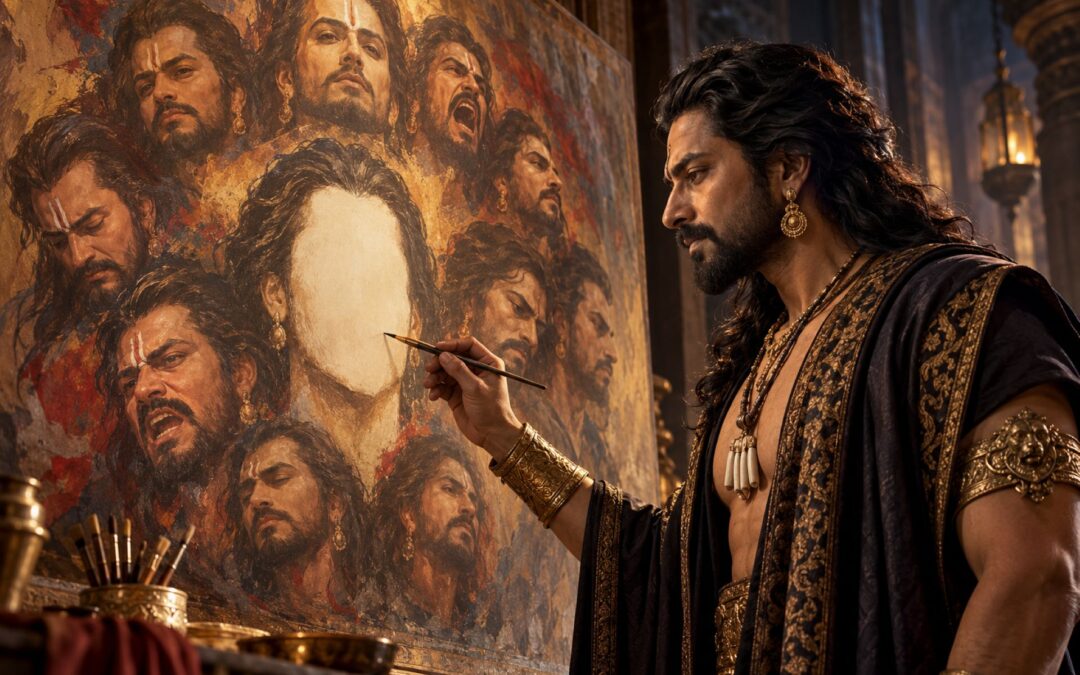
Raavan shows Kumbhakarna a painting depicting Vedavati helping a child toward the wheel of dharma. Kumbhakarna is represented in the image, suggesting Raavan recognises his brother’s moral aspirations.
Raavan’s own symbolic presence is more troubling.
Ten faces appear on a wall, recalling the traditional association of Raavan with ten heads. Nine express recognisable emotions, while the central face is blank.
Kumbhakarna understands that the painting reflects a disturbing uncertainty in Raavan’s self-conception. His artistic intelligence has not necessarily produced self-knowledge or moral peace.
The mission then proceeds.
A storm helps conceal the approach of the Pushpak Vimaan, allowing the Lankans to reach the exiles’ camp without warning.
The attackers overwhelm the Malayaputra soldiers guarding the area.
But Sita, Ram, and Lakshman are absent from the main camp when the initial assault begins.
Raavan’s men organise a search.
Khara attempts to extract information from Jatayu, a Malayaputra officer who refuses to betray Sita.
His interrogation is brutal.
Jatayu withstands the violence, even when Khara threatens him with death.
Meanwhile, Sita has been nearby collecting supplies with a Malayaputra soldier named Makrant.
The Lankan attackers kill Makrant, but Sita defeats those who assault her.
She then approaches the devastated camp and begins attacking the Lankans from concealment.
Using her bow and knowledge of the forest, she kills several soldiers while remaining difficult to locate.
Her resistance is disciplined and effective.
Raavan’s men cannot easily determine how many attackers are hiding among the trees, and Kumbhakarna fears that an uncontrolled response might endanger the woman they need alive.
Khara then uses Jatayu as bait.
He threatens to kill the wounded officer unless Sita reveals herself.
Jatayu attempts to protect her, urging her to escape rather than surrender.
Sita nevertheless refuses to abandon him.
She emerges from the forest with her bow ready.
Khara betrays the implied promise of mercy.
He kills Jatayu even after Sita has stepped forward.
Enraged, Sita shoots an arrow into Khara’s eye, killing him instantly.
The Lankan soldiers then move to capture her.
Kumbhakarna repeatedly orders them not to kill her.
Sita continues fighting.
After exhausting her arrows, she seizes a bamboo staff from an attacker and uses it to resist the surrounding soldiers.
She calls desperately for Ram, who is somewhere in the forest.
Despite her skill, the numerical imbalance becomes overwhelming.
The Lankans finally subdue her and press a substance against her nose that renders her unconscious.
She is carried into the Pushpak Vimaan.
The operation has succeeded militarily, though at considerable cost.
Raavan has captured the person he believes will provide leverage over the Malayaputras, and Ram remains alive.
Then comes the revelation withheld since the opening chapter.
Raavan sees Sita’s face.
The resemblance to Vedavati is unmistakable.
The woman lying unconscious before him has the features of the person he has loved for decades.
He realises that the baby abandoned after the murders at Todee survived.
Sita is the daughter of Vedavati and Prithvi.
For Raavan, the discovery transforms the kidnapping into an event of overwhelming personal significance.
He has unknowingly captured the surviving child of the woman whose death shaped his hatred of Aryavarta.
The final chapter then shifts to Vishwamitra.
The guru receives news that Raavan has successfully kidnapped Sita.
His reaction is strikingly different from that of someone whose chosen Vishnu has suffered an unexpected disaster.
He is satisfied.
Vishwamitra reveals that he has known about Sita’s parentage for many years.
After investigating the destruction of Todee, he reconstructed what happened to Vedavati and Prithvi.
He concluded that Raavan had loved Vedavati sincerely and had retaliated after her murder.
Subsequent investigation revealed that Vedavati’s child survived.
Vishwamitra recognised the strategic significance of that discovery.
Raavan might destroy countless enemies, but he would be unlikely to kill Vedavati’s daughter.
This knowledge strengthened Vishwamitra’s conviction that Sita was the correct person to recognise as the Vishnu.
He had identified a formidable antagonist whose one great emotional vulnerability could protect his chosen hero.
The reasoning is politically sophisticated and ethically disturbing.
Sita has been placed within a conflict in which her parentage is both a personal fact and an instrument of strategy.
The reader also learns that Vishwamitra and Vashishtha were once close friends.
Their rivalry arose from an earlier tragedy involving a woman whom both loved and whose death they blamed on one another.
The novel briefly returns to that past, showing how their friendship collapsed into enduring hostility.
The identity and full significance of the woman remain part of a larger unresolved history.
In the present, Vashishtha also receives news of Sita’s abduction.
He understands that the event has triggered a conflict extending beyond Raavan’s immediate ambitions.
For Vashishtha, Raavan is only one participant in a struggle between powerful organisations and competing visions of India’s future.
He recognises Vishwamitra as the deeper opponent.
The novel ends with Vashishtha preparing to fight.
Raavan’s origin story has reached the moment toward which its opening pointed, but the larger war remains ahead.
Aryavarta, Lanka, and the Economics of Power
The political and economic setting of Raavan: Enemy of Aryavarta is unusually important for a mythological adventure.
Raavan’s rise cannot be understood through battlefield victories alone. Much of his power originates in the structure of trade between India’s kingdoms and the wider world.
The Sapt Sindhu possesses considerable productive capacity, but its rulers impose regulations and commercial arrangements that create opportunities for intermediaries.
Raavan begins by exploiting these restrictions as a smuggler.
He recognises that the value of a product depends partly on the barriers preventing it from reaching buyers. Goods carried through unofficial channels may command extraordinary prices when ordinary merchants cannot legally or efficiently provide them.
The strategy requires speed, secrecy, and reliable contacts.
His early partnership with Akampana gives him access to the necessary infrastructure. His understanding of transport and commercial negotiation allows him to turn that access into a rapidly expanding enterprise.
The special coating used on ship hulls illustrates the novel’s practical approach to technological advantage.
A vessel that travels much faster than its competitors changes the economics of trade. It can complete more journeys, reduce certain risks, and respond to market opportunities before rivals.
Raavan immediately sees how scaling such an advantage across a fleet could transform an individual success into commercial dominance.
Once he becomes wealthy, however, his relationship with the market changes.
As a smuggler, he profits by circumventing restrictions. As a ruler, he increasingly profits by imposing arrangements that others cannot escape.
The Battle of Karachapa demonstrates this transformation.
Defeating Dashrath gives Raavan the ability to rewrite the commercial relationship between Lanka and the Sapt Sindhu.
He does not need to conquer every Indian kingdom physically. Instead, he can control prices, commissions, and access to major trading routes.
This is a form of economic domination sustained by military intimidation.
The novel’s account of Golden Lanka further complicates the relationship between prosperity and justice.
Lanka is wealthy, internationally connected, and capable of providing benefits to its residents. Raavan’s administration can finance important public goods because so much wealth flows into the kingdom.
Yet the prosperity enjoyed by some depends partly on burdens imposed upon others.
The destruction of Mumbadevi exposes the violence beneath this system.
The Devendrars believe trade should fulfil a social obligation. Their commercial practices challenge Raavan’s desire to control the region, and their refusal to submit results in catastrophe.
Raavan’s response demonstrates that he considers competitors dangerous even when they are acting from moral principles rather than military ambition.
His empire permits prosperity so long as prosperity does not threaten his supremacy.
The novel also connects economic power to social exclusion.
Raavan and Kumbhakarna suffer prejudice because they are Nagas, a fictional category describing people born with physical abnormalities.
The stigma is reinforced by religious and social beliefs that associate bodily difference with moral failure in previous lives.
Vaidyanath offers a contrasting possibility, demonstrating that a society can organise itself around more accepting practices.
The treatment of Nagas matters because Raavan’s political authority grows from the experience of having been denied dignity.
But gaining power does not make him consistently compassionate toward those excluded or exploited by society.
His ability to understand humiliation coexists with a willingness to inflict it on others.
The institutions surrounding Vishwamitra and the Malayaputras provide another layer of authority.
They possess knowledge and technologies unavailable to ordinary rulers, including specialised medicines and dangerous weapons.
Raavan’s dependence on their medical expertise limits his independence even at the height of his power.
This dependence reveals the limits of wealth.
A king can command armies and reshape trade, yet remain vulnerable to a small group controlling something necessary for his survival.
The Pushpak Vimaan, unusual maritime technologies, specialised medicines, and the Asuraastra all belong to Amish’s speculative world-building. The novel uses a fictional ancient chronology while presenting technological developments that should not be treated as verified features of historical India.
These inventions serve narrative purposes.
They make enormous geographic distances manageable, create new forms of military asymmetry, and allow religious institutions to exercise practical power through control of knowledge.
The world is therefore organised around a recurring question: who possesses the resources, technology, legitimacy, or physical force required to make others obey?
Raavan answers that question through accumulation and domination.
Other characters, particularly Vedavati and Kumbhakarna, ask what those advantages should be used to achieve.
Raavan’s Genius, Cruelty, Grief, and Responsibility
The central achievement of Amish’s characterisation is the construction of a Raavan whose abilities are undeniable even when his conduct becomes indefensible.
His intellectual brilliance is established long before he acquires political power.
As a child, he excels in scholarship and music. As a teenager, he becomes a remarkably effective businessman. As an adult, he plans complicated military operations and identifies strategic possibilities overlooked by experienced rulers.
The Battle of Karachapa is perhaps the clearest demonstration of his professional competence.
Raavan studies his opponent’s pride, numerical superiority, and supply requirements. He then designs a battlefield that neutralises those advantages and makes Dashrath’s predictable behaviour part of the trap.
The victory is not attributed to supernatural destiny or the sudden arrival of a more powerful weapon. It emerges from planning, understanding of terrain, logistical preparation, and coordination.
Yet the same episode illustrates his moral limitations.
Once the enemy has been defeated, Raavan refuses mercy.
The strategic necessity of destroying Dashrath’s attack does not require killing every soldier who can no longer resist.
Raavan’s decision reveals the pleasure he takes in overwhelming an opponent.
This distinction between competence and character appears throughout his life.
The young boy who tortures a hare already possesses an inclination toward cruelty. The rejection he later suffers helps explain the development of his resentment, but it cannot be treated as the origin of every destructive impulse.
His treatment by Vishrava is nevertheless psychologically important.
Raavan’s father does not merely fail to recognise his talents. He rejects the legitimacy and dignity of his children because of their bodily differences.
For a boy intensely concerned with superiority, such rejection is devastating.
Raavan comes to associate safety with overwhelming power.
If he becomes wealthy enough, nobody can deny him resources. If he becomes militarily formidable, nobody can threaten his family. If he becomes a king, nobody can dictate his status.
The difficulty is that his ambitions extend beyond practical security.
He increasingly demands emotional and symbolic submission.
Winning is insufficient unless his opponents acknowledge his superiority. Possessing wealth is insufficient unless those who once rejected him are humiliated.
His relationship with Vedavati exposes another dimension of this insecurity.
Raavan remembers her because she treated him as someone capable of moral improvement.
Unlike Vishrava, she does not define him entirely through his deformity or failures. Unlike his followers, she does not praise him because of his money or power.
Her approval therefore becomes unusually valuable.
He is emotionally attached to the possibility of being good in the eyes of someone whose goodness he respects.
But Raavan’s devotion has an obsessive quality.
He sustains an idealised image of the Kanyakumari for years without knowing the adult Vedavati. When he finds her, he initially struggles to accommodate the reality that she is married and has commitments unrelated to him.
His willingness to let her remain married while living in Lanka suggests that his fixation is not entirely conventional sexual jealousy.
He wants proximity, worship, and the reassurance that she still exists within his emotional world.
His feelings are sincere, but sincerity alone does not establish that a relationship is healthy or reciprocal.
Vedavati’s most important influence is her ability to make Raavan recognise his own moral agency.
She does not simply assure him that he is secretly good.
She asks him to change his conduct.
Raavan admits that he has enjoyed monstrous behaviour, making his subsequent choices more significant. He understands that his actions are wrong and briefly considers using his abilities for another purpose.
The donation to Todee is therefore an important test.
He moves beyond words and makes a practical contribution to communal welfare.
But Vedavati’s murder exposes the fragility of his reform.
Her death removes the person whose approval he valued most, and Raavan abandons the effort to restrain himself.
His massacre of Todee is a deliberate reversal of her teaching.
The villagers are largely innocent, yet he makes them suffer because he cannot tolerate the injustice inflicted upon someone he loved.
The contradiction is especially severe because Vedavati had condemned the destruction of ordinary people caught in conflicts between powerful figures.
Raavan responds to her murder by creating precisely that form of suffering.
His grief is psychologically comprehensible, but his decision remains morally his own.
The novel continues examining this distinction during his kingship.
Raavan does not become incapable of tenderness.
He loves Kumbhakarna, worries about Indrajit, remembers Vedavati, and occasionally responds to moral criticism.
Yet he permits atrocities when they serve his interests.
His reaction to the destruction of Mumbadevi is particularly revealing.
He can recognise that Prahast has acted excessively, but he refuses serious punishment because the commander remains useful.
The episode strips away the excuse of emotional breakdown.
Raavan is making an administrative decision after receiving information about civilian slaughter. He weighs moral wrongdoing against military convenience and chooses convenience.
His artistic life adds further complexity.
Raavan is a sensitive musician and painter capable of expressing grief, tenderness, and spiritual yearning through beautiful work.
But artistic refinement does not prevent him from committing terrible acts.
The later paintings of Vedavati suggest that even his imagination is being shaped by vengeance. He transforms a compassionate woman into a warrior who destroys the enemies he wishes to punish.
He is no longer preserving only her memory. He is using that memory to authorise his preferred understanding of the world.
The final revelation involving Sita creates another psychological challenge.
Raavan has spent decades believing that Vedavati’s child died.
Discovering that she survived means that a part of the life he mourned has existed independently of him.
The woman he kidnaps is therefore connected to the most important moral relationship of his life, although he has spent years becoming the sort of ruler Vedavati opposed.
Raavan’s complexity does not require that his worst behaviour be softened.
The novel presents someone who can be brave, intelligent, affectionate, cultured, and extraordinarily destructive.
His abilities increase the scale of his achievements, but they also increase the consequences of his choices.
The tragedy lies partly in the distance between what those abilities could have accomplished and what he repeatedly uses them to achieve.
Kumbhakarna and Vedavati as Raavan’s Moral Counterweights
Kumbhakarna and Vedavati are the two people who most consistently challenge Raavan’s understanding of power.
They influence him in different ways, and neither possesses complete authority over his decisions.
Vedavati’s relationship with Raavan begins in childhood.
As the Kanyakumari, she treats him with a kindness he desperately wants to deserve. Her encouragement allows him to imagine that his destructive tendencies are not permanent.
When he finds her again, her adult life demonstrates the practical form of the values she represents.
Vedavati works to improve water access and village conditions. She respects her husband, engages with ordinary villagers, and challenges the assumption that the strong are entitled to dominate the weak.
Her moral language is connected to action.
She does not merely discuss dharma as a philosophical abstraction. Her daily responsibilities show what an ethic of communal welfare can accomplish.
This is why her disagreement with Raavan matters.
She recognises his talent and does not demand that he abandon ambition or achievement. Instead, she questions the ends toward which he directs them.
A person capable of building an enormous commercial empire could also finance hospitals, strengthen communities, and improve the lives of people without power.
Her argument is especially persuasive because she does not need Raavan’s personal devotion to make it meaningful.
She is already living according to the principles she recommends.
Her relationship with Prithvi reinforces her independence.
Prithvi is not presented as an obstacle whose moral inferiority justifies Raavan’s desire to replace him. Their marriage has its own validity, and Vedavati has no obligation to abandon it because a powerful outsider loves her.
Raavan’s grief after her death is therefore complicated by the fact that she never belonged to him.
He mourns someone who profoundly influenced his life, but whose own life extended far beyond his feelings.
Kumbhakarna’s position is different.
He has depended on Raavan since infancy.
When Vishrava threatens his life, Raavan becomes his defender. Throughout their childhood and adolescence, the elder brother provides resources, protection, and emotional security.
Kumbhakarna grows up regarding Raavan as an extraordinary person whose affection has enabled his survival.
His loyalty is consequently rooted in genuine gratitude and love.
But Kumbhakarna possesses a moral temperament quite different from Raavan’s.
He is frequently disturbed by unnecessary violence, especially when its victims are vulnerable or innocent.
The rescue of Samichi illustrates both his strength and his limitation.
Kumbhakarna is the one who insists that the girl’s suffering deserves intervention. Yet Raavan determines the violent manner in which her liberation occurs.
Kumbhakarna succeeds in getting his brother to act, but not necessarily in controlling the ethics of the action.
This pattern continues throughout their lives.
At Karachapa, Kumbhakarna executes Raavan’s military plan with exceptional competence, contributing to a victory that enables subsequent exploitation.
At Mumbadevi, he demands accountability for atrocities but ultimately remains within a political system that refuses meaningful punishment.
At Mithila, he challenges his brother’s reckless decisions but continues serving him.
Kumbhakarna’s loyalty therefore creates a difficult moral problem.
He may be the most effective restraint on Raavan, but he also helps preserve the power that makes Raavan dangerous.
His conversations with M’Bakur address this tension.
Kumbhakarna gradually considers whether doing the right thing always requires separating oneself completely from wrongdoing, or whether remaining close to a powerful person can sometimes reduce harm.
The novel does not provide an uncomplicated answer.
Kumbhakarna’s continued influence does produce benefits.
His insistence on funding Vedavati’s hospital is a concrete achievement, and his intervention at Mithila prevents Raavan from prolonging an attack that has become militarily disastrous.
He also repeatedly protects his brother from avoidable danger.
But his restraint has limits.
Raavan retains ultimate authority, and Kumbhakarna’s appeals frequently fail when they threaten his brother’s pride or political interests.
The younger brother’s suffering becomes increasingly physical.
His defence of Raavan during the Asuraastra attack causes permanent injury, making the relationship’s emotional imbalance visible in his damaged body.
Kumbhakarna gives everything to protect someone whose decisions repeatedly expose him to danger.
By the final abduction operation, he has become more assertive.
He invokes one of Raavan’s promised boons to prevent him from personally entering combat, using the emotional debt between them to obtain compliance.
The moment represents a change from pleading to exercising authority.
Kumbhakarna is no longer relying entirely on his brother’s goodwill.
Yet the underlying relationship remains tragic.
Vedavati tried to persuade Raavan to become better through moral insight. Kumbhakarna tries to achieve a similar result through love, persistence, and practical intervention.
Both see possibilities in Raavan that his own conduct repeatedly betrays.
Their influence demonstrates that he is not isolated from goodness. He encounters it directly and understands enough to respond.
What remains uncertain is whether he can ever make it the governing principle of his life.
Raavan’s Family, Followers, and Those Hurt by His Rule
Raavan’s relationships with his family and followers reveal the selective nature of his compassion.
Vishrava is the central figure in his childhood resentment.
A respected scholar, he nevertheless treats his Naga children as shameful and ultimately authorises a threat against Kumbhakarna’s life.
His intellectual achievements do not prevent serious moral failure.
For Raavan, Vishrava becomes proof that social prestige and religious learning can coexist with cruelty.
But Raavan later reproduces a similar contradiction.
He accumulates knowledge and authority while exercising power in ways that betray the very virtues he claims to admire.
Kaikesi begins as a protective mother willing to defy her husband for her children’s survival.
Her relationship with Raavan deteriorates as his behaviour becomes increasingly destructive.
Eventually she distances herself from him and treats Vibhishan and Shurpanakha as members of her family.
Her rejection is different from Vishrava’s original prejudice.
Kaikesi is responding primarily to Raavan’s conduct rather than his bodily condition, although his history makes every rejection emotionally painful.
Mareech provides another form of family support.
He helps Kaikesi escape, participates in Raavan’s commercial development, and remains involved in important practical operations.
His usefulness illustrates how Raavan attracts capable people through loyalty, opportunity, and the rewards of association with power.
Akampana represents the commercial version of this relationship.
He initially sees Raavan as a young opportunist but eventually becomes deeply dependent on his success.
His behaviour grows increasingly deferential, reflecting the social distance between the enormously wealthy ruler and the men who helped him rise.
Prahast demonstrates a more dangerous form of loyalty.
He is capable, ambitious, and willing to employ extreme violence in service of Raavan’s interests.
His destruction of Mumbadevi exposes the costs of maintaining such an ally.
Raavan’s refusal to punish him meaningfully encourages a political culture in which useful cruelty receives protection.
Samichi is especially important because her loyalty originates in childhood trauma.
Raavan rescues her from abuse, but the rescue is inseparable from her participation in retaliatory violence.
She grows up regarding him as a figure of extraordinary authority.
Her later career in Mithila and participation in the operation against Sita demonstrate how a single intervention can create lifelong political and emotional allegiance.
Samichi’s devotion should not be confused with independent proof of Raavan’s goodness.
Her gratitude is understandable, but the circumstances that produced it were deeply troubling.
Mandodari occupies another difficult position.
Raavan marries her without releasing his attachment to Vedavati, leaving his wife unable to become the centre of his emotional life.
His continuing indulgence in other women further undermines the relationship.
Mandodari’s treatment reveals the consequences of Raavan’s tendency to organise other people’s lives around his unresolved desires.
Indrajit receives a more affectionate response.
Raavan takes pride in his son and seeks to protect him from unnecessary danger, including during the later plans involving Sita.
His paternal feelings are genuine, but they exist within a household shaped by domination and emotional neglect.
Vibhishan and Shurpanakha grow up under the shadow of Raavan’s hatred for their father.
Their attempts to obtain his approval influence their actions, particularly the proposal to kidnap Sita through deception.
The failed mission reveals how the desire to gain status within a powerful family can produce reckless decisions.
Kubaer represents an important political contrast.
He understands trade and accumulated wealth before Raavan arrives, but lacks the military confidence and ruthlessness required to resist his younger rival.
His displacement demonstrates that commercial authority becomes fragile when someone else controls the armed forces.
Prithvi’s role is quieter but morally substantial.
He treats Vedavati as a partner, participates in a constructive village life, and has no meaningful reason to deserve Raavan’s hostility.
His death prevents the Todee tragedy from being understood solely as the loss of the woman Raavan loves.
The murdered couple are independent victims whose lives are destroyed by other people’s greed.
Ram and Sita enter Raavan’s story principally as political opponents.
Their importance grows because they repeatedly challenge the assumptions underlying his power.
Ram’s victory at Mithila and subsequent willingness to use the Asuraastra demonstrate that Raavan cannot always intimidate enemies into surrender.
Sita’s defence against the Lankan soldiers shows courage and tactical intelligence comparable to qualities Raavan admires in himself.
The final revelation makes her importance personal as well.
She becomes the surviving connection between Raavan’s greatest emotional loss and the larger political struggle.
The civilians killed at Todee and Mumbadevi remain essential to the novel’s moral assessment.
They do not possess the narrative prominence of kings, gurus, and royal relatives, but their deaths establish the human consequences of decisions made by those figures.
Raavan’s greatness cannot be judged solely through the devotion he inspires among people he loves or rewards.
It must also be judged through the lives he treats as expendable.
Two Vishnus, Rival Gurus, and the Politics of Dharma
The political conflict underlying the Ram Chandra Series is organised around the idea that society periodically requires a transformative leader.
Within Amish’s fictional system, such a leader may be recognised as the Vishnu.
The designation is more than a religious title. It carries enormous political and moral authority, particularly among organisations that preserve the traditions of earlier great figures.
The Malayaputras are associated with the previous Vishnu, Lord Parshu Ram.
Their leader, Vishwamitra, possesses extensive knowledge, influence, and resources.
The Vayuputras, connected with the tradition of the previous Mahadev, occupy a related but distinct position.
Vashishtha’s relationship with the Vayuputras becomes central to the competing recognition of Ram.
Vishwamitra supports Sita as the Vishnu.
Vashishtha and the Vayuputras support Ram.
The existence of rival candidates creates a struggle over political legitimacy, moral authority, and the future direction of India.
Raavan becomes entangled in that struggle because his power and cruelty make him an increasingly useful antagonist.
A leader chosen to restore dharma requires a world in need of correction.
Raavan’s rise supplies an unusually conspicuous example of concentrated power being exercised without adequate moral restraint.
But the novel raises a troubling possibility.
What happens when institutions that claim to defend dharma deliberately allow evil to develop because they believe it will strengthen their preferred solution?
Vishwamitra’s dealings with Raavan demonstrate how this problem emerges.
He recognises Raavan’s talent early and provides access to resources that help expand his power.
His motives are not wholly altruistic.
Vishwamitra needs funds and influence for his own plans, and he regards Raavan as someone whose behaviour can be incorporated into a larger strategy.
By the ending, his calculations are even more explicit.
He knows Sita is Vedavati’s daughter and believes Raavan will be unable to kill her.
That personal connection becomes one reason he considers her the ideal Vishnu.
Vishwamitra’s reasoning is effective from a strategic perspective.
He has identified a weakness in the antagonist that may protect the chosen leader during an eventual confrontation.
But the strategy treats the lives and emotions of several people as instruments.
Sita’s birth becomes useful because it connects her to Raavan’s most enduring attachment. Vedavati’s death becomes part of the political information through which later events can be manipulated.
Even the death of Malayaputra soldiers is absorbed into a broader calculation about achieving a desired outcome.
The novel therefore complicates the contrast between good and evil.
Raavan clearly commits atrocities, but the organisations opposing him are not presented as free from moral compromise.
Their willingness to manipulate people raises questions about whether the pursuit of a righteous end permits harmful means.
The Asuraastra episode presents the same problem from a different angle.
Ram uses a prohibited weapon to save Mithila from invasion.
The immediate circumstances provide a compelling justification: without extraordinary intervention, Raavan’s army may destroy the city.
Yet the weapon’s prohibition exists for a reason.
Its destructive effects extend beyond ordinary combat, making its use a violation of an important moral boundary.
Ram’s decision therefore carries consequences even when the immediate objective is defensible.
This distinction matters because the novel does not treat dharma as a guarantee that every action taken in its name must be correct.
Vedavati’s conversations with Raavan provide a more intimate approach.
She asks him to consider the consequences of his decisions for other people and to recognise that strength creates responsibilities.
Her discussion of the lion and deer refuses the assumption that a powerful creature’s needs automatically outweigh those of a vulnerable one.
M’Bakur’s teachings add another complication.
His conversations with Kumbhakarna acknowledge that people often face situations without morally perfect options.
Withdrawing from a corrupt ruler may preserve one’s personal integrity but allow greater suffering if the ruler loses an important restraint.
Remaining may reduce harm while also enabling the ruler’s continued authority.
Neither option is automatically beyond criticism.
The difference between the characters lies partly in how they respond to such uncertainty.
Raavan often converts complexity into permission to do what benefits him.
Vedavati uses complexity to encourage greater responsibility.
Kumbhakarna tries to reduce suffering within an imperfect situation.
Vishwamitra and Vashishtha operate on a much larger scale, risking people’s lives in pursuit of competing futures.
Their rivalry gains a personal history in the final chapter.
The revelation that they were once close friends, and that a woman’s death destroyed their relationship, suggests that even institutions claiming to act for civilisation may be directed by individuals carrying old grievances.
The parallel with Raavan is significant.
Personal loss and public power become closely intertwined.
The novel does not establish that every political decision made by the rival gurus is merely revenge. Their plans may also reflect sincere convictions about the future of society.
But it refuses to separate those convictions completely from personal ambition, attachment, and resentment.
The central ethical challenge is therefore broader than identifying the correct Vishnu.
It concerns the legitimacy of people who claim the authority to shape an entire civilisation while treating particular lives as pieces in a strategic contest.
Music, Bones, Fire, and the Symbols of Loss
Raavan’s emotional development is closely connected to objects and images that recur throughout the novel.
Music is among the most important.
His ability to play the Rudra Veena establishes his artistic talent during childhood, before his later commercial and military accomplishments.
The instrument is associated with the religious tradition he reveres, allowing his performance to express devotion as well as technical mastery.
Yet his early musical competition also exposes his insecurity.
Raavan damages Dagar’s instrument because he wants victory badly enough to abandon fairness.
The scene demonstrates that artistic achievement does not necessarily guarantee moral discipline.
The later Raavanhatha performances offer a different possibility.
Raavan uses music to express longing, grief, and the desire for emotional connection.
During his time with Vedavati, performance becomes a means of communicating feelings that his normal arrogance prevents him from articulating.
His art briefly allows him to create beauty from pain rather than directing pain outward as violence.
After Vedavati’s death, this relationship changes.
Raavan continues composing and painting, but his creative work increasingly reflects rage.
The emotional intensity remains, yet its direction becomes more destructive.
The paintings of Vedavati illustrate this development particularly clearly.
At first, they preserve an idealised memory of the Kanyakumari.
Raavan represents her through the qualities that drew him toward her: gentleness, spiritual authority, and the possibility of redemption.
Later, he paints her as a warrior capable of destroying the enemies he despises.
The transformation is revealing because it occurs within his imagination.
Vedavati did not encourage him to seek revenge against an entire society. She repeatedly emphasised compassion and responsibility.
Raavan’s later images gradually replace her actual beliefs with a figure more compatible with his own anger.
The finger-bone pendant serves a related purpose.
To outsiders, the object appears to be a gruesome trophy, consistent with the reputation of a ruler who enjoys violence.
Its actual origin is deeply personal.
The bones belonged to Vedavati, and Raavan preserves them because they remain a physical connection to someone he cannot recover.
The object therefore carries two opposing meanings.
For Raavan, it signifies love and grief.
For observers who do not know its history, it reinforces his monstrous public identity.
Both interpretations are connected to reality.
He did love Vedavati deeply, and he has also become a man capable of extraordinary cruelty.
The pendant does not resolve that contradiction. It keeps the contradiction physically present.
The funeral rites following Vedavati’s death provide another important symbolic sequence.
Raavan participates in rituals associated with accepting responsibility toward the dead.
Such responsibility could have led him to preserve her work, care for the vulnerable, and fulfil the charitable commitments she valued.
Kumbhakarna later invokes precisely this obligation when demanding support for the hospital.
But Raavan’s response at the river takes a different direction.
His symbolic repudiation of Aryavarta transforms a funeral into a declaration of political hostility.
The land itself becomes the object of his anger.
The ritual reveals how completely Raavan has generalised his suffering.
Instead of condemning particular murderers or institutions, he directs hatred toward an entire civilisation.
The imagery of fire also changes across the novel.
Fire appears within ordinary religious practice and domestic life, but the story increasingly associates it with devastation, funerary rites, torture, and war.
The destruction of Todee marks an especially important shift.
The community Vedavati sought to improve becomes a scene of death, and the rituals that follow cannot restore what has been destroyed.
Raavan’s association with ten heads receives an imaginative treatment near the ending.
His painting presents ten faces, nine displaying the major emotions described in traditional aesthetic theory.
The tenth is expressionless.
The image suggests a man who possesses an extraordinary range of emotional and intellectual capacities but remains uncertain about their integration into a stable moral identity.
Kumbhakarna’s presence in the same painting, moving toward the wheel of dharma, creates a contrast between the brothers’ trajectories.
The symbolism is particularly effective because it emerges from Raavan’s own artistic activity.
He understands enough about emotion, religious tradition, and human nature to produce a complex image of himself.
But such understanding has not necessarily made him capable of living wisely.
The Multilinear Structure, Prose, and Mythological Reinvention
The structure of Raavan: Enemy of Aryavarta is inseparable from its place in the Ram Chandra Series.
The first three novels follow Ram, Sita, and Raavan through overlapping periods rather than presenting a single continuous chronology.
As Amish explains in his discussion of the series’ parallel narrative design, each protagonist’s story progresses toward the kidnapping of Sita, after which the larger narrative converges.
This approach changes how readers encounter familiar events.
A moment that previously appeared primarily as a crisis in Ram and Sita’s lives becomes, in this volume, the endpoint of decades of ambition, grief, and political calculation.
The opening chapter establishes that endpoint immediately.
By beginning with the abduction and then returning to Raavan’s childhood, Amish creates a different form of suspense.
Readers do not need to wonder whether Raavan will become Sita’s captor.
They already know he will.
The questions concern how he reaches that position and why seeing Sita’s face produces such a powerful reaction.
The novel’s chronology is otherwise largely straightforward.
After the opening, it follows Raavan’s development through childhood, commercial ambition, the relationship with Vedavati, military expansion, kingship, and eventual confrontation with Mithila.
This progression allows the reader to watch changes that would be less comprehensible if presented only through the perspective of his enemies.
The extended treatment of commerce is particularly distinctive.
Raavan’s rise is developed through shipping, negotiations, technological advantages, financial arrangements, and the manipulation of markets.
These passages give his political authority a material foundation.
He is not powerful simply because the familiar epic requires a powerful antagonist.
The reader sees how he acquires resources and converts them into military capacity.
The same attention to practical detail shapes the battle sequences.
The Battle of Karachapa is explained through logistics, terrain, formation, and coordinated naval action.
The assault on Mithila involves siege equipment, defensive architecture, and the disastrous consequences of poor tactical judgment.
Such scenes give the novel the character of a military adventure as well as a mythological retelling.
The costs become apparent when explanation overwhelms narrative momentum.
Amish frequently pauses to describe institutions, technology, customs, or strategic reasoning in considerable detail.
Some of this exposition is essential. Without understanding the commercial system, Raavan’s economic rise would seem implausible.
But the volume sometimes explains more than the immediate scene requires.
Its philosophical conversations follow a similar pattern.
Vedavati’s discussions of dharma provide necessary insight into her values and Raavan’s moral contradictions.
M’Bakur’s teachings deepen Kumbhakarna’s conflict between loyalty and responsibility.
Yet several exchanges are constructed as explicit moral debates, with characters articulating ideas in a manner that can feel more instructional than conversational.
The prose is generally direct and accessible.
Amish favours clear action, emotional immediacy, and contemporary-sounding dialogue over an attempt to reproduce an archaic literary style.
This choice helps readers move through an elaborate invented world without excessive difficulty.
It can also create tonal inconsistencies.
The colloquial language and occasional modern attitudes may sit awkwardly beside elaborate religious rituals, ancient political institutions, and ceremonial speech.
The novel’s genre explains part of this choice.
It is a speculative reimagining of mythological material, not an attempt to reproduce a historically verified ancient society.
Its characters speak and behave in ways designed to communicate with modern readers, even when the setting invokes an ancient chronology.
The treatment of Raavan exemplifies this approach.
Traditional associations with scholarship, music, power, devotion, and terrifying violence are retained, but they are reorganised within a fictional biography shaped by economic ambition and psychological conflict.
The result is recognisable as a Ramayana-inspired story while remaining substantially different in its narrative details.
The multilinear design is therefore both a strength and a limitation.
It allows a familiar antagonist to become the centre of his own complex narrative.
But it also requires readers to accept that major conflicts will remain unresolved until subsequent volumes.
The novel’s ending supplies a powerful revelation about Sita and Vedavati, yet it does not offer the final resolution normally expected from a completely independent epic.
What Sita’s Identity Reveals About the Ending
The revelation that Sita is Vedavati and Prithvi’s daughter transforms the meaning of Raavan’s journey.
For decades, he has believed that the child born during the massacre at Todee died after being abandoned in the wilderness.
His grief therefore includes the apparent extinction of Vedavati’s family.
When he sees Sita’s face, that assumption collapses.
The child survived, grew into an accomplished warrior and political leader, and eventually became the person selected by Vishwamitra as the Vishnu.
Raavan has unknowingly brought the surviving child of the woman he loved into his own power.
The revelation changes the meaning of the opening chapter.
At first, the abduction appears to be an operation by a ruthless ruler seeking political leverage.
That remains true.
But the operation also brings Raavan face to face with a history he believed had ended in complete destruction.
His emotional vulnerability suddenly becomes relevant to his strategic intentions.
He has captured someone whose parentage may make her life unusually precious to him.
Vishwamitra’s role deepens the significance of this discovery.
The guru knew about Sita’s identity before Raavan did.
He recognised that the connection between Raavan and Vedavati could be used to protect Sita from the antagonist’s worst impulses.
This calculation reveals the degree to which the larger political conflict has been shaped by information withheld from the people most directly affected.
Raavan believes he is acting to obtain medical and political leverage.
Vishwamitra has incorporated that action into another strategy.
Sita is both an independent warrior and a person whose ancestry creates an advantage that others have decided to exploit.
The ending also reveals the personal history behind the rivalry between Vishwamitra and Vashishtha.
Their former friendship ended amid accusations surrounding a woman’s death.
The novel deliberately withholds enough detail to keep the full consequences uncertain, but it establishes that the conflict between the gurus is not simply a disagreement over political methods.
Personal grief and competition are deeply involved.
This creates a structural parallel with Raavan.
All three men possess exceptional abilities and pursue objectives that they believe to be important.
All three also carry emotional histories capable of influencing decisions affecting large numbers of people.
The novel does not resolve the coming conflict.
Raavan remains alive and politically powerful. Sita has been kidnapped, Ram is preparing to respond, and Vashishtha understands that the confrontation with Vishwamitra has entered a new phase.
The central mystery concerning Raavan’s reaction to Sita is answered, but the broader struggle has only begun.
The ending is therefore best understood as a convergence rather than a conclusion to the entire epic.
The novel completes its account of how Raavan became Sita’s captor and why her capture is more complicated than it first appears.
The ultimate consequences belong to the subsequent narrative.
Where the Novel Succeeds and Where It Falters
The strongest feature of Raavan: Enemy of Aryavarta is its refusal to make extraordinary talent synonymous with moral greatness.
Raavan’s accomplishments are convincing within the novel’s speculative world because they are developed through identifiable abilities.
His commercial success emerges from understanding regulations, logistics, transport, and negotiation. His military victories depend on preparation, innovation, and tactical judgment. His artistic achievements demonstrate discipline and sensitivity that cannot be dismissed as superficial.
These qualities make him formidable.
They also create a more interesting antagonist than a figure whose only significant attribute is cruelty.
Amish allows readers to recognise Raavan’s competence without requiring them to excuse his actions.
The Battle of Karachapa illustrates this particularly well.
The strategy is impressive, but the refusal to stop killing after victory reveals the moral direction of the man using it.
The combination makes Raavan dangerous in a way that neither a purely brilliant hero nor an uncomplicated villain would be.
The relationship with Kumbhakarna is another major success.
Kumbhakarna is emotionally credible because his loyalty has a clear history.
Raavan protected him when he was helpless, creating a debt of gratitude and affection that cannot easily be dissolved by later wrongdoing.
The younger brother’s struggle therefore develops naturally.
He sees the suffering caused by Raavan’s rule, but he also remembers the person who ensured his survival.
His attempts to influence Raavan become increasingly difficult and increasingly costly.
The hospital episode is especially effective because it converts their emotional conflict into a practical decision.
Kumbhakarna wants Raavan to fulfil a promise made in Vedavati’s name.
He must confront his brother directly and insist on an action that Raavan has repeatedly postponed.
The scene reveals character through conduct rather than abstract commentary alone.
Kumbhakarna’s injuries at Mithila give the relationship additional force.
His loyalty is no longer measured only through words. He has sacrificed his health to preserve his brother’s life.
Raavan’s distress afterward demonstrates real affection, while also exposing how frequently the people closest to him bear the consequences of his recklessness.
Vedavati is central to the novel’s emotional architecture.
Her influence gives Raavan a reason to question his behaviour and provides a standard against which his later decisions can be judged.
Her commitment to village welfare distinguishes her from characters who pursue influence through wealth or royal status.
The strongest scenes involving her are those in which her principles are visible in practical work.
Her conversations with Raavan become more persuasive because she has already demonstrated the kind of responsibility she advocates.
However, the romantic construction is less consistently convincing.
Raavan spends years obsessing over a girl he knew only briefly, and his adult attachment develops with extraordinary intensity despite Vedavati’s independent marriage and life.
The novel establishes his emotional fixation, but does not always make the psychological process behind it equally persuasive.
His idealisation can also reduce Vedavati’s role.
Although she is given meaningful convictions and choices, much of her narrative significance is determined by what she represents to Raavan.
Her death then becomes the event through which his descent into greater violence is accelerated.
The character remains morally important, but the novel sometimes relies more heavily on her symbolic function than on the complexity of her own continuing experience.
This limitation is particularly relevant because the story involves a man claiming to love a woman while repeatedly betraying her values.
The contradiction is intellectually compelling, but it also places a considerable emotional burden on a character whose life is largely filtered through his longing.
The novel’s violence is similarly uneven in its effectiveness.
Some brutal scenes establish necessary facts about Raavan’s character.
His childhood treatment of animals, the rescue of Samichi, the destruction of Todee, and his response to Mumbadevi’s massacre all reveal different aspects of his relationship with suffering.
The violence has analytical value because it distinguishes cruelty for pleasure, revenge, political convenience, and the punishment of enemies.
Yet the graphic detail can sometimes exceed what is required to convey the moral stakes.
Prolonged torture and descriptions of destroyed bodies risk overwhelming the psychological argument with spectacle.
The result is not necessarily a deeper understanding of Raavan.
Readers already know that he is capable of atrocity, and repetition can reduce the force of later incidents.
The treatment of women also deserves scrutiny.
Vedavati possesses independence and moral authority, while Sita is presented as a capable warrior whose physical resistance is among the novel’s most impressive action sequences.
At the same time, Raavan’s frequent objectification of women and his unhappy treatment of Mandodari are depicted within a narrative strongly centred on his emotional experience.
The book does not require readers to endorse his attitudes, but it does not always examine their consequences for the women affected with equal depth.
The political and economic world-building is ambitious.
The account of maritime commerce, the relationship between Lanka and Aryavarta, and Raavan’s use of military force to restructure trade give the novel a distinctive identity.
Lanka becomes an economic system rather than merely the antagonist’s distant stronghold.
Its prosperity is especially useful to the larger argument because it prevents a simplistic association between effective administration and virtuous leadership.
Raavan can provide benefits to his subjects while presiding over grave injustice elsewhere.
The novel is less successful when its institutional explanations become excessively elaborate.
Commercial arrangements, medical technologies, political histories, and military mechanisms sometimes receive prolonged explanation in moments when the dramatic situation already has sufficient momentum.
Such passages may satisfy readers who enjoy detailed speculative systems, but they can slow the story for readers more interested in character and conflict.
The Battle of Karachapa illustrates the successful side of this approach.
The tactical explanation makes the outcome convincing.
Other sections are less selective, continuing to explain a mechanism after its narrative significance is clear.
The philosophical material also varies in effectiveness.
Vedavati’s challenge to Raavan is rooted in an emotionally specific relationship, making the discussion of duty and selfishness meaningful.
M’Bakur’s teachings provide an interesting framework for Kumbhakarna’s moral predicament.
But the dialogue occasionally functions as a vehicle for explicit lessons, with characters articulating opposing positions more neatly than people usually do during spontaneous conversation.
The modern diction contributes to this effect.
Amish’s language is accessible and often energetic, particularly during action scenes and informal exchanges between the brothers.
Their banter gives the relationship warmth and prevents the narrative from becoming relentlessly solemn.
Yet colloquial expressions and contemporary-sounding social commentary can weaken the atmosphere of the fictional ancient setting.
The style prioritises communication and pace over historical or literary immersion.
This is not inherently a failure in mythological fantasy, but it remains a matter of reader preference.
The multilinear structure is more successfully integrated.
The opening abduction creates a mystery whose solution genuinely changes the reader’s understanding of Raavan’s history.
The revelation about Sita’s parentage is prepared through the supposedly lost child, Raavan’s attachment to Vedavati, and the strategic interests of Vishwamitra.
It does not arrive without narrative groundwork.
However, the concluding shift toward Vishwamitra and Vashishtha is more dependent on the larger series.
The novel’s personal mystery is resolved, while substantial political questions are left open.
Readers expecting a fully self-contained tragedy may find the ending incomplete.
Those approaching the book as the third perspective in an ongoing narrative are more likely to appreciate the convergence.
As a mythological reinvention, the novel succeeds in giving its antagonist a distinctive social and political history.
Raavan’s brilliance, devotion, cruelty, and pride are reorganised into a biography that connects individual choices to institutional power.
The result is substantial entertainment, particularly for readers interested in morally contradictory protagonists and elaborate speculative settings.
Its main limitations concern excess: too much explanation in some passages, too much graphic violence in others, and an emotional fixation that occasionally demands more belief than its development has earned.
These weaknesses do not invalidate the novel’s central project.
They do, however, prevent its strongest character relationships and political ideas from achieving their full potential.
Who Should Read Raavan: Enemy of Aryavarta?
Raavan: Enemy of Aryavarta is particularly suitable for readers who enjoy Indian mythological fiction presented through unconventional perspectives.
Those interested in morally complicated protagonists will find considerable material in Raavan’s combination of brilliance, devotion, resentment, and cruelty.
The novel also offers substantial rewards for readers who appreciate political strategy, commercial intrigue, military planning, and detailed world-building.
Its treatment of Raavan’s rise through shipping, negotiation, and economic coercion distinguishes it from simpler versions of a villain’s origin story.
Readers who value character relationships may find Kumbhakarna especially compelling.
His love for Raavan develops into a sustained conflict between personal loyalty and moral responsibility, giving the novel an emotional centre beyond the protagonist’s romantic attachment.
The book is less likely to appeal to readers seeking restrained prose, understated characterisation, or a realistic historical novel.
Its world combines speculative technology, religious institutions, modern language, and invented political arrangements. The violence is frequently graphic, and the narrative sometimes pauses for lengthy philosophical or technical explanations.
It also works best within the context of the Ram Chandra Series.
Although Raavan’s childhood and rise can be understood independently, the political importance of Ram and Sita, the rival Vishnu projects, and the significance of the ending become clearer when the preceding novels are familiar.
Readers looking for the complete story of the eventual Lanka war will need the subsequent volume, War of Lanka.
For its intended audience, however, the novel remains a worthwhile and often gripping contribution to contemporary Indian mythological fantasy.
Its greatest achievement is making Raavan comprehensible without making him morally innocent.
Amish gives him enough intelligence, vulnerability, affection, and artistic sensitivity to resist easy dismissal, while preserving the consequences of his brutality.
The final revelation involving Sita also gives his long history a personal significance that changes the meaning of the familiar abduction.
Raavan’s tragedy is therefore more disturbing than the simple destruction of a gifted man by circumstances beyond his control.
He repeatedly encounters people who show him alternatives to violence and domination. He understands enough about those alternatives to recognise their value, but repeatedly allows resentment, ambition, and pride to govern his conduct.
The novel’s most enduring question concerns the distance between extraordinary ability and the wisdom required to use it well.
Raavan possesses almost everything that worldly success can provide, yet his greatest gifts become instruments of destruction when separated from moral restraint. Amish’s achievement lies in showing how that contradiction develops across an entire life, until the man who might have transformed his society becomes one of its greatest threats.
Last Updated on October 17, 2026 by Aseem Gupta