
Reading Time: 24 Minutes
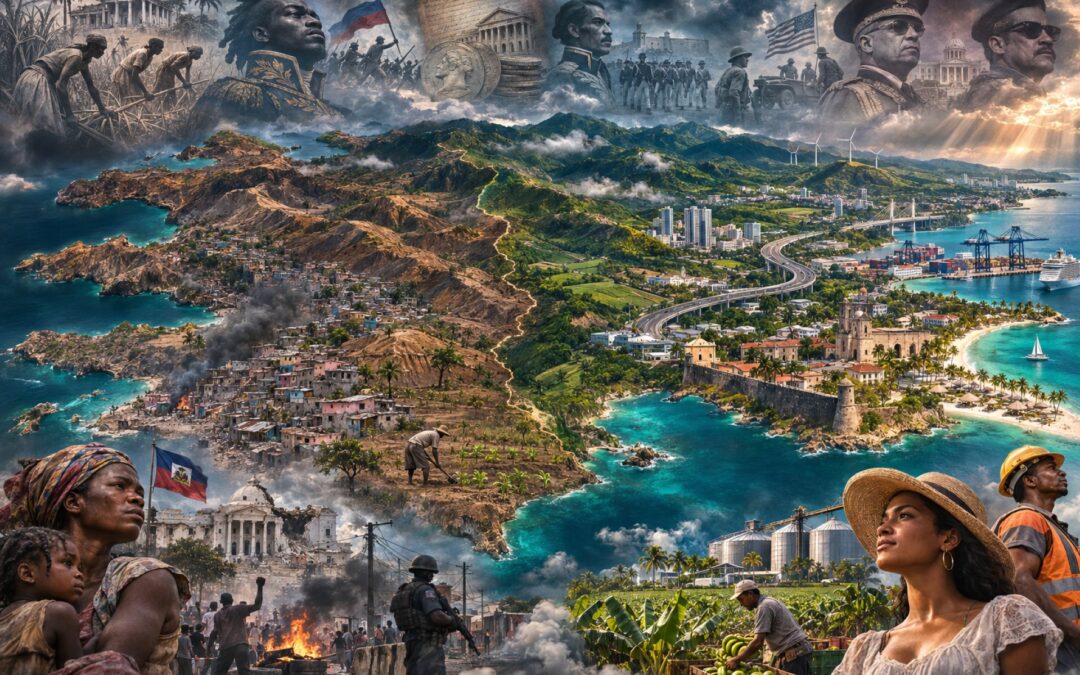
Look at a satellite image of Hispaniola, the Caribbean island shared by Haiti and the Dominican Republic, and you may notice something unusual. Parts of the international border appear as a sharp line between relatively bare hillsides on the Haitian side and greener landscapes in the Dominican Republic. It almost looks as though someone drew a political boundary across the natural environment.
The contrast extends far beyond the landscape. The Dominican Republic has become a major tourism destination with a growing manufacturing and services economy. Haiti, meanwhile, has endured repeated political crises, devastating disasters and an economic decline made worse by armed gangs controlling large parts of its capital.
The two countries have populations of roughly 12 million and 11.5 million respectively, share an island, and were both shaped by European colonialism, slavery, American military occupation and authoritarian rule. Yet their economic trajectories have diverged dramatically, particularly since the second half of the twentieth century.
It would be easy to attribute the difference to geography, colonial history or the quality of government. Each explanation contains something important, but none is sufficient on its own. The real story involves the interaction of historical disadvantages, political decisions, economic institutions, environmental management and opportunities that accumulated over generations.
To understand why two neighboring countries developed so differently, we need to examine not only what happened to Haiti, but also what happened across the border—and when their paths began to separate.
One Island, Two Colonial Economies
Long before Haiti and the Dominican Republic existed, Hispaniola was home to Indigenous communities, primarily the Taíno, whose societies had developed their own political systems, agricultural practices and trading networks. Christopher Columbus arrived in 1492 and claimed the island for Spain, beginning a colonial transformation that proved catastrophic for its original inhabitants.
European diseases, warfare, forced labor and displacement devastated the Indigenous population. Spanish colonists initially sought gold and compelled Taíno people to work in mines and settlements. As the Indigenous labor force collapsed, enslaved Africans were brought to the island, helping establish the foundations of a plantation economy.
Santo Domingo, founded in the late fifteenth century, became one of the earliest centers of Spanish colonial administration in the Americas. Its churches, fortifications and urban institutions reflected the city’s early importance. However, Spain’s growing interest in the mineral wealth of Mexico and Peru eventually reduced Hispaniola’s relative significance within its empire.
By the seventeenth century, much of the island’s western territory had become a refuge for European buccaneers, hunters and settlers. French influence expanded there, and the 1697 Treaty of Ryswick formally recognized French possession of the western part of Hispaniola. The island now contained two colonial societies governed by different European powers.
France called its western colony Saint-Domingue. During the eighteenth century, French investors transformed it into an extraordinarily profitable producer of sugar, coffee and indigo. Plantation owners imported vast numbers of enslaved Africans, whose labor generated enormous wealth for merchants, shipowners and consumers across the Atlantic.
By the late eighteenth century, Saint-Domingue had become France’s most valuable colony and one of the world’s most productive plantation economies. Enslaved people vastly outnumbered free inhabitants. The system depended on relentless labor, severe punishment and the continuous arrival of captives from Africa to replace those who died under brutal conditions.
The wealth was real, but it was profoundly unequal. Saint-Domingue’s reputation as the Pearl of the Antilles described its value to colonial investors, not the living standards of its enslaved majority. Its prosperity rested on institutions designed primarily to extract labor and export commodities rather than educate, protect or politically represent the people producing them.
Across the border, Spanish Santo Domingo followed a different economic trajectory. Its population was smaller, plantation agriculture less dominant, and ranching, subsistence farming and local commerce more important. Enslavement existed in Spanish territory too, but the scale and structure of the economy differed substantially from the highly concentrated plantation system in the west.
This difference is sometimes presented as evidence that Spain created a more humane or sustainable colonial society. That interpretation goes too far. Spanish colonization also involved Indigenous destruction, forced labor, slavery and economic exploitation. The important distinction was not that one colonial power behaved benevolently, but that the two territories developed different populations, property arrangements and economic relationships.
There was another consequence. The French colony produced enormous export revenue through a system so unequal and violent that its overthrow would require a devastating war. The less export-intensive Spanish colony did not experience an equivalent revolution during the same period. Its later economic development was therefore shaped by a different sequence of conflict, land use and political change.
In 1791, enslaved people in Saint-Domingue began the uprising that became the Haitian Revolution. After years of fighting involving France, Spain and Britain, revolutionary forces defeated the expedition sent by Napoleon Bonaparte. On 1 January 1804, Haiti declared independence, becoming the first enduring independent state created through a successful mass revolt of enslaved people.
The victory abolished the colonial system that had made Saint-Domingue so profitable. But the war had destroyed plantations, infrastructure and trading relationships, and the new republic faced hostility from governments that feared its example. Haiti had achieved a revolutionary political breakthrough without inheriting the financial freedom or international support that might have helped it rebuild.
The colonial histories of the island’s two halves had created different starting conditions. Yet those differences alone do not explain the present-day economic gap. For much of the nineteenth century, neither side was a particularly successful independent economy. The next stage of their history actually brought them together under one government.
Why Haiti Ruled Santo Domingo—and Why the East Broke Away
The modern border between Haiti and the Dominican Republic was not inevitable. Over the centuries, Hispaniola was governed as a single territory, divided between colonial powers, reunited under French authority in principle, and eventually brought together under an independent Haitian government.
The final decades of European rule were particularly complicated. Spain ceded Santo Domingo to France in 1795, but the transfer did not produce a stable unified French colony. Toussaint Louverture extended his authority into the east in 1801, while Napoleon’s subsequent military intervention disrupted the political settlement. Following Haiti’s independence in the west, French forces retained a position in Santo Domingo until 1809, when Spanish authority was restored.
In December 1821, José Núñez de Cáceres proclaimed the eastern territory independent from Spain, establishing a short-lived state commonly known as Spanish Haiti. It was not the Dominican Republic we know today, and it lacked the political strength to maintain its independence for long.
Haitian President Jean-Pierre Boyer moved his army into the eastern territory in February 1822. He brought the whole island under his authority, beginning a period of unified rule that lasted until 1844.
Boyer’s decision had several motivations. Haitian leaders continued to fear that France or another European power might use Santo Domingo as a base to invade the western republic and restore slavery. Controlling the entire island appeared to offer greater strategic security. It also promised more territory and resources for a government under considerable fiscal pressure.
For some eastern inhabitants, unification initially brought an important reform: the abolition of slavery. Boyer’s government extended Haitian laws and sought to reorganize landholding and public administration. These policies did not affect everyone equally, and initial support for union varied among social groups.
Over time, resentment grew. The Haitian government imposed new taxes, military obligations and land policies that disrupted established interests. Church property was confiscated, and the influence of Catholic institutions was reduced. Restrictions on commerce and agricultural arrangements created further opposition.
The issue was not simply that French-speaking Haitians governed Spanish-speaking Dominicans. The eastern population included people with varied African, European and mixed ancestry, and cultural identities were still developing. Nevertheless, language, religion, local customs and political traditions helped make Haitian administration appear increasingly foreign to many eastern residents.
The financial burden of Haiti’s relationship with France compounded these tensions. In 1825, France demanded a huge indemnity in exchange for recognizing Haitian independence. Boyer agreed, and the government faced intense pressure to raise money. Eastern inhabitants were also subjected to the fiscal demands of a state servicing obligations created by the former French colony.
By the late 1830s, organized opposition had emerged. In 1838, Juan Pablo Duarte and his associates established La Trinitaria, a clandestine movement seeking an independent Dominican state. Its members helped mobilize opposition to Haitian rule while political instability weakened Boyer’s government.
Boyer was overthrown in 1843. On 27 February 1844, Dominican nationalists proclaimed independence in Santo Domingo. The event marked the founding of the Dominican Republic as a separate sovereign state, though its independence still had to be defended militarily.
The Dominican declaration of independence in 1844 was followed by armed conflicts as Haitian governments attempted to reassert control. The struggle contributed to national identities that increasingly defined the two societies in opposition to one another.
Yet Dominican independence did not immediately produce political stability. Military strongmen competed for power, and Pedro Santana eventually arranged the country’s annexation by Spain in 1861. Dominican resistance led to the Restoration War, which ended with the withdrawal of Spanish forces in 1865.
That sequence is important because it undermines the idea that the Dominican Republic achieved independence on friendly terms with its former colonial ruler. Dominican sovereignty emerged through repeated conflict—against Haitian control, internal authoritarianism and renewed Spanish rule.
The two countries would remain politically separate, but their histories were inseparable. Border disputes, competing national narratives and the movement of workers and traders continued to shape their relationship.
The separation also established different fiscal and diplomatic circumstances. Haiti remained burdened by the indemnity it had accepted to secure French recognition. The Dominican Republic did not inherit an equivalent French demand, although it soon developed substantial foreign debts of its own.
Neither side escaped instability, foreign pressure or elite domination. The important difference was that the two governments entered the second half of the nineteenth century with distinct economic structures and international obligations. Those differences would matter even more when foreign powers began taking direct control of Caribbean finances.
Debt, Occupation and the Diverging State
One of the strongest explanations for Haiti’s underdevelopment begins with an extraordinary injustice: France demanded compensation from the people who had liberated themselves from French slavery.
In 1825, French warships arrived with an ultimatum requiring Haiti to pay 150 million gold francs to compensate former French colonists. The demand was backed by the threat of military force. President Boyer accepted in exchange for French recognition of independence and preferential trading arrangements.
Haiti could not afford the payment. Its government borrowed from French banks, creating what historians call the double debt: the original indemnity and the loans required to finance it. France reduced the indemnity to 90 million francs in 1838, but interest, refinancing and other charges prolonged the burden.
The effects extended far beyond the money transferred abroad. Servicing the debt consumed revenue that might otherwise have financed roads, education, irrigation, sanitation and other investments. Governments relied heavily on taxes and customs duties, frequently placing the burden on rural producers whose living standards remained low.
The economic consequences are difficult to measure precisely. Estimates of the total historical loss vary according to whether researchers count payments, financial charges or the growth that might have occurred had the money remained in Haiti. Nevertheless, there is little doubt that the indemnity represented an enormous transfer of resources from an impoverished new republic to its former colonial power.
The Dominican Republic had serious fiscal problems of its own, but the structure of those problems differed. Its governments accumulated debts through borrowing, political instability and attempts to finance public expenditure. Foreign creditors gained influence, particularly as the United States became more active in Caribbean affairs.
By the early twentieth century, Washington regarded the region as strategically important because of European financial involvement and the Panama Canal. The United States established customs-receivership arrangements in the Dominican Republic before sending troops to Haiti in 1915 and occupying the Dominican Republic in 1916.
Both occupations were justified partly in the language of stability and financial reform. Both strengthened American control over local governments and were enforced through military power. They also encountered resistance and left lasting political consequences.
Haiti remained under US occupation from 1915 to 1934. American officials controlled important parts of national finance, influenced constitutional arrangements and reorganized the security forces. Roads, bridges and other infrastructure were constructed, but some projects relied on forced labor, while resistance was met with severe repression.
The Dominican Republic experienced a shorter occupation, from 1916 to 1924. American authorities established a military government, reorganized state finances and created a constabulary. These changes also centralized the means of coercion and gave future authoritarian leaders access to a more organized security apparatus.
The occupations therefore cannot be described as a simple contrast between an American failure in Haiti and an American success in the Dominican Republic. Both involved coercion, foreign control and the creation of military institutions that later influenced domestic politics. The longer Haitian occupation was one relevant difference, but not a complete explanation for subsequent economic performance.
A comparative study published by the International Monetary Fund on Hispaniola’s divergent growth examines the economic, political and institutional forces behind the widening gap. Its central insight is that the countries’ fortunes cannot be understood through geography or colonial history alone. Their postcolonial institutions and subsequent economic policies also mattered.
Haiti emerged from occupation with a centrally organized military that would repeatedly intervene in politics. The country’s fiscal institutions had been shaped to serve external creditors, while investment in human development and rural productivity remained inadequate. The debt legacy and occupation did not determine every later choice, but they constrained the resources and capabilities available to succeeding governments.
The Dominican Republic also inherited a powerful army, and its immediate political future was hardly democratic. However, later governments made different choices about infrastructure, economic management and international investment. Over time, these choices created conditions in which private firms could operate with greater predictability.
The distinction between extractive capacity and developmental capacity is crucial. A state can be effective at collecting taxes and suppressing opposition without being effective at educating citizens, providing healthcare or encouraging productive investment. Both countries experienced governments that exercised enormous coercive power. The question is why one eventually developed more dependable economic institutions while the other struggled to do so.
By the mid-twentieth century, the Dominican Republic was beginning to build a stronger foundation for industrial production and services, even though its political system remained deeply authoritarian. Haiti, meanwhile, would enter a period in which government institutions increasingly served the personal security and wealth of a ruling family.
Duvalier, Trujillo and the Institutions They Left Behind
Haiti and the Dominican Republic both experienced long and brutal dictatorships during the twentieth century. Yet the legacies of those dictatorships were not identical, and the difference helps explain why their economies subsequently followed different paths.
In the Dominican Republic, Rafael Leónidas Trujillo established his dictatorship in 1930 and dominated national politics until his assassination in 1961. In Haiti, François Duvalier, known as Papa Doc, came to power in 1957 and ruled until his death in 1971. His son, Jean-Claude Duvalier, known as Baby Doc, continued the dynasty until 1986.
Trujillo had risen through the military apparatus developed during the American occupation. He created a highly centralized regime characterized by surveillance, censorship, political violence and a personality cult. His image dominated public life, while opposition figures faced imprisonment, exile or assassination.
He also treated the Dominican economy as an extension of his personal business empire. Trujillo and his relatives acquired substantial interests in agriculture, sugar production, transportation, industry and commerce. Through their control over economic activity, they profited directly from the growth of enterprises operating under the regime.
This created a distinctive and deeply compromised form of development. Trujillo’s government invested in roads, irrigation, public works and industrial activity, partly because those investments could enrich businesses associated with the ruling family. Some infrastructure remained useful after his death, even though its construction took place under coercive and corrupt political conditions.
It would be a serious mistake to interpret these achievements as evidence that Trujillo’s dictatorship was beneficial overall. His regime was responsible for systematic repression and mass violence. In October 1937, Dominican forces massacred thousands of Haitians and people of Haitian descent living near the border.
The killings, often called the Parsley Massacre, formed part of a broader campaign of anti-Haitian nationalism. Historical estimates of the death toll differ, but scholarship on the 1937 Haitian massacre establishes that it was a state-organized atrocity associated with Trujillo’s rule.
The episode also shows why the two countries’ divergent development cannot be separated from race and national identity. Anti-Haitian prejudice became deeply embedded in Dominican political rhetoric, while Haitian migrants remained important to sectors such as sugar agriculture and construction. Economic interdependence coexisted with exclusion and persecution.
Across the border, François Duvalier built a different political machine. He initially presented himself as a defender of Haiti’s impoverished black majority against traditional elites. His background as a physician and his association with black nationalist thought helped him cultivate popular support.
Once in power, however, Duvalier systematically dismantled political opposition. He purged the military leadership, weakened independent institutions and established the feared Tonton Macoutes, a paramilitary organization that answered directly to him.
The Macoutes enforced loyalty through intimidation, extortion, disappearances and killings. Rather than creating a predictable system of public administration, Duvalier fostered a network in which officials and armed supporters depended on personal relationships with the ruler. Businesses and professionals operated under the threat of arbitrary punishment.
Duvalier declared himself president for life in 1964. When he died, the presidency passed to his nineteen-year-old son, turning the state into a hereditary dictatorship. The younger Duvalier encouraged some economic opening, but corruption and political patronage remained widespread.
The consequences were particularly damaging for human capital. Educated Haitians, including doctors, teachers, engineers and entrepreneurs, left the country to escape repression and seek better opportunities. Public services remained weak, while economic activity became concentrated around politically connected interests.
The comparison is therefore not between a good dictator and a bad dictator. Both regimes relied on repression, corruption and the concentration of wealth. The difference lay partly in how state institutions and economic investments developed under their rule—and what survived once the dictators were gone.
Trujillo’s death did not bring immediate democracy. The Dominican Republic experienced political turmoil, a civil war in 1965 and another American military intervention. Joaquín Balaguer then governed for long periods, notably from 1966 to 1978 and again from 1986 to 1996.
Balaguer’s governments continued substantial infrastructure investment and economic modernization, but were also associated with repression, electoral manipulation and restrictions on political competition. The country’s later stability emerged gradually, through political struggles and reforms, rather than automatically following the end of dictatorship.
By the late 1990s, the Dominican Republic had developed a more competitive electoral system, with regular elections and relatively predictable transfers of power. Its institutions remained imperfect, but businesses and investors benefited from greater continuity in economic policy.
Haiti’s transition after Baby Doc fled in 1986 was substantially more troubled. Military interventions, disputed elections and coups repeatedly interrupted civilian government. Jean-Bertrand Aristide won the presidency in 1990, was overthrown in 1991, returned with international assistance in 1994 and left power again amid armed conflict in 2004.
The abolition of Haiti’s army in 1995 removed an institution responsible for repeated coups, but the new police and judicial systems never acquired the resources or authority necessary to control all armed groups. Political leaders continued cultivating informal networks of coercion, while public trust deteriorated.
A devastating earthquake in 2010, the PetroCaribe corruption scandal, the assassination of President Jovenel Moïse in 2021 and the subsequent expansion of gang violence placed additional strain on already fragile institutions.
The Dominican Republic’s advantage was therefore not simply that its politicians were less corrupt or its rulers more enlightened. It gradually established greater continuity in public administration, economic policy and electoral competition. Haiti repeatedly lost the capacity to sustain reforms long enough for their benefits to accumulate.
Trade, Tourism and Different Growth Models
The Dominican Republic’s economic transformation became especially visible during the second half of the twentieth century. Growth in manufacturing, tourism, construction, telecommunications and other services reduced dependence on traditional agricultural exports and attracted investment from abroad.
The country was increasingly integrated into international trade, particularly with the United States. Export-processing zones offered manufacturers favorable conditions for producing goods destined for overseas markets. Clothing and textiles were initially important, but industrial activity gradually expanded into medical devices, electrical products and other manufactured goods.
The Dominican Republic also joined the Dominican Republic–Central America–United States Free Trade Agreement, commonly called CAFTA-DR. Negotiated in the 2000s and implemented for the Dominican Republic in 2007, the agreement reduced trade barriers and helped consolidate access to important export markets.
Membership did not guarantee prosperity. It worked alongside industrial investment, transport infrastructure, workforce development and broader economic policies. The Dominican Republic’s investment environment and trade relationships also benefited from its proximity to the United States, though businesses still faced corruption, regulatory problems and institutional weaknesses.
Foreign investment helped create jobs and expand productive capacity. International companies could establish operations with greater confidence that ports, electricity, logistics and administrative procedures would function reasonably consistently. That predictability mattered because industrial growth depends on repeated transactions rather than isolated investments.
Tourism became another major engine. Resorts developed along the country’s coast, especially around Punta Cana, Puerto Plata and other destinations. Hotels, airports, restaurants, transport operators and recreational businesses generated employment and attracted foreign currency.
The Dominican Republic became one of the Caribbean’s leading tourism destinations. Visitors supported industries ranging from construction and hospitality to food distribution and transportation. Tourism also helped strengthen incentives to expand airport capacity, roads and other infrastructure.
The sector nevertheless introduced vulnerabilities. Tourism depends on international demand, airline connectivity, environmental quality and political stability. Resort development can place pressure on coastal ecosystems, housing markets and water resources, while some of its economic benefits are concentrated among large companies and particular regions.
Haiti never developed a comparable mass-tourism industry, although it possesses striking mountains, historic sites, beaches and a rich cultural heritage. In earlier decades, Haiti attracted international visitors and supported hotels, craft markets and cultural tourism. Political instability, weak infrastructure and insecurity progressively undermined that potential.
The contrast became especially sharp as gang violence disrupted transport and international travel. Investors are understandably reluctant to develop hotels, factories or distribution networks where access roads can be blocked and essential supplies interrupted.
Haiti’s economy has remained heavily dependent on agriculture, informal commerce, garment manufacturing and money sent home by Haitians abroad. Many rural households depend on small farms, while urban workers rely on low-wage or informal employment that offers limited financial security.
Its garment industry demonstrates both the possibilities and limitations of export-oriented growth. Haitian factories have produced clothing for foreign markets, taking advantage of relatively low wages and preferential trade arrangements. Yet frequent political disruptions, electricity shortages and weak transport systems have constrained expansion.
Agriculture faces similar challenges. Farmers need dependable roads, irrigation, storage facilities, access to credit and protection against natural disasters. Without those investments, productivity remains low and rural incomes struggle to rise.
Trade policy has also been controversial. Haiti reduced tariffs on imported rice during the 1990s, exposing domestic growers to stronger competition from foreign producers, including heavily supported American agriculture. Cheaper imports could benefit consumers, but domestic farmers faced considerable difficulty competing without equivalent infrastructure or support.
The resulting dependence on imported food creates vulnerability. When global prices rise, exchange rates deteriorate or domestic roads become unsafe, Haitian households face serious problems obtaining affordable essentials. The country that once supplied European markets with enormous quantities of sugar and coffee now imports substantial amounts of food.
Remittances help cushion these pressures. Haitians working abroad send billions of dollars to relatives, supporting consumption, education, healthcare and small businesses. The World Bank’s comparative indicators show that personal remittances represented 16.9% of Haiti’s GDP in 2024, compared with 9.7% in the Dominican Republic.
Both countries benefit from diasporas, but their reliance on remittances differs. In Haiti, transfers often compensate for the absence of dependable employment and public services. In the Dominican Republic, they complement a broader domestic economy with more diversified sources of income.
The distinction is not that tourism is inherently superior to agriculture or manufacturing. It is that successful economies create conditions in which several sectors can grow, employ people and reinvest profits. The Dominican Republic gradually built such a system, despite serious limitations. Haiti has repeatedly struggled to maintain the security, infrastructure and institutions needed for comparable diversification.
Forests, Farming and Natural Hazards
The environmental contrast between Haiti and the Dominican Republic has become one of the most recognizable images in discussions of their divergent development.
In some satellite photographs, the Dominican side of the border appears greener, while the Haitian side contains extensive areas of bare or degraded land. The difference is genuine in certain locations, but it requires more explanation than the familiar claim that Haiti has cut down virtually all its trees.
Hispaniola is a mountainous island with complex patterns of rainfall, temperature and vegetation. Mountain ranges influence where moisture falls, and some areas are substantially wetter than others. However, neither country can simply be classified as uniformly wet or dry. Haiti contains humid mountains and forested landscapes, while the Dominican Republic includes arid valleys and regions vulnerable to drought.
Geography creates different local opportunities, but political borders do not follow an absolute division between fertile and infertile land. Some of Haiti’s agricultural valleys are productive, while Dominican farmers also confront difficult terrain, erosion and climate extremes.
The two countries have experienced substantial deforestation through different historical processes. Colonial plantation agriculture cleared land for crops and timber. After independence, Haiti’s rural population increasingly depended on small-scale farming, charcoal production and wood fuel. Population pressure, insecure land tenure and limited access to alternative energy sources contributed to forest degradation.
Removing trees from steep slopes can accelerate soil erosion, especially where land is heavily cultivated and exposed to intense rainfall. Topsoil washes away, reducing fertility and making crops more vulnerable to drought. Sediment can accumulate in rivers and drainage systems, increasing flood risks.
This creates a damaging cycle. Low agricultural productivity increases pressure to clear more land, while deforestation can make farming even less productive. Poor farmers may have few alternatives to using charcoal or cultivating marginal land, even when those activities create long-term environmental costs.
The Dominican Republic followed a different pattern of forest management. Governments introduced conservation policies, established protected areas and supported reforestation at various points during the twentieth century. Some policies emerged under authoritarian rulers and were motivated partly by state control over natural resources rather than environmental concern alone.
Forest protection became more systematic over time. Protected watersheds, enforcement measures and changing patterns of agricultural employment helped parts of the Dominican landscape recover. As people moved out of agriculture into urban and service-sector employment, pressure on some rural areas also declined.
Yet the apparent simplicity of the comparison conceals an important statistical problem. Primary forest, secondary forest and total tree cover are not the same thing.
Primary forests contain relatively undisturbed ecological communities and are particularly important for biodiversity. Secondary forests can grow after land has been cleared or cultivated. Tree cover may also include agroforestry, plantations and other landscapes that do not meet every definition of natural forest.
Some studies have estimated that Haiti retains less than 2% of its original primary forest. That does not mean less than 2% of its entire land area contains trees. Other satellite studies have estimated substantially higher overall forest or tree cover, depending on the definition and methodology.
A study of Haiti’s forest cover using Landsat imagery estimated forest cover at approximately 26% in 2000 and 21% in 2015, illustrating how different methods produce different results. Separately, research focused on primary forest has found severe losses in ecologically valuable habitats.
The World Bank’s 2024 forest-area indicator reports approximately 13.5% forest cover for Haiti and 46.7% for the Dominican Republic. Those figures use a common statistical framework, making them more appropriate for direct comparison than combining estimates based on unrelated definitions.
More recent research using Landsat imagery has also distinguished primary from secondary forests across Hispaniola. A NASA account of the findings describes substantial primary-forest losses in both countries between 1996 and 2022, with especially severe damage in Haiti. The results reinforce the environmental concern while demonstrating why careful classification matters.
Natural disasters further complicate the development story. Hispaniola lies near the boundary between the Caribbean and North American tectonic plates, exposing both countries to earthquakes. The island is also vulnerable to hurricanes, heavy rainfall, flooding and landslides.
Haiti’s catastrophic earthquake in January 2010 caused immense loss of life and infrastructure damage near Port-au-Prince. A second major earthquake struck southwestern Haiti in August 2021. Both disasters occurred in a country with limited building-code enforcement, fragile public services and a large population unable to afford safer housing.
The earthquakes cannot simply be blamed on deforestation. Their causes lie in geological fault systems, while their human consequences depend heavily on building quality, population distribution, emergency response and institutional capacity.
The Dominican Republic faces serious natural hazards too. Hurricanes can damage its agriculture, tourism facilities and infrastructure, and the country has its own seismic risks. Stronger public finances and more developed institutions can improve preparation and recovery, but they do not eliminate vulnerability.
Environmental degradation is therefore both a cause and consequence of economic weakness. Poverty can force households into unsustainable land use, while damaged landscapes make farming less productive and disasters more destructive. Better forest management can improve resilience, but it works most effectively when people also have access to affordable energy, secure livelihoods and effective public institutions.
What the Development Gap Actually Measures
After examining the history, institutions, industries and geography of Hispaniola, we can return to the economic numbers. They reveal a substantial development gap, but understanding that gap requires more than selecting the most dramatic statistic.
GDP per capita is one of the most frequently used measures. It divides the total value of economic production by the population, providing a rough indication of average economic output per person. It does not tell us how income is distributed or what a particular worker earns.
According to the World Bank’s 2025 figures, Haiti’s nominal GDP per capita was approximately $2,694, compared with $11,059 in the Dominican Republic. That makes the Dominican figure about 4.1 times Haiti’s—not ten times, as some comparisons suggest.
Different estimates produce different ratios because they use different years, currencies or methods. Purchasing-power-parity measures adjust for differences in local prices, while nominal GDP converts output into US dollars using market exchange rates. Comparing a nominal figure for one country with a PPP figure for another produces a misleading result.
Historical trajectories can be even more revealing than a single-year comparison. The countries were much closer in economic output per person in the middle of the twentieth century. The Dominican Republic’s sustained growth after the 1960s and especially from the 1990s onward widened the gap considerably.
Our World in Data’s comparison of the two economies illustrates the divergence using figures adjusted for inflation and purchasing power. The Dominican Republic experienced substantial long-term growth, while Haiti’s output per person stagnated or declined during important periods.
Several other indicators show how economic divergence affects ordinary life:
| Indicator | Haiti | Dominican Republic |
|---|---|---|
| GDP per capita, current US dollars (2025) | $2,694 | $11,059 |
| Life expectancy at birth (2024) | 65 years | 74 years |
| Access to electricity (2024) | 53.9% | 99.5% |
| Annual consumer-price inflation (2025) | 28.6% | 3.9% |
| Intentional homicides per 100,000 people (2023) | 41 | 11 |
These World Bank indicators compare the same measure and reporting year for each country. They do not capture every aspect of life, but they show that the gap extends beyond national income.
Consider electricity. Nearly universal access in the Dominican Republic supports factories, hospitals, schools, refrigeration and digital businesses. Haiti’s much lower access rate forces households and companies to rely more heavily on expensive alternatives or to operate without dependable power.
That difference affects productivity. A manufacturer must account for the possibility that machines cannot operate, while a hospital may need fuel for generators before it can provide essential services. Reliable infrastructure lowers costs across multiple industries simultaneously, helping explain why development can become self-reinforcing.
Life expectancy illustrates the human consequences. Better access to healthcare, nutrition, sanitation and public services generally improves survival, especially for children. Haiti’s lower life expectancy reflects longstanding disadvantages compounded by disasters, poverty and insecurity.
Inflation creates another difference. Persistently high prices reduce purchasing power, particularly for households whose incomes do not rise at the same rate. Haiti’s dependence on imported essentials and exposure to disruptions in transportation and exchange rates make ordinary consumers especially vulnerable.
Security affects almost every economic decision. Investors hesitate to establish businesses where employees cannot travel safely, suppliers face extortion and courts cannot reliably enforce agreements. Armed violence also discourages tourism and can prevent farmers from moving their products to market.
The Dominican Republic has serious problems of its own. Poverty and inequality remain significant, and economic growth has not benefited every community equally. Corruption, educational shortcomings, pressure on natural resources and unequal opportunities continue to limit its development.
The country also faces difficult questions about the treatment of Haitian migrants and Dominicans of Haitian descent. Economic prosperity does not erase the consequences of discrimination, exploitative labor arrangements or restrictive citizenship policies.
Meanwhile, Haiti possesses resources that economic statistics cannot adequately capture. Its cultural traditions, entrepreneurial activity, agricultural potential and diaspora networks remain important assets. The country’s political and economic crisis should not be confused with an absence of human capability.
The deeper question is why those capabilities have so often failed to translate into sustained national development. Haiti’s history shows how external financial extraction, coercive institutions, political instability and insufficient investment can reinforce one another. The Dominican Republic’s experience shows how a country with its own history of authoritarianism and inequality can nevertheless develop more reliable institutions and diversify its economy over time.
Both paths were shaped by decisions rather than destiny.
The Dominican Republic did not become more prosperous simply because Spain once governed it, nor did Haiti become poor because its people fought successfully against slavery. Those historical experiences created different constraints and opportunities, but later choices about debt, public investment, security, trade, education and political institutions determined how those conditions evolved.
The island’s contrasting landscapes provide a useful metaphor, but they are not a complete explanation. A border can mark differences in environmental management and economic development without revealing the complicated history behind them.
Haiti and the Dominican Republic demonstrate that prosperity accumulates when institutions, infrastructure and productive opportunities reinforce each other. Poverty and instability can accumulate in much the same way when each crisis weakens the capacity to respond to the next.
The most important lesson is therefore neither that one country was fortunate nor that the other was doomed. Hispaniola’s two nations have followed different paths because geography and history interacted with generations of human decisions. Understanding those decisions is essential to explaining the divide—and to recognizing that the future of either country is not fixed by its past.
Last Updated on November 18, 2026 by Aseem Gupta