
Reading Time: 24 Minutes
There is a side of Haiti that rarely makes international headlines. Beyond the images of political instability, earthquakes and poverty lies a country of extraordinary mountains, Caribbean beaches, vibrant markets, celebrated music and artistic traditions unlike those found anywhere else.
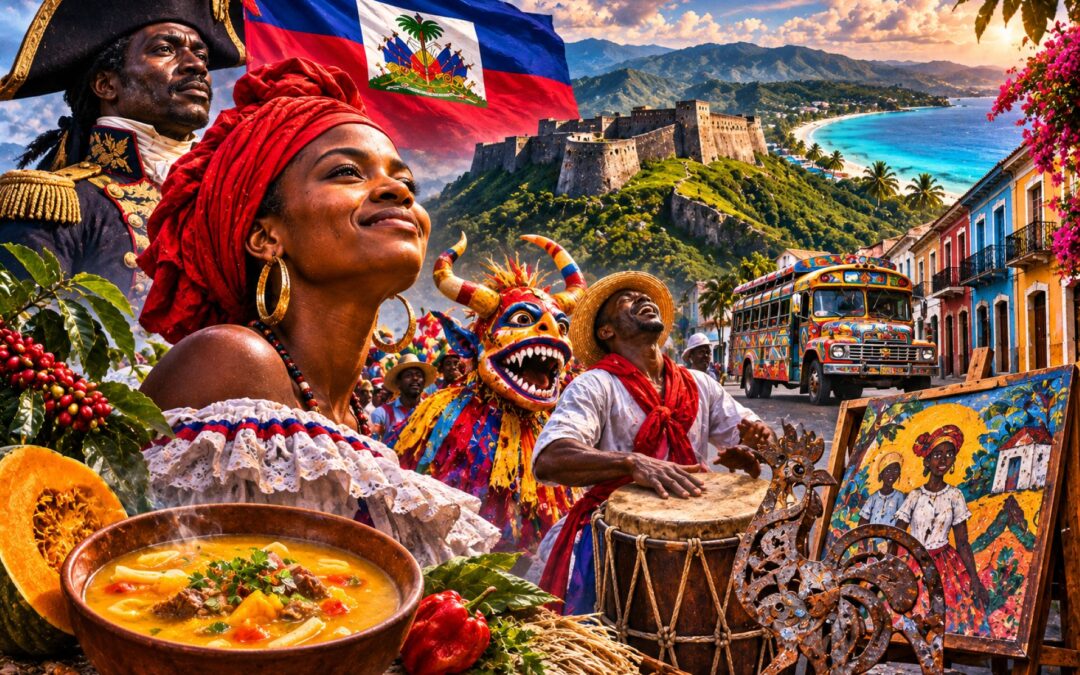
In the northern mountains, an enormous stone fortress stands above the surrounding valleys, built by people who had recently won their freedom from slavery. In Port-au-Prince and Jacmel, brightly painted buses, street murals and elaborate Carnival decorations transform everyday spaces into expressions of national identity. On New Year’s Day, families gather around bowls of squash soup that carry more than two centuries of revolutionary history.
These are not contradictions to Haiti’s difficulties. They are essential parts of understanding the country.
Haiti occupies the western portion of Hispaniola, sharing the Caribbean island with the Dominican Republic. Its geography has shaped its agriculture, settlements and exposure to natural disasters. Its history has produced a distinctive language, religion and national identity, while its people have developed cultural traditions that have traveled far beyond the island.
To understand Haiti, we need to look at the landscape, the communities that inhabit it, and the many ways Haitians express their history through food, music, art and everyday life.
Mountains, Coasts and the Shape of Hispaniola
Haiti is a Caribbean country located between the Caribbean Sea and the North Atlantic Ocean. It occupies roughly the western third of Hispaniola, with the Dominican Republic covering the eastern portion. Cuba lies to the northwest across the Windward Passage, Jamaica is to the southwest, and Puerto Rico is farther east.
The country covers approximately 27,750 square kilometers, making it relatively small by global standards. Yet its geography is remarkably varied. Rugged mountains dominate much of the interior, while fertile plains, river valleys, coastal wetlands and tropical beaches occupy the lower elevations.
The country’s name reflects this landscape. Ayiti, the Indigenous name from which Haiti derives, is commonly interpreted as land of high mountains. Whether every part of that translation can be reconstructed precisely from historical Taíno vocabulary is debated, but the association between the name and mountainous terrain is longstanding.
Mountain ranges run through much of the country. The Massif du Nord dominates parts of the north, while the Chaîne de la Selle extends across the southeast. The southern peninsula contains the Massif de la Hotte, a region known for its forests and remarkable biodiversity.
Haiti’s highest mountain is Pic la Selle, which rises approximately 2,680 meters above sea level. The peak belongs to the southeastern mountain system near the Dominican border and stands above landscapes that differ dramatically in rainfall, vegetation and temperature.
These mountains influence the climate. Moist air arriving from the sea can rise over the slopes, cool and produce rainfall. Areas sheltered from prevailing winds may be significantly drier, creating sharp differences between neighboring valleys and hillsides.
Haiti has a generally tropical climate, but local conditions vary considerably. Some mountains support humid forests, while other regions contain dry scrubland or landscapes vulnerable to prolonged drought. The country experiences wet and dry seasons, although their timing and intensity differ by region.
Water is an essential feature of its geography. The Artibonite River, the longest river on Hispaniola, begins in the Dominican Republic and flows across central Haiti toward the Gulf of Gonâve. Its valley provides important agricultural land, particularly for rice cultivation.
The Plaine de l’Artibonite is among Haiti’s most significant farming regions. Irrigation allows growers to produce crops in a landscape where rainfall alone would not always support reliable harvests. The river is therefore important not only as a geographical landmark but also as a foundation of rural livelihoods.
Other notable water bodies include Étang Saumâtre, also called Lac Azuéi, a large brackish lake near the Dominican border. Its surroundings support distinctive ecosystems, including habitats associated with waterbirds and other wildlife.
The country’s irregular coastline creates an equally diverse maritime landscape. The Gulf of Gonâve cuts deeply into the western coast, separating the northern mainland from the long southern peninsula.
Several offshore islands contribute to Haiti’s geography. La Gonâve, the largest, lies within the gulf. Île-à-Vache, off the southern coast, is known for its beaches and coastal settlements, while Île de la Tortue, or Tortuga, lies off the northwestern coast.
Tortuga occupies a colorful place in Caribbean maritime history. During the seventeenth century, it became associated with buccaneers, privateers and pirates who operated around Hispaniola. Its reputation later inspired countless fictional representations of Caribbean piracy.
Haiti’s capital, Port-au-Prince, lies on the Gulf of Gonâve and serves as the country’s principal administrative and commercial center. Other important cities include Cap-Haïtien in the north, Gonaïves in the Artibonite region, Les Cayes on the southern peninsula, and Jacmel on the southeastern coast.
Administratively, Haiti is divided into ten departments, which are subdivided into arrondissements and communes. These divisions help organize local government across a country where mountainous terrain can make transportation between neighboring communities difficult.
The rugged landscape creates opportunities and hazards simultaneously. Mountain slopes provide different growing conditions for crops, but steep terrain makes road construction expensive and exposes settlements to landslides. Rivers support agriculture yet can produce destructive flooding during intense storms.
Hispaniola also lies near the boundary between the Caribbean and North American tectonic plates. Fault systems crossing the region create a persistent earthquake hazard. The catastrophic 2010 earthquake near Port-au-Prince and the destructive 2021 earthquake in southwestern Haiti were reminders of the forces operating beneath the island.
Hurricanes and tropical storms present another danger. Powerful winds, intense rainfall and flooding can damage crops, homes and infrastructure. Deforested or unstable slopes may increase the severity of landslides and erosion.
Nevertheless, geography should not be treated solely as a source of misfortune. The same mountains, valleys and coastal landscapes support distinctive ecosystems, regional cuisines, agricultural traditions and communities with strong local identities.
Indigenous Roots and the Formation of Haiti
Long before Haiti became an independent republic, Hispaniola was inhabited by Indigenous Caribbean peoples, including the Taíno.
Taíno communities developed agricultural settlements, political institutions and trading relationships throughout the Greater Antilles. They cultivated crops such as cassava, maize, beans and peppers, using farming techniques suited to tropical environments.
Cassava was particularly important because its roots could be processed into a durable form of bread. The food remained significant in Caribbean culinary traditions long after European colonization transformed the region.
Taíno societies were organized into political communities governed by leaders commonly called caciques. Their religious beliefs, artistic traditions and social structures reflected centuries of development before European contact.
Among the best-known Indigenous leaders associated with Hispaniola is Anacaona, a Taíno woman who became a major political figure in the island’s southwestern region. She is remembered for resisting Spanish colonial domination and for her execution by Spanish authorities.
The turning point came in December 1492, when Christopher Columbus arrived on Hispaniola during his first voyage to the Americas. Spain claimed the island and began establishing colonial settlements.
European colonization devastated Indigenous communities. Warfare, forced labor, displacement and introduced diseases produced enormous population losses. Spanish colonists compelled Indigenous inhabitants to work in gold mining and other activities, disrupting their established ways of life.
Older historical narratives often described the Taíno as completely extinct within a few generations. That interpretation is now recognized as too simplistic. Although their societies experienced catastrophic destruction, Indigenous ancestry and cultural practices survived among Caribbean populations, and modern communities continue to reclaim Taíno identities.
As Spanish interest shifted toward mainland American territories, the western part of Hispaniola became increasingly vulnerable to competing European settlements.
French buccaneers and settlers gradually established themselves in the west. In 1697, the Treaty of Ryswick formalized French possession of that territory.
The colony became known as Saint-Domingue.
During the eighteenth century, Saint-Domingue developed into one of the most profitable plantation colonies in the world. Its sugar and coffee exports generated tremendous wealth for French merchants and plantation owners.
That prosperity depended on the labor of hundreds of thousands of enslaved Africans.
By the late eighteenth century, enslaved people vastly outnumbered white colonists. Brutal working conditions, harsh punishments and high mortality made the plantation economy extraordinarily exploitative.
In 1791, enslaved people launched the uprising that became the Haitian Revolution. The struggle involved France, Britain, Spain and competing revolutionary leaders, but its central achievement was the destruction of a major slaveholding system.
Toussaint Louverture emerged as an important military and political leader, while Jean-Jacques Dessalines ultimately commanded the forces that defeated Napoleon’s attempt to restore direct French control.
On 1 January 1804, Dessalines proclaimed Haitian independence at Gonaïves.
The new country adopted the Indigenous name Haiti, reconnecting its national identity with the island’s precolonial past. It became the first enduring independent state created through a successful mass revolt of enslaved people.
The achievement fundamentally challenged the racial and political assumptions of the Atlantic colonial world. Haiti had established its sovereignty in an international system where slavery and European empire remained powerful.
The republic’s subsequent history involved enormous difficulties, including diplomatic isolation, a coercive independence indemnity imposed by France in 1825, foreign occupation and recurring struggles over political power.
These events profoundly shaped the country, but they also contributed to a distinctive national identity centered on freedom, self-determination and the memory of revolutionary resistance.
Physical reminders remain visible across Haiti.
Near Cap-Haïtien, the enormous Citadelle Laferrière stands high above the northern landscape. Developed under Henri Christophe after independence, the fortress was intended to defend the new nation against a possible French invasion.
Nearby are the ruins of the Sans-Souci Palace, another monument associated with Christophe’s rule. Together with the Ramiers structures, these sites form a national historical park recognized by UNESCO as a World Heritage Site in 1982.
The monuments are more than tourist attractions. They embody the determination of a recently emancipated population to protect its independence and demonstrate its ability to construct a state of its own.
Creole, French and the People of Haiti
Haiti has a population of roughly eleven million people, the overwhelming majority of whom descend primarily from Africans brought to the Caribbean through the Atlantic slave trade.
The country’s population also reflects European, Indigenous and other influences accumulated over centuries. Smaller communities include people with mixed ancestry and families descended from immigrants from the Middle East and elsewhere.
Haitian identity, however, cannot be reduced to a simple calculation of ancestry.
The country’s revolution created a political community whose founding principle challenged racial slavery. Its language, traditions and social relationships subsequently developed through the experiences of people living together on the island.
One of the most distinctive features of Haitian society is its language.
Haiti has two official languages: Haitian Creole, commonly called Kreyòl Ayisyen, and French.
Haitian Creole is spoken by virtually the entire population and serves as the principal language of everyday conversation. It is heard in homes, markets, music, religious ceremonies and public life.
French remains important in formal administration, law, higher education and sections of business and the media. However, fluency in French is far less widespread than fluency in Creole.
This distinction has long carried social consequences.
For generations, access to higher education, influential government positions and professional opportunities was often linked to mastery of French. A child who spoke Creole at home might enter a school where textbooks and instruction were presented in a language the child did not fully understand.
The resulting educational disadvantage reflected institutions rather than any deficiency in Creole itself.
Haitian Creole developed through contact between French and several other languages, particularly West African languages spoken by enslaved Africans. Its vocabulary is largely French-derived, but its grammatical structure, pronunciation and expression have developed into a distinct linguistic system.
For example, the everyday greeting Kijan ou ye? means How are you?, while Mwen byen means I am fine.
The language has its own rules for word order, tense, aspect and possession. It is not simply incorrectly spoken French or a simplified substitute for a supposedly more sophisticated language.
An English speaker might find some Creole vocabulary recognizable through French, but the languages are not automatically mutually intelligible.
The 1987 Constitution formally recognized both Creole and French as official languages. It also emphasized that Creole was the language uniting Haitians.
This recognition was an important moment in the struggle for cultural and linguistic equality. Yet legal recognition did not immediately eliminate the unequal position of French in education and public administration.
Efforts to expand Creole-language education and publishing remain significant because they affect who can participate fully in national life.
Family and community relationships are another central feature of Haitian society.
Extended families often provide support across several households, particularly where public services are unreliable. Relatives may cooperate to care for children, support older family members, share resources and help one another through illness or economic difficulty.
In rural communities, the concept of lakou can refer to a family compound or shared residential space organized around extended kinship relationships. Its meaning varies, but it reflects the importance of family networks, land and collective responsibilities.
Marketplaces also play an essential social role.
Women traders, commonly called madan sara, have historically connected rural producers with urban consumers. Their work involves buying, transporting and selling agricultural goods, often under difficult conditions.
These traders demonstrate how informal economic relationships can support entire communities. Markets are places of exchange, negotiation, information and social interaction, not merely spaces where food is purchased.
Religion adds another dimension to Haitian identity.
Christianity is widespread, including Catholic and Protestant traditions. Haitian Vodou, an African-derived religion that developed under slavery, also remains important.
Vodou involves relationships with spiritual beings known as lwa, alongside rituals associated with ancestry, healing, community obligations and the natural world.
Some Haitians practice Vodou alongside Catholicism, while others identify exclusively with one religious tradition. Religious affiliations therefore cannot always be represented by mutually exclusive statistics.
The country’s cultural life also reflects its connections with the wider world. Haitians have migrated to the United States, Canada, the Dominican Republic, France and other countries, creating communities that remain closely connected with relatives and cultural traditions at home.
Language, family and religion have consequently become important ways of maintaining Haitian identity across national borders.
Food and Celebrations That Carry History
Haitian cuisine brings together African, Indigenous Caribbean and European influences, producing a distinctive combination of ingredients, cooking techniques and flavors.
Meals frequently feature rice, beans, plantains, vegetables, meat and seafood, depending on region, household circumstances and availability. Seasoning is particularly important, and many dishes develop their characteristic flavor through combinations of herbs, peppers, garlic and citrus.
A foundational preparation is epis, a seasoning mixture commonly made with ingredients such as parsley, scallions, garlic, peppers, thyme and other herbs.
Epis can be used to marinate meat, flavor stews and enrich rice dishes. Recipes vary between households, reflecting family preferences and the availability of ingredients.
One of Haiti’s best-known dishes is griyo, made from pieces of pork that are seasoned, cooked until tender and then fried.
It is often served with bannann peze, flattened fried green plantains, and pikliz, a spicy pickled mixture usually containing shredded cabbage, carrots, peppers and vinegar.
The combination of rich meat, crisp plantains and acidic heat illustrates the balance of flavors common in Haitian cooking.
Another distinctive dish is diri ak djon djon, rice prepared with dried black mushrooms that give the dish its dark color and characteristic flavor.
The mushrooms are particularly associated with northern Haiti, where the dish is often prepared for special occasions. It may be served with meat, seafood or other accompaniments.
Poul ak nwa, chicken cooked with cashews, is another northern specialty. The combination reflects the region’s agricultural products and its particular culinary traditions.
In southern Haiti, tonmtonm, a preparation made from pounded breadfruit, is especially associated with the Jérémie area. It is commonly eaten with a flavorful sauce or stew, sometimes made with okra.
Cassava bread, or kasav, provides a direct connection to Indigenous food traditions. Made from cassava root, it preserves an ingredient that was essential to Taíno communities long before European colonization.
Beverages also reflect Haiti’s culinary heritage.
Akasan is a traditional preparation based on cornmeal, often flavored with cinnamon, vanilla and other ingredients. It may be served warm or cold, with a consistency that varies from a drink to a porridge.
Kremas, a rich coconut-based alcoholic drink, is associated with celebrations and special occasions. Its ingredients commonly include coconut milk, sweetened milk, spices and rum.
Food in Haiti is not only about flavor. Certain dishes carry historical meanings that connect ordinary family meals with the country’s founding struggle.
The most famous example is soup joumou, a traditional squash soup eaten on New Year’s Day.
The soup commonly contains squash, vegetables, meat, pasta, plantains and aromatic spices. Different families prepare it in different ways, passing recipes and techniques from one generation to another.
Its meaning comes from the history of slavery.
According to a widely preserved tradition, the soup was associated with the French colonial elite and was not ordinarily available to enslaved people. After independence, formerly enslaved Haitians claimed the dish as their own.
Eating soup joumou on 1 January, the anniversary of independence, consequently became a celebration of freedom and dignity.
The practice transforms a meal into a historical statement.
Preparing the soup often involves several generations working together. Ingredients are gathered, vegetables are chopped, and a large pot is prepared to feed relatives, friends or neighbors.
Families may exchange bowls with others, making the tradition an expression of generosity and community belonging.
In 2021, UNESCO inscribed the knowledge and practices surrounding soup joumou on its Representative List of the Intangible Cultural Heritage of Humanity.
The recognition acknowledged more than the recipe. It emphasized the soup’s connection with Haitian independence, intergenerational knowledge and social relationships.
The story illustrates how history remains present in everyday Haitian life.
A dish prepared in a family kitchen can carry memories of colonialism, emancipation and the determination of ordinary people to claim rights once denied to them.
Music, Art, Festivals and Everyday Ingenuity
Haiti’s cultural life is exceptionally expressive, particularly through music, painting, sculpture, literature and public celebrations.
Its artistic traditions draw on African and Caribbean influences while continually adapting to new technologies, migration and social change. They are not limited to preserving historical customs; Haitian artists regularly experiment with contemporary forms.
Music occupies a central place in this cultural landscape.
One of the country’s most popular genres is compas, often written konpa in Haitian Creole.
Developed during the 1950s and associated particularly with musician Nemours Jean-Baptiste, compas combines rhythmic dance music with instruments such as guitars, bass, keyboards, percussion and horns.
Its distinctive beat has made it enormously influential across Haitian communities at home and abroad. Bands including Tabou Combo helped carry the genre to international audiences.
Compas is frequently heard at weddings, parties, clubs and community celebrations. Its popularity reflects both its musical appeal and its ability to connect different generations of Haitians.
Another important tradition is twoubadou, a style associated with acoustic instruments and songs about everyday experiences.
Twoubadou musicians often perform with guitars, percussion and other portable instruments. The style reflects Caribbean musical exchanges and is well suited to intimate gatherings and smaller social spaces.
Méringue, an older Haitian musical and dance tradition, also contributed to the development of later popular styles.
The relationship between these genres is complicated by decades of interaction with music from Cuba, the Dominican Republic and other Caribbean societies. Haitian music has never developed in isolation from its neighbors.
Rara represents another major expression of Haitian cultural identity.
Rara processions are especially associated with the period between Lent and Easter. Groups move through streets and communities with drums, horns, singing and dancing.
The music often features bamboo trumpets known as vaksen, along with percussion instruments and metal objects that create powerful overlapping rhythms.
Rara can have religious, social and political dimensions. Some processions are connected with Vodou traditions, while songs may comment on local events, public figures or community grievances.
The result is not simply a street parade. Rara creates a temporary public space in which music, religious expression and social commentary come together.
A more contemporary movement is mizik rasin, or roots music.
Emerging prominently in the late twentieth century, this style combines traditional Haitian rhythms and spiritual themes with rock, reggae and other modern influences.
Groups such as Boukman Eksperyans became internationally known for using music to explore cultural identity, spiritual traditions and political concerns.
The movement demonstrates how younger musicians could draw on inherited rhythms without treating them as museum pieces.
Haitian artists have also developed forms of hip-hop, rap Kreyòl and other contemporary popular music. These styles connect local experiences with global musical conversations while preserving the importance of Creole-language expression.
The country’s most recognizable public celebration is Carnival, held in the period before Lent.
Carnival celebrations involve elaborate costumes, street music, dancing, decorated vehicles and large crowds. They provide opportunities for artistic creativity and political satire.
The city of Jacmel is particularly celebrated for its Carnival masks and papier-mâché sculptures.
Artists create enormous animal figures, fantastical characters and symbolic representations using materials that can be shaped, painted and carried through the streets.
The tradition has become an important source of local artistic identity, combining historical influences with contemporary imagination.
Religious festivals add another dimension to the national calendar.
At Saut-d’Eau, a waterfall in central Haiti, pilgrims gather during July celebrations associated with Our Lady of Mount Carmel and spiritual traditions connected with Haitian Vodou.
Some participants engage in Catholic devotional practices, while others honor lwa associated with the sacred landscape. The gathering demonstrates the complicated relationship between Catholicism and African-derived religion within Haitian cultural life.
Haiti’s visual arts are equally distinctive.
Painters have used vivid colors, detailed landscapes, religious imagery and scenes of ordinary life to explore the country’s identity.
Among the best-known artists is Hector Hyppolite, whose paintings drew on spiritual themes and the visual language of Haitian Vodou.
His work helped bring international attention to Haitian painting during the twentieth century, particularly following the establishment of the Centre d’Art in Port-au-Prince in 1944.
Other important painters include Philomé Obin, known for historical and everyday scenes, and Préfète Duffaut, celebrated for imaginative architectural landscapes and fantastical cities.
Haitian art has sometimes been described by outsiders as primitive or naïve. Such labels may refer to particular artistic movements, but they can also misleadingly suggest a lack of sophistication.
The artistic traditions themselves involve deliberate choices about composition, symbolism, history and visual storytelling.
Metalwork is another celebrated form.
In communities such as Croix-des-Bouquets, artists have transformed discarded steel oil drums into intricate sculptures.
The process involves cutting, flattening, shaping and decorating metal, producing works that may depict animals, spirits, historical scenes or abstract patterns.
What begins as an industrial container becomes an object of extraordinary detail.
The tradition reflects technical skill and artistic imagination, while also demonstrating how available materials can be adapted into valuable cultural products.
Haiti’s brightly painted tap-tap buses offer another familiar expression of everyday creativity.
These shared vehicles often feature elaborate decorations, religious messages, portraits, patterns and vivid colors. Their name is commonly associated with the practice of tapping the vehicle to signal a stop.
The artwork transforms ordinary transportation into a moving part of the urban visual landscape.
Literature provides another important window into Haitian life.
Jacques Roumain, whose novel Masters of the Dew explores rural poverty, agricultural cooperation and social conflict, remains a major figure in Haitian writing.
Frankétienne became known for experimental literary forms and his involvement in the development of Spiralism, a movement associated with the complexity and movement of contemporary life.
Writers such as Edwidge Danticat, working across Haitian and diasporic experiences, have brought stories of migration, family memory and national identity to readers internationally.
Filmmakers including Raoul Peck have similarly explored history, politics and social injustice through cinema.
These artistic achievements demonstrate that Haitian culture is neither frozen in the past nor defined exclusively by national suffering.
It is a living, evolving body of expression sustained by individuals, families, workshops, performance groups and communities.
The Haitian Flag and the Symbols of Independence
Few national symbols carry a historical meaning as closely connected to liberation as the Haitian flag.
The present national flag consists of two horizontal bands: blue above red. The state flag includes the national coat of arms within a white panel at the center, while the plain bicolor is also used.
Its origins are traditionally traced to 18 May 1803, during the final stages of Haiti’s struggle against French colonial rule.
According to the best-known account, Jean-Jacques Dessalines removed the white central band from the French tricolor, leaving the blue and red sections.
The gesture symbolized a break with French colonial authority and a commitment to unity among the people fighting for independence.
Catherine Flon, a woman remembered as an important figure in Haitian national history, is traditionally credited with sewing the remaining pieces together.
The story is associated with a gathering of revolutionary leaders at Arcahaie, where the different groups fighting against France sought to strengthen their alliance.
Historians have examined differences between the surviving accounts of the flag’s creation. The familiar story remains central to Haitian national memory, but its precise details should be distinguished from those that can be established through contemporary documentation.
The Haitian Embassy’s account of the national flag explains the traditional association between the removal of the white band, the revolutionary alliance and Catherine Flon’s contribution.
The colors are commonly interpreted as representing unity between Black Haitians and people of mixed ancestry, groups whose cooperation was essential to defeating French forces.
The symbolism is therefore political as well as racial. The flag represented an attempt to unite communities divided by the colonial hierarchy behind the shared objective of independence.
The original revolutionary flag was not identical in every respect to the design used today.
Haiti has adopted several national flags during different political periods, including black-and-red designs associated with particular rulers and regimes.
The blue-and-red bicolor regained its constitutional status following the fall of Jean-Claude Duvalier’s dictatorship in 1986 and the adoption of the 1987 Constitution.
The national coat of arms adds another layer of symbolism.
Its central image includes a palm tree topped by a Phrygian cap, an emblem historically associated with liberty. Arranged around it are military objects, including cannons, flags, weapons and other equipment.
These elements recall the revolutionary struggle and the determination of the new republic to defend its sovereignty.
A banner beneath the symbols carries Haiti’s national motto:
L’Union Fait La Force — Unity Makes Strength.
The phrase expresses an ideal that has remained important throughout the country’s turbulent political history.
The coat of arms also contains an unusual visual detail: flags appear within the design of the national flag itself. Together with the military symbols, they reinforce the connection between independence and collective defense.
Haiti celebrates Flag and University Day on 18 May.
Schools and communities often mark the occasion through ceremonies, performances, patriotic songs and displays of the national colors.
For many Haitians, the flag remains a reminder that independence was not granted by a colonial ruler. It was achieved through organized resistance and military victory.
The symbols therefore represent both the country’s revolutionary origins and its enduring aspiration to protect the freedom gained in 1804.
Environment, Livelihoods and the Wider Diaspora
Haiti’s environment is far more diverse than the familiar images of bare hillsides might suggest.
Its mountains contain habitats that support an extraordinary range of plants and animals, including species found nowhere else in the world.
The Massif de la Hotte in southwestern Haiti is particularly important. Its forests contain numerous endemic species, including rare amphibians, birds and plants adapted to the region’s distinctive ecological conditions.
Macaya National Park, established in 1983, protects part of this mountainous landscape.
The park is recognized for its exceptional biodiversity, including orchids, amphibians and rare wildlife. Its surviving forests are especially valuable because many species depend on habitats that have been greatly reduced elsewhere.
In 2016, UNESCO designated the wider Massif de la Hotte region as a biosphere reserve.
The UN Environment Programme’s assessment of Haiti’s biodiversity identifies the area as one of the country’s most important natural sanctuaries and emphasizes the need to protect its remaining primary forests.
Haiti also shares several unusual animal species with the Dominican Republic.
One example is the Hispaniolan solenodon, a small, mostly nocturnal mammal with a long snout and a venomous bite. It belongs to an ancient mammalian lineage and is threatened by habitat loss and introduced predators.
Another is the Hispaniolan hutia, a large rodent associated with the island’s forests and rocky habitats.
The country’s birdlife includes species such as the Hispaniolan trogon, a striking bird associated with woodland habitats and recognized as Haiti’s national bird.
These species reveal an ecological heritage that receives relatively little attention compared with the country’s political difficulties.
Nevertheless, environmental degradation is a serious challenge.
Haiti has experienced extensive deforestation through a combination of historical land clearance, agriculture, charcoal production, population pressure and limited access to affordable alternative fuels.
Trees provide wood for construction and energy, while charcoal remains an important cooking fuel for many households.
For people with few alternatives, cutting wood or producing charcoal may be an economic necessity rather than a choice made without regard for the environment.
The resulting pressure can damage watersheds, expose soil to erosion and increase the vulnerability of steep hillsides to heavy rainfall.
Yet the widely repeated claim that Haiti has only 2% forest cover requires careful qualification.
Some estimates refer specifically to remaining primary or old-growth forest, while others measure all land classified as forest or covered by trees.
These are different measurements.
Haiti has suffered severe losses of ecologically valuable forests, but it is not a country entirely devoid of trees. Secondary forests, agroforestry systems and other wooded landscapes remain important.
The distinction matters because effective conservation policies must reflect the actual condition of the land rather than an oversimplified national image.
Agriculture continues to support substantial numbers of Haitians, particularly in rural communities.
Farmers cultivate rice, maize, beans, cassava, plantains, mangoes, coffee and other crops, depending on local climate, elevation and access to water.
The Artibonite Valley is especially important for rice, while mountainous regions provide conditions suitable for coffee cultivation.
Coffee has occupied a significant place in Haiti’s history since the French colonial period. Saint-Domingue became a major exporter during the eighteenth century, helping transform the Atlantic coffee trade while depending on the labor of enslaved Africans.
Today, smallholder coffee production remains important in some mountain communities, although farmers face difficulties involving infrastructure, prices, plant disease and access to markets.
Other agricultural products also contribute to exports.
Haitian mangoes, particularly varieties valued in international markets, provide income for growers and traders. Vetiver, a grass whose roots are used to produce fragrant essential oil, is another significant export product, especially in parts of southern Haiti.
These industries connect rural Haitian livelihoods with international consumers, sometimes through commercial networks that receive little attention outside the country.
Manufacturing also plays a role.
Textile and garment factories have provided employment in urban and industrial areas, producing clothing for overseas markets. However, inadequate infrastructure, political instability and interruptions to transportation have restricted industrial growth.
Much of the economy operates informally. Market traders, craftspeople, transport operators and small businesses provide goods and services without always being part of a conventional salaried employment system.
These activities demonstrate economic initiative, but informal workers often have limited financial security and few protections against emergencies.
Tourism represents another unrealized opportunity.
Haiti possesses beaches, mountains, waterfalls, historic monuments and vibrant cultural traditions that could support a more developed visitor economy.
Destinations such as Labadee, Île-à-Vache, Jacmel and the northern historical sites illustrate the country’s range of attractions.
Tourism was more prominent during certain periods of the twentieth century, but political instability, insecurity and infrastructure problems have repeatedly undermined the sector.
The contrast with the Dominican Republic is particularly striking. Both countries share Hispaniola, but they have developed very different tourism industries and economic institutions.
Natural hazards add further pressures.
Hurricanes can destroy crops, damage roads and isolate communities. Earthquakes threaten buildings and public services, while erosion and flooding worsen the consequences of heavy rainfall.
Climate change may intensify some environmental risks, particularly those connected with extreme precipitation, rising temperatures and coastal vulnerability.
These challenges interact with poverty and limited public resources. A community with reliable drainage, safe buildings and functioning emergency services is better equipped to withstand a storm than one without them.
Haiti’s environment therefore cannot be separated from questions of infrastructure, livelihoods and public administration.
The country’s diaspora plays an equally important role in its economic and social life.
Large Haitian communities live in the United States, particularly in Florida and New York, while the Dominican Republic hosts a substantial population of Haitian migrants and their descendants.
Canada, especially Montreal, has also become an important center of Haitian cultural and community life. Haitians have established communities in France, Chile, Brazil and other countries.
Migration reflects different experiences, including employment opportunities, education, family reunification and the desire to escape instability.
Money sent home by relatives abroad, known as remittances, provides an essential source of income for many Haitian households.
These transfers can help pay for food, school fees, healthcare, housing and small businesses. In some communities, the support of family members overseas makes the difference between meeting daily needs and facing severe hardship.
The diaspora also contributes through professional expertise, charitable organizations, investment and cultural exchange.
Haitian musicians, writers and artists have carried their work into international markets while maintaining connections with the country.
Wyclef Jean, born in Haiti and raised partly in the United States, became internationally known through the Fugees and his subsequent musical career.
Actors such as Jimmy Jean-Louis and Garcelle Beauvais, alongside writers, filmmakers and other public figures, have helped make Haitian identity more visible internationally.
The country’s cultural influence therefore extends far beyond its geographical size.
Cuban medical cooperation has also been significant. Cuban doctors and healthcare workers have assisted Haitian communities during different periods, illustrating how regional relationships can contribute to essential services.
Venezuela has historically maintained important political and economic ties with Haiti, including through petroleum arrangements such as PetroCaribe.
These relationships, like Haiti’s connections with the United States, Dominican Republic and Canada, show that the country is deeply involved in wider Caribbean and international networks.
Haiti’s challenges remain severe. Political instability, insecurity, poverty and repeated disasters have damaged public services and made daily life difficult for millions.
Yet those circumstances do not describe the entirety of the country.
The same society facing extraordinary pressures continues to produce music, literature, art, agricultural goods, religious traditions and cultural practices with significance far beyond the island.
Its communities sustain relationships through marketplaces, family networks, churches, Vodou ceremonies, festivals and shared memories of independence.
Haiti is often introduced to the world through what has gone wrong. Its geography and culture reveal something far more complicated: a country shaped by spectacular landscapes, a revolutionary founding, centuries of cultural exchange and the continuing creativity of its people.
The mountains that gave Haiti its name, the Creole spoken in its streets, the soup shared on Independence Day, and the blue-and-red flag carried in public celebrations all tell parts of the same story.
They represent a society whose identity cannot be reduced to hardship.
Understanding Haiti requires recognizing its difficulties without allowing them to overshadow its history, achievements and everyday life. Only then does the country emerge not as a collection of crises, but as a place with its own extraordinary character, traditions and possibilities.
Last Updated on November 18, 2026 by Aseem Gupta