
Reading Time: 22 Minutes
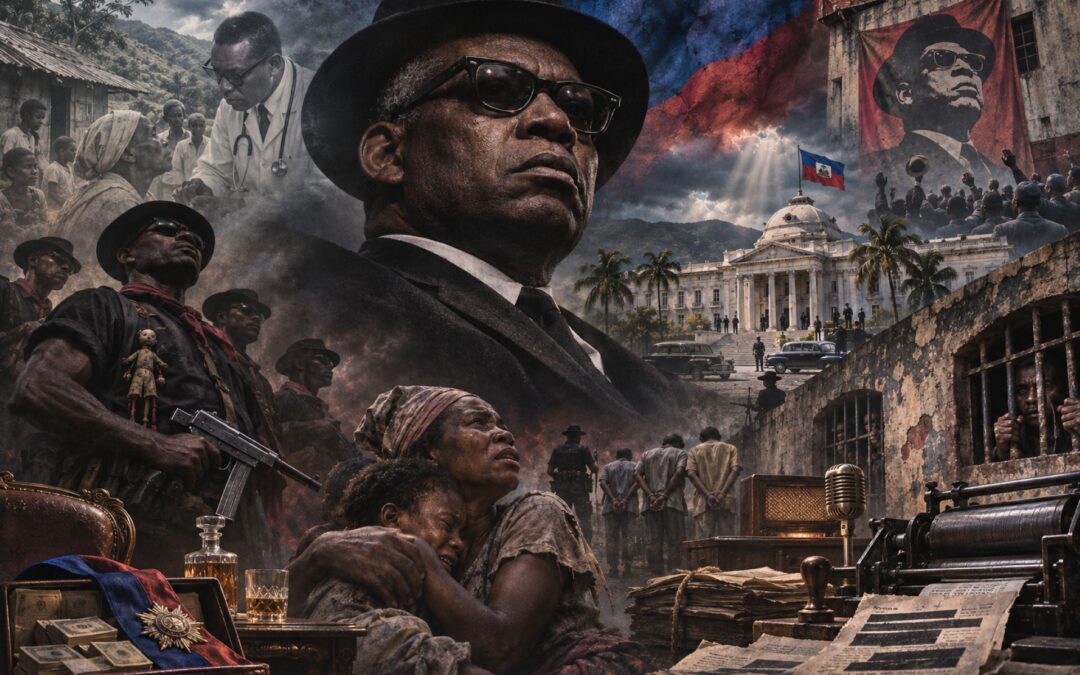
François Duvalier spent part of his early career traveling through rural Haiti to treat people suffering from a disfiguring tropical disease. Patients knew the soft-spoken physician as Papa Doc, a name that suggested familiarity, gratitude and care. Years later, the same name inspired fear. Under his presidency, armed men could drag someone from a home, demand money from a shopkeeper or kill a suspected opponent without expecting punishment.
By the time Duvalier died in April 1971, he had ruled Haiti for nearly fourteen years. Elections had become rituals of submission, the security services answered to his family, and a son still in his teens was prepared to inherit the presidency. The machinery of terror he built would survive him for another fifteen years.
The transformation from country doctor to president for life is sometimes told as a story of an eccentric tyrant who exploited Haitian Vodou and believed himself immortal. Those elements of his public image matter, but they can distract from the practical methods that kept him in power. Duvalier understood Haiti’s racial divisions, cultivated the army before undermining it, rewarded armed followers with impunity and convinced foreign governments that his dictatorship was preferable to communism.
His career reveals how a political leader can use genuine social grievances to win support, then dismantle the institutions that might hold him accountable.
From Physician to Black Nationalist
François Duvalier was born in Port-au-Prince on 14 April 1907, into a country still grappling with the legacy of slavery, independence and unequal political power. Haiti had emerged from the Haitian Revolution in 1804, but formal freedom had not erased differences in wealth, education or access to public office. A relatively small French-speaking, often lighter-skinned elite exercised disproportionate influence, while much of the black, Creole-speaking population lived in poverty, especially in the countryside.
Duvalier’s family circumstances are described differently in popular biographies. His father worked as a teacher and justice of the peace, and the household afforded him educational opportunities unavailable to many Haitians. He was not a member of the country’s most powerful ruling families, but portraying him as either a destitute peasant or a privileged aristocrat obscures his position between those worlds. He studied medicine at the University of Haiti and graduated in 1934, the year American troops left after a nineteen-year occupation.
The occupation profoundly influenced the politics of Duvalier’s generation. Beginning in 1915, United States forces had taken charge of important government functions, reorganized security institutions and used compulsory labor on public works. American racial attitudes often reinforced existing Haitian hierarchies. For young intellectuals, national independence had come to mean more than replacing foreign troops: it meant recovering dignity for the country’s African-descended majority and defending cultural traditions marginalized by European-oriented elites.
One important influence was physician, ethnologist and writer Jean Price-Mars, who challenged educated Haitians’ tendency to dismiss rural customs and African heritage. His work helped shape indigénisme, a movement seeking to understand Haitian culture on its own terms. Duvalier absorbed those arguments but developed them in a more explicitly racial and political direction associated with noirisme. The movements overlapped without being identical: cultural recognition did not necessarily require the racial essentialism or authoritarianism that Duvalier later embraced.
With like-minded thinkers including Lorimer Denis, Duvalier wrote about black identity, nationalism and the cultural significance of Vodou. He was associated with the journal Les Griots, established in the late 1930s, and the intellectual circle that gave it its name. His writing sometimes treated race as a defining collective psychological identity, a position that went beyond exposing discrimination and toward a rigid understanding of national belonging. That ideology offered a way to present political opposition as resistance to Haiti’s supposedly authentic black character.
Medicine gave these ideas an unexpectedly powerful audience. During the 1940s, Duvalier participated in public-health campaigns against yaws, a bacterial infection that produces skin lesions and can damage bones if untreated. He worked with an internationally supported health program, traveling to rural communities that rarely received dependable medical attention. These visits brought him into contact with people whose daily experiences were almost invisible to the capital’s political class.
The doctor developed a reputation for attending to neglected patients, and the affectionate nickname Papa Doc followed him into public life. His work also introduced him to local community leaders, including Vodou priests known as oungan, and gave him an understanding of networks that could mobilize people far from Port-au-Prince. Some later accounts interpret every friendship as an early political calculation. That may exaggerate how much of his future Duvalier had planned, but the relationships unquestionably became useful to his political career.
His rise was initially conventional. President Dumarsais Estimé, whose government challenged some established hierarchies, appointed Duvalier to senior public-health responsibilities. He later served in the cabinet, including as minister of public health and labor. When soldiers deposed Estimé in 1950 and Colonel Paul Magloire took power, Duvalier lost his government position and returned to medical practice. He increasingly aligned himself with opponents of Magloire, sometimes living discreetly to avoid arrest.
By the middle of the decade, Duvalier possessed something more valuable than a standard party machine. He had a recognizable name, a reputation for service in the countryside, an ideological message directed at the majority and firsthand experience of the state’s vulnerability to military intervention. Those advantages would help him win power in 1957—and shape the methods by which he refused to relinquish it.
Winning the 1957 Presidency
The political opening came after Magloire’s government lost support. His rule had promised stability and encouraged tourism, but corruption, political favoritism and growing dissatisfaction undermined it. Controversy over the handling of relief following Hurricane Hazel in 1954 added to the criticism. Magloire departed in 1956, leaving a succession of short-lived provisional governments and competing claims to authority.
By September 1957, many Haitians wanted an elected government capable of ending the cycle of upheaval. Duvalier presented himself as the candidate of the black majority and the rural poor. His medical record gave his appeal a personal dimension: voters who had encountered him as a physician could regard his promise of social reform as more credible than the promises of career politicians.
His principal opponent was Louis Déjoie, a wealthy industrialist and landowner associated with Haiti’s lighter-skinned elite. The campaign reinforced the country’s racial and class divisions. Duvalier portrayed Déjoie as the candidate of entrenched privilege, while supporters of Déjoie feared that noiriste politics would replace one form of exclusion with another. Neither candidate represented a population divided neatly into two racial camps, but their competing images were politically effective.
The army’s role proved decisive. Officers who had already shaped the transitional government came to favor Duvalier, in some cases apparently assuming that a mild-mannered doctor would be easier to influence than a more independent political leader. That calculation underestimated his willingness to use violence and his understanding of how quickly military allies could become threats.
Duvalier won the election of 22 September 1957 by a large margin. The Bibliothèque nationale de France’s chronology records 633,503 votes for him against 265,697 for Déjoie, with military-junta support behind the victory. Contemporary allegations of intimidation and irregularities make it difficult to treat the result as an entirely untroubled democratic mandate. Nevertheless, he also enjoyed real support among people who expected their government finally to address entrenched inequality.
He took office on 22 October 1957, promising respect for rights and national unity. His electoral rhetoric suggested that a physician attentive to the poor might reform institutions that had long served the privileged. But the new president’s first actions quickly exposed a different priority: preventing opponents from organizing to remove him.
Officials connected with rival factions lost their positions, critics were detained, and newspapers and civic organizations faced harassment. Businesses that protested his administration risked attacks. Duvalier established a political atmosphere in which people could not easily distinguish lawful government action from intimidation by armed loyalists. The passage from winning an election to dismantling competition did not require a single dramatic decree; it took shape through purges, arrests and the systematic raising of the cost of dissent.
The weakness of existing democratic safeguards made the transformation easier. Legislators, courts and officers had few reliable means of resisting a president who combined an electoral victory with powerful patrons and the willingness to punish disobedience. By the time some early supporters recognized what they had helped install, their room to maneuver had narrowed considerably.
Surviving a Coup and Creating the Tonton Macoutes
For all his growing power, Duvalier understood that the army could destroy his presidency. Haitian soldiers had removed rulers before, including the president under whom he had served. The institution was trained, armed and organized through a hierarchy that existed independently of him. A president who relied exclusively on generals had to keep their confidence—or risk being replaced by another figure they found more convenient.
A failed attack in July 1958 made the danger tangible. A small group that included former Haitian officers and Americans attempted to seize a military position and overthrow the government. The operation was poorly supported and quickly defeated, but Duvalier treated it as proof that enemies were waiting to strike. He declared a state of siege, intensified surveillance and broadened the repression of suspected opponents.
His response was not merely to reinforce the existing army. He also replaced senior officers, promoted people whose careers depended on him and strengthened units assigned to his personal protection. More fundamentally, he built an alternative source of armed power that would not answer to the military chain of command.
The militia became known as the Tonton Macoutes, although its formal identity was the Volontaires de la Sécurité Nationale, or Volunteers for National Security. The popular name came from a folkloric bogeyman said to carry disobedient children away in a sack. Its members made that association useful: dark glasses, civilian clothing, visible weapons and a reputation for unpredictable violence made them instantly recognizable and difficult to challenge.
The militia’s earliest development was closely associated with Clément Barbot, a former teacher and Duvalier confidant who became one of its feared organizers. Recruitment was not confined to professional soldiers. Local strongmen, political loyalists and men seeking authority in their communities could join a network whose members derived power from closeness to the president. The force operated alongside the army, creating overlapping jurisdictions that encouraged rivalry rather than unified professional control.
The Macoutes did not need to be a disciplined military formation to be effective. Their central function was political intimidation. They monitored neighborhoods, identified supposed opponents, broke up demonstrations, attacked journalists and made arrests outside ordinary legal procedures. Torture and killings could follow an accusation that required little or no evidence. The uncertainty was part of the system: even people who had avoided politics could not be certain they were safe.
Duvalier also gave the organization an economic foundation. Many militia members received little dependable pay and instead used their positions to demand money, seize property or extract favors. A shopkeeper might pay to avoid trouble; a farmer might surrender part of a harvest; a family might search for an influential intermediary to secure a detained relative’s release. Such payments were not ordinary taxation. They were enforced through the threat of arbitrary harm, enriching armed patrons while weakening public confidence in law.
This pattern was particularly consequential outside Port-au-Prince. A study of the militia’s role in rural Haiti argues that decades of peasant exclusion from formal power helped create conditions in which Macoute commanders could rise. Some men who had once lacked influence became local authorities through their association with the regime. Others saw the militia as a threat to land, livelihoods and personal safety. A coercive organization could thus build a social constituency even while terrorizing the broader population.
Violence against women was another instrument of domination. Members of the security network committed sexual assaults with little prospect of accountability, and threats against families could silence political opponents. Public killings and the display of bodies in conspicuous places sent warnings far beyond the immediate victims. It was not necessary to punish every critic when one spectacular act could frighten an entire community.
The president’s fear of rivals extended inside the militia itself. In 1959, Duvalier suffered a serious heart attack and was temporarily unable to govern normally. Barbot exercised considerable authority during his illness. Once Duvalier recovered, he came to suspect that his lieutenant had developed an independent base of support and ordered him imprisoned. The fate of a longtime confidant illustrated a central rule of the regime: personal loyalty was never enough to guarantee survival.
After his release, Barbot became involved in an attempt against the Duvalier family in 1963. An attack associated with his network targeted a car carrying the president’s children, killing members of their security detail without capturing the children. Duvalier responded with a sweeping manhunt and reprisals that killed suspected conspirators and people linked to them. Barbot was eventually tracked down and killed.
One notorious story from the pursuit held that Barbot could transform into a black dog, prompting militia men to kill black dogs while searching for him. Historians have discussed the tale as part of the regime’s atmosphere of rumor and supernatural intimidation. Its value is not as proof of any magical belief or a confidently documented nationwide order, but as evidence of how violence and folklore could become intertwined in public memory.
The elimination of Barbot made Duvalier’s position safer in the short term. It also revealed the insecurity at the center of his rule: a system based on personal loyalty, fear and competing armed factions could never produce genuine trust. The Tonton Macoutes solved the president’s problem of dependence on the army by creating a second problem for the country—an armed network with power but almost no accountability.
Vodou, Religion and the Theater of Invulnerability
Duvalier’s public image was remarkable even by the standards of twentieth-century dictatorships. He wore dark glasses and somber clothing, spoke in a distinctive nasal voice and cultivated an aura of secrecy. He was frequently associated with Baron Samedi, a spirit linked to cemeteries and the dead in Haitian Vodou, often represented wearing formal black attire and a top hat. The symbolism suggested that the president possessed a power beyond that of an ordinary politician.
To understand why it worked, Vodou must first be separated from the caricature Duvalier helped create. Haitian Vodou developed from African religious traditions, Catholic practices and the experiences of enslaved and free communities. Its rituals involve relationships with spirits known as lwa, ceremonies, music, healing and obligations within families and communities. It is not a system built around political terror, and its practitioners did not collectively endorse Duvalier’s dictatorship.
Indeed, the religion had often been stigmatized by Haitian elites and foreign occupiers, sometimes treated as proof that the country’s rural majority was backward. Intellectuals such as Price-Mars challenged that prejudice and argued that African-derived beliefs deserved serious cultural study. Duvalier inherited this defense of Haitian identity but turned selected religious symbols into instruments of personal authority.
His association with Baron Samedi was especially calculated. The president’s dark suit, hat, spectacles, cane and manner of speaking encouraged comparisons with a spirit who mediates between life and death. The scholarly analysis of Duvalier’s religious imagery describes how he blended Vodou symbolism with the heroic image of revolutionary founder Jean-Jacques Dessalines. The resulting persona connected claims of national authenticity with suggestions that resistance to him was futile.
Duvalier had cultivated relationships with Vodou religious leaders long before entering the palace, first through his intellectual interests and medical work. During his presidency, he continued to draw selected priests and local figures into networks of influence. Those relationships mattered politically because spiritual and community leaders could shape local opinion, particularly where formal government services were weak. But the existence of such alliances should not be confused with uniform support from the religion’s practitioners.
Stories about his supposed occult powers circulated widely. He was rumored to commune with the dead, study animal entrails, interrogate severed heads or use curses against enemies. One sensational tale claimed that he had arranged the killing of black dogs during the hunt for Barbot. Another held that he blamed a curse for the assassination of American President John F. Kennedy in 1963, thereby claiming a role in an event far beyond his reach.
These episodes need careful handling. Some originated in contemporary political rumor, some were repeated by later biographers, and some cannot be independently verified. The claim that a head was kept for supernatural consultation, for example, is very different from the documented fact that political opponents were imprisoned, tortured and killed. The folklore reveals a climate of intimidation without establishing that magical acts took place.
The regime encouraged the uncertainty. A frightened population might find it dangerous even to question whether the ruler believed his own supernatural reputation. Those who accepted the rumors could interpret survival after a coup or illness as evidence of unusual protection. Those who rejected them still faced an entirely worldly explanation for the president’s apparent invulnerability: soldiers, armed supporters, secret-police surveillance and ruthless reprisals.
Religion also gave Duvalier a means of challenging the Roman Catholic Church, which had historically held considerable institutional influence in Haiti. Relations deteriorated as clergy supported protests or resisted presidential interference. The regime expelled senior church figures, including the archbishop of Port-au-Prince, and the Vatican imposed ecclesiastical sanctions. Duvalier nevertheless continued to present himself through Catholic imagery, sometimes encouraging comparisons between himself and sacred figures.
The conflict took a pragmatic turn in 1966. An agreement with the Vatican helped settle the dispute and allowed Duvalier greater influence over appointments in the Haitian Catholic hierarchy. By promoting clergy more closely aligned with his government, he reduced another possible center of opposition. He was willing to use Vodou symbolism to intimidate, Catholic imagery to legitimize himself and institutional bargaining to bring church leadership under political pressure.
His personality cult extended into everyday language. A version of the Lord’s Prayer recast to praise the president circulated as regime propaganda, while official slogans described him as the spiritual father and indispensable embodiment of the nation. Compulsory demonstrations made ordinary people perform enthusiasm in public, even when they were privately terrified. The spectacle did not replace coercion; it made visible the obedience that coercion had already secured.
The danger in calling Duvalier merely a Vodou dictator is that it implies the religion caused his brutality. His regime was sustained by recognizable authoritarian methods: patronage, surveillance, control of security forces, censorship and violence. Religious imagery supplied another language for power, one that drew on Haiti’s history and culture while distorting both.
Repression, Corruption and Cold War Diplomacy
Duvalier’s dictatorship was not confined to a struggle between the president and a few elite rivals. It reached into workplaces, classrooms, churches and households. A student protest could lead to arrest; a journalist could lose a newspaper office; a public employee could be dismissed for insufficient enthusiasm. The security services treated the distinction between political criticism and treason as something the president alone could decide.
The most chilling reprisals were not always directed at people accused of organizing a coup. In 1964, a small exile group known as Jeune Haiti landed in an attempt to challenge the dictatorship. Security forces hunted the insurgents, while families suspected of sympathizing with them faced collective punishment. In the southern town of Jérémie, killings of relatives and alleged supporters became remembered as the Jérémie Vespers. The killings demonstrated that the regime could treat kinship itself as political guilt: someone did not have to carry a weapon or attend a meeting to become a target.
The regime periodically targeted educated Haitians whose skills and public standing might have supported independent institutions. Teachers, doctors, lawyers and business owners fled to the United States, Canada, France, other Caribbean countries and African states. Each departure diminished the pool of people available to maintain schools, hospitals, universities and professional administration. The losses helped make repression economically self-defeating: the president reduced political competition by driving away people whose knowledge the country needed.
Others remained and adapted. Civil servants learned that appointments depended on political sponsorship, businesses that survived often cultivated powerful protectors, and rural residents relied on personal connections when ordinary legal remedies failed. Such arrangements made the regime durable because many people acquired reasons to defend their positions within it. They also made public policy unpredictable and disadvantaged anyone outside the network.
Macoute commanders could enrich themselves through extortion, but the palace exercised control over larger flows of money and favors. Public positions, contracts, import permissions and access to foreign assistance became instruments of political patronage. A showcase project called Duvalierville, intended as a modern settlement bearing the ruler’s name, became associated with coerced contributions, grand claims and limited practical results. The gap between theatrical modernization and services actually delivered was a recurring feature of his rule.
The international environment gave Duvalier room to maneuver. His rise coincided with the Cold War, when the United States judged many Caribbean governments through the fear of communist expansion. After Fidel Castro’s revolution in Cuba in 1959, Haiti’s location became especially useful to a president willing to portray himself as a dependable opponent of communism.
Duvalier understood the leverage this gave him. His government could present opposition groups as communist conspirators, regardless of their actual politics. Washington had reasons to worry about repression and misuse of aid, but it also feared that instability in Haiti might open a path to another revolutionary government near Cuba. Support for a dictatorship could therefore be rationalized as a form of regional security.
American policy was not uniformly supportive. The Eisenhower administration maintained assistance and security contacts, and American medical specialists helped treat Duvalier after his severe 1959 illness. But President John F. Kennedy’s administration became more critical, suspending significant assistance as the regime manipulated elections and intensified repression. Relations deteriorated further during disputes surrounding dissidents, border tensions with the Dominican Republic and the influence of the Organization of American States.
In 1963, Duvalier’s forces threatened the Dominican embassy after opponents sought refuge there, creating a crisis involving Dominican President Juan Bosch and regional diplomacy. The confrontation showed how the dictator’s treatment of enemies could spill across international borders. Rather than recognizing asylum and diplomatic protections as limits, the regime treated escape itself as a political challenge.
After Kennedy’s assassination and under President Lyndon B. Johnson, strategic concerns about Cuba again made a confrontational policy less attractive to Washington. The United States did not simply endorse everything Duvalier did, and some restrictions remained, but the dictator avoided the kind of sustained external pressure that might have threatened his survival. The Cold War made his anti-communist identity an asset even when his government was impoverishing and terrorizing its own population.
Duvalier also practiced a cynical form of ideological flexibility. His political writings defended black national identity, while his administration could pursue whichever foreign relationship helped secure aid, diplomatic recognition or tolerance. He denounced outside interference when convenient but used international support whenever it strengthened his position. The consistency lay not in his economic or foreign-policy doctrines, but in the protection of his personal power.
Life for many Haitians deteriorated. Agriculture suffered from weak infrastructure and uncertainty, while public services failed to keep pace with needs. Fear and patronage discouraged investment outside favored circles. Even the health advances associated with Duvalier’s earlier medical career could not compensate for the prolonged neglect of public health and sanitation under his government.
Estimates of the number killed under the Duvaliers vary substantially, with some accounts placing the combined toll of political murders across the family dictatorship in the tens of thousands, sometimes 30,000 to 60,000. The surviving records do not support a precise, uncontested total specifically for Papa Doc’s years. What is beyond serious dispute is the systematic use of killings, torture, arbitrary detention, sexual violence and forced exile to destroy political opposition.
The most notorious detention sites, including Fort Dimanche, became synonymous with cruelty. Survivors described overcrowding, starvation, beatings and torture. Accounts that Duvalier personally watched elaborate punishments through hidden openings are widely repeated but difficult to verify independently. Such allegations should be distinguished from the overwhelming evidence that his government organized and tolerated the broader machinery of repression.
Haitians also paid a cultural price. Public silence became a survival strategy, while exile separated families across generations. Fear changed the relationship between neighbors, since a casual remark might be reported to someone with authority. That was one of the regime’s most lasting achievements: it made ordinary people police their own words and associations without needing a Macoute at every door.
President for Life and the Succession of Baby Doc
Duvalier’s electoral mandate had been for a limited term. Once his government eliminated meaningful opposition, however, elections ceased to be a means of choosing leaders and became demonstrations of the president’s claim to permanent authority.
In 1961, while years remained on his original term, the regime organized a parliamentary vote that also served as a vehicle for a claimed presidential renewal. Official figures suggested an essentially unanimous endorsement, despite the absence of free competition. The political message was unmistakable: ballots existed to confirm what the palace had already decided, not to allow citizens to remove a ruler.
Three years later, a new constitution and referendum completed the transition to openly permanent rule. In 1964, Duvalier became president for life. State propaganda celebrated him as a father of the nation and a uniquely necessary leader. Parliamentary institutions, the courts and the security establishment could not realistically challenge his position.
The cult of personality moved between grandiosity and calculated humiliation. Public servants were expected to affirm their devotion; crowds could be assembled to cheer at official events; portraits and slogans reinforced the notion that Haiti and its president were inseparable. A rewritten devotional prayer and claims of supernatural favor transformed loyalty into something approaching a compulsory civic religion. The performance could seem absurd from outside Haiti, but the people ordered to participate understood the consequences of refusal.
The official machinery could manufacture unanimity, but it could not make consent genuine. Citizens were not offered a credible choice between candidates, and openly voting against Duvalier could be dangerous. Patronage reached through the legislature, local administration and security organizations; the presidency became the source from which careers and protections flowed. This was why a constitutional provision alone could not explain his survival. The political balance had already been altered so extensively that the supposed endorsement merely ratified a monopoly maintained by force.
Yet the ruler who advertised permanence remained physically vulnerable. Duvalier had survived a serious illness in 1959 and his health deteriorated during his later years, including problems associated with diabetes and heart disease. He could control public discussion of his condition but could not prevent the question of succession from becoming urgent.
His solution was not to restore constitutional competition or appoint an experienced civilian successor. He prepared the presidency for his son, Jean-Claude Duvalier, born in 1951. The younger Duvalier had little political experience, and he was only nineteen when his father arranged the transfer. Constitutional changes lowered the minimum age for presidential office and enabled the incumbent to designate a successor, giving hereditary rule the appearance of legality.
The Inter-American Commission on Human Rights’ account of Haiti’s constitutional changes documents how the presidency for life passed to Jean-Claude through amendments made in 1970 and 1971. The outcome was not a normal presidential election, and the public had no meaningful opportunity to choose a different leader.
François Duvalier died on 21 April 1971, at sixty-four, after nearly fourteen years as president. The man whose public image emphasized invulnerability had died of natural causes. His supporters preserved the succession arrangements, and Jean-Claude assumed the title of president for life under the name Baby Doc.
There were differences between father and son. Jean-Claude initially appeared less ideologically driven and more interested in commercial and diplomatic respectability. His government encouraged some foreign investment and light manufacturing. But it retained the essential architecture of family rule, political patronage, censorship and intimidation, including the Macoute network.
The younger ruler’s lavish lifestyle, corruption and favoritism deepened public resentment while large numbers of Haitians remained poor. Over time, journalists, students, religious groups and ordinary citizens became more willing to protest. A visit by Pope John Paul II in 1983, during which he publicly urged change, captured growing demands that the regime could not indefinitely contain.
In February 1986, nationwide demonstrations and collapsing support forced Jean-Claude to leave Haiti for exile in France. The dynasty had lasted almost twenty-nine years. Its fall brought enormous relief, but not a functioning democracy ready to replace a state built around family loyalty. The transition exposed how much damage had been done beneath the appearance of political continuity.
Why Duvalier’s Rule Outlasted Him
The Duvaliers’ legacy was more than a period of unusually brutal leadership. François Duvalier changed the incentives through which public authority operated. Instead of strengthening offices that could function independently of a president, he made personal loyalty the condition for advancement. Instead of resolving political disagreements through law, he empowered armed men to decide whose interests counted. Instead of building public confidence, he made uncertainty and fear useful instruments of government.
When Baby Doc fled, the Tonton Macoutes formally lost their protected status, but their habits and networks did not vanish. Some former militia members retained local influence, while the army remained capable of intervening in politics. The years that followed brought short-lived governments, disputed elections and fresh violence. A democratic constitution could establish rights, but it could not immediately replace the courts, policing standards and administrative competence that decades of dictatorship had undermined.
The 1986 uprising also produced attacks on suspected Macoutes and other figures associated with repression. Such violence reflected long-suppressed anger, but it demonstrated another damaging inheritance: communities often lacked confidence that formal institutions would punish abuses fairly. When official justice has been replaced by arbitrary force for decades, restoring respect for legal process becomes exceptionally difficult.
The fall of the dynasty also exposed the cost of associating a whole religious tradition with presidential terror. In the upheaval after 1986, some Vodou priests and practitioners were attacked as suspected Macoutes, regardless of their actual conduct. The distinction between an individual’s collaboration with repression and membership in a faith was easily lost amid the anger. A regime that exploited Vodou imagery had helped place ordinary believers at risk once its political protection disappeared.
The economic inheritance was equally severe. Professionals who had fled could not simply be brought home, and institutions that had neglected roads, schools and healthcare required more than new leadership to recover. Investors and citizens faced a state whose rules had long depended on the preferences of powerful individuals. Political crises under later governments had their own causes, but they unfolded on ground profoundly shaped by Duvalierism.
Nor was the dictatorship a story of one man acting alone. Generals who supported his rise, local commanders who enforced his orders, business figures who accommodated him and foreign governments that prioritized strategic convenience all contributed to its durability. The regime survived because coercion was organized and rewarded, not because an entire population accepted its claims to legitimacy.
Duvalier’s manipulation of black nationalism adds a final warning. He built his appeal upon real inequalities and a legitimate demand that Haiti’s African-descended majority receive dignity and political power. Yet he transformed that demand into an argument for silencing rivals and concentrating authority in one family. When a leader claims to embody a nation so completely that criticism becomes betrayal, even a movement born from injustice can become a tool of oppression.
Duvalier’s enduring achievement was not the illusion that he commanded spirits or could evade death. It was his ability to make the institutions around him work against one another, so that the army feared his militia, officials feared dismissal, citizens feared their neighbors and foreign governments feared an alternative regime more than they opposed the one in power. He turned the insecurities of almost everyone around him into reasons to tolerate his continued rule. That mechanism helps explain how a physically frail man, frequently challenged and sometimes seriously ill, remained politically formidable until the day he died.
The soft-spoken doctor who treated rural patients had understood something important: many Haitians had been excluded from their country’s political and economic life. The president he became did not correct that exclusion. He reorganized it around himself, his relatives and the armed men who protected them. His greatest political achievement was also Haiti’s tragedy: he created a system powerful enough to outlive its creator, but too dependent on fear to serve the people in whose name he ruled.
Last Updated on November 18, 2026 by Aseem Gupta