
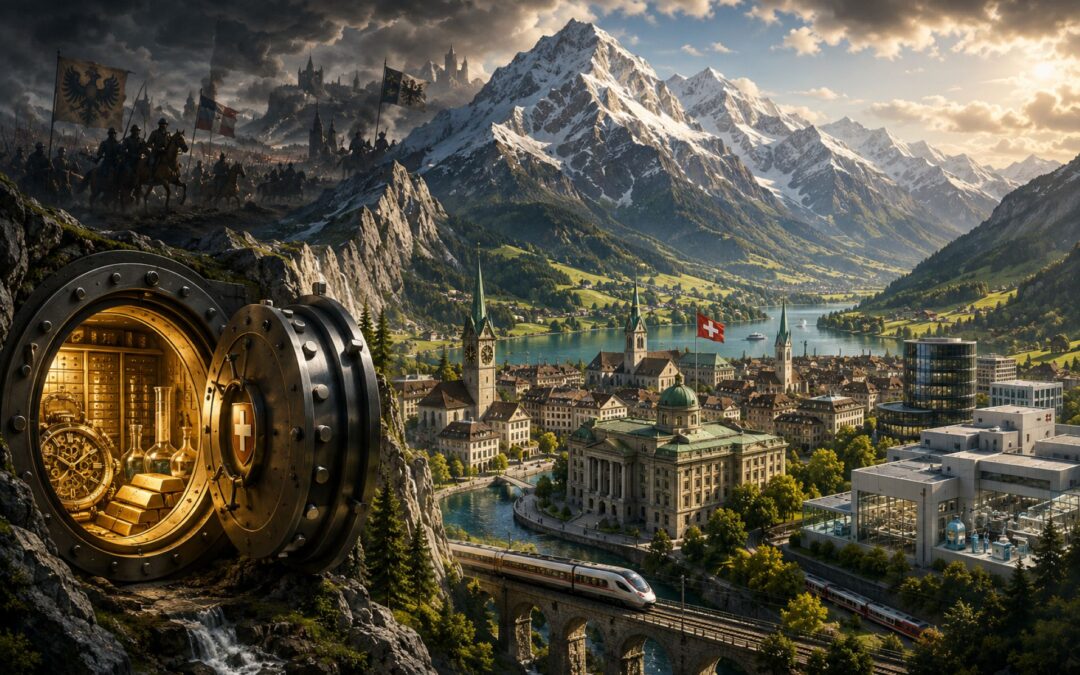
Switzerland is one of the richest countries in the world, yet its geography seems to work against it. It is landlocked, surrounded by larger European powers, divided by several languages, and lacks the abundant fossil fuels and mineral deposits that have helped other countries accumulate wealth. Much of its territory is mountainous, making construction, agriculture, and transportation more difficult.
Despite these disadvantages, Switzerland has developed some of the world’s most sophisticated industries, built an internationally important financial centre, and achieved exceptionally high living standards. Its banks manage enormous amounts of private wealth, its pharmaceutical companies and manufacturers compete globally, and its political institutions have earned a reputation for stability.
The explanation is more complicated than the familiar story of a neutral country that became rich by protecting other people’s money. Switzerland was once an aggressive military power, experienced foreign occupation and civil war, and industrialised long before modern private banking became its international trademark. Its prosperity emerged from centuries of political adaptation, commercial development, industrial specialisation, and integration into the wider European economy.
The Alpine Alliances That Became Switzerland
The origins of Switzerland are traditionally traced to 1291, when representatives of Uri, Schwyz, and Unterwalden supposedly gathered in a meadow overlooking Lake Lucerne and swore an oath of mutual assistance. According to the legend, these communities agreed to defend their freedoms against outside domination, particularly from the powerful Habsburg dynasty.
The story of the Rütli Oath became a central part of Swiss national identity, although historians distinguish the patriotic legend from the surviving documentary evidence. A Federal Charter dating from 1291 records an agreement between Alpine communities to cooperate in maintaining peace and security. As the Swiss government’s official history of the country explains, the Confederation emerged gradually from overlapping alliances between towns and rural territories rather than from one founding ceremony.
These alliances developed in a politically fragmented region of medieval Europe. The mountainous communities controlled important Alpine routes connecting northern and southern Europe, while surrounding dynasties sought to consolidate their authority. Cooperation allowed relatively small communities to defend local privileges and resist attempts to impose greater external control.
A defining early confrontation came in 1315 at the Battle of Morgarten, when forces associated with Schwyz and its allies defeated an army led by Leopold of Habsburg. Traditional accounts describe Swiss fighters using difficult terrain to overcome heavily armed opponents. Although the precise circumstances and casualty figures remain disputed, the battle became an important symbol of the Confederates’ ability to withstand more powerful adversaries.
The victory strengthened the reputation of the emerging alliance. Lucerne joined in 1332, Zurich followed in 1351, and Bern became part of the expanding Confederation in 1353. Over time, additional communities entered agreements that created a wider political network across the Swiss Plateau and Alpine regions.
Switzerland did not initially develop like France or England, where monarchies gradually centralised political power. Its Confederation remained a collection of communities with distinct governments, economic interests, and legal traditions. The cities of Zurich, Bern, Basel, and Geneva developed different commercial strengths, while the rural cantons retained considerable independence.
This decentralised origin helps explain why modern Switzerland has several important urban centres rather than one overwhelmingly dominant capital. Bern eventually became the seat of the federal government, but Zurich developed into the country’s principal financial centre, Geneva became an international diplomatic and financial hub, and Basel emerged as an important industrial centre.
The early Confederation was not particularly wealthy or peaceful. Nevertheless, its geography encouraged cooperation over trade routes, while its political structure established a tradition of bargaining between communities that would later become central to Swiss governance.
From Swiss Conquests to Armed Neutrality
Modern Switzerland is closely associated with neutrality, but the early Confederation had a formidable military reputation. During the fifteenth century, Swiss forces expanded their territory, defeated powerful rivals, and became some of Europe’s most feared infantry.
Swiss soldiers were especially effective in formations armed with long pikes and halberds. Their disciplined infantry tactics helped them challenge armies that depended heavily on aristocratic cavalry and traditional forms of medieval warfare. Victories over Habsburg forces and the armies of Charles the Bold of Burgundy established the Swiss as a significant military power.
By the early sixteenth century, Swiss expansion had reached northern Italy. Confederate forces intervened in the struggle for control of Milan, sometimes acting independently and sometimes supporting larger European powers. Their success demonstrated how far the once-small Alpine alliances had developed into an influential military force.
However, this expansion faced a decisive setback in 1515 at the Battle of Marignano, where French forces defeated the Swiss near Milan. The defeat undermined the Confederation’s ambitions in northern Italy and encouraged a more cautious approach to territorial expansion.
Marignano is often described as the moment Switzerland became neutral, but that interpretation compresses a much longer historical process. The Swiss did not immediately abandon all foreign military involvement, and neutrality was not yet the settled constitutional and diplomatic principle it would later become.
Instead, Swiss military strength found another market: foreign armies.
For centuries, European rulers recruited Swiss soldiers as mercenaries. Their reputation for discipline and battlefield effectiveness made them attractive to monarchs who wanted reliable professional infantry. Swiss military service abroad became an important source of income for soldiers, officers, and influential families.
Entire formations could serve foreign powers under arrangements negotiated with Swiss authorities and military entrepreneurs. These units sometimes fought on opposing sides of European conflicts, revealing the tension between the Confederation’s emerging political independence and the commercial importance of foreign military service.
The most recognisable surviving example is the Pontifical Swiss Guard, which continues to protect the pope in Vatican City. Other forms of organised foreign military service eventually disappeared as Switzerland developed stricter rules governing its citizens’ participation in foreign armies.
Meanwhile, neutrality evolved through the religious and political conflicts of early modern Europe. The Confederation avoided direct participation in the Thirty Years’ War, which devastated much of Central Europe between 1618 and 1648. Avoiding such conflicts demonstrated the advantages of staying outside struggles between much larger powers.
The Swiss government’s explanation of its policy of neutrality identifies the seventeenth century as a particularly important period in the development of the country’s neutral foreign policy.
Nevertheless, Switzerland could not always protect itself from European upheaval. In 1798, French revolutionary troops invaded, bringing down the old Confederation and establishing the Helvetic Republic.
The new government attempted to replace the loose alliance of cantons with a centralised state. It promoted legal equality and introduced substantial institutional reforms, but the experiment generated resistance from communities accustomed to governing themselves.
In 1803, Napoleon replaced the centralised republic with a more decentralised constitutional arrangement under the Act of Mediation. The experience demonstrated that neither complete cantonal independence nor an imposed unitary state could easily resolve Switzerland’s competing political interests.
After Napoleon’s defeat, the European powers reorganised the continent at the Congress of Vienna. In 1815, Switzerland’s independence and permanent neutrality received international recognition, establishing an important foundation for its later security policy.
Neutrality did not make Switzerland invulnerable, nor did it remove the need for military preparedness. Switzerland developed a policy of armed neutrality, maintaining defensive capabilities while generally avoiding participation in wars between other states.
This policy reduced certain geopolitical risks and eventually contributed to Switzerland’s attractiveness as a location for international commerce and finance. But it was only one part of a much broader transformation.
The Federal Reforms That Made a Fragmented Country Work
Switzerland’s political fragmentation remained a serious obstacle to economic development well into the nineteenth century. The cantons possessed considerable autonomy, and internal differences in laws, currencies, customs arrangements, and commercial regulations complicated trade across what is now a single country.
Religious divisions made political cooperation even more difficult. Protestant and Catholic cantons often disagreed over the relationship between church and state, the distribution of political authority, and the future of the Confederation.
These tensions culminated in the Sonderbund War of 1847, when an alliance of conservative Catholic cantons confronted federal forces supporting a more centralised liberal constitutional order. The conflict was brief, but its consequences were profound.
In 1848, Switzerland adopted a new federal constitution that established the foundations of the modern Swiss state. The Confederation gained stronger national institutions while the cantons retained considerable authority over matters such as education, local administration, and taxation.
This arrangement provided something Switzerland had previously lacked: a stronger common economic and political framework without requiring every region to surrender its identity.
The federal government could improve conditions for internal commerce, while reforms gradually created a more integrated national market. The Swiss franc, introduced in 1850, replaced a confusing monetary system in which numerous different coins had circulated. Greater monetary consistency reduced transaction costs and simplified business dealings between cantons.
The federal constitution also helped create a more predictable legal environment for infrastructure investment, banking, industrial expansion, and trade. These developments are documented in the Swiss government’s history of Switzerland in the nineteenth century.
Another defining feature of Swiss governance was the gradual expansion of direct democracy. The revised constitution of 1874 strengthened citizens’ ability to challenge federal legislation through referendums, while the popular initiative introduced in 1891 enabled voters to propose constitutional amendments.
Unlike a purely representative system, Switzerland allows citizens to participate directly in important political decisions. However, this does not mean voters approve every government expenditure or that referendums automatically produce low taxes. Swiss fiscal policy is shaped by federal, cantonal, and municipal institutions, political preferences, and economic conditions.
Direct democracy also involves trade-offs. Public consultation can make major reforms slower and encourage compromise, but popular participation does not guarantee progressive outcomes.
Women did not receive the right to vote in federal elections until 1971, considerably later than in many other European democracies. The delay illustrates how institutions associated with political stability can also preserve existing inequalities.
Switzerland’s multilingual character created additional challenges. German, French, Italian, and Romansh became recognised national languages, while cantons maintained distinct linguistic and cultural identities. Rather than eliminating these differences, Switzerland developed institutions that enabled them to coexist within a common political system.
The economic importance of this arrangement should not be underestimated. Businesses benefit when commercial rules are reasonably predictable, political disputes can be managed without constant institutional breakdown, and different regions can participate in a common market.
Federalism did not create Swiss prosperity by itself, but it helped establish the conditions under which investment, industrial development, and long-term commercial relationships could flourish.
The Industries That Built Wealth Without Abundant Raw Materials
Switzerland’s banking reputation often obscures an essential fact: the country became an industrial economy before it became internationally synonymous with private wealth management.
Its early industrial development was particularly impressive because Switzerland lacked large domestic coal deposits and had comparatively limited supplies of major industrial minerals. Countries such as Britain and Germany could build heavy industries around extensive coal and iron resources. Switzerland had to develop a different economic structure.
One of its earliest advantages came from textiles. During the eighteenth and early nineteenth centuries, textile production expanded through rural workshops, merchant networks, and eventually mechanised factories. Cotton spinning and weaving became especially important in eastern and northern Switzerland.
Textile production created more than finished fabrics. It encouraged mechanical innovation because businesses needed equipment that could spin, weave, and process materials efficiently. Swiss manufacturers began producing and improving machinery rather than simply purchasing it from abroad.
Water was a particularly valuable resource. Rivers and streams provided power for early mills, and later hydroelectricity offered an important energy source for industrial development. Switzerland did not possess abundant fossil fuels, but its mountains and waterways were economically useful rather than merely obstacles.
The transition from textile machinery to broader engineering capabilities was crucial. Skills in metalworking, mechanical design, and precision manufacturing could be applied to new industries, allowing businesses to produce specialised equipment for increasingly demanding customers.
Watchmaking followed a related path of specialisation. Centres such as Geneva and the Jura region developed traditions of intricate mechanical craftsmanship, supported by networks of skilled artisans and specialist suppliers. As production methods evolved, Swiss companies combined precision engineering, technical innovation, and reputation to compete internationally.
Swiss watchmaking eventually became associated with expensive luxury goods, but the industry’s economic significance extended beyond prestigious consumer products. It helped cultivate capabilities in miniaturisation, mechanics, specialised materials, and quality control that were transferable to other sectors.
Chemical manufacturing also developed rapidly, particularly around Basel. Textile production had created demand for dyes and related chemicals, encouraging expertise that later supported pharmaceutical research and manufacturing. Over time, Swiss companies moved into increasingly sophisticated chemical and medical products.
The growth of industry required substantial infrastructure. Railways connected production centres, reduced transport costs, and improved access to foreign markets. The opening of the Gotthard railway tunnel in 1882 strengthened an important transportation route across the Alps, linking northern and southern Europe.
Railways also reshaped tourism. Mountain landscapes that had once been difficult and expensive to reach became accessible to growing numbers of visitors. Hotels, mountain railways, and resort towns developed around the country’s natural attractions.
Switzerland’s food industry benefited from similar changes. Improved transportation, commercial agriculture, industrial processing, and access to international markets supported companies producing dairy products, chocolate, and packaged foods. Businesses such as Nestlé expanded from specialised food products into international operations.
The growth of these industries was not without social costs. Nineteenth-century industrialisation involved long working hours, dangerous factories, poverty, and considerable inequality. Some Swiss citizens emigrated in search of better opportunities, while foreign workers played an important role in building the country’s infrastructure and supporting industrial expansion.
The development of public education, vocational training, and technical expertise helped Switzerland expand its industrial capabilities over subsequent generations. Businesses increasingly depended on workers who could operate sophisticated machinery, maintain exacting production standards, and develop specialised products.
Switzerland gradually established a competitive position in goods where technical quality, reliability, and expertise mattered more than access to inexpensive raw materials.
This was a powerful economic strategy for a small country. Raw materials could be imported, transformed through skilled labour and advanced production methods, and exported as goods with much greater value.
By building capabilities in machinery, chemicals, pharmaceuticals, watches, and other specialised products, Switzerland developed sources of prosperity that were independent of its later reputation as a financial safe haven.
How Swiss Banking Became a Global Safe Haven
Banking eventually became one of Switzerland’s most recognisable industries, but its development was closely connected to the broader economy.
During the nineteenth century, industrial expansion created increasing demand for capital. Factories needed machinery, railway companies required enormous investment, and expanding businesses depended on institutions capable of financing commercial growth.
Swiss banking developed partly in response to these needs. Private banks had long served merchants and wealthy families, while commercial banks emerged to finance infrastructure and industry. Savings, cooperative, and cantonal banks also expanded access to financial services beyond the wealthiest clients.
As Switzerland accumulated industrial expertise and financial capital, its institutions began attracting a wider international clientele.
The country’s neutrality and comparatively stable political institutions offered advantages in a continent repeatedly disrupted by war and political upheaval. Wealthy individuals and businesses could view Switzerland as a relatively predictable jurisdiction in which to maintain financial relationships.
Its multilingual character also helped. French-speaking Geneva could serve clients from France and other French-speaking regions, German-speaking Zurich had close connections with German-speaking Europe, and Italian-speaking Ticino maintained commercial links with Italy.
These relationships supported the emergence of Switzerland as an international financial centre. However, the development of banking secrecy eventually gave Swiss financial institutions an additional competitive advantage.
Confidentiality had been part of Swiss private banking before the twentieth century. In 1934, Switzerland adopted federal banking legislation that strengthened legal protections surrounding information about banking clients.
The origins of this law are frequently misunderstood. A popular explanation claims that banking secrecy was created primarily to protect Jewish assets from Nazi persecution. Historian Sébastien Guex, in his study of the origins of Swiss banking secrecy, challenges that interpretation and traces the law to broader financial, political, and international pressures.
Banking secrecy helped attract foreign assets at a time when European governments were introducing new taxes, expanding financial oversight, and confronting economic instability. For clients seeking discretion, Swiss banking institutions could offer legal protections that were difficult to obtain elsewhere.
Numbered accounts became associated with this culture of confidentiality. Such accounts limited the visibility of a client’s identity within ordinary banking operations, although the bank itself still had to know who owned the account. They did not create a legitimate system in which the bank had no record of its customer.
Switzerland’s financial reputation grew from a combination of discretion, specialised wealth-management services, international relationships, and institutional stability. Its banks became particularly important in managing investment portfolios for wealthy individuals and families.
Over time, this developed into an enormous international industry. According to the Swiss Banking Barometer 2026, banks operating in Switzerland managed approximately CHF 9.73 trillion in client assets at the end of 2025.
That figure requires an important distinction. Assets under management are not the same as the money owned by Switzerland’s government, the profits earned by Swiss banks, or the country’s gross domestic product. Much of the wealth belongs to domestic and foreign clients, and much of it consists of securities held in custody rather than cash deposits.
Swiss banking has also changed significantly. International pressure, financial scandals, and efforts to combat tax evasion have weakened the traditional secrecy model.
Under today’s automatic exchange of financial-account information, Switzerland shares specified account information with participating jurisdictions under international agreements. The legal framework entered into force in 2017, with the first exchanges taking place in 2018.
Swiss banks therefore remain important for international wealth management, but they cannot accurately be described as institutions that automatically shield all foreign customers from their home countries’ tax authorities.
Their continued competitiveness depends increasingly on investment expertise, service quality, international networks, and trust in the country’s financial and legal institutions.
The World Wars and the Darker Side of Swiss Neutrality
Switzerland’s ability to avoid direct participation in Europe’s major twentieth-century wars reinforced its international reputation for stability. However, its experience during these conflicts reveals that neutrality was neither effortless nor morally uncomplicated.
During World War 1, Switzerland was surrounded by countries participating in a devastating military conflict. Its multilingual population included communities with strong cultural connections to opposing belligerents, creating tensions over foreign policy and national loyalties.
The Swiss government mobilised its military and maintained formal neutrality. Although the country avoided becoming a battlefield, it still faced significant economic difficulties, including disruptions to trade, supply shortages, and social unrest.
At the same time, Switzerland’s financial institutions benefited from their ability to maintain relationships with international clients during a period of political and monetary uncertainty. Foreign wealth seeking relatively stable conditions contributed to the development of its financial sector.
The Second World War presented an even more serious challenge.
After Nazi Germany conquered much of continental Europe, Switzerland became surrounded by territories controlled by Germany, Italy, or their allies. The possibility of invasion was real, and Swiss authorities made extensive defensive preparations.
Military planners developed a strategy known as the National Redoubt, under which Swiss forces could withdraw into fortified Alpine positions if necessary. Mountain terrain, tunnels, and defensive infrastructure would make occupation more difficult and potentially costly for an invading army.
Nazi Germany considered military operations against Switzerland, but an invasion never occurred. The decision cannot be explained confidently by geography alone, since German strategic priorities, economic considerations, and military circumstances also mattered.
Although Switzerland remained outside the fighting, its economy was deeply connected to the surrounding Axis-controlled territories. Swiss companies traded with Germany, and the country’s financial institutions conducted transactions involving German assets.
These connections became the subject of substantial historical controversy after the war.
Swiss banks and financial institutions handled gold and other assets linked to Nazi Germany, including gold obtained through theft and the exploitation of occupied territories. Switzerland’s economic relationships with Germany therefore contributed to an international debate about the responsibilities of neutral states during wartime.
The treatment of Jewish refugees and financial assets also exposed serious failures. Switzerland admitted some people fleeing persecution but turned others away, including Jews attempting to escape Nazi-controlled Europe. After the war, difficulties surrounding dormant bank accounts and the property of Holocaust victims created further disputes.
These issues were investigated extensively by the Independent Commission of Experts Switzerland–Second World War, often called the Bergier Commission. Its examination of Switzerland’s relationship with National Socialism and the Second World War documented financial, economic, and humanitarian dimensions of the country’s wartime conduct.
The commission’s work challenged an overly reassuring national narrative in which Switzerland had simply remained uninvolved while protecting everyone who sought refuge within its borders.
The historical record is more complicated. Switzerland maintained its independence and avoided the widespread physical destruction experienced by many European countries, but its financial relationships, commercial transactions, and refugee policies created serious questions about neutrality and responsibility.
Following World War II, Switzerland emerged with much of its infrastructure, industrial capacity, and financial system intact. This provided significant economic advantages at a time when many neighbouring countries were rebuilding cities, factories, transportation networks, and public finances.
Swiss businesses were well positioned to participate in Europe’s postwar recovery, while the country’s financial institutions continued attracting international customers.
Avoiding destruction helped preserve accumulated capital, productive capacity, and commercial relationships. Nevertheless, the advantages of wartime survival cannot be separated from the ethical controversies surrounding how Switzerland operated during the conflict.
Swiss neutrality contributed to its economic success, but understanding that success requires acknowledging both the security it provided and the compromises made in maintaining it.
Why Switzerland Is Rich Today Beyond Banking
Modern Switzerland’s prosperity is supported by a much broader economy than private banking.
The country remains an important centre for financial services, but it is also home to globally competitive manufacturers, pharmaceutical companies, research institutions, engineering businesses, and specialised service providers.
The scale of its industrial economy is especially revealing. According to Switzerland’s official foreign trade results for 2025, goods exports reached approximately CHF 287 billion, setting a new record.
Chemicals and pharmaceuticals accounted for roughly 53% of these exports. Their importance demonstrates how far Swiss industry has developed beyond its traditional association with watches, chocolate, and precision machinery.
Pharmaceutical manufacturing involves sophisticated research, complex production processes, strict quality standards, and substantial investment in scientific expertise. Companies operating in these industries can generate high economic value from relatively small quantities of physical products.
This pattern is particularly advantageous for a country with limited territory and expensive labour. Switzerland does not need to compete primarily by producing enormous volumes of low-cost commodities. It can concentrate on goods and services for which technical sophistication, intellectual property, and reliability command a premium.
Precision manufacturing remains another important capability. Swiss companies produce specialised machinery, instruments, components, and industrial equipment used across international supply chains.
Watchmaking continues to demonstrate the value of this specialisation. Although watches are a relatively small component of total Swiss exports compared with pharmaceuticals, premium Swiss brands have developed internationally recognised reputations for craftsmanship, mechanical expertise, and quality.
These industries depend on sustained investment in education and technical skills. Switzerland’s vocational training system combines classroom instruction with practical workplace experience, helping businesses develop workers whose qualifications align with industrial needs.
Universities and research institutions also contribute to the country’s technological capabilities. Organisations such as ETH Zurich and EPFL support advanced scientific research and innovation, while commercial companies transform research into products and services.
In the Global Innovation Index 2026, Switzerland ranked first for the sixteenth consecutive year. Such rankings do not mean the country leads in every technology or produces more inventions than all larger economies, but they reflect the strength of its wider innovation environment.
Switzerland’s transportation infrastructure also supports its economy. Its railway network connects cities, industrial regions, and international routes, while Alpine tunnels enable goods and passengers to cross terrain that would otherwise create major barriers.
This infrastructure is particularly important for a landlocked export economy. Reliable transport allows businesses to import raw materials, distribute manufactured products, and maintain connections with European customers and suppliers.
Tourism adds another source of income. The Alps, lakes, mountain resorts, historic towns, and high-quality transportation services attract visitors who support hotels, restaurants, mountain railways, and related businesses.
The country’s dairy and food industries also benefit from established agricultural traditions and strong international brands. Chocolate and cheese may occupy a prominent place in Switzerland’s global image, but their economic role sits alongside much larger and more technologically intensive sectors.
What connects these industries is a consistent economic pattern: Switzerland frequently competes through specialisation, quality, expertise, and high value added rather than simply through low production costs.
Banking, manufacturing, tourism, education, and research reinforce one another. Advanced businesses generate demand for specialised financial services, financial institutions help mobilise investment, and a skilled workforce supports the development of increasingly sophisticated industries.
Switzerland’s modern wealth is therefore best understood as the result of an interconnected economic system rather than a single profitable national speciality.
The Strengths and Vulnerabilities of the Swiss Model
Switzerland’s approach to international relations reflects the same preference for political autonomy that has shaped its domestic institutions.
Despite being located in the centre of Europe, Switzerland is not a member of the European Union. It participates in the European Free Trade Association and maintains an extensive network of bilateral agreements with the EU, allowing close economic cooperation without accepting the entire framework of EU membership.
This distinction matters because Switzerland depends heavily on foreign markets. Its manufacturers sell products internationally, its banks serve customers across borders, and many Swiss businesses rely on workers, materials, and commercial relationships originating elsewhere in Europe.
The country has therefore sought to balance independence with economic integration rather than pursuing complete isolation.
A similar approach shaped its participation in international institutions. Switzerland joined the League of Nations in 1920 and became an important centre for international diplomacy, particularly in Geneva. However, it did not join the United Nations as a full member until 2002, despite hosting major UN institutions for decades.
Its eventual membership reflected the recognition that neutrality did not necessarily require avoiding international organisations devoted to diplomacy and cooperation.
Switzerland’s political and economic institutions offer significant advantages. Its stable legal framework, developed infrastructure, sophisticated industries, and strong international commercial relationships support high productivity and economic resilience.
However, the Swiss model is not immune to problems.
The collapse of Credit Suisse as an independent bank in 2023 demonstrated that a country’s historical financial reputation does not guarantee the safety or sound management of every institution operating within it. Years of strategic difficulties, scandals, management failures, and declining confidence culminated in an emergency takeover by UBS.
The crisis exposed weaknesses in banking supervision, corporate governance, and the management of large financial institutions. It also demonstrated the potential risks of having exceptionally important banks whose difficulties can threaten wider financial stability.
Beyond banking, Switzerland faces problems associated with its own prosperity. Housing is expensive in major cities and desirable tourist destinations, while businesses in some sectors struggle to recruit sufficiently skilled workers.
High wages and living costs can create difficulties for industries that cannot achieve the productivity levels of Switzerland’s leading exporters.
The OECD Economic Survey of Switzerland 2026 highlights several challenges, including uneven productivity growth, housing shortages, skills constraints, and the need to improve regulatory and administrative efficiency.
The OECD also emphasises the country’s exposure to international economic uncertainty. Switzerland is wealthy partly because it has integrated successfully into global markets, but that integration also leaves it vulnerable to trade disputes, geopolitical instability, and weaker foreign demand.
Its prosperous pharmaceutical companies, engineering businesses, and financial institutions cannot operate independently of the international economy.
Political institutions can create additional tensions. Federalism and direct democracy encourage participation and compromise, but complicated decision-making arrangements can sometimes slow reforms. Different cantonal regulations can also increase costs for businesses and infrastructure projects.
Switzerland must therefore continually adjust the institutions and economic capabilities that helped it become wealthy. Preserving stability does not mean resisting every change, and maintaining independence does not eliminate the necessity of international cooperation.
Its future prosperity will depend on remaining innovative, maintaining high levels of education and productivity, managing financial risks, and preserving access to the foreign markets on which much of its economy relies.
Switzerland’s success is substantial, but it is not automatic or permanent. It must be sustained through the same institutional adaptability and economic specialisation that made it possible in the first place.
Switzerland did not become one of the world’s richest countries simply because it stayed out of wars, established confidential bank accounts, or possessed beautiful mountain scenery. Those factors contributed to its development, but the foundations of its prosperity were considerably broader.
Its early communities established forms of political cooperation that eventually evolved into stable federal institutions. Its businesses responded to limited raw materials by developing industries based on craftsmanship, engineering, scientific expertise, and high-value production. Its financial institutions grew alongside those industries before becoming important participants in international wealth management.
Neutrality helped the country avoid some of Europe’s most destructive conflicts, although the historical record also reveals the costs and controversies associated with maintaining that position.
Switzerland’s greatest economic achievement was not overcoming geography through one extraordinary decision. It was developing institutions, skills, infrastructure, and industries capable of creating substantial wealth despite geographical constraints.
Its history demonstrates that natural resources can support prosperity, but the ability to organise people, knowledge, capital, and technology into highly productive economic activity can be just as important.
Last Updated on October 21, 2026 by Aseem Gupta