
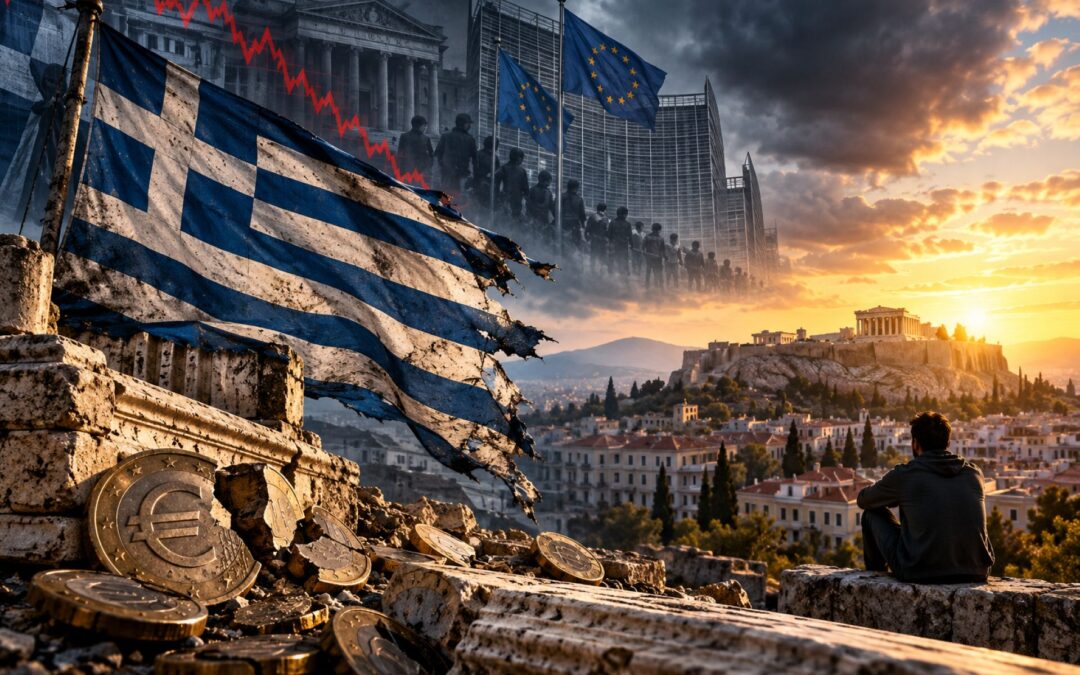
In 2001, Greece joined the euro, gaining access to a currency backed by some of the world’s strongest economies. Borrowing became cheaper, investment increased, and the country appeared to be entering an era of prosperity. Less than a decade later, Greece was approaching bankruptcy, its financial credibility had collapsed, and the stability of the entire eurozone was in question.
What followed was one of the most devastating economic crises in modern European history. Greece required three international rescue programmes, endured years of austerity, and experienced an economic contraction comparable in scale to the Great Depression. Unemployment reached extraordinary levels, businesses closed, and hundreds of thousands of people left the country seeking better opportunities.
The Greek debt crisis was not caused by a single dishonest government, an investment bank, or an unfortunate global recession. It emerged from a combination of persistent fiscal weaknesses, misleading financial reporting, excessive borrowing, structural problems within the eurozone, and rescue policies that proved far more damaging than initially expected.
Understanding how these failures interacted explains not only why Greece collapsed, but also why saving the country became such a prolonged and painful undertaking.
Greece Joined the Euro With Debt Already High
The origins of the Greek debt crisis lie partly in Europe’s ambitious decision to create a common currency. Following the Cold War, European leaders believed that deeper economic integration could strengthen trade, encourage investment, and bring the continent closer together politically.
The euro was introduced as an electronic currency in January 1999, initially replacing national currencies for accounting and financial transactions. Euro banknotes and coins would arrive in 2002. Instead of constantly exchanging currencies and managing fluctuating exchange rates, participating countries could operate within a single monetary system.
However, sharing a currency required a degree of economic discipline. If one participating government accumulated unsustainable debts, the consequences could extend beyond its own borders.
The Maastricht convergence criteria established several conditions for joining the euro. Government budget deficits were generally expected to remain below 3% of gross domestic product, while public debt was supposed to stay below 60% of GDP or be declining sufficiently toward that reference level. Countries also had to demonstrate price stability, manageable long-term interest rates, and exchange-rate stability.
Greece faced considerable difficulties meeting these requirements.
The country had struggled with inflation, persistent budget deficits, weak tax administration, and a large public debt burden. Political patronage, inefficient public institutions, and difficulties collecting taxes undermined government finances. Successive administrations had relied heavily on borrowing to support public expenditure.
Greece had been a member of the European Economic Community since 1981, but entry into the single currency was a separate decision. During the late 1990s, the government introduced measures intended to reduce inflation and fiscal deficits, bringing its reported performance closer to the eurozone’s requirements.
Nevertheless, Greek public debt remained exceptionally high. It was approximately 104% of GDP in 1999, far above the Maastricht reference level.
Despite these concerns, European authorities concluded that Greece had achieved sufficient convergence. The European Council formally approved its admission in June 2000, as recorded in the decision authorizing Greece to adopt the single currency.
Greece adopted the euro on January 1, 2001.
The decision was celebrated as a major national achievement. Membership promised greater financial stability, easier access to European markets, and closer integration with the continent’s wealthiest economies.
Yet the fundamental challenge was never simply whether Greece could qualify for the euro. It was whether the country’s economy and public finances were strong enough to function sustainably inside the monetary union.
The years that followed would reveal how significant that distinction was.
Cheap Credit Concealed Deeper Economic Weaknesses
Joining the euro transformed the way financial markets perceived Greece.
Before adopting the single currency, Greece generally faced substantially higher borrowing costs than economically stronger European countries. Investors demanded higher interest rates because they worried about inflation, currency depreciation, and the government’s ability to repay its obligations.
Euro membership appeared to reduce some of those risks. Greece now borrowed in the same currency as Germany, France, and other eurozone economies, encouraging investors to treat Greek government bonds as considerably safer than before.
Interest rates fell, making it easier for the government, businesses, and households to borrow money.
Lower borrowing costs can benefit an economy by encouraging productive investment and reducing debt-servicing expenses. In Greece, however, easier credit also allowed long-standing weaknesses to persist without immediately producing a financial emergency.
Government spending remained high, while tax collection continued to suffer from evasion, administrative weaknesses, and the political difficulty of reforming established arrangements. Public-sector compensation, pension commitments, and other recurring expenditures created substantial obligations.
Meanwhile, the economy was becoming less competitive relative to several northern European countries.
Wages and domestic prices increased without equivalent improvements in productivity across the economy. Greek businesses consequently faced difficulties competing internationally, while households and companies could more easily purchase imported goods.
The result was a widening current account deficit, meaning Greece was spending more on goods, services, and income payments abroad than it was earning from the rest of the world. The difference had to be financed through foreign borrowing and investment.
This distinction matters because Greece’s problem was broader than government overspending. Both public finances and the economy’s dependence on external financing made the country vulnerable to a sudden reversal in investor confidence.
Financial reporting further obscured the risks.
In 2001, the Greek government entered into complex cross-currency swap transactions arranged by Goldman Sachs. Such instruments ordinarily allow borrowers to exchange payment obligations denominated in different currencies, helping them manage exchange-rate exposure.
The Greek arrangements, however, involved unusual exchange rates and accounting treatments that helped obscure the true extent of certain financial obligations. They effectively brought financing forward while creating costs that would materialize later.
These transactions subsequently became an important example of the weaknesses in Greece’s fiscal transparency.
One crucial historical detail is frequently misunderstood: the best-documented Goldman Sachs transactions occurred after Greece entered the euro. They therefore cannot be treated as the mechanism that originally secured the country’s admission. Contemporary reporting on the transactions and their chronology, including The Guardian’s examination of the Goldman Sachs deal, helps establish this distinction.
The swaps were significant because they demonstrated how financial engineering and inadequate disclosure could make government finances more difficult to understand. They were not, by themselves, large enough to explain the entire Greek debt crisis.
The atmosphere of optimism was particularly visible when Athens hosted the 2004 Summer Olympics.
Greece had won the right to host the Games in 1997, before entering the euro. Organizing the event involved major public investments in sporting venues, transportation, security, and other infrastructure.
The Olympics represented a chance for modern Greece to celebrate its historic cultural importance and demonstrate its place within contemporary Europe. However, preparations also involved substantial spending and cost overruns, adding pressure to public finances.
Olympic expenditure contributed to Greece’s fiscal difficulties, but it would be misleading to identify the Games as the principal cause of the subsequent collapse. The country’s debt, competitiveness problems, and institutional weaknesses were much broader and more persistent.
For much of the 2000s, the economy appeared healthy on the surface. Consumption increased, construction and service industries expanded, and rising incomes created a sense of progress.
Yet prosperity depended partly on continued access to affordable financing.
As long as investors remained willing to lend, Greece could refinance existing obligations and support its growing economy. When international confidence disappeared, weaknesses that had been manageable during the boom would become extraordinarily difficult to address.
The Numbers That Broke Investor Confidence
The global financial crisis of 2008 exposed vulnerabilities across the international economy. Banks suffered severe losses, credit markets tightened, businesses reduced investment, and economic activity contracted.
For Greece, the international downturn was particularly dangerous because the country depended heavily on sectors sensitive to global demand.
Tourism weakened as consumers in other countries reduced discretionary spending. International shipping, another important Greek industry, suffered as global trade declined. Lower economic activity reduced tax revenues precisely when the government was already struggling to finance its obligations.
Greece’s problems were different from those of the American banks at the centre of the original crisis. The country’s immediate danger came from its public finances and dependence on borrowing, although the global financial shock helped trigger the loss of confidence.
The decisive turning point arrived in October 2009, following a change of government.
Prime Minister George Papandreou’s newly elected administration revealed that Greece’s budget deficit was substantially larger than previously reported. Initial revisions placed the deficit at approximately 12.7% of GDP, far above earlier expectations.
Further investigations and statistical revisions revealed an even more serious situation. By November 2010, the estimated deficit for 2009 had been revised to 15.4% of GDP, while the estimated public debt ratio had also increased substantially.
The problem was not merely that Greece had borrowed too much. Investors and European institutions could no longer confidently trust the financial information on which earlier lending decisions had been based.
Eurostat investigated repeated weaknesses in Greek government accounting, including inadequate reporting procedures, statistical misclassification, and political interference. Its 2010 report on Greek government deficit and debt statistics documented how unreliable official information had become.
Financial markets reacted by demanding increasingly high interest rates on Greek government bonds.
The mechanism was straightforward. If investors believed Greece might be unable to repay its debts, they would lend only at higher interest rates to compensate for the additional risk. Higher borrowing costs then made repayment more difficult, reinforcing the original fears.
This created a dangerous feedback loop: doubts about solvency raised financing costs, and rising financing costs made insolvency more likely.
Credit rating downgrades intensified the problem, further reducing investor appetite for Greek debt. By early 2010, Greece was losing the ability to refinance its obligations through ordinary financial markets.
A Greek default would also threaten other European economies.
Banks and financial institutions across Europe held Greek government bonds. A disorderly failure to repay them could generate losses, destabilize banking systems, and encourage investors to question the finances of other heavily indebted eurozone countries.
Portugal, Ireland, Spain, and Italy faced different economic problems, but policymakers feared that panic over Greece could spread through financial markets.
What began as a sovereign debt crisis in a relatively small European economy had become a threat to the monetary union itself.
Why Europe Rescued Greece in 2010
By the spring of 2010, Greece could no longer realistically rely on financial markets to provide the money needed to meet its obligations.
The country faced several deeply unattractive possibilities. It could default on government debt, attempt a severe and immediate reduction in public spending, or seek outside financial assistance.
A disorderly default threatened Greek banks, pension funds, government services, and the wider European financial system. Abruptly eliminating the budget deficit without financial support would also have required enormous spending cuts and tax increases.
European governments therefore organized an international rescue.
In May 2010, eurozone countries and the International Monetary Fund agreed to a financing package commonly described as €110 billion. The arrangement was intended to provide emergency funding while Greece implemented measures designed to restore confidence and improve its finances.
The programme was overseen by the institutions commonly called the Troika: the European Commission, the European Central Bank, and the IMF.
Although these institutions worked together, they had different responsibilities. The European Commission helped coordinate the economic programme, the ECB was responsible for eurozone monetary policy and played a central role in financial stability, and the IMF provided lending and technical assessments.
The loans came with substantial conditions.
Greece was expected to reduce its budget deficit, increase revenues, control public spending, and undertake reforms involving taxation, pensions, labour markets, and public administration.
The underlying argument was that restoring fiscal discipline would convince investors the government could eventually manage its obligations without emergency assistance.
There was an economic rationale for demanding adjustment. Greece could not indefinitely finance large deficits through new borrowing, and weaknesses in its institutions and tax system required reform regardless of the immediate crisis.
European taxpayers were also assuming financial risks by supporting a government that had previously provided unreliable fiscal information. Creditor countries feared that unconditional assistance would encourage further irresponsible borrowing elsewhere in the eurozone.
However, the rescue also protected financial institutions holding Greek debt.
If Greece received emergency loans, it could continue making payments to existing creditors rather than defaulting immediately. This reduced the risk of losses spreading through European banks and financial markets.
As a result, the distribution of costs became deeply controversial.
Supporters argued that preserving financial stability prevented an even larger European crisis. Critics maintained that the initial programme postponed unavoidable debt restructuring while protecting creditors and shifting more of the adjustment burden onto Greek society.
Both concerns were relevant. Financial stability was a legitimate objective, but it did not automatically mean that the rescue was designed in the best possible way.
The European Stability Mechanism’s historical account of financial assistance to Greece shows how the rescue effort ultimately developed into three successive programmes.
Importantly, announced programme amounts were not necessarily the sums actually transferred. Across the three programmes, Greece eventually received approximately €288.7 billion in emergency loans from euro-area facilities and the IMF.
These were loans rather than unconditional grants, although later adjustments to interest rates, repayment periods, and other terms provided substantial relief.
The central question was whether the conditions attached to this financing could restore the economy quickly enough to make its debt sustainable.
The first programme failed to produce that recovery.
How Austerity Deepened the Downturn
Austerity became the defining economic policy of Greece’s rescue programmes.
The government raised taxes, reduced public-sector wages, cut expenditure, altered pension arrangements, and attempted to restructure public administration. These policies aimed to reduce fiscal deficits and convince creditors that Greece could eventually repay its debts.
The difficulty was that the measures were introduced while the economy was already contracting.
Government expenditure forms part of economic demand. When public authorities reduce purchases, salaries, and investment, households and businesses may receive less income. Higher taxes can also reduce private spending, leaving companies with fewer customers.
Businesses respond by postponing investment, cutting production, and reducing employment. Unemployed workers then spend less, which can weaken demand elsewhere in the economy.
Economists describe the relationship between an initial change in spending and its wider effect on national output through the fiscal multiplier.
A spending reduction of one euro does not necessarily reduce GDP by exactly one euro. Its effect depends on economic conditions, monetary policy, household behaviour, the financial system, and whether other forms of demand can compensate for the loss.
During a deep recession, when businesses have spare capacity, banks are reluctant to lend, and households are financially stressed, the negative effect of rapid fiscal consolidation can be particularly large.
Greece experienced these conditions simultaneously.
The government reduced expenditure and increased taxes, but economic activity weakened sharply. As unemployment increased and businesses closed, tax revenues came under further pressure. The financial system also struggled with bad loans, deposit withdrawals, and uncertainty about the country’s future.
There was another complication: austerity could improve the government’s deficit while worsening its debt-to-GDP ratio.
That ratio compares outstanding government debt with the annual value of the economy’s production. If GDP shrinks substantially, the ratio can rise even when the government is borrowing less.
For example, a country with €180 billion in debt and €200 billion in GDP has a debt-to-GDP ratio of 90%. If the economy contracts to €150 billion while debt remains at €180 billion, the ratio rises to 120% without any increase in the absolute debt stock.
Greece faced a more complicated version of this problem. Economic contraction weakened the denominator, while continuing borrowing needs, banking support, and other obligations also affected the amount of debt outstanding.
The economy contracted by roughly one-quarter between its pre-crisis peak and the mid-2010s, making Greece’s downturn one of the deepest experienced by an advanced economy in peacetime.
The decline was caused by several interacting forces, including lost financial confidence, restricted credit, declining private investment, political uncertainty, and the fiscal adjustment itself. Austerity was a major contributor, but it was not the only source of economic weakness.
Nevertheless, the depth of the recession demonstrated that the original rescue assumptions had been excessively optimistic.
The IMF subsequently acknowledged major weaknesses in programme design. Its 2013 evaluation of the first Greek bailout identified problems including delayed debt restructuring, inadequate attention to political realities, and the failure to restore growth and market confidence.
The question of whether Greece should have pursued a slower adjustment remains economically and politically contested.
Critics argue that rapid austerity weakened output so severely that it made debt sustainability harder to achieve. Earlier debt relief and a more gradual adjustment programme, they contend, could have reduced unnecessary economic destruction.
Defenders of the rescue approach counter that Greece had already lost market access and could not finance existing expenditure indefinitely. Without international lending, the country might have faced an even more abrupt fiscal collapse, widespread payment disruptions, and a banking emergency.
The distinction between necessary adjustment and poorly timed adjustment is therefore essential.
Greece needed stronger public finances and more effective institutions. But imposing multiple contractionary measures during a severe recession increased the danger that efforts to solve the fiscal problem would undermine the economy supporting those public finances.
Europe had encountered a related problem during the 1930s. As explained in how the Great Depression broke Europe, countries constrained by the gold standard sometimes struggled to respond to financial collapse because defending monetary arrangements took priority over supporting domestic economic activity.
The historical circumstances were different, but the underlying monetary constraint offered a useful comparison. Greece, like countries bound by fixed monetary arrangements during the Depression, could not independently devalue its currency to restore competitiveness.
Instead, adjustment had to occur through domestic wages, prices, spending, and economic activity.
By 2012, it was increasingly clear that the original programme had not resolved the country’s debt problem. Greece would need another rescue and a substantial restructuring of its obligations.
The 2012 Debt Restructuring and Its Human Cost
Greece’s second bailout programme was agreed in 2012, combining further international financing with a major restructuring of government debt.
The second rescue is often described as involving approximately €130 billion in additional commitments, although broader programme figures also included financing carried over from the first arrangement.
The crucial development was private-sector involvement, a debt restructuring in which participating holders of Greek government bonds accepted losses.
Under the March 2012 agreement, private bondholders accepted a 53.5% reduction in the face value of eligible bonds. The restructuring involved approximately €197 billion in privately held debt and produced a reduction in Greece’s debt stock of around €107 billion.
This was one of the largest sovereign debt restructurings in modern history.
However, the 53.5% reduction did not mean that half of all Greek public debt disappeared. It applied to the principal of the eligible private bonds involved in the exchange, while other obligations remained outside its scope.
The restructuring also created difficult consequences for financial institutions holding those bonds, including Greek banks and pension-related investors. Further support was needed to stabilize the banking system.
Debt reduction provided relief, but it could not immediately reverse years of declining economic activity.
As the country continued implementing reforms and fiscal consolidation, the social consequences became increasingly severe.
Greece’s unemployment rate reached approximately 27.5% in 2013. Youth unemployment climbed to exceptionally high levels, exceeding half of the labour force among young people in some periods.
These figures represented a profound disruption to ordinary life.
People who had expected stable careers found themselves without work for extended periods. Young graduates entered a labour market offering few opportunities, while experienced workers struggled to replace lost incomes.
Many businesses closed because customers no longer had enough money to sustain demand. Others faced financing difficulties, tax pressures, and uncertainty about whether the economy would recover.
Household incomes declined, poverty and material hardship increased, and families became more dependent on savings, pensions, informal assistance, and support from relatives.
Public services also came under pressure. Healthcare providers, schools, municipalities, and social programmes faced constrained budgets while the population’s needs were increasing.
The suffering was not distributed evenly.
People with secure financial resources could often protect themselves more effectively than unemployed workers, pensioners dependent on reduced benefits, or young people trying to establish independent lives.
Many Greeks chose to emigrate, particularly younger and highly educated workers who saw better employment opportunities elsewhere in Europe and beyond.
Emigration offered individuals a way to rebuild their careers, but it also deprived Greece of part of the workforce and skills needed for a sustainable recovery.
The European Court of Auditors’ investigation into the Greek adjustment programmes later identified important weaknesses in programme implementation and the achievement of economic objectives. Its findings reinforced concerns about the gap between the expected recovery and the actual social and economic outcomes.
Economic hardship soon reshaped Greek politics.
Traditional governing parties lost credibility among citizens who blamed them for earlier financial mismanagement and the continuing austerity programme. Protest movements expanded, while political parties across the ideological spectrum attracted support from voters frustrated with the existing political establishment.
The crisis also created opportunities for extremist movements, including the far-right Golden Dawn, which gained parliamentary representation during the period.
For many citizens, the problem was no longer simply whether Greece could repay its debts. It was whether the country’s political institutions could still protect their livelihoods and provide a believable path toward recovery.
That growing distrust would culminate in another confrontation with European creditors in 2015.
The 2015 Confrontation That Nearly Forced Grexit
By January 2015, Greece had endured several years of economic contraction, mass unemployment, and painful reforms. The public’s patience with the established political order had diminished sharply.
The left-wing Syriza party won the national election under Alexis Tsipras, promising to challenge austerity and negotiate a more favourable agreement with European creditors.
The new government argued that further spending cuts and tax increases would prevent Greece from recovering. It sought greater debt relief and more flexibility over the policies attached to international financial assistance.
European leaders were reluctant to abandon the existing programme conditions.
Governments that had provided financial support wanted assurances that Greece would meet its commitments. Some also feared that allowing one country to disregard agreed conditions could weaken confidence in the broader eurozone framework.
Negotiations became increasingly confrontational.
As uncertainty intensified, Greek depositors began withdrawing money from banks because they feared restrictions on access to savings or a possible departure from the euro.
The ECB faced difficult decisions concerning emergency liquidity support for Greek financial institutions. Meanwhile, the government was approaching important repayment deadlines without a sufficiently secure financing agreement.
On June 30, 2015, Greece failed to make a scheduled payment to the IMF.
The missed obligation was widely described as a default, although the IMF’s formal terminology was that Greece had fallen into arrears. This distinction matters because it identifies the precise institutional status of the unpaid obligation rather than treating every missed payment as legally identical.
Greece subsequently cleared its overdue IMF obligations on July 20, as confirmed by the IMF’s official statement on repayment of the arrears.
The banking crisis became visible in everyday life.
Greek authorities imposed capital controls and temporarily closed banks to slow the withdrawal of deposits and preserve financial stability. Cash withdrawals from ATMs were generally restricted to €60 per day, subject to practical exceptions and adjustments.
Citizens suddenly faced limits on access to their own money, while businesses encountered difficulties making payments and conducting ordinary transactions.
The government then held a referendum on July 5, 2015, asking voters whether to accept the bailout conditions proposed by creditors.
Approximately 61% of those voting rejected the proposal.
The result gave Tsipras a political mandate to resist the creditors’ demands, but it did not resolve the government’s financing difficulties. Greece remained dependent on emergency financial assistance, and prolonged uncertainty threatened the banking system and continued euro membership.
The possibility of a Greek exit from the eurozone, commonly called Grexit, became a central concern.
Leaving the euro might eventually have allowed Greece to introduce and devalue its own currency. However, such a transition also risked severe banking disruption, capital flight, legal disputes, and difficulties managing euro-denominated obligations.
Remaining inside the monetary union required reaching another agreement with creditors.
After intense negotiations, the Greek government accepted a new programme involving further fiscal and structural reforms, despite the referendum’s rejection of the earlier proposal.
The third bailout, agreed in August 2015, authorized up to €86 billion in assistance through the European Stability Mechanism.
Not all that money was ultimately needed or disbursed. Greece received approximately €61.9 billion under the third programme between 2015 and 2018.
The outcome was politically devastating for a government elected on the promise of ending austerity.
Tsipras had demonstrated that substantial opposition existed to the existing rescue conditions. However, Greece’s dependence on eurozone financing and financial stability limited the practical alternatives available to his administration.
The 2015 confrontation exposed how difficult it could be for a government to change economic policy while remaining dependent on institutions whose assistance came with conditions.
Could Greece’s Crisis Have Been Avoided?
The Greek debt crisis was not inevitable in every detail. Yet avoiding it would have required different choices by Greek governments, financial institutions, investors, and European policymakers over many years.
The first major problem was domestic fiscal and institutional weakness.
Greece entered the euro with high debt, persistent problems collecting taxes, and public institutions that were not consistently capable of managing financial obligations transparently.
Greater fiscal discipline, more reliable statistics, stronger tax enforcement, and earlier administrative reform could have reduced the country’s vulnerability.
The second problem was excessive financial confidence.
Euro membership lowered Greece’s borrowing costs, but investors often failed to distinguish adequately between countries sharing the same currency. The existence of a common currency did not eliminate differences in public finances, productivity, or economic competitiveness.
When investors eventually reassessed the risks, the change in borrowing conditions was sudden and destructive.
The third problem was the structure of the eurozone itself.
Countries using their own currencies can, under certain circumstances, allow exchange rates to depreciate or use independent monetary policy to respond to economic shocks.
Greece had surrendered that monetary independence by adopting the euro.
The ECB could provide monetary support to the eurozone as a whole, but Greece could not independently create euros or devalue a national currency. Its adjustment therefore depended more heavily on fiscal policy, wages, prices, structural reform, and assistance negotiated with European institutions.
The monetary union initially lacked sufficiently developed mechanisms for managing a sovereign debt crisis of this magnitude. European institutions subsequently introduced additional lending facilities, financial supervision, and crisis-management arrangements, partly in response to the weaknesses revealed by Greece and other eurozone emergencies.
The fourth problem was the design and timing of the rescue programmes.
Delaying debt restructuring while requiring rapid fiscal adjustment intensified the economic consequences. Once private creditors suffered losses in 2012, Greece had already experienced a severe contraction that made recovery substantially harder.
An earlier restructuring, more realistic growth assumptions, and better coordination between debt relief and fiscal reform might have reduced the damage.
There is, however, no painless alternative that can be established with certainty.
Defaulting earlier could have imposed larger immediate losses on banks and pension funds. Reducing austerity would have required creditors to provide financing for longer. Leaving the euro could have restored exchange-rate flexibility but introduced major financial and institutional risks.
Argentina’s earlier debt crisis offers a revealing comparison.
During the 1990s, Argentina operated a currency arrangement that fixed the peso to the US dollar. Its government accumulated serious financial vulnerabilities, and economic contraction made the fixed exchange-rate system increasingly difficult to sustain.
Argentina ultimately defaulted on sovereign debt in 2001 and abandoned the currency peg, allowing the peso to depreciate sharply.
The Federal Reserve Bank of San Francisco’s comparison of Greece and Argentina highlights the similarities between their financing problems while emphasizing the important differences in their economic circumstances.
Argentina had its own currency and could eventually abandon the peg, although doing so produced severe immediate disruption. Greece was part of a much more deeply integrated monetary union, making the consequences of introducing a replacement currency substantially more complicated.
Both crises demonstrated the dangers of large debts, weak confidence, and economic policies constrained by fixed monetary arrangements.
Neither provides a simple formula for avoiding financial collapse.
Greece’s experience suggests that preventing excessive borrowing and maintaining credible institutions are far less costly than attempting to restore confidence after an economy has entered a debt crisis.
It also shows that when rescue becomes unavoidable, the speed and distribution of adjustment can determine whether recovery begins relatively quickly or becomes a prolonged national disaster.
Greece After 2018: Recovery With Lasting Scars
Greece officially completed its third bailout programme on August 20, 2018, ending eight years of successive international rescue arrangements.
Leaving the programme did not mean its debts had disappeared. The country still owed substantial sums to official creditors, although long repayment periods, favourable interest rates, and subsequent debt-relief arrangements helped make those obligations more manageable.
Over time, Greece restored greater stability to its public finances and banking system.
The government improved its fiscal position, while renewed investment, tourism, exports, and broader economic activity supported recovery. International confidence gradually returned, and Greece regained investment-grade sovereign credit ratings after years of exclusion.
These developments represented a major change from the emergency conditions of 2010 and 2015.
Nevertheless, the recovery was slow and uneven.
The economy had lost an extraordinary amount of output during the crisis. Even when growth resumed, restoring employment, incomes, public services, private investment, and household wealth required sustained progress over many years.
Greece also faced the longer-term consequences of emigration, population aging, low productivity growth, and difficulties financing business investment.
The years spent in recession could not simply be recovered by returning to positive annual GDP growth.
By 2026, however, the country’s economic position had improved substantially.
In its May 2026 assessment of the Greek economy, the IMF reported real GDP growth of 2.1% in 2025 and projected growth of 1.8% for 2026.
Unemployment had fallen to approximately 8.9% in 2025, a dramatic improvement from the levels experienced during the crisis. The IMF projected a further decline to 7.4% in 2026.
Public debt remained large but had fallen substantially relative to the size of the economy. The IMF estimated government debt at 146.6% of GDP in 2025 and projected a decline to 136.6% in 2026.
These figures are important because they challenge the idea that Greece remained trapped in the economic conditions of the early 2010s.
The country had achieved meaningful fiscal stabilization, stronger market access, lower unemployment, and a more resilient financial system.
Yet major weaknesses persisted.
The IMF warned that income per person remained considerably below the economic trajectory implied by pre-crisis trends. Productivity growth and investment were still insufficient to close the gap, while demographic pressures, household financial constraints, and external imbalances posed continued challenges.
A falling debt ratio therefore did not automatically imply broad prosperity.
For a household facing expensive housing, limited savings, or wages that have not recovered sufficiently, improvements in financial indicators may feel less significant than they do to investors evaluating government bonds.
The distinction between national financial stability and living standards is central to understanding Greece’s recovery.
By 2026, Greece was no longer the country whose imminent default threatened the eurozone. It had regained substantial economic credibility and was better equipped to meet its obligations.
However, the crisis had permanently altered the financial expectations, employment histories, and opportunities of many of its citizens.
The most important consequence was not simply the amount of debt accumulated or repaid. It was the economic development and personal security that could not be recovered once so many years had been lost.
Greece’s crisis began with structural weaknesses that were repeatedly concealed or underestimated during an era of easy borrowing. It became catastrophic when the global financial shock exposed those weaknesses, markets withdrew confidence, and emergency measures intended to restore stability deepened an already severe recession.
The country was responsible for serious fiscal and institutional failures, but European creditors and international institutions also made decisions that shaped the crisis’s severity. Recognizing domestic mismanagement does not remove the need to examine the consequences of the rescue programmes, just as acknowledging the costs of austerity does not make Greece’s original borrowing sustainable.
The eventual recovery demonstrates that a country can restore financial credibility after an extraordinary economic collapse. It also shows that stabilization and recovery are different achievements, particularly when unemployment, emigration, and lost investment have damaged an economy’s productive capacity.
The Greek debt crisis ultimately reveals how expensive financial instability becomes when governments, creditors, and institutions delay confronting underlying problems. Preventing such a crisis requires credible economic management; resolving one requires policies that preserve enough economic activity and public trust for recovery to become possible.
Last Updated on October 21, 2026 by Aseem Gupta