
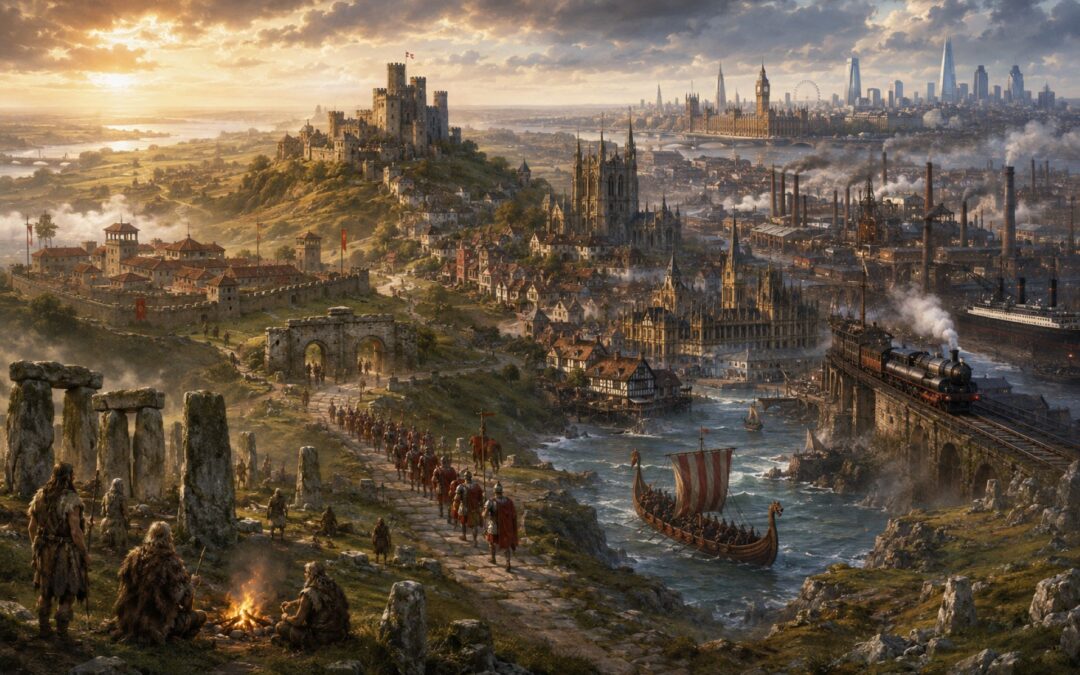
The history of the United Kingdom begins long before there was a United Kingdom—and even before Britain was permanently an island.
England, Britain, Great Britain, and the United Kingdom are often used as though they were interchangeable. They are not. England is one country. Great Britain is the island containing England, Scotland, and Wales. The Kingdom of Great Britain was created when England and Scotland formed a parliamentary union in 1707. The United Kingdom emerged only after Great Britain and Ireland were joined in 1801, before most of Ireland later left the union.
This distinction matters because the modern state was not founded at a single moment. It was assembled over centuries from different peoples, kingdoms, legal traditions, religious settlements, economic systems, and political bargains. Some of those arrangements were negotiated. Others were created through conquest, coercion, or war.
Nor was the process inevitable. Roman Britain could have developed differently. England might never have emerged from the rival kingdoms of the early medieval period. Scotland could have remained outside the political union. Ireland’s relationship with Britain might have taken another form. Even today, the future of the union remains contested.
The long chronology outlined by English Heritage’s history of settlement and political change reveals not the steady progress of one ancient nation, but repeated reconstruction. Britain was shaped by migration and environmental change, Roman occupation and withdrawal, Anglo-Saxon and Scandinavian settlement, Norman conquest, religious revolution, parliamentary conflict, industrialisation, imperial expansion, world war, decolonisation, and European integration.
The central thread is therefore not continuity alone. It is the repeated struggle over who belonged, who ruled, where authority came from, and what held the state together.
Britain Before Britain
The earliest human history of Britain was governed less by kings or borders than by climate.
Human groups reached the region hundreds of thousands of years ago, but occupation was not continuous. During colder periods, expanding ice and increasingly hostile conditions drove populations away. During warmer intervals, people returned from continental Europe. At times, the land that became Britain was connected to the European mainland, making migration possible across landscapes that are now beneath the North Sea.
These early inhabitants lived by hunting, scavenging, fishing, and gathering plants. Archaeologists have reconstructed their lives largely through surviving tools, animal remains, and traces of occupation. Stone hand axes, cutting implements, and exceptionally rare wooden weapons reveal considerable practical knowledge, but they do not support the idea of one continuous community that can simply be called the “first Britons.”
Different human populations arrived at different times. Neanderthals lived in the region during parts of the Ice Age, followed eventually by anatomically modern humans. Their movements depended on changing vegetation, animal populations, coastlines, and temperatures.
As the climate warmed after the last Ice Age, forests spread across the landscape. Hunters adapted from pursuing cold-climate animals such as reindeer to hunting deer and wild boar. Seasonal camps allowed groups to move between inland forests, rivers, and coastal areas without exhausting one environment. Fishing and shellfish gathering became increasingly important in some regions.
The most significant transformation came with the arrival of farming from continental Europe during the fourth millennium BCE. Agriculture did not appear because hunter-gatherers suddenly invented it in isolation. New people, knowledge, animals, crops, and customs entered Britain through wider European networks.
Cultivation changed the landscape. Communities cleared woodland, planted wheat and barley, and raised cattle, pigs, and sheep. More permanent forms of settlement became possible, although movement remained important. Farming also changed relationships with land. Fields, herds, storage sites, houses, and burial monuments created new claims over territory and new reasons for cooperation or conflict.
The Neolithic period also produced some of Britain’s most enduring monuments. Long barrows, causewayed enclosures, stone circles, and henges required organised labour extending beyond individual households. Stonehenge, constructed and altered over many generations, remains the most famous example. Its astronomical alignments and ceremonial landscape suggest ritual importance, but its precise meanings remain debated. It should not be reduced to a single function or treated as evidence of one unified religion.
The material record collected in the British Museum’s account of ancient Britain also shows how technology and exchange tied prehistoric communities to a much larger world. Pottery styles, burial practices, metal objects, and raw materials moved across considerable distances.
During the Bronze Age, metalworking transformed both everyday tools and symbols of status. Bronze required copper and tin, resources that were unevenly distributed. Their use therefore depended on mining, specialist knowledge, and long-distance exchange. Metal axes, swords, jewellery, and ceremonial objects reveal technical sophistication, but their survival can distort our view. Valuable metal objects were more likely than ordinary possessions to be deposited deliberately or recovered by archaeologists.
Settlements and agricultural boundaries became more visible. Some communities accumulated greater wealth, while weapons and defensive structures suggest that competition could become violent. Yet warfare was only one part of Bronze Age life. Farming, craft production, exchange, ritual, and kinship remained equally important.
Iron technology spread gradually during the first millennium BCE. Iron was more widely available than the ingredients required for bronze, although producing useful iron objects required specialised skill. Improved tools supported agriculture and woodland clearance, while hillforts and enclosed settlements became prominent features in some areas.
The peoples living in Britain before the Roman conquest are often grouped together as Celts, but the label can be misleading. There was no single Celtic kingdom controlling the island, nor one uniform people with a shared political identity. Britain contained numerous communities and regional societies connected through trade, language, custom, and rivalry. Some maintained close relationships with communities across the Channel.
Long before Rome arrived, Britain was neither isolated nor culturally static. Its inhabitants had spent millennia adapting ideas and materials from continental Europe. The Roman conquest would intensify those connections, but it did not introduce civilisation into an empty or primitive land.
Rome Conquers an Island, Not a Nation
When Julius Caesar crossed the Channel in 55 BCE, he did not discover an unknown island populated by a single barbarian people. Roman merchants and officials already knew that Britain existed, while communities on both sides of the Channel traded and maintained political relationships.
Caesar’s expeditions in 55 and 54 BCE were extensions of his campaigns in Gaul. He sought military prestige, intelligence, tribute, and leverage over British rulers who were connected to his continental enemies. The expeditions demonstrated Roman reach but did not result in permanent occupation.
Almost a century passed before Emperor Claudius launched a sustained invasion in 43 CE. Roman forces landed in southeastern Britain and advanced through a combination of military conquest, negotiated surrender, and alliances with local rulers. Claudius briefly appeared in Britain to associate himself with the victory, but the conquest continued for decades.
Resistance varied by region and circumstance. Some rulers cooperated with Rome. Others fought it. Caratacus led prolonged opposition before being captured and taken to Rome. The most famous uprising began in 60 or 61 CE under Boudica, queen of the Iceni, after Roman officials mistreated her family and attempted to absorb her late husband’s kingdom.
Boudica’s forces destroyed Camulodunum, Londinium, and Verulamium before being defeated by the Roman governor Suetonius Paulinus. Roman accounts claimed enormous losses, although their numbers should not be accepted uncritically. The rebellion was nonetheless a severe crisis, demonstrating that conquest had not secured consent.
Rome eventually governed most of present-day England and Wales, but control in the north remained difficult. Military campaigns reached into Scotland without permanently subduing the entire island. Hadrian’s Wall and, for a shorter period, the Antonine Wall marked not the boundary of civilisation, but the practical limits of sustained Roman administration.
Within the conquered territories, Roman rule transformed government, infrastructure, settlement, and trade. Londinium developed into an important commercial and administrative centre. Roads connected military forts, towns, ports, farms, and mining districts. Aqueducts, baths, amphitheatres, temples, and planned streets introduced new forms of urban life.
These developments did not simply replace British society with Roman society. Roman Britain was created through interaction. Local elites adopted Roman goods, architecture, language, and legal practices partly because cooperation could preserve or increase their status. Soldiers and officials arrived from across the empire, bringing diverse religions and customs. Rural communities, meanwhile, experienced Romanisation unevenly.
Agricultural production expanded to support towns and armies. Mining intensified. Coinage circulated more widely. Taxes and imperial administration linked Britain to an economic system extending across Europe, North Africa, and the Middle East.
The benefits were distributed unequally. Roman order depended upon military force, taxation, slavery, and political hierarchy. Urban prosperity coexisted with exploitation. Cultural exchange did not eliminate resistance or erase local identities.
Christianity reached Roman Britain before imperial authority collapsed, although older religious traditions also continued. The later Roman period saw administrative division, political instability, raids, and pressure on the empire’s frontiers. Britain was occasionally detached from central Roman control by military usurpers before being recovered.
By the early fifth century, the Western Roman Empire could no longer maintain its position. Troops and resources were withdrawn, and local communities were increasingly expected to organise their own defence. Around 410, Roman imperial government in Britain effectively ended.
Rome’s departure did not make four centuries of occupation disappear. Roads continued to shape movement. Towns and fortified sites remained important, even when some urban centres declined. Christianity survived in parts of the island. Latin influenced language and administration. The memory of Roman authority would later inspire kings who sought to rule a politically unified Britain.
Yet Roman Britain did not become the United Kingdom, or even England. When imperial government receded, the island fragmented into competing societies. The political order that followed would be created from the struggles among Britons, incoming settlers, emerging kingdoms, and later Scandinavian armies.
Anglo-Saxons, Vikings, and the Making of England
The centuries after Roman withdrawal are sometimes presented as a sudden descent into darkness. The reality was more complicated.
Central imperial administration disappeared, long-distance trade diminished in some regions, and many Roman towns contracted. Written evidence became scarcer. But people did not forget agriculture, craft production, religion, or political organisation. New centres of power emerged, and old ones adapted.
Brittonic-speaking kingdoms developed in western and northern Britain. At the same time, groups traditionally identified as Angles, Saxons, and Jutes crossed the North Sea and settled in eastern and southern areas. Their arrival was not one coordinated invasion. It unfolded over generations through migration, military service, local alliances, conflict, and settlement.
Historians continue to debate its scale. Earlier accounts imagined the near-total displacement of the Romano-British population. Archaeological and genetic evidence suggests a more varied pattern in which significant migration occurred but newcomers also mixed with existing communities.
What emerged was a changing political landscape of small kingdoms. Kent, East Anglia, Northumbria, Mercia, Wessex, Sussex, and Essex became important at different times. Their rulers fought, intermarried, converted to Christianity, founded monasteries, and competed for influence.
Christianity arrived through more than one route. Missions connected southern kingdoms to Rome, while Irish and northern British traditions shaped conversion elsewhere. Monasteries became centres of learning, manuscript production, landholding, and political influence. Christianity also linked rulers to wider European institutions and provided new languages of kingship.
The period described by English Heritage’s account of early medieval England was therefore not simply a contest between isolated tribes. It was the gradual formation of kingdoms within European religious and commercial networks.
From the late eighth century, Scandinavian raiding introduced another major force. The attack on the monastery at Lindisfarne in 793 became a symbol of the Viking Age, but raids soon developed into campaigns of conquest and settlement.
In 865, the force remembered as the Great Heathen Army arrived in England. Over the following years, Scandinavian armies defeated or dominated several Anglo-Saxon kingdoms. Northumbria and East Anglia fell, while much of Mercia came under pressure. Wessex survived.
King Alfred of Wessex became the central figure in resisting further conquest. After being driven into a desperate position, he defeated the army of the Danish leader Guthrum at Edington in 878. Guthrum accepted baptism, and subsequent agreements helped define spheres of control.
Large parts of northern and eastern England fell within the region later known as the Danelaw. This was not one centrally administered Viking state, but an area where Scandinavian settlement, law, language, and political power became especially influential. Towns such as York, Lincoln, Derby, Leicester, Nottingham, and Stamford developed as important commercial and strategic centres.
Scandinavian settlers did not remain permanently separate from Anglo-Saxon populations. They farmed, traded, intermarried, converted to Christianity, and participated in local government. Their influence remains visible in place names, vocabulary, law, and regional identity.
Conflict nevertheless continued. Alfred reorganised military defence through fortified settlements and networks of obligation. His successors expanded Wessex’s authority. His daughter Æthelflæd, who ruled Mercia after her husband’s death, played a major role in campaigns against Scandinavian-controlled territories.
By the tenth century, rulers descended from the West Saxon royal house had extended their power across most of England. The expulsion of the last Scandinavian king from York in 954 was an important moment in political consolidation, but it did not end Scandinavian involvement.
Renewed Danish attacks eventually produced a Scandinavian monarchy over England. Sweyn Forkbeard briefly became king, and his son Cnut later ruled England as part of a wider North Sea empire. Cnut’s government demonstrated how thoroughly Scandinavian and English political worlds had become intertwined.
After the restoration of an English royal line, the death of Edward the Confessor in January 1066 created a succession crisis. Harold Godwinson became king, but his claim was challenged by Harald Hardrada of Norway and William, Duke of Normandy.
Harold defeated Hardrada at Stamford Bridge in September. Within weeks, he marched south to face William. The outcome at Hastings would transform England again.
By then, however, England already existed as a recognisable political kingdom. It possessed a monarchy, coinage, administrative divisions, taxation, legal customs, churches, and a developing sense of English identity. It had emerged not from ethnic purity but from centuries of migration, conflict, conversion, settlement, and political consolidation.
Conquest, Monarchy, and the Medieval State
The Norman Conquest began with a contested succession, but its consequences extended far beyond the crown.
William of Normandy claimed that Edward the Confessor had promised him the throne and that Harold Godwinson had sworn to support him. Harold’s supporters rejected that version of events. After William’s victory at Hastings on 14 October 1066, the conquest still had to be enforced across the kingdom.
The chronology of the succession crisis and Norman takeover reveals a prolonged process rather than one decisive battle. Rebellions continued, especially in the north. Norman forces answered resistance with castle building, land confiscation, military campaigns, and harsh repression.
A new aristocracy replaced much of the English landowning elite. William distributed estates among followers whose position depended upon royal favour and military service. Castles appeared across the landscape as instruments of defence, administration, intimidation, and control.
The Domesday survey of 1086 recorded landholdings, resources, obligations, and taxable value across much of England. It represented an extraordinary exercise in royal information gathering. Norman government built upon existing English institutions while placing them under a new ruling class.
The social order is often described as feudal, although the term can create a misleading impression of one uniform system. Relationships among kings, lords, knights, tenants, and peasants varied. Landholding carried obligations, while many rural people owed labour, rent, or service. Some were legally unfree. Others possessed more bargaining power.
The Norman ruling dynasty also connected England more closely to continental politics. English kings governed territories in France, and disputes over inheritance repeatedly drew the kingdom into European wars.
When Henry I died without a legitimate son, rival claims by his daughter Matilda and his nephew Stephen produced a civil war known as the Anarchy. Royal authority weakened, local conflicts intensified, and neither side achieved immediate dominance. The eventual settlement allowed Matilda’s son to succeed as Henry II in 1154.
Henry II expanded royal justice and administrative authority. Travelling judges, standardised legal procedures, and the development of common law strengthened the crown. Yet his attempt to control the Church brought him into conflict with Thomas Becket, Archbishop of Canterbury.
Becket was murdered in Canterbury Cathedral in 1170 by knights who believed they were acting in accordance with the king’s anger. Whether Henry explicitly intended his death remains disputed. The killing became a political and religious disaster for the monarchy, turning Becket into a martyr.
The struggle over royal power intensified under King John. Military failures in France, financial demands, and arbitrary government alienated leading barons. In 1215 they forced John to accept Magna Carta.
The charter did not create democracy. It was originally designed to protect elite rights and regulate the king’s treatment of powerful subjects. Many of its clauses addressed specific medieval grievances. Yet Magna Carta established a principle with a far longer life: royal authority was not entirely above law.
That principle survived even though the original settlement quickly collapsed into war. Later generations reissued and reinterpreted the charter, turning it into a symbol of lawful government and limits on arbitrary power.
Parliament developed through similarly gradual processes. Kings needed revenue, advice, and political cooperation. Councils of nobles and clergy evolved, while representatives from counties and towns were increasingly summoned. Simon de Montfort’s Parliament of 1265 included knights and burgesses, but it was not a democratic assembly representing the population as a whole.
The long evolution of Parliament involved repeated disputes over taxation, representation, royal authority, and political consent. Parliament did not begin as the sovereign institution it later became. Its powers accumulated through precedent and conflict.
Medieval political development was repeatedly disrupted by war, famine, and disease. The Black Death reached England in 1348 and killed a devastating proportion of the population. It was caused by the bacterium Yersinia pestis, transmitted through complex interactions involving fleas, animals, and human contact.
Its economic effects were profound. Labour became scarcer, giving surviving workers greater leverage to seek higher wages or better conditions. Landowners and governments attempted to restrict mobility and control wages, provoking resentment.
The Peasants’ Revolt of 1381 grew from taxation, labour regulation, local grievances, and resistance to lordly power. Rebels entered London and demanded major social changes. The revolt was suppressed, but the social order could not simply return to its earlier form. Serfdom continued to decline over the following generations, although not solely because of the uprising.
The later Middle Ages were also marked by dynastic instability. The Wars of the Roses pitted competing branches of the royal family against one another, principally associated with Lancaster and York. These conflicts were not an uninterrupted national war but a series of political crises and battles shaped by noble alliances.
In 1485, Henry Tudor defeated Richard III at Bosworth. His victory founded a new dynasty and brought the main phase of the dynastic wars to an end.
By then, medieval England possessed stronger royal administration, a developing Parliament, common-law traditions, and a political culture in which rulers still needed cooperation from powerful groups. The monarchy remained formidable, but it was neither absolute nor institutionally isolated.
The Tudors would use these inherited institutions to centralise power more effectively. In doing so, they would also trigger a religious transformation that permanently changed England’s relationship with Europe and altered the political development of the entire archipelago.
The Tudors Remake Religion and Royal Power
Henry VII’s victory at Bosworth did not immediately guarantee stability. His claim to the throne was vulnerable, and rival claimants remained. He strengthened his position through careful finance, dynastic marriage, alliances, and control over the nobility.
His son, Henry VIII, inherited a more secure monarchy in 1509. Henry is often remembered through his six marriages, but the greatest consequence of his reign was institutional rather than romantic.
His marriage to Catherine of Aragon produced a surviving daughter, Mary, but no surviving son. Henry sought an annulment, arguing that the marriage had been invalid because Catherine had previously been married to his brother. The papacy refused to grant the outcome he wanted.
Henry’s response transformed the state. Through parliamentary legislation, the English Church rejected papal authority and recognised the king as its supreme head. The break with Rome did not initially make Henry a Protestant in doctrine, but it created a national church subject to royal control.
The dissolution of monasteries transferred enormous wealth and land from religious institutions to the crown and private owners. Monasteries had provided education, charity, employment, and local services as well as religious life. Their destruction therefore altered communities and redistributed power.
The Reformation also demonstrated how Parliament could be used to enact revolutionary changes in sovereignty. The crown was not merely ignoring Rome; it was redefining the source of legal and religious authority.
The Tudor state incorporated Wales more fully into the English legal and administrative system through legislation passed during Henry’s reign. Parliamentary representation was extended, one of the key stages in Britain’s developing constitutional structure. Yet incorporation did not erase Welsh language, culture, or identity.
Religious policy shifted sharply after Henry’s death in 1547. His young son Edward VI ruled through advisers committed to Protestant reform. English worship, doctrine, and church practice moved further from Catholic tradition.
Edward died in 1553 without an heir. An attempt to prevent his Catholic half-sister Mary from inheriting the throne placed Lady Jane Grey on the throne, but the plan collapsed within days. Mary gathered support, entered London, and became queen.
Mary I restored papal authority and Catholic worship. Hundreds of Protestants were executed for heresy, creating the reputation later captured in the name “Bloody Mary.” Her marriage to Philip of Spain heightened fears that England would become subordinate to a foreign Catholic power, although Philip’s authority was legally restricted.
Mary died without a child in 1558. Her half-sister Elizabeth succeeded her and restored royal supremacy over the Church of England. The Elizabethan religious settlement attempted to create conformity while avoiding the most extreme positions within both Catholicism and Protestantism.
It did not end religious conflict. Catholic plots, papal opposition, Protestant pressure, and disputes over Mary, Queen of Scots continually threatened the regime. Elizabeth’s execution of Mary in 1587 intensified tensions with Catholic Europe.
The defeat of the Spanish Armada in 1588 became one of the defining symbols of Elizabeth’s reign. It protected England from immediate invasion, but the wider conflict with Spain continued. The victory did not suddenly establish uncontested naval supremacy.
Elizabethan England also experienced population growth, inflation, poverty, enclosure, and pressure on traditional forms of welfare. Poor laws placed greater responsibility on local parishes to distinguish between those considered deserving of relief and those punished as idle or disorderly.
Education expanded for some boys, particularly those from prosperous families, while opportunities for girls remained much more restricted. Theatres, printed books, music, sport, gambling, and public entertainment flourished, but this cultural vitality existed alongside hunger, disease, and harsh punishment.
Overseas activity increased. English sailors, merchants, privateers, and colonisers entered Atlantic networks already shaped by Iberian empires. Early colonial projects were fragile, but they foreshadowed much larger expansion. English participation in slave trading also began before the end of the Tudor period, though it had not yet reached the scale of later centuries.
Elizabeth never married and left no direct heir. When she died in 1603, the Tudor dynasty ended. James VI of Scotland inherited the English throne as James I, bringing the crowns of England and Scotland together under one monarch.
The two kingdoms remained legally and politically separate. Yet the accession created a new possibility: a more integrated British monarchy. Real political union would take another century, and it would emerge only after civil war, regicide, revolution, and a fundamental redefinition of royal power.
Civil War, Revolution, and the Creation of Great Britain
James VI of Scotland’s accession to the English throne in 1603 created a union of crowns, not a united state. England and Scotland retained separate parliaments, churches, laws, and institutions. Ireland occupied another position, ruled by the English crown but never peacefully incorporated into a shared political community.
James wanted to style himself king of Great Britain, but institutional union advanced slowly. Religious conflict presented a more immediate challenge. Catholics who hoped for greater toleration were disappointed, and in 1605 a group of conspirators attempted to destroy the king and Parliament with gunpowder. The plot failed, and its discovery became the basis of the annual commemorations associated with 5 November.
Tensions between monarchy and Parliament deepened under James’s son, Charles I. Charles defended an elevated view of royal authority, supported controversial religious policies, and attempted to govern without Parliament for eleven years.
The crown could administer government without regular parliamentary sessions, but major military campaigns required money. When conflicts involving Scotland exposed this weakness, Charles summoned Parliament in 1640. Instead of simply providing funds, its members challenged royal ministers, taxation, and religious policy.
The resulting crisis expanded across England, Scotland, and Ireland. It is therefore more accurate to speak of the Wars of the Three Kingdoms than of one isolated English Civil War.
In England, royalists and parliamentarians fought over the authority of the king, the rights of Parliament, the future of the Church, and control of the armed forces. In Scotland, religious and constitutional disputes shaped alliances. In Ireland, rebellion, sectarian conflict, land ownership, and English intervention produced catastrophic violence.
Parliament’s New Model Army became a disciplined and politically influential force. By 1646, Charles had been defeated, but he continued to negotiate with competing factions and encouraged renewed conflict.
After a second civil war, leading army officers concluded that peace was impossible while Charles remained king. He was tried for treason and executed in January 1649.
The regicide shocked Europe. Kings had been killed before, but Parliament had publicly tried and executed an anointed monarch in the name of the people. The monarchy and House of Lords were abolished, and England was declared a commonwealth.
The new republic was neither peaceful nor democratic in the modern sense. Oliver Cromwell and parliamentary armies imposed their authority through force, including brutal campaigns in Ireland. Radical groups such as the Levellers demanded wider political participation, legal reform, and religious liberty, but the army leadership rejected many of their proposals.
Cromwell eventually became lord protector. His government permitted greater toleration for some Protestant groups and allowed Jewish resettlement, but it did not establish unrestricted religious freedom. Catholicism remained heavily suppressed, and public morality was regulated according to Puritan priorities.
After Cromwell’s death, the regime lost stability. The monarchy was restored in 1660 under Charles II.
The Restoration revived the crown, the House of Lords, and the established Church, but it did not erase the constitutional lessons of the previous decades. Parliament had demonstrated its ability to raise armies, remove governments, and destroy a monarchy.
Charles II’s reign also brought cultural reopening. Theatres resumed performances, scientific institutions expanded, and London’s commercial world flourished. It was also marked by the Great Plague of 1665 and the Great Fire of London in 1666.
The accession of Charles’s Catholic brother, James II, renewed fears of absolutism and religious reversal. James promoted Catholics to positions of authority and challenged laws restricting their public role. Some of his policies could be described as toleration, but many Protestants believed he intended to undermine the established constitutional and religious order.
In 1688, a group of English political leaders invited William of Orange, husband of James’s Protestant daughter Mary, to intervene. William landed with an army, and James fled. The transition became known as the Glorious Revolution.
It was relatively bloodless in England, but not across Scotland and Ireland, where war continued. Nor was it democratic in the modern sense. Its central achievement was to strengthen the principle that monarchy depended upon law and parliamentary consent.
William and Mary accepted constitutional limits. The Bill of Rights restricted royal power, affirmed parliamentary privileges, and prevented the crown from suspending laws or maintaining a standing army without parliamentary approval. Government finance increasingly depended on Parliament, encouraging the growth of institutions capable of supporting war, taxation, and public credit.
The succession of Queen Anne brought the political relationship between England and Scotland to a decisive point. The two kingdoms shared a monarch but remained vulnerable to different succession arrangements, economic rivalry, and strategic conflict.
The Acts of Union of 1707 joined the English and Scottish parliaments and created the Kingdom of Great Britain. Scotland retained important institutions, including its legal system and established church, while gaining representation at Westminster and access to English colonial trade.
The union was neither the fulfilment of an ancient national destiny nor a simple conquest. Scottish elites had different motives, including economic opportunity and political security. Opposition was widespread, and the settlement remained contested.
The constitutional sequence recorded in the parliamentary unions of 1707 and 1801 shows how political Britain was assembled in stages. Wales had already been incorporated into the English legal and parliamentary system. Scotland entered a parliamentary union in 1707. Ireland remained under a separate but subordinate Parliament until another union took effect in 1801.
The creation of Great Britain coincided with the rise of a state capable of mobilising taxation, credit, naval force, and commercial expansion on an unprecedented scale. That capacity would make industrialisation and empire mutually reinforcing parts of the next transformation.
Industry, Empire, and the United Kingdom
Eighteenth-century Britain did not enter the Industrial Revolution as a unified, equal society. It was a composite state containing significant regional, national, religious, and class divisions.
Its economy was already connected to overseas trade, colonial markets, Atlantic slavery, agriculture, mining, manufacturing, and finance. Industrialisation emerged from the interaction of these systems rather than from a single invention.
Agricultural productivity increased in many regions, although enclosure displaced customary rights and altered rural life. Population growth expanded the workforce and consumer market. Coal offered concentrated energy. Commercial institutions mobilised capital. Ports, roads, rivers, and canals moved goods. Imperial expansion opened markets and secured raw materials through unequal political power.
Textiles became one of the central industries. Machines increased the speed of spinning and weaving, while factories concentrated workers under one system of supervision. Water power remained important, but steam engines eventually allowed production to expand beyond fast-flowing rivers.
Coal mining supported steam power, ironmaking, transportation, and urban growth. Iron production supplied machinery, rails, bridges, tools, weapons, and ships. Canals lowered the cost of carrying heavy materials, while turnpike roads and later railways transformed the speed and scale of movement.
Industrial change was uneven. Workshops, domestic production, farming, and traditional trades continued alongside factories. Some areas specialised in cotton, others in wool, metalworking, shipbuilding, pottery, or coal.
Population growth accelerated the transformation. Britain’s first national census in 1801 reflected the state’s growing ability to count and administer its population. Industrial towns expanded rapidly as people left rural communities in search of wages.
Manchester became associated with cotton, Birmingham with metalworking, Sheffield with steel, and the northeastern coalfields with mining and heavy industry. London remained a commercial, financial, political, and imperial centre.
The new economy created extraordinary wealth. It also produced dangerous factories, polluted cities, overcrowded housing, unstable employment, and severe exploitation. Men, women, and children worked long hours around unguarded machinery. Mines exposed workers to collapses, explosions, disease, and physical exhaustion.
Child labour was not invented by factories, but industrial production intensified and made it more visible. Children employed in mills and mines could be subjected to brutal discipline and life-threatening conditions. Reform came gradually through investigation, legislation, trade-union pressure, and political mobilisation.
Industrialisation also transformed class. Landed aristocrats remained powerful, but manufacturers, merchants, financiers, professionals, and entrepreneurs accumulated wealth. A larger middle class emerged, while industrial workers developed new forms of collective identity.
Political representation did not keep pace with economic change. Growing cities could be underrepresented, while tiny constituencies retained seats in Parliament. Reform Acts in the nineteenth century gradually widened the electorate and redistributed representation, but political rights expanded in stages and remained restricted by gender, property, and class.
Policing and punishment also changed. Earlier law enforcement relied heavily on local officials, private prosecution, constables, and watchmen. Rising urban populations and concerns about disorder contributed to the creation of professional police forces.
The criminal law remained harsh. Large numbers of offences were theoretically punishable by death under the so-called Bloody Code, although many sentences were commuted. Transportation sent convicted people to penal colonies. Prisons eventually became more central as reformers sought alternatives to public execution, corporal punishment, and transportation.
These domestic transformations were inseparable from empire.
British merchants, companies, settlers, soldiers, and officials built influence across the Atlantic, Asia, Africa, and the Pacific. The empire did not grow according to one master plan. It developed through trading privileges, naval warfare, settler expansion, private companies, alliances, annexations, and direct conquest.
The Atlantic slave economy was central to Britain’s commercial development. British ships transported enslaved Africans, while plantations in the Caribbean produced sugar and other commodities through coerced labour. Ports, insurers, merchants, manufacturers, and consumers benefited from these networks.
Britain abolished its transatlantic slave trade in 1807 and slavery in most of the empire in the 1830s. Abolition was a major political and moral campaign, driven by enslaved resistance as well as British activism. Yet emancipation compensated slave owners rather than the formerly enslaved, and other forms of forced and indentured labour continued.
The loss of thirteen North American colonies after the American Revolution did not end British imperial expansion. Attention shifted more heavily toward India, where the East India Company acquired political and military power. After the uprising of 1857, the British government assumed direct rule.
India became central to imperial strategy, trade, finance, and prestige. British authority depended upon local soldiers, officials, princes, landlords, and intermediaries, but it was ultimately sustained by unequal power. Railways, telegraphs, legal systems, and administrative institutions connected the colony while also serving military control, extraction, and commercial priorities.
The Victorian empire expanded across Africa, Asia, and the Pacific. Supporters presented British rule as a civilising mission, but such claims disguised racial hierarchy, economic exploitation, dispossession, repression, and violence. Colonial peoples repeatedly resisted through rebellion, negotiation, political organising, cultural movements, and everyday non-cooperation.
At home, empire shaped consumption, museums, education, popular entertainment, military culture, and racial attitudes. Tea from Asia, sugar from the Caribbean, cotton linked to colonial and slave economies, and raw materials from overseas became part of British daily life.
Ireland exposed the contradictions within the United Kingdom itself. The Acts of Union that took effect in 1801 created the United Kingdom of Great Britain and Ireland, abolishing the Irish Parliament and bringing Irish representatives to Westminster.
Union did not resolve religious discrimination, unequal land ownership, poverty, or demands for self-government. The Great Famine of the 1840s killed approximately one million people and drove mass emigration. A potato disease caused the crop failure, but the scale of suffering was shaped by poverty, land structures, inadequate relief, and government policy.
Meanwhile, industrial Britain appeared to reach the height of global power. The Great Exhibition of 1851 displayed manufacturing and imperial confidence. Steamships, railways, telegraphs, and finance connected London to a worldwide network.
Yet the benefits remained uneven. Middle-class households gained access to improved transport, sanitation, communications, education, and consumer goods. Many workers continued to live in overcrowded districts with contaminated water, polluted air, and insecure wages.
Reforms gradually changed these conditions. Public-health measures improved sanitation. Factory and mining laws limited some abuses. Education expanded. Trade unions became more influential. The electorate widened through successive reforms.
Women participated in industrial labour, reform movements, education, and public campaigns while remaining politically excluded. The suffrage movement challenged that exclusion through constitutional advocacy, mass mobilisation, civil disobedience, and, among some activists, militant tactics.
By the beginning of the twentieth century, Britain had become an industrial, imperial, and increasingly democratic state. Its wealth and power were immense, but so were its vulnerabilities. It depended on global trade, overseas resources, naval supremacy, and the management of a vast empire.
A European war would mobilise all of those resources—and strain them almost beyond recovery.
Two World Wars Transform the British State
The First World War began in the summer of 1914 after the assassination of Archduke Franz Ferdinand triggered a crisis among Europe’s alliance systems and rival powers. Britain entered the war after Germany invaded Belgium.
The conflict demanded mobilisation on a scale Britain had never experienced. A professional army expanded into a mass force of volunteers and, later, conscripts. Millions of men entered military service. Industrial production shifted toward shells, rifles, uniforms, vehicles, ships, and other military supplies.
The distinction between battlefield and home front narrowed. Government intervention expanded into labour allocation, food supply, transportation, information, and industry. Coal miners, railway workers, factory employees, agricultural labourers, and dockworkers became essential to national survival.
As men left civilian employment, women entered occupations from which they had previously been excluded. They worked in munitions factories, transport, offices, agriculture, hospitals, and auxiliary military services. Their labour did not eliminate discrimination, but it demonstrated the inadequacy of older assumptions about women’s public role.
Submarine warfare threatened food imports. Agricultural production became a strategic concern, and the Women’s Land Army helped replace labour lost to military service. Rationing was eventually introduced.
The war killed vast numbers of soldiers from Britain, Ireland, and the empire. Colonial troops and labourers served across multiple fronts, making Britain’s war effort an imperial undertaking rather than a purely national one.
The political consequences were profound. The Representation of the People Act of 1918 expanded the male electorate and gave parliamentary voting rights to some women. Equal voting terms for women and men followed in 1928.
Ireland moved in a different direction. The Easter Rising of 1916, its suppression, and the execution of its leaders increased support for independence. Sinn Féin’s electoral victory in 1918 was followed by a war between the Irish Republican Army and British forces.
The settlement created the Irish Free State in most of Ireland while six counties in the north remained within the United Kingdom. Partition was intended to resolve incompatible political demands, but it created a border and constitutional conflict that would endure.
The interwar years brought unemployment, industrial disputes, economic depression, and anxiety about another conflict. Britain remained an imperial power, but the United States and Soviet Union were becoming increasingly important. Nationalist movements across the empire grew stronger.
The Second World War began in September 1939 after Germany invaded Poland. Britain and France declared war, but the collapse of France in 1940 left Britain facing Nazi Germany from across the Channel.
Winston Churchill’s leadership became central to British wartime memory, particularly during the Battle of Britain and the threat of invasion. Yet survival depended upon more than speeches or individual resolve. It required imperial resources, Commonwealth forces, American support, Soviet resistance, industrial labour, intelligence, scientific research, and mass civilian endurance.
The documentary record of Britain’s wartime home front shows how deeply the conflict penetrated daily life. Rationing regulated food and clothing. Evacuation moved children away from cities. Air-raid precautions reshaped homes and public spaces. Women entered military and industrial roles. Bombing killed civilians and destroyed neighbourhoods.
The state coordinated production, housing, health, labour, and information on an unprecedented scale. Wartime planning strengthened the belief that government could organise society not merely for survival but for social improvement.
Victory in 1945 did not restore the pre-war world. Britain had defeated Nazi Germany as part of a global alliance, but it emerged indebted and economically weakened. Much of Europe lay devastated. Colonial movements demanded independence. The electorate expected reconstruction rather than a simple return to the inequalities of the 1930s.
In the general election of 1945, voters rejected Churchill’s Conservatives and elected a Labour government led by Clement Attlee. The result demonstrated how thoroughly war had changed political expectations.
The state that had mobilised the population for conflict would now be asked to provide employment, housing, healthcare, insurance, and security in peace.
Welfare, Decolonisation, and the Post-Imperial Nation
The Labour government elected in 1945 attempted to create a new social settlement. Its reforms were based on the principle that citizenship should provide protection against unemployment, illness, poverty, and old age.
National Insurance expanded social security. Major industries, including coal, railways, and utilities, were brought into public ownership. The National Health Service began operating in 1948, offering healthcare based on need rather than the ability to pay.
The welfare state did not remove inequality, and post-war Britain still faced shortages, rationing, damaged infrastructure, and financial weakness. Yet these reforms redefined the relationship between government and society.
At the same time, Britain’s empire was rapidly changing. India and Pakistan became independent in 1947. Other colonies across Asia, Africa, the Caribbean, and the Middle East followed through negotiations, political campaigns, strikes, rebellions, and wars.
Decolonisation was not simply Britain generously granting freedom. It reflected anticolonial resistance, the economic strain of imperial rule, changing international norms, and the diminished ability of European states to suppress independence movements indefinitely.
Britain attempted to replace empire with the Commonwealth and a new international role. It became a founding member of NATO and aligned closely with the United States during the Cold War. British forces participated in the Korean War, while the country developed its own nuclear weapons.
The Suez Crisis of 1956 exposed the limits of Britain’s remaining power. After Egyptian president Gamal Abdel Nasser nationalised the Suez Canal, Britain, France, and Israel launched a coordinated military intervention.
The operation achieved early military objectives but provoked international opposition. Pressure from the United States, the United Nations, and financial markets forced Britain to withdraw. Suez demonstrated that Britain could no longer act as an independent imperial power without considering American support.
Post-war immigration also transformed society. Citizens from the Caribbean, South Asia, Africa, and other parts of the Commonwealth moved to Britain for work, education, and family life. They helped staff hospitals, transport systems, factories, public services, and businesses.
The arrival of the Empire Windrush in 1948 later became a symbol of Caribbean migration, although Black communities had existed in Britain for centuries. Migrants often encountered discriminatory employment practices, racial violence, hostile housing markets, and political campaigns against immigration.
Over time, Britain became more visibly multicultural. Food, music, language, religion, literature, sport, and urban life were reshaped. Yet debates about immigration also revealed how poorly the country had reconciled imperial history with its post-imperial identity.
The 1960s brought cultural experimentation and social reform. Laws concerning censorship, homosexuality, divorce, abortion, and racial discrimination changed. Older hierarchies weakened, although neither class inequality nor racial prejudice disappeared.
Economic problems became increasingly difficult. Britain’s older industries faced international competition, underinvestment, labour conflict, and changing technology. Inflation, unemployment, and disputes between governments and trade unions destabilised the 1970s.
Northern Ireland entered a prolonged period of violence known as the Troubles. Unionists largely wanted Northern Ireland to remain within the United Kingdom, while nationalists and republicans sought Irish unity. These political identities overlapped with Protestant and Catholic communities but cannot be reduced to religion alone.
Discrimination, segregation, civil-rights protests, policing, paramilitary violence, and constitutional disputes intensified the conflict. British troops were deployed in 1969. Bloody Sunday in 1972, when British soldiers killed unarmed civil-rights marchers in Derry, further damaged trust.
Direct rule from Westminster replaced Northern Ireland’s devolved government. Republican and loyalist paramilitaries carried out bombings, shootings, assassinations, and punishment attacks. Security forces were also accused of abuses and collusion.
The conflict did not end through military victory. The Good Friday Agreement of 1998 created a power-sharing framework, recognised that Northern Ireland’s constitutional status could change only through consent, and developed institutions linking Northern Ireland, the Republic of Ireland, and the British and Irish governments.
Meanwhile, Margaret Thatcher’s Conservative government, elected in 1979, pursued a major economic transformation. Monetarist policies attempted to control inflation, while state-owned industries were privatised, financial markets were deregulated, trade-union power was restricted, and council houses were sold to tenants.
Supporters argued that these reforms increased efficiency, entrepreneurship, and individual ownership. Critics pointed to mass unemployment, industrial decline, regional inequality, and the weakening of communities built around mining, manufacturing, steel, and shipbuilding.
The miners’ strike of 1984–85 became a defining confrontation. The government prevailed, accelerating the decline of organised labour and the coal industry. London and the southeast benefited disproportionately from finance and services, while many industrial regions struggled to replace lost employment.
The Falklands War of 1982 strengthened Thatcher politically after British forces recaptured the islands from Argentina. Yet the conflict did not reverse Britain’s long-term transition from industrial and imperial power toward a service-based, Atlantic, and increasingly European economy.
These post-war developments laid the foundations of contemporary Britain: the welfare state, multicultural citizenship, the financial economy, deindustrialised regions, devolved government, close American alignment, and membership in European institutions.
They also created many of the institutional and economic tensions explored in greater depth in why modern Britain has become so difficult to repair. The country remained wealthy and influential, but the social and geographical distribution of opportunity became increasingly uneven.
The question was no longer how Britain would manage an empire. It was what kind of post-imperial state the United Kingdom intended to become.
Europe, Brexit, and the Unfinished Union
Britain’s relationship with European integration was ambivalent from the beginning.
After the Second World War, European states developed institutions intended to bind their economies together and make another continental war less likely. Britain initially remained outside the European Economic Community, preferring its imperial and Commonwealth connections, Atlantic alliance, and global trading role.
As those alternatives weakened, the economic case for membership grew. Britain joined the European Economic Community in 1973. A referendum in 1975 confirmed continued membership.
European integration reshaped trade, regulation, agriculture, labour markets, and law. It also became a recurring political dispute. Supporters viewed membership as a practical response to economic interdependence and Britain’s reduced post-imperial power. Critics argued that European institutions constrained parliamentary sovereignty and national control.
At the same time, the internal structure of the United Kingdom changed. Devolved legislatures were established in Scotland, Wales, and Northern Ireland around the end of the twentieth century.
Devolution recognised that political authority did not need to be concentrated entirely at Westminster. Scotland gained a Parliament with substantial legislative powers. Wales developed its own elected legislature and later wider authority. Northern Ireland’s Assembly became part of the Good Friday settlement.
England did not receive an equivalent national parliament. This created an asymmetrical union in which the four countries possessed different institutions, powers, legal systems, and political expectations.
Scottish nationalism grew in this environment. A referendum on independence in 2014 produced a majority for remaining in the United Kingdom, but it did not settle the constitutional debate permanently.
Two years later, the UK held a referendum on membership in the European Union. The Leave campaign emphasised sovereignty, immigration control, regulatory autonomy, and dissatisfaction with political elites. The Remain campaign stressed economic integration, trade, cooperation, and the risks of withdrawal.
The result was 52 per cent for leaving and 48 per cent for remaining. Yet the vote exposed divisions among the nations and regions of the union. England and Wales voted overall to leave, while Scotland and Northern Ireland voted to remain.
Implementing the decision proved difficult because European integration had become embedded within British law, trade, supply chains, regulation, and the Northern Irish peace settlement. The border between Northern Ireland and the Republic of Ireland became especially sensitive. Leaving the EU’s legal and customs systems risked creating either a harder land border in Ireland or new barriers between Northern Ireland and Great Britain.
After years of negotiation and political conflict, the United Kingdom formally withdrew from the European Union on 31 January 2020. The transition period ended later that year.
Brexit restored certain legal and regulatory powers to the British government, but it did not resolve the deeper argument over sovereignty. Instead, it revealed how many forms of sovereignty existed at once: parliamentary sovereignty at Westminster, devolved authority, the principle of consent in Northern Ireland, economic dependence on external markets, and competing national identities.
The death of Elizabeth II in 2022 marked another historical transition. Her seventy-year reign had stretched from the early Cold War and accelerating decolonisation to the digital age and Brexit. The monarchy endured, but the country over which it presided had changed fundamentally.
The empire had largely disappeared. Britain had become a diverse, service-based economy rather than the industrial workshop of the world. Parliamentary government remained central, yet power was distributed through devolved institutions, courts, local authorities, international agreements, and financial markets.
The union also remained uneven. Scotland continued to debate independence. Northern Ireland’s status remained protected by the principle of consent while its economic and political relationship with both Britain and Ireland required careful management. Wales possessed its own growing political institutions. England, by far the largest country, frequently treated English priorities as though they were automatically British ones.
This is why the history of Britain cannot be understood as the biography of one ancient nation. The island’s prehistoric inhabitants did not imagine England. The Romans did not create the United Kingdom. Anglo-Saxon kings created England, not Britain. Norman rulers strengthened the English state, while Wales, Scotland, and Ireland followed different political paths. Great Britain emerged in 1707, and the United Kingdom only in 1801.
Each stage was built from arrangements that could have failed and, in some cases, partially did. Ireland largely left the union. Empire dissolved. Industrial supremacy faded. European membership was reversed.
Yet the United Kingdom survived because its institutions repeatedly adapted. Monarchy yielded power without disappearing. Parliament evolved from an elite council into the centre of democratic government. Religious uniformity gave way, unevenly, to pluralism. Imperial citizenship became a multicultural national society. Central rule made room for devolution.
That adaptability is not the same as permanence.
The modern United Kingdom remains a historical construction: a state created through conquest and compromise, held together by law, habit, shared institutions, economic relationships, political consent, and competing interpretations of the past.
Its history does not point toward one predetermined future. It shows instead that Britain has always been remade whenever the balance among identity, power, prosperity, and belonging could no longer be sustained in its existing form.
Last Updated on July 23, 2026 by Aseem Gupta