
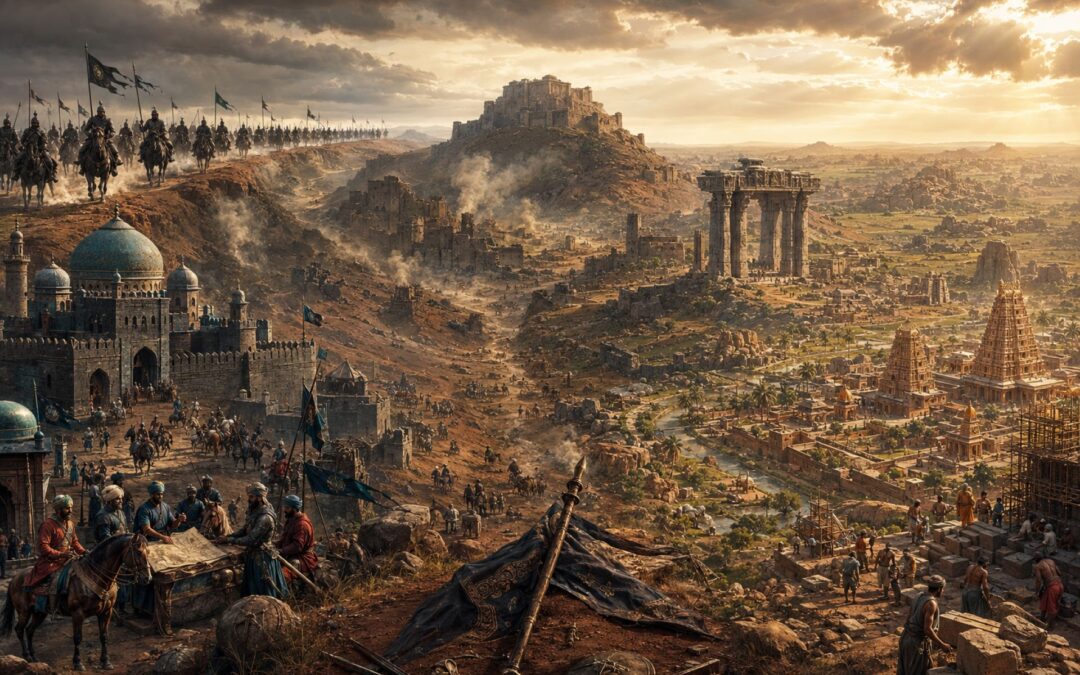
The Delhi Sultanate’s expansion into the Deccan seemed, for a time, to prove that armies based in northern India could dominate almost the entire subcontinent. Delhi’s commanders raided wealthy capitals, forced powerful kings to submit, carried enormous quantities of treasure north, and eventually replaced tribute with direct imperial government.
Yet the more territory Delhi conquered, the harder that territory became to rule.
The old kingdoms of the Deccan were weakened, subordinated, or destroyed. In their place, the Khaljis and Tughluqs attempted to construct a political system stretching from the Punjab to the deep south. That system depended on distant garrisons, cooperative local rulers, provincial commanders, reliable supply routes, and the continued ability of Delhi to intimidate elites who were hundreds of miles from the capital.
When that authority faltered, the earlier political order did not simply return. The people who inherited the Deccan were commanders, governors, warriors, landed chiefs, revenue officials, and royal families whose world had already been transformed by decades of conquest.
That transformation produced two of medieval India’s most consequential powers: the Bahmani Sultanate and the Vijayanagara Empire.
The irony is central to the story. Delhi’s southern expansion into the Deccan succeeded so dramatically on the battlefield that it created an empire too large and politically unstable to hold together. Its victories helped produce the conditions for its retreat.
The Deccan Before Delhi
The Deccan Plateau was not a single political unit waiting to be conquered. It was a vast region of uplands, river valleys, fortified capitals, agricultural zones, mineral resources, commercial routes, and competing royal houses.
At the end of the thirteenth century, the Yadavas ruled from Devagiri in the north-western Deccan. Farther east, the Kakatiyas governed a Telugu-speaking kingdom from Warangal. The Hoysalas controlled much of the southern Karnataka region from Dwarasamudra, while the Pandyas remained a major force in Tamil country. Smaller kingdoms, local chiefs, warrior lineages, and subordinate rulers occupied the spaces between them.
These states fought one another, but they also participated in extensive networks of trade, tribute, diplomacy, pilgrimage, and military service. Their capitals were connected to productive agricultural lands and to commercial routes leading toward ports on both coasts.
The region was attractive to Delhi for obvious reasons. Its rulers could draw revenue from rich farmlands, mines, merchant communities, temple establishments, and trade in horses, textiles, precious stones, metals, and other valuable goods. Devagiri was particularly tempting because it combined wealth with a commanding position between northern India and the southern peninsula.
The geography that made the Deccan valuable also made it difficult to govern. Armies moving south from Delhi had to cross great distances and sustain horses, soldiers, baggage trains, and siege equipment in unfamiliar terrain. Monsoon conditions could render roads unusable. Fortified capitals could resist for long periods. Local rulers knew the routes, water sources, and seasonal rhythms far better than their invaders.
Political division created opportunities for conquest, but conquest did not automatically produce control.
As Richard Eaton’s social history of the Deccan emphasises, the region should be understood as a distinctive political and cultural world shaped by migration, military competition, commercial exchange, and the movement of people across supposedly rigid boundaries. Delhi entered that world as a powerful external force, but it soon became entangled in its rivalries and institutions.
This upheaval formed one episode within India’s wider medieval transformation, but its consequences were unusually far-reaching. Delhi did not merely defeat individual kings. Over several decades, it dismantled the balance of power that had organised much of the peninsula.
Alauddin Khalji’s Raid on Devagiri Changed the Stakes
In 1296, Alauddin Khalji was not yet the sultan of Delhi. He was an ambitious governor and military commander serving under his uncle and father-in-law, Sultan Jalaluddin Khalji.
Alauddin needed more than military experience. He needed wealth, loyal troops, prestige, and a degree of independence from the ruler whose throne he intended to seize.
Devagiri offered a solution.
The Yadava capital lay far beyond the zones in which Delhi usually operated. Its king, Ramachandra, did not expect a major northern army to appear suddenly at his gates. The main Yadava forces were reportedly absent on a southern campaign, leaving the capital vulnerable to Alauddin’s fast-moving cavalry.
The details of the raid were later shaped by chroniclers who favoured dramatic episodes, including stories of deceptive rumours and imaginary reinforcements. The strategic result, however, is clear. Alauddin surprised the Yadava kingdom, threatened its capital, and compelled Ramachandra to negotiate.
The settlement provided Alauddin with an extraordinary quantity of wealth. He returned north with treasure, animals, precious metals, and the political credibility that came from an expedition few had expected him to attempt.
That wealth was not incidental to his later seizure of power. It helped Alauddin reward supporters, attract soldiers, neutralise rivals, and present himself as a commander favoured by fortune. Soon after returning, he murdered Jalaluddin and took the throne.
The Devagiri raid had changed the scale of political ambition in Delhi. The Deccan was no longer a distant region known principally through trade and diplomacy. It had become a source of wealth capable of altering the balance of power within the sultanate itself.
Alauddin did not initially attempt to administer Devagiri as a normal province. Ramachandra remained on his throne and was expected to acknowledge Delhi’s superiority, pay tribute, and avoid rebellion.
This arrangement reflected strategic caution rather than mercy. Tribute gave Delhi many of the rewards of conquest without requiring it to occupy every fortress, replace every official, or defend every road. A submissive regional ruler could collect revenue more efficiently than an unfamiliar military governor.
Alauddin also faced serious pressures closer to home. His rule had to contend with rival nobles, rebellions, the cost of maintaining a large cavalry army, and repeated Mongol incursions across the north-western frontier. Annexing distant southern kingdoms would have required permanent garrisons and a reliable administrative network at a time when Delhi’s survival could still be threatened from Central Asia.
Peter Jackson’s political and military history of the Delhi Sultanate draws an important distinction between extracting submission and attempting territorial government. Alauddin’s early southern policy sought treasure, obedience, and strategic advantage. It did not yet amount to a coherent plan to govern the peninsula directly from Delhi.
That distinction would shape the next phase of expansion.
Malik Kafur Built an Empire of Tribute
Delhi’s first efforts to extend its influence beyond Devagiri did not proceed smoothly.
An early Khalji expedition against Warangal failed. The surviving accounts do not allow every tactical detail to be reconstructed with confidence, but distance and logistics clearly worked against the invaders. Armies advancing toward the Kakatiya capital had to move through unfamiliar territory while maintaining their supplies during difficult seasonal conditions.
The failure demonstrated that the Deccan kingdoms could not be defeated merely by sending an army south and expecting them to collapse.
Delhi also remained vulnerable in the north. Mongol forces repeatedly attacked the sultanate’s frontier and, in 1303, threatened Delhi itself. Alauddin strengthened fortifications, expanded the army, reorganised military finance, and built a defensive system capable of absorbing future attacks.
Once the Mongol danger had been contained, he could return his attention to the south.
The commander most closely associated with this new phase was Malik Kafur. He had entered Alauddin’s service after being captured during the conquest of Gujarat and rose with remarkable speed through the court and military hierarchy.
His career demonstrated the opportunities available within the sultanate’s elite military system. Enslaved people with talent and access to patronage could be trained, promoted, and entrusted with enormous authority. Malik Kafur became one of Alauddin’s most important commanders, serving against both Mongol forces and the kingdoms of the Deccan.
Later chroniclers described his appearance and his closeness to the sultan in language coloured by court hostility, moral judgement, and political rivalry. Such accounts reveal something about the prejudices of their authors, but they do not need to define Malik Kafur’s historical importance. His significance lay in his ability to command armies, manage subordinate rulers, and turn military victories into a temporary network of tribute.
By the first decade of the fourteenth century, Ramachandra of Devagiri had ceased to behave as a dependable subordinate. Alauddin sent Malik Kafur south to restore Delhi’s authority.
The Yadava king was defeated and taken to Delhi, where he submitted formally to Alauddin. Yet he was not discarded. Ramachandra was restored to a position of honour and became a valuable intermediary in Delhi’s further campaigns.
This cooperation transformed the strategic situation. Malik Kafur’s army could use Yadava territory as a base. It gained access to local supplies, guides, routes, and military assistance. Instead of approaching Warangal through the difficult eastern route used during the earlier failure, Delhi’s forces could move through territory controlled by a ruler who now had strong incentives to assist them.
In 1309, Malik Kafur advanced against the Kakatiyas. Warangal’s fortifications were formidable, but the invading army arrived with greater resources and a better logistical position than its predecessor.
King Prataparudra eventually negotiated. He retained his throne but accepted tributary submission and surrendered substantial wealth. Later traditions attempted to identify one of the diamonds transferred after the siege with a famous jewel, but the evidence does not justify treating that claim as established.
What mattered politically was not the identity of a particular stone. Delhi had forced one of the strongest kingdoms in the Deccan to acknowledge its supremacy without assuming the entire burden of governing it.
Malik Kafur then moved against the Hoysala ruler Ballala III at Dwarasamudra. The Hoysalas were engaged in conflicts farther south and could not concentrate all their forces against the invasion. Ballala submitted, paid tribute, and was allowed to retain authority.
The expedition into the Pandya territories was less decisive. Tamil country was divided by a succession struggle, and Delhi’s forces could raid wealthy centres and seize treasure. Yet they could not easily impose a stable political settlement comparable to the arrangements made with Ramachandra or Prataparudra.
The campaigns created the appearance of an enormous southern empire. Rulers from Devagiri to Dwarasamudra had acknowledged Delhi’s power, paid tribute, or suffered raids. Wealth travelled north, helping Alauddin finance his army and court.
But this was an empire constructed through intimidation rather than integrated administration.
Its stability depended on local kings continuing to pay, Delhi retaining the ability to punish disobedience, and commanders being able to return south whenever tribute stopped. It also depended on the personal authority of Alauddin and the continued effectiveness of Malik Kafur.
As the Yadava succession changed, Devagiri again attempted to escape Delhi’s control. Malik Kafur returned, and the process of replacing indirect submission with direct rule began. The end of Yadava sovereignty was not one perfectly dated event, but by the final years of Alauddin’s reign, Devagiri was being drawn more firmly into the sultanate’s territorial structure.
The change appeared to strengthen Delhi. In reality, it began to remove the political buffer that had made the tributary system manageable.
The Tughluqs Turned Tribute into Direct Rule
Alauddin Khalji died in 1316. His death was followed by a violent struggle involving royal relatives, court factions, military commanders, and Malik Kafur himself.
Kafur briefly dominated the government but was assassinated within months. The Khalji dynasty survived only a few more years before being replaced in 1320 by Ghiyath al-Din Tughluq.
The succession crisis weakened Delhi’s authority in the Deccan. Tributary rulers had submitted because the sultanate could punish them. When Delhi appeared divided, they had strong incentives to stop paying and reclaim their independence.
The Tughluqs responded not by restoring Alauddin’s looser arrangement but by pursuing more systematic annexation.
Ghiyath al-Din sent his son Ulugh Khan, the future Muhammad bin Tughluq, against Warangal. The first campaign ended in failure after disorder spread through the invading army. Rumours from Delhi, tensions among commanders, and mutiny forced a retreat.
The prince returned with another army in 1323.
This time Warangal fell. Prataparudra was captured, the Kakatiya kingdom was dismantled, and its territories were placed under Delhi’s officers. Prataparudra died while being taken north. Later accounts associate his death with suicide near the Narmada, but the precise circumstances cannot be known with certainty.
The destruction of the Kakatiya state was more than another extraction of tribute. Delhi attempted to reorganise the conquered territory as part of its imperial system. Officials, governors, garrisons, and revenue collectors were expected to replace the authority previously exercised from Warangal.
The consequences survived long after the Tughluq administration disappeared. As Cynthia Talbot’s study of the later memory of the Kakatiya collapse demonstrates, later communities reconstructed the conquest through changing political and religious identities. Those memories should not be projected backwards as though every participant in the original conflict had acted within one unified civilisational struggle.
The political reality was more complicated. Local chiefs could resist Delhi, collaborate with it, change sides, or use its authority against regional rivals. Muslim commanders served Hindu rulers, Hindu chiefs served the sultanate, and alliances were often shaped by survival rather than fixed communal loyalty.
The Tughluqs also moved against Kampili, a smaller kingdom that had sheltered the rebel Baha al-Din Garshasp. Kampili’s destruction later became entangled with traditions concerning the early lives of Harihara and Bukka, but it should not be confused with the fall of the Hoysala kingdom.
The Hoysalas survived into the 1340s. Their ruler Ballala III at times submitted, negotiated, and attempted to expand into territories weakened by Delhi’s intervention. The political map was being rearranged through overlapping conquest and opportunism, not cleared in one single campaign.
When Ulugh Khan became Sultan Muhammad bin Tughluq in 1325, he inherited an empire of extraordinary size. Devagiri, Warangal, and several other southern territories were no longer merely expected to send tribute. They were to be governed as components of a centralised state.
That ambition changed the nature of Delhi’s problem.
A tributary ruler could be punished when disobedient. A directly administered province had to be governed continuously. Officials had to be appointed and supervised. Soldiers had to be paid. Roads had to remain open. Revenue had to reach the imperial treasury. Local elites had to believe that cooperation with Delhi was safer than rebellion.
The Tughluqs had conquered the Deccan more completely than the Khaljis. They had also made themselves responsible for everything that followed.
Daulatabad Exposed the Limits of Delhi’s Power
Muhammad bin Tughluq’s decision to favour Devagiri, renamed Daulatabad, became the most notorious symbol of his reign.
It is often presented as an inexplicable attempt to force the entire population of Delhi to march south because the sultan had suddenly decided to move his capital. That simplified version obscures both the logic of the policy and the severity of its implementation.
Daulatabad occupied a strategically valuable position. It stood closer than Delhi to the southern provinces that Muhammad was attempting to govern. From there, imperial power could be projected toward Gujarat, the western coast, Telangana, Karnataka, and the Tamil territories.
A stronger political centre in the Deccan could also help supervise provincial governors and military commanders whose loyalty could not be taken for granted. Relocating influential families, officials, scholars, soldiers, and religious figures might bind the southern territories more closely to the imperial system.
The policy therefore had an intelligible objective: the integration of a subcontinental empire whose political centre lay too far north of many of its most recently acquired provinces.
Its implementation was coercive and destructive.
The affected population was substantial, although the sources do not allow a precise count or prove that every inhabitant of Delhi was permanently expelled. People compelled to move faced an exhausting journey, disrupted livelihoods, separation from local networks, and the difficulty of rebuilding their lives in a different environment.
Delhi suffered from the departure of politically and economically important households. Daulatabad struggled to absorb the newcomers. The policy became associated with hardship, disease, death, and resentment.
Muhammad eventually reversed much of the movement. Some people returned north, while others remained in the Deccan and contributed to its changing social and cultural composition.
The reversal did not restore the empire to its earlier condition. It demonstrated that the sultan could impose enormous demands but could not necessarily sustain them.
The Daulatabad project also unfolded amid wider fiscal and military crises. Muhammad pursued campaigns in several directions, raised armies for ambitious plans, experimented with revenue policies, and faced repeated rebellions. Each failed project weakened confidence in the government and increased the temptation of provincial elites to act independently.
This was particularly dangerous in the Deccan.
Delhi’s governors and military commanders controlled forts, troops, and revenue networks far from the imperial centre. Many had built relationships with local warriors and landholders. They possessed the machinery required to administer the region, but their loyalty depended on the sultan’s continued ability to reward cooperation and punish revolt.
As Delhi’s attention shifted from one crisis to another, that ability deteriorated.
The capital experiment did not single-handedly destroy Tughluq authority in the south. It exposed the deeper contradiction within Muhammad’s imperial project. The sultan had attempted to centralise a territory whose size required negotiation, delegation, and political flexibility.
When central authority weakened, the institutions built to govern the Deccan became tools in the hands of those who wished to leave Delhi.
Rebellion Reassembled the Deccan
The retreat of Tughluq power did not happen in one moment. Delhi’s southern government fragmented through a succession of rebellions, local recoveries, and provincial declarations of independence.
In Tamil country, the governors of Madurai established an independent sultanate. In the former Kakatiya territories, Telugu warrior chiefs and regional lineages challenged Delhi’s garrisons and recovered Warangal. Other rulers expanded into districts from which Tughluq authority had disappeared.
These movements did not restore the political map of 1296. The Yadava and Kakatiya dynasties had been broken. The Hoysala kingdom was approaching its end. The Pandya territories remained divided. New elites had acquired military experience, revenue rights, titles, and administrative knowledge under the sultanate.
The two most enduring states to emerge from this upheaval were the Bahmani Sultanate and Vijayanagara. They arose through different political coalitions, but both belonged to the same transformed Deccan world.
The Bahmani Sultanate Emerged from the Deccani Revolt
Delhi depended on military commanders known collectively as amirs to control the Deccan. These men held offices, commanded soldiers, collected revenue, defended forts, and negotiated with local elites on behalf of the sultan.
As Muhammad bin Tughluq’s authority weakened, the relationship between the centre and its Deccani officers became increasingly hostile. The government suspected provincial commanders of disloyalty. The commanders feared punishment, confiscation, or removal.
Repeated revolts followed.
By the 1340s, Deccani amirs had concluded that they could survive only by breaking permanently with Delhi. Their success depended not merely on defeating an imperial army but on creating a political coalition capable of governing the region after independence.
The strongest leader to emerge was Zafar Khan, who took the regnal name Alauddin Bahman Shah. In 1347, the rebels established what became known as the Bahmani Sultanate.
Later traditions offered several stories about his earlier life. One claimed that he had served a Brahmin named Gangu, producing the familiar name Hasan Gangu. Other accounts proposed different family and social origins. None can be accepted uncritically.
His precise ancestry mattered less than the political foundation of his authority. He was elevated by a coalition of military elites who needed a ruler capable of holding their new state together.
The Bahmani Sultanate was not simply a detached province continuing Delhi’s rule under another name. Its political centre lay in the Deccan. Its survival depended on regional revenue, local alliances, military migration, and the integration of communities with different linguistic, cultural, and religious backgrounds.
It inherited institutions associated with the Delhi Sultanate, including Persian administrative practices and military titles. It also had to adapt those institutions to the realities of the Deccan.
Independence therefore involved both rebellion and inheritance. The Bahmani rulers rejected Delhi’s sovereignty while using parts of the political system Delhi had helped spread.
Vijayanagara Emerged from a Contested Southern Frontier
The early history of Vijayanagara is more difficult to reconstruct than later foundation narratives suggest.
Harihara and Bukka, the first major Sangama rulers, have been connected to several political worlds. Some traditions associate them with the Kakatiyas of Warangal. Others link them to Kampili or to the Hoysala sphere.
It is possible that these affiliations reflected different stages in their careers. It is also possible that later writers attempted to attach the founders to prestigious earlier kingdoms.
The best-known story claims that the brothers were captured by Delhi, taken north, converted to Islam, returned to the south as officials of the sultanate, and later reconverted to Hinduism under the influence of the sage Vidyaranya.
This account cannot be treated as a straightforward contemporary biography. The Vidyaranya-centred foundation narrative became prominent in sources produced after the earliest phase of the kingdom. The brothers may have had some relationship with Delhi’s administration, but the exact sequence of capture, conversion, appointment, and reconversion remains disputed.
What can be said more securely is that the Sangama family emerged within the political vacuum created by the weakening of Kakatiya, Kampili, Hoysala, and Tughluq authority.
Harihara and Bukka established themselves around the Tungabhadra River, a frontier zone containing important fortifications, agricultural resources, sacred centres, and routes linking different parts of southern India. The conventional date of Vijayanagara’s foundation is 1336, but the state developed gradually rather than appearing fully formed in one ceremony.
Its rulers expanded by conquering territory, absorbing local chiefs, claiming inherited rights, and presenting themselves as defenders and patrons of Hindu religious institutions. Temples, Brahmin settlements, sacred geography, and royal ritual all contributed to their legitimacy.
Yet Vijayanagara did not emerge outside the political culture of the sultanates. Its rulers borrowed and adapted titles, clothing, diplomatic practices, military techniques, and courtly forms that circulated across the Deccan.
Their use of the title Hinduraya Suratrana, often translated as “sultan among Hindu kings,” captures this complexity. Phillip Wagoner’s analysis of Vijayanagara’s political titulature shows that adopting forms associated with Islamicate kingship did not negate the rulers’ Hindu identity or religious patronage.
It expressed sovereignty in a language understood across the region.
Vijayanagara could oppose neighbouring sultanates, patronise Hindu institutions, recruit Muslim soldiers, engage Persianate political conventions, and participate in a shared commercial system without seeing those actions as contradictory.
The capital that developed near present-day Hampi later became one of the largest and most impressive urban centres of the medieval world. Its temples, markets, fortifications, waterworks, palatial enclosures, and ceremonial spaces survive within the Group of Monuments at Hampi.
That later magnificence should not obscure the uncertainty of its beginnings. Vijayanagara emerged not through a single act of national restoration but through the gradual consolidation of power in a region transformed by war.
The Deccan Emerged with a New Political Order
The Delhi Sultanate’s armies achieved victories that would have appeared almost unimaginable before Alauddin Khalji crossed into Yadava territory.
Devagiri submitted. Warangal paid tribute and was later annexed. Dwarasamudra yielded. The Pandya territories were raided. Tughluq officers attempted to govern a realm extending deep into the peninsula.
Yet military reach was not the same as political durability.
Alauddin’s tributary system acknowledged some of the practical limits of conquest. It left regional rulers in place and demanded wealth and obedience rather than continuous administration. That arrangement was profitable, but it depended on repeated coercion and the personal authority of Delhi’s rulers.
The Tughluqs attempted something more ambitious. They sought to turn fluctuating submission into permanent government. Their officers replaced dynasties, occupied capitals, collected revenue, and attempted to bind the Deccan to an imperial centre.
The effort changed the region profoundly, even though it failed.
Delhi’s campaigns broke the power of established royal houses and displaced older networks of authority. Its administration moved soldiers, officials, scholars, merchants, and families across the subcontinent. Its armies introduced new opportunities for service and advancement. Its provincial system gave commanders control over forts, revenues, and local alliances.
When Delhi withdrew, those structures did not disappear.
The Bahmani Sultanate was created by military elites who had served within the Tughluq imperial order before rebelling against it. Vijayanagara was built by regional leaders operating in a frontier transformed by the collapse of Kakatiya, Kampili, Hoysala, and Delhi authority.
Both states rejected Delhi’s sovereignty. Both also inherited parts of the world its conquests had created.
Their later rivalry would shape the Deccan for generations, but it was not a struggle between two isolated civilisations. They competed for the same forts, river valleys, trade routes, agricultural territories, commanders, and symbols of kingship. They exchanged diplomatic practices, military techniques, artistic forms, and political language even while fighting destructive wars.
Delhi therefore did more than invade the south and retreat.
It destroyed an old balance without successfully replacing it. In the resulting space, new states formed from conquest, resistance, collaboration, migration, and adaptation.
The Delhi Sultanate lost its Deccan empire. The political world created by its victories endured.
Last Updated on July 27, 2026 by Aseem Gupta