
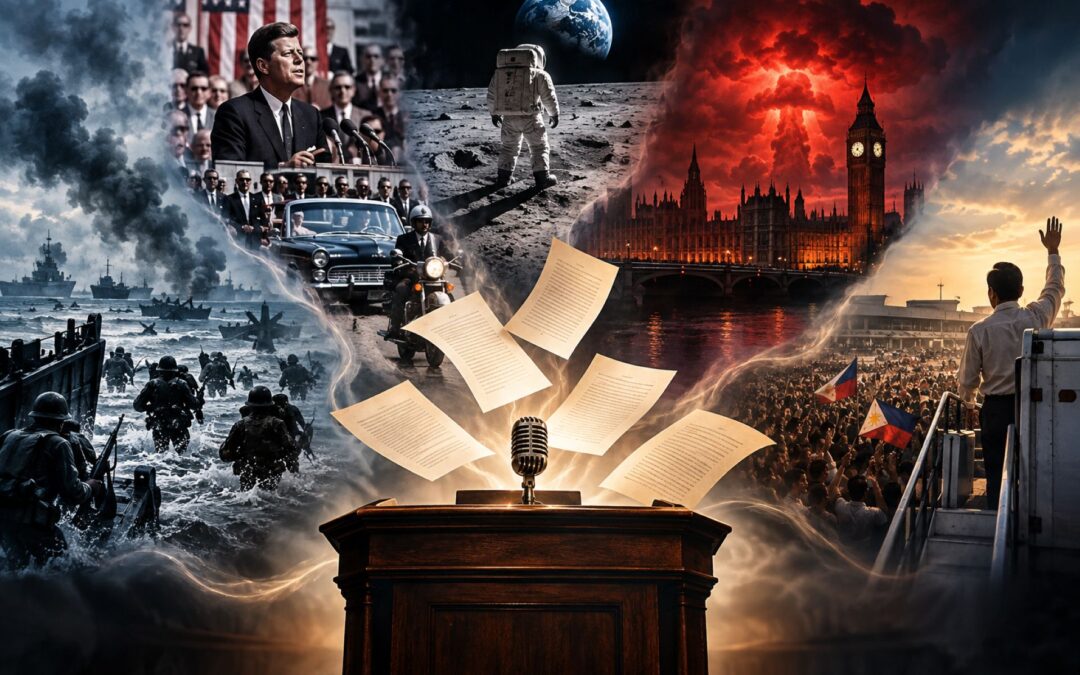
History usually reaches us after uncertainty has disappeared. D-Day succeeded, John F. Kennedy was assassinated, Apollo 11 returned safely from the Moon, Britain never fought the Soviet Union in a nuclear war, and Benigno “Ninoy” Aquino Jr. was killed moments after returning to the Philippines. Once those outcomes become fixed in memory, it is difficult to recover what the world looked like to people who did not yet know what was going to happen.
History’s Lost Speeches, Professor Suzannah Lipscomb’s five-part 2020 audio series, finds an ingenious way back into that uncertainty. Each episode begins with words prepared for a moment that never arrived in the expected form: Dwight Eisenhower accepting responsibility if D-Day failed, Kennedy’s undelivered Dallas address, a presidential statement for the deaths of the Apollo 11 astronauts, a simulated royal broadcast for nuclear war, and Aquino’s intended statement on returning from exile. Audible describes the series as an exploration of how twentieth-century history might have unfolded differently through speeches that were never delivered, while Lipscomb’s own site lists it among her audio work. the original Audible release Suzannah Lipscomb’s official audio page (Audible.co.uk)
The result is not really a collection of speeches and not quite a conventional work of alternate history. It is a compact study of contingency: the gap between what happened and what people feared, expected, planned for, or might plausibly have done if one critical event had turned out differently. Its strongest insight is also its most important limitation. The unused documents are genuine evidence of historical possibilities and contemporary assumptions; the farther the episodes move from those documents into imagined chains of consequences, the less certain the conclusions necessarily become.
This article discusses the complete series, including the real outcomes of all five historical events and the principal counterfactual possibilities the episodes explore.

What History’s Lost Speeches Is—and How the Series Works
History’s Lost Speeches is best understood as a historical documentary series built around five primary documents. According to Audible, the five episodes were released in 2020 as an Audible Original, with Lipscomb talking to historians, writers, academics, and other specialists about how different outcomes might have altered warfare, political power, nuclear strategy, democratic protest, heroic narratives, and Western historical memory. Audible’s official description of the five-part series (Audible.co.uk)
The recurring structure is simple but productive. First comes a real historical moment whose outcome was uncertain at the time. Then comes an unused text produced for another version of that moment, followed by discussion of what would have needed to change for that text to be spoken and what consequences might plausibly have followed. Each episode eventually returns to the history that actually occurred, which allows the counterfactual to illuminate assumptions that are difficult to see once the real outcome has become familiar.
The method works because the documents are not retrospective inventions. Eisenhower genuinely prepared words for failure before he knew whether Operation Overlord would succeed. William Safire genuinely drafted a response in case Neil Armstrong and Buzz Aldrin could not return from the Moon. British officials genuinely imagined what a royal broadcast during nuclear war might sound like, while Kennedy and Aquino left behind prepared statements that assassination prevented them from delivering.
That factual foundation distinguishes the series from free-form alternate history. The episodes do not begin by changing the past arbitrarily; they begin with futures that historical actors themselves had reason to contemplate. The existence of the documents cannot tell us exactly what would have followed, but it can tell us that the successful or familiar outcome was not the only outcome people at the time regarded as imaginable.
The series also becomes progressively more complicated. A failed military operation, an assassinated president, a fatal technological accident, nuclear war, and the murder of an opposition politician involve very different kinds of causation. By placing them within one structure, History’s Lost Speeches invites comparison, but it also forces the listener to notice how quickly counterfactual certainty declines as the imagined consequences move further away from the original event.
Five Speeches History Never Heard: Complete Episode-by-Episode Summary
The five episodes follow chronological order from the Second World War to the political upheavals of the 1980s, but they do more than move through time. Each one alters the counterfactual problem slightly. Together they move from failure that never happened, to lives that were cut short, to catastrophe that was avoided, and finally to an assassination whose absence rather than occurrence has to be imagined.
That progression makes the episode sequence important. The first program establishes the method through a remarkably direct document of personal responsibility; the middle episodes broaden the consequences from one operation to presidential leadership, technological prestige, and nuclear survival; the last episode reverses the pattern by asking what might have happened if the historical tragedy had been avoided.
In the Event of D-Day Failure
The first episode begins with an event whose successful outcome has become almost inseparable from the popular story of Allied victory in the Second World War: the Normandy landings of June 6, 1944. D-Day is now remembered as the beginning of the liberation of Western Europe from Nazi occupation, a vast amphibious operation that established the Western Allies on the European continent and helped open the campaign that would end with Germany’s defeat.
That outcome can make success appear inevitable in retrospect. Yet the men planning Operation Overlord did not possess the benefit of hindsight, and Eisenhower had to contemplate the possibility that the invasion would fail badly enough to require withdrawal. The Eisenhower Presidential Library’s D-Day archive preserves the handwritten statement he prepared for that possibility and confirms an evocative detail: he accidentally dated it “July 5” rather than June 5. (Eisenhower Presidential Library)
The text is striking partly because it is so short. Eisenhower does not construct an elaborate explanation or identify subordinates whose decisions supposedly caused the defeat. He states that the troops, air forces, and navy did all that courage and devotion to duty could demand, and he places responsibility for the attempt on himself. The unused note therefore tells the listener something concrete about command before any speculation begins: Eisenhower understood that supreme command meant ownership not only of victory but of failure.
From there, the episode opens the central counterfactual. What would a failed D-Day actually have meant? The immediate answer is clearer than the long-term one. An unsuccessful lodgment in Normandy would have inflicted major losses, shaken Allied confidence, disrupted carefully coordinated plans, and forced political and military leaders to decide whether and when another cross-Channel invasion could be attempted.
A failed landing, however, would not automatically have meant that Nazi Germany won the war. Germany was already fighting the Soviet Union on the enormous Eastern Front, the Western Allies possessed significant industrial and military resources, and Italy had already become another front. The episode’s counterfactual power comes from exploring how much the route to victory might have changed rather than assuming that one lost operation simply reverses the final result.
The wider implications concern the shape of Europe after the war. If the Western Allies had taken longer to establish themselves in France, Soviet armies might have advanced farther west before Germany collapsed. That raises possibilities involving occupation zones, political influence, the postwar balance of power, and the geographical division between Soviet-dominated Eastern Europe and the Western-aligned states that eventually developed on the other side of the Iron Curtain.
These possibilities connect the episode to the larger history of the war, which is useful to keep separate from the counterfactual itself. The wider conflict involved multiple fronts, enormous Soviet-German warfare in the east, Allied industrial capacity, naval power, strategic bombing, resistance movements, colonial forces, and a sequence of political and military decisions extending far beyond Normandy. Readers who need that larger chronology can place D-Day within the wider course of World War II without treating June 6 as the only event that determined the war’s outcome. (Aseem Gupta)
Where the episode becomes especially interesting is in its treatment of memory. Successful D-Day became evidence for a particular Western heroic narrative: democratic powers crossed the Channel, liberated occupied territory, and helped defeat Hitler. If the same armada had been driven back into the sea, later Western political culture might have remembered 1944 not as proof of resolve and competence but as an enormous disaster that demanded explanation.
Eisenhower’s note would then have occupied a completely different place in public history. Instead of being an archival curiosity admired because it reveals what he was prepared to say, it might have become one of the defining documents of Allied failure. Its humility could have strengthened his reputation for personal responsibility, or the scale of the defeat could have overwhelmed whatever rhetorical value the statement possessed.
The counterfactual therefore branches quickly. Military failure might affect command, command might affect future operations, delays might affect Soviet advances, those advances might affect the postwar settlement, and that settlement might change the later balance of the Cold War. Every step is conceivable, but every additional step introduces other variables that make certainty harder to sustain.
This is precisely why the episode works so well as the beginning of the series. The historical document is concrete, the immediate alternative is easy to understand, and the long-term consequences illustrate both the attraction and danger of counterfactual reasoning. The more familiar D-Day feels as an inevitable triumph, the more useful Eisenhower’s unused words become as evidence that those living through the event had no guarantee of success.
If JFK Had Lived…
The second episode moves from a failed operation that did not occur to a presidency interrupted by assassination. John F. Kennedy was travelling to the Dallas Trade Mart on November 22, 1963, when he was shot, leaving behind a speech prepared for an audience he never reached. That document provides the episode with a way to begin from Kennedy’s actual priorities on the day he died rather than from the mythology that accumulated around him afterward.
The surviving prepared Dallas Trade Mart address is revealing because it is concerned with national power, international leadership, security, knowledge, and the relationship between military strength and political judgment. Kennedy planned to argue that American leadership required more than weapons alone: economic strength, alliances, information, research, political confidence, and the ability to distinguish reality from comforting slogans all mattered. (The American Presidency Project)
That makes the episode’s question larger than “Would Kennedy have been a successful two-term president?” Lipscomb uses the undelivered address to examine the future that disappeared when Kennedy was killed: another year of his first term, a possible 1964 reelection campaign and second term, continuing management of the Cold War, the American commitment in Vietnam, and the space program that had become closely associated with his presidency.
Vietnam is the most difficult part of the counterfactual because later events were so consequential. Under Lyndon Johnson, the United States dramatically escalated its military involvement, and it is tempting to reason backward from that history and imagine that Kennedy would necessarily have chosen the opposite course. The surviving record does not support that level of certainty.
The Miller Center’s examination of the Kennedy withdrawal debate shows why the question remains unresolved. Kennedy’s administration did undertake serious planning for the withdrawal of American personnel and for transferring greater responsibility to South Vietnam, but historians still debate the reasons for that planning, how conditional it was, and what Kennedy would have done if the military and political situation deteriorated. (Miller Center)
This distinction is central to the episode’s value. Evidence that Kennedy considered or approved a withdrawal schedule tells us something important about policy in 1963. It does not prove that every later decision under a surviving Kennedy would have followed the same path, because the president would have confronted new information, changing conditions inside South Vietnam, domestic political pressures, developments elsewhere in the Cold War, and the consequences of his own previous choices.
The same uncertainty applies to the broader superpower rivalry. Kennedy had already experienced the Bay of Pigs, the Berlin crisis, the Cuban Missile Crisis, and the negotiations that produced the Limited Test Ban Treaty. A surviving Kennedy might have pursued additional forms of accommodation with the Soviet Union, faced renewed confrontation, or done some combination of both as circumstances changed.
The episode also links Kennedy to the space race. The Apollo goal had been framed during his presidency as a demonstration of American capacity and national purpose within the wider superpower competition. NASA’s historical account emphasizes that Apollo was inseparable from the political pressures created by Soviet achievements in space and Cold War rivalry, even though its technological and scientific legacy ultimately became much larger than that original competition. NASA’s account of Apollo’s Cold War origins (NASA)
Yet the most revealing counterfactual may concern Kennedy himself. Assassination froze him at forty-six and transformed an unfinished presidency into a cultural memory that could be filled with possibilities. The living politician had compromises, misjudgments, unresolved policies, domestic opponents, electoral calculations, and decisions whose consequences remained uncertain; the dead president could become the symbol of a lost future.
That distinction matters because heroic memory often works by removing later evidence. A president who survives must continue choosing, disappointing constituencies, confronting events he cannot control, and accumulating failures alongside achievements. Kennedy’s assassination prevented the historical record from showing what another five years of decisions might have done to his reputation.
The episode therefore exposes a subtle problem in all biographical counterfactuals. When people ask what Kennedy would have done in Vietnam, the Cold War, civil rights, or the space race, they are not merely extending a known personality forward in time. They are inventing encounters between that personality and events that had not yet occurred, which means the future can never be recovered with the confidence available for the past.
The wider background belongs to the Cold War confrontation in which military alliances, nuclear weapons, ideological competition, proxy wars, espionage, economic power, and technological prestige interacted across several continents. Kennedy mattered enormously within that system, but he was never the only force shaping it. (Aseem Gupta)
By the end of the episode, the lost Dallas speech serves two purposes. It is evidence of what Kennedy intended to say at one specific moment, and it is a barrier against making his imagined future completely abstract. The document anchors the counterfactual in the historical Kennedy even while the episode demonstrates why no document can tell us exactly who the later Kennedy would have become.
A Moon Disaster
The third episode begins with perhaps the most visually triumphant event in the series: Apollo 11. Neil Armstrong and Buzz Aldrin landed on the Moon in July 1969, walked on its surface, returned to the lunar module, rejoined Michael Collins in orbit, and came home safely. Their success became one of the defining technological achievements of the twentieth century.
Yet the Nixon administration had to prepare for another possibility. Three days before the lunar landing, presidential speechwriter William Safire sent H. R. Haldeman a memorandum titled “In Event of Moon Disaster”, containing words President Richard Nixon could use if Armstrong and Aldrin became stranded on the Moon without hope of rescue. (National Archives)
The document is more than an emergency press statement. Safire tries to give a catastrophe narrative form before it happens. The astronauts would not be remembered merely as victims of a failed machine; their deaths would be interpreted as sacrifice in the pursuit of knowledge, and their isolation on another world would be transformed into a story about humanity’s desire to explore.
The memorandum also anticipates the practical ritual surrounding such a disaster. Nixon would contact the astronauts’ widows before addressing the public, communications with the stranded men would eventually end, and religious observance would give their deaths a form analogous to burial at sea. The administration was therefore preparing simultaneously for personal grief, public communication, symbolic meaning, and an event unlike any previous human death.
That planning reveals how seriously success and catastrophe coexisted inside the same mission. Apollo 11 is so thoroughly remembered through Armstrong’s first step and the safe splashdown that it is easy to imagine the mission as a straight line toward success. The unused speech preserves the possibility that the lunar module might have become a tomb.
The political consequences would have extended beyond NASA because Apollo was never merely a scientific expedition. The program grew from Cold War competition, and NASA’s history of Apollo explicitly places Kennedy’s lunar commitment within a period of Soviet space success and American concern about international prestige. (NASA)
A fatal Apollo 11 could therefore have been interpreted simultaneously as a human tragedy, technological failure, national trauma, and propaganda setback. The Soviet Union would not have needed to cause the accident for it to matter geopolitically; simply demonstrating that the most visible American technological project had ended in catastrophe could alter perceptions of competence and risk.
The psychological question is even larger. Hundreds of millions of people experienced the successful Moon landing as an expansion of the boundaries of human possibility. If the same global audience had instead followed the final hours of two men stranded beyond rescue, the Moon might have acquired a very different emotional meaning.
The episode considers whether such a disaster could have weakened political support for further crewed exploration. That is plausible, especially because Apollo was expensive and public priorities were already changing, but it cannot be treated as certain. A tragedy might have produced retrenchment, renewed determination, technical reform, or a mixture of all three.
The unused speech itself would have influenced whichever response followed. Safire’s rhetoric is constructed to prevent failure from meaning pointlessness. By defining Armstrong and Aldrin as explorers whose deaths belong to a larger human search for truth and understanding, the address attempts to protect the meaning of the endeavor even when its immediate objective has ended disastrously.
This makes the episode one of the strongest demonstrations of the series’ central idea. Political rhetoric cannot change whether astronauts live or die, but it can influence the story through which millions of people understand their deaths. In a crisis where government has almost no remaining physical power over the outcome, language becomes a tool for mourning, interpretation, and collective memory.
The real Apollo 11 success meant Safire’s words remained unused. Instead of becoming one of the most famous presidential speeches of the century, the document became evidence of the disaster that never happened. That reversal is exactly what makes it so haunting: it allows the reader to see the triumphant history alongside the catastrophe for which officials had quietly prepared.
Britain Faces Nuclear War
The fourth episode expands the scale of catastrophe dramatically. Apollo 11 could have killed two astronauts and damaged a national project; a nuclear war between the Cold War blocs could devastate states, governments, cities, infrastructure, families, and the social systems through which ordinary political life functioned. The speech at the center of the episode therefore exists for an imagined situation in which rhetoric itself might have very little practical power left.
The document requires a crucial qualification. It was not a private speech written by Queen Elizabeth II, nor is there evidence that she had personally decided to address the country in these words. The text was drafted by British officials as part of Wintex-Cimex 83, a government and NATO-associated exercise simulating the escalation toward major conflict.
The UK National Archives material on monarchy and state contingency planning places documents of this kind within the machinery of government preparation. Contemporary reporting on the released papers likewise records that senior civil servants produced the speech within the 1983 exercise scenario, imagining what a royal address might sound like as Britain approached all-out nuclear war. (The Guardian)
That provenance changes how the speech should be read. It is not primarily evidence of the Queen’s personal political thinking; it is evidence of how British officials imagined the monarchy functioning during an extreme national emergency. The distinction is important because attributing every line directly to Elizabeth II would give the document an authority it does not possess.
Within the imagined address, the monarch becomes a symbol of continuity. The speech reaches backward to the experience of the Second World War, invokes family bonds and national endurance, and attempts to place an unprecedented nuclear crisis inside older British memories of surviving war. The language tries to connect a future that scarcely fits existing political categories to familiar ideas of duty, courage, home, and shared hardship.
That strategy reveals both the usefulness and inadequacy of historical analogy. Memories of 1939 and the Blitz could give listeners a vocabulary of national endurance, but nuclear war would not simply repeat the Second World War with more powerful bombs. The possibility of mass destruction, radioactive contamination, shattered infrastructure, disrupted government, and escalation beyond national control made the nuclear scenario qualitatively different.
This is why the episode’s discussion of deterrence matters. The Cold War nuclear order depended partly on convincing potential adversaries that aggression would provoke consequences so devastating that initiating a direct conflict would be irrational. The same weapons that were supposed to discourage war could, if deterrence failed, make meaningful victory difficult or impossible.
The broader history of the Cold War shows how nuclear weapons changed superpower confrontation by making direct conflict extraordinarily dangerous even while competition continued through alliances, proxy wars, espionage, arms races, technology, and political influence. By the early 1980s, that danger existed alongside renewed tensions between the Western alliance and the Soviet bloc. (Aseem Gupta)
The speech therefore occupies an unusual category among the five episodes. Eisenhower prepared for a military operation to fail, Nixon’s team prepared for astronauts to die, and Kennedy and Aquino genuinely intended to deliver their addresses. The British nuclear text existed within an exercise designed to simulate an event that officials hoped deterrence would ensure never occurred.
Its non-delivery is consequently the ideal historical outcome. There is no lost opportunity attached to the speech and no suggestion that the public was deprived of words it ought to have heard. The document matters because the circumstances that would have made it necessary were avoided.
This also exposes the limit of political language more clearly than any other episode. A presidential statement might preserve meaning after the death of astronauts, and Eisenhower’s words might define responsibility after a military defeat. In a full nuclear exchange, a speech cannot reconstruct communication systems, protect destroyed cities, restore institutions, or reverse physical devastation.
The episode thus turns the very existence of the speech into evidence of governmental imagination. Bureaucracies prepare for possibilities they hope never to experience because preparation is part of their function. Once those preparations become historical records, they reveal what governments believed they might be required to manage and how they expected public authority to sound when ordinary political reassurance was no longer credible.
Democracy Returns to the Philippines
The fifth episode changes the logic of the series. The earlier programs largely ask what might have happened if an avoided catastrophe had occurred or if an assassinated president had survived. The Philippines episode begins with a tragedy that did happen—the assassination of Benigno “Ninoy” Aquino Jr.—and asks what Philippine politics might have looked like if it had not.
Aquino had been a prominent opponent of President Ferdinand Marcos, had spent years in detention after the declaration of martial law, and later lived in the United States before deciding to return to the Philippines in 1983. He knew the journey involved serious danger, and he prepared an arrival statement explaining why he was coming back and what political position he intended to advocate.
The surviving undelivered Aquino arrival statement is especially valuable because it prevents his politics from being reduced to the fact of his death. He describes his return as voluntary, identifies himself with a nonviolent struggle to restore rights and freedoms, calls for national reconciliation founded on justice, and presents political, economic, and social problems as interlocking sources of instability. (GMA Network)
Those claims have to be read as Aquino’s arguments rather than as neutral narration. He was an opposition politician returning to confront a government he strongly opposed, and the statement is designed to justify his decision, define the crisis as he understood it, reject accusations made against him, and present a path toward political change. Its historical significance lies partly in the fact that these were the arguments he intended to place before the Filipino public.
He never had the opportunity. Aquino was shot after arriving at Manila International Airport on August 21, 1983. The undelivered speech therefore acquired meaning through the very event that prevented its delivery.
The assassination intensified opposition to Marcos and became one important event in the political developments that eventually culminated in the 1986 People Power Revolution and the transfer of presidential power to Corazon Aquino. Philippine historical institutions place Ninoy Aquino’s death within that larger history of resistance, although the transition cannot responsibly be reduced to a single cause or individual. the National Historical Commission of the Philippines’ discussion of martial-law memory and resistance (NHCP)
That complexity generates the episode’s central counterfactual. If Aquino had survived his return, would he have strengthened the opposition through active leadership, negotiation, and organization? Or did his assassination create a form of martyrdom whose symbolic power mobilized people in ways that the living politician could not have reproduced?
Neither question has a demonstrable answer. A living Aquino would have made decisions, confronted rivals, negotiated with allies, possibly endured renewed detention, responded to changing economic and political circumstances, and faced disagreements within the opposition. His survival would not simply preserve everything that followed while adding him as an extra participant.
Conversely, it would be equally simplistic to say that the assassination automatically caused the 1986 revolution. Political movements emerge from accumulated grievances, organizations, institutions, economic conditions, elite defections, public mobilization, religious and civic networks, state responses, and choices made by many actors. Aquino’s death could be a powerful catalyst without functioning as a complete explanation.
The episode therefore asks one of the series’ most difficult questions about political martyrdom. A murdered opposition figure can become symbolically clearer after death because all later compromises and contradictions disappear. The unfinished life becomes available as a public ideal, often represented through the cause with which the dead person is most strongly associated.
Aquino’s prepared statement makes that process unusually visible. Had he lived and delivered it, the words would have entered an ongoing political argument and been judged alongside his subsequent actions. Because he died before he could speak them publicly, the statement instead survives as a record of intention attached permanently to his final journey.
The episode also broadens the meaning of the title History’s Lost Speeches. Aquino’s text was not designed for an imaginary catastrophe like Safire’s Apollo address or the British nuclear exercise. He genuinely intended to deliver it. What made the speech “lost” was not a contingency plan remaining unused but a murder that removed the speaker at the threshold of his return.
As the final episode, it provides an effective reversal. Earlier programs recover disasters that did not happen; this one tries to recover the possibility of a tragedy not happening. That inversion brings the series back to its deepest idea: history does not consist only of outcomes but of roads not taken, and sometimes the most revealing evidence of those roads survives in words prepared for a future that disappeared.
How Undelivered Speeches Reveal the Fragility of History
Once the five episodes are placed together, their common subject becomes clearer. The series is less interested in eloquence for its own sake than in the unstable moment before an outcome becomes history. The unused documents matter because they preserve expectations that later events rendered obsolete.
They also reveal two different processes. One concerns causation: how much would actually have changed if an event had gone differently? The other concerns memory: how does the outcome that did occur reshape the way societies understand the people, institutions, and choices involved?
Contingency Rather Than Inevitability
Historical narratives naturally compress uncertainty. Once we know that the Normandy invasion succeeded, it becomes easy to tell the story as a sequence leading toward victory; once we know Apollo 11 returned safely, every preparation becomes part of the buildup to triumph. Causes are selected partly because we already know which consequences followed them.
The lost speeches interrupt that retrospective order. Eisenhower’s note proves that senior command contemplated failure. Safire’s memorandum proves that the Nixon administration contemplated the possibility of Armstrong and Aldrin being left on the Moon. The British war exercise proves that officials were required to imagine forms of public authority within a nuclear catastrophe.
This does not mean all imagined outcomes were equally likely. Governments plan for low-probability disasters precisely because the consequences would be severe, and prudent contingency planning cannot be converted into evidence that catastrophe was expected. The documents establish possibility and preparedness, not probability.
That distinction is especially important in the D-Day episode. The existence of Eisenhower’s failure message demonstrates uncertainty about the invasion; it cannot tell us how probable failure was or establish one particular version of the postwar world. Once the imagined scenario reaches Soviet occupation patterns, Western political identity, later alliances, or the evolution of the Cold War, additional decisions and contingencies multiply.
Kennedy presents an even clearer example of branching. His record up to November 1963 constrains what can plausibly be said about his future, but it does not determine that future. Evidence of withdrawal planning in Vietnam is relevant, while claims that he therefore certainly would have prevented the later American war go beyond what the evidence can establish. (Miller Center)
This is where counterfactual history is most useful when practiced cautiously. Asking what had to be different for another result to occur forces attention onto causation. If one altered event appears to change nothing, perhaps that event was less decisive than later memory suggests; if changing it requires many other assumptions, the counterfactual exposes how complicated the real causal structure was.
The series repeatedly demonstrates that historical turning points are often turning points only within systems. D-Day mattered because armies, industry, logistics, Soviet offensives, German decisions, geography, weather, command structures, and coalition politics already existed around it. Kennedy mattered because presidential decisions operated inside institutions, alliances, domestic politics, military bureaucracies, and an international system.
Aquino’s case makes the same point from another direction. His assassination mattered enormously, but the political movement that followed cannot be understood without the wider conditions that made millions of people responsive to that event. The counterfactual becomes richer, not weaker, when it acknowledges those surrounding forces.
The strongest historical habit encouraged by History’s Lost Speeches is therefore resistance to inevitability. Knowing what happened is not the same as demonstrating that it had to happen. The unused documents are valuable because they restore alternative expectations to moments later flattened by hindsight.
Heroic Memory, Martyrdom, and the Stories Nations Tell
The series also examines how outcomes produce heroes. Success, death, and survival do not merely conclude events; they influence the stories later told about the people who participated in them. Those narratives can become so familiar that they appear to reveal an individual’s essential character rather than one historical interpretation shaped by what happened next.
D-Day is a clear example. Because the invasion succeeded, Eisenhower’s role became part of a victorious Allied story. His unused failure note now reinforces that positive reputation by demonstrating that he was prepared to accept responsibility, but had the invasion ended in disaster, exactly the same document could have been read within arguments over military judgment, accountability, and the cost of the decision.
Kennedy illustrates the process more dramatically because assassination permanently interrupted the accumulation of evidence about his presidency. His legacy combines real accomplishments and failures with an enormous realm of unknowable possibilities. The imagined Kennedy who resolves Vietnam, deepens détente, advances civil rights, or leads America through the remainder of the 1960s is necessarily partly a creation of retrospective desire.
That does not make every positive interpretation false. It means the assassination changed the type of evidence available. Instead of judging a completed two-term presidency, historians must distinguish the record Kennedy actually produced from the future that admirers, critics, and counterfactual historians construct for him.
Apollo offers a different route to heroic memory. Armstrong and Aldrin returned safely, allowing the first lunar landing to become a story of technological mastery, exploration, discipline, and successful risk. Safire’s unused speech demonstrates that death could have generated a parallel heroic narrative built around sacrifice rather than achievement.
The rhetorical mechanism is revealing. Heroism is not necessarily the opposite of disaster; catastrophe can itself be incorporated into heroic meaning. The imagined dead astronauts would still represent exploration, courage, and humanity’s movement into the unknown, but the emotional center of the story would shift from accomplishment to sacrifice.
Aquino brings heroic memory into explicitly political territory. His assassination gave his opposition to Marcos a finality that living politicians rarely possess. A living Aquino could have compromised, miscalculated, disagreed with allies, lost support, or altered his program; the murdered Aquino could become a stable symbol around which different groups organized political meaning.
This is one reason martyrdom can exert such power. Death removes the possibility of later revision by the person themselves, leaving supporters, opponents, families, institutions, and later generations to interpret the unfinished life. The final act becomes disproportionately important because there can be no subsequent act to compete with it.
History’s Lost Speeches does not need to claim that national memory is false to show that it is constructed. D-Day really did succeed, Kennedy really was assassinated, Apollo 11 really did reach the Moon, and Aquino really was killed. What changes over time is the arrangement of those facts into stories about courage, destiny, leadership, sacrifice, and political meaning.
The undelivered speeches are especially valuable because they do not fit neatly into those completed narratives. They belong to moments before the story hardened. By preserving what people were prepared to say under other circumstances, they expose the gap between history as experienced and history as remembered.
How Political Language Turns Catastrophe into Meaning
Several of the documents in History’s Lost Speeches were written for circumstances in which words could no longer prevent the central event. If the Normandy invasion had already failed, if astronauts were already stranded, or if nuclear war had begun, the speaker’s practical control over the catastrophe would be sharply limited. The remaining political task would be to explain what had happened and give the public a framework through which to understand it.
That makes crisis rhetoric different from ordinary persuasion. The objective is not simply to convince an audience to support a policy. It is to allocate responsibility, maintain legitimacy, organize grief, preserve continuity, and prevent catastrophe from dissolving into meaningless shock.
Responsibility, Leadership, and Blame
Eisenhower’s unused statement is the purest example of responsibility in the series. Its force comes from what it refuses to do: it does not turn failure into the fault of insufficient courage among the troops or obscure responsibility behind an abstract description of circumstances. The commander states that the decision was his.
Because the invasion succeeded, Eisenhower never had to discover whether that acceptance of responsibility would satisfy governments, soldiers, bereaved families, journalists, or political critics. The statement could not reverse casualties or recover a lost beachhead. Its significance would have been moral and political: the person with the greatest authority was prepared to connect authority to accountability.
This provides a useful contrast with the way political systems often process disaster. Complex operations create many possible targets for blame because responsibility is distributed among planners, intelligence services, commanders, institutions, allies, and circumstances. A leader can exploit that complexity to distance themselves from failure, but Eisenhower’s draft moves in the opposite direction.
The choice also protects subordinates symbolically. By emphasizing what the forces had done and placing the decision to attack on himself, the statement separates defeat from cowardice or lack of effort among those ordered into battle. That rhetorical act cannot determine how historians would ultimately judge the operation, but it shapes the first public interpretation of failure.
The other episodes complicate responsibility because their catastrophes are less directly controllable. Nixon did not personally design the lunar module, and a presidential speech could not meaningfully assign one individual responsibility before the cause of an accident was known. The British monarch would possess still less causal control over a nuclear exchange generated by military and political decisions across multiple states.
Aquino’s statement operates differently again. He is not accepting responsibility for a catastrophe after it occurs; he is publicly assuming the personal risk of returning to a dangerous political environment. His language about voluntary return and nonviolent struggle frames agency before the event, while his assassination subsequently changes the meaning of that self-presentation.
Across the series, leadership therefore does not have one rhetorical form. Sometimes it means accepting blame, sometimes explaining sacrifice, sometimes embodying institutional continuity, and sometimes publicly accepting personal risk. What unites the examples is the relationship between power and interpretation: political figures are expected not merely to act but to tell societies what action, failure, death, or endurance means.
Nuclear War, Sacrifice, and the Limits of Rhetoric
The Moon-disaster and nuclear-war episodes form the most revealing pair because both involve prewritten responses to catastrophe, yet the scale of the catastrophe changes what language can plausibly accomplish. Safire’s Apollo text can imagine turning two deaths into a meaningful human story. The British nuclear exercise confronts a situation in which the survival of the audience, institutions, and communications system could itself be uncertain.
In the Apollo scenario, sacrifice remains narratively containable. Armstrong and Aldrin would die, their families and country would grieve, and the mission would become tragic, but the society interpreting that tragedy would continue. Government, media, religious institutions, NASA, universities, schools, and future generations could all participate in constructing its meaning.
The speech therefore has a recognizable function. It can assure the public that the astronauts did not die for nothing, connect their deaths to exploration, and elevate a technical disaster into a story about human aspiration. Whether every listener accepted that interpretation would be another question, but the basic communicative structure would survive.
Nuclear war threatens that structure itself. A broadcast invoking family, duty, national memory, and endurance assumes that there remains an audience capable of listening and a society capable of carrying those concepts forward. The more catastrophic the imagined exchange becomes, the less confidence anyone can have that such continuity exists.
The exercise speech consequently reveals the boundary between symbolic and material power. A monarch may embody continuity, but symbolism cannot prevent blast effects, radiation, infrastructure collapse, or military escalation. Political language can shape human responses to danger, but it cannot make an unwinnable physical reality manageable merely by describing it nobly.
This is also what makes deterrence so paradoxical. The political utility of nuclear weapons rests heavily on the belief that their threatened use will prevent the circumstances in which actual use becomes necessary. The most successful nuclear-war speech is therefore the one that never has to be delivered.
The unused British address has historical value precisely because that condition was met. It survives as an artifact of anticipation rather than as a record of catastrophe. In that respect, its silence is more significant than any eloquence it contains.
Safire’s speech occupies the intermediate case. Its non-delivery means Armstrong and Aldrin survived, yet the existence of the document enriches our understanding of the successful mission by exposing what officials believed they might need to explain. In both cases, the words reveal the imaginative work governments undertake around disasters they cannot fully control.
What Counts as a “Lost Speech”?
One of the most interesting features of the series becomes visible only after all five episodes have been heard: its title describes a thematic category, not a precise archival one. The five “lost speeches” are not five examples of the same kind of document, and treating them as though they were would obscure some of the series’ best material.
Eisenhower’s document is not really a speech in the conventional sense. The Eisenhower Library describes it as a press release prepared for use if the D-Day operation failed. Its importance lies in contingency and responsibility rather than in the expectation that Eisenhower would personally stand before an audience and deliver a formal address. (Eisenhower Presidential Library)
Kennedy’s document sits at the opposite end of the spectrum. The Dallas Trade Mart remarks were prepared for an actual scheduled appearance on November 22, 1963. The speech was “lost” because assassination intervened between preparation and delivery, not because the circumstances contemplated by the text failed to occur. (The American Presidency Project)
Safire’s “In Event of Moon Disaster” memorandum is a genuine contingency address, but one written by a presidential speechwriter for Nixon rather than by Nixon himself. It exists within a package of crisis procedures and was conditional on a very specific disaster. Its non-use means the condition that would activate it never occurred. (National Archives)
The British nuclear text is further removed from an ordinary speech. It was part of a war exercise, drafted by officials to model what a royal broadcast could sound like inside a hypothetical crisis. Calling it “the Queen’s undelivered speech” is convenient, but without qualification that phrase can misleadingly suggest personal authorship or imminent delivery.
Aquino’s statement returns to the Kennedy pattern but with a different political setting. He genuinely intended to speak on returning home and had prepared words explaining that return. Assassination prevented him from delivering them, turning the text into evidence of his final political intentions.
These differences matter because provenance determines what a document can prove. Eisenhower’s note tells us what he was prepared to say if his decision failed. Kennedy’s address tells us what he planned to emphasize publicly on the day of his death. Safire’s memorandum tells us how Nixon’s staff intended to frame an unprecedented space tragedy.
The nuclear exercise tells us something about British official contingency planning rather than Queen Elizabeth II’s personal political convictions. Aquino’s statement tells us how Aquino wanted to present his return, the political crisis, his opposition strategy, and his willingness to accept risk.
Seen this way, the looseness of the phrase “lost speeches” becomes productive rather than merely inaccurate. The series is really about unrealized political language: words whose intended relationship to public events was broken because the event changed, failed to occur, or killed the speaker before delivery.
That broader category explains why the cases belong together despite their differences. Every document occupies the space between intention and outcome. Each survives because history made it unnecessary, impossible, or different from what its authors expected.
The distinction also protects the analysis from a common mistake: assuming that prepared language reveals a complete future policy. A speech can show what someone intended to say, what an administration wanted the public to hear, or how officials imagined managing an emergency. It cannot by itself prove what the speaker would subsequently have done.
Kennedy’s Dallas remarks are therefore evidence about November 22, 1963, not a script for his hypothetical second term. Eisenhower’s note reveals command responsibility, not the precise postwar borders of a Europe in which D-Day failed. Aquino’s statement reveals his intended political stance, not the exact trajectory the Philippines would have followed had he survived.
By making these distinctions explicit, the series becomes more historically interesting. The documents are not magical windows into alternate timelines. They are records of unrealized intentions, and their evidentiary power is strongest when the analysis stays close to what those intentions can actually tell us.
Counterfactual History: Where the Method Illuminates and Where It Speculates
Counterfactual history has an obvious problem: the event being studied did not happen, so there is no archive containing its consequences. Once the historical path is altered, evidence gives way progressively to inference. That does not make counterfactual reasoning useless, but it means the quality of the exercise depends on how clearly possibility is separated from certainty.
History’s Lost Speeches has an advantage because its counterfactuals begin with real documents. Eisenhower did prepare for failure. Kennedy did leave behind an undelivered speech. Safire did prepare words for dead astronauts. British officials did simulate a royal wartime broadcast, and Aquino did prepare a statement for his return.
Those facts establish the branch points. They demonstrate that alternative circumstances were imaginable to contemporaries and, in several cases, that institutions actively prepared for them. The speculation begins not with the existence of the alternative but with the consequences assigned to it.
The safest counterfactual conclusions are usually the closest ones. If D-Day failed disastrously, there would have been military and political consequences requiring new Allied decisions. If Armstrong and Aldrin could not return, they would have died and Nixon’s administration would have confronted a public tragedy. If Kennedy survived Dallas, he—not Lyndon Johnson—would have continued making presidential decisions.
The farther the chain extends, the more alternative branches appear. A failed D-Day could lead to another invasion attempt, altered command arrangements, different Soviet advances, changes in occupation, changes in postwar alliances, and eventually changes in Western identity. Yet every one of those stages contains decisions and events that could develop in more than one direction.
A good counterfactual therefore does not ask only, “What happens if X changes?” It asks which later developments actually depend on X, which are driven mainly by other causes, and where additional assumptions have quietly been introduced. Without that discipline, alternate history becomes an exercise in storytelling rather than causal analysis.
Kennedy and Vietnam offer the clearest test. The documentary record supports the fact that withdrawal planning occurred, as the Miller Center’s study of the issue makes clear, but the same evidence leaves unresolved how Kennedy would have responded to later circumstances. (Miller Center)
A counterfactual that says Kennedy might have handled Vietnam differently is therefore reasonable. A claim that his survival would definitely have prevented large-scale American escalation is much stronger and requires knowledge of decisions he never had to make. The difference between those statements is the difference between using counterfactual history to reveal uncertainty and using it to conceal uncertainty behind a preferred narrative.
D-Day poses a related structural problem. Great historical events attract attention because they are visible, dramatic, and dateable, but major outcomes often emerge from systems rather than isolated moments. Germany’s defeat depended on the Eastern Front, Allied production, maritime power, logistics, strategic decisions, resistance, resource constraints, and multiple campaigns as well as Normandy.
Changing D-Day therefore does not simply reverse the war. The more responsible question is how the timing, geography, political balance, and human cost of victory might change if one major operation fails. That produces a more modest counterfactual, but also a more illuminating one.
Apollo shows why emotional consequences can be as uncertain as political ones. It is plausible that seeing astronauts die on the Moon would have altered public attitudes toward spaceflight. Yet catastrophe can produce either aversion or renewed determination, and real political responses would depend on the perceived cause of the accident, public opinion, congressional decisions, NASA’s technical response, Cold War pressures, and later missions.
The British nuclear case differs because the central counterfactual is almost too large. Once full nuclear war begins, predicting long-term political consequences becomes extremely difficult because so many underlying institutions and physical conditions might be transformed. The exercise speech is therefore more useful as evidence of planning and imagination than as a foundation for detailed alternate history.
Aquino reveals another difficulty: political movements are multi-causal. His assassination became a major symbol within opposition to Marcos, but imagining his survival requires more than subtracting the martyrdom while holding everything else constant. A living Aquino would become an active causal force who could alter alliances, strategies, negotiations, public expectations, and the state’s response.
This points to a broader distinction between individual and structural explanations. Counterfactuals centered on famous figures naturally emphasize personal agency because the altered variable is a person’s survival, death, or decision. Yet leaders act within institutions and conditions they only partly control.
That does not mean individuals are irrelevant. Eisenhower’s judgment mattered, Kennedy’s decisions mattered, Aquino’s political role mattered, and presidential language during Apollo would have mattered. The challenge is to resist treating their agency as sufficient explanation for every later development.
Used carefully, counterfactual reasoning can therefore improve historical understanding. It forces historians and readers to state what they think caused an outcome, identify which conditions were necessary, and test whether a familiar turning point really carried as much causal weight as later narrative assigns to it.
Used carelessly, the same method produces false precision. An imagined timeline can become so detailed and psychologically satisfying that its invented certainty hides the fact that each stage depends on choices that were never made. The more vivid the alternate world becomes, the easier it is to forget that plausibility is not evidence.
History’s Lost Speeches generally benefits from keeping the unrealized documents at the center because they tether speculation to historical reality. Its best counterfactual moments are not those that tell us exactly what the alternate twentieth century would have looked like, but those that make the real twentieth century look contingent again.
Style, Structure, and Audio Presentation
The audio format suits the concept because speeches are meant to be heard. Even when the historical documents were never publicly delivered, the series can restore their oral quality by treating them as words intended for crisis, ceremony, persuasion, or public interpretation rather than as inert archival objects. That gives the project more dramatic immediacy than a simple collection of facsimiles would possess.
Lipscomb’s role is primarily organizational and interpretive. She establishes the historical problem, introduces the unrealized text, guides discussion with specialists, and repeatedly moves the listener between what actually happened and what might have happened. The structure keeps complex historical questions accessible without requiring extensive prior knowledge.
The individual episodes are short—Audible lists them at roughly half an hour each—and that compression produces both clarity and limitation. Audible’s episode listing shows a sequence ranging from the high twenties to just over thirty minutes, enough to establish each case but not enough to exhaust subjects as large as D-Day, Vietnam, nuclear strategy, or the fall of an authoritarian political order. (Audible.co.uk)
The recurring architecture helps. Each episode has an immediate dramatic object, so the program does not need to begin with long stretches of abstract theory. A sheet of paper in Eisenhower’s handwriting, Kennedy’s prepared remarks, Safire’s memorandum, the simulated royal broadcast, or Aquino’s arrival statement gives the historical discussion a concrete center.
That technique also prevents counterfactual history from becoming completely detached from evidence. Even when the discussion travels into hypothetical consequences, it can return to a document produced by people who actually inhabited the uncertain moment. The archive acts as ballast.
There is nevertheless a cost to the format. Huge structural forces have to be summarized quickly, and a listener can move from a specific document to a sweeping possibility in only a few minutes. The transitions are intellectually stimulating, but they sometimes require more caution than a short episode can comfortably provide.
This is most noticeable when the program shifts from immediate alternatives to long-term civilizational consequences. It is one thing to imagine D-Day failing; it is another to infer the resulting shape of postwar Europe. It is one thing to establish that Kennedy’s presidency would continue; it is another to determine the course of Vietnam and the Cold War.
The series is strongest when the audio keeps that distinction visible. Expert disagreement and qualified language improve the episodes because uncertainty is not an obstacle to the concept; uncertainty is the concept. The listener should leave with a sharper awareness of possible alternatives, not the illusion that the “correct” alternate timeline has been discovered.
The final episode is structurally useful because it prevents the format from becoming too mechanical. By shifting from catastrophes that never happened to a murder that did, the Aquino story changes the direction of speculation and makes the listener reconsider what the series has been doing all along. The question is no longer simply how disaster would alter history but how the absence of a disaster might do so.
The five-part scale also works in the series’ favor. There are enough cases to establish a pattern without turning the project into an encyclopedia of unused political texts. The result feels like a deliberately selected argument about historical contingency rather than a catalogue assembled for novelty alone.
Critical Review: Strengths, Limits, and Lasting Value
The central achievement of History’s Lost Speeches is conceptual. It finds a memorable way to make historical contingency tangible by using documents created before outcomes were known. Instead of merely telling listeners that history could have gone differently, the series produces physical evidence that important people and institutions were preparing for different futures.
That gives the series more substance than a collection of speculative “what if?” scenarios would possess. Eisenhower’s note, Kennedy’s Dallas text, Safire’s memorandum, the British exercise speech, and Aquino’s statement all existed independently of the later program. The counterfactual discussion is therefore built on real historical anxiety, intention, or preparation.
The selection of cases is also effective because the examples are not redundant. D-Day concerns military success and command responsibility. Kennedy concerns the unknowable continuation of a political life. Apollo concerns technological risk, sacrifice, and national prestige.
The nuclear episode concerns contingency planning for destruction on a scale that challenges the usefulness of rhetoric itself, while Aquino concerns martyrdom, democratic opposition, and the political consequences of assassination. Together the cases allow the series to compare failure, survival, catastrophe, memory, and political legitimacy without pretending they operate identically.
The documents themselves often produce the strongest moments. Eisenhower’s willingness to accept responsibility gives the D-Day counterfactual moral weight before any alternate postwar map is imagined. Safire’s text is disturbing because it demonstrates how quickly the rhetoric of triumph could have been repurposed into the rhetoric of sacrifice.
Aquino’s statement is powerful for a different reason. It preserves political agency before martyrdom. Instead of allowing the assassination alone to define him, the document tells listeners what he wanted to say, how he framed his return, and what kind of political struggle he claimed to support.
The series is also good at exposing the narrative construction of heroism. Success made D-Day and Apollo foundational stories of Western military or technological achievement. Assassination shaped the remembered Kennedys and Aquinos by preventing the later political lives that might have complicated their reputations.
That does not mean the program reduces heroism to propaganda. Its deeper point is that public memory depends on outcomes. People who live continue generating evidence about themselves; people who die at symbolically charged moments leave unfinished lives that later communities must interpret.
As an introduction to counterfactual thinking, the series is therefore genuinely useful. It encourages listeners to ask what causes an event, which consequences depend on it, what alternative expectations existed at the time, and how hindsight changes judgment. Those are productive historical questions even when no alternate timeline can be proven.
The main limitation is that the same premise invites overreach. Once a program asks how twentieth-century ideology, power, warfare, or democratic protest might have evolved differently, the temptation is to follow one changed event through decades of hypothetical consequences. The resulting discussion can be illuminating, but each additional stage is less securely grounded than the one before it.
The Kennedy episode carries this risk most obviously. His assassination generated one of modern history’s most enduring counterfactuals because the later escalation in Vietnam makes the possibility of another path emotionally and politically significant. Yet the existence of withdrawal planning does not settle what Kennedy would have done as conditions changed, a limitation the broader historical scholarship continues to emphasize. (Miller Center)
The D-Day episode faces a different form of the same problem. A failed invasion could certainly alter military timing and Western political confidence, but predictions about Soviet territorial gains, postwar institutions, or the later identity of “the West” require increasingly large assumptions. The episode is most persuasive when those possibilities are treated as branches rather than conclusions.
Apollo’s counterfactual is psychologically vivid but similarly open. A dead Armstrong and Aldrin could have traumatized the United States and weakened enthusiasm for spaceflight, yet a major disaster could also have generated determination to correct the failure and continue. Historical analogy does not provide a simple rule for which response would dominate.
The British nuclear episode has fewer problems of this kind because the hypothetical consequence is so obviously unknowable that the speech itself becomes the primary object of interest. Its greatest value lies in what the exercise reveals about state planning, monarchy, public reassurance, and the terrifying logic of preparing for nuclear war.
That episode does, however, illustrate another limitation of the series’ organizing label. Calling all five documents “lost speeches” risks flattening important archival differences. A government exercise script, a contingency press statement, a scheduled presidential address, and an opposition politician’s intended arrival statement are not interchangeable kinds of evidence.
Once that distinction is acknowledged, the diversity actually improves the series. It allows History’s Lost Speeches to become a study of unrealized political language more broadly: words designed for futures that did not materialize in the form their authors anticipated.
The compact running time is another mixed strength. Roughly thirty minutes per episode keeps the programs focused and makes a potentially academic subject approachable. It also means enormous questions about Soviet power, Vietnam, nuclear deterrence, Philippine politics, and the psychology of space exploration have to be handled selectively.
Listeners looking for exhaustive historiography will therefore need more. The series does not replace full histories of Operation Overlord, Kennedy’s foreign policy, Apollo, nuclear strategy, or the Philippines under Marcos. Its purpose is narrower and more conceptual.
Within that purpose, the audio presentation is well matched to the material. Lipscomb’s framing gives the series continuity, expert participation prevents the exercise from becoming purely imaginative, and the speech-centered structure repeatedly brings abstract discussion back to concrete words. The spoken format also underlines an important irony: these are texts defined partly by the fact that their intended audiences never heard them.
The series’ most important contribution may ultimately be methodological rather than factual. It teaches the listener to treat known outcomes with suspicion when they begin to look inevitable. A successful operation can conceal how frightened its planners were, a celebrated achievement can obscure the disaster plan sitting beside it, and an assassination can make one imagined future seem more obvious than it ever was at the time.
Its most important limitation follows from the same method. Counterfactuals are strongest as questions about causation and weakest when they become detailed claims about a world for which no evidence can exist. History’s Lost Speeches remains most convincing when it asks what could have changed and why, rather than when any possibility begins to sound like the history that “would” have happened.
For listeners interested in twentieth-century history, rhetoric, political decision-making, alternate history, or the construction of public memory, the series remains worth hearing. Its brevity makes it accessible, while the surviving documents give the premise enough historical weight to reward more serious reflection.
The best reason to listen is not to discover five secret versions of the twentieth century. It is to recover five moments before history became settled, when generals prepared to explain defeat, presidents had speeches they would never give, governments imagined disasters they hoped never to confront, and politicians wrote words without knowing whether they would live to speak them.
That is what makes the title’s “lost” speeches so revealing. They were not lost because the words vanished; in most cases, the words survived remarkably well. What disappeared were the futures in which those words would have acquired their intended meaning.
History’s Lost Speeches turns that mismatch between surviving language and vanished possibility into a compelling way of thinking about the past. The series cannot tell us exactly what would have happened if D-Day failed, Kennedy lived, Apollo 11 ended in disaster, Britain entered nuclear war, or Aquino survived his return. It can show us something more defensible and, in many ways, more useful: none of the people living through those moments possessed the certainty that later history gives to us.
The surviving speeches restore some of that uncertainty. They remind us that historical actors make decisions while facing several possible futures, not while reading the finished story in which we now place them. When the series stays closest to that insight, its counterfactuals do not weaken history by replacing facts with fantasy; they sharpen our understanding of why the facts that survived were never as inevitable as they now appear.
Last Updated on September 25, 2026 by Aseem Gupta