
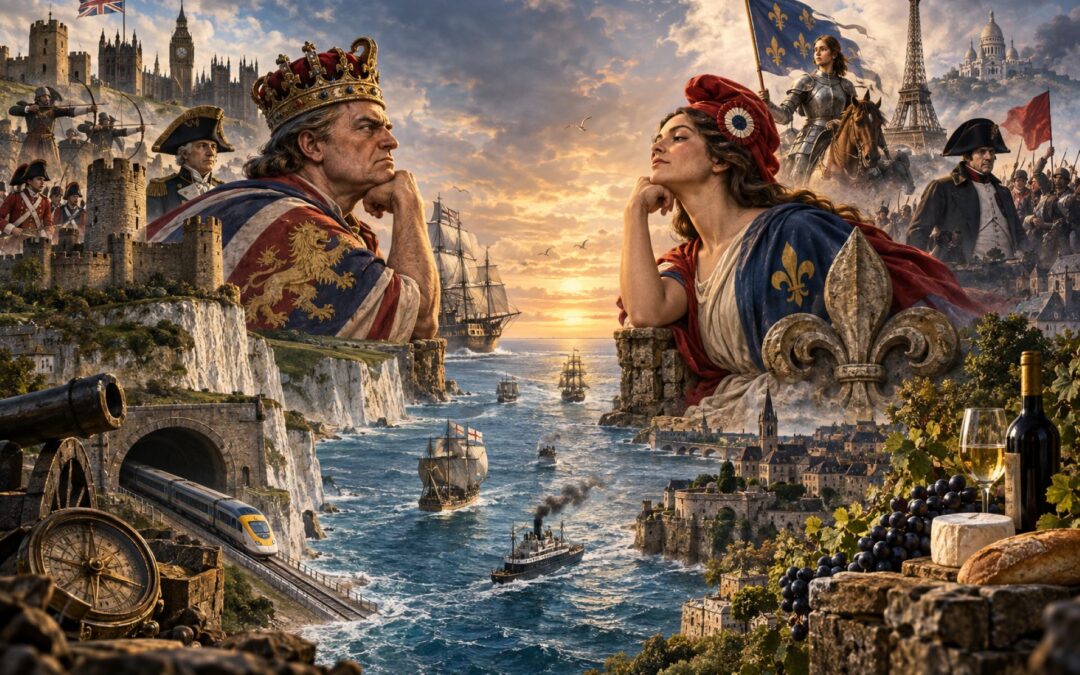
Stephen Clarke’s 1000 Years of Annoying the French looks, from its title, like a long joke at France’s expense. It certainly contains plenty of jokes, but the book’s real project is more interesting. Clarke takes roughly a millennium of relations between England or Britain and France and asks why two countries that have fought together, fought against one another, copied one another, married into one another’s ruling families, shared technologies, exchanged ideas and built joint projects still remember their common history so differently.
The book is therefore neither a conventional national history nor an impartial diplomatic survey. Clarke builds his narrative around disputed ownership: Who really invaded whom? Who invented what? Who betrayed whom? Who deserves credit for a victory, a food, an idea or a political achievement? On his official page for the book, Clarke describes the project as a journey through the “tragi-comedy” of Anglo-French relations, and that mixture of serious history and comic provocation determines almost every chapter.
The result is enormously entertaining, frequently illuminating and deliberately argumentative. Clarke is often strongest when he exposes how patriotic storytelling simplifies shared history, but his method has a built-in danger: after dismantling a French myth, he sometimes replaces it with an equally memorable British counter-myth. Understanding the book therefore requires two things at once. We have to follow the history Clarke actually tells from 1066 to the twenty-first century, and then ask how reliable, fair and revealing his method is.

What Stephen Clarke Is Trying to Prove
Clarke begins from an observation that many British and French people would recognize even if they disagreed about its causes: the two countries are unusually close and unusually capable of irritating one another. Geography makes separation impossible, but proximity has never guaranteed affection. The English Channel has worked both as a barrier and as an invitation, protecting Britain from some continental dangers while repeatedly tempting rulers, armies, traders, writers and politicians to cross it.
His explanation is historical rather than psychological. Britain and France have accumulated so many shared victories, defeats, humiliations, borrowings and rival claims that the past has become part of contemporary identity. A medieval battle or an eighteenth-century insult may no longer have direct political consequences, but its story can survive in schoolbooks, monuments, national heroes, jokes, stereotypes and diplomatic language.
That means the same event can produce incompatible national memories. A French reader may instinctively understand 1066 as a French conquest of England, while an English reader may emphasize William’s Norman identity. Joan of Arc may appear in one version as the victim of English brutality and in another as someone betrayed by French institutions. Napoleon can be the great modernizer of France or the defeated imperial enemy of Britain. Clarke’s recurring pleasure comes from discovering the less flattering fact hidden behind the most flattering national story.
He does not treat this as evidence that history itself is meaningless. On the contrary, the book depends on the belief that evidence can complicate myths. The problem is that national history tends to compress mixed motives, shifting identities and multinational coalitions into cleaner stories of “us” and “them.” Clarke repeatedly tries to reopen those stories by asking what the patriotic version leaves out.
The book’s chronology also demonstrates how the form of rivalry changes. Medieval conflict is largely dynastic and territorial. Early-modern competition expands through religion, trade and empire. The eighteenth century turns Anglo-French hostility into a worldwide contest stretching from Canada to India and the Pacific. Revolution and Napoleon transform the rivalry into a struggle over political order and continental power, while the nineteenth century increasingly replaces invasion with cultural borrowing, colonial competition and diplomacy.
By the twentieth century, Britain and France are often military allies, yet the older suspicion does not disappear. The two governments quarrel over strategy, empire, Charles de Gaulle, Europe, NATO, the Falklands, trade and American power. Clarke’s final point is not that Britain and France remain natural enemies. It is almost the opposite: they are too entangled to become indifferent to one another.
That distinction matters because the title can otherwise be misleading. 1000 Years of Annoying the French is written from a British and increasingly Anglophone perspective, and many chapters are designed to puncture French pride. Yet the deeper story is one of mutual dependence. Britain and France repeatedly win by learning from others, lose by misreading one another and create national traditions out of material that turns out to be international.
From the Norman Conquest to the End of English France
Clarke begins with 1066 because the Norman Conquest appears to provide France with the perfect opening victory. William the Conqueror crosses the Channel, defeats Harold Godwinson at Hastings and becomes king of England. If the book were simply a patriotic scorecard, France would seem to begin a thousand-year contest with one of the most consequential invasions in British history.
Clarke’s first move is to challenge the label. William is Duke of Normandy, and Normandy itself takes its name and ruling origins from Scandinavian settlers. The Normans had become French-speaking Christians embedded within the political world of medieval France, but they were not simply representatives of a modern French nation-state marching under a later national identity. The distinction is historically important because one of Clarke’s recurring targets is the habit of projecting modern national categories backward onto periods when political identity worked very differently.
The Bayeux Tapestry becomes both evidence and symbol. It presents the Norman version of the events leading to Hastings, including Harold’s relationship with William and the disputed question of rightful succession. Modern material from the Bayeux Museum likewise treats Bishop Odo, William’s half-brother, as the probable patron and recognizes the work’s capacity to legitimize the Norman cause. Clarke therefore invites the reader to see one of medieval Europe’s most famous visual narratives not merely as documentation but as political storytelling.
William’s victory nevertheless transforms England. A new Norman elite takes land and power, castles spread across the country, government becomes more tightly connected with continental aristocratic networks, and French-speaking rulers sit above an English-speaking population. The long linguistic consequences are enormous; the mixture of elite French and popular English helps reshape vocabulary and social distinctions in ways explored more fully in how the Norman Conquest changed the English language.
Yet the conquest does not permanently turn England into an appendage of France. Instead, the English crown becomes part of a cross-Channel political system in which rulers possess different lands under different legal relationships. William’s sons divide and contest his inheritance. Henry I eventually reunites England and Normandy, but his succession crisis after the death of his heir creates another phase of instability.
Henry I wants his daughter Matilda to succeed him, but Stephen seizes the throne, leading to years of civil war. The eventual settlement allows Matilda’s son Henry Plantagenet to become Henry II. His marriage to Eleanor of Aquitaine gives him control or influence over an enormous collection of territories in western France, so that the king of England now possesses a continental domain that rivals or exceeds the direct lands of the French king.
The irony is central to Clarke’s early chapters. England and France cannot yet be treated as neatly separated national organisms because aristocratic families, languages, feudal obligations and territorial claims cross the Channel constantly. Henry II’s conflict with Thomas Becket, his rebellious sons and Eleanor’s political role therefore belong to a world in which “English” rulers often spend much of their time in lands that are now considered French.
Richard I demonstrates the problem even more clearly. Later English memory transforms Richard the Lionheart into an archetypal national hero, yet he is a continental ruler whose political concerns lie heavily in France and whose reign is dominated by crusading, warfare and disputes with Philip II. Clarke uses figures like Richard to show how national legend can appropriate people whose own identities and priorities do not fit the later national story.
King John’s reign changes the balance. Through military and political failures he loses most of the Plantagenet lands in northern France, including Normandy itself. His weakened authority contributes to the crisis that produces Magna Carta, while English politics becomes less deeply anchored in continental possessions.
Even this separation is not clean. During John’s troubles, rebellious English barons invite Prince Louis of France to take the English crown. Louis lands in England and acquires substantial support before the death of John and the accession of the young Henry III undermine his cause. Clarke relishes the episode because it complicates another comfortable national story: after 1066, England was not simply an island that successfully kept French claimants out.
Over the following generations, however, England and France become more recognizable as rival kingdoms. English monarchs retain claims and possessions on the Continent, but their political identity becomes increasingly tied to England. Military institutions also develop in ways that will shape the next long phase of conflict.
The Hundred Years War begins when Edward III advances a claim to the French crown through his mother, Isabella of France. French succession practice and political resistance prevent that claim from being accepted, but the dynastic dispute provides a basis for decades of intermittent war. Clarke is careful to show that “Hundred Years War” is a retrospective label for several phases of conflict rather than one uninterrupted campaign.
English success depends partly on military organization and the use of the longbow. At Crécy in 1346, English and Welsh archers contribute to a devastating victory against a much larger French force. The weapon itself is less important than the tactical system built around it: disciplined deployment, terrain, defensive preparation and the difficulty faced by mounted or heavily armoured attackers under concentrated missile fire.
Edward then captures Calais, giving England a strategically important continental foothold. Calais becomes a military base, commercial centre and symbol of English persistence in France. It also illustrates the broader economics of the war because control of trade, taxation and profitable territories matters alongside dynastic honour.
The Black Prince, Edward III’s son, extends the English military reputation through campaigns in France. Clarke also emphasizes the brutality of the chevauchée, the mounted raid designed to burn property, terrorize populations and undermine the enemy’s capacity to govern. Romantic national memory tends to preserve knights and famous battles; Clarke repeatedly drags attention back toward the destruction inflicted on civilians and agriculture.
The Black Death temporarily overwhelms both countries with a disaster larger than their rivalry, but the war resumes. Political instability in France, internal faction and changing military fortunes mean that spectacular English victories never produce a simple permanent conquest.
Henry V’s campaign culminates at Agincourt in 1415, perhaps the most mythologized English victory of the war. Disease, exhaustion and numerical disadvantage make the English triumph especially dramatic, and later literature—above all Shakespeare—turns the battle into a lasting story of courage against the odds. Yet Clarke places Agincourt within a larger pattern: tactical success encourages increasingly ambitious territorial claims that prove difficult to sustain.
Henry’s later position appears extraordinarily strong. The Treaty of Troyes recognizes him as heir to the French throne after Charles VI, and his marriage to Catherine of Valois seems to create the possibility of a dual monarchy. But Henry dies before Charles VI, leaving the claim to an infant son.
The French cause is revived in one of the book’s most provocative chapters, devoted to Joan of Arc. Joan emerges from rural Lorraine claiming divine guidance and persuades supporters of the Dauphin Charles that she has a role in saving the kingdom. Her arrival contributes to the raising of the siege of Orléans, after which Charles is crowned at Reims as Charles VII.
Clarke’s interest lies not only in Joan’s success but in what happens when her usefulness declines. Her campaign against Paris fails, and she is eventually captured by Burgundian forces, whose alliance with the English is one of the complications often flattened in popular memory. She is transferred into English hands and put on trial in Rouen.
The usual shorthand says that the English burned Joan of Arc, and English political responsibility was indeed substantial. Clarke complicates the story by emphasizing that her captors included Burgundians, her judges included French clerics and Bishop Pierre Cauchon was French. Charles VII, whom she had helped place securely on the throne, also failed to rescue her.
The correction is useful so long as it does not become another simplification. Joan was tried in English-controlled territory and the process served English political interests, so it would be misleading to use the nationality of individual clerics to erase English responsibility. Clarke’s real contribution is to demonstrate that “France versus England” conceals a civil and dynastic conflict involving rival French factions as well as foreign occupation.
Joan is executed in 1431, but the political situation continues to turn against England. The Burgundian alliance shifts, French military organization improves and English resources become strained. By the middle of the century, almost all English possessions in France have been lost.
Calais survives. Its continued possession gives England a final continental enclave and preserves the memory of a much larger territorial ambition. Clarke follows the town through the Tudor period, when English monarchs still intervene in European warfare and occasionally imagine recovering earlier prestige.
That last remnant disappears under Mary I. In 1558 French forces capture Calais, ending more than two centuries of English rule there. The loss carries emotional weight because it marks the final collapse of an old political world in which the English crown possessed sovereign territory inside France.
The first five chapters therefore form a coherent arc beneath their comic details. The story begins with a Norman duke conquering England and ends with England losing its last major continental possession. In between, identities harden, dynastic entanglement becomes national rivalry and famous victories fail to produce permanent domination.
Queens, Colonies, Champagne, and the Sun King
Once England’s territorial presence in France contracts, the rivalry does not disappear. It shifts into dynastic politics, religion, overseas expansion, court diplomacy and eventually competition for global power. Clarke’s next group of chapters therefore moves rapidly from Mary Queen of Scots to Canada, Charles II, sparkling wine and Louis XIV, but the connecting theme is the widening range of places in which Anglo-French competition operates.
Mary Stuart is useful to Clarke precisely because she resists simple national classification. Born Queen of Scots, she is sent to France as a child, raised at the French court and married to the future Francis II. Her upbringing makes her culturally and politically far more French than many modern images of a purely Scottish queen suggest.
Her position also matters because Scotland remains a potential French ally against England. The traditional Franco-Scottish relationship, Mary’s Guise family connections and the religious divisions of the Reformation place her at the centre of a triangular struggle. When Francis becomes king of France, Mary briefly stands beside him as queen consort, but his early death changes her prospects dramatically.
Returning to Scotland, Mary encounters a political society transformed by Protestant reform. Her Catholic faith, French education and dynastic claims make her both glamorous and dangerous. Clarke follows the sequence of personal and political crises that destroys her Scottish rule: her marriage to Lord Darnley, the murder of her secretary David Rizzio, Darnley’s own violent death and her rapid marriage to the Earl of Bothwell.
Rebellion follows, and Mary is imprisoned at Loch Leven before escaping. Her defeat sends her across the border into England, where she expects assistance from Elizabeth I but instead enters years of confinement. Her proximity to the English succession means she becomes a focus for Catholic plots whether or not she controls all of them.
Eventually the Babington Plot gives Elizabeth’s government evidence strong enough to prosecute Mary. She is executed in 1587. Clarke uses the episode not as an isolated biography but as another demonstration that Anglo-French history repeatedly passes through individuals whose identities, loyalties and political significance cross borders.
The next major expansion is geographical. France’s attempts to establish a North American empire place explorers such as Giovanni da Verrazzano and Jacques Cartier inside the long competition with England and, later, Britain. Cartier explores the St Lawrence region and claims territory for France, but early settlement efforts face climate, disease, logistical difficulties and inconsistent support.
Samuel de Champlain gives New France a more durable foundation. Quebec becomes an imperial centre, while French traders and missionaries build relationships with Indigenous nations across a vast interior. The French system differs significantly from later British settler expansion because the European population remains comparatively small and much of the empire depends on trade networks, alliances and mobility rather than dense agricultural colonization.
Clarke argues that France repeatedly weakens its own position. Religious policy, especially limitations on Protestant settlement, reduces the available population at a time when rival English colonies are growing rapidly. Centralized administration and uneven metropolitan commitment compound the demographic disadvantage.
Acadia becomes one of the most contested zones. British and French control alternates, while Acadian communities develop identities not reducible to either imperial state. During the eighteenth-century wars, British authorities deport many Acadians, a reminder that the struggle for North America involves coercion, displacement and Indigenous as well as European politics.
The contest culminates in the Seven Years War. British naval power and military pressure gradually erode the French position, while battles around Quebec decide the fate of Canada. The famous deaths of James Wolfe and Louis-Joseph de Montcalm become symbols of an imperial struggle whose result is much larger than either commander’s legend.
France eventually loses most of its North American possessions. Clarke’s emphasis is characteristically provocative: British success matters, but French strategic and demographic weaknesses matter too. This recurring pattern—France being “annoyed” partly because of mistakes made by French governments themselves—gives the book much of its comic structure.
The seventeenth-century monarchy chapters move back to Europe. Charles II spends part of his exile in a French environment and returns to England after the Restoration with a complicated relationship to Louis XIV. France is both model and danger: Louis embodies royal magnificence and centralized authority, but English politics remains deeply suspicious of Catholicism and French influence.
The Secret Treaty of Dover gives Clarke one of his most effective examples of hidden diplomacy. Charles accepts French subsidies while making promises that, if fully revealed, would have been politically explosive in England. His dependence on Louis is real, yet Charles also maneuvers between domestic constraints, personal interests and international alliances.
For British readers, the episode helps explain why “French influence” can become a synonym for political suspicion. France is not merely another foreign state. It represents a particular combination of Catholicism, absolutism, court luxury and strategic ambition that many English Protestants increasingly define themselves against.
Clarke then makes one of his abrupt but deliberate changes of subject. Champagne seems far removed from secret treaties, yet it fits the book’s obsession with disputed national ownership. The popular legend credits the Benedictine monk Dom Pérignon with inventing sparkling Champagne, but the historical story is much messier.
Pérignon worked to improve wine quality and blending, and his name became attached to later myths about discovering bubbles. Clarke instead emphasizes the English scientist Christopher Merrett, whose 1662 paper to the Royal Society discusses the addition of sugar to wine in ways that could produce renewed fermentation. The Royal Society’s surviving record of Merrett’s paper confirms the early documentation on which Clarke builds his case.
English glassmaking technology also matters because stronger bottles can contain the pressure created by secondary fermentation more reliably than weaker containers. Clarke therefore turns a supposedly quintessential French product into another Anglo-French collaboration. Yet even here his best argument is not that England single-handedly “invented Champagne” in the modern commercial sense. It is that the familiar lone-genius legend conceals technological and commercial developments occurring across borders.
Louis XIV then brings the book back to state power. Versailles becomes the architectural expression of a monarchy that intends to project magnificence not merely within France but throughout Europe. Louis expands French influence through war and diplomacy, alarming neighbouring states and encouraging coalitions designed to contain him.
William of Orange becomes central to that resistance. His eventual seizure of the English throne in the Glorious Revolution aligns England more firmly against France, and English military and financial power increasingly become part of broader European coalitions. Anglo-French rivalry is therefore no longer principally about possession of Normandy or Aquitaine; it is about the balance of European power.
John Churchill, Duke of Marlborough, becomes the great British military figure of the War of the Spanish Succession. Clarke gives particular attention to Blenheim, where Marlborough and his allies inflict a major defeat on French and Bavarian forces. The battle damages the aura of French invincibility and prevents Louis XIV from dominating the conflict on his own terms.
The eventual Treaty of Utrecht reorganizes European and colonial interests. Britain gains important commercial and strategic advantages, while France remains a major power but fails to achieve unlimited hegemony. The sequence from Charles II to Marlborough therefore explains a fundamental shift in British identity: fear of French power becomes a lasting organizing principle of foreign policy.
Voltaire and the Global Anglo-French Empire War
By the eighteenth century, Clarke’s subject is no longer simply Britain and France as neighbouring monarchies. Their rivalry now stretches across intellectual life and a growing imperial system. Voltaire can be shaped by England while French and British armies fight for North America, India and the Caribbean, making the relationship simultaneously cultural and geopolitical.
Voltaire enters the book as a Frenchman who discovers in Britain an alternative against which to criticize his own society. Personal conflicts with aristocratic privilege and the French authorities contribute to his exile, after which he encounters British religious pluralism, commerce, science and politics. Clarke is fascinated by the idea that one of France’s most influential critics sharpened his arguments by observing the country’s traditional rival.
Voltaire’s Lettres philosophiques contrasts English institutions with French ones, sometimes idealizing the comparison for polemical effect. England appears more tolerant, commercially energetic and intellectually open, while France appears constrained by religious and aristocratic authority. The important point for Clarke is not that Voltaire simply becomes an Anglophile but that ideas move across the Channel even during periods of strategic hostility.
That movement anticipates another irony. French participation in the American Revolution will eventually help create a new Anglophone republic that becomes an even larger rival to France. In Clarke’s long chronology, irritation keeps reproducing itself through unexpected consequences.
Before American independence, however, France attempts to build a continental empire of its own. Explorers such as René-Robert Cavelier, Sieur de La Salle, extend French claims through the Mississippi basin, while Louisiana theoretically connects Canada to the Gulf of Mexico. On a map the French imperial position can appear enormous, but the actual European population is thinly spread.
The Mississippi Company and John Law’s financial schemes add an economic dimension. Law helps create a speculative system based on expectations surrounding colonial wealth, credit and state finance. When the bubble collapses, the political and financial consequences damage confidence while illustrating Clarke’s larger argument that France repeatedly possesses opportunities it cannot fully convert into durable imperial advantage.
The strategic clash becomes more direct in the Ohio Valley. French and British colonial claims overlap, and Indigenous nations pursue their own interests within a rapidly changing balance of power. A young George Washington becomes involved in confrontations with French forces before emerging much later as the leading figure of American independence.
The North American fighting expands into the Seven Years War, a global conflict in which Britain and France fight not only in Canada but across oceans and colonial theatres. British naval success, the capture of key positions and France’s difficulties in reinforcing its empire shift the balance decisively.
The Treaty of Paris in 1763 leaves Britain dominant in much of eastern North America. France relinquishes Canada and other possessions, although the geopolitical consequences are more complicated than simple victory. Britain now has a large empire but also substantial wartime debt and increasingly contentious relations with its own American colonists.
That reversal becomes the foundation of Clarke’s chapter on American independence. France sees the rebellion of Britain’s colonies as an opportunity to weaken its old enemy. Money, weapons and covert assistance begin flowing before formal French entry into the war.
Benjamin Franklin becomes a celebrated diplomatic figure in France, cultivating elite fascination with the American cause while negotiating practical support. Once France enters openly, its military and naval contribution significantly alters the strategic balance. Spain and other European actors also become involved, widening the war far beyond thirteen rebellious colonies.
The decisive campaign at Yorktown shows why French participation cannot be treated as a decorative footnote. French naval power helps prevent British escape or reinforcement, while French and American land forces cooperate in the siege. Readers wanting the wider context can follow France’s intervention in the American Revolution within the broader war rather than treating Clarke’s Anglo-French focus as the entire story.
Clarke’s joke is that France helps create American independence “from France” as well as from Britain in the long run. The newly independent United States does not become a permanent French client. Instead, American foreign policy develops around its own interests, and relations with France eventually become contentious.
The fiscal cost of French intervention also matters. Supporting the American war worsens the monarchy’s financial problems at precisely the moment when structural taxation and political crises are becoming acute. Clarke therefore turns France’s revenge against Britain into one of the contributing pressures that precede its own revolution.
The Atlantic consequences continue through the Caribbean. Saint-Domingue, France’s enormously profitable slave colony, becomes the site of the Haitian Revolution, destroying another major piece of French imperial power. Napoleon later abandons wider North American ambitions and sells Louisiana to the United States.
The Louisiana Purchase transforms the scale of the new republic. A vast region that France once imagined as part of a continental empire passes into American hands. Clarke’s wider argument is that French attempts to weaken Britain repeatedly contribute to the growth of an English-speaking power that will eventually overshadow both European states.
India provides another example of lost imperial opportunity. The French East India Company establishes strong positions, especially around Pondicherry, and French officials such as Joseph François Dupleix seek political influence through alliances with Indian rulers. The struggle cannot be understood merely as Europeans conquering passive territory; competing local powers use European forces and diplomacy for their own objectives.
Nevertheless, British and French companies become increasingly militarized rivals. French political and military leadership suffers from disagreement and inconsistent support, while British forces gradually secure a stronger position. The failure of French ambitions under figures such as Lally contributes to Britain’s later dominance in India.
Clarke then shifts from India to the Pacific. Louis Antoine de Bougainville’s voyage around the world, French involvement in the Falklands and the extraordinary participation of Jeanne Baré expand the narrative beyond conventional warfare. Baré, travelling disguised as a man, becomes the first known woman to circumnavigate the globe.
Tahiti becomes especially important because European explorers transform it into a cultural fantasy. Reports of sexuality, abundance and apparently relaxed social customs feed European ideas about the “natural” human condition. French and British voyagers compete for prestige and knowledge even while producing narratives that often say as much about European desires as about Pacific societies.
By the end of these chapters, Clarke has expanded his field enormously. Anglo-French rivalry now helps shape the United States, Canada, India and parts of the Pacific world, while Voltaire demonstrates that intellectual influence moves in the opposite direction from military competition. The two nations increasingly define themselves through a global contest whose effects extend far beyond either population.
Revolution, Napoleon, and Britain’s Great French Enemy
The French Revolution and the Napoleonic Wars form the most sustained central sequence in Clarke’s book. Here the older rivalry acquires ideological intensity because Britain is no longer merely confronting a French king. It faces a revolution that destroys the Bourbon monarchy, reorganizes political authority and eventually produces Napoleon Bonaparte, the French leader who becomes the defining continental enemy in British national memory.
Clarke approaches the Revolution through one of his characteristic object histories: the guillotine. The device is so strongly associated with revolutionary France that it appears almost inherently French, and its name derives from Joseph-Ignace Guillotin. Yet Guillotin did not simply invent the machine from nothing.
Mechanical decapitation devices existed earlier in several European regions, including the Halifax Gibbet in England and the Scottish Maiden. Clarke therefore uses the guillotine as another example of a national symbol with a more complicated ancestry. His chapter title pushes the joke into “British invention,” but the stronger historical claim is narrower: the revolutionary machine belongs to a wider European history of mechanical execution rather than being an entirely unprecedented French creation.
The Revolution itself grows from a much deeper crisis. The monarchy faces severe fiscal problems, a tax system full of exemptions and inequalities, political resistance to reform and growing public debate over representation and privilege. France’s participation in the American War aggravates the financial strain without by itself explaining the collapse.
The calling of the Estates-General in 1789 opens a political process the monarchy cannot control. Representatives of the Third Estate declare themselves a National Assembly, and the crisis becomes increasingly revolutionary. The storming of the Bastille acquires enormous symbolic importance even though the fortress’s military significance is limited.
Feudal privileges are attacked, the Declaration of the Rights of Man and of the Citizen articulates universal political principles, and the old relationship among monarchy, church and aristocracy is transformed. For readers seeking the broader chronology beyond Clarke’s selective treatment, the wider causes and stages of the French Revolution provide the context in which his Anglo-French comparisons operate.
Clarke is particularly interested in British reactions. Edmund Burke condemns the Revolution in terms that help shape conservative criticism of radical political change, while others in Britain initially welcome aspects of the French challenge to absolutism. The conflict is therefore ideological inside Britain as well as geopolitical between states.
The monarchy’s position deteriorates through failed compromise, war and mistrust. Louis XVI and Marie Antoinette become targets of increasingly intense suspicion, and Clarke takes the opportunity to attack another familiar myth: there is no reliable evidence that Marie Antoinette responded to reports of bread shortages with the famous instruction to eat cake.
The monarchy falls, and Louis XVI is executed. War with European monarchies intensifies the pressure on the new republic, while internal rebellion and political faction push revolutionary politics toward greater violence. The September Massacres and the Reign of Terror reveal how fear of treason and invasion can turn revolutionary ideals into systems of coercion.
Robespierre and the Committee of Public Safety become associated with emergency government, mass executions and an increasingly uncompromising definition of political virtue. The revolutionary state also attempts to reshape everyday time through the Republican Calendar, presenting political change as a complete cultural reconstruction rather than a mere change of rulers.
Clarke’s tone is often comic, but the chapter’s deeper function is serious. The Revolution destroys the old diplomatic framework within which Britain and France fought dynastic wars. Once revolutionary armies spread beyond France, Britain increasingly confronts not just a rival government but a political transformation with potentially continental consequences.
Out of that military environment rises Napoleon Bonaparte. Clarke begins by stripping away another myth, the caricature of Napoleon as exceptionally short. The stereotype owes much to propaganda, misunderstanding of measurements and later cultural repetition rather than an extraordinary physical fact.
Napoleon first demonstrates his military ability during the revolutionary wars and gains prominence through campaigns such as Toulon and Italy. His victories combine tactical skill, speed, political self-promotion and the ability to make war finance itself through conquered territory. By the late 1790s he has become both a general and a public phenomenon.
His relationship with Joséphine gives Clarke room to mix political history with personal narrative. Yet the crucial shift is strategic. Napoleon’s campaign in Egypt is designed partly to threaten British interests and weaken Britain’s access to India, demonstrating how imperial rivalry continues even within revolutionary warfare.
The Egyptian expedition produces military and intellectual consequences. French scholars accompany the army, and the discovery of the Rosetta Stone becomes one of the expedition’s most famous legacies. Yet the British naval victory at the Battle of the Nile under Horatio Nelson isolates Napoleon’s army and destroys much of the strategic promise of the campaign.
The Rosetta Stone itself later passes into British possession after the French defeat. Clarke naturally treats this as another perfect object for Anglo-French irritation: an artefact discovered during a French expedition becomes one of the British Museum’s most famous possessions.
Napoleon returns to France and participates in the coup of 18 Brumaire, eventually making himself First Consul and later emperor. His domestic rule stabilizes important revolutionary changes while concentrating political authority. Administrative centralization, the Napoleonic Code and institutional reforms give his regime a legacy that cannot be reduced to military conquest.
For Britain, however, the central question is invasion. Napoleon gathers forces and contemplates crossing the Channel, reviving one of the book’s oldest themes: French power seeking a way into Britain. The decisive obstacle is naval.
Nelson’s victory at Trafalgar destroys the realistic prospect that Napoleon can establish the maritime control required for a major invasion. Napoleon may dominate much of continental Europe, but Britain’s naval strength prevents him from converting continental power into control of the British Isles.
He therefore turns increasingly toward economic warfare. The Continental System attempts to exclude British goods from European markets and break Britain financially. The policy demonstrates both the scale of Napoleon’s power and its limitations because enforcing the blockade requires control over states whose interests do not always align with France.
The Peninsular War becomes one of those weak points. French intervention in Spain and Portugal triggers prolonged resistance, while British forces under Arthur Wellesley, the future Duke of Wellington, build experience fighting Napoleon’s armies. Guerrilla warfare and conventional campaigns drain French resources.
At the same time, Napoleon’s empire creates resentments even where French rule carries administrative reform. National resistance, dynastic interests and the demands of war combine to make permanent domination increasingly expensive.
The invasion of Russia in 1812 becomes the catastrophic turning point. Napoleon enters with an enormous multinational army but cannot force the decisive political result he needs. Distance, supply failure, Russian strategy, combat, disease and winter contribute to the destruction of much of the force during the retreat.
After Russia, the coalition against Napoleon becomes much harder to defeat. Wellington advances through the Iberian Peninsula into France, while other Allied armies pressure Napoleon from the east. Paris eventually falls, and Napoleon abdicates.
Exile to Elba appears to end the story, but Napoleon escapes and returns to power during the Hundred Days. The final confrontation comes at Waterloo in 1815, where Wellington’s Anglo-Allied army resists Napoleon until Prussian forces under Gebhard Leberecht von Blücher make their decisive contribution.
Clarke naturally enjoys the Wellington-versus-Napoleon version of Waterloo, but the battle should not be reduced to a private Anglo-French duel. It is a coalition victory, and the Prussian role is indispensable. That wider coalition setting is essential to understanding the Napoleonic Wars beyond the national mythologies they later produce.
Napoleon abdicates again and is sent to St Helena, where he spends the remainder of his life under British supervision. Even in defeat, however, his legend grows. France eventually repatriates his remains, turning Les Invalides into a site of national memory.
Britain responds with its own heroic pantheon. Nelson and Wellington become monumental figures, embedded in statues, place names and patriotic storytelling. Clarke’s sequence therefore ends not merely with Napoleon losing but with both countries converting the wars into durable national memory.
This is one of the book’s strongest narrative arcs because military history and mythmaking reinforce one another. Britain needs Napoleon partly because a formidable enemy makes British resistance more heroic, while France can remember Napoleon’s administrative genius and military brilliance without allowing Waterloo to define his entire legacy. The same historical figure therefore strengthens two different national identities.
When War Gives Way to Food, Art, Wine, and Diplomacy
After Waterloo, Britain and France continue to compete, but the book changes texture. Military confrontation no longer dominates every chapter. Clarke turns increasingly to food, literature, displaced royalty, agriculture and diplomacy, showing that rivalry becomes cultural and symbolic even as direct war between the two countries recedes.
Food provides an ideal field for his method because national identity attaches itself strongly to cuisine. Dishes and techniques become symbols of authenticity even when their histories involve migration, technology and borrowing. Clarke uses steak, the baguette and the croissant to show how difficult it can be to identify a single national origin.
The croissant is the clearest example. Its ancestry leads back toward the Austrian kipferl, while the nineteenth-century Viennese baker August Zang helped popularize Viennese baking in Paris. A Smithsonian examination of the croissant’s history likewise emphasizes this Austrian connection and the weakness of the popular Marie Antoinette legend.
That does not make the modern croissant “not French.” French bakers transformed the form, technique and cultural identity of the pastry. Clarke’s broader point works better when understood as a challenge to pure national ownership rather than as an attempt to relocate an entire culinary tradition to another country.
The baguette is harder to pin down. Viennese baking methods and technology influence nineteenth-century French breadmaking, but the exact origin of the modern baguette is uncertain. Stories about Napoleon, metro workers or particular bakers circulate widely, and Clarke’s version is best treated as part of an unresolved history rather than a final explanation.
The next chapter shifts from food to Romanticism. France possesses an enormously prestigious Classical tradition, but nineteenth-century cultural change increasingly exposes French audiences to different literary models. British and German Romanticism help undermine older assumptions about what serious art should look like.
Walter Scott is particularly influential in France. His historical novels demonstrate a form capable of combining national past, adventure and social change, and French writers respond enthusiastically. Byron likewise acquires a powerful European reputation, while Wordsworth and Coleridge belong to the broader British Romantic challenge to rationalist and Classical conventions.
Shakespeare provides Clarke’s most important case. French neoclassical taste had often regarded Shakespeare’s mixture of tragedy and comedy, his violence and his disregard for Classical unities as barbaric. Yet the very characteristics once treated as defects eventually become sources of creative freedom.
Victor Hugo and other French Romantics help transform Shakespeare’s standing. Painters such as Eugène Delacroix also find inspiration in Shakespearean drama and British Romantic literature. The supposed cultural enemy therefore becomes a source of French artistic renewal.
The irony is more powerful than a simple British boast. Cultural influence flows because artists borrow what they need, not because nations surrender. A French Romantic can oppose British political interests while admiring Shakespeare, just as Voltaire had earlier used England as a tool for criticizing France.
Clarke then returns to political personalities through the strange afterlife of French monarchy. Louis-Philippe, overthrown in the Revolution of 1848, finds refuge in Britain and dies there. Britain, formerly the great military enemy of French monarchy and revolution alike, repeatedly becomes a safe destination for defeated French rulers.
Napoleon III deepens the pattern. Before establishing the Second Empire, he experiences exile and spends time in Britain. Once emperor, he becomes an ally of Britain during the Crimean War, demonstrating how dramatically the relationship has changed since Waterloo.
After France’s defeat in the Franco-Prussian War, Napoleon III again ends up in England. His son, the Prince Imperial, later serves with British forces in the Anglo-Zulu War and is killed in southern Africa. Clarke’s chapter title jokes that Britain “killed off” the last French royals, but the historical reality is more revealing: Britain has become refuge, ally and stage for the final episodes of French dynastic history.
The phylloxera crisis then provides one of the book’s most effective examples of international dependence. In the nineteenth century, a tiny insect pest devastates French vineyards by attacking the roots of European grapevines. The crisis threatens not merely an agricultural sector but one of France’s strongest symbols of cultural identity.
The durable solution comes through resistant American rootstock. European Vitis vinifera varieties can be grafted onto American roots that tolerate phylloxera far better. A historical review of wine and France confirms both the scale of the disaster and the importance of grafting in the recovery of European vineyards.
Clarke naturally turns that fact into the claim that French wine comes from America. As with Champagne, the joke works because it collapses several layers of identity into one sentence. The roots may be American, but the fruiting varieties, terroirs, production cultures and wine traditions remain European and specifically French in many of their defining characteristics.
The chapter is nevertheless one of Clarke’s strongest because the underlying irony is undeniable. A national product associated with ancient continuity survives because of biological material imported from across the Atlantic. Purity turns out to depend on adaptation.
The final chapter in this sequence centres on Edward VII. Before becoming king, Edward develops an unusually strong familiarity with France and Parisian society. His reputation for pleasure, nightlife and cosmopolitan sociability makes him a very different diplomatic figure from the austere caricature of Victorian monarchy.
As king, his 1903 visit to France helps improve the public atmosphere between two countries still carrying memories of centuries of rivalry and more recent colonial disputes. The Entente Cordiale of 1904 then settles several outstanding imperial disagreements and establishes a framework for closer relations.
Clarke enjoys personalizing this transformation through Edward’s charm, but the settlement is not the work of one sociable monarch. Government diplomacy, strategic concerns and the desire to resolve colonial disputes matter far more structurally. Edward contributes to the atmosphere in which rapprochement becomes popular and symbolically credible.
That transition is crucial for the rest of the book. Britain and France are moving from habitual rivalry toward strategic cooperation, but the accumulated habits of competition survive. The coming world wars will reveal how awkwardly the two can cooperate even when they face the same enemy.
Allies Who Still Do Not Trust Each Other
The twentieth century changes the central paradox of Clarke’s history. Britain and France spend much of the century formally aligned, yet alliance does not erase mistrust. In the First World War, Second World War and their aftermath, the two states repeatedly disagree over strategy, responsibility, national honour and the meaning of victory.
In 1914 British troops arrive in France not as invaders but as allies. The British Expeditionary Force joins French armies against Germany, and the Western Front rapidly becomes a shared battlefield. The Battle of the Marne helps prevent an immediate German victory, but the conflict settles into the attritional trench warfare that defines much of the popular memory of the war.
Clarke is interested not only in strategy but in cultural contact. British soldiers encounter French civilians, French language, food, sexuality and customs on an enormous scale. Slang, misunderstandings and stereotypes become part of the wartime relationship, while sport and informal social contact coexist with military cooperation.
The alliance is therefore experienced at several levels. Governments coordinate strategy imperfectly, generals dispute priorities, soldiers live among civilians, and each society develops its own interpretation of sacrifice. France bears enormous physical destruction on its territory, while Britain experiences the conflict partly through expeditionary warfare and mass casualties abroad.
Victory does not produce agreement. The Versailles settlement exposes different strategic priorities, especially over how Germany should be treated. France seeks security against another invasion, while British policymakers often worry about economic stability and the balance of power.
The older national myths also survive. Joan of Arc’s canonization in 1920 strengthens her role as a national symbol at precisely the moment when France and Britain are supposed to have emerged from the war as close allies. Cooperation overlays memory rather than replacing it.
The Second World War produces a far sharper crisis. France enters the war alongside Britain in 1939, but the German offensive of 1940 collapses Allied positions with extraordinary speed. The fall of France becomes one of the most politically sensitive episodes in the entire book because later British and French memories emphasize different aspects of the disaster.
The Maginot Line provides an easy symbol of failure, though Clarke recognizes that the full military problem is more complex than the stereotype of French soldiers hiding behind fortifications. German operational success, command problems, strategic assumptions and the breakthrough through the Ardennes all matter.
Dunkirk becomes a foundational British story. The evacuation saves much of the British Expeditionary Force, turning retreat into a narrative of national survival. Yet from a French perspective, the episode can look very different because France remains under attack after British forces withdraw.
Charles de Gaulle then emerges as the dominant French personality in the final part of the book. A relatively junior general in 1940, he rejects the armistice and reaches Britain, where he issues the 18 June appeal calling for continued resistance. His authority is initially far from secure, but over time he becomes the political embodiment of Free France.
The moment briefly produces an extraordinary proposal: an Anglo-French political union intended to keep France in the war. The scheme fails amid the political collapse that brings Marshal Philippe Pétain to power and produces the Vichy regime. Even the fact that such a union could be contemplated shows how far the relationship has moved from medieval territorial rivalry.
The armistice creates a new problem for Britain. France possesses a significant navy, and British leaders fear that its ships could eventually fall under German control. The result is the British attack on the French fleet at Mers-el-Kébir in July 1940, in which large numbers of French sailors are killed.
Strategically, Britain wants to demonstrate that it will prevent German use of the fleet at any cost. Politically and emotionally, the attack deepens bitterness. Clarke uses Mers-el-Kébir as proof that being allies does not prevent Britain and France from inflicting violence on one another when their governments define survival differently.
De Gaulle’s relationship with Churchill is equally complicated. Churchill supports Free France but finds de Gaulle difficult, while de Gaulle believes British and American leaders repeatedly underestimate or attempt to control French interests. Franklin Roosevelt is even more suspicious of de Gaulle’s claim to political leadership.
Free French forces operate alongside the Allies in multiple theatres, but conflicts over sovereignty recur. Disputes involving territories such as Saint-Pierre and Miquelon illustrate how de Gaulle refuses to accept that Allied strategic convenience should override French authority.
The book’s second World War chapter turns toward resistance and collaboration. Britain’s Special Operations Executive supports networks inside occupied France, while French groups pursue different political and military agendas. The Resistance is real, dangerous and significant, but it is never a single unified organization.
Collaboration is equally varied. The Vichy regime does not merely endure German pressure passively; French institutions participate in repression and persecution. The United States Holocaust Memorial Museum’s account of France under occupation makes clear that Vichy authorities actively collaborated with Nazi policy, including in the persecution and deportation of Jews.
At the same time, it would be false to move from the myth of a uniformly resistant France to an opposite myth of a uniformly collaborationist one. Individuals and groups resist for different reasons, at different times and with different degrees of risk. Communists, Gaullists, intelligence networks, local fighters, foreign nationals and ordinary civilians all occupy different positions within the wartime landscape.
Clarke also explores the morally unstable category of cultural collaboration. Writers, artists, intellectuals and entertainers continue working under occupation, but the meaning of doing so varies enormously. Some openly support fascism or German power, while others navigate censorship, survival and ambiguity.
The treatment of women accused after liberation of “horizontal collaboration” reveals another dimension of memory. Public head-shaving and humiliation make women’s bodies into symbols of national betrayal, even though political, military and economic collaboration had often involved men in much more powerful positions.
D-Day and the Allied invasion reopen the question of French participation in liberation. Resistance groups disrupt communications and support operations, while Free French forces fight within the wider Allied campaign. De Gaulle is determined that France must appear not merely as a liberated victim but as one of the victorious powers.
The liberation of Paris becomes particularly important. Fighting inside the city, the French 2nd Armoured Division under Philippe Leclerc, Resistance activity and the wider Allied military position all contribute to the outcome. The National WWII Museum’s account of the liberation of Paris reflects this combined picture rather than attributing the liberation to any one national force.
Clarke is especially interested in de Gaulle’s postwar presentation of the Resistance. The idea of a France that had collectively resisted serves a powerful political purpose because it restores national legitimacy and avoids defining the postwar state through Vichy defeat. Yet the myth cannot simply erase the reality of collaboration.
Nor should the exposure of that myth erase the reality of resistance. This is one place where Clarke’s adversarial structure requires careful handling. A corrective history should make the picture more complex, not merely move the moral credit from one national column to another.
For a reader who needs the wider military framework beyond Clarke’s Anglo-French quarrels, the broader history of World War II helps place Dunkirk, Vichy, North Africa, D-Day and Paris inside the global conflict. Clarke’s distinctive contribution lies elsewhere: he shows how alliance itself becomes material for later national argument.
By 1945 Britain and France have fought on the same side in two world wars, but they emerge in different conditions. Both are victorious powers with global empires, yet both are economically weakened and confronted by American and Soviet dominance. De Gaulle’s subsequent policies will be driven partly by his determination that France should never again depend completely on Anglo-American decisions.
De Gaulle, Europe, and the Modern Rivalry
The postwar world changes the scale of British and French power. Neither country can dominate Europe as it once hoped to, and both face decolonization, American influence and the construction of new European institutions. Clarke’s final chapters show the old rivalry surviving by migrating into arguments about sovereignty, alliances, trade, prestige and culture.
Suez is one of the most dramatic examples. In 1956 Britain and France cooperate with Israel after Egyptian president Gamal Abdel Nasser nationalizes the Suez Canal. Militarily, the operation achieves some immediate objectives, but intense American and international pressure forces Britain and France to withdraw.
The crisis is humiliating because it exposes the limits of independent European imperial action in an American-led Western system. Britain and France respond differently to the lesson. British policy becomes more firmly centred on the relationship with the United States, while French policy under de Gaulle will increasingly emphasize strategic independence.
France is meanwhile struggling with decolonization, especially in Algeria. The Algerian War destabilizes the Fourth Republic and helps bring de Gaulle back to power in 1958. His return gives France a new constitutional order and restores a leader whose political identity has been shaped by his wartime suspicion of dependence on allies.
De Gaulle’s relationship with Britain is therefore more than a personal grudge. He questions whether Britain is truly committed to Europe or too closely tied to the United States and Commonwealth. When Britain seeks membership of the European Economic Community, de Gaulle vetoes its application.
The veto becomes one of the defining modern Anglo-French irritations. From the British perspective it can appear as French obstruction; from de Gaulle’s perspective it expresses a strategic theory about what sort of Europe should exist and how much American influence Britain would bring into it.
Nuclear weapons, NATO and defence policy deepen the distinction. France develops an independent nuclear deterrent and seeks greater freedom from American command structures. In 1966 de Gaulle withdraws French forces from NATO’s integrated military command and requires NATO institutions to leave French territory.
Clarke’s shorthand risks making this sound as though France simply left NATO. It did not. NATO’s own historical account of France’s relationship with the alliance confirms that France remained a member while leaving the integrated military command structure, which it formally rejoined in 2009.
The distinction is revealing because it captures de Gaulle’s entire approach. France wants the protection and political benefits of the Western alliance without accepting automatic subordination to its integrated command. To British policymakers more comfortable with close American cooperation, the strategy can look theatrical or obstructive; to Gaullists, it is an assertion of sovereignty.
Not every postwar project is competitive. Concorde is an extraordinary Anglo-French technological collaboration, jointly developed by British and French industries and governments. The aircraft becomes a symbol of prestige that neither country is likely to have produced in the same way alone.
Its commercial limitations do not erase its symbolic importance. Concorde demonstrates the contradiction at the heart of Clarke’s book: Britain and France can complain continuously about one another while cooperating on projects that require extraordinary technical trust.
May 1968 gives Clarke another opportunity to explore cultural difference. Student revolt, strikes and political unrest challenge de Gaulle’s government and create an image of France as a society capable of sudden ideological eruption. British observers can react with fascination, amusement or incomprehension, reinforcing stereotypes about French protest culture.
Film and popular culture keep the exchange moving in both directions. Britain and France each protect distinctive cultural traditions while consuming one another’s music, cinema, fashion and ideas. The old battlefield has become a market of influence.
The Falklands War in 1982 revives the military dimension in an unexpected form. Argentina’s armed forces use French-made Exocet missiles and aircraft, while Britain fights to recover the islands. France provides Britain with assistance and information despite the uncomfortable fact that French weapons have become part of the threat.
The episode neatly embodies postwar rivalry: commercial competition, alliance obligations and national strategic interests overlap in ways that do not fit simple friendship or hostility. France can be both the manufacturer of the weapon British sailors fear and a government helping Britain counter it.
The Rainbow Warrior affair is much more damaging to France’s image. French agents bomb the Greenpeace ship Rainbow Warrior in Auckland harbour in 1985, killing photographer Fernando Pereira. The operation, intended to disrupt protests against French nuclear testing in the Pacific, creates international scandal.
For Clarke, the affair belongs to a pattern in which French governments defend sovereign independence even at the cost of angering allies and partners. Yet it also reveals the danger of reducing policy to national personality. The bombing was a specific covert operation by the French state, not an expression of some timeless French instinct.
Margaret Thatcher’s battles with European integration create another arena of conflict. Disputes involving budgets, agricultural policy, sovereignty and Jacques Delors allow older national rhetoric to reappear inside European institutions. Britain and France are no longer fighting over territory but over the political architecture of Europe.
Agricultural disputes make the conflict even more visceral. The BSE crisis and restrictions on British beef provide material for tabloid hostility and mutual accusations. Food, which earlier symbolized cultural borrowing, now becomes a battlefield of regulation, trust and public health.
The Channel Tunnel ought to provide the perfect ending to a millennium of separation. Opened in 1994, it physically connects Britain and France beneath the water that had so often functioned as Britain’s defensive moat. What generations of invading kings and emperors could not achieve by force is accomplished through engineering and agreement.
Clarke treats the tunnel as a historical joke but also as a serious symbol. Napoleon imagined crossing the Channel with an army; the modern connection allows millions of ordinary travellers to cross in hours. The geography that produced centuries of strategic anxiety becomes infrastructure.
Language nevertheless remains contested. French efforts to protect the French language, including the Toubon law, reflect anxiety about the growing global dominance of English. To Clarke, this naturally becomes another example of France attempting to resist the Anglophone world after military rivalry has largely disappeared.
The Iraq War in 2003 produces one of the sharpest recent episodes of anti-French feeling in the United States and Britain. France opposes the invasion, while the governments of George W. Bush and Tony Blair support it. American expressions such as “freedom fries” revive a remarkably old style of national caricature in a new geopolitical setting.
Yet global economic integration makes the rivalry harder to sustain literally. French companies operate internationally, British people live and work in France, French people work in Britain, and ownership crosses borders. The idea of a clean economic contest between separate national camps becomes increasingly artificial.
The centenary celebrations of the Entente Cordiale and later state visits demonstrate the same contradiction. Politicians ceremonially praise partnership while newspapers and publics continue enjoying rivalry. Nicolas Sarkozy’s visit to Britain gives Clarke contemporary material for a relationship that remains theatrically competitive even after strategic hostility has largely vanished.
The book ends, then, with Napoleon’s “dream” fulfilled in an ironic form. France has not conquered Britain, and Britain has not conquered France. Instead, the two are tied by infrastructure, institutions, commerce, migration, alliances and accumulated cultural memory.
That is the real resolution of the thousand-year chronology. The rivalry survives not because the countries failed to influence one another but because they influenced one another constantly. Every borrowed word, disputed battle, shared war and national stereotype becomes another reason to pay attention.
The Real Subject of the Book Is Historical Memory
Clarke presents his material as a sequence of provocations, but the deepest subject is collective memory. The book repeatedly distinguishes between what happened and what a nation prefers to remember happened, although Clarke does not always maintain that distinction with academic precision. Battles, inventions, foods and personalities become cultural possessions long after their original historical settings disappear.
The Norman Conquest provides an early model. Calling William “French” can be defensible in one sense because Normandy belongs to the French political and linguistic world, but it can also conceal the duchy’s Norse origins and the unstable meaning of medieval identity. Modern people want a clear national label because the later rivalry encourages them to imagine that the categories always existed.
Joan of Arc is even more revealing because memory turns a politically complicated civil and international conflict into moral theatre. The English become persecutors, the French become the nation Joan saves, and her execution becomes a national martyrdom. Clarke reopens the story by restoring Burgundians, French clerics and Charles VII’s limited intervention, thereby exposing how collective memory simplifies responsibility.
Napoleon works in the opposite direction. His defeat is central to British memory, but Waterloo does not erase his prestige in France. French memory can emphasize legal reform, administrative centralization, military genius and national glory, while British memory emphasizes resistance, Trafalgar and Waterloo.
The Second World War brings the mechanism into the modern era, where the political stakes are especially high. Postwar France benefits from a unifying story of resistance because a state emerging from occupation needs legitimacy. Britain benefits from stories of Dunkirk and solitary resistance because they transform a period of strategic danger into national resilience.
Neither story is wholly false, which is precisely why memory is so powerful. Dunkirk really does save hundreds of thousands of Allied soldiers, and Resistance movements really do fight occupation. Myth emerges when a selected truth becomes so dominant that it crowds out contradictory truths.
Clarke also understands that memory is material. It lives in statues, memorials, place names, museums, cuisine and objects. The Bayeux Tapestry, the guillotine, Napoleon’s tomb, Champagne and even grape rootstocks become ways of arguing about national identity.
The English Channel itself functions as a recurring symbol. It separates and connects the countries at the same time. Its strategic meaning shifts from Norman invasion route to defensive barrier, from Napoleonic obstacle to tunnel corridor, but it never stops structuring the relationship.
This emphasis places Clarke within a much broader tradition of writing about Anglo-French mutual definition. Robert and Isabelle Tombs’s That Sweet Enemy offers a more expansive and systematically comparative account of how Britain and France have shaped one another. Clarke’s version is narrower and more comic, but both approaches point toward the same underlying fact: hostility is only one part of a relationship built equally on fascination and imitation.
The title therefore contains its own contradiction. To be annoyed by someone for a thousand years requires persistent attention. Britain and France notice one another because each has repeatedly mattered to the other’s security, prestige and self-image.
Clarke is particularly effective when he shows that humiliation can be as historically productive as victory. French loss in North America helps produce later intervention in the American Revolution. British fear of Louis XIV contributes to new coalitions and institutions. Napoleon’s defeat produces enduring heroic traditions on both sides.
The relationship thus becomes self-renewing. One generation inherits not merely events but interpretations, and those interpretations shape how later conflicts are understood. A modern diplomatic dispute can revive a vocabulary of betrayal or arrogance created in completely different circumstances.
The book’s weakness is that Clarke sometimes behaves as though exposing one national myth reveals the neutral truth beneath it. Often what lies beneath is another layer of contested interpretation. His strongest chapters recognize this complexity; his weakest rely too heavily on the satisfaction of reversal.
Even so, the cumulative effect is valuable. Readers emerge less willing to accept national ownership at face value. The French may claim Champagne, Britain may claim Waterloo, Americans may claim independence, but each history becomes more complicated when the surrounding relationships are restored.
How Clarke Turns French Myths into British Counter-Myths
Clarke’s favourite narrative machine is easy to recognize after several chapters. He begins with a familiar claim associated with French pride, locates an inconvenient detail, shifts perspective and then gives the revision a headline designed to be remembered. The structure is comic, efficient and potentially dangerous.
The Norman Conquest is the first demonstration. A simple version says that the French conquered England in 1066. Clarke answers that the Normans were descended from Vikings and therefore were not straightforwardly “French” in the modern sense.
The correction is useful because it exposes anachronism. It becomes weaker only if it implies that Viking ancestry somehow makes Normandy non-French in every relevant sense by 1066. Norman rulers spoke a Romance language, participated in Frankish-Christian political culture and held a duchy within the French kingdom.
The Bayeux Tapestry follows the same pattern. Instead of accepting it as a transparent illustrated chronicle, Clarke directs attention toward patronage and political purpose. That shift is supported by modern scholarship and by the Bayeux Museum’s discussion of its likely commissioning and legitimizing function.
Joan of Arc reveals both the method’s power and its limitation. Clarke is right that the usual sentence “the English burned Joan” conceals Burgundian participation, French clerical actors and the political abandonment of Joan by the monarchy she had helped. The history becomes richer when those elements are restored.
But “the French killed Joan” is not a superior simple sentence. English authorities purchased her from her captors, held her in English-controlled Rouen and had a direct political interest in discrediting her. The truth is multi-actor responsibility, which is less catchy than either national slogan.
Champagne is similar. Dom Pérignon did not suddenly invent sparkling wine in the romantic manner later advertising suggests. Merrett’s paper demonstrates that English scientific observers understood deliberate secondary fermentation early, and English glass technology helped make pressurized bottled wine more practical.
Clarke’s counterclaim therefore exposes a real problem with the legend. Yet “the English invented Champagne” still compresses centuries of viticulture, regional identity, technological development and commercial standardization into a single national triumph. The best conclusion is that Champagne’s development was more transnational than patriotic mythology implies.
The guillotine chapter repeats the pattern with even greater comic exaggeration. Mechanical decapitation machines existed in Britain before the French Revolution, so the French device cannot be treated as a wholly unprecedented national invention. Yet similar machines existed elsewhere as well.
Calling it a British invention is therefore rhetorically satisfying but historically too strong. Clarke knows that the joke depends on exaggeration, but readers who remember only the chapter title may not preserve the qualification.
Food makes the technique especially visible because culinary history rarely has clean borders. The croissant does have important Austrian ancestry, but its later French development is equally real. A national cuisine often works by absorbing foreign forms until they become locally transformed.
The baguette is even less suitable for a definitive counterclaim because its precise origin is uncertain. A useful correction should increase uncertainty when the evidence is uncertain rather than replacing one folklore story with another.
Phylloxera gives Clarke a stronger case because the biological dependency is well established. French and other European vineyards survive largely through grafting onto resistant American rootstocks. The humorous claim that French wine is American underneath contains a literal botanical truth.
Yet even that statement plays with levels of identity. Roots, grape varieties, soil, climate, winemaking practices and regional institutions all contribute to what people mean by “French wine.” National ownership is not disproved merely because one biological component comes from elsewhere.
World War II is where the counter-myth technique becomes ethically most serious. Clarke is justified in resisting a sanitized story of universal French resistance. Vichy collaboration, police participation and accommodation with German occupation are essential parts of the historical record.
The opposite simplification would be equally false. Resistance exists, Free French forces fight throughout the war and large numbers of people make difficult choices under occupation that cannot be reduced to one moral category. The liberation of France depends on Allied armies, Free French forces and resistance networks together.
Clarke’s method therefore works best as an opening question rather than a closing verdict. When he says, in effect, “the story you know is missing something,” he is often persuasive. When the joke becomes “the opposite national story is the true one,” the history can narrow again.
That tension is not incidental to the book; it explains both its readability and its limitations. A nuanced sentence is harder to remember than a provocative reversal. Clarke deliberately chooses memorability, and much of the book’s pleasure comes from the speed with which he overturns expectations.
The responsible way to read him is neither to accept every reversal nor to dismiss the reversals because they are comic. Many originate in real historical complications. The reader simply has to preserve the complication after the joke has done its work.
Britain and France as Rivals Who Constantly Borrow from Each Other
The surface story of 1000 Years of Annoying the French is competition, but the deeper historical pattern is borrowing. Britain and France become distinct partly through contact with one another. Even some of their strongest symbols of difference are products of exchange.
The Norman Conquest illustrates the process at the most basic level. England’s ruling elite becomes heavily French-speaking, and English absorbs a vast quantity of vocabulary associated with government, law, cuisine, rank and culture. The conquerors eventually become English even as the language preserves evidence of their origins.
Centuries later, intellectual traffic moves the other way. Voltaire uses his experience of Britain to sharpen his criticism of French institutions. British political and scientific life becomes material for French Enlightenment argument.
Romanticism repeats the pattern. Shakespeare, Scott and Byron become important in France not because French culture disappears but because French writers and artists find foreign forms useful for challenging local conventions. Cultural borrowing becomes a method of national reinvention.
Food makes the same point at a more everyday level. Croissants can have Austrian ancestry and still become French. Sparkling wine can depend on English documentation and bottle technology while Champagne remains inseparable from a French region, production tradition and commercial identity.
Wine itself survives phylloxera through American rootstock. This is not an embarrassment to French viticulture unless national identity requires biological purity, which no serious history of agriculture can sustain. Successful traditions often endure because they adapt.
Military rivalry produces borrowing too. Armies study one another’s weapons, tactics and organization. Naval competition accelerates innovation, while colonial administrations observe and imitate rival systems even as they denounce them.
The American Revolution creates a different sort of transfer. France aids British colonists partly to damage Britain, but the resulting republic becomes a major Anglophone power. Strategic action produces cultural consequences no government fully controls.
The twentieth century makes interdependence explicit. Britain and France fight together in two world wars, coordinate diplomacy and build joint technologies. Concorde cannot be described honestly as either purely British or purely French without erasing the structure that created it.
The Channel Tunnel is the ultimate physical expression of this history. The countries that once defended themselves by controlling crossings now spend vast resources making crossing easier. The project does not eliminate national difference; it makes difference more continuously accessible.
This is why Clarke’s humour works even when it is unfair. Rivalry is funny partly because absolute separation is impossible. Britain and France can claim superiority only while borrowing, trading and cooperating with the opponent.
The concept also complicates Clarke’s expanding use of “Anglo-Saxon” identity. By the modern chapters, the antagonist is often no longer Britain alone but a broader English-speaking world, especially the United States. That rhetorical category allows Clarke to connect old British-French rivalries with language politics, globalization and American power.
Historically, however, “Anglo-Saxon” can become too imprecise when used as a catch-all for Britain, America and English-speaking modernity. Those societies do not share identical interests, and France’s relationship with each differs substantially. Clarke uses the term because it suits his comic binary, but the history itself repeatedly escapes the binary.
The book is therefore at its most revealing when the rivalry appears almost secondary to exchange. Britain and France spend centuries trying to prove that the other matters less, while their own languages, political strategies, cuisines, arts and institutions show the opposite. Annoyance becomes evidence of intimacy.
Humour, Structure, Sources, and Historical Reliability
Clarke’s historical method cannot be separated from his comic voice. A conventional academic narrative might organize the same material around state formation, imperial competition, nationalism or diplomatic systems. Clarke organizes it around irritation because irritation gives the reader a reason to remember.
The chapter titles function like miniature arguments. They promise that an accepted story will be overturned: the French did not really conquer England, the English helped invent Champagne, Britain somehow “killed off” French royalty, French wine depends on America and Napoleon’s dream eventually comes true through a tunnel. The titles are intentionally less qualified than the chapters beneath them.
That technique gives the book tremendous momentum. A thousand years of Anglo-French history could easily become a catalogue of kings, treaties and battles, but Clarke continually resets the reader’s attention with a puzzle. Each chapter asks what familiar national story is about to be embarrassed.
His prose also resists reverence. Monarchs, generals and statesmen are described with colloquial humour, sexual scandal sits beside diplomacy, and high politics frequently gives way to food, gossip or technological trivia. The approach makes historical figures feel less remote.
The cost is that comic compression can blur hierarchy. A dispute over pastry may appear structurally equivalent to imperial warfare because both receive equally memorable treatment. Clarke knows they are not equivalent, but his episodic structure rewards good stories more than proportionate historical weighting.
The book’s evidence is stronger than its deliberately unserious tone might suggest. Clarke has said in his discussion of his research process that the project involved roughly two years of work and materials including diaries, historical letters and travel writing. The selective bibliography in the book confirms that he consulted a broad range of general and specialist histories.
That bibliography is important because it demonstrates that the jokes are not simply improvised from popular folklore. Clarke reads serious historical work and then translates it into a highly accessible narrative. Many of his best corrections arise from details that disappear from simplified national accounts.
At the same time, the book is not a scholarly monograph. It lacks the dense apparatus that would allow a reader to trace every disputed factual claim immediately to primary evidence. Sources are selective rather than exhaustively tied to individual statements.
That matters most when Clarke moves from fact to inference. If a humorous claim is controversial, the reader may not always know how much is documentary evidence, how much is Clarke’s synthesis and how much is comic framing. The stronger the joke, the easier it is for those levels to merge.
His chronology also creates an illusion of continuity that the book sometimes needs to disrupt. “England,” “Britain,” “France” and the later “Anglo-Saxon world” change profoundly over the millennium. The political meaning of being Norman, French, English or British in 1066 cannot simply be projected forward into modern nationalism.
Clarke often acknowledges this, especially when doing so produces a useful joke, but the entire premise still encourages long-term personification. Britain and France start to behave like two characters who have been arguing for a thousand years. That is excellent storytelling but only partly accurate historiography.
The benefit is explanatory clarity. By personifying the rivalry, Clarke makes otherwise disconnected events feel cumulative. Readers can see why Calais, Waterloo, de Gaulle and European disputes belong within one historical relationship.
The weakness is selection. Events that fit the rivalry receive attention, while forces that cut across the binary may appear mainly when they affect the competition. Indigenous nations, German states, Spain, the Netherlands, Russia, the United States and colonial populations are sometimes reduced to supporting roles in an Anglo-French drama in which they had their own agendas.
Clarke’s method is therefore best understood as thematic popular history. It is not attempting to replace detailed histories of the Hundred Years War, colonial North America, the Revolution, Napoleon or World War II. It asks what those episodes look like when selected through the lens of Anglo-French memory.
On those terms, the structure is remarkably successful. The reader can move across ten centuries without losing the central question. The repeated comic machinery becomes a form of organization, not merely decoration.
Where the Historical Claims Need More Qualification
The book does not need to be fact-checked sentence by sentence to be evaluated fairly. Its more important claims can instead be divided into three broad types: corrections that are substantially strong, corrections that are right in direction but need narrower wording, and comic reversals that should not be repeated as literal conclusions. The distinction matters because Clarke’s titles often collapse all three into the same rhetorical form.
The Norman argument is a good example of a basically sound correction that becomes misleading only when pushed too far. William was Duke of Normandy, and the Norman ruling elite descended in part from Scandinavian settlers. That complicates the phrase “France conquered England.”
But Normandy by 1066 had been integrated for generations into the political and cultural world of the French kingdom. Its rulers were not Viking outsiders arriving freshly from Scandinavia. The best conclusion is that modern national labels distort the period, not that William was somehow unrelated to medieval France.
The Bayeux Tapestry claim is stronger. Its probable patronage by Bishop Odo and its narrative function make it reasonable to read the work partly as Norman legitimation. The evidence does not require us to treat every scene as calculated propaganda, but it absolutely justifies caution about treating the embroidery as neutral reportage.
Joan of Arc demands greater care. Clarke is right to restore French and Burgundian actors to a story often remembered as a simple English atrocity. Her capture, transfer, clerical trial and execution involve multiple political authorities.
Yet English power remains central. The trial occurs under English domination, English interests require Joan’s discrediting and English money is involved in obtaining custody. Clarke’s chapter is therefore historically useful as a complication but not as a transfer of responsibility from England to “the French.”
The Champagne argument follows the same pattern. Merrett’s 1662 paper establishes that English observers understood the role of added sugar in creating secondary fermentation before later legends assigned sparkling wine to Dom Pérignon’s inspiration. English bottle technology also matters.
What the evidence does not establish is a single moment in which England creates modern Champagne as a finished French regional product. The historically responsible formulation is that the development of sparkling wine involved cross-Channel technical knowledge and that Dom Pérignon’s popular “invention” legend is inaccurate.
The guillotine claim is even more obviously rhetorical. Britain possessed earlier mechanical decapitation devices, but so did other parts of Europe. France did not invent the basic concept of a falling-blade execution machine, yet “British invention” is too exclusive.
The croissant correction is comparatively robust. Austrian forms and Viennese baking play an important role in its ancestry. French bakers then transform those influences into the laminated pastry now recognized worldwide.
The baguette is much less certain. Technology, changes in urban bread consumption and Austrian influence all matter, but no single popular origin story commands enough evidence to close the case. Clarke’s version should therefore be read as one route through a contested culinary history.
The phylloxera chapter rests on a strong factual foundation. Resistant American rootstocks did save European vineyards from devastation. Clarke’s exaggeration lies in extending that root-level dependence into the broader claim that “all French wine comes from America.”
That joke confuses biological support with cultural identity. French grape varieties are grafted onto resistant roots precisely so that European viticulture can continue. The episode proves interdependence, not the disappearance of Frenchness.
World War II requires the most morally and politically careful qualification. Clarke is justified in challenging any postwar myth suggesting that France uniformly resisted. Vichy collaboration was real, institutional and consequential.
The correction becomes misleading if it treats resistance largely as self-serving mythology. Resistance networks did operate, Free French forces fought and the liberation of France was not simply something done to a passive or collaborating population. The historical reality contains collaboration, resistance, accommodation, coercion and shifting loyalties simultaneously.
The liberation of Paris is another example. French Resistance fighters and Leclerc’s armoured division are central, but the wider Allied military campaign makes liberation possible. Neither “the French liberated themselves” nor “the Americans and British liberated Paris while the French watched” captures the event adequately.
Finally, the NATO issue requires straightforward factual precision. France did not leave the North Atlantic Treaty Organization in 1966. It withdrew from the integrated military command structure while remaining within the Alliance.
These qualifications do not destroy Clarke’s central project. In most cases they strengthen its underlying message because they reveal that national myths fail precisely when they make complicated international histories too simple.
The irony is that Clarke occasionally succumbs to the same temptation. His joke works by replacing a familiar slogan with a surprising slogan, even when the real historical lesson is that slogans themselves are the problem.
Critical Review
1000 Years of Annoying the French succeeds first as an act of historical popularization. Clarke takes material that could become exhausting—ten centuries of dynastic claims, wars, colonies, cultural borrowing and diplomacy—and turns it into a narrative with recognizable momentum. A reader can move from Hastings to de Gaulle without feeling trapped inside a textbook chronology.
The humour is central to that achievement. Clarke understands that people remember contradiction. Telling a reader that Anglo-French history is “complex” is forgettable; telling them that the English helped invent Champagne or that American roots saved French wine creates a puzzle that demands explanation.
He is also unusually good at making national history feel relational. Many popular histories remain confined within one country, as though Britain developed internally while France developed separately. Clarke repeatedly shows that each country’s politics and culture are partly responses to the other.
That is perhaps the book’s strongest contribution. England’s language changes after Norman rule, French thinkers look to Britain, French support helps create American independence, British culture influences French Romanticism, American biology preserves French viticulture and modern Anglo-French engineering creates Concorde and the Channel Tunnel. The history of national distinctiveness turns out to be full of foreign ingredients.
The scope is ambitious without pretending to be comprehensive in the conventional sense. Clarke cannot possibly narrate every major development in either nation across a millennium, so he selects episodes that illuminate the relationship. The method works because the book knows what it is looking for.
Selection nevertheless creates bias. Clarke is much more interested in stories where France can be embarrassed, corrected or shown to have depended on Britain or the Anglophone world. That is appropriate to the comic premise but means the book should not be mistaken for a symmetrical account of mutual mythmaking.
British myths are sometimes challenged, especially where doing so sharpens the history, but the energy of the book points mostly in one direction. A systematic examination of British self-deception about France would have produced a different and probably more balanced work.
The term “Anglo-Saxon” also becomes increasingly awkward as the story approaches the modern era. It allows Clarke to fold the United States into a long rivalry that began between medieval kingdoms, but the category can hide major differences among British, American and wider English-speaking interests.
Historical depth is uneven for similar reasons. Chapters on the Hundred Years War, Revolution, Napoleon and World War II carry enormous political and social complexity, while others are built around food or technological curiosities. The resulting mixture is entertaining but can flatten differences in significance.
Clarke’s evidence is generally more serious than the tone suggests. His bibliography and descriptions of his research reveal substantial engagement with historical writing, and many of his most memorable corrections have a genuine factual foundation.
The problem lies less in fabrication than in presentation. A qualification buried within an entertaining chapter can easily disappear behind a provocative title. Readers may remember “the guillotine was British” long after they forget the more accurate explanation that earlier mechanical decapitation devices existed in several places.
That is the book’s most important limitation. Clarke sets out to expose oversimplified national stories, yet the mechanics of popular history reward him for producing equally sharp counterclaims. The better chapters resist that temptation by allowing the reversal to open into complexity.
Joan of Arc illustrates the problem perfectly. Restoring Burgundian and French clerical involvement is valuable. Treating that restoration as proof that “the French” rather than the English killed her merely changes which simplified nation receives the blame.
Champagne works similarly. The Merrett evidence genuinely weakens the Dom Pérignon creation myth, but the history is most interesting when it becomes a story of technological exchange rather than a competition over whether France or England owns the invention.
The book has aged reasonably well because its central subject has not disappeared. National myths remain politically useful, arguments over historical statues and collective memory remain intense, and relations among Britain, France, Europe and the United States continue to be interpreted through inherited narratives.
Some contemporary details from the 2010 political world naturally feel dated, but that does not seriously damage the central argument. The concluding chapters are valuable precisely because they show how old stereotypes can be reactivated around new disagreements.
Clarke’s treatment of twentieth-century France benefits most from later qualification. Scholarship and public debate about Vichy, collaboration and Resistance have continued to emphasize complexity, making any simple “France resisted” or “France collaborated” story increasingly untenable. In that sense, the direction of Clarke’s skepticism remains useful even when particular formulations are too aggressive.
The book’s reception also reflects the difference between its title and its actual content. A contemporary Paris Update review noted that the work should not simply be mistaken for an anti-French rant. That is an important distinction because much of Clarke’s humour depends on affection, familiarity and the recognition that neither country can plausibly tell its own story without the other.
As prose, the book is accessible almost to a fault. Readers who dislike formal history may find its speed, jokes and personality liberating. Readers looking for sustained historiographical argument or exhaustive documentation will sometimes find the same qualities frustrating.
Its best audience is therefore the curious general reader. Someone who knows fragments of British or French history but has never understood how the fragments connect will gain a great deal from Clarke’s thousand-year frame. It is especially good at provoking further questions.
It should not be the final authority on the Norman Conquest, Hundred Years War, colonial North America, French Revolution, Napoleon or World War II. Each of those subjects requires specialist histories capable of treating actors and forces that Clarke necessarily compresses.
That limitation does not make the book unsuccessful. Popular history should be judged partly by whether it leads readers toward a more intelligent curiosity, and Clarke repeatedly succeeds at making accepted stories feel worth checking.
The fairest assessment is therefore that 1000 Years of Annoying the French is a sharp, funny and genuinely informative history of Anglo-French historical memory disguised as a national score-settling exercise. Its provocations work best when the reader treats them as invitations to investigate rather than replacement myths to memorize.
Clarke promises a millennium of French irritation, but his own narrative ultimately undermines the idea that Britain and France can be separated into clean historical teams. Norman rulers remake England, British ideas shape French thinkers, French money helps create the United States, British and French armies become allies, American roots save French vines and the Channel itself eventually becomes a transport corridor.
The book is worth reading for readers who enjoy history most when it is argumentative, surprising and irreverent. Anyone seeking a definitive scholarly account of the individual periods will need more specialized works, but that is not really the role Clarke has chosen.
His larger achievement is to make national certainty feel suspicious. Again and again, the story that seems most obviously French or British turns out to contain foreigners, allies, enemies, borrowed technology, shared culture or later propaganda. The rivalry survives, in Clarke’s telling, because the two countries have never been able to stop shaping one another—and because after a thousand years, each has become part of the other’s memory.
Last Updated on September 22, 2026 by Aseem Gupta