

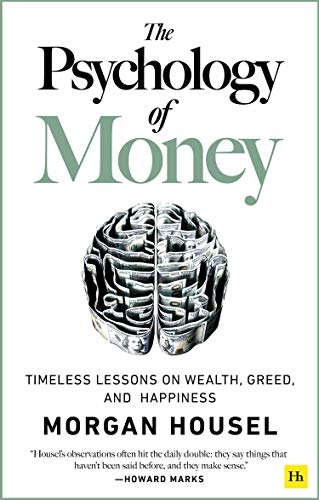
In The Psychology of Money: Timeless Lessons on Wealth, Greed, and Happiness, Morgan Housel examines a peculiar feature of financial life: people with exceptional financial knowledge can lose everything, while people with little formal training can accumulate substantial wealth. The difference cannot always be explained by intelligence, education, or investment skill. It often comes down to how people respond to uncertainty, opportunity, fear, ambition, and the behavior of others.
Published by Harriman House in 2020, the book challenges the assumption that successful money management is primarily a mathematical exercise. Financial decisions are made by people whose experiences differ, whose expectations change, and whose emotions can overwhelm their knowledge. A technically excellent investment strategy is of little practical value if its owner cannot withstand the risks required to follow it.
Across 20 chapters and a historical postscript, Housel develops a philosophy centered on patience, financial survival, adaptability, and independence. He argues that the purpose of accumulating wealth is not necessarily to maximize a numerical result, but to gain greater control over one’s life. His explanations are memorable and often persuasive, although some of his recommendations depend on financial circumstances that not everyone shares. Understanding the book therefore requires examining both its insights into human behavior and the limits of applying those insights to different economic realities.
Experience, Luck, and the Danger of Never Having Enough
Housel begins with his experience working as a valet at an expensive Los Angeles hotel. One regular guest was a technology executive who had earned a fortune through genuine technical achievement. The man had developed important technology, started successful businesses, and accumulated enough money to enjoy almost any material comfort. Yet his relationship with money was extraordinarily reckless.
The executive carried large quantities of cash, flaunted his wealth, and once arranged for expensive gold coins to be thrown into the ocean for amusement. On another occasion, he responded to a dispute over a damaged hotel lamp by handing over far more money than its replacement cost. Housel later learned that the man had lost his fortune. His ability to create wealth had not been accompanied by the restraint necessary to preserve it.
Two contrasting lives establish the book’s central problem more clearly. Ronald Read worked as a gas-station attendant and janitor, lived modestly, saved consistently, and invested in stocks over many decades. When he died, he left an estate worth millions of dollars. Richard Fuscone, meanwhile, had an elite education and a distinguished career at Merrill Lynch. His considerable earnings and professional expertise did not prevent him from experiencing financial collapse.
Housel is not suggesting that financial knowledge is worthless or that every janitor can become a millionaire. His point is that knowledge and behavior are different capabilities. Read’s patience and restraint proved financially productive, while Fuscone’s professional sophistication offered no automatic protection against destructive choices.
This distinction becomes the foundation for the rest of the book.
The opening chapter, No One’s Crazy, asks readers to reconsider how they judge other people’s financial decisions. Someone who grew up during severe inflation may fear holding cash, while someone who witnessed a devastating stock-market crash may distrust equities. A person raised in financial insecurity can have a radically different understanding of risk from someone whose family always had sufficient resources.
Both individuals may be responding sensibly to what they have experienced. Their decisions can still have poor outcomes, but dismissing those decisions as irrational ignores the circumstances through which their beliefs developed.
Housel draws particular attention to generational experience. Investors who lived through the Great Depression developed attitudes toward markets that differed from those of people who entered adulthood during prolonged prosperity. Similarly, memories of inflation, unemployment, or rising asset prices can influence how people assess future opportunities.
He also uses an example involving a Chinese factory worker to demonstrate how the alternatives available to someone affect the meaning of an apparently undesirable choice. Working conditions that seem unacceptable to an outsider may represent an improvement over the worker’s previous opportunities. Understanding the decision requires examining the actual alternatives rather than applying one’s own circumstances.
The same principle informs Housel’s discussion of lottery tickets. People with little realistic prospect of financial advancement may purchase tickets that offer terrible mathematical odds because the remote possibility of dramatic improvement has psychological value. A wealthy observer sees an irrational purchase; a struggling buyer may see one of the few available opportunities to imagine a different future.
This does not make lottery tickets sound investments. It explains why their attraction cannot be understood through probability calculations alone.
Housel adds a historical complication. Many features of modern personal finance are relatively recent. Widespread retirement investing, consumer credit, index funds, and the expectation that ordinary households should independently manage complex financial decisions developed over comparatively short periods. People are therefore expected to make sophisticated choices within systems that neither they nor their families have necessarily experienced for generations.
The second chapter, Luck & Risk, introduces a different obstacle to evaluating financial decisions: outcomes depend partly on forces outside individual control.
Bill Gates attended Lakeside School in Seattle, where students gained unusually early access to computers. In 1968, teacher Bill Dougall helped arrange access to a computer terminal connected to a time-sharing system. Gates and Paul Allen were able to develop programming skills at an age when most students had no comparable opportunity.
Their intelligence, curiosity, and extraordinary commitment mattered. But Housel emphasizes that their development also depended on an improbable educational advantage. Without access to that particular environment at that particular moment, their opportunities would have been substantially different.
Housel contrasts Gates’s trajectory with that of Kent Evans, another exceptionally capable Lakeside student and close friend of Gates. Evans had the intelligence and ambition to pursue a remarkable career, but died in a mountaineering accident while still young. The comparison exposes two sides of uncertainty: favorable circumstances help make extraordinary achievements possible, while unpredictable misfortune can prevent equally promising lives from developing.
Gates’s success cannot be reduced to luck, just as Evans’s death cannot be attributed to poor professional judgment. The underlying lesson is that effort, ability, opportunity, and randomness interact in ways that outsiders cannot completely separate.
Housel extends the argument to historical figures such as Cornelius Vanderbilt and John D. Rockefeller. Their willingness to push boundaries and disregard conventional constraints contributed to their extraordinary business success. Yet behavior celebrated as audacious when it succeeds may be condemned as reckless when it fails. The outcome changes how observers describe the decision.
He therefore warns against learning too much from individual winners or losers. Successful people may have benefited from favorable circumstances they cannot reproduce, while unsuccessful people may have made defensible decisions that produced unfortunate outcomes. Patterns shared by many cases usually offer more reliable lessons than any single extraordinary life.
The third chapter, Never Enough, moves from explaining financial outcomes to questioning the pursuit of wealth itself.
Housel recounts a story associated with Vanguard founder John Bogle, in which Kurt Vonnegut tells fellow writer Joseph Heller that a wealthy party host has earned more in a day than Heller earned from his celebrated novel Catch-22. Heller responds that he possesses something the billionaire may never acquire: a sense of having enough.
The anecdote introduces the danger of continually raising financial expectations. A person may achieve everything previously desired and still feel unsuccessful because the comparison group has changed. Instead of measuring progress against earlier needs or ambitions, people begin measuring themselves against whoever has more.
Rajat Gupta provides a particularly revealing example. Born into difficult circumstances in Kolkata, Gupta rose to become managing director of McKinsey and accumulated enormous wealth and prestige. Nevertheless, his pursuit of still greater status and financial success became associated with an insider-trading scandal that led to his conviction and imprisonment.
Bernie Madoff offers an even more extreme case. He had established wealth, professional standing, and influence, yet operated a massive fraudulent investment scheme that eventually destroyed his reputation and harmed numerous investors. Housel uses these cases to examine the consequences of continuing to pursue additional gains when the potential rewards have become comparatively small beside what can be lost.
The critical issue is not ambition itself. Housel recognizes that progress requires effort and that people should have aspirations. His concern is the inability to establish a boundary beyond which further financial gain is no longer worth risking an already satisfactory life.
He identifies reputation, independence, family, relationships, and happiness as possessions that should not be casually placed in danger for incremental wealth. A sufficiently ambitious person who cannot recognize the point of sufficiency may eventually sacrifice something much more valuable than the money being pursued.
These opening chapters establish three complementary ideas. Financial behavior emerges from personal history, financial outcomes are partly shaped by luck, and financial satisfaction depends on expectations rather than wealth alone. Together, they undermine the assumption that economic success can be understood simply by examining how much someone knows, earns, or accumulates.
Compounding, Survival, and the Power of Rare Winners
The fourth chapter, Confounding Compounding, begins with an unexpected subject: ice ages.
Housel describes how relatively modest changes in Earth’s orbital patterns can influence climate over extremely long periods. Gradual temperature changes allow snow and ice to accumulate, which alters how much sunlight the planet reflects and reinforces the cooling process. Enormous consequences emerge from a sequence of small changes operating through feedback over time.
He uses the analogy to introduce compound growth. Financial wealth can increase not only because an investment generates returns, but because those returns become part of the capital generating future returns. Over sufficiently long periods, this process can produce outcomes that are difficult to understand intuitively.
Warren Buffett supplies Housel’s most important example. Buffett’s investment achievements are extraordinary, but Housel draws attention to how early Buffett began investing and how long he continued. By the book’s publication, Buffett had been accumulating investment returns for many decades. A large proportion of the fortune he had built emerged relatively late in his life.
Housel contrasts Buffett with Jim Simons, whose Renaissance Technologies became famous for exceptional investment performance. Simons achieved remarkably high returns, yet Buffett’s longer compounding period helps explain why Buffett accumulated a much larger personal fortune within the comparison presented in the book.
The distinction is between the rate of return and the time over which returns accumulate. An unusually high return sustained for a relatively brief period can produce less wealth than a more moderate return maintained over several additional decades.
This is difficult for people to appreciate because ordinary intuition tends to understand linear growth better than exponential growth. Housel compares the problem with technological progress, including the enormous increases in computer-storage capacity that emerged from compounded improvements.
His recommendation is to favor good returns that can be sustained over long periods rather than constantly pursuing the highest conceivable return. A strategy that occasionally produces spectacular gains but repeatedly collapses may generate less wealth than one that survives and compounds steadily.
That argument leads directly into Getting Wealthy vs. Staying Wealthy.
Housel examines Jesse Livermore, one of the most famous stock-market speculators of the early twentieth century. Livermore made an enormous fortune by betting against stocks during the 1929 crash. While most investors were devastated, his positioning made him extraordinarily wealthy.
Another investor, Abraham Germansky, had accumulated substantial property wealth and was reportedly heavily exposed to the market before the crash. His disappearance during the period of financial turmoil provides a contrasting image of the destruction surrounding the same event.
Livermore initially appears to represent the perfect response to financial catastrophe. He understood the danger, positioned himself advantageously, and profited while others suffered. But his later financial history undermines the assumption that one extraordinary victory establishes permanent security.
He continued speculating, suffered devastating losses, and ultimately lost much of what he had gained. His ability to make money had not guaranteed his ability to retain it.
Housel argues that building a fortune and preserving one often require different attitudes. Accumulation may reward optimism, willingness to take risks, and confidence in one’s judgment. Preservation requires humility, restraint, and an awareness that favorable circumstances can reverse.
He reinforces this distinction through Warren Buffett, Charlie Munger, and their former associate Rick Guerin. All three were talented investors, but Guerin’s use of leverage left him vulnerable when markets fell. Buffett and Munger were able to continue compounding their capital because they avoided being forced out of the game.
Leverage magnifies both gains and losses. Borrowed money can accelerate wealth accumulation when investments rise, but it may create obligations that force an investor to sell during a decline. Even a fundamentally sound long-term investment can become disastrous if the owner cannot survive the period before its value recovers.
This produces one of the book’s most important distinctions: being right about the long-term future is not enough if a person cannot remain financially solvent until that future arrives.
Housel advocates a combination of long-term optimism and short-term caution. A person can believe that economic progress will continue while recognizing that recessions, market crashes, personal emergencies, and bad decisions will repeatedly interrupt the process.
Financial survival is therefore a prerequisite for realizing the benefits of compounding.
The sixth chapter, Tails, You Win, expands the argument by explaining how extraordinarily uneven successful outcomes can be.
Housel introduces art dealer Heinz Berggruen, who accumulated a remarkable collection of works by artists including Picasso, Braque, Klee, and Matisse. The collection eventually became immensely valuable. Housel discusses the proposition that success in a field like art collecting can emerge from acquiring many works and allowing a small number of exceptional successes to dominate the value of the entire collection.
The important principle is the disproportionate influence of rare outcomes. When returns are highly uneven, most investments or projects do not need to become spectacular successes for the overall undertaking to succeed.
Walt Disney illustrates the same phenomenon. His early animation business experienced serious financial difficulties, and many productions failed to generate sufficient profits. After hundreds of cartoons, Snow White and the Seven Dwarfs became a commercial breakthrough that transformed the company’s financial position.
Disney did not need every earlier production to become an enormous commercial success. The exceptional performance of one project changed the results of the broader enterprise.
Housel then examines public equities. Research discussed in the book shows that many individual companies deliver disappointing long-term outcomes, while a comparatively small number of outstanding performers account for a disproportionate share of market gains. He references the Russell 3000 and the large share of overall performance contributed by its exceptional stocks.
This creates an important distinction between the experience of an individual investment and the experience of a diversified portfolio. A portfolio can contain many disappointing companies and still perform well because it also captures a few unusually successful ones.
The principle also applies to business experimentation. Amazon and Apple became highly successful companies despite numerous products and projects that did not work as intended. Their overall performance depended heavily on a limited number of exceptional achievements.
Housel uses comedian Chris Rock to demonstrate a less obvious version of the same process. Rock tests new material in smaller venues, where many jokes fail or receive mediocre reactions. The polished performance audiences eventually see is the result of extensive experimentation and discarded attempts.
This example matters because people usually encounter the finished success rather than the numerous failures required to produce it. They underestimate how normal unsuccessful attempts are within systems that generate extraordinary outcomes.
Housel’s argument is consequently more subtle than advising readers to make repeated risky bets. He suggests that when positive results are concentrated among rare winners, people should avoid expecting every individual decision to succeed. Diversification, patience, and the ability to tolerate disappointment can be essential.
The three chapters form a connected explanation of long-term financial success. Compounding rewards duration, survival preserves the opportunity to compound, and rare winners account for an unusually large share of the gains that patient participation can capture.
Freedom, Status, and the Wealth You Cannot See
Having explained how wealth can accumulate, Housel turns to the question of what accumulated wealth is supposed to achieve.
In Freedom, he argues that money’s most valuable benefit is control over one’s time. Income and possessions may provide comfort, but financial independence gives people greater authority over when they work, which opportunities they pursue, and how they organize their lives.
He draws on psychologist Angus Campbell’s research into well-being. Campbell found that happiness was not determined solely by income, education, or location. A particularly important element was people’s perceived control over their circumstances.
Housel interprets this finding financially. Someone with substantial savings may be able to leave an unpleasant job, reject unfavorable working conditions, take time away from employment, or make decisions without immediately worrying about basic expenses. The usefulness of that independence may exceed the pleasure of purchasing additional possessions.
His experience as an investment-banking intern illustrates the problem. Housel initially regarded a prestigious, highly paid finance career as a desirable achievement. After beginning the internship, he encountered exhausting hours and extremely limited control over his schedule.
The work was financially attractive and intellectually stimulating, yet the lack of autonomy made the experience deeply unpleasant. The income promised greater future freedom while the job itself demanded the sacrifice of present freedom.
Entrepreneur Derek Sivers provides a contrasting story. As a young musician, Sivers lived inexpensively and saved enough money to leave his day job. His savings were modest compared with the fortunes usually celebrated in financial writing, but they allowed him to pursue music without depending on conventional employment.
For Sivers, that independence represented a meaningful form of wealth. The amount of money mattered less than the practical control it provided.
Housel also discusses the evolving nature of work. In occupations where workers produce physical goods, working hours and output can often be separated more visibly. Knowledge work is different because ideas, problems, and professional obligations may continue occupying a person’s mind after the formal working day ends.
Greater income can therefore coexist with less psychological freedom. The financial value of control over time becomes increasingly important when work expands beyond ordinary boundaries.
The next chapter, Man in the Car Paradox, examines why people nevertheless devote so much money to visible status.
Housel recalls driving expensive vehicles while working as a valet. He admired Ferraris, Lamborghinis, and other luxury cars and imagined how impressive he would appear if he owned one. Eventually, he recognized a contradiction in his thinking.
When he saw an expensive car, his attention was directed toward the vehicle and his fantasy of possessing it. He rarely thought seriously about the person driving it.
Yet many people purchase luxury goods partly because they expect those possessions to make others admire them. The object may attract attention without producing the personal respect its owner desires.
Housel does not argue that expensive purchases are always foolish. Someone may genuinely enjoy a beautiful car or another costly possession. His criticism concerns buying objects for recognition that may never arrive.
Status is particularly unstable because comparison has no natural endpoint. An expensive purchase may feel impressive until the owner encounters someone with a more expensive version.
Wealth Is What You Don’t See develops the argument from another direction.
Housel recounts encountering a young man with an expensive Porsche, only to learn later that the vehicle had been repossessed. The car had created an outward appearance of wealth, but it provided little reliable information about the owner’s underlying financial position.
He distinguishes between being rich and being wealthy. A rich person may have a high current income and the capacity to purchase expensive goods. A wealthy person has accumulated assets that provide financial security and future options.
The two conditions can overlap, but they are not identical. A person earning an enormous salary may spend nearly all of it, while someone with a more modest income may accumulate substantial assets through saving and investing.
Housel emphasizes that visible consumption cannot reveal retained wealth. Expensive possessions show that money has been spent. They do not disclose the amount remaining in investments, savings, or other assets.
This creates an unusual social problem. People learn financial behavior partly by imitating others, but the most visible examples of apparent success often demonstrate consumption rather than wealth accumulation.
A luxury car, large house, or lavish holiday is easy to observe. The decision to invest money instead of spending it leaves no comparable public display.
People may therefore imitate the spending habits of affluent individuals without possessing their financial resources. They copy the visible result while overlooking the invisible foundation.
The chapter Save Money explains how individuals can begin creating that foundation.
Housel opens with the energy crisis of the 1970s. Predictions of severe energy shortages emphasized the need to discover more oil and increase production. Yet improvements in fuel efficiency and energy conservation also helped expand the economic value obtained from available resources.
The analogy is that financial progress does not depend entirely on earning more money or achieving higher investment returns. Reducing the amount required to maintain one’s lifestyle can produce a comparable improvement in financial capacity.
Housel regards the savings rate as an especially important variable because individuals may have more influence over their spending than over market returns. Earnings are constrained by professional circumstances, while investment performance remains uncertain. Expenses, at least beyond basic needs, may offer more immediate opportunities for adjustment.
He connects unnecessary spending with ego. When people use purchases to demonstrate success, additional income creates pressure to finance a progressively more expensive lifestyle. The gap between earnings and spending remains small even as income rises.
Reducing status-driven expenditure can increase savings without requiring extraordinary investment performance.
Housel then introduces a distinction between saving for a specific purchase and saving for flexibility.
Conventional financial planning frequently asks people to define a particular goal: a house, education, retirement, or another anticipated expense. Such planning is useful, but Housel argues that savings can have considerable value even when their eventual purpose is unknown.
Unexpected opportunities and emergencies cannot always be assigned to a predetermined category. Savings may allow someone to change careers, endure unemployment, assist a family member, move to another location, or reconsider a major life decision.
The future value of these options is difficult to calculate. A cash reserve may produce a modest financial return while offering substantial practical freedom.
These chapters give the book a broader conception of prosperity. Wealth accumulation is meaningful because it can create independence, while conspicuous consumption may consume the very resources that could have provided it.
The challenge is to recognize which expenditures genuinely improve life and which are attempts to obtain validation through material possessions.
Financial Decisions That Can Withstand an Uncertain Future
The middle of The Psychology of Money examines the difficulty of planning when both the external world and an individual’s internal priorities can change. Housel argues that successful financial decisions must be robust enough to survive imperfect knowledge, adverse events, and the emotional demands placed on the person following the plan.
This requires a different standard from mathematical optimization alone. The most attractive projected result may be worthless if reaching it depends on assumptions that eventually fail, or on behavior that an investor cannot realistically sustain.
Reasonable Choices and Unreliable History
In Reasonable Over Rational, Housel begins with the historical treatment of syphilis.
Physician Julius Wagner-Jauregg observed that severe fevers sometimes appeared to improve the condition of patients suffering from certain illnesses. He experimented with deliberately inducing fever, including through infections such as malaria, in an attempt to treat syphilis.
The treatments were dangerous, but the medical example allows Housel to distinguish between a theoretically defensible procedure and something patients might reasonably accept. A proposed intervention can have a logical justification while remaining frightening, uncomfortable, or unacceptable to the people expected to undergo it.
The same distinction applies to investing.
A spreadsheet can identify a portfolio with attractive expected returns, but it cannot guarantee that its owner will tolerate the uncertainty involved. An individual who becomes terrified during a market decline may abandon the strategy precisely when continuing would be most important.
For that person, an allocation with somewhat lower expected returns but greater psychological comfort may be more successful in practice. Housel prefers a strategy that someone can genuinely maintain over an apparently optimal one that depends on unrealistic emotional discipline.
He also questions the assumption that all irrational-looking preferences should be eliminated. People develop attachments to particular assets, regions, companies, or investment approaches. Such preferences may not maximize expected returns, but their psychological value can sometimes improve long-term commitment.
The example of Vanguard founder Jack Bogle investing money in funds managed by his son illustrates the point. A strict financial analysis might question the choice, but personal relationships form part of the circumstances in which financial decisions occur.
Housel is not claiming that emotion makes all choices equally good. A person can still take excessive risks, concentrate assets dangerously, or ignore basic financial facts. The distinction is between a technically ideal strategy and a sufficiently sound strategy that fits the individual’s actual life.
Surprise! explains why even technically sophisticated plans cannot reliably eliminate uncertainty.
Housel begins with the observation that history contains events that seemed highly improbable before they happened but became central to understanding everything that followed. Wars, economic crises, technological breakthroughs, and political upheavals can alter the world in ways that earlier forecasts failed to anticipate.
Such events also interact. An unexpected development changes institutions, incentives, expectations, and future possibilities. The resulting sequence may become comprehensible in retrospect even though predicting it beforehand would have been extraordinarily difficult.
Historical data therefore has an unavoidable limitation. It records events that have occurred, not every event that could occur.
Housel argues that investors can learn much about recurring human behavior from history. Fear, greed, overconfidence, and the desire for certainty have recognizable patterns. But the conditions under which those tendencies operate are not permanently fixed.
Financial markets change as industries, regulations, technologies, institutions, and investment practices evolve. A particular trading strategy may appear successful during one historical period because it exploited circumstances that later disappear.
Benjamin Graham illustrates this difficulty. Graham developed influential approaches to identifying undervalued securities, but his own investment methods changed substantially over time. Some opportunities available during his earlier career became less useful as markets evolved.
Housel uses this example to challenge the idea that a successful historical formula can always be applied indefinitely. The enduring principle may be the need for disciplined valuation and intellectual flexibility rather than permanent adherence to one precise rule.
He also identifies the danger of preparing only for previously observed disasters. If a financial plan is constructed around the worst historical outcome, an unprecedented event can still exceed its assumptions.
History is therefore most valuable when used to understand the range of human behavior and the possibility of surprise. It becomes dangerous when treated as a complete catalogue of future risks.
Safety Margins and Changing Priorities
Room for Error develops the practical consequences of uncertainty.
Housel begins with professional blackjack players who count cards. Card counting can provide a statistical advantage by helping players estimate when remaining cards are more favorable. But having a positive expected return does not prevent losing streaks.
A player who bets too much relative to available capital can exhaust the bankroll before the statistical advantage has time to produce results. The method may be mathematically sound while its execution is financially destructive.
The same problem applies to investing. An investment can have a favorable expected outcome while still exposing its owner to losses that are unaffordable.
Housel connects this to Benjamin Graham’s margin-of-safety principle. If an investment or financial plan depends on everything going approximately as expected, small forecasting errors may produce disastrous consequences. A margin of safety creates space between the future one hopes for and the minimum outcome required to survive.
For a household, this might mean maintaining emergency savings, avoiding excessive borrowing, or making retirement assumptions more conservative than optimistic projections suggest.
The purpose is not to predict every emergency. It is to remain functional when something unexpected occurs.
Housel illustrates this through an incident involving German tanks during the Battle of Stalingrad. Mice damaged electrical wiring in vehicles that had been prepared for military operations, rendering some equipment unusable. The problem was not necessarily among the dangers planners had prioritized.
The incident demonstrates that risk can emerge from sources a person never considered. Preparing for familiar dangers is useful, but genuine resilience requires some ability to absorb surprises that have not been specifically identified.
Engineering offers a similar principle through redundancy. Important systems often include backups because a single component can fail unexpectedly. Housel believes personal finances benefit from comparable protection.
Having additional cash, manageable obligations, and alternative options can prevent one adverse event from destroying an otherwise viable plan.
He extends the idea beyond investment portfolios. Employment, health, family commitments, and unexpected expenses all introduce uncertainty into financial decisions. A strategy that leaves no room for error in any of these areas may be more fragile than its apparent numerical efficiency suggests.
You’ll Change adds another complication: the individual making the plan will not necessarily retain the same preferences.
Housel describes a childhood acquaintance who worked extraordinarily hard to become a doctor. The ambition required years of effort and sacrifice, but the man eventually became unhappy with the career he had struggled to enter.
The story introduces the difficulty of predicting what one’s future self will want. A person may confidently pursue a goal that no longer provides satisfaction when it is finally achieved.
Housel draws on research into people’s tendency to underestimate the extent of future personal change. Individuals readily recognize how much they have changed during previous years while assuming their present values and preferences will remain comparatively stable.
This creates a problem for long-term financial planning. Decisions about careers, houses, retirement, spending, and investment commitments often assume that today’s priorities will continue for decades.
Extreme choices can make later adaptation expensive. Someone who organizes every aspect of life around maximizing income may discover that other values have become more important, yet feel unable to change because of the commitments already made.
Housel recommends moderation as a way to preserve flexibility. Maintaining a reasonable balance between spending and saving, work and leisure, or risk and security can reduce the likelihood that a future change in priorities will require a painful reversal.
He also discusses sunk costs. People often remain committed to decisions because they have already invested time, effort, or money in them. Those past expenditures cannot be recovered, yet they influence choices about what to do next.
A person may continue pursuing an unsuitable career or maintaining an expensive lifestyle because abandoning it would seem to invalidate earlier sacrifices. Housel argues that changing direction is sometimes necessary to avoid allowing past decisions to control the future.
Financial independence and flexibility are valuable partly because they make those changes possible.
The Hidden Price of Investment Returns
In Nothing’s Free, Housel examines a different kind of financial mistake: wanting the benefits of an investment without accepting the costs required to obtain them.
He begins with General Electric, once among the most valuable and admired companies in the world. Its financial problems became especially severe during and after the 2008 crisis, when weaknesses in its financial operations and later corporate decisions damaged its position.
The company’s decline illustrates how apparent success can conceal risks and complications. Exceptional outcomes rarely arrive without difficulties, uncertainties, and costs that may remain invisible until circumstances deteriorate.
Housel applies the idea to investment returns.
When people buy an ordinary product, they generally know its price. Investments are different because some of their most important costs are psychological rather than contractual.
The investor seeking high long-term equity returns may need to tolerate sharp market declines, prolonged periods of disappointing performance, uncertainty about future results, and the discomfort of watching other assets appear more attractive.
These costs cannot always be measured in advance, and they do not appear as straightforward charges on an account statement.
Housel uses historical examples of stocks such as Netflix and Monster Beverage to show that extraordinary long-term gains can coexist with frequent or severe declines below previous peaks. Investors who eventually received the large gains had to remain exposed through periods that could have made the investments appear unsuccessful.
The temptation is to avoid this discomfort while still collecting the eventual returns. Investors may repeatedly switch strategies, try to predict market corrections, or abandon holdings whenever prices decline.
But successfully escaping every downturn requires a level of forecasting ability that cannot be assumed. Attempting to eliminate volatility may introduce additional costs, including poor timing, higher transaction expenses, and missed recoveries.
Housel proposes a change in interpretation. Instead of automatically treating market volatility as evidence of a mistake, investors can understand it as part of the price of pursuing uncertain returns.
He distinguishes a fee from a fine. A fee is a cost someone knowingly accepts in exchange for something valuable, while a fine suggests wrongdoing that should be avoided.
Market volatility may be an unavoidable feature of certain investments rather than proof that the investor has acted incorrectly.
This does not mean every loss is harmless. Permanent capital impairment, excessive leverage, fraud, or a fundamentally unsuitable investment cannot be dismissed as ordinary volatility. Housel’s argument works when the investor has selected an appropriate strategy and prepared for the risks inherent in it.
The larger point is that a financial plan must account for the experience of following it. Projected returns are only one part of the decision. The person pursuing them must be able to pay the financial and emotional costs along the way.
Different Investor Games, Pessimism, and Persuasive Stories
The next three chapters examine the collective behavior of financial markets. Housel moves beyond individual saving and planning to explain how different objectives, emotional reactions, and incomplete information influence prices and expectations.
You & Me begins with the enormous damage caused by speculative bubbles. The dot-com collapse and the housing crash destroyed substantial household wealth, leaving people wondering why investors repeatedly become enthusiastic about assets whose prices eventually prove unsustainable.
Greed provides part of the explanation, but Housel believes another mechanism deserves attention: people participating in the same market may be playing fundamentally different games.
Consider a long-term investor evaluating a company’s ability to generate profits over several decades. The price that investor should be willing to pay depends on long-term business prospects, expected cash flows, and uncertainty.
A trader planning to sell the same stock within hours or days faces a different question. The immediate concern may be whether someone else will pay more for it in the near future.
Both participants trade the same security, but they evaluate it according to different objectives and time horizons.
This difference becomes especially important during speculative booms. An asset may appear severely overpriced to a long-term investor while continuing to attract short-term traders who expect further appreciation.
Housel uses Cisco during the dot-com bubble as an example. Its stock price rose dramatically during the late 1990s, reaching a valuation that implied extraordinarily ambitious expectations about the company’s future growth.
Short-term traders could pursue gains without believing that the price represented reasonable long-term value. Their willingness to buy nevertheless influenced the market price observed by everyone else.
A long-term investor who interpreted that price as evidence of informed confidence could be drawn into a dangerous decision. The market seemed to suggest that others knew something important, but some participants were operating on time horizons for which long-term valuation was largely irrelevant.
The problem arises when investors adopt the behavior of people pursuing different goals.
Housel makes a similar observation about housing speculation. Someone buying a property to resell quickly may accept a price that would be unreasonable for a family intending to live there for decades. As speculative activity increases, prices can begin reflecting expectations that do not match the needs of ordinary long-term buyers.
The practical lesson is to define the financial game one is playing. A retirement investor should not automatically interpret the transactions of short-term speculators as useful information about retirement planning.
The Seduction of Pessimism examines why negative financial stories receive disproportionate attention.
Housel observes that pessimistic predictions often appear serious and intellectually sophisticated. Forecasts of collapse attract attention because they identify immediate threats and potentially catastrophic consequences. Optimism, by contrast, can sound naïve because its benefits may emerge gradually.
He discusses dramatic forecasts about the political and economic disintegration of the United States, including predictions that became widely circulated despite their extreme assumptions. Such warnings may be memorable even when their anticipated outcomes never occur.
Housel identifies several reasons for pessimism’s appeal.
Financial losses can occur suddenly, while economic progress often accumulates slowly. A market crash may destroy years of gains in a short period, attracting intense attention. The gradual improvements that preceded the crash are less visually or emotionally compelling.
Bad developments also spread through interconnected economic systems. A major company’s failure can harm employees, suppliers, creditors, and customers. The consequences become immediately apparent.
Progress is frequently more dispersed. Thousands of independent improvements in productivity, technology, medicine, and business operations may collectively raise living standards without creating one dramatic event that captures public attention.
Housel uses the development of aviation to illustrate how even extraordinary achievements may initially receive limited recognition. The Wright brothers’ early success did not immediately generate the level of public attention its eventual historical importance would seem to justify.
He also examines adjustments to oil scarcity. Rising energy concerns can create frightening forecasts, while improvements in efficiency, substitution, and technological adaptation may emerge gradually in response to those concerns.
His conception of optimism is therefore conditional. It does not require believing that recessions, wars, market crashes, or personal disasters will disappear. It involves believing that economic systems can adapt and improve over long periods despite serious interruptions.
The distinction matters because Housel simultaneously recommends preparing for adverse events. Optimism about long-term possibilities should coexist with an appreciation of immediate dangers.
When You’ll Believe Anything turns from pessimism to the human need for explanations.
Housel imagines an alien observing New York City on New Year’s Eve in 2007 and returning two years later. The buildings, roads, offices, universities, and productive infrastructure appear broadly similar. Technological progress has continued, and many of the physical foundations of economic activity remain intact.
Yet the alien discovers that households have suffered enormous financial losses, unemployment has risen sharply, and the stock market has collapsed.
The physical environment alone cannot explain what happened. Much of the economic damage emerged through changing expectations, financial relationships, confidence, and people’s interpretations of the future.
The example shows how financial systems depend on beliefs as well as productive capacity. Confidence can sustain borrowing, spending, and investment, while collapsing confidence can cause people to withdraw from those activities even when much of the underlying physical infrastructure remains.
Housel introduces what he calls appealing fictions: stories people are especially willing to believe because the stories promise solutions to difficult problems.
He recounts a father in Yemen who accepted a dangerous traditional medical treatment for his sick son because desperation made the promise of recovery difficult to resist. The example demonstrates how high stakes and limited control can create intense vulnerability to unsupported assurances.
The same psychological conditions can influence financial behavior. Someone desperate to obtain security may become receptive to implausible investment promises. Investors who fear missing an extraordinary opportunity may accept optimistic forecasts without adequately questioning their assumptions.
Housel argues that people also construct complete narratives from incomplete information.
He reflects on his young daughter, who understands only a small portion of the world around her yet experiences that world as comprehensible. Adults possess more knowledge, but they similarly fill gaps in their understanding with assumptions.
This tendency makes financial explanations particularly dangerous. Markets are influenced by enormous numbers of people, institutions, incentives, and unpredictable events. No observer possesses all the relevant information, yet forecasters and investors frequently behave as though their interpretations are complete.
Even sophisticated people can underestimate the importance of what they do not know. An entrepreneur may understand a proposed product very well while giving insufficient attention to competitors, changing demand, or developments outside the company’s control.
The chapter’s practical implication is intellectual humility. Financial forecasts should be judged according to the quality and limits of their evidence, not merely their narrative appeal.
Taken together, these chapters describe markets as systems populated by people with different incentives and incomplete information. Prices and expectations emerge from their interactions, while public stories can encourage individuals to mistake short-term enthusiasm or persuasive explanations for reliable knowledge.
The Practical Rules and Housel’s Personal Financial Choices
In All Together Now, Housel collects the preceding arguments into a set of practical recommendations. He begins, however, with a disturbing medical story that explains why general principles should not become universal instructions.
In 1931, Clarence Hughes visited a dentist for treatment of severe pain. The dentist administered anesthesia and performed extensive procedures, including removing teeth and tonsils, without obtaining the kind of informed consent that would now be expected. Hughes subsequently died from complications, and his wife challenged the treatment.
The case arose during a period when medical authority was often understood as giving physicians broad discretion to decide what was best for patients. The patient’s own preferences did not always receive independent consideration.
Housel uses the history of medical consent to draw a parallel with financial advice. Experts may know a great deal about technically appropriate decisions, but individuals have different circumstances, needs, values, and tolerances for risk.
A financial strategy cannot be judged solely by an abstract calculation if the person following it has incompatible goals or cannot tolerate its consequences.
The chapter then brings together the book’s practical principles.
Housel encourages readers to recognize the influence of luck and risk when judging financial outcomes. This should produce greater humility about personal success and greater caution about treating another person’s failure as proof of incompetence.
He recommends identifying what constitutes enough. Ambition can be productive, but continually expanding expectations can lead people to risk established security for gains that make little difference to their well-being.
Saving is another central recommendation. Retaining money creates flexibility, protects against uncertainty, and increases the possibility of choosing how one’s time will be spent.
He places particular emphasis on allowing investments enough time to compound. A sustainable investment approach is generally more valuable than a spectacular strategy that cannot be maintained.
Housel also argues that investors should accept the possibility of frequent disappointments. Financial success may depend on a relatively small number of favorable outcomes, while many individual decisions generate ordinary or poor results.
A related recommendation is to avoid catastrophic risks. Volatility and temporary setbacks may be necessary costs, but financial ruin destroys the opportunity to benefit from later recoveries.
He advocates maintaining substantial room for error. Forecasts should not assume that every important variable will develop as expected, and financial plans should retain the capacity to absorb unanticipated expenses, market declines, or life changes.
Housel advises moderation in long-term commitments because personal preferences will evolve. A plan that allows no flexibility may become unsuitable even if it originally reflected sensible priorities.
Finally, he tells readers to identify their own investment objectives rather than imitate people operating on different time horizons.
These recommendations do not form a rigid sequence of mandatory steps. They describe principles that can guide decisions across a variety of circumstances.
The final numbered chapter, Confessions, shows how Housel applies those principles in his household.
He begins with investor Sandy Gottesman’s practice of asking prospective investment professionals what they personally own and why. The question reveals the distinction between the strategies people recommend intellectually and the arrangements they are comfortable using themselves.
Housel also discusses physicians who may recommend intensive treatment for patients while making more restrained end-of-life choices for themselves. The example reinforces his belief that personal circumstances can legitimately shape decisions even when professional knowledge is extensive.
He then explains his own financial priorities.
Housel’s principal goal is independence. He and his wife seek to maintain enough financial flexibility that their lives are not determined entirely by employment demands or market fluctuations.
They have avoided allowing spending to rise proportionately with income. As their earnings increased, they retained much of the additional money rather than repeatedly expanding their lifestyle.
One particularly revealing choice is their decision to own their home without a mortgage.
Housel acknowledges that this may not maximize expected wealth. When mortgage interest rates are low, keeping a mortgage while investing available capital may produce a higher expected financial return, although that outcome is uncertain.
For his family, however, eliminating the monthly housing payment provides psychological security and independence. The satisfaction of owning the house outright is worth more to him than the potential improvement in the portfolio’s calculated value.
He offers the decision as an example of personally reasonable behavior rather than universally optimal financial planning.
His household also maintains a substantial cash reserve. Cash may deliver lower long-term returns than riskier financial assets, but it provides liquidity and reduces the chance that an unexpected event will force unfavorable investment sales or stressful decisions.
For longer-term investments, Housel prefers diversified, inexpensive index funds covering U.S. and international stocks. He does not attempt to identify the next exceptional company, predict recessions, or continuously adjust his portfolio according to market forecasts.
His approach depends on maintaining a strong savings rate, continuing to invest, accepting market uncertainty, and allowing time to work.
The chapter ends without claiming that these particular choices should be copied by everyone. Housel explicitly recognizes that his circumstances and preferences may change, and that other households may reasonably follow different approaches.
This personal disclosure matters because it tests whether the book’s philosophy can be applied consistently. Housel has argued that people should pursue a strategy they can sustain, protect their independence, and recognize their psychological limitations. His own arrangements reflect those preferences, even when he acknowledges that alternative decisions might generate higher expected financial returns.
The final position is deliberately personal: financial decisions should satisfy sound general principles while remaining compatible with the individual’s actual goals.
How Postwar America Created Modern Consumer Expectations
The historical postscript, A Brief History of Why the U.S. Consumer Thinks the Way They Do, changes the scale of Housel’s explanation. Instead of concentrating on individual investors, he examines how several generations of Americans developed expectations about income, borrowing, homeownership, consumption, and economic fairness.
The postscript follows the period from the end of World War II to the book’s publication era in 2020. Housel argues that contemporary financial attitudes cannot be understood without examining the conditions through which those attitudes developed. His account is explicitly selective rather than a comprehensive economic history, but it provides an important historical foundation for the personal psychology discussed throughout the book.
From Wartime Uncertainty to Shared Prosperity
Housel begins in 1945, when the United States faced a difficult transition from wartime production to a peacetime economy.
Millions of service members were returning home, military demand was declining, and businesses needed to adjust production to civilian markets. Policymakers feared that demobilization could produce severe unemployment and another economic contraction resembling the Great Depression.
The eventual economic expansion was therefore not an inevitable outcome apparent to everyone at the time.
Low interest rates, government policies, and the increasing availability of consumer credit helped support economic activity. Borrowing became an important mechanism through which households could purchase homes, vehicles, appliances, and other goods.
Years of wartime restrictions and deferred purchases had created substantial consumer demand. Industrial capacity and productivity improvements also contributed to the economy’s ability to satisfy that demand.
As households purchased goods, businesses expanded production and employment. Rising economic activity supported incomes, which in turn allowed further consumption.
Housel emphasizes that the postwar expansion was not experienced solely as increased aggregate output. Large numbers of American workers gained access to a standard of living that would have seemed extraordinary to earlier generations.
Homeownership expanded, consumer goods became increasingly common, and many families began experiencing material comfort that had previously been associated with greater affluence.
The relationship between economic growth and household income also differed from patterns that emerged later. In Housel’s account, the gains of the postwar period were distributed more broadly across much of the income spectrum, producing a large middle class with relatively shared expectations.
This environment helped establish the belief that ordinary working households could expect improving wages, greater material security, and a better standard of living than their parents had experienced.
Borrowing grew alongside those expectations.
Home mortgages became increasingly accessible, and household debt expanded as a normal part of economic life. People who had lived through the Depression were often wary of debt, but younger households increasingly regarded borrowing as a practical means of acquiring homes and other possessions.
Housel argues that the rapid growth of incomes made expanding debt appear manageable for many households. Borrowing was associated with participation in an improving economy rather than necessarily with financial distress.
A psychological expectation gradually took shape: prosperity would continue, economic advancement would be widely shared, and each generation could reasonably aspire to a higher standard of living.
That expectation would become increasingly difficult to maintain when economic conditions changed.
From the 1970s Break to the Debt-Fueled Stretch
The postwar arrangement encountered serious difficulties during the 1970s.
Inflation, unemployment, energy-price shocks, slower economic growth, and wider social uncertainty challenged the assumption that wages and living standards would continue rising along familiar lines.
Housel identifies the early 1970s, particularly the period around 1973, as a turning point in the relationship between economic expansion and ordinary household experience.
The economy eventually recovered and experienced substantial growth during the 1980s and 1990s. However, the distribution of its rewards became increasingly uneven.
People at the upper end of the income distribution benefited disproportionately from several aspects of the expanding economy. Many middle-income households experienced more limited progress, especially relative to the expectations established by earlier decades.
The crucial psychological problem was that expectations did not immediately adjust to the new economic circumstances.
Families continued comparing their lives with inherited standards of success. A house, comfortable retirement, education, consumer goods, and other markers of financial advancement remained important symbols of what ordinary prosperity was supposed to provide.
At the same time, the lifestyles of affluent households became increasingly visible.
Advertising, television, celebrity culture, and later digital media exposed people to forms of consumption that had previously been less accessible to everyday observation. Economic inequality became more noticeable because affluent lifestyles could be seen and compared with ordinary household circumstances.
Housel argues that this visibility affected people’s expectations. When the wealthy acquired larger homes, more expensive vehicles, and increasingly luxurious experiences, these patterns influenced the ambitions of households further down the income distribution.
People did not necessarily want to reproduce the lives of the very richest Americans. They often wanted to maintain what they understood as a respectable standard of living relative to their peers.
But the definition of that standard could expand as the spending habits of more affluent groups became increasingly visible.
Borrowing provided one way of financing the gap between income and expectations.
Household debt expanded through mortgages, credit cards, and other forms of consumer borrowing. Families could acquire goods and lifestyles that might otherwise have been difficult to afford from current income alone.
Housel interprets this development as more than a series of isolated personal financial mistakes. Borrowing became connected to a historical belief about what economic progress should deliver and a social desire to keep up with increasingly visible standards of consumption.
The combination of weaker income growth for some households, expanding lifestyle expectations, and greater borrowing made financial arrangements more vulnerable to disruption.
His account does not imply that every household borrowed for status or that all increases in debt resulted from excessive consumption. Housing, education, and other necessary expenses also changed significantly. Nevertheless, the postscript emphasizes how inherited economic expectations can influence decisions even after the conditions supporting those expectations have changed.
The Financial Crisis and the Politics of Disappointment
The 2008 financial crisis exposed the vulnerability of heavily indebted households and institutions.
Falling property values, financial instability, unemployment, and reduced economic confidence damaged household finances. Borrowing that had appeared manageable under assumptions of stable employment and appreciating assets became much more dangerous.
Policymakers responded through measures intended to stabilize the banking system, support financial markets, and prevent a deeper economic collapse.
Housel argues that these interventions had uneven effects on household wealth. People who owned substantial financial assets benefited from subsequent recoveries in asset prices, while many households without comparable assets experienced more limited improvements.
The distinction reinforced the growing separation between aggregate measures of economic prosperity and the financial experience of different social groups.
Economic statistics could show recovery even while many households continued struggling with insecure employment, debt, housing costs, or disappointment relative to their earlier expectations.
Housel connects this frustration with several political movements of the following decade.
He discusses the Tea Party, Occupy Wall Street, Brexit, and Donald Trump’s election in 2016 as developments influenced, in part, by dissatisfaction with prevailing economic arrangements.
These movements were politically diverse and had different immediate causes. Housel does not provide a comprehensive explanation of their electoral or ideological development. His narrower claim is that economic disappointment, perceived unfairness, and the sense that institutions no longer deliver expected opportunities can contribute to demands for dramatic change.
The argument returns to the psychological importance of comparison.
People evaluate their economic circumstances against what they believe should be possible, what they remember from earlier periods, and what they observe others enjoying. Even improvements in material living standards may fail to produce satisfaction if expectations rise faster or if the gains appear unfairly distributed.
Housel notes that modern Americans enjoy technological, medical, and social advances that earlier generations could scarcely have imagined. He therefore rejects the idea that the mid-twentieth century should be treated as an uncomplicated golden age.
Nevertheless, material improvement does not automatically eliminate feelings of exclusion or injustice. The benefits of progress may be distributed unevenly, and people may continue comparing their opportunities with the economic expectations inherited from earlier generations.
The postscript ends with the observation that economic and political conditions continue changing while expectations often respond slowly.
This historical conclusion deepens the book’s opening argument. In No One’s Crazy, Housel explains that individual financial beliefs are shaped by personal experience. In the postscript, he demonstrates how entire generations can develop economic expectations from circumstances that later disappear.
Financial decisions are consequently embedded in history. People do not approach saving, borrowing, investing, or consumption with neutral minds. They inherit assumptions about prosperity, security, and success from the economic worlds that formed them.
How Housel’s Financial Principles Fit Together
Housel’s chapters are independently readable, but their most useful ideas form a connected account of how people can manage money under uncertainty.
The relationship begins with experience. Individuals approach financial decisions with different beliefs because their histories, resources, and previous outcomes differ. These beliefs influence how much risk they accept, how they interpret market movements, and which financial goals they consider worthwhile.
That personal element has empirical support. In their research on macroeconomic experience and financial risk-taking, economists Ulrike Malmendier and Stefan Nagel found that people who experienced poor stock-market returns during their lives tended to report lower willingness to accept financial risk, participate less in stock markets, and hold smaller equity allocations. Their findings support the view that financial beliefs emerge partly from lived economic conditions.
Housel then complicates those beliefs with luck and risk. People want clear explanations for success and failure, but outcomes rarely reveal every cause. A successful investment may involve genuine skill, favorable circumstances, and randomness. A failed investment may reflect poor judgment, misfortune, or both.
Recognizing this uncertainty encourages humility. It also makes financial plans that depend on consistently accurate predictions less attractive.
The next connection concerns compounding and survival.
Compound growth rewards sustained participation because accumulated returns generate additional returns. But an investor only benefits from this process while retaining capital and the capacity to continue investing.
Excessive leverage, insufficient reserves, or an inability to tolerate declines can interrupt that process. A strategy promising exceptionally high returns may be inferior to a more moderate approach if its risks create a meaningful probability of permanent financial destruction.
This explains why Housel treats avoiding ruin as a separate priority from maximizing returns. The financial value of remaining capable of future participation is not fully captured by comparing projected annual returns.
The importance of rare winners strengthens the same argument.
Hendrik Bessembinder’s research on long-run stock-market returns found that the best-performing 4% of listed American companies accounted for the net wealth created by the U.S. stock market over Treasury bills during the period studied. The remaining companies, considered collectively, generated returns equivalent to that Treasury-bill benchmark.
This does not mean that only 4% of stocks earned positive returns. It means that the net creation of wealth above the comparison benchmark was extraordinarily concentrated.
The finding helps explain why diversified investing can be effective. An investor who owns a broad collection of companies may participate in rare successes without needing to identify those winners in advance.
Diversification also has limits. It cannot prevent the entire market from declining or guarantee satisfactory returns over every investment horizon. Its primary contribution in this context is reducing dependence on selecting a handful of exceptional individual companies.
The next relationship connects saving with freedom.
Saving increases the resources available to handle unexpected events and future opportunities. Those resources can reduce dependence on a particular employer, asset, or source of income.
This practical independence changes how people make decisions. Someone with an adequate financial reserve may reject a poor opportunity, tolerate temporary unemployment, or wait for more favorable circumstances. Someone facing immediate financial obligations may have little choice but to accept less desirable terms.
Money therefore provides value through options that are not necessarily exercised. The possibility of changing direction can be worthwhile even when a person continues along the original path.
Housel’s emphasis on reasonable rather than perfectly rational decisions fits into this system.
The highest expected investment return is not automatically the best personal outcome. A strategy must be compatible with the investor’s financial obligations, psychological tolerance, expected investment horizon, and broader life goals.
This does not erase the importance of sound financial calculations. Instead, it places those calculations inside a wider assessment of whether the plan can actually be followed.
His preference for ample reserves, manageable commitments, and limited complexity emerges from that reasoning. Such arrangements may sacrifice some expected returns in exchange for lower dependence on precise forecasts and greater freedom to respond to changing circumstances.
There remains a productive tension between Housel’s encouragement to take risk and his insistence on caution.
His position is that some financial risk may be necessary to participate in long-term growth, while risks capable of permanently destroying financial security deserve special treatment. Accepting ordinary uncertainty differs from accepting obligations that could make one severe loss unrecoverable.
The distinction also helps reconcile optimism and preparedness.
Housel believes economic progress can create opportunities over long periods. He does not believe that an optimistic long-term outlook removes the possibility of severe interim crises.
A person can participate in economic growth while constructing a household financial plan that does not require favorable conditions to continue without interruption.
The underlying system is therefore organized around resilience. Patience matters because returns accumulate over time, but patience becomes useful only when financial circumstances allow a person to remain invested. Savings, flexibility, moderation, and risk management support that endurance.
The final purpose is independence rather than the endless maximization of wealth.
What the Stories and Statistics Actually Demonstrate
The Psychology of Money relies heavily on memorable anecdotes. These are among the book’s greatest strengths, but they also create important questions about evidence.
Ronald Read and Richard Fuscone establish that formal expertise and financial outcomes do not always correspond. Yet their contrasting lives cannot establish how frequently modestly paid workers become wealthy or how financial education affects success across a representative population.
They demonstrate that the two outcomes are possible. They do not measure the relative importance of financial knowledge and behavioral discipline across society.
The distinction matters because unusually memorable cases are often unusual precisely because they depart from typical experience.
The same problem applies to Bill Gates. His educational opportunities at Lakeside clearly contributed to his early exposure to programming. Recognizing that advantage provides a useful correction to explanations of success based exclusively on personal brilliance.
But identifying favorable circumstances does not tell us exactly how much of Gates’s eventual success should be attributed to luck, ability, effort, business strategy, or later developments. Those contributions cannot be derived from one life story with numerical precision.
Housel generally recognizes that luck and skill are difficult to separate. His examples work best as challenges to overconfident explanations rather than as definitive accounts of causation.
Bessembinder’s stock-market research provides a stronger basis for one of the book’s general claims. The concentration of wealth creation among relatively few companies is measurable across a large historical sample. It gives substantive support to Housel’s discussion of tail outcomes.
Even here, interpretation requires care. Concentrated wealth creation does not prove that every diversified portfolio will succeed. Results depend on the time period, market, measurement method, and assets owned.
The evidence supports the importance of capturing exceptional winners within a diversified portfolio more directly than it supports any claim that stock-market investing offers a guaranteed path to prosperity.
Research on individual trading behavior similarly strengthens Housel’s warnings about excessive activity.
In Trading Is Hazardous to Your Wealth, Brad Barber and Terrance Odean studied the investment activity of more than 66,000 households with brokerage accounts during the 1990s. They found that the most active traders substantially underperformed the broad market during the period studied.
The authors interpreted overconfidence as an important explanation for excessive trading. The results support Housel’s skepticism toward frequent intervention and the assumption that greater effort automatically produces better investment outcomes.
The study does not establish that every active strategy must fail or that all inactivity is wise. Its relevance lies in demonstrating that frequent trading by ordinary investors can carry substantial costs, especially when activity is driven by misplaced confidence.
Later evidence about professional investing points in a similar direction.
The SPIVA research published by S&P Dow Jones Indices compares actively managed funds with relevant benchmarks across several markets. Its 2025 U.S. scorecard reported that 79% of active large-cap equity funds underperformed the S&P 500 during that year.
The finding supports the practical appeal of low-cost index investing, although the performance of active managers varies across asset classes and time periods. It also does not establish that passive investing eliminates market risk or that every index fund is equally suitable for every investor.
Housel’s historical and biographical examples are more vulnerable when readers treat them as universal evidence.
The success of Walt Disney or an exceptional art dealer illustrates how rare winners can determine total results. However, most people cannot assume that repeatedly making unsuccessful investments will eventually produce one extraordinary success.
The ability to survive numerous failures, identify promising opportunities, and retain ownership of eventual winners may depend on financial resources and conditions unavailable to many participants.
The lessons from Jesse Livermore also require interpretation. His eventual destruction demonstrates that spectacular financial success does not guarantee permanent security. It does not prove that every investor who uses leverage or pursues an aggressive strategy will suffer the same fate.
Anecdotes can identify mechanisms and expose assumptions. They become less reliable when asked to establish the frequency or inevitability of particular outcomes.
Housel’s discussion of economic history raises an additional issue.
The postscript connects consumer debt, inequality, changing expectations, and political unrest into a broadly coherent explanation. These relationships are plausible and important, but political outcomes depend on numerous overlapping causes.
Economic discontent may interact with national identity, institutional distrust, cultural change, media environments, and particular political events. Housel’s historical account should therefore be understood as one interpretation rather than a complete causal explanation.
The book is most persuasive when it uses stories to reveal a problem that readers can then examine through broader reasoning or independent evidence. It is less conclusive when a vivid incident carries more explanatory weight than the underlying information can justify.
This distinction does not diminish the value of narrative financial writing. Stories can make complicated concepts memorable and reveal psychological features that mathematical models overlook.
It does mean that the reader should distinguish an illustration of how something happens from evidence showing how often it happens, why it happens, or whether a particular response will improve future outcomes.
How Housel’s Stories Shape the Reader’s Judgment
Housel’s writing is deliberately accessible. He avoids organizing the book around elaborate investment models, technical calculations, or a comprehensive system of financial planning. Instead, he presents short chapters built around memorable observations and incidents.
The approach reflects his understanding of the problem he wants to address. In his explanation of the book’s origins, Housel describes how covering the 2008 financial crisis led him to look beyond conventional financial explanations toward psychology, history, sociology, and other disciplines concerned with human behavior.
That intellectual background helps explain the book’s unusual collection of examples.
Ice ages become an introduction to compounding. A comedian’s unsuccessful jokes explain the role of experimentation and rare winners. Medical treatment provides an analogy for the distinction between theoretical rationality and personal choice. Military equipment failure illustrates the need for protection against unforeseen risks.
These comparisons work because Housel first establishes a recognizable situation and then identifies a financial mechanism that resembles it. The reader encounters the problem in a concrete setting before being asked to understand its broader significance.
His prose also relies on contrast.
Ronald Read and Richard Fuscone represent opposing relationships between financial sophistication and eventual wealth. Bill Gates and Kent Evans demonstrate divergent outcomes among talented young people. Jesse Livermore’s spectacular gains and later collapse distinguish accumulation from preservation.
The contrasts simplify complicated subjects without requiring extensive preliminary explanation. They are particularly effective for readers who would otherwise find discussions of compounding, volatility, or financial risk abstract.
However, the same economy of explanation can weaken the analytical depth.
An especially memorable story may encourage the reader to accept a general principle before considering whether the case is representative. When a chapter ends with a persuasive conclusion, the emotional coherence of the story can make the underlying explanation appear more certain than it is.
The book also repeats related principles. Saving, patience, humility, flexibility, and survival appear in multiple chapters, sometimes with different examples but substantially similar implications.
The repetition provides reinforcement. Readers who encounter the chapters independently can understand them without remembering every previous argument.
It also means that the conceptual system is less extensive than the chapter count might initially suggest. Several chapters develop new applications of a relatively small collection of core ideas rather than introducing wholly distinct theories.
The arrangement nevertheless has an identifiable progression.
The opening chapters establish uncertainty and individual differences. The middle chapters examine wealth accumulation, independence, risk management, and the costs of investing. The later chapters turn toward markets, shared narratives, and practical decisions.
Confessions changes the relationship between the author and reader by revealing Housel’s own financial arrangements. He moves from explaining general principles to showing how he has resolved some of their tensions in his personal life.
The historical postscript then expands the subject beyond individual households. It shows how collective economic experiences shape financial expectations, complicating the book’s otherwise strong emphasis on personal behavior.
This final expansion is important because it supplies social and historical context that the earlier chapters only partially develop. It also exposes an unresolved tension: the degree to which financial behavior can be changed independently of the circumstances that produced it.
Housel’s strongest stylistic achievement is making ideas about uncertainty and financial restraint readable without stripping them of all complexity. His main stylistic limitation is that the persuasive clarity of his stories can sometimes exceed the precision of their evidence.
How Much Financial Freedom Depends on Circumstance
Housel emphasizes saving, modest expectations, restraint, and the importance of constructing financial choices around independence. These are useful principles, but their practical application depends partly on resources that individuals do not fully control.
The clearest difficulty concerns saving.
For a financially comfortable household, reducing discretionary purchases may produce a meaningful increase in savings without substantially lowering basic living standards. For someone whose income is largely consumed by rent, food, transportation, healthcare, and family responsibilities, the same recommendation may offer much less room for adjustment.
Housel acknowledges that personal circumstances differ, but his discussion of saving frequently focuses on the relationship between income, consumption, and ego.
That explanation is persuasive when unnecessary expenditure accounts for a significant part of a household’s financial decisions. It is less complete when essential costs already consume most available income.
Evidence from the Federal Reserve’s 2025 survey of U.S. household economic well-being, released in May 2026, illustrates the issue. Only 63% of surveyed adults said they could cover a hypothetical $400 emergency expense entirely with cash or its equivalent.
The same report found that financial difficulties remained unequally distributed. Household finances were particularly strained among some lower-income groups, while medical expenses, housing costs, and unexpected bills continued creating substantial pressure.
These findings do not invalidate Housel’s argument that financial reserves are valuable. They demonstrate why the capacity to build those reserves cannot be assumed.
A household may fully understand the importance of emergency savings while lacking sufficient disposable income to create an adequate buffer quickly.
Financial behavior still matters under such circumstances. Avoiding expensive unnecessary borrowing, preserving available liquidity, and making informed decisions can improve outcomes. But those choices operate within constraints that may dominate the eventual result.
The same distinction applies to the goal of controlling one’s time.
Housel correctly identifies autonomy as a powerful benefit of wealth. Savings can reduce dependence on an employer and provide the opportunity to leave unsuitable circumstances.
However, the ability to accumulate those savings may itself depend on stable employment, accessible healthcare, affordable housing, family support, and the absence of major financial emergencies.
A person supporting dependants or facing unpredictable medical expenses may have much less freedom to preserve income for future independence.
The book’s examples also reflect the financial opportunities available within particular historical and national systems.
American stock markets have provided exceptional opportunities for long-term investment, although their history includes severe crises and periods of disappointing returns. Tax arrangements, retirement systems, employment protections, household debt, and access to diversified investment products differ across countries.
Housel’s preference for low-cost index funds and substantial cash reserves can offer broadly useful principles, but implementing them requires attention to local costs, regulations, taxation, inflation, and investment access.
The decision to own a home without a mortgage similarly depends on circumstances.
Eliminating debt can reduce financial obligations and improve psychological security. But paying off a mortgage early may be less advantageous when it consumes essential liquidity, prevents repayment of more expensive debt, or creates an excessive concentration of household wealth in one property.
Conversely, maintaining a mortgage to invest more money introduces risk, because investment returns are uncertain while debt obligations are contractual.
Neither choice is universally correct. Housel’s emphasis on personal comfort is helpful precisely because it encourages consideration of these differences, although technical financial analysis remains necessary to understand their consequences.
The historical postscript partly anticipates the criticism that the book places too much responsibility on individual behavior.
There, Housel explains how economic expectations emerge from institutions, public policy, wage patterns, credit availability, inequality, and collective historical experience.
The implication is significant. People do not simply choose their financial attitudes in isolation. Their opportunities, anxieties, and spending expectations develop within economic environments.
A household raised during increasing prosperity may approach borrowing differently from one shaped by unemployment or financial instability. A worker experiencing stagnant real wages may struggle to act on financial principles that were easier to follow during a period of broad income growth.
Individual psychology and economic structure therefore cannot be separated completely.
Housel’s advice is strongest when treated as guidance for making better decisions within one’s circumstances. It becomes less persuasive if interpreted as suggesting that personal discipline alone can overcome every major disadvantage.
The distinction also affects how financial success should be judged.
Luck, inheritance, health, education, economic opportunity, and institutional conditions can exert substantial influence over outcomes. Housel recognizes this in his early discussion of Gates and Evans, and the postscript reinforces it through economic history.
A fully developed interpretation of the book must retain those observations when applying its recommendations. Saving, patience, and humility are valuable, but their effectiveness depends partly on the resources and opportunities available to the person practicing them.
Where Housel’s Financial Psychology Succeeds—and Overreaches
The Psychology of Money succeeds most clearly in challenging the assumption that financial success follows automatically from technical knowledge.
Housel shows that wealth accumulation involves decisions made repeatedly under uncertainty. The ability to remain patient, control spending, resist social comparison, and avoid catastrophic risks can matter enormously even when a person understands financial theory.
His argument is particularly effective because it explains why apparently intelligent financial decisions can fail in practice.
An aggressive portfolio may offer attractive expected returns, but the investor may abandon it during a downturn. A household may generate substantial income but accumulate little wealth because spending continually expands. A successful investor may jeopardize an established fortune by treating earlier victories as proof of invulnerability.
These problems cannot be resolved solely by improving the accuracy of calculations.
The book’s treatment of financial survival is its strongest contribution.
Many discussions of investing concentrate on maximizing returns while treating risk mainly as a statistical variable. Housel asks whether an investor can withstand the consequences of unfavorable outcomes long enough to benefit from future opportunities.
The distinction between becoming wealthy and remaining wealthy gives practical meaning to leverage, liquidity, diversification, and caution. Avoiding permanent financial destruction is valuable even when the protective measures reduce expected returns under favorable conditions.
His discussion of compounding also benefits from this emphasis.
Compounding is mathematically straightforward, yet the financial discipline required to benefit from it is not. People must save, maintain exposure to appropriate investments, tolerate uncertainty, and resist the temptation to repeatedly interrupt the process.
Housel’s account explains why the most difficult part of long-term investing may be maintaining a strategy through circumstances that make abandoning it emotionally attractive.
The book is equally valuable when it challenges the connection between wealth and visible consumption.
Distinguishing income from accumulated assets helps readers recognize that apparent prosperity can coexist with financial fragility. More importantly, Housel shifts attention from what money allows people to display toward what it allows them to choose.
His conception of wealth as control over time gives financial planning a purpose beyond indefinitely increasing net worth.
The importance of enough complements that argument. Without some standard of sufficiency, income growth can produce an endless succession of more expensive expectations.
These ideas are familiar in broader discussions of happiness and personal development, but Housel integrates them convincingly with investment behavior and financial risk.
The book’s originality therefore lies less in discovering entirely new psychological principles than in connecting existing insights into a clear explanation of everyday financial decisions.
Its accessibility is another important achievement.
Readers do not need prior knowledge of financial theory to understand most chapters. Housel explains complicated ideas through experiences, historical incidents, and familiar human tendencies.
The stories also make the material memorable. A reader may forget a statistical explanation of compound growth while remembering the comparison between Buffett and Simons. The contrast between a luxury car and invisible wealth is similarly easier to recall than an abstract distinction between consumption and accumulated assets.
Yet accessibility sometimes comes at the cost of precision.
The reliance on unusual people and extraordinary outcomes can create an impression that memorable anecdotes establish broad causal principles. Ronald Read, Bill Gates, Walt Disney, and Jesse Livermore are instructive cases, but they are not representative samples of financial experience.
Housel’s conclusions are often plausible, and some have independent empirical support. Nevertheless, the book sometimes moves quickly from a vivid story to a generalized recommendation without fully examining how frequently the underlying mechanism operates or where it might not apply.
This is especially relevant to the treatment of luck.
Housel correctly argues that chance influences outcomes, but the amount of influence cannot be established merely by identifying a fortunate circumstance in a successful person’s history. Almost every life includes advantages, disadvantages, and unpredictable events.
The most defensible conclusion is that financial outcomes should not be interpreted as perfect measures of personal merit. Attempts to assign exact proportions to skill and luck would require a different kind of evidence.
The book is also less complete as a practical financial guide than its accessibility might lead some readers to expect.
It offers strong principles for thinking about money but comparatively little detailed instruction on implementing them. Readers will not find a comprehensive method for calculating retirement needs, constructing an asset allocation, evaluating insurance, managing different types of debt, or navigating complex tax systems.
That absence should be judged in relation to the book’s stated purpose. Housel is primarily interested in the psychology behind financial decisions, not in writing an exhaustive personal-finance manual.
The limitation becomes important when readers mistake broad behavioral principles for sufficient technical guidance.
For example, accepting volatility may help an investor remain committed to an appropriate diversified portfolio. It does not mean that every declining asset should be retained indefinitely. Some investments deteriorate permanently, and distinguishing temporary volatility from fundamental impairment may require technical analysis.
Similarly, saving money without a defined purpose can create valuable flexibility. But a household still needs to consider inflation, liquidity requirements, debt costs, and how much capital is appropriate for different time horizons.
The instruction to choose a strategy that permits comfortable sleep is psychologically appealing but potentially ambiguous. Excessive caution may also damage long-term financial security, particularly when inflation erodes purchasing power or when retirement goals require investment growth.
A sustainable plan should therefore combine emotional tolerance with an informed assessment of financial risks.
The postscript creates an additional challenge for the book’s individualistic emphasis.
Its history of American consumption demonstrates how expectations and financial outcomes respond to institutions, public policy, economic inequality, and changing opportunity. That explanation is valuable, but it also reveals that behavioral advice alone cannot solve every problem the book describes.
Many households face circumstances in which greater discipline cannot fully compensate for inadequate income, unstable employment, high essential expenses, or limited access to productive financial assets.
Housel recognizes individual differences, yet these structural limitations are not examined as systematically as the benefits of saving and restraint.
His long-term optimism also deserves qualification.
Economic progress has historically created immense wealth, but progress is uneven across countries, industries, generations, and individual investors. Participation in a diversified market improves the opportunity to benefit from broad growth; it does not guarantee a favorable result over every possible period.
Optimism is most useful when combined with the caution Housel advocates elsewhere. Without that qualification, readers could interpret historical growth as stronger evidence of future returns than it actually provides.
The book’s repetition is a more modest weakness.
Several chapters return to patience, humility, saving, and flexibility through different examples. This reinforces the principles and makes individual chapters easy to understand, but it sometimes reduces the sense of conceptual development.
The book is consequently more effective as a collection of interconnected essays than as a rigorously cumulative financial theory.
Confessions provides a satisfying practical conclusion because it demonstrates how Housel resolves the tensions he has described. His willingness to acknowledge that his mortgage decision may be mathematically suboptimal strengthens the book’s argument about personal preferences.
It also prevents the final chapter from becoming an advertisement for one supposedly perfect portfolio.
The historical postscript broadens the book’s significance, even though its causal explanations of political developments require caution. It connects individual financial psychology with collective memory and economic change, making the book more intellectually substantial than a simple collection of personal-finance tips.
Much of the work has also aged well.
The evidence concerning the challenges of frequent trading and active management continues to support Housel’s skepticism toward unnecessary financial activity. Research on the concentration of individual-stock returns reinforces his explanation of rare winners. Contemporary household-finance evidence demonstrates both the importance of financial resilience and the unequal ability to achieve it.
These developments support the book’s continuing relevance while clarifying its boundaries.
Housel’s most convincing achievement is showing that financial success requires a workable relationship between an individual’s goals, available resources, emotional tendencies, and exposure to uncertainty.
His main limitation is the tendency to emphasize behavioral explanations in situations where economic circumstances and technical financial considerations may be equally important.
Those weaknesses do not undermine the central project. They define what the book can reasonably accomplish.
The Psychology of Money is an unusually clear and useful account of why people make financial decisions that conventional economic reasoning does not fully explain. It is strongest as a guide to judgment, expectations, resilience, and the purposes of wealth, rather than as a complete explanation of financial outcomes or a comprehensive investment manual.
Who Should Read The Psychology of Money—and Who Needs More
The Psychology of Money is particularly valuable for readers beginning to manage savings and investments. Its explanations of compounding, risk, financial survival, and the difference between visible consumption and accumulated wealth can help establish sensible expectations before costly habits become entrenched.
Experienced investors may also benefit, especially if they struggle with market anxiety, excessive trading, impatience, or the temptation to compare their results constantly with those of others. The book’s central value for these readers is less about introducing unfamiliar investment products than about examining the behavior required to use familiar ones effectively.
It is also worthwhile for readers interested in the relationship between wealth and personal satisfaction. Housel’s discussion of autonomy, sufficiency, status, and invisible wealth challenges the assumption that higher income or greater consumption necessarily produces a better life.
Readers seeking precise technical instructions will need additional resources. The book cannot substitute for detailed guidance on investment allocation, insurance, taxation, retirement calculations, debt management, or the legal and financial conditions of a particular country.
Its recommendations also require adaptation to individual circumstances. A financially secure professional and a household struggling to meet essential expenses may agree about the value of savings while facing radically different possibilities for accumulating them.
The fairest assessment is that The Psychology of Money remains one of the more effective accessible explanations of the behavioral side of finance. Its stories simplify complex subjects, sometimes excessively, but its strongest principles withstand scrutiny: financial decisions should account for uncertainty, the risk of ruin deserves special attention, and a sustainable plan is more valuable than an impressive strategy that cannot be followed.
Housel’s final emphasis on independence brings these ideas together. Accumulating money is useful because it expands the range of decisions people can make without being controlled entirely by immediate financial necessity. The amount required and the best means of reaching it will differ, but the underlying purpose gives financial planning a clearer direction.
The book is worth reading for that perspective. It cannot tell every reader exactly what to do with money, but it offers a durable framework for understanding why people make financial choices, why those choices sometimes fail, and what financial success can reasonably be expected to provide.
Last Updated on October 10, 2026 by Aseem Gupta