

History has a peculiar habit of producing events that almost nobody anticipated while repeating patterns of human behavior that have been visible for centuries. Financial crises, technological revolutions, political upheavals, and unexpected disasters regularly overturn confident predictions. Yet the fear, ambition, envy, overconfidence, and desire for security that influence people’s responses to these events remain remarkably familiar.
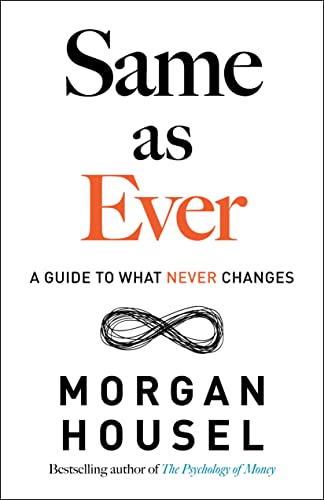
In Same as Ever: A Guide to What Never Changes, Morgan Housel argues that understanding these enduring tendencies can be more valuable than trying to predict exactly what will happen next. Rather than explaining the future through forecasts, he examines the recurring behaviors and circumstances that shape success, failure, risk, progress, and human judgment.
Published in 2023, the book contains 23 short, largely independent essays. Housel draws on historical events, financial markets, scientific discoveries, business failures, personal experiences, and stories about exceptional individuals. His subjects range from deadly avalanches and the Great Depression to the psychology of social comparison, the dangers of excessive efficiency, and the importance of sustainable progress.
As Housel explained in his announcement of the book, The Psychology of Money primarily examined individual behavior, while Same as Ever considers the recurring tendencies of people collectively. The broader ambition gives this book much of its appeal, although it also creates a challenge: the observations are often persuasive, but their historical illustrations do not always establish universal truths.
How Chance, Risk, and Human Expectations Shape Outcomes
Housel begins by questioning how much of the future can reasonably be predicted. His opening essays examine historical accidents, risks that become visible only after disasters, expectations that rise alongside material prosperity, and the complicated personalities behind extraordinary achievements. Together, they establish why even sophisticated judgments about the world remain vulnerable to forces people misunderstand or fail to notice.
The introduction provides the book’s governing idea through a conversation involving Warren Buffett. During the financial crisis of 2009, Buffett was asked how the American economy could recover from such devastation. Instead of presenting an economic forecast, he pointed to the continuing popularity of Snickers candy bars. The economy had undergone enormous changes, but people still wanted many of the same things.
Housel connects that observation to Amazon founder Jeff Bezos’s emphasis on customer preferences unlikely to disappear, particularly low prices and fast delivery. A business built around such enduring demands does not need to guess every development in technology or consumer behavior. Housel extends the principle to investing, politics, ambition, fear, and the ways people respond to uncertainty.
Hanging by a Thread
Housel begins his first essay with a traumatic experience from his adolescence as a competitive skier in Lake Tahoe. He had spent much of his childhood racing with a close group of teammates, including Brendan Allan and Bryan Richmond. The three were experienced skiers who knew the mountains well, but that familiarity encouraged them to accept risks they did not adequately understand.
In February 2001, heavy snowfall created dangerous conditions at Squaw Valley, now Palisades Tahoe. A dense layer of new snow had accumulated over lighter snow, increasing the possibility of an avalanche. Housel and his friends nevertheless ventured into an out-of-bounds area behind the KT-22 chairlift, where ordinary resort avalanche protections did not apply.
During their first descent, they experienced a small avalanche. Although Housel was briefly swept into it, the episode ended without serious injury. Rather than treating the incident as a warning, the boys regarded it as an exciting part of their adventure.
Back at the resort, Brendan and Bryan decided to ski the same area again. Housel inexplicably declined, offering instead to drive around and collect them at the bottom. He had no clear reason for changing his mind and no special knowledge of what would happen.
When he arrived at the designated meeting place, his friends were missing. At first, he assumed they had taken another route or found their own transportation. As the afternoon progressed, however, their absence became increasingly worrying. Their belongings remained in the locker room, and nobody had seen them.
Search-and-rescue personnel eventually investigated the area. Brendan and Bryan had been caught in a massive avalanche and were killed. Housel had survived because of an ordinary decision whose significance he could not possibly have understood when he made it.
The experience permanently changed his understanding of chance. His survival did not demonstrate superior judgment, and his friends’ deaths could not be explained by a meaningful difference in their behavior that morning. All three had already taken the same dangerous route. The decisive difference was that Housel chose not to repeat it.
He extends this observation to historical events with consequences far beyond individual lives.
During the American Revolutionary War, George Washington’s army escaped a potentially devastating British attack on Long Island. Favorable conditions, including the weather, contributed to the success of the evacuation. A relatively small difference in circumstances could have altered the military situation at a critical moment.
Housel also considers the sinking of the Lusitania in 1915. The passenger ship’s destruction intensified American hostility toward Germany and became an important event in the political atmosphere surrounding World War I. The specific circumstances of its voyage and sinking demonstrate how contingent incidents can exert immense influence.
The historical relationship requires an important distinction. As the National WWI Museum and Memorial’s account of the sinking explains, the disaster did not immediately bring the United States into the war. American entry came in 1917, amid additional developments. The event’s importance is real, but the alternative outcomes Housel invites readers to imagine remain counterfactual possibilities rather than established historical facts.
A third example concerns Giuseppe Zangara’s attempted assassination of Franklin D. Roosevelt in February 1933, shortly before Roosevelt became president. The shots missed Roosevelt but struck several other people, including Chicago mayor Anton Cermak, who subsequently died. Housel considers how American history might have unfolded differently if the attempt had succeeded.
The chapter’s argument is that history is extraordinarily sensitive to small events whose importance becomes obvious only afterward. Looking backward, people construct coherent explanations for developments that may have depended on accidents, timing, and circumstances nobody controlled.
Housel’s survival provides the emotional foundation for that argument. The historical examples then expand its scale, showing why the world people inhabit should not be mistaken for the only world that could plausibly have emerged.
Risk Is What You Don’t See
After describing how chance changes outcomes, Housel examines why individuals and institutions are so poorly equipped to anticipate consequential surprises.
The chapter opens with Victor Prather, an American test pilot who participated in a demanding high-altitude balloon mission. The mission exposed him to extreme physical conditions and required elaborate preparations for dangers associated with altitude and pressure.
Prather survived the hazardous flight. Yet during the recovery operation, a comparatively ordinary accident led to his death. The extraordinary dangers had been carefully anticipated, while the fatal event occurred in circumstances that appeared much less threatening.
For Housel, the contrast illustrates the central problem of risk assessment: people concentrate on hazards they can imagine and overlook those they cannot.
Financial institutions may develop sophisticated estimates of market losses, businesses may plan for familiar competitive threats, and governments may prepare for disasters that resemble previous emergencies. Such preparation can be valuable, but it cannot eliminate the possibility of an unfamiliar failure.
Housel also argues that historical knowledge provides an incomplete foundation for forecasting. Records preserve only part of what happened, and they are particularly poor at documenting events that nearly occurred but did not. A crisis that was narrowly avoided may leave little evidence, even though it reveals an important vulnerability.
This creates a limitation for statistical estimates based solely on observed outcomes. The fact that an event has never occurred in a particular record does not establish that the event is impossible.
His practical answer is to prepare for surprises without pretending to know precisely what they will be. Financial savings, limited debt, diversified investments, flexible commitments, and sufficient reserves can provide protection against many different problems.
The same reasoning applies outside finance. Buildings designed with safety margins and organizations that preserve operational flexibility can withstand difficulties that designers or managers did not specifically predict.
Housel closes with Harry Houdini, whose ability to escape elaborate restraints made him famous for surviving apparent dangers. Houdini ultimately died of peritonitis following a ruptured appendix, after suffering blows to his abdomen.
The story is a memorable contrast between mastery of anticipated threats and vulnerability to an unexpected medical emergency. However, historical reporting on Houdini’s death does not establish that the punches caused his appendicitis. The distinction matters because the chapter’s useful lesson about unforeseen danger does not depend on proving that particular causal claim.
The broader argument is that resilience is often more practical than prediction. A person who cannot know which disaster will arrive can still build a life that is less easily destroyed by one.
Expectations and Reality
Housel moves from uncertain events to a different psychological puzzle: why improvements in living standards do not reliably produce greater happiness.
He examines American nostalgia for the 1950s, a period frequently remembered as an era when ordinary families could live comfortably on modest incomes. Although many aspects of life have improved substantially since then, including medical care, technology, material conveniences, and consumer choice, people do not necessarily experience those improvements as increasing satisfaction.
Housel suggests that the explanation lies partly in expectations and comparison.
Many households in earlier decades had fewer possessions and fewer conveniences than modern households, but their immediate social environments often supplied narrower standards of comparison. People primarily encountered the lifestyles of neighbors, relatives, and colleagues.
Modern communications have transformed that environment. Television, advertising, celebrity culture, and social media allow people to observe exceptionally wealthy and successful individuals continuously. The standard against which they measure their own circumstances expands faster than their circumstances improve.
Housel argues that satisfaction depends on the gap between reality and expectations. Rising income may improve someone’s material position while simultaneously exposing that person to a more expensive set of aspirations.
He illustrates this idea with John D. Rockefeller, whose extraordinary fortune did not provide many conveniences now available to ordinary people. Material progress makes modern life more comfortable in ways that historical wealth could not guarantee, yet present-day individuals rarely compare themselves with people who lived a century ago.
Instead, they compare themselves with people who appear better off today.
The chapter also discusses people whose remarkable achievements did not produce the permanent fulfillment outsiders might expect. Professional success, public admiration, and extraordinary wealth can change the conditions of life without eliminating dissatisfaction, anxiety, or the desire for more.
The founder of Match.com, elite tennis player Naomi Osaka, and examples involving celebrity fame illustrate how success can introduce new expectations and pressures. The situation is not necessarily improved by reaching the next milestone, because the definition of success often changes once the milestone is reached.
Housel also considers the reflections of Holocaust survivor and human-rights advocate Ben Ferencz, Harry Truman, and Charlie Munger. Their experiences and observations suggest different ways of understanding contentment, ambition, and the emotional consequences of expectations.
The lesson is not that material improvement is meaningless or that people should abandon ambition. Housel’s argument is that increasing resources and managing expectations are separate tasks.
Someone who earns more while continually increasing perceived needs may remain dissatisfied. Someone who learns to appreciate existing circumstances can experience greater contentment without requiring constant external improvement.
The chapter introduces one of the book’s strongest recurring ideas: objective conditions and subjective experience do not necessarily move together.
Wild Minds
Housel next considers the unusual personalities behind extraordinary achievement.
He begins with Eliud Kipchoge, the celebrated marathon runner whose habits differed strikingly from those of many other athletes. During a period when others occupied themselves with phones and entertainment, Kipchoge could remain quietly absorbed in his thoughts for long stretches.
Housel presents this behavior as part of the unusual mental discipline associated with exceptional performance. Kipchoge’s ability was not simply the result of adopting ordinary good habits more consistently; it emerged from a distinctive disposition.
The central example is John Boyd, the American fighter pilot and military strategist whose innovative thinking influenced aviation tactics and military doctrine.
Boyd was extraordinarily capable, but his personal and professional behavior could be abrasive and confrontational. His unconventional intelligence coexisted with characteristics that made him difficult to work with.
Housel extends the pattern to Isaac Newton, whose extraordinary scientific work accompanied intense interest in subjects outside modern science, and George Patton, whose military effectiveness was inseparable from a forceful and frequently difficult temperament.
Elon Musk supplies a contemporary illustration of how extreme ambition can coexist with controversial behavior and unpredictable judgment.
Housel’s central claim is that people cannot always separate the qualities they admire in exceptional individuals from the eccentricities and weaknesses they dislike. Both may arise from the same underlying intensity or unconventional approach to life.
This complicates the usual practice of selecting role models. Someone may envy an entrepreneur’s wealth without wanting the obsessive working habits, strained relationships, public scrutiny, or emotional costs that accompany the entrepreneur’s life.
Similarly, an expert’s extraordinary ability in one field does not guarantee sound judgment in every other field.
Housel encourages readers to admire particular achievements without automatically idealizing the entire person. The most unusual minds may contribute enormously precisely because they are unlike ordinary minds, but that difference does not make all their behavior admirable.
Why Stories, Probabilities, and Booms Distort Judgment
The next four essays examine the difficulty of understanding a world shaped by uncertainty, emotion, and feedback loops. Housel argues that people are uncomfortable with probabilities, easily persuaded by compelling narratives, and inclined to trust measurements that leave important human factors unexplained.
These habits become especially consequential when confidence spreads through large groups. A convincing story can attract investment, strong recent performance can encourage risky decisions, and a seemingly stable environment can gradually become unstable because people begin treating safety as permanent.
Wild Numbers
Housel argues that people prefer definitive answers even when probabilistic estimates would be more accurate.
A prediction that assigns a particular outcome a 70 percent probability leaves substantial room for the outcome not to occur. Yet when the less likely result arrives, people often declare that the original prediction was wrong.
This confuses the probability of an event with its eventual occurrence.
Housel draws on an exercise associated with Stanford professor Ronald Howard, who encouraged students to express uncertainty through probability estimates rather than unwarranted confidence. The challenge is to recognize that knowledge often comes in degrees and that good judgment requires acknowledging what remains unknown.
The chapter also considers disagreements over the probability that Osama bin Laden was present at the compound targeted by American forces in 2011. Different officials could examine similar information and still assign different degrees of confidence to the conclusion.
For Housel, the point is that uncertainty is not automatically a sign of incompetence. It is frequently an unavoidable feature of decisions made with incomplete evidence.
He then examines remarkable coincidences, including lottery outcomes, and refers to the work of mathematicians Persi Diaconis and Frederick Mosteller.
An event may seem astonishingly unlikely when considered individually. But when millions or billions of opportunities exist for something unusual to happen, the occurrence of some extraordinary event becomes much less surprising.
The distinction between the probability of one specified incident and the probability of some unusual incident occurring somewhere is crucial.
Housel extends the reasoning to disasters and news consumption. A globally connected information environment exposes people to rare tragedies from every part of the world. Because there are so many opportunities for unusual events, an individual can encounter reports of exceptional incidents almost every day.
This can distort intuition about how dangerous ordinary life is.
The chapter also explains why evaluating forecasts requires repeated observations. If someone assigns a 70 percent probability to an event and the event fails to occur, that single outcome cannot establish whether the person’s probability judgment was well calibrated.
A meaningful evaluation requires examining many comparable predictions and determining whether events assigned similar probabilities occur at approximately the expected frequency.
Housel’s larger argument is that people underestimate uncertainty while simultaneously reacting too strongly to surprising outcomes. Accurate thinking requires accepting that unlikely events sometimes happen and that sound decisions can produce disappointing results.
Best Story Wins
Housel turns from numerical reasoning to the influence of storytelling.
He begins with Martin Luther King Jr.’s 1963 March on Washington speech. Its most remembered passage was not simply the result of meticulously delivering a prepared manuscript. King’s movement beyond his original text helped transform the speech into an exceptionally powerful public moment.
The example establishes Housel’s claim that the effectiveness of an idea depends partly on how it is communicated.
Information does not arrive in people’s minds as an isolated collection of facts. It competes for attention with existing beliefs, emotions, distractions, and stories.
Housel examines writers and communicators whose influence reflects their ability to organize complex subjects into compelling narratives.
Yuval Noah Harari’s Sapiens illustrates the appeal of large historical explanations presented through accessible stories. Ken Burns’s documentary The Civil War demonstrates how documentary filmmaking can make historical material emotionally immediate, while Bill Bryson shows how curiosity and narrative detail can make explanatory nonfiction enjoyable.
Housel’s discussion of investment writing develops the same principle in a professional context. Someone who communicates a financial idea clearly and memorably may attract more attention than a technically knowledgeable person whose explanation is difficult to understand.
The contrast between the enduring fascination with the Titanic and the relative obscurity of the SS Kiangya disaster illustrates how public memory can be shaped by narrative possibilities. Historical importance and cultural visibility are not identical.
The Titanic offers a distinctive combination of luxury, ambition, inequality, technological confidence, personal tragedy, and dramatic reversal. Those elements have supported countless retellings.
Housel argues that narratives can also influence economic behavior. A company’s valuation may be affected by investors’ beliefs about its future, and those beliefs are frequently organized through stories rather than established numerical facts alone.
The ability to tell a convincing story is therefore an important form of influence. It can attract customers, investors, supporters, and public attention.
But the same mechanism introduces danger.
A person who communicates elegantly may understand a subject poorly, while a knowledgeable person may struggle to make a convincing presentation. Audiences who mistake persuasive skill for accuracy can reward confidence over substance.
Housel’s point is not that facts are irrelevant. Rather, facts must compete within a social environment in which stories determine what people notice, remember, and believe.
Does Not Compute
Housel argues that many important forces shaping human affairs cannot be adequately represented through numerical models.
He begins with Robert McNamara, whose success applying quantitative management techniques at Ford contributed to his reputation as an exceptionally capable administrator. As US secretary of defense, however, McNamara encountered a conflict in Vietnam that resisted the kind of numerical assessment he favored.
Measures such as enemy casualties, troop numbers, and military resources could be collected and analyzed, but they did not adequately represent political legitimacy, national determination, morale, and the motivations of the people involved.
Housel uses this example to question the assumption that everything important can be measured.
He then examines Hitler’s decision to launch the Battle of the Bulge. From a conventional military perspective, the offensive appeared irrational because Germany faced overwhelming strategic disadvantages.
Nevertheless, Hitler pursued it. Assessments that assumed decisions would follow a familiar calculation of military advantage could underestimate the possibility of behavior driven by ideology, desperation, or distorted judgment.
The chapter also introduces physiologist A. V. Hill’s research into athletic performance. Physical capacity matters enormously, but it cannot completely explain how hard an athlete will compete or how effectively that athlete will respond to pain, pressure, motivation, and rivalry.
The difference between biological limits and observed performance reveals the importance of psychological forces that are difficult to quantify.
Housel carries this argument into financial markets.
Lehman Brothers’ collapse during the 2008 financial crisis illustrates the importance of confidence in institutions dependent on funding and trust. When confidence disappears, financial conditions can deteriorate with extraordinary speed.
GameStop’s dramatic market activity in 2021 offers another illustration of how social narratives, collective enthusiasm, and investor behavior can affect prices in ways that conventional valuations do not fully explain.
Housel also considers the fact that people have different objectives. A transaction that seems irrational to an outside observer may serve another participant’s desire for excitement, belonging, revenge, public recognition, or immediate income.
This does not mean every decision is rational according to its participant’s goals. It means that judging behavior requires understanding the motivations behind it rather than assuming everyone is trying to maximize the same measurable outcome.
The chapter ultimately argues for humility when numerical explanations fail to account for human conduct. Models are useful, but they become misleading when their users mistake the measurable part of reality for the whole of reality.
Calm Plants the Seeds of Crazy
Housel examines why periods of stability frequently create conditions for later instability.
His central influence is economist Hyman Minsky, whose financial instability hypothesis describes how prolonged economic calm can encourage increasingly dangerous financial behavior.
During stable periods, borrowers and lenders gain confidence. As they become more comfortable with risk, debt expands and asset prices rise. Financial arrangements that once appeared dangerous begin to seem reasonable because recent experience contains few serious warnings.
Eventually, the system becomes vulnerable to relatively small changes in conditions.
The paradox is that success in avoiding financial crises can encourage behavior that makes another crisis more likely.
This is a recognizable form of feedback loop. People respond to safety by reducing the protections that previously helped maintain it.
Housel applies the same logic beyond finance.
The long-term decline of infectious diseases was an extraordinary achievement of public health and modern medicine. Yet generations that had experienced relatively few major epidemics could also become less psychologically prepared for a widespread outbreak.
Housel links this historical unfamiliarity to the shock of COVID-19, noting the difference between expert warnings and ordinary public expectations.
He also presents an example from California’s climate and vegetation cycles. Heavy rainfall can produce abundant plant growth, but when subsequent conditions become dry, the additional vegetation can become fuel for destructive wildfires.
An apparently beneficial development can therefore contribute to a later hazard under different circumstances.
Housel connects this pattern to Carl Jung’s concept of enantiodromia, in which movement toward one extreme can produce the conditions for an opposite extreme.
Success can similarly undermine an individual’s habits. A business leader who becomes successful through vigilance may gradually abandon that vigilance after success makes danger feel remote.
The chapter ends with Jerry Seinfeld’s decision to conclude his successful television series while it remained popular. Rather than continuing until declining quality made the end unavoidable, Seinfeld accepted that maximizing success indefinitely was not necessarily desirable.
Housel uses this decision to introduce the importance of knowing when enough is enough.
The wider argument is that instability should not always be interpreted as an unprecedented breakdown. Cycles of excessive optimism and pessimism are recurring features of systems influenced by human behavior.
There is empirical support for aspects of this mechanism. Federal Reserve research on low perceived risk and financial crises examines how subdued measures of risk can be associated with the buildup of financial vulnerabilities.
Housel’s contribution is to translate the economic mechanism into a broader account of human behavior: comfort changes decisions, and those changed decisions can eventually destroy the comfort that encouraged them.
Why Growth and Progress Require Restraint and Endurance
Having examined how confidence becomes dangerous, Housel considers the pace of progress itself. His next essays explore why excessive growth can become destructive, why crises sometimes accelerate innovation, why beneficial changes accumulate slowly, and why the most consequential results can emerge from very small beginnings.
The governing distinction is between immediate intensity and sustainable development. Progress can require urgency, but it also depends on survival, patience, and the ability to withstand setbacks.
Too Much, Too Soon, Too Fast
Housel begins with the extraordinary height of Robert Wadlow, whose body continued growing far beyond ordinary human proportions.
Wadlow’s growth was remarkable, but it also produced serious physical difficulties. His body could not function indefinitely as though increased size carried no corresponding costs.
Housel uses the example to explain why growth is constrained by the systems required to support it.
He refers to biologist J. B. S. Haldane’s observations about the relationship between an organism’s size and its physical requirements. Structural support, circulation, movement, and energy consumption do not necessarily increase in simple proportion to size.
A process that functions effectively at one scale may become unstable at another.
Housel applies the same reasoning to investing. Long-term market returns can create substantial wealth when they are allowed to compound over many years. Attempting to obtain several decades’ worth of results in a short period often requires leverage, concentration, or speculative risk.
The pursuit of faster progress changes the nature of the original strategy.
Business growth can create similar problems.
Housel discusses Starbucks and the difficulties associated with rapid expansion. Opening more locations may initially strengthen a business, but expansion can eventually place pressure on operations, customer experience, organizational culture, and profitability.
Corporate acquisitions create another version of the same problem when management teams pursue scale without adequately accounting for complexity.
The chapter does not argue against growth. It argues that growth becomes valuable only when the underlying system can support it.
Speed is therefore a trade-off rather than an unqualified advantage.
For an investor, business owner, or professional, a sustainable rate of progress may produce better long-term results than an impressive short-term pace that creates an intolerable risk of failure.
When the Magic Happens
Housel examines the uncomfortable relationship between adversity and innovation.
He begins with the Triangle Shirtwaist Factory fire in New York City in 1911. The disaster killed 146 workers, many of them young immigrant women, and exposed appalling workplace safety conditions.
Frances Perkins witnessed the fire and became deeply involved in the campaign for labor reform. She later served as US secretary of labor and played an important role in the development of major American labor protections.
Housel uses the disaster to illustrate how an event that reveals intolerable conditions can generate political pressure for change.
The fire did not make suffering desirable. Rather, its visibility helped create public urgency that ordinary descriptions of unsafe conditions had struggled to produce.
The chapter then expands to military history, where intense competition and danger have repeatedly accelerated technological development.
Wartime needs encouraged improvements in aviation, communications, medicine, transportation, computing, and large-scale industrial coordination. Problems that governments and institutions might have addressed gradually became immediate priorities because failure carried extraordinary consequences.
Housel’s explanation emphasizes concentrated attention, resources, and motivation. When an urgent problem becomes impossible to ignore, institutions may suddenly undertake projects that previously seemed impractical.
The Great Depression provides another extensive example.
Although the 1930s were characterized by severe unemployment, business failure, poverty, and economic suffering, the period also witnessed substantial developments in infrastructure and productivity.
Housel examines electrification, improvements in transportation, supermarkets, and changes in business organization that contributed to future economic efficiency.
The contrast challenges a simple assumption that prosperity always creates the greatest innovation.
Periods of hardship can force individuals and institutions to reconsider familiar methods, remove inefficiencies, and develop new systems. Necessity can make experimentation more urgent.
However, the causal relationship is not straightforward.
The existence of innovation during a crisis does not establish that the crisis was necessary for the innovation to occur. Some developments reflect research, investments, institutions, or technological knowledge established well before the emergency.
The distinction is especially important in Housel’s treatment of tragedy. Pressure can motivate change, but extreme destruction can also eliminate the resources needed for recovery.
The Triangle fire, for example, accelerated demands for stronger workplace regulation, but its victims did not need to die for safer working conditions to be desirable. Institutional histories of the resulting reform efforts show that workplace safety investigations and regulation developed through political organization and sustained public action.
Housel’s more defensible claim is that adversity can produce extraordinary motivation when people retain the capacity to respond.
He ends by suggesting that comfort and urgency create different conditions for problem-solving. A society that wants progress without hardship must find ways to sustain the attention and determination that crises often generate automatically.
Overnight Tragedies and Long-Term Miracles
Housel examines why beneficial developments and destructive events tend to unfold at different speeds.
Improvements in cardiovascular medicine provide his central example.
Progress against heart disease has emerged through many overlapping changes: better scientific understanding, improved medical treatments, preventive measures, and changes in public behavior.
Each individual improvement may appear modest when considered over a short interval. Across decades, however, their cumulative effect becomes enormous.
Housel contrasts this gradual progress with financial crises, sudden disasters, and collapses of confidence.
An institution may require decades to acquire a strong reputation, but a single event can destroy that reputation. A financial system may accumulate wealth and stability over many years before suffering a rapid crisis.
The asymmetry arises partly from the complexity of successful systems.
Maintaining progress requires many conditions to work reasonably well together. Severe disruption may require only one essential component to fail.
Housel also observes that successful prevention is inherently less visible than catastrophe.
When public-health improvements prevent deaths, those avoided deaths do not produce individual news stories. People experience the resulting improvement gradually, often without recognizing how much has changed.
A disaster, by contrast, provides a concentrated event with an identifiable beginning, dramatic consequences, and immediate emotional force.
This helps explain why bad news can dominate attention even when some underlying conditions are improving.
The chapter reinforces the importance of compounding. Modest improvements sustained across many years can produce transformations that initially seem implausible.
The difficulty is that people experience time sequentially. Slow improvement seldom feels as dramatic as a sudden reversal.
Housel encourages readers to recognize both realities: long-term progress can be substantial, and short-term disruptions can still be devastating.
Tiny and Magnificent
Housel develops the idea that small factors can produce enormous consequences when they interact or compound.
He begins with nuclear weapons, examining the risks associated with smaller tactical weapons.
A weapon designed for a more limited military purpose might appear less dangerous than a strategic nuclear arsenal. Yet if its relative usability makes nuclear deployment more likely, it could increase the risk of escalation toward a much larger conflict.
A comparatively small decision can therefore activate consequences far beyond its immediate scale.
Housel applies this reasoning to the Great Depression, where interacting weaknesses in economic and financial systems contributed to an enormous contraction.
The important point is not that every small weakness automatically causes disaster. It is that vulnerabilities can reinforce one another when institutions become dependent on interconnected systems.
The Tenerife airport disaster provides another illustration.
In 1977, two Boeing 747 aircraft collided on a runway in the Canary Islands. The catastrophe emerged from a sequence of conditions and decisions whose combined consequences were far greater than the apparent significance of many individual contributing factors.
Housel uses such examples to challenge the intuition that the largest outcomes must have equally large initial causes.
The chapter then turns toward positive compounding.
Evolutionary change can emerge from small differences accumulated across generations. Financial wealth can grow through returns repeatedly earned and reinvested over long periods.
In both cases, the final outcome can become extraordinary without requiring every individual step to be extraordinary.
This observation changes the relevant question for investors.
An impressive return that cannot be sustained, or that exposes the investor to ruin, may be less valuable than a moderate return maintained over many years.
The same principle applies to careers, organizations, habits, and knowledge.
Small improvements repeated consistently can eventually produce results that seem disproportionate to the original effort. Their significance becomes visible only after sufficient time has passed.
Elation and Despair
Housel argues that optimism and pessimism serve different purposes and that successful long-term decisions often require both.
Pessimism helps people recognize threats, anticipate failure, and protect themselves against dangerous conditions. Optimism encourages investment, persistence, experimentation, and the belief that improvement remains possible.
Either attitude becomes destructive when pursued without the other.
Housel draws on Admiral James Stockdale, who endured years of imprisonment during the Vietnam War.
Stockdale maintained confidence that he would eventually survive, but he also refused to deny the severity of his immediate situation. The distinction between long-term faith and short-term realism helped shape his approach to survival.
Housel treats this as an example of practical resilience.
The chapter also examines optimism during the Great Depression. Even amid economic devastation, the American Dream continued to hold appeal because people could imagine a future better than their immediate circumstances.
Bill Gates provides a business example.
Gates’s ambition and competitive intensity helped Microsoft grow, yet his concern about financial vulnerability also contributed to an emphasis on reserves and preparedness.
Housel argues that confidence in opportunity can coexist with anxiety about survival.
In investing, the combination might involve believing that markets can generate wealth over decades while acknowledging that severe losses, recessions, and unexpected crises are inevitable possibilities along the way.
Unqualified optimism can encourage leverage and complacency. Unqualified pessimism can prevent participation in opportunities that offer genuine long-term value.
The chapter’s practical lesson is to remain hopeful about what can be achieved without assuming that the path toward achieving it will be smooth.
Success, Imperfection, and the Limits of Appearances
Housel next examines the costs that accompany achievement. He questions the assumption that successful systems should eliminate every inefficiency, difficulty, competitive threat, or embarrassing weakness.
These essays suggest that survival often requires accepting imperfections, that worthwhile accomplishments involve unavoidable hardship, and that competitive success rarely remains secure forever. They also warn that the public appearance of achievement reveals relatively little about the private experience behind it.
Casualties of Perfection
Housel argues that the pursuit of perfect efficiency can make individuals and organizations fragile.
Evolution provides his opening analogy.
An organism that becomes exceptionally specialized for a particular environment may perform extremely well while those conditions persist. But specialization can become a liability when the environment changes.
A more adaptable organism may survive conditions that destroy a competitor optimized for a narrower set of circumstances.
Housel extends this principle to professional life.
Many organizations reward constant activity and treat unoccupied time as a sign of insufficient productivity. Yet creative thinking, strategic judgment, and reflection often require periods that produce no immediately measurable output.
Walking, thinking, reading, and allowing the mind to explore possibilities can contribute to work in ways that formal productivity measurements fail to capture.
The same principle applies to financial planning.
An investor who deploys every available resource in pursuit of maximum returns may achieve impressive results during favorable conditions. But a lack of cash reserves can force the investor to sell assets or accept unfavorable terms when unexpected expenses arise.
A business operating without spare capacity may enjoy lower costs until a supply interruption, sudden increase in demand, or operational failure exposes its vulnerability.
Diversification represents another deliberate acceptance of imperfection. It prevents an investor from placing all resources into whichever investment currently appears most promising.
Housel argues that the value of such arrangements becomes clear during conditions that could not have been anticipated accurately.
The chapter also discusses the costs of excessive forecasting. Elaborate attempts to predict markets can consume time that might be more productively spent understanding enduring behavior and maintaining a workable long-term plan.
The central distinction is between maximum efficiency under expected conditions and sufficient adaptability across many possible conditions.
What looks inefficient in normal circumstances may be essential when circumstances change.
It’s Supposed to Be Hard
Housel examines the attraction of shortcuts and the mistaken belief that worthwhile achievements should become easy once the correct method is discovered.
He begins with the Donner Party, a group of American migrants traveling west in 1846.
Seeking a faster route to California, the travelers adopted a proposed shortcut that proved far more difficult than anticipated. Delays, exhausting terrain, and the approaching winter contributed to their eventual entrapment in the Sierra Nevada mountains.
Their suffering became one of the most notorious tragedies of westward migration.
Housel uses the episode to illustrate how attempts to avoid ordinary difficulty can introduce much greater danger.
A shortcut is valuable only when it genuinely reduces costs without creating unacceptable new risks.
The chapter then considers creative work, where frustration and repetition are frequently unavoidable.
Jerry Seinfeld’s approach to comedy writing demonstrates the effort involved in producing work that appears effortless to an audience. Successful comedy may emerge from prolonged experimentation, discarded material, revision, and attention to small details.
Steven Pressfield’s struggles before establishing himself as a writer provide another example of persistence through rejection and uncertainty.
Housel argues that people often interpret difficulty as evidence that something is wrong with their approach. In some cases, however, the difficulty is simply part of the activity.
Investing requires tolerating disappointing periods. Building a business involves conflict and uncertainty. Writing demands revision, and important relationships require accommodation and patience.
The relevant task is to distinguish avoidable problems from necessary costs.
Housel introduces the idea of an optimal amount of hassle: the inconvenience a person must reasonably accept to obtain something worthwhile.
This does not justify unlimited suffering or imply that every difficult path is productive. It suggests that eliminating discomfort should not become an overriding objective when discomfort is inseparable from achieving the desired result.
Keep Running
Housel argues that competitive advantages are usually temporary.
He begins with an evolutionary tendency associated with Edward Drinker Cope, the nineteenth-century paleontologist whose name became attached to Cope’s Rule.
The observation concerns a tendency toward increased body size across certain evolutionary lineages. Larger size can offer advantages, but it can also create vulnerabilities through greater resource requirements and reduced flexibility.
Housel uses this trade-off to introduce the impermanence of apparently successful adaptations.
The central business example is Sears.
For much of the twentieth century, Sears was one of America’s most influential retailers. Its catalog operations, distribution capabilities, brand recognition, and physical stores gave it considerable advantages.
Its scale and reputation once made continued success seem natural.
Yet the competitive environment changed, and Sears eventually lost much of its position. Organizational complexity, leadership decisions, changing customer preferences, and stronger competitors contributed to its decline.
Housel sees this as an example of a recurring problem.
Success can generate overconfidence. Established organizations may become protective of existing arrangements rather than responsive to new conditions. The advantages that originally produced their dominance can become barriers to adaptation.
Meanwhile, competitors continue searching for weaknesses to exploit.
The chapter invokes the Red Queen from Lewis Carroll’s Through the Looking-Glass, whose world requires constant running merely to remain in place.
In competitive environments, standing still can amount to falling behind.
Housel extends the argument beyond business to products, careers, cities, cultural prominence, and other forms of success.
A dominant position attracts competitors and creates expectations that may eventually become difficult to satisfy.
The essay warns against treating past achievement as proof of permanent superiority.
Housel does not suggest that every decline is inevitable on a fixed timetable. His point is that competitive advantage requires continuing effort, and the belief that success has become permanent can accelerate its disappearance.
The Wonders of the Future
After examining the impermanence of success, Housel turns toward the possibilities of technological development.
He introduces a 1908 newspaper discussion of Thomas Edison’s views about invention.
Edison anticipated continued technological progress even though many future inventions were impossible to describe precisely at the time.
Housel uses the example to distinguish predicting particular technologies from recognizing the continuing potential for innovation.
The chapter emphasizes that important inventions frequently emerge through combinations.
A development may initially serve a limited purpose, but its capabilities can become far more consequential when combined with other technologies.
Housel considers aviation, military research, and the networks that contributed to the modern internet.
Technologies originally developed for specialized applications eventually supported forms of communication, commerce, entertainment, and social organization that their early designers did not necessarily anticipate.
The important mechanism is emergence.
When several advances interact, their combined effects can exceed what an observer might predict by examining each development separately.
Housel also notes how people tend to respond to unfamiliar technologies. Early innovations are frequently difficult to understand, easy to dismiss, or apparently irrelevant to ordinary life.
Only after enough supporting developments appear do their transformative possibilities become obvious.
This connects technological progress with the book’s broader discussion of compounding.
Small discoveries accumulate. New inventions make later inventions possible, and technologies become more powerful as complementary systems develop around them.
Housel’s optimism is therefore different from a prediction that a particular technology will succeed.
He argues that the long history of unexpected technological combinations provides reason to expect further surprises.
The future may be difficult to forecast partly because its possibilities exceed what present knowledge allows people to imagine.
Harder Than It Looks and Not as Fun as It Seems
Housel examines the distance between public success and private experience.
The chapter begins with James Baldwin’s reflections on suffering and the hidden difficulties of life.
Individuals know their own insecurities, mistakes, disappointments, and unresolved problems. They usually know much less about the corresponding difficulties experienced by other people.
This unequal access to information distorts social comparison.
Someone observing a successful entrepreneur may see wealth, public recognition, and professional accomplishment without seeing the anxiety, strained relationships, failures, or exhausting work behind them.
A similarly incomplete picture emerges when people compare their ordinary lives with carefully selected representations of celebrities, executives, or admired professionals.
Housel also discusses his own experience with a chronic stutter.
The example shows how a difficulty can occupy an enormous place in someone’s private experience while remaining largely invisible to others.
People who appear confident or accomplished may be managing problems that outsiders never suspect.
Housel argues that exaggerated admiration creates a second danger.
When a person seems exceptionally capable in one domain, observers may assign them superior judgment in unrelated areas.
A successful investor’s political opinions or a celebrated business leader’s personal advice may therefore receive more attention than their actual expertise warrants.
The chapter encourages greater humility about judging other people’s lives.
The appearance of success does not establish that someone is happy, and a visible achievement does not reveal every sacrifice involved in producing it.
The Forces That Sustain Decisions and Beliefs
The final five essays investigate why people continue pursuing actions and defending beliefs that outsiders find difficult to understand. Housel examines the influence of financial and social incentives, the force of firsthand experience, the difficulty of long-term commitment, the attraction of unnecessary complexity, and the lasting effects of historical trauma.
The book closes by connecting these ideas to intellectual humility. People can learn recurring patterns from history, but they must also recognize how personal circumstances and experiences shape what they consider obvious, desirable, or possible.
Incentives: The Most Powerful Force in the World
Housel argues that incentives are among the strongest explanations for human behavior.
He begins with Wall Street Journal writer Jason Zweig’s observations about the professional pressures facing writers. Producing valuable work is one objective, but writers also operate within systems that reward attention, productivity, commercial success, and public recognition.
Those rewards can influence what gets written and how ideas are presented.
Housel extends this observation to more troubling examples.
People may participate in questionable business practices, defend unsustainable financial arrangements, or overlook harmful consequences when their income and status depend on maintaining the existing system.
The financial incentives surrounding the American housing boom provide a particularly important illustration.
Mortgage originators, financial institutions, investors, and other participants could benefit from continued lending and rising activity even as risks accumulated. Their individual incentives did not necessarily encourage them to protect the long-term stability of the entire system.
Housel emphasizes that such behavior does not require every participant to be consciously dishonest.
People are capable of constructing elaborate justifications for actions that benefit them personally. Financial rewards, group loyalty, professional identity, and fear of losing status can all influence what someone comes to believe.
The chapter broadens the discussion through examples involving criminal enterprise and extreme group commitment, including Joaquín “El Chapo” Guzmán and Heaven’s Gate.
These cases illustrate how powerful rewards, pressures, and beliefs can sustain conduct that outsiders consider destructive or incomprehensible.
The central observation is that incentives influence not only what people do but also what they are willing to regard as reasonable.
This helps explain why unstable arrangements can persist long after knowledgeable observers identify their weaknesses.
Participants may have compelling immediate reasons to avoid acknowledging the long-term problem.
Housel turns the argument toward the reader by encouraging scrutiny of personal incentives.
A useful question is whether a deeply held opinion would change if the financial or social rewards associated with holding it disappeared.
The point is not that every belief is reducible to self-interest. It is that people should be cautious about assuming their own judgments are immune to the pressures they readily recognize in others.
Now You Get It
Housel argues that firsthand experience can change beliefs more powerfully than information or intellectual persuasion alone.
Someone may understand a crisis in abstract terms without knowing how it will feel to live through one.
The Great Depression provides his central historical example.
Economic collapse transformed people’s understanding of employment, finance, government responsibility, personal security, and social obligations.
Ideas that previously appeared unnecessary or unacceptable could become compelling when ordinary households experienced unemployment, poverty, and uncertainty directly.
Housel extends the discussion to the political consequences of economic distress, including the appeal of authoritarian solutions in Germany.
His larger argument is that lived circumstances can alter the assumptions through which people interpret the world.
Military experience provides another illustration. A person can study war extensively without fully anticipating how exposure to danger, fear, and deprivation will influence personal judgment.
Financial markets create a more familiar example.
An investor may confidently declare an ability to withstand substantial losses. Yet that declaration is made under conditions different from those experienced during an actual collapse.
Watching savings disappear while frightening news accumulates may produce reactions that the investor could not imagine during a calm market.
Housel also explores the reverse situation: people frequently misjudge how extraordinary success will feel.
Wealth, fame, professional achievement, and unusual experiences may initially appear capable of transforming everyday emotional life.
But people adapt to new circumstances. Ordinary frustrations, illnesses, responsibilities, and interpersonal difficulties do not disappear merely because someone’s material position improves.
Experiences involving astronauts and exceptionally successful individuals demonstrate how actual conditions can differ from imagined ones.
The chapter explains why different generations often reach different conclusions despite access to similar information.
Someone shaped by prolonged financial insecurity may value stability differently from someone who has known only prosperity.
Housel’s argument is that knowledge and experience have distinct psychological effects. Reading about an event can improve understanding, but directly experiencing it can reshape priorities in ways that theoretical knowledge does not reliably reproduce.
Time Horizons
Housel examines why long-term thinking is much easier to endorse than to practice.
The appeal of long-term investing is straightforward: sustained participation allows compounding to operate, while patience reduces the pressure to react to temporary conditions.
Yet a long time horizon contains numerous short periods, and some of those periods will be deeply uncomfortable.
An investor who expects to hold an asset for twenty years may encounter years of disappointing performance, frightening losses, or opportunities that make continued patience feel foolish.
The same tension appears in careers, marriages, businesses, and creative projects.
Long-term objectives require people to endure immediate difficulties without knowing whether their eventual reward will justify the effort.
Housel also emphasizes the importance of other participants.
A business leader may be willing to tolerate years of uncertain results, but employees, lenders, customers, or investors may operate with different expectations.
An investment strategy that appears suitable for one person can become impractical when someone else depends on the money being available sooner.
Long-term thinking is therefore partly a problem of coordination.
The participants must have sufficiently compatible expectations about time, risk, and acceptable discomfort.
Housel adds an important qualification: patience can become stubbornness.
Continuing a strategy through ordinary volatility is different from refusing to acknowledge that the original assumptions have failed.
The ability to persist must coexist with the ability to change one’s mind.
The chapter then considers information and knowledge.
Some information expires quickly. Daily market commentary, political speculation, and short-term news can become irrelevant soon after publication.
Other knowledge remains valuable for decades.
Housel observes that books dealing with history, enduring behavior, and fundamental principles often provide more lasting understanding than information consumed merely because it is current.
He does not argue that current news has no value. Rather, permanent knowledge can help readers interpret which new developments deserve attention.
The chapter connects the book’s interest in enduring patterns with a practical approach to learning: accumulate understanding that remains useful across changing circumstances.
Trying Too Hard
Housel examines why people frequently prefer complex solutions even when simpler approaches may work better.
He begins with Harold Varmus, the physician and former director of the National Cancer Institute, and the continuing difficulty of reducing cancer’s burden.
Cancer research involves sophisticated technologies and complicated biological questions. Yet some of the most consequential improvements in population health have come from preventive measures, including reducing tobacco consumption.
Housel uses the contrast to question why complicated interventions often receive more attention than straightforward approaches with substantial benefits.
Complexity can signal intelligence, effort, professional expertise, or technological sophistication.
Simplicity, by contrast, can appear unimpressive even when it produces superior results.
The chapter extends this reasoning to academic work, financial decisions, and writing.
A complicated investment strategy may sound more sophisticated than saving consistently, diversifying, and remaining invested. Yet sophistication does not guarantee better results.
Similarly, writing can become longer and more intricate without becoming more informative.
Housel considers the way institutions reward complexity. Professional recognition, organizational incentives, and the desire to appear knowledgeable can encourage people to make problems seem more difficult than necessary.
A historical medical-diagnosis anecdote develops the danger of giving excessive attention to rare possibilities while neglecting common explanations.
The underlying principle is probabilistic.
When familiar causes are much more common than exotic ones, the dramatic possibility should not automatically dominate judgment.
This does not mean that simple explanations are always correct. Some problems genuinely require specialized knowledge and complex methods.
Housel’s narrower argument is that difficulty and usefulness are different qualities.
An effective solution should be evaluated by what it achieves, not by how technically impressive or intellectually demanding it appears.
The chapter also reflects the author’s preferred writing style. His short, direct explanations attempt to demonstrate the same principle he recommends.
Wounds Heal, Scars Last
The final essay examines how experiences continue shaping people long after their immediate consequences have disappeared.
Housel begins with the Pentagon after the September 11 terrorist attacks.
The physical damage was repaired, but the broader consequences remained visible in American air travel and security procedures.
The distinction between repaired structures and enduring institutional changes introduces the chapter’s central idea.
An event can end while the beliefs, fears, habits, and regulations it produced continue for generations.
Housel turns to the Soviet experience of World War II, where extraordinary destruction shaped subsequent understandings of security and national survival.
He also returns to the Great Depression, whose economic consequences influenced generations that experienced financial collapse and prolonged insecurity.
These examples help explain why people who lived through different historical circumstances may develop profoundly different assumptions about risk.
Housel then describes experiments associated with Ivan Pavlov’s dogs following a severe flood.
The animals’ experiences during the disaster affected their later behavior, demonstrating how extreme stress can disrupt previously established patterns.
Housel uses this example to discuss the lasting psychological effects of trauma.
The chapter also examines how historical experiences can influence political preferences and institutional arrangements long after the original conditions have changed.
A person who grew up amid instability may remain unusually concerned about security even during prosperous periods.
Someone whose formative years were comparatively stable may struggle to understand that concern.
Housel argues that disagreement frequently arises from these differences in lived experience.
Two people may encounter the same information yet interpret it differently because their memories, expectations, and emotional associations are different.
This leads to a more sympathetic approach to disagreement.
Instead of assuming that someone with a different opinion must be ignorant or irrational, it can be useful to ask what experiences produced that person’s understanding of the world.
The chapter concludes the collection’s substantive argument by returning to an enduring feature of human nature: experience shapes belief, and human experiences will never be identical.
Questions
Housel closes the book with a short reflection on uncertainty and a collection of questions rather than a final set of instructions.
The section begins with an exchange between Franklin Roosevelt and Eleanor Roosevelt before the Allied invasion of Normandy in June 1944.
Eleanor reflects on the discomfort of uncertainty despite her age and experience. Housel uses the exchange to emphasize how deeply people desire advance knowledge about events they cannot control.
He returns to his preference for studying history and durable behavioral tendencies rather than relying primarily on forecasts.
The closing section contains twenty questions encouraging readers to examine their assumptions.
They ask readers to consider hidden incentives, people they admire without understanding, unnecessary complications, unavoidable difficulties, strong beliefs that may later change, and risks they have failed to imagine.
These questions draw directly from the preceding essays.
The earlier chapters have shown that people can mistake luck for skill, confuse persuasive stories with reliable explanations, underestimate risk, pursue unsustainable growth, and misjudge others because they cannot see their private experiences.
The conclusion asks readers to investigate those possibilities in their own lives.
Its form is significant.
Housel does not end by proposing a precise formula that would allow readers to avoid every mistake. Such a formula would contradict his repeated insistence that uncertainty, human diversity, and changing circumstances place limits on universal prescriptions.
The closing questions instead encourage intellectual flexibility. They invite readers to examine what they believe, why they believe it, and which assumptions may become dangerous when circumstances change.
What Actually Stays the Same in Housel’s World
The central claim of Same as Ever is both appealing and potentially ambiguous. Housel argues that human beings repeatedly display familiar tendencies, but his examples also show that the outcomes produced by those tendencies can be extraordinarily unpredictable.
Understanding the difference between a recurring behavioral pattern and a predictable result is essential to interpreting the book accurately.
The distinction is clearest in the introductory examples.
Buffett’s observation about Snickers concerns a durable consumer preference. Bezos’s interest in low prices and fast delivery similarly identifies desires that remain useful for business planning despite changes in technology.
These observations suggest that certain motivations can remain stable over long periods.
Yet Housel also repeatedly demonstrates that motivations are filtered through circumstances, incentives, institutions, and chance.
The avalanche that killed Brendan and Bryan was not predictable merely because young people sometimes take excessive risks. That behavioral tendency helps explain why the boys entered dangerous terrain, but it does not identify which descent would prove fatal.
Similarly, knowing that political leaders can become desperate does not establish when they will pursue militarily irrational decisions.
This difference matters because a recurring pattern can be useful without functioning as a reliable prediction of individual events.
Housel’s strongest insights are therefore often conditional.
Periods of prolonged financial stability can encourage leverage, but they do not guarantee that a crisis will occur at a particular moment. Competitive success can produce complacency, but successful organizations differ greatly in their ability to adapt.
People frequently compare themselves with others, but the intensity and consequences of that comparison depend on their circumstances.
Housel’s language sometimes makes such observations sound closer to universal laws than the evidence allows.
Human beings undoubtedly possess recurring motivations, but their behavior also changes through institutions, education, technology, legal constraints, and shifting social norms.
The desire for status may persist while the socially acceptable ways of pursuing status change dramatically.
Likewise, fear may remain a powerful motivation even as medical advances, insurance systems, communication technologies, and collective institutions alter how people respond to danger.
The book is most convincing when its enduring patterns are understood as recurring pressures rather than fixed outcomes.
This interpretation also clarifies the relationship between stability and instability.
In Calm Plants the Seeds of Crazy, confidence changes behavior. Borrowers and investors take risks precisely because conditions appear safe.
Their collective decisions can then create the vulnerability that produces the next crisis.
In other words, the same behavioral tendency can repeatedly generate very different outcomes depending on its environment.
Housel’s framework is useful because it encourages readers to examine how people are likely to respond to incentives, success, danger, and uncertainty.
Its usefulness declines when those observations are treated as substitutes for studying the specific circumstances that determine what actually happens.
The Psychology of Stories, Incentives, and Experience
Several essays explain human behavior through different but interacting mechanisms.
Best Story Wins emphasizes persuasion. Incentives: The Most Powerful Force in the World emphasizes rewards and penalties. Now You Get It and Wounds Heal, Scars Last emphasize the formative influence of personal experience.
These explanations become more interesting when considered together.
A persuasive story can change what someone believes. Yet the influence of that story may depend on what the person already wants, fears, and expects to gain.
Consider the housing bubble discussed in the incentives chapter.
Financial professionals could encounter warnings about excessive lending and dangerous valuations. But acknowledging those warnings might threaten immediate income, professional standing, or business relationships.
The incentive to continue participating could make reassuring stories about permanently rising property values especially attractive.
The story and the incentive reinforce one another.
Experience introduces another influence.
Someone who lived through a devastating market collapse may interpret optimistic financial narratives with suspicion. Someone whose entire professional career occurred during an expanding market may find the same narratives more convincing.
Neither person’s response follows solely from the information presented.
Their experiences affect which parts of the story seem plausible and which risks feel emotionally significant.
Housel’s account of social comparison reveals a similar interaction.
Advertising and social media present stories about desirable lifestyles. Those stories influence expectations, while professional and social incentives encourage people to pursue the status associated with those lifestyles.
The resulting aspirations can reshape how people evaluate their existing circumstances.
Housel also explores the limitations of expertise.
The unusual individuals discussed in Wild Minds demonstrate that outstanding performance can coexist with poor judgment or difficult behavior elsewhere.
When observers idealize these people, they may interpret eccentricity as proof of genius rather than recognizing that particular talents do not necessarily transfer between domains.
Storytelling contributes to this mistake by making an extraordinary life appear more coherent than it actually is.
The public sees a narrative of determination and accomplishment, not the full set of accidents, weaknesses, costs, and failures involved.
These observations form a plausible account of why people often behave differently from what a detached analysis might predict.
However, their breadth creates a limitation.
Almost any decision can potentially be explained afterward through a combination of incentives, experience, social pressure, and narrative.
Without additional evidence, it can become difficult to determine which mechanism was actually decisive.
A strong explanation needs more than the observation that several psychological forces might have been involved. It should establish how those forces operated in the particular case.
Housel generally provides memorable illustrations rather than systematic tests of competing explanations.
That method is well suited to improving the reader’s awareness of possible influences. It is less suited to determining precisely how much influence each factor has in a particular environment.
Uncertainty, Safety Margins, and the Logic of Compounding
The book’s most coherent practical philosophy emerges from the interaction between uncertainty, resilience, and compounding.
Housel repeatedly argues that long-term achievement requires surviving conditions that cannot be predicted accurately.
This is why reserves and flexibility matter.
An investor who relies on borrowed money may earn higher returns while markets rise, but leverage creates obligations that remain even when market prices fall.
A severe decline can force the investor to sell assets before recovery becomes possible.
The investor’s long-term thesis may eventually prove correct, yet the strategy can still fail because it did not survive the intervening period.
This is the practical relationship between Risk Is What You Don’t See and Time Horizons.
A long-term commitment is meaningful only if the person can remain committed through the short-term difficulties contained within it.
The same reasoning explains the defense of imperfection in Casualties of Perfection.
Holding cash rather than investing every available amount may reduce expected returns under favorable conditions. But cash reserves can prevent a crisis from becoming financially destructive.
Diversification can similarly reduce the possibility of spectacular gains while protecting against concentrated losses.
The apparent sacrifice of maximum efficiency purchases greater flexibility.
Too Much, Too Soon, Too Fast develops the other side of the argument.
A strategy that produces attractive returns at a sustainable pace can become dangerous when someone attempts to accelerate it through borrowing, speculation, or excessive expansion.
The original goal may remain sensible, but the attempt to achieve it more quickly changes the associated risk.
Compounding makes this particularly important.
An adequate return sustained over a long period can produce substantial wealth, while an unusually high return that ends in permanent loss may accomplish very little.
Housel therefore encourages a different conception of optimization.
The relevant objective is often not obtaining the highest possible performance in one period. It is obtaining a sufficiently good result repeatedly without encountering a failure that ends the process.
This principle can apply to professional work and organizational development.
A business with spare operational capacity may appear less efficient than one using every available resource. Yet the more flexible business may be better equipped to handle interruptions or unexpected opportunities.
A professional who preserves time for learning, rest, and reflection may produce less measurable output in the short term while maintaining better judgment and performance over a longer career.
These ideas are practical, but they also assume that readers possess meaningful choices.
Someone with an unstable income or urgent financial obligations may not have the resources to maintain substantial cash reserves. A struggling business may be unable to sacrifice immediate revenue for long-term flexibility.
The advice remains valuable, but its application depends on circumstances.
The distinction between patience and stubbornness introduces another limitation.
Maintaining a long-term strategy through ordinary fluctuations can be rational. Continuing when the original assumptions have demonstrably failed can be destructive.
Housel recognizes this difference in Time Horizons, although he does not provide a detailed method for identifying the boundary.
The resulting philosophy is more useful as a set of decision-making principles than as an operational system.
Prepare for uncertainty, avoid unnecessary fragility, preserve flexibility, and pursue progress at a pace that can survive setbacks. These ideas provide a durable orientation, but the appropriate implementation requires judgment about specific risks and resources.
How Expectations, Adversity, and Competition Reinforce Each Other
Housel’s chapters about expectations, financial instability, innovation, and competitive decline describe several forms of self-reinforcing change.
Each begins with an apparently positive development that alters behavior and can eventually create new problems.
In Expectations and Reality, improving living standards expand the possibilities available to individuals. Yet greater access to information about wealth and success can increase expectations faster than living conditions improve.
Progress can therefore produce dissatisfaction when people continually compare themselves with more privileged reference groups.
The important mechanism is adaptation.
What initially feels exceptional may eventually become normal. Once a particular standard of living becomes familiar, it may cease to generate the satisfaction it previously produced.
Calm Plants the Seeds of Crazy examines a related adjustment in financial markets.
A long period without severe losses encourages confidence. That confidence can motivate greater borrowing, higher valuations, and reduced caution.
The system gradually changes because participants respond to the very stability they are enjoying.
Keep Running describes a competitive version of the same process.
A successful business gains resources, reputation, and market position. But success attracts competitors, raises customer expectations, and can encourage leaders to protect existing arrangements.
The organization may eventually become less adaptable precisely because its earlier strategy was so successful.
These examples share a common structure, but they should not be treated as identical mechanisms.
Social comparison depends heavily on psychological and cultural circumstances. Financial instability involves credit arrangements, asset prices, and institutional incentives. Competitive decline depends on organizational decisions and market conditions.
The similarities are suggestive, but each process requires its own explanation.
When the Magic Happens introduces another complication.
Housel argues that adversity can concentrate attention and motivate innovation. The Triangle fire contributed to demands for stronger labor protections, while military emergencies accelerated technological development.
In such cases, negative circumstances can create pressure for positive change.
Yet adversity does not reliably produce progress.
Economic collapse can destroy productive capacity, war can eliminate skilled workers and infrastructure, and personal hardship can reduce rather than increase the ability to innovate.
The outcome depends on available resources, institutions, leadership, scientific knowledge, and the possibility of effective action.
A crisis may accelerate a solution that already has the necessary conditions for development. It may also prevent solutions by destroying those conditions.
Housel’s insights become more useful when treated as explanations of feedback loops rather than claims that particular results must follow.
Comfort can encourage complacency. Scarcity can encourage invention. Success can invite competition. Rising prosperity can alter expectations.
Whether any of these forces dominates depends on the circumstances in which it operates.
Housel’s Method: Historical Anecdotes as Behavioral Evidence
The writing method of Same as Ever is central to its intellectual character.
Housel rarely begins with a formal definition or an extended theoretical argument. Instead, he introduces a memorable incident, explains its circumstances, and gradually connects it to a broader observation.
The avalanche story is the clearest example.
The reader follows the three skiers into dangerous terrain, sees how a warning was dismissed, and understands the significance of Housel’s decision to remain behind before encountering any elaborate discussion of historical contingency.
The emotional force comes from the sequence of events.
Only afterward does Housel connect the experience to Washington’s escape, the Lusitania, and Roosevelt’s assassination near miss.
This movement from personal experience to historical analogy makes an abstract argument accessible.
The same approach appears in Does Not Compute.
McNamara’s management methods provide an identifiable example of numerical sophistication encountering a problem it could not adequately explain.
Housel then broadens the discussion through military judgment, athletic performance, and financial markets.
The reader encounters several apparently different situations before recognizing their shared concern with the limits of measurement.
The Triangle fire provides a more morally serious version of the method.
Housel describes a tragedy and its consequences before discussing the broader relationship between adversity and reform.
Sears serves a similar function in the essay on competitive decline, turning an abstract principle about temporary advantage into a recognizable business history.
These examples help the reader remember ideas that might otherwise seem familiar or vague.
The chapters are also relatively short, and most can be understood independently.
That independence is intentional. Housel presents the collection as a group of observations rather than a continuous theoretical system.
The structure encourages readers to enter the book at different points and allows each essay to establish a distinct atmosphere.
Personal experience creates intimacy, historical narrative supplies variety, and financial examples connect the discussion to practical decisions.
Housel’s language is conversational. He favors direct explanations, memorable contrasts, and conclusions that can be applied beyond the original example.
This accessibility is a genuine achievement.
However, the method creates a tension with the argument of Best Story Wins.
Housel explicitly warns that compelling stories can influence belief more powerfully than accurate explanations. Yet his own book depends on the persuasive effect of carefully selected stories.
That does not make the book hypocritical. Storytelling can illuminate real mechanisms, and accessible explanation is necessary for reaching a broad audience.
The difficulty arises when a vivid anecdote is asked to support more than it can establish.
The avalanche demonstrates that an individual life can change because of a seemingly minor decision. It does not reveal how frequently comparable decisions produce such consequences.
Sears illustrates competitive decline, but its history alone cannot establish how long competitive advantages typically last or which factors most reliably predict their disappearance.
Similarly, McNamara’s difficulties in Vietnam illuminate the limitations of numerical indicators, but they do not demonstrate that quantitative analysis is generally ineffective.
These distinctions matter because Housel often moves from a particular incident to a broad claim with considerable rhetorical confidence.
The stories make the claims memorable, but memorability and evidentiary strength are different qualities.
The collection also repeats certain ideas.
Compounding appears in discussions of investing, biological development, medical improvement, and technological innovation. The importance of survival reappears through safety margins, restrained growth, imperfect efficiency, and realistic optimism.
Such repetition can strengthen the book’s coherence by showing how a principle applies across different subjects.
But it can also make the reader feel that several chapters are variations on an observation already established.
The arrangement is associative rather than rigorously progressive. The discussion moves from finance to biology, history, psychology, and business without always explaining why one subject follows another.
For readers seeking an organized theory, this can be frustrating.
For readers willing to approach the book as a collection of essays, the variety is part of its appeal.
The closing questions reinforce the form’s strengths. Rather than converting the observations into a rigid framework, Housel invites readers to apply them critically to their own circumstances.
The book is most successful when its anecdotes stimulate better questions. It is less convincing when they appear to settle questions that would require broader evidence.
Where the Timeless Rules Need Qualification
The greatest limitation of Same as Ever arises from the distance between its ambitious central claim and the evidence typically presented to support it.
Human beings repeatedly display fear, greed, envy, overconfidence, and the desire for security. Those observations are plausible and often well illustrated.
But a claim that something recurs frequently is different from a claim that it is universal, inevitable, or historically unchanged.
Some aspects of human behavior may have deep psychological foundations while others reflect specific institutions, technologies, and cultural expectations.
For example, social comparison is hardly new. Yet the scale and frequency of comparison in an environment dominated by global media differ considerably from those of a small community with limited exposure to distant lifestyles.
The motivation may remain recognizable while its expression and consequences change.
Housel’s historical examples also require care.
The sinking of the Lusitania illustrates the possibility of consequential historical contingencies. But the United States entered World War I almost two years later, following additional political and military developments.
The story cannot establish that a slightly different event in 1915 would necessarily have produced a particular alternative history.
The same principle applies to Washington’s escape and the attempted assassination of Roosevelt.
These events provide reasons to question deterministic interpretations of history. They do not allow observers to know what would have happened if events had unfolded differently.
Houdini’s death provides a smaller example of the importance of evidentiary precision.
His fatal illness was real, and the contrast with his professional escapes is striking. Yet the commonly repeated explanation connecting the abdominal blows directly to his death remains medically uncertain.
The lesson about unforeseen risks is still valuable, but the particular anecdote does not remove the need to distinguish documented events from disputed causation.
Housel’s treatment of forecasting also deserves qualification.
The difficulty of predicting unexpected events does not establish that forecasting is generally futile.
Some events are inherently difficult to predict with useful precision. Others occur within systems containing regularities that careful analysis can identify.
The relevant question is often how accurate a forecast can become under particular conditions, not whether perfect foresight is possible.
Research associated with Philip Tetlock provides an important counterpoint.
As discussed in Knowledge at Wharton’s examination of improved forecasting, forecasting performance can improve through calibrated probabilities, willingness to update beliefs, careful question framing, and attention to evidence.
The research also recognizes irreducible uncertainty.
This creates a more nuanced position than either absolute confidence in prediction or complete rejection of it.
Housel is right to question forecasts that present uncertainty as certainty. But readers should distinguish such overconfidence from disciplined attempts to estimate probabilities.
The chapter on probability makes this distinction especially important.
A useful forecast need not identify exactly which outcome will occur. It may still help someone make a better decision by estimating the relative likelihood of different outcomes.
The book’s treatment of adversity raises a different concern.
The Triangle fire, wartime technological development, and the innovations associated with the Great Depression demonstrate that progress sometimes occurs under conditions of immense suffering.
But their existence does not prove that suffering was necessary to produce those developments.
Historical outcomes reflect many interacting causes. Scientific knowledge, preexisting institutions, public investment, labor organization, technological infrastructure, and political decisions can all contribute to change.
A crisis may intensify these processes without originating them.
This matters ethically as well as historically.
Recognizing that adversity can stimulate innovation should not become an argument for tolerating avoidable harm or assuming that severe hardship will produce beneficial consequences.
Similarly, the chapter on unavoidable difficulty should not be interpreted as an endorsement of unnecessary suffering.
Some inconveniences are intrinsic to valuable pursuits, while others result from poor management, inadequate resources, exploitation, or defective systems.
The ability to distinguish them is precisely what useful judgment requires.
Housel also occasionally treats broad explanations as though they are self-evident because they sound intuitively satisfying.
Incentives influence behavior, but they do not explain every decision. Experience shapes beliefs, but it does not make people incapable of learning from evidence. Complexity can conceal weak reasoning, but some problems genuinely require complex methods.
These qualifications do not destroy the book’s central contribution.
They establish its proper scope.
Same as Ever is a collection of historically informed observations designed to improve judgment, not a comprehensive scientific account of human behavior.
Its lessons work best as prompts for investigation and preparation.
They become less reliable when treated as universal laws that can replace detailed analysis of particular circumstances.
What Same as Ever Does Especially Well
The strongest achievement of Same as Ever is its ability to make uncertainty intellectually manageable without pretending to eliminate it.
Housel begins from a realistic observation: important events frequently emerge from combinations of circumstances that people could not predict accurately.
Instead of offering a more elaborate forecasting technique, he asks readers to identify behaviors and vulnerabilities that repeatedly influence outcomes.
This shift is especially useful in the chapters about risk, compounding, financial instability, and long-term decision-making.
Risk Is What You Don’t See provides a practical argument for maintaining reserves and flexibility even when no specific danger appears imminent.
Calm Plants the Seeds of Crazy gives readers a recognizable explanation for why stability can encourage excessive risk-taking.
Tiny and Magnificent and Time Horizons explain why sustainable progress can be more valuable than impressive short-term performance.
These chapters work well together because they connect psychological observations to decisions people can actually make.
Housel also succeeds in drawing useful connections between subjects that are usually discussed separately.
The relationship between biological specialization and financial fragility is illuminating. The parallels between corporate success and competitive decline are instructive. The effects of firsthand experience on political beliefs and investment behavior become easier to understand when examined together.
His historical range also helps prevent the book from feeling confined to personal finance.
The avalanche account gives the argument emotional seriousness, while examples from medicine, war, business, and technological development demonstrate its broader relevance.
The concise essay format makes the ideas accessible without requiring readers to master an elaborate conceptual system.
Housel’s best stories are effective because their concrete circumstances explain why the underlying idea matters.
The death of his friends gives the discussion of chance an emotional foundation that a purely abstract account would struggle to provide.
The description of McNamara’s quantitative approach to Vietnam clarifies the limits of measurement, while the story of Sears makes competitive decline recognizable through a familiar institution.
The book’s greatest strength is not scientific originality. Many of its themes have substantial histories in economics, psychology, management, and philosophy.
Its achievement lies in selecting, connecting, and communicating these ideas in a way that encourages readers to reconsider ordinary assumptions about success and uncertainty.
Where Same as Ever Falls Short
The book’s chief weakness is that its storytelling is sometimes stronger than its argumentation.
Housel frequently selects dramatic incidents that fit a compelling general observation, but he does not always establish how representative those incidents are.
The stories demonstrate that particular events occurred and that particular mechanisms are plausible.
They less often establish how consistently those mechanisms operate or which competing explanations might account for the same outcomes.
This limitation is especially important when he describes behavior as timeless.
The distinction between enduring motivations and historically variable circumstances remains insufficiently developed.
Greed, fear, envy, and overconfidence certainly recur, but their effects differ across institutional environments.
Without a more precise account of what genuinely remains constant, the book sometimes moves between modest psychological observations and much stronger claims about history.
Its organization also produces unevenness.
Some essays, particularly those concerning risk, probability, compounding, and incentives, make substantial contributions to the central premise.
Others address broader observations about personal difficulty, exceptional individuals, or the hidden costs of success.
These chapters are often engaging, but their relationship to the book’s principal argument can feel looser.
The collection also returns repeatedly to patience, flexibility, sustainable progress, and the limits of prediction.
Repetition is not inherently a flaw in a collection of essays, especially when recurring concepts appear in meaningfully different contexts.
Here, however, certain observations reappear without enough new analysis to justify the full repetition.
The independent chapter structure sometimes makes the book feel like a series of strong articles assembled under a broad theme rather than a systematically developed argument.
An independent review in Kirkus Reviews raises a similar concern, criticizing the book’s loose focus and suggesting that some stories do not adequately serve its governing argument.
That criticism identifies a genuine structural weakness, although it understates the coherence supplied by the recurring concerns with risk, incentives, compounding, and human expectations.
The book’s form is intentionally episodic. Judging it as though it promised a formal academic theory would be unreasonable.
Nevertheless, the breadth of its title and argument invites scrutiny of the relationship between its examples and conclusions.
The practical guidance can also remain general.
Preserving financial reserves, maintaining flexibility, accepting some difficulty, and avoiding excessive confidence are sensible principles.
But Housel rarely provides detailed procedures for deciding how much risk is acceptable, when patience becomes stubbornness, or which inefficiencies are worth preserving.
Readers must supply those judgments themselves.
This limits the book’s value as a comprehensive practical method, although it does not necessarily weaken its value as a work of explanatory nonfiction.
There is also a tension between Housel’s criticism of complexity and the complexity of some subjects he discusses.
Financial crises, historical counterfactuals, medical developments, and technological innovation involve causal relationships that cannot always be adequately explained through brief analogies.
Simple explanations are valuable when they preserve what matters. They become misleading when brevity obscures consequential qualifications.
Despite these weaknesses, the collection retains considerable value.
Its limitations mostly concern precision, completeness of evidence, and organization rather than the basic usefulness of its strongest observations.
The book should be read as a collection of judgment-improving perspectives rather than a definitive account of the permanent laws governing human affairs.
Who Should Read Same as Ever?
Same as Ever is particularly worthwhile for readers interested in behavioral finance, business decision-making, practical psychology, history, and the limitations of forecasting.
Its strongest chapters offer useful ways to think about problems that recur in personal and professional life: preparing for unexpected setbacks, resisting unsustainable growth, understanding incentives, avoiding overconfidence, and accepting that worthwhile long-term outcomes require endurance.
Readers familiar with Housel’s The Psychology of Money will recognize his conversational style, financial examples, and interest in the psychological forces behind decisions.
The difference is one of scope.
The Psychology of Money concentrates more directly on personal financial behavior, while Same as Ever examines a wider range of recurring patterns in individual and collective life.
For readers seeking a practical financial education, the earlier book may offer a more concentrated experience.
For readers interested in the relationship between history, human behavior, and decision-making under uncertainty, Same as Ever provides the broader discussion.
It is less suitable for readers expecting an academic treatment of behavioral psychology, a rigorous theory of historical causation, or an empirically tested forecasting framework.
The collection provides many plausible observations and effective illustrations, but it seldom develops the kind of systematic evidence required to establish its most expansive claims.
Readers looking for a detailed investment strategy or a prescriptive personal-development program may also find it too general.
Its principal value is conceptual rather than procedural.
The book is best approached as a set of questions that can improve how people evaluate their assumptions.
What risks are being overlooked because recent experience has been comfortable? Which beliefs are sustained by incentives rather than evidence? What apparent inefficiencies provide essential protection? Which ambitions are worth the difficulty they require, and which are driven by expectations that will never stop rising?
These questions remain useful even when particular examples or arguments require qualification.
Housel’s most convincing insight is that people often place too much confidence in knowing what will happen and too little emphasis on preparing for circumstances they cannot foresee.
His historical stories make that insight memorable, while his discussions of compounding, resilience, incentives, and expectations give it practical substance.
The collection does not prove that human behavior remains unchanged in every meaningful sense. Nor does it establish that accurate forecasting is impossible or that every historical pattern will repeat.
What it offers is a more modest and durable achievement: a way to recognize recurring sources of error, preserve room for uncertainty, and make decisions that do not depend on every prediction being correct.
Read with that distinction in mind, Same as Ever is an engaging and worthwhile book. Its lessons are most valuable when treated as guides to better judgment rather than guarantees about the future.
Last Updated on October 10, 2026 by Aseem Gupta