
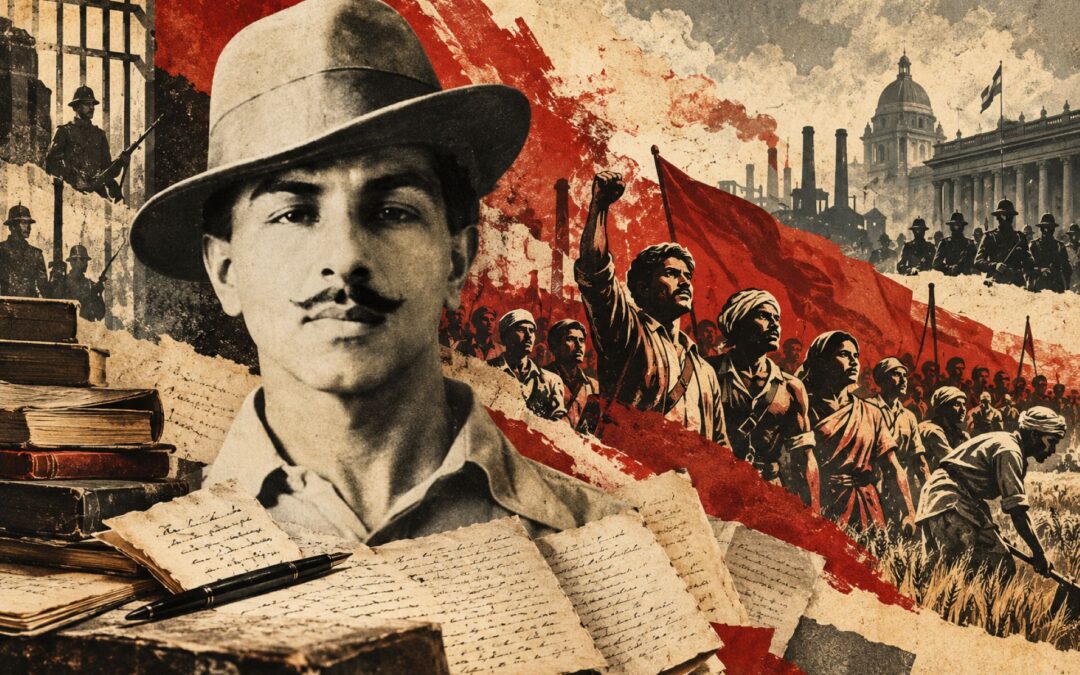
Bhagat Singh occupies an extraordinary place in the history of India’s independence movement. His photograph, his defiance of British colonial rule, and his execution at the age of twenty-three have made him one of the country’s most recognisable revolutionary figures. Yet the popularity of Bhagat Singh as a national hero has often obscured a more complicated question: what kind of independent India did he actually want to create?
In To Make the Deaf Hear: Ideology and Programme of Bhagat Singh and His Comrades, historian S. Irfan Habib examines the political ideas behind the revolutionary movement associated with Bhagat Singh. Published by Three Essays Collective in 2007, the book shifts attention from the familiar episodes of bombings, trials, imprisonment, and martyrdom to the ideological development of the revolutionaries themselves. It considers their organisations, their intellectual influences, their relationship with the wider nationalist movement, and their increasingly explicit commitment to socialism.
Habib’s central argument is that Bhagat Singh and his comrades developed a vision extending beyond the removal of British rule. They wanted to transform the political, economic, and social arrangements that permitted exploitation and inequality. The distinction matters because independence could mean replacing foreign rulers with Indian ones, or it could mean changing the conditions under which ordinary people lived and worked. For the socialist revolutionaries, these were related but fundamentally different objectives.
The book consists of five analytical chapters supported by appendices containing Bhagat Singh’s writings, organisational manifestos, and a record of his reading. These documents are essential to its purpose. They allow the revolutionaries to be understood through the political arguments they made rather than through the symbolic meanings subsequently attached to their deaths.

Why Habib Reexamines Bhagat Singh’s Political Ideas
The conventional account of Bhagat Singh’s revolutionary career tends to concentrate on a relatively short sequence of dramatic events. In December 1928, he participated in the killing of British police officer John Saunders in Lahore. In April 1929, he and Batukeshwar Dutt threw bombs in the Central Legislative Assembly in Delhi. Their arrest and subsequent trials drew enormous attention, while Bhagat Singh’s execution alongside Sukhdev and Rajguru on 23 March 1931 established his enduring reputation as a martyr of Indian independence.
These events were historically consequential, but they do not explain the revolutionary programme behind them. A movement can oppose colonial rule without necessarily agreeing on what should replace it. Even people willing to sacrifice their lives for independence may hold radically different beliefs about political representation, economic ownership, religion, class, and the legitimate exercise of state power.
Habib’s study addresses these questions through the history of revolutionary organisations and the political writings associated with them. As the publisher’s description of the book makes clear, particular attention is given to the Hindustan Socialist Republican Association (HSRA), the Naujawan Bharat Sabha, and the movement toward socialism in Bhagat Singh’s political outlook.
This approach makes the book a work of intellectual and political history rather than a conventional biography. Its subject includes Bhagat Singh’s personal development, but the larger concern is how revolutionary nationalism changed during the 1920s and early 1930s. Habib examines a generation of activists who increasingly asked whether freedom from colonial domination could be meaningful without freedom from economic exploitation.
The book also challenges the tendency to treat India’s independence movement as though it contained one agreed programme. Congress nationalism, Gandhian mass politics, revolutionary republicanism, and socialist politics developed alongside one another, sometimes cooperating and sometimes disagreeing over objectives and methods. Understanding the revolutionary movement requires placing it within these competing possibilities.
From Early Revolutionary Nationalism to the HRA
The political movement associated with Bhagat Singh did not emerge suddenly in the late 1920s. It developed from older traditions of armed anti-colonial resistance, secret revolutionary societies, republican nationalism, and political activism inspired by developments inside and outside India.
Earlier revolutionary movements had been particularly active in Bengal, Punjab, and parts of northern India. Organisations such as the Anushilan Samiti and Jugantar became associated with underground resistance to British rule. The Ghadar movement, founded among Indian expatriates in North America, brought an explicitly international dimension to the struggle and attempted to encourage an uprising against colonial authority during the First World War.
Although these organisations differed considerably, they shared dissatisfaction with gradual constitutional reform under British supervision. Their members questioned whether colonial power could be removed through petitions, limited political representation, or negotiations controlled by the imperial government.
The emergence of the Hindustan Republican Association in the 1920s marked an important development because it sought to give revolutionary resistance a more definite political objective.
The immediate political background included disappointment following the withdrawal of Gandhi’s Non-Cooperation Movement in 1922. The movement had mobilised large numbers of Indians against colonial authority, but Gandhi suspended it after the violence at Chauri Chaura. Some young nationalists concluded that Congress leadership was unwilling to sustain a confrontation when it threatened to escape the discipline of nonviolence.
The HRA emerged from this atmosphere of frustration. Figures associated with its early development included Sachindra Nath Sanyal, Ram Prasad Bismil, Jogesh Chandra Chatterjee, and other revolutionaries who sought to organise resistance through an underground political association.
Its programme was more substantial than the overthrow of individual colonial officials. The 1925 HRA manifesto, The Revolutionary, proposed a federal republic based on universal suffrage. It envisaged representative institutions, the accountability of government, and the abolition of arrangements that permitted the exploitation of one person by another.
The manifesto also supported nationalising major industries and infrastructure, including important means of transportation and communication. These commitments show that economic and social reconstruction already occupied a place in the early revolutionary programme.
Consequently, the HRA should not be imagined as an organisation concerned exclusively with armed action. Its political language combined republican government, democratic participation, opposition to exploitation, and revolutionary methods of obtaining power.
Nevertheless, the organisation had not yet developed the fully articulated socialist orientation associated with Bhagat Singh’s later writings. Its ideas brought together several intellectual traditions, including republican nationalism, religiously influenced revolutionary idealism, and emerging socialist commitments.
The distinction becomes clearer when examining the political and religious outlook of earlier revolutionary leaders. Sachindra Nath Sanyal, for example, expressed religious and spiritual convictions that differed significantly from Bhagat Singh’s later materialism and atheism. Ram Prasad Bismil also drew upon religious traditions while participating in revolutionary politics.
These differences do not diminish their opposition to colonial rule. They demonstrate that revolutionary nationalism was not originally a single, coherent philosophical doctrine.
The Kakori train action of August 1925 became a decisive episode in the organisation’s development. HRA revolutionaries seized government money being transported by train, intending to obtain resources for their activities. The subsequent investigation, arrests, trials, and executions inflicted a severe blow on the organisation.
Ram Prasad Bismil, Ashfaqulla Khan, Rajendra Lahiri, and Roshan Singh were executed in 1927. Other revolutionaries received lengthy prison sentences, while Chandrashekhar Azad remained underground.
The repression weakened the earlier leadership but did not destroy the revolutionary movement. Younger activists increasingly assumed responsibility for its future, and the need to rebuild the organisation created an opportunity to reconsider its political objectives.
This transition is central to Habib’s historical argument. The later socialist orientation did not appear in an ideological vacuum. It developed from an existing revolutionary tradition whose republican and egalitarian commitments offered possibilities for further intellectual change.
How Republican Revolutionaries Turned Toward Socialism
The transformation of the Hindustan Republican Association into the Hindustan Socialist Republican Association represented an important change in the movement’s declared political identity.
By the late 1920s, Bhagat Singh and several of his associates were increasingly convinced that removing British rule would accomplish little if economic exploitation continued under an Indian government. The problem was therefore no longer limited to who governed India. It also concerned who controlled economic resources, whose interests political institutions protected, and whether independence would improve the conditions of workers and peasants.
This development reflected a broader international intellectual environment. The Russian Revolution of 1917 had demonstrated that an existing political order could be overthrown in the name of socialism. Marxist writings offered explanations of capitalism, class relations, imperialism, and the relationship between economic power and political authority.
Bhagat Singh became deeply interested in these questions. His reading included works associated with Marx, Engels, Lenin, Trotsky, and other radical thinkers. He also studied revolutionary history and political philosophy more widely, including anarchist and rationalist arguments.
His engagement with these ideas should not be understood as the simple adoption of a complete doctrine at one particular moment. Political development involved reading, debate, changing circumstances, and dissatisfaction with earlier methods of revolutionary action.
In his later recollections, Bhagat Singh described a movement away from romantic revolutionary idealism toward a more systematic understanding of political change. He increasingly emphasised studying social conditions, defining political objectives, and organising people capable of bringing about the desired transformation.
The reorganisation of the revolutionary association in 1928 reflected these changes. The addition of the word Socialist to its name publicly indicated that the organisation sought more than a republican transfer of power.
Habib gives particular significance to Bhagat Singh’s role in this ideological transition. As discussed in Pritam Singh’s scholarly review of the book, Habib highlights Bhagat Singh’s insistence on the socialist identity of the reorganised association.
The distinction between the HRA and the HSRA should not, however, be exaggerated into a complete ideological break. The earlier association already advocated universal suffrage and opposed economic exploitation. Socialism gave these concerns a more developed political framework and a clearer understanding of class relations.
The younger revolutionaries also had to confront a practical problem. Underground organisations could carry out spectacular acts of resistance, but small conspiratorial groups could not independently reorganise an entire society. A socialist programme required the participation of large numbers of people, especially the workers and peasants whose interests the revolutionaries claimed to represent.
The Naujawan Bharat Sabha, established in Lahore in 1926, was an important attempt to develop a broader political organisation. Unlike an underground revolutionary association, it could operate publicly, organise young people, spread political ideas, and participate in campaigns.
Its existence illustrates the tension between clandestine revolutionary methods and public political mobilisation. The revolutionaries increasingly recognised the importance of reaching people outside their immediate circles, yet colonial repression and the movement’s continued commitment to armed actions complicated that effort.
Bhagwati Charan Vohra, Sukhdev, Chandrashekhar Azad, and other associates contributed to the organisational and intellectual environment in which these ideas developed. The movement cannot be reduced to Bhagat Singh acting independently, even though his writings later provided some of its clearest political statements.
The socialist turn therefore involved several interconnected changes: a more explicit criticism of capitalism, greater attention to workers and peasants, an interest in international revolutionary experience, and a developing belief that the political struggle required long-term organisation.
This was the foundation on which the HSRA’s mature revolutionary programme would be built.
The Trials, Congress, and Bhagat Singh’s Popularity
The revolutionary movement entered a new phase after the events surrounding the death of Lala Lajpat Rai in 1928.
Lajpat Rai had participated in protests against the Simon Commission, which had arrived in India without Indian representation. During a demonstration in Lahore, he was injured in a police lathi charge and died several weeks later.
Bhagat Singh and his associates blamed the colonial police for his death and planned retaliation against police superintendent James A. Scott, who was associated with the confrontation. Instead, the revolutionaries killed assistant superintendent John Saunders on 17 December 1928.
The killing was intended as retaliation for colonial repression, but it also increased the danger facing the revolutionary organisation. British investigators intensified their pursuit of those involved, while the revolutionaries sought ways to carry their political message beyond underground circles.
The most consequential public action came on 8 April 1929, when Bhagat Singh and Batukeshwar Dutt threw bombs inside the Central Legislative Assembly in Delhi.
The immediate political context included the Public Safety Bill and Trade Disputes Bill, measures that the revolutionaries regarded as attacks on civil liberties and organised labour. The Assembly was also seen as an institution whose elected representatives could be overridden by an unaccountable colonial executive.
The bombs were accompanied by political leaflets. Bhagat Singh and Dutt did not attempt to escape, allowing themselves to be arrested and brought before the courts.
Their decision transformed the incident into a prolonged public confrontation. Rather than relying solely on the immediate effects of the bombing, they used legal proceedings to defend their political ideas and criticise colonial institutions.
The Assembly bombing was dangerous and caused minor injuries, but the defendants maintained that they had deliberately attempted to avoid fatalities. Their statements presented the action as a warning rather than an assassination attempt.
The political purpose of the protest was inseparable from the wider revolutionary argument. The government was accused of suppressing organised labour, denying meaningful political representation, and protecting structures of exploitation.
The defendants’ courtroom statements therefore addressed issues that were much broader than the criminal charges against them. They criticised colonial institutions, defended the legitimacy of resistance, and explained that revolution required transforming the social order.
The proceedings also helped establish Bhagat Singh as a nationally recognised political figure. Newspapers, public meetings, youth organisations, and campaigns surrounding the trials carried his name and political statements to audiences far beyond the revolutionary movement.
The Lahore Conspiracy Case intensified this public attention. Bhagat Singh and other revolutionaries faced prosecution over the Saunders killing and related revolutionary activities. Their imprisonment also produced further political confrontations over the treatment of prisoners.
Revolutionary prisoners protested against discriminatory prison conditions, demanding treatment consistent with their status as political prisoners. Their concerns included food, clothing, reading materials, and the humiliating conditions imposed on Indian prisoners.
Jatin Das’s death in September 1929 following a prolonged hunger strike became another major episode in the public campaign surrounding the prisoners. The hunger strikes brought attention to the conditions of colonial imprisonment and helped turn individual prisoners into symbols of wider resistance.
The growing popularity of Bhagat Singh created difficulties for Congress politicians, who could recognise the intensity of public feeling without necessarily accepting the revolutionary movement’s methods or political programme.
Jawaharlal Nehru and Subhas Chandra Bose acknowledged Bhagat Singh’s extraordinary appeal among young people. Their responses reflected the fact that revolutionary nationalism had become a political force that the wider independence movement could not simply ignore.
Habib’s archival research is especially important here. His account draws attention to contemporary evidence of public mobilisation, including campaigns against the death sentences imposed on Bhagat Singh and his associates.
Records of appeal committees, public demonstrations, and newspaper responses demonstrate the extent of support. They also establish that concern for the condemned revolutionaries was not confined to their immediate organisations.
Nevertheless, political popularity is difficult to measure precisely. The existence of extensive public sympathy does not by itself establish that Bhagat Singh had the same nationwide political influence, organisational resources, or sustained popular following as Gandhi.
The two figures occupied very different political positions. Gandhi led a mass nationalist organisation with an established network of supporters, while Bhagat Singh became a symbol of revolutionary defiance whose political programme had not yet acquired comparable organisational strength.
The tension reached a particularly emotional point during negotiations between Gandhi and the British government in early 1931.
The Gandhi-Irwin Pact, concluded in March, concerned the suspension of the Civil Disobedience Movement and various concessions relating to political prisoners and nationalist activity. The impending executions of Bhagat Singh, Sukhdev, and Rajguru generated demands for their sentences to be commuted.
The three revolutionaries were nevertheless executed on 23 March 1931.
Their deaths provoked widespread grief and anger. At the subsequent Karachi session of the Indian National Congress, public demonstrations and debates made clear that the executions had become a central political controversy.
For Habib’s historical argument, these events demonstrate the relationship between revolutionary politics and the broader nationalist movement. Bhagat Singh’s popularity cannot be understood solely as admiration for courage. His public statements and political identity also appealed to young people dissatisfied with prevailing strategies of nationalist leadership.
At the same time, admiration for a revolutionary figure did not necessarily imply agreement with his socialism. A person could mourn Bhagat Singh, oppose British repression, and still favour a different political system for independent India.
That distinction is essential to evaluating the historical significance of his popularity.
What the HSRA Meant by Revolution
The ideological programme of the Hindustan Socialist Republican Association provides the clearest expression of the transformation traced through the earlier revolutionary movement.
The organisation’s developing outlook treated colonialism as a political system connected to wider structures of economic domination. British rule was objectionable because it denied Indians self-government, but the revolutionaries also opposed the exploitation of labour, concentrations of economic power, and social arrangements that allowed privileged groups to dominate others.
Within this framework, political independence was necessary but insufficient.
If British officials were replaced by Indian political leaders while workers and peasants remained economically subordinate, the revolutionaries believed that the fundamental structure of exploitation would survive.
Bhagat Singh’s writings reveal a concern with the relationship between political power and economic interests. He increasingly adopted the Marxist view that the state was not simply a neutral administrative institution. It could protect the interests of the dominant classes and therefore had to be understood as part of the struggle over economic relations.
This reasoning shaped the distinction between political and socialist revolution.
A political revolution could remove the existing colonial government. A socialist revolution required a further transformation of the institutions, property relations, and class structures that organised society.
The HSRA’s socialist orientation therefore implied a more demanding objective than transferring authority from British officials to Indian politicians.
It also raised the question of who would bring about the transformation.
Bhagat Singh came to regard workers and peasants as the central social forces required for a genuinely revolutionary movement. Industrial workers were important because of their position within the economy, while peasants formed the overwhelming majority of the Indian population.
For the revolutionaries, these groups needed reasons to support political change that went beyond appeals to national honour.
A peasant struggling under exploitative economic conditions might experience little improvement if only the nationality of the country’s rulers changed. A worker facing low wages, insecurity, or political repression required more than the promise of an Indian government.
The socialist programme had to address their material conditions.
This understanding placed mass organisation at the centre of revolutionary strategy. Workers and peasants needed political education, institutions through which they could organise, and a clear explanation of the social changes being proposed.
Bhagat Singh’s later writings increasingly rejected the notion that revolutionary transformation could be accomplished through isolated acts of heroism. Dramatic actions might create publicity or demonstrate resistance, but they could not substitute for a broad social movement.
The distinction becomes especially clear in his reflections on political parties.
A revolutionary party was expected to develop a programme, understand existing social conditions, organise supporters, and work continuously toward its objectives. Political education and disciplined organisation were therefore necessary parts of the struggle.
The ideas expressed in his later writings also included a recognition that political change occurred through stages. Partial reforms and temporary compromises might be unavoidable, provided the movement retained a clear understanding of its ultimate objectives.
This was a more complex position than an unconditional rejection of negotiation. Bhagat Singh distinguished between accepting a temporary concession and abandoning the purpose for which the movement existed.
Such arguments reveal a revolutionary thinker increasingly concerned with the practical problems of political strategy.
Nevertheless, the HSRA’s aspirations should be distinguished from its actual organisational achievements. Its underground structure, limited resources, dependence on relatively small groups of activists, and exposure to intense colonial repression constrained its ability to develop a sustained mass political apparatus.
The organisation’s commitment to socialism was clear in important statements, but the extent to which all members shared a fully developed Marxist understanding is a separate historical question.
The language of revolution also contained unresolved tensions. Some texts strongly defended the use of force, while others emphasised long-term organisation, popular participation, education, and the limits of individual violent action.
Rather than eliminating these contradictions, the movement’s intellectual development makes them historically important.
The HSRA attempted to move from an underground organisation known for spectacular acts of resistance toward a political movement capable of articulating a wider social programme. Its surviving writings show the seriousness of that ambition, even though the circumstances of the independence struggle prevented the programme from being fully tested.
Habib’s Conclusion: A Different Vision of Indian Freedom
The larger historical conclusion of Habib’s work concerns the political possibilities represented by Bhagat Singh and his comrades.
Their significance cannot be measured adequately through the number of revolutionary actions they carried out or the extent of their personal sacrifice. Their writings and organisational programmes reveal an alternative understanding of independence, one in which political sovereignty was inseparable from social equality and freedom from economic exploitation.
This interpretation complicates any historical narrative that treats independence primarily as the achievement of national self-government. The revolutionary socialists asked what the new state would do, which social groups would control it, and whether ordinary people would experience a fundamental improvement in their conditions.
Habib’s emphasis on an alternative political framework is therefore central to the book’s historical purpose. The executions of Bhagat Singh and his associates brought their personal participation in the struggle to an end, while the movement’s broader programme remained largely unrealised.
That does not establish that a socialist alternative would necessarily have succeeded had the revolutionaries survived. Historical outcomes depended on organisational strength, popular support, class relations, political alliances, colonial repression, and developments across the wider nationalist movement.
The more defensible conclusion is that India’s freedom struggle contained serious ideological alternatives whose significance cannot be understood through the eventual outcome alone.
Bhagat Singh’s political writings remain evidence that some revolutionaries were attempting to imagine and organise a different future for India. Habib’s contribution lies in restoring those ideas to the historical discussion.
What the Appendices Reveal About the Revolutionary Programme
The appendices are an unusually important component of To Make the Deaf Hear. They provide the documentary basis for understanding the revolutionaries’ intellectual influences, political statements, and organisational ambitions.
The distinction between Habib’s historical interpretation and the documents themselves is valuable. His analysis places revolutionary thinking within a larger historical development, while the primary writings allow readers to encounter arguments made by the revolutionaries in their own political circumstances.
The documents also demonstrate that revolutionary thought was neither static nor entirely uniform. Earlier republican programmes, statements defending specific political actions, essays on religion, and later discussions of socialist organisation reveal different purposes, audiences, and stages of intellectual development.
Bhagat Singh’s Reading and Intellectual Formation
Appendix A contains a reading list associated with Bhagat Singh. Its significance lies in the range of political and philosophical ideas with which he engaged.
The material discussed in Habib’s book includes Marxist works and references to thinkers such as Karl Marx, Friedrich Engels, Lenin, and Leon Trotsky. Bhagat Singh’s prison writings and notebook also demonstrate an interest in figures including Mikhail Bakunin, Peter Kropotkin, Charles Darwin, and Bertrand Russell.
These influences covered more than one political tradition. Marxism offered an interpretation of capitalism, class struggle, and historical change, while anarchist writings examined authority, freedom, and the state. Scientific and rationalist thinkers provided material for questioning inherited beliefs and conventional explanations of the world.
The intellectual range matters because Bhagat Singh did not approach revolutionary politics as a collection of patriotic slogans. He wanted to understand the foundations of political authority, the causes of economic exploitation, and the principles by which a different society might be organised.
However, reading-list evidence must be interpreted carefully. A title recorded in a notebook does not automatically prove that the entire book was read, understood, or accepted. Quotations copied from authors may reveal interest without establishing complete philosophical agreement.
The strongest conclusion is that Bhagat Singh engaged seriously with a remarkably broad intellectual environment and increasingly attempted to connect political action with theoretical understanding.
Bhagat Singh’s Political and Philosophical Writings
To Make the Deaf Hear: Notice of the HSRA
The document from which Habib’s book takes its title was distributed during the Central Legislative Assembly bombing on 8 April 1929.
The HSRA notice, commonly known as The Red Pamphlet, begins by invoking the need for a loud warning when those in power refuse to listen. Its immediate concerns include the Public Safety Bill, the Trade Disputes Bill, arrests of labour leaders, and the limitations of political institutions operating under colonial authority.
The notice frames the Assembly action as a protest against repression and a means of drawing public attention to the government’s conduct. It also expresses the revolutionaries’ belief that suppressing individuals could not permanently suppress political ideas.
Importantly, the pamphlet connects anti-colonial resistance with opposition to economic exploitation. The action is presented on behalf of people whose political and economic interests have been ignored.
Its immediate function was propaganda and political justification, not a comprehensive explanation of socialist theory. Nevertheless, it shows the relationship between the organisation’s dramatic methods and its broader political concerns.
Statement in the Sessions Court
Bhagat Singh and Batukeshwar Dutt’s statement in the Assembly Bomb Case provides a more developed explanation of their action and political objectives.
Read in court by Asaf Ali on 6 June 1929, the statement acknowledges their responsibility for throwing the bombs while disputing aspects of the prosecution’s account. It argues that the Assembly represented colonial power rather than meaningful democratic government.
The defendants describe the institution as incapable of protecting workers and ordinary Indians from exploitation. They also criticise repressive legislation and the suppression of organised labour.
The full courtroom statement distinguishes between an attack intended to kill particular individuals and a political protest intended to expose an institution’s character. The defendants maintain that the bombs were placed so as to minimise casualties, although the act plainly involved the use of dangerous explosives.
The statement also develops a broader definition of revolution. Political violence, in itself, is not presented as the ultimate objective. The desired transformation concerns the structure of society, the conditions of labour, and the replacement of exploitation with a more just social order.
This text is indispensable because it connects the Assembly incident to the revolutionaries’ stated political philosophy.
Why I Am An Atheist
Written in prison in October 1930, Why I Am An Atheist addresses the accusation that Bhagat Singh’s rejection of religion arose from arrogance.
The essay begins with an examination of his own intellectual and religious history. He recalls being raised in a religious household, participating in prayer, and initially accepting belief in God.
His doubts developed through political experience, discussion, and study. He describes how reading and critical reflection gradually changed his understanding of religious authority and the supernatural.
In the essay’s account of his atheism, Bhagat Singh argues that rejecting belief in God requires independent reasoning rather than personal vanity. He questions the compatibility of an all-powerful, benevolent deity with the existence of suffering and injustice.
The essay also confronts the personal consequences of atheism. Facing possible execution, Bhagat Singh considers what it means to accept death without expecting divine intervention, reincarnation, or rewards in an afterlife.
His position is that political commitment must rest on reasons and convictions sufficient to sustain it without supernatural consolation.
The essay is especially important because it challenges religious interpretations that later readers might impose upon his revolutionary sacrifice. It presents a thinker consciously rejecting inherited assumptions and defending intellectual independence.
Introduction to The Dreamland
Bhagat Singh’s introduction to Ram Saran Das’s revolutionary poem The Dreamland reveals another aspect of his political thinking.
The work presented an imagined social order and drew upon idealist and religious influences associated with earlier revolutionary traditions. Bhagat Singh respected its author’s commitment and suffering but disagreed with important elements of its philosophy.
In his critical introduction to The Dreamland, he distinguishes the author’s metaphysical assumptions from his own materialist outlook. He also examines the political value of imagining a different society.
The discussion goes beyond the disagreement over religion. Bhagat Singh considers education, punishment, social equality, economic organisation, and the possibility of reducing the causes of war.
He approves of the idea that punishment should aim at reform rather than revenge and discusses education as an instrument of social transformation.
Another important distinction concerns the relationship between revolutionary violence and social reconstruction. Bhagat Singh argues that an egalitarian society cannot be created simply by imposing new institutions through force. It requires education and the development of new social relationships.
Yet he also believes that political power must be transformed because existing authorities will resist changes that threaten their interests.
The essay therefore combines respect for an earlier revolutionary’s idealism with a criticism of its philosophical and strategic limitations.
To the Young Political Workers
This is among Bhagat Singh’s most substantial surviving statements of revolutionary strategy.
Written in February 1931, shortly before his execution, the text considers the political circumstances surrounding Congress negotiations and the possibility of compromise with British authorities.
Bhagat Singh argues that compromise is not inherently a betrayal. Political movements may accept partial gains when circumstances prevent them from achieving their entire programme, but they must retain a clear understanding of their ultimate objectives.
The address to young political workers draws upon the Russian revolutionary experience to explain the difference between strategic flexibility and ideological surrender.
It then develops a more systematic account of the revolutionary programme.
Bhagat Singh identifies workers and peasants as the social groups whose participation is essential to fundamental transformation. He criticises nationalist leaders who rely upon these groups rhetorically while avoiding political demands that might threaten landlords and capitalists.
His argument is that ordinary people must understand how the proposed revolution will improve their material circumstances. Appeals to nationalism alone cannot substitute for a programme addressing exploitation.
He also distinguishes political revolution from socialist revolution. Gaining political power is necessary because the existing state protects prevailing social interests, but capturing power is only the beginning of the proposed transformation.
A revolutionary party must organise people, develop political consciousness, clarify its objectives, and prepare for a prolonged struggle.
The document is significant because it challenges the stereotype of Bhagat Singh as a revolutionary interested primarily in spectacular acts of violence. His final political concerns included organisation, political education, class relations, and the practical difficulties of establishing socialism.
The HRA, Naujawan Bharat Sabha, and HSRA Manifestos
Manifesto of the Hindustan Republican Association
The HRA manifesto demonstrates that the earlier revolutionary organisation already possessed a political programme extending beyond anti-British armed resistance.
It advocates a federal republic, universal political participation, and the abolition of systems permitting exploitation. It also proposes public control of important industries and mechanisms to make representatives accountable to the people.
These commitments establish continuity between early revolutionary republicanism and the later socialist programme. The addition of an explicitly socialist identity in 1928 did not create an interest in equality where none had previously existed.
The manifesto nevertheless reflects a broader combination of revolutionary ideals. Its republican and egalitarian language coexists with influences that differ from Bhagat Singh’s later, more consistently materialist political outlook.
Manifesto of the Naujawan Bharat Sabha
The Naujawan Bharat Sabha manifesto provides evidence of the revolutionaries’ attempts to mobilise young people through public political work.
Associated with Bhagwati Charan Vohra, the document responds to the political disillusionment and divisions of the 1920s. It appeals to young Indians to organise themselves, overcome passivity, and participate in the struggle for national freedom.
The Sabha’s public character distinguishes it from the underground revolutionary association. It offered an organisational setting in which political education, youth mobilisation, and broader nationalist activity could take place.
Its importance lies partly in the relationship between political consciousness and collective organisation. A revolution needed supporters who understood its objectives and could work beyond the immediate circle of underground activists.
Philosophy of the Bomb
The final organisational document addresses a different problem: the legitimacy and effectiveness of revolutionary violence.
Written by Bhagwati Charan Vohra in response to Gandhi’s criticism of bomb-related revolutionary action, Philosophy of the Bomb defends the political reasoning behind the HSRA’s methods.
Gandhi had criticised an attempt to attack the train carrying Viceroy Lord Irwin. The revolutionary response rejected his condemnation and defended the use of force against colonial domination.
The argument proceeds from the belief that an oppressive political order cannot necessarily be defeated by appealing to the moral conscience of those who control it. Revolutionary violence is consequently presented as a possible instrument of resistance.
The document should not be confused with Bhagat Singh’s personal writings, even though it belongs to the broader organisational tradition associated with him. Its authorship and circumstances also demonstrate why the movement’s ideas must be studied collectively rather than attributed automatically to its most famous member.
Taken together, the three manifestos reveal an evolving political movement concerned with republican government, social equality, mass mobilisation, and the justification of revolutionary action. They also reveal that the relationship between these objectives was sometimes difficult and contested.
Bhagat Singh as a Political Thinker: From Sacrifice to Strategy
One of the most important consequences of Habib’s historical approach is the recovery of Bhagat Singh’s intellectual development.
Popular representations frequently portray him through a relatively fixed image: a fearless young revolutionary who challenged an empire and accepted execution. That image captures part of his political life, but it can conceal the changes in his ideas and the seriousness with which he examined the problems of revolution.
Bhagat Singh’s development is particularly visible when his autobiographical reflections and political writings are considered together.
In Why I Am An Atheist, he describes the movement from inherited religious beliefs and romantic revolutionary idealism toward systematic study. He does not present this change as an effortless revelation. It involved questioning earlier assumptions, encountering different philosophical arguments, and reconsidering the political methods he had initially admired.
His interest in Marxism became part of this broader effort to understand social conditions. Marxist analysis offered explanations of economic exploitation, class power, and the relationship between political institutions and material interests.
Yet Bhagat Singh’s intellectual engagement was not limited to Marxist theory. His reading and writings show attention to revolutionary history, anarchism, materialism, secular thought, and problems of ethics and social organisation.
His introduction to The Dreamland is especially revealing because it demonstrates an ability to distinguish respect for another revolutionary from agreement with that person’s philosophy. He recognises the author’s commitment and historical experience while openly criticising religious mysticism and inadequate political explanations.
This suggests a political thinker willing to examine disagreement within the revolutionary tradition rather than treating all revolutionaries as ideologically identical.
Another revealing feature is his approach to organisation.
In To Young Political Workers, Bhagat Singh is concerned with questions that receive comparatively little attention in popular accounts of his life. He wants to know how political movements identify their objectives, evaluate constitutional reforms, build support among workers and peasants, and use compromise without surrendering their principles.
Such arguments require long-term strategic thinking. They are difficult to reconcile with an image of a revolutionary whose political imagination stopped at the successful execution of an armed action.
His developing outlook also contains a tension that should not be overlooked. He remained associated with an organisation that employed violence, even as his later writings emphasised the limits of isolated revolutionary action and the need for systematic mass politics.
The resulting picture is neither that of an unchanging advocate of violence nor that of someone who simply abandoned revolutionary force. It is of a political activist attempting to define the circumstances in which force might be justified while increasingly recognising that enduring transformation required something much broader.
Habib’s emphasis on this development restores an important dimension of Bhagat Singh’s political identity. His courage explains his willingness to accept extraordinary risks, but his writings explain the purposes for which he believed those risks should be taken.
Socialism, Workers, Peasants, and the Meaning of Independence
The distinction between national independence and social revolution is fundamental to understanding the political programme associated with the HSRA.
National independence answers the question of whether a country governs itself. Socialism, as developed in Bhagat Singh’s later writings, raises further questions concerning economic ownership, class relations, labour, and the distribution of political and economic power.
From this perspective, a change in national government could leave important structures of exploitation intact.
An Indian capitalist might exercise power over workers in ways similar to a British capitalist. An Indian landlord might continue exploiting peasants after colonial officials had departed. The nationality of the ruling authorities would change, but the economic relationships affecting ordinary people might remain substantially the same.
Bhagat Singh’s criticism therefore extended beyond the British political presence to the economic arrangements he believed colonialism protected and reinforced.
This analysis gave workers and peasants a central position in his understanding of revolution.
Workers were important because industrial production depended upon their labour, while peasants were indispensable because of their numbers and their place within India’s predominantly agricultural economy.
A genuine revolutionary movement would have to organise these groups around their own interests rather than treating them as passive supporters of a political struggle directed by others.
This reasoning led to a criticism of nationalist movements dominated by property-owning or commercially influential groups. Bhagat Singh suspected that political leaders with substantial economic interests might hesitate to support mass mobilisation if it threatened the existing property system.
His political critique was not simply that Congress leaders lacked courage or patriotism. It concerned the relationship between their social positions, political methods, and willingness to endorse extensive economic transformation.
The socialist programme also required a different conception of political power.
The state was understood as an institution capable of enforcing existing class relations. Political authority therefore mattered because it could either defend established economic arrangements or become an instrument for transforming them.
Bhagat Singh argued that revolutionary forces needed political power to reorganise society on socialist principles. Without that power, they would struggle to overcome resistance from institutions and economic interests opposed to transformation.
However, the acquisition of political authority was not an end in itself. The purpose was to change social relations, expand opportunities, and remove conditions of exploitation.
The political programme thus contained an important sequence: develop revolutionary consciousness, organise workers and peasants, obtain political power, and use that power to carry out social reconstruction.
The sequence was ambitious, but its practical requirements were formidable.
India’s workers and peasants were divided by region, language, religion, caste, occupation, and local economic conditions. Organising them into a unified socialist political force would require institutions, resources, sustained leadership, and a programme capable of addressing different interests.
The HSRA’s writings demonstrate awareness of the need for mass organisation, but they do not establish that the organisation possessed the capacity to accomplish it.
This distinction is crucial when evaluating the socialist alternative. The political objectives can be examined seriously without assuming that their achievement was historically inevitable.
Habib’s interpretation gives these objectives their rightful place within India’s freedom struggle. It also invites examination of the considerable distance between revolutionary vision and the institutions required to realise it.
Secularism, Atheism, and Religious Nationalism
Bhagat Singh’s atheism is one of the most distinctive aspects of his intellectual life, particularly because religion played a prominent role in many strands of Indian nationalism.
His rejection of belief in God was neither inherited automatically nor presented as a casual expression of rebellion.
In Why I Am An Atheist, he recalls a religious upbringing and describes how intellectual inquiry gradually led him away from the beliefs he had previously accepted. The essay’s autobiographical sections are important because they establish the change as a process of reflection rather than a fixed characteristic present throughout his life.
His argument also responds to a personal accusation. Some associates suggested that his disbelief reflected excessive pride. Bhagat Singh answers that rejecting the existence of God does not amount to believing oneself superior to God or to other people.
He treats atheism as an intellectual position that should be evaluated through reasoning.
The essay then raises familiar philosophical difficulties concerning the existence of suffering and the claim that the universe is governed by an all-powerful, benevolent deity.
Bhagat Singh questions religious explanations that postpone justice until a future existence or describe suffering as punishment for earlier actions. His concern is that such explanations may make existing suffering appear necessary, deserved, or beyond human responsibility.
The political significance becomes clearer when he discusses independent thinking.
A revolutionary who accepts inherited beliefs without examination may also become unwilling to criticise political authorities, respected leaders, or established institutions. Intellectual independence is therefore important because social transformation requires the ability to question what society treats as unquestionable.
This reasoning connects his atheism to a wider philosophical outlook, although atheism and political secularism are not identical.
Atheism concerns belief in the existence of God. Political secularism concerns the relationship between religious identities, public institutions, citizenship, and political authority.
A person may be religious and support secular government, just as an atheist may hold political views that are not democratic or egalitarian.
Bhagat Singh’s political importance lies in the relationship between his rationalist outlook and a revolutionary movement increasingly concerned with overcoming religious and communal divisions.
Religious nationalism posed a serious problem for a socialist programme based on organising workers and peasants across communities. Divisions among Hindus, Muslims, Sikhs, and others could weaken collective political action by encouraging people to identify primarily through competing religious interests.
The movement’s public organisations sought forms of mobilisation that could bring people together across these boundaries. Their political objectives required a conception of shared interests extending beyond religious identity.
Nevertheless, earlier revolutionary movements frequently employed religious imagery and drew upon spiritual traditions. Bhagat Singh’s criticism of such influences was part of a changing intellectual environment, not evidence that every revolutionary before him accepted religious nationalism or that every later socialist revolutionary was an atheist.
His introduction to The Dreamland shows this complexity. He disagrees with Ram Saran Das’s metaphysical assumptions while respecting the historical circumstances that shaped them.
The deeper importance of Habib’s approach is that it prevents Bhagat Singh’s identity from being reduced to symbols that can be detached from his own political and philosophical arguments.
The question is not simply whether Bhagat Singh believed in God. It is how his commitment to rational inquiry, criticism, equality, and political organisation contributed to his understanding of revolution.
Bombs, Courts, and the Limits of Revolutionary Violence
The relationship between revolutionary violence and political strategy is among the most difficult issues raised by Bhagat Singh’s career.
His participation in the killing of Saunders and the Assembly bombing cannot be separated from the history of the HSRA. These actions involved deliberate violence and the possibility of injury or death, even when their participants described them as politically necessary.
At the same time, the revolutionaries’ own statements demonstrate that they understood armed actions within a larger political framework.
The Assembly bombing provides the clearest example.
Bhagat Singh and Batukeshwar Dutt intended to protest against colonial legislation and draw attention to a revolutionary political programme. By allowing themselves to be arrested, they ensured that the action would lead to public proceedings in which their arguments could be communicated.
The bombing thus functioned partly as political theatre. Its immediate physical effects were less important to the participants’ stated purposes than the publicity and confrontation it generated.
Their courtroom defence emphasised that they had attempted to avoid killing people. This claim is relevant to understanding their intentions, but it does not remove the ethical question of whether placing explosives in an occupied legislative chamber was justified.
The defendants acknowledged the action while insisting that its political meaning lay in opposition to an oppressive institution.
A different argument appears in Philosophy of the Bomb.
The manifesto responds to Gandhi’s condemnation of revolutionary violence by defending force as a possible means of resisting colonial domination. Its reasoning challenges the idea that moral persuasion alone could overcome an entrenched system of political coercion.
The disagreement raises questions about the legitimacy of resistance, the relationship between means and ends, and the consequences of violence for public political movements.
There is also an important distinction between defending violence as a possible instrument and treating it as a sufficient programme for revolution.
Bhagat Singh’s later writings increasingly emphasise the limitations of isolated armed actions. In To Young Political Workers, the sustained organisation of workers and peasants becomes central to achieving a socialist transformation.
His introduction to The Dreamland also distinguishes the seizure of political power from the constructive work of reorganising society.
This produces a tension within the revolutionary tradition. Armed resistance might challenge colonial power, but a socialist society required institutions and social relationships that could not be created through explosions or assassinations alone.
Individual acts of violence could also strengthen colonial repression, isolate revolutionary organisations, or make it more difficult to build broad political support.
The historical outcomes of revolutionary actions therefore require evaluation separately from the intentions of their participants.
The Saunders killing and Assembly bombing contributed to Bhagat Singh’s public reputation and helped place revolutionary politics at the centre of national debate. They also intensified prosecutions that removed important activists from political life.
The spectacular character of these actions could create awareness, but awareness was not the same as organisation.
Habib’s focus on ideology brings this problem into view. A movement that hoped to transform society needed to explain how isolated acts of defiance related to a broader strategy of gaining popular support and changing institutions.
The surviving writings do not establish that the revolutionaries completely resolved this problem. They show that some of their most important thinkers recognised it and were attempting to develop a more comprehensive political approach.
Gandhi, Congress, and Competing Visions of Independence
The relationship between Bhagat Singh’s revolutionary politics and Gandhi-led nationalism cannot be understood adequately as a simple opposition between violence and nonviolence.
That difference was certainly important. Gandhi treated nonviolence as a fundamental principle of legitimate political action and developed methods of mass resistance around it. Revolutionary organisations defended the possibility of force against colonial authority, even as their strategic thinking changed.
However, their disagreements also concerned political objectives, social transformation, methods of organisation, and the interests represented by the nationalist movement.
Gandhi’s political work centred on creating a broad movement capable of challenging British rule through civil resistance, non-cooperation, and negotiations. Congress contained people with diverse economic and political beliefs, including liberals, conservatives, socialists, and nationalists whose priorities did not always coincide.
Bhagat Singh’s later writings advanced a more explicitly socialist programme. He argued that national independence would remain incomplete if it left the exploitation of workers and peasants substantially unchanged.
He was particularly critical of political strategies that depended upon economically privileged groups while failing to organise labourers and peasants around their own material interests.
This criticism is prominent in To Young Political Workers. Bhagat Singh argues that the interests of landlords and capitalists could conflict with the demands of a movement seeking extensive social transformation.
The differences also involved the role of compromise.
It would be misleading to suggest that Gandhi accepted political compromise while Bhagat Singh rejected it under all circumstances. Bhagat Singh explicitly defended tactical compromise when it advanced a movement’s position without surrendering its ultimate objectives.
His objection concerned the possibility that a nationalist organisation might settle for constitutional or political gains while abandoning broader social transformation.
This was a disagreement over ends as well as means.
Yet Gandhi’s political outlook should not be reduced to a desire for nothing more than the transfer of government to an Indian elite. His economic, ethical, and social ideas included criticisms of industrial capitalism, exploitation, inequality, and aspects of modern civilisation.
His proposed remedies differed substantially from Marxist socialism, and he rejected the revolutionaries’ justification of violence, but he did not simply regard every existing economic arrangement as beyond criticism.
Similarly, Congress was not a completely unified expression of Gandhi’s personal beliefs. Its internal disagreements included questions concerning economic justice, constitutional strategy, labour movements, socialism, and the nature of independence.
The relationship between Gandhi and Bhagat Singh became especially controversial during the events preceding the 1931 executions.
The Gandhi-Irwin negotiations occurred while Bhagat Singh, Sukhdev, and Rajguru faced execution. Demands for commutation were widespread, and Gandhi’s role in the negotiations remains a subject of historical disagreement.
Some critics argue that Gandhi failed to apply sufficient pressure to secure commutation. Others emphasise the representations he did make and the limits of his influence over a colonial government determined to proceed with the executions.
These questions require examination of negotiations, correspondence, government decisions, and contemporary political circumstances.
They cannot be settled simply by assuming that Gandhi either possessed the power to save the prisoners or deliberately desired their deaths.
Pritam Singh’s review of Habib’s book offers a particularly forceful interpretation of the rivalry between Gandhian nationalism and Bhagat Singh’s socialist outlook. He argues that Bhagat Singh represented a potentially major alternative political leadership and speculates that Indian politics might have developed differently had he survived.
The documentary material discussed in the review establishes the importance of Bhagat Singh’s popularity and the political challenge represented by revolutionary socialism. It does not prove the counterfactual claim that a surviving Bhagat Singh would necessarily have displaced Gandhi or established a mass socialist movement.
That possibility would have depended on organisational capacity, political alliances, social divisions, and circumstances that cannot be reconstructed with certainty.
The contrast is nevertheless historically useful because it reveals competing conceptions of what independence should accomplish.
One approach emphasised national mobilisation and political self-government through a broad movement. The revolutionary socialist approach increasingly insisted that independence must be accompanied by fundamental changes in economic and social power.
These conceptions were not always mutually exclusive in the beliefs of individual nationalists, but they generated real disagreements about the political future of India.
Habib’s historical contribution is to ensure that the revolutionary socialist alternative remains visible within this wider debate.
Habib’s Sources, Method, and Historical Interpretation
The distinctive value of To Make the Deaf Hear lies partly in the historical evidence used to reconstruct revolutionary political thought.
Habib’s research draws upon archival material and contemporary records relevant to the revolutionary movement. Scholarly discussion of the book identifies his use of collections in Delhi, Chandigarh, and Meerut, as well as interviews with individuals connected to Bhagat Singh’s life and movement.
These sources matter because the revolutionary movement was frequently described by colonial officials through the language of criminal conspiracy, terrorism, and threats to public order.
Police reports and court proceedings contain important historical information, but they also reflect the purposes and assumptions of institutions attempting to suppress revolutionary organisations.
Using such evidence responsibly requires attention to its origin and the circumstances in which it was produced.
The same is true of revolutionary declarations. Manifestos and courtroom statements are indispensable for identifying political objectives, but they are also documents written for particular audiences and immediate political purposes.
An organisational manifesto expresses what its authors wanted people to believe about the movement. It may reveal genuine principles while also exaggerating unity, strength, or practical capability.
Similarly, a courtroom statement provides evidence of how defendants explained their actions, but it does not independently establish that every claim about intention or historical necessity was correct.
Habib’s use of these materials permits a historical interpretation focused on ideology rather than on incidents alone. The documents make it possible to compare the stated objectives of the earlier HRA with the developing socialist arguments of Bhagat Singh and the HSRA.
The appendices strengthen this approach because readers can examine significant primary writings alongside the historian’s interpretation.
They also demonstrate the importance of distinguishing individual authors from collective organisations.
The writings of Bhagat Singh, Bhagwati Charan Vohra, Sachindra Nath Sanyal, and other revolutionaries belong to related political traditions, but their authors did not always share identical philosophical or strategic positions.
An interpretation that treats every revolutionary statement as an expression of one perfectly consistent ideology risks obscuring meaningful disagreements.
Another methodological challenge concerns the relationship between intellectual development and practical politics.
A movement may adopt socialist terminology before establishing institutions capable of putting socialism into practice. Its leading intellectuals may develop sophisticated arguments that other members understand differently or only partially.
Historical research therefore needs to examine organisational decisions and actual political activity alongside writings and declarations.
Habib’s central interpretive strength is the recovery of a political programme that popular narratives often overlook. The accompanying challenge is to show the extent to which that programme was coherent, representative of the movement, and capable of influencing India’s political future.
The book’s combination of historical analysis and documentary evidence provides an especially useful basis for investigating these questions.
How Well the Book Reconstructs the Revolutionary Alternative
To Make the Deaf Hear makes an important contribution to the historical understanding of Bhagat Singh because it asks readers to evaluate him through political ideas rather than through martyrdom alone.
That approach addresses a genuine weakness in many popular representations. The narrative of a young revolutionary confronting an empire can become so emotionally compelling that his actual political objectives receive comparatively little attention.
Habib’s emphasis on ideology changes the historical questions being asked.
Instead of concentrating exclusively on the courage of revolutionary acts, the book investigates the political future envisaged by the people who carried them out. Instead of treating revolutionary organisations as collections of conspirators, it considers their programmes, intellectual influences, and development over time.
This gives Bhagat Singh’s political writings a historical importance that cannot be captured through commemorative narratives.
The book’s strongest contribution is the explanation of the movement toward socialism.
By examining the development from earlier republican organisations to the HSRA, Habib places the revolutionary movement within a history of changing political ideas. The socialist orientation becomes a substantive development involving class, economic power, and the meaning of independence.
This interpretation is particularly valuable because it identifies connections between revolutionary nationalism and wider international political currents without denying the movement’s specific Indian circumstances.
Bhagat Singh’s engagement with Marxism and revolutionary history was part of an attempt to understand colonial India, not evidence that he simply reproduced a foreign programme without modification.
The documentary appendices considerably strengthen the book.
Bhagat Singh’s writings provide direct evidence of his intellectual development and political objectives, while the organisational manifestos permit comparisons across different stages of the movement.
The contrast between the HRA manifesto and the later socialist arguments is especially revealing. It demonstrates both continuity and change, allowing readers to see how existing republican and egalitarian commitments could develop into a more explicit socialist outlook.
The inclusion of Why I Am An Atheist also makes the book useful for understanding the philosophical dimensions of revolutionary politics.
Bhagat Singh’s argument about reason, doubt, and religious authority complicates representations that treat revolutionary sacrifice as though it necessarily arose from religious devotion or inherited spiritual convictions.
Likewise, To Young Political Workers challenges the idea that Bhagat Singh’s political strategy consisted primarily of armed resistance. Its discussion of mass organisation, workers, peasants, socialism, and compromise reveals a much broader conception of political struggle.
The use of archival evidence adds another dimension to Habib’s argument.
Contemporary reports of Bhagat Singh’s popularity, the reactions of Congress leaders, and public campaigns surrounding the death sentences show how revolutionary politics entered the wider nationalist imagination.
This material helps explain why Bhagat Singh became a major public figure, but it also requires careful interpretation.
Popularity cannot be equated automatically with sustained political organisation or ideological agreement. Many Indians could admire Bhagat Singh’s sacrifice without subscribing to his socialist programme.
The most important limitation of the revolutionary alternative as a historical project lies in the distance between its objectives and its organisational resources.
The HSRA possessed committed activists and influential political ideas, but it did not develop a mass organisation comparable to Congress. Its underground methods, limited resources, internal differences, and exposure to repression constrained its capacity to translate ideological commitments into sustained political power.
This does not invalidate the significance of its programme. It does, however, limit the conclusions that can reasonably be drawn about its possible political success.
Any interpretation suggesting that revolutionary socialism might have displaced Gandhian nationalism must therefore remain counterfactual.
Bhagat Singh’s survival could have altered the development of socialist politics in India, but the extent and direction of that influence cannot be known. His personal popularity was considerable, yet leadership of a large political movement required institutions and alliances that the revolutionary organisation had not fully established.
A second limitation concerns the coherence of the socialist programme.
The available documents demonstrate clear commitments to economic equality, workers and peasants, socialist reconstruction, and political organisation. They do not establish that all major revolutionary leaders held identical views on socialism, violence, religion, class, or the future state.
The earlier movement included religious revolutionaries and republican nationalists whose ideas differed from Bhagat Singh’s later materialism.
Even within the HSRA’s political tradition, statements defending armed resistance coexist with arguments emphasising the limitations of individual violence.
These differences can be understood as evidence of ideological development rather than simply contradictions to be eliminated. Nevertheless, a historical account must preserve them instead of presenting the movement as more unified than the evidence permits.
The relationship with Gandhi and Congress also requires a careful separation between evidence and interpretation.
Habib’s historical material offers a basis for investigating the extraordinary public response to Bhagat Singh and the ideological differences between revolutionary socialism and Gandhi-led politics.
Pritam Singh’s detailed academic review develops these questions into a stronger argument about rival political leadership and the possibility of a different trajectory for Indian independence.
The review is valuable because it identifies the political implications of Habib’s research, but its most speculative claims should not be treated as established conclusions of the book.
The question of Gandhi’s role in Bhagat Singh’s execution is especially sensitive. Historical criticism of Gandhi’s negotiations is legitimate, but assertions about his private motives require stronger evidence than the fact that the executions were not prevented.
A related consideration concerns the distinction between the book’s ideological reconstruction and an exhaustive social history of the revolutionary movement.
Political writings reveal objectives, disagreements, and intellectual influences. A complete understanding of the movement’s social reach would also require extensive evidence about its membership, finances, regional networks, relationships with labour and peasant organisations, and practical capacity to mobilise supporters.
These are demanding historical questions. The absence of conclusive answers in the surviving revolutionary declarations should not be mistaken for proof that the movement lacked meaningful social connections, but neither should its declared ambitions be treated as proof of organisational achievement.
The book’s documentary structure also gives it an educational advantage.
Readers who approach Bhagat Singh primarily through popular biographies or commemorative accounts can encounter his political thinking directly. Those already familiar with his writings can place them within the development of revolutionary organisations and wider nationalist debates.
For historians and students, the combination of primary documents and historical interpretation is particularly useful because it offers material for examining the evidence independently.
The work’s continuing relevance does not depend on accepting the political programme of the HSRA or agreeing with every historical interpretation made on its behalf.
Its value lies in demonstrating that India’s independence struggle included serious debates about the meaning of freedom, the nature of economic power, the legitimacy of political violence, and the social responsibilities of an independent government.
There is also an important critical distinction between taking revolutionary ideals seriously and endorsing all revolutionary methods.
Bhagat Singh’s commitment to reason, equality, and social transformation deserves careful historical examination. His participation in political violence remains a separate matter requiring ethical and political judgment.
An intellectually serious assessment should neither erase that violence through admiration nor allow it to obscure the surviving evidence of his political thought.
Judged by the central project identified in its contents, historical interpretation, and scholarly reception, To Make the Deaf Hear offers an important corrective to simplified accounts of revolutionary nationalism.
Its most substantial achievement is to make Bhagat Singh’s developing political philosophy central to his historical significance. Its interpretive limits arise where political aspirations are treated as evidence of unrealised possibilities whose practical achievement cannot be demonstrated.
Is To Make the Deaf Hear Still Worth Reading?
To Make the Deaf Hear remains a valuable book for anyone interested in Bhagat Singh, India’s independence movement, the history of revolutionary socialism, or the political alternatives that emerged during the final decades of British colonial rule.
Its greatest strength is the seriousness with which it treats the revolutionaries’ political ideas. Bhagat Singh’s courage and sacrifice are already prominent in Indian historical memory, but his arguments about socialism, religion, economic exploitation, and political organisation require a different kind of attention. Habib’s work supplies an important historical framework for understanding those arguments.
The book is especially useful for readers who want to move beyond a conventional biography. Its discussion of revolutionary organisations explains why Bhagat Singh cannot be understood in isolation from his comrades, while its documentary appendices provide access to writings through which the movement defined its aims and defended its methods.
Readers seeking a comprehensive account of every event in Bhagat Singh’s life may need a more conventional biography alongside it. Those expecting a fully demonstrated account of how the HSRA could have established a socialist political order should also distinguish the movement’s ambitions from the practical achievements established by the historical record.
The book’s importance lies in the alternative conception of independence it recovers. For Bhagat Singh and his socialist comrades, ending colonial rule was essential, but political freedom would remain incomplete if economic domination and social inequality continued under new rulers.
That argument does not require readers to accept the revolutionaries’ methods or believe that their preferred political system would necessarily have succeeded. It requires recognising that they were engaged in a serious debate about the kind of society India should become.
Habib’s enduring contribution is to place that debate alongside the events for which Bhagat Singh is most widely remembered. The result is a significant work of political history that gives readers a stronger understanding of the ideas behind one of India’s most celebrated revolutionary figures.
Last Updated on October 10, 2026 by Aseem Gupta