
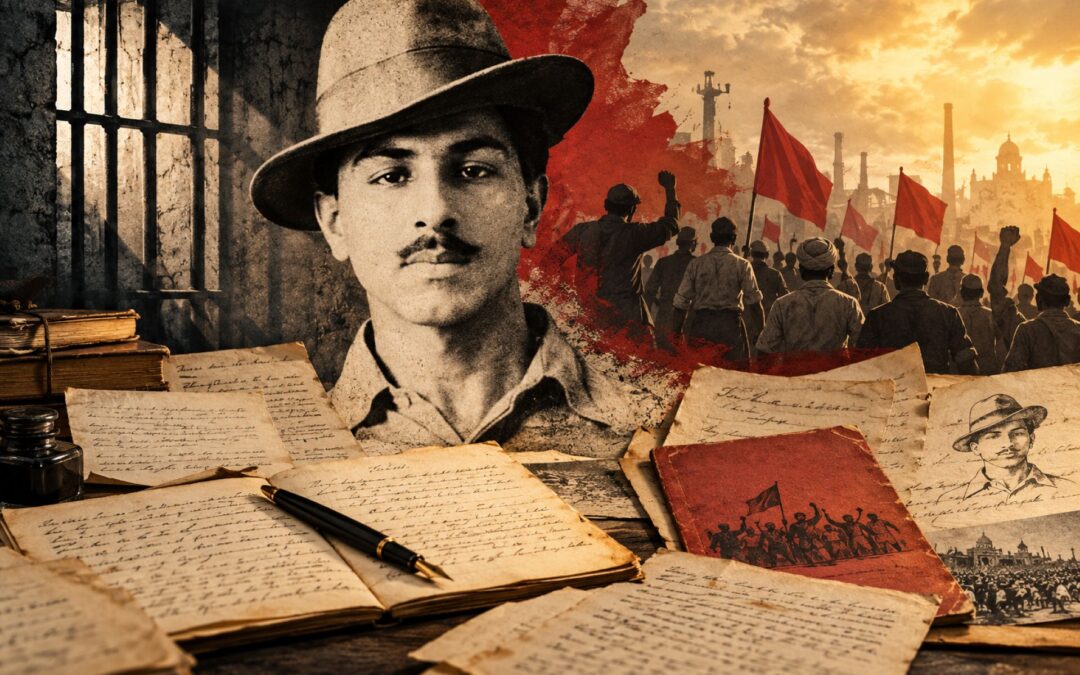
Bhagat Singh is remembered as one of the most influential revolutionaries of India’s independence movement. His participation in the killing of British police officer J. P. Saunders, the bombing of the Central Legislative Assembly, and his execution at the age of 23 established his place in Indian political memory. Yet the writings he left behind reveal a considerably more complicated figure: a revolutionary concerned with the meaning of political freedom, the organization of workers and peasants, the relationship between religion and reason, and the kind of society that should replace British colonial rule.
The Complete Writings of Bhagat Singh, published by Golden Deer Classics in 2019, brings together 23 selections encompassing essays, political declarations, letters, legal petitions, philosophical arguments, and revolutionary programs. The collection follows his development from early reflections on language and nationalism through his underground political activities and imprisonment to his increasingly systematic arguments for socialism and social reconstruction. It also preserves disagreements with friends and family that reveal the personal demands of his political convictions.
Despite its title, the collection does not contain every surviving writing by Bhagat Singh. It is best understood as a substantial selection of primary documents rather than an exhaustive scholarly edition. Its value lies in allowing readers to encounter his arguments directly, including their intellectual development, historical limitations, and unresolved contradictions.

Language, Literature, and the Babbar Akali Martyrs
The collection opens with The Problem of Punjab’s Language and Script, an essay written for a literary competition in 1923. Its subject initially appears remote from the revolutionary activities for which Bhagat Singh became famous. Instead of British repression or armed struggle, he addresses the relationship between literature, language, cultural identity, and the development of a nation.
Singh begins from the proposition that a society’s literature expresses its intellectual and moral consciousness. Political movements, he argues, cannot achieve durable results unless they create the cultural conditions that sustain collective action. Literature develops public awareness, supplies shared ideals, and prepares people to understand the political and social changes being demanded of them.
He supports this argument through examples drawn from European and Indian history. Giuseppe Mazzini’s contribution to Italian nationalism illustrates the importance of cultural preparation before political mobilization. The Irish language revival demonstrates how linguistic identity can become an instrument of resistance. Rousseau and Voltaire appear as intellectual precursors of the French Revolution, while Tolstoy, Marx, and Gorky are presented as writers whose contributions helped prepare the ground for revolutionary change in Russia.
These examples establish the essay’s governing assumption: political consciousness does not arise automatically from oppression. People need a language in which they can recognize their circumstances, communicate their aspirations, and imagine alternatives.
Singh then turns to the history of Punjab, particularly the role of Sikh religious literature. He discusses Guru Nanak’s emphasis on humility, Guru Tegh Bahadur’s association with defending the oppressed, and the martial spirit expressed in the writings associated with Guru Gobind Singh. The development of Gurmukhi and the compilation of Sikh scripture become examples of how literary traditions can preserve and transform a community’s identity.
He also considers the decline and revival of Sikh political power, arguing that bravery without a developing intellectual purpose cannot sustain a movement indefinitely. Military resistance may preserve a community temporarily, but literature must continue to articulate the social and political ideals toward which that resistance is directed.
The essay subsequently turns from historical examples to what Singh considers Punjab’s immediate cultural problem. Unlike regions where a provincial language has developed a broadly accepted literary identity, Punjab is divided among competing linguistic communities. Urdu is associated principally with Muslims, Hindi with sections of the Hindu population and the Arya Samaj, and Punjabi in Gurmukhi with Sikhs.
Singh regards this division as a serious obstacle to political unity. If communities organize their linguistic loyalties primarily around religious identities, he argues, they prevent the creation of a common public culture. The problem becomes especially urgent because national development requires communication among ordinary people, not simply agreement among educated political leaders.
His discussion, however, is far from an impartial assessment of the three traditions. He criticizes the Persian and Arabic influences on Urdu, questions the suitability of its script for expressing Indian names and concepts, and accuses sections of the Muslim community of cultural estrangement from India. He also criticizes Gurmukhi on linguistic and technical grounds, while presenting the Devanagari script as comparatively suitable for wider national communication.
These judgments are historically revealing but frequently sweeping and inadequately supported. The essay repeatedly associates cultural authenticity with proximity to particular Indian literary traditions, treating other influences as potential barriers to national identity. Its argument about linguistic unity therefore carries assumptions about religion and culture that deserve scrutiny rather than uncritical acceptance.
Singh nevertheless recognizes a practical distinction between the language of a future unified India and the language needed for political education in Punjab. He favors Hindi as a prospective common national language but acknowledges that Punjabi has a stronger immediate connection with the region’s population. Literature intended to awaken ordinary Punjabis, he argues, must employ a language that genuinely reaches them.
He illustrates the point with Punjabi verse whose emotional force, in his view, cannot be reproduced merely by substituting a language less familiar to its audience. His proposed solution involves developing Punjabi literary culture while bringing its script and vocabulary into closer alignment with Hindi. The desirability and linguistic soundness of that solution are debatable, but the political principle behind it is important: a mass movement cannot succeed if its language remains inaccessible to the masses.
The second selection, Blood Sprinkled on the Day of Holi: Babbar Akalis on the Crucifix, shifts from cultural argument to revolutionary commemoration. Written in response to the execution of six Babbar Akalis on February 27, 1926, it contrasts their deaths in Lahore Central Jail with the Holi celebrations taking place outside.
Singh is disturbed by the apparent indifference of the surrounding population. People continue celebrating while the bodies of executed revolutionaries are carried for cremation. His criticism is directed less toward the festival itself than toward a society that can overlook what he considers extraordinary political sacrifice.
The article then reconstructs the emergence of the Babbar Akali movement. It begins with the political atmosphere surrounding the Non-Cooperation and Akali movements, including resistance to colonial interference in Sikh religious institutions. Singh describes the activities of Master Mota Singh, who avoided arrest while continuing to organize and address political gatherings.
The repression of unarmed Akali protesters becomes an important turning point. Singh presents activists such as Kishan Singh Gargaj as men who concluded that peaceful resistance alone could not protect their communities against violence. The resulting armed movement began targeting people regarded as collaborators or supporters of colonial authority.
Singh describes disagreements within the revolutionary group about when and how force should be used. Some members favored caution and organization, while others sought immediate retaliation. This disagreement matters because the movement was not presented as having emerged with a universally agreed strategy.
The essay proceeds through accounts of armed encounters, betrayals, arrests, and deaths. Singh describes the confrontation near the Chaunta Sahib gurdwara, where several revolutionaries were surrounded by police and refused to surrender their weapons. He also recounts the death of Dhanna Singh, who, according to the essay, caused an explosion after being captured, killing himself and several police personnel.
Other incidents involve revolutionaries being trapped in houses, armed confrontations in villages, and the efforts of police informers to penetrate the movement. Figures such as Banta Singh, Variyam Singh, and Dilip Singh appear in accounts of individuals who abandoned ordinary criminal activities or conventional lives to join revolutionary resistance.
The narrative culminates in the trials and executions of the Babbar Akalis. Singh emphasizes their refusal to display fear and their willingness to accept severe punishment without expressing regret for their political commitments.
Although the essay supplies considerable historical detail, its purpose is commemorative and persuasive. The revolutionaries are described in heroic terms, while police officers, informers, and collaborators receive almost uniformly hostile treatment. Their actions are interpreted through the moral distinction Singh draws between resistance to oppression and service to an oppressive state.
The essay’s historical claims therefore require independent verification where precision matters. It remains valuable as evidence of how a young revolutionary understood an earlier militant movement and sought to preserve its memory. A separately documented version of the essay dates its publication to March 15, 1926, rather than the inconsistent 1925 date supplied in this edition’s editorial introduction.
Placed beside the language essay, the Babbar Akali account reveals two connected dimensions of Singh’s early thinking. Literature and historical memory can awaken public consciousness, while resistance requires courage, organization, and a population prepared to recognize the significance of political sacrifice.
Saunders, Sukhdev, and the Assembly Bomb Case
Beware, Ye Bureaucracy introduces the revolutionary movement with which Bhagat Singh became directly associated. Issued on December 18, 1928, under the name of the Hindustan Socialist Republican Army, the notice announces the killing of police officer J. P. Saunders as retaliation for the assault on Lala Lajpat Rai during protests against the Simon Commission.
Lajpat Rai had been injured during a police confrontation in Lahore and subsequently died. The revolutionaries attributed responsibility for his death to colonial police violence, and Saunders was killed in an operation intended to avenge him. The notice presents this act as a response to an insult inflicted upon the Indian nation.
Its language is deliberately confrontational. Colonial officials are warned that repression cannot extinguish the determination of young revolutionaries. Even restrictions on weapons, the notice argues, cannot prevent determined resistance from finding ways to retaliate against political humiliation.
Yet the document makes an important distinction between Saunders as an individual and the institution he represented. It expresses regret for the death of a human being while defending the killing as an act directed against British colonial authority. The document asserts that individual sacrifice may become unavoidable in a revolution intended to end exploitation.
This does not resolve the moral contradiction between respect for human life and deliberate political killing. Rather, it shows how the organization attempted to justify its actions through a distinction between personal hostility and institutional resistance. The notice is signed Balraj, a revolutionary name associated with the organization’s leadership, and should be understood as a collective political declaration rather than an intimate expression of Singh’s individual feelings.
The next document, Letter to Shaheed Sukhdev, offers a striking change of perspective. Written before the Central Legislative Assembly bombing, it addresses an accusation that Sukhdev had apparently made against Singh’s character.
Singh believes his friend has mistaken frankness and emotional vulnerability for weakness. He insists that possessing hopes, ambitions, and attachments does not make a revolutionary incapable of sacrifice. In fact, he argues that renouncing meaningful possibilities in life is what gives voluntary sacrifice its moral significance.
He also urges Sukhdev to continue revolutionary work carefully rather than rush toward dramatic action. Singh anticipates his own departure on a dangerous mission and recognizes that those remaining behind will have continuing responsibilities to the movement.
Much of the letter concerns love. Singh responds to Sukhdev’s question about whether romantic attachment can strengthen an individual, using Giuseppe Mazzini’s emotional experiences as an example. He argues that genuine love can sustain courage and help people endure disappointment without necessarily compromising their moral commitments.
His discussion also challenges the restrictive morality inherited from the Arya Samaj environment in which both men had developed. Revolutionary convictions, he suggests, are inconsistent with retaining unnecessarily harsh judgments about personal relationships. A person may embrace radical political ideas while continuing to treat ordinary human vulnerability with excessive severity.
Singh imagines an ideal state in which reason governs human conduct and love expands beyond attachment to one individual. Nevertheless, he recognizes that actual people live with emotional needs and limitations. He asks Sukhdev to show greater sympathy toward people who cannot meet impossibly severe standards of personal conduct.
The letter is valuable because it reveals a revolutionary trying to reconcile affection, personal fulfillment, self-discipline, and political obligation. It also makes clear that Singh’s willingness to risk death did not arise from indifference to life.
The Red Pamphlet returns to public revolutionary action. Distributed in connection with the bombing of the Central Legislative Assembly in Delhi on April 8, 1929, it explains why the Hindustan Socialist Republican Association had authorized the operation.
The immediate political circumstances involved proposed repressive legislation, including the Public Safety Bill and Trade Disputes Bill, alongside the arrests of labour leaders. Singh and his associates viewed the Assembly as an institution whose elected representatives possessed insufficient power to restrain colonial authority.
The pamphlet criticizes constitutional reforms that appeared to offer participation while preserving the government’s ability to impose its preferred measures. It presents the proposed legislation as another example of the subordination of Indian political institutions to imperial interests.
The decision to throw bombs into the Assembly is explained as an attempt to force public attention toward the government’s actions. The revolutionary organization intended the incident to expose the limitations of colonial constitutionalism and warn the population that significant political change could not be secured through legislative appearances alone.
The pamphlet also urges Indian representatives to return to their constituencies and prepare the population for a wider revolutionary struggle. Its audience extends beyond officials in the Assembly to ordinary Indians whose political consciousness the organization hoped to influence.
The declaration links the incident with an objective larger than national independence. The intended revolution is supposed to end the exploitation of human beings by other human beings. Its language combines immediate opposition to colonial policies with a developing socialist conception of political transformation.
The most detailed explanation appears in the Joint Statement of Bhagat Singh and B. K. Dutt in the Assembly Bomb Case. Here the two accused openly acknowledge throwing the bombs but challenge the prosecution’s interpretation of their intentions.
They argue that the action was designed as a political demonstration rather than an attempt to massacre legislators. Their defence emphasizes where the bombs landed, the comparatively limited injuries, and their decision to surrender instead of escaping.
The statement contends that the physical consequences of the explosions were consistent with deliberate restraint. Singh and Dutt dispute the prosecution’s suggestion that the absence of greater destruction was accidental. They maintain that they possessed opportunities to cause more serious harm but intentionally avoided doing so.
This is their account of the incident, not an independently established scientific conclusion about the devices. Nevertheless, it is central to understanding their political defence. The accused wanted the court and public to distinguish an intentionally limited demonstration from indiscriminate violence.
Their explanation then broadens into a criticism of the Legislative Assembly. They accuse the colonial government of disregarding representatives’ decisions, manipulating legislative procedures, and rendering elected participation largely ineffective.
The condition of workers receives particular emphasis. Singh and Dutt describe labourers who create society’s wealth yet experience poverty, deprivation, and political exclusion. They view the Trade Disputes legislation and the repression of labour organizations as evidence that the colonial state protects economic exploitation.
The statement’s argument about violence is carefully formulated but remains controversial. It condemns aggressive force as morally unjustifiable while claiming that force used for a legitimate cause can sometimes possess moral justification. The authors reject a political doctrine that excludes force under every conceivable circumstance.
They connect this position to a broader revolutionary history, invoking figures associated with struggles for national liberation and fundamental political change. Their intention is to place the Assembly action within a tradition of resistance rather than present it as an isolated act of aggression.
The statement subsequently defines revolution in social and economic terms. It describes peasants who produce food while remaining hungry, textile workers unable to clothe their families adequately, and artisans whose labour creates impressive buildings while they live in deprivation.
These examples identify exploitation as a structural feature of the existing order. Political authority and economic power are connected because the state protects arrangements through which producers are deprived of the full benefits of their work.
For Singh and Dutt, revolution therefore requires the reconstruction of society on socialist foundations. They envisage the political ascendancy of the working class, an end to the exploitation of nations and labouring populations, and a form of international cooperation capable of overcoming imperial competition.
Their willingness to accept punishment follows from this political objective. By surrendering, they transformed their own prosecution into another opportunity to circulate their ideas. The government could imprison or execute individual revolutionaries, they argued, but could not eliminate the underlying grievances and convictions that produced the movement.
The joint statement is one of the collection’s decisive documents because it clarifies the gap between the public visibility of revolutionary violence and the wider political program its participants claimed to represent. The Assembly explosion brought the accused before the country, but their written defence was intended to explain why the ultimate object of revolution could not be reduced to an explosion.
Prison Protest and the Political Uses of Trial
The next group of documents shows how Bhagat Singh and his comrades attempted to continue political struggle after imprisonment. Their attention shifted toward the treatment of political prisoners, the conduct of colonial courts, and the possibility of using legal proceedings to expose institutional injustice.
Hunger-strikers’ Demands, dated June 24, 1929, is a petition jointly signed by Singh and B. K. Dutt. After receiving sentences in the Assembly Bomb Case and being transferred from Delhi to other prisons, they protested against the deterioration in their treatment.
The petition demands food of a standard comparable to that provided to European prisoners. The writers clarify that they seek equivalent standards rather than identical meals, recognizing that dietary requirements may differ while insisting that racial distinctions should not determine the quality of treatment.
They also demand exemption from hard or degrading labour, access to books and writing materials, a daily newspaper, separate accommodation for political prisoners, toiletries, and adequate clothing. These are presented as reasonable conditions for people imprisoned because of political activity.
The document alleges particularly rough treatment during attempts at forced feeding. It reports that Singh temporarily lost consciousness after one such episode. The demand for an end to forced feeding indicates the physical risks and administrative coercion surrounding the hunger strike.
The authors define political prisoners broadly as those convicted of offences against the state, referring to earlier revolutionary conspiracy and sedition cases. Their argument is that political motive should have consequences for prison classification and treatment.
The following Letter to I.G. (Prisons), Punjab Mianwali Jail, dated June 17, 1929, concerns a different immediate problem. Singh objects to his transfer to Mianwali when proceedings in the Saunders case are approaching. The distance from Lahore obstructs communication with his relatives, consultation with lawyers, and preparation for the trial.
He asks to be transferred to Lahore Central Jail so that he can obtain the ordinary facilities necessary to defend himself. The letter is concise and procedural. Its significance lies in demonstrating that opposition to colonial rule did not automatically mean refusing every legal opportunity available within colonial institutions.
Although this letter precedes the hunger-strike petition chronologically, it appears after it in the collection. The arrangement reinforces the thematic association of prison grievances while making the publication order less strictly chronological than it first appears.
Message to Punjab Students’ Conference redirects attention from prison conditions to the responsibilities of young political workers. Singh and Dutt reject the idea that students should simply imitate the spectacular armed actions of imprisoned revolutionaries.
They argue that students face a more demanding political task: taking revolutionary ideas into factories, working-class neighbourhoods, and villages. Political independence, in their account, requires the mobilization of people whose material conditions expose them directly to exploitation.
The message connects youth activism with the larger independence struggle being prepared by the Indian National Congress. It urges students to awaken political consciousness across Punjab, which the authors describe as comparatively backward in political organization.
The memory of Jatindra Nath Das, who died during a prison hunger strike, serves as an example of sacrifice. Yet the work recommended to students is sustained political education. The contrast between heroic memory and practical organizing is important because it complicates the assumption that Singh wanted young people primarily to take up weapons.
The longest personal document in this part of the collection is Letter to Sukhdev Regarding Suicide. Written in response to Sukhdev’s reported thoughts about ending his life if condemned to prolonged imprisonment, it combines an intimate disagreement with reflections on revolutionary responsibility.
Singh begins by recognizing that imprisonment has affected the two friends differently. Their opinions about personal love have changed, and positions they previously held with confidence have become less secure under the pressures of confinement.
He recalls an earlier conversation in which Sukhdev had rejected suicide while Singh had entertained the possibility that it might be justified in exceptional circumstances. Their positions have now reversed. Singh firmly opposes suicide in the situation Sukhdev describes.
His central distinction concerns the purpose of death. A revolutionary who accepts the foreseeable risk of dying during a political struggle, he argues, is different from someone who deliberately ends his life to escape the suffering resulting from that struggle.
He uses their Assembly action and subsequent imprisonment to illustrate the distinction. They deliberately exposed themselves to punishment because they regarded the political demonstration as justified. To abandon the struggle because the consequences proved severe would, in Singh’s reasoning, undermine the responsibility they had voluntarily assumed.
The hunger strike provides another example. Singh argues that the prisoners accepted the possibility of death while fighting to improve conditions. He contrasts such a death with an attempt to escape hardship through suicide.
His reasoning is severe and should be understood as a historically situated appeal to a particular comrade rather than an authoritative moral judgment about suicide generally. The letter gives little weight to forms of psychological suffering that may exceed an individual’s ability to endure, because its immediate concern is preserving what Singh regards as revolutionary commitment.
The discussion then expands to literature and personal development. Singh recalls their admiration for Russian realist writing, especially its depictions of suffering, moral struggle, and human endurance. He suggests that meaningful literary understanding requires some recognition of the experiences that produce such characters.
He also regards imprisonment as an opportunity to examine the social problems of punishment, crime, and justice through direct experience. The prisoner’s suffering becomes connected to a larger responsibility to seek changes in prison conditions.
Singh rejects the argument that struggle is useless merely because success appears unlikely. He reminds Sukhdev that revolutionary work outside prison had also faced enormous obstacles. If the movement had abandoned its activities whenever circumstances became unfavourable, it would never have begun.
He then develops a historical argument about socialism. Political ideas, he suggests, do not originate solely in the minds of exceptional individuals. Marx and other socialist thinkers emerged from economic and social circumstances that made particular questions increasingly urgent.
The same principle applies to Indian revolutionaries. Singh does not believe that he and his comrades personally invented socialist ideas in India. They have been shaped by changing conditions and have contributed to a broader historical process.
This reduces the significance of individual personalities while preserving their responsibility to act. A movement depends on people who persist through difficulties, but its existence cannot be attributed entirely to any one of them.
Toward the end, Singh reflects upon his own likely execution. He anticipates little possibility of clemency but still regards organized appeals for the prisoners’ release as politically legitimate. He does not want the fate of individual revolutionaries to obstruct an honourable settlement that might benefit the wider struggle.
The letter thus contains a tension between the value of personal life and the perceived political significance of sacrifice. Singh insists that life should be used as fully as possible for humanity, even as he anticipates that his own death may acquire a public meaning beyond his control.
Reasons for Refusing to Attend the Court explains a more immediate form of protest. Singh and his co-accused challenge the restrictions imposed on their ability to prepare a legal defence.
They describe difficulties meeting supporters and authorized representatives, obstacles in obtaining legal assistance, and the imprisonment of a person involved in organizing their defence. Singh also objects to limitations on the presence of trusted observers during court proceedings.
Access to newspapers becomes another grievance. The prisoners want publications in languages accessible to all the accused, not merely English-language newspapers. In protest against unequal access, they refuse even the English newspaper made available to them.
The document explicitly rejects the suggestion that they have boycotted every British court. They continue participating in other proceedings. Their refusal concerns particular circumstances in which, they argue, the tribunal’s conduct makes proper defence impossible.
Telegram on Lenin’s Death Anniversary is much shorter but supplies a clear political statement. It sends greetings to those carrying forward Lenin’s ideas, expresses support for revolutionary developments in Russia, and identifies with the international working-class movement.
Its importance is greater than its length. The message places the imprisoned Indian revolutionaries within a political struggle extending beyond British India. Opposition to imperialism is connected with opposition to capitalism and solidarity among workers internationally.
Hunger-Strikers’ Demands Reiterated, dated January 28, 1930, is the most detailed administrative protest in the collection. Singh, Dutt, and other prisoners argue that the authorities have failed to honour assurances given after earlier hunger strikes.
The document recounts how prisoners suspended their protest following the appointment of committees and public assurances that their treatment would be reconsidered. The death of Jatindra Nath Das had attracted substantial public attention, and government representatives indicated that reforms would be examined.
According to the petition, the promised changes failed to materialize while punitive treatment continued. The writers describe reductions in prisoners’ remission, solitary confinement, restrictions on correspondence and interviews, withdrawal of privileges, and reports of deteriorating health.
Several named cases are used to substantiate these allegations. B. K. Banerji and Baba Sohan Singh are described as losing remission because of participation in hunger strikes. Sachindra Nath Sanyal and others are said to have experienced disciplinary punishment. The petition also recounts alleged assaults on Lahore Conspiracy Case prisoners and the use of handcuffs and chains on undertrial prisoners.
These cases give the document a specificity absent from general denunciations of colonial oppression. It identifies administrative decisions, dates, institutions, and individuals whose treatment the authors considered unjust.
The petition then examines the principles used to classify prisoners. The authorities are criticized for emphasizing the formal nature of offences and the social status of offenders while excluding political motive.
Singh and his co-signatories argue that motive matters when judging actions. They distinguish crimes committed for personal gain from acts performed for political or allegedly selfless purposes, even when both involve violence.
Their position is not that political motivation makes every action morally acceptable. Rather, they insist that the penal system should recognize meaningful differences between categories of offenders instead of treating political prisoners according to social rank or ordinary criminal classifications alone.
They accept that distinctions may be made within the category of political prisoners, including distinctions involving violent offences. What they reject is a system that ignores political purpose while privileging wealth and social standing.
The practical demands remain consistent: exemption from degrading labour, the ability to study, access to newspapers, opportunities for prisoners to remain together, and permission to supplement food and clothing at their own expense. The petition ends by warning that the hunger strike will resume unless the government acts.
The final document in this group, Regarding the LCC Ordinance, concerns the extraordinary legal arrangements imposed during the Lahore Conspiracy Case. Addressed to the Governor-General in May 1930, it protests the government’s attempt to justify a special tribunal by blaming delays on the accused.
Singh and his comrades distinguish the hunger strikes from attempts to obstruct the trial. The prison protests began over conditions of confinement and continued because official assurances were allegedly ignored. Jatindra Nath Das, they argue, did not die merely to delay courtroom proceedings.
The creation of extraordinary judicial procedures is interpreted as an admission that the existing legal system cannot conduct the prosecution while preserving ordinary rights of defence. Instead of simply lamenting the ordinance, the prisoners welcome it ironically as proof of the government’s political intentions.
This is a revealing conclusion to the prison sequence. The accused repeatedly demand access to lawful procedures, yet when the government restricts those procedures, they interpret the restriction as evidence of colonial injustice. Even defeat within the courtroom can become material for a political argument addressed to the public.
Books, Family, Atheism, and the Socialist Program
Letter to Jaidev Gupta, dated July 24, 1930, provides one of the simplest and most revealing glimpses of Bhagat Singh’s intellectual life. Writing from Lahore Central Jail, he asks his friend to obtain a collection of books from local libraries.
The requested titles cover militarism, war, socialism, political economy, revolutionary theory, anarchism, agriculture, and fiction. Authors include Karl Liebknecht, Bertrand Russell, Karl Marx, Peter Kropotkin, Nikolai Bukharin, and Upton Sinclair, alongside writings associated with Lenin and the Russian revolutionary movement.
The range is significant because Singh’s interests extend beyond the literature of armed insurrection. He wants to understand economic systems, social organization, material conditions, and competing accounts of political transformation.
The letter also asks for books to be supplied to prisoners in Borstal Jail, who are described as suffering from a serious shortage of reading material. Singh requests assistance for another prisoner’s study of agrarian conditions and sends greetings to friends.
The document should not be used to infer that Singh had fully read every requested work or accepted every argument contained in them. It does, however, demonstrate how central reading and intellectual exchange had become to his understanding of revolutionary work.
Justice Hilton Must Also Go returns to the conduct of the Lahore Conspiracy Case tribunal. The dispute concerns an order to handcuff the accused, issued under the presidency of Justice Coldstream.
One judge, Agha Haider, had dissociated himself from the order. Singh and Dutt subsequently refused to attend the proceedings unless the responsible tribunal acknowledged the injustice or its leadership was changed appropriately.
When judges were replaced, however, Justice Hilton, who had participated in the disputed decision, became presiding judge. The prisoners regarded this as an evasion rather than a correction of the original wrong.
Their letter emphasizes that the objection is directed toward the decision and the institutional responsibility behind it, not personal hostility toward Coldstream or Hilton. Replacing one judge with another who supported the same order does not resolve the grievance.
The argument reflects a recurring feature of Singh’s legal correspondence: procedural rights must possess real substance rather than be satisfied through superficial administrative changes.
Letter to Father, written in October 1930, shifts the conflict from colonial institutions to Singh’s own family. He has learned that his father, Kishan Singh, submitted a petition seeking to defend him in the Saunders case.
Singh reacts with unusual anger. He acknowledges the sincerity of his father’s political commitments and the understandable affection motivating the intervention, but insists that the petition was submitted without his consent and contrary to his settled position.
His argument rests upon the political character of the trial. Singh believes the accused have adopted a collective strategy that places the revolutionary cause above individual attempts to escape punishment. A personal defence inconsistent with that strategy could weaken its public significance.
He explains that political defendants may sometimes defend themselves, but their decisions should arise from the interests of the movement rather than the desire to preserve their own lives at any cost. In his own case, he has chosen to demonstrate indifference toward the personal consequences of conviction.
Singh also worries about the effect of his father’s action on other prisoners. His comrades might assume that he has abandoned their collective position or secretly authorized an attempt to secure special treatment.
He therefore asks his father to publish the letter. The disagreement is no longer simply private; it concerns Singh’s political reputation and his responsibility to the other accused.
The severity of his language is striking. He considers the intervention a grave failure of judgment, even while refusing to equate his father’s conduct with deliberate betrayal. The letter concludes affectionately, preserving the personal relationship beneath the political confrontation.
Why I Am an Atheist is the collection’s most substantial philosophical essay. Written under the shadow of a possible death sentence, it responds to the accusation that Singh’s disbelief in God arises from arrogance.
He begins by acknowledging that he is capable of vanity. Friends have described him as domineering or excessively confident in his opinions, and he does not pretend to be free of such weaknesses.
Nevertheless, he challenges the logic connecting personal pride with atheism. A vain person might imagine himself superior to others or even claim divine authority, but neither possibility explains genuine disbelief in the existence of God.
Singh then provides an intellectual autobiography intended to demonstrate that his atheism developed before public recognition made personal vanity a plausible explanation.
His grandfather was an orthodox Arya Samajist, and his early education included regular religious practice. At DAV School in Lahore, Singh recited the Gayatri Mantra and participated in prayers. His father was more liberal in religious matters but remained a believer and encouraged religious observance.
At National College, Singh began questioning religious doctrines more seriously. Yet he was still not an atheist. His rejection of religious mythology developed before his rejection of belief in a supreme being.
His early revolutionary associates also demonstrate that political radicalism did not necessarily involve atheism. Sachindra Nath Sanyal, for example, maintained deeply religious convictions, and several revolutionaries associated with the Kakori movement remained committed to prayer.
This background matters because Singh rejects the assumption that atheism was an unquestioned doctrine of his revolutionary organization. He arrived at it through a process of intellectual disagreement within a political environment that included believers.
A turning point came when setbacks threatened the revolutionary movement’s survival. Singh concluded that enthusiasm and admiration for earlier acts of defiance were insufficient. Political convictions needed a rational foundation capable of withstanding criticism.
He began studying revolutionary history and political philosophy more systematically. His reading included anarchist and socialist thinkers such as Bakunin, Marx, Lenin, and Trotsky. These works helped him replace what he describes as an earlier romantic attitude toward revolution with a more definite political and philosophical outlook.
By the end of 1926, he says, he had become convinced that the belief in an all-powerful conscious creator could not be sustained. His disbelief was therefore established before the trials that made him widely known.
He recounts a further test during his arrest in May 1927. Police officials allegedly pressured him to disclose information about revolutionary activities and threatened serious charges if he refused. Some also encouraged him to pray.
Singh describes confronting the possibility that his atheism might disappear when he became frightened. He decided that he could not sincerely believe in God merely because religious belief might offer protection or consolation.
For him, maintaining disbelief under pressure demonstrated the seriousness of his conviction. He recognizes that believers may derive genuine comfort from religion, but considers it intellectually dishonest to adopt a belief only because it makes suffering easier to endure.
The essay then moves from autobiography to an argument about critical thinking. Singh objects to the assumption that respected leaders, religious authorities, or inherited doctrines should be protected from scrutiny.
A society that treats disagreement with prominent figures as arrogance, he argues, risks intellectual stagnation. Progress requires the willingness to examine received beliefs, identify weaknesses, and revise conclusions.
He acknowledges that reasoning can be mistaken. His defence of reason does not depend upon the claim that everyone who questions tradition will necessarily arrive at the truth. Rather, reason is valuable because arguments can be examined and corrected.
With this principle established, Singh turns to the existence of God. His central objection concerns the relationship between divine power and human suffering.
If an omnipotent and benevolent creator governs the universe, he asks, why does the world contain extreme misery, exploitation, violence, hunger, and injustice? Why would such a being create circumstances in which people endure suffering that appears neither necessary nor deserved?
He rejects the claim that suffering can be justified by a reward in the afterlife. For Singh, promising compensation after death does not explain why an all-powerful being would permit the original harm.
He also challenges explanations based on karma and rebirth. If poverty, disability, or oppression are interpreted as punishments for actions in previous lives, such doctrines can make existing inequalities appear morally deserved.
To expose the difficulty, he imagines a child born into poverty and a community subjected to caste discrimination. The child may be denied education, opportunities, and social respect through circumstances beyond personal control. Treating these disadvantages as punishment for unknown previous actions, Singh argues, obscures the responsibilities of the society producing them.
He then examines punishment itself. A defensible system of punishment should, in his view, aim at reforming offenders rather than imposing suffering for its own sake. Punishments attributed to karma appear especially irrational when the person supposedly being punished cannot remember the original offence or learn from it.
This objection connects the philosophical discussion with the political argument running throughout the collection. Religious doctrines become dangerous when they are used to excuse poverty, social hierarchy, and exploitation instead of encouraging people to change the conditions responsible for them.
Singh also challenges divine explanations of colonial domination. British authority in India, he argues, rests upon material instruments of power, including weapons, police, prisons, and the population’s inability to resist effectively. Explaining colonial rule as divine will conceals the actual political relationships sustaining it.
He offers naturalistic explanations of the universe and living organisms, drawing upon the scientific ideas available to him. His understanding of scientific questions reflects the intellectual circumstances of his time and should not be treated as a comprehensive or always accurate account of modern science.
The essay also attempts to explain why religious beliefs arose. Singh suggests that human beings developed ideas of divine assistance in response to fear, uncertainty, limited knowledge, and the need for emotional reassurance.
Importantly, he does not claim that religion originated solely as a deliberate invention of ruling classes. He recognizes that belief may have fulfilled genuine psychological and social functions while arguing that religious institutions subsequently became associated with political and economic power.
The conclusion returns to his approaching execution. Singh expects no supernatural reward and no continued personal existence after death. He regards the struggle he has undertaken as sufficient justification for his life.
He refuses to pray simply because death is approaching. Such a change would, in his understanding, contradict the intellectual independence he has spent the essay defending.
Letter to B. K. Dutt, written after the death sentence, presents a different aspect of the same situation. Singh knows that he faces execution while Dutt must endure life imprisonment.
He tells Dutt that revolutionaries have responsibilities in both circumstances. Those sentenced to death may demonstrate their willingness to sacrifice themselves, but those who survive must demonstrate the ability to endure confinement without abandoning their convictions.
This is a demanding message to send someone facing prolonged imprisonment. It reflects Singh’s belief that political commitment should not depend entirely upon the possibility of heroic death. Continued suffering and survival may require a different kind of courage.
The collection’s most systematic political program appears in To Young Political Workers, dated February 2, 1931. Addressed to young activists during a period of negotiations over constitutional reform, the document explains Singh’s assessment of the independence movement and the organization he believes necessary for socialist revolution.
He begins with the subject of compromise. Revolutionary rhetoric often treats compromise as betrayal, but Singh considers it an unavoidable feature of political struggle.
He uses Russian revolutionary history to illustrate the argument. Lenin’s changing positions on participation in the Duma and the Bolsheviks’ acceptance of the Treaty of Brest-Litovsk are presented as examples of tactical decisions made under particular political circumstances.
The principle is that partial concessions can be accepted without abandoning the final objective. A revolutionary movement must understand what it is attempting to achieve and judge each compromise according to whether it improves or undermines its prospects.
Singh distinguishes tactical flexibility from ideological surrender. Compromise becomes dangerous when a movement accepts limited reforms as the final goal and dissolves the organization needed to pursue more fundamental change.
He then criticizes the existing Indian independence leadership. In his assessment, much of the movement depends upon middle-class groups and property-owning interests unwilling to mobilize workers and peasants for a thorough social transformation.
These leaders may demand greater political rights or administrative participation, he argues, while fearing the consequences of awakening social forces that could challenge their own economic privileges.
His criticism is directed particularly toward the assumption that national independence will automatically benefit every section of Indian society. A change in the nationality of rulers may leave economic exploitation intact.
The central political question is therefore who will exercise power after independence and whose interests the new government will serve.
Singh defines the immediate revolutionary objective as gaining political authority and the ultimate objective as reconstructing society on socialist foundations. He understands the state as an instrument through which ruling classes protect their interests. Revolutionaries must transform political power so that it can be used for social and economic reconstruction.
This argument leads to an examination of constitutional reform. Singh proposes three broad criteria for judging any settlement: the extent of power transferred to Indians, the democratic character of the institutions created, and the safeguards or possibilities for further development.
He places particular emphasis on executive accountability. A legislature cannot exercise meaningful authority if the executive remains independent of its decisions and the colonial government retains overriding powers.
He also advocates universal adult suffrage, explicitly including both men and women. Property qualifications for voting are inconsistent with the political participation required by a revolutionary democratic movement.
Provincial autonomy receives similar scrutiny. If governors retain extensive powers over elected institutions, the constitutional arrangement may provide the appearance of self-government without its substance.
Singh then considers the forces required for more comprehensive change. Workers and peasants, he argues, cannot be mobilized through patriotic sentiment alone. They must understand how the proposed revolution will improve their material conditions.
A labourer or peasant may reasonably ask what difference independence will make if economic power remains concentrated in the hands of landlords and capitalists. The movement must answer that question through a genuine program of social transformation.
The proposed organization begins with disciplined, full-time political workers. Singh believes revolution requires preparation over many years, not simply enthusiasm during a moment of national agitation.
Youth organizations should provide political education through study circles, lectures, publications, and discussion. Activists who develop sufficient understanding and commitment can then enter a disciplined political party capable of sustained work.
The party should organize among industrial labourers and peasants, establish connections with trade unions and related movements, and circulate accessible literature explaining socialist ideas.
Singh considers this educational work indispensable. Revolutionary movements cannot rely entirely on clandestine networks or isolated spectacular actions when ordinary people neither understand nor support their objectives.
He also discusses the limited place of an armed component within revolutionary organization. He does not declare bombs and weapons inherently useless, but strongly rejects the belief that isolated acts of violence can produce the desired social transformation.
Any military organization, in his proposed framework, must remain subordinate to a larger political movement and cannot substitute for its organizational and educational functions.
The document ends by rejecting impatient expectations of immediate revolution. Singh anticipates years of preparation, setbacks, discipline, study, and sustained political work.
Its conclusion is especially significant given his approaching execution. He describes revolution as a long collective project requiring the lives and labour of committed people, even as his own remaining time is extremely limited.
The Last Political Interventions and the Dreamland Critique
Regarding Line of Defence in Hari Kishan’s Case concerns a revolutionary attack on the Punjab governor in December 1930. Hari Kishan had fired at the governor during an event in Lahore; the governor survived with injuries, while another person was killed.
Singh examines the legal strategy adopted by Hari Kishan’s defence. He objects particularly to the claim that the revolutionary intended only to issue a warning rather than kill the governor.
He believes this argument misrepresents the political purpose of the action without offering a convincing legal advantage. In his view, portraying an attempted assassination as a harmless demonstration undermines the credibility of the revolutionary movement.
His concern is principally political. An accused revolutionary should not allow legal strategy to erase the motive that originally gave the action its significance. The individual defendant matters, but the defendant’s interests must be considered alongside the movement’s purpose.
Singh describes certain revolutionary actions as attempts to influence public consciousness through deeds. Such acts, he argues, can create a political atmosphere and draw attention to a larger struggle.
Yet he explicitly states that the death of an individual is not valuable for its own sake. His concern is how an action affects wider political organization and public understanding.
The letter contains a significant qualification. Singh does not advocate sacrificing Hari Kishan simply to preserve an image of revolutionary courage. He insists that an appeal should be filed and that every possible effort should be made to save his life.
His position is therefore neither unconditional legal self-defence nor a categorical refusal to defend political defendants. Defence is justified when it can preserve life without destroying what he considers the political meaning of the action.
He also criticizes lawyers who appear more concerned with professional interests than the responsibilities of representing political prisoners. The integrity of revolutionary defendants, in his view, should not become an opportunity for personal advantage.
The document’s surviving text includes an indication that some words are missing. It also refers to earlier correspondence not reproduced here. These limitations prevent a complete reconstruction of every exchange surrounding the Hari Kishan defence.
The essay’s association with a June 1931 publication must not be mistaken for evidence that Singh wrote it after his execution. It belongs to his final period of imprisonment and was subsequently published.
Last Petition turns from another revolutionary’s fate to the impending execution of Singh and his comrades. Addressed to the Punjab governor, the petition adopts the legal language used by the court against the accused.
The Lahore Conspiracy Case tribunal had found them guilty of waging war against the British Crown. Singh’s petition takes this characterization seriously and argues that the accused should consequently be treated as prisoners of war.
This is a deliberate argumentative reversal. By describing the revolutionaries as participants in a war, the colonial authorities have supplied language through which their prisoners can challenge the legitimacy of ordinary criminal punishment.
The petition then defines the conflict much more broadly than an armed dispute between British officials and Indian nationalists. The struggle, it argues, will continue wherever Indian workers and natural resources remain subject to exploitation.
It makes little difference whether the exploiters are British, Indian, or a combination of both. A political settlement that transfers authority without changing exploitative economic relationships would leave the underlying conflict unresolved.
Singh also refuses to identify the revolutionary struggle exclusively with the actions of his own generation. Earlier sacrifices contributed to it, and future participants will continue it. Individual deaths belong to a historical process larger than any single person.
The document requests execution by firing squad rather than hanging, presenting this as the treatment appropriate to prisoners of war. It is not a conventional plea for forgiveness or a declaration of personal innocence.
Its argument depends upon challenging the meaning of the legal charge. If the state insists that the accused are enemies engaged in war, Singh demands that it confront the political implications of that description.
The collection concludes with Introduction to Dreamland, an extended discussion of Lala Ram Saran Das’s revolutionary poem The Dreamland. The text was written as a requested introduction, but Singh acknowledges that he disagrees with important aspects of the work.
Rather than offering conventional praise, he approaches the poem as a political thinker evaluating another revolutionary’s vision of the future. He does not claim special competence in literary metre or technical criticism, and he deliberately limits his assessment to matters of political and philosophical significance.
Singh begins by identifying a weakness in many revolutionary movements. They know which government or institution they wish to overthrow, but possess comparatively little understanding of the society they intend to establish afterward.
He distinguishes resistance to existing rulers from the constructive task of political transformation. In his definition, revolution requires systematic reconstruction on new social foundations, not simply an uprising or the replacement of one administration by another.
The poem matters because Ram Saran Das attempts to imagine that reconstructed society. His experience in the revolutionary movement and prolonged imprisonment gives the work a particular historical significance.
Singh explains that Ram Saran Das had received a death sentence later commuted to life imprisonment. The poet endured years of confinement, emotional pressure, and separation from family.
These experiences help explain the poem’s religious and metaphysical language. Singh recognizes that the author turned toward spiritual consolation while struggling against despair.
Their philosophical differences are substantial. Ram Saran Das approaches the universe through religious and metaphysical assumptions, while Singh identifies his own position as materialist and concerned with causal explanation.
He disagrees with the idea that the world is merely an illusion or dream. Nevertheless, he does not dismiss the poem because of its mysticism. The religious language belongs to the author’s experience and to the historical outlook of an earlier generation of revolutionaries.
Singh then examines the social institutions imagined in The Dreamland. Free education receives his approval because education should be available to all members of society rather than determined by wealth.
He also supports the rejection of social hierarchies that treat intellectual work as inherently superior to manual labour. A socialist society, in his understanding, requires a different relationship between productive work, education, and social respect.
The poem’s treatment of crime and punishment receives especially favourable attention. Drawing upon the author’s experience of imprisonment, it imagines a system based upon reform rather than revenge.
Singh argues that prisons should help offenders return to society instead of functioning primarily as institutions of degradation and suffering. He links this conception of justice with the broader social changes necessary to reduce the conditions producing crime.
The discussion then extends to warfare. Singh anticipates a future society in which the economic and political causes of imperialist conflict have been overcome. He nevertheless recognizes that armed forces may remain necessary during a transition from capitalism to socialism.
His argument reflects the revolutionary circumstances and assumptions of his time. He distinguishes military conflict intended to preserve exploitation from struggles he considers necessary to defend or establish a socialist order.
International organization receives attention as well. Singh approves of the idea of a world federation and criticizes political arrangements that claim to preserve peace while leaving competing imperial interests intact.
One of his most important disagreements concerns the methods by which a new social order can emerge. Ram Saran Das emphasizes gradual development and education rather than the imposition of socialism through violent upheaval.
Singh agrees that socialist relationships cannot simply be created through physical destruction. People must learn new forms of social cooperation, and institutions must develop through sustained constructive work.
He nevertheless argues that existing governments are unlikely to permit unrestricted socialist transformation when it threatens their economic foundations. Consequently, revolutionaries must obtain political authority before they can organize reconstruction on the necessary scale.
In this conception, education and institutional development supply the constructive substance of revolution, while the struggle for political power creates the conditions under which those activities can proceed.
The introduction ends with an unusually clear statement of intellectual independence. Singh recommends the poem to young readers but warns them against treating it as unquestionable doctrine. They should examine its claims critically and formulate their own positions.
That conclusion is particularly appropriate for a collection containing writings from different periods and political circumstances. Its final selection presents a revolutionary who respects another person’s work while openly disagreeing with its philosophy and inviting readers to exercise the same freedom of judgment.
What Bhagat Singh Means by Revolution and Socialism
The meaning of revolution changes considerably across Bhagat Singh’s writings. His early essays emphasize cultural awakening, national honour, and the courage of people resisting colonial authority. His later work increasingly defines revolution through economic exploitation, organized political power, class relations, and the reconstruction of society.
This development does not mean that his early concerns disappear. Rather, they become part of a wider explanation of what political liberation requires.
The language essay treats collective consciousness as a prerequisite for national progress. Its central concern is that people divided by linguistic and religious attachments cannot communicate effectively or develop the literary culture required for political unity.
The Babbar Akali essay places greater emphasis on resistance to oppression. The courage of the revolutionaries matters because they refuse to accept humiliation and violence as permanent conditions of political life.
By the time of the Assembly Bomb Case, Singh’s argument has moved beyond national resistance as an end in itself. The joint statement identifies the exploitation of workers and peasants as a fundamental injustice requiring transformation.
This distinction is crucial. A country may become politically independent while retaining economic arrangements in which landlords, industrial employers, and privileged classes dominate those whose labour sustains society.
In such circumstances, national sovereignty does not necessarily produce social freedom. Political authority may change hands while the material relationships shaping everyday life remain substantially unchanged.
Singh’s later socialism therefore challenges the assumption that the nationality of a ruling class determines whether its rule is just. British capitalists, Indian capitalists, or coalitions of both may benefit from exploitation. What matters is the relationship between economic power and those who produce society’s wealth.
The Assembly statement illustrates this position through occupations and living conditions. Peasants grow food yet experience hunger; weavers produce textiles yet lack adequate clothing; workers build substantial homes for others while living in poverty themselves.
These examples are not elaborate economic demonstrations, but they clarify Singh’s moral and political diagnosis. Those responsible for production lack control over the resources and institutions governing their lives.
The concept of the proletariat becomes important in this context. In socialist political theory, the term refers principally to workers whose economic position depends upon selling their labour. Singh frequently connects their interests with those of peasants, recognizing both groups as essential to revolutionary change in India.
The significance of these classes is political as well as economic. Singh regards them as forces capable of sustaining a movement whose objectives extend beyond the constitutional demands of elites.
In To Young Political Workers, this argument becomes an explicit criticism of the existing nationalist leadership. Singh believes that middle-class and property-owning politicians may hesitate to mobilize workers and peasants because the resulting movement could challenge their own social position.
His analysis should be understood as a partisan interpretation, not an uncontested description of every nationalist leader or movement. Nevertheless, it exposes a question that any independence struggle must confront: whether political freedom is intended primarily to alter the composition of government or to transform the conditions of the population.
Singh’s proposed answer requires a socialist revolution. He distinguishes the immediate achievement of political authority from the ultimate reconstruction of economic and social relationships.
Political power is necessary because the state protects existing property arrangements, maintains administrative institutions, and possesses the means to enforce its decisions. A revolutionary movement that cannot influence or transform state power may struggle to implement its social objectives.
Yet political power is not sufficient. Once obtained, it must be used to develop new institutions, educate the population, and reorganize society on principles that reduce or eliminate exploitation.
This explains his insistence on preparation. Revolutionary change cannot be secured simply by announcing a political program or provoking a dramatic confrontation. The population must understand the proposed transformation and develop the organization necessary to sustain it.
Singh places particular importance on students and young workers because they can participate in long-term political education. Study circles, political publications, public discussions, and organizational training are intended to create people capable of understanding and communicating revolutionary ideas.
He also believes that workers and peasants must be approached according to their actual circumstances. Patriotic appeals cannot replace explanations of how political change will affect wages, agricultural conditions, property, and social power.
The class-based nature of the program introduces difficult questions about political leadership. Singh advocates mass mobilization but also proposes a disciplined revolutionary party of committed workers. Its relationship with the broader population is therefore both educational and directive.
His confidence in a tightly organized political vanguard reflects the influence of contemporary revolutionary socialism. It also raises questions about internal disagreement, popular consent, and the concentration of authority that his short program does not fully resolve.
His defence of compromise adds an important corrective to any picture of revolutionary politics as simple absolutism. Lenin’s tactical decisions serve as examples of maintaining a long-term objective while accepting temporary limitations.
The purpose of compromise is to preserve or strengthen the movement’s ability to act. Singh objects to compromises that transform partial concessions into final objectives, but he does not reject negotiation as inherently dishonourable.
The distinction between means and ends extends to his understanding of political institutions. Universal adult suffrage, accountable executives, and meaningful legislative authority are important measures of constitutional reform.
He treats these rights as necessary stages in political development while arguing that parliamentary reforms alone cannot deliver the socialist transformation he seeks.
The closing Introduction to Dreamland reveals the constructive aspirations behind these arguments. Free education, social equality, reformative justice, and international cooperation are examples of institutions that might characterize a society organized differently from colonial capitalism.
There remains a tension between democratic participation, revolutionary party leadership, and his support for the political ascendancy of the proletariat. The collection articulates the objectives more fully than it explains how all of these political principles would coexist in practice.
Nevertheless, the writings offer a coherent answer to the question of what revolution should accomplish. Singh increasingly envisages a change in political authority that enables a much wider transformation of society. His concern is not exhausted by obtaining independence from Britain; it includes examining whose freedom independence would actually secure.
Violence, Nonviolence, and Revolutionary Sacrifice
Bhagat Singh’s reputation is closely associated with revolutionary violence, but his writings offer neither an uncomplicated celebration of armed action nor a categorical rejection of it. They show repeated attempts to distinguish between personal revenge, political demonstration, organized struggle, and the use of force in pursuit of social transformation.
The Babbar Akali essay presents armed resistance through the experience of people who believed peaceful protesters were being attacked without adequate protection. Singh describes their actions sympathetically and emphasizes the courage required to confront colonial police forces.
The essay does not, however, provide a sustained moral examination of every act attributed to the movement. Its commemorative purpose encourages the reader to admire sacrifice, leaving relatively little room to consider the wider consequences of particular attacks or the position of those who became their victims.
Beware, Ye Bureaucracy makes the moral tension explicit. It expresses regret for Saunders’s death while defending the killing as a revolutionary response to state violence.
The notice attempts to separate personal worth from institutional responsibility. Saunders is presented as a representative of colonial authority, and the organization claims that the political importance of resistance outweighs the tragedy of an individual death.
This reasoning is controversial because institutional responsibility does not automatically settle the moral question of deliberately killing an individual. The document explains the revolutionaries’ justification without conclusively establishing it.
The Assembly statements formulate a more developed distinction. Singh and Dutt insist that their action was designed to attract attention rather than kill legislators. They argue that the limited physical consequences were intentional and that surrender formed part of the political demonstration.
Their public purpose was to expose the inadequacy of colonial institutions and provide a platform for explaining socialist revolutionary objectives.
The act nevertheless depended upon the threat and reality of an explosion in an occupied political institution. Its ethical significance cannot be determined solely by the intentions asserted afterward. The distinction between intending limited harm and accepting a risk of greater harm remains important.
Singh’s philosophy of force becomes clearer in Why I Am an Atheist. He describes moving away from an earlier romantic attraction to violent methods toward a more reflective position.
He maintains that force may be justified under conditions of necessity while recognizing nonviolence as an indispensable policy for mass movements. This is not a conversion to an absolute doctrine of nonviolence.
In To Young Political Workers, he is even more explicit that isolated acts of violence cannot create socialist society. He rejects the view that revolutionary action can be reduced to bombing or individual attacks.
His proposed armed component occupies a subordinate position within a larger political organization. The emphasis has shifted from dramatic acts to political education, disciplined organizing, and mass participation.
At the same time, the continued acceptance of an armed role prevents the writings from supporting the claim that Singh abandoned revolutionary force altogether.
The Hari Kishan letter demonstrates the complexity of his position. Singh considers the political significance of an attempted assassination important enough that he criticizes legal arguments minimizing the actor’s intention. Yet he also insists that every effort should be made to save Hari Kishan from execution.
The value of an individual life and the symbolic meaning of an action must be considered together. Singh refuses both the position that political motives should always be concealed to preserve an accused person’s life and the position that an accused person’s death should be sought for its own sake.
Sacrifice is another recurring concept. The early Babbar Akali essay celebrates people who accept death rather than surrender. The Assembly statement explains voluntary acceptance of punishment as a method of exposing political injustice.
The letters to Sukhdev and Dutt complicate this ideal further. Singh insists that revolutionaries must endure suffering after their actions, but he also argues that living through prolonged imprisonment can serve a purpose equal to or greater than dying publicly.
This distinction matters because martyrdom can become politically attractive in ways that obscure the sustained labour required for social change. Singh’s own program demands years of patient work, while his public reputation increasingly centres upon his anticipated execution.
His correspondence reveals an awareness of that imbalance, although it does not eliminate the severe expectations he places upon himself and his comrades.
The final petition places individual sacrifice within a continuing historical struggle. The revolutionaries may be executed, but the social conflict they identify will outlive them.
The writings therefore reveal a developing preference for organized, purposeful, and politically intelligible struggle over isolated violence. They do not supply a fully resolved ethical theory of when force is legitimate. That unresolved question remains one of the most important limitations and interpretive tensions in his political thought.
Atheism, Reason, and the Critique of Religion
The philosophical significance of Why I Am an Atheist extends well beyond Singh’s disbelief in a divine creator. Its arguments concern the grounds of knowledge, the psychological functions of belief, the relationship between religious authority and political power, and the moral responsibility of human beings toward suffering.
The essay begins with a question about intellectual integrity. Singh has been accused of rejecting God because he considers himself superior to others. He responds by distinguishing confidence in a reasoned conclusion from the vanity of imagining oneself exempt from criticism.
The distinction is central to his philosophy. An individual may reach a strong conviction after examination while still recognizing the possibility of error. What matters is whether the conviction can be defended through argument rather than inherited authority.
His personal history gives this position a concrete foundation. Singh did not grow up in an irreligious household or acquire atheism automatically through revolutionary association. He describes years of prayer, religious education, and continuing belief before a prolonged process of doubt and study.
He also acknowledges that many revolutionaries remained religious. Their courage and political commitments demonstrate that the relationship between revolutionary activity and atheism is neither automatic nor universal.
His own intellectual development involves rejecting the assumption that political commitment eliminates the need for independent inquiry. He becomes more critical of religious doctrines at the same time that he becomes more systematic about revolutionary politics.
The argument about suffering forms the philosophical centre of the essay. Singh asks why an all-powerful, benevolent creator would permit a world containing extreme injustice and apparently unnecessary pain.
His question is not simply whether religious believers can produce any possible explanation for suffering. He challenges the moral adequacy of explanations that preserve divine goodness while treating human misery as necessary or deserved.
The analogy with human cruelty is deliberate. People condemn rulers who inflict suffering for their pleasure, yet some theological arguments appear willing to excuse a divine being for permitting suffering on a vastly greater scale.
This is an argument against particular conceptions of divine omnipotence and benevolence. It is not a comprehensive refutation of every possible religious philosophy, especially those whose understanding of divine power or responsibility differs from the premises Singh examines.
His objection to karma and rebirth introduces a specifically social dimension. If present inequality is explained through actions in previous lives, the suffering of disadvantaged people can appear to arise from their own moral failures.
Singh attacks the consequences of this reasoning through examples involving caste discrimination and poverty. A child denied education and social opportunity because of inherited social status should not be treated as responsible for circumstances that the surrounding society has imposed.
This criticism connects religion with the distribution of power. Explanations of suffering can encourage compassion and reform, but they can also legitimize social hierarchies by presenting them as natural or deserved.
Singh is especially concerned with the second possibility. He argues that the privileged may benefit when inequality is explained as the consequence of moral laws rather than the result of social institutions.
His criticism should not be generalized into the claim that every religious tradition necessarily endorses oppression. The essay concentrates upon doctrines and forms of authority he considers harmful, and its broad formulations sometimes overlook the diversity of religious interpretations.
The discussion of punishment offers another connection with his political thought. Singh favours reformative justice over the infliction of pain as an end in itself.
If punishment is supposed to improve the person being punished, it should provide some intelligible relationship between the offence, the consequence, and the opportunity for change. Suffering attributed to forgotten actions in earlier lives does not satisfy this requirement.
The argument parallels his later approval of reformative prisons in Introduction to Dreamland. In both places, the purpose of justice should be evaluated through its effects on human beings and society rather than through an unquestioned appeal to authority.
Singh’s explanation of religious belief is also more nuanced than a simple accusation of fraud. He recognizes that human beings may have imagined divine protection because they faced dangers and uncertainties beyond their control.
A powerful, benevolent figure could offer consolation when ordinary human assistance was absent. Religion could also supply moral restraints and a sense of order.
Singh nevertheless believes that the advancement of knowledge and social organization makes reliance on supernatural explanation increasingly unnecessary. He wants human beings to understand the forces shaping their lives and address them through their own collective efforts.
This is where philosophical materialism intersects with revolutionary politics. British colonial authority, economic exploitation, and social inequality are explained through historical and institutional causes rather than divine intentions.
Singh’s alternative is not merely personal disbelief. It is the conviction that human beings must examine the world rationally and accept responsibility for changing conditions they can influence.
His reliance on contemporary scientific explanation reflects this aspiration, although several claims in the essay do not possess the precision or evidentiary support expected of modern scientific writing. His philosophical method is more important to the argument than the accuracy of every naturalistic example he supplies.
A further tension concerns the language of reason and belief. Singh presents criticism as the essential activity of an intellectually independent person, yet his political commitments remain strongly influenced by confidence in particular revolutionary outcomes.
This does not invalidate his defence of reason, but it raises the question of whether the same critical scrutiny should apply equally to socialist political theory, revolutionary leadership, and the assumptions of historical inevitability.
His closing discussion of death supplies the essay’s most personal dimension. He does not expect an afterlife to compensate him for execution. Instead, he wants his actions to be judged according to their contribution to human freedom.
The refusal to pray is therefore an assertion of continuity between private conviction and public conduct. He does not regard religious consolation as meaningless to everyone, but refuses to adopt it in contradiction of his own beliefs.
As scholar J. Daniel Elam examines in his study of Bhagat Singh’s atheism, the question of disbelief is inseparable from the larger intellectual and political ethics associated with Singh’s revolutionary thought.
The connection becomes especially clear in Introduction to Dreamland. Singh can admire the social ambitions of a religiously inclined revolutionary while rejecting his metaphysical assumptions. He does not demand that agreement on political goals require complete philosophical uniformity.
His concluding recommendation to read, criticize, and formulate one’s own ideas consequently provides a practical expression of the intellectual independence defended in Why I Am an Atheist.
Language, Communal Identity, and the Limits of Early Nationalism
The opening language essay is one of the most revealing documents in the collection because it exposes both the cultural ambitions and the limitations of Singh’s early nationalist thinking.
His principal concern is understandable. He believes that a population divided into separate linguistic communities will find it difficult to establish the shared institutions, public literature, and political consciousness necessary for national development.
Language, in this argument, performs more than a communicative function. It becomes a means through which people inherit historical memory, recognize common interests, and participate in public life.
Singh’s discussion of European nationalism and Sikh literary history attempts to demonstrate that cultural and political development reinforce one another. A movement requires words, stories, arguments, and recognizable symbols through which it can communicate its objectives.
He is also sensitive to the limitations of elite political language. His insistence on reaching Punjabi-speaking populations through Punjabi literature anticipates the later importance he attaches to accessible socialist publications for workers and peasants.
The difficulty lies in his treatment of cultural difference. Singh repeatedly associates particular religious communities with particular languages, then evaluates those languages through their supposed distance from a preferred conception of Indian identity.
His criticism of Urdu’s Persian and Arabic influences treats linguistic borrowing as evidence of cultural estrangement. His assumptions about scripts similarly present contested questions of linguistic suitability as if they possessed simple and objective solutions.
These arguments overlook the historically mixed character of Indian languages and the fact that cultural exchange does not necessarily weaken political belonging. A language can acquire vocabulary from different traditions without becoming alien to the society in which it is spoken.
The proposed movement toward Devanagari also raises questions about whose cultural practices would be privileged in a supposedly unified linguistic order. Political unity and linguistic uniformity are not identical, and the essay does not adequately explore the possibility of national solidarity across enduring linguistic differences.
The contrast with Singh’s later writings is substantial. Why I Am an Atheist criticizes religious authority and inherited beliefs, while the socialist writings increasingly explain political identity through class relationships and material conditions.
These later arguments are broader than the communal assumptions visible in the early essay. They also emphasize international solidarity, a principle that places national identity within a larger conception of human emancipation.
It would nevertheless be inaccurate to claim that Singh explicitly withdrew every earlier assertion about language. The collection does not document such a comprehensive repudiation.
What it does reveal is a change in the questions dominating his political thought. In the early essay, he asks how linguistic unity can create a nation. In his later writings, he increasingly asks what social relationships should define a free society and whose interests political institutions should serve.
That development makes the collection more historically illuminating than a selection limited to Singh’s most admired statements would be. His early writing contains prejudices and generalizations that deserve criticism, but it also shows the concerns from which his more developed political thought emerged.
Law, Prisons, and the Court as a Political Stage
The prison documents demonstrate how Bhagat Singh and his comrades attempted to expose the contradictions between colonial claims of legality and the actual administration of justice.
Their arguments often begin with narrow practical matters. Prison food, clothing, reading materials, correspondence, visits, and access to lawyers may seem secondary to the question of independence. Yet Singh treats these conditions as indicators of how political power operates in everyday institutional life.
The distinction between European and Indian prisoners is particularly important. By asking for comparable standards of food and accommodation, the hunger strikers challenge inequalities embedded within prison administration.
Their demands also expose the significance of education. Books, newspapers, and writing materials enable political prisoners to maintain intellectual activity, follow public developments, and communicate with the world outside.
Restricting these resources can isolate prisoners politically as well as physically. For revolutionaries who regard education as essential to public organization, such restrictions become part of the struggle over political power.
The petitions are distinctive because they provide concrete examples rather than relying solely on broad allegations. The January 1930 memorandum names prisoners whose remission was allegedly reduced, reports solitary confinement and physical mistreatment, and describes restrictions imposed after hunger-strike participation.
These claims require historical verification where precise responsibility matters. Nevertheless, their documentary specificity demonstrates the prisoners’ attempt to make administrative conduct accountable to public scrutiny.
The death of Jatindra Nath Das gives the dispute an especially serious dimension. Hunger strikes placed prisoners under severe physical strain, and Das’s death became an event around which demands for prison reform acquired wider political attention.
Singh’s letters insist that the strikes were directed toward identifiable improvements. He rejects the government’s characterization of them as devices for delaying prosecution.
This distinction matters because it separates the treatment of imprisoned people from the question of their guilt or innocence. A person accused of a serious offence does not thereby lose every claim to humane conditions and fair procedure.
The legal correspondence repeatedly advances the same principle. Singh’s transfer request from Mianwali seeks access to lawyers and family members. The court-boycott statement demands facilities for defence and communication. The protest over Justice Hilton concerns the institutional responsibility for an objectionable tribunal order.
These writings reveal no simple refusal to engage with colonial legality. Instead, the prisoners use the government’s own claims about procedure and justice to challenge its actions.
There is nevertheless a tension with Singh’s personal trial strategy. In his letter to his father, he insists that his own case should be approached primarily as a political struggle rather than an effort to avoid punishment.
The distinction can be understood by separating two kinds of legal defence. One concerns basic procedural rights necessary for fair treatment. The other concerns whether an individual revolutionary should contest a particular charge when doing so might undermine a collective political strategy.
Singh places high value on the first while adopting a more conditional attitude toward the second.
His Hari Kishan letter makes this reasoning explicit. Political defendants should consider whether a legal argument preserves or distorts the political meaning of their actions. At the same time, they should not surrender opportunities to save lives merely because those opportunities involve legal proceedings.
The collection therefore reveals a flexible but demanding approach to legal struggle. Courts can be used to defend individuals, challenge procedural injustice, and communicate political arguments to the public.
The Lahore Conspiracy Case Ordinance becomes an example of this method. Singh interprets the creation of exceptional judicial arrangements as evidence that ordinary procedural rights are being restricted to secure the prosecution.
His response is deliberately ironic. The government presents the ordinance as a solution to delays, while the accused present it as confirmation that the colonial legal system cannot tolerate the scrutiny they have brought upon it.
The last petition carries this strategy to its conclusion. By accepting the tribunal’s language of war against the Crown and demanding treatment as prisoners of war, Singh exposes what he sees as the political character of the prosecution.
The legal effectiveness of such an argument is separate from its rhetorical force. The petition did not establish an enforceable entitlement to execution by firing squad, but it challenged the government’s effort to treat revolutionary conflict exclusively as ordinary criminality.
These documents are valuable because they show political struggle continuing through detailed institutional engagement. Singh’s revolutionary philosophy did not prevent him from arguing over procedural rules, prison conditions, or the treatment of individual defendants.
Indeed, these arguments reveal how seriously he regarded the relationship between declared political principles and everyday exercises of administrative power.
Friendship, Love, Family, and the Cost of Commitment
The personal letters complicate the familiar image of Bhagat Singh as a revolutionary defined principally by fearlessness and sacrifice. They reveal a young man deeply involved in friendships, intellectual disagreements, family relationships, and questions about the demands political commitment places upon private life.
The two letters to Sukhdev are particularly revealing because they preserve different stages of a continuing relationship. Before the Assembly bombing, Singh is concerned that Sukhdev has misunderstood his emotional openness as weakness.
His response distinguishes personal attachment from an inability to act. He considers ambition, hope, and affection normal human experiences, and argues that their existence does not diminish the seriousness of political conviction.
The discussion of love challenges a restrictive moral ideal in which intimate attachment appears incompatible with revolutionary discipline. Singh believes that emotional relationships may provide strength rather than simply distract from public responsibilities.
He also recognizes that revolutionary groups can retain harsh social attitudes even when their members embrace radical political theories. His criticism of inherited Arya Samaj morality suggests that political radicalism does not automatically produce openness in personal life.
The later letter to Sukhdev shows both continuity and change. Imprisonment has altered their circumstances and their opinions about love. Singh now places less importance on personal attachment than he previously did, while Sukhdev has apparently come to value it more strongly.
This reversal prevents the letters from supporting a simple claim that Singh held one unchanging theory of emotional life. His priorities developed under the pressure of political action and imprisonment.
The letter concerning suicide also demonstrates the severity of his expectations toward comrades. Singh insists that suffering following revolutionary action must be endured as part of the responsibility voluntarily undertaken.
His concern is connected to the movement’s future and the example set by prominent prisoners. Yet the language he uses is often unforgiving toward someone experiencing distress.
This severity is an important limitation of his moral reasoning. His effort to preserve Sukhdev’s commitment is understandable in context, but his assumptions about endurance do not adequately account for the complexity of psychological suffering.
The letter to his father presents another conflict between personal affection and political independence. Kishan Singh’s attempt to defend his son arises from a desire to preserve his life, while Singh interprets the intervention as an unauthorized departure from a collective strategy.
Neither position is difficult to understand. A father wants to save his son, and a political prisoner wants to prevent personal intervention from compromising his chosen course.
What makes the correspondence unusual is Singh’s willingness to make the disagreement public. He believes that accountability to fellow revolutionaries requires explaining that the petition did not have his approval.
The letter’s emotional force comes from the fact that Singh does not deny his father’s sincerity. He regards the act as a grave mistake committed by someone whose patriotism and affection he continues to recognize.
His communication with B. K. Dutt is less argumentative but equally demanding. After sentencing, he asks Dutt to endure life imprisonment and demonstrate that revolutionary commitment can survive without the dramatic finality of execution.
The message reveals Singh’s belief that living may impose greater responsibilities than dying. It also exposes how difficult those expectations could be for comrades whose futures involved prolonged confinement.
The letter to Jaidev Gupta provides a contrasting picture of ordinary friendship and cooperation. Singh requests books, worries about prisoners who lack reading material, asks for assistance with deliveries, and sends affectionate greetings.
These practical concerns show a social world sustained through libraries, correspondence, visitors, and intellectual exchange. Revolutionary thought appears here as an activity shared among friends rather than simply produced by isolated leaders.
Taken together, the letters reveal an individual who values personal affection but repeatedly subjects it to political obligations. He is capable of sympathy, sharp criticism, intellectual generosity, and uncompromising demands.
The resulting portrait is neither emotionally detached nor uncomplicatedly heroic. His relationships provide some of the clearest evidence of the costs imposed by his understanding of revolutionary commitment.
How the Collection Is Written, Translated, and Arranged
The Complete Writings of Bhagat Singh is unusually varied in form. Its selections include historical essays, polemical notices, private correspondence, administrative petitions, courtroom statements, philosophical argument, political instruction, and literary criticism.
That variety is one of the collection’s principal strengths. Readers encounter arguments written for markedly different purposes and audiences, making it possible to distinguish the public revolutionary voice from the more personal or intellectually exploratory one.
The early language essay employs historical comparison and cultural argument. Singh moves between examples from European nationalism, Sikh literature, and contemporary linguistic politics to establish his belief that literary development supports national progress.
The Babbar Akali essay uses an entirely different method. It narrates deaths, confrontations, escapes, and acts of resistance in language designed to arouse admiration and indignation. Its emotional emphasis reveals its commemorative purpose.
The Saunders notice and Red Pamphlet are brief political declarations. Their force depends on urgency, public warning, and the attempt to justify an action through an immediately recognizable political cause.
The Assembly statement is more sustained and argumentative. It addresses legal accusations, reconstructs the authors’ intentions, criticizes institutions, and gradually moves toward a wider explanation of socialist revolution.
The prison petitions replace dramatic rhetoric with administrative detail. Names, dates, conditions, classifications, and procedural objections become central to the argument.
These differences matter because they show that Singh’s writing was adapted to circumstance. A political manifesto cannot be judged by exactly the same standards as a confidential letter, and an administrative petition has different obligations from a philosophical essay.
Why I Am an Atheist combines personal recollection with conceptual reasoning. Singh begins with an accusation concerning his character, recounts his intellectual development, and then develops philosophical objections to religious belief.
Its argument is direct and often forceful. The autobiographical material helps explain why the philosophical claims matter personally, while the examples of suffering and injustice connect metaphysical questions with social criticism.
To Young Political Workers adopts the tone of an organizer addressing a movement in difficulty. It evaluates political conditions, explains tactical choices, proposes criteria for constitutional reform, and recommends a disciplined program of political work.
Its prose is sometimes repetitive, but that repetition serves an instructional function. Singh is attempting to clarify distinctions that he believes enthusiastic young activists are likely to misunderstand.
Introduction to Dreamland is distinctive because it demonstrates sustained disagreement without abandoning respect for the work being discussed. Singh evaluates Ram Saran Das’s poem according to its political and philosophical usefulness while explicitly refusing to endorse its metaphysical premises.
The collection’s arrangement creates a broad intellectual progression. Early cultural nationalism gives way to revolutionary action, prison resistance, philosophical inquiry, socialist organization, and reflection on the future society that revolution should establish.
This arrangement is effective as a reading experience, though imperfect as documentary history. The documents are not strictly chronological, and the publisher does not consistently explain why particular pieces were selected or placed in their chosen positions.
A more serious limitation concerns textual reliability. The 2019 Golden Deer Classics edition does not provide a clearly identified editor or translator in the supplied EPUB, despite containing English versions of writings that originated in different linguistic and publication contexts.
Readers therefore receive limited information about original-language sources, translation decisions, manuscript variants, or disputed textual details. This makes it difficult to determine whether unusual wording belongs to Singh’s original expression or to later transcription and translation.
The text also contains frequent typographical and grammatical irregularities. Some are minor, but others disrupt the meaning of passages.
The introduction to the Babbar Akali essay contains a dating inconsistency. The Hari Kishan letter acknowledges missing words. Portions of Introduction to Dreamland display particularly awkward textual transitions, suggesting that the version reproduced here has not received the level of editorial attention expected of a critical edition.
The distinction between individual and collective authorship also requires care. Several documents are jointly signed or issued in the name of revolutionary organizations. Their inclusion in a collection of Singh’s writings does not establish that every sentence was composed independently by him.
The book’s title presents another difficulty. Other compilations contain material outside its 23 selections. A more recent collection edited by Chaman Lal and Michael D. Yates illustrates the continuing importance of scholarly selection and contextualization in presenting Singh’s political writings.
This does not make the Golden Deer Classics volume useless. It means the book should be read as an accessible anthology of significant texts rather than a complete, critically established documentary record.
The collection succeeds best when readers understand these limitations. Its variety reveals the range of Singh’s political and intellectual activities, while its editorial weaknesses make independent verification necessary for close historical scholarship.
The Collection’s Intellectual Achievement and Editorial Limitations
The greatest achievement of The Complete Writings of Bhagat Singh is its presentation of a political thinker whose intellectual concerns extend far beyond the episodes that established his public reputation.
The combination of revolutionary declarations, personal letters, legal protests, philosophical arguments, and organizational proposals makes it difficult to reduce Singh to a single defining characteristic. His writings contain courage and political militancy, but also substantial engagement with literature, education, economic organization, religious criticism, and institutional reform.
The Assembly Bomb Case statement is particularly important because it explains the political argument behind an event frequently remembered primarily for its dramatic character. Readers encounter the authors’ account of their intentions, their criticism of colonial institutions, and their insistence that revolution requires social reconstruction.
The prison documents are among the volume’s strongest historical materials. They demonstrate the ordinary administrative conflicts through which political prisoners challenged colonial authority. The demands are concrete enough to reveal how large political questions were expressed through food, clothing, reading materials, legal assistance, and prison classification.
Their specificity prevents imprisonment from appearing merely as a setting for heroic suffering. Prisons become institutions whose rules, privileges, punishments, and inequalities are open to political analysis.
Why I Am an Atheist provides the clearest example of Singh’s intellectual independence. Its strength lies in connecting personal belief with a wider argument about evidence, authority, consolation, and the social consequences of religious explanations.
The essay is not an exhaustive philosophical treatment of religion. Its examples are sometimes rhetorically forceful rather than analytically comprehensive, and its understanding of science reflects the limitations of its historical moment.
Nevertheless, the argument is considerably more developed than the familiar assertion that revolutionaries should reject superstition. Singh attempts to explain how he reached disbelief, why he maintains it under pressure, and what intellectual obligations follow from that position.
To Young Political Workers may be the most valuable selection for understanding his mature political objectives. It clarifies the distinction between constitutional concessions and revolutionary transformation while specifying the organizational work he believes necessary for the latter.
Its emphasis on study circles, political education, class organization, and long-term preparation challenges the popular tendency to identify revolutionary commitment with spectacular action alone.
The essay also reveals the limitations of Singh’s political program. He is confident in the necessity of socialist reconstruction and the leadership of a disciplined revolutionary organization, but supplies less detail about institutional safeguards, internal dissent, political pluralism, and the practical governance of a future socialist state.
His criticisms of nationalist leaders are similarly shaped by his ideological commitments. They expose important questions about class interests and the limitations of political independence, but sometimes rely upon broad characterizations of movements and individuals whose actions were more varied than his polemical argument allows.
The philosophical and political writings also contain unresolved tensions. Singh values critical inquiry but occasionally presents historical or political conclusions with greater certainty than the available evidence warrants. He advocates social emancipation while leaving difficult questions about the exercise of revolutionary authority incompletely examined.
His treatment of political violence is another example. He increasingly emphasizes mass organization and the inadequacy of isolated armed acts, yet continues to justify force under certain conditions without fully resolving the moral problems of risk, harm, and individual responsibility.
These limitations are reasons to read the writings critically, not to dismiss them. They show a developing thinker responding to urgent political circumstances rather than a philosopher producing a complete and internally settled system.
The early language essay demonstrates why chronological breadth matters. Its assumptions about religion, scripts, and cultural authenticity are not easily reconciled with the wider human emancipation emphasized in his later work.
Including such material makes the collection historically more useful than an anthology designed only to preserve statements that contemporary readers will admire.
The personal correspondence is another substantial strength. The letters reveal changes of opinion, emotional vulnerability, disagreement, and practical concerns that would otherwise disappear behind the public image of unwavering revolutionary certainty.
The correspondence with Sukhdev is especially revealing because the two letters show different understandings of love, suffering, and personal responsibility under changing circumstances. The letter to Singh’s father demonstrates the conflict between political independence and family loyalty, while the letter to Dutt emphasizes the responsibilities of survival.
These documents enrich the reader’s understanding of Singh without requiring speculative psychological explanations.
The collection also succeeds in allowing different voices and forms to remain visible. Its most important passages do not all sound like political manifestos. Some are procedural, some argumentative, some affectionate, and others openly confrontational.
The principal weakness lies in editorial presentation. A collection of historical primary sources depends upon reliable attribution, accurate transcription, informative dating, and clarity about translation.
Golden Deer Classics provides the documents but offers limited assistance in establishing their textual history. The edition does not consistently distinguish original publication contexts, collaborative composition, or the relationship between the reproduced English text and its original form.
The title’s claim of completeness is particularly unfortunate because it may lead readers to assume that the volume represents the entire surviving corpus. It does not.
A scholarly edition would ideally explain the principles of selection, identify translators and sources, record important textual variants, and provide notes clarifying historical references. Such apparatus is not merely a luxury. It helps readers distinguish the original writer’s intentions from later editorial interventions.
The typographical problems become more serious when they affect philosophical or political reasoning. Awkward grammar may sometimes be recognizable as a transcription defect, but a reader cannot always determine how the underlying passage should be understood.
The apparent corruption in parts of Introduction to Dreamland is especially disappointing because the piece makes a distinctive contribution to the collection. Its discussion of socialist reconstruction, education, criminal justice, and political imagination deserves a more reliable presentation.
The lack of substantial historical annotation is another limitation. Readers unfamiliar with the Akali movement, the Simon Commission, the Lahore Conspiracy Case, the Round Table Conference, or the ideological divisions within the independence movement may struggle to understand the significance of particular references.
The documents frequently assume knowledge shared by their original audiences. Without editorial guidance, general readers may have to reconstruct that context independently.
There is also a risk of mistaking the collection’s arrangement for a fully coherent intellectual autobiography. Because the volume moves broadly from nationalism toward socialist theory, readers may infer that Singh consciously authored the sequence as a continuous account of his development.
He did not. These are documents produced for different purposes, assembled long after his death. The development visible across them is historically meaningful, but it must be reconstructed through comparison rather than treated as the deliberate architecture of a single authored book.
Despite these weaknesses, the collection has considerable value. It places important primary writings within reach of readers who may otherwise encounter only selected quotations, commemorative accounts, or simplified descriptions of Singh’s politics.
Its strongest contribution is to demonstrate the importance Singh attached to explaining the objectives of revolution. He repeatedly distinguishes a dramatic political act from the larger struggle required to transform institutions and economic relationships.
The book also reveals the significance of intellectual independence within his thought. His insistence upon criticism appears in discussions of religion, political leadership, constitutional reform, and even the poetry of a revolutionary friend.
The fairest assessment must therefore distinguish the quality of the source material from the quality of its presentation. Bhagat Singh’s writings deserve close attention for their historical and intellectual significance. The Golden Deer Classics edition makes many of them accessible, but does not provide the editorial reliability or comprehensiveness necessary for definitive scholarly study.
Who Should Read The Complete Writings of Bhagat Singh?
The Complete Writings of Bhagat Singh is especially valuable for readers who know him primarily through his revolutionary activities and execution. The collection reveals how much of his political work involved explaining ideas, debating principles, challenging institutions, and developing a conception of freedom that extended beyond the end of British rule.
Students of Indian independence will find important primary material on revolutionary movements, colonial prisons, political trials, and the ideological debates of the period. Readers interested in socialism will benefit particularly from the Assembly statement, To Young Political Workers, and Introduction to Dreamland, which together reveal the relationship Singh saw between political power, class organization, and social reconstruction.
Those interested in philosophy will find Why I Am an Atheist valuable for its account of intellectual development, criticism of religious authority, and insistence upon independent reasoning. The personal correspondence adds a dimension often missing from purely political histories, revealing how revolutionary commitments affected friendships, family relationships, and the experience of imprisonment.
Researchers, however, should not rely upon this edition as a complete or textually authoritative source. Its limited documentation, occasional transcription problems, and incomplete selection make comparison with more carefully edited collections advisable.
The book’s lasting significance lies in the questions its writings continue to pose: whether national independence can secure meaningful freedom without social and economic change, how political movements should balance principled objectives with tactical compromise, what role force can legitimately play in political struggle, and why the pursuit of liberation requires the freedom to criticize even one’s own convictions.
The Golden Deer Classics collection is an imperfect vehicle for these writings, but the material it preserves remains substantial. Its most valuable contribution is the opportunity to understand Bhagat Singh as a thinker engaged in difficult political and philosophical arguments—one whose historical importance cannot be adequately explained by the circumstances of his death alone.
Last Updated on October 10, 2026 by Aseem Gupta