
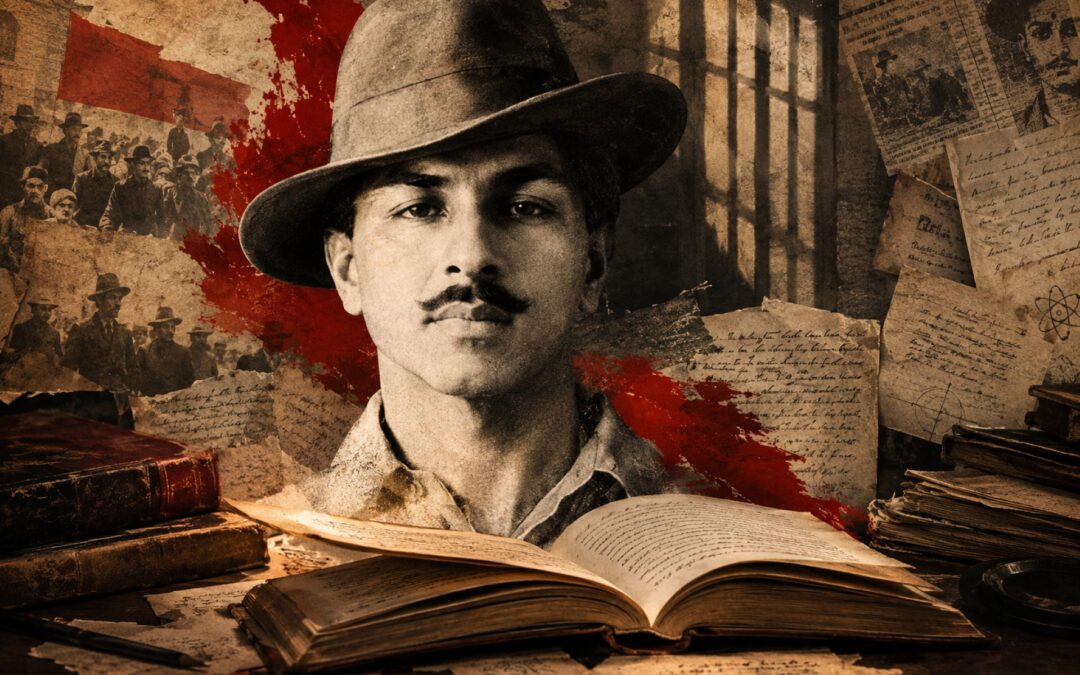
Bhagat Singh is among the most recognisable figures of India’s independence movement. His execution at twenty-three, his participation in the killing of British police officer J. P. Saunders, and the bombing of the Central Legislative Assembly made him a symbol of revolutionary resistance. Yet the familiar image of the young martyr explains remarkably little about what he believed, how his political thinking developed, or what kind of independent India he wanted to create.
The Bhagat Singh Reader, edited by Chaman Lal and published by HarperCollins India in 2019, offers a different way of understanding him. It brings together letters, telegrams, political essays, revolutionary declarations, court statements, biographical sketches, and the extensive notes he compiled while imprisoned. These documents reveal a writer concerned with problems far beyond British rule: religious conflict, untouchability, class exploitation, the nature of political authority, and the relationship between individual sacrifice and organised social change.
The collection is particularly revealing because Bhagat Singh’s ideas did not emerge fully formed. His early writings celebrate patriotism and the extraordinary possibilities of youth; his later work develops a more systematic socialist programme. Between these positions lie disagreements with fellow revolutionaries, criticism of established nationalist leaders, encounters with anarchist and Marxist thought, and increasingly sophisticated arguments about revolutionary methods.
Chaman Lal’s editorial contribution is substantial. He reconstructs writings scattered across newspapers, family collections, government records, and earlier publications, many of which appeared under pseudonyms or survived only through translations. The resulting anthology is unusually comprehensive, although questions of authorship, documentary accuracy, and editorial interpretation remain important.
Understanding the book therefore requires attention to two related subjects: Bhagat Singh’s intellectual and political development, and the historical work involved in recovering his writings. Together, they reveal why his importance cannot be adequately explained by the actions that made him famous.

The Editor’s Project and the Shape of the Collection
The Bhagat Singh Reader is an anthology rather than a conventional biography or a continuous argument written by Bhagat Singh. Its contents are arranged primarily by documentary form, allowing readers to examine how his thinking appears in private correspondence, public appeals, revolutionary journalism, court proceedings, and prison reading notes.
Chaman Lal begins with a discussion of his decades-long effort to collect and authenticate these materials. His interest developed through the literature of India’s revolutionary movement, including the work of Manmath Nath Gupta, who had participated in the Kakori revolutionary movement before becoming a historian. Lal subsequently helped edit Bhagat Singh aur Unke Sathiyon ke Dastavez, published in 1986, and continued searching for additional documents.
In his account of the publication of The Bhagat Singh Reader, Lal describes the English-language compilation as the culmination of a long research commitment. Earlier collections had appeared in Hindi, Punjabi, and other languages, but he wanted to make the widest possible selection available together in English.
The volume is divided into five principal sections. The first collects letters and telegrams, beginning with school correspondence and ending with communications from prison. The second contains posters, notices, and leaflets associated with revolutionary actions. The third reproduces statements delivered in court. The fourth brings together essays, political articles, and sketches of earlier revolutionaries. The fifth contains the jail notebook, accompanied by explanations of its recovery and publication.
The appendices extend the collection beyond writings attributed directly to Bhagat Singh. They include organisational manifestos prepared in consultation with him, a chronology, family information, linguistic classifications, colonial legal documents, and additional archival discoveries.
The arrangement creates a useful contrast between the different roles Bhagat Singh occupied. A family letter expresses affection or anxiety in a few lines, while a political essay may develop a detailed argument about class relations. An administrative petition demands a specific legal remedy, whereas a revolutionary leaflet attempts to persuade an entire population. His notebook, meanwhile, records the thoughts of other writers rather than presenting a finished argument of his own.
The editor’s introduction supplies a biographical framework connecting these materials. Bhagat Singh was born in 1907 into a family already involved in anti-colonial activity. His father Kishan Singh and uncle Ajit Singh were politically active, while the imprisonment, exile, and suffering of relatives made resistance to British authority part of his childhood environment.
The book follows his increasing involvement with the Hindustan Republican Association, the Naujawan Bharat Sabha, and eventually the Hindustan Socialist Republican Association, or HSRA. It explains the influence of the Ghadar movement, the Russian Revolution, and Indian socialist networks on his developing political outlook.
Lal argues that the addition of the word socialist to the revolutionary organisation’s name in September 1928 represented a substantive change in its objectives. The aim was no longer simply to remove British rulers, but to challenge the economic and social structures that made exploitation possible.
That argument guides the anthology, but the documents themselves are more varied than a single ideological narrative. Some reveal uncertainty, personal attachment, or disagreement. Others belong to different stages of Bhagat Singh’s political development. Reading them together allows readers to observe a thinker whose convictions were formed through sustained argument, experience, and study.
The Early Letters: Family, Education, and Revolutionary Commitment
The collection opens with schoolboy correspondence that presents a surprisingly ordinary beginning to Bhagat Singh’s documentary record. His earliest surviving letter, addressed to his grandfather Arjun Singh in July 1918, reports examination results and reassures the family about his performance in English and Sanskrit.
The details are modest but revealing. He explains his marks, mentions the passing requirements, and asks when his grandfather intends to visit. The letter shows a child concerned with school, family expectations, and everyday communication rather than the political identity that later dominated his public image.
A second letter, written in July 1919, concerns examinations, a mathematics retest, and the health of his younger brother Kultar. Bhagat Singh’s affectionate greetings to relatives establish the family world in which he grew up.
The third letter to his grandfather, dated November 1921, contains a more explicit indication of political awareness. Alongside family news, he mentions preparations for a railway workers’ strike. Although the comment is brief, it shows that organised labour had already entered his field of attention.
Two letters to his aunt Hukam Kaur, written in Punjabi during 1921, similarly combine domestic affection with growing political interests. One mentions his attendance at a procession and his inability to visit relatives because his father had forbidden the journey. Another offers apologies for delayed correspondence and conveys greetings throughout the family.
Chaman Lal places particular importance on the linguistic evidence in these early documents. Bhagat Singh’s first letters were written in Urdu, which was widely used in education and public life in Punjab. The Punjabi letters contain spelling and grammatical weaknesses, suggesting that his command of written Punjabi was still developing.
His educational environment also included Hindi, Sanskrit, and English. This multilingual background later enabled him to write for different audiences, from Punjabi workers and peasants to Hindi literary readers and English-speaking political and judicial institutions.
The most consequential early letter appears in the separate college subsection. Written to his father in 1923, it explains why Bhagat Singh was leaving home instead of accepting the marriage arrangements his family had begun discussing.
He recalls a childhood commitment to national service and declares that the struggle for Indian freedom has become the governing purpose of his life. Marriage and domestic comfort, he argues, cannot be allowed to obstruct that obligation.
This decision takes him to Kanpur, where he becomes involved with Ganesh Shankar Vidyarthi’s newspaper Pratap and encounters members of the revolutionary underground. Journalism, political education, and organised resistance begin to reinforce one another.
The letter also establishes a recurring tension in his later correspondence. His family remains emotionally important, yet he insists on independence in political decisions. Affection does not entitle relatives to determine the course of his revolutionary activity.
These early documents are important because they prevent his later willingness to die from appearing as an isolated personality trait. His commitment develops within a family already familiar with sacrifice, through education and political reading, and through decisions that progressively narrow the possibilities of an ordinary life.
Letters from Underground and the Colonial Surveillance State
The correspondence from Bhagat Singh’s active revolutionary years reveals the practical pressures of working under colonial surveillance. These documents concern intercepted letters, police investigations, personal property, publishing arrangements, and relationships with friends and comrades.
In November 1926, Bhagat Singh wrote to the Lahore postmaster after noticing irregularities in the delivery of his correspondence. Envelopes appeared to have been opened, and some letters arrived later than expected. He demanded to know whether postal officials were intercepting his mail and, if so, under whose authority.
Further correspondence with the Punjab government established that the interception was being conducted under official orders. The exchange is striking for its administrative precision. Rather than simply denouncing repression, Bhagat Singh requests dates, explanations, and direct answers about the government’s actions.
These letters show a politically suspect young man attempting to make officials account for their interference in his ordinary civil affairs. They also reveal that surveillance preceded the revolutionary actions for which he later became famous.
His arrest in May 1927 intensified this confrontation. The police detained him in connection with the Dussehra bombing investigation, and he was subsequently released on substantial bail. Letters to officials in Lahore demand the return of clothes, papers, books, and other belongings seized during his arrest.
One petition refers to proceedings in the Punjab Legislative Council, where questions had been raised about his detention and bail conditions. Bhagat Singh uses the government’s own procedures to challenge its treatment of him.
The pattern becomes familiar in his later prison correspondence: he identifies a restriction, documents the relevant circumstances, invokes procedural rights, and demands an official response. Even when he rejects colonial political authority, he remains willing to expose inconsistencies within its administrative and legal system.
A more personal letter to Amar Chand reveals interests that political petitions cannot convey. Bhagat Singh discusses the possibility of studying abroad, asks for books from America, and expresses concern about his exiled uncle Ajit Singh. He also describes continued police harassment.
His desire for higher education is particularly significant. Revolutionary work has restricted his opportunities, but his interest in study remains active. Reading appears as a personal aspiration as well as a political necessity.
Another letter, addressed to the editor of Maharathi in February 1928, concerns the publication of a biographical sketch of Guru Ram Singh. Bhagat Singh asks about photographs, printing arrangements, and the timely delivery of further material.
This correspondence exposes the ordinary work behind revolutionary journalism. He was concerned with illustrations, deadlines, publication costs, and the accuracy of historical presentation. His attempts to preserve the memory of earlier revolutionaries required the practical skills of a working journalist.
The most revealing letter in this group was written to Sukhdev on 5 April 1929, shortly before the Assembly bombing. The immediate background was a disagreement over the selection of revolutionaries who would undertake the action.
Bhagat Singh had wanted to participate, but the organisation initially preferred to protect him because his involvement in the Saunders case already placed him in serious danger. Sukhdev’s criticism, which Bhagat Singh understood as an accusation of weakness, deeply disturbed him.
In response, Bhagat Singh defends his courage while reflecting on the relationship between love and revolutionary sacrifice. He rejects the idea that genuine affection necessarily weakens political commitment.
He invokes the Italian revolutionary Giuseppe Mazzini, whose emotional attachment, he suggests, helped him endure political defeat and personal suffering. Love can sustain courage rather than undermine it.
Bhagat Singh also insists that renunciation has meaning only when there is something valuable to surrender. A revolutionary may possess ordinary hopes, desires, and attachments while remaining prepared to sacrifice them for a larger cause.
The letter complicates any interpretation of his life as one of complete emotional detachment. His understanding of sacrifice assumes the continuing importance of human relationships.
It also contains practical advice to Sukhdev about recruiting and preparing comrades. Bhagat Singh cautions against haste and urges careful judgment of character. Even while anticipating his own arrest, he remains concerned with the organisation’s future effectiveness.
Prison Correspondence and the Fight for Political-Prisoner Rights
Bhagat Singh’s imprisonment transformed correspondence into a sustained instrument of political resistance. The letters addressed to colonial administrators, prison officials, and judicial authorities document the conditions in which prisoners were held and the methods through which they attempted to challenge those conditions.
Following the Assembly bombing of April 1929, Bhagat Singh and B. K. Dutt were arrested and prosecuted. They received sentences of transportation for life in that case, while the investigation into Saunders’s killing exposed Bhagat Singh to a separate and ultimately fatal prosecution.
During imprisonment, the revolutionaries challenged the treatment of Indian political prisoners. They argued that people incarcerated for political activity should not be subjected to degrading conditions or denied facilities available to other categories of prisoners.
The demands recorded in the correspondence include better food, appropriate clothing, reading and writing materials, newspapers, sanitation, personal necessities, and freedom from compulsory menial labour. The prisoners also sought access to family members and legal advisers.
The struggle developed into prolonged hunger strikes. Bhagat Singh and his comrades refused food as a means of protesting conditions they believed violated their dignity as political prisoners.
The authorities resisted these demands, and prisoners faced serious physical suffering. Jatindra Nath Das, who joined the protest, died in September 1929 after a prolonged hunger strike. His death became a major political event, intensifying public attention to prison conditions and colonial repression.
Chaman Lal emphasises that the hunger strikes helped transform the public perception of the revolutionaries. The same men associated with the use of bombs and firearms now demonstrated political resistance through deliberate suffering inflicted upon themselves.
The letters reveal the practical details behind that transformation. The prisoners were not merely issuing general moral appeals. They addressed specific conditions, named officials, sought written assurances, and repeatedly raised the consequences of administrative decisions.
Bhagat Singh’s petitions also demonstrate his interest in the unequal treatment of European and Indian prisoners. Differences in food, accommodation, and privileges became evidence of the racial hierarchy embedded in colonial institutions.
As the Lahore Conspiracy Case progressed, the correspondence increasingly focused on judicial procedure. Bhagat Singh complained about restrictions on meetings with legal advisers, difficulties communicating with relatives, denial of access to documents, and the inability of defendants to coordinate their responses.
The special tribunal created in 1930 intensified these concerns. The colonial government established an extraordinary procedure for conducting the trial, and the prisoners repeatedly challenged the fairness of the resulting proceedings.
Several letters written in August 1930 address the consequences of being denied interviews while prosecution evidence was being presented. Bhagat Singh argued that the prison administration’s restrictions were preventing him from exercising the procedural rights that even the special legal framework ostensibly recognised.
The documents are repetitive in their immediate demands, but the repetition is historically revealing. Administrative injustice often operates through small restrictions whose cumulative effects are severe. The correspondence records an extended struggle over access, communication, legal representation, and the ability to participate in one’s own trial.
Bhagat Singh’s attitude toward courtroom defence also requires care. He frequently opposed conventional strategies aimed primarily at securing personal acquittal, preferring to use proceedings as opportunities for public political explanation. Nevertheless, he did not consider every procedural right irrelevant. He distinguished between accepting the colonial court’s political legitimacy and demanding fair treatment within the proceedings it imposed.
This distinction helps explain why he could protest passionately against denial of legal access while refusing attempts to defend him through arguments inconsistent with his chosen political strategy.
The final letter in this administrative group, addressed to the governor of Punjab on 20 March 1931, takes the confrontation to its conclusion. Bhagat Singh and his condemned comrades argue that their prosecution has effectively treated them as participants in a war against the British government.
On that basis, they demand recognition as prisoners of war and request execution by shooting rather than hanging. The argument is intended to establish the political character of their struggle, even though the colonial authorities did not accept the demand.
Bhagat Singh, Rajguru, and Sukhdev were executed on 23 March 1931.
The prison correspondence establishes that imprisonment was neither an interruption of Bhagat Singh’s revolutionary work nor simply the setting of his final sacrifice. It became a political arena in which he challenged colonial authority, fought for collective rights, pursued legal arguments, and continued developing his ideas.
Political and Personal Letters: Strategy, Love, and Farewell
The political letters from prison reveal Bhagat Singh’s growing determination to define revolution precisely. They also expose disagreements over political strategy, individual suffering, and the relationship between personal loyalty and revolutionary responsibility.
His message to the Punjab Students’ Conference in October 1929 addresses young people preparing for a new phase of the independence struggle. He rejects the suggestion that their immediate task should be to take up bombs and pistols.
Instead, students should carry political ideas into villages, factories, and impoverished communities. Their responsibility is to awaken people whose participation would make a broad struggle for freedom possible.
This message develops a significant distinction between spectacular individual action and sustained political organisation. Bhagat Singh does not deny the role of revolutionary courage, but he identifies the mobilisation of ordinary people as the more urgent task.
The December 1929 response to Ramananda Chatterjee, editor of Modern Review, addresses the revolutionary slogan Inqilab Zindabad. Chatterjee had questioned whether calling for revolution to live forever meant advocating endless upheaval without stability or progress.
Bhagat Singh and B. K. Dutt respond by distinguishing revolution from continuous armed rebellion. They describe it as a permanent willingness to challenge institutions and social conditions that prevent improvement.
The argument expands the meaning of revolutionary activity beyond the moment of overthrowing a government. Political independence alone cannot conclude the struggle if exploitation and injustice remain embedded in society.
Another major letter, addressed to Sukhdev in September 1930, considers suicide and the difficulty of enduring imprisonment. The correspondence arose from disagreements over whether a revolutionary should continue living through severe suffering when the prospects of freedom appeared remote.
Bhagat Singh rejects suicide as an escape from the obligations and hardships of revolutionary life. His argument is severe, sometimes bitter, and shaped by the extraordinary circumstances of imprisonment.
The letter is especially interesting when compared with his earlier discussion of love. In April 1929, he had defended affection as compatible with revolutionary courage. By September 1930, he acknowledged that confinement had changed his own emotional priorities.
Rather than presenting a fixed personality untouched by events, these letters show a person responding differently to changing circumstances. His convictions remain strong, but the significance of private relationships and individual choices is repeatedly reconsidered.
The October 1930 letter to his father offers another striking example. Kishan Singh had petitioned the special tribunal in an attempt to defend his son, apparently hoping to prevent the impending death sentence.
Bhagat Singh reacted with anger. He argued that his father had no right to intervene without consultation and that the petition undermined the political strategy the accused had deliberately adopted.
The disagreement was painful precisely because it occurred within a close family relationship. Kishan Singh’s action can be understood as a father’s attempt to save his child, while Bhagat Singh regarded it as an unacceptable sacrifice of political principle.
The collection also contains letters concerning Harikishan, a young revolutionary prosecuted for an attack on the Punjab governor. Bhagat Singh criticises the legal defence for attempting to diminish or misrepresent the political intention behind the action.
His concern is that a lawyer’s effort to save an individual defendant may destroy the wider significance of a revolutionary protest. This position reflects his belief that certain trials should become opportunities for political argument.
It also exposes a limitation of his approach. A defendant’s survival and the public meaning of an action are not necessarily opposing goals. Bhagat Singh’s insistence on political consistency could place extraordinary demands on individuals facing execution.
His last message to his comrades, dated 22 March 1931, brings the conflict between life and sacrifice into its most immediate form. He acknowledges the natural desire to live but refuses to seek survival through conditions he regards as incompatible with his political commitments.
The personal prison letters reveal a different rhythm. Several communications with Jaidev Gupta concern books, shoes, clothing, and other necessities. Bhagat Singh asks for particular reading material and arranges practical assistance through trusted friends.
A letter to Promila, the sister of B. K. Dutt, expresses affection and concern within the extended circle of revolutionary comrades. His correspondence with Dutt similarly reflects solidarity between men whose experiences had been closely connected since the Assembly bombing.
The letters to his younger brothers Kulbir and Kultar are particularly moving. Bhagat Singh worries about the family’s future, recognises the distress his execution will cause, and tries to encourage the younger men to continue their lives responsibly.
In his final correspondence with Kultar, he responds to his brother’s visible grief with tenderness and encouragement. His language conveys concern for the suffering of those who will remain alive after his death.
The four telegrams collected at the end of the correspondence section return to the wider political world. They concern political-prisoner treatment, revolutionary solidarity with the Third International on Lenin Day, the Kakori prisoners, and an Indian independence organisation in Berlin following the death of Shyamji Krishna Varma.
Taken together, these communications connect the personal, organisational, national, and international dimensions of Bhagat Singh’s political life. His final months were occupied simultaneously by family worries, ideological debate, prison grievances, legal proceedings, and international revolutionary interests.
Saunders, the Assembly Leaflet, and the Meaning of Revolutionary Action
The second principal section contains three documents associated with two of the most consequential revolutionary actions of Bhagat Singh’s life. Their purpose was to explain acts of political violence to the public and establish the HSRA’s responsibility for them.
The background to the Saunders killing was the widespread protest against the Simon Commission. In Lahore, Lala Lajpat Rai led a demonstration that was subjected to a police baton charge in October 1928. Rai subsequently died in November, and revolutionary activists held the colonial police responsible.
The HSRA planned retaliation against James Scott, the officer they believed responsible for directing the police action. During the operation on 17 December 1928, however, J. P. Saunders was shot instead.
The first poster, issued the following day, presents the killing as retribution for the treatment of Lajpat Rai and as a warning to the colonial administration. The announcement links the action to national humiliation and resistance against oppressive authority.
The poster contains a tension that runs through Bhagat Singh’s later writings. It acknowledges the seriousness of taking human life while presenting the killing as a necessary part of a revolutionary struggle.
A second notice, issued several days later, reinforces the organisation’s claim of responsibility and warns that repression will be answered by continued resistance. Its threatening language belongs to a political strategy based partly on demonstrating the government’s vulnerability.
The Central Assembly bombing of 8 April 1929 was conceived differently. Bhagat Singh and B. K. Dutt entered the legislature in Delhi and threw explosive devices into the chamber before surrendering to the authorities.
The leaflet distributed during the action argued that the colonial legislature had become an instrument for exposing India’s lack of genuine political power. Even when Indian representatives opposed government proposals, the executive retained the ability to impose its decisions.
The immediate context involved measures including the Public Safety Bill and Trade Disputes Bill, which the revolutionaries viewed as attacks on political and labour organisation.
The leaflet also invoked the death of Lajpat Rai and the wider history of repression. The Assembly bombing was intended to force attention upon grievances that ordinary parliamentary discussion had failed to resolve.
Its most important feature is its insistence that revolutionary ideas cannot be eliminated simply by imprisoning or executing their supporters. The organisation presents the attack as a public warning and an assertion of political purpose.
Bhagat Singh and Dutt maintained that the bombs were deliberately thrown into relatively unoccupied areas and were not intended to kill legislators. Their subsequent statements repeated that the intention was political communication rather than indiscriminate injury.
Those claims require qualification. The explosions caused injuries and created a risk of more serious harm, regardless of the participants’ stated intentions. The ethical problem cannot be removed merely by accepting the revolutionaries’ description of the action.
The posters and leaflet also differ significantly in tone. The Saunders declarations openly threaten retaliation and defend a killing, while the Assembly leaflet emphasises protest, public explanation, and the survival of ideas.
Both forms of communication reveal how the HSRA sought to turn individual revolutionary acts into events of national political significance. The organisation understood that violence by a small underground group could not itself overthrow the colonial state. It hoped instead to attract attention, inspire resistance, and give its political programme a wider audience.
Whether such methods advanced the broader movement is a separate question. The documents establish the revolutionaries’ intentions, but intentions alone cannot determine the political or moral consequences of their actions.
The Court Statements: Revolution on Trial
The two court statements are among the collection’s most concentrated expressions of Bhagat Singh’s political philosophy. They also demonstrate how he and B. K. Dutt attempted to transform judicial proceedings into opportunities for explaining revolutionary objectives.
The Sessions Court statement of 6 June 1929, read by their lawyer Asaf Ali, addresses the reasons for the Assembly bombing. It begins with the nature of colonial representation and the limitations of the Central Legislative Assembly.
The accused argue that the institution possessed the outward appearance of parliamentary government without effective authority over colonial policy. Resolutions could be ignored, elected representatives overruled, and legislation imposed despite widespread objections.
For Bhagat Singh and Dutt, this exposed the contradiction between the British government’s claims to constitutional legitimacy and its actual exercise of power in India.
They therefore describe the bombing as a protest against an institution rather than an attack motivated by personal hatred of its members. Their stated aim was to create an event that could not be ignored and then accept arrest to explain its meaning publicly.
The statement defends the decision to throw the bombs into relatively unoccupied spaces. It disputes the prosecution’s treatment of the explosive devices and emphasises the limited injuries and damage caused.
The accused argue that the consequences of the explosions support their claim that they intended to issue a warning rather than carry out a massacre. They nevertheless acknowledge responsibility for the action.
The court statement then develops a much broader argument about revolution. Political independence, it suggests, cannot be separated from the lives of workers, peasants, artisans, and others whose labour supports society.
Bhagat Singh and Dutt describe a social order in which producers remain impoverished while those who control wealth enjoy disproportionate rewards. They regard this inequality as structurally unstable and morally indefensible.
The proposed alternative is a socialist reorganisation of society in which the working population possesses political authority and economic exploitation is abolished.
The statement thus connects anti-colonial struggle with class politics. The British state is condemned not only for denying national sovereignty, but also for protecting an exploitative social and economic system.
This is a much more demanding conception of revolution than replacing British officials with Indian ones. It requires changes in property relations, political institutions, and the distribution of economic power.
The statement also draws a distinction between force and aggression. Bhagat Singh and Dutt argue that the moral character of force depends partly on the purpose for which it is used.
This defence is controversial because noble political aims do not automatically justify harmful methods. Nevertheless, it is important to understand the argument as the revolutionaries actually present it: they believed certain forms of resistance could be justified against an oppressive state, especially when other channels of political expression were ineffective.
The High Court statement delivered during the appeal proceedings develops a related argument through the question of intention.
Bhagat Singh challenges the view that the law can adequately judge an act without considering why it was committed. He argues that the same outward conduct may possess very different moral meanings depending on the circumstances and the actor’s purpose.
He offers historical and religious examples to illustrate the danger of treating all disruptions of established authority as equivalent crimes.
The argument also criticises the severity of the punishment imposed for the Assembly bombing. Bhagat Singh maintains that the limited physical consequences of the action should have been considered alongside its political motivation.
The two statements are not identical in emphasis. The first presents a revolutionary political programme; the second concentrates more closely on legal reasoning, intention, and punishment.
Both insist that the court must confront the political significance of the accused’s conduct.
Their lasting importance lies partly in the way they move beyond the particular trial. The Assembly becomes evidence of defective colonial representation, the bombing becomes an occasion to explain socialist revolution, and the prosecution becomes a debate about political legitimacy and criminal intention.
These statements do not resolve every ethical difficulty surrounding revolutionary violence. They do, however, establish that Bhagat Singh’s actions were accompanied by developed arguments whose meaning cannot be understood from the events alone.
Early Essays on Language, Youth, and Universal Love
Bhagat Singh’s earliest essays differ considerably from the political programmes he later wrote in prison. They are more literary, frequently idealistic, and often concerned with national character, cultural identity, and the emotional energies of political commitment.
The Problem of Language and Script of Punjab, written in 1923, examines the connection between language, literature, and social development.
Bhagat Singh argues that a society’s progress depends partly on its ability to develop and communicate ideas through language. Literature preserves collective experience and makes political and cultural education possible.
Punjab presents a particularly difficult problem because linguistic differences overlap with religious and communal identities. Urdu, Hindi, and Punjabi are associated with different communities, scripts, and political claims.
The essay considers how those divisions obstruct intellectual and national development. Its concern is therefore wider than a preference for one language or script: linguistic fragmentation becomes a political problem when communities treat cultural forms as exclusive possessions.
The argument reveals an early interest in the relationship between national unity and social communication. It also shows the limits of his position, since resolving linguistic conflict involves competing claims about identity, accessibility, and cultural inheritance.
Universal Love, written in 1924, approaches political life from a more explicitly ethical direction. It considers the ideal of human fraternity and the apparent contradiction between universal sympathy and struggles against oppression.
Bhagat Singh draws on examples of reformers, patriots, and revolutionaries to examine whether devotion to humanity requires passive acceptance of injustice.
The essay suggests that genuine human love cannot remain indifferent when some people are systematically exploited or humiliated. Resistance may arise from concern for humanity rather than hatred of particular individuals.
This argument anticipates the language of his later court statements, where the revolutionaries defend their opposition to colonial power while asserting respect for human life.
Yet Universal Love remains more morally idealistic than institutionally specific. It does not contain the developed account of class power and socialist reconstruction that emerges in the writings of 1930 and 1931.
Youth, published in 1925 under the pseudonym Balwant Singh, is striking for its exuberant prose. Bhagat Singh presents youth as a period of enormous physical, emotional, and imaginative energy.
He uses natural imagery, mythology, historical examples, and dramatic contrasts to describe the possibilities of young life. The young can surrender themselves to destructive impulses or direct their energy toward national regeneration.
The essay repeatedly returns to sacrifice. Youth possesses the courage, vitality, and willingness to risk everything that political movements require.
Its style is far removed from the administrative precision of the later prison letters. The prose is emotionally expansive, full of heightened imagery and appeals to heroic action.
Religious and mythological references appear naturally within this earlier rhetoric. Their presence is important because Bhagat Singh’s later atheism should not be projected backwards as though his literary vocabulary and intellectual convictions had always been unchanged.
These essays also reveal the importance of journalism in his development. He was learning to address readers, construct arguments, select examples, and use prose as a political instrument.
The shift from patriotic literary expression to systematic political analysis did not eliminate his earlier interests in humanity, courage, and solidarity. Instead, those interests acquired increasingly explicit institutional and economic meanings.
Religion, Communal Violence, Caste, and Political Participation
The essays published in Kirti during 1927 and 1928 demonstrate a marked broadening of Bhagat Singh’s political concerns. He increasingly treats social divisions, economic conditions, and political education as central problems of India’s struggle for freedom.
The Religious Riots and Their Solution begins with the destructive consequences of communal violence. Bhagat Singh condemns political leaders who encourage religious antagonism and journalists who inflame tensions through sensational or provocative reporting.
He argues that newspapers should educate the public, diminish prejudice, and encourage understanding among different communities. Instead, sections of the press have become instruments for spreading hostility.
His criticism is especially pointed because communal riots weaken the broader anti-colonial struggle. People who might unite against foreign rule become absorbed in conflicts with one another.
Bhagat Singh then turns to economic conditions. Poverty, unemployment, insecurity, and dependence make communities vulnerable to manipulation by political and religious leaders.
He proposes class consciousness as a means of overcoming these divisions. Workers and peasants, regardless of religion or caste, share economic interests that could form the basis of political solidarity.
The argument reflects his growing engagement with Marxist explanations of society. Religious conflict is treated partly as a consequence of material insecurity and political manipulation rather than simply disagreement about doctrine.
This explanation is powerful in identifying common economic interests, though its tendency to make economic conditions the decisive cause of communal conflict risks overlooking the independent power of religious identity, historical grievances, and organised prejudice.
Religion and Our Freedom Struggle examines the role religion should play in political organisation. Bhagat Singh distinguishes moral principles, philosophical beliefs, and religious rituals.
He does not assume that every ethical teaching associated with religion must be rejected. His principal concern is the use of religious authority to restrict freedom, justify divisions, or prevent common political action.
The freedom movement, he argues, cannot become dependent on sectarian commitments that exclude portions of the population. Political solidarity requires a basis broader than adherence to any particular religious tradition.
The essay anticipates his later atheism but addresses a distinct problem. A secular political organisation need not require every participant to abandon personal religious belief; it must prevent religious difference from determining political rights and collective membership.
The Issue of Untouchability extends the argument about equality to caste oppression.
Bhagat Singh confronts the hypocrisy of demanding rights from colonial rulers while denying elementary human dignity to members of oppressed communities. He describes restrictions on social contact, access to water, religious participation, and occupations considered degrading.
His examples expose the contradiction between ritual claims of purity and the dependence of privileged groups on the labour of those they exclude.
He criticises reformers who express sympathy for oppressed communities while retaining practices that mark them as inferior. He also examines the competition among religious groups to attract people subjected to untouchability.
For Bhagat Singh, the issue cannot be resolved merely by treating oppressed people as objects of charity or religious recruitment. They must possess equal human rights and the capacity to organise independently.
The essay connects caste emancipation with the legitimacy of national freedom. A society that tolerates internal subjugation cannot convincingly present itself as committed to liberty.
The analysis is important because it rejects a narrow definition of colonial liberation. British rule is one form of oppression, but Indian society contains other structures of domination that also require transformation.
The essay Satyagraha and Strikes reveals another side of Bhagat Singh’s political thinking. He examines the Bardoli peasant movement, where farmers opposed increases in land revenue through organised non-payment and collective resistance.
He describes how peasants prepared to face confiscation of property and other official reprisals. Their strength lay in sustained organisation and shared resolve rather than isolated acts by individual activists.
The article also discusses strikes as signs of political awakening. Workers and peasants become capable of challenging established power when they act collectively.
Bhagat Singh’s account complicates the familiar opposition between Gandhi’s nonviolent methods and revolutionary militancy. He was willing to recognise the effectiveness of satyagraha and strikes without abandoning his own broader political objectives.
Students and Politics challenges attempts to exclude students from public affairs. Bhagat Singh argues that education becomes inadequate when it prepares people merely for employment while leaving them ignorant of the political and social conditions around them.
He recounts an episode involving a student reading Peter Kropotkin and a professor who reacts with alarm at the mention of a Russian political thinker. The example ridicules an educational culture that fears independent inquiry.
Students should study seriously, but political understanding is itself part of meaningful education. The capacity to examine public conditions and contribute to social improvement cannot be separated from intellectual development.
The essays on contemporary leadership continue this emphasis on political education.
In New Leaders and Their Different Ideas, Bhagat Singh examines the differences between Jawaharlal Nehru and Subhas Chandra Bose. His interest is not simply in their popularity or personal courage, but in the ideological direction each represents.
He treats political leadership as something to be judged by the clarity and substance of its programme. Nationalist language alone does not establish agreement about the structure of a future independent society.
Lala Lajpat Rai and the Youth examines a particularly complicated relationship. Rai was an important nationalist leader and a figure of immense political stature in Punjab, but Bhagat Singh and his comrades disagreed with aspects of his politics, especially his increasing association with communal positions.
The criticism is significant because the revolutionaries later undertook the Saunders operation in response to Rai’s death. Defending him against colonial violence did not require accepting all his political views.
Together, these essays reveal a political thinker moving beyond the emotional unity of anti-colonial nationalism. He increasingly asks what social relationships should exist within an independent India, who would exercise power, and whether the movement’s methods and leadership were capable of producing genuine equality.
Anarchism, Russian Nihilism, and the Search for Revolutionary Methods
Bhagat Singh’s three-part series What Is Anarchism?, published in Kirti during 1928, introduces readers to a political tradition commonly associated with disorder and political assassination.
He begins by challenging the assumption that anarchism simply means chaos. Its serious philosophical meaning, he explains, concerns opposition to coercive forms of authority and the possibility of organising society without institutions that perpetuate domination.
The first essay introduces the major objects of anarchist criticism: religion and ecclesiastical authority, the coercive state, and private property. These are presented as institutions through which power can be concentrated and human freedom restricted.
Bhagat Singh’s treatment is introductory and explanatory. He is attempting to familiarise readers with a body of European political thought that was poorly understood in India.
The second essay considers anarchist ideas about freedom and social organisation. It questions whether government and coercive law are necessary features of human society or products of particular historical relationships.
The discussion links anarchist opposition to private property with the argument that economic exploitation produces social conflict. A society based on genuine freedom would require more than replacing one government with another.
The third essay turns increasingly toward anarchist history and revolutionary action.
Bhagat Singh discusses figures including Mikhail Bakunin and Peter Kropotkin, placing their ideas within European movements against monarchy, state repression, and capitalist domination.
He also examines the concept of propaganda through action: the belief that a dramatic deed could communicate revolutionary possibilities more effectively than written argument alone.
This idea helps explain an important element of the HSRA’s later political methods. Revolutionary action could be conceived as a way of awakening public attention rather than simply defeating an opponent through force.
The essays do not establish that Bhagat Singh became a doctrinaire anarchist. They reveal intellectual exploration at a time when he was studying competing revolutionary traditions.
His later socialist writings place considerably more importance on organised political authority and the creation of a revolutionary state than a consistent anarchist philosophy would ordinarily allow.
The Revolutionary Nihilists of Russia continues his historical investigation. The essay begins with Ivan Turgenev’s novel Fathers and Sons and its portrayal of a young intellectual challenging inherited beliefs.
Bhagat Singh explains that Russian nihilism emerged as a rebellion against religious superstition, autocracy, social convention, and intellectual submission.
He describes how young Russians rejected established authority and attempted to spread new ideas through education and political activity. Their efforts encountered severe repression under the tsarist state.
The essay follows the movement’s growing radicalisation. As peaceful political activity was suppressed, sections of the revolutionary movement adopted clandestine methods and assassination.
Bhagat Singh is interested in how repression transforms political movements and how individual actions relate to the possibilities of broader social change.
The Russian example offers both inspiration and a warning. Courage and sacrifice can challenge an apparently invincible state, but spectacular violence does not necessarily create the organised social forces required for lasting transformation.
The shorter document Ideal of Indian Revolution, dating from 1930, brings together headings and notes concerning Indian revolutionary history, political schools, methods, and competing ideological approaches.
Unlike his published essays, it does not develop each point into a continuous argument. It is closer to an outline for systematic historical and political study.
The surviving material mentions the republican ideal, earlier revolutionary movements, nationalism, socialism, communism, anarchism, and other approaches to political transformation.
Its fragmentary character is important. The outline shows the range of questions Bhagat Singh wanted to investigate, but readers cannot infer a completed theory from brief headings.
Taken together, these writings reveal the intellectual effort behind his eventual political position. Bhagat Singh was comparing revolutionary traditions, identifying their methods and limitations, and attempting to understand how Indian conditions might require a different combination of ideas and strategies.
Atheism, Dreamland, and the Programme for Young Revolutionaries
The final group of major essays contains Bhagat Singh’s most sustained reflections on religion, political philosophy, revolutionary literature, and socialist organisation.
Why I Am an Atheist, written in 1930, is the best known of these documents. Its immediate purpose was to answer the accusation that Bhagat Singh’s rejection of God arose from vanity or excessive confidence in his own abilities.
He begins by distinguishing atheism from the desire to compete with divine authority. He does not claim to possess the powers of God or to consider himself a superior being. He rejects the existence of an omnipotent deity altogether.
The accusation of vanity, he argues, also fails historically. He had abandoned religious belief before achieving the public prominence associated with the Assembly bombing and Lahore trials.
Bhagat Singh then reconstructs the development of his beliefs. His grandfather was associated with Arya Samaj, and religious observance formed part of his childhood education. He recalls prayers, devotional practices, and the influence of believing family members.
His earliest revolutionary associates were also frequently religious. He refers to Sachindra Nath Sanyal and the faith expressed by several Kakori revolutionaries.
This background matters because atheism was not simply inherited from his political environment. He presents it as the outcome of sustained questioning.
During a period when revolutionary activity had become difficult, Bhagat Singh increasingly turned toward reading. He examined anarchist, socialist, and other philosophical writings while reconsidering the assumptions he had previously accepted.
His account treats intellectual criticism as an obligation. Inherited beliefs must remain open to examination, and traditions cannot be considered immune from rational scrutiny merely because they are old or widely respected.
He acknowledges that reasoning is fallible. A person may reach mistaken conclusions, but the willingness to revise beliefs through criticism is preferable to accepting claims without examination.
The essay then addresses the existence of suffering and the difficulty of reconciling widespread injustice with a benevolent, omnipotent God.
Bhagat Singh asks why a divine power would permit poverty, oppression, cruelty, and apparently undeserved suffering. He rejects explanations that transfer responsibility to previous lives or future rewards.
His objections belong to a long philosophical tradition concerning the problem of evil, although the essay develops them in direct language intended for a broad political readership.
The final dimension concerns the approaching possibility of death. Belief in divine protection or an afterlife might provide emotional reassurance, but Bhagat Singh refuses to adopt religious faith for consolation.
He does not claim that disbelief makes suffering easy. Instead, he regards consistency under extreme pressure as an important test of intellectual independence.
Why I Am an Atheist is therefore both a philosophical argument and a personal explanation of how Bhagat Singh understands courage. Its force comes from the relationship between his reasoning and his circumstances, not from the originality of every objection he raises.
The First Rise of Punjab in the Freedom Struggle turns from philosophy to historical reconstruction. The essay examines earlier political mobilisation in Punjab, particularly agrarian grievances and the activities associated with Ajit Singh and other anti-colonial organisers.
Bhagat Singh challenges the view that Punjab had been politically passive or backward. He emphasises movements through which peasants resisted colonial policies and developed forms of political consciousness.
The history is personally relevant because his own family participated in that political environment. It also reinforces his conviction that agrarian questions are central to Indian freedom.
The text’s transmission history requires caution. Chaman Lal explains that the surviving version involves translation and subsequent recovery, making it necessary to distinguish the historical argument from uncertainty about the exact original wording.
Introduction to Dreamland, written for L. Ram Saran Das’s poetry collection, offers an unusual combination of literary criticism and revolutionary political analysis.
Bhagat Singh begins by acknowledging the value of the author’s sacrifice and experience. He nevertheless refuses to treat revolutionary commitment as a reason to exempt a literary work from criticism.
The poems imagine a transformed world based on peace, equality, and the end of exploitation. Bhagat Singh recognises these aspirations while questioning some of the philosophical assumptions through which they are expressed.
He objects to religious and mystical explanations that do not satisfy his own materialist understanding of society. He also considers the relationship between utopian imagination and practical political change.
A vision of a better world can inspire political action, but it cannot replace analysis of existing institutions, economic interests, and the means through which change might occur.
Bhagat Singh examines the poet’s emphasis on education and gradual transformation. He agrees that a socialist society cannot be created simply through the exercise of violence, but argues that existing governments may suppress the educational and organisational work required for change.
His proposed solution involves acquiring political power and using it for social reconstruction. This position reveals his continued willingness to justify coercion against opposition, even while emphasising education and constructive work.
One of the introduction’s most important features is its attitude toward reading. Bhagat Singh encourages readers to examine the poems critically and develop their own ideas rather than accept them because of the writer’s revolutionary credentials.
This insistence on independent judgment provides a direct link between his philosophical commitments and his literary practice.
To Young Political Workers, written in February 1931, is the collection’s most developed political programme.
The document begins by examining the possibility of compromise between the Congress leadership and the British government. Bhagat Singh argues that revolutionary movements must distinguish temporary tactical settlements from abandonment of their ultimate objectives.
He uses historical examples, including Lenin’s political decisions, to explain why compromise is not necessarily equivalent to surrender. An organisation may accept limited gains while continuing to work toward a more fundamental transformation.
His central criticism of the Congress movement concerns its social base. He believes leadership dominated by property-owning and middle-class interests is unlikely to mobilise workers and peasants fully when doing so might threaten existing property relations.
Political independence obtained through negotiations among elites could therefore preserve the economic structure that maintained exploitation.
Bhagat Singh argues that the real forces capable of producing a social revolution are the working population, particularly industrial labourers and peasants.
His vision of revolution involves transferring political authority to forces committed to socialist reconstruction. The objective is not simply an Indian government operating the existing colonial system, but a different social order.
He proposes organised political education, mass mobilisation, and disciplined party activity as necessary conditions for achieving that aim.
The programme connects the political and economic dimensions of revolution. He envisages measures concerning landlordism, peasant indebtedness, public control of land and industry, housing, education, and working conditions.
These proposals give concrete content to his socialism. Freedom is defined through institutions that determine how people live and work, not solely through national sovereignty.
Bhagat Singh also analyses revolutionary terrorism with unusual severity. He acknowledges that dramatic acts of violence can awaken political interest and inspire individual sacrifice.
But he argues that isolated attacks have repeatedly failed to produce social revolution. A colonial government can absorb the loss of individual officials while continuing to exercise economic and political control.
Such methods may also encourage compromises that fall short of genuine transformation. Without mass organisation, the revolutionary movement remains dependent on actions performed by a small number of unusually committed individuals.
He therefore places increasing emphasis on systematic work among workers, peasants, students, and other sections of society.
The document calls for political study and organisational discipline. Revolutionaries must understand history, economics, social conditions, and contemporary political developments rather than depend only on courage.
The programme is not free of authoritarian possibilities. Its commitment to a revolutionary party, concentrated political power, and coercive methods raises difficult questions about how socialist transformation would protect dissent and prevent the emergence of new forms of domination.
Nevertheless, To Young Political Workers demonstrates the intellectual distance Bhagat Singh travelled from his earliest celebrations of youthful sacrifice.
His final sustained programme treats revolution as a long process of political education, organisation, economic reconstruction, and institutional change. The heroic individual remains important, but can no longer substitute for the participation of the population whose liberation the movement claims to seek.
The Revolutionary Portraits: Kuka, Kakori, Ghadar, and Babbar Akali Histories
A substantial portion of The Bhagat Singh Reader consists of biographical sketches of earlier Indian revolutionaries. These writings are essential to understanding Bhagat Singh’s historical imagination.
He did not regard his own generation as the beginning of anti-colonial resistance. Through journalism and commemorative writing, he attempted to recover people and movements that had challenged colonial rule long before the formation of the HSRA.
The initial group includes Drops of Blood on the Day of Holi, an account commemorating Babbar Akali revolutionaries who had been executed. The essay uses the contrast between a festival associated with colour and the blood of martyrs to direct public attention toward their sacrifice.
The writings on the Kakori revolutionaries include an introduction to the movement’s principal figures and an account of the circumstances surrounding their execution.
The Kakori action of 1925 had brought members of the Hindustan Republican Association into direct confrontation with the colonial state. The subsequent prosecutions and executions became central events in the political education of younger revolutionaries.
Bhagat Singh’s sketches preserve the identities and experiences of those involved rather than reducing the episode to an isolated act of robbery or defiance.
The accounts associated with the Kuka movement examine Guru Ram Singh and the Namdhari tradition. Bhagat Singh presents the movement as part of Punjab’s longer history of resistance, tracing its religious and social origins and its conflict with colonial authority.
The existence of more than one Kuka-related sketch reflects his interest in reconstructing the movement for different publications and audiences. The versions need not be identical to contribute to the same historical project.
His piece on Madan Lal Dhingra moves the narrative beyond India. Dhingra’s assassination of British official William Hutt Curzon Wyllie in London and his subsequent execution became a powerful example of sacrifice within overseas revolutionary politics.
The most extensive group comes from the November 1928 Phansi Ank, or Gallows Issue, of the Hindi journal Chand. The collection reproduces thirty-five sketches associated with that publication.
The original issue contained a larger body of material prepared through the efforts of Bhagat Singh, Shiv Verma, and others. Consequently, the reproduced sketches cannot all be treated as independently authored compositions by Bhagat Singh.
The earliest portraits include Master Amir Chand, Avadh Behari, Bal Mukund, and Basanta Kumar Biswas, associated with revolutionary activity in northern India.
These accounts trace clandestine political organisation, prosecution, imprisonment, and execution. They establish that the revolutionary networks of Bhagat Singh’s generation inherited methods and ideals developed through earlier struggles.
Another group concerns Punjabi revolutionaries and the overseas Ghadar movement.
The sketches include figures such as Bhag Singh, Vatan Singh, Mewa Singh, Kashi Ram, and Gandha Singh, whose lives connect colonial India with migration and revolutionary activity abroad.
The Ghadar movement emerged among Indians living outside India, particularly in North America, and sought to organise resistance against British rule. Its international character challenged the assumption that the struggle for Indian independence was confined within the country’s borders.
The portraits describe political activism, encounters with colonial authority, and the consequences faced by participants who attempted to carry the movement into India.
Kartar Singh Sarabha occupies a particularly important place.
Executed in 1915 while still a teenager, Sarabha became an admired example for Bhagat Singh and his comrades. The editor notes Bhagat Singh’s personal attachment to Sarabha’s memory, including the importance of his photograph within revolutionary activities.
The sketches devoted to Sarabha present his early life, involvement with the Ghadar movement, revolutionary commitment, arrest, and execution.
His significance is both historical and personal. Bhagat Singh regarded him as an example of youthful courage joined to a larger political cause.
The collection also includes portraits of Vishnu Ganesh Pingle, Jagat Singh, Balwant Singh, Dr Mathura Singh, Banta Singh, Ranga Singh, Veer Singh, Uttam Singh, Dr Arur Singh, Babu Harinam Singh, Sohan Lal Pathak, and Sufi Amba Prasad.
These accounts reconstruct a network extending across different regions, occupations, and revolutionary organisations. Some focus on work abroad, others on clandestine activity within India, and still others on imprisonment, suffering, and execution.
Additional sketches concern Ram Singh, Bhan Singh, Udham Singh, and Khushi Ram. The Udham Singh discussed in this earlier revolutionary context must not be confused with the later Udham Singh who killed Michael O’Dwyer in London in 1940.
The concluding group deals particularly with Babbar Akali revolutionaries. It includes the four martyrs of the Battle of Bomeli and portraits of Dhanna Singh, Banta Singh Dhamiyan, Waryam Singh Dhugga, Kishan Singh Gadgajj, Santa Singh, Dalip Singh, Nand Singh, and Karam Singh.
These accounts document armed resistance, pursuit by police, underground activity, trials, and deaths. They also show how revolutionary memory was constructed through stories of exceptional courage and endurance.
The authorship of this group is especially complicated. Chaman Lal explains that some pieces attributed to Bhagat Singh were revised or jointly prepared with Shiv Verma, while others associated with the original issue were written by different revolutionaries.
That uncertainty matters because the historical evidence of Bhagat Singh’s admiration for these movements is not identical to proof that every sentence originated with him.
The sketches also have literary limitations. They often emphasise heroism, sacrifice, and moral steadfastness more than political disagreement, strategic failure, or the personal complexity of their subjects.
Many individuals appear principally through their willingness to endure imprisonment or execution. The format can encourage exemplary portraits rather than fully balanced biographies.
Nevertheless, the cumulative achievement is considerable. The collection preserves a broad revolutionary inheritance that is often overshadowed by a few nationally famous figures.
The portraits also explain why Bhagat Singh repeatedly returned to questions of sacrifice, memory, and political education. Remembering previous revolutionaries was itself part of preparing a new generation to understand the struggle in which it participated.
Inside the Jail Notebook: Revolution, Law, and Literature
The fifth principal section reproduces Bhagat Singh’s jail notebook, one of the most revealing documents associated with his final years.
The notebook is not a diary narrating the events of imprisonment. It consists mainly of extracts from books, quotations, factual notes, lists, political observations, and miscellaneous information gathered through reading.
Chaman Lal introduces the complicated history of its preservation and publication. Unlike many of Bhagat Singh’s other writings, which appeared in newspapers during or shortly after his lifetime, the notebook remained largely inaccessible for decades.
Bhupender Hooja played an important role in bringing it into wider circulation during the early 1990s. His introductory discussion explains the notebook’s provenance, physical character, preparation for publication, and importance to the study of Bhagat Singh’s intellectual life.
The surviving notebook contains evidence of its formal issue to Bhagat Singh in prison in September 1929. Its pages were used for extensive reading notes, although the surviving material does not form a continuous narrative or fully systematic treatise.
One of its major subjects is the historical development of property and society.
Bhagat Singh records material concerning early human social organisation, private ownership, class divisions, and the development of economic institutions.
Extracts associated with Friedrich Engels and other socialist writers connect changes in property relations with the formation of family structures, political authority, and social inequality.
These notes illuminate his interest in materialist explanations of history. Social institutions are treated as products of historical conditions rather than permanent arrangements beyond criticism.
A related body of material concerns socialism and the transformation of economic life.
The notebook includes discussions of exploitation, capitalism, labour, wealth, public power, and the possibilities of collective ownership. It also records quotations from revolutionary writers and historical examples associated with movements against established authority.
The notes do not amount to a finished economic theory. They show the texts and concepts Bhagat Singh was consulting while working toward a more systematic understanding of socialist politics.
Another substantial subject is the state.
Bhagat Singh records historical and philosophical observations about government, political authority, property, sovereignty, and the evolution of institutions.
These materials connect closely with his plan to write a more substantial work on the nature of the state. Chaman Lal discusses the proposed project, but the notebook itself cannot be treated as though that unwritten book had been completed.
The notebook’s material on law and punishment is especially revealing.
Bhagat Singh copies arguments concerning the purpose of criminal law, different forms of punishment, the relationship between intention and guilt, and the competing objectives of deterrence, retribution, and reform.
These topics had immediate relevance to his circumstances. He was facing prosecution by the colonial state while challenging both the fairness of judicial proceedings and the legitimacy of the political order that controlled them.
The notes suggest that his interest in law extended beyond the immediate question of securing a favourable verdict. He was studying the broader principles through which societies define crimes, justify punishment, and exercise coercive authority.
Political philosophy occupies another important place.
The notebook refers to ideas associated with democracy, liberty, equality, republicanism, and the relationship between individuals and government. Writers from different periods and intellectual traditions appear alongside socialist and revolutionary material.
The range is striking because Bhagat Singh did not confine his reading to texts that merely confirmed one established ideological identity. The notebook preserves material from thinkers whose assumptions and political conclusions were not always compatible.
Its literary content is equally important.
Bhagat Singh copied poetry, dramatic passages, aphorisms, and reflections on suffering, courage, freedom, and human dignity. Literature offered ways of thinking about experience that were not reducible to economic explanation or party programmes.
His interests included writers such as Victor Hugo, as well as broader traditions of European and Indian literary expression.
The notebook also contains practical and miscellaneous information: currency values, measurements, historical figures, statistics about India, and lists of books.
Such material makes the surviving document less orderly than a reader might expect from its reputation. Political philosophy appears beside factual calculations; literary quotations interrupt historical or economic notes.
This variety is central to understanding the notebook correctly.
It is evidence of reading, selection, comparison, and intellectual curiosity. It does not prove that Bhagat Singh endorsed every statement he copied or had resolved every disagreement between the authors he studied.
Nor does the number of quotations alone establish complete mastery of each book. A notebook records encounters with ideas, not necessarily final conclusions about them.
Its significance becomes clearer when placed alongside the essays and court statements. Those documents show how Bhagat Singh developed arguments of his own; the notebook reveals part of the intellectual material available to him during that process.
The result is a portrait of political study conducted under extreme circumstances. Bhagat Singh continued reading while participating in hunger strikes, preparing legal statements, facing prison restrictions, and awaiting the resolution of his trial.
The notebook does not provide a final philosophical confession before his execution. Instead, it preserves an unfinished intellectual activity that continued until the circumstances of his life brought it to an end.
Manifestos, Judgements, and the Documentary Appendices
The appendices extend the anthology from Bhagat Singh’s writings into the wider organisational and legal history of the revolutionary movement.
The first major documents are the manifestos of the Naujawan Bharat Sabha and the Hindustan Socialist Republican Association.
Chaman Lal explains that both were drafted by Bhagwati Charan Vohra in consultation with Bhagat Singh. Their inclusion is justified by their importance to the organisations in which he participated, but their collaborative origin must remain clear.
The Naujawan Bharat Sabha manifesto addresses the political responsibilities of young Indians at a time of national uncertainty and dissatisfaction with established leadership.
It calls for disciplined service, national awakening, sacrifice, and opposition to colonial domination. Its purpose is to cultivate a generation capable of sustained political work.
The manifesto reflects the importance the revolutionary movement assigned to public organisation. The Sabha was an open political vehicle through which young activists could engage with wider society.
The HSRA manifesto presents a more militant statement of revolutionary objectives. It explains the organisation’s opposition to imperialism and its commitment to a social order free from exploitation.
The manifesto also defends revolutionary resistance and criticises political approaches considered inadequate to the conditions of colonial rule.
Read alongside Bhagat Singh’s later writings, it reveals both continuity and tension. The organisation’s commitment to socialist revolution is explicit, but its defence of revolutionary violence sits beside his growing emphasis on mass political work.
The appendices also contain linguistic details about Bhagat Singh’s writings.
These classifications are valuable because his documents originated in several languages and appeared through different publication channels. They help clarify which writings survive in their original form and which depend on later translation or editorial reconstruction.
The chronology of his life provides an additional means of connecting documents with historical events. Family information and genealogical material establish relationships that recur throughout his correspondence and the editor’s introduction.
The legal appendices are especially substantial.
The viceroy’s ordinance of May 1930 established extraordinary procedures for conducting the Lahore Conspiracy Case through a special tribunal.
The document is important because the revolutionaries’ complaints about their treatment were made within a legal structure specially created to manage the prosecution.
The Lahore Conspiracy Case judgment reproduces the colonial court’s account of the revolutionary organisation, the evidence presented against the accused, and the conclusions reached by the tribunal.
It provides extensive information about how the prosecution reconstructed the HSRA’s activities and connected individual defendants to the killing of Saunders.
The judgment must nevertheless be read as a judicial document produced by the colonial state. It records evidence, allegations, reasoning, and findings within a particular political and legal system. It cannot automatically be treated as a neutral history of everything that occurred.
The Privy Council judgment concerns the legal challenge to the special tribunal and the validity of the proceedings established under the ordinance.
Its inclusion allows readers to examine the formal legal reasoning through which the colonial authorities defended the extraordinary judicial arrangement.
The final archival additions include a tribunal petition and specimen signatures. Their importance lies in the continuing recovery of documents long after Bhagat Singh’s execution.
The notes, bibliography, acknowledgments, and source information further establish the scale of Chaman Lal’s editorial work. They also expose the practical limitations of reconstructing an archive from materials that survived through different institutions, families, newspapers, and political circumstances.
Photographic material supplies additional visual context, although photographs and captions should be interpreted with the same care as written evidence.
The appendices ultimately change how the main collection should be read. They demonstrate that Bhagat Singh’s revolutionary activity was collective, legally contested, and preserved through a complicated documentary history.
They also remind readers that the surviving writings represent an incomplete historical record, even when gathered into a volume intended to be comprehensive.
From Anti-Colonial Nationalism to Socialist Revolution
One of the most important developments revealed by The Bhagat Singh Reader is the movement from patriotic resistance toward a more systematic socialist conception of freedom.
The early writings already contain concerns with humanity, inequality, and national development. Yet their dominant vocabulary often emphasises courage, sacrifice, historical examples, and the emotional obligations of youth.
By the later 1920s, Bhagat Singh increasingly analyses political problems in terms of economic power and social institutions.
The essay on communal riots, for example, connects religious conflict with poverty and class insecurity. The essay on untouchability challenges hierarchies within Indian society rather than focusing exclusively on colonial discrimination.
The writings on students and strikes recognise that political transformation depends on education and collective participation.
These concerns converge in the socialist reorientation of the Hindustan Republican Association and the adoption of the HSRA name in 1928.
The change does not mean that every member possessed an identical or fully developed Marxist understanding. The documents instead show an organisation increasingly committed to making socialist reconstruction part of its declared purpose.
Bhagat Singh’s later writings make the political implications explicit.
He distinguishes national independence from the abolition of exploitation. Removing British rulers would not automatically change the position of landless peasants, industrial workers, or communities subjected to inherited social inequalities.
An independent government could preserve economic privilege if political authority remained under the control of existing property-owning groups.
He therefore argues that revolution requires transformation of the state and the economic system.
The state, in his later political analysis, is bound up with the organisation and protection of class power. Acquiring control of it becomes necessary for carrying out socialist reconstruction.
His programme involves changes to ownership, agrarian relations, industry, education, and labour conditions. These proposals connect political freedom with the material conditions of everyday life.
The working population occupies a central position because its members possess both a direct interest in transformation and the collective capacity to make economic and political life function.
For Bhagat Singh, a revolution conducted solely by educated conspirators cannot fulfil this programme. It requires the active participation of the social groups whose position the revolution intends to change.
His criticism of elite nationalism follows from this analysis. Leaders whose economic interests depend on existing property relations may support constitutional freedom without accepting a transformation that threatens their own social position.
This argument does not mean that Bhagat Singh rejected every political contribution made by Congress leaders. His writings repeatedly distinguish between tactical cooperation, individual respect, and disagreement over ultimate objectives.
The distinction also explains his willingness to consider compromise. He does not treat every negotiated concession as betrayal; he objects to allowing a temporary settlement to replace the movement’s larger goal.
His socialism was strongly influenced by the Russian revolutionary experience, but the collection does not demonstrate that he had resolved every institutional question involved in establishing a socialist society.
His later writings express considerable confidence in revolutionary political organisation and the seizure of state power. They devote less attention to the safeguards necessary to prevent a revolutionary government from becoming coercive toward the population it claims to represent.
That limitation is especially important given his simultaneous interest in anarchist critiques of authority.
The development visible in the collection is therefore neither a complete abandonment of earlier commitments nor an intellectually finished system. It is the emergence of a more comprehensive political programme from a combination of patriotic experience, historical reading, organisational disagreement, and confrontation with colonial power.
Violence, Mass Movements, and the Limits of Conspiratorial Action
The relationship between political violence and mass organisation is the most difficult question running through Bhagat Singh’s revolutionary writings.
His historical reputation rests partly on actions that involved the use of firearms and explosives. Yet his later political arguments repeatedly warn against confusing such acts with social revolution itself.
The Saunders killing represents a form of retaliatory violence directed against a representative of colonial authority. Its public justification combined anger over Lala Lajpat Rai’s death with the intention of demonstrating that British officials were not beyond the reach of revolutionary resistance.
The Assembly bombing had a different immediate purpose. It was designed as a dramatic political protest whose participants deliberately accepted arrest and used the subsequent trial to explain their objectives.
Both actions relied on the expectation that exceptional events could break through public indifference.
Bhagat Singh’s study of anarchism and European revolutionary movements helps explain this reasoning. The idea of propaganda through action suggested that a deed might communicate political urgency when ordinary speeches and publications failed.
But the same historical studies also revealed the limits of individual revolutionary violence.
In To Young Political Workers, Bhagat Singh recognises that isolated attacks cannot destroy the economic foundations of imperialism. A colonial administration can replace individual officials and continue governing.
Successful revolution requires a much larger transformation of political consciousness, social organisation, and economic relationships.
This is why his later programme places such importance on workers, peasants, political education, and disciplined organisation.
The hunger strikes add another dimension to his understanding of resistance.
By refusing food and challenging prison conditions, Bhagat Singh and his comrades used their own suffering to expose the colonial state’s treatment of political prisoners. The resulting public response demonstrated the political force of collective endurance.
The relationship between this method and armed action is complicated. Both were intended to attract public attention, but they operated through different forms of coercion, sacrifice, and moral appeal.
The correspondence also shows that Bhagat Singh did not adopt an absolute doctrine of nonviolence. He continued to justify force under particular circumstances and envisaged coercive measures in the process of establishing revolutionary political power.
His later criticism of terrorism should therefore be understood as a criticism of its strategic insufficiency and the danger of mistaking it for revolution, rather than as a complete repudiation of every possible use of force.
This distinction prevents the imposition of an artificially tidy political conversion.
The ethical contradiction remains significant. Declaring respect for human life does not remove responsibility for killing a police officer or creating danger through an explosion. Nor does the existence of colonial injustice make every form of resistance morally equivalent.
The collection is most revealing when these tensions remain visible. Bhagat Singh was trying to reconcile revolutionary urgency with humane political objectives, and individual sacrifice with the need for a broad social movement.
His most mature political insight was that courage could attract attention but could not substitute for organised popular power.
Whether the coercive elements of his programme were compatible with the freedom he envisioned remains a serious question that the surviving writings do not fully resolve.
Secularism, Equality, and the Rejection of Untouchability
Religion and caste occupy a substantial place in Bhagat Singh’s political thought because he regarded them as questions central to India’s freedom.
His criticism of communalism begins with the recognition that a struggle for national independence can be weakened by conflicts among the population it seeks to unite.
In The Religious Riots and Their Solution, he condemns leaders and newspapers that exploit religious identity for political advantage. He also identifies poverty and economic insecurity as conditions that make people more vulnerable to such manipulation.
His proposed solution combines class consciousness with a commitment to social equality.
Workers and peasants belonging to different religious communities possess common economic interests. Political education should help them recognise those interests instead of allowing sectarian organisations to define their enemies.
Religion and Our Freedom Struggle develops the institutional implications. A political movement should not be governed by religious rules that exclude people or restrict their rights.
Bhagat Singh’s secularism is therefore more substantial than a demand for tolerance between communities. It involves resisting the use of religious authority to determine political membership, social status, and collective action.
His essay on untouchability extends this position into the internal structure of Indian society.
The central argument is that national liberation loses moral credibility when the society demanding freedom denies basic dignity to some of its own members.
Bhagat Singh’s examples concern social exclusion, access to public necessities, ritual pollution, and the treatment of people performing occupations considered degrading.
He objects to privileged groups treating oppressed communities as inferior while depending upon their labour.
He is also alert to the political use of religious conversion and communal competition. Oppressed communities can become objects of struggle between religious organisations seeking to increase their numbers or influence.
The more important question is whether the people concerned possess dignity, equality, and independence.
This emphasis makes caste oppression a direct challenge to the claim that political sovereignty alone will produce a free society.
His atheism adds another layer but should not be treated as interchangeable with secularism.
A person may reject religious authority in politics without denying God’s existence. Conversely, an atheist may still tolerate social hierarchies unless those hierarchies are independently criticised.
Bhagat Singh’s rejection of religion emerges from philosophical arguments about evidence, suffering, authority, and the obligation to question inherited beliefs.
His opposition to communalism concerns political organisation and collective equality. His rejection of untouchability concerns social dignity and entrenched discrimination.
The three positions reinforce one another, but they address distinct problems.
There are limitations to his analysis. His confidence that common economic interests could overcome communal divisions may underestimate how deeply religious identity and caste status can structure social experience.
Similarly, a socialist transformation does not automatically guarantee the disappearance of caste hierarchy. Discrimination may survive changes in property ownership or political leadership.
Nevertheless, these essays establish that Bhagat Singh’s ideal of freedom was broader than independence from Britain.
He was concerned with the social conditions that would determine whether people could live as equals after colonial rule ended.
That breadth remains one of the most substantial achievements of his political writing.
Bhagat Singh’s Inner Life: Comradeship, Affection, and Doubt
The correspondence reveals an emotional life that cannot be reduced to the willingness to die for a political cause.
Bhagat Singh’s relationships with family members and comrades were marked by affection, disagreement, dependence, and sometimes anger. These connections shaped both his revolutionary activities and his understanding of personal sacrifice.
The 1929 letter to Sukhdev is especially important because it rejects the idea that love necessarily weakens revolutionary resolve.
Bhagat Singh regards affection as a genuine human emotion capable of strengthening character. His example of Mazzini suggests that political commitment and emotional attachment can support one another.
The letter also shows how deeply he was affected by Sukhdev’s criticism. An accusation of weakness from a close comrade mattered to him in a way that hostile colonial opinion probably did not.
Their later correspondence concerning suicide exposes a harsher side of the relationship.
Imprisonment had changed the circumstances of both men. Their discussion of suffering, endurance, and personal responsibility became more severe as execution appeared increasingly likely.
Bhagat Singh’s reasoning is not always gentle or psychologically accommodating. He demands extraordinary commitment from comrades whose physical and emotional resources were under enormous pressure.
That severity is part of the historical personality revealed by the letters. It should not be converted into a simple moral lesson about strength.
His relationship with his father is equally complicated.
Kishan Singh had helped shape his son’s political environment, but their disagreement over the tribunal petition demonstrates how deeply their priorities could diverge.
The father wanted to preserve his child’s life; the son insisted that his political position could not be compromised through an unsolicited defence.
Both positions are intelligible, and the surviving letter reveals the pain caused when they became incompatible.
The correspondence with Jaidev Gupta exposes another dependence. Bhagat Singh needed friends who could provide books, clothing, shoes, and other practical necessities.
The image of the solitary revolutionary thinker becomes less convincing when placed beside the network of people who enabled his prison life.
His letters to B. K. Dutt and Dutt’s sister Promila similarly reveal relationships that extended beyond formal organisational membership.
The revolutionary group was also a community of people who shared danger, imprisonment, and concern for one another.
The final letters to Kulbir and Kultar show Bhagat Singh attempting to manage the emotional consequences of his expected execution.
He offers encouragement and expresses concern about the family’s future, but he cannot remove the suffering his death will impose.
These documents do not establish that Bhagat Singh was secretly uncertain about his political convictions. They show something more specific: conviction did not eliminate grief, affection, anger, or concern for those left behind.
His political identity was sustained through relationships rather than existing independently of them.
Reading, Writing, and the Formation of Political Ideas
Bhagat Singh’s writings demonstrate that reading was central to his revolutionary activity, but the significance of his intellectual life extends beyond the number of books he encountered.
His early essays show a writer learning to communicate through literary imagery, patriotic emotion, and historical examples.
The Kirti articles adopt a more direct explanatory style. They introduce political concepts, criticise contemporary developments, and attempt to educate readers about social problems and international revolutionary traditions.
The court statements combine legal advocacy with political argument. Their language is formal, argumentative, and intended for circulation beyond the courtroom.
The administrative petitions are more precise and repetitive, shaped by immediate procedural objectives.
The personal letters permit a different voice, sometimes affectionate and informal, sometimes angry or emotionally strained.
The revolutionary sketches use biography to construct political memory. Their recurring attention to sacrifice and execution reflects the commemorative conventions of their journalistic setting.
The jail notebook differs from all these forms because its principal activity is the preservation of other people’s words and information.
That difference creates an important interpretive question. What does it mean to study a revolutionary thinker through a collection of quotations?
One approach treats the notebook as evidence of Bhagat Singh’s extraordinary intellectual discipline. His extensive engagement with politics, literature, economics, and law supports the view that he was far more than a militant nationalist.
Yet the notebook’s contents also reveal an ongoing search rather than a completed intellectual system.
In his scholarly essay Commonplace Anti-Colonialism: Bhagat Singh’s Jail Notebook and the Politics of Reading, J. Daniel Elam challenges interpretations that use the notebook primarily to establish Bhagat Singh’s philosophical mastery.
Elam suggests that the practice of reading itself may reveal an important revolutionary orientation: a willingness to encounter ideas without necessarily converting them into claims of final authority.
This interpretation offers a useful alternative to the image of Bhagat Singh as someone who had already arrived at complete theoretical certainty.
The surviving notebook contains material from different intellectual traditions, including writers who disagree with one another. Its fragmentary arrangement makes it difficult to impose a single, fully coherent philosophical position on every entry.
The more direct evidence of Bhagat Singh’s commitments appears when he turns reading into argument.
In Why I Am an Atheist, he explains how study and criticism changed his beliefs. In Introduction to Dreamland, he encourages readers to evaluate a text independently. In To Young Political Workers, he treats political education as indispensable to revolutionary organisation.
These documents establish a relationship between intellectual inquiry and political practice.
Reading was a way of examining the assumptions of inherited nationalism, considering foreign revolutionary experiences, understanding law and economics, and developing arguments that could be communicated to others.
The collection also reveals the importance of language.
Bhagat Singh wrote across Urdu, Hindi, Punjabi, and English. His choice of language affected the audience and character of particular documents.
The ornate Hindi of an early literary essay differs from the more conversational language of some Punjabi articles and the formal English of his later political declarations.
Translation into a single English anthology makes these writings accessible to a wider audience, but it also reduces the visible differences between their original linguistic settings.
Understanding his intellectual development therefore requires attention to form as well as content.
The most convincing portrait is not of an isolated genius producing a finished political theory, but of a writer whose ideas developed through reading, journalism, organisational discussion, legal conflict, and historical circumstances.
The Problems of Authorship, Translation, and Completeness
The greatest scholarly strength of The Bhagat Singh Reader is also the source of some of its most important limitations.
The anthology brings together material that was originally scattered across newspapers, letters, court records, family archives, and earlier collections. Recovering these documents was a substantial achievement, but their origins are not equally secure.
Some letters survive in Bhagat Singh’s handwriting. Other writings appeared under pseudonyms such as Balwant or Vidrohi.
Certain documents were issued collectively by revolutionary organisations or signed by more than one person. Their political significance is clear, but exclusive individual authorship may not be.
The manifestos in the appendices illustrate the problem particularly well. They were drafted by Bhagwati Charan Vohra in consultation with Bhagat Singh. Their inclusion illuminates Bhagat Singh’s organisational commitments, but identifying them simply as his writings would erase another revolutionary’s contribution.
The biographical sketches present an even more complicated case.
Chaman Lal explains that the original Chand issue included works by different writers and that Shiv Verma translated, revised, or jointly prepared several pieces associated with Bhagat Singh.
The volume’s effort to recover the sketches is valuable precisely because it also exposes these questions of attribution.
The collection’s claim to comprehensiveness must therefore be understood as a claim about the widest recoverable body of material available to the editor, rather than proof that every document can be securely attributed to one author.
Translation creates further difficulties.
Bhagat Singh wrote in several languages, and some original manuscripts have disappeared. A surviving translation may preserve an argument while leaving uncertainty about the exact words of the original.
One recovered letter discussed by the editor was published in Hindi after having been translated from English, requiring a subsequent English retranslation for this edition.
Such a text cannot be treated as preserving the precise wording Bhagat Singh originally used.
The publication history of Why I Am an Atheist also illustrates the problem of competing textual versions. Chaman Lal describes how translations and retranslations circulated widely while the original published English version became difficult to access.
These issues are particularly important when readers attach great significance to a particular phrase.
The missing prison manuscripts represent a different kind of limitation.
Comrades reported that Bhagat Singh prepared several substantial works during imprisonment, including projects concerning socialism, revolutionary history, autobiography, and death. Their manuscripts have not survived in a form that permits reliable reconstruction.
The anthology cannot recover the arguments of books whose contents are unavailable. References to their existence establish intellectual ambition, not the conclusions of completed works.
Editorial interpretation also requires attention.
Chaman Lal consistently emphasises Bhagat Singh’s socialist and Marxist identity. The collected writings provide substantial evidence for that interpretation, especially the later essays and political programmes.
Nevertheless, the editor’s confidence can sometimes move beyond the narrower claims established by an individual document.
A responsible reading must distinguish the text from the interpretation placed upon it.
Contemporaneous critical reception identified further concerns. Vishav Bharti’s review in The Tribune praises the collection’s documentary importance while also identifying problems involving factual mistakes, proofreading, and acknowledgment of earlier sources.
These criticisms do not negate the significance of the compilation. They establish that comprehensiveness and editorial reliability are different achievements.
The book is most useful when approached as a major scholarly resource that nevertheless remains open to correction.
A Critical Assessment of Chaman Lal’s Collection
The Bhagat Singh Reader is a major contribution to the study of Bhagat Singh because it changes the evidence available to readers.
Instead of relying on selected speeches, celebrated quotations, or retrospective accounts of revolutionary actions, it provides access to a broad range of documents produced across different stages of his short political life.
Its strongest achievement is the recovery of intellectual variety.
The early school letters establish an ordinary personal beginning. The political correspondence documents surveillance, organisational conflict, and confrontation with colonial institutions. The essays show a growing interest in social equality and socialist transformation.
The court statements reveal the arguments through which Bhagat Singh attempted to explain revolutionary actions. The historical sketches place him within a much larger tradition of resistance, while the jail notebook exposes the breadth and unfinished character of his reading.
No single document could accomplish what the anthology achieves through their juxtaposition.
The inclusion of correspondence is particularly valuable because it prevents the public revolutionary from completely displacing the private individual.
The letters to Sukhdev, his father, and his brothers reveal emotional tensions that a conventional political biography might acknowledge only briefly.
The administrative correspondence also has considerable historical value. It allows readers to examine the ordinary mechanisms of colonial surveillance, prison control, and legal restriction, rather than encountering repression only through spectacular events.
The collection’s political essays are equally important.
Their range challenges portrayals of Bhagat Singh as a revolutionary interested solely in ending British rule. He addresses communal conflict, caste hierarchy, labour organisation, political education, religion, economic exploitation, and the structure of a future independent society.
The most substantial late writings contain a coherent demand for socialist reconstruction, even when individual arguments remain open to criticism.
In his review for The Indian Express, Azaadi for All, historian S. Irfan Habib recognises the importance of a comprehensive English collection that makes this intellectual legacy more widely available.
The book also benefits from Chaman Lal’s historical introduction and documentary annotations.
Readers unfamiliar with the revolutionary networks of the 1920s receive essential context about the HRA, HSRA, Naujawan Bharat Sabha, Ghadar movement, and the political circumstances surrounding Bhagat Singh’s imprisonment.
The appendices contribute further depth by preserving organisational declarations and colonial legal records.
Yet the book is less consistently successful as a work of editorial presentation.
Its greatest structural difficulty is the unevenness inherent in such a large documentary collection.
Letters appear alongside legal petitions that repeat similar complaints. Historical sketches differ considerably in length and substance. The jail notebook moves between disconnected quotations and factual notes.
Some of this unevenness is unavoidable and indeed necessary to preserve the documentary record.
But the arrangement can make the reading experience demanding, especially for readers who expect a continuous narrative or a carefully developed argument.
The collection also requires greater attention to documentary distinctions than casual reading may encourage.
A collectively drafted manifesto, an individually signed letter, a translated historical sketch, and a court statement do not possess the same authorship status.
The editor discusses many of these distinctions, but the sheer size of the collection makes it easy for readers to lose track of them.
A more consistently standardised account of provenance and translation would strengthen the anthology’s scholarly usefulness.
The problems identified by contemporary reviewers concerning factual errors and proofreading are also consequential.
In an ordinary narrative history, minor mistakes may be irritating without fundamentally changing the argument. In a collection intended to serve as a reliable repository of primary documents, errors involving names, dates, attribution, and source history can obstruct further research.
The standard of accuracy should therefore be especially demanding.
Another limitation concerns the interpretive emphasis of the editorial commentary.
Chaman Lal’s determination to recover Bhagat Singh as a socialist thinker is justified by substantial textual evidence. The later political essays clearly establish that Bhagat Singh wanted a transformation extending beyond the replacement of colonial rulers.
However, that emphasis can sometimes encourage a retrospective image of ideological coherence.
Bhagat Singh’s early writings were different in language and orientation from his final political programmes. His interests in anarchism, socialism, revolutionary martyrdom, and coercive political action did not always fit into a single, fully resolved doctrine.
The surviving documents reveal serious intellectual development, but not the completion of every philosophical problem he explored.
A balanced critical interpretation should preserve the possibility that Bhagat Singh was still working through disagreements when his life ended.
The treatment of revolutionary violence requires similar care.
The editor frequently foregrounds Bhagat Singh’s humane intentions and his later criticism of terrorism. Both are supported by the writings.
But the moral and political problems created by assassination, the use of explosives, and the projected coercive authority of a revolutionary state remain substantial.
A reader should not have to choose between celebrating every revolutionary act and dismissing the entire movement as irrational violence.
The writings deserve examination through their stated objectives, historical circumstances, consequences, and unresolved contradictions.
The collection is also limited by the historical character of some of Bhagat Singh’s own claims.
His confidence in socialist revolution and the Soviet example reflects the political possibilities and assumptions available during his lifetime. Later historical developments complicate the expectation that revolutionary state power would necessarily produce democratic freedom and social equality.
Similarly, his interpretation of communal conflict through economic exploitation illuminates important causes but does not fully explain the durability of religious and caste identities.
Such limitations belong partly to the original political writings rather than the editor. They should be considered when evaluating Bhagat Singh’s arguments as political theory.
The strongest sections remain those in which intellectual ambition and historical evidence reinforce one another.
Why I Am an Atheist demonstrates independent reasoning under exceptional pressure. To Young Political Workers connects criticism of elite nationalism with a concrete programme of mass organisation.
The court statements show the political meaning Bhagat Singh sought to attach to his actions, while the essays on communalism and untouchability demonstrate his refusal to regard national independence as sufficient social liberation.
The revolutionary sketches offer a different achievement: the preservation of a political history populated by figures whose experiences might otherwise remain obscure.
The jail notebook is valuable for still another reason. It reveals the intellectual materials of a developing revolutionary without pretending to supply the finished conclusions of an unwritten book.
Scholarship such as J. Daniel Elam’s reading of the notebook usefully reminds readers that intellectual openness may be as historically revealing as settled conviction.
The continuing contest over Bhagat Singh’s public memory provides another reason the collection matters.
His image has been employed by different political traditions, often with incompatible understandings of his beliefs. As Chris Moffat examines in India’s Revolutionary Inheritance: Politics and the Promise of Bhagat Singh, revolutionary figures continue to influence political life through the ways later generations remember and reinterpret them.
A substantial body of primary writing cannot eliminate interpretive disagreement, but it makes such disagreement more accountable to evidence.
That is the lasting value of Chaman Lal’s project.
The book does not provide a flawless edition, a neutral history of the revolutionary movement, or a fully resolved account of Bhagat Singh’s philosophy.
It does provide an unusually broad documentary foundation from which those questions can be investigated.
Its weaknesses require careful reading rather than dismissal. Its achievement is substantial enough to make it an essential starting point for serious engagement with Bhagat Singh’s intellectual and political legacy.
Who Should Read The Bhagat Singh Reader?
The Bhagat Singh Reader is most valuable to readers who want to understand Bhagat Singh through his writings rather than through the simplified narratives of heroism and martyrdom that dominate popular memory.
Students of Indian history will find an extensive record of revolutionary politics during the final decades of British rule. Readers interested in socialism, secularism, political violence, and anti-colonial thought will encounter a developing political programme articulated in its original historical circumstances.
The book is particularly useful to researchers because it consolidates documents that previously appeared across different publications and archives. Its letters, judicial records, historical sketches, and notebook material provide numerous starting points for more specialised investigation.
General readers should expect a demanding anthology rather than a conventional biography. The administrative petitions, repeated revolutionary portraits, and discontinuous notebook entries require patience, and the editor’s interpretations should sometimes be checked against the documents themselves.
Readers primarily seeking an accessible chronological life story may find a biography easier to begin with. Those willing to examine the primary material, however, will encounter a far more detailed and complicated figure.
Chaman Lal’s compilation ultimately succeeds in restoring intellectual substance to a life often represented through a small number of dramatic events. Its most valuable contribution is the opportunity to observe Bhagat Singh thinking, arguing, changing his mind, challenging comrades, confronting authority, and attempting to define the social transformation for which he believed national independence should create the conditions.
The result is a portrait that is more historically useful than an uncomplicated heroic legend. Bhagat Singh emerges as a committed, intellectually ambitious revolutionary whose ideas deserve careful study, including where they remain incomplete or open to objection. Despite its editorial shortcomings, The Bhagat Singh Reader remains one of the most substantial English-language resources for understanding that legacy.
Last Updated on October 10, 2026 by Aseem Gupta