
Reading Time: 74 Minutes
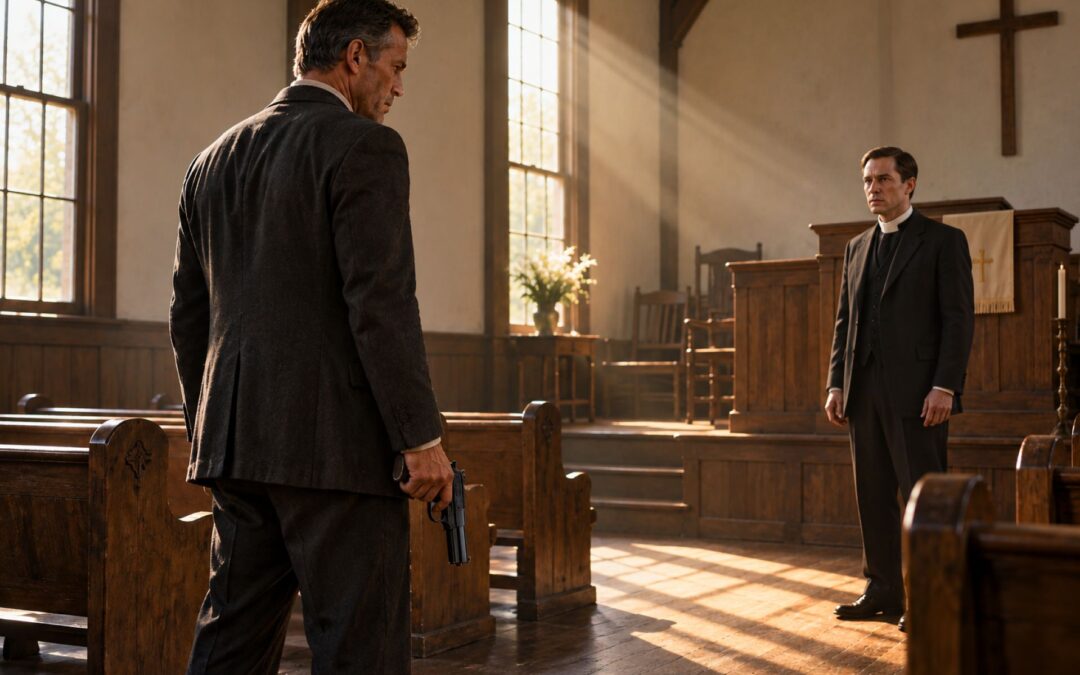
In October 1946, Pete Banning, one of the most respected men in Clanton, Mississippi, walks into a Methodist church and shoots its minister, Reverend Dexter Bell. Pete is a wealthy cotton farmer, a devoted father, and a decorated World War II veteran who survived experiences that should have killed him many times over. He makes no effort to escape, denies nothing, and refuses to explain himself. Even when his silence makes execution increasingly likely, he will not reveal why he committed the murder.
Published by Doubleday in October 2018, John Grisham’s The Reckoning uses this apparently straightforward crime to construct a much larger story about war, marriage, family secrets, racial injustice, and the destructive consequences of personal certainty. Set primarily in the fictional Ford County of Mississippi and the Philippines during World War II, the novel moves between legal drama, historical fiction, murder mystery, and Southern family tragedy.
The central mystery concerns Pete’s motive, but Grisham does not answer it through an ordinary criminal investigation. Instead, he first follows Pete through conviction and execution, then returns to his earlier life and extraordinary wartime experiences. The final portion reveals how the murder destroys his family and gradually exposes the truth he refused to disclose.
This structure forces readers to reconsider Pete several times. The man who commits a deliberate murder is also a courageous soldier who endured starvation, imprisonment, torture, and combat. His love for his wife and children appears genuine, yet his decisions ultimately deprive them of nearly everything. The novel’s deepest conflict lies in the distance between what Pete believes he knows and what actually happened.
Spoiler Warning: This article covers the complete novel, including the murder, trial, wartime narrative, family tragedies, and final revelation.

Pete Banning Murders Reverend Dexter Bell
On a cold morning in early October 1946, Pete Banning wakes before sunrise at his family farm outside Clanton, Mississippi. He is forty-three years old, physically damaged by the war but sufficiently recovered to supervise the cotton harvest. He has spent much of his life connected to this land, and his responsibilities include managing workers, protecting the family property, and ensuring the farm remains profitable.
Pete goes through his morning routine with deliberate calm. He checks the farming operation, considers the work ahead, and has breakfast with his sister, Florry, who lives in a separate cottage on the property. Nothing about his behavior suggests panic or uncertainty. Yet he has already made a decision that will end his life and destroy the family’s future.
Pete drives into Clanton and approaches the Methodist church, where Reverend Dexter Bell is working. Dexter is a relatively young minister with a wife, Jackie, and three children. He is widely respected in the community, has provided pastoral support to the Banning family, and was especially attentive to Pete’s wife, Liza, during the years when Pete was missing in the Philippines and presumed dead.
When Pete confronts Dexter, the minister recognizes that something is wrong. Their brief exchange makes it clear that the matter concerns Liza, although Grisham withholds the nature of the grievance. Pete then draws his pistol and shoots Dexter repeatedly.
The murder is deliberate. Pete has not acted during an unexpected quarrel, and he does not attempt to conceal what he has done. The precision of his conduct immediately distinguishes the case from a conventional crime of sudden passion.
Hop Purdue, the Black caretaker who works at the church, discovers the aftermath. Pete briefly points his pistol toward him, terrifying the defenseless man, but lowers it and instructs him to notify the sheriff. The moment is revealing: Pete has decided that Dexter must die, yet he does not intend to shoot anyone else.
Sheriff Nix Gridley responds to the scene and begins investigating. The evidence quickly establishes Pete’s responsibility, and the sheriff travels to the Banning farm to arrest him. Pete is waiting rather than hiding, as though arrest were merely the next expected step in a plan he has already accepted.
The community is stunned. Pete is a successful landowner whose family has lived in Ford County for generations, and his wartime decorations have made him a local hero. Dexter, meanwhile, is a minister whose killing violates both the criminal law and the town’s religious expectations.
Pete’s longtime attorney, John Wilbanks, becomes involved, but encounters an extraordinary problem. His client will not supply a motive, authorize a convincing explanation, or cooperate in constructing a defense. Pete admits the act while refusing to discuss its circumstances.
The mystery is therefore established without uncertainty about the killer’s identity. The question is why a man who apparently had everything to live for would murder a minister and willingly expose himself to the death penalty.
Clanton Demands Answers and Pete Refuses
News of Dexter Bell’s murder spreads rapidly through Clanton. The Methodist church becomes a gathering place for grieving parishioners, curious townspeople, and anyone hoping to understand the catastrophe. Dexter’s widow, Jackie, is left with three children and little financial security beyond the modest resources associated with her husband’s ministry.
The funeral emphasizes Dexter’s importance to the community. He is remembered as a conscientious pastor who cared for his congregation and offered comfort during difficult times. Even people who know Pete personally struggle to reconcile their admiration for the veteran with the suffering he has inflicted on an innocent family.
Pete’s reputation complicates the town’s response. Some residents suspect that the minister must have committed an unforgivable offense. Others are unwilling to believe that a respected veteran would kill without justification. Such speculation becomes a substitute for information because Pete refuses to provide any.
Florry Banning is among those most desperate for an explanation. She has spent much of her life near her brother, understands his stubbornness, and knows that he rarely speaks openly about painful experiences. Nevertheless, she cannot comprehend why he would throw away his life.
During visits to the jail, she demands to know what happened. Pete responds with affection but refuses to explain. He wants their remaining conversations to be pleasant and becomes irritated when she tries to confront him with the suffering his actions have caused.
Their exchanges establish a fundamental feature of Pete’s personality. Once he considers a decision settled, he sees further discussion as unnecessary interference. He behaves as though his private certainty should be sufficient for everyone who loves him.
His children are equally bewildered. Joel, a student at Vanderbilt University, initially finds the murder almost impossible to believe. He has grown up respecting his father’s discipline and authority, and the idea that Pete could become a murderer contradicts everything Joel thinks he knows about him.
Despite instructions to remain at college, Joel eventually returns home. His decision to disobey is significant because Pete has raised him to respect paternal commands without argument. Joel’s growing independence begins with the recognition that obedience can no longer answer the family’s most urgent questions.
Stella, his younger sister, is similarly shaken. She is intelligent, socially confident, and developing ambitions beyond Mississippi. Her studies and interest in literature give her an emerging identity separate from the Banning name, but the murder suddenly makes that name a source of public humiliation.
The children’s confusion becomes more disturbing when they consider their mother.
Liza Banning has been confined to the Mississippi State Hospital at Whitfield, a psychiatric institution. Her hospitalization preceded the murder, and Pete has exercised considerable control over her treatment and access to visitors. Joel and Stella know that she suffered a severe emotional breakdown, but they have never received a satisfactory explanation.
The possibility of a connection between Liza’s condition and Dexter’s death is obvious. The minister had visited her frequently when Pete was believed dead, providing religious counsel and emotional support. Rumors also suggest that Dexter was not entirely immune to inappropriate attention toward women.
None of this establishes wrongdoing. The suspicions arise partly because the family cannot imagine another explanation for Pete’s behavior.
John Wilbanks and his legal colleagues investigate possible defenses. They consider whether the trial should be moved away from Ford County, whether Pete’s wartime experiences may support an insanity defense, and whether information about Dexter’s conduct might establish a motive sufficiently sympathetic to influence a jury.
Pete rejects these efforts. He does not want his military suffering used to excuse the murder and will not authorize the lawyers to attack Dexter’s reputation.
His refusal is particularly frustrating because the defense needs to address a simple question: if Pete understood his actions and intentionally killed Dexter, why should the jury spare him?
Without an answer, the prosecution’s task will be comparatively easy.
In October, a grand jury considers the case. Some jurors find it difficult to indict a decorated veteran, but the evidence leaves little room for disagreement. Pete is charged with murder, and proceedings move toward trial.
Meanwhile, Jackie Bell relocates with her children to Rome, Georgia, where her parents can provide support. Her husband’s death has deprived the family of income, housing, and stability. She faces the burden of raising the children while repeatedly hearing that the killer may have had a good reason.
During this period, Errol McLeish enters her life. An attorney with connections to Georgia, McLeish is attentive and helpful, gradually positioning himself as someone Jackie can rely upon. His later involvement in the family’s legal affairs will become increasingly significant.
At Christmas, Joel and Stella return to Mississippi and reunite with Florry. They visit Pete, hoping that his approaching trial might make him more forthcoming. Instead, they encounter the same calm determination.
The family also attempts to visit Liza at Whitfield. Hospital administrators initially prevent meaningful access because of the restrictions surrounding her commitment. The children discover that even their mother’s condition has become something controlled by legal arrangements and decisions made without their participation.
Their frustration is profound. Their father is in jail, their mother is inaccessible, and neither parent seems capable of helping them understand what happened.
Florry eventually takes Joel and Stella to New Orleans for a respite. They enjoy hotels, restaurants, and entertainment, trying briefly to recover something resembling an ordinary family holiday. Yet their ability to escape Mississippi geographically does nothing to resolve the uncertainty awaiting them.
By the end of the year, Pete’s trial is approaching. His lawyers have explored the available options, but their client has denied them the one piece of information that might explain his extraordinary conduct.
The Trial, Execution, and Unanswered Question
Pete Banning’s murder trial begins in January 1947 before Circuit Judge Rafe Oswalt. Clanton is intensely interested in the proceedings because the accused and victim are both prominent members of its social and religious world.
The trial presents an unusual challenge for the defense. The central facts are not disputed: Pete went to the church armed, confronted Dexter Bell, and shot him. Witnesses and physical evidence can establish what happened without significant uncertainty.
Jury selection reveals the difficulty of finding people unaffected by Pete’s reputation. Some potential jurors admire his wartime service, while others are disturbed by the killing of a minister. The possibility of capital punishment introduces another obstacle because jurors must be willing to impose death if the evidence and law justify it.
Pete’s refusal to cooperate undermines every effort to shape the proceedings. His lawyers consider the emotional consequences of the war, possible mental impairment, and the unexplained circumstances involving Liza. Pete either rejects these approaches or refuses to provide the information needed to pursue them.
The prosecution, led by Miles Truitt, presents a direct case.
Hop Purdue describes discovering Dexter’s body and encountering Pete. Sheriff Gridley explains the investigation and arrest. Other witnesses and physical evidence confirm the deliberate shooting. Jackie Bell’s testimony gives the crime its human dimension by establishing the loss suffered by Dexter’s wife and children.
The witnesses leave little room for a factual defense. The question of motive remains unanswered, but motive is not necessary to prove that Pete intentionally killed Dexter.
John Wilbanks tries to introduce Pete’s military record. Anthony Rusconi testifies about the extraordinary suffering Pete endured during the war, when he survived captivity and combat under conditions that killed thousands of others.
The defense hopes this evidence will make the jury reconsider the mental and emotional condition of a man who experienced prolonged starvation, brutality, and violence. Pete, however, resists using those experiences to justify what he did in Clanton.
His objection is consistent with the private code governing his behavior. He believes that his wartime service and his decision to kill Dexter belong to different categories of experience. He will not permit his lawyers to present him as an incapacitated man who lacked responsibility for his actions.
This leaves the defense with little more than his admirable past, his previously respectable conduct, and an appeal for mercy.
During the trial, Pete also receives a visit from Clay Waller, a fellow soldier whose friendship was forged during their imprisonment and subsequent service in the Philippines. Clay knows a very different Pete from the man described by the prosecution. He has witnessed the captain’s leadership, endurance, and courage under conditions that most people in Clanton cannot imagine.
Their reunion is warm, but it does not produce a change in Pete’s decision. The existence of men who would risk their lives for him cannot overcome his determination to accept punishment without explaining the murder.
In closing arguments, the prosecution emphasizes that the state has proved its case. Pete deliberately killed a man who was neither armed nor threatening him, and no lawful justification has been offered.
The defense asks the jurors to consider the defendant’s history and the possibility that the war affected him in ways they cannot fully understand. But without Pete’s cooperation, the lawyers cannot provide a coherent account connecting those experiences to the crime.
The jury returns a guilty verdict and sentences Pete to death.
His conviction intensifies public interest in the case. Reports of his military achievements circulate beyond Mississippi, and Pete becomes the subject of fascination among people who struggle to understand how a decorated hero could commit murder.
The legal process continues through post-trial motions and appeals. Wilbanks attempts to protect his client’s life, but the case contains few promising grounds for reversal. Pete’s insistence that he knew what he was doing makes arguments about diminished responsibility especially difficult.
On June 4, 1947, the Mississippi Supreme Court unanimously affirms the conviction and sentence. The execution is set for July 10.
As the date approaches, Pete makes practical arrangements for his death. He considers the disposition of his property, the needs of his children, and his burial at Old Sycamore, the family cemetery on the farm.
He remains unusually composed, treating death as something to be managed rather than escaped.
Pete visits Liza at Whitfield before the execution. Their meeting confirms that he still loves her, but also reveals the emotional separation between them. Liza is overwhelmed by guilt and desperately wants forgiveness. Pete cannot bring himself to grant it.
The exchange is important because it establishes that Pete has not merely ceased caring about his wife. His feelings remain powerful, but his injured pride and judgment have made reconciliation impossible.
His children and Florry share a final family dinner with him. The occasion is emotionally devastating because they know they are approaching the end of his life, yet he continues to deny them an explanation.
He is affectionate and concerned about their futures. He also refuses to acknowledge the obvious contradiction between wanting to protect his family and voluntarily accepting a death that will leave them fatherless.
On execution day, representatives of the governor offer a final possibility of intervention. A credible explanation might lead to some reconsideration of his sentence. Pete declines.
He will not reveal his motive even to save his own life.
During his final meeting with Florry, however, he tells her that there are things she should know. The narrative does not disclose their conversation, leaving readers with the knowledge that Pete has finally spoken privately about matters he refused to discuss publicly.
Pete asks to walk from the jail to the courthouse, where the electric chair has been installed. He wants to make the short journey upright and unaided, preserving the dignity he associates with courage.
He is executed on July 10, 1947.
His death concludes the criminal case but leaves almost every personal question unresolved. Florry and the children bury him at Old Sycamore, where generations of Bannings have been laid to rest. Former military comrades later visit the grave, honoring a man whose courage they remember even though his final civilian act has disgraced him.
The contrast is painful. The justice system has established the murder, imposed a sentence, and carried it out. Yet the central question remains unanswered, and those most affected by Pete’s decisions must continue living without understanding them.
Pete and Liza Before the War
The second part of the novel moves backward in time, beginning long before the murder. Grisham reconstructs Pete’s early adulthood, his relationship with Liza, and the circumstances that led him to the Philippines.
Pete graduates from the United States Military Academy at West Point and begins his military career as a young cavalry officer. During a visit to Memphis, he meets Liza Sweeney at the Peabody Hotel, a center of Southern social life.
Their attraction develops quickly. Pete is disciplined, confident, and accustomed to military life, while Liza offers the promise of an emotionally fulfilling marriage. Their relationship becomes serious, and they marry while Pete is establishing his career as an officer.
The couple lives at various military postings, including time in Germany. Joel and Stella are born during these early years, and the family gradually develops a strong domestic identity.
Pete enjoys the military, but his obligations to the Banning family eventually pull him home.
His father, Jacob Banning, dies, leaving behind land and financial responsibilities. The Great Depression has made farming increasingly difficult, and the family’s position is less secure than its social standing suggests.
Pete resigns his military career and returns to Mississippi, determined to protect the farm. He becomes absorbed in cotton production, land management, repairs, livestock, and the financial pressures of agricultural life.
The transition is demanding. Although the Bannings possess substantial property, ownership does not guarantee immediate prosperity. Pete must manage debts, changing cotton prices, and the practical demands of running a large farm during an economic crisis.
He gradually becomes a capable and conscientious farmer. He works alongside his laborers, pays attention to the details of cultivation, and takes pride in improving the property.
Florry owns an adjoining portion of the family land. Pete cultivates her acreage under a profit-sharing arrangement, allowing her to maintain an independent life while remaining connected to the farm.
Florry builds a pink cottage and returns from Memphis to live there. She is unmarried, independent, and interested in writing. Her unconventional position contrasts with the more traditional roles expected of women in the surrounding community.
Liza initially finds farm life difficult. Having grown up outside the Banning household, she is unfamiliar with some of its customs and uncomfortable with the assumption that Black servants should manage much of her domestic work.
Nineva, the experienced housekeeper, becomes essential to the household. Her husband, Amos, works on the property, and their family has lived in the area for generations. Nineva’s practical authority within the home is considerable, even though the racial structure of Mississippi denies her anything approaching equal social standing.
Over time, Liza adapts. She grows attached to the farm, becomes involved in domestic life, and develops a genuine bond with Pete.
Their marriage is affectionate and physically passionate, but it is also marked by repeated reproductive loss. Liza suffers miscarriages that leave her emotionally devastated. Pete attempts to support her, although his practical approach cannot always address her grief.
The family eventually settles into a stable life. Joel and Stella grow older, Pete takes satisfaction in the agricultural seasons, and Liza becomes more comfortable in Mississippi.
By 1941, the possibility of American involvement in another world war is increasingly difficult to ignore.
Pete remains a reserve officer, and his military friends expect mobilization. Although he once sought excitement and advancement through military service, he now dreads leaving his family and farm.
His orders arrive in the autumn. After a farewell gathering, Pete departs for Fort Riley, Kansas, accompanied part of the way by Jupe, Nineva’s grandson, whom he has known since childhood.
Pete has taught Jupe to drive and trusts him with errands and responsibilities. At this point, the relationship appears to be another example of Pete’s paternal attachment to people who work around the household.
After training, Pete is sent to the Philippines with the Twenty-Sixth Cavalry Regiment.
He leaves believing that his wife and children will remain safe and that the farm will continue operating under the supervision of trusted employees. Neither Pete nor Liza understands how dramatically the war will alter their lives.
Bataan, the Death March, and the Boneyard
Pete arrives in the Philippines shortly before Japan launches its offensive against American and Filipino forces in December 1941.
The islands occupy a strategically important position in the Pacific. American military authorities expect that a Japanese attack is possible, but defensive preparations remain inadequate. General Douglas MacArthur has demanded reinforcements, aircraft, weapons, supplies, and other resources that have not arrived in sufficient quantities.
The Japanese offensive rapidly exposes these weaknesses.
American aircraft are caught vulnerable on the ground, Japanese forces establish themselves on the islands, and the defenders struggle to coordinate an effective response. The Twenty-Sixth Cavalry participates in the retreat and subsequent resistance, but horses become increasingly difficult to maintain as food and supplies disappear.
Grisham includes the regiment’s distinctive place in the campaign, including cavalry operations that belong to the final period of mounted American combat. As the military situation deteriorates, Pete’s unit loses much of its original identity, and the surviving soldiers are assigned to infantry and defensive duties.
The retreat toward the Bataan Peninsula changes the nature of the conflict.
American and Filipino troops attempt to hold defensive positions while waiting for reinforcement or rescue. They endure shortages of food, medicine, ammunition, and equipment. Malaria, dysentery, exhaustion, and malnutrition weaken men who are already facing an enemy with superior supplies and momentum.
Pete loses substantial weight. His clothes become loose, his physical strength declines, and the daily effort of surviving begins to outweigh nearly every other concern.
He continues serving under increasingly desperate circumstances. The men dig defensive positions, attempt to conserve ammunition, and seek whatever food they can find. Military discipline persists, but hunger and disease erode the strength needed to maintain it.
The historical campaign culminated in the surrender of Bataan in April 1942. The National WWII Museum’s account of the Battle of Bataan and the Death March documents the defeat and the subsequent atrocities inflicted on American and Filipino prisoners. Grisham places his fictional characters within this real historical catastrophe.
After the surrender, Pete and his fellow soldiers are taken prisoner.
The Japanese guards begin moving enormous numbers of captives through the tropical heat. Many of the men are already close to death from starvation and disease, yet they are forced to march with little water, food, or rest.
Those unable to maintain the required pace face beatings or immediate execution. Prisoners who collapse may be abandoned or killed. The guards demonstrate that surrender has provided no meaningful protection from brutality.
Pete survives by concentrating on the next step and the next opportunity to remain alive. He encourages other prisoners when possible, but his ability to help is limited. Even men who survived the fighting are now dying along the roads.
The march becomes an extended ordeal of thirst, exhaustion, fear, and helplessness. At times the prisoners are forced into enclosed spaces or overcrowded railway cars, where the heat and lack of air intensify their suffering.
Grisham’s account emphasizes the physical details of captivity. Food is scarce, contaminated water causes illness, and wounds receive little attention. Men who have become too weak to move are treated as disposable.
Pete eventually reaches Camp O’Donnell, where conditions are scarcely better.
The prison camp is dangerously overcrowded. Disease spreads rapidly, medical supplies are inadequate, and the combination of malnutrition and unsanitary conditions produces continuing deaths.
Pete encounters Clay Waller, another American officer and cavalryman. Their friendship develops through the practical necessities of staying alive.
Clay is resourceful and willing to take risks. He obtains scarce medicine, including quinine, which becomes essential to Pete’s survival. Their relationship grows into one of the deepest bonds of Pete’s life because each understands what the other has endured without requiring explanation.
As the death toll rises, prisoners are assigned to burial details.
Pete and Clay work in a cemetery known as the Boneyard. Their task involves handling the bodies of men who have died from disease, starvation, mistreatment, or the cumulative effects of captivity.
The work confronts them with the scale of the disaster. Burial becomes almost mechanical because there are too many dead for individual ceremonies or sustained mourning.
Pete recognizes the body of Salvadore Moreno, a fellow soldier he knew during the campaign. The discovery reduces the overwhelming statistics of wartime death to the loss of one identifiable companion.
Moreno’s body represents a man who had endured the military defeat but could not survive its aftermath. For Pete, the Boneyard is filled with comrades whose courage and discipline proved powerless against captivity.
Meanwhile, the war produces a different kind of suffering in Mississippi.
News reaches Liza that Pete is missing and presumed dead. She struggles to accept the uncertainty, but as the months pass without reliable information, hope becomes increasingly difficult to sustain.
Dexter Bell visits her regularly, offering prayer, conversation, and pastoral support. The children continue growing up, the farm must be operated, and Nineva and the other workers attempt to preserve ordinary life.
Liza’s grief is compounded by the absence of a body or definitive proof of death. She is expected to behave as a widow while remaining legally married to a man whose fate cannot be established.
The narrative’s alternating treatment of Pete and Liza creates a painful irony. Readers know Pete is alive and desperately trying to survive, while his wife organizes her emotional life around the belief that he will never return.
Pete, in turn, remains sustained partly by thoughts of Liza and the children. During moments when survival seems impossible, home provides a reason to continue.
The Boneyard is therefore central to his character’s development. It is where he witnesses the destruction of men he respects and where survival requires a degree of emotional compartmentalization that will remain recognizable after the war.
Yet the experience also demonstrates the limits of endurance. Pete can survive appalling conditions through discipline, loyalty, and physical determination, but survival alone cannot prepare him to understand what has happened to the life he left behind.
Escape, Guerrilla Warfare, and Pete’s Return
Pete and Clay eventually learn that some prisoners will be transferred to Japan for forced labor. The prospect is terrifying because their survival in the camp has already required extraordinary luck, and conditions during transport may be even worse.
They are placed aboard a prison ship carrying captives through waters contested by American forces.
The ship is not protected by any effective identification that would guarantee its safety from attack. When it is struck and begins sinking, the prisoners are trapped in another catastrophe created by the war.
Pete and Clay manage to escape into the water. Their survival depends on reaching safety amid the destruction, finding flotation, and remaining concealed from Japanese forces.
They encounter a Japanese guard during the escape and kill him. The episode underscores how quickly their situation has changed: although still exhausted prisoners, they must again act as combatants to remain alive.
The two men make their way onto a raft and endure further exposure, thirst, and uncertainty. Rescue eventually arrives through a Filipino fisherman named Amato and his sons.
Amato understands the enormous danger of assisting escaped American prisoners. Discovery could expose his family to execution or other reprisals, but he nevertheless shelters the men and helps them recover.
The assistance is practical and often improvised. Pete and Clay need clothing, food, footwear, information, and a safe route away from the coast. Their physical size and appearance make concealment difficult among the local population.
Pete wants to contact Liza and assure her that he is alive. Amato initially helps him obtain paper and envelopes, but ultimately destroys the letters because sending them would endanger the family.
This is one of the novel’s more consequential incidents of failed communication. Pete is alive, his wife believes he is dead, and even a brief message might change her understanding of the future. Yet under Japanese occupation, the act of posting a letter can create an unacceptable risk for people whose lives are already precarious.
Pete and Clay eventually leave Amato’s protection and attempt to reach guerrilla forces operating in the mountains.
Their journey is difficult because they are still weak from captivity. They rely on local knowledge, concealed routes, and the willingness of Filipino civilians to assist men whom the Japanese are determined to recapture.
They finally reach the West Luzon Resistance Force, commanded in the novel by General Bernard Granger, a British veteran who has lived in the Philippines for many years.
Granger has assembled a mixed group of American and Filipino fighters. They operate from mountain positions, use local intelligence networks, and attack Japanese transport, installations, and supplies whenever conditions permit.
The force lacks the conventional resources of a large army, but it benefits from mobility, familiarity with the terrain, and the determination of local supporters.
Pete and Clay are initially too weakened to participate fully. They need food, rest, medical attention, and time to regain their strength. The resistance offers them a chance to become soldiers again, but recovery is gradual.
Pete’s experience and military training eventually make him valuable to Granger.
He participates in planning and carrying out guerrilla operations, including attacks on Japanese convoys and supply routes. Explosives, ambush positions, intelligence, and carefully chosen escape routes replace the large-scale military tactics of the earlier campaign.
In one operation, guerrillas ambush a Japanese convoy, destroy vehicles, seize supplies, and escape before enemy reinforcements can arrive.
The raid is a tactical success, but its consequences reveal a central difficulty of resistance warfare.
Japanese forces retaliate against nearby Filipino civilians, punishing communities suspected of assisting the guerrillas. Homes are destroyed, and people who had little direct control over the operation suffer for it.
Pete encounters the consequences of this retaliation and is deeply shaken. He understands the military importance of sabotage, but he must also confront the fact that victory in an ambush may produce death and suffering among the people the guerrillas intend to protect.
The moral problem has no easy solution. Refusing to fight would leave the occupation unchallenged, but successful resistance can provoke reprisals against civilians.
Pete continues participating in operations as the guerrillas increase pressure on Japanese forces.
One of their most ambitious missions targets Fort Stotsenburg, where Japanese aircraft and facilities offer a strategically valuable objective. The guerrillas prepare explosives, approach the installation through dangerous territory, and attack the aircraft.
The operation succeeds in destroying Japanese resources, demonstrating that a relatively small resistance force can inflict significant damage through planning and surprise.
The success comes with losses. Members of the resistance are killed or wounded, and Japanese forces intensify efforts to locate and destroy the guerrilla network.
Pete also participates in further sabotage and combat operations, including attacks on transportation infrastructure. The fighting becomes increasingly dangerous as Japanese patrols tighten their control over roads, villages, and mountain approaches.
He sustains serious injuries during later operations. Clay helps him escape immediate danger and reach safety, but the wounds threaten to end his military service and possibly his life.
Once again, Pete survives through a combination of determination and assistance from comrades.
As American forces return to the Philippines and the Japanese position deteriorates, opportunities for rescue and evacuation improve. Pete receives medical attention and is eventually transported out of the combat zone.
His return to the United States is the culmination of years of suffering. He has survived the fall of Bataan, forced marches, imprisonment, disease, a sinking ship, guerrilla combat, and severe wounds.
For Liza, the news that he is alive is almost impossible to believe.
She receives word from Pete while he is recovering in a hospital in San Francisco. The voice on the telephone belongs to a husband she has spent years mourning.
Her shock gives way to extraordinary happiness. Florry shares the excitement, and the household begins preparing emotionally for the reunion.
Liza travels across the country to join Pete at the hospital. Their meeting is affectionate and tearful, and she remains with him as he undergoes treatment.
Pete has suffered significant damage to his legs and back, and recovery requires repeated medical procedures and extended care. His body carries evidence of the war in its scars, weakened movement, and continuing pain.
Their children also visit, bringing a brief return of ordinary family warmth to the hospital. Pete enjoys their company, although his energy remains limited.
He speaks little about his wartime experiences. Liza and the children learn some details from doctors and military accounts, but Pete resists recounting the suffering himself.
Eventually, he returns to Mississippi.
The outward conditions of family life seem to promise recovery. Pete has survived against overwhelming odds, the farm remains in operation, and his wife and children are waiting to rebuild their lives with him.
Yet the relationship he expects to resume has already changed in ways he does not understand.
Grisham ends the wartime retrospective without immediately revealing those changes. Readers have witnessed a long account of Pete’s courage and endurance, but the story still has not explained why he later kills Dexter Bell.
The unresolved mystery now carries greater emotional weight because the marriage that will collapse has been shown as something both Pete and Liza once valued intensely.
A Wrongful-Death Suit Threatens the Family Farm
The final part of the novel returns to the period after Pete’s execution. His death has ended the criminal proceedings, but it has not settled the financial and legal consequences of Dexter Bell’s murder.
Pete’s will is admitted to probate, and the family begins organizing the estate.
Before committing the murder, however, Pete transferred a substantial portion of his land to Joel and Stella. The timing of the deed becomes crucial because a property transfer made shortly before a foreseeable legal claim may be challenged as an attempt to prevent creditors from reaching valuable assets.
The transfer raises another question about Pete’s intentions. His actions before the murder suggest that he anticipated the possibility of imprisonment, execution, and litigation.
He may have believed that placing the land in his children’s names would protect their inheritance. Yet his attempt to arrange the family’s financial future is undermined by the scale of the liability he has created.
Jackie Bell’s position is equally important.
Her husband’s death deprived her of a source of support and forced her to relocate with her children. Although the criminal trial punished Pete, it did not provide her with compensation for Dexter’s lost earnings or the consequences of his death.
Errol McLeish encourages Jackie to pursue a civil claim against Pete’s estate.
Because McLeish is not licensed to practice law in Mississippi, he works with Burch Dunlap, an experienced and formidable trial attorney. Dunlap understands that the emotional circumstances of the case favor Jackie and that the Banning family’s property offers an attractive source of recovery.
The lawsuit creates a second legal battle for Joel and Stella. They have already lost their father, and now the land that represents their family’s history may also be taken from them.
Meanwhile, the children continue trying to understand Liza’s psychiatric condition.
They eventually obtain greater access to her at Whitfield and meet people involved in her care. Dr. Hilsabeck, who treats her, recognizes that her illness involves severe emotional distress and unresolved experiences that she cannot or will not explain.
Joel becomes increasingly convinced that understanding his mother’s breakdown might also reveal why his father killed Dexter.
The civil litigation proceeds toward trial.
The central issue is different from the criminal case. There is no need to decide whether Pete should be imprisoned or executed; the question is whether his estate must compensate Jackie for Dexter’s death.
The plaintiffs emphasize the murder’s deliberate nature, the family’s financial loss, and the widow’s responsibility for her children. The defense attempts to limit damages while protecting the estate’s assets.
Joel observes Dunlap’s courtroom skill during another legal proceeding and recognizes how difficult the upcoming contest will be. He has entered law school, partly because the family’s experiences have drawn him into the legal world, but he cannot yet match the seasoned attorneys handling the dispute.
Settlement discussions prove unsuccessful.
The Bannings hope to pay an amount that would satisfy Jackie while preserving the farm. Dunlap and McLeish believe a much larger recovery is possible, and they are unwilling to accept a compromise that would leave substantial property beyond their reach.
At trial, the facts of Dexter’s murder again work against Pete’s family.
The plaintiff does not need to establish a complicated theory of misconduct. Pete intentionally killed Dexter, and the criminal conviction reinforces the strength of the claim.
The jury finds the estate liable and awards Jackie $50,000 in actual damages and another $50,000 in punitive damages.
The $100,000 judgment is financially devastating.
Actual damages compensate for the harm associated with Dexter’s death, while punitive damages impose an additional financial penalty for the wrongful conduct. Together, they exceed what the estate can comfortably pay from available cash.
The land becomes the obvious asset against which the judgment may be enforced.
Joel and Stella discover that their father’s determination to accept punishment has consequences far beyond the execution. The criminal justice system has taken his life, but the civil system can still reach the family wealth he intended them to inherit.
Joel’s Search and the Courts’ Final Decisions
Joel continues his legal education while becoming increasingly involved in the family’s affairs.
The Banning name has become notorious, and he finds it difficult to enjoy the social freedom usually associated with college. His father’s crime follows him into classrooms, conversations, and professional situations.
He also struggles with the possibility that the entire family has accepted a false explanation for Pete’s behavior simply because no better one has emerged.
The most likely theory remains that Dexter Bell had an affair with Liza. Pete’s violence, Liza’s hospitalization, and the minister’s frequent pastoral visits appear to fit together, but Joel possesses no conclusive evidence.
He decides to question Nineva.
Nineva has worked inside the Banning household for years and understands its habits more intimately than many relatives. She observed Liza during Pete’s absence, saw Dexter’s visits, and may remember details that other family members overlooked.
Joel approaches the conversation carefully, emphasizing his concern that Liza cannot recover without confronting the events that caused her breakdown.
Nineva initially denies knowing anything suspicious. Dexter visited frequently, but his activities generally involved prayer, Bible reading, and conversation. Sometimes Jackie accompanied him, and other people were often present in the house.
Joel presses her about occasions when Dexter and Liza may have been alone.
Eventually, Nineva remembers an unusual journey to Memphis.
Liza had claimed that her mother was seriously ill in a hospital and wanted to see a minister before dying. Dexter accompanied Liza on the trip, supposedly to provide religious comfort to her mother.
The explanation now seems impossible.
Liza’s mother is alive, and Joel has no knowledge of the serious illness described. He also remembers the family’s relationships with churches in Memphis and sees little reason why Dexter would have been needed for this particular visit.
Nineva acknowledges that the journey had seemed strange even at the time. Liza did not want the children informed, and the explanation appeared unnecessarily secretive.
The trip occurred in the autumn of 1943, long after Pete had been reported missing and presumed dead.
Joel interprets the discovery as an important clue. The apparent evidence supports the theory that Liza and Dexter were involved in an affair, but it raises as many questions as it answers.
Why would they travel to Memphis together? What were they hiding? Why had Nineva never revealed the journey to Pete?
Joel suspects that Nineva still knows more than she is willing to say.
His investigation develops alongside the continuing lawsuits over the estate.
Dunlap challenges the pre-murder transfer of land to Joel and Stella. The plaintiffs argue that Pete conveyed the property to shield it from the consequences of a murder he was already planning.
The timing strongly supports that interpretation. The defense must persuade the chancery court that the transfer should nevertheless be respected.
Chancellor Abbott Rumbold initially gives the Banning family reason for hope. Local loyalties, legal arguments, and procedural complications delay a final resolution.
Joel becomes deeply involved in the litigation, learning how appeals, property law, and courtroom procedure can determine the fate of an entire family’s assets.
The experience also changes his understanding of the profession.
He observes the tactical differences between lawyers who seek a workable compromise and those who regard every advantage as an opportunity to extract more. Dunlap’s skill is undeniable, but Joel resents his aggressive pursuit of the estate.
The litigation ultimately moves through appellate courts, where favorable local decisions cannot necessarily survive independent scrutiny.
In March 1949, the Fifth Circuit Court of Appeals affirms the wrongful-death judgment. The $100,000 award remains enforceable.
The state proceedings concerning the land transfer also move against the Banning family. Higher judicial authority prevents the earlier favorable handling of the deed from providing a permanent escape.
The children begin recognizing that further appeals will accomplish little beyond increasing costs and postponing an unavoidable outcome.
While this struggle continues, Joel and Stella develop lives beyond Clanton.
They visit their maternal grandparents in Kansas City, reconnecting with relatives who have remained relatively distant from their Mississippi upbringing. Their travels offer a view of adulthood not defined by cotton farming or the Banning inheritance.
Stella wants to become a writer and eventually live in New York. Her ambitions carry her toward a wider literary and professional world.
Joel continues law school at the University of Mississippi. He encounters the cultural presence of William Faulkner, whose fiction about Mississippi provides an intriguing parallel to the secrets, social hierarchies, and family histories dominating his own life.
He also meets Mary Ann Malouf, a young woman whose intelligence and independence attract him. Their relationship develops gradually, despite complications involving her existing romantic commitments and Joel’s uncertain future.
For Joel, Mary Ann represents a possibility that increasingly separates his future from his father’s expectations. He may become a lawyer without remaining tied to the farm or the social order into which he was born.
The family nevertheless continues appealing and negotiating, determined to preserve whatever property can be saved.
By the time the courts have substantially exhausted their options, the reality is clear: the wrongful-death judgment stands, the transfer of the land cannot reliably protect it, and the Bannings must prepare to surrender much of their ancestral property.
The legal struggle has prolonged their loss without resolving the underlying mystery.
Liza’s Death and the Loss of the Banning Land
While the litigation continues, Liza remains at Whitfield.
Her treatment has produced some improvement in her physical condition, but she remains emotionally fragile. She has regained weight and can participate more easily in ordinary activities, yet she has not recovered the capacity to resume life outside the institution.
Joel visits regularly and tries to maintain a connection with her. He tells her about his travels, education, and experiences, hoping that familiar family conversations may provide comfort.
He increasingly doubts that she will ever return to the farm.
The institution has become the center of her existence, and even discussions of home can produce distress. The death of Pete remains an enormous burden, made worse by the knowledge that their final meeting did not produce reconciliation.
Liza continues carrying secrets that she has never disclosed to her children.
Eventually, during an organized outing from Whitfield to a cinema in Jackson, she escapes the supervision of the hospital staff.
She travels secretly toward the Banning farm, using public transportation and avoiding the people searching for her.
Her journey is deliberate. She has decided to return to the place where she lived with Pete, and she wants to speak with Florry.
Liza arrives without announcing herself to the household. She remains cautious about attracting Nineva’s attention, suggesting that even now she is concerned about what the housekeeper may know.
Florry is shocked to discover her at the house.
She tries to persuade Liza to contact the hospital and arrange a safe return. Liza resists, insisting that she wants time in her own home.
The women spend the evening together, moving through memories of Pete, the marriage, his murder, and his execution.
Liza asks Florry to describe the circumstances of Pete’s death. She wants to know how he behaved, what happened in the final hours, and whether there was any sign that he forgave her.
Florry initially avoids discussing the most painful details, but Liza persists.
As the evening develops, Liza becomes increasingly distressed. She cries over her lost marriage and speaks of guilt, sin, and the possibility that Pete might forgive her beyond death.
Her emotional condition deteriorates, and Florry struggles to comfort her.
During their conversation, Liza reveals information about her marriage and the events leading to Pete’s crime. Florry listens without understanding that the disclosure will become her responsibility to preserve.
Eventually, Liza goes to the bedroom she once shared with Pete.
She is overwhelmed by grief and longing. She believes that the life she valued has been destroyed and that there is no realistic prospect of restoring it.
After Florry falls asleep, Liza leaves the house and walks to Old Sycamore.
She lies beside Pete’s grave, speaks to him, and takes an overdose of pills. Her final hope is that death may reunite her with the husband who could not forgive her in life.
Amos discovers her body the following morning.
The family gathers again for a funeral, this time mourning the mother whose suffering they had been unable to understand. Joel and Stella bury Liza near Pete.
Her death completes the destruction of their parents’ marriage, but the family still does not know the full truth about its collapse.
The property litigation meanwhile reaches its final stages.
Jackie Bell’s legal representatives continue pursuing the estate, and the prospects for preserving the Banning land deteriorate. Changes in chancery court leadership remove some of the advantages the family had enjoyed under earlier proceedings.
Jackie marries Errol McLeish, whose financial ambitions have become increasingly clear. Her parents distrust his motives, but she proceeds with the relationship.
Joel and Stella are appalled at the prospect of McLeish controlling land their family has owned for generations.
They also recognize that Jackie possesses a legitimate civil judgment arising from Dexter’s murder. Their anger at her lawyers cannot erase their father’s responsibility.
During the final negotiations, the family agrees to surrender the main Banning property.
In January 1950, Joel signs documents transferring 640 acres, the principal house, buildings, and much of the remaining property to Jackie Bell McLeish.
The moment is devastating because the farm has represented more than financial wealth. It has shaped Joel’s childhood, his parents’ identities, and the family’s place within the county.
Joel walks over the property and visits his parents’ graves at Old Sycamore. He attempts to understand how a family that seemed secure only a few years earlier has been reduced to death, disgrace, and displacement.
The family cemetery remains on land belonging to Florry, preserving access to the graves even after the main farm is lost.
Nineva and Amos face a different form of displacement.
They have spent their lives working on Banning land, but they do not possess the same ownership rights as the family they served. McLeish’s arrival makes their position increasingly insecure.
Nineva initially hopes that she and Amos may remain in their small house. Instead, the new owner begins treating the workers according to his own interests, and the elderly couple eventually face eviction.
Joel is furious at the treatment of people who helped raise him, but his ability to protect them is limited.
The episode exposes a painful contradiction in his attachment to the farm. He experiences its transfer as the loss of a rightful inheritance, while Nineva and Amos lose the only home they have known without ever having possessed secure legal ownership.
Joel and Stella begin building futures elsewhere.
Stella pursues educational and professional opportunities away from Mississippi. Joel deepens his relationship with Mary Ann, and they become engaged.
Florry relocates to New Orleans, where she lives with her friend Twyla. The city offers an escape from Clanton’s social expectations, but Florry is growing older and increasingly unwell.
In April 1950, she suffers a heart attack. Doctors diagnose serious heart disease and indicate that recovery is unlikely.
Joel visits her and realizes that the aunt who has held the remaining family together may soon die.
When Stella joins him in New Orleans, Florry decides that the time has come to reveal what she knows about Pete and Liza.
Florry’s Revelation: Pete Killed the Wrong Man
In May 1950, with her health deteriorating, Florry gathers Joel and Stella at her residence in New Orleans.
She tells them that Pete had confided in her shortly before his execution and that Liza disclosed further information during the final night before her suicide.
The account begins after Pete’s return from the Philippines.
He had suffered terrible physical injuries but expected eventually to resume his marriage. Before the war, he and Liza had enjoyed an affectionate and active sexual relationship. When Pete recovered enough to seek physical intimacy, however, Liza repeatedly avoided him.
At first, he wondered whether she was repelled by his scarred body or affected by his prolonged absence.
Liza explained that she had suffered another miscarriage after he left for military service and that the complications had permanently affected her health and sexual desire.
Pete became suspicious when he examined the timing of her story.
Before leaving Mississippi in 1941, he had injured his back severely enough to make sexual intercourse impossible during the period in which Liza claimed she became pregnant. He remembered the circumstances clearly and recognized inconsistencies in her account.
His suspicion intensified when he considered the attention Dexter Bell had given her while he was missing.
Pete hired a private investigator in Memphis to investigate Liza and Dexter. The detective discovered that Liza had undergone an abortion on September 29, 1943, and obtained confirmation from the person who performed the procedure.
The evidence established that Liza had become pregnant by another man while Pete was presumed dead.
Pete confronted her with the discovery and demanded to know whether Dexter was responsible.
Unable to admit the truth, Liza said yes.
Pete believed her. He concluded that the minister had betrayed his trust, seduced his wife during his absence, and helped conceal the pregnancy.
Liza’s emotional collapse followed the confrontation, and arrangements were made for her commitment to Whitfield.
Pete never forgave her. He also decided to kill Dexter.
The children initially believe that Florry has finally explained the mystery. The supposed affair provides a motive consistent with Pete’s possessiveness, anger, and refusal to discuss the case.
But Florry has more to tell them.
Dexter Bell was not Liza’s lover.
The man with whom she had conducted an affair was Jupe, Nineva’s grandson, who worked around the Banning household and had been trusted by Pete since childhood.
During Pete’s presumed death, Liza and Jupe began a consensual sexual relationship. They met secretly in the house and at other locations around the county.
When Liza became pregnant, she feared that the relationship would be discovered. In segregated Mississippi, exposure could have been catastrophic, especially for Jupe.
Her first desperate idea was to accuse him falsely of rape. Dexter, whom she trusted as a minister, persuaded her not to do so, recognizing that such an accusation could cost Jupe his life.
Dexter then accompanied Liza to Memphis, where she underwent the abortion. The journey Nineva later described to Joel had concealed that visit.
Meanwhile, another boy had witnessed Liza and Jupe together and passed the information to his family. The news reached Nineva and Amos, who understood the danger and sent Jupe to Chicago.
Pete returned without knowing any of this.
When he eventually confronted Liza about the abortion, he assumed Dexter was her lover. She confirmed the false accusation because admitting an interracial affair seemed unthinkable and potentially dangerous.
Pete subsequently murdered the man who had actually helped protect Jupe from a false allegation.
The full explanation devastates Joel and Stella.
Their father killed Dexter because he believed a lie, their mother died consumed by guilt, and their family lost its land as a consequence of a murder based on a mistaken assumption.
The revelation also shows that Dexter’s pastoral involvement with Liza was genuine. The minister had concealed her situation, but he had not committed the sexual betrayal Pete imagined.
After hearing Florry’s account, Joel leaves the house and wanders through New Orleans, overwhelmed by the knowledge he has sought for years.
He considers how much happier he had been when the mystery remained unresolved. The truth provides an explanation, but it cannot restore his parents, Dexter, or the family property.
Stella eventually finds him, and the siblings discuss what might have happened if Liza had told Pete the truth.
Joel believes their father probably would have divorced Liza and attempted revenge against Jupe. Yet the actual course of events might have spared Pete’s life, Dexter’s life, and the family inheritance.
Neither sibling can know with certainty what would have followed.
They also decide that the full truth should remain private. Revealing it would expose their mother’s affair and reopen the family’s humiliation without reversing any of the damage.
In doing so, they continue the pattern of secrecy that has shaped the entire tragedy.
The novel ends with Joel and Stella facing the loss of nearly everyone who once held their family together. They have survived, but their understanding of their parents and their inheritance has been permanently altered.
Clanton and the Segregated World of the Banning Farm
Clanton is central to The Reckoning because its social hierarchy determines how people interpret Pete’s conduct and whose suffering receives attention.
The Bannings possess the advantages of landownership, wealth, family history, and social recognition. Pete’s father built an imposing home, and generations of ownership have established the family’s position among Ford County’s leading white residents. Even after the Depression, the family’s status remains tied to the assumption that its land will pass from one generation to the next.
Pete’s reputation rests partly on his management of that inheritance. He knows the demands of cotton farming, works hard, and attempts to treat his employees fairly according to the standards of his environment.
Yet the agricultural economy depends on a racial structure that gives Black workers far less security than white landowners.
Nineva and Amos are trusted members of the household, but their employment and residence remain subject to decisions made by others. They can exercise considerable practical influence without possessing comparable economic or legal power.
That contradiction becomes unmistakable after the farm changes hands. Joel experiences the loss of land as a violation of his expected inheritance, while Nineva and Amos face the possibility of losing their home because they never owned it.
Their long service offers no dependable protection once McLeish takes control.
The novel portrays Pete as a relatively fair employer, but this personal quality does not eliminate the underlying inequality. A landowner may be generous within a system that continues to concentrate power in his hands.
Liza’s early discomfort with the household arrangement provides another perspective. Having grown up without servants managing every domestic responsibility, she initially finds Nineva’s presence intrusive and the workers’ living conditions troubling.
She gradually accepts the arrangement, however, illustrating how adaptation to a social environment can also mean accommodation to its injustices.
Clanton’s religious institutions reinforce the town’s social expectations. Methodist respectability influences ideas about marriage, reputation, personal conduct, and who deserves public sympathy. Dexter’s murder is particularly shocking because he is not merely another townsman but a minister associated with spiritual guidance.
The courts operate within the same community. Judges, lawyers, jurors, and witnesses know one another or recognize prominent family names. Personal reputation can affect the atmosphere of a proceeding even when legal rules remain formally applicable.
The criminal trial reveals these tensions through the difficulty of judging Pete without considering his status as a veteran and landowner.
The civil litigation exposes them differently. Many residents resent the possibility that Jackie might obtain Banning land through a legal judgment, even though her husband was murdered by the man who controlled the property.
The local attachment to inherited wealth threatens to eclipse the legitimate claims of someone who has suffered grievous harm.
Grisham’s treatment of Mississippi’s racial order attracted particular critical attention. Neely Tucker’s review of the novel’s engagement with Mississippi’s racist past in The Washington Post identifies the historical and cultural setting as an important element of the book’s ambitions.
The final revelation demonstrates why this background is essential rather than decorative.
Liza can conceal an interracial sexual relationship because the racial order makes open acknowledgment dangerous. Jupe faces consequences that would be vastly more severe than those confronting his white lover. The possibility of a false rape accusation carries the threat of racial violence into the center of the story.
The novel’s social world therefore helps create the conditions in which its central lie becomes possible.
The Banning Family and Its Closest Witnesses
The central characters in The Reckoning differ sharply in what they know, what they are willing to disclose, and what power they possess over others. Pete controls the family’s most consequential decisions, Liza conceals information that could expose another person to danger, and Florry becomes the custodian of knowledge she finds almost impossible to share.
Joel and Stella inherit the consequences while trying to construct adult identities separate from their parents. Around them, Dexter, Jackie, Nineva, Amos, and Jupe reveal how one family’s catastrophe extends into religious, legal, economic, and racial relationships.
Pete Banning: Honor, Control, and Self-Destruction
Pete Banning is both the novel’s most capable character and the person responsible for its central catastrophe.
His competence is established across different environments. At West Point and in the cavalry, he learns discipline, leadership, and physical endurance. On the family farm, he applies those qualities to difficult agricultural work, restoring financial stability through sustained effort.
During the war, his ability to endure suffering becomes extraordinary.
He survives starvation, imprisonment, disease, repeated exposure to death, and dangerous guerrilla operations. He remains concerned for his comrades and repeatedly demonstrates tactical courage. His wartime record supports the admiration he receives after returning to Mississippi.
The difficulty is that the qualities making him effective in those situations become destructive when applied to a personal betrayal.
Pete prizes certainty, discipline, obedience, and loyalty. He is accustomed to making decisions under pressure and expecting others to follow them. When he believes Liza has betrayed him with Dexter, he responds as though the relevant facts have been established and only punishment remains.
He does not sufficiently question his assumption.
His refusal to explain the murder can be understood partly as a determination to protect the family from scandal. Revealing the abortion and alleged affair would expose Liza to public humiliation and damage the children’s view of their mother.
Yet this protective interpretation cannot account for the full consequences of his silence. By refusing to cooperate with his lawyers, Pete makes his execution more likely and leaves Joel and Stella exposed to the emotional and financial destruction that follows.
He treats the preservation of a secret as more important than the continuing needs of his family.
His dealings with the defense also reveal the distinction he draws between responsibility and mitigation. He refuses to present himself as mentally incapable merely because he endured horrific wartime experiences. That decision can appear morally serious because he will not evade responsibility through an explanation he considers dishonest.
At the same time, he refuses to acknowledge the central possibility that his understanding of the crime’s motive might be wrong.
This produces an important contradiction. Pete is willing to accept punishment for an act he deliberately committed, but he is unwilling to reconsider whether committing it was justified.
His treatment of Liza exposes a related conflict. He loves her intensely, yet his love cannot accommodate the discovery that she has acted independently and betrayed him. His response converts injured trust into a claim of authority over her future.
He participates in arranging her institutionalization, denies her forgiveness, and ultimately kills the man he believes responsible for the affair.
The narrative does not establish that Pete’s wartime suffering caused these decisions. His experiences may have intensified his emotional rigidity or damaged his ability to recover from humiliation, but the book does not provide a definitive psychological diagnosis.
His conduct is better understood through the combination of his established character and the particular assumptions he makes about marriage, honor, and betrayal.
The final revelation permanently changes the meaning of his certainty.
Pete is not punished for a murder that conceals some defensible act of justice. He is punished for a killing based on a false conclusion, reached without giving the accused person any meaningful opportunity to answer it.
His courage remains real, but it cannot make his judgment reliable.
The limitation of Grisham’s characterization is that Pete remains unusually inaccessible. Readers witness his decisions and understand the experiences that shaped him, but his emotional reasoning often has to be inferred. His silence is essential to the mystery, yet it also restricts the psychological depth available to the novel.
Liza Banning: Loneliness, Desire, and Psychological Collapse
Liza enters the novel’s family history as a lively young woman whose marriage to Pete begins with attraction and mutual affection.
Her early life with him includes military postings, the births of their children, and a gradual adjustment to rural Mississippi. She becomes devoted to the household, although the miscarriages she suffers introduce recurring experiences of grief and helplessness.
Pete’s departure in 1941 places the marriage under a different strain.
When Liza learns that her husband is missing and presumed dead, she must attempt to build a future without knowing whether he is alive. The absence of a body or reliable information makes her position emotionally difficult, but the passage of time gradually encourages her to accept widowhood.
Her relationship with Jupe develops during this period.
The affair is consensual, according to the account she eventually gives Florry. It begins in the household and continues through clandestine encounters around the county.
Liza’s choices are not presented as the inevitable consequence of loneliness. She recognizes the pleasure and excitement of the relationship, and Florry’s final disclosure acknowledges that she continued it voluntarily.
Yet her position is complicated by the social world in which she lives.
A white woman having an affair with a Black man in wartime Mississippi risks scandal and ostracism. For Jupe, exposure can mean physical violence or death. The inequality between them affects every possible decision once Liza becomes pregnant.
Her initial consideration of a false rape accusation is among the novel’s most disturbing revelations.
Such an accusation would transfer responsibility to Jupe while exploiting a racial order in which a Black man’s denial might carry little weight against a white woman’s claim.
Dexter persuades her not to pursue that course, and the abortion provides a different means of concealing the pregnancy.
Liza later faces another terrible choice when Pete discovers the abortion.
She could disclose Jupe’s identity, risking her husband’s reaction and possibly renewed danger for Jupe. Instead, she confirms Pete’s mistaken suspicion about Dexter.
The decision is impulsive, but its consequences are irreversible.
Liza’s lie does not make her responsible for Pete’s voluntary decision to commit murder. It nevertheless supplies the false information upon which he acts, and she remains conscious of that connection for the rest of her life.
Her subsequent psychiatric collapse involves severe guilt, distress, and an inability to resume ordinary relationships. The novel depicts symptoms of profound psychological suffering, including withdrawal, despair, and continuing fixation on forgiveness.
Dr. Hilsabeck treats her at Whitfield, and her physical condition eventually improves, but the underlying emotional crisis remains unresolved. It would be inappropriate to reduce the character to a specific modern diagnosis that the narrative does not establish.
Her final journey to the farm shows both the strength of her attachment to Pete and the extent of her hopelessness.
She wants to return to the bedroom they shared and the family life that once gave her identity. She seeks reassurance about Pete’s final moments while believing that reconciliation is no longer possible in life.
Her suicide beside his grave transforms the family cemetery into the location of a second tragedy.
Liza’s characterization is particularly challenging because the novel makes her secret the mechanism of its final revelation. For much of the story, readers encounter her through other people’s accounts rather than through sustained access to her thoughts.
This produces suspense but also limits her independence as a character. Her actions are often understood according to what they mean for Pete’s honor, Joel’s investigation, or the mystery’s eventual solution.
The strongest reading of Liza recognizes both her agency and her vulnerability. She makes consequential and sometimes morally indefensible decisions while living in a society that places unequal risks on people involved in the same relationship.
Her tragedy does not erase the harm she causes, but neither should that harm be detached from the pressures shaping her choices.
Florry Banning: Caretaking and Buried Knowledge
Florry is the family’s most persistent source of emotional support.
She lives independently in a cottage near the Banning home, maintains an interest in literature and writing, and occupies a position somewhat outside the conventional expectations of marriage and motherhood.
Her independence gives her room to question Pete’s behavior more directly than many other characters. She is affectionate toward her brother but repeatedly challenges his refusal to explain the murder.
Pete’s stubbornness frustrates her, especially because she recognizes the damage his silence causes Joel and Stella.
After his execution, Florry helps sustain the remaining family. She offers companionship, advice, financial assistance, and temporary escape from Clanton’s scrutiny.
Her role is complicated by what Pete tells her shortly before his death.
She becomes the keeper of information that belongs to her brother’s most private life and affects the memories of everyone who loved him. Her loyalty initially encourages silence.
The situation changes after Liza’s unexpected arrival at the farm.
Florry listens to her sister-in-law’s confession without knowing that Liza intends to die. The information she receives changes the meaning of Pete’s actions, but Florry continues withholding it from the children.
Her eventual disclosure is prompted by her failing health. She recognizes that death may soon make the truth permanently inaccessible.
The decision exposes the tension between loyalty and responsibility that defines her character.
Silence once seemed a way to protect Pete and Liza from scandal. By the time Florry speaks, however, both are dead, and the remaining children have spent years suffering from uncertainty.
Her confession is therefore an act of overdue honesty, although she cannot undo the consequences of withholding information.
Florry also provides a necessary emotional counterweight to Pete. She understands family loyalty as a responsibility to care for the living, whereas Pete increasingly defines it through the defense of private honor.
Her final act suggests that loyalty may require disclosing painful truths rather than preserving a comforting image.
Joel and Stella: Inheritance and Escape
Joel and Stella begin the novel as young adults whose expectations have been shaped by the stability of the Banning household.
They assume that their father is honorable, their parents’ marriage is secure, and the family farm will remain part of their future. Pete’s murder destroys those assumptions with extraordinary speed.
Joel initially responds by seeking explanations.
He disobeys his father’s instruction to remain at college, questions Florry, visits Pete in jail, and later investigates Liza’s history. His pursuit becomes increasingly systematic as he acquires legal knowledge.
His education is important because it teaches him the difference between suspicion, evidence, and a conclusion that can be responsibly defended.
Ironically, the family mystery ultimately depends on Pete’s failure to observe those distinctions.
Joel’s law studies also place him inside the machinery destroying the estate. He understands why Jackie can recover damages, why the deed can be challenged, and why procedural delays cannot provide permanent protection.
His growing knowledge does not give him the power to save the land.
Stella follows a somewhat different path. She is intelligent, ambitious, and interested in writing, with less attachment to farming as a source of identity.
Her literary aspirations and eventual movement toward a life outside Mississippi make her better positioned to imagine a future independent of the Banning inheritance.
Nevertheless, she is no less affected by the family’s collapse.
Both children suffer through their father’s conviction, their mother’s prolonged institutionalization, the execution, the civil lawsuits, the loss of the farm, and Liza’s suicide.
Their relationship with Florry becomes increasingly important because she is the last adult who can connect them to the family before the murder.
Joel’s relationship with Mary Ann Malouf offers a possibility of rebuilding his life. Their developing romance and engagement establish that his future need not reproduce his father’s circumstances.
The final revelation, however, creates another test.
Joel and Stella have sought the truth for years, but once they learn it, they recognize that disclosure cannot restore the family. They decide to keep the secret rather than expose Liza’s relationship with Jupe to public scrutiny.
This decision is understandable but morally complicated.
They have learned how destructive secrecy can become, yet they preserve another silence because they fear the consequences of speaking.
The novel ends without presenting them as people who have fully escaped their family’s habits. They have gained independence, but their understanding of loyalty still involves deciding which truths should remain buried.
Dexter Bell and Jackie Bell: Victims and Claimants
Dexter Bell is initially presented through his reputation and the circumstances of his murder.
As a Methodist minister, he occupies a respected position in Clanton. He provides spiritual guidance, conducts church services, and supports families during periods of grief and uncertainty.
His frequent visits to Liza after Pete’s presumed death make him an obvious target for suspicion.
Rumors of inappropriate interest in women further complicate his reputation. Such suggestions help sustain the possibility that Pete’s anger originated in an affair.
The ending establishes that Dexter was not Liza’s lover.
His actual involvement was pastoral and practical. He knew of her pregnancy, persuaded her not to accuse Jupe falsely of rape, and accompanied her to Memphis for the abortion.
That knowledge may explain why he recognizes Liza as the subject of Pete’s confrontation, but it does not make him responsible for the sexual betrayal Pete imagines.
Dexter’s position reveals the danger of constructing a judgment from partial evidence. The suspicious journey and private meetings are real, but their meaning is different from the meaning Pete assigns them.
The novel also gives Dexter relatively limited independent development. His importance lies largely in his relationship to the mystery and in the suffering caused by his death.
Jackie Bell is more sustained as a character, though her perspective remains narrower than that of the Bannings.
She loses her husband, must relocate, and faces the prospect of raising three children without the support previously supplied by his ministry.
Her wrongful-death action is legally understandable. She seeks compensation for a genuine loss caused by Pete’s deliberate conduct.
As the lawsuit develops, however, her pursuit becomes entangled with McLeish’s ambitions. He recognizes the wealth represented by the Banning farm and encourages an aggressive approach to litigation.
Their eventual marriage raises questions about Jackie’s independence and the extent to which McLeish influences her decisions.
Grisham sometimes presents her as increasingly acquisitive, especially through the eyes of the Banning family. Yet that perspective risks obscuring the original injustice: Jackie possesses a legitimate claim because her husband was murdered.
Her acquisition of the farm is therefore both a lawful consequence of Pete’s conduct and a source of further suffering for the children and workers who had no role in his decision.
The novel’s treatment of Jackie is strongest when these competing realities remain visible.
Nineva, Amos, and Jupe: Intimacy Across a Racial Hierarchy
Nineva and Amos occupy a complicated position in the Banning household.
They have worked for the family for decades and share an intimate knowledge of its routines, personalities, and private difficulties. Nineva has helped raise the children, manages domestic responsibilities, and possesses considerable practical authority.
Yet her social position remains subordinate to the white family she serves.
She may know more than Joel about his mother’s activities, but she has learned that revealing everything she knows can be dangerous. Her restraint reflects experience with a world in which information does not carry equal consequences for everyone.
During Joel’s investigation, she eventually reveals the Memphis journey but withholds or avoids other details.
The final revelation indicates that Nineva and Amos became aware of the relationship between Liza and Jupe after information circulated through the local Black community.
Their response was immediate and practical: Jupe had to leave Mississippi.
They understood that an interracial affair involving a white woman and a Black man could expose him to violence regardless of whether the relationship was consensual.
Sending him to Chicago was an attempt to remove him from danger.
Jupe’s relationship with Pete had previously appeared affectionate. Pete taught him to drive, trusted him with errands, and treated him with familiarity.
That history creates another bitter irony. Pete’s supposed affection for Jupe existed within a social hierarchy that might have made the young man a target of vengeance if the affair became known.
The novel leaves Jupe largely absent from the final proceedings.
Readers learn about his relationship with Liza through Florry’s account, based on Liza’s confession. His own version of events is never developed with comparable detail.
This absence matters because he is the person most vulnerable to the racial consequences of exposure.
Liza briefly considers accusing him of rape, and Dexter’s intervention prevents a potentially fatal escalation. The danger arises from a society in which the accusation itself could be sufficient to trigger punishment.
The final revelation thus depends on the unequal power of the people involved. Liza can conceal the relationship by falsely naming Dexter; Jupe survives partly because his family removes him before the consequences become public.
After the land transfer, Nineva and Amos face another loss of security when McLeish takes control of the property.
Their treatment demonstrates that loyalty between individual employers and workers does not replace enforceable rights.
The Black characters are essential to the novel’s moral meaning, but their perspectives are less fully developed than those of the Bannings. Grisham makes their vulnerability central to the conclusion without giving them equal narrative authority over the events that shape their lives.
The War’s Physical and Moral Aftermath
The Philippine narrative is the longest interruption of the legal and family story, and its importance extends beyond establishing Pete’s heroism.
Grisham shows how military defeat changes the conditions under which a person makes decisions.
During the campaign, Pete is trained to evaluate danger, give orders, and protect men under his command. Once captured, however, he loses nearly every source of authority.
His captors control food, water, movement, shelter, and the possibility of medical treatment. Survival depends partly on obedience, partly on chance, and partly on the willingness of other prisoners to provide help.
The Death March reduces life to immediate physical necessities.
A man who once made strategic decisions must concentrate on remaining upright. A soldier who expected medical assistance must endure disease and injury without reliable treatment.
The Boneyard makes the loss of control especially visible.
Pete works among the bodies of prisoners who died despite their training, courage, and determination. Men he respected become part of an overwhelming accumulation of death.
The experience encourages emotional compartmentalization. Mourning every loss fully would make the daily task almost impossible, so the prisoners continue working while suppressing much of what they feel.
Clay Waller provides a different model of survival through companionship and practical care.
Their friendship is built on shared vulnerability. Clay helps Pete obtain medicine, supports him during escape, and later protects him during guerrilla operations.
The relationship demonstrates that courage in the novel can involve dependence on other people rather than simply refusing assistance.
After escaping captivity, Pete returns to military operations under Granger.
The guerrilla campaign restores his ability to make tactical decisions and direct violence against an enemy. Yet the Japanese reprisals against Filipino civilians show that even justified resistance can produce consequences beyond the intentions of those who fight.
Pete is disturbed by the destruction inflicted on people who were already living under occupation.
His experiences therefore provide grounds for understanding the human cost of violence, not a simple explanation for why he later commits murder.
The historical campaign and captivity were real, although Pete’s particular experiences are fictional. Grisham’s reconstruction draws from established accounts of imprisonment and resistance, and his author’s note acknowledges the historical works that informed the narrative.
When Pete returns home, the war remains present in his damaged body and habits.
He has suffered severe injuries, endured hunger, and developed an extraordinary tolerance for pain. He is also reluctant to discuss what happened, preferring to resume ordinary responsibilities without recounting the experiences that transformed him.
His silence may reflect the difficulty of communicating traumatic experiences, but it also belongs to an established personality that valued restraint and authority before the war.
This distinction is crucial.
The novel does not demonstrate that trauma made Pete incapable of rational judgment or legally responsible conduct. In the criminal proceedings, he repeatedly insists that he knew what he was doing.
His experiences may have reinforced certain tendencies, including emotional reserve, pride, and the ability to endure consequences without complaint.
Yet the same qualities that helped him survive captivity do not enable him to evaluate his wife’s confession carefully.
Military courage and moral discernment require different abilities. Pete possesses the first in extraordinary measure, but the final revelation demonstrates a catastrophic failure of the second.
The Courts, Capital Punishment, and the Price of Silence
The legal proceedings in The Reckoning are unusually important because the murder itself presents little factual uncertainty.
Pete’s criminal trial is therefore less concerned with discovering what happened than with determining how the law should respond to a deliberate killing whose motive the defendant refuses to explain.
His attorneys confront a difficult professional problem.
They cannot deny the overwhelming evidence, and their client will not authorize a defense based on diminished responsibility or provide information supporting a sympathetic explanation.
Pete’s military history may influence the jury emotionally, but it cannot establish a legal justification for shooting an unarmed minister.
The trial distinguishes evidence from reputation.
Pete’s medals, public service, and respected family name belong to his history, but the court must determine responsibility for a particular act. The fact that he has behaved courageously elsewhere does not disprove that he intentionally killed Dexter.
The death sentence introduces another question about the relationship between punishment and personal choice.
Pete refuses interventions that might preserve his life because he considers explanation unacceptable. His conduct makes the execution seem partly self-imposed, although the state remains responsible for carrying out the sentence.
The novel does not provide a straightforward argument either for or against capital punishment.
Instead, it shows a legal system imposing its most severe penalty on a defendant who could potentially have altered the proceedings by cooperating.
The final revelation complicates this picture.
The undisclosed motive might have influenced public sympathy, but it would not have made Pete’s decision lawful. Even if Dexter had committed adultery with Liza, Pete would still have deliberately killed an unarmed man.
Because Dexter was not Liza’s lover, the imagined justification becomes still weaker.
The civil litigation develops a separate understanding of responsibility.
Jackie’s wrongful-death action is not designed to punish Pete with imprisonment or death. It seeks monetary compensation and additional damages from an estate whose owner caused a legally actionable loss.
This distinction is essential to understanding the subsequent destruction of the Banning family’s wealth.
Pete’s execution does not eliminate the financial consequences of his conduct. The estate remains exposed to claims, and the earlier transfer of land to the children cannot necessarily prevent collection.
The fraudulent-conveyance dispute focuses on whether property was transferred to defeat anticipated creditors.
Pete executed the deed before committing the murder. The timing supports the argument that he intended to protect assets from a liability he knew he was about to create.
The dispute demonstrates how legal responsibility can reach beyond the person directly responsible for the wrongful act.
Joel and Stella did not murder Dexter, but their expected inheritance becomes vulnerable because the property remains connected to Pete’s conduct.
Jackie receives compensation through the eventual transfer, yet no payment can restore her husband.
The Bannings lose their home, while Nineva and Amos face displacement despite having no role in the crime.
The legal system produces recognizable decisions concerning guilt, punishment, compensation, and ownership. It cannot return the dead, resolve the family’s grief, or create a morally satisfying outcome for everyone affected.
Grisham’s legal experience strengthens this part of the novel. He understands that litigation is shaped by evidence, procedural rules, professional strategy, negotiation, and the unequal resources available to the parties.
The sequence also exposes the inadequacy of Pete’s belief that he can contain the consequences of his decision.
He controls whether to explain himself, but he cannot control the institutions that respond or the people who must live with the results.
Race, Gender, and the Danger Behind the Final Secret
The final explanation for Dexter Bell’s murder depends on an interracial relationship in segregated Mississippi.
Liza’s affair with Jupe would have violated powerful social expectations concerning race, sexuality, marriage, and white female respectability.
Those expectations did not create equal risks for both participants.
Liza could face scandal, ostracism, divorce, or punishment within her family and community. Jupe, as a Black man involved with a white woman, faced the possibility of severe racial violence.
The distinction is essential to understanding Liza’s decision to conceal his identity.
When she becomes pregnant, she cannot simply present the relationship as an ordinary affair. The racial identity of the father transforms the consequences of disclosure.
Her initial thought of accusing Jupe of rape demonstrates how racial power could be used to transfer responsibility and invite punishment.
Such an accusation would exploit the presumption that a white woman’s claim carried greater credibility than a Black man’s denial.
Dexter’s intervention prevents Liza from pursuing the false allegation.
His action is morally important because it contradicts Pete’s later understanding of the minister as the person responsible for corrupting his marriage.
Dexter is trying to protect Jupe from a potentially lethal accusation while helping Liza deal with the pregnancy.
The journey to Memphis becomes one of the novel’s most effective examples of misleading evidence.
Nineva accurately remembers that Liza traveled with Dexter under a false pretext. Joel correctly identifies the trip as suspicious. Pete also knows that Dexter had been involved with his wife during the years he was absent.
Yet the facts do not establish an affair between them.
The mistake lies in moving too quickly from accurate observations to a false conclusion.
The social setting makes that error more consequential because Liza believes she cannot safely identify Jupe.
Even when Pete confronts her with proof of the abortion, she chooses the lie that appears easier to sustain.
That decision protects the actual lover’s identity while exposing Dexter to Pete’s vengeance.
The moral analysis must therefore consider several forms of responsibility.
Liza is responsible for falsely confirming the accusation against Dexter. Pete is responsible for choosing murder instead of questioning the evidence or pursuing a lawful response. The racial order is responsible for creating the extreme dangers that make disclosure appear intolerable.
These responsibilities are connected, but they are not identical.
The novel also invites criticism of how it uses the interracial affair as a final revelation.
Jupe’s identity provides a dramatic explanation for Liza’s refusal to confess, and the historical setting gives the secret genuine danger. Yet Jupe himself is absent from most of the narrative, and readers do not receive sustained access to his perspective.
His relationship becomes a mechanism for resolving the Banning family’s mystery rather than a fully developed account of his own life.
A similar imbalance shapes the treatment of Nineva and Amos. They understand the danger earlier than the white family does, but their knowledge remains largely subordinate to Joel’s eventual investigation and Florry’s final confession.
Grisham clearly recognizes the brutality of the racial system, but his narrative remains centered on the white family whose wealth and reputation are destroyed.
The ending is therefore both a forceful exposure of racial danger and an example of the difficulty of representing that danger through a story dominated by the people who possess the greatest social power.
Faith, Marriage, Betrayal, and Forgiveness
Religion shapes the moral atmosphere of The Reckoning from its opening crime.
Dexter Bell is a Methodist minister, and the church represents an institution through which Clanton expresses ideas about family, morality, respectability, and forgiveness.
Killing Dexter violates the community’s expectations at several levels.
Pete murders a fellow citizen, destroys a family, and attacks a figure associated with spiritual guidance. His conduct becomes especially disturbing because he has long been recognized as a faithful member of the same religious world.
The apparent motive concerns adultery, another violation of the moral code governing marriage.
Pete’s reaction to Liza’s betrayal is shaped by his understanding of marital loyalty. He has endured years of suffering while imagining his wife and children waiting for him, and he interprets the affair as a repudiation of the emotional commitment that helped him survive.
His anger is understandable as an emotional response, but he converts that anger into an assumption that another man deserves death.
The distinction between betrayal and justified punishment is central to the book.
A spouse’s infidelity may cause devastating pain, but it does not grant the injured partner authority to kill the person believed responsible.
Pete’s treatment of Liza also reveals the limits of his capacity for forgiveness.
He continues loving her, visits her at Whitfield, and remains emotionally connected to their shared history. Yet he cannot forgive the betrayal even when he knows that execution is approaching.
His refusal makes forgiveness appear less like a spiritual possibility than a concession his pride cannot permit.
Liza’s understanding is different.
She recognizes her conduct as sinful and repeatedly seeks release from guilt. Her remorse becomes so intense that she can no longer imagine a satisfactory life without Pete’s forgiveness.
The final conversation with Florry demonstrates how completely she has attached her hope of redemption to the husband who rejected reconciliation.
The tragedy is that she treats his refusal as the final judgment on her worth.
Dexter offers a contrasting form of religious behavior.
When Liza considers accusing Jupe of rape, Dexter intervenes to prevent an injustice. His pastoral concern involves protecting a vulnerable person rather than condemning the woman seeking his help.
His decision does not resolve every moral question surrounding the abortion or the affair, but it reveals a willingness to confront the consequences of religious and social judgment.
Pete’s later murder destroys the person who had attempted to prevent a greater wrong.
Florry provides a third understanding of forgiveness and moral responsibility.
She does not deny that Liza behaved badly. Nevertheless, she asks Joel and Stella to remember their mother as a person who loved them and suffered deeply, rather than reducing her entire life to the affair.
This appeal does not erase responsibility. It recognizes that a person’s worst decision need not exhaust everything that can be said about them.
The novel leaves forgiveness unresolved because death prevents the central relationships from reaching a meaningful reconciliation.
Pete cannot reconsider his judgment, Liza cannot repair the false accusation, and Dexter cannot offer his own account.
Joel and Stella inherit the difficult task of deciding how to remember people they loved after discovering that their conduct was far more complicated than they imagined.
The Land, Old Sycamore, and the Images of Loss
The Banning farm is the novel’s most important physical setting because it concentrates the family’s history, wealth, identity, and assumptions about permanence.
Pete inherits responsibility for the land during the Depression and devotes years to preserving it. The farm represents practical achievement as well as ancestral continuity.
Its fields, buildings, livestock, roads, and houses are the material evidence of generations of work and ownership.
For Joel and Stella, it appears to be a permanent foundation.
They grow up assuming that their family belongs to the land and that the property will eventually pass to them.
The civil judgment exposes the fragility of that belief.
Legal ownership depends on enforceable rights and obligations, not emotional attachment or family mythology. Once the courts determine that the estate must satisfy Jackie’s claim, the land can be transferred regardless of its personal meaning to the Bannings.
The farm also represents a system of unequal power.
Nineva and Amos have devoted their lives to the property, but their attachment does not give them ownership. Their displacement demonstrates that belonging and legal security are not the same thing.
Old Sycamore introduces a different relationship between land and permanence.
The family cemetery contains the graves of earlier Bannings, linking present generations to ancestors whose lives and struggles have largely disappeared from memory.
Pete chooses to be buried there, restoring him physically to the land he spent years protecting.
Liza later dies beside his grave, turning Old Sycamore into the location of her final attempt at reconciliation.
For Joel, visiting the cemetery after the loss of the farm becomes a confrontation with the limits of inheritance. His parents remain buried in a place associated with the family, but the surrounding property is no longer his.
The fact that the cemetery remains accessible through Florry’s land provides a narrow form of continuity amid broader dispossession.
The Boneyard in the Philippines offers a powerful comparison.
At Camp O’Donnell, Pete handles the bodies of soldiers whose individual histories are being erased by mass death. The cemetery represents suffering on a scale too great for ordinary remembrance.
Old Sycamore, by contrast, preserves names and family connections across generations.
Yet both burial grounds show the limits of physical remembrance.
The dead can be identified and honored, but their motives, experiences, and secrets are not automatically preserved with them.
Pete’s military comrades visit his grave because they know him as a brave soldier. Joel and Stella eventually discover that his life also contained a catastrophic act of mistaken judgment.
The recurring images of graves, confinement, and inaccessible rooms reinforce the novel’s concern with knowledge that cannot easily be recovered.
Whitfield confines Liza while the truth remains hidden. The jail confines Pete while he refuses to speak. The family cemetery preserves the dead while offering no answers about their choices.
By the ending, the places that once represented security have become reminders of loss.
How the Three-Part Structure Controls What We Know
The Reckoning is divided into three named parts: “The Killing,” “The Boneyard,” and “The Betrayal.”
The arrangement is one of Grisham’s most consequential narrative decisions.
The first part gives readers the crime, trial, and punishment before revealing the motive. This reverses the expectations of a conventional murder mystery, in which the investigation usually leads toward identifying the killer.
Grisham removes uncertainty about Pete’s guilt and replaces it with uncertainty about his reasoning.
The reader knows what Pete did but lacks the information necessary to understand why he believed the act was justified.
The second part moves backward through Pete’s life and concentrates heavily on World War II.
Its placement is provocative because Pete has already been executed. Readers know that the admirable soldier they are following will eventually murder an unarmed minister.
This knowledge changes the emotional effect of the war narrative.
Pete’s courage cannot be accepted as proof of innocence, but neither can his later crime erase what he accomplishes during captivity and resistance.
The structure asks readers to hold both versions of the man in mind.
The historical middle also creates a substantial interruption in the murder mystery.
The Bataan campaign, prison camp, escape, and guerrilla operations possess their own conflicts, supporting characters, climaxes, and emotional stakes. For long stretches, the investigation into Dexter Bell’s death disappears almost entirely.
The novel consequently begins to resemble a separate historical war story.
Whether this strengthens or weakens the whole is a legitimate matter of critical disagreement.
The contemporary critical reception collected by Book Marks reflects both appreciation for the novel’s expanded ambition and concern about its deliberate, sometimes slow pacing.
The third part returns to the consequences of Pete’s murder.
Grisham shifts attention away from the dead protagonist and toward the people who remain. The estate litigation, Joel’s investigation, Liza’s illness, and the loss of the farm gradually replace the original criminal proceeding.
This change is important because it prevents the execution from functioning as a complete ending.
Pete’s punishment is only one stage in the family catastrophe.
The novel’s narration is largely third-person and moves among different characters and settings. Grisham generally relies on direct prose, clear physical description, procedural explanation, and dialogue to convey information.
He is particularly comfortable describing systems.
The cotton operation, courtroom procedures, military organization, prison conditions, guerrilla logistics, and property litigation all receive detailed attention. These explanations establish an atmosphere of practical reality in which actions produce recognizable consequences.
The method can also slow the narrative when technical detail begins to exceed its contribution to character or suspense.
The final revelation depends on the author’s control over information.
Pete knows what Liza admitted but refuses to speak. Liza knows the true identity of her lover but remains inaccessible and psychologically distressed. Nineva possesses relevant knowledge but does not reveal it fully. Florry eventually learns the complete explanation but delays disclosing it.
The reader receives the truth only after the principal participants have died.
Grisham’s author’s note adds context to this construction.
He explains that the premise was inspired by an anecdote he heard about a murderer who went to his execution rather than disclose his motive. He acknowledges that the story’s factual basis is uncertain.
The note also identifies historical works that helped him reconstruct the Philippine campaign and captivity.
The novel therefore combines an unverified anecdotal premise with extensive historical research, using an invented family to connect the two.
Its structure is ambitious because the mystery, war narrative, and family tragedy are meant to illuminate one another. The difficulty is that the connections sometimes depend more on delayed revelation than on continuously developing psychological relationships.
Why the Ending Rewrites the Murder
The ending changes the interpretation of nearly every major relationship in the novel.
Until Florry speaks, the apparent explanation is that Pete killed Dexter because the minister had an affair with Liza.
The evidence seems to support this theory.
Dexter visited Liza frequently while Pete was presumed dead. The two traveled secretly to Memphis under a false explanation. Liza later suffered a psychological breakdown, and Pete’s refusal to discuss the murder suggests that the truth would expose private family shame.
Yet the apparent pattern is misleading because the individual facts have different meanings.
Dexter’s visits were pastoral. The Memphis journey concerned Liza’s abortion. Her breakdown followed the discovery of her affair and her husband’s refusal to forgive her.
Pete’s interpretation was wrong because he assumed that Dexter’s involvement established sexual responsibility.
The revelation that Jupe was the actual lover transforms Dexter’s role from suspected betrayer to an imperfect but fundamentally protective figure.
He knew about the pregnancy and helped conceal the circumstances, but he also persuaded Liza not to accuse Jupe falsely of rape.
The man Pete killed had prevented a potentially lethal injustice.
The contrast is particularly severe because Pete’s own relationship with Jupe had been affectionate.
He taught the young man to drive and trusted him around the farm. Yet the social order surrounding them made an open acknowledgment of Jupe’s relationship with Liza almost impossible.
Liza’s lie becomes understandable as a desperate attempt to avoid consequences, but its effects remain devastating.
She accepts Pete’s accusation against Dexter because the truth seems more dangerous.
Pete then converts her admission into certainty and acts without further investigation.
The causal chain exposes the difference between possessing evidence and understanding it.
Pete’s private investigator correctly establishes that Liza had an abortion. The discovery proves that her account of the miscarriage was false and that she had become pregnant during his absence.
It does not prove that Dexter was the father.
Pete supplies that missing connection through suspicion, and Liza reinforces it through a lie.
His willingness to murder Dexter reveals the danger of treating a plausible inference as an established fact.
The ending also changes the meaning of Pete’s silence.
Earlier, it might appear that he is protecting his wife’s reputation or refusing to reveal a morally complicated justification. After the revelation, the silence looks more like the preservation of a mistaken judgment that no one was allowed to challenge.
Had he disclosed the accusation during legal proceedings, other people might have investigated the relevant circumstances.
The outcome cannot be known, but the possibility highlights how secrecy prevented correction.
Florry’s account introduces an additional complication.
The final truth reaches the reader through her recollection of conversations with Pete and Liza, rather than through an independent investigation involving every participant.
She acknowledges that Liza was emotionally distressed during her final confession, although she believes the account was genuine.
The narrative strongly invites readers to accept Florry’s explanation, but its mediated nature remains part of the novel’s design.
Joel and Stella’s response is equally important.
They do not receive the truth as a comforting resolution. The explanation makes the entire tragedy seem more avoidable and therefore more painful.
Their father died for a murder based on an error. Their mother suffered under the burden of a lie. Dexter lost his life despite having tried to prevent a dangerous false accusation.
The children also lost their ancestral property, while Jackie, Nineva, Amos, and many others experienced consequences they never chose.
Yet Joel and Stella ultimately decide to keep the truth private.
This decision shows how deeply the family’s habits of secrecy have survived.
They understand the devastation caused by concealed information but believe that another disclosure would produce humiliation without meaningful repair.
Their choice may be defensible as an attempt to protect the surviving family, but it also ensures that the public understanding of Pete and Dexter remains incomplete.
The ending’s moral significance rests in this unresolved tension.
Truth can expose wrongdoing and correct false beliefs, but it cannot automatically undo the consequences of choices made before the truth became available.
Pete’s tragedy is that he acts irreversibly while his understanding remains incomplete.
The final revelation makes his courage and suffering no less real. It demonstrates that neither could protect him from the consequences of mistaken certainty.
The Reckoning’s Strengths: Legal Drama, Wartime Detail, and Human Cost
One of The Reckoning’s principal achievements is its willingness to move beyond the conventional structure of a legal thriller.
Grisham begins with a crime whose perpetrator is known, stages a trial with little uncertainty about the evidence, and executes the protagonist before reaching the novel’s midpoint.
This is a risky design because the usual question of whether the accused will escape conviction cannot sustain the entire narrative.
Instead, Grisham makes the withholding of motive the central source of suspense.
Pete’s refusal to explain himself becomes compelling because it persists even when his lawyers, family, and the governor offer opportunities to change the outcome.
The repeated refusals also reveal his personality through action.
He is not simply described as stubborn or proud. He demonstrates those qualities by rejecting legal strategies, resisting Florry’s pleas, and choosing execution over disclosure.
The courtroom scenes are among the book’s strongest passages.
Grisham understands the practical work of litigation: jury selection, evidentiary constraints, defense preparation, witness examination, appeals, settlement strategy, and the importance of financial resources.
The criminal trial is particularly effective because the lawyers’ professional competence cannot overcome their client’s unwillingness to cooperate.
Their frustration is credible. They recognize possible approaches that might influence the proceedings, but Pete refuses to supply the information required.
The later civil litigation is equally important to the novel’s originality.
Many thrillers would treat the execution as the story’s conclusion. Grisham instead follows the consequences through probate, damages, property disputes, and negotiations.
The legal process becomes a mechanism through which the family’s wealth and social position are gradually dismantled.
The $100,000 judgment and subsequent loss of 640 acres provide concrete consequences for an act whose emotional damage might otherwise remain abstract.
Grisham is also effective at portraying the economic life of the Banning farm.
Cotton harvests, labor arrangements, machinery, debts, livestock, and property records create a tangible environment. The reader understands why the land matters because the novel has repeatedly shown how much work and family identity are invested in it.
The historical war narrative is another major accomplishment.
The descriptions of the Philippine campaign, Death March, Camp O’Donnell, and guerrilla operations are detailed and often harrowing. Grisham conveys the physical reality of starvation, disease, exhaustion, and imprisonment without reducing these experiences to brief background references.
The Boneyard scenes are especially memorable.
Pete’s work among the dead and his discovery of Moreno’s body give the historical catastrophe a personal dimension. The soldiers’ suffering becomes specific rather than merely statistical.
The relationship between Pete and Clay also supplies genuine emotional substance.
Their friendship is built through shared danger and practical assistance, and Clay’s loyalty offers one of the clearest examples of affection expressed through action.
The guerrilla episodes add a different kind of complexity.
Pete and his comrades achieve tactical successes, but Japanese retaliation against Filipino communities exposes the difficulty of resistance under occupation. Grisham allows the consequences of military action to extend beyond the soldiers who plan it.
The book’s broader ambition has been recognized in positive critical assessments. Its combination of murder mystery, courtroom drama, historical war fiction, and family saga expands the emotional and narrative territory usually associated with Grisham’s most familiar work.
The final section also succeeds in showing that punishment does not end when the person directly responsible dies.
Joel and Stella must confront the legal, financial, and emotional effects of their father’s choices. Their growth provides continuity after Pete’s execution, preventing the story from ending entirely with its most commanding personality.
The strongest element of the novel is this accumulation of consequences.
A single murder eventually affects a widow, her children, the killer’s family, the ownership of agricultural land, and the security of people who worked there for decades.
Grisham makes those consequences intelligible through concrete events rather than leaving them as general moral declarations.
The Reckoning’s Weaknesses: Pace, Character, and the Final Twist
The same ambition that gives The Reckoning its range also creates its principal weaknesses.
The extended Philippine narrative is the clearest example.
Grisham devotes substantial space to military preparation, the collapse of Bataan, captivity, escape, guerrilla organization, sabotage operations, and Pete’s injuries. Much of this material is compelling on its own terms, but it interrupts the murder mystery for a considerable portion of the book.
By the time the narrative moves backward into Pete’s youth and wartime experiences, the reader has already watched him die.
The war section therefore cannot generate suspense about his eventual survival. Its value depends on developing an understanding of the man and the historical circumstances he endured.
Grisham achieves that goal partially.
Pete’s endurance, leadership, courage, and loyalty become unmistakable. His friendship with Clay and his response to civilian reprisals reveal emotional dimensions that are less visible in the courtroom.
Yet the wartime episodes do not fully explain the psychological movement from respected survivor to deliberate murderer.
The character who returns from the Philippines retains much of the same rigidity established in the opening chapters. Readers learn more about what he endured than about how those experiences changed his capacity for trust, emotional vulnerability, or moral judgment.
This limitation matters because the novel devotes so much space to an experience that appears structurally designed to illuminate the central crime.
The criticism is not that Grisham should have provided a simple causal explanation linking trauma to murder. Such an explanation would risk reducing a morally responsible decision to a medical or psychological inevitability.
Rather, the difficulty is that the connection between the middle narrative and the final tragedy remains less developed than the amount of space devoted to it might suggest.
The extensive military detail can also affect pacing.
Descriptions of equipment, supply problems, guerrilla logistics, and tactical operations establish authenticity, but their cumulative effect occasionally makes the narrative resemble a separate historical adventure.
Readers strongly invested in Pete’s mysterious motive may find the interruption frustrating, particularly because the final explanation is withheld until the last chapter.
The Kirkus Reviews assessment of The Reckoning raises concerns about the novel’s imaginative energy and the psychological accessibility of its central character. Those concerns identify a genuine weakness in a book that asks readers to follow Pete across such different periods of his life.
Pete’s silence is also a double-edged narrative device.
It creates the mystery and establishes his stubbornness, but it limits direct access to his emotional reasoning. He becomes a figure whose decisions must be interpreted by others.
For a character whose actions are driven by injured love and honor, the absence of sustained psychological exploration can be frustrating.
Liza presents a related problem.
Her history includes repeated miscarriages, wartime bereavement, a concealed affair, abortion, institutionalization, and suicide. These experiences offer the material for a complex independent character study.
Yet readers spend much of the novel encountering her through Pete’s suspicions, Joel’s investigation, and Florry’s eventual confession.
Her interior life is comparatively inaccessible, particularly during the affair that determines the story’s final meaning.
The final revelation itself is carefully prepared in some respects.
Dexter’s visits, the secret journey to Memphis, Liza’s hospitalization, and Pete’s refusal to explain the murder all acquire new meanings once Florry discloses the truth.
The distinction between evidence and interpretation gives the twist genuine intellectual force.
Nevertheless, the explanation arrives extremely late and depends on information that has been withheld from the reader rather than on clues that could realistically establish the truth independently.
The identity of Jupe as Liza’s lover is the decisive missing fact. Without it, the reader cannot reconstruct the actual motive simply by examining the earlier evidence.
The ending is therefore more effective as a revelation of tragic irony than as the solution to a fair-play mystery.
It also creates an ethical problem.
Liza’s interracial affair explains her fear of disclosure within the historical setting, but the relationship is introduced primarily to supply the final reversal.
Jupe does not receive a developed narrative perspective, and the dangerous racial consequences of the affair are largely explained through other characters.
The result risks using the unequal vulnerability of Black people as a dramatic mechanism within a story centered on the suffering of a white family.
The novel recognizes the brutality of Jim Crow Mississippi, particularly through the possibility of a false rape accusation. Yet its emotional center remains Pete, Liza, and their children.
This imbalance does not invalidate the racial dimension of the story, but it limits its depth.
Jackie Bell’s portrayal presents another tension.
Her civil claim is legitimate, but as the litigation progresses, the narrative increasingly associates her position with McLeish’s greed and the threat to the Banning inheritance.
Readers are encouraged to sympathize with Joel and Stella as they lose the farm, even though Jackie is seeking compensation for the murder of her husband.
Grisham gives the conflict more complexity than a simple division between good and bad parties, but the narrative’s emotional loyalties remain uneven.
The ending also places considerable weight on the claim that Liza’s lie was the decisive cause of the catastrophe.
That interpretation is incomplete unless Pete’s voluntary decision to murder Dexter remains central.
He could have questioned his assumption, confronted the minister without violence, pursued divorce, or accepted that betrayal did not justify killing.
His choice transforms misinformation into death.
The novel is strongest when these distinctions remain visible. It is weaker when the dramatic emphasis on Liza’s concealed relationship threatens to make her the principal author of a tragedy brought about through Pete’s violent response.
Despite these limitations, the final revelation gives the novel a coherent conclusion.
It explains the murder, reinterprets Dexter’s conduct, and shows why the family’s suffering cannot be repaired by knowledge acquired too late.
The ending is emotionally effective because Joel and Stella receive what they have wanted for years and discover that it brings no relief.
Who Should Read The Reckoning?
The Reckoning is best suited to readers who enjoy historical fiction, courtroom drama, and family tragedies that develop through consequences rather than continuous action. Its unusual structure requires patience, particularly during the extended Philippine war narrative, but that section offers some of the book’s most memorable scenes and substantial historical atmosphere.
Readers expecting a conventional John Grisham legal thriller may find the pacing uneven. The criminal trial occupies only part of the novel, and the central mystery remains unresolved until the final chapter. Those who prefer psychologically intimate characterization may also find Pete and Liza more difficult to understand than the length of the book seems to promise.
The novel’s strongest achievement lies in its portrayal of the consequences of irreversible judgment. Pete Banning is courageous, disciplined, and capable of extraordinary endurance, yet those qualities cannot protect him from making a catastrophic moral error. His insistence on private certainty destroys lives that his courage once helped preserve.
Grisham’s ambitious combination of legal procedure, wartime survival, and Southern family history is not entirely seamless, but it produces a distinctive and often compelling novel. Its final revelation is most effective when understood as the culmination of a tragedy about secrecy, unequal power, and the danger of acting on an assumption that has never been properly tested.
The Reckoning remains worth reading for its historical atmosphere, detailed legal conflicts, and unsettling examination of a respected man whose worst decision survives him. The mystery eventually receives an answer, but Joel and Stella must live with the more difficult knowledge that an explanation is not the same as justice, forgiveness, or repair.
Last Updated on October 16, 2026 by Aseem Gupta