
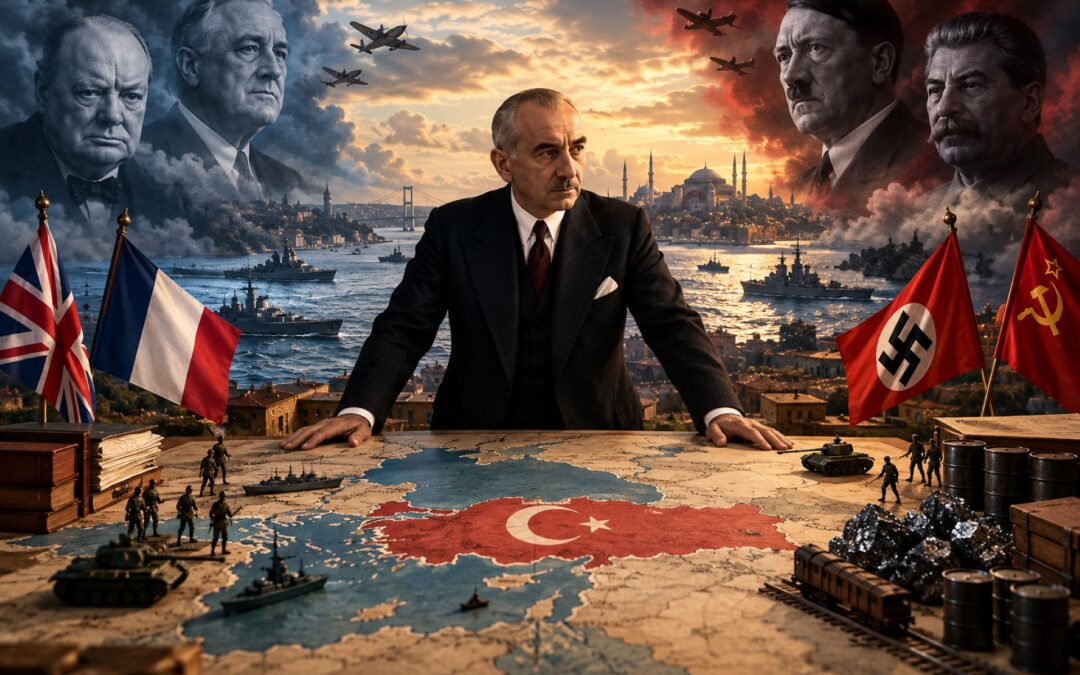
When World War II began in September 1939, Turkey occupied one of the most strategically important positions in Europe and the Middle East. It controlled the waterways connecting the Black Sea to the Mediterranean, stood between the Balkans and the oil-rich Middle East, and shared a long history of rivalry with Russia. Yet while German armies conquered much of Europe and the Soviet Union fought for its survival, Turkey managed to avoid entering the fighting.
Its position was more complicated than simple neutrality. Turkey signed a mutual-assistance treaty with Britain and France in October 1939, maintained important commercial relationships with Nazi Germany, resisted Allied demands to join the fighting, and eventually declared war on Germany and Japan in February 1945. Despite that final declaration, Turkish forces never participated in the war’s major combat operations.
How did President İsmet İnönü’s government manage this balancing act when countries across Europe were being invaded, occupied, or forced to choose sides?
The answer lies in a combination of military weakness, strategic geography, careful diplomacy, economic bargaining, and the competing priorities of the great powers. Turkey’s leaders understood that their country could not afford another devastating war, but they also recognised that its geographical position gave them negotiating power. Their challenge was to exploit that advantage without provoking an invasion or becoming dangerously dependent on either side.
The Republic That Could Not Afford Another War
To understand Turkey’s position in 1939, it is necessary to examine the wars that preceded the republic’s foundation. Modern Turkey emerged from the ruins of the Ottoman Empire after more than a decade of almost continuous military conflict, territorial losses, political upheaval, and economic destruction.
In 1911, Italy attacked Ottoman possessions in North Africa, beginning the Italo-Turkish War. The Ottomans lost control of Libya, while Italy also occupied the Dodecanese islands in the Aegean Sea. Before the empire could recover, the Balkan Wars of 1912–1913 stripped it of most of its remaining European territories. Although Ottoman forces recovered some territory during the second conflict, the overall result was a dramatic reduction in the empire’s European presence.
The situation deteriorated further when the Ottoman Empire entered World War I alongside Germany and Austria-Hungary. Ottoman armies fought across multiple fronts, including the Caucasus, Mesopotamia, Palestine, the Arabian Peninsula, and Gallipoli. The conflict exhausted the empire’s resources and ended with its defeat in 1918, exposing its remaining territories to Allied occupation and competing territorial claims.
The subsequent Turkish War of Independence, fought principally between 1919 and 1922, brought further bloodshed. Turkish nationalists led by Mustafa Kemal resisted the postwar settlement and fought particularly important campaigns against Greek forces in western Anatolia. The struggle also involved military confrontations, territorial disputes, and negotiations with Armenia, France, Britain, Italy, and other powers, although these countries played different roles rather than participating in one unified invasion.
The nationalist victory transformed Turkey’s political future. Mustafa Kemal’s movement abolished the Ottoman sultanate in 1922, and the Treaty of Lausanne in 1923 established international recognition of the new Turkish state’s sovereignty. The Republic of Turkey was proclaimed that October, with Mustafa Kemal, later known as Atatürk, becoming its first president.
Atatürk’s government embarked on sweeping reforms intended to build a modern, secular, industrialising nation-state. These included changes to education, law, political institutions, language, and economic development. Rather than attempting to restore the Ottoman Empire’s former territories, the republic increasingly concentrated on consolidating its borders and strengthening its institutions.
Modernisation, however, required time and resources that Turkey did not possess in abundance. The country remained predominantly agricultural, with limited industrial capacity, inadequate transport infrastructure, and substantial dependence on imported machinery and military equipment. Its armed forces could defend Turkish territory, but they were not equipped to sustain a prolonged modern war against Europe’s strongest military powers.
Turkey’s difficulties were not simply a question of how many soldiers it possessed. Its forces could be expanded considerably through mobilisation, but increasing the number of men under arms did not automatically provide modern aircraft, tanks, artillery, motor vehicles, trained technical personnel, or the industrial capacity needed to replace battlefield losses. A large defensive army equipped with outdated weapons remained vulnerable to the kind of combined-arms warfare Germany had demonstrated in Europe.
When Atatürk died in November 1938, İsmet İnönü succeeded him as president. İnönü had served as a senior military commander during the struggle for Turkish independence and understood the consequences of military defeat. His government continued the republic’s commitment to national sovereignty and development while facing an increasingly dangerous international environment.
Turkey’s determination to avoid war was therefore grounded in experience rather than indifference. Another major conflict threatened to consume the resources needed for national reconstruction and risk the territorial independence the republic had fought to establish.
Turkey’s Strategic Geography Was Both Shield and Threat
Turkey’s geographical position made its neutrality valuable, but it also exposed the country to competing foreign ambitions. It occupied the southeastern approaches to Europe, bordered the Black Sea and the eastern Mediterranean, and connected the Balkans with Anatolia and the Middle East.
Its most important strategic assets were the Bosporus and the Dardanelles. These waterways connect the Black Sea to the Mediterranean through the Sea of Marmara, providing a vital route for maritime traffic between Russia’s southern coast and the wider world. Whoever controlled passage through these straits possessed significant influence over Black Sea naval operations and commercial access.
The 1936 Montreux Convention strengthened Turkey’s control over the waterways while establishing rules governing the passage of civilian vessels and warships. It imposed particularly important restrictions on naval vessels belonging to countries outside the Black Sea region and gave Turkey additional powers concerning belligerent warships during wartime.
The convention was not an unrestricted licence to close the waterways to all shipping whenever Ankara wished. Nevertheless, its provisions meant that Turkey’s decisions could influence the movement of foreign naval forces into and out of the Black Sea. That made Turkish cooperation or neutrality especially important to Germany, Britain, and the Soviet Union.
Turkey’s southern and eastern positions were similarly valuable. Access through Anatolia could potentially offer a route towards Syria, Iraq, and the oil-producing regions of the Middle East. Oil was essential for mechanised warfare, and German strategists were acutely aware of their country’s dependence on limited and vulnerable fuel supplies.
An Axis-controlled Turkey might also have threatened Allied positions in the eastern Mediterranean and complicated Britain’s ability to defend its regional communications and possessions. Conversely, a Turkey that remained outside Axis control denied Germany an easy overland route into strategically sensitive areas.
Italy presented another source of danger. Benito Mussolini’s government had expansionist ambitions in the Mediterranean, occupied the Dodecanese islands close to the Turkish coast, and invaded Albania in April 1939. Italian claims to regional dominance reminded Turkish policymakers that their western neighbours could threaten the republic’s security even without a direct German invasion.
The Soviet Union posed a different problem. Russian governments had long considered the Turkish Straits strategically important, and Ankara feared that Soviet demands for greater influence over them might compromise Turkish sovereignty. These concerns deepened after Germany and the Soviet Union signed their non-aggression pact in August 1939 and subsequently divided Poland.
Yet Turkey’s geography also complicated the calculations of potential attackers. Invading and occupying Anatolia would require substantial troops, equipment, transport capacity, and supply arrangements. Mountainous terrain, difficult communications, and the prospect of sustained Turkish resistance made conquest less straightforward than simply moving troops across a border.
This did not make Turkey invulnerable. German victories in the Balkans eventually brought Axis forces dangerously close, while Soviet military strength remained a serious concern. Geography gave Ankara some room to manoeuvre, but its leaders still needed diplomacy to prevent stronger powers from deciding that intervention was worth the cost.
The 1939 Alliance and the Decision to Stay Out in 1940
Turkey did not enter World War II with a policy of absolute neutrality already settled beyond question. In the months before and after Germany invaded Poland, Ankara moved closer to Britain and France because their interests appeared more compatible with Turkish security.
Italy’s activities in the Mediterranean were particularly important. Britain and France also wanted to prevent Turkey from falling under German influence, partly because German businesses occupied a prominent position in Turkish foreign trade. A cooperative Turkey could strengthen the Allied position in the eastern Mediterranean and discourage Axis expansion towards the Middle East.
The negotiations culminated in the Anglo-French-Turkish Treaty of Mutual Assistance, signed on October 19, 1939. Under the agreement, Turkey undertook certain obligations connected with aggression and warfare in the Mediterranean, while Britain and France promised military and political assistance under specified circumstances.
The treaty contained an important safeguard. Turkey was not required to fulfil obligations that would involve it in an armed conflict with the Soviet Union. Ankara had sought an understanding with Moscow, but negotiations proved unsuccessful, leaving Turkish leaders concerned about becoming entangled in a wider struggle involving their powerful northeastern neighbour.
The agreement therefore represented a qualified commitment to the Western powers rather than an unconditional willingness to fight Germany. Turkish leaders wanted security guarantees, access to weapons, and diplomatic support, but their ability to honour military commitments depended on circumstances that could change rapidly.
Those circumstances changed dramatically in 1940.
Germany conquered Denmark and Norway, invaded the Low Countries, and launched its devastating offensive against France. The speed of the German advance demonstrated the effectiveness of its armoured forces, air power, and coordinated operations against opponents who had been regarded as major European military powers.
Italy entered the war on June 10, 1940, expanding the conflict in the Mediterranean. This development brought the treaty’s Mediterranean obligations into immediate consideration, raising the question of whether Turkey should now enter the war against Italy.
But France was collapsing under German attack. Its government sought an armistice, which was signed on June 22 and took effect shortly afterward. Britain remained determined to fight, but its forces were stretched across several theatres, and the equipment Turkey had requested could not be supplied quickly enough to make Turkish participation militarily safe.
Ankara argued that fulfilling its commitments could expose the country to conflict with the Soviet Union, invoking the treaty’s protective provisions. Historians differ over the relative importance of this legal argument, Soviet fears, inadequate Allied assistance, and the shock of France’s defeat. These factors were interconnected rather than mutually exclusive.
The practical calculation was stark. Entering the war could invite German or Italian retaliation while leaving Turkey dependent on allies who were struggling to defend themselves. Remaining outside the fighting allowed Ankara to maintain its army, protect its territory, and reconsider its position as events developed.
Turkey consequently adopted a policy of non-belligerency, despite its continuing formal relationship with Britain and France. This distinction mattered because Ankara had not become an Axis ally, but neither was it prepared to fight for the Allied cause simply because the treaty had anticipated circumstances that now existed.
The decision reflected a broader lesson from the rapid transformation of World War II in 1940: diplomatic promises could not overcome military realities. For İnönü, an alliance that did not provide the means to defend Turkey offered little protection against the consequences of entering the conflict.
When Hitler’s Armies Reached Turkey’s Border
Turkey’s situation became more dangerous in the spring of 1941, when German forces swept through southeastern Europe. Germany invaded Yugoslavia and Greece in April, while Bulgaria had already joined the Axis powers and permitted German military operations from its territory.
The campaign brought Germany into a position from which it could directly threaten European Turkey. German forces were now operating across much of the Balkans, and Turkish policymakers had to consider the possibility that Hitler might attempt to force Ankara into cooperation or invade if cooperation was refused.
Developments in the Middle East increased the pressure. In April 1941, a pro-Axis government led by Rashid Ali al-Gaylani came to power in Iraq, creating an opportunity for Germany to weaken Britain’s regional position. The Germans explored ways to assist the Iraqi government, including moving military equipment towards the region.
Turkey’s territory offered a potentially useful route, but Ankara resisted arrangements that would compromise its sovereignty or non-belligerent position. German diplomacy included proposals involving the passage of military supplies, while wider discussions raised the possibility of territorial concessions and Turkish cooperation.
These negotiations should not be confused with an agreement permitting German armies to march freely through Turkey. The distinction between transporting military material and allowing foreign combat forces to cross Turkish territory was fundamental to Ankara’s position. Either development could carry substantial political risks, but a general right of troop transit would have created a far more serious threat to Turkish independence.
The government’s resistance was consistent with the concerns reflected in contemporary American diplomatic correspondence, which documented Turkey’s determination to protect its sovereignty while facing pressure from the belligerent powers.
Germany also faced practical limits. Moving large military formations through Turkey would require extensive logistical preparations, secure supply routes, and either Turkish consent or the military resources necessary to overcome resistance. At a time when Hitler was preparing an enormous offensive against the Soviet Union, another potentially prolonged campaign carried substantial costs.
Meanwhile, Britain’s position in the Middle East improved. British and Allied forces defeated the pro-Axis Iraqi government and subsequently moved against Vichy French-controlled Syria and Lebanon, reducing Germany’s opportunities to exploit those territories.
Turkey nevertheless remained vulnerable to German coercion. On June 18, 1941, Ankara signed a Treaty of Friendship with Germany, affirming peaceful relations between the two countries. The agreement helped reduce the immediate danger of confrontation, but it did not transform Turkey into an Axis member or require participation in German military operations.
Just four days later, on June 22, Germany launched Operation Barbarossa, its invasion of the Soviet Union.
The invasion fundamentally changed the European war. Germany and the Soviet Union, which had cooperated under the 1939 non-aggression pact, were now fighting one another. The Soviet Union became an Allied power, creating new strategic possibilities and complications for Turkey.
For Ankara, the change was not an uncomplicated relief. Germany’s principal military effort shifted towards the Soviet Union, which could reduce the incentive to invade Turkey. However, Turkish policymakers still feared Soviet ambitions, and a decisive victory by either side could produce new dangers.
A successful German conquest of the Soviet Union might leave Turkey facing an overwhelmingly powerful Axis empire. A Soviet victory could strengthen a country whose interests in the Turkish Straits had long caused anxiety in Ankara.
Turkey therefore continued its balancing strategy. Its objective was not to predict which ideological system would prevail but to prevent either outcome from destroying Turkish independence.
Chromite, Arms, and Trading With Both Sides
Military diplomacy was only one part of Turkey’s wartime strategy. Economic relations provided Ankara with another means of maintaining influence over Germany and the Allied powers, although those relationships also created serious ethical and strategic complications.
Germany had been an important trading partner throughout the 1930s. German companies purchased Turkish agricultural products and minerals, while Turkey imported industrial machinery, manufactured goods, and military equipment. These commercial relationships made it difficult for Ankara to abandon German trade without significant economic consequences.
One particularly important Turkish export was chromite, the principal ore from which chromium is obtained. Chromium is used in producing specialised alloy steels, including materials valuable for military manufacturing because of their hardness, strength, and resistance to wear or corrosion. Access to these materials was important to Germany’s war industries.
Germany sought to preserve its access to Turkish chromite, while Britain and its allies attempted to prevent strategically valuable supplies from reaching German manufacturers. Both sides recognised that economic agreements could influence Ankara without requiring Turkey to enter the war.
The British pursued purchasing arrangements intended partly to secure Turkish production and partly to deny it to Germany. Such purchases were a form of economic warfare: a government could reduce an opponent’s access to strategic materials by buying those materials itself, sometimes even when immediate domestic demand was limited.
Germany offered its own incentives. Under the commercial agreement associated with German negotiator Karl Clodius in October 1941, Turkey agreed to supply chromite under arrangements linked to German trade and deliveries of equipment. Significant shipments to Germany resumed in 1943.
Contemporary reports indicate that approximately 47,000 tons of Turkish chrome ore reached Germany during 1943. The importance of those supplies is clear, although estimates of Germany’s dependence vary depending on whether the source measures total consumption, imports, particular grades, or requirements for specific industrial purposes.
The US Foreign Economic Administration’s wartime reporting demonstrates how seriously the Allies regarded the problem. Allied governments attempted to restrict German access through purchasing agreements, commercial negotiations, and pressure on neutral suppliers.
For Turkey, the trade served several purposes. It generated export revenue, sustained commercial relationships, and provided opportunities to obtain equipment that Turkish industry could not readily manufacture. Ankara also hoped that maintaining economic connections with Germany would reduce the risk of provoking hostility from Berlin.
At the same time, Turkey continued dealing with Britain and the other Allies. Its policymakers sought military assistance, financial support, and commercial agreements without accepting the corresponding demand to become an active participant in the war.
This was not neutrality in the sense of maintaining identical relationships with every belligerent. The nature and extent of Turkish cooperation differed across countries and changed as the war developed. German purchases of chromite could assist Axis military production even while Turkish diplomacy prevented German troops from entering the country.
That contradiction became increasingly difficult to sustain as the Allies gained the advantage. Britain and the United States were unwilling to treat Turkish neutrality as an unlimited justification for supplying Germany with materials considered essential to the war effort.
Nevertheless, economic bargaining gave Turkey leverage that military strength alone could not provide. Ankara’s resources and commercial relationships mattered to both sides, allowing the government to negotiate from a position more advantageous than its military capabilities might suggest.
Why Churchill Could Not Persuade İnönü to Fight
By 1943, the strategic environment had changed dramatically. Germany had suffered a catastrophic defeat at Stalingrad, Axis forces were losing their position in North Africa, and the Allies were preparing further operations in the Mediterranean.
British Prime Minister Winston Churchill increasingly wanted Turkey to enter the war. Turkish participation might enable operations against Axis positions in southeastern Europe, provide additional airfields, and potentially improve Allied access to the Black Sea.
Churchill also viewed the Balkans as a region where military operations could place new pressure on Germany. A Turkish contribution might complicate Axis defences and create opportunities beyond the Mediterranean campaigns already underway.
For İnönü, however, the military consequences remained alarming. Germany still possessed substantial forces and aircraft in southeastern Europe, and the Turkish army remained inadequately equipped for a prolonged modern campaign. An Allied promise of assistance was valuable only if that assistance could arrive before German retaliation.
Churchill met İnönü near Adana in January 1943. Their discussions addressed Turkey’s possible participation and the military assistance required to make it feasible. Britain hoped to encourage Turkish cooperation, but İnönü insisted that Turkey could not expose itself to German attack without substantial preparation.
Turkey’s objections were specific rather than merely rhetorical. Its air defences were inadequate, its army lacked sufficient modern equipment, and the transport system could struggle to support major Allied operations. German air attacks against Turkish cities, military installations, ports, and railways could inflict serious damage before Britain and its allies were able to provide effective protection.
These concerns were not eliminated by Allied victories elsewhere. Germany’s military position might be deteriorating overall, but German forces in the Balkans could still pose a formidable regional threat. The fact that the Allies were winning did not necessarily mean Turkey could safely begin fighting.
American and British strategic priorities also differed. Churchill favoured additional opportunities for pressure in the Mediterranean and southeastern Europe, while American military leaders were concerned about diverting aircraft, shipping, equipment, and troops from operations regarded as more decisive.
The planned invasion of northwest Europe was particularly important to American strategy. A major new commitment through Turkey could compete for resources needed elsewhere, even if the operation appeared promising from a British perspective.
These disagreements should not be reduced to a simple struggle over which Western power would dominate the Balkans. Political influence mattered, but the arguments also concerned logistics, military feasibility, timing, and the allocation of scarce resources.
The Soviet position was equally complicated. Moscow wanted Germany defeated as quickly as possible and was often interested in operations that could divert German forces from the Eastern Front. At the same time, Soviet leaders were conscious of the political consequences of Western military influence in southeastern Europe.
Soviet attitudes towards Turkish participation therefore changed with circumstances and cannot be described as consistently identical to American opposition to Balkan operations.
The diplomatic pressure intensified later in 1943. Roosevelt, Churchill, and İnönü met in Cairo in December, where the Allies again pressed Turkey to participate more actively in the war.
The records of the Cairo Conference discussions reveal the central disagreement. The Allied leaders regarded Turkish participation as strategically desirable, while İnönü emphasised that Turkey needed the military means to defend itself before accepting the consequences of belligerency.
Turkey wanted equipment, trained personnel, air protection, and credible guarantees that Allied military preparations would be sufficient. These requirements were difficult to reconcile with the Allies’ competing commitments and the urgency with which Churchill hoped to develop operations.
The issue was not simply whether Turkey possessed enough courage or political goodwill to join the Allies. Once Turkey entered the war, its territory could become a legitimate target for German military operations. Ankara would then be responsible for protecting its population, infrastructure, and armed forces against an opponent still capable of inflicting substantial destruction.
For İnönü, remaining outside the fighting preserved an important degree of control over events. Joining the war might place Turkey’s security in the hands of Allied commanders whose priorities extended far beyond the defence of Turkish territory.
Ankara’s position also made it a centre of wartime diplomacy and espionage. German, British, American, Soviet, and other representatives sought intelligence about Turkish policy and the intentions of rival governments. One extraordinary example was Elyesa Bazna, the German spy known as Cicero, who obtained sensitive British diplomatic documents while working in the British ambassador’s household.
The Cicero affair illustrated how valuable information about Allied negotiations and Turkish intentions had become. It also reflected the unusual diplomatic environment created by a country that maintained relations with opposing powers while resisting demands to join either side militarily.
Ultimately, the Allied conferences did not produce the Turkish entry into the war that Churchill wanted. The promised military preparations remained difficult, Ankara continued to insist on its security requirements, and the Allied strategic situation evolved without the opening of a major front through Turkey.
By the time the Allies possessed greater freedom to act, Turkey’s participation was becoming less essential to the defeat of Germany.
Germany’s Defeat and Turkey’s Late Declaration of War
The balance of power shifted decisively in 1944. The Soviet Union was advancing westward, the Western Allies were operating in Italy and preparing the invasion of France, and Germany’s military position was becoming increasingly difficult to sustain.
Turkey could no longer exercise the same diplomatic leverage it had enjoyed when both sides regarded its allegiance as potentially decisive. The Allies had developed alternative routes to victory, while Germany’s ability to threaten Turkish territory was gradually diminishing.
At the same time, Allied governments became increasingly unwilling to tolerate Turkey’s strategic trade with Germany. British and American officials exerted pressure over chromite exports and warned that continued commercial assistance to the Axis could damage Turkey’s relationship with the powers likely to shape the postwar settlement.
In April 1944, Turkey stopped exporting chromite to Germany. This was an important step, but it should not be confused with the termination of all commercial and diplomatic relations. The broader break occurred in August 1944, when Ankara severed relations with Germany as the Axis position continued to deteriorate.
These decisions reflected both the changing military situation and the growing costs of appearing insufficiently cooperative with the Allies. Turkey’s government increasingly recognised that its postwar security would depend partly on its relationship with the victorious powers.
By early 1945, Germany’s defeat was approaching. The diplomatic question was no longer whether Turkey’s entry could substantially influence the outcome of the war, but whether Turkey would be included in the institutions and arrangements being established for the postwar world.
The emerging United Nations was particularly important. Governments planning the founding conference at San Francisco established eligibility requirements that included participation in the wartime coalition or declarations of war against the common enemy by the specified deadline.
As described in the United Nations’ account of its preparatory years, the wartime alliance provided the foundation for the organisation that would replace the League of Nations.
Turkey declared war on Germany and Japan on February 23, 1945, shortly before the relevant March 1 deadline. The declaration established Turkey’s formal position among the countries opposing the Axis and supported its participation in the United Nations’ founding process.
It did not lead to a Turkish military campaign against Germany or Japan. Turkish troops were not deployed to participate in the final Allied offensives, and the declaration came too late to alter the military outcome of the conflict.
Turkey subsequently became one of the founding members of the United Nations. Its diplomatic position had changed from maintaining non-belligerency during most of the war to formally joining the victorious coalition at the point when the international order was being reconstructed.
This transition was pragmatic rather than sudden. Throughout the conflict, Ankara had sought to preserve its independence and maintain relationships that would protect the country against future threats. By 1945, the circumstances required a different diplomatic alignment from the one that had served Turkey in 1940 or 1941.
What Neutrality Cost Turkey—and What It Could Not Prevent
Turkey’s achievement in avoiding combat was substantial, particularly when compared with the destruction experienced across occupied Europe. Its cities were not subjected to the sustained aerial bombardment suffered by many belligerent countries, and its armed forces did not experience the enormous battlefield casualties associated with the major campaigns.
However, remaining outside the fighting did not mean that Turkey escaped the war’s consequences. The government maintained extensive military mobilisation because it could not assume that neutrality would be respected indefinitely. Keeping large numbers of men under arms imposed heavy demands on the economy, even when those soldiers were not fighting.
Mobilisation removed workers from agriculture and other productive activities, while defence spending consumed resources that might otherwise have supported development. Import difficulties and disruptions to international trade restricted access to essential materials and manufactured goods.
Shortages, inflation, and pressures on food supplies affected civilian life. Turkey’s economy was already relatively underdeveloped, and prolonged wartime uncertainty made its existing weaknesses more difficult to overcome. The country’s ability to protect its borders did not prevent ordinary households from experiencing considerable hardship.
Domestic policy also created suffering that cannot be attributed simply to unavoidable wartime shortages. In 1942, the Turkish government introduced the Wealth Tax, or Varlık Vergisi, ostensibly to raise revenue and address wartime economic problems.
In practice, the tax was implemented in a discriminatory manner that imposed exceptionally heavy burdens on many non-Muslim citizens, including Armenian, Greek, and Jewish business owners. Assessments could be punitive, and those unable to pay faced severe consequences, including the loss of property and livelihoods.
Research into the 1942 Wealth Tax and the disappearance of non-Muslim enterprises has examined the policy’s lasting economic effects. The episode demonstrates that the Turkish state’s successful avoidance of external warfare did not ensure fair or humane treatment for everyone living within its borders.
The economic costs of neutrality should therefore be distinguished from the benefits of avoiding military destruction. Turkey was spared an invasion and large-scale battlefield casualties, but its population still experienced wartime deprivation, coercive mobilisation, and discriminatory government measures.
The international consequences were equally complicated. During the war, Ankara had attempted to avoid domination by either Germany or the Soviet Union. Germany’s defeat removed one immediate threat, but the Soviet Union emerged from the conflict as a far more powerful military and political force.
Soviet leaders renewed pressure concerning the Turkish Straits and raised demands affecting Turkey’s security arrangements and territorial position. These developments revived Ankara’s longstanding fears that a stronger neighbour might seek concessions at the expense of Turkish sovereignty.
Turkey’s wartime diplomacy had succeeded partly because Germany and the Soviet Union were preoccupied with fighting one another. Once that struggle ended, Turkey had to confront a different balance of power in which Soviet influence extended across much of eastern Europe.
This helps explain why Turkey subsequently moved closer to Britain and the United States. As the confrontation between the Western powers and the Soviet Union developed into the Cold War, Turkey increasingly regarded Western security cooperation as essential to protecting its independence.
That orientation eventually culminated in Turkey joining NATO in 1952. The decision represented a major shift from the flexible non-belligerency of World War II towards a formal military alliance, but the underlying concern for national security and territorial sovereignty remained consistent.
Turkey’s wartime success must consequently be understood in its historical context. İnönü had managed to prevent the republic from becoming a battlefield during a global conflict, but he had not eliminated the geographical vulnerabilities or international rivalries that threatened Turkish security.
The government had avoided one catastrophe without acquiring permanent freedom from great-power pressure.
Turkey remained outside the fighting in World War II because its leaders consistently placed national survival above the demands of the belligerent powers. The country’s military limitations made active participation dangerous, while its strategic geography gave Britain, Germany, and the Soviet Union reasons to influence Ankara rather than necessarily invade it. İnönü used treaties, commercial relationships, military preparations, and carefully qualified commitments to preserve room for manoeuvre as the war evolved.
Neutrality was therefore neither passive isolation nor a guaranteed product of geography. It was an adaptive diplomatic strategy that succeeded partly because the competing powers had other priorities and partly because Turkish leaders understood the risks of surrendering control over their country’s decisions.
The result was a significant achievement: Turkey emerged from World War II with its territorial independence intact and without participating in the great military campaigns that devastated much of Europe. Yet its economy had suffered, sections of its population had endured serious injustice, and Soviet pressure soon forced Ankara to reconsider its international position.
Turkey did not escape history. It avoided the battlefield while navigating the political and economic consequences of a war that transformed the world around it.
Last Updated on October 29, 2026 by Aseem Gupta