
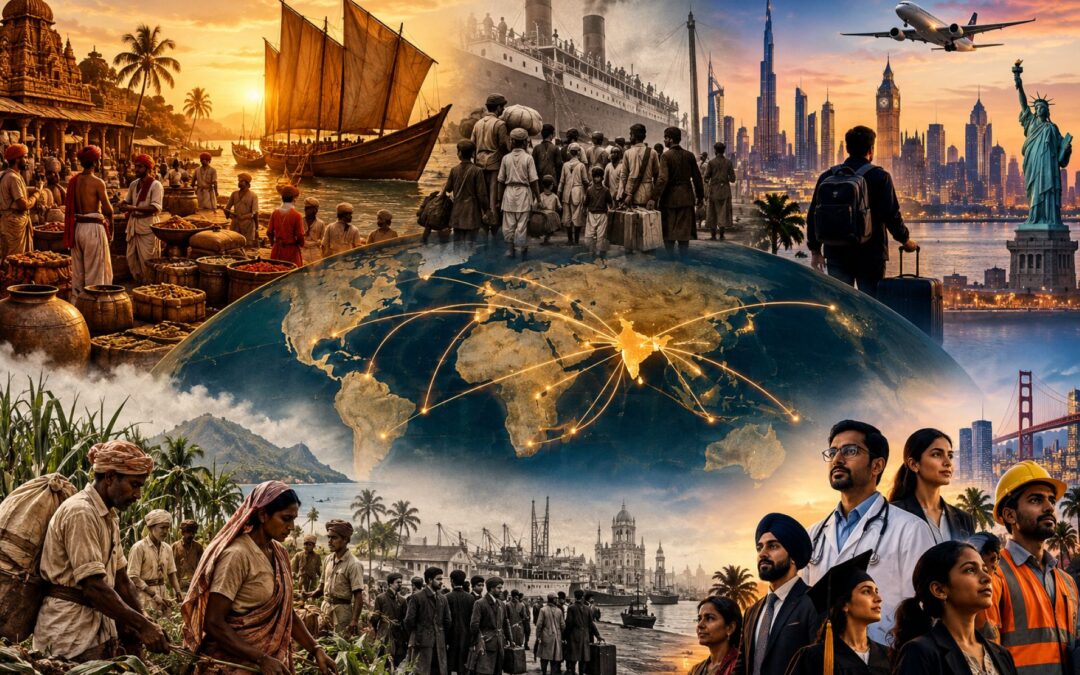
In Mauritius, descendants of Indian plantation workers form a central part of the country’s society. In Trinidad and Guyana, communities with Indian ancestry have developed distinctive languages, cuisines, religious traditions, and political identities. In Dubai, Indian expatriates help sustain an economy built around international labour, while in the United States, Indian professionals have become prominent in technology, medicine, business, and academia.
These communities share ancestral connections to the Indian subcontinent, but their histories are remarkably different. Some descend from merchants who crossed the Indian Ocean centuries ago. Others trace their roots to labourers transported across the British Empire, families displaced by political upheaval, or professionals who migrated voluntarily in search of opportunities.
According to India’s Ministry of External Affairs, approximately 34.36 million overseas Indians were recorded in January 2025, including Indian nationals living abroad and people of Indian origin. This makes India one of the world’s most significant sources of international migration and ancestral diaspora communities. The figure is broader than a count of Indian-born migrants because it includes descendants whose families may have lived outside India for generations.
How did people from one subcontinent become established in so many different parts of the world?
The answer stretches across two thousand years of maritime commerce, European imperial expansion, forced and contracted labour, independence movements, political expulsions, and economic migration. The history of the Indian diaspora is not the story of one great exodus. It is the accumulated result of several migration systems, each creating communities shaped by the circumstances under which their ancestors left.
Before the Empires: Migration in the Indian Ocean World
Long before European ships arrived in Asia, the Indian subcontinent occupied a central position in an extensive commercial network connecting East Africa, Arabia, Persia, South Asia, and Southeast Asia. Merchants transported textiles, spices, precious stones, metals, and other commodities through ports that connected inland production centres with overseas markets.
These networks developed over centuries, supported by geographical advantages and accumulated navigational knowledge. Seasonal monsoon winds made regular voyages across the Arabian Sea and Bay of Bengal possible. Sailors could travel during favourable winds, conduct business abroad, and return when the seasonal patterns changed.
Western Indian ports maintained commercial relationships with the Persian Gulf, Arabian Peninsula, and East African coast. On the eastern side of the subcontinent, merchants from regions such as Kalinga and the Tamil coast participated in trade extending toward Sri Lanka, the Malay Peninsula, Sumatra, and other Southeast Asian destinations.
These journeys did more than transport merchandise. Traders established relationships with local authorities, religious communities, and commercial partners. Some spent months or years overseas, while others settled permanently, married into local societies, and raised families whose identities gradually combined different cultural traditions.
Trade also created opportunities for religious and intellectual exchange. Hindu and Buddhist traditions travelled eastward through merchants, monks, scholars, and religious specialists. Sanskrit, Indic writing systems, religious imagery, and political concepts became influential in several Southeast Asian kingdoms.
However, the spread of these traditions should not be confused with the establishment of Indian colonies or the displacement of indigenous cultures. As explored in the history of Indian cultural exchange with Southeast Asia, local rulers and communities selectively adopted foreign ideas, adapting them to their own political institutions, religious practices, and cultural environments.
Kingdoms such as Funan, Champa, and Srivijaya developed through indigenous political and economic processes while participating in wider networks of cultural exchange. Their rulers sometimes employed Sanskrit inscriptions, supported Hindu or Buddhist institutions, and cultivated relationships with merchants and religious specialists from South Asia. Yet these societies remained distinctly Southeast Asian rather than becoming extensions of an Indian homeland.
Later, Muslim merchants from the Indian subcontinent also participated in the commercial networks through which Islam spread around the Indian Ocean. South Asian traders contributed to religious and cultural connections in Southeast Asia alongside Arab, Persian, and local merchants, scholars, and religious teachers. The growth of Muslim communities in places such as Indonesia and Malaysia resulted from these overlapping relationships and the choices made by local rulers and populations, not from a single movement originating in India.
The Indian Ocean also supported trading communities along the Swahili coast and around the Persian Gulf. Merchant families, especially those connected to western India, developed commercial relationships that linked African, Arabian, and South Asian markets. Some established enduring overseas connections, although the composition and continuity of individual communities varied considerably.
Much of this early migration was circular rather than permanent. A merchant might spend several trading seasons overseas before returning home, while another could establish a household abroad and gradually become integrated into the surrounding society. Over generations, some descendants retained identifiable connections to South Asia, whereas others assimilated into local populations.
This distinction matters because cultural influence does not necessarily indicate the existence of a recognisable diaspora. A Southeast Asian temple influenced by Indian religious traditions is evidence of cultural exchange, but it does not establish that its builders were Indian migrants or that their descendants maintained an Indian identity.
Nevertheless, these early networks created routes, commercial relationships, and traditions of mobility that would remain important for centuries. The Indian subcontinent was already connected to a wider world long before European empires transformed the scale and organisation of overseas migration.
How Colonial Rule Turned Movement into a Global System
European involvement in the Indian Ocean began with commercial ambitions rather than a coordinated plan to redistribute the subcontinent’s population. Spices and other Asian commodities were extremely valuable in European markets, encouraging maritime powers to seek direct access to the trading networks that already connected Asian and African merchants.
In 1498, Vasco da Gama reached Calicut after sailing around Africa. The Portuguese subsequently established fortified settlements and maritime strongholds, including Goa, which they captured in 1510. Their naval power allowed them to interfere with established trading networks, but they did not suddenly replace the merchants who had operated across the Indian Ocean for centuries.
The Dutch, English, and French followed, establishing competing commercial enterprises and coastal trading settlements. One organisation would eventually become especially important: the English East India Company, chartered in 1600.
The Company initially sought profits from Asian commerce. Over time, however, its commercial interests became increasingly entangled with military intervention, territorial expansion, and the collection of revenue. Its transformation from a trading enterprise into a territorial power, examined in the history of the East India Company’s expansion from trade into conquest, fundamentally changed Britain’s relationship with India.
By the nineteenth century, the Company had established direct or indirect control over much of the subcontinent. Following the uprising of 1857, the British Crown assumed direct responsibility for governing the Company’s Indian territories in 1858.
Colonial rule increasingly connected India with British territories across Asia, Africa, the Caribbean, and the Pacific. Administrative institutions, shipping routes, military establishments, legal arrangements, and commercial networks enabled people and resources to move between possessions that had previously maintained very different relationships with the subcontinent.
These connections were not simply extensions of earlier voluntary trade. Colonial authorities could recruit workers, transport soldiers, appoint officials, regulate movement, and reorganise local economies according to imperial priorities. Indian merchants continued to pursue commercial opportunities, but the empire also developed systems that moved large numbers of people under conditions shaped by poverty, inequality, restricted choices, and coercive labour arrangements.
The most consequential transformation came when European plantation economies began searching for new sources of workers after the abolition of slavery.
Indenture: From Mauritius to the Caribbean, Africa and Fiji
During the eighteenth and early nineteenth centuries, plantation economies across the Caribbean and other colonial regions depended heavily on enslaved African labour. Sugar production generated enormous profits for plantation owners, merchants, and imperial governments, while enslaved people endured violent exploitation and the denial of fundamental freedoms.
Britain passed the Slavery Abolition Act in 1833, with emancipation taking effect across most of its colonies in 1834. The transition was not immediate or uniform, since an apprenticeship system continued to constrain many formerly enslaved workers until 1838. Nevertheless, emancipation changed the labour arrangements on which plantation economies had depended.
Plantation owners wanted a workforce that could sustain production without surrendering the degree of control they had previously exercised over enslaved labourers. Colonial authorities increasingly looked toward India, where poverty, debt, agricultural insecurity, and the availability of large rural populations created conditions in which people might accept contracts for work overseas.
The resulting indenture system became one of the most important mechanisms in the formation of the modern Indian diaspora.
Under indenture, workers entered into contracts requiring them to labour for a specified period, commonly five years. Agreements usually promised wages and set out conditions relating to employment, accommodation, and sometimes eventual return passage. In principle, indentured workers possessed legal rights that distinguished their position from that of enslaved people.
In practice, the system frequently exposed workers to severe exploitation. Recruiters could misrepresent destinations, wages, and working conditions, while some prospective labourers had little meaningful understanding of the distances involved or the restrictions they would face. Others accepted contracts because economic desperation made overseas employment appear preferable to remaining at home.
Once workers arrived, plantation regulations, penalties for breaches of contract, restrictions on movement, and dependence on employers could make leaving an abusive situation extremely difficult. The legal distinction between indenture and slavery was real, but it did not prevent coercion, harsh discipline, or serious inequalities of power.
Mauritius became an early testing ground for this system. The British began experimenting with Indian indentured labour there in 1834, before recruitment expanded to other plantation colonies. The island’s Aapravasi Ghat immigration depot, constructed in 1849, later became a major point of arrival for indentured workers and now stands as a UNESCO World Heritage Site.
Mauritius was particularly significant because Indian migration developed into a lasting demographic transformation. Many labourers remained after completing their contracts, established families, and developed communities that preserved and adapted languages, religions, and social traditions associated with their ancestral regions. Their descendants eventually became a central part of Mauritian society.
The experiment spread across the Atlantic. In 1838, Indian indentured workers began arriving in British Guiana, now Guyana. Recruitment subsequently expanded to other Caribbean destinations, including Trinidad and Jamaica, where plantation owners sought workers for sugar cultivation and related agricultural activities.
Many recruits came from northern India, particularly regions associated with present-day Uttar Pradesh and Bihar, although workers also originated elsewhere. They brought languages such as Bhojpuri and Awadhi, religious practices, food traditions, music, and family customs that changed over generations in their new environments.
The experience of migration varied widely. Some workers eventually returned to India, while others accepted additional contracts, acquired land where opportunities existed, or established permanent households. Their descendants became part of societies already shaped by Indigenous populations, African slavery, European colonisation, and other forms of migration.
This history explains the distinctive character of Indo-Caribbean cultures. Indian culinary traditions combined with locally available ingredients and regional tastes, while religious celebrations, music, and language evolved through contact with other communities. Indian ancestry remained important for many descendants, but their cultural identities became inseparable from Caribbean history.
Indentured migration also reached southern Africa. In 1860, the first Indian indentured workers arrived in Natal, in present-day South Africa, primarily to work in sugar plantations. Over the following decades, roughly 150,000 Indians were brought to Natal under indentured contracts, alongside other Indian migrants who arrived through different channels.
The South African experience developed within a particularly restrictive racial order. Colonial policies and later apartheid classified Indians as a distinct population group and imposed severe constraints on residential, political, and social life. These arrangements encouraged the maintenance of identifiable Indian communities but did not prevent cultural adaptation, interaction with other populations, or the development of distinctly South African identities.
Durban and its surrounding region became an important centre of Indian settlement. Over generations, descendants of indentured workers and later migrants established religious institutions, businesses, educational organisations, and political movements while confronting discriminatory laws.
Other European colonial powers adopted comparable labour arrangements. France abolished slavery in its colonies in 1848 and recruited Indian workers for territories including Réunion, Martinique, and Guadeloupe. The Netherlands also employed Indian indentured labour, particularly in Suriname, where recruitment began in the nineteenth century.
These movements were made possible through agreements with British authorities controlling recruitment from India. Their contractual arrangements and colonial circumstances differed, but they shared the broader objective of supplying plantation economies with workers whose labour could be tightly regulated.
In the Pacific, Fiji became another major destination. The islands were ceded to Britain in 1874, and Indian indentured workers began arriving in 1879 as colonial authorities developed plantation agriculture. The High Commission of India’s account of Indian migration to Fiji records approximately 60,553 arrivals between 1879 and 1916.
Fiji’s Indian labourers and their descendants became known through a migration history commonly associated with the term girmit, a local rendering of the English word agreement. The term girmitiya came to describe indentured workers whose contracts carried them across the oceans.
Indo-Fijian communities subsequently developed a distinctive identity, including Fiji Hindi, religious and cultural institutions, and traditions shaped by life in the Pacific. Their experience would later be transformed again by the political tensions of postcolonial Fiji.
Indian indenture as a government-sanctioned overseas recruitment system came to an end in 1917, although the termination of particular contracts and colonial arrangements followed different timelines. Fiji’s indenture system was formally abolished in 1920.
The larger historical consequences lasted far longer. Plantation systems had transported Indian workers to places thousands of kilometres from their ancestral homes, and many of their descendants would never migrate to India. Instead, they became members of new societies, carrying inherited cultural traditions while developing languages, political identities, and everyday practices rooted in their countries of birth.
The Indian diaspora that emerged through indenture was therefore not merely a population living temporarily overseas. It was a collection of permanent communities created through the interaction of colonial economic demands, unequal labour arrangements, individual choices, and generations of settlement.
The wider history of Britain’s plantation and imperial labour system helps explain why these migrations connected places as geographically distant as the Caribbean, southern Africa, and the Pacific.
Beyond Indenture: The Kangani System, Railways and Indian Merchants
Indenture was not the only colonial mechanism that moved Indians overseas. Across South and Southeast Asia, other recruitment arrangements connected rural communities with plantations, construction projects, ports, and commercial centres.
One important example was the Kangani system, particularly associated with labour recruitment from southern India to Ceylon, now Sri Lanka, and British Malaya. A kangani was commonly a supervisor or intermediary who recruited workers, often by returning to villages where personal relationships helped establish trust.
Unlike some of the highly formalised overseas indenture arrangements, Kangani recruitment frequently operated through existing social networks. A supervisor might recruit relatives, neighbours, or acquaintances by promising wages and employment abroad. The familiarity of the recruiter could make overseas migration appear less uncertain.
However, these relationships also created opportunities for exploitation. Travel expenses, advances, debts, and dependence on supervisors could place workers in vulnerable positions. A recruit who relied on the kangani for employment, accommodation, or access to wages might find it difficult to challenge unfair treatment.
Burma, now Myanmar, also attracted substantial migration from British India, but its labour recruitment arrangements were not identical. The maistry system, associated with labour contractors and intermediaries, developed in a different commercial and institutional environment. The distinctions among indenture, Kangani and Maistry recruitment systems are important because colonial migration did not operate through one uniform structure.
Indian migration to Ceylon, Malaya, Burma, and Singapore included more than plantation labourers. Workers found employment in ports, transport, construction, public services, and commercial enterprises. Merchants, clerks, moneylenders, and professionals also travelled through imperial networks, often building connections that facilitated further migration.
Different regional communities became associated with different industries and destinations, although these patterns were never exclusive. Tamil migrants were especially prominent in several South and Southeast Asian labour markets, while merchants from western and northern India participated in commercial networks extending into Africa and the Persian Gulf.
East Africa provides a particularly revealing example of how colonial infrastructure helped create lasting Indian communities.
In the 1890s, British authorities began constructing the Uganda Railway, intended to connect the port of Mombasa with the interior of East Africa. Building the railway required substantial labour, and colonial administrators recruited workers from British India, particularly from regions experienced in railway construction and related trades.
More than 30,000 Indian workers were employed over the course of the project, with historical records differing according to whether they count recruitment, total employment, or particular stages of construction. The British Online Archives’ account of Indian workers on the Uganda Railway documents the project’s role in connecting Indian labour migration with the development of British East Africa.
The working conditions were difficult and sometimes dangerous. Construction passed through demanding terrain, and workers faced disease, accidents, and other hazards. Some returned to India after completing their employment, while others remained and pursued opportunities created by the growing railway network.
Indian traders and entrepreneurs followed, establishing businesses in towns connected by transport routes. Clerks, artisans, shopkeepers, and professionals found work in the expanding colonial economy. Over time, Indian communities became important participants in commerce and administration across Kenya, Uganda, and neighbouring territories.
Their position was also shaped by imperial racial hierarchies. Colonial governments often treated Europeans, Asians, and indigenous Africans as separate categories, assigning different rights and opportunities to each. Indians could occupy economically important intermediate positions without possessing the political privileges enjoyed by European settlers.
These arrangements created lasting tensions. Indian commercial success in particular sectors sometimes reflected genuine entrepreneurship and extensive trading networks, but it also developed within colonial economies that distributed opportunities unequally.
The result was a diaspora with several overlapping origins: railway labourers, plantation workers, merchants, professionals, and families who migrated through existing community networks. Their descendants would eventually face the challenges created when the colonial political structures supporting those economies disappeared.
After 1947: Independence and the Move to Britain
Indian independence in 1947 marked a fundamental change in the political meaning of migration from the subcontinent.
Before independence, British India included territories that subsequently became India and Pakistan, with Bangladesh emerging as an independent country in 1971. Historical discussions of migration under the British Raj therefore concern people from a much larger colonial territory than the modern Republic of India.
Partition created new national identities and borders, accompanied by mass displacement and widespread violence within the subcontinent. Although these movements form a crucial part of South Asian migration history, they were different from the overseas communities that had developed through Indian Ocean commerce and colonial labour recruitment.
After 1947, India, Pakistan, and eventually Bangladesh developed distinct migration histories. The Indian diaspora in the modern national sense increasingly came to refer to Indian citizens living overseas and people whose ancestry connected them specifically to the Republic of India, although older communities often retained broader subcontinental identities.
Independence also raised a diplomatic question: what responsibility did India have toward overseas communities whose ancestors had left under colonial rule? In December 1947 talks with Ceylon’s prime minister, Jawaharlal Nehru addressed citizenship and political rights affecting people of Indian ancestry settled there. These discussions highlighted both India’s concern for overseas communities and the limits of its power over the laws of other countries.
Other postcolonial governments faced similar questions about minority rights, nationality and political participation. India’s diplomatic engagement could advocate fair treatment but could not automatically make foreign citizens Indian nationals or guarantee their rights abroad.
One early post-independence movement involved Anglo-Indians, a community historically associated with mixed Indian and European ancestry and particular roles in colonial institutions. Many Anglo-Indians worked in railways, government administration, education, and other occupations connected with British rule.
Independence transformed their social and political circumstances. Some remained in India and continued to participate in national life, while others emigrated to countries such as Britain, Australia, and Canada. Their decisions reflected employment prospects, family relationships, cultural affiliations, and concerns about their future in a changing political environment.
At the same time, Britain faced significant labour shortages following the Second World War. Reconstruction and the expansion of public services created demand for workers in factories, transport, healthcare, and other sectors.
The British Nationality Act 1948 established a new nationality framework involving citizenship of the United Kingdom and Colonies and the wider status of Commonwealth citizens. As explained in the British government’s historical background on nationality and citizenship, these arrangements developed during a period when imperial political relationships were being reorganised.
Many people from India and other Commonwealth territories could initially enter Britain under relatively permissive arrangements compared with those imposed later. Indian migrants sought employment and joined family or community networks, gradually establishing substantial populations in London, Leicester, Birmingham, and other industrial centres.
Factories, public transport services, and the National Health Service provided important employment opportunities. Established migrants could help relatives and acquaintances find accommodation and work, creating networks through which migration became easier for subsequent arrivals.
Yet the postwar settlement was politically contested. Commonwealth immigration restrictions began tightening in the 1960s, including through the Commonwealth Immigrants Act 1962, followed by further restrictions and changes to immigration and nationality law.
These reforms altered the conditions under which people could move to Britain. Nevertheless, family reunification, existing communities, and later immigration channels allowed British Indian populations to continue developing.
This movement was different from colonial indenture. Migrants were generally not being transported to overseas plantations under fixed labour contracts, although many encountered racial discrimination, insecure housing, occupational barriers, and hostility in their new surroundings.
Britain was also about to receive Indian-origin families whose journeys had begun elsewhere in the empire. Their migration would reveal a distinctive feature of the diaspora: some communities had to leave not one homeland, but two.
The Twice-Migrant Diaspora: Expulsions and New Homelands
The end of European colonial rule did not bring an end to Indian migration. In several regions, independence and political transformation placed established Indian-origin minorities in difficult positions, prompting families to move again.
These communities are sometimes described as twice migrants. Their ancestors had already moved from the Indian subcontinent to another country, often during the colonial period. Later generations then migrated from that country to a third destination, frequently under circumstances very different from those that had originally brought their families overseas.
The distinction is important because these migrants were not necessarily people who regarded India as their immediate homeland. Many had been born and raised in East Africa, the Caribbean, the Indian Ocean, or the Pacific, with family histories rooted in those societies for decades or generations.
Their subsequent migrations could involve losing a country they considered home.
One complicated example emerged from the Portuguese empire. Although India became independent in 1947, Portugal retained Goa, Daman, and Diu until December 1961, when Indian military action brought those territories under Indian control.
The confrontation also affected Indian communities in Portuguese-controlled Mozambique. Portuguese authorities subjected some Indian residents to restrictions and detention amid deteriorating relations with India. Citizenship, colonial identity, and connections to Goa became politically sensitive questions.
The upheaval surrounding Portugal’s later withdrawal from Mozambique generated another movement. Following the Portuguese revolution of 1974, Mozambique achieved independence in 1975. Political uncertainty and the transformation of colonial institutions encouraged some Indian-origin and Goan families to relocate, including to Portugal.
These experiences cannot be reduced to one expulsion policy. The circumstances of migration differed according to nationality, family connections, political developments, and economic prospects. Nevertheless, they illustrate how the collapse of imperial structures could unsettle communities that had lived overseas for generations.
A broader transformation occurred across East Africa during the 1960s.
As Kenya, Uganda, and Tanganyika gained independence, newly established governments confronted economies shaped by colonial racial divisions. European settlers and businesses had enjoyed substantial privileges, while Indian and other Asian communities occupied significant positions in trade, retail, and administration.
Independence created demands for economic opportunities and institutions to be brought under greater indigenous African control. Governments introduced various Africanisation policies affecting employment, business ownership, citizenship, and participation in particular industries.
These policies differed from country to country, and their effects were not uniform. They reflected legitimate grievances about colonial inequality, but they could also place Asian minorities under severe pressure, especially where citizenship rights were insecure or political leaders portrayed minorities as obstacles to national development.
Some Indian-origin families responded by leaving East Africa for Britain, Canada, or other countries. Others remained, negotiated new circumstances, and continued building their lives in independent African states.
Uganda experienced the most dramatic rupture.
In August 1972, President Idi Amin ordered the expulsion of much of the country’s Asian population, giving those affected approximately ninety days to leave. The policy developed through shifting distinctions involving citizenship and documentation, while exemptions and their implementation were often uncertain.
The expulsion affected tens of thousands of people. Families who had operated businesses, attended schools, and established homes in Uganda faced the loss of property, livelihoods, and communities within a remarkably short period.
Britain became a major destination for those displaced. Documents preserved by the UK National Archives on the 1972 expulsion of Ugandan Asians reveal the complicated questions of nationality, resettlement, and political responsibility surrounding the crisis.
Approximately 27,000 Ugandan Asians were admitted to Britain through the resettlement response, while thousands of others moved to Canada and additional destinations. The displacement became a defining event in the history of East African Asian communities.
For many families, the emotional reality was especially complex. Their ancestral connection to India did not necessarily mean that India was the country they had lost. Uganda was where they had grown up, worked, established relationships, and imagined their futures.
Their children and grandchildren would eventually develop identities shaped by Indian ancestry, East African family history, and life in Britain or another destination. The result was not simply an extension of the original colonial migration but a new layer added to it.
A related pattern appeared in Suriname.
Indian indentured workers had arrived in the Dutch colony during the nineteenth century, and their descendants became known as Hindustanis or Indo-Surinamese. Over generations, they developed distinctive cultural traditions, including the Sarnami language, while participating in Suriname’s increasingly diverse society.
When Suriname gained independence from the Netherlands in 1975, questions about citizenship, political stability, employment, and future opportunities influenced migration decisions. Many Surinamese residents moved to the Netherlands before and after independence.
Statistics Netherlands’ account of migration following Surinamese independence documents the scale of this movement. However, Surinamese migrants included several ethnic communities, and national migration totals should not be mistaken for statistics concerning Indo-Surinamese people alone.
For Indo-Surinamese families who relocated, the Netherlands became another home in a migration history that had begun with ancestors leaving India for South America.
Fiji experienced a further transformation toward the end of the twentieth century.
Descendants of Indian indentured workers had become a substantial share of the population, at times approaching half the country’s residents. Their political and economic position became entangled with disputes over land, indigenous political rights, representation, and the balance of power in the postcolonial state.
In 1987, military coups followed the election of a coalition government supported heavily by Indo-Fijian voters. The upheaval intensified fears about political exclusion and encouraged emigration among some Indo-Fijian families.
Another major crisis followed in 2000, when Mahendra Chaudhry, who had become Fiji’s first Indo-Fijian prime minister in 1999, was overthrown during a coup. Political instability contributed to continued migration, particularly toward Australia and New Zealand.
As Indo-Fijians emigrated and demographic patterns changed, their share of Fiji’s population declined. Nevertheless, Indo-Fijian communities remained an important part of the country’s social, economic, and cultural life.
These episodes show why the Indian diaspora cannot be understood exclusively through journeys beginning in India. For many people, migration involved leaving an overseas homeland where their families had already lived for generations.
They also reveal that political independence affected minority communities differently. Some gained new opportunities and greater representation, while others experienced insecurity, exclusion, or displacement. The diaspora’s later geography reflects those contrasting experiences.
Oil and Opportunity: The Gulf and the Skilled-Migration Boom
From the second half of the twentieth century, two additional migration patterns became increasingly important. Both involved economic opportunity, but they operated through very different employment systems, immigration policies, and possibilities for long-term settlement.
The first developed in the Persian Gulf.
The expansion of oil production and the surge in petroleum revenues during the 1970s accelerated economic development across countries such as Saudi Arabia, Kuwait, the United Arab Emirates, Qatar, and Oman. Governments and private enterprises invested heavily in roads, ports, airports, housing, industrial facilities, and public services.
These projects required far more workers than local labour markets could immediately supply. Employers recruited internationally, drawing workers from India and other Asian countries alongside migrants from elsewhere.
India already possessed commercial and historical connections with the Gulf, but the modern expansion of labour migration was driven primarily by the scale of economic development and demand for workers.
Indian migrants entered construction, transport, retail, hospitality, engineering, healthcare, administration, and numerous service industries. Some took physically demanding jobs with relatively low wages, while others worked in skilled occupations or established businesses.
The economic opportunities could be substantial compared with those available at home. Wages earned overseas helped families finance housing, education, healthcare, and other expenses in India, while remittances became an important economic connection between Gulf employment and Indian households.
However, the structure of Gulf migration created particular vulnerabilities.
In many Gulf countries, residence and employment have historically been closely linked through sponsorship arrangements commonly associated with the kafala system. Migrant workers may depend on employers or other sponsors for important aspects of their legal and employment status, although the precise rules and reforms vary among countries.
The International Labour Organization’s analysis of employment sponsorship and labour mobility helps explain how these arrangements can affect workers’ ability to change jobs, exercise employment rights, and negotiate working conditions.
Reforms in several Gulf states have altered aspects of these systems, but the broader distinction from many permanent-immigration destinations remains significant. Long-term residence and employment do not generally provide an automatic pathway to citizenship, and children born to foreign parents do not ordinarily receive nationality solely because of their birthplace, subject to each country’s laws and exceptions.
Consequently, a worker may spend decades in a Gulf country while retaining a legal and personal relationship with India that differs from the experience of someone who becomes a naturalised citizen elsewhere.
Cities such as Dubai illustrate the scale of these relationships. The history of Dubai’s development through expatriate labour shows how international workers became central to infrastructure, commerce, and services within a rapidly changing economy.
The Indian presence in the Gulf is therefore both economically important and internally diverse. It includes temporary workers, long-term residents, business owners, professionals, and families whose lives are spread across countries. Their experiences cannot be reduced either to stories of exploitation or to uncomplicated economic success.
The second major pattern involved migration toward the United States, Canada, Australia, and other countries increasingly willing to admit non-European immigrants.
After independence, India’s universities, technical institutes, medical colleges, and professional training institutions produced growing numbers of educated workers. English-language education and familiarity with institutional structures influenced by British rule helped some graduates participate in international employment markets.
Yet domestic opportunities did not always expand at the same pace as the supply of qualified professionals. Differences in wages, research facilities, career prospects, and access to advanced training encouraged people to seek opportunities abroad.
Changes in destination-country immigration policies were equally important.
In the United States, the Immigration and Nationality Act of 1965 dismantled the earlier national-origins quota system that had severely limited immigration from much of Asia. The reform expanded pathways connected with family relationships and employment preferences, enabling substantial changes in subsequent migration patterns.
Canada introduced a points-based immigration selection system in 1967, placing greater emphasis on criteria such as education, skills, and employability rather than explicit racial or national-origin preferences.
Australia progressively dismantled its White Australia policy, with major reforms completed in 1973. These changes helped create opportunities for migrants from India and other Asian countries, although the timing and conditions of immigration continued to depend on evolving national policies.
Indian doctors, engineers, scientists, academics, and other professionals increasingly established careers in these destinations. Some initially arrived as students or temporary workers before pursuing permanent residence, while others migrated through family or skilled-immigration channels.
The expansion of the American technology industry during the 1990s and 2000s created especially visible opportunities. Indian software engineers and other technical professionals became prominent in Silicon Valley and wider technology employment networks, supported by international recruitment, specialist visa arrangements, and educational pathways.
Over time, Indian-origin professionals also gained leadership roles in major corporations and other institutions. These achievements became an important part of the public image of the modern Indian diaspora.
However, professional success should not obscure the population’s diversity. Indian migration to Western countries includes workers in many occupations and income groups, while migrants’ experiences differ according to qualifications, legal status, family background, and the conditions of their arrival.
The contrast with the Gulf is revealing.
In several Western destinations, eligible migrants may eventually obtain permanent residence, naturalise, and raise children whose citizenship and identities are rooted in their new country. In Gulf states, migration has more often remained organised around expatriate employment and residence systems that do not routinely lead to naturalisation.
Neither pattern is absolute. Some Gulf residents establish remarkably enduring family and business connections, while temporary status and immigration insecurity also affect Indian workers in Western countries.
Nevertheless, the two systems have created different relationships between migrant communities and their destinations. One has often emphasised employment with limited prospects of citizenship, while the other has provided wider possibilities for permanent settlement and the emergence of new generations identifying as Indian-American, Indian-Canadian, or Indian-Australian.
Together, they explain much of the continuing expansion and diversity of India’s contemporary overseas population.
The Indian Diaspora Today: Size, Identity and Influence
By the twenty-first century, Indian-origin communities had become established across every inhabited continent. Their geographic distribution reflects the accumulated effects of centuries of commerce, colonial recruitment, political displacement, and more recent economic migration.
India’s January 2025 overseas-population estimates recorded approximately 34.36 million overseas Indians. The United States accounted for roughly 5.69 million people within the government’s combined categories of non-resident Indians and persons of Indian origin, while the United Arab Emirates accounted for approximately 3.90 million.
These figures require careful interpretation. Non-resident Indians are Indian citizens living outside India, whereas persons of Indian origin may possess another nationality while retaining qualifying ancestral connections. Such figures are therefore not interchangeable with statistics measuring people born in India who subsequently emigrated.
The labels also have different legal meanings. An NRI remains an Indian citizen while living abroad; non-residence is defined differently across legal contexts, including tax law. A person of Indian origin, or PIO, is a broader description of someone with Indian ancestry who may have another nationality. The distinction cannot be reduced to a universal 182-day rule.
India previously operated a PIO card scheme, which was merged into the Overseas Citizen of India framework on 9 January 2015, as explained in the Ministry of External Affairs’ guidance on overseas Indians. Being counted as a person of Indian origin is not the same as holding an OCI card.
Despite its name, OCI is not Indian dual citizenship. Eligible foreign nationals registered under the scheme receive long-term travel and residence privileges, but do not obtain an Indian passport, voting rights, or unrestricted eligibility for public office. The official OCI guidance describes these restrictions. An Indian citizen employed abroad, a naturalised Indian-American, and an Indo-Caribbean descendant of plantation workers may therefore have different legal relationships with India.
They also do not capture every possible ancestral connection to the historical subcontinent. Communities formed before modern national borders may possess identities that cannot be neatly assigned to contemporary citizenship categories.
The demographic scale is significant, but the differences among communities are equally important.
For descendants of indentured workers in Mauritius, Guyana, Trinidad, and Fiji, Indian ancestry may be separated from the original migration by several generations. Their languages, cuisines, political histories, and everyday cultural practices have evolved within their own societies, creating identities that are simultaneously connected to India and rooted elsewhere.
For Indian-origin families whose ancestors settled in East Africa before moving to Britain or Canada, identity may incorporate experiences across three regions. The inherited history of Indian migration, the memory of life in Africa, and participation in a new Western society can all remain meaningful.
For Indian expatriates in the Gulf, connections to India may be sustained through citizenship, regular travel, family responsibilities, financial commitments, and expectations about eventual residence or retirement. Even long-established communities may maintain a different relationship with their host country’s citizenship institutions.
In the United States, Canada, Australia, and Britain, Indian-origin populations include both recent migrants and people born abroad whose relationships with India range from intensive family and cultural engagement to more distant ancestral identification.
These differences challenge the idea that the Indian diaspora possesses one uniform culture, political outlook, or experience of migration.
Language offers a revealing example. Bhojpuri-derived traditions survived and evolved in parts of the Caribbean, Fiji Hindi developed in the Pacific, and Sarnami became an important language among Indo-Surinamese communities. These languages reflect adaptation rather than the unchanged preservation of an ancestral homeland.
Religious practices followed similar patterns. Hinduism, Islam, Sikhism, Christianity, and other traditions became part of different diaspora settings, sometimes developing distinctive institutions and expressions through interaction with surrounding societies.
The diaspora has also become important economically.
Remittances sent by overseas workers support households in India and contribute to the country’s foreign-exchange receipts. The World Bank’s estimates of remittance flows in 2024 placed India among the world’s leading remittance recipients, reflecting the scale of international financial connections maintained by migrants.
According to India’s Economic Survey 2025–26, remittance inflows reached approximately $135.4 billion in the financial year 2024–25. This is a figure for a specified reporting period, not a timeless annual total or proof that every member of the diaspora sends money to India.
However, remittances are not simply an expression of cultural loyalty. They often represent wages transferred to support dependants, repay debts, finance education, or sustain families across borders. Their importance differs greatly between households relying on overseas earnings and families whose connections to India are primarily ancestral or cultural.
Indian-origin communities also influence research, business, technology, politics, education, and cultural production in their countries of residence. In the United States, for example, Pew Research Center’s demographic profile of Indian Americans documents relatively high levels of educational attainment and household income within the population.
Yet averages and prominent success stories do not describe every individual. Differences in immigration pathways, occupation, income, and opportunity remain important, just as they do among other diverse migrant communities.
Diaspora influence extends beyond economic indicators. Communities participate in national political institutions, contribute to cultural exchange, maintain international family networks, and create relationships among societies that would otherwise have fewer everyday points of contact.
India has also developed mechanisms to assist some migrants in difficulty. The Indian Community Welfare Fund, established in 2009 and revised in 2017, supports eligible Indian nationals facing distress overseas, including certain emergency and repatriation needs. It is not universal insurance, and foreign-national PIOs or OCI cardholders do not automatically qualify for the assistance intended for Indian citizens. Effective protection also depends on the laws and institutions of the countries where migrants live.
A more symbolic form of engagement is Pravasi Bharatiya Divas, first organised in 2003. Its date, 9 January, commemorates Mahatma Gandhi’s return from South Africa in 1915; the principal convention has been biennial since 2015. The event provides a forum for discussions about cultural ties, investment, and concerns affecting people overseas. Such engagement does not make the diaspora politically uniform: people living in different countries possess their own citizenships, interests, and views.
These connections can strengthen India’s international relationships, but diaspora members are not simply representatives of the Indian state. They possess their own citizenships, interests, political views, and relationships with the countries where they live.
The Indian diaspora is therefore best understood not as one community reproduced around the world, but as a collection of communities connected by overlapping histories of origin and movement.
The difference between an Indo-Caribbean family whose ancestors migrated under indenture, an East African Indian family displaced during decolonisation, a construction worker in Qatar, and an Indian-American technology professional is not merely geographical. Each belongs to a different migration history, shaped by different laws, economic conditions, social relationships, and possibilities for settlement.
The extraordinary worldwide presence of Indian-origin communities makes sense only when those histories are considered together.
The earliest Indian Ocean merchants established commercial and cultural connections long before modern states existed. European empires subsequently transformed mobility into systems capable of transporting large populations across oceans, often under exploitative conditions. Independence and decolonisation created new national identities and sometimes compelled already-settled communities to migrate again. Modern labour markets and immigration policies then opened additional routes, extending the diaspora into new regions and professions.
Across these different periods, migrants responded to circumstances they did not always control, but they also made decisions, established relationships, built institutions, and created lives in their destinations. Their descendants developed identities shaped as much by those new homes as by the places their ancestors had left.
The history of the Indian diaspora is consequently more than an account of how millions of people departed from the subcontinent. It explains how different forms of migration created enduring communities, and how those communities became part of the societies around them without necessarily losing the memory of their origins.
What connects them is not a single journey, a uniform culture, or an unchanged relationship with India. It is a shared historical connection that has taken remarkably different forms across the world.
Last Updated on October 31, 2026 by Aseem Gupta