
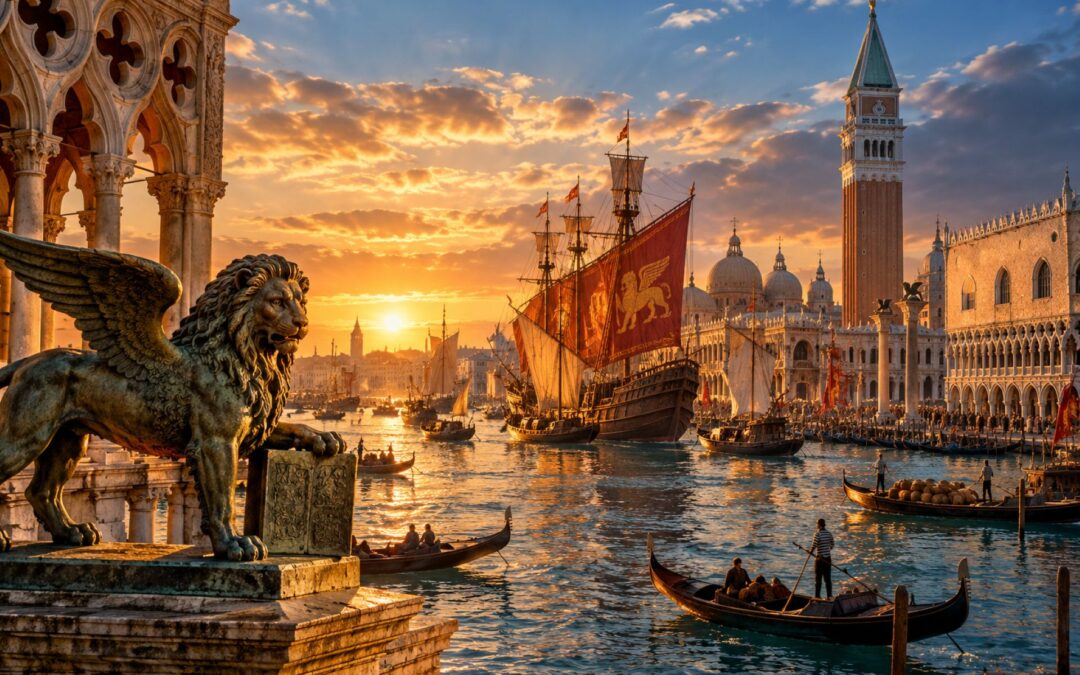
Today, Venice is one of the most recognizable cities in the world. Its canals, gondolas, bridges, and extraordinary architecture attract millions of visitors every year. Yet the city that people now associate with romance, art, and tourism was once the capital of one of Europe’s most powerful and prosperous maritime republics.
For centuries, Venice commanded trading routes across the Mediterranean, maintained an extensive network of overseas possessions, and competed with the greatest powers of Europe and the Middle East. Its merchants brought spices, silk, precious metals, and luxury goods from distant markets, while its shipyards produced the vessels that protected this commercial empire. The wealth generated by maritime trade helped create magnificent palaces, churches, paintings, and public institutions that continue to define the city.
What makes the history of Venice remarkable is that none of this seemed particularly likely when the first settlers established their communities in the lagoon. They occupied muddy islands with little agricultural land, few natural resources, and difficult conditions for permanent construction. Their geographical isolation initially offered protection from invasion, but it also forced them to depend on the outside world for survival.
Over the following centuries, the Venetians transformed these disadvantages into the foundations of a sophisticated commercial civilization. They developed naval technology, financial arrangements, political institutions, and territorial strategies that allowed a relatively small city to exercise influence far beyond its borders.
Their success, however, was never permanent or guaranteed. Rival maritime powers, changing trade routes, Ottoman expansion, repeated wars, and political upheaval gradually weakened the republic. In 1797, Napoleon Bonaparte brought its long history of independence to an end.
The history of Venice is therefore more than the story of a wealthy city that eventually declined. It reveals how geography, commerce, institutions, and military power can combine to create an extraordinary state—and how changing circumstances can eventually undermine the very system that made it successful.
From Roman Refugees to a City in the Lagoon
The origins of Venice lie in the political instability that followed the weakening of Roman authority in Western Europe. During the fifth century, the Western Roman Empire was losing its ability to defend its territories against successive invasions and migrations. Northern Italy, once part of a prosperous imperial network, became increasingly exposed to warfare and disruption.
Communities living around cities such as Padua, Aquileia, and Treviso sought refuge in the lagoons along the northern Adriatic coast. The region contained a complicated landscape of shallow waters, marshes, mudflats, sandbanks, and small islands. For people escaping violence on the mainland, these difficult surroundings offered an important advantage: invading armies could not easily move their soldiers, horses, or equipment through the lagoon.
The traditional account describes Venice as a settlement founded by refugees fleeing barbarian invasions. The actual process was more gradual. People had already used the lagoon for fishing, salt production, transport, and seasonal habitation, and permanent settlements developed over several generations as conditions on the mainland changed.
The environment that protected these communities also made everyday life difficult. The islands provided little agricultural land, freshwater supplies were limited, and much of the ground was too soft to support substantial buildings. The settlers had to develop methods of construction suited to an environment where water and unstable sediment shaped almost every aspect of life.
Their solution involved driving wooden piles into the saturated ground to support platforms and foundations. Where conditions required it, closely spaced piles helped transfer loads and stabilize the structures above them. Timber platforms, brickwork, and stone foundations subsequently allowed increasingly substantial buildings to rise above the mud.
A crucial feature of these foundations was that much of the submerged timber remained in waterlogged conditions with limited oxygen. This slowed the biological processes that would otherwise cause wood to decay rapidly. The technique did not make the city immune to structural deterioration, but it made durable construction possible in a location that initially appeared unsuitable for urban development.
Over time, wooden buildings gave way to structures incorporating brick and stone. Istrian stone, obtained from across the Adriatic, became particularly important because of its durability in the maritime environment. It was eventually used extensively in the foundations, exterior surfaces, and architectural decoration of Venetian buildings.
The early inhabitants supported themselves through fishing, salt production, boatbuilding, and exchange with nearby settlements. Salt was especially valuable because it helped preserve food and could be traded for commodities unavailable in the lagoon. These activities gradually connected the island communities to the wider Adriatic economy.
Politically, the region remained connected to the Eastern Roman, or Byzantine, Empire. When Emperor Justinian’s armies reconquered parts of Italy during the sixth century, the lagoon became part of the restored imperial territories. Subsequent Lombard expansion weakened Byzantine control over much of the mainland, but the coastal settlements retained important links with Constantinople.
Distance and geography nevertheless allowed local institutions to develop considerable independence. The lagoon communities increasingly organized their own defense and administration, eventually establishing a political leadership associated with the title doge, derived from the Latin dux, meaning leader or duke.
The traditional chronology identifies Paoluccio Anafesto as the first doge in 697, while other accounts regard Orso Ipato, elected in the eighth century, as the first reliably identifiable independent Venetian leader. The details of this earliest period remain disputed because later Venetian historians reconstructed parts of the city’s origins through traditions that were not always supported by contemporary records.
By the early ninth century, Venice faced pressure from the expanding Frankish Empire, which had replaced Lombard authority across much of northern Italy. Frankish attempts to bring the lagoon under control were unsuccessful, and the Venetian leadership increasingly concentrated its political activities on the more defensible central islands.
Around 810–812, under Doge Agnello Participazio, the seat of government moved toward Rialto, whose name derived from Rivo Alto, or high bank. This settlement eventually became the centre of Venice, with the developing ducal palace and surrounding institutions forming the nucleus of the future city.
Another defining development occurred in 828, when Venetian merchants brought relics believed to belong to St. Mark the Evangelist from Alexandria in Egypt. According to the famous tradition, the relics were concealed beneath pork to prevent their discovery by Muslim customs officials. Whether every detail of that account is historically reliable is less important than the political and religious significance of the event.
St. Mark became the city’s principal patron saint, and his winged lion became the enduring emblem of Venice. The construction and subsequent reconstruction of the basilica dedicated to him reinforced the city’s religious identity and growing prestige.
By the ninth and tenth centuries, Venice was no longer merely a refuge from instability on the mainland. Its inhabitants had established a functioning political community, developed the means to build permanently on the lagoon, and begun using their position between the Adriatic and the Byzantine world to expand their commercial opportunities.
The same waters that initially separated Venice from its enemies would soon connect it to an extraordinary network of markets.
How Venice Turned the Adriatic into a Commercial Lifeline
Venice’s prosperity began with a basic economic problem: the lagoon could not produce everything its inhabitants needed. A growing population required grain, timber, metals, livestock products, building materials, and many other necessities that had to be obtained from elsewhere.
For a community surrounded by water, maritime trade was the most practical solution. Boats transported essential supplies from the mainland and coastal settlements, while Venetian merchants exchanged salt, fish, and other goods for commodities they could not produce locally.
This dependence gradually encouraged specialization. Venetian sailors became familiar with the challenging waters of the Adriatic, shipbuilders developed the vessels needed for trade, and merchants learned how to negotiate with different political authorities. Instead of relying on territorial agriculture as the principal source of wealth, the city increasingly depended on moving goods between producers and consumers.
Its geographical location was particularly valuable. The Adriatic formed a maritime corridor connecting northern Italy and Central Europe with the eastern Mediterranean. Ships travelling between Constantinople, the Levant, and markets farther west could use Venetian connections to reach customers in the European interior.
Venice’s early association with Byzantium provided access to an enormous commercial world. Constantinople was among the most important cities in medieval Europe, and Byzantine markets connected Mediterranean traders with commodities arriving from Asia, the Middle East, and surrounding regions.
Venetian merchants benefited from commercial privileges granted by Byzantine emperors, but political favour alone could not guarantee profitable trade. Ships also needed safe passage, reliable ports, and protection against piracy. Along parts of the eastern Adriatic, local rulers and raiders could threaten vessels or demand payments.
During the reign of Doge Pietro II Orseolo, who governed from 991 to 1009, Venice pursued a more assertive maritime policy. In 1000, Orseolo led an expedition along the eastern Adriatic coast, seeking the submission or cooperation of coastal communities and confronting pirate strongholds.
The campaign strengthened Venetian influence in Dalmatia, the coastal region corresponding largely to parts of modern Croatia. Although Venetian control over individual towns remained contested and fluctuated over subsequent centuries, the expedition marked an important step toward treating the Adriatic as a sphere of strategic interest.
The Venetian doges adopted titles reflecting their claims in Dalmatia, and the expedition became an important part of the republic’s political memory. Its anniversary helped inspire ceremonies celebrating Venice’s special relationship with the sea.
That relationship eventually acquired one of the city’s most distinctive rituals: the Marriage of the Sea. During the annual Ascension Day ceremony, the doge travelled into the lagoon aboard the ceremonial state barge, the Bucintoro, and cast a ring into the water.
The ritual symbolized Venice’s claim to enduring dominion over the surrounding seas. It was not proof that the republic controlled every part of the Adriatic without challenge, but it communicated the political belief that maritime power was central to Venetian identity and sovereignty.
The next major commercial breakthrough came from Byzantium. During the late eleventh century, Emperor Alexios I Komnenos confronted a serious threat from Norman forces expanding into Byzantine territory. Venice provided naval assistance, and in 1082 the emperor rewarded the republic with exceptionally favourable trading privileges.
These arrangements granted Venetian merchants extensive exemptions from customs duties and expanded their commercial opportunities within Byzantine territories. Access to Constantinople and other imperial markets became considerably more profitable.
The advantages were significant because medieval commerce involved numerous charges, restrictions, and uncertainties. A merchant paying lower duties could offer competitive prices, earn greater profits, or make trading journeys economically worthwhile when they might otherwise have been too expensive.
Venetian communities subsequently became established in important eastern Mediterranean ports. Their merchants increasingly operated through permanent commercial connections rather than isolated expeditions, making Venice an intermediary between multiple regional economies.
The Crusades provided further opportunities. Beginning in the late eleventh century, European expeditions to the eastern Mediterranean created demands for transport, provisions, military supplies, and naval support.
Venice participated in these activities while seeking access to the commercial privileges offered by the Crusader states. Its involvement reflected both religious commitments and practical commercial interests, which frequently overlapped in medieval politics.
The republic’s strategy increasingly depended on controlling strategic points along routes rather than conquering continuous expanses of territory. A fortified harbour, island anchorage, or commercial settlement could secure supplies, protect ships, and extend Venetian influence without requiring control over every surrounding community.
This approach allowed a relatively small population to develop an international presence disproportionate to the size of its homeland. Venice was becoming a state whose economic foundations lay in commercial networks and maritime infrastructure.
But the expansion of trade brought new problems. Profitable routes attracted competitors, merchants required financing for increasingly expensive voyages, and the state needed more ships to defend its commercial interests.
Addressing these challenges would transform both the Venetian economy and its political institutions.
The Merchant Republic: Ships, Trade and Political Power
Venice’s rise depended on more than courageous sailors and favourable geography. It required institutions capable of organizing commerce, financing voyages, building fleets, settling disputes, and preventing political instability from disrupting the economy.
For much of its early history, the doge occupied a powerful position. Although elected, individual doges sometimes attempted to establish hereditary authority or concentrate control within their families. Conflicts between ruling households and other influential groups made the distribution of political power a recurring concern.
As Venetian merchants accumulated wealth, they also acquired greater influence over public affairs. Economic prosperity created families capable of challenging the doge’s authority and demanding a role in decisions affecting taxation, military expenditure, commerce, and diplomacy.
Between the eleventh and twelfth centuries, these pressures encouraged the development of a more elaborate system of collective government. Reforms in 1032 helped constrain attempts to establish hereditary ducal rule, while the emergence of the Great Council in 1172 marked an important stage in the development of republican institutions.
Over time, Venice established a complex political structure involving the Great Council, Senate, smaller executive councils, judicial bodies, and other committees. The doge remained the symbolic head of state, but his authority was increasingly limited by laws, oaths, and institutional procedures.
His election eventually became an elaborate process intended to reduce the influence of competing factions. The doge served for life, yet he could not simply govern as an independent monarch or transmit his office to his descendants.
This political system helped Venice maintain continuity through changing circumstances. Governments could negotiate treaties, raise revenues, administer overseas possessions, and organize military campaigns without depending entirely on the personality of a single ruler.
The republic’s constitutional reputation, however, should not be confused with modern democracy. Participation was concentrated among privileged groups, and political power gradually became more restricted as wealthy families consolidated their position.
A particularly important turning point began in 1297 with the Serrata, or closure of the Great Council. Through a series of measures completed over subsequent decades, membership increasingly became the privilege of established patrician families. By 1323, hereditary qualifications had become central to participation in the governing elite.
This development reveals an important contradiction within Venice’s political economy. The commercial opportunities that initially supported broader participation also enabled some of the most successful merchant families to secure lasting control over those opportunities.
Economists Diego Puga and Daniel Trefler examine this process in their research on international trade and institutional change in medieval Venice. Their analysis shows how the expansion of long-distance commerce initially encouraged institutional innovation before wealthy families increasingly restricted political and economic competition.
The result was a remarkably durable republic, but one governed by an oligarchy rather than an unrestricted community of merchants.
Commerce also required methods for sharing financial risks. A long-distance trading voyage could involve purchasing expensive cargo, hiring sailors, provisioning ships, and travelling for months through dangerous waters. A single storm, pirate attack, or commercial failure could destroy a merchant’s investment.
Venetians developed contractual arrangements that helped distribute these risks. One important form was the colleganza, a partnership in which an investor supplied capital while a travelling merchant managed the voyage and conducted commercial transactions. Profits were divided according to the agreed terms, allowing merchants with different resources to participate in international trade.
Such partnerships encouraged the circulation of capital and enabled successful traders to develop careers without necessarily owning an entire fleet. Over time, however, established families increasingly dominated access to the most lucrative commercial opportunities.
The state also played a direct role in maritime transport. Public authorities regulated aspects of trade, maintained commercial infrastructure, negotiated privileges, and organized armed protection for valuable cargo.
At the centre of this system stood the Venetian Arsenal, one of the most important industrial establishments of medieval and early modern Europe.
Traditionally associated with a foundation date of 1104, the Arsenal developed over subsequent centuries into an enormous complex of shipyards, workshops, warehouses, basins, and storage facilities. It became the principal centre for constructing, maintaining, and equipping many of the republic’s naval vessels.
Shipbuilding required far more than the skills of a few carpenters. Timber had to be acquired, transported, seasoned, and shaped. Rope, sails, anchors, weapons, metal fittings, and countless smaller components had to be manufactured or obtained from specialist suppliers.
The Arsenal brought many of these activities under organized state supervision. Different workshops specialized in particular tasks, while stores of materials and equipment allowed vessels to be fitted out rapidly when military circumstances demanded it.
The complex is often described as an early precursor of modern industrial production. That comparison is useful when applied to specialization, coordination, standardized practices, and the movement of vessels through different stages of preparation. It becomes misleading when interpreted as evidence that Venetians routinely constructed complete warships from raw materials in a single day.
Research into the Arsenal’s historic supply-chain and production-management systems demonstrates how sophisticated its planning eventually became. Venetian authorities managed sources of timber over long periods, including forest cultivation and methods intended to produce wood suitable for particular ship components.
This integration of natural resources, labour, manufacturing, and naval planning was especially valuable because the republic’s military requirements could change abruptly. During peace, the state needed to maintain commercial activity and reasonable expenditure; during war, it might suddenly require large numbers of equipped vessels.
The Arsenal gave Venice the ability to respond to these demands more effectively than many rivals. Its strength did not lie in any single revolutionary invention, but in the coordination of people, materials, knowledge, and state authority.
Together, the republic’s financial institutions, political councils, naval organization, and commercial partnerships formed a mutually reinforcing system. Trade financed government and military power, while government and military power protected trade.
That system would soon allow Venice to exploit one of the most consequential events in medieval European history.
The Fourth Crusade and the Creation of Venice’s Overseas Empire
By the beginning of the thirteenth century, Venice had become a leading maritime power, but its influence remained dependent on access to eastern Mediterranean trade. The Fourth Crusade offered the republic an opportunity to expand that influence dramatically.
In 1201, representatives of a planned crusading expedition approached Venice seeking transport to the eastern Mediterranean. Their objective was ultimately to recover Jerusalem, which had fallen to Saladin in 1187.
The crusading leaders negotiated an enormous transportation agreement with Doge Enrico Dandolo. Venice agreed to construct and provision a fleet capable of carrying thousands of knights, their horses, additional soldiers, and supplies for an extended campaign.
The commitment placed extraordinary demands on the republic. Ships had to be built or prepared, provisions accumulated, equipment manufactured, and labour diverted toward fulfilling the contract.
The Venetians expected substantial payment in return, but when the crusaders assembled in 1202, far fewer participants arrived than had originally been anticipated. The expedition could not raise the full amount owed.
The resulting financial crisis created an opportunity for Dandolo. Rather than abandon the expedition, he proposed that the crusaders assist Venice in recovering Zara, a Dalmatian city that had resisted Venetian authority.
Zara was a Christian city, and attacking it was inconsistent with the religious purpose of the crusade. Nevertheless, the crusading leadership accepted the arrangement, and Venetian and crusader forces captured Zara in November 1202.
The assault provoked condemnation from Pope Innocent III, who had opposed an attack on fellow Christians. The expedition’s conduct had already exposed the tension between its declared religious mission and the political and financial interests influencing its decisions.
The situation became even more complicated when a claimant to the Byzantine throne entered the picture. Alexios Angelos, whose father Isaac II had been deposed, promised money, military assistance, and religious concessions if the crusaders helped restore his family to power.
For Venice, Byzantine instability offered a chance to strengthen its position against an imperial government with which relations had repeatedly deteriorated. The Venetians had benefited enormously from Byzantine trading privileges, but disputes over commerce and political authority had also produced serious hostility.
The expedition therefore diverted toward Constantinople rather than continuing directly to the Holy Land.
In 1203, the crusaders and Venetians reached the Byzantine capital and helped place Alexios IV and his restored father on the throne. Their intervention did not resolve the expedition’s financial difficulties, however. The new rulers struggled to fulfil their promises, while opposition within Constantinople intensified.
By early 1204, the political situation had collapsed. Alexios IV was overthrown and killed, and the crusaders no longer expected to receive the payments and support they had been promised.
In April 1204, Venetian and crusader forces attacked Constantinople. After overcoming its formidable defenses, they entered the city and subjected it to several days of looting, destruction, and violence.
The sack of Constantinople was a catastrophe for the Byzantine world. Churches, palaces, libraries, and private residences were plundered, while works of art and religious treasures accumulated over centuries were taken or destroyed.
Among the famous objects removed were the four bronze horses associated with the Hippodrome. The Venetians transported them to their own city, where they eventually became part of the decoration of St. Mark’s Basilica.
Their removal symbolized the extraordinary reversal in the relationship between Venice and Byzantium. The lagoon community that had once depended on Constantinople’s protection and commercial privileges had participated in the conquest and plunder of the imperial capital.
The victors divided much of the former Byzantine territory and established the Latin Empire of Constantinople. Venice received extensive rights and territorial claims, although effective control over individual possessions developed through subsequent negotiation, acquisition, and military action.
The republic acquired strategically important positions throughout the eastern Mediterranean. Crete became one of its most valuable overseas territories, while possessions and trading stations in the Aegean and along major shipping routes strengthened its maritime network.
Ports such as Modon and Coron, in the southwestern Peloponnese, became especially important. Their position allowed Venetian vessels travelling between the Adriatic and the eastern Mediterranean to obtain supplies, seek protection, and maintain contact with friendly authorities.
Venice’s empire was therefore not simply a collection of conquered territories. It was a network of islands, fortified harbours, commercial settlements, naval stations, and administrative centres intended to protect trade and support the republic’s wider strategic position.
This system did not always require direct government over large populations. Controlling the places through which ships passed could be more commercially valuable than governing extensive inland territories.
The Fourth Crusade dramatically expanded Venice’s opportunities, but it also created lasting hostility. Byzantines remembered the destruction of their capital, while other maritime powers competed for access to territories and privileges that Venice sought to monopolize.
In 1261, Byzantine forces restored imperial rule in Constantinople with support from Genoa, Venice’s increasingly powerful commercial rival. The recovery challenged the Venetian position established after 1204 and helped intensify competition between the two maritime republics.
Venice had gained extraordinary advantages from the Fourth Crusade, but the methods used to secure them had also deepened political rivalries that would dominate Mediterranean commerce for generations.
Genoa, Marco Polo and the Struggle to Control Mediterranean Trade
Venice was not the only Italian maritime republic to grow wealthy through Mediterranean commerce. Genoa, Pisa, and Amalfi had also developed important merchant communities, naval capabilities, and overseas trading connections.
Among these competitors, Genoa eventually became Venice’s greatest rival. Both republics depended heavily on maritime commerce, and their merchants frequently sought access to the same ports, markets, and political privileges.
The rivalry became especially intense in the eastern Mediterranean and Black Sea. These regions connected European traders to goods arriving through extensive commercial networks stretching into Central Asia, Persia, India, and China.
The expansion of Mongol power during the thirteenth century created new opportunities for long-distance exchange. Although the Mongol world was not permanently unified under a single government, periods of political stability across important routes made travel and commerce between distant regions more practical.
Venetian and Genoese merchants competed for access to these networks. Genoa developed a particularly influential position at Caffa in Crimea, while Venice established commercial interests at Tana near the mouth of the Don River and maintained connections elsewhere around the Black Sea.
These trading stations acted as intermediaries between merchants arriving by land and ships travelling toward Mediterranean markets. Goods could pass through several commercial communities before reaching their final consumers.
Silk, spices, precious materials, dyes, and other luxury commodities were particularly attractive because they offered considerable value relative to the space they occupied aboard ships. A successful merchant might earn substantial profits by carrying goods from markets where they were relatively abundant to places where demand was high and access was limited.
One of the most famous Venetians associated with eastern commerce was Marco Polo. In 1271, he travelled east with his father and uncle, beginning a journey that eventually took him deep into Asia and, according to his account, into the domains of Kublai Khan.
After returning to Venice in 1295, Polo became associated with a narrative describing cities, peoples, political institutions, commercial practices, and distant territories unfamiliar to many European readers.
His account was not the first European description of an Asian journey, and historians continue to examine the reliability of particular episodes. Nevertheless, its enormous reach and circulation helped shape European understanding of Asia for centuries.
Polo’s travels also illustrate how far Venetian commercial horizons had expanded. The republic itself did not control the Asian routes he described, but Venetian merchants participated in networks through which information, commodities, and commercial opportunities moved between distant societies.
Such commerce required ships suited to different tasks. Venetian fleets included galleys propelled by oars and sails, as well as larger sailing vessels designed primarily for transporting bulk cargo.
Galleys offered speed, manoeuvrability, and predictable movement under certain conditions. They were especially useful for military operations, escorts, and the transport of expensive goods that justified substantial operating costs.
Larger sailing ships could carry greater quantities of grain, timber, wine, salt, and other relatively bulky products. They generally required fewer crew members relative to cargo capacity, making them economically attractive despite their dependence on favourable sailing conditions.
The labour systems aboard Venetian vessels changed over time. Earlier galleys relied significantly on paid free rowers, while later fleets increasingly incorporated compulsory service, convicts, and other forms of coerced labour. The popular distinction between entirely free Venetian crews and enslaved crews elsewhere is therefore too simple.
Venice also developed a distinctive system of organized trading convoys known as the muda. Under arrangements formalized during the fourteenth century, the state owned or controlled certain great galleys and auctioned their commercial use to private merchants.
These fleets followed established routes and schedules, often travelling under armed protection. Convoys connected Venice with destinations including Constantinople, the Black Sea, Alexandria, the Levant, England, and Flanders.
The system combined public organization with private commercial investment. Merchants benefited from naval protection and predictable arrangements, while the state gained revenue and influence over strategically important trade.
Yet the commercial networks that enriched Venice also exposed it to dangers that no fleet could defeat.
During the middle of the fourteenth century, the Black Death spread across Eurasian trade routes and into the Mediterranean world. The disease reached major Black Sea trading communities and travelled westward through connections linking ports, ships, merchants, and populations.
Accounts of the siege of Caffa describe infected corpses being thrown into the settlement by besieging forces, although the extent to which this episode contributed to the wider spread of plague remains uncertain. Maritime commerce provided multiple pathways through which infected people and animals could move between ports.
By 1348, the plague had reached Venice. Its densely populated neighbourhoods, crowded dwellings, and extensive commercial connections made the epidemic particularly devastating.
Contemporary and later accounts suggest enormous mortality, possibly approaching or exceeding half the population in some estimates, although exact figures remain uncertain. The crisis disrupted trade, overwhelmed burial arrangements, and inflicted demographic losses that took generations to overcome.
The experience encouraged Mediterranean authorities to develop new approaches to disease control. In 1377, Ragusa, modern Dubrovnik, introduced a documented system requiring travellers arriving from infected regions to undergo a period of isolation.
The initial maritime isolation period was thirty days, rather than the forty days commonly associated with the later word quarantine. Venice subsequently developed its own sophisticated system of maritime health controls, including a permanent lazaretto established in 1423.
As historical research into the development of plague isolation and public-health measures explains, these institutions emerged from attempts to protect communities without permanently shutting down commercial activity.
For a trading republic, disease prevention was also an economic necessity. Venice could not abandon maritime commerce without undermining the foundations of its prosperity, so it increasingly sought ways to manage the dangers accompanying it.
Despite the devastation of the plague, competition with Genoa continued. The second half of the fourteenth century witnessed a succession of conflicts over maritime influence.
The most dangerous confrontation culminated in the War of Chioggia, fought between 1378 and 1381. In 1379, Genoese forces occupied Chioggia at the southern edge of the Venetian lagoon, placing an enemy fleet dangerously close to Venice itself.
The republic responded with an extraordinary military and political mobilization. Venetian forces blockaded the Genoese position and eventually forced its surrender in 1380.
The victory helped preserve Venetian independence and strengthened its position in Mediterranean commerce. Genoa, however, remained an important state and later developed a particularly influential role in European finance.
For Venice, the more immediate consequence was that its greatest maritime threat had been contained. The republic entered the fifteenth century with the opportunity to consolidate and expand its influence across both the mainland and the sea.
La Serenissima at Its Height: Empire, Wealth and Renaissance Culture
The fifteenth century marked one of the most impressive periods in Venice’s political and economic history. The republic combined a powerful merchant fleet, valuable overseas possessions, established commercial institutions, and a growing territorial position in northern Italy.
For centuries, Venice had depended heavily on maritime access while possessing little territory on the mainland. This arrangement brought substantial wealth but also created vulnerabilities. An enemy controlling nearby rivers, roads, or agricultural districts could threaten the city’s food supplies and commercial connections.
Venetian leaders increasingly recognized the strategic value of controlling territory beyond the lagoon. During the early fifteenth century, under Doge Michele Steno and his successors, the republic expanded into the Venetian mainland.
Padua, Verona, and Vicenza came under Venetian control in the early 1400s. Further expansion eventually incorporated important territories including Friuli, Brescia, and Bergamo.
These acquisitions gave Venice access to agricultural production, inland commercial routes, resources, and defensive positions. They also involved the republic more directly in the political struggles of northern Italy, where powerful cities and princely states competed for territory.
Venice’s dominions came to be described through three broad geographical and administrative divisions.
The Dogado comprised Venice itself and the lagoon territories associated with the original ducal domain. The Domini di Terraferma referred to the mainland possessions in northern Italy, while the Stato da Mar consisted of overseas territories and maritime strongholds.
The Stato da Mar included islands and fortified positions stretching across the Adriatic and eastern Mediterranean. Crete, Corfu, sections of Dalmatia, and various Aegean possessions performed different military, administrative, and commercial roles.
Cyprus became a particularly important possession in 1489, when Queen Caterina Cornaro formally relinquished her crown to Venice. The island added another strategically valuable position near the commercial routes connecting the eastern Mediterranean with Egypt and the Levant.
Administering such geographically scattered territories required careful organization. Venetian officials were sent abroad to govern important possessions, oversee defenses, administer justice, and report to the central authorities.
Their responsibilities varied according to local circumstances. Some territories retained significant elements of their existing social and administrative arrangements, while others experienced more direct Venetian intervention.
The republic’s overseas power depended on cooperation with local elites as well as military force. Its governors had to balance commercial priorities, defensive requirements, taxation, and the competing interests of populations who did not necessarily share the privileges enjoyed by Venice’s ruling families.
The wealth flowing through these territories transformed the city itself. The Grand Canal became a magnificent commercial and architectural centre, lined with residences belonging to some of the republic’s richest families.
These palazzi displayed the wealth and prestige of merchants whose fortunes had been made through maritime commerce. Their facades combined elements associated with Byzantine, Gothic, and later Renaissance architecture, reflecting the city’s long history of contact with different cultural worlds.
The Doge’s Palace became another symbol of Venetian power. Its distinctive Gothic architecture housed institutions responsible for governing the republic, administering justice, and conducting public ceremonies.
St. Mark’s Basilica similarly reflected Venice’s connections with Byzantium and the eastern Mediterranean. Its domes, mosaics, and architectural decoration expressed a cultural identity that could not be reduced to the artistic traditions of mainland Italy.
Venetian prosperity also supported an extraordinary flowering of painting and craftsmanship. Artists associated with the Bellini family helped establish a distinctive local artistic tradition, while later masters such as Giorgione, Titian, Tintoretto, and Veronese contributed to the city’s enduring reputation.
Glassmaking became another important industry. The island of Murano developed a celebrated tradition of specialized glass production, with artisans creating decorative objects, mirrors, vessels, and other products valued across European markets.
Printing and publishing also flourished after the arrival of movable-type printing. By the late fifteenth century, Venice had become a major European publishing centre.
The printer Aldus Manutius, active in Venice from the 1490s, helped transform the production and circulation of books. His editions of classical works and innovations in book design contributed to the spread of humanist scholarship.
The republic’s cultural achievements, however, existed alongside significant social distinctions. Wealth was concentrated among the merchant aristocracy, while artisans, labourers, sailors, servants, and inhabitants of overseas territories occupied very different positions within the Venetian order.
Political participation remained heavily restricted, and the government regulated the lives of minority communities. In 1516, the Senate required Jews residing in Venice to live within a designated enclosed area in Cannaregio, creating the institution from which the modern word ghetto became widely known.
Jewish residents faced restrictions on residence, occupation, and movement, although the community also developed important religious, commercial, and intellectual institutions. Venice’s reputation for cosmopolitan trade therefore coexisted with exclusion and unequal rights.
The republic’s celebrated stability rested partly on its ability to manage these different populations and interests while preserving the power of its governing elite.
By the end of the fifteenth century, Venice stood among Europe’s most significant commercial and cultural centres. Its political reach extended from northern Italy into the eastern Mediterranean, while its merchants connected the city with markets far beyond the territories it directly governed.
Yet the conditions that had supported this remarkable prosperity were beginning to change. New powers were challenging the republic’s eastern possessions, and European maritime trade was gradually expanding beyond the Mediterranean world.
Venice Against the Ottomans and the New Oceanic Powers
Venice’s commercial prosperity depended heavily on access to the eastern Mediterranean. For centuries, that access had been shaped by relations with the Byzantine Empire, the Crusader states, Muslim rulers, and other maritime republics.
The rise of the Ottoman Empire transformed this political environment. Ottoman rulers expanded from Anatolia into southeastern Europe, gradually taking control of territories and routes that had previously been divided among Byzantine, Balkan, and other regional powers.
In 1453, Sultan Mehmed II conquered Constantinople, bringing the Byzantine Empire to an end. For Venice, the conquest meant that one of its most important historic commercial partners had been replaced by a rapidly expanding military power.
The Ottomans controlled a strategically vital position between the Black Sea and the Mediterranean. Their expansion also threatened Venetian possessions in Greece, Albania, the Aegean, and other regions.
The relationship between Venice and the Ottomans was never simply one of uninterrupted hostility. Venetian merchants continued to seek commercial arrangements with Ottoman authorities, and periods of peace allowed trade to continue across political and religious boundaries.
Nevertheless, military competition became increasingly important. The first major Ottoman–Venetian war began in 1463 and continued until 1479, imposing substantial costs on the republic and leading to territorial losses.
Further conflict between 1499 and 1503 weakened Venetian positions in parts of the eastern Mediterranean. The Ottomans also consolidated their influence around the Black Sea, limiting the commercial arrangements that had supported earlier Venetian expansion.
These developments formed part of the wider history of Ottoman expansion across the eastern Mediterranean, during which military conquest, diplomacy, commercial negotiation, and maritime rivalry repeatedly overlapped.
Venice confronted another challenge from a very different direction: the emergence of direct oceanic routes between Europe and Asia.
During the fifteenth century, Portuguese navigators progressively explored the Atlantic coast of Africa. Their expeditions sought commercial opportunities, strategic influence, and maritime access to regions previously connected to European markets primarily through established intermediary networks.
In 1488, Bartolomeu Dias rounded the southern tip of Africa, demonstrating that the Atlantic and Indian oceans could be connected by sea. In 1497, Vasco da Gama departed Portugal on a voyage that reached the western coast of India in 1498.
The expedition established the practical possibility of regular direct maritime communication between Portugal and Indian Ocean markets. Over the following decades, the Portuguese oceanic trading empire developed a network of fortified ports, commercial agreements, military operations, and naval routes stretching from Africa toward India and Southeast Asia.
This development challenged an important advantage Venice had enjoyed for centuries. European merchants no longer had to depend exclusively on commercial networks passing through the eastern Mediterranean to obtain certain Asian commodities.
Spices were particularly important. Pepper and other valuable products reached European markets through complex routes involving merchants in India, the Arabian Peninsula, Egypt, and the Levant. Venetian traders purchased goods through these established networks and redistributed them across Europe.
Portuguese merchants attempted to bypass some of these intermediaries by transporting commodities around Africa. Their vessels could reach markets connected more directly to the Indian Ocean trading world.
It would be misleading, however, to claim that Vasco da Gama’s arrival in India immediately destroyed the Venetian economy. Mediterranean commerce remained significant, Portuguese expansion encountered considerable resistance, and established Levantine routes continued to operate.
The economic consequences emerged gradually and unevenly. Competition intensified, markets adjusted, and European commercial opportunities increasingly extended into the Atlantic and Indian oceans.
Other European powers eventually developed their own overseas trading networks, further changing the distribution of commercial influence.
Venice remained wealthy and commercially active, but the relative advantages of its established geographical position were becoming less secure. The city could no longer rely on the same degree of influence over the routes connecting Asian products with European consumers.
Its political circumstances also became more complicated. Mainland expansion had drawn Venice into expensive Italian conflicts, while Ottoman pressure required continued investment in ships, fortifications, garrisons, and diplomacy.
In the early sixteenth century, the League of Cambrai demonstrated the dangers of mainland involvement when several European powers formed a coalition against Venetian territorial expansion. Although Venice survived the crisis and recovered much of its position, the conflict exposed the limits of its military resources.
By the later sixteenth century, the republic faced a difficult strategic balance. Its maritime territories remained valuable, but defending them required increasingly substantial commitments against opponents with larger territorial and demographic resources.
The approaching struggle over Cyprus would illustrate how difficult that balance had become.
From Lepanto to the Exhaustion of the Maritime Empire
In 1570, Ottoman forces invaded Cyprus, one of Venice’s most important eastern Mediterranean possessions. The island’s location made it strategically valuable for communications, commerce, and naval operations, while its loss would further reduce the republic’s influence in the Levant.
Venice sought assistance from other Christian powers, and a coalition known as the Holy League assembled to confront Ottoman expansion. The alliance included forces associated with Spain, the papacy, Venice, and other participants.
On 7 October 1571, the allied fleet encountered the Ottoman navy near Lepanto, off the western coast of Greece. Venice supplied a major contingent to the Christian coalition, reflecting its continuing naval capabilities despite decades of strategic pressure.
The battle became one of the most famous naval confrontations of the early modern period. Hundreds of vessels participated, and the fighting resulted in a decisive tactical victory for the Holy League.
The Ottoman fleet suffered severe losses, and the victory was celebrated across Catholic Europe. For Venice, it demonstrated that the republic remained capable of contributing to an enormous maritime military effort.
Yet the victory did not reverse the broader direction of Venetian territorial fortunes. The Ottomans rebuilt substantial naval capacity, and the coalition struggled to translate its success into enduring control of the eastern Mediterranean.
Cyprus had already effectively fallen following the surrender of Famagusta in August 1571. Venice subsequently accepted the Ottoman conquest in the peace settlement of 1573.
Lepanto therefore revealed the distinction between winning a great battle and achieving a lasting strategic objective. The Holy League inflicted a spectacular defeat on the Ottoman navy, but Venice did not recover the island whose loss had helped provoke the conflict.
During the following century, the republic continued to face the costs of defending distant possessions. Fortifications required maintenance, naval expeditions demanded money and manpower, and commercial activity suffered during periods of war.
Plague outbreaks and competition from other trading centres compounded these difficulties. The republic still possessed important resources, but sustaining military commitments across a scattered maritime empire became increasingly burdensome.
The struggle over Crete proved especially destructive. Venice had governed the island for centuries, and its position made it one of the most valuable components of the Stato da Mar.
In 1645, Ottoman forces invaded Crete, beginning a prolonged conflict that lasted until 1669. The Ottoman campaign gradually reduced Venetian control, while the fortified capital of Candia, modern Heraklion, endured one of the longest sieges in European military history.
The siege of Candia began in 1648 and continued, with interruptions and varying intensity, for more than two decades. Venetian defenders resisted repeated Ottoman attacks, while both sides committed enormous resources to maintaining their positions.
In 1669, Candia finally surrendered. Venice had lost one of its most important overseas territories after a war that imposed severe financial and human costs.
The republic was not entirely incapable of recovering territory. During the Morean War in the late seventeenth century, Venetian forces commanded by Francesco Morosini captured significant positions in the Peloponnese.
These campaigns brought temporary success, but they also demonstrated the destructive consequences of warfare over historically significant territories. In 1687, during Morosini’s operations against Ottoman-held Athens, Venetian bombardment struck the Parthenon, which was being used to store gunpowder.
The resulting explosion inflicted catastrophic damage on the ancient monument. The episode remains a reminder that Venice’s later military campaigns produced consequences extending far beyond the republic’s own political fortunes.
Venice briefly recovered much of the Peloponnese, but its renewed territorial position proved difficult to maintain. Ottoman forces reconquered the region in 1715, and the subsequent peace settlement at Passarowitz in 1718 confirmed a substantially reduced Venetian maritime empire.
The republic retained important possessions along the Dalmatian and Istrian coasts and in the Ionian Islands, together with other limited territories. Nevertheless, its former influence across the eastern Mediterranean had been greatly diminished.
This decline was not simply the consequence of one defeat or a lack of military courage. Venice confronted a structural problem: it was a relatively small state defending expensive overseas territories against a powerful land empire while international commercial competition was changing.
Its naval institutions, once exceptionally effective in securing trade and responding to regional threats, could not guarantee success against every combination of military, demographic, and economic pressure.
By the eighteenth century, Venice remained independent, but the balance between its international ambitions and its available resources had changed profoundly.
The Last Century of the Republic and Napoleon’s Intervention
Eighteenth-century Venice was no longer the dominant maritime power it had been during the fifteenth century. Its overseas territories had contracted, its military influence had weakened, and the commercial networks supporting European prosperity had become increasingly centred on wider Atlantic and global trade.
Yet the city was far from culturally insignificant. It remained an important centre of art, entertainment, craftsmanship, and aristocratic society, attracting visitors from across Europe.
The Venetian Carnival became famous for elaborate celebrations, masked gatherings, theatrical performances, and the city’s distinctive public life. European travellers undertaking the Grand Tour regarded Venice as an essential destination for experiencing art, architecture, and fashionable society.
The painter Canaletto produced celebrated views of the canals, piazzas, and buildings that defined the city, while the adventurer Giacomo Casanova became one of its most recognizable eighteenth-century personalities. Venetian music, theatre, publishing, and decorative arts continued to flourish.
This cultural prestige should not be mistaken for evidence that the city’s entire economy had collapsed. Venice remained a functioning commercial and manufacturing centre, but it no longer possessed the geopolitical position necessary to dominate Mediterranean affairs.
Its ruling patrician families continued governing through institutions established centuries earlier. Those institutions provided continuity, but they also operated within an increasingly rigid political order that struggled to respond to major changes in European power.
The French Revolution of 1789 eventually transformed the republic’s strategic environment. Revolutionary France entered a series of wars against neighbouring monarchies, bringing conflict into northern Italy.
In 1796, Napoleon Bonaparte assumed command of the French Army of Italy and began a remarkably successful campaign against Austrian and allied forces. His victories changed the balance of power across the Italian peninsula and placed the Venetian Republic in an increasingly vulnerable position.
Venice attempted to preserve neutrality, but its territories became entangled in the movements of foreign armies and the political struggles accompanying French expansion.
Napoleon regarded Venetian territory as strategically valuable, both for military purposes and as a bargaining asset in negotiations with Austria. The republic possessed neither the military strength nor the diplomatic leverage needed to resist effectively.
In May 1797, under intense French pressure, the Venetian government agreed to dissolve its traditional institutions. On 12 May, the Great Council voted to end the old republican order, and Doge Ludovico Manin relinquished his office.
The decision ended the independent Republic of Venice after more than a millennium of political development.
French forces subsequently entered the city, and valuable artworks were removed. Among the objects taken were the bronze horses that Venice had acquired from Constantinople after the Fourth Crusade, creating a striking historical reversal.
The Treaty of Campo Formio, signed in October 1797, transferred Venice and much of its territory to Austria as part of the settlement between France and the Habsburg monarchy.
The destruction of the republic formed one episode in the much wider political transformation associated with Napoleon’s campaigns and wars across Europe. For Venice, however, the consequences were especially profound because the city lost the independent institutions that had governed it for centuries.
The republic’s fall was the result of immediate political and military circumstances as well as longer-term vulnerabilities. Its reduced naval power and territorial resources left it poorly equipped to resist Napoleon, but centuries of commercial change had not made its abolition inevitable.
A state that had survived rival republics, emperors, crusaders, and Ottoman armies finally disappeared when a new European military power overturned the political order around it.
From Foreign Rule to Modern Italy: Venice, 1797–1945
The fall of the Venetian Republic did not bring an immediate return to stability. Instead, Venice became part of the territorial competition between France and Austria that reshaped northern Italy during the Napoleonic era.
Following the Treaty of Campo Formio, the city passed under Austrian control. French victories subsequently changed the arrangement, and Venice became part of Napoleon’s Kingdom of Italy in 1806.
After Napoleon’s defeat, the Congress of Vienna established a new European settlement in 1815. Venice returned to Austrian rule and became part of the Kingdom of Lombardy–Venetia within the Habsburg Empire.
The city had lost its independent government, but its economic and geographical position continued to evolve. Austrian administration introduced new arrangements, while improvements in infrastructure gradually strengthened connections between Venice and the mainland.
One of the most important developments was the completion of a railway bridge across the lagoon in 1846. For centuries, the city had depended on boats for its principal connections with surrounding territories. The railway created a permanent land-based transport route linking Venice more directly with the expanding European railway network.
Political unrest nevertheless continued. During the revolutionary movements that swept across Europe in 1848, Venetian nationalists challenged Austrian authority.
Daniele Manin, a lawyer and political leader, became the central figure in an uprising that temporarily restored an independent Venetian republic. The revolution reflected wider demands for constitutional government, national self-determination, and freedom from Habsburg rule.
The restored republic survived for approximately seventeen months, but Austrian forces eventually regained control in 1849. Venice’s brief return to independence ended after siege, military pressure, and deteriorating conditions.
The city remained under Austrian rule until 1866, when the Austro-Prussian War and the wider struggle for Italian unification transformed the political map once again.
Following Austria’s defeat, Venetia was transferred through French mediation to the Kingdom of Italy, with a subsequent plebiscite confirming annexation. Venice became part of the newly unified Italian state.
Italian unification changed the city’s political future, but it did not restore the maritime supremacy of its republican past. The commercial geography of Europe had been transformed by industrialization, railways, steamships, and the growth of competing ports.
Trieste, across the Adriatic, had developed into a particularly important Habsburg commercial centre. The opening of the Suez Canal in 1869 created new possibilities for Mediterranean shipping, but Venice was no longer positioned to dominate international trade through the institutions and networks that had sustained its earlier prosperity.
Instead, the city increasingly developed the activities for which it would become famous in the modern world: tourism, cultural events, artistic production, and the preservation of its extraordinary architectural environment.
Its canals, palaces, churches, and distinctive urban setting attracted wealthy travellers, writers, painters, and visitors fascinated by the survival of an unusual historical city.
During the First World War, Venice’s proximity to the conflict between Italy and Austria-Hungary exposed it to military threats and aerial bombardment. Some buildings suffered damage, although the historic city survived the war without the devastation experienced by many European urban centres.
The interwar period brought further changes. In 1932, the Venice Film Festival was established, helping create an international cultural event that would become one of the world’s most prestigious film festivals.
In 1933, a road bridge opened alongside the earlier railway connection, allowing motor vehicles to reach the city’s western edge. These transport improvements strengthened connections with the mainland while preserving the largely pedestrian and waterborne character of the historic centre.
The most destructive aspects of the Second World War were not confined to physical damage. Although Venice escaped much of the large-scale bombing and urban destruction suffered by other Italian cities, its Jewish community experienced persecution and deportation.
The community had lived in Venice for centuries, developing religious, intellectual, and commercial traditions despite periods of severe discrimination. Fascist racial laws introduced in 1938 excluded Jewish residents from important areas of public life and subjected them to increasingly restrictive measures.
Conditions deteriorated further following the German occupation in September 1943. Jewish residents faced arrest, confiscation of property, imprisonment, and deportation to concentration and extermination camps.
The president of the Venetian Jewish Community, Giuseppe Jona, died by suicide in September 1943 rather than surrender information that could facilitate the persecution of community members.
Arrests continued through 1944 and into the final months of the war. Among those deported were elderly residents of the Jewish old-age home, including Rabbi Adolfo Ottolenghi.
According to the Jewish Community of Venice’s account of the racial laws and the Holocaust, 246 Venetian Jews were deported during the period of persecution. A memorial in the historic ghetto commemorates those who were taken.
The community began the difficult process of rebuilding its institutions after the war. The experience remains an essential part of Venice’s modern history, demonstrating that the city’s celebrated cultural continuity did not protect its residents from the political violence of twentieth-century Europe.
By 1945, Venice had survived the fall of its republic, repeated foreign occupations, Italian unification, industrial transformation, and two world wars.
Its future would increasingly depend on a different challenge: preserving a historic city within a modern economy while managing the fragile environment that had made its existence possible.
Venice Today: A Historic City Fighting for Its Future
Since the end of the Second World War, Venice has undergone another profound transformation. The former capital of a maritime empire has become one of the world’s most important cultural and tourism destinations.
Its historic centre attracts visitors interested in architecture, painting, music, religious heritage, and the unique experience of a city in which canals perform many of the functions normally associated with streets.
The same buildings that once housed merchants, government officials, aristocratic families, and religious institutions now form an extraordinary historical environment. St. Mark’s Basilica, the Doge’s Palace, the Rialto Bridge, and the Grand Canal preserve visible connections to different stages of Venetian history.
In 1987, Venice and its lagoon were inscribed on the UNESCO World Heritage List. The UNESCO assessment of Venice and its lagoon recognizes the city as an exceptional cultural landscape in which architecture, urban development, and the natural environment have been closely connected for centuries.
That recognition carries an important responsibility. Venice is not simply a collection of monuments that can be preserved independently of their surroundings. Its buildings, canals, foundations, transport networks, and residential neighbourhoods function within an interconnected lagoon ecosystem.
Tourism provides income and employment, supporting hotels, restaurants, shops, transportation services, cultural institutions, and numerous related businesses. However, its extraordinary concentration also creates economic and social pressures.
The historic city’s resident population has declined dramatically since the middle of the twentieth century. Housing costs, changing employment patterns, the conversion of residential property into tourist accommodation, and the practical difficulties of everyday life have all contributed to the challenge of maintaining permanent communities.
Businesses serving visitors may be more profitable than establishments meeting residents’ ordinary needs. As shops, buildings, and neighbourhoods increasingly cater to short-term tourism, the city risks losing some of the social life that makes it more than a historical attraction.
This creates a difficult economic dilemma. Reducing the pressures associated with tourism may improve living conditions, but tourism also supports a substantial share of the local economy.
Venice has experimented with measures intended to regulate visitor numbers and improve the management of tourism. In 2026, the city operated an access-fee programme on selected days between April and July, continuing its efforts to address the pressures associated with day-trip tourism.
Such measures may influence visitor behaviour and provide administrative tools, but they cannot independently resolve the broader problems of housing availability, economic dependence, and residential decline.
The city’s environmental challenges are even more fundamental.
Venice has always lived with flooding. Seasonal high-water events, known as acqua alta, occur when combinations of tides, meteorological conditions, and other factors raise water levels within the lagoon.
For centuries, Venetians adapted their buildings, public spaces, and commercial activities to the surrounding water. Nevertheless, modern conditions have increased the risks posed by severe flooding.
One important factor is relative sea-level rise. Global sea levels are rising as the climate warms, while parts of the Venetian region have also experienced land subsidence caused by natural processes and past human activities.
The combined effect is that the water stands progressively higher relative to the city’s land and buildings. Flooding can therefore occur under circumstances that would have posed less danger in earlier periods.
This problem should not be confused with the idea that Venice’s wooden foundation piles are simply disintegrating beneath the city. Although individual buildings require continuous structural maintenance, the broader threat arises from changing water levels, land movement, and the stresses imposed on a historic urban environment.
Saltwater can damage masonry and building materials, while repeated flooding affects ground floors, public infrastructure, monuments, and everyday activities.
One of the most ambitious responses has been the MOSE project, whose name derives from Modulo Sperimentale Elettromeccanico. The system consists of movable barriers installed at the inlets connecting the Venetian lagoon with the Adriatic Sea.
Construction began in 2003, following decades of debate and planning prompted partly by the catastrophic floods of 1966.
Under ordinary conditions, the barriers remain lowered, allowing water to circulate between the lagoon and the sea. When exceptionally high water is forecast, they can be raised to limit the movement of seawater into the lagoon.
The barriers began protecting Venice during high-water events in 2020, demonstrating that large-scale engineering could significantly reduce the immediate danger posed by storm surges.
MOSE, however, is not a permanent solution to every consequence of climate change.
As sea levels continue to rise, the barriers may need to close more frequently and remain closed for longer periods. This creates potential problems for navigation, water quality, ecological conditions, and the natural exchange of water between the lagoon and the Adriatic.
A study published in October 2026 in Scientific Reports, examining the cumulative effects of climate change and adaptation measures on Venice’s lagoon, highlights these trade-offs.
The researchers modelled how future sea-level rise and more frequent barrier closures could affect water renewal within the lagoon under different greenhouse-gas emissions scenarios. They found that MOSE can effectively limit flooding while simultaneously increasing the time required for lagoon water to be exchanged with the sea.
Under scenarios involving higher emissions and more frequent closures, these changes could intensify pressures associated with warming water and altered ecological conditions. The findings illustrate why protecting Venice requires attention to the entire lagoon system rather than treating flood prevention as an isolated engineering problem.
The challenge is particularly difficult because the city must preserve several competing values. Residents need safe housing and reliable infrastructure, commercial activities require access and transport, historic buildings need protection, and the lagoon must remain environmentally viable.
Measures that improve one aspect of the problem can sometimes create difficulties elsewhere. A barrier that prevents severe flooding may restrict water circulation; a tourism policy that protects neighbourhoods may affect local businesses; and infrastructure improvements may alter a landscape whose historical character is itself extraordinarily valuable.
Venice’s future therefore depends on a combination of environmental management, climate adaptation, urban planning, heritage conservation, and policies that support permanent residential life.
The city is not facing the same circumstances that once threatened its trading empire, but there is an important historical continuity. Its survival has always depended on understanding and adapting to the relationship between geography, technology, political institutions, and economic activity.
The early Venetians used the lagoon’s difficult environment to protect themselves from invasion. Their descendants transformed that environment into the foundation of commercial wealth and political independence. Modern Venice must now manage the risks associated with the water that once helped make its prosperity possible.
The question is no longer how Venice can dominate the seas, but how it can remain a living city within them.
Venice’s history demonstrates how an unlikely settlement became a powerful state through the accumulation of commercial knowledge, maritime infrastructure, political institutions, and strategic influence. Its inhabitants turned the limitations of their environment into reasons to develop skills and systems that eventually connected their city to markets across Europe and Asia.
Those achievements also created dependencies. Protecting distant trade routes required military investment, overseas possessions brought political obligations, and commercial success encouraged powerful families to restrict access to wealth and government. As the international environment changed, the republic’s established advantages became more difficult to sustain.
Its decline was neither immediate nor inevitable. Venice remained commercially active and culturally influential long after it had ceased to dominate Mediterranean trade, and its political independence ended through a particular confrontation with Napoleonic France rather than through economic weakness alone.
The republic disappeared in 1797, but the city survived. Its architecture, artistic traditions, commercial heritage, and unusual urban environment continue to reflect the centuries during which it exercised influence far beyond the lagoon.
Modern Venice faces a challenge unlike that of its medieval rulers, yet one rooted in the same geographical circumstances. Preserving the city requires maintaining the delicate balance between the water, the built environment, the economy, and the people who live there.
The Venetian Republic no longer exists, but the extraordinary city it created remains a testament to what human ingenuity and institutional cooperation can accomplish—and to how much effort is required to preserve those accomplishments when the world around them changes.
Last Updated on October 30, 2026 by Aseem Gupta