
Reading Time: 32 Minutes
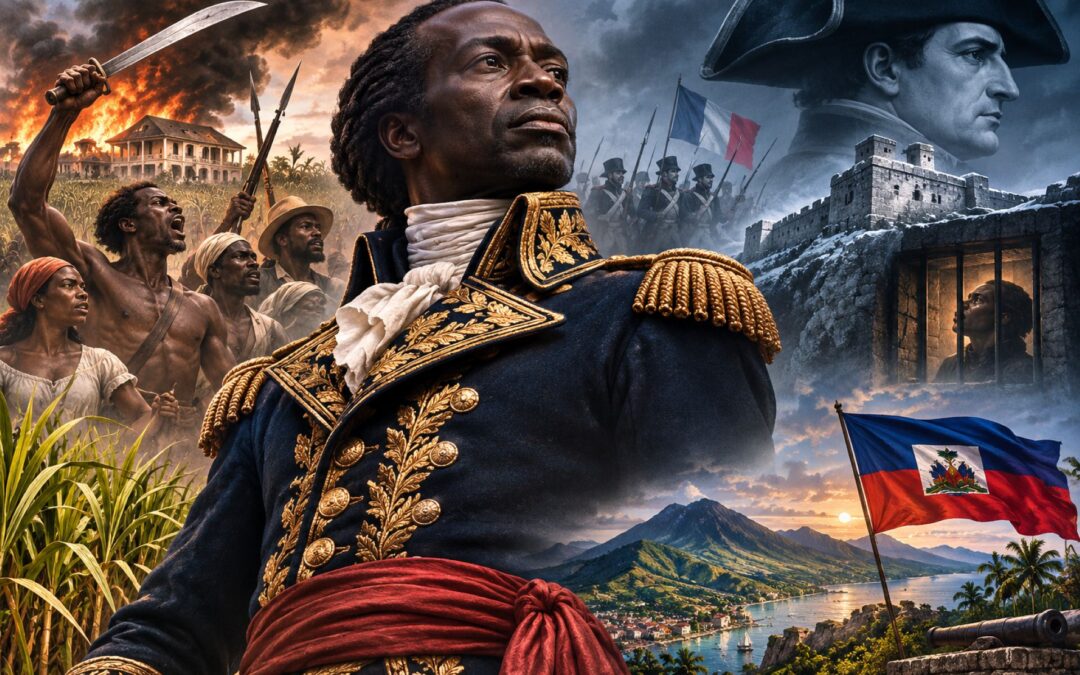
In February 1802, a French expeditionary force arrived off the coast of Saint-Domingue, the immensely wealthy Caribbean colony that would soon become Haiti. Its commander, Charles Leclerc, had been sent by Napoleon Bonaparte to restore French authority over a territory that was increasingly governing itself. Among those preparing to resist him was a man born into slavery who had become one of the most powerful military and political figures in the Atlantic world.
His name was Toussaint Louverture.
A decade earlier, Louverture had been relatively unknown outside the plantation communities of northern Saint-Domingue. Now he commanded thousands of soldiers, negotiated with European governments and ruled a society that had abolished slavery. He had fought alongside Spain before joining revolutionary France, helped defeat British attempts to conquer the colony and persuaded former enemies to cooperate in rebuilding its economy.
He had also become an authoritarian ruler. The man who defended emancipation forced former slaves back onto plantations under military supervision, suppressed opposition and made himself governor for life. Those contradictions weakened his position just as Napoleon prepared to destroy the autonomy he had built.
Louverture would not survive the confrontation. Arrested and deported to France, he died in a mountain fortress in April 1803, nine months before Haiti declared independence.
His life poses a difficult question: how did a former slave become a general capable of challenging Europe’s most powerful rulers, and why did a leader who fought for liberty become so determined to control the freedom of others?
Enslavement, Literacy and the Life Before the Revolution
Toussaint Louverture was born around 1743 on the Bréda plantation near Cap-Français, the principal commercial center of the French colony of Saint-Domingue. His exact birth date is unknown. Some accounts suggest 1 November because Toussaint means All Saints, but there is no reliable birth record establishing the connection.
His original name was Toussaint Bréda, reflecting the plantation on which he was enslaved. The surname Louverture came much later, after he became a revolutionary commander.
His parents were Africans brought to the Caribbean through the transatlantic slave trade. Family traditions identify his father as Hippolyte, a man of Allada ancestry from the region of present-day Benin, and his mother as Pauline. According to recollections preserved by Louverture’s son Isaac, his paternal grandfather had been a king named Gaou-Ginou.
The royal ancestry story is difficult to verify. Historians have found reasons to believe the family came from a respected West African lineage, but they have not established that Toussaint was the grandson of a specific monarch. The distinction matters because his later fame encouraged biographers to search for signs that he had been destined for greatness.
The world into which he was born offered few such possibilities. By the late eighteenth century, Saint-Domingue was among the world’s most valuable plantation colonies. Its exports of sugar, coffee and other commodities generated enormous profits for French merchants, shipowners and plantation investors.
That wealth depended on the forced labor of hundreds of thousands of enslaved Africans. Many worked long hours in cane fields and sugar-processing facilities under exhausting conditions. Punishments could be exceptionally cruel, and high mortality meant that plantation owners continually imported new captives.
The colony’s wealth therefore concealed a profound imbalance. A relatively small population of white colonists and free people of color occupied positions of privilege, while the enslaved majority had almost no legal protection. Conditions differed between plantations and occupations, but the system ultimately treated human beings as property.
Toussaint’s circumstances were unusual. Rather than spending his entire working life cutting sugarcane, he became associated with the management of livestock and horses. His skill as a rider earned him a reputation that later helped his military career.
He eventually worked as a coachman for Antoine-François Bayon de Libertat, the manager of the Bréda estate. It was a position of considerable responsibility. A coachman could travel between properties, carry messages, meet influential people and acquire knowledge of roads and settlements.
These responsibilities gave Toussaint opportunities that were unavailable to most enslaved field workers. His work also brought him into contact with both plantation managers and enslaved laborers, teaching him how authority functioned on either side of the colonial hierarchy.
He learned to read and acquired a degree of education that later observers found remarkable. His godfather, a free Black man named Pierre-Baptiste, is frequently credited with encouraging his intellectual development. Some accounts associate his education with Catholic missionaries and the Jesuit presence in northern Saint-Domingue.
Precisely what Toussaint studied, and when, remains disputed. Popular biographies describe him secretly reading military classics by candlelight, mastering Latin or memorizing every road on the island in preparation for an eventual uprising. Such scenes are compelling, but there is little reliable evidence for their dramatic details.
He did encounter ideas associated with Catholicism, classical history and the European Enlightenment. Historians have discussed his familiarity with authors such as Julius Caesar, Machiavelli and the philosopher Guillaume-Thomas Raynal, whose criticism of colonial slavery influenced debates across the Atlantic world.
His learning was not confined to books. Experience with animals and local remedies gave him practical medical knowledge, which later helped him establish a reputation as a healer. His familiarity with plantation operations also gave him an understanding of agricultural production, labor discipline and the economic interests of the planter class.
A particularly revealing story concerns unrest at Bréda during the 1770s. An unpopular manager reportedly provoked workers to flee, and Toussaint helped negotiate their return after Bayon de Libertat regained his position. The episode, reconstructed from later testimony and plantation records, suggests that Toussaint had already acquired influence among both managers and workers.
By 1776 at the latest, Toussaint had obtained his legal freedom. The discovery of documents establishing this fact changed the way historians understood his life. Earlier biographies often assumed that he remained enslaved until the revolution began in 1791.
His emancipation did not mean that he severed his relationship with Bréda. He continued working there and maintained close ties to people who remained enslaved, including members of his own family.
His private life was more complicated than the traditional heroic biographies suggested. He married a free Black woman named Cécile, with whom he had children. After that relationship ended, he formed a union with Suzanne, who remained enslaved at Bréda, and became stepfather to her son Placide. Toussaint and Suzanne also had children together, including Isaac and Saint-Jean.
The household’s circumstances reveal how uneven freedom could be. Toussaint had acquired legal independence, yet his wife and children remained subject to the authority of plantation owners. His position enabled him to secure less demanding assignments and forms of protection for relatives, but not to free everyone around him.
More controversially, Toussaint himself owned enslaved people.
Archival research has established that he acquired at least two enslaved people and, in 1779, leased a coffee plantation associated with thirteen enslaved workers. The enterprise lasted only a relatively short time before he gave it up.
These findings complicate the familiar picture of a revolutionary who had always rejected every aspect of slavery. Historians Philippe Girard and Jean-Louis Donnadieu have helped reconstruct the period through notarial and plantation records, demonstrating that Toussaint occupied an unusual position within the colonial economy.
The reassessment of Louverture’s early life makes clear that he was neither a typical field slave nor a fully accepted member of the white planter elite. He was a free Black man with modest resources, important social connections and direct experience of both enslavement and slave ownership.
This distinction does not erase his later achievements. It does, however, prevent us from imagining that his commitment to emancipation emerged fully formed during childhood.
Historian Sudhir Hazareesingh has emphasized Toussaint’s African cultural connections, Catholic faith and ability to move between different communities. His knowledge of African-derived traditions, European political ideas and plantation society helped him communicate with people who did not necessarily share the same experiences or goals.
In his study of Louverture’s revolutionary leadership, Hazareesingh also describes the significance of his family relationships and the archival discoveries that have revised older biographies.
By 1789, Toussaint was approaching fifty. He had experienced slavery, gained his freedom, worked within the plantation economy, established a family and accumulated knowledge of the colony’s social divisions.
Nothing in the surviving records proves that he had spent his life secretly preparing a revolution. But when the colonial order began to collapse, he possessed an unusual combination of experience, relationships and abilities that would allow him to play a decisive role.
From Rebel Officer to French General
The immediate spark for Saint-Domingue’s revolution came from events in France.
In 1789, the French Revolution challenged monarchy and inherited privilege while introducing a language of liberty, equality and political rights. Those ideals created an obvious problem for a colonial society whose prosperity depended on treating most of its inhabitants as property.
White planters sought greater control over colonial affairs, while free people of color demanded political rights that many wealthy colonists resisted. The tensions intensified after Vincent Ogé, a free man of color, launched an unsuccessful movement for equal rights in 1790 and was executed.
Enslaved workers followed these developments closely. News traveled through plantations, markets, churches and personal networks. Their expectations did not always match the political demands of white revolutionaries, but the apparent contradiction between universal freedom and colonial slavery became increasingly impossible to ignore.
In August 1791, enslaved people in northern Saint-Domingue launched a massive uprising. Plantation buildings burned, owners were attacked and rebel groups took control of extensive rural territory. The violence followed generations of exploitation and quickly provoked equally severe reprisals.
The uprising is frequently associated with a gathering at Bois Caïman, traditionally described as involving a Vodou ceremony and the leadership of Dutty Boukman. The event occupies an important place in Haitian historical memory, although historians debate the precise details and the relationship between different meetings held before the rebellion.
Toussaint’s role during the opening weeks is similarly uncertain.
Some accounts present him as a secret organizer from the beginning. Others suggest he remained at Bréda while deciding whether the revolt could succeed. Surviving documents do not establish that he planned the uprising or attended the Bois Caïman gathering.
He appears to have protected Bayon de Libertat’s family and arranged for his own relatives’ safety before joining the insurgents in the autumn of 1791.
His initial position was not that of an independent revolutionary commander. He entered the camp of Georges Biassou, one of the principal rebel leaders, and served partly as an adviser and healer. His medical knowledge earned him an association with the title General Doctor.
Other prominent commanders included Jean-François Papillon and, earlier, Boukman. The movement was not a single army governed by one strategy. Its leaders differed over military objectives, relations with European powers and the conditions they would accept in negotiations.
In December 1791, rebel commanders attempted to reach a settlement with colonial authorities. Their proposals included amnesty for selected leaders, relief from the whip and additional freedom for enslaved workers rather than immediate universal abolition.
The demands may seem surprisingly limited from the perspective of Haiti’s eventual independence. They reveal how uncertain the revolution’s direction remained. Its participants had not yet agreed on whether victory meant reforming slavery, abolishing it or establishing an independent state.
When the negotiations failed, the conflict continued.
Toussaint gradually established a military command of his own. By 1792, he reportedly led several hundred men, a force that would expand substantially during the following year. He learned to coordinate infantry and cavalry, maintain supplies, impose discipline and negotiate with rival commanders.
Accounts of his leadership emphasize his ability to win loyalty and insist on restraint toward prisoners. Such claims should not be accepted as proof that his troops never committed atrocities, but they help explain why he acquired a reputation different from that of some other commanders.
He also surrounded himself with talented officers. Among those who would become central to the revolution were Jean-Jacques Dessalines, Henri Christophe and Hyacinthe Moïse, a relative whom Toussaint treated as a nephew and trusted with military responsibilities.
The international situation changed dramatically in 1793.
Revolutionary France went to war with Britain and Spain, and both powers saw opportunities in Saint-Domingue. Britain sought control of valuable coastal settlements, while Spain offered arms and commissions to rebel commanders fighting the French.
Toussaint joined the Spanish side, serving under the authority of the Spanish monarchy. His decision was not a simple betrayal of a French cause he had always embraced. At that point, French revolutionary authorities had not secured the rebels’ confidence, and Spanish officials offered military recognition and practical assistance.
Toussaint received a commission and expanded his forces, eventually commanding thousands of men. His association with Spain also brought him into conflict with French republican troops, even as the French Revolution was moving toward abolition.
In August 1793, he adopted the name Louverture, generally understood to mean the opening. The precise reason remains uncertain. It may have referred to his ability to break through enemy defenses, his political ambitions or a symbolic opening toward freedom.
On 29 August 1793, he issued a proclamation calling for liberty and equality in Saint-Domingue. His appeal urged enslaved people and other inhabitants to unite behind his cause. Yet he was still fighting under the Spanish crown.
The same date marked a remarkable political development. Léger-Félicité Sonthonax, a French civil commissioner, proclaimed the abolition of slavery in northern Saint-Domingue.
Sonthonax’s decision emerged from a combination of revolutionary principle, military necessity and the need to secure Black support against France’s enemies. It was not simply a benevolent decree handed down from Paris. Enslaved insurgents had already made the continuation of the old system increasingly impossible.
On 4 February 1794, the French National Convention abolished slavery throughout the French colonies.
For Toussaint, the change created a profound strategic dilemma. Spain remained a slaveholding monarchy, while revolutionary France now officially promised emancipation.
He did not immediately switch allegiance when Sonthonax first made his proclamation in 1793. His decision came in May 1794, after months of uncertainty, disputes among rebel commanders and negotiations with French representatives.
Toussaint transferred his forces to the French Republic, helping turn the war against his former Spanish allies.
The historical chronology of his changing allegiances records his progression from the rebel armies of Biassou and Jean-François to Spanish service and then to the French republican military.
Historians continue debating his precise motives. France’s abolition decree was important, but tensions with Biassou, dissatisfaction with Spanish policies and Toussaint’s growing ambitions also contributed. Reducing the decision to a single sudden revelation about liberty overlooks the political calculations involved.
Whatever his reasons, the consequences were enormous.
Toussaint’s troops strengthened the French position in northern Saint-Domingue at a moment when European reinforcements were limited. He attacked Spanish forces, secured territory and helped transform the republican army from a struggling colonial force into a serious contender for control of the island.
By 1795, Spain had made peace with France through the Treaty of Basel, and its military challenge was coming to an end. Toussaint’s attention could increasingly turn toward the British, whose coastal strongholds still threatened the future of emancipation.
Defeating Imperial Armies Through War and Diplomacy
Toussaint Louverture’s military reputation rested on more than personal bravery. He understood how to combine rapid movement, knowledge of terrain, disciplined forces and negotiation to defeat opponents whose governments possessed far greater financial and naval resources.
His experience as a coachman had exposed him to the geography of northern Saint-Domingue. As a commander, he learned to move troops through mountain routes, valleys and plantation roads that could be difficult for European expeditionary armies.
He was also able to identify capable subordinates and give them substantial responsibilities. Christophe, Dessalines and Moïse became important commanders within a force that mixed formerly enslaved men, African-born veterans and soldiers familiar with European military methods.
French general Étienne Laveaux developed a productive working relationship with Toussaint. Although they came from radically different backgrounds, they shared an interest in defending the French Republic’s abolition of slavery against external enemies and internal opponents.
Their alliance was tested in March 1796, when a faction associated with Jean-Louis Vilatte challenged Laveaux’s authority at Cap-Français. Toussaint intervened, helped restore the governor’s position and emerged with even greater influence.
Laveaux rewarded him with senior responsibilities, and Toussaint’s military standing continued to rise. He would ultimately become the leading French general in the colony.
The episode also revealed the fragility of French authority. A European governor could hold office, but his ability to exercise power increasingly depended on troops commanded by a formerly enslaved Black general.
The British presented a different challenge.
British forces had entered Saint-Domingue in 1793, initially cooperating with white planters who hoped to resist revolutionary changes and preserve their privileges. British commanders occupied coastal towns and fortified positions, relying on their navy and overseas supply networks.
Their campaign, however, proved extraordinarily expensive.
European soldiers suffered heavily from tropical diseases, particularly yellow fever. The British could control particular ports and fortifications, but extending their authority across a hostile countryside was far more difficult.
Toussaint exploited these weaknesses. His soldiers operated through terrain they knew well, threatened supply lines and made it costly for British forces to move inland.
He could attack a vulnerable position and withdraw before a larger opposing force arrived. At other times, he concentrated troops quickly enough to overwhelm isolated detachments.
His reputation for speed became central to his command. Accounts describe extraordinary marches over mountainous ground, though individual distances and episodes should be treated cautiously unless supported by contemporary records.
Disease was an important part of the military environment, but it would be misleading to imagine that Toussaint commanded mosquitoes as though they were another unit in his army. Yellow fever and other illnesses independently devastated European troops; the difficulty of operating in the climate magnified the effectiveness of resistance.
By 1797, Toussaint had helped reduce British control to increasingly vulnerable coastal enclaves. Operations around Saint-Marc and elsewhere demonstrated that the British could not easily convert their naval strength into lasting control of the colony.
The scale of their losses was extraordinary. Thousands of British soldiers died, many from disease rather than battlefield wounds. Exact totals vary across historical estimates, but the expedition had become too costly to sustain indefinitely.
In 1798, British commander Thomas Maitland negotiated with Toussaint over withdrawal.
Agreements reached during that year facilitated British evacuation of major positions, including Saint-Marc and Port-au-Prince. They also opened the possibility of renewed commercial relations.
The negotiations were a diplomatic breakthrough for a man who had once been legally classified as property. Britain now dealt directly with him because it recognized that he controlled the military forces capable of determining the colony’s future.
Yet the agreement also exposed a troubling feature of his pragmatism.
Toussaint was eager to restore trade, obtain supplies and prevent further intervention. He was willing to assure the British that his government would not encourage slave uprisings in their Caribbean colonies, particularly Jamaica.
For an abolitionist leader, that assurance carried a profound contradiction. The freedom of people in Saint-Domingue was being defended partly through an understanding with another power that continued to hold enslaved Africans in bondage.
The contradiction became more concrete in 1799.
A revolutionary named Isaac Sasportas was involved in plans to encourage a slave uprising in British Jamaica. Toussaint supplied information about the conspiracy to British authorities, who arrested and executed Sasportas.
The episode is discussed in historian Madison Smartt Bell’s biography of Toussaint Louverture, which examines how his commitment to protecting Saint-Domingue could lead him to decisions that endangered other enslaved populations.
The trade agreement helped the colony, but it came at a moral cost.
Toussaint also pursued relations with the United States. President John Adams viewed Saint-Domingue as an important trading partner, and American merchants were eager to resume commerce with the colony.
The situation was diplomatically awkward because the United States and revolutionary France were engaged in the undeclared naval conflict known as the Quasi-War. Toussaint nevertheless negotiated arrangements that allowed commercial activity to expand.
American ships supplied food, manufactured goods and military equipment. These transactions helped Toussaint rebuild an economy devastated by warfare while increasing his independence from the French authorities who supposedly governed the colony.
The result was a remarkable transformation. By the end of the decade, Louverture could negotiate with Britain and the United States, command an effective army and manage economic affairs with relatively little interference from Paris.
His French superiors were not always pleased.
Toussaint’s relationship with Sonthonax deteriorated as they disagreed over the treatment of white planters and the political future of the colony. Sonthonax regarded many returning colonists as dangerous counterrevolutionaries, while Toussaint believed some possessed skills and commercial contacts essential to economic recovery.
In 1797, Toussaint helped pressure Sonthonax into returning to France. Although the commissioner had supported abolition and advanced his career, his continued presence represented an obstacle to the general’s expanding authority.
The French Directory subsequently dispatched Gabriel Marie Joseph d’Hédouville in an effort to restore civilian oversight and restrain Toussaint’s power.
Hédouville encountered similar difficulties. When he attempted to interfere with the command of Toussaint’s officers, tensions escalated. Dessalines and other loyal soldiers challenged his authority, and the commissioner departed in October 1798.
By then, the greatest threat to Toussaint’s position was no longer a foreign European army. It came from another revolutionary commander within Saint-Domingue.
André Rigaud, a prominent free man of color, controlled much of the southern peninsula. His forces had fought against British occupation and established an autonomous political and military position.
The division between Toussaint and Rigaud reflected personal ambition, regional competition and the complicated racial hierarchy of colonial society. Rigaud drew important support from mixed-race communities, while Toussaint commanded a predominantly Black military network.
Reducing the struggle to a simple war between Black and mixed-race Haitians, however, obscures the shifting alliances and political interests involved.
In 1799, the conflict erupted into the War of the Knives, sometimes called the War of the South.
Rigaud’s forces seized positions including Petit-Goâve, while Toussaint sent Dessalines to campaign against him. Alexandre Pétion, a talented officer who would later become president of southern Haiti, sided with Rigaud.
Dessalines pursued the war with exceptional brutality. Soldiers and civilians associated with Rigaud suffered massacres and reprisals, creating long-lasting resentment. Some accounts give death tolls in the thousands or even higher, but the figures are disputed and should not be presented as exact.
Toussaint benefited from American naval assistance and the superior strength of his army. Rigaud eventually abandoned the struggle and left the colony in 1800.
By defeating Rigaud, Louverture consolidated control over Saint-Domingue. But the victory carried a political price.
The War of the Knives intensified divisions among communities whose cooperation was essential to the future of emancipation. It also demonstrated that Toussaint could allow subordinate commanders to use extreme violence when it served his strategic objectives.
The man who had once served under Biassou was now the dominant ruler of French Saint-Domingue. Britain had withdrawn, Spain was no longer a major military threat, rival French commissioners had departed and Rigaud had been defeated.
His authority was unprecedented.
The difficult question was what he would do with it.
Freedom, Forced Labor and the 1801 Constitution
Toussaint Louverture inherited a devastated economy.
Saint-Domingue had once generated enormous wealth through the production of sugar and coffee. Years of revolution had destroyed plantations, interrupted exports and displaced workers. Commercial networks were disrupted, while the army and government required food, weapons and revenue.
For Toussaint, preserving emancipation meant ensuring that the colony could sustain itself economically and militarily. He feared that a society unable to finance its defense would remain vulnerable to European reconquest.
He therefore sought to restore agricultural production.
The problem was that the workers whose freedom he defended had very different ideas about what emancipation should mean.
For many formerly enslaved people, liberty meant leaving plantations, cultivating their own land, maintaining family life and escaping the discipline of overseers. Returning to the estates where they had suffered forced labor could feel like a betrayal of the revolution.
Toussaint believed that large-scale export agriculture remained essential. The plantations needed to produce commodities that could be sold abroad in exchange for money, food, weapons and equipment.
His administration encouraged white planters and managers to return, reasoning that their experience might help revive production. He also involved Black military officers in agricultural management and maintained commercial relationships across racial lines.
The system did not legally restore slavery. Workers were no longer supposed to be owned or sold, and they were entitled to a share of agricultural production or wages.
Nevertheless, their freedom of movement and choice of employment was severely restricted.
Formerly enslaved workers could be compelled to remain on plantations. Military officers enforced labor rules, while penalties for desertion and resistance made it difficult to leave.
The difference between free labor and forced labor became increasingly blurred in practice.
Some administrators regarded these measures as unavoidable emergency policies. Others believed they had re-created important features of the plantation order under a new name.
Toussaint defended the system as necessary to protect liberty itself. Without agricultural production, he argued, the colony would lack the resources to resist a future invasion.
That reasoning had economic logic. Saint-Domingue could not easily rebuild its export economy without workers, infrastructure and access to international markets.
But the policy also raised a fundamental political question: whose freedom was the revolution supposed to secure?
If emancipation meant that former slaveholders could no longer own people, Toussaint had achieved a historic change. If it meant that workers could decide where to live and whom to work for, his government fell far short.
The conflict was not merely theoretical.
Thousands of men who had fought in the revolutionary armies were expected to return to agricultural employment. Former soldiers who had risked their lives for freedom could now find themselves compelled to labor under the supervision of officers they once followed into battle.
Some workers resisted by leaving plantations, cultivating smaller plots or refusing orders. Others complained about treatment by managers and the restrictions imposed on their families.
Toussaint sometimes responded by visiting troubled plantations and speaking directly with workers. His personal reputation could persuade people to accept difficult arrangements, especially when he argued that foreign enemies remained eager to restore slavery.
At other times, military coercion replaced persuasion.
His administration also discouraged the subdivision of plantations into small farms. This approach favored large agricultural estates and limited the economic independence of people who wanted to own their own land.
The consequences were significant. The government might increase export production while weakening the attachment of rural workers to the regime. A society that had mobilized against slavery was discovering that political emancipation did not automatically produce economic independence.
There were nevertheless genuine achievements.
Toussaint encouraged repairs to roads and public works, supported trade and sought to restore education and administration. He maintained a commitment to racial equality in public life and promoted capable individuals from different backgrounds.
Some contemporary observers reported improvements in urban society, including greater opportunities for Black residents to participate in activities previously dominated by whites. Formerly enslaved people could hold military and administrative authority on a scale unimaginable before the revolution.
Yet the contrast between cities and plantations remained stark. A government could proclaim equality while treating rural laborers as people whose main obligation was to produce revenue.
Louverture’s military officers also accumulated wealth and influence. The new political hierarchy increasingly depended on rank, property and proximity to the governor.
In 1801, Toussaint further strengthened his position by extending authority across the entire island of Hispaniola.
The eastern territory of Santo Domingo had formally been ceded by Spain to France under the 1795 Treaty of Basel, but Spanish administration persisted in practice. Napoleon opposed Toussaint taking independent action there, partly because it might complicate relations with Spain.
Toussaint nevertheless ordered forces into the territory, and his troops established control early in 1801. He abolished slavery there and extended the authority of his government over the island.
The move was both humanitarian and strategic. It eliminated a nearby slaveholding system and reduced the possibility that an enemy might use the eastern territory as a base.
But it also showed that Louverture was increasingly willing to disregard instructions from Paris.
His next decision went further.
In early 1801, he convened an assembly to prepare a constitution for Saint-Domingue. The membership included white planters and free people of color, while representation of the formerly enslaved majority was highly limited.
The resulting document, proclaimed in July 1801, is often described as Haiti’s first constitution, although Haiti would not formally declare independence until 1804.
The 1801 Constitution of Saint-Domingue embodied the contradictions of Toussaint’s rule.
Its Article 3 abolished slavery and declared that people were born, lived and died free. It established racial equality as a constitutional principle, a radical departure from the colonial order that had defined the territory.
But Article 14 also described the colony as essentially agricultural and treated the continuation of cultivation as a matter of public necessity. The wording helped provide a constitutional basis for the restrictive plantation system.
Religious freedom was limited as well. Article 6 identified Roman Catholicism as the only publicly recognized religion, reflecting Toussaint’s deeply held Catholicism while constraining other forms of worship.
The constitution established a governor with extensive executive powers and provided for a central assembly whose independence was limited.
Most significantly, it named Toussaint Louverture governor for life and authorized him to designate a successor.
The document formally preserved Saint-Domingue’s association with the French Republic. It did not straightforwardly declare independence.
Nevertheless, it transferred extraordinary authority into Toussaint’s hands and provided little meaningful opportunity for the population to remove him.
He presented the constitution as a guarantee of freedom and stability. Napoleon saw it as an affront to French sovereignty.
The clash was more complex than a straightforward dispute between a champion of independence and an imperial ruler. Toussaint’s own intentions concerning eventual separation from France remain debated. He repeatedly acknowledged a connection to the republic while pursuing policies that made him increasingly autonomous.
His government could be described as seeking self-rule under French sovereignty, although the arrangement was unlikely to satisfy a ruler in Paris determined to control the colony directly.
A surviving December 1801 address challenging Bonaparte provides evidence of Toussaint’s assertive position at a moment when relations with France were deteriorating.
Meanwhile, discontent within Saint-Domingue was becoming dangerous.
In October 1801, a serious uprising erupted in northern agricultural districts. The movement involved thousands of workers and was associated with Hyacinthe Moïse, Toussaint’s adopted nephew and one of his senior commanders.
Moïse had become increasingly sympathetic to rural grievances, particularly opposition to coercive plantation labor. The revolt also involved violence against white inhabitants, heightening fears that ethnic conflict would resume.
The precise origins of the uprising remain contested. Historians disagree about Moïse’s actual role, the extent of his involvement in planning it and whether rival factions manipulated the crisis.
What is clear is that Toussaint responded with severity.
Dessalines and Christophe helped suppress the unrest. Moïse was arrested, subjected to a military process widely criticized as lacking proper safeguards and executed on Toussaint’s orders.
The episode shocked people who had regarded Louverture as the defender of their freedom. The governor had demonstrated that even a trusted relative and revolutionary commander could be killed for challenging his authority.
He also imposed harsher measures against dissent, threatening severe punishment for people accused of encouraging resistance to plantation work or undermining government authority.
The suppression strengthened his immediate control but damaged his political support.
A tragic contradiction was emerging. Toussaint had defeated European forces partly because he commanded the loyalty of men willing to fight against slavery. His labor policies and repression now alienated some of the same people whose support he would need against Napoleon.
The 1801 constitution had established his authority at its height. It had also made his coming confrontation with France more likely while exposing fractures within the society he governed.
Napoleon’s Expedition and the Unraveling of His Command
Napoleon Bonaparte had become First Consul of France in November 1799. His government sought to restore French power after years of revolutionary warfare, and Saint-Domingue remained one of the most valuable possessions associated with the French colonial empire.
Napoleon faced an uncomfortable reality.
A Black general born into slavery exercised effective control over a rich colony, negotiated independently with foreign governments and had promulgated a constitution that made him governor for life.
Toussaint still professed loyalty to France, but his actions left Paris with little practical authority.
Napoleon’s ambitions were also connected to the wider Atlantic world. France had reacquired Louisiana from Spain, and Saint-Domingue was important to plans for rebuilding French influence in the Caribbean and North America.
The colony’s agricultural wealth and strategic location made it attractive, but Napoleon could not fully exploit either while Toussaint governed independently.
The changing European diplomatic situation offered an opportunity. Preliminary peace arrangements between France and Britain in 1801 reduced the immediate threat of British naval interference and allowed Napoleon to prepare a major expedition.
He selected his brother-in-law, General Charles Victor-Emmanuel Leclerc, to command it. Leclerc was married to Napoleon’s sister Pauline and had experience in the French military.
The expedition included roughly twenty thousand troops in its initial deployment, with more arriving later. It was among the largest French forces sent across the Atlantic.
Its objectives were partly concealed behind promises that French authorities would respect emancipation and restore orderly government.
The danger was real. Napoleon’s administration intended to regain control of the colony and revive its economic value, and the possibility of restoring slavery was central to the fears of Saint-Domingue’s Black population.
In May 1802, France passed legislation permitting slavery to continue or be restored in certain colonies, and French authorities re-established slavery in Guadeloupe by force. That development became critical in the subsequent collapse of trust in Napoleon’s expedition.
When the French fleet approached Saint-Domingue in late January and early February 1802, Toussaint recognized the scale of the threat.
His own army was experienced, but he lacked a navy capable of contesting the French landing. Leclerc possessed trained European troops, artillery and the advantage of attacking several coastal positions.
Louverture attempted to organize resistance while preserving the possibility of negotiations.
At Cap-Français, Henri Christophe initially refused to admit the French forces. After resisting the landing, he ordered the town evacuated and burned rather than allow the invaders to take its resources intact.
The destruction was a dramatic example of the scorched-earth strategy available to the defenders.
If French troops captured ports, roads and plantations in usable condition, they could draw supplies from the colony. Destroying infrastructure made occupation more costly and forced the invaders to depend more heavily on vulnerable supply lines.
But scorched-earth warfare also imposed terrible costs on the population. Buildings, stored goods and commercial facilities destroyed to hinder the French were resources Haitians would eventually need for their own recovery.
Toussaint’s commanders were divided over how to respond.
Some believed Leclerc’s promises that the expedition would preserve emancipation. Others doubted that a government seeking to restore direct colonial authority could be trusted.
Family relationships complicated the confrontation. Toussaint’s sons Isaac and Placide, who had been educated in France, accompanied the expedition and were used in efforts to persuade their father to submit.
The French offered assurances that his rank, family and the freedom of the population would be respected.
Toussaint refused to surrender immediately. He continued military operations, but the presence of his sons and the uncertainty surrounding French intentions placed additional pressure on him.
Fighting intensified in February.
At the Battle of Ravine-à-Couleuvres, Toussaint confronted a French force associated with General Donatien de Rochambeau. The battle involved difficult terrain, maneuvering and heavy casualties, although surviving accounts differ over troop numbers and the result’s tactical significance.
The defenders demonstrated that French victory would not be easy, but the invaders continued advancing.
A particularly important engagement followed at Crête-à-Pierrot in March 1802.
The fortress, situated near the Artibonite River, was defended by troops associated with Dessalines and other revolutionary officers. French forces attacked repeatedly, suffering severe losses before the defenders withdrew.
Crête-à-Pierrot became one of the most celebrated episodes of resistance to Napoleon’s expedition.
The battle also illustrated the limitations of both sides. The French possessed numerical and material advantages but struggled against determined troops in fortified positions. The defenders could impose enormous costs yet had difficulty preventing the gradual loss of territory.
Meanwhile, the unity of Toussaint’s command was deteriorating.
Several officers submitted to Leclerc or changed sides, accepting French assurances that abolition would remain in force. Christophe eventually surrendered, and other commanders followed.
Toussaint’s increasingly authoritarian policies had weakened his ability to rally the population. Many workers remembered coercive plantation regulations, while communities affected by the War of the Knives distrusted commanders associated with earlier atrocities.
Not everyone opposed Napoleon for the same reasons, and not everyone supported Toussaint simply because he had defended emancipation.
Some former colonists welcomed the French expedition as an opportunity to regain influence. Others hoped that submitting early would protect their property and families.
The revolutionary army was therefore not a unified national force confronting a universally hated invader. It was divided by political rivalries, racial tensions, economic grievances and conflicting expectations about France’s intentions.
By May 1802, Toussaint’s military position had become increasingly difficult.
He opened negotiations with Leclerc and agreed to end his resistance in exchange for guarantees concerning emancipation and the treatment of his officers.
The settlement allowed him to retire to his estate at Ennery while maintaining certain protections. He did not formally surrender the cause of freedom, but he relinquished the military authority that had made him the dominant figure in the colony.
Dessalines also submitted to French command.
For Napoleon’s expedition, the agreement appeared to be a major success. The principal Black commanders had been brought under French authority, and the government could begin restoring direct control.
But the settlement was fragile.
Leclerc remained suspicious of Toussaint’s influence, while armed groups continued resisting in different parts of the colony.
A general who had repeatedly outmaneuvered European opponents was still dangerous even after retirement. Leclerc feared he might resume rebellion or encourage others to do so.
The French command therefore decided to remove him.
What followed would end Toussaint’s political career but not the revolution he had helped shape.
Arrest, Exile and Death at Fort de Joux
In early June 1802, French general Jean-Baptiste Brunet invited Toussaint Louverture to a meeting. The invitation concerned military and administrative matters, giving the appearance of routine consultation between officers who had recently reached an accommodation.
Toussaint had reasons to be cautious. The French had violated assurances before, and his former authority made him an obvious threat to Leclerc’s plans.
Nevertheless, he attended.
On 7 June 1802, French soldiers arrested him during the meeting. The operation had been arranged in advance, and the authorities quickly moved to prevent his supporters from organizing a rescue.
The circumstances have generated different interpretations. Some biographers portray Toussaint as an unusually trusting victim of betrayal. Others speculate that he understood the danger but believed attendance offered the best chance of preserving his family or avoiding renewed bloodshed.
Neither interpretation can be established with certainty.
The arrest was a decisive political act. Rather than bringing charges before a court, the French authorities treated Louverture as a military prisoner whose continued presence in Saint-Domingue was unacceptable.
His family was also detained. Suzanne and their children were transported to France, where they would remain separated from him.
The separation was particularly cruel for a man whose family life had already been shaped by enslavement and the legal vulnerability of his loved ones.
Toussaint was carried across the Atlantic on a French ship and arrived in Europe during the summer of 1802.
The voyage reversed the direction of the journey that had brought his parents to Saint-Domingue as enslaved Africans. The former slave had become a governor and general, only to be removed from the society he helped transform and transported to the country whose authority he had challenged.
After a period of confinement near Brest, he was transferred to Fort de Joux, a fortress in the Jura Mountains of eastern France.
The location was deliberately isolating.
Fort de Joux stood far from the Caribbean and France’s major ports, reducing any possibility that Toussaint could escape and return to his supporters. Its mountain climate was drastically different from the tropical conditions in which he had spent his life.
The prison environment was harsh. His cell was damp and cold, while his health deteriorated during the winter.
He was denied an ordinary public trial and had few opportunities to defend himself.
Nevertheless, Toussaint continued to write.
He prepared a memoir explaining his actions during the final period of his government and the French expedition. He also sent appeals seeking Napoleon’s attention and assistance.
The French military archives’ account of his imprisonment describes his confinement, correspondence and death.
The writings reveal a man attempting to justify decisions that had become controversial even among his own supporters. He defended his loyalty to France, his conduct toward Leclerc and his commitment to the freedom of the colony’s population.
His situation was desperate.
The former governor had no independent means of communicating with Saint-Domingue, little reliable information about his family and no effective legal process through which to challenge his imprisonment.
Napoleon did not grant the hearing he requested.
Popular biographies sometimes describe the authorities deliberately freezing him to death by systematically reducing fuel and food. The evidence does establish severe confinement and neglect, but precise scenes involving guards, daily ration changes and the intentions of individual officials are not always independently documented.
It is reasonable to conclude that his treatment contributed to his decline. It is less certain to claim that every aspect of his death followed a carefully documented plan of slow execution.
On 7 April 1803, Toussaint Louverture died at Fort de Joux, around sixty years old.
His precise medical condition is difficult to reconstruct. Contemporary accounts refer to respiratory illness, and later descriptions commonly identify pneumonia as the cause of death.
He was buried in France, thousands of kilometers from the land where he had been born and risen to power.
One of the most famous statements attributed to him concerns the arrest that ended his career. According to a widely repeated tradition, he warned that the French had cut down only the trunk of the tree of Black liberty and that its roots would grow again.
The exact circumstances and wording remain uncertain.
Nevertheless, the image endured because subsequent events appeared to vindicate its meaning.
By the time Toussaint died, the French expedition was already losing control of Saint-Domingue.
The Revolution That Continued Without Him
Toussaint Louverture did not live to see Haiti become independent, but his removal did not secure a lasting French victory.
Napoleon’s expedition encountered two forces it could not easily overcome: determined resistance and disease.
Yellow fever devastated European troops, whose vulnerability increased during the tropical rainy season. General Leclerc himself died of the disease in November 1802.
The precise numbers of deaths vary, but the human cost of the expedition was enormous. Disease inflicted severe losses alongside those suffered in combat.
More importantly, Napoleon’s policies destroyed confidence in French promises.
News that slavery had been restored in Guadeloupe convinced many soldiers and civilians that the same fate awaited Saint-Domingue. Those who had accepted Leclerc’s assurances now had powerful reasons to distrust him.
Former commanders who had submitted to the French resumed resistance.
Jean-Jacques Dessalines, Henri Christophe and other leaders eventually became central figures in the final struggle against French rule.
Dessalines differed from Toussaint in important ways. Where Toussaint had repeatedly sought arrangements that preserved a relationship with France, Dessalines moved toward the conclusion that emancipation could survive only through complete political independence.
His campaign also became exceptionally violent.
The French under Rochambeau employed brutal measures against Black inhabitants and insurgents. Revolutionary forces responded with fierce reprisals, and both sides committed atrocities.
The conflict was no longer a contest primarily over colonial autonomy. It had become a struggle over whether formerly enslaved people would remain free.
The international situation also changed.
In May 1803, Britain renewed its war with France, and British naval power made it increasingly difficult for Napoleon to reinforce and supply the troops remaining in Saint-Domingue.
The French position deteriorated as Dessalines’s forces captured territory and pressed the remaining garrisons.
On 18 November 1803, the revolutionary army defeated French forces at the Battle of Vertières, near Cap-Français.
The battle marked the decisive end of Napoleon’s attempt to reassert control over the colony.
On 1 January 1804, Dessalines proclaimed independence and adopted the name Haiti for the new state.
The Haitian Revolution had achieved an outcome unmatched by any other large-scale uprising of enslaved people: the establishment of an enduring independent country through their successful struggle against slavery and colonial rule.
Napoleon’s defeat also affected events far beyond the Caribbean.
The failure to maintain Saint-Domingue as a profitable and secure French possession weakened his broader ambitions in North America. In April 1803, France agreed to sell Louisiana to the United States.
The Louisiana Purchase had several causes, including financial considerations and renewed war with Britain. It would be an exaggeration to attribute the sale solely to Toussaint or the Haitian Revolution.
Nevertheless, the collapse of France’s Caribbean project was an important part of Napoleon’s changing strategic calculations.
Toussaint’s influence also continued through the officers and institutions he had developed.
He had helped organize a professional revolutionary army, established international relationships and demonstrated that formerly enslaved people could govern and defend their society.
Yet his legacy cannot be separated from the coercion that marked his final years.
The plantation labor regime, suppression of Moïse’s revolt and authoritarian constitution were not incidental details. They reveal the difficulties and contradictions involved in trying to defend emancipation while preserving an export economy built on slavery.
Historians have consequently portrayed Louverture in sharply different ways.
Some emphasize his military brilliance, political imagination and commitment to racial equality. Others focus on his willingness to compromise with white planters, restrict workers’ freedom and concentrate authority in his own hands.
Neither perspective fully captures him.
Toussaint was a revolutionary who understood the power of compromise, a former slave who had owned enslaved people, a defender of liberty who imposed forced labor and a French republican who increasingly governed independently of France.
He was also a leader who helped make Haiti’s independence possible without ever fully embracing the political separation that Dessalines ultimately achieved.
His significance lies partly in those contradictions.
The French colonial order had been built on the assumption that enslaved Africans were incapable of governing themselves. Toussaint disproved that assumption through military command, diplomacy and administration.
He did not create a fully free or democratic society, but he helped make the restoration of the old plantation system increasingly impossible.
His death at Fort de Joux was therefore not the end of the struggle. The army he had helped develop, the political expectations raised by emancipation and the determination of formerly enslaved people to resist renewed bondage all survived him.
Napoleon could remove the general. He could not restore the world in which that general had once been property.
Toussaint Louverture remains one of the most important figures of the Atlantic revolutionary age because he forced the question of universal liberty into a setting where European powers had long denied its application. His achievements were extraordinary, his methods often troubling and his final defeat profoundly consequential.
The country that emerged after his death would face enormous political and economic challenges. But the fundamental transformation he helped bring about endured: the people of Saint-Domingue had ceased to accept slavery as the natural order of their world, and no European emperor could simply command them to return to it.
Last Updated on November 18, 2026 by Aseem Gupta