
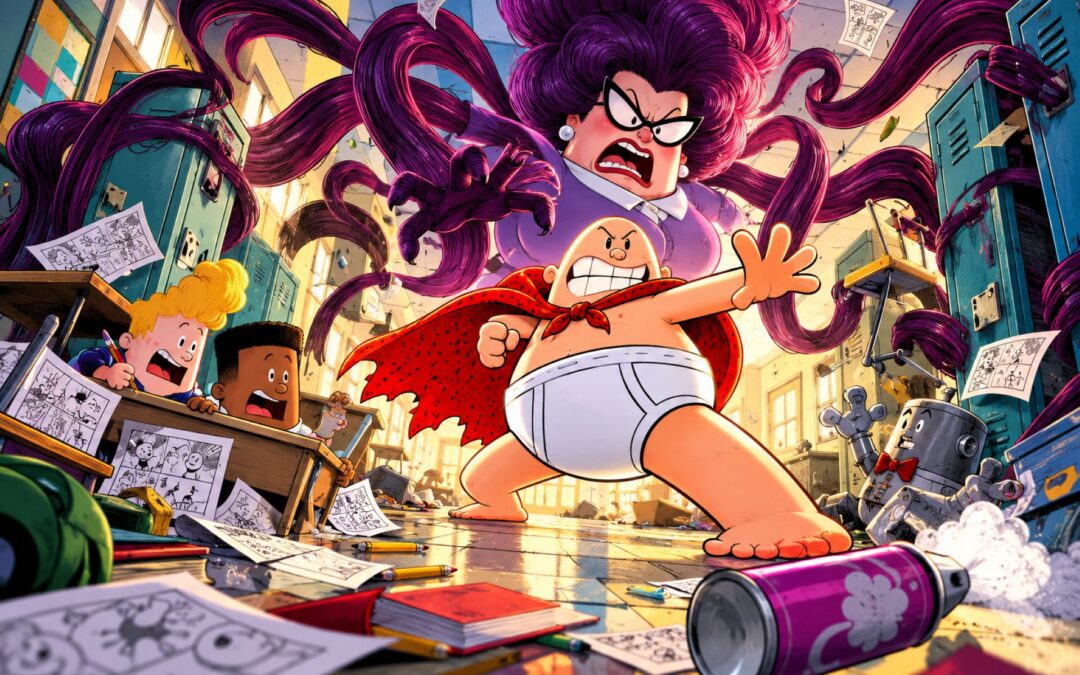
Dav Pilkey’s Captain Underpants and the Wrath of the Wicked Wedgie Woman is the fifth novel in the Captain Underpants series, and Scholastic’s official listing for the fifth Captain Underpants novel places it squarely within the series’ familiar mixture of school comedy, superhero parody, cartoons, and fast-moving illustrated fiction. The premise sounds deliberately ridiculous: George Beard and Harold Hutchins accidentally turn their unpleasant teacher, Ms. Ribble, into the supervillain they had invented in one of their own comics. Yet the book is more carefully constructed than its underwear jokes and deliberately chaotic presentation initially suggest.
The story repeatedly links imagination, reversal, and belief. George and Harold’s creativity causes much of the trouble, but it is also their most reliable means of escaping it. Their comic about Wedgie Woman becomes an accidental blueprint for a real villain, while a later comic about Captain Underpants gives him the confidence he needs to recover from a weakness that exists largely in his own mind. At the same time, almost every major development involves something turning into its opposite: a retirement card becomes a marriage proposal, precautions against creating a villain create exactly that villain, obedient versions of George and Harold become dangerous robots, and an attempt to hypnotize Ms. Ribble into behaving normally ends with her personality being radically rewritten.
Spoiler warning: This article covers the complete plot, including the climax, Ms. Ribble’s transformation, and the ending.

What Happens in Captain Underpants and the Wrath of the Wicked Wedgie Woman
The novel begins by re-establishing the central joke on which the entire series depends. George and Harold once hypnotized their grouchy school principal, Mr. Krupp, into believing that he is Captain Underpants whenever someone snaps their fingers. Water changes him back into Krupp, but an earlier adventure has complicated matters by giving Captain Underpants genuine superpowers, meaning the boys now have to manage a secret superhero whose heroic identity shares a body with the principal who most dislikes them.
That recurring setup allows the fifth novel to start almost like an ordinary school comedy before expanding into a full superhero crisis. The important difference is that this time the villain does not arrive from outside George and Harold’s world. They create her themselves.
Ms. Ribble’s Retirement and the Comic That Starts Everything
George Beard and Harold Hutchins are fourth graders whose greatest talent is imagination. They make comics, devise elaborate pranks, and routinely turn the rigid routines of Jerome Horwitz Elementary School into material for jokes. Their teacher, Ms. Ribble, represents nearly everything they dislike about school authority: she is irritable, controlling, and openly hostile to the kind of creativity that makes the boys happy.
Ms. Ribble soon announces some seemingly excellent news. She is going to retire. George, Harold, and their classmates are delighted until she clarifies that she will not actually leave until the end of the school year, which means they still have months to endure her classroom.
Her retirement nevertheless gives Ms. Ribble another opportunity to control the class. She instructs the children to make retirement cards for her, but the cards are supposed to follow precise rules rather than reflect the children’s own ideas. Even something as simple as a homemade card becomes another exercise in obedience, with Ms. Ribble dictating what the children should write and what their drawings should look like.
George and Harold naturally respond by doing almost the opposite. Instead of making the approved card, they create a comic in which Ms. Ribble becomes a villain called the Wicked Wedgie Woman. Their fictional Ribble is transformed into a ridiculous superhero-style menace whose hair can attack people and give them enormous wedgies.
The comic also invents a weakness for Captain Underpants. In George and Harold’s version, spray starch can incapacitate him, turning an ordinary laundry product into the equivalent of kryptonite. The idea is merely another absurd joke at this point, but it later becomes one of the most important pieces of the real plot.
This is the first indication that George and Harold’s comics will not remain separate from the story around them. The fictional Wedgie Woman, her hair powers, and Captain Underpants’ supposed vulnerability to starch all begin as childish inventions. By the second half of the novel, versions of all three ideas have entered the real world of the characters.
The Retirement Prank, Freaky Weeky, and the Disastrous Wedding
Ms. Ribble eventually discovers what George and Harold have drawn and reacts exactly as they would expect. She is furious that they have turned her into a ridiculous supervillain and punishes them, reinforcing the conflict that drove them to make the comic in the first place.
While dealing with the consequences, the boys encounter the school’s Friday Memo, which contains announcements about upcoming activities. George and Harold cannot resist altering it before it is distributed. The result is an increasingly absurd series of school events that later turns an ordinary week into “Freaky Weeky,” with the normal rules of the school becoming temporarily unrecognizable.
Their larger prank, however, involves Mr. Krupp. George and Harold persuade him to sign what he believes is a retirement card for Ms. Ribble. They then manipulate him through reverse psychology, knowing that Krupp is so suspicious of the boys that he will often do whatever they claim they do not want him to do.
The card Krupp eventually delivers to Ms. Ribble is not an ordinary retirement message. George and Harold have altered it so that it looks as though Mr. Krupp is proposing marriage.
The joke works far better than the boys probably intended. Ms. Ribble and the adults around her interpret the card as a genuine proposal, and the situation escalates rapidly into wedding preparations. Krupp finds himself trapped in circumstances he did not create and never wanted, while George and Harold watch their prank expand from a piece of paper into a major school event.
Ms. Ribble’s retirement celebration itself offers another demonstration of her personality. Rather than allowing the occasion to become a warm farewell between teacher and pupils, she dominates it. The children are expected to celebrate her on her terms, and even their handmade cards become opportunities for criticism when they fail to satisfy her standards.
Meanwhile, the altered Friday Memo begins producing the promised “Freaky Weeky.” The normal routine of Jerome Horwitz Elementary collapses into a sequence of absurd dress codes, unusual activities, food-related chaos, and general disorder. Under ordinary circumstances, Mr. Krupp would probably react with fury, but he is too distracted by the possibility that he is somehow about to marry Ms. Ribble.
The wedding eventually takes place in the school auditorium. George and Harold insist that they are not planning another prank, which is true in the narrowest sense because the original prank has already developed its own momentum.
At the crucial moment, Ms. Ribble suddenly refuses to marry Mr. Krupp. Her reason is comically superficial: she criticizes his nose, even though her own looks remarkably similar. The wedding collapses.
Krupp, relieved and enraged, finally reveals that he never wanted to marry Ms. Ribble and explains how George and Harold tricked him into delivering the apparent proposal. The revelation humiliates Ms. Ribble in front of everyone and redirects her anger completely toward the boys.
What follows is less a dignified confrontation than a prolonged explosion of slapstick. Food and refreshments from the failed wedding become weapons as Ms. Ribble chases George and Harold through the auditorium. The boys eventually escape, but they have transformed an already hostile teacher into an adult who now feels personally humiliated and wants revenge.
Ribble’s Revenge and the Hypno-Ring Mistake
Ms. Ribble’s retaliation is considerably more serious than the boys’ prank. She changes George and Harold’s legitimate grades into failing marks and even invents grades worse than F so that they will be unable to pass fourth grade.
This matters because it gives George and Harold a genuine reason to feel wronged. Their earlier behavior was mischievous and manipulative, but Ms. Ribble now abuses her authority in a way that threatens their academic future. Instead of finding a responsible solution, however, the boys respond with another dangerous shortcut.
George remembers the 3-D Hypno-Ring, the same device that originally helped create the Captain Underpants problem. Harold is understandably reluctant to use it again because their previous experience has demonstrated that hypnosis can produce consequences far beyond what they intend. George eventually convinces him that they have little choice if they want their real grades restored.
The boys hypnotize Ms. Ribble and try to formulate their instructions carefully. They tell her to correct their grades, but because they are now aware of how badly hypnosis can go wrong, they also attempt to prevent every obvious disaster they can imagine.
This is where the structure of the book becomes particularly clever. Because George and Harold have already invented the Wicked Wedgie Woman in their comic, they specifically tell Ms. Ribble not to become the Wicked Wedgie Woman. They tell her not to destroy Captain Underpants and not to take over the world.
The narrative then interrupts itself with Chapter 14½, presented as an important news bulletin. A television report explains that the novelty company responsible for the 3-D Hypno-Ring has discovered a serious flaw and removed the product from circulation.
The defect is absurdly specific: when the ring is used on a woman, she does the opposite of whatever she has been told to do.
The warning reaches the reader but not George and Harold. The fractional chapter therefore creates dramatic irony in a book that is usually too fast and silly to pause for conventional suspense. Readers immediately understand that every safety instruction the boys just gave Ms. Ribble has become a command to do exactly what they were trying to prevent.
Chapter 14¾ returns to the original scene while the boys are still congratulating themselves for having covered every possibility. They end the hypnosis and snap their fingers, believing the problem is solved.
Instead, they have effectively ordered Ms. Ribble to become Wedgie Woman, destroy Captain Underpants, and take over the world.
Wedgie Woman Becomes Real
Later that night, Ms. Ribble appears at George and Harold’s treehouse as the Wicked Wedgie Woman. Their comic-book villain has crossed into their reality, not through magic in the conventional sense but through a chain of their own decisions.
At first, she resembles the exaggerated version of herself that George and Harold had drawn. The transformation becomes much more dangerous when she comes into contact with Extra-Strength Super Power Juice left over from an earlier adventure.
The substance spills into her enormous beehive hairstyle. Instead of simply making Ms. Ribble physically stronger, it transforms her hair into a powerful weapon and significantly increases her intelligence.
Her beehive can now produce long, hand-like extensions that move independently, allowing her to seize and manipulate people from a distance. The ridiculous visual idea from George and Harold’s comic has become a functioning superpower.
The enhanced intelligence is equally important because Wedgie Woman immediately begins thinking like a comic-book mastermind. She captures George and Harold and constructs mechanical duplicates of them: Robo-George and the Harold 2000.
The robots look like the boys but behave nothing like them. They are obedient, mechanical, and completely free of the impulsive imagination that defines the real George and Harold. Wedgie Woman also equips them with spray starch, borrowing the supposed Captain Underpants weakness from the original comic.
Once again, the boys’ invented story becomes a blueprint for the real conflict. The comic did not merely predict the villain’s appearance. It supplied her with both a weapon and a strategy.
The Robot Doubles Defeat Captain Underpants
Robo-George and the Harold 2000 infiltrate Jerome Horwitz Elementary while the real boys remain prisoners. Their disguise should theoretically work perfectly because they physically resemble George and Harold, but their behavior immediately feels wrong.
They are too obedient.
Instead of reassuring the adults, their unnaturally perfect behavior makes Mr. Krupp suspicious. George and Harold are so consistently mischievous that well-behaved versions of them seem more alarming than the originals.
The robots eventually display abilities no ordinary children possess, and events lead to Krupp snapping his fingers. He instantly transforms into Captain Underpants.
Captain Underpants initially mistakes Robo-George and the Harold 2000 for his friends. As usual, he approaches danger with absolute confidence and almost no caution. His familiar heroic behavior activates the robots’ hostile purpose, and they reveal themselves as weapons.
They grow into more formidable machines, take to the air, and attack him. Their decisive weapon is spray starch.
When Captain Underpants is hit with it, he becomes convinced that the starch has taken away his powers. The important point is that the starch has not actually removed anything. George and Harold invented that weakness for their comic, and Wedgie Woman has reproduced it, but Captain Underpants’ real vulnerability is psychological.
Because he believes starch is his weakness, he behaves as though he has become powerless. The robots defeat him and leave him hanging helplessly by his underwear.
Meanwhile, George and Harold are still trapped in one of Wedgie Woman’s elaborate villainous contraptions. Like many comic-book deathtraps, it is much more complicated than necessary, and its complexity eventually helps the prisoners escape instead of killing them.
The boys emerge to discover how far the crisis has spread. Wedgie Woman and her robots are no longer merely causing problems at school. They are terrorizing the town, humiliating police officers and defeating attempts to stop them.
George and Harold eventually locate Captain Underpants, but finding him does not immediately solve the problem. He insists that his powers are gone because of the spray starch.
The boys recognize that nothing physical has actually happened to him. They describe the problem as the “placenta effect,” their mistaken version of the placebo effect: Captain Underpants has accepted the idea that starch makes him powerless so completely that his belief now controls his behavior.
George and Harold first consider solving the problem with fabric softener, reasoning from the laundry logic of their own comic. When that option is unavailable, they choose a method much more suited to them.
If a story created Captain Underpants’ belief in his weakness, they will use another story to replace it.
The Fake Origin Story and the Flip-O-Rama Battle
George and Harold make another comic. This time they are not simply entertaining themselves or mocking an adult. They are deliberately constructing a fictional history designed to manipulate Captain Underpants’ expectations.
Their new story gives Captain Underpants an elaborate superhero origin. He supposedly comes from Underpantyworld and belongs to a heroic family that includes Big Daddy Long Johns and Princess Pantyhose. His world is threatened by enemies associated with wedgies and starch, turning laundry products and underwear into the vocabulary of cosmic superhero warfare.
The comic freely parodies familiar superhero and science-fiction conventions. The basic structure resembles the classic story of a child sent away from a doomed or threatened world, while the imagery borrows from space opera, superhero mythology, and other popular media. Pilkey filters all of those references through the vocabulary of underwear.
The key invention is an anti-starch explanation. George and Harold claim that Captain Underpants was protected against starch long ago after accidentally swallowing a special object with magical protective properties. The story gives him a reason to believe that starch cannot actually hurt him.
Captain Underpants accepts the comic as his true origin story.
That acceptance is enough. Once George and Harold give him the appropriate phrase and he believes that his supposed protection has been activated, his confidence returns. His powers were never physically removed, so recovering his belief in them effectively restores his ability to use them.
The climax then shifts into one of Pilkey’s signature Flip-O-Rama sequences. Instead of describing the fight entirely through prose or ordinary sequential illustrations, the book asks the reader to flip pages rapidly back and forth. Two alternating images create the illusion of crude animation.
Captain Underpants fights Robo-George and the Harold 2000 while the reader physically participates in the action. The technique turns what could have been a conventional superhero battle into something that only really works in a printed or fixed-page book.
Captain Underpants eventually destroys the robots. Their defeat removes Wedgie Woman’s mechanical allies, but it does not defeat Wedgie Woman herself.
The final solution again belongs to George and Harold.
Reverse Psychology Defeats Wedgie Woman
George returns to the method that helped create the wedding disaster earlier in the story: reverse psychology.
He loudly announces that he must get rid of a box containing extra-strength spray starch. Since Wedgie Woman believes starch can defeat Captain Underpants, she predictably takes the bait and steals the containers.
She then uses the supposed starch herself.
The bottles do not contain starch. They contain hair remover.
The cloud strips hair from everyone caught in it, but the important victim is Wedgie Woman. Her super-powered beehive is the source of her most dangerous physical abilities, so destroying the hair destroys the living weapon that has allowed her to dominate the fight.
Captain Underpants is ready to deal with the defeated villain, but George and Harold still face a more fundamental problem. Ms. Ribble remains trapped in the Wedgie Woman identity created by the defective hypnosis.
They send Captain Underpants away, arrange for him to return to being Mr. Krupp, and bring back the 3-D Hypno-Ring.
This time the boys understand the ring’s defect. Because a hypnotized woman will do the opposite of what she is instructed to do, they formulate their commands backward. The technique becomes what they call “reverse reverse psychology.”
They effectively instruct Ms. Ribble in a way designed to make the ring reverse the commands into the results they actually want. Wedgie Woman disappears. Ms. Ribble loses the villainous identity and forgets the recent events.
George and Harold go considerably further than merely restoring her original personality. They cause her to become extraordinarily kind, cheerful, and supportive. The hostile teacher who once tried to suppress their imagination now behaves like almost the exact opposite person.
Chapter 28 reduces the immediate aftermath to a joke about shortening a long story. The elaborate adventure is over, and the solution has worked.
In the final chapter, Ms. Ribble returns to class as a transformed teacher. Instead of discouraging George and Harold’s creativity, she allows them to teach the other children how to make comics. She gives out cookies and appears genuinely happy.
George and Harold conclude that the change is good for everyone, including Ms. Ribble herself. Within the cheerful logic of the book, the conflict has been solved by turning a miserable adult into a pleasant one.
Then the series restores its basic instability. Ms. Ribble casually snaps her fingers while Mr. Krupp is nearby.
Krupp immediately transforms into Captain Underpants.
The adventure has ended, but George and Harold’s larger problem has not. Captain Underpants flies out into the world again, dragging the boys toward whatever comes next.
Jerome Horwitz Elementary and the Cartoon World of the Novel
Jerome Horwitz Elementary is not designed as a realistic school so much as a comic pressure chamber. Adults create arbitrary rules, children search for ways around them, and minor disciplinary conflicts can become superhero catastrophes without anyone finding the transition particularly strange. The exaggerated environment allows Pilkey to make school frustrations feel as large as they sometimes seem to children.
Ms. Ribble’s classroom is particularly important because it turns creativity into a source of conflict. Even retirement cards must conform to her instructions, so George and Harold’s desire to make something funny becomes a form of rebellion. The final classroom deliberately reverses this arrangement: comic-making, previously treated as misbehavior, becomes the activity the class is encouraged to pursue.
The wider world follows similarly flexible rules. A novelty Hypno-Ring works well enough to alter personalities, Super Power Juice can transform hair into a weapon, and two children can build stories that influence the behavior of an actual superhero. These rules are consistent enough for the plot to function, but Pilkey never treats them as a serious system that requires rigorous scientific explanation.
Series continuity nevertheless matters. Captain Underpants becomes active through finger snapping, water can return him to Mr. Krupp, and Super Power Juice has already turned the alter ego into a genuine superhuman figure. The fifth book uses those established mechanics as raw material while adding new complications rather than rebuilding the premise from scratch.
The town beyond the school functions in much the same way as the school itself. Police officers, public spaces, machinery, and ordinary adults become props in an expanding cartoon disaster. Once Wedgie Woman enters the second half of the novel, the scale changes from classroom embarrassment to citywide menace, but the underlying logic remains the same: reality bends toward the joke without losing the causal chain that makes the story comprehensible.
George, Harold, Ms. Ribble, and Captain Underpants
Pilkey’s characters are deliberately broad comic types, but they are not interchangeable. George and Harold solve problems differently from the adults around them, Ms. Ribble transforms from an unpleasant authority figure into an exaggerated version of her own hostility, and Mr. Krupp’s Captain Underpants identity turns a grouchy principal into an almost absurdly sincere hero. Even the robot doubles work because the story has already established what makes the real boys distinctive.
George and Harold: Creativity, Friendship, and Responsibility
George is generally the more strategically aggressive of the two boys. He proposes the dangerous use of the Hypno-Ring, understands how to manipulate Mr. Krupp through reverse psychology, and later uses the same principle to trick Wedgie Woman into spraying herself with hair remover. His imagination is not merely artistic; it is tactical.
Harold tends to be more cautious. He recognizes the risk of reusing the Hypno-Ring and sometimes functions as the boy who sees danger before George does. Yet he remains George’s full creative partner, particularly through their comics, and caution rarely prevents him from participating once the pair commit themselves to a plan.
Their friendship works because the boys share a creative language. They do not simply get into trouble together; they make things together. Their comics allow them to process adults they dislike, reinterpret the world around them, entertain themselves, and eventually solve problems that ordinary authority figures cannot handle.
The same creativity also creates responsibility. George and Harold do not accidentally stumble into every crisis. They alter the memo, create the fake proposal, reuse a dangerous hypnotic device, and manipulate both Ms. Ribble and Captain Underpants. Their motives are often understandable, especially after Ribble falsifies their grades, but the novel repeatedly shows their solutions producing consequences larger than expected.
That tension prevents their imagination from functioning as simple moral goodness. Pilkey clearly values creativity, but George and Harold are creative children rather than idealized heroes. They can be generous, reckless, clever, selfish, loyal, and irresponsible within the same adventure.
Ms. Ribble and Wedgie Woman: Authority Turned Into a Monster
Ms. Ribble begins as a caricature of the teacher who treats children’s independence as a personal inconvenience. Her retirement-card instructions capture her personality efficiently: even an act supposedly expressing affection must be completed according to her rules. George and Harold respond by exaggerating her into a comic-book villain, but the exaggeration works because the villain is built from traits already visible in the teacher.
Her retaliation after the wedding makes that connection stronger. Changing the boys’ real grades because they embarrassed her is not superhero villainy, but it is an abuse of authority motivated by revenge. By the time hypnosis turns her into Wedgie Woman, the supernatural transformation feels like a literalization of behavior the book has already established.
Wedgie Woman enlarges every aspect of Ribble into cartoon form. The controlling teacher becomes a would-be conqueror. Her imposing beehive becomes a physical weapon. Her anger becomes supervillain vengeance, while her intelligence increases enough for her to construct robot servants and devise elaborate traps.
At the same time, the transformation reduces some of the distinction between the woman and the caricature George and Harold created. Once the boys’ fictional version becomes reality, Ms. Ribble is almost imprisoned inside someone else’s joke about her. That makes the conclusion more complicated than a normal villain defeat.
The final hypnosis does not simply remove the supervillain persona. George and Harold turn Ms. Ribble into a much kinder teacher whose behavior is nearly the complete opposite of the woman introduced at the beginning. The result is funny and convenient, but it also means her redemption is imposed on her rather than chosen.
Mr. Krupp and Captain Underpants: One Body, Opposite Identities
Mr. Krupp and Captain Underpants are another pair of opposites. Krupp is suspicious, irritable, and hostile toward George and Harold. Captain Underpants is enthusiastic, brave, trusting, and so wholehearted in his heroic identity that he rarely stops to question anything.
The contrast creates an ongoing joke because the boys have a complicated relationship with the same physical person. They fear punishment from Krupp while simultaneously trying to protect and guide Captain Underpants. Keeping the superhero safe often means keeping their own principal safe, even though he would never knowingly cooperate with them.
This volume makes suggestibility particularly important. Captain Underpants is physically powerful, but he can be defeated by an idea. Once he believes spray starch has removed his abilities, he behaves as though he truly has no powers.
His recovery works for the same reason. George and Harold do not discover a scientific cure or repair an actual injury. They tell him a better story, and because he believes it, he regains the confidence necessary to act.
That makes Captain Underpants’ greatest weakness in this particular book neither starch nor a stronger villain. It is his unquestioning acceptance of whatever narrative seems convincing in the moment.
Robo-George and the Harold 2000: The Boys Without Imagination
Robo-George and the Harold 2000 are not psychologically developed characters, but they work as effective doubles. They look like George and Harold while lacking the curiosity, spontaneity, and imagination that define the real boys.
Their exaggerated obedience creates one of the novel’s sharper jokes about adult expectations. In theory, teachers and principals want George and Harold to behave perfectly. When perfectly behaved versions actually appear, Mr. Krupp immediately senses that something is wrong.
The robots turn conformity into something mechanical and uncanny. Their danger ultimately comes not from mischievous independence but from programmed obedience to Wedgie Woman, which makes them useful thematic opposites to the protagonists even while their primary function remains comic action.
Major Themes and Ideas
The novel rarely stops to announce a moral. Its ideas emerge from repetitions in the action: adults attempt to control children, stories escape their original boundaries, plans reverse themselves, and belief repeatedly becomes powerful enough to change behavior. These patterns give the book more unity than its deliberately chaotic surface might suggest.
Imagination Versus Authority
The clearest conflict is between imagination and institutional control. George and Harold are repeatedly punished for the same quality that allows them to survive the eventual superhero crisis.
Ms. Ribble’s retirement-card assignment shows the conflict in miniature. She does not merely ask the children to make cards; she dictates how affection and creativity should look. George and Harold reject the assignment by making a comic that is rude, childish, and disrespectful, but also undeniably imaginative.
The irony is that the adults who try to eliminate this behavior later depend on exactly the kind of thinking they discourage. Conventional school authority does not defeat Wedgie Woman. George and Harold do, using drawings, storytelling, wordplay, reverse psychology, and improvisation.
The ending completes the reversal. Ms. Ribble’s classroom begins as a place where creativity is disciplined and ends as one where George and Harold teach their classmates how to make comics. The book’s preferred classroom is not one without rules so much as one where imagination is treated as productive rather than automatically disruptive.
Stories That Change Reality
George and Harold’s comics are not side material inserted between the “real” chapters. Both major comics directly affect what happens outside them.
The first comic creates the conceptual template for the Wicked Wedgie Woman. George and Harold invent her appearance, her hair-related powers, and the idea that spray starch can defeat Captain Underpants. The defective Hypno-Ring later turns Ms. Ribble into that identity, and Wedgie Woman then borrows the starch strategy from the comic.
The second comic works in the opposite direction. Instead of unintentionally creating danger, George and Harold deliberately use fiction as treatment. Captain Underpants believes himself powerless, so they invent an origin story in which he has always possessed protection from starch.
Nothing in the origin story needs to be historically true because its function is psychological. Once Captain Underpants accepts it, his behavior changes.
The book therefore presents storytelling as an active force. Fiction can humiliate, inspire, mislead, frighten, encourage, and reshape expectations. George and Harold’s special power is not merely that they tell stories but that they understand how stories affect people.
Reverse Psychology and Unintended Consequences
Reversal structures almost the entire plot. George and Harold tell Krupp they do not want him to give Ms. Ribble the retirement card because they know that opposition will encourage him. Later, the Hypno-Ring turns every precautionary instruction into its opposite.
Wedgie Woman herself is a reversal of Ms. Ribble, but not in the sense of becoming different. Instead, qualities already present in Ribble become grotesquely amplified. Meanwhile, the robot versions of George and Harold reverse the boys’ normal behavior by becoming obedient, controlled, and humorless.
Captain Underpants experiences another reversal when an imaginary weakness becomes functionally real simply because he believes in it. George and Harold then reverse the process with an imaginary immunity.
The climax returns explicitly to reverse psychology when George tricks Wedgie Woman into stealing fake starch. Even the cure for Ms. Ribble depends on “reverse reverse psychology,” turning the Hypno-Ring’s defect into a usable rule.
This pattern makes the novel feel less random than a scene-by-scene description might imply. Almost every major event takes an intention, assumption, or identity and turns it in the opposite direction.
Fairness, Revenge, and the Ethics of Control
George and Harold are frequently punished for legitimate misbehavior, but Ms. Ribble crosses an important line when she falsifies their grades. At that point, the boys are not merely complaining about discipline. An adult with institutional power is threatening their progress through school because she wants revenge.
Their response is still ethically dubious. Instead of exposing what she has done or seeking help, they decide to control her mind.
The novel treats hypnosis primarily as a comic device, but the pattern of control is striking. Ms. Ribble tries to control the children. George and Harold manipulate Krupp. Ribble abuses her authority over grades. The boys use the Hypno-Ring on Ribble. Wedgie Woman builds robot versions of George and Harold that obey her commands.
Control repeatedly produces resistance or unintended effects.
The final resolution does not completely escape this pattern. George and Harold defeat a villain, but then they rewrite Ms. Ribble’s personality so that she becomes easier for everyone to live with. Within the book’s comic morality, the outcome is positive. Taken literally, however, it leaves an unresolved question about whether turning someone into a “better” person by removing their ability to choose can really count as reform.
Belief, Suggestion, and the “Placenta Effect”
The “placenta effect” joke works because George and Harold have misunderstood the term “placebo effect,” but beneath the malapropism is one of the book’s clearest mechanisms. Captain Underpants believes spray starch has made him powerless, so his expectations shape his behavior.
The novel does not present a scientifically careful account of placebo effects, hypnosis, or psychology. The Hypno-Ring is fantasy technology, and the boys’ explanation is deliberately inaccurate.
What matters narratively is suggestion. Captain Underpants accepts a story about his weakness and behaves accordingly. George and Harold then replace that story with a different one that allows him to act again.
The sequence also fits the larger structure because belief has been shaping behavior throughout the novel. Adults believe Krupp proposed marriage because of a card. Krupp reacts to what he believes George and Harold are trying to stop him from doing. Ms. Ribble becomes a fictional identity because hypnosis makes that identity psychologically real to her.
Captain Underpants’ recovery therefore concentrates a pattern already spread across the whole story: people act according to the realities they accept, even when those realities have been manufactured by somebody else.
Hair, Starch, Snaps, and Other Recurring Motifs
The book does not use symbolism in the dense literary sense, but several recurring objects tie its different comic systems together. Hair, starch, underwear, finger snaps, comics, and hypnosis repeatedly move from joke to plot mechanism and back again.
Ms. Ribble’s enormous beehive is initially part of her caricature. Once Super Power Juice enters it, the hairstyle becomes an actual weapon. Removing the hair at the climax therefore works simultaneously as a visual gag and as a logical method of disarming the villain.
Spray starch functions in a similar way. George and Harold invent it as Captain Underpants’ weakness because underwear, laundry, fabric softener, and starch belong to the same absurd domestic vocabulary. Wedgie Woman later treats the fictional rule as fact, and Captain Underpants’ belief makes the rule temporarily effective even though the starch has not physically taken away his powers.
Finger snapping is more fundamental because it destabilizes identity throughout the series. One ordinary gesture can transform Mr. Krupp into Captain Underpants, and the final accidental snap makes it impossible for the story to settle permanently into normality. The novel can resolve Ms. Ribble’s plot while preserving the central problem that generates future adventures.
The 3-D Hypno-Ring is the most ethically charged recurring object. It offers an easy way to control difficult people, which is exactly why every attempt to use it produces trouble. The ring turns language into a dangerous technology: wording matters, unintended meanings matter, and commands can escape the intentions of the person giving them.
Underwear itself remains the series’ central comic material. Pilkey repeatedly takes objects associated with embarrassment or childish humor and promotes them into the vocabulary of heroic mythology. Capes, alien artifacts, magic weapons, and superhero weaknesses become briefs, waistbands, starch, and fabric softener. The absurdity is not separate from the world-building; it is the world-building.
Comics Inside the Novel: Metafiction, Parody, and Flip-O-Rama
Pilkey’s most distinctive achievement is formal rather than thematic. Captain Underpants does not simply tell a funny story and add pictures afterward. It constantly shifts between prose, cartoon illustration, George and Harold’s homemade comics, exaggerated typography, direct addresses to the reader, fake media interruptions, and interactive page mechanics.
The embedded comics are particularly important because they exist at two levels at once. Within the fictional world, George and Harold are their authors. Outside it, Dav Pilkey draws those comics in a deliberately rougher, more childlike style so that they look plausibly different from the surrounding novel.
Misspellings, crude drawings, exaggerated violence, and improvised layouts are therefore part of characterization. The pages show what George and Harold make, not merely what Pilkey tells us they make.
The first Wedgie Woman comic demonstrates this most clearly. It gives the boys a way to transform their frustration with Ms. Ribble into parody. The drawing style and ridiculous superhero logic make the comic feel like a private act of rebellion created by children rather than a polished adult product.
Later, the novel allows that amateur fiction to influence its own main reality. Wedgie Woman acquires elements invented in the comic, collapsing the boundary between the story created by George and Harold and the story in which George and Harold themselves are characters.
The fake Captain Underpants origin pushes the technique even further. George and Harold knowingly write false mythology because they understand that Captain Underpants needs a story he can believe. The embedded comic is therefore simultaneously a parody for the reader, a fictional document inside the plot, and a psychological intervention aimed at another character.
Pilkey also makes frequent use of the narrator to break conventional distance between book and reader. Fractional chapter numbers, interruptions, warnings, and jokes about how the story is being presented remind readers that they are holding an object somebody has designed for play.
Chapter 14½ is a particularly effective example. Instead of merely having George and Harold misunderstand the Hypno-Ring, the book interrupts itself with a television bulletin that gives readers the missing information. Chapter 14¾ then drops them back into the unfinished scene.
The reader consequently experiences two perspectives at once. George and Harold believe they have been cautious, while the audience knows that every precaution has created a new danger.
Flip-O-Rama turns this direct involvement into a physical activity. By rapidly flipping between pages, readers create the illusion that characters are punching, kicking, crashing, or flying. A conventional action sequence becomes a toy built out of the mechanics of a book.
The technique is especially appropriate to Captain Underpants because the series consistently treats reading as something active rather than solemn. Pages can be flipped, interrupted, mocked, redrawn, or invaded by comics.
That philosophy also helps explain why the books have appealed to children who do not naturally gravitate toward dense prose. Pilkey has discussed his own difficulties with reading as a child, and the series’ constant visual rewards, rapid transitions, comic panels, and playful typography reduce the psychological distance between a traditional chapter book and the kinds of visual storytelling many young readers already enjoy.
The popular-culture parody operates on a similar principle. The Underpantyworld origin borrows recognizable structures from superhero and science-fiction mythology but converts grand cosmic ideas into jokes about underwear. Readers who recognize the references get an extra layer of humor, while younger readers can still follow the immediate joke without knowing every source being parodied.
Most importantly, the formal tricks are not detachable decorations. The first comic creates the villain’s conceptual design. The second changes Captain Underpants’ behavior. Flip-O-Rama delivers the physical climax. Fractional chapters generate dramatic irony. The book’s form repeatedly performs work that ordinary prose would otherwise have to explain.
What the Ending Means
The ending resolves the immediate conflict through a combination of physical comedy, psychological manipulation, and the reversal mechanisms that have governed the entire novel. Wedgie Woman loses her principal weapon when George tricks her into using what she believes is spray starch. Because the containers actually hold hair remover, the plan destroys the beehive that received Super Power Juice and therefore eliminates the source of her super-powered hair.
That victory does not automatically restore Ms. Ribble. The villain exists because the defective Hypno-Ring caused her to follow the opposite of George and Harold’s commands, so the boys have to work within the same faulty logic to undo their mistake. “Reverse reverse psychology” is essentially their attempt to make the reversal predictable.
The result is more extensive than returning Ribble to her original state. She becomes warm, generous, supportive, and enthusiastic about the very creativity she once punished. The final classroom deliberately mirrors the beginning of the novel: where Ms. Ribble once dictated the contents of children’s cards, she now allows George and Harold to teach the class how to make comics.
That reversal gives the ending emotional satisfaction within the book’s comic world. The oppressive classroom has been transformed into a creative one, and even Ms. Ribble appears happier than before.
The troubling part is how the transformation occurs. Ms. Ribble does not learn from her mistakes, choose to change, or develop empathy. George and Harold impose a new personality through hypnosis.
The book largely waves away that problem by showing that everyone benefits, including Ribble herself. For its intended comedic register, that may be enough, but the ending becomes more interesting when its logic is taken seriously. The protagonists defeat an authoritarian adult partly by using an even more direct form of control.
The final snap prevents the conclusion from becoming too tidy. Ms. Ribble casually activates Captain Underpants again, transforming Krupp and sending the superhero back into action.
The gesture restores the central engine of the series. One problem has been solved, but George and Harold still live in a world where their principal can become an underwear-clad superhero at any moment.
That cyclical ending also suits the book’s view of imagination. Chaos cannot be permanently eliminated because the same instability that causes disasters is also what makes adventure possible. George and Harold repeatedly wish they could control the consequences of what they create, but the series depends on the fact that they never quite can.
Critical Review: Why Book 5 Works—and Where It Doesn’t
As a work of children’s comic fiction, The Wrath of the Wicked Wedgie Woman succeeds largely because Pilkey disguises careful construction as chaos. The plot seems to bounce from retirement cards to weddings, hypnosis, robot children, living hair, fake superhero mythology, and interactive battles, but most of those elements grow directly out of something introduced earlier.
The first Wedgie Woman comic is the strongest example. What initially looks like a disposable joke establishes the villain, the hair imagery, and Captain Underpants’ supposed weakness to starch. Those ideas later return in the main narrative, so the story rewards attention without ever requiring readers to slow down and analyze its structure.
Reverse psychology gives the book another layer of cohesion. George and Harold manipulate Krupp with it early in the novel, the Hypno-Ring turns instructions into opposites, and reverse psychology eventually defeats Wedgie Woman. The climax therefore does not arrive through an unrelated new solution; it develops a mechanism the book has been rehearsing from the beginning.
The pacing is exceptionally fast. Scenes rarely remain in one mode for long before a new joke, illustration, chapter break, visual device, or escalation appears. Kirkus’s contemporary review praised the fifth book’s sustained comic momentum, and that remains one of its clearest strengths: despite being the fifth installment in a deliberately repetitive series, the novel continually finds new ways to manipulate its familiar premise.
Publishers Weekly’s contemporary review also emphasized the volume’s comedy, which is important because evaluating the book primarily through plot plausibility or psychological depth would miss what it is actually attempting. Its central artistic problem is how to keep children laughing, reading, flipping pages, and anticipating the next escalation.
The visual storytelling is essential to that achievement. Pilkey frequently communicates character and timing through drawings that would lose force if converted into prose. The embedded comics feel intentionally unlike the surrounding novel, while Flip-O-Rama asks the reader to participate physically in the climax.
That formal inventiveness gives the book unusual accessibility. A child who finds a page of continuous prose intimidating is repeatedly offered cartoons, exaggerated lettering, tiny chapters, fake comics, and visual jokes. Yet the book does not merely reduce reading difficulty by simplifying everything. It teaches readers how to navigate several forms of storytelling inside one volume.
George and Harold also remain effective protagonists because their flaws produce the plot. If they were simply clever children surrounded by foolish adults, the story would become self-congratulatory. Instead, their creativity repeatedly creates disasters as large as the ones it solves.
Their decision to use the Hypno-Ring is reckless. Their fake proposal humiliates Ms. Ribble. Their solution to her final personality problem is ethically extreme. The book usually treats these actions comically, but their consequences prevent the boys from becoming entirely innocent pranksters.
Characterization is nevertheless one of the book’s obvious limitations. George and Harold have distinct tendencies, but they do not undergo deep emotional development. Mr. Krupp and Ms. Ribble are broad caricatures, and many supporting adults exist primarily to misunderstand situations or become victims of jokes.
That limitation is partly deliberate. The book relies on instantly readable personalities so that it can move quickly. Psychological complexity would alter the rhythm and perhaps undermine the cartoon logic.
Even so, Ms. Ribble’s ending exposes the cost of that simplicity. Because the story never gives her much interior life, it can transform her personality without spending much time on what such a transformation would mean for a real person. The joke works better if the reader accepts Ribble as a comic type rather than a psychologically complete adult.
The Hypno-Ring’s gender-specific malfunction has also aged less well than many of the book’s broader jokes. The rule that women do the opposite of hypnotic instructions exists purely to create the plot twist and has no meaningful explanatory foundation. Because the novel treats it as arbitrary cartoon science, it does not dominate the story, but it remains one of the less elegant mechanisms in an otherwise tightly connected plot.
The rules of the world are similarly elastic. Super Power Juice can transform hair, hypnosis can rewrite identities, and a false superhero origin can restore powers through confidence. Readers looking for internally rigorous speculative world-building will not find it here.
Yet the book rarely violates the kind of logic it actually promises. Its rules are comic rather than scientific. Once a ridiculous premise has been introduced, Pilkey generally remembers it and finds a way to make it useful later.
The ending’s ethical ambiguity is the most significant weakness if the story is read beyond its immediate comic intentions. George and Harold correctly recognize that Ms. Ribble abused her authority, but permanently changing her personality is not proportionate justice. The book treats kindness as the obvious improvement and therefore does not interrogate the loss of agency involved.
For most young readers, that issue will probably register far less strongly than the reversal itself. The mean teacher has become nice, the children can make comics, and the villain is gone. Within the series’ moral universe, the ending provides clean comic satisfaction.
The book’s strongest contribution is therefore not depth of characterization or moral complexity. It is the integration of narrative form and comic imagination. George and Harold make comics inside the novel, those comics affect the novel’s reality, and the reader is repeatedly asked to interact with the book as a physical object.
That gives The Wrath of the Wicked Wedgie Woman more structural cleverness than its deliberately childish vocabulary advertises. The book never asks readers to admire that cleverness. It simply turns it into jokes, surprises, reversals, and page-flipping momentum.
Is Captain Underpants and the Wrath of the Wicked Wedgie Woman Still Worth Reading?
Yes, particularly for children who enjoy irreverent humor, superhero parody, cartoons, quick chapters, and stories in which adults do not always possess the best ideas. It is especially well suited to readers who enjoy comics but may resist conventional prose-heavy chapter books, because Pilkey continually rewards progress with illustrations, visual jokes, embedded comics, and interactive devices.
Readers looking for subtle characterization, realistic school life, careful scientific logic, or a serious exploration of the ethics raised by hypnosis will find the novel deliberately shallow in those areas. Some of the humor is repetitive, some of the gender-based comedy has aged poorly, and the final transformation of Ms. Ribble becomes uncomfortable if treated as anything more than cartoon logic.
Those limitations do not undermine the book’s central achievement. The fifth Captain Underpants adventure takes a collection of ridiculous ideas—wedgies, starch, hypnosis, evil hair, robot children, and homemade comics—and connects them through a surprisingly coherent chain of cause and effect.
George and Harold’s imagination creates almost every catastrophe they face, but it is also the only tool flexible enough to solve problems that ordinary authority cannot. That contradiction captures why the series works: creativity is messy, disruptive, and impossible to control completely, yet the world of Captain Underpants would be far poorer without it.
Last Updated on October 15, 2026 by Aseem Gupta