
Reading Time: 23 Minutes
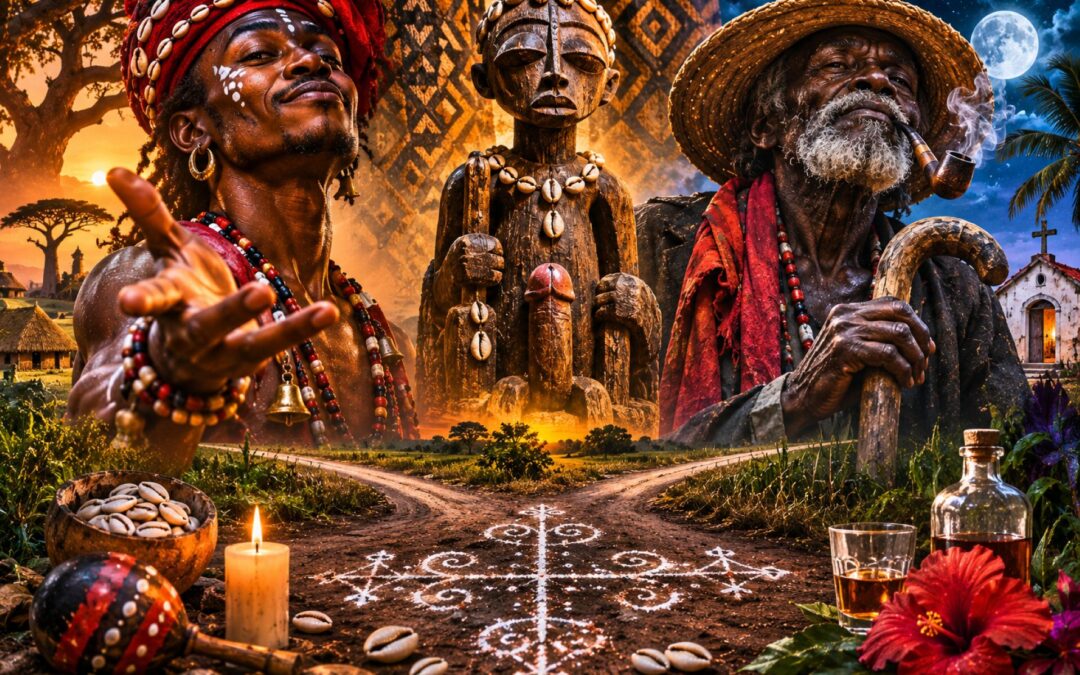
Imagine approaching a crossroads just before dawn. Four paths stretch into the distance, and you must decide which one to follow. According to certain West African and Caribbean religious traditions, such places are not merely intersections between roads. They are points where the ordinary world meets the spiritual realm, where messages can pass between humans and divinities, and where seemingly small choices can produce extraordinary consequences.
Two spiritual figures are particularly associated with these thresholds: Eshu, a powerful Yoruba deity, and Legba, a divine messenger in the religious traditions of the Fon people of West Africa.
Their names, stories and responsibilities are closely connected. Both are associated with communication, trickery and the boundaries separating different worlds. Both can disrupt human affairs, sometimes creating confusion before restoring balance. Yet they are not simply two names for an identical god.
Eshu occupies an important position within Yoruba religion, while Legba developed distinct characteristics within Fon religious traditions. Across the Atlantic, Legba underwent further transformations, eventually becoming Papa Legba, the elderly gatekeeper honored in Haitian Vodou.
Their stories reveal how African religious traditions adapted to slavery, colonialism and migration without losing their central concerns. They also demonstrate how spiritual figures associated with communication and transformation came to be misunderstood as manifestations of the Christian devil.
Èṣù-Ẹlẹ́gbára in Yoruba Religious Thought
The Yoruba are a major West African ethnolinguistic people whose historical homeland extends across southwestern Nigeria and neighboring parts of Benin and Togo. Their religious traditions recognize numerous divine beings known as orisha, each associated with particular powers, responsibilities and relationships with human communities.
Among the most important is Èṣù, commonly written Eshu in English.
He is also known as Èṣù-Ẹlẹ́gbára, Eshu-Elegba or related names, although terminology varies by region and religious lineage. The forms of his name are important because they reflect a complex history of worship and storytelling rather than a single standardized religious identity.
Eshu is frequently described as a trickster, but the English word can be misleading. It suggests someone who enjoys practical jokes or deliberately deceives others for amusement. Eshu certainly possesses those characteristics in many narratives, yet his religious responsibilities extend far beyond entertainment.
He is a messenger and mediator between human beings and the orisha. He helps carry communications, offerings and requests across the boundaries separating the visible world from the spiritual realm.
That responsibility makes him indispensable.
Within many Yoruba religious traditions, offerings and prayers must be communicated through Eshu to reach their intended recipients. He is therefore honored in ritual contexts involving other orisha, not because he necessarily outranks them, but because communication depends on his participation.
Eshu also has a particularly close relationship with Orunmila, the orisha associated with wisdom, destiny and divination.
Orunmila possesses knowledge concerning the patterns governing human existence. The Ifá divination system, through which priests interpret sacred configurations and verses, provides a means of consulting that knowledge.
Eshu helps ensure that the messages revealed through divination can be transmitted and acted upon. His role resembles that of a messenger who not only delivers information but also ensures that communication between different parties remains possible.
This association explains why Eshu should not be regarded simply as an unpredictable troublemaker. Without him, the orderly relationships between human beings and the divine would be incomplete.
His presence is also associated with places of transition.
Crossroads, doorways, thresholds and marketplaces are natural settings for a deity concerned with movement, exchange and communication. Each represents a point at which separate paths, people or possibilities encounter one another.
A doorway connects the protected interior of a home with the outside world. A marketplace brings together strangers who negotiate, exchange goods and sometimes misunderstand one another. A crossroads presents a decision whose consequences may not be immediately apparent.
All these situations involve uncertainty.
Eshu’s role is to inhabit that uncertainty, sometimes resolving it and sometimes making it more visible.
His iconography reflects the same combination of mediation and ambiguity. Representations may include carved figures, staffs, stones and shrine objects placed near entrances or other significant locations.
Some portrayals emphasize his unusual physical characteristics. In particular traditions, Eshu is described as having a limp or possessing legs of different lengths, a feature sometimes interpreted as symbolizing his ability to stand between separate realms.
His imagery can also contain explicit sexual symbolism, unconventional bodily forms or characteristics that challenge ordinary distinctions between masculine and feminine.
These representations should not be interpreted solely through modern ideas about sexuality. Within the religious traditions concerned, they can express fertility, vitality, creative power and the ability to cross categories that normally separate human experience.
The deity’s contradictions are especially apparent in the praise poetry known as oríkì.
Eshu can be described as both young and old, immensely powerful and remarkably small, present and absent, gentle and dangerous. One tradition portrays him as the youngest among the orisha while also attributing to him the authority or wisdom of an elder.
These descriptions are not necessarily intended to produce a consistent physical portrait.
They communicate the idea that Eshu cannot be contained within ordinary categories.
Anthropologist Joan Wescott explored these themes in her 1962 study of Eshu-Elegba’s sculpture and religious symbolism. Her research examined how contradictory characteristics appear in artistic representations, ritual contexts and myths.
The contradictions are central to Eshu’s significance.
A being who communicates between worlds must understand both without belonging entirely to either. A figure who reveals hidden truths may need to produce confusion before those truths become apparent.
Perhaps no story demonstrates this better than the famous tale of two friends and a multicolored cap.
The Two Friends and the Multicolored Cap
Two men lived in neighboring communities and worked fields separated by a narrow path.
They were close friends, so devoted to one another that they promised never to quarrel. Their friendship appeared unbreakable, and each believed the other to be trustworthy.
Yet the men made their promise without acknowledging Eshu.
In several versions of the story, this omission attracts the deity’s attention. Eshu decides to test the strength of their friendship and demonstrate that human confidence is not always as secure as it appears.
He prepares a remarkable cap.
One side is white and the other black. Some tellings use red, blue or other colors, while others describe a cap divided into several differently colored sections. The exact combination varies across oral traditions, but the important feature remains the same: someone viewing the cap from one direction will see something different from someone standing on the opposite side.
Eshu then approaches the fields where the two friends are working.
One man is clearing bushes while the other tends his crops. Eshu travels along the path between them, greeting both as he passes.
Each farmer looks up.
The first sees a traveler wearing a white cap. The second sees a traveler wearing a black cap.
Neither has any reason to doubt what he has observed.
Later, the friends meet during a break from work.
One mentions the pleasant stranger who passed between their fields, describing him as the man wearing the white cap.
The other immediately disagrees.
The traveler wore a black cap, he insists.
At first, the disagreement seems trivial. Both men are describing the same encounter, yet they cannot agree about a simple visible detail.
Soon, however, each begins to interpret the other’s confidence as dishonesty or foolishness.
The first believes his friend is contradicting an obvious fact. The second thinks exactly the same thing.
Neither considers that they may have seen different sides of the same object.
The argument intensifies until their friendship collapses into anger. In some versions, they begin fighting and neighbors attempt to separate them. In others, the dispute becomes so serious that the men are brought before a ruler to explain their conduct.
Their promise of eternal friendship has been destroyed by something that seems absurdly insignificant.
Then Eshu appears.
He asks why the men are arguing, and they explain the disagreement.
Each remains certain that the other has misrepresented what happened.
Eshu produces the cap.
He turns it so that everyone can see both sides.
One is white. The other is black.
Both men were telling the truth about what they saw.
Neither had understood that his experience represented only part of the reality.
Eshu then reminds them of their promise. They had sworn to remain friends without acknowledging his power to alter circumstances or test human confidence.
Their certainty, combined with their failure to consider another perspective, had made them vulnerable to the very conflict they promised to avoid.
The story exists in several forms, and their endings are not identical. In some tellings, Eshu’s intervention prevents the men from causing further harm. In others, the quarrel has already produced consequences that cannot be undone.
The essential lesson, however, concerns the limits of human perception.
Two people can observe the same event, report different details and still describe their experiences accurately.
The mistake occurs when either assumes that his partial view must represent the complete truth.
The story also warns about the fragility of social promises.
The men sincerely believed their friendship would endure every challenge. Yet neither had considered how easily suspicion could overcome affection when events challenged their assumptions.
Eshu did not have to invent an elaborate lie or force either man to make a false statement.
He created circumstances in which their own pride and certainty completed the deception.
There is an additional religious dimension.
Within Yoruba traditions, Eshu is not simply teaching a lesson about appreciating different viewpoints. The friends have neglected a divine power whose involvement they should have recognized.
The story therefore concerns the responsibilities of human beings within a world that includes spiritual relationships and obligations.
This is why it would be incomplete to reduce the narrative to a modern lesson about tolerance.
Eshu’s intervention exposes human limitations, but it also demonstrates his own authority as a mediator whose influence cannot safely be ignored.
Crossroads, Trickery and Moral Ambiguity
The crossroads is one of the most enduring symbols associated with Eshu and Legba.
Its meaning begins with an ordinary experience. At a crossroads, a traveler must select a direction without necessarily knowing what lies ahead. Different people may arrive from different routes, carrying different information and intentions.
The intersection creates opportunities for meetings, exchanges and misunderstandings.
Within Yoruba religious thought, these characteristics make the crossroads an appropriate place for Eshu.
His responsibilities involve movement between worlds, the transmission of messages and the consequences of choices. He stands at a point where different possibilities encounter one another.
But the crossroads is not simply a symbol of indecision.
It can represent the moment when a person must acknowledge that choices have consequences and that knowledge is always incomplete.
Eshu’s stories frequently place human beings in situations where their assumptions are tested. He may reveal hypocrisy, expose broken promises or create circumstances in which hidden motives become visible.
Sometimes he appears to cause trouble without any immediately obvious justification.
This is part of what makes him a trickster.
Trickster figures appear in religious and storytelling traditions across the world. They frequently challenge conventions, cross boundaries and behave in ways that other characters cannot.
The Akan spider Anansi, for example, is celebrated in West African and Caribbean folklore for using intelligence and deception to overcome stronger opponents. Eshu shares certain qualities with Anansi, but his status as an orisha gives his trickery a more explicit place within religious relationships.
Anansi is often encountered as a storytelling protagonist whose exploits entertain while illustrating human behavior. Eshu’s actions can serve similar purposes, but they are also associated with the functioning of divination, ritual communication and the relationship between humanity and the divine.
His tricks may therefore be funny without being trivial.
The distinction becomes clear in the story of the multicolored cap. Eshu reveals that the two friends are less wise and faithful than they imagined. Yet the lesson is produced by deliberately exposing them to conflict.
From a human perspective, his conduct appears provocative or even cruel.
From another perspective, the disruption exposes a weakness that already existed.
This moral ambiguity is essential to understanding the character.
Eshu is not consistently depicted as a benevolent protector who prevents every misfortune. Nor is he simply a malicious being who seeks suffering for its own sake.
He is associated with uncertainty, contradiction, communication and the instability of apparently settled arrangements.
Some traditions emphasize his capacity to punish people who neglect their religious obligations. Others stress his ability to solve problems, create opportunities and restore communication.
The same deity who disrupts a relationship may reveal the cause of its breakdown.
The same power that produces confusion can make greater understanding possible.
Religious scholar Robert D. Pelton examined such themes in West African trickster traditions, arguing that these figures connect apparent disorder with the processes through which life and social relationships are renewed.
Pelton’s comparative work places Eshu alongside other West African figures whose behavior challenges conventional distinctions between good and bad, order and disorder, or sacred and ordinary experience.
Sexuality is another expression of this boundary-crossing quality.
Stories and artistic representations sometimes emphasize enormous sexual appetites, explicit bodily characteristics and conduct that violates social expectations.
These features can appear deliberately outrageous. Yet they are also linked to the life force, fertility and the uneasy relationship between human rules and the natural world.
It is important not to force every erotic symbol into a single interpretation. A ritual sculpture, a humorous oral narrative and a theological account of creation may each use similar imagery for different purposes.
The stories are also not necessarily greeted with uncomplicated laughter by practitioners.
Eshu can inspire reverence, affection and fear precisely because his influence is unpredictable. A person may honor him not because his behavior is always comfortable, but because communication and transformation require acknowledging forces beyond human control.
These qualities would acquire new meanings as related traditions developed among the Fon people of Dahomey.
There, a figure called Legba became a divine messenger whose own stories connected language, sexuality, creation and the restoration of balance.
Legba in Fon and Dahomean Traditions
The Fon are a West African people concentrated particularly in present-day Benin, historically associated with the kingdoms of Allada and Dahomey.
Their religious traditions recognize spiritual powers commonly known as vodun. These include beings associated with different parts of the natural world, social order and human life.
Within these traditions, Legba occupies an important position as messenger, interpreter and mediator.
He resembles Yoruba Eshu in several respects, but the two figures are not identical.
Historical contact between Yoruba and Fon communities encouraged the circulation of religious ideas and imagery. Trade, migration, warfare and the movement of enslaved people across West Africa created opportunities for spiritual traditions to influence one another.
Some scholars have suggested that Fon traditions concerning Legba developed partly through contact with Yoruba worship of Eshu-Elegba. The precise historical process remains difficult to reconstruct, and it would be misleading to claim that one community simply copied an unchanged deity from another.
Legba acquired a distinctive place within Fon cosmology.
One important set of myths concerns Mawu-Lisa, a supreme divine figure associated with the creation and ordering of the world.
Mawu and Lisa are sometimes represented through complementary feminine and masculine aspects, connected respectively with qualities such as the moon and sun. Interpretations differ across Fon religious communities and recorded traditions.
According to one creation narrative, Mawu-Lisa has several divine children, each given authority over a particular domain of existence.
One governs the earth. Another controls the sky or thunder. Others receive responsibility for different natural forces.
Yet the arrangement creates a problem.
Because the divine children inhabit separate domains, they do not share a single language. They cannot communicate freely with one another or convey their concerns directly to their divine parent.
Legba, the youngest child, receives a different responsibility.
He is not assigned a domain comparable to those of his siblings. Instead, he is given the ability to understand and speak all languages.
He becomes the divine interpreter.
Any spirit wishing to communicate with Mawu-Lisa must approach through Legba, who possesses the necessary linguistic knowledge.
His importance comes not from controlling one element of the physical world, but from making relationships between different parts of existence possible.
That responsibility explains why Legba is associated with crossroads and thresholds.
He belongs at the places where separate territories meet because communication depends on overcoming boundaries.
The myth also illustrates the religious importance of language itself.
Words can transmit commands, resolve disagreements and establish obligations. But they can also conceal motives, produce confusion and create conflict.
A spirit who controls communication therefore possesses enormous power, even without ruling a specific natural domain.
Legba also participates in myths concerning divination.
In certain Fon traditions, the system known as Fa provides a means of interpreting destiny and obtaining knowledge about the future.
One narrative describes the divine figure Gbadou, sometimes represented as possessing sixteen eyes. The eyes are associated with hidden knowledge and the possibilities that govern human existence.
Legba helps Gbadou open her eyes and communicates the information required to make divination possible.
In one telling, Gbadou gives Legba palm kernels as signals indicating which eyes should be opened. Their arrangement becomes part of a larger explanation of how sacred knowledge can be transmitted through signs.
The imagery is connected to the importance of numerical patterns and palm kernels in divinatory traditions.
As with Yoruba Ifá, the precise ritual systems are complex and cannot be reduced to fortune-telling in the everyday sense. They involve inherited knowledge, interpretation and obligations concerning how people should act.
Legba’s role is again that of mediator.
He enables knowledge to pass from a divine source to those who require it.
Yet the same figure who makes communication possible is also famous for troublesome behavior.
Fon narratives frequently portray Legba as youthful, energetic, sexually assertive and capable of creating disorder.
His artistic representations can be strikingly explicit. Some shrine figures possess exaggerated phallic features, reflecting associations with sexuality, vitality and generative power.
One story explains how Legba acquired an insatiable sexual appetite.
According to a version discussed by Pelton, Legba engages in a forbidden sexual relationship involving members of his divine family. When confronted by Mawu, he denies the accusation.
The evidence of his arousal betrays him.
Mawu then punishes Legba by making his sexual desire permanently unsatisfied. The punishment explains both his unusual physical characteristics and his provocative behavior.
The story involves sexual taboo, deception and divine punishment, but it is also a myth about the origin of an enduring aspect of the natural and spiritual world.
Legba cannot simply be classified as a force of chaos. His misconduct becomes part of the explanation for how vitality, desire and the disruptions of ordinary life enter the world.
Another narrative connects him to the relationship between earth and sky.
The earth deity Sagbata and the sky or thunder deity Hevioso become involved in a destructive quarrel.
In one telling, Legba encourages the dispute by persuading Hevioso that the earth will consume all the water from the heavens.
Hevioso responds by withholding rain.
Without water, the earth becomes dry and lifeless.
Legba then provokes a further crisis by encouraging Sagbata to create a fire so powerful that it threatens the sky itself.
The conflict becomes dangerous for both domains.
To prevent destruction, Mawu-Lisa intervenes and orders rain to fall. Water from the sky extinguishes the fire on earth, establishing a necessary relationship between the two realms.
The story illustrates a recurring feature of Legba’s character.
He creates an apparently destructive situation that ultimately produces a new form of balance.
He is not simply restoring a peaceful order that existed before his interference. Through disruption, he helps establish a relationship that makes life possible.
That creative role extends into other traditions in which Legba is associated with music, dancing, medicine and the passage between life and death.
He can be a magician, entertainer and provocateur, but also a figure who connects separated worlds.
Some Fon traditions portray him as more playful or forgiving than the often-feared Yoruba Eshu. Such comparisons are useful as descriptions of recurring emphases, not universal rules governing every story or religious community.
What remains consistent is the importance of mediation.
Legba stands between different languages, divine powers and realms of existence.
When these traditions crossed the Atlantic through the slave trade, that responsibility endured, even as his appearance and personality changed dramatically.
Papa Legba and Kalfou in Haitian Vodou
From the seventeenth century onward, large numbers of Africans were transported to the Caribbean and forced to work in European plantation colonies.
Among them were people from the regions associated with the Fon, Yoruba and other West African communities.
In French Saint-Domingue, the colony that would become Haiti, enslaved Africans preserved and transformed elements of their ancestral religious practices.
Their circumstances were extraordinarily harsh.
Plantation labor demanded relentless work, enslaved people could be separated from their families, and European authorities attempted to regulate religious life through Catholic institutions.
The French Code Noir of 1685 required Catholic religious instruction for enslaved people and prohibited the public practice of religions outside Catholicism.
Yet African religious knowledge did not disappear.
People preserved songs, ritual practices, spiritual identities and relationships with ancestral powers. Traditions from different African communities interacted with Catholic prayers, saints and images, gradually contributing to the development of Haitian Vodou.
The process was not simply a matter of disguising African religion beneath Christianity. African communities had encountered and adapted Catholicism long before some of their descendants were enslaved in the Caribbean.
Haitian Vodou therefore emerged through multiple forms of cultural transformation.
Among its most important spiritual figures was Papa Legba.
He maintained the role of mediator between human beings and the spiritual world, but his Caribbean identity differed in important ways from that of the youthful, sexually vigorous Legba often described in Fon traditions.
Papa Legba is commonly portrayed as an elderly man.
He may carry a cane, smoke a pipe or wear a straw hat. His movements can be slow, and he may appear physically weakened or hunched over.
The imagery emphasizes age and experience rather than physical vitality.
This transformation has attracted considerable scholarly attention.
One interpretation suggests that the change reflects the circumstances of enslaved Africans who were deprived of control over their own land and livelihoods.
A youthful fertility spirit associated with agricultural abundance might take on a different meaning in a society where enslaved workers could not freely cultivate land for themselves.
In this reading, Papa Legba’s elderly appearance expresses the endurance of ancestral wisdom under conditions of dispossession.
It is a suggestive interpretation, but not an established historical explanation accepted by every scholar or practitioner.
Religious imagery develops through numerous influences, and Papa Legba’s appearance varies between Haitian traditions.
His central responsibility, however, remains recognizable.
Papa Legba opens the spiritual gates.
In Vodou, practitioners commonly believe that communication with the spirits known as lwa requires his assistance.
He is therefore frequently honored near the beginning of ceremonies.
Without Legba opening the passage, other lwa may be unable to approach or communicate with the assembled community.
This is not a sign that he is necessarily the supreme deity.
Haitian Vodou recognizes a divine creator known as Bondye, while the lwa maintain more immediate relationships with human beings.
Papa Legba’s importance lies in making those relationships possible.
A ceremony may begin with Catholic prayers before participants invoke Legba through songs, drumming and offerings.
His presence establishes the conditions under which the other lwa can be welcomed.
The relationships between Vodou practitioners and the lwa involve reciprocal obligations. Devotees honor spirits through prayers, offerings, ceremonies and care for inherited religious traditions, while the spirits are believed to provide guidance and protection.
Legba’s role is consistent with this broader understanding of spiritual service.
He facilitates communication rather than simply granting favors in exchange for gifts.
His Catholic associations also demonstrate the religion’s historical adaptations.
Images of Saint Peter, traditionally depicted holding the keys to heaven, are frequently connected with Papa Legba because both figures symbolize access to spiritual realms.
Other traditions associate him with different saints, including figures connected with roads, passage or protection.
The symbolism of the cross can also appear in his ritual imagery.
Within Christianity, the cross primarily evokes the crucifixion of Jesus. In Vodou, intersecting lines may additionally represent pathways, spiritual connections or the meeting of different realms.
One symbol can therefore acquire several related meanings within the same religious community.
Papa Legba’s identity is closely connected with Kalfou, another important Haitian crossroads spirit.
The name derives from the French carrefour, meaning crossroads.
Kalfou is often associated with the dangerous, unpredictable or forceful aspects of spiritual passage.
Where Papa Legba may be portrayed as an elder who opens gates and facilitates communication, Kalfou can be associated with the crossroads at night and the risks involved in moving between worlds.
Some interpretations describe Kalfou as a counterpart, aspect or contrasting manifestation associated with Legba.
Others treat him as a distinct lwa with his own personality and ritual responsibilities.
The relationship therefore should not be presented as a universally agreed division in which one spirit governs all benevolent forces and the other controls evil.
Haitian Vodou does not divide its spiritual world into the same categories as Christian demonology.
Kalfou can represent spiritual power that requires respect and careful handling, rather than a literal equivalent of Satan.
His associations with nighttime, uncertainty and potentially dangerous forces reflect the crossroads’ broader meaning.
A road may lead toward an opportunity, but it may also expose travelers to harm.
The power to open a passage is not necessarily the same as the power to guarantee what will happen after someone crosses it.
The Gede spirits provide another important comparison.
Associated with death, sexuality and regeneration, the Gede are known for humor, provocative behavior and their relationship with the dead.
Baron Samedi, often depicted wearing a top hat and dark glasses, is among the best-known figures in this spiritual family.
His imagery can resemble some popular representations of Vodou tricksters, and his irreverence recalls the sexually provocative behavior found in West African Legba narratives.
However, it would be misleading to describe Baron Samedi or the Gede simply as pieces of an original Legba that separated during the journey across the Atlantic.
Haitian Vodou developed through the interaction of many African traditions and local experiences. Similar symbols and responsibilities do not establish a simple genealogical relationship between every figure.
Papa Legba also appears in traditions associated with Louisiana Voodoo, whose history was shaped by French colonialism, African religious inheritances and connections with Saint-Domingue.
People, ideas and ritual practices moved between the Caribbean and Louisiana, including through migrations following the Haitian Revolution.
The religious traditions that developed in New Orleans shared connections with Haitian Vodou, but they were never identical.
Local African American communities, Catholic influences, regional folk practices and later commercial culture contributed to a distinct religious environment.
In Haiti, the role of Papa Legba continued through generations of religious practice despite periods of persecution.
He remains associated with the beginning of ceremonies, the opening of spiritual pathways and the relationships that connect living communities with their ancestors.
His transformation from West African Legba illustrates how religious figures can acquire new appearances and meanings while retaining recognizable responsibilities.
The messenger survived the Atlantic crossing, but the world in which he was honored had changed.
From Spirits to Devils: Colonial and Popular Misreadings
The popular association between crossroads spirits and the Christian devil emerged through a long history of religious misunderstanding.
European missionaries encountered African religious systems whose concepts of divine power did not fit comfortably into Christian categories.
A deity associated with trickery, sexuality, uncertainty and the crossing of boundaries could easily be interpreted through the image of a tempter.
This interpretation was especially tempting when religious stories described conduct that violated Christian moral expectations.
Eshu’s willingness to disrupt human relationships and Legba’s overt sexual symbolism made them particularly vulnerable to such judgments.
Yet the comparison confused fundamentally different religious roles.
In Christianity, Satan commonly represents opposition to God and the corruption of human beings.
Within Yoruba religion, Eshu is an important mediator whose participation helps maintain communication between human communities and the divine.
His tricks can be unsettling, but he is not generally understood as an enemy of the supreme creator.
Similarly, Legba’s responsibilities in Fon religion concern communication, divination and the maintenance of relationships between spiritual powers.
His provocative actions belong within a religious world that uses contradiction and disruption to explain how order emerges.
The confusion deepened through translation.
During the nineteenth century, some Christian missionaries used the name Eshu when translating references to Satan into Yoruba.
Those choices helped establish associations that later readers could mistake for evidence that traditional Yoruba worshippers regarded Eshu as a devil.
The problem was not simply a disagreement over vocabulary.
A translation can reshape how an entire religious figure is perceived by people encountering the tradition for the first time.
The association also influenced colonial descriptions of Haitian Vodou.
European and American writers frequently portrayed the religion as a collection of sinister ceremonies involving witchcraft, curses and dangerous supernatural powers.
Such portrayals ignored the importance of ancestor relationships, healing, community obligations and religious service.
They also reflected racial assumptions about African-descended populations.
In a society created through slavery, describing the spiritual traditions of enslaved people as demonic could reinforce the idea that European religious and cultural institutions were inherently superior.
The same prejudices continued after Haiti achieved independence.
Accounts of the Haitian Revolution sometimes portrayed its participants’ religious practices as evidence of savagery rather than considering how spirituality could sustain communities fighting for freedom.
The well-known gathering at Bois Caïman, traditionally associated with Dutty Boukman and the beginning of the 1791 uprising, became particularly vulnerable to sensational retelling.
The gathering occupies an important place in Haitian memory, but historians continue to debate its precise events and ritual details.
Later descriptions sometimes transformed it into a supposed pact with demonic forces.
That interpretation says more about the religious assumptions of the people making it than about the spiritual beliefs of those involved.
Popular entertainment reinforced the distortions.
Novels, films and tourism advertisements repeatedly borrowed images associated with Vodou while presenting them as symbols of occult danger.
The top hat, cane and mysterious crossroads became visual shorthand for supernatural bargains, curses and sinister bargains with unseen forces.
The popular image increasingly blended Papa Legba, Baron Samedi, various trickster figures and the Christian devil into an invented character who did not correspond precisely to any of them.
The crossroads acquired another famous association through American blues folklore.
According to a widely repeated legend, Robert Johnson, the Mississippi blues musician, acquired his extraordinary musical skill by selling his soul to the devil at a crossroads.
Some modern interpretations connect the figure in that story with Papa Legba, suggesting that an African-derived crossroads spirit survived through the religious traditions of Black communities in the American South.
The connection is evocative, but the historical evidence requires caution.
Stories of supernatural bargains at crossroads circulated in different forms, and the most famous version of Johnson’s supposed pact developed substantially after his death in 1938.
There is no reliable evidence that Johnson personally identified the figure in his story as Papa Legba or that the original legend specifically involved Haitian Vodou.
His music contains references to the devil, frightening encounters and spiritual danger, but those themes also existed within African American Christian and folk traditions.
The broader cultural connections between African-derived spirituality and blues folklore are worth studying. They do not justify presenting every crossroads legend as a direct survival of one particular West African deity.
The distinction becomes especially important because crossroads symbolism is not exclusive to Eshu or Legba.
Intersections appear in religious and folkloric traditions across the world. Their association with uncertainty, choice and encounters with supernatural forces can arise in different cultural settings.
Historical connections must therefore be demonstrated rather than assumed from similar imagery.
The consequences of these misunderstandings continue.
Modern media sometimes portray Papa Legba as a supernatural villain who manipulates human beings into destructive bargains.
Meanwhile, actual practitioners of Yoruba religion, Fon Vodun and Haitian Vodou continue to honor Eshu and Legba through relationships that outsiders may barely recognize.
These religious communities have their own interpretations, practices and internal disagreements. There is no single authoritative account that can be imposed upon all of them.
The historical relationship between Eshu and Legba remains significant precisely because their similarities coexist with important differences.
Yoruba Eshu-Elegba is associated with the orisha, divination, communication and the disruption of human certainty.
Fon Legba serves as a divine linguist and mediator whose provocative behavior can help explain the creation of new relationships and cosmic balance.
Haitian Papa Legba opens the spiritual gates through which the lwa communicate with human communities, often appearing as an elderly guardian rather than the vigorous trickster of some West African traditions.
These figures are connected through centuries of cultural exchange, but each belongs to a distinct religious history.
Their stories also invite us to reconsider the meaning of trickery.
In ordinary life, deception is usually regarded as a failure of honesty. In religious narratives, however, a trickster’s actions can reveal the limits of knowledge, expose hidden motives or create the conditions for change.
Eshu’s multicolored cap reveals that confident observers may possess only partial truths. Legba’s manipulation of earth and sky produces the crisis through which life-sustaining balance becomes possible.
The trickster stands at the boundary between what people believe they understand and what they have not yet learned.
The crossroads is therefore an appropriate symbol for both figures.
It represents choices whose consequences cannot be fully predicted, encounters between different worlds and the need for communication when paths intersect.
Across West Africa and the Caribbean, Eshu and Legba have helped communities express those experiences through stories, rituals and spiritual relationships.
Their enduring significance is not that they promise easy answers at the crossroads. It is that they remind people how much depends on what happens when different paths, perspectives and possibilities meet.
The traveler who encounters Eshu or Legba may discover that the most important question is not simply which road to take, but whether they understand the world well enough to recognize what lies at the intersection.
Last Updated on November 18, 2026 by Aseem Gupta