
Reading Time: 30 Minutes
Ask someone what they associate with Vodou, and the answer may involve dolls pierced with pins, sinister curses, zombies or frightening rituals performed in the darkness. Decades of horror films, sensational travel accounts and popular entertainment have made these images familiar around the world.
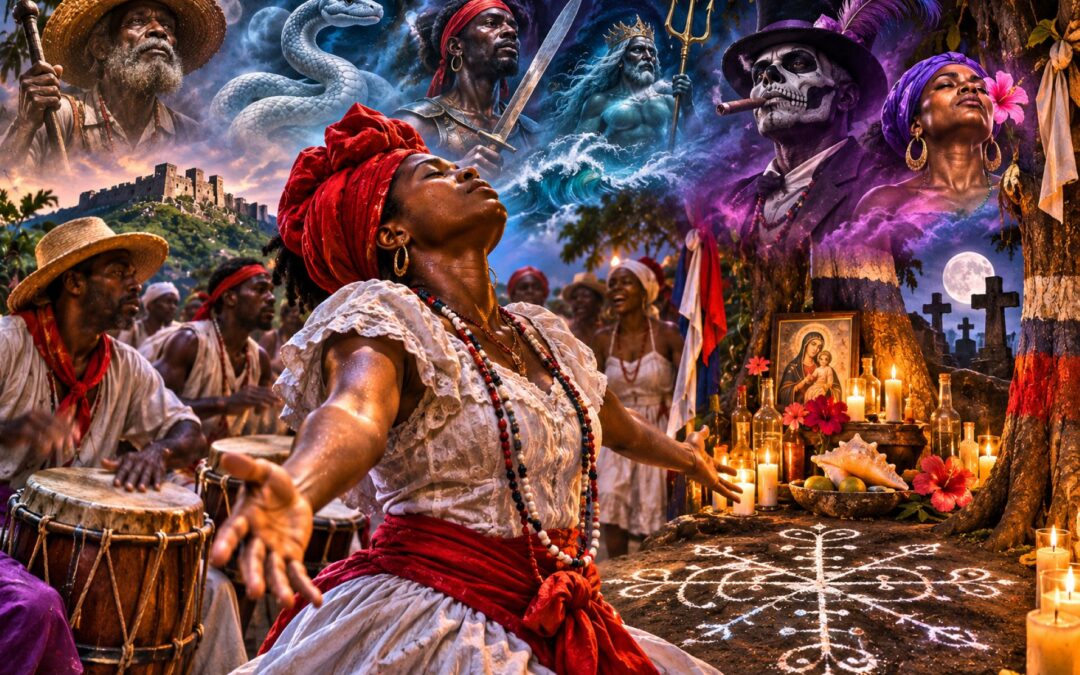
Yet a Haitian Vodou ceremony might begin with Catholic prayers before moving into drumming, singing and dancing. Participants gather to honor spirits connected with their ancestors, families, livelihoods and the natural world. Food is prepared and shared, and religious leaders help people seek guidance through the difficulties of everyday life.
The difference between these realities is enormous. Far from being a religion devoted to supernatural evil, Haitian Vodou is a complex spiritual tradition that developed among Africans enslaved in the Caribbean. It preserves memories of their ancestral homelands while incorporating elements of Catholic Christianity and the experiences of generations born in Haiti.
It also occupies a complicated place in the country’s history. Vodou helped sustain communities under slavery, became associated with the struggle for independence, endured persecution and was later manipulated by political rulers seeking legitimacy.
Understanding Haitian Vodou means looking beyond the stereotypes to explore its history, beliefs, spirits, rituals and ideas about life and death. It also means asking why a religion centered on relationships and community became one of the world’s most misunderstood spiritual traditions.
How Haitian Vodou Took Shape
Haitian Vodou emerged from one of the most violent processes in modern history: the forced transportation of millions of Africans across the Atlantic.
From the seventeenth century onward, European colonial powers brought enslaved Africans to plantations throughout the Caribbean and the Americas. They came from different regions, spoke different languages and followed religious traditions that were not identical. Enslavement separated people from their families, political communities and places of worship, but it did not erase the knowledge they carried.
In the western part of Hispaniola, which became the French colony of Saint-Domingue, Africans from West and West Central Africa formed new communities under extraordinarily difficult conditions. People associated with the Fon and related cultural traditions of present-day Benin contributed important religious concepts, while Yoruba-speaking populations and communities from the Kongo region brought additional beliefs, rituals and spiritual figures.
The word Vodou is commonly connected to vodun, a term associated with spiritual powers or divinities in the Fon and related languages. Similar words continue to describe religious traditions in Benin and neighboring countries. However, Haitian Vodou is not simply West African Vodun transported unchanged across the ocean. It became a distinct religion through centuries of cultural interaction and adaptation in the Caribbean.
The colonial system made this transformation both necessary and difficult. Enslaved Africans could be moved between plantations, prevented from practicing familiar ceremonies and separated from elders who preserved religious knowledge. Different communities therefore shared songs, spiritual concepts and ritual practices, gradually developing traditions that crossed their original linguistic and ethnic boundaries.
French colonial authorities promoted Catholicism. The Code Noir of 1685, which regulated slavery in French colonies, required enslaved people to receive Catholic religious instruction and prohibited the public practice of religions other than Catholicism. Enslaved Africans encountered Christian prayers, saints, holy days and images within a society that denied them basic human freedom.
The interaction was not exclusively a matter of Africans disguising their religion behind Catholic symbols. Christianity had already reached parts of Africa before the Atlantic slave trade. In the Kingdom of Kongo, the ruler Nzinga a Nkuwu converted to Christianity in 1491, and his son Afonso I later promoted Catholic institutions. African communities had therefore been adapting Christianity to existing spiritual traditions for generations before some of their descendants arrived in the Caribbean.
In Saint-Domingue, these different religious inheritances came together. African spiritual beings were associated with Catholic saints, Christian prayers entered ceremonies, and religious practices adapted to the realities of plantation life. The result was neither conventional European Catholicism nor an unchanged African religion, but a new tradition shaped by both.
Vodou also helped people maintain connections with the ancestors from whom slavery had separated them. The spiritual homeland known as Ginen became more than a geographical reference to Africa. It represented ancestral belonging, memory and the possibility of returning spiritually to a world from which people had been violently uprooted.
Religious gatherings could create bonds of trust among enslaved people who otherwise had limited opportunities to organize independently. Songs, ceremonies and shared beliefs offered ways to preserve dignity and identity within a system designed to deny both.
These traditions became intertwined with the Haitian Revolution, which began in 1791.
One of the revolution’s most famous episodes is the gathering at Bois Caïman, traditionally associated with the religious leader Dutty Boukman and a priestess often identified as Cécile Fatiman. According to accounts developed and repeated over time, enslaved people gathered for a ceremony, made offerings and committed themselves to fighting for freedom.
The precise date, participants and rituals remain subjects of historical debate. Some narratives include a blood oath and animal sacrifice, but the surviving evidence does not establish every familiar detail. Bois Caïman is important both as a historical tradition associated with revolutionary organizing and as a powerful symbol of the connection between spiritual solidarity and liberation.
The uprising that followed eventually defeated the French colonial system. On 1 January 1804, Haiti became independent, establishing a republic through a successful mass revolt of enslaved people.
Independence did not immediately bring religious freedom. Many Haitian political leaders remained influenced by European attitudes toward African-derived practices. Vodou could be tolerated privately while being condemned publicly, particularly by officials who associated national respectability with Catholic institutions and European culture.
Nevertheless, it survived. Its beliefs and rituals continued through families, villages and religious communities, demonstrating an ability to adapt that would remain one of its defining characteristics.
Bondye, the Lwa and the Spiritual World
Contrary to the common assumption that Vodou involves worshipping numerous competing gods, Haitian Vodou recognizes a supreme divine creator known as Bondye.
The name derives from the French Bon Dieu, meaning Good God. Bondye is understood as the source of existence and the ultimate divine power. In many Haitian religious communities, this understanding overlaps with the Christian conception of God.
Bondye is not necessarily approached through the same regular rituals devoted to other spiritual beings. The creator is often understood as transcendent, while the forces that interact more directly with human affairs are the lwa, sometimes written loa.
Lwa are spirits associated with different aspects of life, nature, ancestry and human experience. They are sometimes described as saints, angels, mysteries or invisible beings. No single English word captures their religious significance perfectly.
Some lwa are connected to rivers, seas, storms and other natural forces. Others are associated with love, warfare, agriculture, healing, death or the protection of families. Their identities are not merely abstract categories. Each can possess distinctive characteristics, preferences, relationships and forms of behavior recognizable to practitioners.
For example, a spirit associated with agriculture may be represented through the clothing and conduct of a rural farmer. A warrior spirit may favor military imagery and forceful movements. A spirit connected with water may be honored through flowing rhythms and movements resembling waves.
The lwa are not generally understood as simple substitutes for Bondye. They exist within a spiritual cosmos in which divine power, human communities and ancestral relationships are closely connected. Their importance lies partly in the ways they help people understand and respond to ordinary life.
A person may seek a lwa’s assistance when facing illness, family conflict, financial difficulty or a major personal decision. The relationship involves obligations on both sides. Practitioners honor the spirits through offerings, prayers, songs and rituals, while the spirits are believed to offer protection, guidance and assistance.
This relationship is often summarized through the expression sèvi lwa, meaning serving the spirits.
The English word serving can create the wrong impression if it suggests unquestioning submission to supernatural masters. In Vodou, service is fundamentally reciprocal. A practitioner honors the lwa because an enduring relationship exists between the human community and the spiritual world.
Religious scholar Kira Malikica Daniels has emphasized the importance of reciprocity in understanding African diaspora religions. The spirits are not distant figures who receive worship without becoming involved in human affairs. They are believed to participate in relationships that involve care, responsibility and mutual recognition.
These relationships may be inherited. Families can maintain connections with particular ancestral spirits, sometimes called lwa rasin, or root spirits. A household may preserve images, candles, offerings or small devotional spaces dedicated to the lwa associated with its lineage.
Other relationships develop through dreams, illness, personal experiences or formal initiation. Practitioners may believe that a particular spirit has chosen them or revealed itself through significant events.
Vodou also includes distinctive understandings of the human soul. Rather than treating personhood as a single indivisible spiritual entity, some traditions distinguish between different aspects of the soul, commonly discussed through concepts such as gwo bonanj and ti bonanj.
The meanings vary across communities and scholarly interpretations, but the concepts help explain how consciousness, vitality, individuality and spiritual vulnerability are understood. These beliefs become particularly important in rituals involving spirit possession, death and relationships with ancestors.
Death is not necessarily viewed as a complete separation from the religious community. The deceased may continue to influence descendants, and rituals help establish the proper relationship between the living and the dead.
In some traditions, aspects of the deceased person’s soul are understood to journey beneath ancestral waters before being ritually reclaimed and restored to the community of ancestors. The ceremony commonly called wete mò nan dlo, meaning bringing the dead from the water, can occur after a year and a day.
These ideas reveal why Vodou cannot be understood simply by listing spirits and their supposed powers. Its religious world connects living families to previous generations, natural environments and a spiritual homeland that remains meaningful across the Atlantic.
Rada, Petwo and Gede: Diversity Within the Tradition
Haitian Vodou does not have a universally binding list of spirits or a single hierarchy governing every religious community. Its traditions differ by region, family, temple and lineage.
One important way of organizing the lwa is through groups commonly called nanchon, or nations. The term reflects the religion’s historical connections to different African cultural communities, although these spiritual categories have developed distinct meanings in Haiti.
Three especially prominent groupings are Rada, Petwo and Gede.
The Rada spirits are often associated with ancestral traditions originating in West Africa, particularly the region historically known as Dahomey. They are commonly described as comparatively cool, measured or serene, although such descriptions are generalizations rather than absolute rules.
Rada ceremonies may emphasize particular rhythms, songs and forms of greeting that reflect the character of these spirits. Among the best-known are Legba, Dambala and other figures connected with ancestral wisdom, protection and communication.
The distinction between cool and hot spiritual energies is important in many Vodou traditions. Coolness may suggest patience, composure and stability, while heat can represent intensity, urgency and force. Neither category is automatically equivalent to moral goodness or evil.
The Petwo, also written Petro, are frequently characterized as hotter, more forceful spirits. Their rituals may involve faster rhythms, intense movement and imagery associated with fire, struggle or transformation.
Some Petwo spirits reflect influences from the Kongo region, while others developed within Haiti itself. The grouping is often interpreted in relation to the historical experience of slavery and resistance, although reducing every Petwo spirit to a revolutionary symbol would oversimplify a diverse body of traditions.
The Petwo are sometimes depicted in popular accounts as dangerous or malevolent, in contrast to supposedly benevolent Rada spirits. That division is misleading. The different nations have distinctive characteristics, but they do not represent two opposing armies of good and evil.
Many lwa can appear in different aspects or under related names across the spiritual nations. A practitioner may encounter different manifestations of a spirit depending on the ritual context, lineage and local tradition.
The third major grouping is the Gede, associated with death, ancestors, sexuality and regeneration.
The Gede are among Vodou’s most visually distinctive spirits. They can be irreverent, provocative and humorous, challenging ordinary social conventions through jokes, dancing and exaggerated behavior.
At first, the association between death and sexuality may seem contradictory. Within the Gede tradition, however, the two are closely related. Death marks the end of one life, while sexuality and fertility point toward the continuation of life through future generations.
Baron Samedi, often depicted wearing a top hat, dark glasses and formal clothing, is one of the most recognizable figures associated with the dead. His family of spirits includes other cemetery and ancestral figures who take part in rituals surrounding mourning, mortality and renewal.
The major celebration known as Fèt Gede, associated particularly with 1 and 2 November, brings these themes into public religious life. Cemeteries and ritual spaces become places for offerings, music, remembrance and sometimes deliberately outrageous humor.
Participants may wear black and purple, the colors commonly connected with Gede spirits. Offerings can include rum prepared with hot peppers, reflecting the spirits’ association with heat and intense personality.
The festival does not simply celebrate death for its own sake. It recognizes the continued relationship between the living and their ancestors, while acknowledging mortality as an unavoidable part of existence.
Rada, Petwo and Gede are not the only spiritual nations. Practitioners also recognize groupings such as Nago, Kongo, Ibo, Juba and others associated with particular historical or cultural lineages.
Some traditions speak of twenty-one nations of lwa. However, there is no universally accepted list that every Vodou practitioner can recite in exactly the same way.
The variety itself is meaningful. Religious communities carried memories of different African peoples into the Caribbean, where those memories developed into a spiritual system capable of recognizing many ancestral origins without requiring everyone to follow identical practices.
What Happens in a Vodou Ceremony
The central religious activity in Haitian Vodou is not the casting of curses or the performance of secret supernatural tricks. It is serving the lwa through rituals that bring together spiritual devotion, community participation and relationships with the ancestors.
Ceremonies may take place in private homes, outdoor spaces or dedicated temples known as ounfò, also written hounfor. Some temples are modest household compounds, while others contain multiple rooms, altars and a covered ceremonial area.
A central space called the peristil is commonly used for dancing and communal worship. It often contains a pillar known as the poto mitan, regarded as a symbolic connection between the visible human world and the spiritual realm.
The physical arrangement of a temple reflects its religious purpose. Altars may contain images of saints, candles, flowers, bottles, sacred objects and offerings associated with particular lwa. Different spirits have preferred colors, foods, objects and forms of music that help practitioners recognize and honor them.
The Open Encyclopedia of Anthropology’s account of Haitian Vodou describes temples, ceremonies and spiritual relationships as interconnected elements of a complex religious tradition rather than isolated supernatural practices.
Ceremonies are often led by an oungan, a male priest, or a manbo, a female priestess. Their responsibilities include conducting rituals, preserving sacred knowledge, guiding initiations and interpreting communications believed to come from the lwa.
There is no universally recognized central authority equivalent to a pope governing every Vodou temple. Priests and priestesses operate through different religious lineages and communities, each maintaining inherited knowledge and particular practices.
Their roles also extend beyond public ceremonies. Individuals may consult an oungan or manbo for advice concerning relationships, personal difficulties, spiritual obligations or illness. Some religious leaders possess knowledge of medicinal plants and traditional healing practices, although spiritual care should not be confused with a substitute for evidence-based medical treatment.
A ceremony may begin with Catholic prayers, including the Lord’s Prayer and Hail Mary. These are often recited before the drumming and singing associated with the lwa begin.
The sequence demonstrates how deeply Catholic practices have become integrated into Vodou. The prayers do not necessarily signify that the ceremony has shifted from one religion to another. For many practitioners, both belong to a continuous religious life.
Papa Legba is frequently invoked early in the ceremony because he opens the spiritual gates through which communication with other lwa becomes possible. Without his assistance, participants may believe that access to the spiritual world remains closed.
Ceremonies then unfold through songs, drumming, dancing and ritual gestures appropriate to the spirits being honored.
Music plays a fundamental role. Different nations of lwa are associated with distinctive rhythms, and participants recognize particular spirits through the sounds and movements that accompany their arrival.
The music is not merely entertainment added to a religious event. It helps structure the ceremony, directs attention toward particular lwa and creates the conditions in which communication between spiritual and human worlds is believed to occur.
For example, martial rhythms may accompany warrior spirits, while dances associated with water spirits can involve movements resembling the rocking of a boat. Dambala’s serpent imagery may inspire sinuous movement, while Petwo ceremonies may feature faster, more forceful patterns.
Practitioners sometimes draw geometric symbols called vèvè on the ground using flour, cornmeal, coffee grounds or other materials. Each design is associated with particular spirits and serves as part of the ritual invitation.
These intricate patterns may feature curves, crosses, intersecting lines and symbolic objects. They are expressions of spiritual identity and communication, not simply decorative illustrations.
Offerings are another essential feature. A lwa may be associated with particular foods, drinks, flowers, colors or personal possessions. These gifts acknowledge the relationship between practitioners and spirits and express gratitude, devotion or requests for assistance.
Some ceremonies involve the ritual slaughter of animals.
This practice is often sensationalized in popular descriptions of Vodou. In reality, animals may be prepared as food offered to the spirits and subsequently shared among participants. The ritual involves prayers, prescribed procedures and communal obligations, although practices differ between temples and religious lineages.
Food plays a role in many religious traditions, from festival meals and sacrificial offerings to communal feasts. Understanding animal offerings in Vodou requires considering their religious and social significance rather than treating them as automatic evidence of brutality.
One of the most distinctive aspects of ceremonies is the experience often called spirit possession.
In Vodou, this does not ordinarily mean an evil entity invading an unwilling person, as the word possession often suggests in Christian horror narratives. Practitioners may understand the experience as the arrival of a lwa who temporarily takes control of a person’s body.
The process is commonly described through the image of riding a horse. The spirit is said to mount the person, who becomes its chwal, or horse.
This relationship is regarded as an honor and a form of spiritual communication. The person temporarily becomes the means through which the lwa interacts with the assembled community.
When a spirit is believed to arrive, other participants may greet it, offer appropriate objects and change their behavior according to its identity. The lwa may speak, dance, give advice, offer blessings or communicate messages concerning individual and collective responsibilities.
The behavior of the mounted person can reflect the characteristics of the visiting spirit. Someone believed to be mounted by Azaka, the agricultural lwa, may behave like a rural farmer. Dambala may be represented through serpent-like movements, while Legba may appear as an elderly traveler using a cane.
Anthropologists have examined these experiences from religious, social and psychological perspectives. Whatever explanation an observer prefers, the phenomenon has a recognized meaning within the community. It is not simply an unpredictable breakdown of ordinary behavior.
Spirit mounting can also provide opportunities for social communication. A message delivered through a lwa may address relationships, obligations, tensions or decisions affecting the community.
Ceremonies therefore combine personal devotion with collective participation. Drummers, singers, priests, initiated members and visitors all contribute to a religious gathering that strengthens relationships as much as it invokes spiritual assistance.
The ritual does not necessarily end when the music stops. Food is shared, offerings are distributed according to local practice, and relationships between families, neighbors and religious leaders continue beyond the ceremonial space.
Legba, Ezili, Ogou and Other Important Spirits
Haitian Vodou includes an extraordinary diversity of lwa. Their personalities, relationships and symbols provide a spiritual vocabulary through which practitioners interpret experiences ranging from romantic love to warfare, agricultural work, illness and death.
Understanding individual spirits also shows why Vodou cannot be reduced to an abstract belief in supernatural forces. The lwa possess recognizable identities that connect religious practice with familiar aspects of human life.
Papa Legba is one of the most important.
He is associated with gates, thresholds, crossroads and communication between the visible and invisible worlds. Because spiritual interaction requires passage between these realms, Legba is often honored at the beginning of ceremonies.
He may be represented as an elderly man carrying a cane, sometimes accompanied by a dog. Catholic images of Saint Peter, who holds the keys to heaven, are frequently associated with him.
A crossroads is a particularly meaningful symbol. It represents a place where different paths meet and choices must be made, but also a boundary between worlds or conditions of existence.
Legba’s role should not be confused automatically with that of Eshu, the Yoruba orisha associated with communication, crossroads and the interpretation of messages. The two figures have historical and thematic connections, but they belong to distinct religious systems with different identities and traditions.
Another prominent spirit is Dambala, often represented as a serpent.
Dambala is associated with wisdom, purity, life and ancestral origins. His movements may be described as calm and fluid, and worshippers sometimes associate him with water, white clothing and peaceful spiritual energy.
In some traditions, Dambala is linked with Ayida Wèdo, a rainbow serpent spirit. Their relationship connects imagery of snakes, water, creation and cosmic continuity.
Serpent symbolism can appear strange to people accustomed to religious traditions in which snakes primarily represent temptation or evil. In Vodou, the meaning is different: serpents can embody fertility, protection, life force and ancient wisdom.
The Ezili, also written Erzulie, are associated with femininity and different forms of love, emotion, beauty and protection.
Ezili Freda is often represented through elegance, romance, luxury and refined beauty. Her offerings may include perfume, flowers, jewelry and other objects associated with affection or adornment.
She can also embody longing and disappointment. The spirit’s character reflects the complexity of desire and the difficulty of finding satisfaction in romantic relationships.
Ezili Dantò represents a very different expression of feminine power. She is associated with motherhood, fierce protection, endurance and the suffering of women who must struggle to defend their families.
Her imagery is frequently connected with the Black Madonna of Częstochowa, a Catholic representation of the Virgin Mary bearing scars on her face. In Haitian Vodou, this image acquires meanings shaped by the experience of Black motherhood and resistance.
The contrast between Freda and Dantò is not a judgment that one form of womanhood is superior. It reflects how different experiences of love, pain, beauty and responsibility can be expressed through distinct spiritual identities.
The Ogou family of lwa is associated with warfare, iron, military discipline, political authority and physical strength.
Ogou’s imagery may include swords, uniforms, military gestures and the color red. Some forms are associated with Catholic Saint James, whose martial representations became connected with warrior traditions across parts of the Atlantic world.
These spirits can embody courage and determination, but also anger, power and the danger of violence. Their significance is not confined to literal warfare. They may be invoked in struggles requiring strength, perseverance or the defense of others.
Azaka, sometimes called Kouzen Azaka, is closely connected with agriculture and rural life. He is frequently portrayed through the appearance of a Haitian peasant, with clothing and objects associated with farming.
His importance reflects Haiti’s agricultural history. Cultivating land, maintaining families and surviving uncertain harvests are not peripheral matters within Vodou. They are fundamental aspects of the human experience through which the spiritual world becomes meaningful.
Other spirits include Simbi, associated with water, rivers and aspects of knowledge or spiritual power. Some Simbi traditions reflect Central African influences, demonstrating how different ancestral origins remain visible in the religious landscape.
Among the most evocative is Agwé, the powerful lwa associated with the sea.
Agwé belongs prominently to the Rada tradition and is understood as a ruler of the ocean, its creatures and its hidden riches. His importance is particularly evident in a Caribbean country where fishing, sailing and coastal livelihoods have shaped communities for centuries.
He protects fishermen and sailors, guiding them through dangerous waters and offering spiritual assurance in a world where storms and uncertain voyages can threaten survival.
The Encyclopedia of African Religion’s account of Agwé describes him as a major ocean spirit associated with La Sirène, a mermaid figure who inhabits the underwater realm.
La Sirène represents the mysterious beauty and power of the sea. Her imagery expresses a world beneath the waves that remains connected to human life while possessing its own spiritual order.
Agwé is commonly associated with a magnificent vessel known as Imamou, also spelled Immamou. The ship symbolizes his authority over the sea and, in some traditions, the spiritual journeys of the deceased.
According to these beliefs, the souls of the dead may travel across or beneath ancestral waters before returning to Ginen, the homeland of the ancestors. The vessel therefore connects the natural ocean surrounding Haiti with a spiritual geography extending toward Africa.
Agwé’s imagery can include ships, oars, flags, shells, naval clothing and other maritime symbols. Some representations associate him with Catholic figures such as Saint Ulrich, who is depicted holding a fish, or the Archangel Raphael, whose iconography also includes a fish.
Devotion to Agwé may involve offerings placed on a small ceremonial boat and carried out onto the water. Champagne, fish, sweet foods, melons and objects in blue or white are among the gifts associated with him in different traditions.
The exact offerings are not universal. Their significance lies in recognizing a relationship between the community and the spirit believed to govern the waters on which its livelihood depends.
The sea also occupies an important place in Vodou’s understanding of death and ancestry.
In some traditions, the soul of a deceased person spends a period beneath the waters before being ritually returned to the community. The ceremony known as wete mò nan dlo, or bringing the dead from the water, expresses the idea that the relationship between living families and their ancestors continues after physical death.
An academic discussion of death, dying and the soul in Haitian Vodou examines the relationship between different aspects of the soul, ancestral waters and rituals performed after death.
Agwé’s underwater kingdom thus has meaning beyond a picturesque maritime legend. It connects fishermen’s everyday dependence on the sea with wider ideas about spiritual protection, the dead and the continuing presence of Africa in Haitian religious memory.
Finally, the Gede family and Baron Samedi demonstrate how Vodou addresses mortality without treating death exclusively as a subject of solemn fear.
The Gede may joke, dance provocatively and challenge social expectations. Their irreverence reflects the tension between the inevitability of death and the continuing vitality of the living.
Together, these spirits reveal the breadth of Vodou’s spiritual imagination. The religion does not separate ordinary human concerns from spiritual experience. Love, labor, illness, navigation, grief, desire and community obligation all find expression through relationships with the lwa.
Vodou, Catholicism and Haitian Identity
For many outsiders, the coexistence of Vodou and Catholicism appears contradictory. A person might attend Catholic Mass, display an image of the Virgin Mary and also participate in ceremonies honoring the lwa. Within Haitian religious life, however, such practices have often been understood as compatible rather than mutually exclusive.
Catholic prayers are regularly incorporated into Vodou ceremonies. Images of saints may appear on altars, and major rituals can coincide with Catholic feast days. Some practitioners consider themselves devout Catholics while also maintaining relationships with inherited spirits.
These associations are sometimes described as religious syncretism, the blending of elements from different traditions. The term is useful, but it should not suggest that the result is a random mixture or a collection of borrowed symbols without deeper meaning.
A Catholic saint may serve as a visual representation of a lwa because their attributes resemble one another. Saint Peter’s keys connect naturally with Legba’s role as guardian of spiritual gateways, while Saint James’s martial imagery resonates with Ogou.
Yet the identities are not always interchangeable. A lwa may possess characteristics, relationships and ritual obligations that do not belong to the Catholic saint associated with its image.
Some practices also reflect forms of Christianity that had already developed in Africa before the transatlantic slave trade. Haitian Vodou thus preserves a history of cultural adaptation that began long before its emergence in the Caribbean.
Religious festivals make this relationship particularly visible.
At Saut-d’Eau, a waterfall in central Haiti, pilgrims gather during celebrations associated with Our Lady of Mount Carmel in July. Some participate in Catholic worship, while others honor spiritual beings associated with the waterfall and its surroundings.
Visitors may take part in both forms of devotion. Water, trees, saints and lwa become part of a shared sacred landscape through which Haitians express religious identity.
Vodou has also played a major role in preserving a sense of African ancestry. Ginen functions as a spiritual homeland, allowing communities separated from their original societies by slavery to maintain symbolic connections with earlier generations.
This relationship is especially meaningful for people whose ancestors were denied the opportunity to preserve family records, languages or institutions. Ritual knowledge can become a form of cultural memory when written genealogies and official histories are absent.
The religion has spread with Haitian migration. Communities in Miami, New York, Boston, Montreal and other cities maintain ceremonies, religious houses and relationships with Haitian spiritual leaders. Practices evolve in these settings as new generations negotiate their identities and connections to Haiti.
For many practitioners, Vodou is therefore both a religion and a way of maintaining relationships across time and distance. It connects families living in different countries with shared ancestors, religious obligations and memories of the homeland.
Its role in Haitian society cannot be measured simply by asking people to choose a single religious affiliation. Someone identifying as Catholic may also serve the lwa, while another person may participate in family ceremonies without describing themselves primarily as a Vodou practitioner.
That complexity helps explain why statistics about religious affiliation often fail to capture the tradition’s actual social reach.
Vodou is not followed by every Haitian, and disagreement about the religion is part of the country’s history. Nevertheless, its influence extends into music, visual art, literature, cultural identity and public understandings of ancestry and spiritual life.
The Haitian Zombie: Slavery, Social Control and Folklore
Few ideas associated with Haiti have traveled as widely as the zombie. In popular entertainment, zombies are usually portrayed as mindless corpses that rise from the dead, attack the living and spread their condition through bites or infection.
The Haitian zonbi comes from a very different cultural and historical world.
In Haitian folklore, a zonbi may be understood as a person whose will or spiritual autonomy has been taken away, leaving a body or spirit subject to another’s control. Some traditions distinguish between a bodily zombie and a captured spirit. The emphasis is not necessarily on a flesh-eating monster, but on the horrifying condition of losing freedom.
That distinction matters in a society whose history is inseparable from slavery.
One way to understand the zonbi is through three contrasting versions of a fictional story.
Imagine a United States Marine stationed in Haiti during the American occupation of 1915–1934. He has grown up hearing that Vodou involves witchcraft and dangerous supernatural powers. During his assignment, he befriends a wealthy planter who cooperates with the occupying authorities and supplies them with information and labor.
One evening, the planter becomes violently ill and apparently dies. Years later, the Marine sees a laborer on a plantation who resembles the dead man. The worker does not speak, appears exhausted and obeys orders without resistance.
The Marine interprets the experience through his existing fears. Perhaps, he thinks, a sorcerer has brought the planter back from the dead and turned him into an obedient servant.
In this version, the mysterious worker becomes proof of frightening Haitian magic. The observer’s assumptions about Vodou shape the explanation before he has established what actually happened.
Now consider the same fictional events from the perspective of a Haitian physician.
She treats the planter during his collapse and believes he has died. Years later, she encounters the man again, alive but profoundly changed. He claims to remember being conscious while unable to move, then enduring years of forced labor under the influence of drugs.
The physician searches for a medical explanation. She wonders whether a toxin might have caused paralysis so severe that the victim appeared dead, allowing others to bury and later recover him.
One possibility involves tetrodotoxin, a powerful neurotoxin found in certain pufferfish. Depending on exposure, it can cause severe paralysis and respiratory failure. The idea that a person might remain aware while unable to move offers a disturbing possible explanation for some stories of apparent death.
Yet the physician’s interpretation remains incomplete.
In a third version, told by a bartender who knows the community, the planter’s fate is explained through social judgment. He has exploited workers, mistreated his family and collaborated with foreign occupiers. Members of a secret society allegedly decide that he should experience the loss of freedom he imposed on others.
His years of involuntary labor become a punishment for betraying the community. In this telling, the question is not merely how someone became a zonbi, but why the community regarded him as deserving that fate.
The three stories are not documented historical incidents. They are a fictional narrative designed to reveal competing interpretations of Haitian zombie traditions: an outsider’s fear of supernatural power, a doctor’s attempt at scientific explanation and a community’s understanding of justice, coercion and belonging.
Each version changes the meaning of the same supposed event.
The Marine sees terrifying witchcraft. The physician sees a possible medical mystery. The bartender sees a story about punishment, exploitation and the destruction of personal autonomy.
The most important theme is the condition of being deprived of one’s will.
That theme is especially powerful in Haiti because the country’s founding revolution challenged the enslavement of human beings. A zonbi condemned to labor without choice represents a frightening reversal of the freedom that the revolution sought to secure.
The folklore also involves ideas about spiritual identity. In some traditions, a sorcerer or bòkò is believed capable of capturing an aspect of a person’s soul, thereby depriving the individual of agency. Such claims belong to the realm of religious belief and folklore, not established evidence that supernatural control occurs.
Stories about secret societies add another dimension. Organizations sometimes identified with names such as Bizango or Chanpwel have been described in Haitian communities as possessing hidden authority and the ability to punish people who violate social obligations.
The historical reality of such groups is complex. They should not be reduced to a single nationwide institution, and accusations that particular societies produce zombies are not proof that they do. Folklore, social fear, religious authority and allegations of wrongdoing often overlap.
During the twentieth century, researchers attempted to investigate whether some reported cases of zombification had a medical explanation.
The best-known was the Canadian ethnobotanist Wade Davis, who traveled to Haiti in the early 1980s. He examined claims involving people who had allegedly been declared dead and later reappeared, including the widely discussed case of Clairvius Narcisse.
Davis proposed that substances used in certain preparations might induce an apparent-death state. He suggested that tetrodotoxin from pufferfish, combined with other ingredients and subsequent treatment, could help explain stories of a person being buried and later controlled.
His research received enormous attention, particularly after the publication of The Serpent and the Rainbow in 1985.
But the hypothesis remains highly controversial.
Researchers questioned the chemical composition and potency of the samples Davis examined, the reliability of some reported cases and whether the proposed combination of drugs could consistently produce the effects described. Tetrodotoxin poisoning is extremely dangerous and can be fatal; it is not an established method for safely creating a temporary state resembling death.
The academic controversy surrounding Wade Davis’s claims illustrates the difficulties of translating complex folklore into a single biomedical explanation.
The existence of tetrodotoxin does not establish that Haitian zombies are chemically manufactured, nor does a story of apparent death automatically demonstrate that poisoning occurred.
Equally important, focusing exclusively on chemistry risks missing the cultural meaning of the zonbi.
The modern horror zombie developed through a long process of retelling and transformation.
During the American occupation of Haiti, foreign soldiers, journalists and travel writers encountered stories about Vodou and the undead. Some interpreted these traditions through racial prejudice and sensational assumptions about African-derived religions.
In 1929, American writer William Seabrook published The Magic Island, a popular account of Haiti that helped introduce zombie stories to a wider English-speaking audience.
Three years later, the film White Zombie appeared, presenting a story about the transformation of human beings into obedient, apparently lifeless servants controlled by a sinister master.
The film’s zombies did not resemble the fast-moving or flesh-eating monsters familiar from much later popular entertainment. They were closer to the earlier image of workers deprived of their will.
A scholarly examination of the zombie’s relationship to Haitian history traces how American writing and cinema transformed folklore associated with slavery and colonial power into a popular horror figure.
The zombie subsequently evolved further. Films such as Night of the Living Dead in 1968 helped establish a different cinematic tradition centered on reanimated corpses, contagious violence and the collapse of society.
The result was a creature increasingly detached from the historical conditions that had given the Haitian zonbi its significance.
For people unfamiliar with Vodou, the Hollywood image became more recognizable than the religious and cultural traditions from which the term had been borrowed.
The irony is profound. A figure that can symbolize the terror of enslavement became a staple of entertainment that often portrays Haiti itself as a place of frightening superstition.
Understanding the zonbi requires reversing that process: looking beyond the monster to the histories of forced labor, stolen autonomy, social punishment and cultural misunderstanding that shaped the original stories.
Why Vodou Became So Misunderstood
Misrepresentations of Haitian Vodou did not begin with Hollywood. They emerged from the colonial encounter between European Christianity and African religious traditions.
Colonial authorities frequently regarded African spiritual practices as inferior, irrational or threatening. Enslaved people who maintained their ancestral religions challenged the assumption that European cultural institutions were naturally superior.
Religious gatherings could also produce solidarity among people the plantation system sought to keep divided. For slaveholders, traditions that sustained independent community relationships might appear politically dangerous even when their immediate purpose was devotional.
After independence, Haitian elites faced pressures of their own. European governments and commentators often depicted the Black republic as uncivilized or incapable of self-government. Some Haitian leaders responded by adopting European religious and cultural standards, treating Vodou as an obstacle to international respectability.
The nineteenth century therefore witnessed repeated efforts to restrict African-derived religious practices. Catholic missionaries and officials sometimes portrayed Vodou as witchcraft, while sensational accounts attributed cannibalism and other atrocities to its followers without reliable evidence.
The American occupation from 1915 to 1934 intensified international exposure to such descriptions. Foreign travel writers encountered Haitian religious life through their own assumptions about race, Christianity and political authority.
Popular entertainment then turned selected elements of the religion into symbols of fear.
Dolls pierced with pins became one of the most recognizable supposed features of Vodou, even though they do not represent ordinary Haitian Vodou practice. Such images belong more closely to the complicated history of European sympathetic magic, commercialized New Orleans traditions and later popular stereotypes.
The distinction between Haitian Vodou, Louisiana Voodoo, West African Vodun and related African diaspora religions is often ignored.
These traditions possess historical connections, but they are not interchangeable. Cuban Lukumí, often called Santería, and Brazilian Candomblé share aspects of the Atlantic African religious inheritance while maintaining distinct communities, spirits and ritual systems.
Horror films frequently collapse all these traditions into a single imaginary religion devoted to curses, zombies and forbidden magic.
The confusion also obscures the distinction between religious service and sorcery within Haitian communities themselves. Vodou practitioners may recognize beliefs concerning harmful magic, protective rituals and spiritual danger, but that does not make malicious supernatural activity the central purpose of the religion.
Many traditions have concepts of divine punishment, harmful spiritual forces or forbidden religious acts. Those concepts do not justify describing an entire religion as evil.
Haitian politics further complicated the religion’s reputation.
During his dictatorship from 1957 to 1971, François Duvalier, known as Papa Doc, deliberately exploited selected Vodou symbols and relationships with religious leaders.
He cultivated an image associated with Baron Samedi, adopting dark clothing, glasses and mannerisms that encouraged comparisons with the spirit of the dead. Stories about supernatural powers reinforced his public persona, while his Tonton Macoutes militia enforced obedience through entirely real violence.
Duvalier’s manipulation of religious imagery helped associate Vodou with dictatorship and terror in the international imagination.
But the conclusion that Vodou itself produced political repression would be mistaken. The regime relied on coercive institutions, patronage, intimidation and murder. Religious symbolism was one of the instruments through which a ruler represented his authority.
Vodou practitioners also suffered repression, and some later faced violence because they were assumed to have collaborated with the dictatorship.
Another important development occurred through Catholic campaigns against practices described as superstition. During the twentieth century, church-led efforts sometimes encouraged the destruction of sacred objects and attacks on traditional religious institutions.
More recently, some evangelical and Pentecostal movements have portrayed Vodou as demonic or blamed it for national misfortunes. Such accusations can intensify religious hostility and endanger practitioners.
At the same time, Haiti has experienced efforts to recognize Vodou as a legitimate part of its national heritage.
In 2003, President Jean-Bertrand Aristide issued a decree recognizing Vodou as a religion and providing a legal framework for its practitioners to conduct certain ceremonies with civil significance, subject to applicable requirements.
The decision represented an important acknowledgment of a tradition that had survived centuries of exclusion, although legal recognition did not eliminate prejudice or resolve every question surrounding religious rights.
Haitian intellectuals and scholars have also worked to challenge inherited misconceptions.
Jean Price-Mars, whose influential 1928 book Ainsi parla l’oncle defended the importance of African heritage in Haitian culture, helped encourage later generations to reconsider traditions that elites had often dismissed.
Anthropologists such as Alfred Métraux, Maya Deren and Laënnec Hurbon examined Vodou’s beliefs and practices, contributing to a richer understanding of its social and religious significance.
Their work also reminds us that studying a religion requires more than collecting its most unusual or visually striking rituals. It means understanding how practitioners interpret their actions, organize relationships and respond to the problems of everyday existence.
Vodou is not a religion without disagreement or change. Its communities possess different practices, interpretations and responses to modern Haitian society.
Nor should it be romanticized as a single unchanging inheritance from Africa. It has developed through slavery, revolution, migration, political conflict, religious competition and cultural exchange.
What makes it remarkable is precisely that capacity for transformation without losing its connection to ancestry and spiritual community.
A Vodou ceremony honoring the lwa, a family maintaining an ancestral altar, fishermen making offerings to Agwé or mourners remembering the dead at Fèt Gede all express relationships that cannot be understood through horror-film imagery.
They represent ways of connecting human life with history, nature, memory and the unseen.
Haitian Vodou emerged from communities whose freedom, families and cultural institutions had been violently disrupted. Its practitioners created a spiritual world in which ancestry could survive separation, collective relationships could endure oppression and everyday experiences could acquire religious meaning.
That history explains why the tradition has remained important even through repeated attempts to marginalize it.
The most persistent misunderstanding is not simply that outsiders believe in frightening dolls or supernatural zombies. It is that they mistake a living religion, shaped by centuries of survival and cultural creativity, for the sensational images produced by people who rarely understood it.
To understand Haitian Vodou is to recognize that behind its songs, symbols, spirits and ceremonies lies a fundamentally human concern: how people maintain relationships with one another, their ancestors and the world around them, even when history has attempted to tear those relationships apart.
Last Updated on November 18, 2026 by Aseem Gupta