
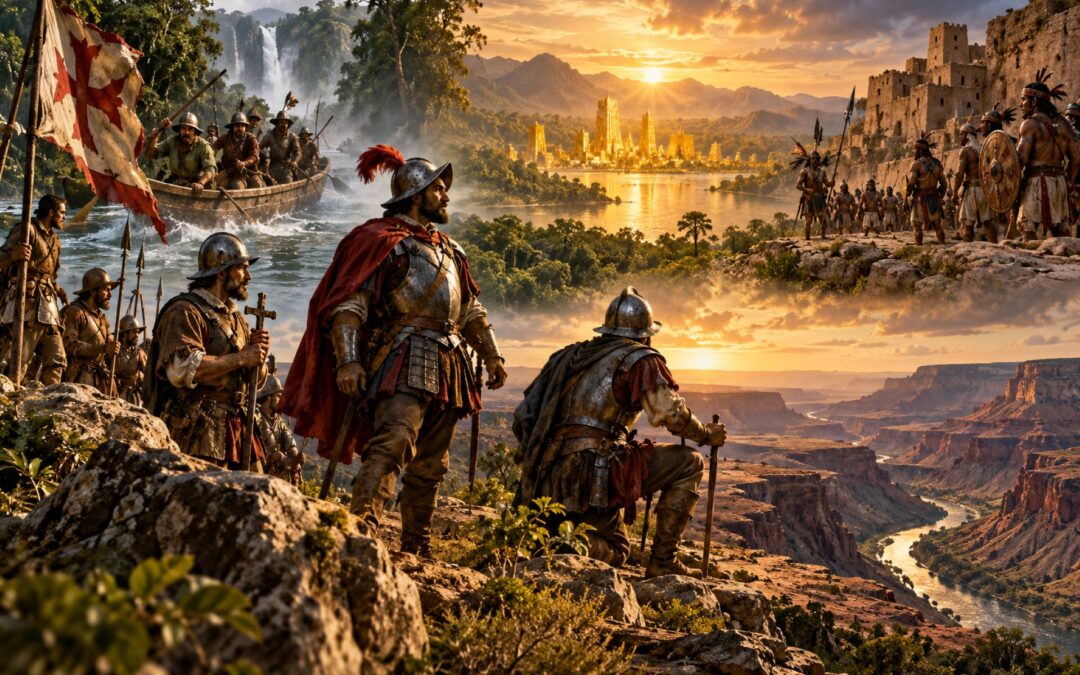
In the early sixteenth century, Spanish conquistadors achieved two of the most extraordinary military conquests in world history. Hernán Cortés and his Indigenous allies brought down the Aztec Empire in 1521, while Francisco Pizarro helped overthrow the Inca Empire in the 1530s. These victories gave Spain control over vast territories and access to enormous wealth, transforming the European kingdom into an imperial power with possessions stretching across the Atlantic.
The success of these campaigns encouraged other ambitious men to seek their fortunes in the Americas. Rumors circulated about wealthy civilizations hidden beyond the territories already conquered, where cities supposedly contained unimaginable quantities of gold and silver. For soldiers, explorers, and younger sons of noble families, the prospect of discovering another powerful kingdom offered the possibility of wealth, political influence, and a place in history.
Yet many expeditions that followed ended very differently. Instead of finding magnificent cities filled with treasure, Spanish adventurers encountered unfamiliar landscapes, powerful Indigenous societies, desperate shortages of food, and resistance from communities unwilling to surrender their independence. Some expeditions collapsed completely, leaving only a handful of survivors to describe what had happened.
Four conquistadors illustrate this lesser-known side of Spanish expansion particularly well. Álvar Núñez Cabeza de Vaca survived a disastrous expedition to Florida and spent years living among Indigenous peoples before reaching Mexico. Hernando de Soto led a violent campaign through southeastern North America that ended with his death beside the Mississippi River. Francisco de Orellana descended the Amazon after becoming separated from another expedition, while Francisco Vázquez de Coronado searched the American Southwest and Great Plains for legendary cities of gold.
Their journeys were remarkably different, but together they reveal the ambitions, failures, violence, and unexpected encounters that shaped the European invasion of the Americas.
The Search for Riches Beyond the Aztec and Inca Empires
The Spanish conquest of the Americas was driven by a combination of royal ambition, private enterprise, religious conviction, and the pursuit of wealth. The Crown claimed sovereignty over newly conquered territories, but individual expeditions were often financed partly by their commanders and private supporters. Successful leaders could receive governorships, estates, valuable privileges, and shares of the wealth extracted from conquered populations.
This arrangement encouraged ambitious men to undertake extraordinary risks. Many had military experience but little prospect of inheriting significant estates in Spain. Others had already made fortunes overseas and hoped that further expeditions would increase their standing. The spectacular treasures seized during the conquests of Mexico and Peru reinforced the belief that other wealthy kingdoms remained undiscovered by Europeans.
These expectations developed during a period of unprecedented contact between previously separated parts of the world. As the wider history of human civilization and early global exchange demonstrates, Spanish expansion helped establish enduring connections between Europe, Africa, Asia, and the Americas. American silver entered international trading networks, while European colonial governments gradually imposed new political, economic, and religious institutions across conquered territories.
However, the Americas were not empty lands awaiting discovery. They contained thousands of Indigenous communities with distinct languages, governments, trading systems, agricultural practices, and histories. Some lived in large urban centers, while others occupied smaller settlements or maintained more mobile ways of life suited to their environments. European expeditions frequently misunderstood these societies because their leaders measured wealth and political importance according to their own expectations.
The promise of gold also gave rise to increasingly elaborate legends. Reports of rich settlements could grow into tales of magnificent cities, while descriptions of Indigenous ceremonies were sometimes transformed into stories of rulers covered in gold. One especially enduring legend concerned El Dorado, originally associated with a gilded individual before becoming connected with the search for a wealthy kingdom or city.
The four expeditions examined here emerged from this atmosphere of ambition and uncertainty. Their leaders hoped to reproduce the achievements of Cortés and Pizarro, but they entered regions where the political circumstances, geography, and Indigenous responses were very different. Their experiences would demonstrate how little Spanish victories elsewhere guaranteed success in unfamiliar territory.
Álvar Núñez Cabeza de Vaca: From Shipwreck to Survival
Álvar Núñez Cabeza de Vaca was born around 1490 in Jerez de la Frontera, near Cádiz, into a family of minor Spanish nobility. Like many young noblemen, he received military training and entered aristocratic service. He participated in campaigns in Europe, including the Italian Wars, and gained experience that would later make him a suitable candidate for a position in an overseas expedition.
In 1527, Cabeza de Vaca was appointed royal treasurer for an expedition commanded by Pánfilo de Narváez. The expedition intended to explore and establish Spanish control over territory in Florida, a region Europeans understood only imperfectly. As treasurer, Cabeza de Vaca held an important royal appointment and was expected to oversee the Crown’s financial interests.
The fleet departed Spain on June 17, 1527, carrying several hundred soldiers, sailors, and settlers aboard five vessels. Almost immediately, the expedition encountered difficulties that undermined its ambitions. During a stop at Hispaniola, numerous men deserted, apparently discouraged by reports of earlier disastrous attempts to establish settlements in the region.
Narváez subsequently traveled to Cuba to obtain horses and additional supplies. Cabeza de Vaca was sent to collect animals from another settlement, but a hurricane struck while he was ashore, destroying vessels and killing members of the expedition. The survivors regrouped and spent the winter preparing for another attempt.
The expedition finally reached the Florida coast near present-day Tampa Bay on April 15, 1528. Its members initially encountered Indigenous inhabitants who supplied or traded food with them, including fish and venison. However, the Spaniards were particularly interested in discovering whether the region contained gold.
According to the expedition’s surviving accounts, information obtained from local inhabitants encouraged Narváez to believe that the territory of Apalachee, farther north, might contain considerable wealth. Whether the information was accurately understood is uncertain, but it proved sufficiently attractive to influence the expedition’s next disastrous decision.
Narváez proposed dividing his forces. One party would march inland in search of the rumored riches, while the ships would continue along the coast and eventually reunite with the soldiers. Cabeza de Vaca objected, recognizing that the Spaniards knew too little about the region to guarantee that the separated groups would ever find each other again.
His objections failed to persuade the commander. Narváez led approximately 300 men overland, leaving the remaining expedition members aboard the vessels.
The consequences were devastating.
The soldiers struggled through unfamiliar terrain, often unable to obtain sufficient food. They encountered Indigenous settlements and sometimes seized inhabitants or demanded provisions. Their search for Apalachee brought them into conflict with local communities, whose resistance increasingly threatened the expedition.
When the Spaniards finally reached a substantial Apalachee settlement in June 1528, they found none of the gold they had expected. They instead encountered agricultural communities with their own political relationships and military capabilities. The Spaniards occupied settlements, appropriated food, and experienced repeated attacks.
Narváez eventually abandoned the search for riches and attempted to reach the coast. His men marched toward a place called Aute, hoping to find food and perhaps reconnect with their ships. By then, starvation, illness, wounds, and exhaustion had reduced the expedition to a desperate struggle for survival.
The Spaniards discovered food crops in the region, but their situation remained precarious. No ships appeared to rescue them, and they lacked the resources necessary to retrace their route across Florida.
Their only remaining possibility seemed to be constructing vessels themselves.
Despite having few conventional shipbuilding materials, the survivors improvised five rafts capable of carrying the remaining men along the Gulf Coast. They transformed metal equipment into nails, tools, and other necessary fittings. They used local timber, plant fibers, and materials salvaged from their possessions, while their clothing supplied material for sails.
Their remaining horses were slaughtered for food. Horsehair was used to make rope, and animal hides helped provide containers for carrying fresh water. The work demonstrated extraordinary ingenuity, but the finished vessels were fragile and poorly equipped for a long coastal journey.
On September 22, 1528, approximately 250 survivors departed Florida, hoping to travel westward toward Spanish-controlled territory in Mexico. Their intended destination was the region around Pánuco, where they believed they might finally reach safety.
The voyage rapidly deteriorated. The men had little food or fresh water, and the rafts were vulnerable to currents, rough seas, and storms. As they approached the region of the Mississippi River, the expedition became increasingly difficult to control.
The vessels separated, and several disappeared. Narváez himself was never seen again, while other survivors were carried toward the coast of present-day Texas.
Cabeza de Vaca was among those who reached land, but the ordeal was far from over. The castaways were starving, weakened by exposure, and dependent on the people whose territories they had entered. Many died during the following months, leaving only a small number alive.
The survivors’ experiences among Indigenous communities varied enormously. Some received food and shelter, while others endured conditions they described as captivity or coercive dependence. Cabeza de Vaca spent years living in different communities along the Gulf Coast, learning aspects of local languages, customs, and methods of survival.
During this period, his relationship with Indigenous societies changed dramatically. Instead of commanding soldiers and seeking territory for the Spanish Crown, he became dependent on local knowledge, food supplies, and social relationships. He eventually worked as a trader, carrying goods between communities and using the contacts this created to move through unfamiliar territory.
Cabeza de Vaca and his surviving companions also became associated with healing practices. Indigenous people sometimes asked them to treat illnesses or injuries, and the Spaniards responded with prayers and rituals shaped by their Christian beliefs. Cabeza de Vaca later attributed successful recoveries to divine intervention, while some Indigenous communities interpreted the strangers’ apparent abilities according to their own understandings of spiritual and supernatural power.
These accounts are historically significant as descriptions of encounters between different healing traditions. They do not establish that the Spaniards possessed supernatural abilities or that every recovery happened exactly as subsequently narrated.
Eventually, Cabeza de Vaca reunited with three other survivors: Andrés Dorantes de Carranza, Alonso del Castillo Maldonado, and Estebanico, an enslaved African man who had accompanied the original expedition. Together, they traveled through parts of what are now northern Mexico and the southwestern United States, although historians continue to debate the precise route.
Their journey depended heavily on Indigenous assistance. Local inhabitants provided food, information, guidance, and opportunities for movement between communities. The survivors also attracted followers who accompanied them for portions of their travels, creating an unusual procession through territories far beyond established Spanish settlements.
In 1536, the four men finally encountered Spaniards in northwestern Mexico, near the region of present-day Sinaloa. Their appearance astonished the Europeans they met. After years outside colonial society, Cabeza de Vaca and his companions wore unfamiliar clothing and traveled in the company of Indigenous people rather than Spanish soldiers.
The reunion also exposed a disturbing contrast. The newcomers had depended on Indigenous communities for their survival, while the Spaniards they encountered were involved in capturing Indigenous people for enslavement. Cabeza de Vaca expressed criticism of such treatment and described efforts to persuade the colonial Spaniards to stop exploiting the people accompanying him.
His experiences did not make him an opponent of Spanish imperial rule in the modern sense, but they distinguished his account from many conventional narratives of conquest.
After reaching Mexico City, Cabeza de Vaca returned to Spain and published an account of his experiences in 1542. Commonly known as Naufragios, or Shipwrecks, it became one of the earliest extensive European descriptions of Indigenous societies across parts of the Gulf Coast and the North American interior.
His adventures in the Americas were not finished. He received a royal appointment in the Río de la Plata region of South America, where he served as governor and attempted to extend Spanish authority. His administration became entangled in disputes with other colonists, eventually leading to his arrest and return to Spain.
Contrary to some simplified accounts, Cabeza de Vaca was not completely exonerated. He was convicted following proceedings concerning his governorship, although his sentence was subsequently commuted after appeals. The Texas State Historical Association’s reconstruction of his life records both the remarkable North American journey and the complicated political consequences of his later colonial career.
Cabeza de Vaca died in Spain in the late 1550s. He had failed to obtain the riches originally promised by the Narváez expedition, but his survival produced an exceptional written record of Indigenous societies and the difficulties Europeans faced outside the territories they controlled.
His experience also foreshadowed another major expedition. Estebanico, who had survived alongside him, would later participate in the search for the legendary Seven Cities of Cíbola, connecting the Narváez disaster directly with the ambitions of Francisco Vázquez de Coronado.
Hernando de Soto: A Conquest That Ended on the Mississippi
Hernando de Soto was born around the beginning of the sixteenth century in Extremadura, Spain, into a family of minor nobility. Although he possessed aristocratic connections, his prospects for acquiring substantial wealth at home were limited. Like many ambitious young Spaniards, he looked toward the Americas as a place where military service might bring fortunes unavailable in Europe.
De Soto traveled to the New World as a young man and joined the colonial ventures associated with Pedro Arias Dávila, commonly known as Pedrarias. In Central America, he developed a reputation for his abilities as a horseman and military commander. He also accumulated wealth and influence through conquest, colonial administration, and ventures that relied on coercive control over Indigenous populations.
His fortunes increased considerably after he joined Francisco Pizarro’s conquest of the Inca Empire. De Soto participated in the campaign that culminated in the capture of the Inca ruler Atahualpa in 1532 and benefited from the immense wealth extracted during the conquest.
By the middle of the 1530s, de Soto had become an extremely wealthy man. He returned to Spain, married Isabel de Bobadilla, and established himself among the prosperous elite of Seville. Nevertheless, the opportunity to acquire another governorship and perhaps discover a new wealthy civilization continued to attract him.
In 1537, de Soto obtained royal authorization to undertake a major expedition involving Florida. After extensive preparations in Cuba, he assembled soldiers, horses, equipment, and ships for a campaign intended to explore and establish control over a large region of southeastern North America.
The expedition landed on Florida’s Gulf Coast in May 1539. Its force included more than 600 Europeans and a substantial number of horses, giving de Soto military advantages over communities unfamiliar with European cavalry and metal weapons.
Soon after arriving, the Spaniards encountered Juan Ortiz, a survivor of an earlier Spanish venture who had spent years living among Indigenous communities. Ortiz had learned local languages and became an essential interpreter for de Soto.
His assistance was particularly valuable because the expedition entered a landscape occupied by numerous Indigenous nations and chiefdoms. These societies maintained agricultural settlements, political hierarchies, trading relationships, and military alliances. Their leaders controlled territories that could support large populations and organize substantial resistance.
The expedition first explored parts of Florida before establishing a winter camp near present-day Tallahassee. Reports of wealthy lands farther north encouraged de Soto to continue searching for a civilization that might provide riches comparable to those taken from the Inca Empire.
His troops traveled through regions now included in Georgia and the Carolinas, encountering several established Indigenous communities. One important encounter involved the chiefdom of Cofitachequi, whose female leader initially received the Spaniards with hospitality and supplied assistance.
However, de Soto’s expectations again exceeded reality. He found valuable objects and evidence of prosperous communities, but nothing resembling the vast stores of gold and silver he sought. The expedition continued inland, often taking Indigenous leaders hostage to secure guides, labor, and provisions.
This method created increasingly hostile relationships with local populations. The Spanish army required enormous quantities of food for its soldiers, servants, and horses. De Soto’s men frequently demanded supplies from communities whose agricultural stores were intended to sustain their own inhabitants.
Refusal could result in threats, seizure of property, or violence. The expedition also captured people to serve as porters and guides, forcing Indigenous communities to support an invasion that endangered their independence.
As the Spaniards moved through the interior, they encountered resistance from leaders unwilling to accept these demands. Their military superiority could win individual battles, but it could not eliminate the logistical problems created by marching through unfamiliar territory while depending on the people they were attacking.
One of the expedition’s most destructive confrontations occurred at Mabila, in present-day Alabama, in October 1540.
The Spaniards entered a fortified settlement associated with the powerful leader Tuscaloosa. Tensions had already developed between de Soto and Indigenous authorities, and the encounter escalated into a major battle. Spanish narratives describe large numbers of warriors fighting inside and around the settlement, although the precise sequence of events and intentions remain disputed.
The fighting was exceptionally violent. Spanish forces eventually overwhelmed the defenders and burned the town, killing many inhabitants. The Spaniards also suffered serious losses, including deaths, injuries, and the destruction of valuable equipment and supplies.
Historical estimates of the casualties vary substantially. Some chroniclers described thousands of Indigenous deaths, while accounts of Spanish losses differ and must be interpreted cautiously. The National Park Service’s account of de Soto’s expedition places the battle within a much wider campaign marked by forced provisioning, captivity, and conflict.
Mabila was a turning point. The expedition had failed to secure the wealth it sought and had lost men, horses, and essential equipment. Its ability to continue operating as an effective military force had been weakened.
De Soto nevertheless rejected the possibility of abandoning his inland campaign and returning to the coast. Ships had been expected to support the expedition, but seeking them might expose the extent of his failures and undermine his ambitions. Instead, he led his surviving men deeper into North America.
The Spaniards spent another difficult winter before moving westward in the spring of 1541. In May, they reached the Mississippi River, one of the largest river systems on the continent.
Indigenous peoples had known and used the Mississippi for countless generations. The river supported extensive agricultural and trading networks and connected communities across a vast region. De Soto’s expedition became one of the earliest extensively documented European encounters with the river, but it did not discover a place previously unknown to humanity.
Crossing the Mississippi required substantial preparation. The Spaniards constructed boats capable of carrying men, horses, and supplies across the powerful current. They then continued into territories west of the river, including parts of present-day Arkansas.
By now, the campaign bore little resemblance to the confident invasion that had departed Cuba. The army had lost men and animals, its supplies were precarious, and its repeated conflicts with Indigenous populations made travel increasingly dangerous.
The death of Juan Ortiz further complicated the situation. Without his linguistic abilities, the Spaniards struggled to communicate with unfamiliar communities, leaving them more dependent on coercion, imperfect interpretation, and uncertain information.
During the winter of 1541–1542, additional men died from illness, exposure, and the hardships of the campaign. De Soto continued seeking a way to transform the expedition into a profitable conquest, but the possibility of achieving his original objectives was steadily disappearing.
In May 1542, while the expedition was near the Mississippi, de Soto became seriously ill and died. His death created a difficult political and military problem because the surviving Spaniards had represented their commander to some Indigenous communities as a figure possessing extraordinary power.
According to expedition accounts, his followers concealed his death and eventually placed his body in the river, reportedly weighting it to prevent the remains from resurfacing. The episode illustrated how completely the ambitions of the expedition had collapsed.
De Soto had entered Florida hoping to establish dominion over wealthy new territories. Three years later, he was dead, and his army was stranded deep within the continent without the riches or lasting colonial settlement he had envisioned.
Command passed to Luis de Moscoso Alvarado, who now faced the immediate challenge of getting the survivors out alive.
The remaining Spaniards initially attempted to travel westward overland toward Spanish-controlled territory in Mexico. They crossed difficult landscapes, including regions of present-day Texas, but encountered increasingly severe problems obtaining food and reliable geographical information.
The attempted overland escape failed. Moscoso eventually led the expedition back toward the Mississippi, where the men decided to construct boats and descend the river to the Gulf of Mexico.
They spent months preparing their vessels while trying to survive another winter. The boats were built using whatever materials remained available, and the Spaniards had to gather supplies while protecting themselves against hostile attacks.
In July 1543, the survivors finally began their journey downstream. Indigenous warriors attacked them from canoes along portions of the route, and the Spaniards struggled to defend themselves. Their horses and other military advantages had become largely useless aboard their crowded vessels.
After reaching the Gulf, they followed the coastline toward Mexico. The final passage was exhausting, but the survivors eventually arrived near Pánuco, ending one of the most ambitious and destructive Spanish expeditions into the North American interior.
Only a fraction of the original participants returned.
De Soto’s campaign failed to establish the wealthy colony he had promised. Its principal achievements from the Spanish perspective were geographical information and accounts of Indigenous societies that later chroniclers preserved.
For the communities the expedition encountered, however, its consequences were far more immediate. Warfare, forced labor, seizure of food, captivity, and the broader disruptions associated with colonial contact inflicted suffering on populations that had possessed complex political and agricultural systems long before de Soto arrived.
His journey remains historically important not because he conquered the Mississippi Valley, but because it reveals both the scale of Indigenous civilization in the Southeast and the brutality of a campaign determined to obtain riches that never materialized.
Francisco de Orellana: The Voyage Down the Amazon
Francisco de Orellana was born around 1511 in Trujillo, Spain, and traveled to the Americas as a young man. He participated in Spanish campaigns in Central and South America and became closely associated with the Pizarro family during the conquest of the Inca Empire.
His service brought him wealth, land, and political connections in the territories that would become Ecuador. Yet the continuing search for valuable resources encouraged him to join another expedition into regions Europeans understood only through incomplete reports and rumors.
In 1541, Gonzalo Pizarro, brother of Francisco Pizarro, organized a major expedition eastward from Quito. Its objectives included finding valuable resources, particularly cinnamon, and investigating stories of wealthy lands beyond the Andes. Accounts associated with El Dorado also helped sustain expectations that another extraordinary prize might await the explorers.
The expedition included hundreds of Spaniards and thousands of Indigenous porters and other participants. These Indigenous people carried supplies, guided the Spaniards through unfamiliar territory, and performed much of the labor necessary to sustain the venture.
The journey was disastrous almost from the beginning.
Crossing the Andes required the expedition to navigate difficult mountain routes before entering tropical forests characterized by heavy rainfall, dense vegetation, and unfamiliar waterways. Progress was slow, and the large force struggled to carry enough food for everyone.
The Spaniards’ dependence on Indigenous labor became increasingly brutal. Accounts describe guides and porters being mistreated or killed, while provisions were distributed unequally. Gonzalo Pizarro reportedly ordered severe punishments against Indigenous guides when the expedition failed to find the resources it expected.
As food supplies disappeared, men and animals began to die. The Spaniards slaughtered horses and other animals to sustain themselves, while the surviving members continued moving eastward in increasingly desperate circumstances.
Eventually, the expedition reached waterways belonging to the Amazon River system. Pizarro ordered the construction of a boat to transport exhausted men and heavy supplies while the remaining participants advanced along the riverbanks.
Even this arrangement proved difficult. Dense vegetation and uneven terrain slowed the people traveling on land, while the river current made coordinated movement increasingly complicated.
By late December 1541, the expedition was running dangerously low on food. Orellana offered to take the boat downstream with a smaller group of men, search for provisions, and return to the main force.
Pizarro accepted the proposal, and Orellana departed on December 26, 1541, with approximately 57 men.
This decision created one of the most enduring controversies of the expedition.
Once Orellana’s party entered the river’s stronger currents, returning upstream proved extremely difficult. The boat traveled rapidly downstream, and the men soon became separated from Pizarro’s main force.
According to accounts defending Orellana, the current and the condition of the men made it impossible to return. Pizarro, however, later accused him of abandoning the expedition when its members were most vulnerable.
The historical record does not allow the controversy to be reduced confidently to either deliberate betrayal or unavoidable separation. What is clear is that Orellana continued downstream and eventually led his companions through an extraordinary journey across northern South America.
Their immediate problem remained starvation. After days of uncertainty, they reached Indigenous settlements along the river and obtained food. Some communities offered assistance and allowed the Spaniards to recover, while other encounters were more tense.
Orellana attempted to learn elements of local languages and communicate with the people whose territories the travelers entered. Such exchanges were crucial because the Europeans lacked reliable maps or knowledge of the enormous river system ahead.
The expedition also began documenting its circumstances and the reasons its members claimed they could not return to Pizarro. This record would become important when Orellana later faced accusations concerning his conduct.
Among the participants was the Dominican friar Gaspar de Carvajal, who recorded the voyage and described many of the Indigenous communities encountered along the river. His narrative remains an important historical source, although it reflects the assumptions, priorities, and limitations of a sixteenth-century Spanish observer.
The men continued downstream through the Napo River system and eventually entered the vast waters of the Amazon itself. They encountered settlements, agricultural communities, and political relationships that challenged European expectations of an uninhabited wilderness.
Some Indigenous groups welcomed or assisted the travelers. Others resisted their presence, particularly when the Spaniards attempted to obtain food or enter settlements without permission. The expedition experienced numerous confrontations as it moved toward the Atlantic.
During the journey, the Spaniards also constructed an additional, larger vessel better suited to the widening river and the maritime passage they hoped would eventually follow.
As they traveled farther downstream, Carvajal described extensive Indigenous settlements and densely inhabited stretches of riverbank. These descriptions became significant because later European observers encountered Amazonian landscapes that appeared much less populated.
For generations, some historians questioned whether Carvajal had exaggerated the scale of the societies he observed. More recent archaeological research has demonstrated that parts of precolonial Amazonia supported substantial populations, settlements, earthworks, and sophisticated forms of landscape management.
This evidence complicates the older idea of the Amazon as an untouched wilderness containing only small, isolated communities. However, archaeological discoveries from particular locations and centuries do not prove that every settlement described by Carvajal existed exactly as recorded, or that the ruins identified today necessarily belonged to the populations he encountered.
Another famous episode occurred in June 1542, when the Spaniards fought Indigenous warriors along the river. Carvajal reported seeing women participating in combat, an observation that reminded the travelers of the Amazons, the legendary female warriors of Greek mythology.
The association helped inspire the name by which the river eventually became known to Europeans. Whether the particular women described fought in the manner claimed by the chronicler remains uncertain, but the story became one of the voyage’s most influential legacies.
The river itself presented enormous navigational challenges. Its powerful currents, tributaries, islands, and changing channels made it difficult for the Spaniards to understand the geography around them. Yet the same current that prevented Orellana from easily returning upstream carried the expedition toward its eventual destination.
In August 1542, after approximately eight months on the river, the survivors reached the Atlantic Ocean. Their passage became the first documented European navigation from the upper Amazonian river system to the river’s mouth.
Reaching the Atlantic did not immediately guarantee safety. The men still had to navigate coastal waters in fragile vessels before arriving in the Spanish Caribbean. Eventually, Orellana and the surviving members reached colonial settlements and were able to report what had happened.
Back in South America, Gonzalo Pizarro had abandoned his own expedition after suffering catastrophic losses. He returned to Quito with only a relatively small number of survivors and blamed Orellana for leaving the main party without the assistance it desperately needed.
The dispute produced allegations of treason and abandonment. Orellana defended his decisions through accounts of the river’s currents and the testimony of members of his party. His subsequent ability to obtain further royal authorization demonstrated that the accusations did not permanently destroy his prospects.
After returning to Spain, Orellana married Ana de Ayala and sought permission to establish Spanish control over territories associated with his Amazonian voyage. He received authority for a new colonial expedition and departed again in 1545.
This second venture ended in disaster.
The expedition encountered severe logistical difficulties, desertion, disease, and losses at sea. Attempts to enter and navigate the Amazonian waterways proved extremely difficult, and Orellana was unable to establish the colony he had envisioned.
He died in 1546, apparently weakened by illness and the hardships of the unsuccessful expedition.
Orellana had not found the golden kingdom that the larger expedition originally hoped to locate. Instead, he had completed a remarkable river journey and helped produce one of the earliest detailed European accounts of the Amazon and its inhabitants.
That record has become particularly important in light of subsequent colonial disruption. Indigenous societies across Amazonia experienced disease, enslavement, warfare, displacement, and the expansion of European-controlled economies over the following generations. The severity and timing of these changes differed from place to place, and Indigenous populations did not simply disappear everywhere after Orellana’s passage.
His voyage therefore has two intertwined legacies. It expanded European geographical knowledge of the Amazon, while its surviving descriptions provide imperfect but valuable evidence of Indigenous societies whose histories cannot be understood solely through the observations of European intruders.
Francisco Vázquez de Coronado: The Seven Cities of Cíbola and Quivira
Francisco Vázquez de Coronado was born in Salamanca, Spain, around 1510 into a noble family. Because he was not the principal heir to his family’s estate, he sought advancement through service overseas. He traveled to New Spain in 1535, where family connections and political patronage helped him establish a successful career.
Coronado developed close ties with Antonio de Mendoza, the first viceroy of New Spain, and married into a wealthy colonial family. He eventually became governor of Nueva Galicia, a province in western Mexico, acquiring considerable political authority and financial resources.
His wealth made it possible to contemplate an expedition on a scale unavailable to many less prosperous conquistadors.
During the late 1530s, reports circulated about wealthy cities somewhere north of established Spanish territories. These stories became associated with the legendary Seven Cities of Cíbola, which some Europeans imagined as settlements containing vast treasures.
One source of information came from the earlier Narváez survivors. Their travels had demonstrated that Indigenous communities existed far beyond the boundaries of Spanish-controlled Mexico, and their accounts stimulated renewed interest in northern exploration.
In 1539, the Franciscan friar Marcos de Niza traveled north accompanied by Estebanico, the African survivor of the Narváez expedition who had journeyed across parts of North America with Cabeza de Vaca.
Estebanico traveled ahead of the main party and eventually reached the region inhabited by the Zuni people. Reports of his death subsequently reached Marcos de Niza, who returned south without directly investigating the settlement he had described.
The circumstances surrounding Estebanico’s death remain uncertain because the surviving accounts are incomplete and reflect the perspectives of outsiders. Whatever happened, his death illustrates the danger of treating Indigenous territories as places through which Spanish agents could move without regard for local authorities.
Marcos de Niza nevertheless returned with descriptions that encouraged belief in the existence of a large and prosperous settlement called Cíbola. His reports reinforced expectations that wealthy cities might exist beyond the northern frontier of New Spain.
Coronado and Viceroy Mendoza decided to organize a major expedition to investigate these claims.
The venture required substantial financial commitments. Coronado and other supporters supplied resources in the expectation that successful conquest would repay their investment many times over.
The expedition included several hundred Spaniards, approximately 1,500 Indigenous Mexican allies, and additional servants, enslaved people, religious figures, and support personnel. Its composition reflected the reality that Spanish imperial campaigns frequently depended on Indigenous manpower and knowledge rather than operating entirely through European soldiers.
Coronado departed Compostela on February 23, 1540, and moved north through territories that today form part of northwestern Mexico. His force followed established routes and information obtained from Indigenous inhabitants as it advanced toward the supposed cities.
After a difficult journey, the Spaniards reached the Zuni settlements of present-day New Mexico and Arizona.
What they encountered was nothing like the magnificent city of gold they had imagined.
The settlements were substantial Indigenous communities with distinctive architecture, agricultural systems, and political traditions. Their buildings were constructed according to local needs and available materials rather than the architectural expectations of Europeans seeking a wealthy imperial capital.
Coronado’s men were disappointed by the apparent absence of gold. The expedition’s expectations had been shaped by exaggerated reports and assumptions that a prosperous community must possess riches comparable to those extracted from Mexico and Peru.
When Coronado approached Hawikuh, one of the Zuni pueblos, the inhabitants resisted the Spaniards’ demands. The resulting confrontation ended with a Spanish assault on the settlement.
Coronado was wounded during the fighting, but his troops eventually gained control of the pueblo. The expedition used the area as a base while scouting parties traveled through surrounding regions in search of additional settlements and possible riches.
One of these detachments was commanded by García López de Cárdenas. His party traveled westward and reached the Grand Canyon, becoming among the first documented Europeans to view this immense geographical feature.
The canyon was already known to Indigenous communities whose ancestors had lived in the region for generations. The Spaniards’ encounter was significant for European geographical records, not because the landscape had previously been unknown.
Cárdenas and his companions were unable to descend easily to the Colorado River far below. The expedition’s difficulty understanding the canyon’s scale further illustrated how unfamiliar the region remained to the Spanish newcomers.
Other scouting parties identified additional Pueblo communities and routes toward the Rio Grande. Coronado eventually moved his headquarters eastward, seeking a location with sufficient food and shelter for the coming winter.
His choice brought the expedition into direct conflict with the Tiwa-speaking communities of the region.
The Spaniards occupied settlements, demanded supplies, and interfered with Indigenous political and social life. At first, some exchanges of goods occurred, but demands intensified as the expedition’s needs increased and local communities became less willing or able to provide what the invaders required.
Tensions escalated into the conflict commonly known as the Tiguex War, fought during the winter of 1540–1541.
The Spanish military campaign involved assaults on pueblos, the killing of inhabitants, and severe punishment of resistance. These events demonstrated how the pursuit of provisions and political submission could transform exploration into organized violence against settled communities.
The Tiguex War was not the first armed conflict between Europeans and Indigenous peoples in what is now the United States. Earlier expeditions, including the Narváez and de Soto ventures, had already engaged in warfare and coercive encounters. Its importance lies instead in the particular scale and documentary record of the conflict in the Pueblo region.
Even after these events, Coronado continued hoping to locate a wealthy civilization.
In 1541, he received information about a place called Quivira, supposedly situated farther east and possessing substantial riches. One of his guides, whom the Spaniards called the Turk, encouraged the expedition to travel into the Great Plains.
The Turk’s motives remain a matter of historical interpretation. Spanish accounts suggested that he deliberately misled Coronado, possibly to draw the invaders away from Pueblo communities suffering under their occupation. Whatever his intentions, the stories of Quivira persuaded Coronado to continue the search.
The expedition crossed enormous stretches of grassland populated by herds of bison. The Spaniards were astonished by the animals and the scale of the plains, which differed dramatically from the settled agricultural environments they had encountered farther west.
The journey also revealed how dependent the expedition remained on local knowledge. Guides supplied information about routes, water, food, and the location of communities across landscapes the Spaniards could not navigate confidently on their own.
Eventually, Coronado concluded that moving the entire expedition farther east was impractical. He ordered most of his men to return toward the established winter quarters while continuing toward Quivira with a smaller group.
His party reached areas of present-day Kansas, where they encountered Indigenous communities whose economies included bison hunting and agriculture.
The settlements were substantial, but their inhabitants did not possess the quantities of gold and silver that the Spaniards had been promised. Coronado again found himself confronting the gap between European fantasies and the societies that actually occupied the continent.
When the expedition failed to locate the expected riches, Coronado blamed the Turk for misleading him. The guide was executed, becoming another victim of an expedition increasingly frustrated by its inability to satisfy the ambitions that had brought it north.
Coronado returned to the Pueblo region and spent another winter there before beginning the journey back toward New Spain in 1542.
The expedition had covered enormous distances and encountered numerous Indigenous nations, settlements, and landscapes. Yet it had failed to discover the legendary cities of gold or establish the profitable conquests that its sponsors had anticipated.
The financial consequences were serious. Coronado had invested heavily in the venture, and its failure damaged his fortune and political standing. His treatment of Indigenous peoples also contributed to accusations and legal scrutiny involving members of the expedition.
These proceedings should be understood within the legal institutions and political conflicts of sixteenth-century Spanish colonial rule rather than described without qualification using modern criminal categories.
Coronado continued serving in colonial government for a period after his return, but his expedition never produced the rewards he had sought. He eventually withdrew from public affairs and died in Mexico City in September 1554.
The National Park Service’s historical account of Francisco Vázquez de Coronado documents the ambitious northern expedition and its disappointing consequences for its commander.
From the Spanish perspective, Coronado’s journey had expanded knowledge of the Southwest, the Great Plains, and the peoples inhabiting those regions. For the Indigenous communities affected, it had also brought military occupation, demands for resources, violence, and the disruption of established ways of life.
Like Cabeza de Vaca, de Soto, and Orellana, Coronado had traveled enormous distances in pursuit of extraordinary riches. And like them, he returned—or, in the cases of de Soto and Orellana, died—without achieving the conquest his ambitions had promised.
What These Expeditions Revealed—and What They Destroyed
The journeys of Cabeza de Vaca, de Soto, Orellana, and Coronado demonstrate a recurring contradiction in Spanish expansion. The conquistadors expected the Americas to contain additional wealthy kingdoms that could be conquered through military force, but they repeatedly encountered societies whose geography, political organization, and resources did not correspond to European expectations.
Their failures arose from more than mistaken rumors. The expeditions also depended on fragile supply arrangements, incomplete geographical knowledge, unreliable communication, and the willingness of Indigenous communities to provide assistance. When the Spaniards attempted to replace cooperation with coercion, they often intensified the very problems threatening their survival.
Cabeza de Vaca’s experiences offer a particularly revealing contrast. He survived not by conquering the societies he encountered, but by adapting to their circumstances and becoming dependent on their knowledge. His accounts describe trading relationships, healing practices, and communities whose social worlds could not be reduced to European ideas about wealth and political power.
De Soto and Coronado generally approached Indigenous populations from positions of military strength, demanding provisions, labor, and submission. Their soldiers possessed horses, metal weapons, and military experience, but these advantages could not compensate indefinitely for shortages of food, hostility from local populations, and the difficulty of controlling enormous territories.
Orellana occupied a different position. His party traveled along a river system whose powerful currents determined much of its movement, forcing the men to seek survival through encounters with communities along its banks. The resulting observations provided evidence of substantial Indigenous settlements, even though the surviving written record cannot be treated as a complete or neutral account of those societies.
A central lesson is that Indigenous peoples were never merely passive inhabitants of territory being explored. They guided, fed, traded with, opposed, negotiated with, captured, and sometimes fought the Europeans. Their choices helped determine whether expeditions advanced, retreated, survived, or collapsed.
Nor were Indigenous communities politically uniform. The agricultural chiefdoms encountered by de Soto differed from the Pueblo societies of the Southwest, the communities of the Texas Gulf Coast, and the diverse populations living along the Amazon. Their environments, economies, languages, and political traditions shaped their responses to the Europeans.
The expeditions also exposed the limitations of Spanish imperial power. The conquests of Mexico and Peru had depended on exceptional political circumstances, Indigenous alliances, military advantages, and the exploitation of existing conflicts. These conditions could not simply be recreated wherever a Spanish commander believed another wealthy civilization might exist.
Nevertheless, failure to obtain gold did not mean that the expeditions were historically inconsequential.
They generated written accounts that became important sources for later generations. Cabeza de Vaca described societies across parts of the Gulf Coast and northern Mexico. Chroniclers accompanying de Soto recorded encounters with major Indigenous chiefdoms of the southeastern interior. Carvajal documented Orellana’s Amazonian voyage, while participants in Coronado’s expedition described Pueblo communities and the Great Plains.
These writings must be interpreted critically. Their authors had personal, political, and religious motives, and their accounts sometimes exaggerated numbers, misunderstood customs, or presented Spanish decisions in favorable terms. The absence of comparable surviving written accounts from particular Indigenous communities does not make European testimony automatically complete or reliable.
Archaeology, Indigenous oral traditions, linguistic evidence, and modern historical research provide additional ways to investigate these societies. Together, such evidence helps historians distinguish the circumstances Europeans reported from the broader histories of the peoples they encountered.
The expeditions also formed part of a colonial transformation that extended far beyond their immediate routes. Disease, warfare, enslavement, forced labor, displacement, and expanding colonial economies disrupted Indigenous populations over subsequent generations. Their impacts differed across regions, but they contributed to changes in societies that had developed independently of European control.
In North America, the histories of the communities encountered during these early Spanish campaigns would later become entangled with additional waves of European settlement, territorial conflict, and state expansion. The broader history of Indigenous North America and European colonization provides the context for understanding how these early encounters preceded centuries of political struggle and dispossession.
These four journeys therefore occupy an unusual place in the history of conquest. They were unsuccessful according to many of the material objectives of their sponsors, yet they widened European awareness of American geography and contributed to the processes through which colonial power spread. Their records preserved observations of Indigenous societies while the expeditions themselves participated in violence and disruption.
Ultimately, the history of the conquistadors cannot be measured solely by the wealth they accumulated or the territories they conquered. Their encounters also reveal the strength, diversity, and agency of the Indigenous populations whose lands they entered, and the profound costs imposed on those societies by European ambitions.
Cabeza de Vaca, de Soto, Orellana, and Coronado set out in different circumstances, but each pursued opportunities created by Spain’s spectacular earlier conquests. Their journeys carried them across Florida’s wetlands, the Mississippi Valley, the Amazon basin, the Pueblo settlements of the Southwest, and the Great Plains. Instead of reproducing the victories of Cortés and Pizarro, they encountered limits that wealth, military experience, and royal authority could not easily overcome.
The chronicles they left behind remain valuable precisely because their expeditions exposed so much of what Europeans did not understand about the Americas. They record extraordinary journeys, but they also describe fragments of a much older human history that existed independently of Spanish ambitions. Understanding these four conquistadors means recognizing both the remarkable distances they traveled and the civilizations they encountered—societies whose importance never depended on whether Europeans found gold among them.
Last Updated on October 27, 2026 by Aseem Gupta