
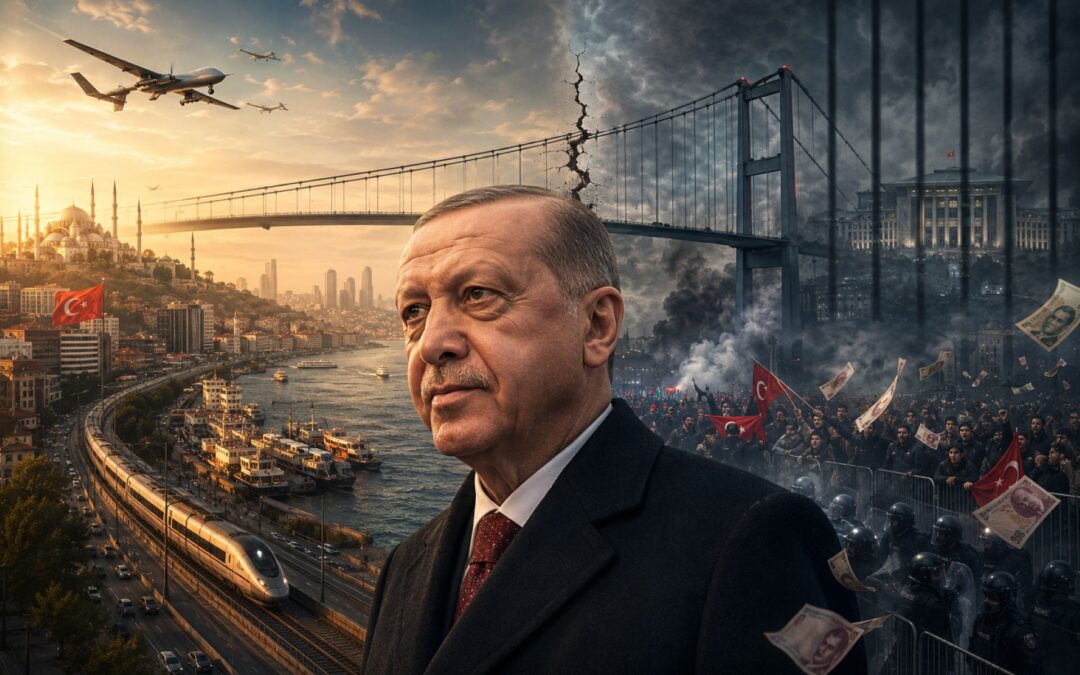
Recep Tayyip Erdoğan has spent more than two decades proving that political survival is a form of power.
He survived imprisonment, attempts to ban his party, mass protests, corruption allegations, a military coup attempt, repeated economic crises, a devastating earthquake and elections that appeared capable of ending his rule. Each time, he emerged weakened but still standing.
In the process, he transformed Turkey.
The country Erdoğan inherited was an imperfect parliamentary democracy shaped by the secular ideals of Mustafa Kemal Atatürk, the political influence of the military and a long ambition to become part of Europe. The Turkey he now leads is governed through a powerful presidency, defined by conservative nationalism and increasingly willing to pursue its own interests against both allies and adversaries.
It is also a country living with the consequences of that transformation.
Turkey has become more influential abroad but less predictable at home. It has built roads, hospitals, airports, weapons and diplomatic leverage, yet weakened many of the institutions needed for stable long-term prosperity. Elections still matter, but political competition has become increasingly unequal. Inflation is falling from its worst levels, but only after years in which Erdoğan’s economic decisions destroyed purchasing power and confidence in the lira.
His legacy cannot be reduced to a simple story of a dictator seizing control.
Erdoğan rose because he understood the frustrations of millions of Turks who felt excluded by the secular establishment. He delivered real improvements, widened political participation and gave religious conservatives a sense that the state finally belonged to them too.
But the outsider who challenged an unaccountable elite gradually built an establishment of his own.
And now, as another popular mayor of Istanbul faces prison and political exclusion, Erdoğan is confronting an uncomfortable reflection of his own rise.
The Two Mayors of Istanbul
In July 2026, Erdoğan hosted NATO leaders in Ankara and presented Turkey as one of the alliance’s most important military and diplomatic powers.
The summit was a personal triumph. Western leaders who had once criticised Turkey’s democratic decline focused instead on defence spending, regional wars, weapons production and Ankara’s strategic importance. Erdoğan stood at the centre of an alliance that could neither fully trust him nor afford to ignore him. Reuters described the summit as a diplomatic victory for the Turkish president.
At home, however, Ekrem İmamoğlu remained in prison.
The elected mayor of Istanbul had been detained in March 2025 and later indicted in a vast corruption case involving more than 400 defendants. Prosecutors accused him of leading a criminal organisation and held him responsible for 142 alleged offences, including bribery, fraud, money laundering and bid-rigging. He denied the charges, while the government insisted that the courts were operating independently. The Associated Press reported that convictions on every count could theoretically expose him to more than 2,000 years in prison.
İmamoğlu was not merely another opposition politician.
He had defeated Erdoğan’s party in Istanbul in 2019, ending its 25-year control of Turkey’s largest city. When electoral authorities annulled that result and ordered the election to be held again, İmamoğlu returned to the voters and won by a much larger margin.
He was re-elected in 2024 as the Republican People’s Party, or CHP, inflicted the AKP’s most serious nationwide electoral defeat since Erdoğan came to power. Reuters reported that İmamoğlu’s ten-point victory in Istanbul established him as Erdoğan’s strongest potential national rival.
His university diploma was annulled shortly before his detention, potentially disqualifying him from running for president. He also faced separate prosecutions involving comments about public officials and accusations of political espionage.
To Erdoğan’s opponents, the pattern was unmistakable: when the government could not reliably defeat İmamoğlu at the ballot box, the legal system began removing the conditions under which he could compete.
The government rejected that interpretation. Erdoğan and his ministers argued that elected office did not provide immunity from criminal investigation and warned critics not to describe judicial proceedings as a political coup.
Yet the comparison with Erdoğan’s own history is impossible to escape.
Before Erdoğan became Turkey’s president, he was a charismatic mayor of Istanbul who was prosecuted, imprisoned and barred from politics by an establishment that considered him dangerous.
His punishment did not end his career.
It created the Erdoğan era.
How Erdoğan Rose from Outsider to Prime Minister
Erdoğan was born in Istanbul in 1954 and grew up in a working-class, religiously conservative family. He attended an İmam Hatip school, part of a network originally created to train Muslim preachers while also providing a conventional education.
His political career began within Turkey’s Islamist movement. He joined parties associated with Necmettin Erbakan, the most important figure in modern Turkish political Islam, and unsuccessfully sought parliamentary office during the 1980s and early 1990s.
His breakthrough came in 1994, when he was elected mayor of Istanbul.
At the time, the city was growing rapidly but struggling with congestion, air pollution, water shortages, rubbish collection and weak municipal administration. Erdoğan gained a reputation as a competent and energetic manager. He improved services, invested in infrastructure and demonstrated that a politician rooted in political Islam could govern a modern metropolis.
The mayoralty also taught him a lesson that would shape his entire career: practical delivery could turn cultural resentment into durable political loyalty.
Erdoğan’s rise appeared to end in 1997 when he recited a poem containing the lines:
The mosques are our barracks, the domes our helmets, the minarets our bayonets and the faithful our soldiers.
A court convicted him of inciting religious hatred. He lost the mayoralty, was banned from political office and served several months in prison in 1999. A timeline of Erdoğan’s career published by the Associated Press traces how the conviction transformed him from a successful mayor into a national symbol of resistance to the secular establishment.
The imprisonment was supposed to remove him from politics.
Instead, it validated his central argument: Turkey’s secular elite would not allow religious conservatives to compete on equal terms.
When Erdoğan helped found the Justice and Development Party in 2001, he did not present it as another narrowly Islamist organisation. The AKP described itself as conservative democratic. It promised economic competence, cleaner government, political stability, European Union membership and greater freedom for religious citizens.
The timing was ideal.
Turkey had just suffered a severe financial crisis. Established parties were discredited, banks had failed, unemployment was rising and voters were tired of unstable coalitions.
The AKP won a parliamentary majority in the 2002 election only a year after its creation. Erdoğan could not initially enter parliament because of his conviction, so his ally Abdullah Gül became prime minister. After the law was changed and Erdoğan won a by-election in March 2003, he took over the government.
He had gone from prisoner to prime minister in four years.
More importantly, he had assembled a coalition far broader than the Islamist parties that preceded him. It included religious conservatives, small business owners, poorer urban families, rural voters, reform-minded liberals and entrepreneurs who wanted Turkey integrated into the global economy.
The coalition was held together by a powerful promise: Erdoğan would make the state more democratic, the economy more prosperous and conservative citizens more respected.
For several years, he appeared to be delivering all three.
Why the Early Erdoğan Era Worked
Erdoğan did not create Turkey’s early economic recovery from nothing.
The foundations had been laid after the 2001 financial crisis, when Turkey adopted banking reforms, tighter fiscal discipline and an economic programme supported by the International Monetary Fund. The AKP inherited that framework and initially preserved much of it.
What Erdoğan added was political stability.
After years of fragile coalitions, the AKP could govern without constantly negotiating its survival. It pursued European Union reforms, attracted foreign investment, expanded infrastructure and improved public services. New roads, hospitals, airports and housing projects made economic development visible in everyday life.
Turkey opened formal EU accession negotiations in 2005. Reforms reduced the political role of the military, strengthened some civil rights and created the impression that religious conservatism, market economics and democratic government could coexist.
The results were substantial.
According to the World Bank’s overview of Turkey’s development, real GDP growth averaged 5.4% between 2002 and 2022, real income per person doubled and the poverty rate measured by the bank fell from above 20% in 2007 to 7.6% in 2021. Much of the most transformative progress occurred during the earlier years of AKP rule.
The changes were not merely statistical.
Families gained access to healthcare, credit, consumer goods and better transport. Construction created employment and reshaped cities. Anatolian businesses expanded into national and international markets. Religious women who had been excluded from universities or government careers because they wore headscarves saw Erdoğan as someone restoring rights denied by the old system.
The AKP also confronted institutions that had repeatedly overridden electoral politics.
Turkey’s military had removed or pressured governments throughout the republic’s history. The judiciary and bureaucracy often treated secularism not simply as the separation of religion and government, but as a mandate to regulate religious expression and restrict Islamist political movements.
For many liberal Turks and European observers, reducing military tutelage looked like democratisation.
For conservative Turks, it felt like liberation.
These interests temporarily aligned. Liberal reformers wanted civilian government. Religious conservatives wanted freedom from secular restrictions. Businesses wanted stability and European integration. Western governments saw Erdoğan as proof that a Muslim-majority country could combine democracy, development and moderate religious politics.
But the coalition contained an unresolved tension.
Was Erdoğan weakening unaccountable institutions so that democracy could become stronger?
Or was he weakening institutions that might eventually restrain him?
During the early years, the distinction was easy to overlook because the economy was growing and elections remained competitive. As Erdoğan’s victories accumulated, however, power became less a means of reforming the system and more a means of controlling it.
From Reformist Government to Presidential Rule
Erdoğan’s transformation did not begin on a single date.
It emerged gradually from electoral success, political conflict and an increasing conviction that opposition to him was not legitimate disagreement but sabotage by hostile elites.
The first warning came from the way the AKP fought the secular establishment. Some reforms genuinely broadened democracy, but the government also relied on prosecutors and police officers connected to the movement led by Fethullah Gülen, an Islamic preacher living in the United States.
The Gülen movement had built influence within education, business, the police and the judiciary. Erdoğan and Gülen were never identical political actors, but for years they shared enemies. Together, their supporters weakened the military and secular officials who had dominated the state.
Once those rivals had been reduced, the alliance collapsed.
The rupture became public during corruption investigations in 2013 that implicated ministers, businessmen and people close to Erdoğan. Erdoğan called the investigations an attempted judicial coup organised by Gülenist networks inside the state.
The same year, the Gezi Park protests revealed another side of the government.
What began as a small environmental protest against the redevelopment of an Istanbul park expanded into a nationwide movement against Erdoğan’s increasingly combative and paternalistic style. The government responded with police force, arrests and rhetoric portraying protesters as extremists manipulated by foreign interests. Human rights groups recorded thousands of injuries and arrests during the crackdown. Reuters later described Gezi as the most serious mass challenge Erdoğan had faced until that point.
Erdoğan’s political language hardened.
He increasingly divided society between the authentic nation and those supposedly working against it: secular elites, foreign powers, Gülenists, Kurdish militants, critical journalists, civil-society organisations and opposition politicians.
Then came the night of July 15, 2016.
A faction of the Turkish military attempted to overthrow the government. Soldiers blocked bridges, tanks entered the streets, fighter jets flew over Ankara and parliament was attacked.
Erdoğan, who was away from the capital, appeared through a mobile video call broadcast on television. He urged citizens to resist the coup in the streets.
Thousands responded. Civilians confronted troops and armoured vehicles, while military and police units loyal to the government fought the plotters. More than 250 people were killed resisting the coup.
The attempt was an attack on an elected government, and Turkey’s major opposition parties condemned it.
Erdoğan blamed the Gülen movement. Gülen denied directing the plot, although officials and analysts broadly agreed that followers of the movement were involved.
The coup left Erdoğan with genuine reasons to fear infiltration and further violence. It also gave him an opportunity to remake the state on an extraordinary scale.
The government declared a state of emergency and launched sweeping purges across the military, judiciary, police, universities, schools, media and civil service. Many of those removed were accused of Gülenist connections, but critics argued that the crackdown extended far beyond people plausibly involved in the coup.
The distinction between protecting the state and protecting Erdoğan became increasingly blurred.
In 2017, voters narrowly approved constitutional amendments replacing Turkey’s parliamentary system with an executive presidency. The prime minister’s office was abolished, and the president gained greater control over appointments, administration and the judiciary. The Venice Commission warned that the changes concentrated power without adequate checks and balances.
The new system took full effect after the 2018 election.
Erdoğan was no longer merely the most important politician within a parliamentary government. He became the centre of the executive state.
Turkey did not stop holding elections. Opposition parties continued winning major cities, and Erdoğan was forced into a presidential runoff in 2023.
But the political arena was no longer level.
The OSCE’s observation mission concluded that the 2023 election offered genuine political alternatives and was generally well administered, while also finding that Erdoğan and the governing parties enjoyed an unjustified advantage through biased media coverage and restrictions on fundamental freedoms.
That combination captures modern Turkey better than either of the simplest labels.
It is not a country without electoral competition.
It is a country where electoral competition survives inside a system increasingly designed around the incumbent.
International assessments show the extent of the institutional damage. The World Justice Project ranked Turkey 118th of 143 countries in its 2025 Rule of Law Index, including 136th for constraints on government power and 134th for fundamental rights. International IDEA places Turkey in the low-performing range for rights, rule of law and political participation, although it remains in the middle range for political representation.
The media environment has undergone a similar transformation. Reporters Without Borders ranked Turkey 163rd out of 180 countries in its 2026 Press Freedom Index, reporting that most national media outlets were under government control or influence and that critical journalists faced censorship, prosecutions and financial pressure.
Erdoğan had defeated the old guardians of the Turkish state.
He then built a system with fewer guardians of its own.
Erdoğanomics and the Long Lira Crisis
For Erdoğan, economic growth was never separate from political power.
It was the foundation of his legitimacy.
The AKP’s early years created an implicit bargain with voters: Erdoğan would deliver rising living standards, public services and national development, while supporters would overlook his combative style and growing control over institutions.
The bargain worked until the economic model beneath it began to fail.
Turkey has long consumed and invested more than it saves domestically. It imports much of its energy, along with machinery, intermediate goods and gold purchased by households seeking protection from inflation and currency risk.
To finance that gap, the economy depends heavily on capital from abroad.
During the boom years, Turkish banks and companies borrowed in dollars and euros, converted much of the money into lira and channelled it into domestic credit. Cheap financing fuelled housing, infrastructure, construction and consumption.
The system delivered rapid growth, but it contained a dangerous mismatch.
Companies and financial institutions earned much of their income in lira while carrying obligations linked to foreign currencies. As long as global investors remained confident and the lira stayed relatively stable, the debts were manageable.
If confidence disappeared and the lira collapsed, those obligations became much more expensive.
That is what began to happen in 2018.
Foreign investors were increasingly concerned about inflation, external borrowing, political interference and the central bank’s ability to defend the currency. A confrontation between Turkey and the United States intensified the pressure, but the underlying vulnerabilities were already present.
As capital left, the lira weakened. The falling currency made imports more expensive, which pushed inflation higher. Higher inflation created more pressure on the currency, which further increased the cost of imports and foreign-currency debts.
Turkey entered a vicious cycle.
The conventional response would have been to raise interest rates decisively, reduce demand and restore confidence in the central bank.
Erdoğan resisted.
He had long argued that high interest rates caused inflation rather than restrained it. Part of his opposition was political: expensive credit threatened the construction, consumption and investment model on which his popularity depended. He also portrayed interest as morally objectionable and associated high rates with an exploitative financial elite.
When central-bank officials disagreed, Erdoğan repeatedly replaced them. The dismissal of Governor Naci Ağbal in 2021, only days after a sharp rate increase, became one of the clearest demonstrations that monetary policy remained subordinate to presidential preference.
The government eventually pushed interest rates down while inflation was accelerating.
The result was not the low-inflation growth Erdoğan promised. It was a further collapse in the lira, surging prices, depleted confidence and a frantic attempt to protect savings without openly reversing course.
For ordinary Turks, the crisis appeared in rent, groceries, fuel, school costs and the value of wages. People paid prices that changed faster than salaries could adjust. Businesses struggled to calculate costs. Households converted savings into dollars, euros, gold or property whenever possible.
Economic policy became an exercise in avoiding the consequences of previous economic policy.
Only after Erdoğan secured another term in 2023 did the government return to a more conventional approach. A new economic team allowed the central bank to raise interest rates sharply, restrain credit and rebuild reserves.
The policy reversal produced genuine improvement.
The International Monetary Fund reported in February 2026 that tighter monetary and fiscal policy had reduced imbalances, strengthened demand for the lira and improved international reserves.
But stabilisation was neither complete nor painless.
Annual consumer inflation was still 32.11% in June 2026. The central bank was holding its main policy rate at 37%, while households and businesses continued absorbing the cost of expensive borrowing and years of lost purchasing power. The IMF also reduced its 2026 growth forecast to 2.9% amid weaker activity and higher energy costs.
Turkey was no longer following Erdoğan’s most extreme low-rate experiment.
It was paying to escape it.
The larger damage was institutional.
Markets can respond to higher interest rates within days. Rebuilding confidence that a central bank, court or regulatory body can operate independently takes much longer.
Investors do not only ask whether the current finance minister is competent. They ask whether the president will overrule him when growth slows, elections approach or political pressure increases.
That is why events such as İmamoğlu’s arrest caused such a strong financial reaction. Political interference and economic instability were no longer separate risks. They had become expressions of the same problem: too much depended on the preferences of one leader.
The Battle Over Secular Turkey
When Mustafa Kemal Atatürk founded the Turkish Republic in 1923, secularism became one of its defining principles.
But Turkish secularism was never simply a neutral separation between religion and government.
The state placed Islam under official supervision, abolished religious courts, changed the legal system and restricted religious symbols within public institutions. The military and judiciary treated themselves as defenders of Atatürk’s secular order and repeatedly intervened when elected politicians appeared to threaten it.
For devout Muslims, this system could be deeply exclusionary.
Women wearing headscarves were barred from many universities and government positions. Religious political parties were closed. Graduates of İmam Hatip schools faced limits on access to higher education. Conservative citizens often felt that the state considered their beliefs backward or dangerous.
Erdoğan built his coalition around that grievance.
His government’s removal of headscarf restrictions was therefore not merely an act of Islamisation. It also expanded the ability of observant women to study, work and participate in public life.
In 2013, Turkey lifted the headscarf ban in most state institutions. The restrictions were later relaxed in high schools, the police, judiciary and armed forces.
To Erdoğan’s supporters, these changes corrected an old injustice.
To his critics, they were part of a broader effort to replace secular social engineering with religious social engineering.
The concern grew as the government expanded İmam Hatip schools and increased religious content in education. Erdoğan openly described his ambition to raise a “pious generation.”
A Reuters investigation into religious schooling found that İmam Hatip students represented approximately 11% of upper-school enrolment in 2018 but received around 23% of the relevant government funding.
The government also tightened restrictions on alcohol advertising and sales, imposed heavy taxes and introduced financial requirements that smaller producers warned could force them out of business. Erdoğan described alcohol policy as a public-health matter, but his rhetoric frequently framed drinking as culturally alien to the nation’s authentic values.
The same divide appeared in his statements about women and LGBTQ citizens. Erdoğan repeatedly presented the heterosexual family, motherhood and religious morality as foundations of the nation while describing LGBTQ activism as a threat to Turkish values.
These policies did not turn Turkey into a theocracy.
The constitution remained secular. Civil law continued to govern the country. Alcohol remained legal. Turkey retained a diverse urban culture, a large secular population and millions of citizens who resisted the government’s religious agenda.
Public opinion also imposed limits on Erdoğan’s project.
A 2025 Pew Research Center survey found that only 32% of Turkish Muslims supported granting official legal status to Islamic law, while 48% strongly opposed it. Even among a population overwhelmingly identified as Muslim, support for replacing the secular legal order was far from a majority.
Erdoğan therefore achieved something more complicated than the Islamisation of Turkey.
He changed which identities the state privileged.
The older republic had often treated visible religiosity as a threat to modernity. Erdoğan restored dignity and access to many citizens harmed by that system. But instead of settling the conflict through pluralism, he increasingly used state resources and political rhetoric to favour his own conservative vision.
The result was not a new national consensus.
It was a reversal of power inside an old cultural struggle.
How Erdoğan Made Turkey More Powerful Abroad
Erdoğan’s domestic legacy is inseparable from his foreign policy.
Turkey occupies a strategic position between Europe, Russia, the Middle East, the Black Sea and the eastern Mediterranean. It controls access between the Black Sea and the Mediterranean, possesses NATO’s second-largest army, hosts millions of refugees and sits beside several of the world’s most dangerous conflicts.
Earlier Turkish governments often defined national success through closeness to the West.
Erdoğan wanted greater freedom of action.
This did not mean abandoning NATO or joining a Russian bloc. Turkey continued to depend on Western trade, technology and security cooperation. It supported Ukraine while maintaining relations with Moscow. It sold drones to countries opposed by Russia while purchasing Russia’s S-400 air-defence system. It pursued EU membership while repeatedly attacking European governments.
The apparent contradictions were deliberate.
Erdoğan’s objective was strategic autonomy: Turkey should cooperate with larger powers when useful, oppose them when necessary and make itself too important to exclude.
Syria became the clearest example.
When the uprising against Bashar al-Assad developed into civil war, Erdoğan abandoned his earlier relationship with the Syrian leader and supported opposition forces. Turkey provided political backing, financing and military assistance to groups seeking Assad’s removal.
It later launched military operations across the border, partly to prevent Syrian Kurdish forces from creating an autonomous zone connected to the Kurdistan Workers’ Party, or PKK.
The policy carried enormous costs.
Turkey faced terrorist attacks, military casualties and a refugee population that reached several million people. Domestic resentment against Syrians grew as economic conditions deteriorated.
Yet Assad’s fall in 2024 also created new opportunities.
Turkey emerged as a central supporter of the new government led by Ahmed al-Sharaa. Ankara discussed military training, security cooperation, economic reconstruction and measures against Kurdish armed groups with the new Syrian leadership. Reuters reported that Erdoğan and al-Sharaa were exploring a strategic partnership and potential defence arrangements.
Turkey did not control post-Assad Syria, but it had become one of the country’s most influential external powers.
The refugee crisis gave Erdoğan another source of leverage.
European leaders were desperate to reduce irregular migration after more than a million asylum seekers and migrants reached Europe in 2015. Under the 2016 EU–Turkey statement, Turkey agreed to help prevent irregular crossings and accept certain returns from Greece. The EU committed billions of euros to refugee assistance and agreed to accelerate discussions over visa liberalisation and Turkey’s accession process, subject to conditions.
Visa-free travel was not automatically granted, but the agreement demonstrated Turkey’s bargaining power.
Europe needed Erdoğan’s cooperation even while relations with his government were deteriorating.
The Kurdish conflict produced a similar combination of domestic politics and foreign strategy.
The PKK began an insurgency against the Turkish state in 1984. The conflict killed more than 40,000 people and shaped Turkey’s politics, security policy and treatment of Kurdish political movements.
Erdoğan’s record was not consistent. His government initially expanded some Kurdish cultural rights and later entered a peace process. When that process collapsed in 2015, violence returned and the state adopted a much harder approach.
In 2025, the PKK announced that it would disarm and dissolve after an appeal from its imprisoned leader, Abdullah Öcalan.
The development created hope for an end to one of the region’s longest conflicts, but it did not instantly settle questions about Kurdish political rights, legal guarantees, disarmament or the future of Kurdish-led forces in Syria. As of June 2026, Erdoğan’s government was still preparing legislation intended to accelerate the process. Reuters described the negotiations as a potential breakthrough whose implementation remained difficult.
Erdoğan’s foreign-policy achievements are real.
Turkey has expanded its defence industry, increased its influence in Syria, supported Azerbaijan, intervened in Libya, bargained with Europe over migration and positioned itself as a mediator and military power.
Its allies may object to its choices, but they increasingly have to account for them.
That was evident at the 2026 NATO summit, where Erdoğan pressed allies to remove defence-industry restrictions and include Turkey in European security initiatives. Western governments largely muted public criticism of his domestic crackdown because cooperation with Ankara had become strategically valuable.
Erdoğan weakened Turkey’s Western alignment.
He also made Turkey harder for the West to take for granted.
Why Erdoğan Remains So Difficult to Defeat
Erdoğan’s durability is often explained as though political control alone keeps him in office.
Control matters. So do media advantages, state resources, pressure on opponents and the ability to shape the legal and political environment.
But repression does not fully explain why tens of millions of Turks continue voting for him.
Erdoğan constructed one of the most resilient political identities in modern democratic politics.
To his supporters, he is not merely the leader of the AKP. He is the man who defeated the secular establishment, gave religious citizens access to the state, built infrastructure, expanded social services and made Turkey act like a great power.
Criticism of Erdoğan can therefore feel like criticism of the people whose status rose with him.
He reinforces that identification through populist language. Political conflict is presented as a contest between the ordinary nation and a series of elites or conspirators: secularists, financiers, foreign governments, terrorists, judges, journalists and opposition parties supposedly disconnected from authentic Turkey.
Every attack can be converted into evidence that he is defending the public.
His imprisonment made him a martyr. Efforts to close the AKP proved that the establishment feared conservative voters. European criticism demonstrated Western arrogance. Currency speculation became economic warfare. Investigations became coups. Election challenges became attempts to steal the national will.
This narrative does not need to persuade everyone.
It only needs to preserve a large and disciplined coalition.
Erdoğan has also repeatedly adapted. When the AKP’s religious-conservative support was insufficient, he moved closer to Turkish nationalism and formed an alliance with the Nationalist Movement Party. When orthodox economic policy threatened growth, he demanded cheaper credit. When the resulting crisis threatened his re-election, he allowed a return to conventional policy.
Ideological consistency has always mattered less than political survival.
The opposition, meanwhile, repeatedly struggled to unite secularists, nationalists, liberals, conservatives and Kurdish voters behind a candidate who could appeal beyond Erdoğan’s cultural divide.
Even in the difficult economic environment of 2023, Erdoğan reached the second round of the presidential election and defeated Kemal Kılıçdaroğlu with approximately 52% of the vote. The result demonstrated both his vulnerability and his resilience.
He was no longer unbeatable.
But beating him required more than exposing his failures.
İmamoğlu appeared capable of solving that problem. His municipal campaigns combined opposition support with an inclusive tone that reached religious, nationalist and working-class voters. He did not simply denounce Erdoğan’s base. He tried to detach parts of it from Erdoğan.
That made him unusually dangerous.
It also exposed the limits of the political system. Turkey’s opposition could win Istanbul, Ankara and other major cities. It could outperform the AKP nationally in local elections. But when a rival began to look capable of winning the presidency, legal pressure intensified around him and his party.
Turkey’s elections still create uncertainty.
The question is whether the government will continue allowing that uncertainty to threaten Erdoğan’s rule.
The pattern resembles the system explored in Viktor Orbán’s model of illiberal democracy: elections survive, but institutions, media advantages and state power are gradually organised around the incumbent. Turkey’s political history, social divisions and geopolitical position are different, yet the underlying logic is familiar.
Domination is most durable when it still looks electoral.
The İmamoğlu Test
İmamoğlu’s rise began with an election Erdoğan’s party expected to win.
In March 2019, he narrowly defeated the AKP candidate in Istanbul. The governing party challenged the result, and the election authority ordered a rerun.
The decision could have destroyed him.
Instead, it gave him a national story.
İmamoğlu presented the repeated election as a choice between the will of the voters and a government unwilling to accept defeat. When Istanbul voted again in June, his margin expanded from roughly 14,000 votes to more than 800,000.
The attempted correction had created a landslide.
He consolidated that position in 2024, winning re-election by approximately ten percentage points even though several opposition parties ran separate candidates. The CHP also became the leading party nationwide in the local vote.
For the first time in years, Erdoğan faced a rival whose appeal extended beyond the traditional secular opposition.
İmamoğlu’s difficulties then multiplied.
He had already been convicted in 2022 of insulting election officials, a case that could lead to a political ban if finally upheld. In March 2025, Istanbul University annulled his degree over alleged irregularities in his transfer decades earlier. A university diploma is required to run for the Turkish presidency. Reuters reported that İmamoğlu called the decision unlawful and politically motivated.
The following day, police detained him along with dozens of other people.
His imprisonment triggered Turkey’s largest anti-government demonstrations in more than a decade. Police used tear gas, water cannon and rubber bullets as protests spread. Authorities detained nearly 1,900 people within days, while the government rejected foreign criticism and said the judiciary had to be allowed to work.
The crackdown did not stop with one mayor.
Other CHP mayors, officials, lawyers and municipal employees were detained or investigated. Reuters found that legal action had disproportionately affected opposition-run municipalities while comparable investigations were absent in Istanbul districts controlled by the AKP.
By 2026, pressure had reached the CHP’s national leadership. A court removed party leader Özgür Özel and reinstated his predecessor following a dispute over the party congress, producing another political crisis and further concern about judicial interference in opposition politics.
None of this proves that every allegation against opposition officials is false. Municipal governments can be corrupt, and opposition politicians are not entitled to immunity.
The democratic problem lies in the surrounding conditions.
Can prosecutors be trusted to apply the law equally when courts are widely viewed as vulnerable to executive influence?
Can an opposition candidate compete fairly when separate institutions can remove his diploma, imprison him before trial and pursue a political ban?
Can elections remain meaningful if repeated victories are followed by escalating legal attempts to remove the victor?
Those questions matter beyond İmamoğlu’s personal fate.
Erdoğan’s original political legitimacy rested on the claim that elected leaders should not be removed by military officers, judges or unelected elites. His imprisonment symbolised the injustice of a system that refused to respect the choices of conservative voters.
If the institutions of Erdoğan’s Turkey now eliminate the opposition figure most capable of defeating him, the president will have reproduced the very political order he once condemned.
There is another danger.
Legal pressure may remove İmamoğlu from an election, but it may also strengthen the historical parallel that makes him powerful. The more he appears to suffer because the government fears his popularity, the more his imprisonment resembles Erdoğan’s own path from Istanbul City Hall to national leadership.
Erdoğan understands better than anyone that prison can destroy a politician.
He also knows that it can create one.
Conclusion: Erdoğan’s Contradictory Turkey
Erdoğan changed Turkey because he recognised truths that the old establishment ignored.
Religious conservatives had been treated as second-class citizens. The military possessed too much political authority. Coalition governments had failed to provide stability. Public services needed improvement. Turkey was capable of exercising greater influence in its region and the world.
His early governments addressed many of those problems.
They expanded participation, delivered economic growth, improved infrastructure and reduced the power of institutions that had repeatedly overridden elected governments. Erdoğan gave millions of citizens a sense of dignity and representation that the secular republic had often denied them.
But he did not replace an exclusionary system with a genuinely pluralistic one.
He replaced its dominant coalition.
As victories accumulated, Erdoğan increasingly treated personal power as national power and opposition to his rule as opposition to Turkey itself. The presidency absorbed authority from parliament, the bureaucracy, the central bank and the judiciary. Independent institutions became obstacles to be overcome rather than protections to be preserved.
The economic consequences exposed the weakness of that model. A leader who could overrule monetary experts could keep interest rates low for political reasons, but he could not command inflation to disappear. A government could pressure journalists and courts, but it could not force investors to trust institutions they no longer considered independent.
At the same time, Erdoğan’s foreign policy made Turkey more assertive and more difficult to marginalise. NATO, Europe, Russia and the Middle East must all deal with him because Turkey possesses geography, military capacity and regional leverage that few other states can match.
That is the contradiction of Erdoğan’s legacy.
He made Turkey more powerful in some of the ways states display power: weapons, infrastructure, diplomacy, executive control and the ability to frustrate larger countries.
He made it weaker in some of the ways nations sustain power: institutional credibility, monetary stability, legal predictability, social trust and confidence that political competition will remain open.
Erdoğan’s story began with a mayor of Istanbul punished by an establishment that feared what he represented.
It may end with another mayor of Istanbul facing a system that fears what he could become.
The greatest threat to Erdoğan’s legacy is therefore not simply that he will eventually lose power.
It is that the political order he leaves behind will prove incapable of surviving uncertainty without suppressing it.
Erdoğan rose by insisting that no authority should stand above the will of the people.
Turkey’s future now depends on whether that principle still applies when the people choose someone else.
Last Updated on July 16, 2026 by Aseem Gupta