
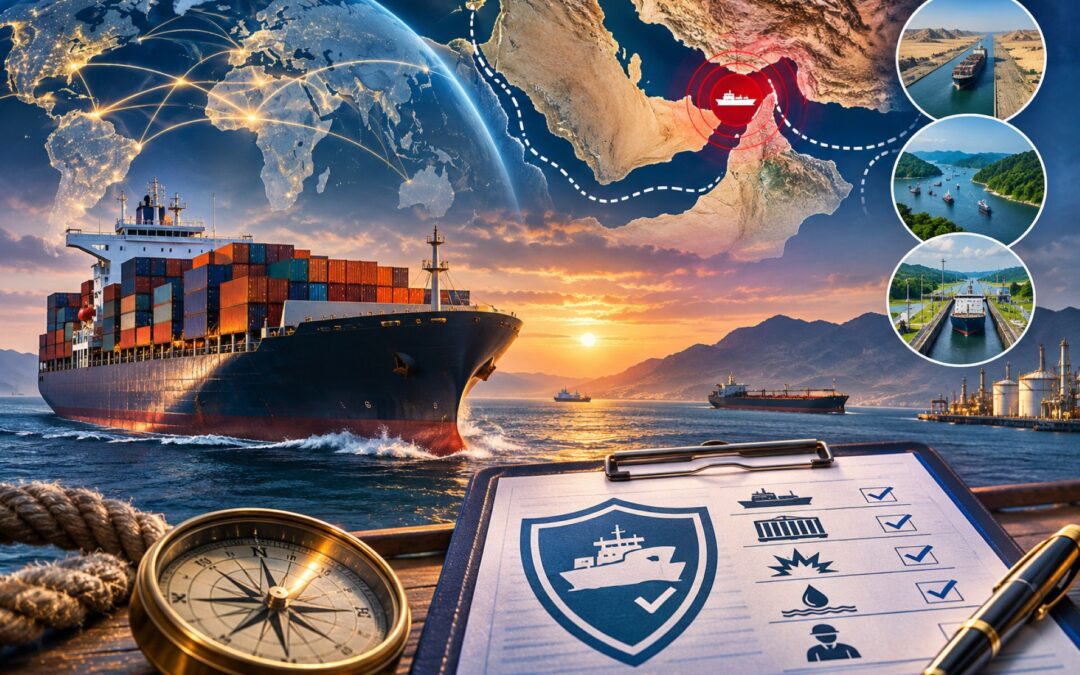
A tanker is ready to leave the Persian Gulf with a valuable cargo of oil. The crew is on board, the buyer is waiting, and the ship can physically reach the open sea. But the route has become dangerous, and before the owner commits to sailing, another question demands an answer: who will bear the financial consequences if something goes wrong?
The answer involves insurers, shipowners, cargo interests, brokers, contracts and a market for risks that most people never see. A sudden increase in danger can change the cost of a voyage, delay a departure or send a vessel along a much longer route. Those decisions can eventually affect factories, fuel markets and household budgets thousands of kilometres away.
Maritime insurance does not steer ships or prevent attacks. It helps determine which financial risks businesses can bear, transfer or negotiate. To understand why it matters so much to global trade, it helps to begin with the extraordinary amount of commerce that depends on ships.
The Hidden Financial System Behind Global Shipping
A phone sold in Chicago may contain minerals extracted in one country, chips manufactured in another and components assembled somewhere else. Such arrangements exist because businesses and countries specialize. The economic principle of comparative advantage explains why producing different goods in different places can make trade beneficial, even when no country is completely dependent on another for every product.
Specialization also creates a formidable transport problem. Raw materials must reach processors, components must arrive before assembly begins, and finished products must move through ports, rail terminals, warehouses and trucks. A container unloaded in Los Angeles may eventually reach a Midwestern retailer; a shipment entering New York or New Jersey can travel throughout the Northeast. American farm products make the journey in reverse, reaching customers overseas.
Shipping works because large vessels distribute their costs across enormous quantities of cargo. Moving thousands of containers or substantial volumes of oil by sea is generally more economical than attempting to move comparable quantities by aircraft. UN Trade and Development estimates that more than four-fifths of merchandise trade by volume travels by sea. Global commerce therefore relies on vessels completing long, carefully scheduled voyages at tolerable cost.
Yet a modern ship represents a concentration of financial risk. The vessel may be worth a great deal; its cargo may belong to numerous parties; and a collision, fire or grounding can damage more than either. Crew members can be injured, another ship can be struck, a port can be obstructed and pollution can create obligations lasting long after the immediate emergency.
A shipowner cannot make those possibilities disappear. Nor can every shipping business comfortably reserve enough money to cover a catastrophic incident on its own. Maritime insurance allows specified risks to be transferred or shared for a premium, making commercial decisions possible without requiring one company to shoulder every potential loss. It is financial infrastructure supporting physical transport, not a guarantee that every loss will be paid.
What Maritime Insurance Actually Covers
The phrase maritime insurance can make the system sound like a single policy purchased before a ship departs. In practice, the ship, the goods on board and the liabilities arising from a voyage are different interests. They may be insured by different parties, under different contracts and against different combinations of risks.
Hull and machinery insurance primarily protects an owner’s financial interest in the vessel. If a ship is damaged in a covered collision, grounding or fire, that policy may respond to eligible repair costs or, in severe circumstances, the loss of the vessel. The insured value, deductible, exclusions and circumstances of the casualty matter. Insurance does not turn an avoidable maintenance problem or every operational breakdown into an automatically payable claim.
Marine cargo insurance concerns the goods being transported. A container could hold electronics, clothing, machine parts or food, and cargo may suffer damage or loss even when the ship itself survives. The cargo owner or another party with an insurable interest can arrange protection according to the sale and transport arrangements. A policy’s coverage conditions determine which losses it addresses; late delivery alone is not necessarily an insured cargo loss.
Protection and indemnity insurance, usually called P&I, addresses important third-party liabilities associated with operating a ship. These may include crew injuries, certain cargo liabilities, collision-related obligations, damage to property, pollution and wreck removal. Much of the international industry obtains this protection through mutual associations called P&I clubs. Unlike ordinary protection for a damaged ship, this cover is often about what the operator may legally owe someone else.
The distinction becomes clearer after a tanker accident. Hull insurers may be concerned with the ship’s physical damage. Cargo insurers may examine the loss of oil being transported. P&I cover may be relevant to injury claims, pollution liabilities or the cost of dealing with a wreck, depending on the incident and the applicable policy. Several insurers and parties may therefore become involved in a single casualty, with different questions to resolve.
These liabilities have consequences beyond shipping-company balance sheets. The International Maritime Organization’s framework for liability and compensation includes conventions addressing harm such as oil pollution. Some regimes require shipowners to maintain insurance or other financial security, and compensation arrangements can involve additional funds under specified circumstances. The point is not simply to protect investors: the system also helps ensure that people and communities harmed by maritime accidents have a financially meaningful avenue for compensation.
War-risk insurance addresses a different class of danger. Ordinary policies may exclude some losses caused by war or hostile acts, creating a need for separate protection or extensions. Depending on the contract, the relevant risks can include damage from attacks, mines, seizure or other specified hostile events. War cover can concern the vessel, cargo and certain liabilities, but the exact insured events, exclusions and limits must be checked rather than assumed.
These categories overlap in the real world without becoming interchangeable. A shipowner may have hull protection but still need additional war cover for a hazardous route. A cargo seller may insure the goods without controlling the vessel’s P&I arrangements. And none of these policies means that an insurer pays whenever a ship arrives late, fuel becomes dearer or a factory loses sales. Those consequences depend on different contracts and on whether an insured event and a covered loss have actually occurred.
How Insurers Share and Price Maritime Risk
For an insurer, selling a policy means accepting an uncertain future payment in exchange for a known premium. That can work when risks are assessed, diversified and supported by enough financial capacity to meet valid claims. An isolated shipping company could face ruin from an enormous accident; an insurer spreads comparable exposures across a much larger portfolio, while still setting limits on what it will accept.
The assessment process is called underwriting. Underwriters consider information such as the type and value of the vessel, its cargo, operating history, route and current security conditions. They also evaluate the wording of the proposed cover, deductibles, exclusions and maximum amounts payable. A safer, routine passage and a journey through an active conflict zone do not present identical exposures, even if the ship and cargo are otherwise unchanged.
The premium is the price for accepting specified uncertainty, not a prediction of exactly how much a voyage will lose. If a dangerous route becomes more likely to produce a major casualty, insurers may charge more, offer narrower terms or restrict how much risk they are willing to carry. They might also ask for updated voyage information or impose conditions. Different insurers can reach different decisions about the same route because their portfolios, capital, underwriting judgments and existing commitments differ.
The International Group of P&I Clubs offers a striking example of organized risk sharing. Its 12 member clubs collectively provide marine liability cover for approximately 87% of the world’s ocean-going tonnage. Each club is a separate mutual association owned by its shipowner and charterer members. Members contribute to an arrangement designed to protect them against specified liabilities, while professional managers handle underwriting, claims and other services.
The clubs do not simply collect money and hope that few incidents occur. Under their pooling arrangements, qualifying large claims exceeding an individual club’s retained amount can be shared between participating clubs. The group also buys extensive reinsurance, transferring parts of potentially enormous liabilities to commercial reinsurers. These layers spread exposure beyond the shipowner and beyond any single club, while the rules of each arrangement determine what is recoverable.
Reinsurance is essentially insurance purchased by insurers. It does not mean the original risk vanishes, because someone remains financially exposed and every layer has terms and limits. It does, however, help insurers and clubs provide protection against losses much larger than a single member or institution would ordinarily want to bear alone.
War-risk underwriting adds another calculation. As London P&I explains in its war-risks coverage overview, additional premiums may be required for ships entering designated higher-risk areas. Cover can address eligible hostile-event damage and associated liabilities, subject to the policy’s conditions. What matters commercially is not just whether insurance exists but what it costs, which risks it excludes and what would happen if the planned route changed.
Insurance therefore turns one part of maritime danger into a financial decision. A high premium tells a shipowner something about the market’s assessment of risk, but it does not replace the owner’s own responsibility for safe operations. Nor does it mean the premium is the entire cost of taking a dangerous voyage: crew welfare, charter obligations, delays and the possibility of losses outside cover still matter.
Hormuz: When War Changes the Cost of a Voyage
The Strait of Hormuz lies between Iran and the Arabian Peninsula, connecting the Persian Gulf with the Gulf of Oman and the Arabian Sea. Its importance is not just that the passage narrows to roughly 39 kilometres at its tightest point. Major energy exporters depend on it to move oil and liquefied natural gas to customers abroad, making it a place where regional insecurity can affect distant energy markets.
The International Energy Agency’s Strait of Hormuz factsheet estimates that about 20 million barrels of crude oil and petroleum products passed through the strait each day in 2025, representing approximately one-quarter of global seaborne oil trade. Qatar also relies on the route for substantial LNG exports. Some Saudi and Emirati oil can travel through pipelines to terminals outside the strait, but bypass capacity cannot readily replace every shipment normally transported by sea.
When conflict makes that route dangerous, shipping companies confront several problems at once. Crews may face attacks, vessels may be damaged or detained, insurers may reassess the exposure, and charterers and cargo interests may demand answers about delivery. A tanker owner might seek additional war-risk protection, renegotiate freight terms, postpone departure or decline the journey. Even if the water remains navigable, the commercial bargain underlying a voyage can change.
Those risks emerge from the wider history of conflict and competing interests in the Middle East, but a shipping decision does not require agreement about the conflict’s political causes. What matters to the vessel is the immediate security environment and the financial and legal commitments attached to the cargo. A charterparty may allocate certain costs and responsibilities between owner and charterer, yet the parties still have to determine whether the passage is practicable and acceptably safe.
The 2026 war involving Iran made these questions unusually visible. In Reuters reporting from 9 September 2026, Emirates National Oil Company executive Paul Bradshaw described dramatically increased expenses for shipping oil through Hormuz. He said cargo insurance could reach five or six per cent of shipment value in some cases, potentially adding around $10 million, while additional war-risk charges had also risen sharply. He described overall transit expenses of approximately $10 million to $20 million in some circumstances.
These were reported examples from an exceptional conflict-affected environment, not prices paid by every tanker or a normal industry tariff. Nor should cargo-insurance percentages, war-risk premiums and overall transit expenses be added together casually: they describe different cost elements and reported situations. Reuters also noted that some market participants were declining insurance and that relatively few shipowners were willing to accept the safety risks. A decision to operate without particular cover does not eliminate the exposure; it shifts more of the possible loss onto those choosing to bear it.
Insurance is only one way the shock reaches the global economy. If shipping delays interrupt energy deliveries, buyers compete for alternatives and traders revise their expectations. The United States is comparatively less dependent on direct Hormuz oil shipments than many Asian importers; the US Energy Information Administration estimated that American oil imports through the strait in 2024 were equivalent to about 2% of US petroleum liquids consumption. Yet oil prices respond to international supply and demand, so American fuel and industrial costs can still be affected by disruptions far from US shores.
The distinction is crucial: a higher insurance bill increases the expense or difficulty of moving a cargo, while a physical interruption can also threaten the quantity of energy reaching buyers. Both may occur together, but an insurer raising a premium is not the same event as millions of barrels becoming unavailable.
When Insurance Is Available but Ships Still Will Not Sail
A common account of a maritime crisis suggests that insurers simply cancel coverage and all shipping stops. Reality is more complicated. Insurance may remain available, but shipowners may judge the danger to crews and vessels unacceptable; alternatively, a voyage may still be technically possible while its increased costs make the commercial arrangement unattractive.
On 23 March 2026, the Lloyd’s Market Association issued a clarification about Hormuz. It said marine war-risk cover continued to be offered in the Lloyd’s and London market, and that concerns about physical safety—not the blanket disappearance of insurance—were driving reduced vessel traffic. The association also explained that notice-of-cancellation provisions in war-risk contracts can allow insurers and shipowners to renegotiate terms as danger changes. A notice in this setting does not necessarily mean the market has stopped providing cover altogether.
The association distinguished war-risk arrangements from P&I protection, stating that club liability cover remained in place while certain fixed-premium charterer arrangements had been repriced. This is an important corrective to the notion that every form of insurance rises and falls together. Hull, cargo, liability and war-risk policies can respond differently to the same crisis because they cover different obligations and operate under different rules.
The March clarification and the September Reuters report are not contradictory. Cover can exist in March and expensive insurance or transit arrangements can be reported later as conditions evolve. There is also no inconsistency between available insurance and owners refusing to expose their crews to attacks. The insurer’s willingness to accept a financial risk cannot make a dangerous passage physically safe.
This is why maritime insurance influences trade without governing it. Underwriters can price losses, negotiate terms or decline particular exposures. Shipowners and other parties must still decide whether the proposed voyage is safe, lawful and commercially feasible. A corridor can remain open on a chart while many vessels choose not to enter it.
Different Routes, Different Risks: Suez, Malacca and Panama
The risks around Hormuz are unusually associated with conflict and energy shipments, but shipping’s other major bottlenecks reveal why there is no single insurance response to every disruption. An attack, accidental grounding and drought may all delay trade, yet they create different questions about causation, liability and the scope of insurance cover.
In March 2021, the container ship Ever Given grounded across the Suez Canal in Egypt, blocking the passage for six days. More than 400 ships accumulated in the backlog before the vessel was freed on 29 March. The immediate damage was a physical obstruction; its wider consequences involved waiting vessels, delayed cargo, missed schedules and commercial disputes. Whether a particular loss was insured would depend on the circumstances, the contract, and the type of loss—not simply on the fact that the canal was closed.
Suez also presents a separate security question. Attacks on commercial vessels in the Red Sea prompted operators to avoid the route and sail around the Cape of Good Hope. In that situation, the danger of hostile action can affect war-risk underwriting and voyage decisions even when the canal itself remains navigable. The same geographic corridor can therefore experience an accident-driven interruption at one moment and a security-driven diversion at another.
The Strait of Malacca, between the Malay Peninsula and Indonesia’s Sumatra island, links the Indian Ocean with major East Asian trading routes. The US Energy Information Administration estimated that about 23.2 million barrels of oil and petroleum liquids passed through it daily in the first half of 2025. Security risks, accidents or a serious disruption could affect energy supplies and manufacturing networks, while any additional insurance cost would be only one part of the economic consequences.
The Panama Canal offers another contrast. Its locks depend on sufficient freshwater, and drought can force restrictions on the number or size of ships transiting. These capacity limits can delay cargo or require longer routes even without a hostile act or a damaged ship. A business does not automatically possess a valid insurance claim just because rain failed to arrive and freight became more expensive.
As UN Trade and Development’s analysis of Suez and Panama disruptions explains, rerouting can raise fuel consumption, crew and transport expenses, congestion and, where relevant, insurance costs. The comparisons show why insurance is necessary but not sufficient. It can transfer defined financial exposures; it cannot restore a canal’s water level, remove a grounded vessel or guarantee that a dangerous sea will be safe to cross.
How Maritime Insurance Costs Reach Businesses and Consumers
Suppose a shipping company normally sends a container vessel through Suez to reach Europe from Asia. If attacks make that route unsafe, it can redirect the ship around southern Africa. The cargo may still arrive, but the voyage takes longer and burns more fuel. Insurance costs may also differ, while the owner incurs more days of crew, vessel and financing expenses before beginning its next assignment.
Time is itself a limited shipping resource. When ships spend longer completing voyages, the existing fleet can perform fewer trips over the same period. That reduces effective shipping capacity without a single vessel disappearing from the world. If many ships are diverted simultaneously, competition for available space may lift freight or charter rates. The insurance premium matters, but so do distance, fuel, delays and the scarcity of vessels in the right place at the right time.
A higher freight rate can help one shipping operator and hurt another business. Carriers with favourable contracts may earn more on some routes, while also paying more for fuel, cover and operations. Revenue is not the same as profit. Port authorities, terminal operators, truckers, warehouses, financiers and insurers have different exposures, and there is no reason to assume every participant benefits or suffers equally.
The effects reach manufacturers through contracts and delivery schedules. A factory may have designed its production around components arriving regularly from a distant supplier. That arrangement reduces the amount of capital tied up in warehouses, particularly when transportation has usually been predictable. It also makes a delay potentially much more expensive than the freight surcharge charged to move a container.
Imagine that a manufacturer needs a part costing $50 for every finished product. The business orders frequently and keeps only a modest reserve of that component because its supplier has been reliable. A rerouted vessel arrives several weeks late, the remaining components are exhausted, and a production line cannot finish its work. The resulting cost may include idle machinery, workers unable to complete scheduled output, late customer orders and lost sales. The $50 component is the trigger, not the measure of the total financial damage.
This is the dilemma behind just-in-time inventory. Holding stock costs money: goods occupy space, require handling and insurance, may become obsolete, and tie up cash. Reducing unnecessary inventory can improve efficiency. But a business with very little buffer is vulnerable when a shipment encounters disruption, and one unavailable component can make other materials temporarily useless.
The route from a maritime cost increase to a household price is therefore indirect. Importers may absorb extra freight or insurance charges, use existing inventory, renegotiate contracts, choose another supplier or raise retail prices. Some pressures appear immediately in traded oil prices, while changes to manufactured goods may take weeks or months to work through orders and inventories. If a crisis ends quickly, some anticipated shortages or price increases may never materialize.
Insurance is one part of this chain, not a universal explanation for inflation. Higher premiums can make transport more costly, but physical supply interruptions, fuel prices, inventory shortages and commercial decisions often matter alongside them. The value of understanding maritime insurance is seeing how an assessment of financial risk can influence a ship’s movement and then combine with other pressures across the economy.
Who Bears Maritime Risk—and How Trade Becomes More Resilient
No single institution runs global shipping. Shipowners deploy vessels, charterers negotiate voyages, banks finance transactions and ports connect ships to inland networks. Insurers provide capacity for defined losses, while governments shape security and regulation. Their responsibilities and incentives differ.
Resilience requires choices rather than a single technical fix. Shipowners can assess routes and prioritize crew safety. Cargo buyers can qualify alternative suppliers or hold reserves of critical components. Ports can improve contingency planning, while insurance markets can explore capacity for risks they can responsibly cover.
There was a concrete example in June 2026. Lloyd’s announced a new marine war-risk insurance consortium led by Chubb to offer additional capacity for vessels and cargo transiting Hormuz. Its stated arrangements included up to $200 million of capacity separately for hull and P&I risks, alongside another $200 million for cargo. Availability remained subject to individual underwriting, policy conditions, sanctions screening and legal requirements. The announcement illustrated how insurers can respond to severe risk, not a promise that every ship could sail safely or obtain identical terms.
Resilience also has a price. Maintaining alternative suppliers, inventory buffers, redundant transport options or insurance capacity may look inefficient in a quiet year. Yet a system optimized entirely for the lowest routine cost can become expensive when one crucial link fails. The relevant question is how much protection is justified against disruptions a business cannot afford to absorb.
Maritime insurance makes global trade more workable by sharing and pricing some of the risks of moving ships and cargo across oceans. It helps victims receive compensation under applicable arrangements and gives businesses greater confidence to undertake ventures with potentially enormous losses. But it cannot replace safe routes, sound decisions or functioning supply chains.
A ship’s departure may depend on far more than a clear stretch of water. It also depends on whether the people and businesses involved understand the dangers, can bear the remaining exposure and agree on the cost of transferring what can be insured. That is how a financial decision made far from a port can help keep physical trade moving—or reveal why a voyage should not proceed.
Last Updated on November 3, 2026 by Aseem Gupta