
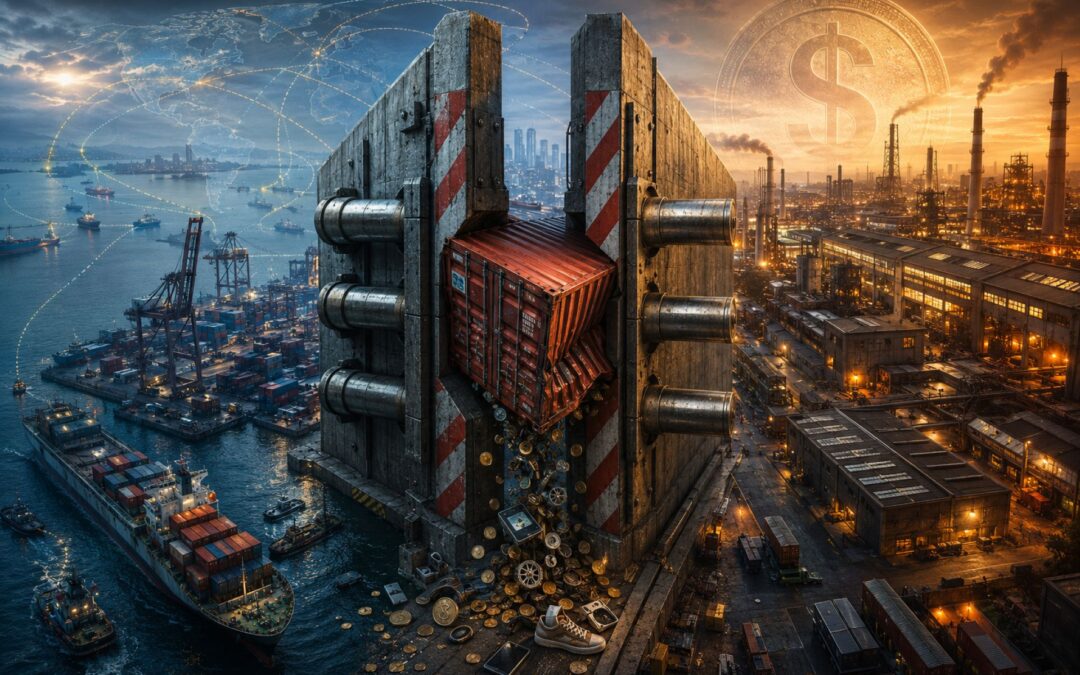
Donald Trump wants American companies to manufacture more of what Americans consume. His proposed solution is to make foreign products more expensive through tariffs, giving domestic producers an advantage over their international competitors. But the policy contains a fundamental contradiction: the same tariffs that protect an American steel mill can make it more expensive for an American car manufacturer to build vehicles.
This tension lies at the heart of Trump’s economic strategy. Tariffs can encourage companies to relocate production, protect industries considered essential to national security, and generate billions of dollars in government revenue. They can also raise consumer prices, provoke retaliation against American exports, disrupt supply chains, and discourage the very investment they are supposed to attract.
The disagreement is not simply between politicians who support American manufacturing and economists who favour free trade. It concerns how industrial economies develop, why manufacturing jobs have disappeared from certain communities, what causes persistent trade deficits, and whether the United States can use access to its enormous consumer market to reshape the global trading system.
Trump’s second administration has pushed these questions further than his first. Beginning in 2025, tariffs became instruments of industrial policy, international bargaining, fiscal strategy, and even monetary ambition. The resulting programme has tested not only the economic effectiveness of protectionism but also the legal limits of presidential power.
To understand whether tariffs work, we need to examine what they actually accomplish, who pays for them, and why their success in one part of the economy can create costs somewhere else.
What Tariffs Actually Do—and Who Pays for Them
A tariff is a tax imposed on goods imported from another country. When an American company imports a product subject to a tariff, it generally pays the duty to US Customs and Border Protection. The money goes to the American government, not directly to the foreign government or manufacturer.
Suppose an American retailer imports a washing machine for $500 and the United States imposes a 20% tariff. The importer now faces an additional $100 duty. But determining who ultimately bears that $100 is considerably more complicated than identifying who pays it at the border.
The retailer might increase the selling price, transferring much of the burden to consumers. It might accept a smaller profit margin to remain competitive. Alternatively, it could negotiate a discount with the foreign manufacturer, which may sacrifice some profit rather than lose access to the American market.
The eventual cost can therefore be divided among foreign producers, American importers, retailers, workers, and consumers. It may appear through higher prices, reduced profits, slower wage growth, postponed investment, or fewer products being offered for sale.
Exchange rates introduce another complication. If the United States imposes a tariff on Chinese goods while China’s currency depreciates against the dollar, Chinese exports become cheaper in dollar terms. This movement can offset some of the tariff, provided the currency change actually affects the prices charged to American importers.
However, contracts may be denominated in dollars, exporters may preserve their existing prices, and retailers may pass along costs even when foreign producers absorb part of the burden. Currency depreciation does not guarantee that consumers escape the tax.
Consequently, two popular claims about tariffs are misleading. Foreign governments do not simply pay the duties imposed by Washington, but American households do not necessarily pay every dollar of those duties immediately either. The economic burden is distributed through a complex network of pricing decisions and supply-chain adjustments.
Tariffs can also make domestically manufactured goods more expensive. An American appliance company that imports steel, electronic components, or industrial machinery may face higher production costs even if its final product is assembled entirely inside the United States. Meanwhile, a domestic competitor protected from cheaper foreign products may find it profitable to raise its own prices.
Whether these costs are worthwhile depends on what a government is trying to accomplish.
If the objective is industrial protection, making imported products more expensive can give domestic producers additional room to compete. Companies may expand existing facilities, invest in new factories, or relocate production to avoid paying import duties.
If the objective is revenue, tariffs can provide the government with money for public spending or other fiscal priorities. But this creates a contradiction: the more successfully tariffs eliminate imports, the smaller the taxable import base becomes.
A policy intended to replace foreign goods with domestic production cannot simultaneously maximize revenue from those foreign goods indefinitely.
Tariffs may also serve diplomatic or strategic purposes. A government might threaten additional duties to obtain concessions in trade negotiations, respond to subsidies it considers unfair, or reduce dependence on foreign suppliers of military equipment, medicines, semiconductors, and critical infrastructure components.
These objectives need not reinforce one another. A tariff might increase domestic steel production while reducing competitiveness in automobile manufacturing. It might improve bargaining leverage against one country while encouraging other countries to establish alternative trading relationships.
The meaningful question is therefore not whether a tariff changes economic behaviour. It almost certainly does. The question is whether the resulting changes advance the intended objective sufficiently to justify their costs.
Why America Once Built Its Economy Around Tariffs
American protectionism is considerably older than Donald Trump. In fact, many of the arguments he uses resemble those advanced when the United States was still struggling to become an industrial power.
Following independence, the American economy remained predominantly agricultural. Britain possessed established factories, skilled workers, accumulated capital, extensive commercial networks, and technological knowledge that American manufacturers could not easily reproduce.
British advocates of free trade argued that countries would benefit by purchasing goods wherever they could be produced most efficiently. For Britain’s already developed industries, that arrangement offered considerable advantages. British factories could supply foreign markets at prices that newer competitors struggled to match.
For American policymakers, however, unrestricted competition threatened to preserve an existing imbalance. If young American manufacturers could never survive against established British firms, the United States might remain permanently dependent on foreign industrial production.
Alexander Hamilton addressed this problem in his 1791 Report on Manufactures.
Hamilton believed that manufacturing could increase national wealth, encourage technological innovation, diversify employment, improve productivity, and strengthen national security. But he also recognized that new industries frequently face disadvantages that private enterprise cannot overcome immediately.
An established foreign manufacturer might enjoy lower costs because it already possesses experienced workers, specialized equipment, reliable suppliers, and access to large markets. An American competitor could potentially become just as efficient, but it needed enough time and capital to develop those capabilities.
Temporary protection could provide that opportunity. By increasing the price of competing imports, tariffs would allow domestic manufacturers to expand production, accumulate experience, and eventually compete internationally.
This became known as the infant-industry argument.
Importantly, Hamilton did not regard tariffs as a complete industrial strategy. He also supported government bounties, an early term for subsidies, alongside measures to improve access to finance, infrastructure, skilled labour, and productive technology.
The objective was not simply to make foreign goods more expensive. It was to develop domestic industries capable of becoming genuinely competitive.
The distinction remains relevant today. A tariff can protect a semiconductor manufacturer from foreign competition, but it cannot independently train engineers, establish advanced research facilities, construct reliable power infrastructure, or create a network of specialized suppliers.
Protection provides an opportunity for industrial development. It does not automatically produce that development.
Hamilton also recognized the potential costs. Consumers could face higher prices during the period of protection, while established manufacturers might become dependent on government assistance and resist competition long after that assistance had served its purpose.
The broader historical argument therefore concerned the circumstances under which intervention could help industries mature, not the assumption that every import was economically undesirable.
Tariffs served another important function in early American history: financing the federal government.
Before modern income taxation, customs duties were among Washington’s principal sources of revenue. From 1789 to 1862, they supplied the overwhelming majority of federal receipts. During the subsequent period, customs duties and domestic taxes contributed more comparable amounts as the government’s responsibilities expanded.
The Civil War accelerated the transformation. Congress introduced a temporary income tax, including a 3% levy on incomes exceeding $800, to meet the extraordinary financial demands of the conflict.
The decisive constitutional change came in 1913, when ratification of the Sixteenth Amendment established the modern federal government’s authority to collect income taxes without apportioning them among the states.
As government spending expanded to encompass larger military commitments, infrastructure, social programmes, and a growing administrative state, internal taxation became a more dependable source of revenue than customs duties.
Import taxes fluctuate with international trade. Revenue can fall during recessions, wars, supply disruptions, or periods when tariffs successfully discourage imports. Income taxation provides access to a much broader economic base.
This historical transition exposes a weakness in proposals to finance a modern government primarily through tariffs. The federal government’s spending commitments are vastly larger than those of the nineteenth-century state, while discouraging imports would undermine the very revenue source intended to replace domestic taxation.
There is also a distributional difference. Lower-income households generally spend a larger proportion of their earnings on consumption. Broad tariffs on everyday goods can therefore absorb a larger share of their income, even when wealthier households pay more in absolute terms.
Trump’s admiration for America’s high-tariff era nevertheless has a recognizable historical foundation. The United States industrialized during a period when tariffs were an important part of government policy. But industrialization also depended on expanding domestic markets, immigration, abundant resources, technological innovation, capital investment, and infrastructure development.
The presence of high tariffs during industrialization does not demonstrate that tariffs alone caused American prosperity.
History also provides warnings about retaliation. The 1930 Smoot-Hawley Tariff raised duties on thousands of imported products at a time when the world economy was already deteriorating. Other countries responded with trade restrictions, worsening the contraction of international commerce during the Great Depression.
Smoot-Hawley did not single-handedly cause the Depression. Monetary failures, banking collapses, deflation, and financial instability were considerably more important to the catastrophe. But the episode demonstrates how policies intended to protect domestic industries can worsen economic conditions when trading partners respond in kind.
The central lesson of America’s protectionist history is therefore more demanding than simply advocating higher tariffs. Governments must distinguish between giving domestic industries an opportunity to develop and creating costly barriers that offer protection without generating lasting competitiveness.
What Trump’s First Trade War Achieved—and What It Cost
Donald Trump’s first presidency provided an extensive modern test of protectionism.
Beginning in 2018, his administration imposed tariffs on steel, aluminium, washing machines, solar products, and hundreds of billions of dollars’ worth of Chinese imports. The policies were justified through different legal authorities and pursued different economic objectives.
Steel and aluminium tariffs were defended partly on national-security grounds. Washing-machine tariffs were designed to protect American producers from import competition and repeated changes in foreign sourcing. Tariffs on China targeted practices Washington considered unfair, including intellectual-property violations, forced technology transfer, industrial subsidies, and other restrictions on American commerce.
The policies produced genuine changes. Foreign goods became more expensive, domestic manufacturers gained protection, some companies relocated production, and federal customs revenue increased.
The difficulty was determining whether these benefits exceeded the broader costs.
In March 2018, Trump imposed a 25% tariff on imported steel under Section 232 of the Trade Expansion Act of 1962. The policy was intended to strengthen an industry considered important for national security and industrial independence.
The reasoning was straightforward. With foreign steel becoming more expensive, American steelmakers could compete more effectively. Existing plants might increase production, previously uneconomic capacity could become viable, and companies might have stronger incentives to invest domestically.
For communities built around steel production, the potential benefits were significant. Industrial employment supports not only factory workers but also local businesses, suppliers, transportation networks, and municipal finances. Losing a major steel plant can damage an entire community.
There was also a strategic argument. A country dependent on foreign supplies of essential materials may encounter serious difficulties during war, diplomatic confrontation, or a major disruption of international trade.
Yet steel occupies an unusual position in the economy because it is both a finished product and an essential input into other industries.
Automobile manufacturers, construction companies, machinery producers, and appliance manufacturers all rely on steel. When tariffs increase their material costs, those industries must either accept lower profit margins, raise prices, or find ways to reduce expenses elsewhere.
An American steel mill might therefore become more profitable while an American automobile factory becomes less competitive.
A Federal Reserve study of the 2018–2019 tariffs examined this tension across manufacturing industries. It found that greater protection from imports was associated with negative employment effects once rising input costs and retaliatory tariffs were taken into account.
The research also identified increases in producer prices, illustrating how the economic burden spread beyond the companies directly importing the taxed products.
This complicates political claims about job creation. Even if a protected steelmaker hires additional workers, the economy may lose employment opportunities when steel-consuming manufacturers reduce investment, scale back production, or become less competitive internationally.
The US International Trade Commission’s assessment of Sections 232 and 301 reached a similarly nuanced conclusion. Steel and aluminium tariffs increased domestic production and reduced imports in affected sectors, but they also increased costs and reduced production in industries using those metals.
These findings do not establish that protecting steel production was inherently unjustified. They demonstrate that the benefits of protection must be evaluated alongside the costs imposed on other American industries.
Washing machines provide an even clearer example of how tariff costs can spread through the economy.
In 2018, the administration imposed safeguard tariffs on imported large residential washing machines. The policy followed years of trade disputes in which foreign manufacturers had shifted production between countries as earlier restrictions were imposed.
The tariffs made imported washing machines more expensive, creating an incentive for manufacturers to expand production inside the United States.
Some companies responded accordingly. Foreign manufacturers invested in American facilities, illustrating how tariffs can encourage production relocation when businesses expect protected market access to justify the investment.
But American consumers paid more for appliances.
Research published by the National Bureau of Economic Research, The Production Relocation and Price Effects of US Trade Policy, found that washing-machine prices increased by nearly 12%. Prices for dryers rose by a comparable amount even though dryers were not themselves subject to the safeguard tariff.
That second finding is particularly revealing.
Washing machines and dryers are frequently purchased together. When manufacturers and retailers increased washer prices, they also had room to increase the prices of complementary products.
The impact extended beyond the goods directly taxed at the border.
This illustrates why measuring tariff success solely by counting new factories or manufacturing jobs can be misleading. Domestic production may expand, but the additional capacity comes at a cost paid partly by households purchasing the finished goods.
A comprehensive assessment must consider how much consumers paid, how many jobs were created or preserved, whether the new investment lasted, and whether the resulting industry became more productive.
The experience of the first trade war also demonstrates the importance of retaliation.
Canada, China, Mexico, the European Union, India, and other trading partners responded to American restrictions with tariffs of their own. These measures affected American exporters, including agricultural producers whose businesses depended on access to foreign markets.
Farmers could lose customers or face lower export prices even though they received no direct protection from the American tariffs that triggered the retaliation.
The government responded to agricultural losses with financial assistance, creating another fiscal consequence of the trade conflict. Tariffs generated revenue, but retaliation also imposed costs that sometimes required public support.
The political consequences were different from the overall employment effects.
A National Bureau of Economic Research study examining employment and electoral outcomes found little evidence of substantial employment gains in newly protected industries by the end of Trump’s first term. It also identified negative employment effects associated with retaliation, particularly in agriculture.
Nevertheless, areas receiving greater import protection showed increased political support for Trump and the Republican Party.
That result helps explain why tariffs remained politically attractive despite their mixed economic performance.
For a community worried about the disappearance of manufacturing jobs, a tariff is a visible demonstration that the government recognizes its concerns. A protected factory, announced investment, or confrontation with a foreign competitor can carry political significance that is not captured by national employment statistics.
Meanwhile, higher prices and input costs are dispersed across millions of consumers and businesses. Their effects may be individually smaller, harder to identify, and less politically visible.
The distinction matters because an economically costly policy can still accomplish a political objective. It may reassure industrial workers, signal a government’s willingness to confront foreign competition, or strengthen support among communities that feel neglected by previous trade policies.
Trump’s first trade war therefore cannot be described accurately as either an unqualified failure or an industrial renaissance.
It protected selected producers, encouraged some investment, changed supply arrangements, and raised government revenue. It also increased prices, hurt downstream industries, provoked retaliation, and failed to produce a broad revival of manufacturing employment.
Those mixed outcomes became even more complicated when the administration confronted China.
Why Tariffs Changed America’s Trade With China Without Ending Its Dependence on Imports
China’s emergence as a manufacturing powerhouse transformed international trade long before Trump entered the White House.
After joining the World Trade Organization in 2001, China became increasingly integrated into global production networks. Its enormous workforce, expanding infrastructure, industrial investment, supplier clusters, and export-oriented policies made it an attractive location for manufacturing.
American businesses gained access to inexpensive products and components. Consumers benefited from lower prices and greater product variety, while companies could reduce manufacturing costs by sourcing goods from Chinese factories.
But those benefits were not distributed equally.
Manufacturing communities exposed to intense import competition experienced factory closures, job losses, declining economic opportunities, and social disruption. The benefits of cheaper goods were spread across millions of consumers, while the costs of industrial decline were concentrated in particular towns and regions.
Trump turned this uneven experience of globalization into a central argument for protectionism. He portrayed America’s bilateral trade deficit with China as evidence that the relationship had become economically unfair and politically unsustainable.
During his first administration, Washington imposed Section 301 tariffs on a broad range of Chinese goods. The intention was to penalize practices considered unfair, encourage American production, and reduce reliance on Chinese imports.
The tariffs succeeded in changing some trading patterns.
The USITC found that Section 301 tariffs reduced imports from China by approximately 13% across affected sectors, while increasing the value of domestic production by an estimated 0.4% and domestic product prices by approximately 0.2%.
These aggregate figures concealed substantial differences between industries. Certain products experienced much larger reductions in imports, while others saw relatively modest changes.
The overall finding was clear: tariffs could reduce China’s direct participation in parts of the American market while encouraging some domestic production.
But reducing imports from China was not equivalent to eliminating America’s demand for imported goods.
American companies still needed electronics, machinery, intermediate components, consumer products, and raw materials. When Chinese suppliers became more expensive, businesses frequently searched for alternative foreign sources rather than bringing every stage of production back to the United States.
Vietnam, Mexico, and other economies gained opportunities as companies diversified their supply chains.
Some Chinese manufacturers responded by investing in production facilities abroad or supplying intermediate goods to factories operating in third countries. Companies could also shift final assembly while preserving earlier stages of production elsewhere.
This did not mean that every product exported from Vietnam or Mexico was merely a Chinese product with a different label. Both countries developed genuine manufacturing activity, attracted investment, employed workers, and created additional productive capacity.
However, the changes revealed a limitation of bilateral tariffs: they could redirect international trade more easily than they could eliminate the underlying economic incentives for global production.
The distinction becomes especially important when examining trade deficits.
A bilateral trade deficit measures the difference between what one country imports from another and what it exports to that country. But reducing a deficit with China does not automatically reduce the overall American trade deficit.
If American consumers and businesses continue purchasing substantial quantities of foreign goods, imports may simply arrive from different countries.
There is also a deeper macroeconomic relationship. When national investment exceeds national saving, an economy generally relies on foreign capital to finance the difference. Under the corresponding balance-of-payments accounting, that external financing is associated with a current-account deficit.
Trade restrictions can influence which products are imported and where they originate. They do not automatically eliminate the domestic saving and investment conditions underlying the wider external imbalance.
This is why a policy can reduce the bilateral deficit with China while leaving America’s overall dependence on foreign production largely intact.
The first trade war consequently generated substantial trade diversification, but a much less dramatic transformation of America’s industrial structure.
Some of that diversification had strategic value. Depending less heavily on a single country can make supply chains more resilient to diplomatic disputes, political restrictions, and disruptions.
Yet the results fell short of the idea that tariffs would automatically restore large numbers of manufacturing jobs or return entire supply chains to American territory.
Understanding why requires looking beyond American trade policy and into the structure of China’s domestic economy.
The Deeper Problem Inside China’s Economy
China’s industrial strength is partly the consequence of an economic model that has prioritized investment, production, and infrastructure over household consumption.
For decades, government policy encouraged the construction of factories, industrial parks, transportation networks, housing developments, and other capital-intensive projects. State-directed finance, local-government support, and industrial subsidies helped expand productive capacity across numerous sectors.
The model produced extraordinary manufacturing capabilities. Chinese companies became deeply embedded in global supply chains, developed technological expertise, and established supplier networks capable of producing goods at enormous scale.
However, household consumption did not expand at the same pace as the country’s productive capacity.
Chinese households save a substantial portion of their income, while household consumption represents a relatively low share of national output compared with many other major economies. This creates an imbalance between what the economy can produce and what domestic consumers are prepared or able to purchase.
It would be misleading to explain this pattern primarily through Chinese culture or an inherent preference for saving.
The International Monetary Fund’s assessment of China’s economy identifies structural factors that encourage precautionary saving and restrain domestic consumption.
Families need financial resources to cover medical expenses, retirement, education, and unexpected disruptions to income. Limited social protection increases the importance of personal savings, while migrant workers may lack access to benefits available to established urban residents.
Population aging adds further pressure. Households preparing for retirement may become more cautious about spending when they are uncertain about pension adequacy or future healthcare costs.
China’s property-sector difficulties have reinforced these tendencies.
For many households, residential property represented a major store of wealth. Falling property prices, financial problems among developers, and uncertainty surrounding unfinished projects have weakened confidence and reduced incentives for discretionary spending.
Industrial policy has meanwhile continued to encourage investment in strategically important sectors.
Companies may receive favourable financing, tax advantages, subsidized land, infrastructure support, or assistance from government-linked investment funds. These policies can accelerate technological development and create internationally competitive industries.
They can also generate production capacity that exceeds sustainable domestic demand.
When factories produce more goods than domestic customers can absorb profitably, companies have strong incentives to seek international markets. The resulting exports increase competition for manufacturers elsewhere and can create political tensions over subsidies, market access, and industrial overcapacity.
American tariffs can change where Chinese goods are sold, but they cannot directly resolve these domestic imbalances.
Making Chinese products more expensive in the United States does not improve Chinese pensions, increase household income, restore confidence in the property market, or shift government priorities from investment toward consumption.
Nor can Washington independently prevent other countries from purchasing competitively priced Chinese products. Exports displaced from the American market may find customers in Europe, Asia, Latin America, Africa, or the Middle East.
A lasting adjustment would require changes within China itself. Stronger social protection, improved household purchasing power, better access to public services, and reduced dependence on investment-led expansion could help rebalance the economy toward domestic consumption.
But the United States also faces responsibilities of its own.
American manufacturers cannot become internationally competitive simply because foreign competitors face additional taxes. They require skilled workers, affordable energy, transportation infrastructure, technological expertise, reliable suppliers, financing, and predictable regulations.
China’s advantage in solar panels, batteries, electric vehicles, and related technologies illustrates the importance of these supporting capabilities.
Its clean-energy manufacturing ecosystem developed through a combination of industrial policy, enormous investment, infrastructure, technological learning, concentrated supplier networks, and intense competition among domestic companies.
The result is not merely a collection of individual factories. It is a network in which manufacturers, component suppliers, engineers, logistics providers, and financiers reinforce one another.
Tariffs can improve the competitive position of an American factory seeking to enter one of these industries. But if that factory lacks affordable components, experienced workers, efficient transportation, or access to advanced technology, protection alone cannot close the gap.
An effective response to Chinese industrial dominance therefore requires more than restrictions on Chinese exports. It requires building the domestic capabilities that make American production competitive.
Trump’s Second-Term Tariffs and the Limits of Presidential Power
The mixed results of Trump’s first trade war did not lead him to abandon tariffs. During his second presidency, he attempted to make them the foundation of a much broader economic programme.
The administration wanted tariffs to serve several purposes simultaneously. They were intended to protect domestic manufacturing, encourage investment in American factories, reduce trade deficits, confront unfair foreign practices, increase government revenue, strengthen national security, and create leverage in international negotiations.
In April 2025, Trump announced sweeping measures justified partly through a national emergency declaration concerning persistent trade deficits and foreign economic practices.
The administration introduced a baseline tariff on most imports, accompanied by higher rates affecting numerous trading partners. It also claimed substantial flexibility to adjust tariffs in response to retaliation, trade negotiations, and perceived economic threats.
This flexibility provided negotiating leverage, but it introduced uncertainty for businesses.
Consider an international manufacturer evaluating whether to construct a factory in the United States. Such a project might require billions of dollars, specialized equipment, long-term supplier contracts, and several years before full production begins.
The company needs to estimate whether imported machinery and components will remain affordable, whether other countries will retaliate against its American exports, and whether the protection encouraging the investment will remain in place.
When tariff rates, exemptions, and legal authorities change frequently, companies may postpone investment rather than commit capital based on uncertain future conditions.
A policy intended to encourage factory construction can therefore discourage investment if businesses cannot predict the rules under which those factories will operate.
The programme also faced a constitutional obstacle.
On February 20, 2026, the Supreme Court ruled in Learning Resources, Inc. v. Trump that the International Emergency Economic Powers Act did not authorize the president to impose tariffs.
IEEPA allows presidents to take certain economic measures in response to declared national emergencies involving foreign threats. Trump had relied on its authority to regulate importation as the legal foundation for broad tariffs.
The Court rejected that interpretation. Congress holds the constitutional power to impose duties, and the statute did not clearly delegate an independent, unrestricted tariff-setting power to the president.
The ruling did not eliminate the president’s ability to impose tariffs under other laws. It meant that the administration needed to rely on authorities that explicitly addressed trade restrictions.
Those alternatives differed considerably in purpose and procedure.
Section 232 of the Trade Expansion Act of 1962 allows import restrictions when national-security investigations establish the relevant statutory basis. It had already been used to justify tariffs on steel and aluminium.
Section 301 of the Trade Act of 1974 authorizes responses to certain unfair, unreasonable, or discriminatory foreign trade practices that burden American commerce. Its procedures involve investigations and opportunities for affected parties to present evidence.
Section 122 of the Trade Act of 1974 permits temporary import surcharges to address specified international-payments problems, but limits their duration to 150 days without congressional extension.
Following the Supreme Court ruling, the administration imposed a temporary 10% global tariff under Section 122 beginning on February 24, 2026. Those measures expired on July 24, 2026.
The expiry did not end the broader tariff programme.
Washington continued using Section 232 for selected industrial and national-security measures while expanding its reliance on Section 301.
On July 23, the Office of the United States Trade Representative announced tariffs on 60 economies, citing failures to establish or effectively enforce prohibitions on imports made with forced labour.
The action followed investigations, public hearings, consultations with foreign governments, and thousands of submitted comments. The resulting duties varied by economy and product, with exemptions intended to address particular supply constraints and economic concerns.
Other Section 301 measures and continuing sector-specific tariffs formed part of the administration’s reconstruction of its trade restrictions.
This transition changed the legal character of the programme. Instead of relying principally on a broad emergency declaration, the administration increasingly used statutory authorities tied to specific trade practices, industries, or investigations.
The new structure remained economically significant, but it operated under different procedural constraints.
The legal developments also affected tariff revenue.
In its August 2026 updated budgetary projections, the Congressional Budget Office estimated that changes in tariff policy would increase projected federal deficits by approximately $900 billion over fiscal years 2027–2036 relative to its February 2026 baseline.
The principal reason was the removal of tariffs imposed under IEEPA. Although the administration introduced replacement duties, CBO projected that they would raise less revenue than the earlier measures.
The agency also estimated that net customs revenue for fiscal year 2026 would be approximately $250 billion below its February projection, with refunds of previously collected IEEPA duties accounting for an important portion of the change.
These figures were revisions to earlier forecasts, not a claim that all customs revenue had disappeared. The administration continued collecting significant tariff revenue under other legal authorities.
By October 2026, the fiscal consequences were no longer purely prospective. Treasury figures showed substantial refunds following the Supreme Court ruling, reducing net tariff receipts despite the continuation of other import duties.
The economic consequences extend beyond the federal budget.
According to the Tax Foundation’s tariff tracker, its estimates for calendar year 2026 placed the effective tariff rate, measured through expected collections, at approximately 7.2%.
The organization estimated an average increase in the federal tax burden of roughly $820 per American household for 2026. It also projected that the tariff programme would reduce long-run US GDP by approximately 0.4%.
These are modeled estimates based on the policies and assumptions used in the analysis, not final measured outcomes. Other institutions report different tariff rates or economic effects because they use different definitions, policy dates, and modeling assumptions.
The Budget Lab at Yale, for example, estimated in April 2026 that the tariff arrangements then in place could increase long-run American manufacturing output by approximately 1.1%, even while reducing overall economic output by about 0.1% if the temporary Section 122 tariffs expired.
The estimates illustrate a distinction that is frequently overlooked.
A policy can expand manufacturing while making the economy as a whole smaller.
When protection increases output in certain industries, resources may shift away from construction, agriculture, services, or other activities. Higher input costs can also reduce productivity elsewhere, while consumers have less purchasing power because imported and competing domestic goods become more expensive.
The economy may end up with additional manufacturing capacity but fewer resources available for other purposes.
That does not automatically make the policy irrational. Governments may legitimately accept higher costs to preserve production considered essential during emergencies, wars, or major supply disruptions.
The issue is whether the protected capability is important enough to justify the price paid elsewhere.
National-security arguments may be persuasive for critical medicines, advanced semiconductors, military equipment, or infrastructure components with few alternative suppliers. They are considerably harder to sustain as blanket justifications for every ordinary consumer product or import from a longstanding ally.
By late 2026, Trump’s trade strategy had demonstrated the extraordinary reach of tariffs as a policy instrument, alongside the legal, fiscal, and economic constraints that prevent them from delivering every promised outcome simultaneously.
Its ambitions, however, extended even further. For some of the administration’s economic thinkers, tariffs were part of an attempt to change the international monetary system itself.
Stephen Miran, the Strong Dollar, and the Mar-a-Lago Proposal
Trump’s tariff strategy is usually explained as an attempt to bring factories and jobs back to the United States. Stephen Miran, one of the economic thinkers associated with the administration, developed a broader argument connecting American industrial decline to the international role of the dollar.
In his paper, A User’s Guide to Restructuring the Global Trading System, Miran examined how the dollar’s position at the centre of international finance might impose costs on American manufacturing.
The argument begins with the unusual demand for American currency and financial assets.
The dollar is the world’s principal reserve currency. Central banks hold dollar-denominated assets to manage exchange-rate instability and meet foreign obligations. Businesses use dollars to settle international transactions, while investors purchase US Treasury securities because American financial markets offer enormous liquidity and depth.
This position gives the United States substantial advantages.
American borrowers benefit from international demand for dollar assets, potentially reducing financing costs. The federal government can issue debt into a large global market, while the dollar’s role in international payments gives Washington considerable financial and diplomatic influence.
The United States also enjoys a degree of flexibility unavailable to countries whose currencies are not widely accepted internationally.
But Miran argues that these benefits come with a cost.
Because foreign investors and governments consistently demand dollar-denominated assets, the dollar may remain stronger than it would otherwise be. A stronger currency makes imported products cheaper for American consumers but makes American exports more expensive for buyers using foreign currencies.
Imagine an American manufacturer producing industrial machinery for export. If the dollar appreciates substantially, a foreign customer must spend more in local currency to purchase the same machine, even if its dollar price remains unchanged.
The American manufacturer’s competitiveness can deteriorate without any change in its productivity or operating costs.
Meanwhile, American consumers benefit from relatively inexpensive imports.
In Miran’s interpretation, the dollar’s international financial role therefore creates an imbalance between different parts of the American economy. Consumers, financial institutions, and government borrowers receive important benefits, while exporters and industries competing with foreign manufacturers face pressure from a comparatively strong currency.
This is a serious economic argument, although its magnitude and policy implications remain disputed. Exchange rates respond to many forces beyond reserve demand, including interest rates, productivity, investment flows, expectations, and relative economic performance.
Miran’s proposed response involves using trade policy as leverage to restructure international economic relationships.
One element concerns the relationship between tariffs and exchange rates.
When the United States imposes tariffs on another country’s products, that country’s currency may depreciate against the dollar. If the foreign currency becomes sufficiently cheaper, the dollar cost of its exports may decline, offsetting part of the additional tariff.
Something resembling this occurred during the first US–China trade war. The Chinese renminbi depreciated against the dollar as trade tensions intensified, cushioning part of the increase in dollar-denominated import costs.
However, that currency movement cannot automatically be attributed entirely to tariffs. Exchange rates respond to multiple economic developments, and the effect on actual import prices depends on how companies set prices and negotiate contracts.
If a Chinese manufacturer continues invoicing American customers in dollars, a weaker renminbi may increase the manufacturer’s local-currency revenue without reducing the price paid by the American importer.
Foreign exporters may also be unwilling or unable to reduce prices sufficiently to neutralize the tariff. American importers and retailers can still transfer costs to customers.
Research on the first-term tariffs generally found substantial pass-through to American importers, limiting the argument that exchange-rate movements can reliably protect households from higher prices.
Miran nevertheless regarded currency adjustment as a potentially important mechanism for reducing tariff-related inflation.
His wider framework contains another apparent contradiction.
Tariffs may strengthen the dollar under some circumstances, particularly if they reduce demand for foreign currencies, affect international capital flows, or weaken growth prospects abroad. But a major objective of improving American export competitiveness would be easier to achieve with a weaker dollar.
A strategy that relies on tariffs strengthening the currency to offset consumer-price increases may therefore work against a separate strategy seeking to weaken the dollar to help exporters.
Miran’s proposed way around this tension involves international coordination.
The historical reference point is the 1985 Plaza Agreement, negotiated by the United States, Japan, West Germany, France, and the United Kingdom.
At the time, the dollar had become unusually strong, putting pressure on American exporters and contributing to trade imbalances. The participating governments agreed that an orderly appreciation of other major currencies against the dollar was desirable.
Coordinated currency-market intervention contributed to the dollar’s subsequent depreciation.
A modern arrangement inspired by this episode has sometimes been described as a Mar-a-Lago Accord, referring to Trump’s Florida residence.
The phrase describes a proposed monetary and diplomatic framework rather than an established international agreement.
Under the broad concept, the United States would use tariffs and other forms of economic leverage to persuade trading partners to support a weaker dollar. Foreign governments might sell dollars or otherwise encourage appreciation of their currencies, making American exports more competitive.
But currency depreciation creates another problem for Washington.
If foreign investors become less willing to hold dollar-denominated assets, the United States could face higher borrowing costs. That would be particularly difficult for a government carrying substantial debt and continuing fiscal deficits.
The proposal therefore contemplates maintaining foreign support for American government debt even while reducing the dollar’s exchange rate.
One possibility involves encouraging trading partners to hold longer-term Treasury securities, supporting federal financing while shifting some of the financial risks associated with American borrowing onto foreign investors.
Miran’s argument also considers the relationship between trade policy and American security commitments.
Countries benefiting from access to the US market, financial system, or military protection could face pressure to contribute more toward maintaining those arrangements.
Tariffs would become bargaining instruments in a wider effort to redistribute what Miran considers the burdens associated with dollar dominance and America’s international economic responsibilities.
In theory, the programme attempts to achieve several objectives together.
A weaker dollar could make American exports more competitive. Continued foreign purchases of Treasury securities could help contain borrowing costs. Tariffs could generate revenue and create negotiating leverage while industrial policy encourages domestic investment.
The difficulty is that each element depends heavily on the willingness of other countries and investors to cooperate.
The Plaza Agreement involved a relatively small group of major economies that broadly accepted the need for exchange-rate adjustment. Today’s financial system is larger, more interconnected, and characterized by enormous private capital flows that governments cannot simply direct at will.
Countries would also have different incentives.
Japan, China, and European economies might resist policies that substantially strengthen their currencies and weaken the competitiveness of their exporters. Foreign investors may be reluctant to exchange liquid, shorter-term securities for very long-term obligations if the arrangement reduces their flexibility or increases exposure to interest-rate risk.
The use of coercive economic or military leverage could introduce additional problems.
A trading partner threatened with tariffs might accept a negotiated arrangement. But it could also diversify its suppliers, reduce exposure to American markets, establish alternative payment channels, or reconsider the reliability of its strategic relationship with Washington.
Investors could interpret pressure to hold longer-duration American debt as an attempt to transfer financial risk rather than an ordinary investment decision. Instead of reducing borrowing costs, such pressure could increase the returns investors demand.
This creates a particular danger for the dollar.
Its dominance does not rest solely on American military power or the size of the economy. It also depends on confidence in American institutions, predictable laws, open capital markets, and the ability to move funds through a deep and liquid financial system.
If governments and investors begin treating dollar-denominated assets primarily as instruments of political pressure, they may seek alternatives even when those alternatives are imperfect.
That does not mean the dollar is about to lose its global position.
The euro benefits from substantial economic scale but lacks a unified sovereign-debt market comparable to the US Treasury market. China’s renminbi is constrained by capital controls, limited convertibility, and institutional barriers to unrestricted international investment.
Other currencies and gold can provide diversification, but none currently reproduces the full collection of financial services offered by the dollar-centred system.
The risk is therefore less about an immediate replacement of the dollar than a gradual weakening of confidence and an expansion of alternative trading and financing arrangements.
Miran’s framework identifies a genuine tension between the advantages of reserve-currency status and the competitive pressures facing American manufacturers. But the proposed solution requires cooperation from trading partners who may have little incentive to accept it under pressure.
The broader lesson is that tariffs cannot independently reshape an international monetary system built upon decades of accumulated financial relationships, institutional trust, and economic dependence.
What Would Make Tariffs Work?
The historical and economic evidence suggests that tariffs are most effective when governments can define precisely what they want them to achieve.
A tariff designed to preserve domestic production of a strategically essential material can be evaluated by examining whether capacity remains available during emergencies. A tariff intended to encourage a new industry can be judged by its contribution to investment, productivity, employment, and eventual competitiveness.
A tariff designed to change foreign-government behaviour requires another standard: whether the targeted country actually changes the policy that prompted the restriction.
These are different objectives, and they require different measures of success.
Protection is more defensible when domestic producers have a realistic path toward becoming competitive. If an industry lacks essential workers, technology, infrastructure, financing, or suppliers, simply raising the price of competing imports may create an expensive market in which domestic companies still struggle to produce efficiently.
Temporary or periodically reviewed protection can create incentives for firms to improve, provided the government establishes credible conditions for assistance. Indefinite protection without performance standards risks allowing inefficient companies to survive through higher consumer prices rather than genuine productivity growth.
Industrial policy also requires complementary investment. Education, research, energy systems, transportation, finance, and supplier development determine whether protected producers can take advantage of the opportunity tariffs create.
Governments must consider the economic burden imposed on industries that purchase protected products. Saving jobs in steel production may be valuable, but the resulting costs to automobile, construction, and machinery manufacturers cannot be ignored.
International coordination matters as well.
Restrictions introduced jointly with allies against a particular harmful practice may be more effective than tariffs imposed simultaneously against allies and adversaries. Cooperation can increase negotiating leverage while reducing incentives for trading partners to abandon American commercial relationships.
The strategic value of domestic production also deserves explicit consideration. A country may rationally accept higher prices to preserve access to medicines, military equipment, critical minerals, or advanced technologies that could become unavailable during a major international crisis.
Economic efficiency is important, but it is not the only legitimate objective of government policy. Supply-chain resilience, national security, and the survival of essential productive capabilities can justify costs that would otherwise seem excessive.
Nevertheless, those justifications should be applied carefully rather than used to defend every form of protection.
A tariff programme cannot reliably maximize government revenue while simultaneously eliminating imports. It cannot promise cheaper consumer goods while deliberately making foreign products more expensive. Nor can it guarantee that a stronger dollar will protect consumers while a weaker dollar simultaneously makes American exports more competitive.
These contradictions do not make all tariffs ineffective. They demonstrate why treating tariffs as a universal solution produces unrealistic expectations.
The strongest tariff policies begin with a limited objective, establish measurable outcomes, account for costs across the economy, and operate alongside investments that strengthen domestic productive capacity.
Without those conditions, tariffs may redistribute economic activity rather than increase national prosperity.
The distinction matters because an expanding protected industry is not necessarily evidence of a more productive economy. Manufacturing output can rise while construction, agriculture, services, or household purchasing power deteriorate elsewhere.
Whether that trade-off is justified depends on what the country gains in return.
Tariffs can protect selected industries, alter international trade patterns, increase government revenue, and provide leverage in negotiations. They can also make production more expensive, reduce competition, provoke retaliation, and encourage trading partners to seek alternatives to American markets.
The experience of Trump’s trade wars demonstrates both sides of that equation. Protection created advantages for certain producers and changed the geography of international manufacturing, but it did not remove the structural conditions that made the United States dependent on global supply chains.
Nor could tariffs independently correct China’s domestic economic imbalances or reconcile the competing advantages and disadvantages of the dollar’s international role.
The fundamental distinction is between protecting an industry and building a competitive one.
Protection can provide time, market access, or strategic security. Lasting competitiveness depends on productivity, technology, skilled workers, infrastructure, reliable institutions, investment, and the ability to produce goods that customers want at sustainable prices.
An effective industrial strategy may sometimes require tariffs, particularly when essential capabilities face serious strategic risks or emerging industries need limited assistance. But tariffs cannot substitute for the economic foundations that make those industries successful.
The question is not whether tariffs can work. It is whether the benefits they create are valuable enough to justify their costs—and whether the country uses the protection they provide to build something capable of competing without it.
Last Updated on October 20, 2026 by Aseem Gupta