

Nicholas Boothman’s How to Make People Like You in 90 Seconds or Less has the kind of title that invites two opposite reactions. One is hopeful: perhaps there really is a learnable way to become more comfortable with strangers, create rapport quickly, and stop leaving important social encounters to chance. The other is skeptical: can liking really be engineered on a stopwatch, and should human connection be reduced to eye contact, posture, vocal tone, and conversational techniques?
Both reactions are justified. Boothman’s book is much better than its gimmicky title makes it sound, but some of the psychological explanations behind its methods have aged poorly. Its strongest material teaches practical interpersonal responsiveness: know what you want from an interaction, approach people openly, pay attention to the response you are getting, listen rather than merely waiting to speak, find genuine common ground, and change your approach when communication is failing. Its weakest material comes when those sensible behaviors are attached to stronger claims about Neuro-Linguistic Programming, Visual-Auditory-Kinesthetic personality types, eye movements, body-language decoding, and supposedly precise percentages describing how communication works.
This article follows the expanded 2008 edition, which contains the complete ten-chapter book and a substantial 21-exercise workbook. That matters because Boothman does not intend his ideas to remain abstract. His real project is to turn social confidence into a practiced skill. The most useful way to read the book today is therefore neither as validated psychological science nor as empty self-help theater, but as a practical system whose behavioral lessons and scientific explanations need to be judged separately.
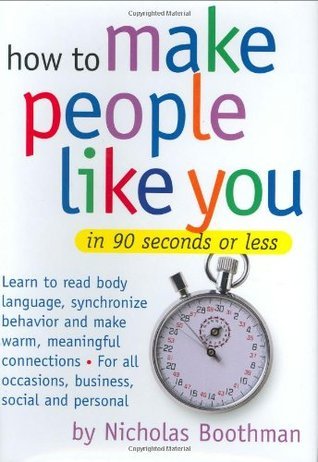
What Nicholas Boothman Means by “90 Seconds”
Boothman’s method grew out of his earlier career as a fashion and advertising photographer. His work repeatedly forced him into an unusual interpersonal situation: he had to meet people who might never have seen him before, make them comfortable quickly, gain their cooperation, and create a productive working relationship almost immediately. A technically skilled photographer who could not establish trust would struggle to get natural expressions, relaxed body language, or useful collaboration from a subject.
From those experiences, Boothman began paying close attention to the differences between encounters that worked and encounters that stalled. He noticed the importance of attitude, facial expression, posture, vocal tone, word choice, and the general sense of ease or tension that one person could create in another. He eventually connected these observations with Neuro-Linguistic Programming, or NLP, developed by Richard Bandler and John Grinder, and incorporated NLP ideas into the communication system he taught in seminars.
The title’s “90 seconds” should not be understood as a promise that another person will become your friend, customer, romantic partner, or admirer within exactly a minute and a half. Boothman divides interpersonal connection into three overlapping stages: meeting, establishing rapport, and communicating. The first meeting happens in seconds. Communication may continue for minutes, hours, or years. The roughly 90-second period belongs primarily to the middle stage, when two strangers are deciding whether the interaction feels safe, comfortable, credible, and worth continuing.
His underlying claim is that much of this process happens automatically, but it does not have to be left completely to chance. People already respond to warmth, familiarity, similarity, attention, emotional tone, and reciprocal behavior. Boothman’s project is to make those normally unconscious processes conscious enough that a reader can practice them deliberately.
That distinction is important because the book is not really a recipe for universally making people “like” you. It is a method for lowering interpersonal friction during the opening phase of an encounter. A better description of its promise would be: learn how to make it easier for another person to feel comfortable enough with you for genuine communication to begin.
Part One — First Contact: People Power and First Impressions
Boothman opens with a broad argument for what he calls “people power.” Human beings depend on other human beings for affection, cooperation, employment, opportunity, security, information, friendship, and belonging. Being technically competent or personally interesting is not enough if people repeatedly feel uncomfortable, ignored, threatened, or disconnected in your presence.
He extends this argument into health, suggesting that connected people tend to fare better than chronically isolated people. The book sometimes states this connection more simply than a scientific discussion would justify, but the broad direction has held up well. A major meta-analysis of social relationships and mortality later found that stronger social relationships were associated with better survival across a very large body of research. That evidence supports Boothman’s belief that social connection matters, though it obviously does not show that learning his 90-second method itself makes someone live longer.
For Boothman, likability matters because liking changes what people are willing to do. When someone feels comfortable with us, they become more likely to listen, cooperate, share information, recommend us, hire us, buy from us, introduce us to others, or simply remain in the conversation. He associates likability with qualities such as openness, confidence, warmth, and sincerity rather than with physical attractiveness or entertaining conversation alone.
The speed of first impressions gives the entire book its urgency. Boothman assumes that people begin evaluating one another almost immediately and that the early moments of a meeting influence everything that follows. Modern research supports the basic idea that impressions can form astonishingly quickly, though not the book’s precise 90-second timetable. Experiments by Janine Willis and Alexander Todorov on rapid first impressions found that people formed trait judgments from faces after extremely brief exposure. What such research does not establish is that those judgments are always accurate or that 90 seconds constitutes a universal psychological deadline.
Chapter 2 turns this premise into a procedure. Boothman wants the first moments of a meeting to communicate openness before the interaction becomes complicated by self-consciousness or overthinking. His memorable sequence is Open—Eye—Beam—“Hi!”—Lean. The reader should open the body toward the other person, establish eye contact, smile warmly, offer a greeting, and orient or lean slightly toward the person in a way that signals engagement.
The point is not that every movement must be mechanically performed in exactly that order. Boothman uses the sequence as a training device for people whose nervousness causes them to do the opposite: close their bodies, look away, forget to smile, mumble, or physically withdraw. His repeated image of “pointing your heart” toward another person is simply a vivid way of encouraging an open orientation instead of a guarded one.
He treats the handshake as another part of the same first-contact signal. A handshake should communicate confidence without aggression and interest without desperation. Where shaking hands is not appropriate, the same intention can be communicated by facing the person openly, making comfortable eye contact, and giving full attention.
An exercise called “Firing Energy” encourages people to approach one another with deliberately different levels of energy and notice how quickly the difference can be felt. The deeper lesson is that people do not encounter our words in isolation. They encounter our entire state: pace, intensity, expression, volume, posture, and expectation all arrive together.
Once the meeting has occurred, Boothman introduces rapport. Rapport is the sense that interaction is flowing rather than grinding. It is not yet intimacy, trust in the deepest sense, or friendship. It is simply enough psychological comfort and common ground that communication can continue without either person constantly defending themselves or searching for an exit.
The most important general framework introduced in this chapter is KFC: Know what you want, Find out what you are getting, and Change what you do until you get the response you want. The acronym is deliberately memorable, but the idea underneath it is more important than the label. Boothman wants readers to stop judging communication solely by intention. If you believe you are being friendly but the other person is visibly uncomfortable, the fact that friendliness was your intention does not make the interaction successful.
“Know what you want” means defining the outcome in positive terms. Instead of thinking, “I don’t want this interview to go badly,” the reader might decide, “I want the interviewer to see that I am competent, calm, and easy to work with.” “Find out what you are getting” requires attention to feedback rather than mental rehearsal. “Change what you do” means becoming flexible enough to alter tone, pace, questions, level of detail, or emotional intensity when the present approach is not working.
This feedback principle becomes the book’s hidden organizing idea. Almost everything that follows is a method for becoming more aware of what you are transmitting, more observant of what another person is returning, and more adaptable in response.
Part Two — The 90-Second Land of Rapport
The second part of the book asks what actually creates the feeling that two people “click.” Boothman’s answer is similarity, broadly understood. People often feel more comfortable when they detect familiar attitudes, rhythms, experiences, expressions, values, language, or behavior in another person, and he wants readers to learn how to work with that tendency deliberately.
The result is the core of his “rapport by design” system. Attitude supplies the internal state, congruity makes that state visible, and synchronization attempts to reduce interpersonal distance by creating compatible patterns of movement and sound.
Natural Rapport, Attitude, and Congruity
Chapter 3 begins with rapport as an ordinary phenomenon rather than an artificial trick. Friends may sit in similar positions, laugh with similar timing, adopt shared expressions, or unconsciously match each other’s energy. Families develop private vocabulary. Colleagues who spend years together may begin anticipating one another’s reactions. Couples often move with a familiar rhythm that outsiders can recognize even when the pair are not consciously coordinating anything.
Boothman calls this natural rapport. It arises without deliberate planning because shared experience gradually produces behavioral and emotional familiarity. His important move is to argue that the same broad process can also occur by chance or be encouraged intentionally.
Chance rapport appears when strangers suddenly discover a meaningful similarity. Two travelers from the same small hometown may become unusually friendly while abroad. Two people waiting at an event may discover they have worked in the same industry, attended the same university, know the same neighborhood, support the same team, or share an unusual hobby. The shared point does not guarantee lasting friendship, but it changes the emotional temperature of the encounter because each person suddenly feels less unfamiliar to the other.
Rapport by design attempts to create some of that ease without waiting for coincidence. Boothman’s shorthand is that “I like you” often contains an element of “I am like you.” He does not mean that people only like copies of themselves. He means that perceived similarity lowers uncertainty, making another person easier to understand and therefore easier to approach.
Chapter 4 begins with attitude because Boothman sees mind and body as parts of one system. A person who feels impatient will tend to sound impatient. Someone who is genuinely interested will usually show signs of attention without consciously arranging every facial muscle. Someone entering an encounter expecting hostility may unknowingly produce the very tension that invites a defensive response.
He divides attitudes into Really Useful Attitudes and Really Useless Attitudes. These are not moral categories. An attitude is useful if it moves the interaction toward the chosen outcome and useless if it works against it. Enthusiasm may be useful during a presentation but excessive during a solemn conversation. Calm patience may help in a service dispute. Curiosity may help when meeting someone socially. The central question remains KFC: what response do you want, and is your present state helping produce it?
A recurring weakness in ordinary goal setting, Boothman argues, is that people concentrate on unwanted outcomes. They think about not appearing nervous, not being rejected, not being awkward, or not losing the sale. Because these goals describe absence rather than direction, they provide little guidance for behavior. Reframing the goal positively—appearing engaged, learning about the other person, communicating value clearly—creates something actionable.
The “Triggering Happy Memories” exercise asks readers to recreate a positive emotional state through sensory memory and connect it with a physical gesture that can later help bring the state back. The exercise reflects Boothman’s NLP background and should not be mistaken for a scientifically established mechanism simply because deliberate recollection can influence mood. Its practical purpose is easier to defend: entering a social encounter after intentionally accessing a warm, confident, or enthusiastic state may change how one behaves.
Chapter 5 shifts to body language and introduces the language of open and closed signals. Boothman associates openness with uncrossed limbs, visible hands, body orientation toward the other person, comfortable eye contact, responsive expressions, and engaged posture. Closed behavior includes turning away, tightening the body, avoiding engagement, or adopting defensive-looking positions.
Some of this works well as broad observation. Someone repeatedly withdrawing, turning away, avoiding eye contact, and giving minimal responses is probably less engaged than someone leaning toward the interaction, responding warmly, and participating actively. The problem appears when individual movements are treated too confidently, because no single gesture has one universal meaning. Crossed arms can indicate defensiveness, but they can also mean comfort, cold temperature, habit, or simply nowhere else to put the arms.
Boothman’s stronger idea is congruity. Words, voice, expression, and body should broadly tell the same story. Someone saying “I’m thrilled to be here” while speaking flatly, avoiding eye contact, and looking toward the door will probably not be believed. Likewise, sincere enthusiasm is easier to trust when facial animation, vocal energy, posture, and words reinforce one another.
He supports this argument with Albert Mehrabian’s famous findings about visual, vocal, and verbal components of communication, but he generalizes them too broadly. The underlying principle—that conflicting tone and expression can change how words are interpreted—is sound. The specific percentages will require a more careful correction later.
The “Words vs. Tone” exercise demonstrates the practical point by asking readers to speak the same words with different emotional tones. Even without believing that vocal tone accounts for a fixed percentage of meaning, the exercise makes something obvious through experience: identical vocabulary can communicate reassurance, boredom, contempt, enthusiasm, fear, or sarcasm depending on how it is delivered.
The chapter also complicates its own interest in technique by returning to authenticity. Nervous readers are not instructed to become theatrical performers. Boothman suggests slowing the body, regulating breathing, reframing some nervous activation as excitement, and allowing genuine interest to replace obsessive self-monitoring. The ultimate goal is not to look like a person who has memorized body-language rules. It is to make natural openness easier to express.
Synchronizing Attitude, Body Language, and Voice
Chapter 6 develops Boothman’s most distinctive practical mechanism: synchronization. He starts from the observation that people who are comfortable together often coordinate without realizing it. They may adopt similar postures, nod at comparable moments, speak at compatible speeds, use related expressions, or settle into a shared emotional rhythm.
Boothman encourages readers to notice these patterns and, where appropriate, create compatible ones deliberately. The emphasis is supposed to be subtle. Staring at someone, copying every gesture a moment after it occurs, or mimicking an accent would not create rapport; it would create suspicion. The aim is similarity of rhythm and state rather than visible imitation.
Attitude can be synchronized first. If someone is upset, approaching them with exaggerated cheerfulness may feel dismissive. If someone is speaking quietly and seriously, an aggressively energetic response may create friction. Boothman recommends meeting people close enough to their existing emotional pace that they feel understood before trying to shift the interaction.
Body synchronization may involve general posture, orientation, gesture rate, movement, or breathing rhythm. The specific mechanics matter less than the broader principle: interaction tends to feel smoother when people are not operating at wildly incompatible physical tempos.
Voice is equally important. Boothman asks readers to notice rate, volume, rhythm, tone, and vocabulary. Someone who speaks slowly and reflectively may experience a rapid-fire conversational partner as intrusive. Someone who is animated and fast-moving may interpret an extremely slow response as indifference. Matching enough of the other person’s communication rhythm can make it easier for information to travel in both directions.
He then extends the idea into “pacing and leading.” When dealing with someone difficult, the first question should be whether the interaction is even necessary. If it is, Boothman recommends defining a constructive outcome, meeting the person close enough to their present state to establish contact, and then gradually changing one’s own state to see whether the other person follows.
This can sound manipulative if described as secretly controlling another person, but it can also describe something ordinary and humane. A calm teacher may first acknowledge a frustrated student’s emotional intensity before slowing the conversation. A customer-service worker may respond seriously to anger before guiding the interaction toward problem solving. The important ethical difference lies in whether synchronization is being used to improve mutual communication or simply to engineer compliance.
The “In and Out of Sync” exercise makes the contrast experiential. Participants deliberately alternate between coordinated and mismatched interaction and observe how different the exchanges feel. Boothman’s larger aim is to make readers sensitive to interpersonal rhythm so they stop communicating as though their own preferred pace is automatically neutral.
Part Three — Conversation, Listening, and Sensory Preferences
The third part changes the nature of the method. Until this point, much of Boothman’s system has concerned what the reader projects: attitude, posture, expression, vocal tone, and synchrony. Chapter 7 moves toward genuine reciprocal communication, while Chapters 8 and 9 introduce the NLP-derived sensory framework through which Boothman believes the information gathered in conversation can be interpreted.
This creates an important divide within the book. The conversation and listening advice is among its most durable material. The Visual-Auditory-Kinesthetic system that follows is central to Boothman’s explanation but much weaker scientifically.
Questions, Free Information, and Active Listening
Chapter 7 begins at the moment when a successful opening can still collapse. You have introduced yourself, made eye contact, smiled, and perhaps established enough initial comfort for the other person not to leave. What happens next?
Boothman’s first answer is simple: stop worrying about performing and become curious. Conversation is easier when the reader does not feel responsible for producing a constant stream of impressive statements. Good questions give the other person material to work with and allow real common ground to emerge.
He distinguishes open questions from questions that can be closed with a yes or no. Questions beginning with who, what, where, when, why, or how are generally more likely to invite elaboration. The book repeatedly uses immediate surroundings as conversational material because situational openings feel less artificial than rehearsed pickup lines.
A stranger under an awning during a rainstorm, a person waiting in a hotel lobby, someone browsing at a trade show, another student at a convenience store, or a familiar stranger encountered regularly can all be approached through the shared environment. Boothman is not promising that every opening will succeed. He is trying to make initiation feel ordinary rather than momentous.
Importantly, he gives the system a boundary. If repeated attempts produce minimal, unenthusiastic responses, the reader should stop. The book is about creating opportunities for connection, not forcing someone to participate in a conversation they do not want.
“Free information” is Boothman’s term for small pieces of personal material that give another person something to respond to. Introducing yourself with only a name may place the entire burden of continuation on the other person. Adding a modest information tag—where you are from, why you are at the event, what you are working on—creates possible branches for the conversation.
The same principle applies while listening. Other people continually offer free information through apparently minor details, but an anxious or self-focused conversational partner may miss them. Boothman uses the example of missed cues to show how easily someone can be so preoccupied with producing the next line that they ignore the most obvious route the other person has already opened.
This leads to active listening. Boothman wants readers to show that they are receiving not only the literal words but also the significance behind them. Eye contact, responsive expressions, nodding, short acknowledgements, follow-up questions, and genuine interest communicate that the speaker does not have to compete for attention.
The distinction matters because listening is not silence. A person can remain quiet while mentally preparing their own story, judging the speaker, or waiting for an opportunity to interrupt. Active listening requires enough attention to ask a relevant follow-up question or respond to what was actually said.
Boothman also avoids turning the listener into a passive interviewer. Conversation needs give-and-take. People usually connect more deeply when curiosity is reciprocal and both participants contribute something of themselves. The reader should be able to talk clearly about personal interests, work, experiences, opinions, and stories without monopolizing the exchange.
He encourages readers to develop a concise description of themselves rather than freezing when asked what they do. He also recommends maintaining enough awareness of the world to have conversational material available and learning to describe experiences with greater sensory detail so that stories feel vivid rather than abstract.
Compliments appear as another conversational tool, but Boothman insists that they work only when sincere, specific, and appropriately timed. Generic praise can sound manipulative because it could be addressed to anyone. A specific observation implies actual attention.
Vocal quality receives another exercise through “Sound Effects,” which asks the reader to experiment with tonality and discover a fuller, more relaxed sound. As elsewhere in the book, the exercise is less valuable as a precise psychological technique than as a way of making people aware of habits they normally never hear in themselves.
The chapter also catalogues common conversational failures: interrupting, finishing another person’s sentences, complaining constantly, offering one-word answers, dominating the exchange, appearing distracted, or neglecting basic presentation. None of these ideas is revolutionary, but Boothman’s strength is turning ordinary social wisdom into behaviors that can be noticed and practiced.
Finally, he discusses memorability. A first meeting may go well and still disappear from memory among dozens of similar encounters. Boothman suggests developing some authentic characteristic that makes the person easier to remember, whether through distinctive style, energy, voice, or another recognizable feature. The advice works best when “memorable” means recognizable rather than artificially eccentric.
Visual, Auditory, and Kinesthetic Preferences
Chapter 8 marks the point where Boothman moves most clearly into NLP theory. Human beings take in experience through their senses, but he argues that individuals tend to rely disproportionately on a preferred representational system. The three systems emphasized in the book are Visual, Auditory, and Kinesthetic, commonly shortened to VAK.
A Visual person supposedly tends to represent experience primarily through images. An Auditory person is more oriented toward sounds, words, rhythm, and tone. A Kinesthetic person emphasizes feeling, physical sensation, movement, texture, pressure, and emotional experience.
Boothman illustrates the distinction by imagining several people describing the same concert. One may remember the lights, clothing, stage arrangement, and appearance of the performers. Another focuses on the sound, volume, instruments, or voices. A third remembers the atmosphere, bodily sensation of the music, crowd energy, or emotional experience.
As a demonstration that people notice different features of the same event, the example is unobjectionable. Problems begin when ordinary variation in attention is treated as evidence for stable psychological types.
The book includes a self-test intended to help readers identify their own preferred sensory orientation. Boothman then extends the concept from self-understanding to persuasion. If a Visual person is supposedly thinking mainly in pictures, communicate in ways they can “see.” If someone is Auditory, use language involving sound and explanation. If someone is Kinesthetic, emphasize feeling, physical experience, and sensation.
A sales example illustrates the method. A customer who is interpreted as Kinesthetic supposedly becomes more responsive when invited to touch or physically experience the product rather than merely looking at it or hearing facts about it. The underlying practical idea—pay attention to what a person actually cares about and present information in a form that helps them evaluate it—is sound. The stronger claim that the behavior reveals a stable sensory personality is far less secure.
Boothman integrates sensory preference into KFC. If the present communication is not producing the desired response, the reader should identify how the other person appears to process information and change the presentation. When uncertain, he recommends communicating through more than one channel rather than insisting on a single mode.
This reveals something important about the book. Its central practical strength is flexibility. The VAK theory is Boothman’s attempt to explain how to be flexible, but the flexibility itself does not depend on the theory being correct. A reader can notice whether someone responds better to diagrams, verbal explanation, demonstration, examples, physical trial, or emotional context without assigning that person a fixed psychological category.
Verbal Cues, Eye Cues, and the Ingrid Example
Chapter 9 attempts to turn VAK into a diagnostic system. Boothman describes stereotypical Visual, Auditory, and Kinesthetic profiles, extending them beyond communication into differences in pace, appearance, behavior, occupation, posture, and personality.
Visual people are often presented as image-conscious, fast-moving, orderly, and attentive to appearance. Auditory people are described as especially sensitive to tone, sound, words, and rhythm. Kinesthetic people are associated with comfort, touch, physicality, emotion, texture, and bodily experience.
These profiles are one of the places where the book becomes too confident. People can certainly differ in what they notice and how they prefer information to be presented, but broad bundles linking sensory preference with dress, occupation, movement, and personality risk becoming stereotypes rather than useful observation.
Boothman next asks readers to listen for sensory predicates. A person using words such as “see,” “clear,” “picture,” or “look” may be interpreted as speaking visually. Words such as “hear,” “sounds,” “rings,” or “tell” suggest the Auditory system. Words such as “feel,” “grasp,” “pressure,” “touch,” or “handle” are treated as Kinesthetic indicators.
He wisely recommends looking for patterns rather than diagnosing someone from a single expression. Even so, the book moves from the reasonable observation that people use different metaphors to the much stronger claim that those metaphors reveal a preferred underlying representational system.
The next step is eye-accessing cues. Boothman presents an NLP model in which the direction of a person’s gaze is supposed to provide information about whether they are visually remembering, visually constructing, auditorily remembering, creating sounds, accessing feelings, or engaging in internal dialogue. Exercises such as “Brain Lock” and “The Eyes Have It” encourage readers to become aware of these movements and use them as clues.
This is the most fragile part of the system because it invites the reader to infer internal cognition from small external movements with a level of certainty the evidence does not justify. Eye movement can be influenced by many things, and the claimed stable mappings have not become an accepted diagnostic system in mainstream psychology.
The chapter nevertheless ends with one of the book’s most useful integrated examples. Ingrid wants a restorative vacation in Portugal. In discussing what she wants, she repeatedly uses language involving tension, comfort, pressure, unwinding, and feeling. Boothman interprets these expressions as Kinesthetic.
The travel agent, Sheldon, responds primarily with a visual presentation. He shows Ingrid things, tells her what she will see, and emphasizes visual attractions. In Boothman’s analysis, the presentation fails because he has not entered the sensory language she is already using.
A better response would acknowledge what Ingrid is actually asking for: relief from tension, physical ease, comfort, and the feeling of getting away from pressure. Even if the VAK diagnosis is rejected, the conversational lesson survives almost intact. Sheldon is less persuasive because he talks past the customer’s expressed priorities.
The example allows Boothman to combine his whole method. A successful interaction requires a useful attitude, enough behavioral synchrony to establish rapport, open questions and active listening to learn what matters, and then communication adjusted to the response being received. Boothman adds sensory-preference matching as the final layer, but the first three components already explain much of what works.
Putting the Method Together
Chapter 10 gathers the book’s techniques into a single operating system. Boothman returns to KFC because every other technique depends on feedback. The communicator needs a positive outcome, must observe the result actually being produced, and must remain flexible enough to change approach instead of blaming the other person for failing to respond correctly.
The opening sequence—Open, Eye, Beam, “Hi!”, Lean—handles the first few seconds. A Really Useful Attitude is meant to ensure that the emotional state underneath those behaviors supports the desired impression rather than contradicting it. Congruity aligns words, tone, and visible behavior.
Synchronization then reduces interpersonal friction through compatible posture, energy, movement, voice, and vocabulary. Conversation provides real information about the other person. Open questions expand the interaction, while active listening prevents the reader from missing the very information needed for adaptation.
The VAK system is intended to complete the process by telling the communicator how the other person represents experience internally. From Boothman’s perspective, this produces a four-part competence model: attitude, synchronization, conversation, and sensory preferences. Attitude receives special priority because it influences the way all the later techniques are expressed.
Boothman recognizes that consciously monitoring so many variables can initially feel artificial. His answer is practice. Driving, typing, playing a sport, or speaking a language can all feel mechanical while being learned; social techniques, he argues, can likewise become automatic once practiced enough.
He also introduces the idea of “assuming rapport.” Instead of entering a situation expecting rejection or conflict, the reader should behave from the assumption that successful connection is possible. This is not proof that rapport will occur, but it changes what the reader brings into the encounter. Someone anticipating failure may hesitate, withdraw, or communicate distrust before the other person has done anything.
The chapter closes with a revealing modern-day parable about a student with a bright green Mohawk who is struggling to find work. The student believes employers are discriminating against him because of his appearance. Boothman asks him to decide what outcome matters more in the immediate situation: keeping the haircut or getting the job.
The anecdote captures the book’s philosophy of adaptability. Boothman is not primarily asking whether the world is fair; he is asking what behavior gives the individual the best chance of producing the desired result. That can be pragmatically useful, but it also reveals a limitation. The KFC model can place so much responsibility on the communicator that structural bias or another person’s unreasonable behavior risks being reframed as merely another obstacle the individual must learn to manage.
The 21-Exercise Workbook: Turning the System into Practice
The expanded edition ends with The Small Things That Make a Big Difference Workbook, and it is more than a collection of filler pages. Boothman explicitly argues that interpersonal skill cannot be learned by reading alone. His analogy is learning to ride a horse: at some point intellectual understanding has to give way to awkward, repeated practice.
The workbook therefore converts the book’s ideas into a progression of 21 exercises. Some are straightforward confidence drills, some involve real conversations, and others train the VAK concepts that are the book’s weakest scientifically. Taken as a whole, however, the workbook reveals Boothman’s strongest pedagogical instinct: social skill improves when vague intentions are translated into observable behaviors.
Exercises 1–7: Commitment, Confidence, and Initiating Contact
Exercise 1, “Before You Begin,” asks the reader to assess commitment and confidence before doing anything else. The idea is to establish a baseline and make an explicit decision to practice rather than treating the workbook as something to browse passively.
Exercise 2, “Who Do You Want to Connect With?”, moves from general ambition to social environment. Boothman asks readers to visualize the kind of life they want and identify the people they would need to meet, know, or interact with for that life to become more likely. The exercise shifts social improvement away from the vague goal of “being more likable” toward concrete relationships and settings.
Exercise 3, “Your Comfort Level When Meeting People,” asks readers to compare their confidence across different contexts. Someone may be relaxed with colleagues but anxious at parties, comfortable with strangers in professional roles but awkward in dating situations, or socially confident with friends while intimidated by authority figures. The exercise makes clear that “shyness” is often context-dependent rather than an all-or-nothing personal identity.
Exercise 4, “My Really Useful Attitude,” returns to the book’s state-management principle. The reader identifies the attitude that would show their best self and thinks about how that state would appear behaviorally. The exercise also asks readers to recall people whose attitudes were immediately noticeable and examine what those people actually did.
Exercise 5, “Chance Encounters,” turns conversation opening into rehearsal. Boothman presents situations such as waiting out the rain with strangers, encountering an unfamiliar colleague near a coffee area, or seeing someone from campus while shopping. The reader has to create a situational statement and an open question rather than relying on a generic script.
Exercise 6, “The Three-Second Rule,” targets overthinking. Boothman asks the reader to act quickly when an appropriate opportunity for conversation appears, ideally initiating contact before internal debate builds into avoidance. The point is not reckless approach behavior but interruption of the familiar cycle in which someone notices an opportunity, rehearses possible embarrassment, and waits until the moment disappears.
Exercise 7, “Me Too—Finding Common Ground,” asks the reader to listen actively for genuine points of shared experience. The “me too” moment is not supposed to be manufactured agreement. It is the recognition of a real similarity that changes the emotional texture of a conversation and gives both people a stronger reason to continue.
Together, these exercises expose a useful feature of Boothman’s system. The reader is not asked to become dazzling. The first goal is simply to participate: notice opportunities, approach, ask, listen, and remain present long enough for common ground to become possible.
Exercises 8–15: Outcomes, First-Impression Skills, and Conversation
Exercise 8, “Know What You Want in the Positive,” develops the first part of KFC. Readers take negatively worded goals and rewrite them as desired outcomes. “I don’t want to embarrass myself” becomes something closer to “I want to have one relaxed conversation and learn something about the other person.” This provides a behavioral direction rather than an anxiety to suppress.
Exercise 9, “Making Eye Contact,” is a simple observation-and-practice drill. Boothman wants readers to notice whether they actually make comfortable eye contact during greetings or whether nervousness causes them to look away at the exact moment connection is being established.
Exercise 10, “Great, Great, Great,” uses repeated playful expressions in front of a mirror to loosen facial tension and encourage a more natural smile. It is intentionally simple, even silly. The aim is to make the reader feel the difference between mechanically arranging a smile and allowing a more animated emotional state to produce one.
Exercise 11, “Heart to Heart,” focuses on body orientation. The reader observes open and closed postures and practices facing another person more directly. The exercise is most useful as awareness training; it becomes less reliable if every movement is treated as a fixed psychological signal.
Exercise 12, “Synchronizing,” asks readers to deliberately experience both matched and unmatched conversation. By shifting posture, movement, or pace, the reader learns what changes when interaction becomes more or less coordinated. This is one of the workbook’s most direct translations of a chapter concept into observable experience.
Exercise 13, “Closed to Open,” concerns questions rather than posture. Boothman gives closed questions and asks the reader to transform them into invitations that require more than yes or no. Instead of asking whether someone liked a suggestion, the reader might ask what they thought about it or which part interested them.
Exercise 14, “Conversation Starters,” extends that practice into additional situations. Readers create ways to begin talking without requiring a perfectly original opening. Boothman’s recurring principle is that conversation is easier when the immediate environment does some of the work.
Exercise 15, “Making Yourself Memorable,” asks readers to identify people whose distinctive features made them easy to remember and then consider what authentic qualities they themselves could emphasize. Boothman mentions possibilities such as style, voice, height, accessories, or other recognizable characteristics. The exercise can be useful as personal branding, though it works best when it enhances an existing quality rather than inventing a costume.
These eight exercises form the most practical middle of the workbook. They train observable skills that can be practiced without accepting any particular psychological theory: goal clarity, eye contact, warmth, orientation, conversational flexibility, open questions, and memorability.
Exercises 16–21: Sensory Practice and the Get-Involved Plan
Exercise 16, “Sensory Preferences,” returns to Visual, Auditory, and Kinesthetic categories. Readers examine the characteristics Boothman associates with each type and consider how the categories supposedly differ. Because the classification itself lacks strong empirical support, this exercise is better treated as an example of the book’s theory than as a reliable diagnostic tool.
Exercise 17, “Sensory Identification,” asks readers to classify people they know by dominant sensory preference. This is where the workbook most clearly risks turning attentive observation into overconfident labeling. People can prefer different kinds of information in different situations without belonging to a fixed type.
Exercise 18, “Talking Sense,” is much more useful even if the VAK theory is discarded. Boothman asks the reader to imagine a place such as an airport and describe what can be seen, heard, felt, smelled, and tasted. The exercise increases descriptive range and helps people notice how much ordinary communication leaves sensory detail unused.
Exercise 19, “Appeal to the Senses,” develops the same ability by asking readers to describe one subject in different sensory modes. Someone explaining a destination could describe how it looks, what sounds characterize it, and what it feels like to be there. This is a valuable communication skill without requiring a claim that different listeners possess fixed representational systems.
Exercise 20, “Talking in Color,” asks readers to tell stories with richer detail. The exercise is ultimately about vividness and audience engagement. A story becomes easier to imagine when it contains concrete images, sounds, sensations, movement, and emotional texture rather than abstract summary alone.
Exercise 21, “Putting It All Together—The Get-Involved Action Plan,” brings the workbook back to behavior in the real world. Readers identify groups, activities, interests, or unfamiliar experiences that could place them around new people and then define a first step. Boothman’s larger message is that no communication technique can compensate for never entering environments where connection is possible.
The workbook closes with “There Is No Rejection, Only Selection.” Boothman acknowledges that some people simply will not be interested in further conversation, friendship, dating, business, or collaboration. Rather than treating every failed approach as evidence of personal inadequacy, the reader should accept incompatibility and continue.
This is an important restraint on the title’s promise. The book does not ultimately claim that technique creates entitlement to another person’s affection. Its healthiest final advice is that good social skill includes knowing when to stop trying.
How Rapport by Design Works as a System
Read chapter by chapter, Boothman can seem to be offering a sequence of separate tips: smile, make eye contact, adjust your attitude, mirror posture, ask open questions, listen, notice sensory vocabulary. Seen as a whole, however, the book is more coherent than that. KFC supplies the feedback architecture connecting almost every technique.
The process begins with an outcome. If you do not know what kind of interaction you are trying to create, you cannot tell whether your behavior is working. The outcome should not be “make this person do what I want” in every situation; it may simply be to have a comfortable conversation, understand a concern, communicate competence, resolve a disagreement, or discover whether mutual interest exists.
Attitude comes next because internal state shapes the way every later behavior is expressed. A smile produced by genuine warmth does not look or sound exactly like one produced by panic. A question asked from curiosity differs from the same words delivered as interrogation. Boothman’s emphasis on attitude prevents his system from becoming entirely cosmetic.
The first-contact sequence opens the interaction and provides initial data. The reader then looks for feedback. Does the other person orient toward the conversation, respond fully, ask questions, or appear comfortable? Or do they withdraw, answer minimally, look elsewhere, or appear tense? KFC says the communicator should work with the response rather than insisting that good intentions should have been enough.
Synchronization is an attempt to reduce unnecessary difference in pace and emotional intensity. Conversation then performs a different job: it discovers actual rather than merely simulated common ground. Open questions allow the other person to reveal interests, priorities, concerns, and experiences, while active listening makes those revelations usable.
This means the method becomes less superficial as it progresses. At the beginning, the reader is mostly managing their own presentation. By Chapter 7, successful communication depends much more on understanding someone else.
VAK is intended to become Boothman’s final layer of personalization. Once the reader has enough information, they are supposed to infer whether the person primarily represents experience visually, auditorily, or kinesthetically and then tailor communication to that preferred system.
Here the architecture becomes especially revealing, because the system does not collapse if VAK is removed. A reader can still know the outcome, adopt a useful attitude, greet openly, observe feedback, regulate pace, ask good questions, listen, discover what the other person cares about, and explain things in a form that produces understanding. In fact, the method arguably becomes stronger when the instruction “diagnose their hidden sensory type” is replaced with the simpler rule “pay attention to what they actually respond to.”
The most durable version of rapport by design is therefore a feedback system rather than a decoding system. It asks the communicator to enter an encounter with enough self-awareness to control their own behavior and enough outward attention to stop assuming that their preferred communication style works equally well for everyone.
What Modern Evidence Supports
Boothman frequently writes with greater scientific certainty than the evidence justifies, but rejecting the book wholesale would create the opposite error. Several underlying principles have meaningful parallels in modern social psychology and communication research.
The important distinction is between evidence supporting a mechanism and evidence validating Boothman’s exact branded method. Research showing that people form impressions rapidly does not prove a universal 90-second threshold. Research showing that follow-up questions help people connect does not validate NLP. Research on spontaneous mimicry does not prove that consciously matching every posture improves every interaction.
Rapid First Impressions and the Value of Social Connection
Boothman is clearly right that first impressions begin earlier than most people consciously realize. Willis and Todorov’s research on impressions formed after extremely brief facial exposure showed that participants could make trait judgments after only fractions of a second, with longer exposure often increasing confidence more than substantially changing the initial judgment.
That supports the practical reason for taking the opening moments of an interaction seriously. Facial expression, orientation, apparent emotional state, and other immediately available cues influence what people think before a substantial conversation has occurred.
It does not, however, establish that the impression is accurate. Humans can form judgments quickly and still be wrong. Nor does it demonstrate that a person has exactly 90 seconds before an opinion becomes fixed. Boothman’s number is best understood as a memorable training window rather than a discovered psychological constant.
The larger claim that human relationships matter has even stronger support. The meta-analysis by Julianne Holt-Lunstad and colleagues found a substantial association between stronger social relationships and survival across 148 studies involving more than 300,000 participants. The result helps validate the book’s broad opening premise that social connection has consequences beyond pleasant conversation.
Again, causal modesty matters. Long-term supportive relationships, social integration, loneliness, family structure, and community participation are far more complex than meeting strangers effectively. Boothman’s method may help some readers initiate more interactions, but no evidence in the book shows that practicing Open—Eye—Beam—“Hi!”—Lean directly produces the health outcomes associated with rich social relationships.
Listening, Follow-Up Questions, and Subtle Synchrony
The book’s listening advice has aged particularly well. In 2025, researchers studying high-quality listening behaviors and social connection between strangers found that observable listening behaviors, including relevant follow-up questions and verbal validation, were linked with important aspects of interpersonal connection.
This maps closely onto Boothman’s practical advice in Chapter 7. People often try to become likable by increasing how much they perform—more jokes, more stories, more impressive information. Boothman repeatedly moves in the opposite direction: ask something the other person can answer meaningfully, notice what they say, and use the response rather than racing toward your next prepared line.
Follow-up questions are especially important because they demonstrate contingent attention. A generic question can be asked without listening to the answer. A useful follow-up depends on having processed what the person actually said.
The book’s synchronization material also has a legitimate research analogue. Tanya Chartrand and John Bargh’s well-known “chameleon effect” experiments found evidence of nonconscious behavioral mimicry and reported that being subtly mimicked could increase liking and perceptions of interaction smoothness.
That finding gives Boothman’s observation about natural synchrony some real foundation. People do appear to coordinate behavior in ways that relate to social affiliation, and subtle matching can sometimes improve interpersonal smoothness.
The limitation is crucial: spontaneous or experimentally induced subtle mimicry is not identical to a full program of conscious matching. A reader who becomes obsessed with reproducing another person’s gestures may become less natural, not more likable. Mimicry can also backfire when it appears obvious, mocking, culturally inappropriate, or strategically manipulative.
The best modern interpretation of Boothman’s synchrony advice is therefore about attunement rather than copying. Notice pace, intensity, conversational rhythm, and emotional state. Avoid needless mismatch. Do not behave as though every person must adapt to you.
What the Book Overstates or Gets Wrong
The evidence problems in How to Make People Like You in 90 Seconds or Less are not evenly distributed. Its practical conversation advice does not depend on a speculative scientific theory. Its VAK system, eye cues, and use of the 55/38/7 rule do.
The fairest criticism therefore does not label the entire book “pseudoscience” and stop. It identifies the point where plausible observations are converted into claims stronger than the evidence can carry.
The VAK Preferred-Sense Model and NLP
Boothman’s VAK model assumes that people possess meaningful preferred representational systems—Visual, Auditory, or Kinesthetic—that influence how they internally process experience and can be detected through speech and behavior. He then recommends communicating in the language of the identified system.
The intuitive appeal is obvious. People really do differ in what catches their attention. One buyer may want photographs, another a detailed verbal explanation, and another a hands-on demonstration. A friend may describe memories with vivid visual detail while someone else talks primarily about emotional atmosphere.
The unsupported step is turning these differences into stable psychological types with reliable diagnostic markers. Christopher Sharpley’s review of research on NLP’s Preferred Representational System found little evidence supporting the central claims. A later systematic review of NLP research in health contexts likewise found a weak overall evidence base, although that review concerns health outcomes and should not be treated as a direct experimental test of Boothman’s interpersonal method.
The difference between “people sometimes prefer different presentations” and “people possess a dominant VAK representational system” is substantial. The first is ordinary observation. The second is a psychological model requiring evidence.
The same issue applies to sensory predicates. If a client repeatedly says, “I can’t picture how this would work,” answering with a visual example may be good communication. If someone says, “Something about this doesn’t feel right,” responding to the unease rather than continuing a purely technical explanation may be intelligent listening.
None of that requires concluding that the speaker is fundamentally a Visual or Kinesthetic person. Language can reflect the immediate topic, idiom, context, or simple habit. People routinely say “I see what you mean” without literally constructing a visual representation, just as “I hear you” need not reveal an Auditory personality.
Boothman’s sales advice becomes stronger when stripped of typing. Instead of asking “Which hidden sensory category is this person?”, the communicator can ask “What kind of information is this person requesting right now?” That preserves adaptive communication while avoiding unsupported psychological labeling.
Eye Cues and Body-Language Decoding
The eye-accessing material is even more problematic because it invites precise inferences from very small movements. Boothman presents gaze direction as a clue to whether someone is visually remembering, visually constructing, accessing sounds, experiencing feelings, or engaging in internal dialogue.
The scientific problem is not that eyes and bodies communicate nothing. Nonverbal behavior is obviously part of human interaction. Facial expression, posture, orientation, gesture, timing, gaze, distance, and movement all influence how people experience one another.
The problem is treating these signals as a universal dictionary. Contemporary scholarship examining misconceptions about nonverbal communication emphasizes that meaning depends on cue combinations, context, interaction, individual differences, and culture. A single gesture rarely supports the kind of confident mind-reading encouraged by popular “body language” systems.
This qualification applies even to some of Boothman’s more conventional examples. Crossed arms may accompany defensiveness, but the posture alone does not prove it. Avoided eye contact may indicate discomfort, but culture, neurodivergence, status relationships, concentration, shyness, or ordinary habit can alter gaze behavior.
Body-language awareness is useful when treated probabilistically. A cluster of changes may suggest that an interaction is becoming uncomfortable: shorter responses, physical withdrawal, reduced participation, less eye contact, and a shift in vocal tone taken together are more informative than any single movement.
Boothman occasionally gestures toward this complexity, but the book’s structure encourages readers to believe that enough practice will allow them to infer hidden internal states with considerable precision. That confidence is not justified.
A better use of nonverbal information is to treat it as a reason to become curious. If someone appears to disengage, do not assume you know why. Change pace, ask a question, check understanding, or give them space. That returns the reader to KFC, which is ironically more reliable than many of the diagnostic claims added to it.
The 55/38/7 Rule
Boothman also repeats the famous idea associated with Albert Mehrabian that communication can be divided into approximately 55 percent visual, 38 percent vocal, and 7 percent verbal components. This is one of the most persistent simplifications in popular communication literature.
Mehrabian and Morton Wiener’s original research on inconsistent communications concerned a much narrower question involving the communication of attitudes when verbal and nonverbal signals conflict. It was not evidence that only 7 percent of ordinary human meaning comes from words.
The universal interpretation becomes obviously implausible when applied to real situations. A doctor explaining a dosage, an engineer specifying a measurement, a lawyer negotiating contract language, or a teacher defining a concept cannot replace the words with facial expression and vocal tone. Content matters enormously.
Yet the misuse of the percentages should not obscure the narrower point Boothman is trying to teach. When a person says something emotionally significant but their tone and visible behavior contradict it, listeners will not evaluate the words in isolation. “I’m happy to help” means something different when said with warmth than when delivered through clenched teeth while looking at the clock.
The defensible lesson is congruity, not a mathematical formula. Words, tone, and behavior interact. Their relative importance changes with context.
Similarity, Authenticity, and the Ethics of Deliberate Rapport
The book’s most interesting ethical question is hidden inside its practical usefulness. If natural rapport involves unconscious similarity, what happens when similarity is produced deliberately? At what point does adaptation become manipulation?
There is nothing inherently deceptive about adjusting communication to another person. Most socially competent people already do it. We speak differently to a close friend than to a nervous child, a grieving relative, a customer, a professor, or someone who speaks our language imperfectly. We adjust vocabulary, pace, detail, humor, tone, and formality because communication is relational.
Boothman’s strongest advice belongs in this category. Slowing down for someone who is processing carefully, showing genuine interest, asking better questions, lowering intensity with a nervous person, or explaining an idea in a concrete way are forms of consideration. They make communication easier for both sides.
The ethical concern increases when adaptation is treated as a concealed instrument for overcoming another person’s resistance. The title itself encourages this reading because “make people like you” sounds like unilateral influence. Sales examples sometimes reinforce it by treating rapport primarily as a route toward a desired outcome.
KFC can also be interpreted too aggressively. “Change what you do until you get the response you want” is an excellent principle when the desired response is understanding, clarity, cooperation on a mutual task, or a comfortable conversation. It becomes questionable when the communicator assumes that any refusal is merely feedback requiring a more sophisticated influence technique.
Fortunately, Boothman places some limits on his own system. If repeated conversation openings receive little enthusiasm, the reader should disengage. When dealing with a difficult person, he first asks whether the interaction is necessary. The workbook’s final discussion of rejection explicitly tells readers to accept that not every person will be interested.
These boundaries matter because another person’s autonomy is part of successful communication. A technically perfect approach does not create an obligation to respond, agree, purchase, date, hire, or become a friend.
Authenticity creates another tension. Deliberately matching posture, vocabulary, or emotional rhythm may improve interaction, but excessive self-monitoring can make someone appear unnatural. A person obsessed with detecting eye cues and sensory predicates may listen less effectively because they are constantly classifying the speaker instead of hearing the content.
Boothman partly solves the problem through practice. He wants techniques to become automatic enough that the reader stops performing them consciously. That is sensible for basic behaviors such as eye contact, open questions, and listening. It is less convincing for questionable diagnostic systems.
Cultural variation further complicates any universal recipe. Eye contact, physical distance, touch, expressiveness, handshake norms, conversational overlap, smiling, vocal intensity, and acceptable familiarity differ across social and cultural settings. A behavior interpreted as warm confidence in one context may feel intrusive or disrespectful in another.
The green-Mohawk employment story exposes the deepest philosophical issue. Boothman tells the student to focus on his desired outcome and adapt to the expectations of potential employers. From a pragmatic perspective, this can be useful advice. People constantly decide which aspects of themselves they are willing to modify for a particular opportunity.
But the story becomes less satisfying if adaptation is treated as proof that the gatekeeper’s expectations are legitimate. Someone can strategically accommodate an unfair environment without making the environment fair. Boothman is fundamentally an outcome-oriented coach, not a theorist of social justice, and his framework sometimes treats structural problems as communication problems because communication is the thing his method knows how to change.
The best ethical version of rapport by design therefore requires a boundary that the book sometimes implies more clearly than it states: adapt enough to communicate well, but do not confuse skillful influence with entitlement to another person’s agreement.
Style, Structure, and Teaching Method
Boothman writes like a communication trainer rather than an academic psychologist. The book’s origins in seminars are visible in its structure: memorable labels, short anecdotes, demonstrations, exercises, repeated slogans, and direct instructions to try something immediately.
That style is a major reason the book remains readable. Concepts such as KFC, Really Useful Attitude, Open—Eye—Beam—“Hi!”—Lean, free information, and rapport by design are easy to remember because Boothman gives them names that can be recalled during an actual interaction.
The book also understands that readers struggling socially often do not need more abstract explanation. Someone who freezes when meeting strangers may benefit more from “make eye contact and ask one open question” than from fifty pages on the theory of interpersonal attraction. Boothman repeatedly translates broad social abilities into behaviors that can be practiced.
The workbook strengthens this pedagogical approach. Rather than ending with a list of principles, it asks readers to approach people, test open questions, observe their own eye contact, practice synchronization, find common ground, and deliberately enter environments where they can meet others. That makes the expanded edition more useful than a version consisting only of the core chapters.
The weakness is that the same training style encourages overstatement. Seminar teaching rewards memorable certainty. “People sometimes differ in how they respond to information” is accurate but not especially dramatic. “Visual people behave like this, Kinesthetic people behave like that, and eye direction tells you which processing system they are accessing” is much easier to demonstrate and remember, even when the underlying science is weak.
A contemporary Publishers Weekly review of the original edition already recognized something of this tension. The book was accessible and potentially useful, but its seminar-like packaging and NLP influence were difficult to separate from the techniques themselves.
Repetition is another double-edged feature. Boothman revisits the same ideas—attitude, openness, similarity, KFC, feedback—many times. A reader looking only for intellectual novelty may find the book repetitive. A reader actively practicing the system may benefit from encountering the same principle in different contexts.
The prose itself is brisk, conversational, and optimistic. Boothman assumes social skill can improve and writes as though behavioral change is within the reader’s control. That confidence can be empowering for someone who has interpreted social awkwardness as a fixed personality defect, but it also contributes to the book’s tendency to make messy interpersonal processes sound more predictable than they are.
Critical Review: How Good Is How to Make People Like You in 90 Seconds or Less?
The fairest evaluation of How to Make People Like You in 90 Seconds or Less depends on what kind of book it is expected to be. As a rigorous account of interpersonal psychology, it has serious weaknesses. As a behavioral starter manual for people who need concrete ways to approach strangers, listen better, and become less self-conscious, it is considerably stronger.
Its best achievement is that it makes social competence feel trainable. Its worst mistake is attaching too much certainty to frameworks that do not deserve it.
What the Book Does Well
Boothman is excellent at converting vague social advice into observable actions. “Be confident,” “be likable,” and “show interest” are not very helpful instructions because readers already know they would prefer to be confident and likable. The problem is not wanting those qualities; it is knowing what to do differently.
The book gives behaviors. Face the person. Look at them. Smile. Ask a question that cannot be answered with one word. Notice what they say. Follow up. Stop pushing when interest is not reciprocated. Define the outcome of the conversation. Change approach when the interaction is failing.
That specificity is particularly valuable for socially anxious or inexperienced readers because ambiguity often fuels anxiety. A person who believes they must spontaneously become fascinating has an impossible task. A person whose goal is to make eye contact, ask one sincere question, and listen to the answer has something manageable to practice.
KFC is arguably the book’s strongest conceptual contribution. Communication is measured by response rather than intention. This sounds simple, yet many interpersonal failures persist because people judge themselves by what they meant while judging everyone else by what actually happened.
The book is also unusually good at redirecting attention outward. Social anxiety often creates intense self-monitoring: How do I look? What should I say next? Was that strange? Do they like me? Boothman’s emphasis on observation, open questions, free information, and listening shifts cognitive attention toward the actual other person.
Chapter 7 is therefore the strongest part of the main text. Its advice about follow-up questions, active listening, reciprocal conversation, and noticing cues remains useful without theoretical modification. Later research on listening makes this section look better rather than worse.
The treatment of synchrony also contains a valuable insight. Good interaction is not only about what is said but whether two people can establish a workable rhythm. Adapting pace, intensity, and communication style can prevent friction that has nothing to do with substantive disagreement.
The expanded workbook improves the book substantially. Exercises such as the Three-Second Rule, converting closed questions to open ones, practicing chance encounters, finding common ground, and creating a get-involved plan turn passive reading into social exposure. Even simple exercises can matter because social confidence grows partly through accumulated evidence that ordinary interactions are survivable.
Boothman also deserves credit for ending with acceptance rather than domination. “There is no rejection, only selection” may sound like self-help reframing, but it places an important limit on the method. The goal is not to force universal approval. Some people will not be interested, and mature social skill includes moving on.
Its Most Important Limitations
The largest weakness is evidential overreach. Boothman often begins with something plausible—people notice different things, body language affects interaction, conversational rhythm matters—and then builds a much more precise psychological structure on top of it.
VAK is the clearest example. Different people can prefer different explanations in particular situations, but the evidence does not justify confidently assigning them to stable Visual, Auditory, or Kinesthetic types. Once the book begins linking those types with personality, clothing, behavior, vocabulary, and eye movements, observation starts becoming stereotype.
The eye-cue system is particularly unconvincing because it encourages a form of interpersonal mind-reading. A reader who believes gaze direction reveals whether someone is remembering an image or constructing one may become confidently wrong while feeling unusually perceptive.
The body-language material suffers from a milder version of the same problem. Boothman’s broad recommendations about openness, engagement, and congruity are useful, but individual movements are context-dependent. Readers should learn to notice behavioral patterns, not decode people from crossed arms or gaze direction.
The 55/38/7 claim is another avoidable weakness. Boothman does not need it. His practical lesson that tone and visible behavior influence how emotionally loaded words are interpreted is obvious enough without turning Mehrabian’s narrow experiments into a universal mathematical law of communication.
The book also sometimes flirts with manipulation. The language of producing the response you want can make the other person sound like a system to optimize rather than an autonomous participant. Sales and persuasion contexts heighten that risk.
In practice, however, much of Boothman’s actual advice is less manipulative than the framing suggests. Listening, finding real common ground, adapting pace, respecting nonresponse, and accepting rejection all require acknowledging the other person rather than overriding them. The book is best when read through those constraints.
Some examples have also aged culturally. Assumptions about dress, appearance, professional norms, and what certain kinds of people supposedly look like reflect the early-2000s world in which the book was written. That does not destroy the method, but it reinforces the need to treat specific social signals as context-dependent rather than universal.
Repetition can become tiring for readers who grasp the method quickly. The central system is not intellectually complicated enough to require every restatement. Yet the repetition has instructional value because Boothman is trying to create habits rather than merely transmit concepts.
These flaws substantially weaken the book’s claim to psychological authority, but they do not destroy its practical project. A reader can discard the diagnostic NLP material and still retain most of the useful behavioral system.
Who Will Benefit—and Who Will Not
The book is best suited to readers who know that they struggle with the opening stages of interaction and want something concrete to practice. Someone who routinely hesitates to introduce themselves, overthinks first impressions, runs out of things to say, talks too much when nervous, or fails to notice conversational cues will find plenty of useful material.
Networkers, salespeople, interviewees, students, managers, and professionals who regularly meet unfamiliar people can also benefit, especially if they use KFC as a reminder to monitor whether communication is actually landing. The same is true of people who need to become better listeners rather than more charismatic speakers.
Readers who enjoy this technique-driven style may also find useful comparison in Leil Lowndes’s How to Talk to Anyone, another highly practical social-skills book built around first impressions, rapport, conversation, and behavioral techniques. Boothman’s book is narrower and more system-oriented, while Lowndes offers a much larger collection of individual tactics.
The book is less useful for readers seeking a rigorous contemporary introduction to social psychology. Anyone inclined to treat psychological labels literally should also approach Chapters 8 and 9 carefully, because the confidence of the presentation exceeds the evidence behind it.
Readers who already navigate unfamiliar social situations comfortably may find the first-contact exercises too basic. Their main value may lie instead in KFC, active listening, and the broader reminder that effective communication requires adaptation rather than simply transmitting the same message more forcefully.
Is How to Make People Like You in 90 Seconds or Less Still Worth Reading?
Yes, but it is worth reading with a filter.
Keep Boothman’s emphasis on warm initial engagement, clear outcomes, useful attitudes, flexibility, active listening, open questions, genuine common ground, attention to feedback, conversational reciprocity, and graceful acceptance when interest is not returned. Those ideas form a practical system that can genuinely help readers who are too inwardly focused, overly hesitant, rigid in their communication, or unsure how to begin connecting with unfamiliar people.
Treat the title’s 90 seconds as a memorable practice window, not a discovered law of human behavior. Treat synchronization as interpersonal attunement rather than mechanical copying. Treat body language as contextual information rather than a secret code.
Most importantly, do not treat Visual, Auditory, and Kinesthetic typing, NLP eye-accessing cues, or the generalized 55/38/7 percentages as established psychological facts. The book does not need those claims to retain much of its value, and removing them actually clarifies what Boothman does best.
The strongest idea in How to Make People Like You in 90 Seconds or Less is ultimately much less sensational than its title. Social encounters improve when you stop assuming that successful communication should happen automatically and start taking responsibility for the conditions you can control: the attitude you bring, the attention you give, the questions you ask, the feedback you notice, and your willingness to adjust without violating the other person’s autonomy.
That will not make everyone like you in 90 seconds. It can, however, make you considerably better at giving connection a chance.
Last Updated on August 25, 2026 by Aseem Gupta